



Abstract
We propose a lexico-grammatical approach to speech in fiction based on the centrality of ‘fictional speech-bundles’ as the key element of fictional talk. To identify fictional speech-bundles, we use three corpora of 19th-century fiction that are available through the corpus stylistic web application CLiC (Corpus Linguistics in Context). We focus on the ‘quotes’ subsets of the corpora, i.e. text within quotation marks, which is mostly equivalent to direct speech. These quotes subsets are compared across the fiction corpora and with the spoken component of the British National Corpus 1994. The comparisons illustrate how fictional speech-bundles can be described on a continuum from lexical bundles in real spoken language to repeated sequences of words that are specific to individual fictional characters. Typical functions of fictional speech-bundles are the description of interactions and interpersonal relationships of fictional characters. While our approach crucially depends on an innovative corpus linguistic methodology, it also draws on theoretical insights into spoken grammar and characterisation in fiction in order to question traditional notions of realism and authenticity in fictional speech.
Keywords
1. Introduction
In fictional narrative, the centrality of character has always been recognised, and the importance of the speech of characters within narratives has received a great deal of critical attention. Indeed, it is possible in the most general terms to discern a broad shift in narratology from a definition of narrative mainly as the sequencing of events (in which characters are caught up) to a definition that narrative is primarily the representation of minds negotiating the events that they perceive and articulate (most obviously, contrast Labov, 1972, and Genette, 1980, with Herman, 2013, and Zunshine, 2006, for indicative examples). The stylistic representation of forms of dialogue in fictional narrative has been an abiding focus of interest, as part of a literary-linguistic account of characterisation, narratorial voice and authorial composition (from, for example, Cohn, 1978, and Page, 1988, to Leech and Short, 1981/2007, Semino and Short, 2004, and Busse, 2010).
In cognitive stylistics, characterisation has been re-described systematically as a process in the mind of the reader where schematic background knowledge and information triggered by cues in the text interact (Culpeper, 2001, 2009). A significant part of this background knowledge are the norms of language. The continuity between fictional worlds and the real world receives even greater emphasis through the concept of mind-modelling: this describes the way in which readers create a sense of the minds of fictional characters. It refers to the human capacity for imagining and maintaining a working model of the knowledge, beliefs, feelings, motivation and consequent behaviour of others (Stockwell, 2009). This human capacity works in similar ways whether minds of real or fictional people are modelled. The textual information that readers draw on in the process includes descriptions of physical appearance, the speech of characters, social relationships and reactions of other characters. Mind-modelling is a cognitive poetic concept, which can be extended through a corpus linguistic dimension (Mahlberg and Stockwell, 2016; Stockwell and Mahlberg, 2015): corpus linguistic methods are employed to find the linguistic patterns that contribute to the cumulative picture of character information in a text.
Ultimately, the language of fictional texts is part of language in general – so language forms a clear link between fiction and the real world. However, the continuity that mind-modelling proposes between real and fictional people has so far been described in terms of the process of modelling and the information used for it, that is, based on information drawn from the text. The fluid linguistic relationship between text and previous experience has not been studied. While information about the physical appearance of characters is less directly comparable, patterns of fictional speech and real spoken language can indeed be compared.
We propose a novel approach to describing the relationship between real and fictional speech along a continuum. This approach enables a more nuanced account of the role of speech in the creation of fictional characters. At the same time, it also utilises innovative corpus methodology to be able to arrive at these theoretical insights. We focus on speech in the novels of Charles Dickens and the 19th century, partly because of Dickens’ influential and canonical status in the 19th-century literary tradition, partly because he is celebrated for his characterisation and verisimilitude and partly because of the practical consideration that, in the 19th-century novel, direct speech is a common form of speech presentation and relatively straightforwardly identifiable.
2. Direct speech itself
In general, the indirect and narratorially mediated forms of speech presentation have received more scholarly attention than straightforward examples of direct speech within narrative fiction. Narrative voice, stream-of-consciousness techniques and free indirect discourse perhaps offer more interesting tensions to explore than what appears to be the simple reportage of a character’s words, represented plainly with a framing reporting clause. This might be explained by the prevalence of what Palmer (2011: 211) calls an ‘internalist’ perspective on the mind: a focus on ‘those aspects that are inner, introspective, private, solitary, individual, psychological, mysterious and detached’. As a corrective, he puts forward the notion of the ‘social mind’ to emphasise the need for an external perspective to minds that recognises the physical and social contexts of the fictional characters’ experience. Like Palmer (2011), we are interested in an externalist perspective on the minds of fictional characters. Our approach differs from his, as we focus on direct speech as a central feature of the social context of fictional characters.
Our approach is also distinguished from most previous literary-linguistic treatments in that we aim to explore squarely the content of the speech, rather than simply its framing presentation. Indeed, we can characterise most previous discussions of fictional dialogue as being interested in the peripheral framing of the speech or in only those stylistic aspects of the speech itself which pertain to the narrative frame. For example, the presence or absence of the reporting clause, the nature of narratorial description, the stylistic extent to which the character’s speech is assimilated syntactically with the narrator and even the deictic style in which the speech is altered to align with the narrator’s mind (as typically discussed in work in the tradition of Leech and Short, 1981/2007) are all aspects of speech representation that are mainly interested in narrator-character agency, rather than speech itself.
Perhaps another reason why direct speech has not been so thoroughly explored as indirect narratorial forms is that, as the psychological norm (Leech and Short, 1981/2007), it is interactively the least deviant. That is, the phenomenon by which someone tells you what someone else said is the most direct and natural form of relaying dialogue in everyday discourse. Since we cannot access people’s thoughts directly, their actual speech is the primary and most direct form of access that we have. (This is why, contrastively, indirect thought is the psychological norm for internal mental presentation).
Comparisons of the content of direct speech in fiction and in natural conversation have tended not to feature in literary-linguistic discussions, except where the concern is a sociolinguistic one (see, for example, Hodson, 2014). The verisimilitude or not of fictional direct speech is set aside with the caveat of poetic licence. In the opening chapter of his classic Speech in the English Novel, Page (1988) describes the nature of fictional speech not as ‘a slavish reproduction of actual features of speech’ (p. 11); rather, he puts the emphasis on the creation of effects of spoken language. The focus on effects, that is, the impressions that linguistic forms create on the reader, has significantly influenced how literary stylistics has dealt with fictional speech. No systematic and large-scale attempt has yet been made to relate real spoken language and direct speech in fiction. The compelling account that Page (1988) makes for the ‘inevitable gap’ between real speech and dialogue in fiction seems to have been prevalent in literary stylistics. Page (1988: 7–10) identifies three main reasons for this gap:
Characteristics of spoken language, such as silence fillers, incomplete words or phrases, and grammatical inconsistencies, would be “unacceptable in the written medium of the novel” where editing and revising is possible, and they would be regarded as thematically meaningful in fiction. [italics in original]
Spoken language depends on the context of situation to a degree that can only be partially recreated in the novel.
The “phonological component” of spoken dialogue cannot be adequately represented by the written medium.
On the basis of these fundamental differences, the question is not how alike real and fictional speech are (they are evidently radically different) but how fictional speech creates a sense of realism and authenticity (see also McIntyre, 2016, on credibility). As Chapman (1994) points out, in the Victorian period ‘the demand for realism in fiction was increasing’ (p. 247), which did not mean that readers expected more transcription-like representations of speech, but rather conventions that would create a fiction of realism appropriate for the time. In this sense, the representation of regional or social differences through language is as relevant as the use of real-life settings. For fictional speech, the relation to theatrical forms is also important. A speech by Dickens is often quoted to make this point: ‘every writer of fiction, though he may not adopt the dramatic form, writes in effect for the stage’ (Fielding, 1960: 262).
The concept of speech realism or authenticity has manifested itself in narratology and literary-linguistics as the notion of ‘faithfulness’. The stylistic model developed by Leech and Short (1981/2007) and colleagues at Lancaster University has a strong commitment to the ‘principle of faithfulness’: the notion that the form of speech presentation can be evaluated in terms of its degree of correspondence with the actual words uttered. So direct speech (‘I am Heathcliff!’, he said) presents what appears to be a verbatim report, whereas indirect speech (he said that he was Heathcliff) is an apparently less faithful representation of the original utterance. The distinction between report and representation is important in the Lancaster model and is significant when it comes to critical discourse analyses of newspaper reports and political, legal and commercial texts. Some researchers (Fludernik, 1993; Sternberg, 1982; Tannen, 1989) have pointed out that faithfulness is problematic in fictional literary texts, where there is of course no recoverable original utterance: the representation is itself the original. The Lancaster model resolves this by pointing to the pretence of faithfulness: [i]n fiction the ‘original’ speech has no independent existence whatsoever, and is only accessible via the report itself [. . .] the pretence of faithful reproduction is one of the consequences of the suspension of disbelief that applies to the reading of fiction. (Short et al., 2001: 499)
Since fictionality itself is essentially predicated on inauthentic pretence, and faithfulness is a matter of authenticity, this resolution is not a simple one. The Lancaster model manages the paradox because it is primarily concerned with the graphological and syntactic formal aspects of speech presentation framing, rather than with the semantic content of the speech itself. Direct speech, for example, is identifiable by its punctuation and reporting clause, and indirect forms can be differentiated by their different clausal structure and backshifting of tense, aspect and deixis. This formal stylistic description allows for the arrangement of speech types along a cline from most free to most narratorially controlled (Leech and Short, 1981/2007: 276).
In fact, the most that can be said about literary faithfulness is that the form of presentation in a fictional text makes a claim to authenticity that a reader will acquiesce in. Importantly, as stressed in Stockwell (2009), the plausibility and authenticity of characters ‘do not depend on realism and believability’ (p. 115). For speech in particular, this implies that direct speech does not have to be exactly the same as spoken language to create an impression of authenticity, or as Short et al. (2001) point out, ‘[w]hen we read novels we pretend that the reports are real’ (p. 494). However, we need to address this readerly engagement with fictionality directly in order to recognise that in this case literary fiction is not like other modes and genres of discourse. The main difference from everyday discourse is the necessary fictional switch into another ontological level (or ‘world’) when we begin to engage with fiction. This crucial, defining difference necessarily alters our understanding of issues such as faithfulness, authenticity and character-autonomy, but it has no automatic bearing on the forms of expression and the meaningful content of speech. So for these latter issues, we can be sure that analytical techniques for exploring everyday discourse, and (as in this article) corpus linguistic methods, can be relied on to be consistent even across a world-boundary. It is the textual functions of linguistic forms that create readerly effects of naturalness. Because of the continuity between real and fictional people, and the similarity in the way in which readers mind-model both, a deeper understanding of the similarities between real and fictional speech will thus enable us to better account for these effects.
The study of speech presentation is not the only approach to fictional speech. Thomas (2012) sets out to bring together some of the theories and models of fictional dialogue that take account of developments and changing perspectives in various fields. Crucially, she is interested in ‘the specific ways in which novelists have responded to changing attitudes to and modes of speech’ (Thomas, 2012: 4). Particularly relevant to the present approach is her observation that often the individualising function of fictional speech is viewed in too simple terms. Thomas (2012) argues that rather than specific language features, the development of conversations and the gradual emergence of habitual behaviour of characters that only becomes apparent in the course of the text contribute to the creation of fictional characters. Linguistic approaches that can account for such development have been illustrated in, for instance, Short (1996) and Toolan (1985), where pragmatic principles, conversation analysis or discourse analysis are drawn on to describe fictional dialogue. In this article, we add corpus linguistic methods and approaches to the rich study of fictional speech.
3. Real spoken language
Page (1988) makes a point that is crucial to this article: ‘it seems probable that the whole concept of realism as applied to fictional speech is often based on an inadequate or inaccurate notion of what spontaneous speech is really like’ (pp. 3–4). The implications are significant if we assume, as argued in the previous section, that analytical techniques for the analysis of linguistic forms of spoken language work across world-boundaries. Since Page (1988) wrote his criticism, corpus linguistic research has made it possible to capture evidence of real spoken language at scale and develop new descriptions of spoken registers. So our ‘notion of what spontaneous speech is really like’ is rather different today. Leech (2000) observed two trends in corpus linguistics: a ‘sameness’ approach and a ‘differentness’ approach. He views the ‘Nottingham School’ as a particular proponent of the differentness approach where no assumption can be made that speech and writing share the same grammatical framework (Leech, 2000: 689). With their Cambridge Grammar of English, Carter and McCarthy (2006) tackle the fact that the written language has long been taken ‘as a benchmark for what is proper and standard in the language’ (p. 9). Stressing the recentness of advances in audio-recording and technology that enable corpus research, Carter and McCarthy (2006) argue that new insights into spoken language also require new grammatical concepts and terminology.
For Leech (2000: 689), the sameness approach is illustrated by the Longman Grammar of Spoken and Written English (Biber et al., 1999) which continues the framework of Quirk et al. (1985). Biber et al. (1999) generally use the same descriptive framework for spoken and written language, which allows them to make comparisons across different registers (Leech, 2000: 690). What Carter and McCarthy (2006) and Biber et al. (1999) crucially share is the recognition of the importance of frequently repeated sequences of words in a corpus-informed grammar of English. Biber et al. (1999) identify ‘lexical bundles’ as ‘the sequences of words that most commonly co-occur in a register’ (p. 989). They use lexical bundles to compare conversation and academic prose and find, for instance, that about 30% of the words in conversation occur in lexical bundles; in academic prose it is 21% (Biber et al., 1999: 995). In conversation, most lexical bundles are part of declarative clauses or questions (e.g. can I have a), whereas in academic prose, lexical bundles are often part of noun phrases or prepositional phrases (e.g. the nature of the). Although Carter and McCarthy (2006) use the term ‘cluster’, they describe the same phenomenon when they emphasise that ‘the most common clusters differ between written and spoken texts’ (p. 828). Lexical bundles have become an important means to compare varieties of the language and to hone in on specific discourse functions within a register. These repeated sequences of words are a manifestation of what Sinclair (1991) describes as the ‘idiom principle’, that is, the selection of semi-pre-constructed phrases that account for an important part of language use, because they facilitate both language production and reception (see also Wray, 2002). Especially because they are frequent and reduce processing effort, language users are not easily aware of lexical bundles. It was only through corpus linguistics that the extent of the lexico-grammatical patterning of the language came into focus (and lexical bundles are just one aspect of this patterning). So it is not surprising that Page (1988), and research in his tradition, approached speech in fiction in a particular way. Now that we have insights from corpus linguistics, it is time to take a fresh view.
Corpus linguistics has even further relevance for this re-assessment. Carter (2004) makes the case for a ‘cline of literariness’ (see also Carter and Nash, 1990). Investigating linguistic creativity with the help of corpus data, he argues that the division between literary and non-literary language cannot be reasonably upheld. With their corpus approach to the speech and thought representation model, Semino and Short (2004) also demonstrate similarities between fiction and non-fiction. In this article, we argue that the fuzziness between literary and non-literary language, or the cline of literariness, is relevant to the nature of fictional speech, too, and what is considered a sense of realism needs to be understood in that context.
4. Methodology
We aim to identify and describe crucial similarities between fictional speech and real spoken language that can create a readerly sense of naturalness and authenticity. Our methodology is innovative in several respects. We focus on the actual utterances of direct speech in fiction rather than the framing that integrates these utterances into the text. This focus is made possible through our innovative corpus tool CLiC (Corpus Linguistics in Context) and the corpora associated with it (see section 4.1 below). The way we analyse direct speech is through the study of clusters – which we interpret functionally as ‘speech-bundles’ (section 4.2). While there are limitations to lexical bundles mainly because of their fixedness, repeated sequences of words are a useful starting point to identify textual functions (Mahlberg, 2013). Finally, we propose a comparative approach to the description of speech-bundles that overcomes the limitations of the use of cut-off points in the study of lexical bundles (section 4.3). Corpus linguistic methods have been applied to narrative fiction in general before; such approaches are often captured under the umbrella of ‘corpus stylistics’ (for an overview of such work and links to digital humanities see, for example, Mahlberg and Wiegand, in press). The analysis of the content of fictional speech is technically more straightforward for drama or TV dialogue because of the format of the data (e.g. Bednarek, 2018; McIntyre, 2016). Small-scale corpus studies on fictional speech have been conducted, for instance, by De Haan (1996) and Oostdijk (1990), but with a focus on more formal features. Axelsson (2009) specifically observes, ‘[i]t is remarkable that so little quantitative research on the language of direct speech in fiction has been published so far’ (p. 190). She sees a particular reason for this in the lack of suitable corpora – which we directly address with CLiC.
4.1. CLiC and the corpora for this study
We developed the CLiC tool (http://clic.bham.ac.uk) as our main research instrument for the study of textual patterns in 19th-century fiction. CLiC is a combined set of corpora with a web interface that allows for a range of search possibilities including concordances, keywords and clusters. What distinguishes CLiC from standard corpus tools is primarily the facility to separately search quoted material (typically this will be direct speech, rather than direct thought or writing) and the narratorial material surrounding these quotes. In Example (1), the text within quotation marks belongs to the ‘quotes’ subset of the corpora. The text outside quotation marks (italicised in the example) is included in ‘non-quotes’. CLiC distinguishes further subtypes not relevant to this article, and the initial annotation process of subsets is explained in Mahlberg et al. (2016) (as CLiC is an expanding resource, see also the online user guide for updates: Mahlberg et al., 2019).
(1) Leaving the carriage at the posting-house and ordering fresh horses to be ready, my companion gave me his arm, and we went towards home. “As this is your regular abode, Miss Summerson, you see,” he observed, “I should like to know whether you’ve been asked for by any stranger answering the description, or whether Mr. Jarndyce has. I don’t much expect it, but it might be.” (Bleak House)
The CLiC corpora we used for this article are the corpus of Dickens’ Novels (DNov), a 19th Century Reference Corpus (19C) by other prominent British 19th-century writers and a corpus of 19th Century Children’s Literature (ChiLit). 19C was originally created as a reference corpus to contextualise findings from DNov (Mahlberg, 2013). ChiLit (Cermakova, 2018) widens the perspective by contributing data from children’s literature, which shows how genre has an effect on speech in fiction, too.
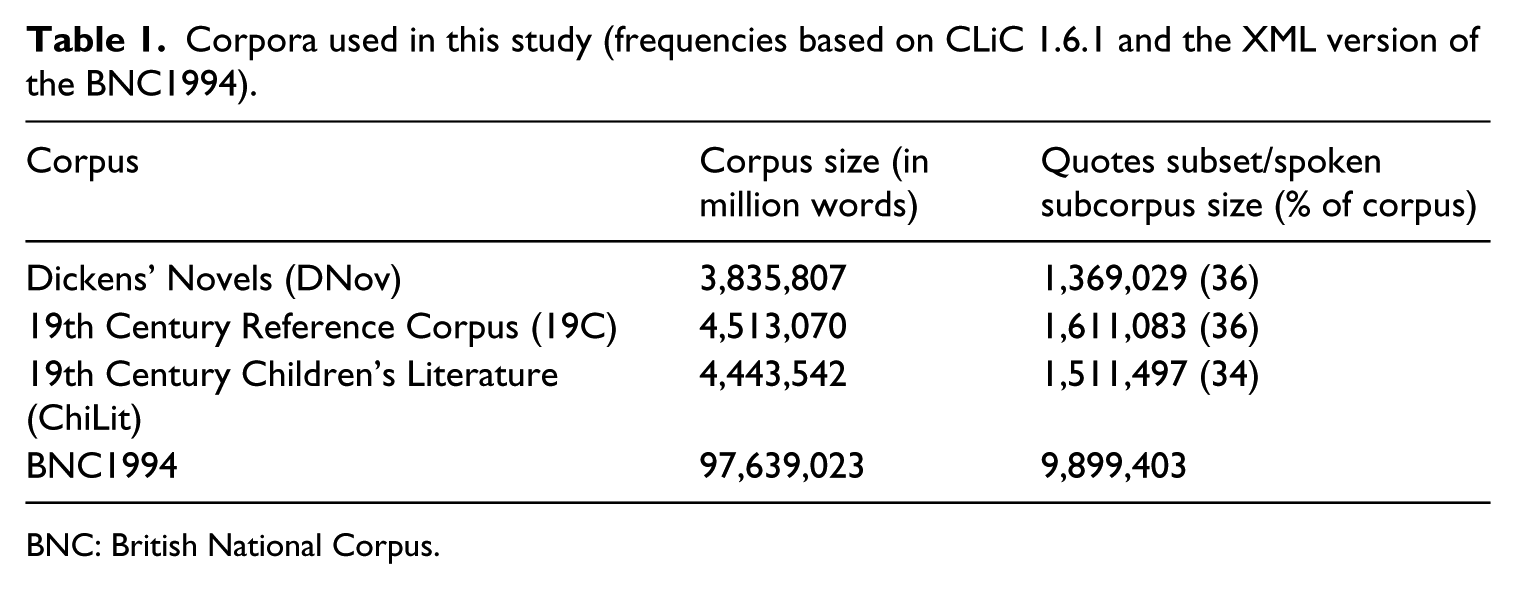
Table 1 provides the number of words in each corpus, as well as the number of words in the quotes subsets. We use the spoken component of the BNC (British National Corpus) as data of real spoken language. Following Love et al. (2017), we refer to the ‘BNC1994’ to distinguish the corpus from the ‘BNC2014’. The time gap between the CLiC corpora and the BNC deserves comment. As present-day readers, we do not have exposure to real spoken English of the 19th century. When we read 19th-century fiction, we bring our real-life experience to bear. The BNC serves as a proxy for this spoken language experience. Whether we know what real 19th-century speech would have sounded like is not crucial. What matters is the readers’ basis for comparison, that is, contemporary speech (as well as the reader’s experience of reading fiction). When we started this research, the full text of the BNC2014 was not available yet. In future research, this corpus can add additional dimensions for comparisons that might enable a more nuanced assessment of the experience of ‘contemporary readers’, because demographic factors of readers, such as age, will affect how well the BNC1994 or BNC2014 serves as a proxy for their background knowledge.
Corpora used in this study (frequencies based on CLiC 1.6.1 and the XML version of the BNC1994).
BNC: British National Corpus.
4.2. Speech-bundles
Biber et al. (1999) define a lexical bundle with regard to particular thresholds of frequency (per million words) and range (the number of texts it appears in). These criteria can vary depending on the aims of the research. Hence, the use of the terms ‘lexical bundles’, ‘clusters’ or also ‘chunks’ and ‘n-grams’ is not consistent across corpus linguistic research. The Longman Grammar of Spoken and Written English (Biber et al., 1999), which gave initial prominence to lexical bundles, is based on a large (40-million-word) general corpus with relatively evenly balanced ‘core’ register components. Biber et al. (1999) set their frequency and range thresholds in order to avoid ‘idiosyncrasies’ and to describe the general usage of lexical bundles across a given register. As shorter bundles are more common than longer ones, they suggest a minimum threshold for four-word bundles at ten per million and for five- and six-word bundles at five per million. For studies of large general corpora, the range criterion can be redundant in practice, because frequency thresholds often presuppose range (see Biber et al., 2004: 376). The situation is different for smaller, specialised corpora, where a highly frequent cluster may not necessarily be widely spread across texts or where functions of clusters can still be identified if the frequency threshold criterion is not met (Mahlberg, 2013).
Kopaczyk (2013) provides an overview of the cut-off points used in several lexical bundle studies, covering both general and specialised corpora (as small as 220,000 words in the case of Culpeper and Kytö, 2010). She finds wide variation, with frequency being reported both in normalised terms (e.g. per million words) and in absolute terms (e.g. ten occurrences in the target corpus), and some studies treating the range of bundles in terms of a minimum number of texts or a percentage of the files in the corpus. Kopaczyk (2013) concludes that ‘[t]here is no uniform practice in lexical bundle studies [. . .] Every researcher takes an informed but idiosyncratic decision’ (p. 152).
An argument against fixed thresholds comes from psycholinguistics, where frequency effects on learners have been shown to be variable rather than divisible into frequency bins (Arnon and Snider, 2010). Based on this argument, Durrant (2017: 170) develops a formula to quantify the overlap of the number of bundles (in terms of tokens rather than types) shared between subcorpora of student writing. The move away from cut-offs and differences between (sub)corpora towards a graded perspective makes Durrant’s (2017) approach similar to ours.
Our unit of analysis is the five-word cluster. A length of five has been shown to be a useful starting point for the analysis of fiction (Mahlberg, 2013). Following Scott (2019), we use the term ‘cluster’ to refer to a unit that is purely defined by surface features. We refer to ‘speech-bundles’ to emphasise those textual functions of clusters that create a sense of spokenness, that is, the way in which they are able to create readerly effects of naturalness of speech. So every speech-bundle is a cluster, but not every cluster is a speech-bundle. When our analysis aims to focus on the most frequent examples, we do refer to cut-offs. Following Biber et al. (1999: 993), we use a frequency of five per million words and occurrence across a range of at least five texts. Through additional comparisons, we ensure our study is not limited to speech-bundles defined by fixed criteria, but takes a more nuanced approach.
4.3. Comparisons and the continuum of fictional speech
Frequency thresholds are not absolute; they have to be seen along a continuum. To describe the continuum of real spoken language and speech in fictional texts, we take the following steps to compare clusters:
We compare the BNC with the CLiC corpora to identify similarities between fiction and real spoken language;
We identify similarities in fictional speech across the CLiC corpora;
We look at author-specific fictional speech;
We compare the quotes and non-quotes subsets of the CLiC corpora.
Steps 1–3 allow us to study clusters along two dimensions – real spoken language and fictional speech on one, and 19th- and 20th-century speech patterns on the other, as shown in Figure 1. Step 4 adds an intratextual comparison, that is, a key cluster comparison that complements the other three steps by showing how fictional speech is characterised through being different from narratorial text. A key cluster comparison uses clusters, instead of words, as units in key comparisons (Mahlberg, 2007). For the four comparisons, we use rank-ordered frequency lists to complement minimal occurrence thresholds, but in both cases the comparison across corpora will be crucial to account for the fuzzy boundaries between different data sets. Detail on the individual comparisons will be provided in the following sections.
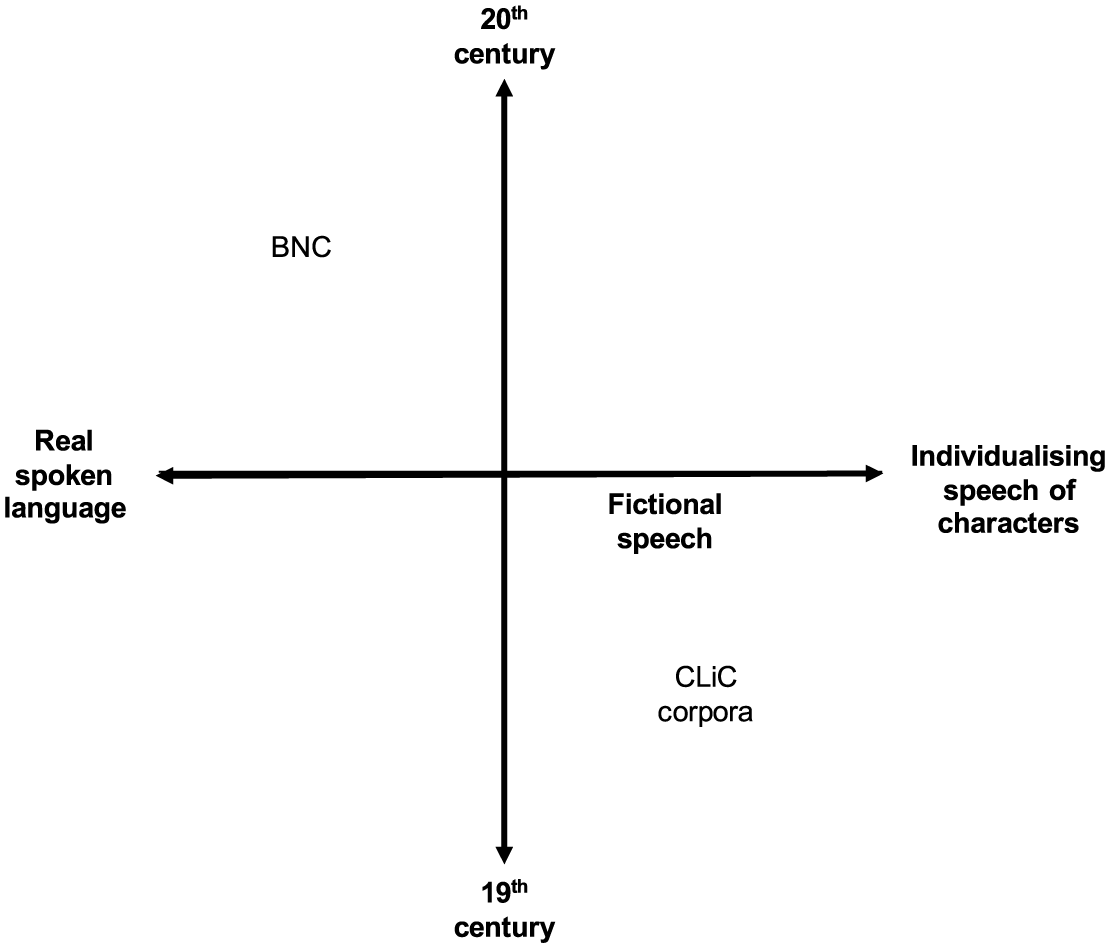
The continuum of real and fictional speech and change over time.
Across all sections we used a combination of the CLiC web interface and its ‘API’ (‘application programming interface’; a way of accessing the data with a programming language). For this article, we used a development version of the CLiC API (for documentation of the current API, see https://clic.readthedocs.io/en/latest/advanced/api_usage.html). It is important to note that CLiC is a developing resource. The data for this article are mainly based on versions 1.6.1 and 1.7. CLiC has since been further expanded with version 2.0 (used for Table 10 of this article), so if readers of this article run searches on live CLiC there might be small quantitative differences, which, however, will not affect the overall results. For comparisons with real spoken language, we used the ‘original’ BNC1994 (XML version http://www.natcorp.ox.ac.uk/) to generate cluster counts and, for concordance searches, we used the BNCweb (Hoffmann et al., 2008). For each results table below, we indicate the respective data source. The R code (R Core Team, 2018) for retrieving the data sets and the large-scale comparisons between the CLiC corpora and the XML version of the BNC is available from our GitHub repository (https://github.com/birmingham-ccr/sm/tree/master/Mahlberg_et_al_supplementary_material).
5. A speech-bundle approach to fictional talk
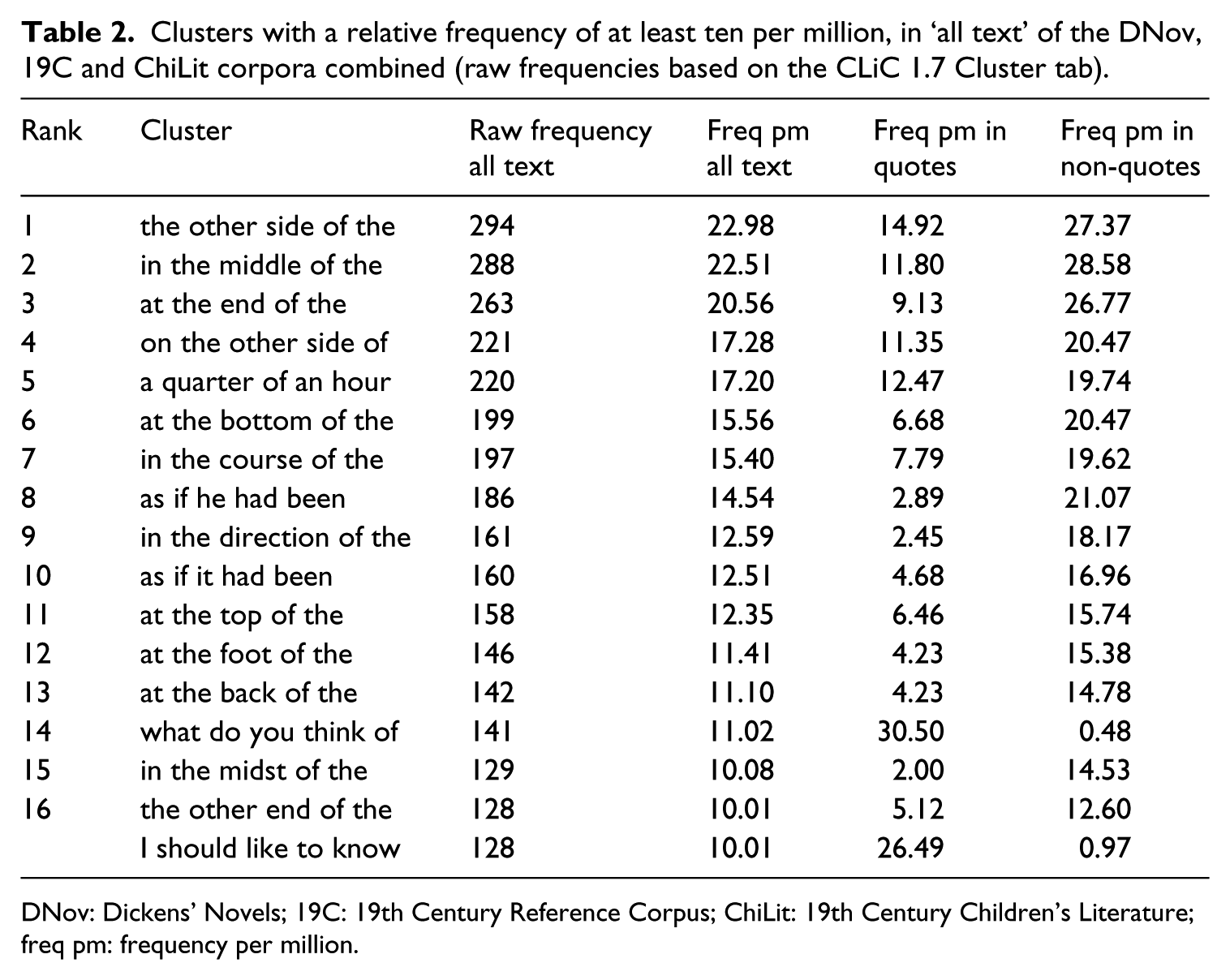
The separate ‘quotes’ and ‘non-quotes’ subsets of CLiC are crucial data sets to gain insights into the nature of fictional speech. Table 2 shows the top of the frequency list of five-word clusters across all three fiction corpora combined, based on cluster counts in the whole texts. The table shows 17 clusters, which cover the top 16 frequency ranks (clusters 16 and 17 have the same frequency so appear on the same rank). The clusters in Table 2 have a frequency of at least ten per million words for the whole texts (‘all text’). Most of them are relatively more frequent in the non-quotes subset, as indicated by the final two columns, providing relative frequencies for quotes and non-quotes (of the 12.8 million words in the three corpora combined, 8.3 million appear in non-quotes and 4.5 million in quotes). Only what do you think of and I should like to know are relatively more frequent in quotes. So features of fictional speech might appear less noticeable when texts are treated as whole units.
Clusters with a relative frequency of at least ten per million, in ‘all text’ of the DNov, 19C and ChiLit corpora combined (raw frequencies based on the CLiC 1.7 Cluster tab).
DNov: Dickens’ Novels; 19C: 19th Century Reference Corpus; ChiLit: 19th Century Children’s Literature; freq pm: frequency per million.
A cluster list for ‘all text’ also illustrates the effects of thresholds to define lexical bundles. With the commonly used cut-off of five per million (see section 4.2), I think it would be is an example that would not be captured as a lexical bundle – it occurs 3.05 per million in ‘all text’. In quotes, however, its relative frequency of 8.68 makes it above this cut-off. We will look at this cluster in more detail in section 5.1.
5.1. Fictional and natural speech-bundles
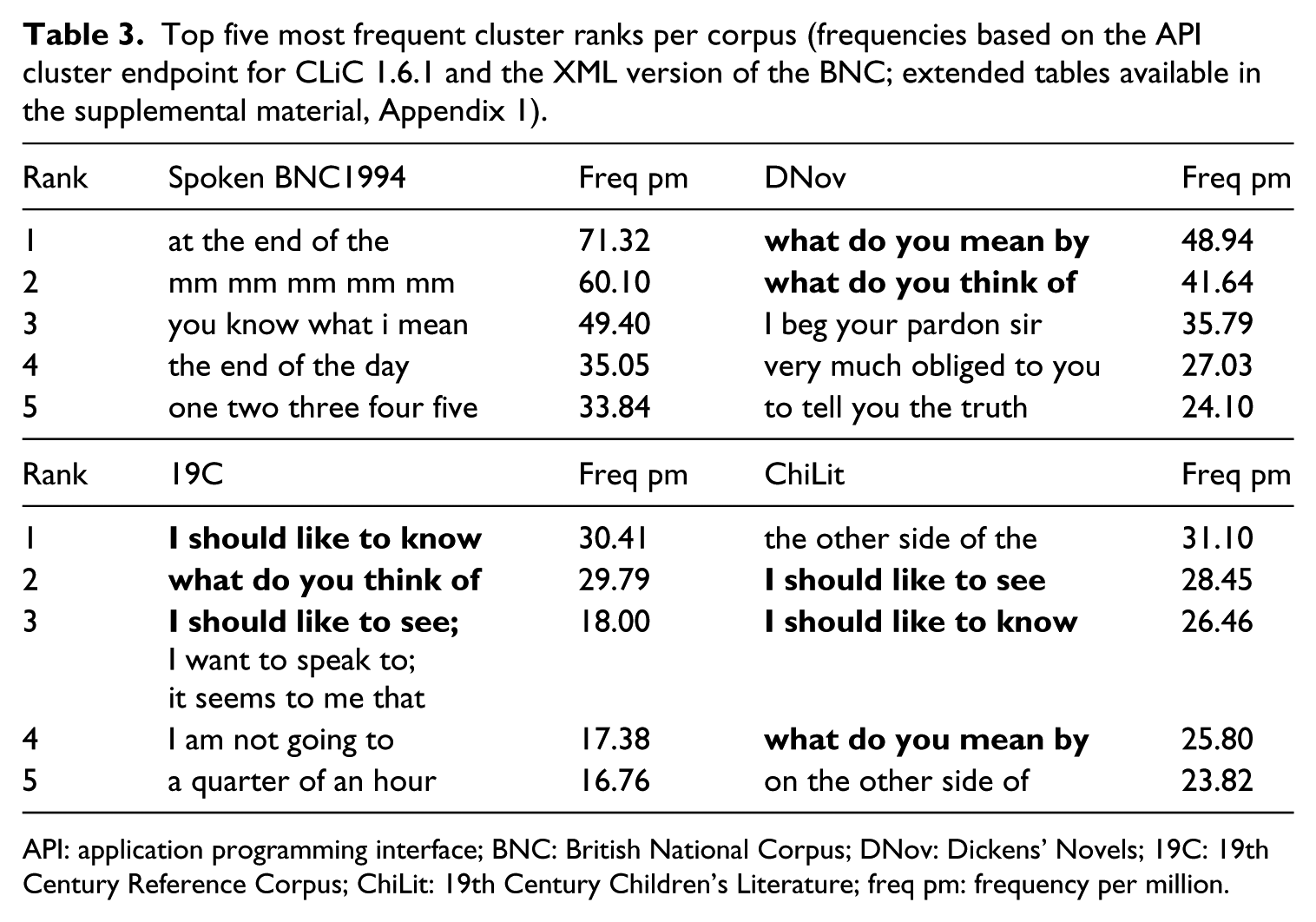
Once quotes are separated out, features of spokenness become more clearly visible. In this section, we look at the quotes subsets of the three fiction corpora individually to identify patterns in a more nuanced way for the comparison with the Spoken BNC1994. Table 3 provides an overview of the top five ranks for each corpus (as in Table 2, bundles with the same frequency are presented on the same rank), which immediately shows there is overlap between the most frequent bundles across the corpora. The bundles in bold appear in the top five frequency ranks of at least two corpora. There is overlap between the fiction corpora but not with the Spoken BNC1994. The relative frequencies in the BNC are the highest – the top bundle has a relative frequency of over 70 per million. In DNov, the top bundle occurs almost 50 times per million, whereas for 19C and ChiLit the top frequency is just over 30 times per million. In the Spoken BNC1994, at the end of the is the most frequent bundle. Its frequency is largely due to the six-word bundle at the end of the day, which is often used to mean ‘ultimately’, as illustrated in Example (2). The six-word bundle accounts for almost half of the occurrences of at the end of the – 332 out of 705 – and relates to the bundle the end of the day on rank 4 of the frequency list.
(2) She’s had her chance and I’m doing all I can to help her but
Top five most frequent cluster ranks per corpus (frequencies based on the API cluster endpoint for CLiC 1.6.1 and the XML version of the BNC; extended tables available in the supplemental material, Appendix 1).
API: application programming interface; BNC: British National Corpus; DNov: Dickens’ Novels; 19C: 19th Century Reference Corpus; ChiLit: 19th Century Children’s Literature; freq pm: frequency per million.
In Table 2, at the end of the also occurs near the top. However, in the fiction corpora, it is more frequent in non-quotes, where it is used with a time or place meaning, as in Example (3).
(3) “What can it matter?” cried Dorian Gray, laughing, as he sat down on the seat
The top most frequent bundles provide a good starting point to identify crucial textual functions in a corpus. Extending Table 3, Table 4 covers all bundles that appear in the top 15 cluster frequency ranks in at least two of the corpora. The table is ordered alphabetically and indicates the frequency rank for each shared bundle. For instance, I should like to know ranks sixth in DNov, first in 19C and third in ChiLit. For the ‘top 15’ criterion, the overlap is greater between the fiction corpora than with the BNC. Still, speech-bundles shared across the fiction corpora do reflect features of spoken language. In Table 4, most refer to interactions between people. First- and second-person pronouns, as in it seems to
Shared speech-bundles among the top 15 cluster frequency ranks per corpus, ordered alphabetically. All examples in Table 4 occur at least five times per million and in at least five texts per corpus (based on the API cluster endpoint for CLiC 1.6.1 and the XML version of the BNC; extended tables available in the supplemental material, Appendix 1).
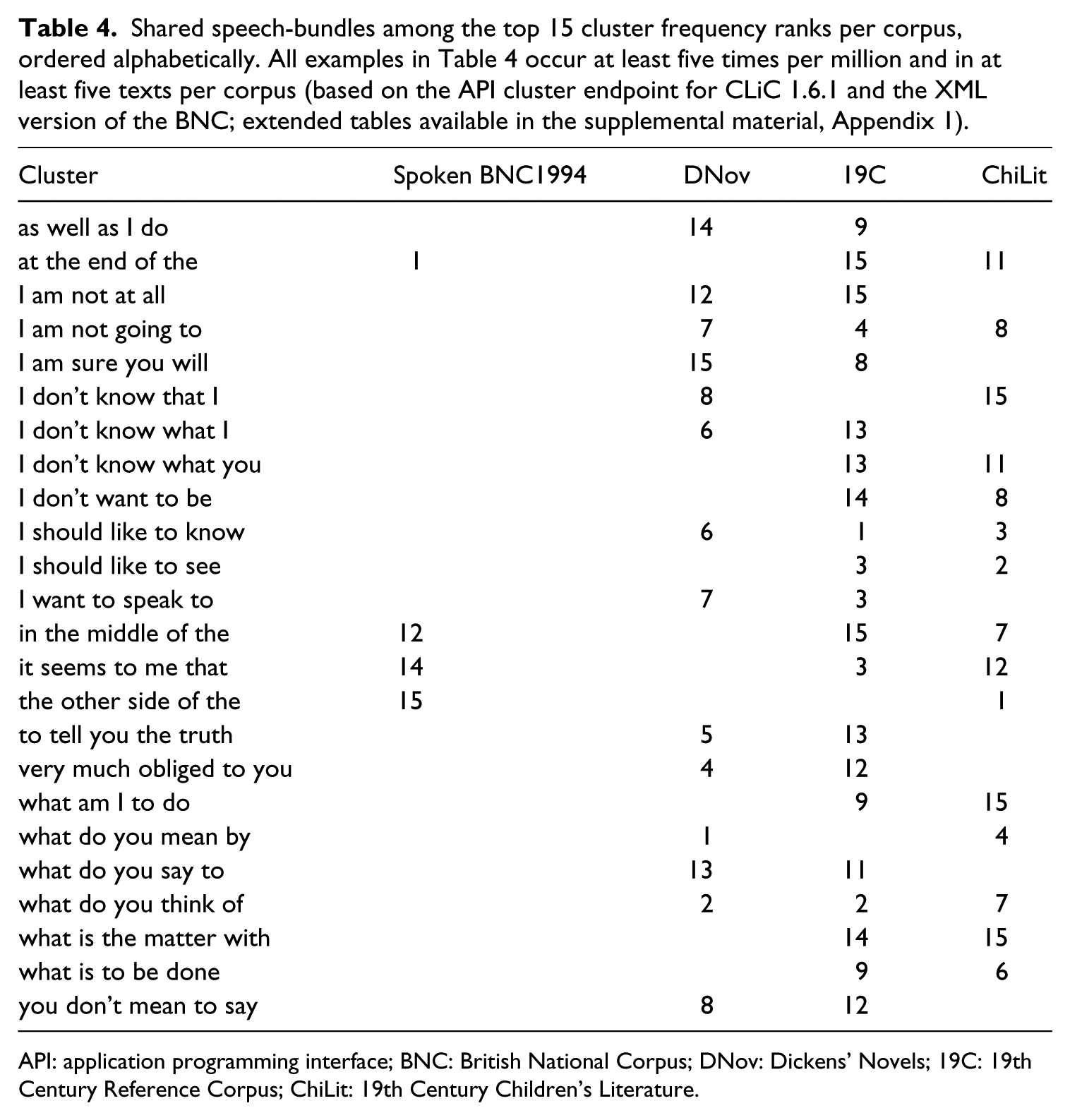
API: application programming interface; BNC: British National Corpus; DNov: Dickens’ Novels; 19C: 19th Century Reference Corpus; ChiLit: 19th Century Children’s Literature.
While fewer of the top frequency bundles of real spoken language are found in Table 4, Table 5 focuses on the overlap between real language and fictional speech by highlighting the speech-bundles that occur at least five times per million and appear in at least five different texts in all four corpora. From Table 5 we can see that even if speech-bundles are shared across all corpora, there are author-specific tendencies. Referring to the continuum of real and fictional speech in Figure 1, what do you think of and what do you mean by tend more towards the fictional end of the cline. Both are particularly frequent in DNov, and especially what do you mean by is an example of a bundle that helps to individualise fictional characters. As shown in Mahlberg (2013), Dickens uses what do you mean by to depict confrontation between fictional characters. It is a device of formulaic impoliteness (section 5.3 goes into more detail of speech-bundles to individualise characters). Table 5 further shows how speech-bundles may reflect features of genre. In Example (4), the other side of the illustrates how references to physical space and activity are commonly found in children’s stories.
(4) “Never mind, we can hurl them like javelins,” said Cyril, “or drop them on people’s heads. I say--there are lots of stones on
All five-word speech-bundles (occurring at least five times per million, in at least five texts per corpus) that are shared across all four corpora, based on the API cluster endpoint for CLiC 1.6.1 and the XML version of the BNC.
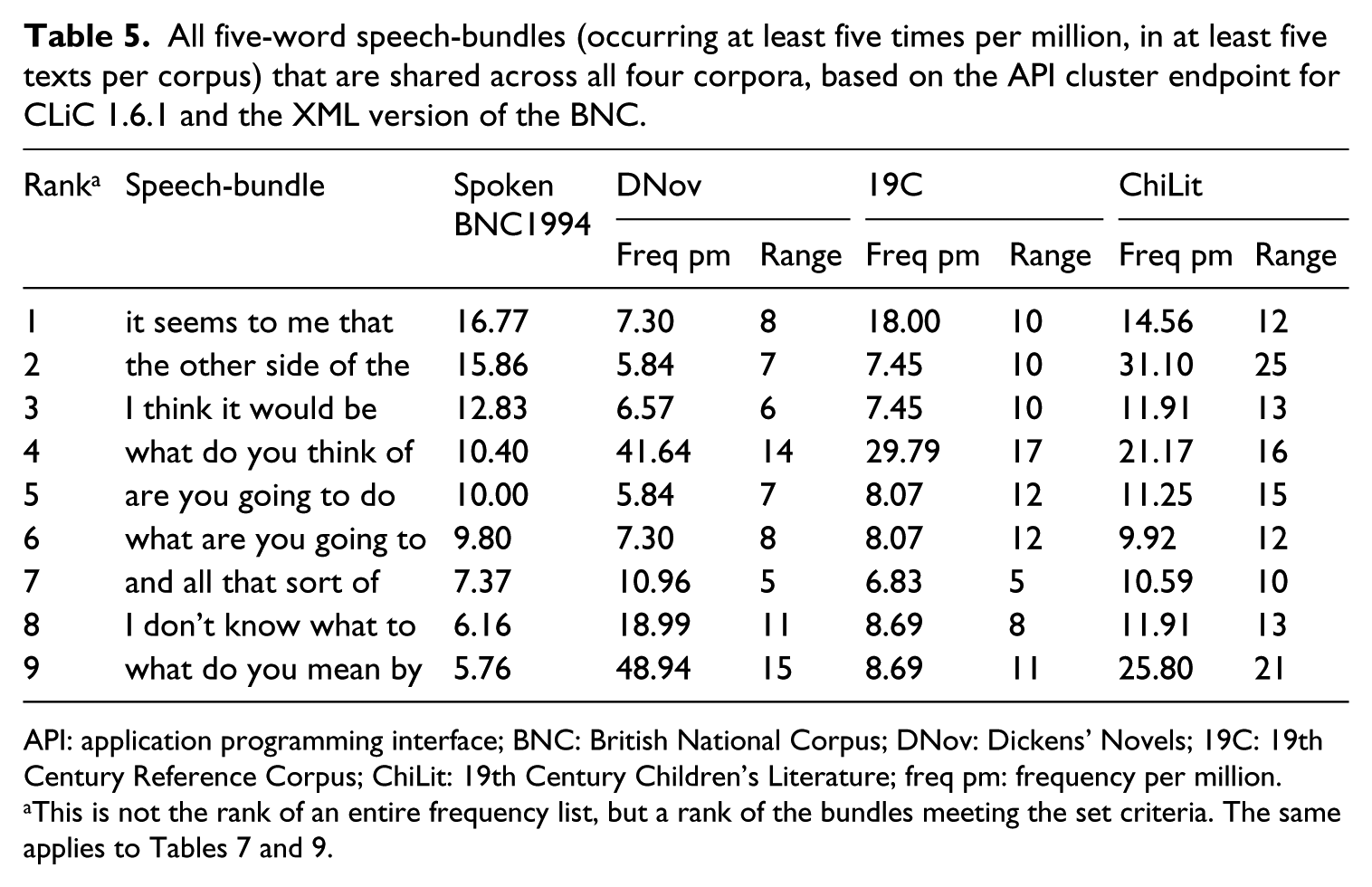
API: application programming interface; BNC: British National Corpus; DNov: Dickens’ Novels; 19C: 19th Century Reference Corpus; ChiLit: 19th Century Children’s Literature; freq pm: frequency per million.
Because of the relatively low frequencies in Table 5, we do not apply statistical tests, but look at some examples in more detail. In a similar way to Table 4, the examples in Table 5 reflect the interpersonal meanings of speech-clusters. Like devices for hedging the assertiveness of the speaker, vagueness expressions are common in everyday conversation. The speech-bundle and all that sort of in Table 5 is such an example. In Example (5), it illustrates how vague language indicates ‘an assumed shared knowledge’ (Carter and McCarthy, 2006: 202).
(5) “My belief is, that she’s been an ill-used woman,” said Cradell. “If she had a husband that she could respect and have loved,
Only I think it would be is more frequent in the BNC than in the other corpora. Note this is an example that does not make the five-per-million threshold for lexical bundles when the fiction corpora are treated together as one corpus with whole texts, as in Table 2. It strikingly shows how focusing on quotes enables a more nuanced analysis. In all four corpora, I think it would be is mostly used to hedge suggestions that speakers make about what should be done or would be better or advisable to do. Figure 2 shows 25 random examples from the BNC. Adjectives from Figure 2 that are also among the repeated adjectives in the full concordance of the Spoken BNC1994 include better, helpful, appropriate, nice, useful, wise, wrong.
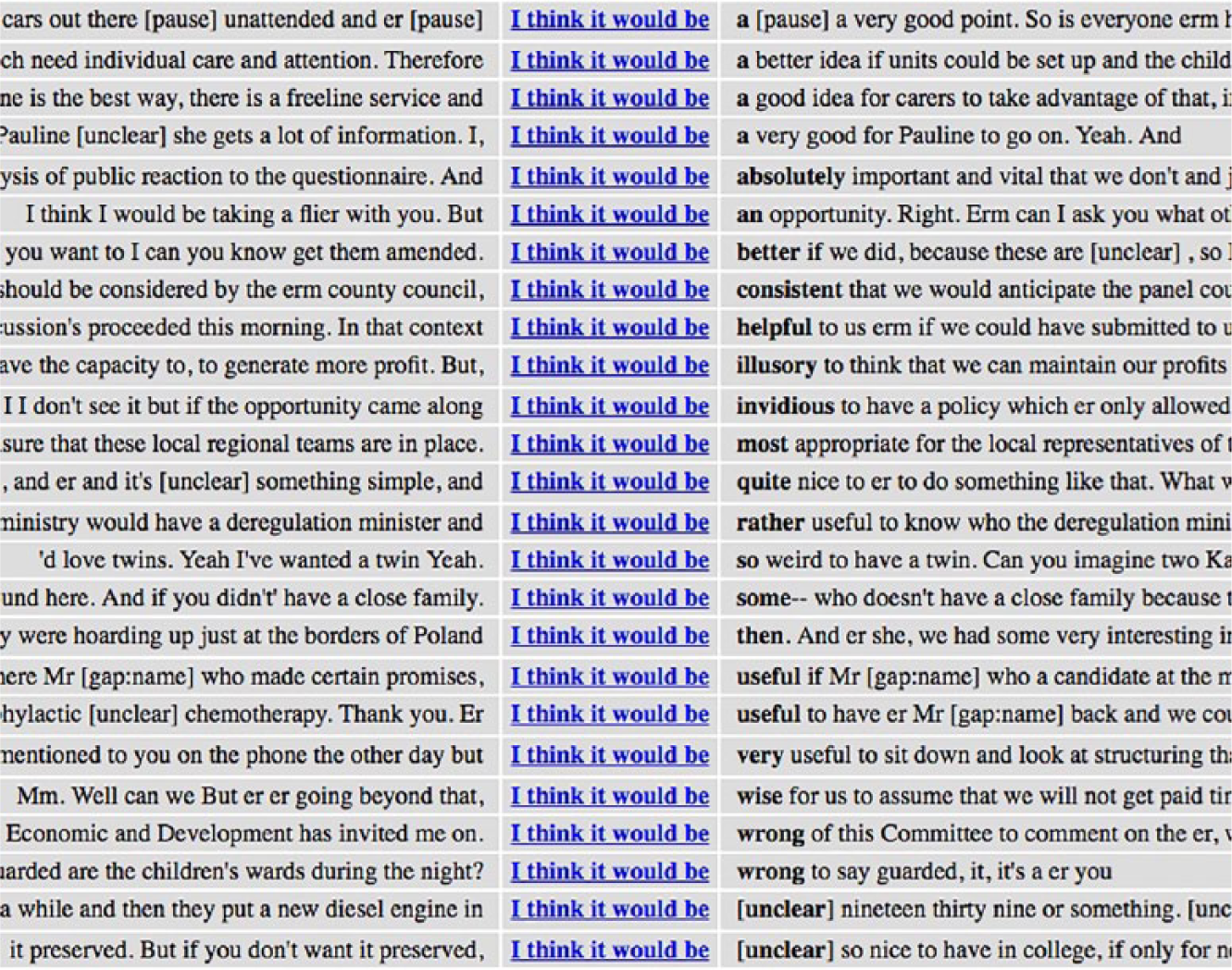
Twenty-five randomly selected examples of the 127 occurrences of I think it would be in the Spoken BNC1994, sorted on the right (retrieved with the BNCweb and its random selection function).
Figure 3 shows 15 of the 39 examples in the fiction corpora, where we find a similar picture. Lines 12–15 are four of the eight examples that are followed by better; in two of these cases, the phrase is it would be much better. As an example of context, the wider text from line 12 in Figure 3 is given in (6). Figure 4 illustrates a case that functions in a similar way in the Spoken BNC1994, where people are speaking about what would be better for another person.
(6) “Poor Alicia is rather jealous of any attention Mr. Audley pays me, and--and--I think it would be better for her happiness if your nephew were to bring his visit to a close.” (Lady Audley’s Secret)
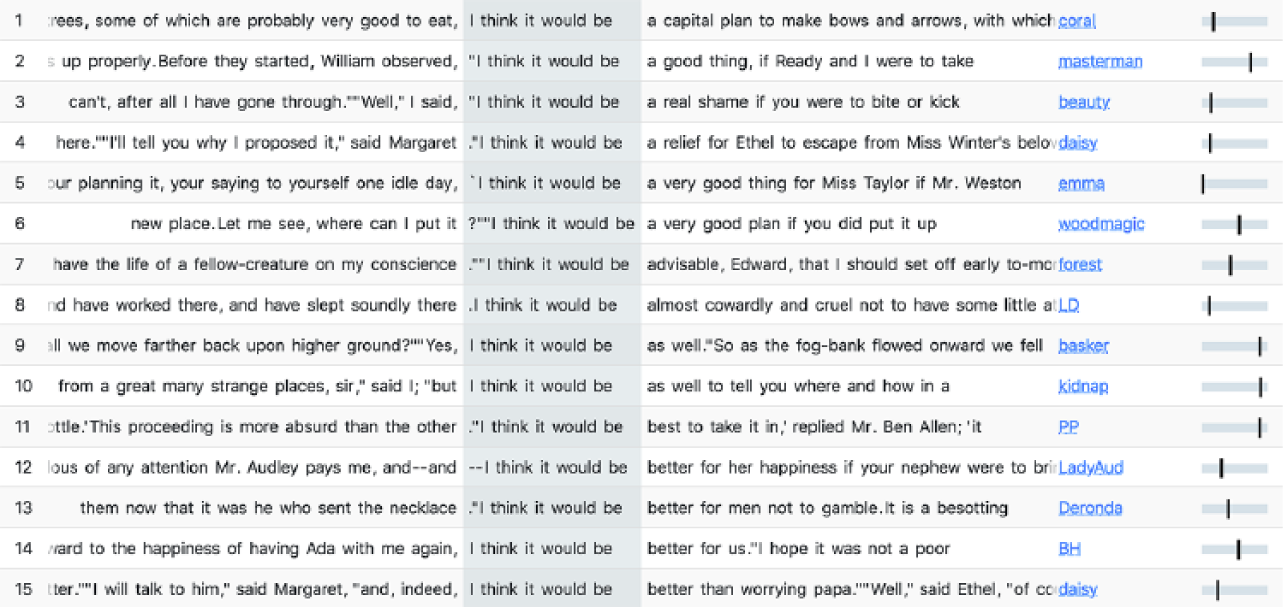
Fifteen of the 39 concordance lines of I think it would be in quotes in DNov, 19C and ChiLit, sorted on the right (one additional concordance line occurs in non-quotes in the first-person narration of Bleak House), retrieved with CLiC 1.7.
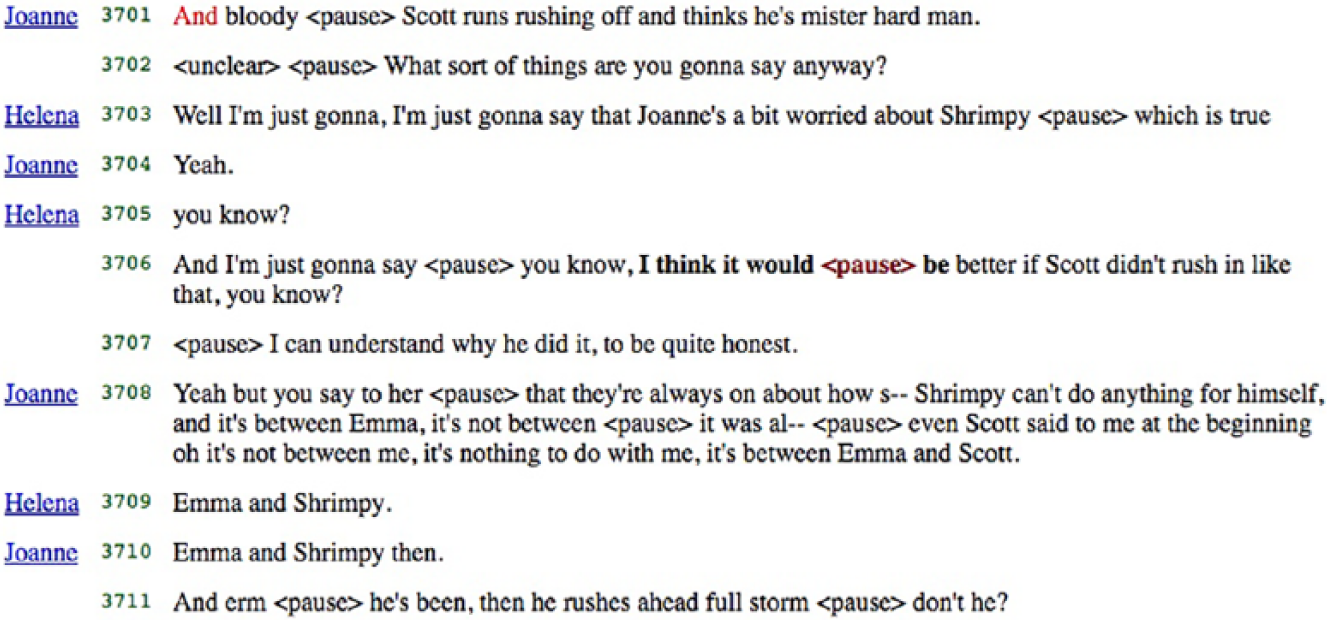
Dialogue in the Spoken BNC1994 (file KCE) containing the bundle I think it would be.
For most speech-bundles in Table 5, their highest frequency is found in one of the fiction corpora rather than in the BNC. This might relate to the larger range of bundles in the Spoken BNC1994 overall. Table 6 shows the total number of clusters in each corpus. These totals refer to cluster types (the different clusters found in the corpus). Table 6 provides frequency brackets, so [5,10) means DNov contains 296 clusters that occur (in at least five texts) a minimum of five times per million and a maximum of 9.
Number of five-word clusters per corpus per million words (all with a range ⩾five texts per corpus, that is, a minimum raw frequency of five), based on the API cluster endpoint for CLiC 1.6.1 and the XML version of the BNC.
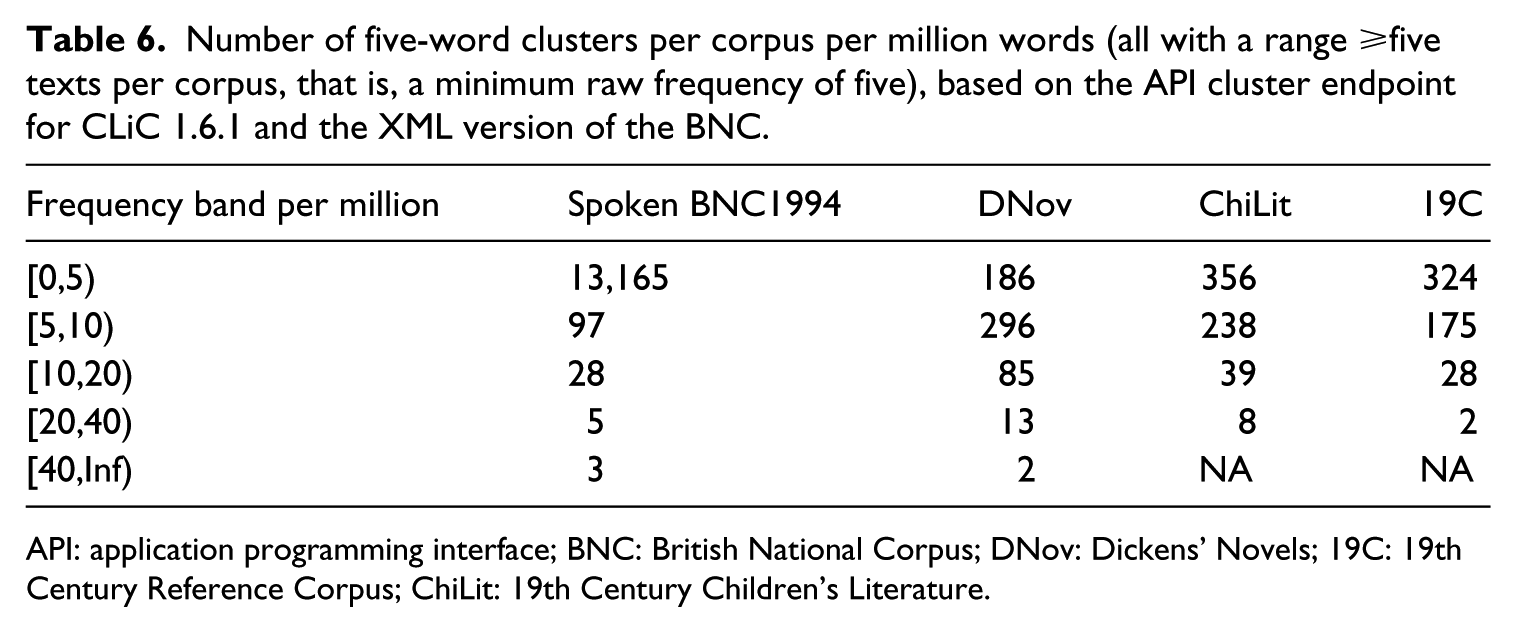
API: application programming interface; BNC: British National Corpus; DNov: Dickens’ Novels; 19C: 19th Century Reference Corpus; ChiLit: 19th Century Children’s Literature.
Speech-bundles (freq pm ≥ 5) in the Spoken BNC1994 that do not occur at all in any other corpus, based on the API cluster endpoint for CLiC 1.6.1 and the XML version of the BNC.
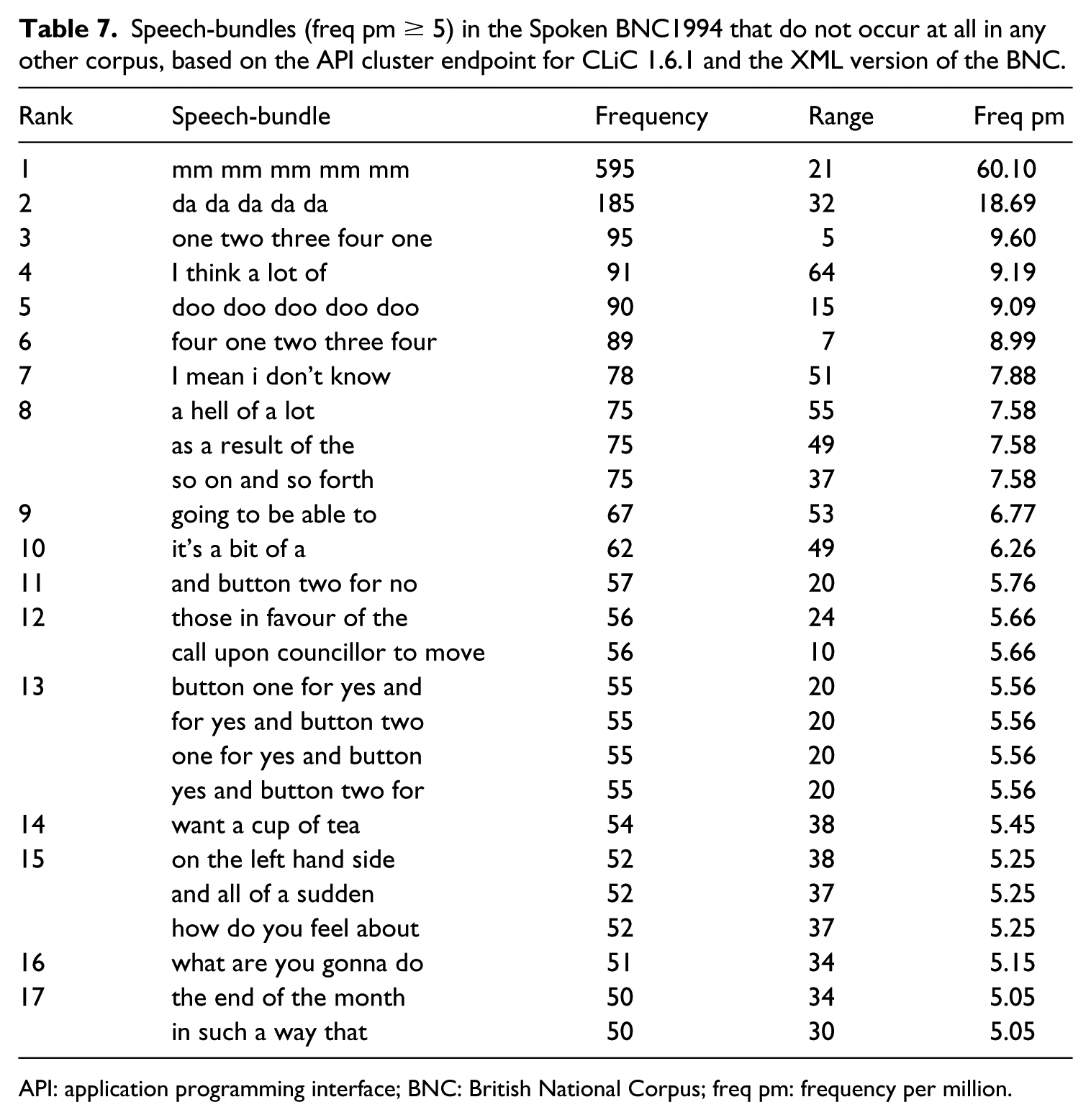
API: application programming interface; BNC: British National Corpus; freq pm: frequency per million.
To describe the furthest end of real spoken language in Figure 1, Table 7 shows the most frequent speech-bundles in the Spoken BNC1994 that are not found in the fiction corpora. The table points to a wider range of ‘relational language’ (O’Keeffe et al., 2007: 159), which ‘serves to create and maintain good relations between the speaker and the hearer’, by contrast with ‘transactional language’ for which the exchange of information is the main function. Discourse markers (I think, I mean) as well as bundles of vagueness and approximation (it’s a bit of a, a hell of a lot) come under this heading. In spoken conversation, frequent discourse markers tend to be shorter than five words.
(7) But I,
Examples of 19th-century fiction politeness bundles across the corpora (based on the BNCweb and the CLiC 1.7 Concordance tab).
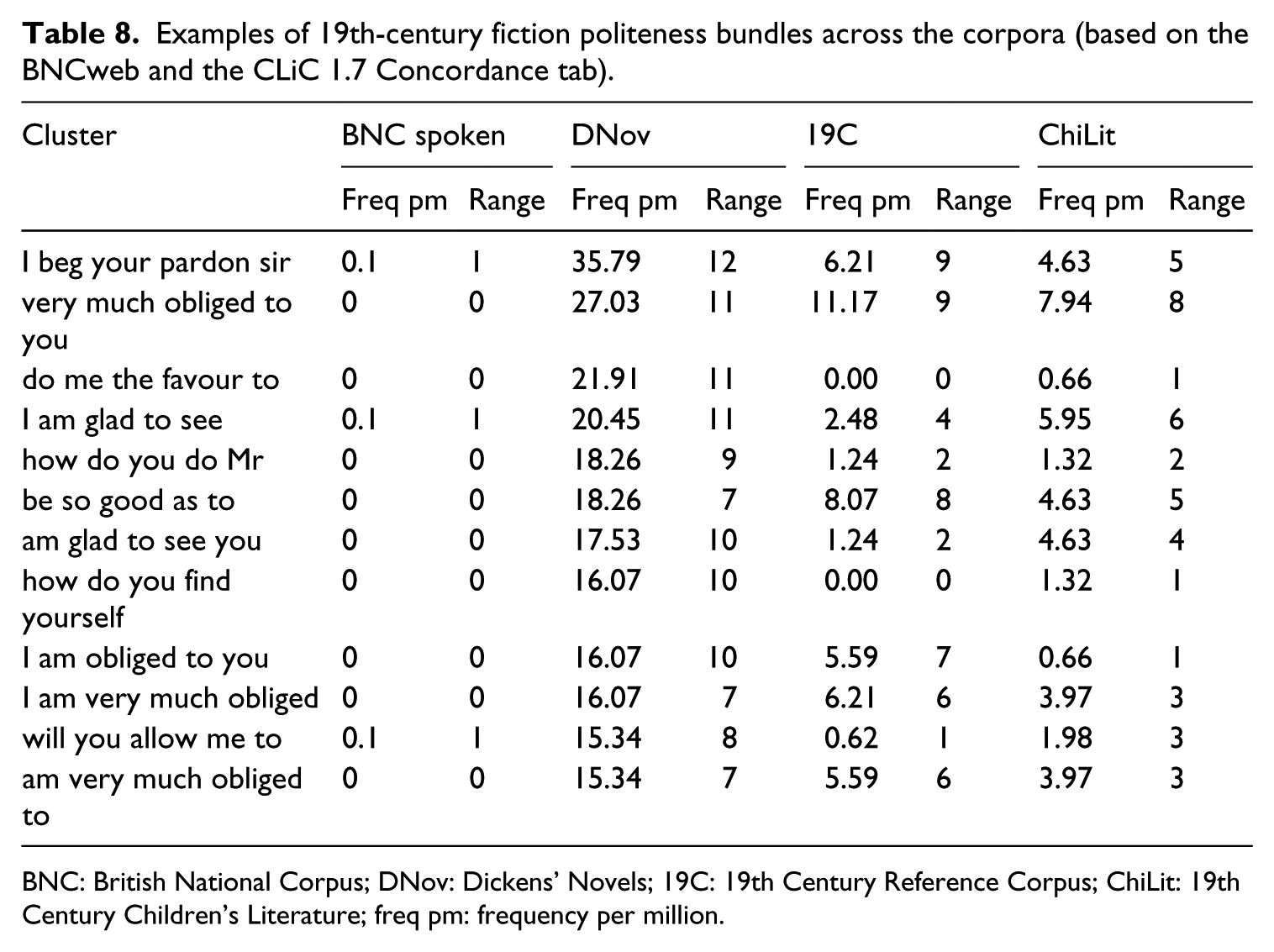
BNC: British National Corpus; DNov: Dickens’ Novels; 19C: 19th Century Reference Corpus; ChiLit: 19th Century Children’s Literature; freq pm: frequency per million.
Examples like I mean, that sort of thing and I think a lot of are lexical bundles that are frequent in spoken language (e.g. Example (7)), but belong to the features that Page (1988) observes as not being reproduced to the same extent in fiction. Figure 5(a) makes this even clearer. The shorter bundles are significantly more frequent in the Spoken BNC1994 (for the significance test, we used Rayson’s (2016) log-likelihood calculator). 1 The bundle I don’t know what I (Table 4), in contrast, is less frequent in the Spoken BNC1994. To check that what we are seeing in Figure 5(a) are not simply the results of language change over time, Figure 5(b) compares the same bundles in the full fiction corpora (including non-quotes) with the BNC fictional prose section, finding more similar results.
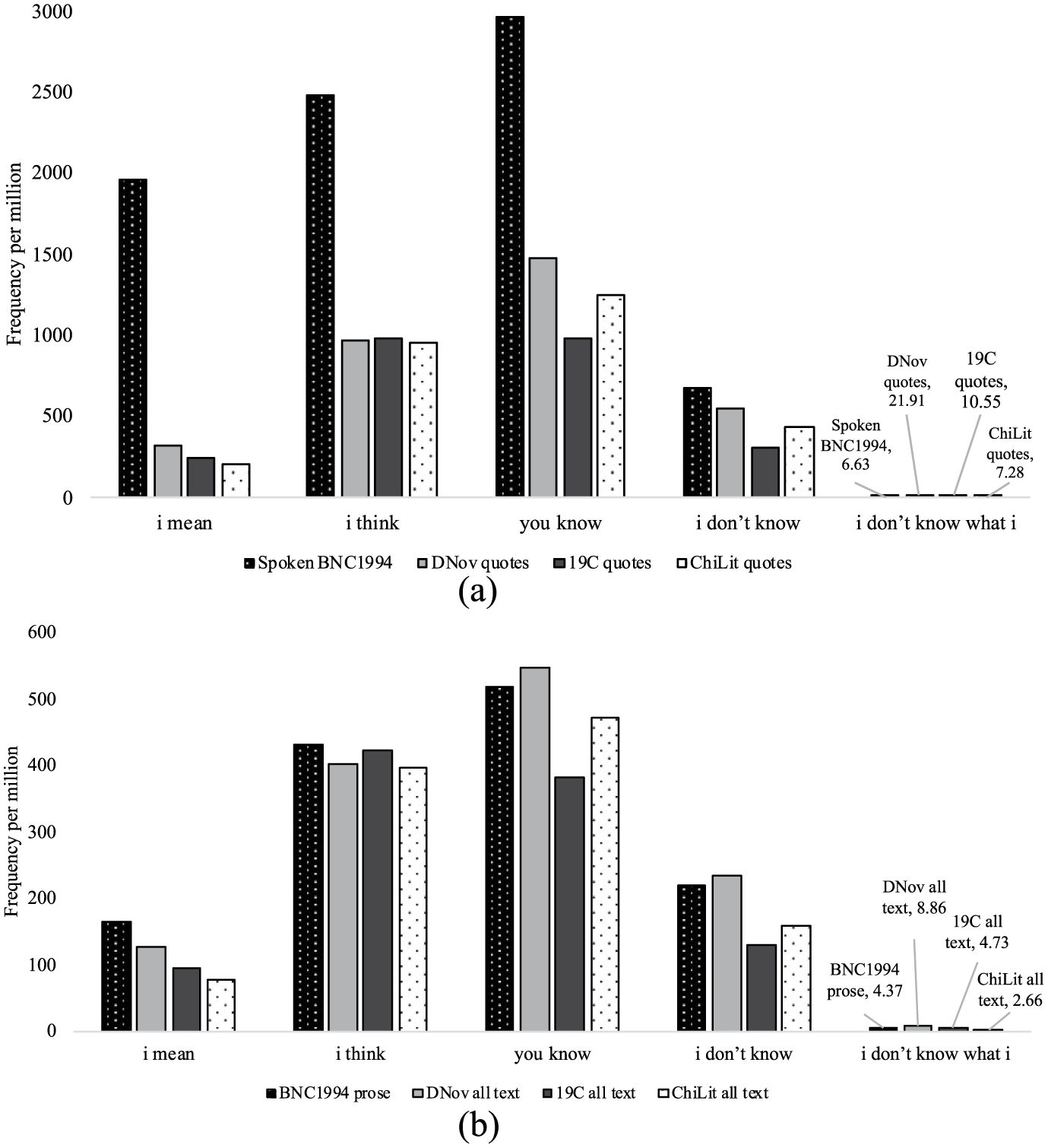
(a) Frequency per million for shorter bundles in the Spoken BNC1994 and the quotes sections of the fiction corpora (frequencies based on the CLiC 1.7 Concordance tab and BNCweb). (b) Frequency per million for shorter bundles in the BNC1994 fictional prose section (‘Genre:W:fict:prose’) compared to the full text of the CLiC corpora (frequencies based on the CLiC 1.7 Concordance tab and BNCweb).
5.2. Speech-bundles articulating 19th-century politeness
In this section and the next, we focus on speech-bundles that appear to be more specific to fiction. One such group are speech-bundles that function to protect the speaker’s face. In identifying these as politeness markers, we are drawing simply on the traditional Brown and Levinson (1987) model. We started with the top 15 ranks of DNov (cf. Table 4) to select examples because in DNov these ranks have more politeness bundles than any of the other fiction corpora. Table 8 compares the frequencies across all four corpora.
The most frequent politeness bundles refer to common speech acts like apologies (Example (8)), greetings (Examples (9) and (10)), giving thanks (Examples (11) and (12)); such forms are also referred to as ‘conversational routines’ (Aijmer, 1996; O’Keeffe et al., 2007).
(8) “I’m sure (9) “ (10) “How d’ye do, Crawley? (11) “Thank you,” said Robert, writing the address in his pocketbook. “ (12) “Yes, Uncle,” Charlie said cheerfully; “and we are
These bundles are shared across all three fiction corpora. But there seem to be genre differences again. The four bundles around obliged are all the least frequent in ChiLit. What appears to be the most formal one, I am obliged to you, just occurs once (in F. Anstey’s Vice Versa). Example (12) referring to Charlie and his mother suggests, for instance, formality is perceived more as part of the adult world. Most politeness bundles in Table 8 do not occur in the Spoken BNC1994. An example with just one occurrence in real spoken language is I beg your pardon sir, which occurs in a classroom setting, where the students discuss Oliver Twist (see Figure 6), so there is an explicit link to 19th-century speech. Generally, the politeness bundles in Table 8 would mostly sound old-fashioned if used in everyday casual conversation today. Along the dimensions of the continuum in Figure 1, they illustrate change over time indicated by the vertical arrow.
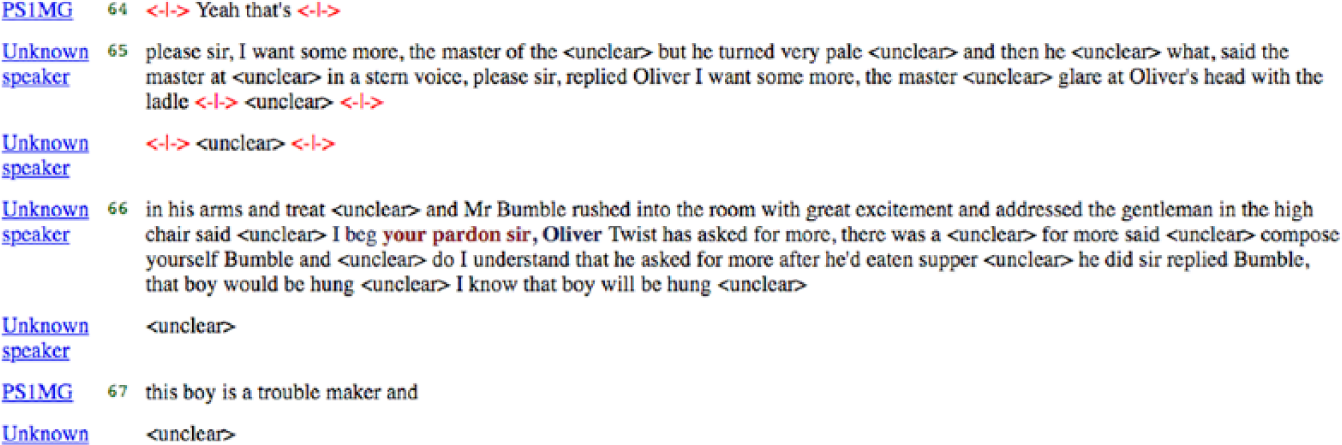
Example showing the only use of I beg your pardon sir in the Spoken BNC1994 (file F7M).
Table 8 includes some bundles which function to soften requests, for example, be so good as to italicised in Example (9). For pragmatic functions, the classification of speech-bundles again is best dealt with on a cline rather than in terms of hard-and-fast categories. Both the categorisation of speech acts and the range of politeness strategies have been the focus of much debate. Similarly, numerous definitions of specific face-saving devices like hedges and vague language exist. It is neither within the scope nor the focus of this article to enter these debates. The key point we make is that speech-bundles are associated with pragmatic functions that contribute to the depiction of character relations and interactions. Politeness bundles are frequent examples of this relational language, including conversational routines associated with frequent speech acts, but also a range of face-saving devices that contribute to the creation of common ground between the fictional characters.
5.3. Authorial speech-bundle style
On a cline from real spoken language on one end to idiosyncratic phrases of individual characters on the other, an author’s individual style takes an intermediate position (cf. Figure 1). The comparison of clusters across corpora can help to identify features of style (cf. the use of clusters/n-grams in authorship attribution research, Grieve et al., 2019). Table 9 shows all speech-bundles that occur in DNov but are not found in any of the other corpora so can be taken as a pointer to Dickens’ style. Neither 19C nor ChiLit contain any speech-bundles with zero occurrences in the remaining corpora. The 19C and ChiLit speech-bundles also need more detailed scrutiny. In the cluster list of 19C (cf. supplemental material, Appendix 1c), examples like I do not know what, I do not know that and I do not wish to point to Jane Austen’s stylistic preference of using non-contracted forms. One obvious reason why stylistic features of Dickens figure so prominently in our data is that he is the author for which most data are included in the study. The 19C reference corpus contains only three novels by Jane Austen, for instance. Table 9 does not imply that not the least doubt of or heaven forbid that I should is only used by Dickens. Instead, it shows that these examples seem to be relatively rare and so do not occur anywhere in our data set other than in DNov. While the relative frequencies of examples in Table 9 are low, there are still similarities with the speech-bundles we discussed in the previous sections. Generally, speech-bundles are about relational language. While politeness bundles specifically reflect the sociable interaction between characters, speech-bundles have the potential to indicate confrontation, too, as the most frequent speech-bundle in DNov, what do you mean by, shows (cf. section 5.1). Examples (13) and (14) similarly illustrate how will you hold your tongue functions as a type of phrasal impoliteness.
(13) ‘You are a little chafed, but I can make allowance for that, and am, fortunately, myself in the very best of tempers. Now, let us see how circumstances stand. A day or two ago, I mentioned to you, my dear fellow, that I thought I had discovered--’ ‘ (14) ‘
All speech-bundles in DNov that do not occur at all in any other corpus (based on the API cluster endpoint for CLiC 1.6.1 and the XML version of the BNC).
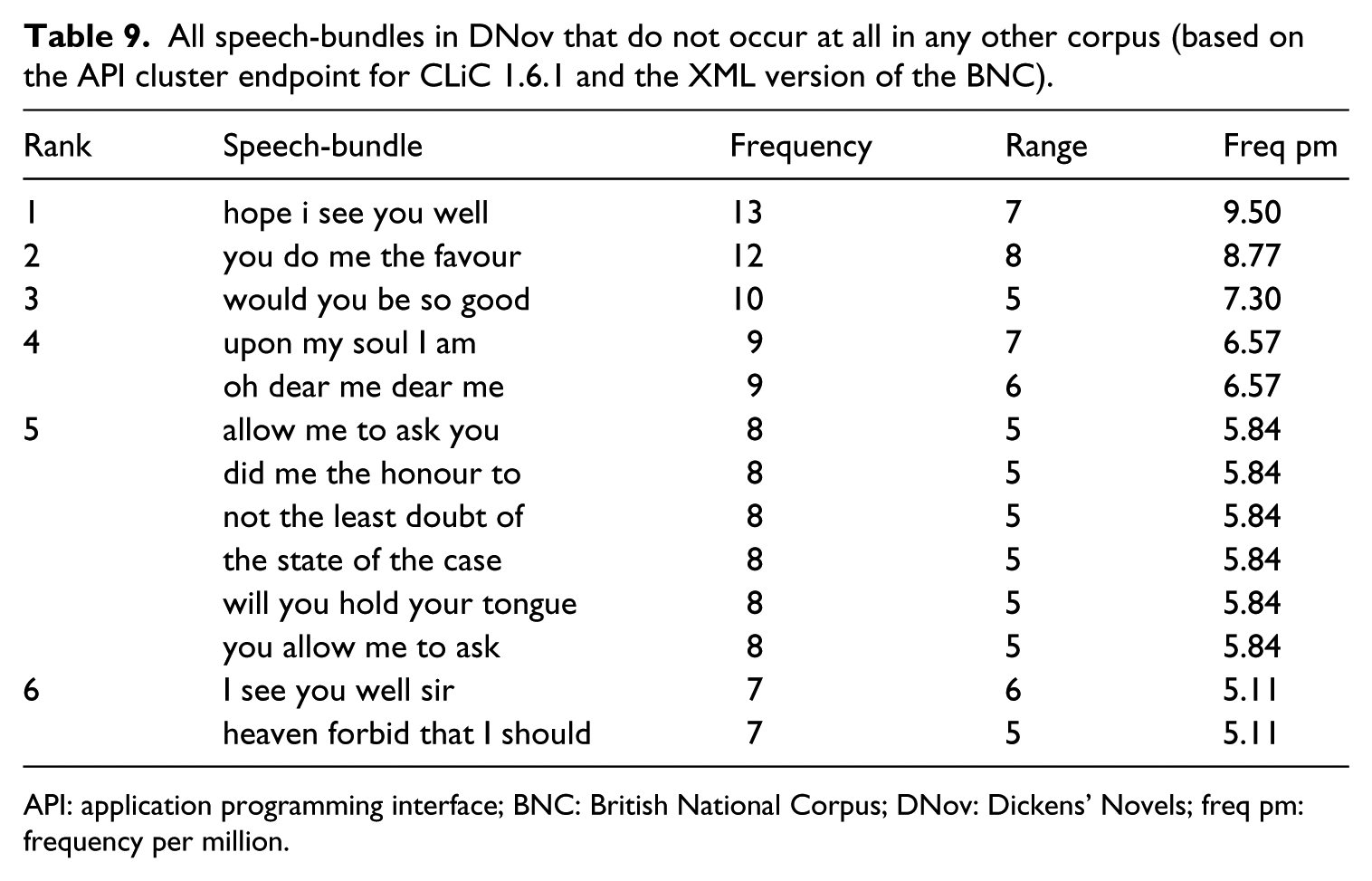
API: application programming interface; BNC: British National Corpus; DNov: Dickens’ Novels; freq pm: frequency per million.
Key comparison of DNov + 19C + ChiLit quotes versus non-quotes and non-quotes versus quotes based on CLiC 2.0.1 (further ranks, frequencies and LL values are available in the supplemental material, Appendix 2).
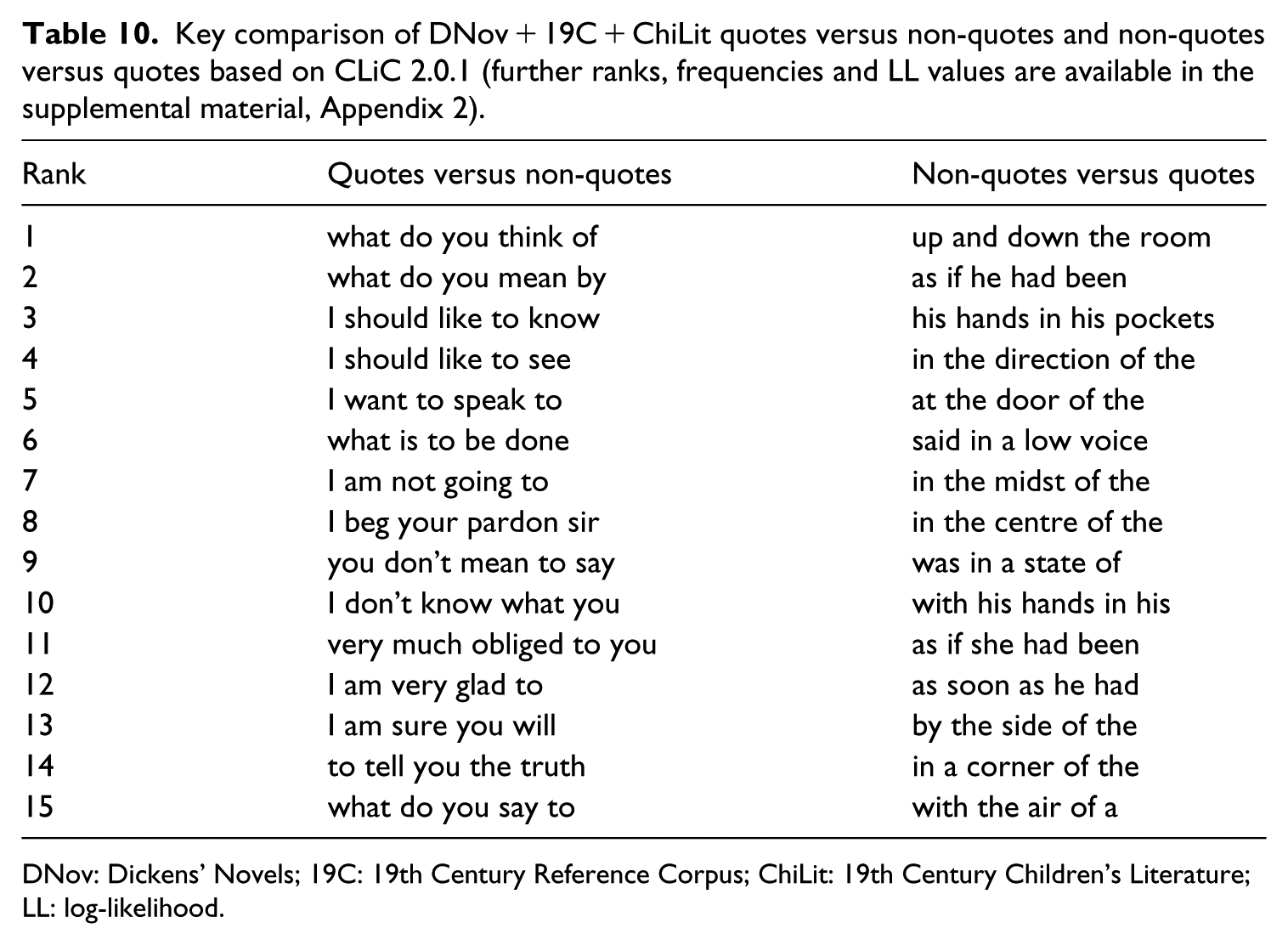
DNov: Dickens’ Novels; 19C: 19th Century Reference Corpus; ChiLit: 19th Century Children’s Literature; LL: log-likelihood.
Speech-bundles that mark authorial style are still not entirely the same as ‘labels’, that is, phrases that are used to individualise specific fictional characters (Mahlberg, 2007, 2013) such as Mr Snagsby’s favourite phrase not to put too fine a point upon it in Bleak House. Phrases with a strikingly characterising function tend to receive more attention from readers and literary critics. Although they are less relevant to a description of fictional speech in general, they are crucial stylistic techniques authors use to individualise fictional characters. Hence, these bundles are located at the far end of the continuum of real and fictional speech.
5.4. Speech-bundles in comparison with narrative bundles
In the previous three sections, we compared different types of speech-bundles and described them in relation to real spoken language. This comparison was enabled through separating the corpora into ‘quotes’ and ‘non-quotes’ subsets. Table 2 above showed that frequency counts for clusters vary across these subsets. A fundamental observation in corpus linguistics is that frequencies relate to meanings and functions (see Mahlberg, 2005), which becomes particularly apparent through comparison. This section contextualises and further validates the earlier findings through a text-internal key comparison. Table 10 contains the top 15 key clusters for a text-internal comparison of all fiction corpora together. The comparison of quotes versus non-quotes shows the relational language we discussed previously: bundles with first- and second-person pronouns, question fragments and politeness expressions. On the other hand, the comparison of non-quotes versus quotes shows narrative bundles that refer to fictional characters in the third person (as if he had been), descriptions of body language (his hands in his pockets), manner of speaking rather than actual speech (said in a low voice), more general descriptions (with the air of a) and common references to time and place (up and down the room, in a corner of the, at the door of the). By focusing on bundles in speech alone, we gain an improved picture of fictional speech that specifically highlights pragmatic functions in the speaker-listener world of the characters in the story. With the comparison of quotes and non-quotes, we additionally demonstrate that meanings in fictional speech are markedly different from narrative meanings. The comparison provides further formal evidence for the functions we described in the previous sections, adding to our ability to identify matters of apparent narratorial control and character-autonomy.
6. Conclusion
We have proposed a novel approach for the description of speech in fiction that explores the relationship between fictional speech and real spoken language. This was motivated by a desire to move beyond the narratorial framing of talk in order to focus on the content of direct speech itself. Through a number of comparisons and contrasts, we found fictional speech-bundles that are shared between fictional speech and spoken language, common across fiction corpora or specific to individual authors or even texts. We thus illustrated a continuum of speech-bundles and the boundaries between fiction and real spoken language. Hence, speech-bundles serve to reaffirm the continuity between real and fictional people that the concept of mind-modelling assumes. Linguistic features that fictional and real people share contribute a sense of naturalness to speech in fiction. So speech-bundles can create a strong impression of authenticity.
Speech-bundles are examples of relational language that contribute to the depiction of social and interpersonal relationships that are also relevant to mind-modelling. The continuity between fictional and non-fictional usage explains the efficacy of readers’ schematic knowledge from the general language system as applied to literary reading. Typical features such as question fragments, politeness and vagueness draw on norms of spoken language and indicate literary conventions. In our data, the range of speech-bundles in fiction is more limited than the range in spoken language, so it is possible that literature confers an iconic or heightened meaningful effect onto these forms. In particular, shorter lexical bundles (e.g. I mean, you know and I don’t know) are less frequent in fiction. In addition, the comparison of 19th- with 20th-century data has suggested some historical change in the norms of naturalness which are worth exploring further. With regard to Dickens specifically, the occurrence of relational language is so far underexplored evidence for the often claimed effect that Dickens’ writing had on his contemporary readers. The relational language in the novels can be seen as complementing the relationship between author and readers that Dickens also furthered through his public readings.
Neither authors nor readers are necessarily aware of lexical bundles – which might explain the lack of attention they have received – and corpus methods have enabled us to shed fresh light on this aspect of speech in fiction. In fact, our corpus linguistic methodology was vital for the identification of fictional speech-bundles. Precisely because of the naturalness they contribute to fiction, speech-bundles are difficult to spot by reading alone. It was crucial to treat the quotes subsets separately as a corpus in its own right and in contrast to the non-quotes. When fictional texts are not separated in this way, features of speech are levelled out to a certain extent, and their value in exploring characterisation is lost. With the help of our freely available CLiC tool and corpora, we have opened up this area of research more widely. For corpus linguistics, the availability of tools and methods has a significant impact on the direction that the field takes. At the same time, the study of fictional speech at scale will allow for connections to be made with work in the digital humanities that uses large sets of novels to study literary history (see Underwood, 2019).
Beyond the contribution to research into fictional language, the way we approached the continuum of speech emphasises the strengths of corpus linguistics in dealing with fuzzy categories. Unlike most studies of lexical bundles, we approached frequency cut-offs in a less selective way. More important than selecting specifically characteristic bundles was the range of comparisons to show fluid boundaries between data sets.
In this article, we have focused on the comparison of corpora. But our work is relevant to the analysis of individual texts too. A sequence of words that is a lexical bundle in a spoken language corpus might only occur once in a fictional text, and so in this text it would not be recognised as a speech-bundle. However, it might still contribute to the naturalness of the text precisely by virtue of its occurrence in real spoken language (for an initial small-scale example, see Mahlberg and Wiegand, 2018). A list of lexical bundles based on a corpus of spoken language can be used to annotate a fictional text for all the sequences that are lexical bundles and in this way contribute to the analysis of an individual text. Such annotation for features of spokenness also has significant potential for the automatic identification of free indirect discourse, which so far is limited (see also the discussion in Toolan, 2009). We hope that the proposal made here, the methodology and CLiC resources, will be used to further the conceptualisation of fictional speech and to develop a new range of corpus approaches to fiction.
Supplemental Material
mahlberg_et_al_supplemental_material – Supplemental material for Speech-bundles in the 19th-century English novel
Supplemental material, mahlberg_et_al_supplemental_material for Speech-bundles in the 19th-century English novel by Michaela Mahlberg, Viola Wiegand, Peter Stockwell and Anthony Hennessey in Language and Literature
Footnotes
Declaration of conflicting interests
The author(s) declared no potential conflicts of interest with respect to the research, authorship, and/or publication of this article.
Funding
The author(s) disclosed receipt of the following financial support for the research, authorship, and/or publication of this article: This work was supported by the Arts and Humanities Research Council (grant number AH/P504634/1).
Supplemental material
Supplemental material for this article is available online.
Notes
Author biographies
References
Supplementary Material
Please find the following supplemental material available below.
For Open Access articles published under a Creative Commons License, all supplemental material carries the same license as the article it is associated with.
For non-Open Access articles published, all supplemental material carries a non-exclusive license, and permission requests for re-use of supplemental material or any part of supplemental material shall be sent directly to the copyright owner as specified in the copyright notice associated with the article.
