



Abstract
Filial piety—children’s respect, duty, and care toward parents—is often misconceptualized despite its role in intergenerational relationships and aging societies globally. We challenge three prevalent misconceptions about filial piety: that it solely involves unwavering obedience to parents, that it exists only in Asian cultures, and that it exclusively concerns caregiving to older adult parents. Drawing from cross-cultural and developmental research, we propose an integrative framework incorporating three main dimensions (i.e., beliefs and values, affect, and behaviors) that evolve across historical time and developmental stages. This framework conceptualizes filial piety as a dynamic and multidimensional construct that varies systematically across sociocultural contexts, age groups, and historical periods. We conclude with directions for future research, specifically focusing on distinguishing dimensions of filial piety, methodological approaches for studying these developmental trajectories, and implications for understanding intergenerational relationships in context.
Filial piety—a multidimensional value system emphasizing respect, duty, and care for parents—shapes parent-child dynamics across generations (e.g., Bedford & Yeh, 2021; Smola & Fuligni, 2024). Unlike general care or respect (e.g., to older community members), filial piety represents a complex web of duties that children hold to parents, involving a cultural valuing of wanting to “pay back” one’s parents (Yoo & Kim, 2010). Although often associated with Confucian heritages, some principles of filial piety are discussed in Western philosophical thought as well (e.g., Socrates and Plato). These parallel traditions suggest that filial piety may be a common thread underpinning parent-child bonds across diverse cultures (Liu, 2007). With increasing research demonstrating the importance of situating family dynamics within cultural niches (e.g., Campos & Kim, 2017), understanding the role of cultural forces such as filial piety is crucial for understanding adaptive intergenerational relationships in context.
The significance of filial piety extends beyond philosophy and the family unit and has important translational value for social policy in rapidly aging societies (Zhan & Huang, 2023). Because of its emphasis on children’s active caregiving, the potential role of filial piety in both parent and child well-being has garnered increased research attention amid population aging (e.g., Pan et al., 2022; Wu et al., 2018). Nevertheless, in family research predominantly driven by researchers in the West, filial piety has often been misunderstood (for a discussion, see Li, 2023). This article aims to debunk three common misconceptions surrounding filial piety. The current article is not an exhaustive review; rather, the goal is to serve as a starting point to address misunderstandings that may have been hampering scientific advancements on the topic. We further seek to advance understanding and research by proposing a developmental perspective that characterizes filial piety as dynamically evolving in tandem with developmental stages.
Misconception 1: Filial Piety Is Unwavering Obedience to Parents
In lay understanding and literature, filial piety is often mischaracterized as static and unidimensional obedience to parental authority (Chong & Liu, 2016), with many research measures focusing on this aspect (e.g., Schwartz et al., 2010). This emphasis has perpetuated the narrative that Asian youths are overly compliant to parental authority, contributing to a perspective that pathologizes the emphasis on filial duties (Zhao et al., 2023). In dispelling this misconception, we adopt Li’s (2023) more nuanced view of filial piety. First, the term “piety” alludes to the relationship of a deity and a worshiper, erroneously implying that filial relationships are excessively hierarchical and unilateral. Considering the mutual nature of parent-child relationships, Li (2023) proposed the use of filial “care” as a more accurate term. Second, even in ancient teachings, filial piety did not always equate to blind obedience: According to Li (2023), the ancient philosopher Xunzi deemed moral vigilance (i.e., children’s duty to respectfully challenge parental missteps) a key aspect of filial piety, suggesting a more complex dynamic of mutual growth and ethical responsibility.
In response to socioeconomic shifts (e.g., population aging), another area of nuance lies in the evolution of filial piety from traditional to contemporary forms, encompassing multiple aspects (e.g., instrumental, relational). Some traditional aspects of filial piety (e.g., continuing patrilinear family line) have become less relevant (Cheung & Kwan, 2009).
Another departure from traditional perspectives on filial piety challenges the notion that it is bound by prescribed norms (e.g., Lum et al., 2016). In this contemporary view, filial piety is a function of children’s pragmatic choices and resources (e.g., financial capabilities) alongside an understanding of parents’ needs. For example, Ang and Malhotra’s (2022) study on Singaporean older adults demonstrated that instrumental support from children (e.g., help with housework) may adversely affect parents’ well-being if it undermines their sense of mastery or control. These findings suggest that modern filial piety encompasses substantial variations across families, situations, and sociocultural contexts.
Filial piety has three main dimensions: beliefs and values, affect, and behaviors. Prior research has often conflated these dimensions in conceptualization and assessment, creating a lack of conceptual consistency and clarity (Chen et al., 2007). Whereas filial beliefs and values represent ideological principles about parent-child relationships that individuals hold to be true and important, filial behaviors refer to behavioral manifestations and enactments of these beliefs and values (e.g., Sung, 1995). Notably, filial beliefs and values may not necessarily align with behaviors (Chen et al., 2007). Filial affect—the socioemotional and motivational states underlying filial piety—may be an independent precursor to filial behaviors (Chen et al., 2007; Kim Haboush, 1995). Differentiating and integrating these dimensions is pivotal for understanding how filial piety manifests today as well as across historical time because these dimensions may exhibit distinct trajectories. As Greenfield (2009) suggested, whereas filial beliefs and values have evolved more gradually (e.g., decrease in the belief and valuing of passive obligation to parents), behavioral manifestations have more rapidly adapted to modern contexts. For example, traditional filial behaviors such as intergenerational co-living have waned in relevance (Esteve & Liu, 2018). Instead, contemporary practices may involve visiting one’s parents frequently, physical care, or financial assistance (Lum et al., 2016). Figure 1 summarizes the historical evolution of filial piety by dimensions.
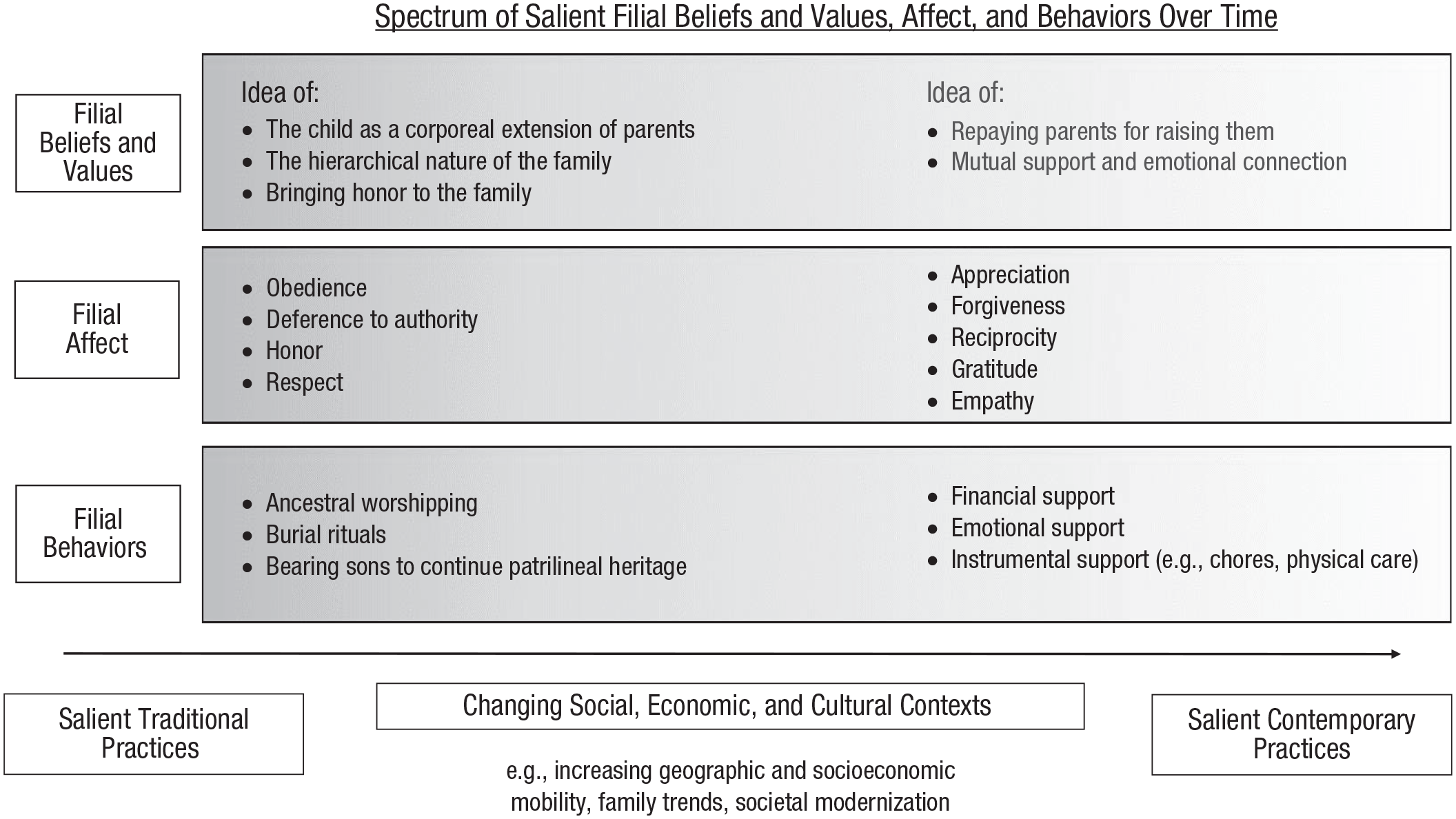
Development of filial beliefs and values, affect, and behaviors over time. The dimensions of filial piety evolve over historical time, and the substantial heterogeneity in these transitional processes across and within individual families and cultures result in a blend of traditional and contemporary forms of filial piety observed within society.
Misconception 2: Filial Piety Is Limited to Asian Societies
Because of its indigenous roots in Confucian cultures, filial piety has typically been associated with East and Southeast Asian societies, with most research constrained to these cultural niches. However, the concept of filial duty as a moral responsibility has long been a cornerstone of both ancient Western and Eastern philosophical discourse (e.g., Liu, 2007), suggesting broader cultural relevance. Evidence suggests that the value of prioritizing family relationships over individual interests transcends Asian cultures. For example, Schwartz et al. (2010) found that Asian (filial piety), Hispanic/Latinx (familism), and Black/African (communalism) descendants in the United States share the value of family primacy. Despite their commonalities, they differ in scope: Filial piety primarily centers on one’s parents, familism emphasizes the importance of the extended family, and communalism may be extended to nonblood kin in the community (Schwartz et al., 2010). Notably, family primacy may function as a double-edged sword because it is associated with both psychological well-being and distress (Schwartz et al., 2010). Bedford and Yeh’s (2019) dual filial piety model may help explain mixed findings by distinguishing authoritarian filial piety (closely corresponding to the traditional filial piety based on obligation and duty) from reciprocal filial piety (based on affection and gratitude to parents). They argued that most of the evidence documenting the negative effect of filial piety on well-being can be attributed to the conflict of authoritarian filial piety with modern societal values (e.g., egalitarianism). Conversely, reciprocal filial piety is more universal and may foster positive child outcomes. In support, Leung et al. (2010) demonstrated that reciprocal filial piety was positively associated with children’s life satisfaction, whereas authoritarian filial piety was negatively associated.
Following the principle of “universalism without uniformity” (Shweder & Sullivan, 1993) in cultural psychology, we propose that although dimensions of filial beliefs, values, and affect may be broadly shared, the behavioral practice of filial piety manifests in more heterogeneous ways across communities. For example, despite a shared influence of Confucian ideology across East Asian societies, there are unique subtleties in how and to what extent filial values are manifested and enacted through language (e.g., whereas Korean children are socialized from a very early age to use formal speech when talking with parents, an increasing trend has been observed in Japanese homes in which Japanese children are encouraged to adopt more intimate and casual speech with parents; see Brown, 2015; Nakamura, 2001). Another cross-cultural nuance lies in the form of instrumental support. Specifically, Esteve and Liu (2018) observed that there are between- and within-cultural variances in the preference for intergenerational co-residence. They found that although intergenerational households have declined in Japan, Taiwan, and South Korea, this trend is less pronounced in China. Despite sharing a cultural emphasis on filial piety, demographic trends—such as decreasing marriage and fertility rates—interact with filial norms, influencing the prevalence and nature of intergenerational co-living in these countries. Overall, although identifying shared, prototypical values of filial piety across cultures is important, it is equally crucial to recognize the diversity in filial practices as shaped by cultural scripts, customs, and tools within each ecological niche.
Misconception 3: Filial Piety Is Relevant Only in Caregiving Contexts for Aging Parents
The third misconception is that filial piety is pertinent only when children reach adulthood. Consequently, the bulk of filial piety research focuses on adult children’s caregiving for older adult parents, with most measures developed for use in adult populations (e.g., Lum et al., 2016). This narrow focus has in part contributed to the limited exploration of how filial piety is developed and socialized throughout the life span. Although certain filial behaviors may not be readily observable during early childhood, the socialization of filial piety begins early in life, as evidenced by parents’ socialization goals of filial piety (e.g., showing respect; Luo et al., 2013). From early childhood, children’s engagement in daily family practices (e.g., waiting for parents as the first to begin eating at dinner) gradually shapes their filial piety. Further, children learn filial values outside their families through cultural media such as storybooks (e.g., respecting parents; Kim et al., 2018) and formal education programs (e.g., Character and Citizenship Education curriculum in Singapore).
Filial behaviors may change in response to life events and demands specific to the developmental stages. Juang and Cookston’s (2009) longitudinal study observed a within-person decline among Chinese American adolescents in one facet of filial behaviors—complying with family obligations such as helping with family errands—over 2 years. Given that it remains an open question whether this decline reflects a normative developmental trajectory or cultural shifts (e.g., cohort effect), research designs that consider both developmental stages and historical context are essential for understanding the development of filial piety. A life-span developmental perspective can help illuminate previously understudied dimensions of children’s filial behaviors. For example, ways to bring pride to the family may include achieving academic success in childhood and adolescence (Luo et al., 2013), but in adulthood, filial piety may instead be enacted by selecting career paths valued by parents. Similarly, parents may adjust their filial expectations (e.g., from emphasizing respectful behaviors in preschool to prioritizing good grades in school years) as children progress through developmental stages. Figure 2 illustrates the evolving expectations of children’s filial piety across developmental stages. Herein, we highlight the behavioral manifestations of filial piety; as previously argued, behaviors exhibit the most pronounced variations across sociocultural contexts.
An essential caveat when interpreting Figure 2 is that the socialization process is not unilateral because children play active roles in their socialization processes (e.g., Darling & Steinberg, 1993). Moreover, when parents and children have incongruent perceptions and expectations of filial piety, negotiations and adjustments may often follow (e.g., Guo et al., 2020). Understanding this dynamic and the reciprocal nature of parents’ and children’s perspectives on filial piety can shed light on potential conflicts or tensions in its fulfillment. For instance, the (mis)alignment in filial expectations, enactment, and receipt within dyads has been implicated in mental-health issues among adult populations (e.g., Liu et al., 2020).
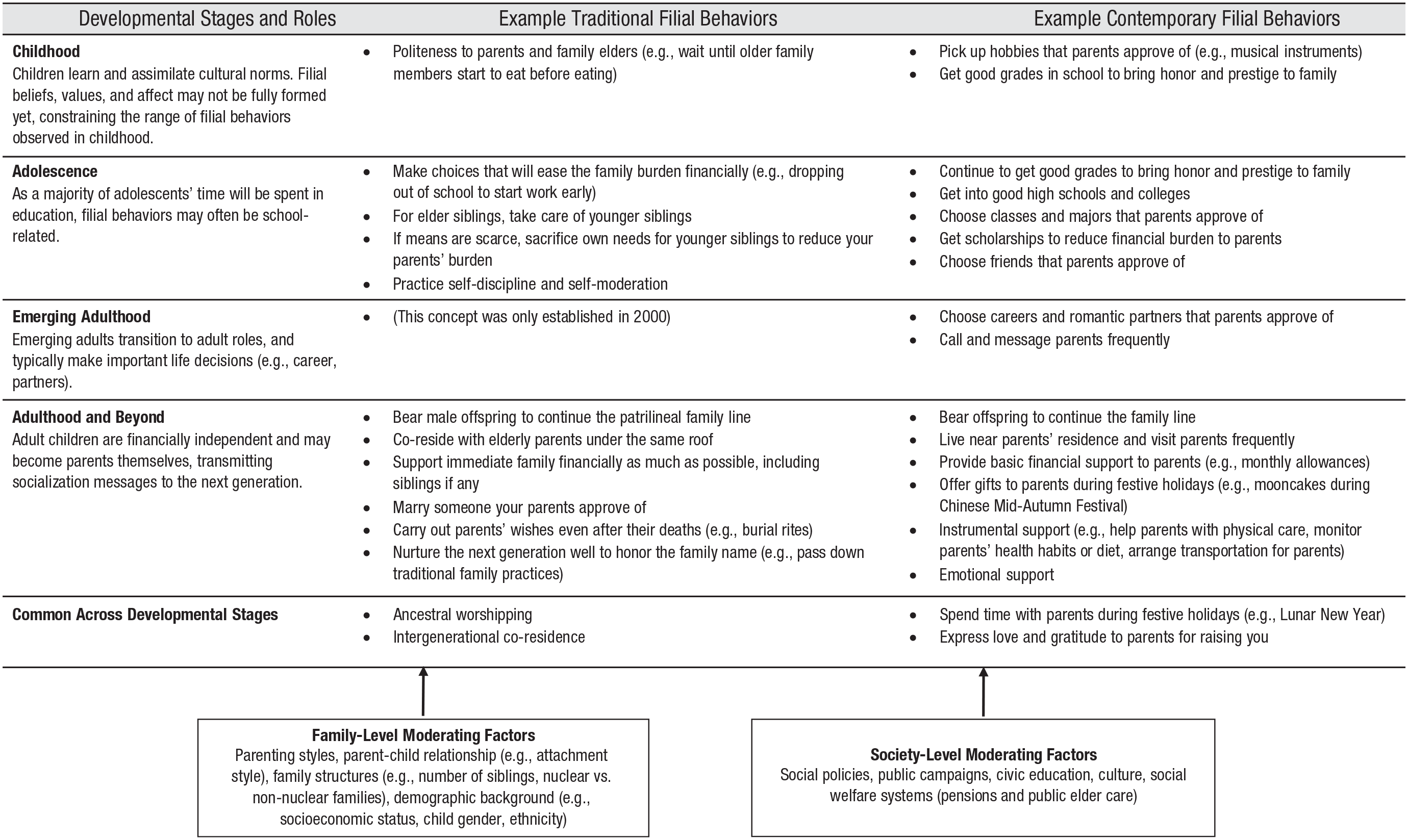
Examples of Filial Behaviors Across Historical Time and Life Span.
Recommendations for Future Research
Examining cultural universality and specificity
To validate the additive value of researching filial piety, we point to some pertinent methodological issues. First, future research should critically evaluate the psychometric properties of existing filial piety measures, particularly how they distinguish between beliefs and values, affect, and behaviors—dimensions that may exhibit varying degrees of cultural universality versus specificity. Although constructs such as familism and communalism share conceptual overlap with filial piety (Schwartz et al., 2010), research examining these values alongside filial piety remains largely U.S.-centric. As noted by Smola and Fuligni (2024), elucidating similarities and differences in these adjacent concepts will promote an understanding of kinship relationships in the global context. Future research can examine the unique contribution of filial piety to parent-child well-being beyond the role of other relevant parenting constructs (e.g., perceived parental warmth: Leung et al., 2010; attachment: Bedford & Yeh, 2019).
Investigating socialization processes across developmental stages
To examine filial piety in the context of lifelong development, we highlight some research questions and methodological concerns. First, how do children internalize filial values, and is there a sensitive period during this socialization process? Do major life transitions and events (e.g., entering parenthood) play a role in shifting filial piety? To aid in this investigation of life course, the developmental sensitivity of filial piety measures should be evaluated. Repeated assessments of parental filial goals and socialization practices (e.g., modeling, direct teaching) would facilitate the elucidation of developmental trajectories over time.
One key limitation of the current literature is the focus on parents within nuclear families. Notably, filial piety potentially extends to nonparental adult figures, such as grandparents, other caregivers, and in-laws. However, the scope of its extension to these targets and the distinction between these extended forms and other adjacent concepts (e.g., familism) remain to be empirically tested. Research should explore various social agents’ (e.g., nonparental family figures, teachers, peers, siblings, media) role in the socialization of filial piety. Furthermore, macrosystem contexts should be accounted for, such as social welfare systems, including pension and public health care. For example, Singapore’s Maintenance of Parents Act, which enables parents aged 60 and above who are unable to support themselves to claim financial assistance from children (Zhan & Huang, 2023), exemplifies how social policies may shape filial practices. Investigating how individuals and families interact within such ecological factors would enrich our understanding of contextualized filial piety across the life span.
Considering both parents’ and children’s perspectives
Some existing literature suggests that the (mis)alignment between filial expectations, perceived filial piety by parents, and children’s actual filial practice might play a significant role in families’ psychosocial adjustment (e.g., Liu et al., 2020). However, research on these dynamics has focused primarily on older adults and their adult children, often relying on single-informant reports on filial expectations and practice (e.g., Liu et al., 2020). Therefore, more research is needed to investigate when these disparities occur and what precursors may foreshadow them in earlier developmental stages. Would more open communication within parent-child dyads be key to resolving disparities between filial expectations and enactment? More empirical evidence is needed to substantiate our understanding of what strategies or interventions may be helpful. Relatedly, do children adjust their behaviors after understanding their parents’ filial expectations? Such feedback loops between parents’ filial expectations and children’s behaviors can be captured in dyadic, longitudinal research designs. Notably, studying this negotiation process across cultures requires caution. In Asian contexts, filial expectations are often implicitly conveyed as an “unspoken agreement” (Yoo & Kim, 2010), and other cultural values, such as “saving face” or fear of burdening children, may complicate support-seeking behaviors (Wang & Lau, 2015). Future research would benefit from examining the intricate interplay of how cultural values are transmitted both implicitly and explicitly. A promising avenue involves examining motivations underlying children’s filial behaviors. Cultural practices are enacted optimally when individuals autonomously endorse cultural values (i.e., doing so by their own choice; Chirkov et al., 2003). Further study is needed to understand how filial values are shaped by the interaction of individual autonomy and agency, and intrinsic versus extrinsic motivations, to manifest in various filial actions.
Conclusion
This article is a call to action to redefine the study of filial piety as a potent organizational concept at the core of families and societies. Establishing an integrative framework that incorporates the multiple dimensions of filial piety (i.e., beliefs and values, affect, and behavior) is pivotal for comprehending how filial piety manifests across the two time scales of historical time and individual families’ developmental stages. Systematic research on filial piety should account for changes across developmental stages and the dynamic reciprocation within parent-child dyads to enhance our understanding of how intergenerational bonding and support are nurtured across the life course.
Recommended Reading
Bedford, O., & Yeh, K. H. (2021). (See References). Reviews the historical evolution of filial piety based on the dual filial piety model.
Chen, S. X., Bond, M. H., & Tang, D. (2007). (See References). Examines the development of the measurement of filial behaviors, highlighting the importance of distinguishing behaviors from beliefs and values.
Lansford, J. E. (2022). Annual research review: Cross-cultural similarities and differences in parenting. Journal of Child Psychology and Psychiatry, 63(4), 466–479. Reviews cross-cultural similarities and differences in parenting and parent-child relationships.
Li, C. (2023). (See References). Examines the key tenets of filial piety from a philosophical and historical perspective.
Schwartz, S. J., Weisskirch, R. S., Hurley, E. A., Zamboanga, B. L., Park, I. J. K., Kim, S. Y., Umaña-Taylor, A., Castillo, L. G., Brown, E., & Greene, A. D. (2010). (See References). Examines the common value of family primacy across diverse cultural groups in the United States.
