



Abstract
Autism has influenced social-cognitive neuroscience in important ways. It has provided the impetus to look for the brain basis of mentalizing and encouraged the search for the brain bases of other social abilities. A fundamental aspect of social interaction is the ability to predict what other agents are going to do. We propose a hierarchy of three worlds—the world of objects, the world of agents, and the world of ideas—that respectively present their own challenges and solutions to such predictions. The world of ideas provides a direct interface between individual minds and other minds (i.e., culture). We highlight the power of culture to change subjective experiences and the power of subjective experiences to influence culture. The example of autism shows these mutual influences at work. These influences have led to dramatic changes in the concept of “autism” since its first use in child psychiatry.
In the 1940s the label “autism” was introduced for a disorder recognized in the clinic in a small number of puzzling children. Leo Kanner identified the key symptoms as “autistic aloneness,” “insistence on sameness,” and “islets of ability.” At first these characteristics were explained in psychoanalytic terms, with toxic parenting thought to be a possible cause (Kanner, 1943). However, this approach was abandoned in the 1970s as evidence for a neurological and genetic basis for the disorder emerged (Amaral, 2017). From the 1960s onward, experimental psychologists began searching for cognitive deficits that could explain social and nonsocial features of autism in the hope of finding clues to their neurological basis. A comparison with nonautistic learning-disabled children revealed weaknesses as well as strengths, such as rote memory for words and shapes (Hermelin & O’Connor, 1970). But none of these investigations explained the difficulties in social communication.
This changed in the 1980s when a novel concept referred to as “theory of mind,” or “mentalizing,” came closer to explaining these difficulties. Mentalizing was proposed as a cognitive mechanism that enables us to represent mental states, such as intentions, beliefs, and desires, and use them to predict what another agent is going to do. The hypothesis was that this mechanism might not be working for autistic children. This hypothesis was confirmed in a wide range of experiments. The first of these used the Sally–Anne task. Here, the critical point is to understand that Sally has a false belief about where her ball is because she did not know that Anne had moved it from its original location (Baron-Cohen et al., 1985). 1
It is now widely agreed that mentalizing comes in both implicit (unconscious) and explicit (conscious) forms (Apperly & Butterfill, 2009). Research is still in progress to determine whether the implicit tracking of mental states is an innate predisposition and can be observed in human infants. It also remains to be clarified just how it differs from explicit mentalizing. However, it is now well established that typically developing children start to pass explicit mentalizing tests around the age of 4 (Wellman et al., 2001). In contrast, autistic children tend to pass these tests at a much later age (Happé, 1995). Highly intelligent autistic adults easily pass explicit tests such as the Sally–Anne task but may have difficulties with the implicit form of mentalizing. This possibility is suggested by the absence of the commonly observed anticipatory eye gaze toward the place where Sally believes her ball is to be found (Wu et al., 2024).
Regardless of controversies that exist around the question of whether mentalizing can explain impairments in social communication, autism helped to cement a fundamental distinction between cognitive mechanisms that are dedicated to the processing of mental states versus physical states. For example, in one study children had to prevent a thief from getting at the contents of a box. In one condition this required deception (telling the thief the box was locked when it was open); in another condition it required sabotage (locking the box). Autistic children with a wide range of verbal IQs largely failed to use deception but were perfectly able to use sabotage (Sodian & Frith, 1992). This dissociation between brain processes relevant to physical and social worlds has been demonstrated in brain imaging studies with neurotypical adults. These studies suggest that there is mutual inhibition by the brain network that processes physical causes (e.g., gravity) and the brain network that processes mental causes (e.g., beliefs; Jack et al., 2013). We suggest that this is likely to be a fruitful area for future studies.
In the 1990s, with the advent of functional brain imaging techniques such as PET and MRI, the search for the neural substrate of mentalizing became possible. Several paradigms have been used for this purpose. For example, in the verbal domain, social narratives were contrasted with physical narratives (e.g., Fletcher et al., 1995). In the visual domain, videos of animated triangles were contrasted, with some designed to appear to move randomly and some to appear to move intentionally (Castelli et al., 2000). Many such studies were carried out with neurotypical participants with robust results (e.g., Hillebrandt et al., 2014). The studies revealed a mentalizing system in the brain, highlighting three distinct hubs in ventromedial prefrontal, temporoparietal, and precuneus regions (Frith & Frith, 2023, Chapter 10). Studies with autistic adults showed unusual brain activity, suggesting a relative functional disconnection between these hubs (Müller & Fishman, 2018).
The Social Brain
The study of autism put the spotlight on the “social brain” and hinted at the existence of distinct mechanisms, such as mentalizing, which can be related to cognitive abilities that enable fluid interaction and communication (Frith & Frith, 1999). It led us to reconceptualize some of our social skills as having their roots in innate dispositions and to differentiate them from those that depend on internalized cultural norms. It also led us to try differentiating social impairments that are due to glitches in brain development from those that are due to environmental factors, such as a language’s writing system (Paulesu et al., 2001).
The study of autism also made clear that there is far more to being social than mentalizing. Thus, we extended our interest to discover more about what makes us social, resulting in 20 chapters (free to download) of a monograph (Frith & Frith, 2023) in which we discussed processes involved in cooperation (e.g., imitation), competition (e.g., in-group/out-group formation), and culture (e.g., teaching). Imitation is underpinned by mirror neurons, a prominent example of a social mechanism that humans share with monkeys and birds (Bonini et al., 2022). Contrary to early suggestions that the mirror neuron system might be compromised in autism, the mechanisms involved in copying actions are largely intact (Hamilton, 2008). Likewise, experimental studies targeting out-group stereotyping revealed this tendency to be present in autistic children just as much as in neurotypical children (Hirschfeld et al., 2007).
Some Ideas on the Evolution of the Social Brain
How did the social mechanisms that the human brain commands without any conscious effort come about? To provide a framework for future studies of the evolution of our complex social nature, we focused on one aspect: the automatic ability to predict what another agent is going to do next. Figure 1 presents a sketch of a hierarchical model that distinguishes between processes that are adapted specifically for the worlds of objects, agents, and ideas (Frith & Frith, 2023, Chapter 7).
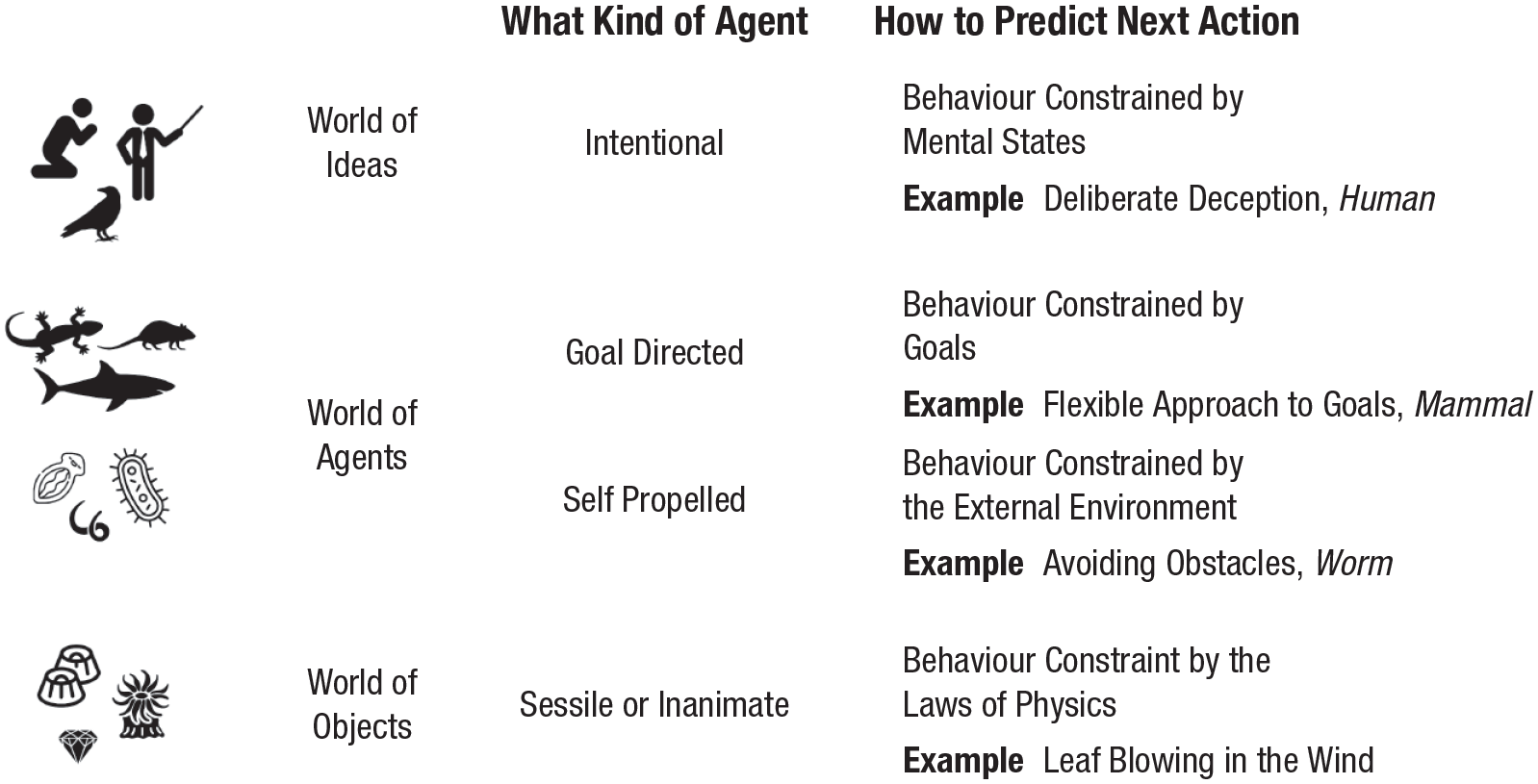
Schema inspired by the idea that the evolution of the mechanisms for predicting behavior began with the emergence of self-propelled creatures. We can recognize self-propelled behavior because changes in the speed and direction of movement occur in the absence of external forces. Objects that behave in this way are perceived as living agents (Tremoulet & Feldman, 2000). Predicting the movements of such creatures is possible because of physical constraints. In contrast, we detect goal-directed agents because they reach their goal via the shortest or least effortful path (Liu & Spelke, 2017). In the world of agents, knowing the goals of others enables us to predict their behavior because this behavior is constrained by goals. The behavior of intentional agents is also constrained by their beliefs and desires. We can predict behavior by making inferences about hidden mental states. This type of prediction requires mentalizing. However, it is difficult to recognize an intentional agent simply by observing behavior. Prior expectations about the agent play an important role (e.g., Stanley et al., 2007).
This schema is inspired by the idea that the evolution of the mechanisms for predicting behavior began with the emergence of self-propelled creatures. We can recognize self-propelled behavior because changes in the speed and direction of movement occur in the absence of external forces. Objects that behave in this way are perceived as living agents (Tremoulet & Feldman, 2000). Predicting the movements of such creatures is possible because of physical constraints. In contrast, we detect goal-directed agents because they reach their goal via the shortest or least effortful path (Liu & Spelke, 2017). In the world of agents, knowing the goals of others enables us to predict their behavior because this behavior is constrained by goals. The behavior of intentional agents is also constrained by their beliefs and desires. We can predict behavior by making inferences about hidden mental states. This type of prediction requires mentalizing. However, it is difficult to recognize an intentional agent simply by observing behavior. Prior expectations about the agent play an important role (e.g., Stanley et al., 2007).
To predict the behavior of other agents we need to know what kind of agent we are dealing with. Figure 1 illustrates our suggestion that there are three kinds of agents with increasing degrees of sophistication. We recognize that an agent is self-propelled because it can change direction without the application of any external force (e.g., when avoiding an obstacle). More sophisticated agents are goal-directed (e.g., animals with central nervous systems). They can reach their goal by different routes, choosing the one that is currently the most efficient.
At the highest level we have creatures, humans in particular, whose behavior is determined by hidden mental states, such as beliefs and desires. To understand and predict their behavior we need to adopt an intentional stance (Dennett, 1987). We call this level the world of ideas. It constitutes the interface between individual minds and other minds. Here we use mentalizing to aid the prediction of what other agents are going to do. Movements here often serve ostensive communication indicating that relevant information is forthcoming (Scott-Phillips, 2024). They may be devious, perhaps to hide one’s goal, or exaggerated, perhaps to aid teaching.
Importantly, the mere observation of behavior is not sufficient to detect an intentional agent. Prior expectations about whether agents are intentional will determine how we experience their behavior (Stanley et al., 2007). Reflecting on our studies with animated triangles, we found that the merest hint that they are protagonists of little stories was enough for observers to slip into the intentional stance and start mentalizing (Castelli et al., 2000). There is a dark side to mentalizing (Frith & Frith, 2023, Chapter 11). We can change people’s behavior by imparting false beliefs. Hence, we propose that the primary value of mentalizing lies in its use as a tool for competition.
The unique position of human agents may to some extent be based on their ability to move freely between the world of objects, the world of goal-directed agents, and the world of ideas (Frith & Frith, 2023, Chapter 7). Nevertheless, we like to think that the intentional stance is such a powerful way of interpreting our own and other agents’ behavior that it tends to predominate. Automatic inferences about mental states—and sometimes very consciously made inferences—are a far better way of predicting what other humans are going to do than merely observing what goals they approach or avoid. But there is an even more important aspect of the world of ideas. Ideas are developed, changed, and shared between different minds. This creates cumulative culture. Here we come to talk of a different kind of evolution in which effects act on individual brains rather than on genes. Here our social behavior is shaped by norms and conventions. They must be communicated to us by others around us, often in the form of deliberate teaching (Frith & Frith, 2023, Chapter 17).
The Culture Interface
For a long time, psychology forgot that we are not alone. Our natural umwelt is other people. Future research should therefore invest in studying how other minds penetrate into the mind of an individual (Sperber, 1996). Cultural influences not only are noticeable at the conscious level, for example, when we talk to each other about what is good taste, but also can trickle down even to the unconscious sphere and affect our private and subjective experience (Heyes et al., 2020; Frith & Frith, 2023, Chapter 14). Without any conscious effort we can share our beliefs about the world and work together to make them more accurate, or at least aligned. However, in the world of ideas, both trustworthy information and misinformation are traded freely. This is a problem of social communication we must grapple with constantly.
We propose that the history of autism is shedding some light on this problem. One result of being open to the influence of other minds is that culture highlights both differences and similarities between individual minds. It also makes us aware of what is considered normative in a particular group, how we should behave, and what attitudes, feelings, and beliefs are appropriate to hold (Frith & Frith, 2023, Chapter 18). Likewise, culture shapes our acquisition and use of abstract concepts (Ojalehto & Medin, 2015). Concepts that are ambiguous and perhaps only tenuously based on objective facts are most likely to be malleable. This would seem to apply to most of our concepts relating to mental health. There is a tendency for diagnostic categories of mental disorders to broaden their meanings over time, and broader categories lead to increases in prevalence (Foulkes & Andrews, 2023). Autism provides an instructive example of this tendency.
Autism as a Culturally Malleable Concept
There have been striking changes in the beliefs of what kind of entity autism represents. When first recognized medically, autism was identified mainly in a subgroup of children with intellectual impairment. This is no longer the case, and over time there have been subtle changes in the diagnostic criteria, resulting in a large increase in cases. Among the many drivers of this increase was the inclusion of milder cases, resulting in a “spectrum.” However, the increase seen over the last 20 years has not been uniform across the spectrum. The prevalence of autism in children with intellectual impairment showed the least increase, and young adults, especially females, showed the steepest rise (Russell et al., 2022). Many of these individuals have IQs above average and are highly articulate. They often share their experiences online, where a shift in focus from social difficulties to sensory issues has become apparent.
An important cultural trend in Western liberal societies is the rejection of the medical model of mental-health conditions in favor of a social model. Here autism is seen not as a disability but as a difference, an individual expression of neurodiversity (e.g., Dwyer, 2022). This raises the question as to whether individuals now diagnosed as autistic can all still be accommodated under one umbrella. The answer can come only from new research.
How did public interest in autism rise to an extraordinary level, and how did autism become a sought-after diagnosis? We can only speculate in the hope that future historians will be able to unravel the causes. One story we like to tell is that it all started with one or two well-documented autistic individuals of high intelligence and exceptional gifts. These cases rapidly found their way into fiction that resonated with readers and viewers. They evoked an older icon of folk psychology, the lone genius who is hopelessly inept in interacting with other people. Everyone seemed to know someone like this, usually a man, who typically excelled at logical precision while lacking in emotional engagement. This combination implies both strength and weakness and corresponds to the uneven profile of cognitive abilities in autistic individuals. Actors portraying this type of person, such as Dustin Hoffman in Rain Man, excelled in emulating autistic features, such as gaze avoidance, motor mannerisms, and speech peculiarities.
We suggest that the cultural icon of autism in fiction was enhanced by autobiographical reports of individual experience and that individual experience was in turn enhanced by the expectations created by the icon. Affected individuals would relate their subjective experiences to clinicians, with the result of reshaping diagnostic practice. The mechanism behind these mutual influences has been termed “looping” by the Canadian philosopher of science Ian Hacking. He proposed that a poorly defined mental disorder can be given shape in popular imagination by taking hints from a wide variety of narratives, some with glamorizing content. This meant that some individuals who, for a variety of reasons, considered themselves outsiders, could find a new identity, “a way to be a person, to experience oneself, to live in society” (Hacking, 2006, para. 10).
The current concept of “autism” is almost unrecognizable compared with the one we understood 60 years ago (Happé & Frith, 2020). However, it is likely to change further. Social media are providing prolific amounts of information about autism. A pioneering study counted collectively 11.5 billion views of TikTok videos associated with the hashtag #autism and analyzed those obtained on a single day (Aragon-Guevara et al., 2023). They selected videos with informational content, setting aside videos that shared personal experience, which were in fact far more common. Although these informational videos had close to 200 million views and 25 million likes, only a third was considered accurate. This is concerning in view of young persons’ presumed reliance on social media as sources of knowledge.
We are also concerned about those autistic individuals who cannot speak for themselves and often need lifelong support. Sadly, they have been not only overshadowed by TikTok stars but also neglected by autism researchers. The Autism and Developmental Disabilities Monitoring Network (2024) reported a prevalence of autism in 2.8% of 8-year-olds; of all those diagnosed, 33% had an intellectual disability (IQ < 70), and another 24% had a borderline IQ score (71–85). Low IQ scores are associated with various behavioral impairments and psychiatric complications. To us this strongly suggests the presence of a neurodevelopmental disorder. But this is only one subgroup. It is unclear whether there are other subgroups for which it is more appropriate to assume a “difference not a disorder.” Research is urgently needed to resolve this question.
Conclusions
We believe that the time is right for social neuroscientists to study mechanisms of social behavior that we inherited through evolution and share with many other animals, as well as the cultural processes that modify and shape our social concepts. The example of autism has opened a door into these still largely unexplored fields. The relatively short history of autism provides a dramatic example of conceptual change at the two-way interface between culture and subjective experience. There is much to be discovered about why and how this change occurred. We need to find out how precisely culturally propagated ideas penetrate individual minds and how subjective experience infiltrates cultural norms. The world of ideas is the stage for new research that will drive changes in the way we understand our social nature.
Recommended Reading
Fletcher-Watson, S., & Happé, F. (2019). Autism: A new introduction to psychological theory and current debate. Routledge. Reviews research on autism and includes a detailed discussion of neurodiversity.
Foulkes, L., & Andrews, J. L. (2023). (See References). Points out that efforts to remove stigma and raise awareness of mental health can have unexpected downsides, such as leading to a prevalence inflation.
Frith, C. D., & Frith, U. (2023). (See References). Reviews and discusses studies on a large variety of social processes relevant to cooperation, competition, and culture.
