



Abstract
We introduce the concept of “metajudgment” to provide a framework for understanding folk standards people use to navigate everyday decisions. Defined as a set of metatheories and beliefs about different types of judgment, metajudgment serves as the guiding principle behind the selection and application of reasoning strategies in various contexts. We review emerging studies on metajudgment to identify common dimensions, such as intuition versus deliberative reasoning and rationality versus reasonableness. These dimensions are examined across multiple societies. The reviewed findings illuminate an apparent paradox: Universal adaptive challenges produce largely consistent folk standards of judgment across cultures, whereas situational demands drive systematic within-person variability. Metajudgment offers a comprehensive framework for understanding diverse reasoning patterns in individual and cross-cultural contexts, calling for greater attention to the ecologically sensitive study of within-person judgmental variability.
Consider Jay, an office worker starting the day by choosing a new project colleague. Guided by gut instinct, Jay opts for someone who struck them as likable and intelligent during onboarding. Later, faced with the choice to upgrade their office computer, Jay consults the IT officer and simply follows their advice. By the afternoon, Jay has first pick in an office-space lottery and selects the coveted corner office with a window. As the day closes, Jay rushes to a local election, voting for a candidate whose policies benefit the broader community rather than the candidate whose policies benefit Jay specifically.
In such situations, individuals must habitually or intentionally select the way to approach their judgments. Options abound: One may rely on intuition, follow expert opinions, or opt for careful deliberation. The focus of these standards can also differ, prioritizing personal gain or broader societal benefits. Jay’s example demonstrates how one person can shift between these standards in the span of a day.
To explore this phenomenon, we introduce the concept of “metajudgment,” spotlighting the normative standards guiding daily choices. Related to existing concepts such as “metacognition” and “metareasoning,” metajudgment specifically focuses on the pluralistic nature of strategies and choices implicated in one’s judgment. It encompasses intuitive and deliberative processes in selecting judgmental approaches and the potential discrepancies between the type of judgment used at the meta level versus the task level (e.g., an intuitive metajudgment to favor deliberation on a specific task).
We propose that Jay’s situationally attuned adaptability—far from being a bug—is an evolved feature that fits the complexity of human experience. Surprisingly, despite its deep roots in intellectual history, the concept of “metajudgment” has not been systematically studied in modern psychological research. We aim to fill this gap by demonstrating that people use situated judgment standards that, although subjective, are remarkably robust across societies yet flexible to adapt to various life situations.
Defining Metajudgment
Metajudgment is any mental activity in which judgment itself becomes the object of analysis. It involves applying folk standards of judgment, whether implicitly or explicitly, to guide one’s decision-making and to evaluate the quality of one’s own or others’ judgments in specific contexts. It draws inspiration from the Aristotelian idea of “phronesis,” or practical wisdom (Grossmann et al., 2020; Hammond, 2007; Kristjánsson et al., 2021; Schwartz & Sharpe, 2019), and from recent theories and research on parallel topics concerning metamotivation (e.g., Miele et al., 2020), folk beliefs (e.g., Boyer & Petersen, 2018; Schlösser et al., 2015), and recent calls to expand the notion of rational judgment to consider variable strategies or tools that enable people to pursue welfare-enhancing goals and live a good life (Schwartz, 2015). Assessing the validity and reliability of judgments is central to critical thinking and effective decision-making—a guiding principle that has shaped scholars and their programs of research in fields as distinct as person perception, moral psychology, motivation science, and behavioral economics. Indeed, classic theories of judgment and decision-making take for granted that people exercise metajudgment in such activities as opting whether to rely on heuristics or engage in more systematic processing (e.g., Kahneman, 2011; Payne et al., 1993). Recent work extends these ideas, proposing formal models of metareasoning for heuristic selection (Lieder & Griffiths, 2017), frameworks for narrative-guided decision-making for situations in which the probabilities or outcomes are unknown (Johnson et al., 2023), and frameworks for judging when it is acceptable to base decisions on consequences versus principles (Everett et al., 2018). Thus, although metajudgment may seem like a novel construct in psychology, it has been a nexus connecting insights from diverse fields and a ubiquitous feature of human experience.
Understanding Metajudgment
Because metajudgment relies on one’s understanding of the standards of judgment, studying metajudgment requires examining underlying folk theories of what judgmental or decision-making approaches would be appropriate within specific contexts (Fig. 1). These folk theories are knowledge frameworks that organize and interpret information on the basis of past experiences and learned associations, similar to the implicit theories described in research on lay beliefs about traits (Ross, 1989), abilities (Dweck, 2013), or the nature of the self (De Freitas et al., 2018). Although often operating habitually, folk theories can be elicited with explicit prompts (Ross, 1989). Likewise, metajudgment is relevant not just to contexts in which people consciously deliberate about which judgment standard to apply. Through repeated exposure to situations that require consciously applying lay theories to select appropriate judgment standards, people develop expertise in using these theories in their lives. In turn, this expertise allows them to make implicit metajudgments without deliberate reflection.
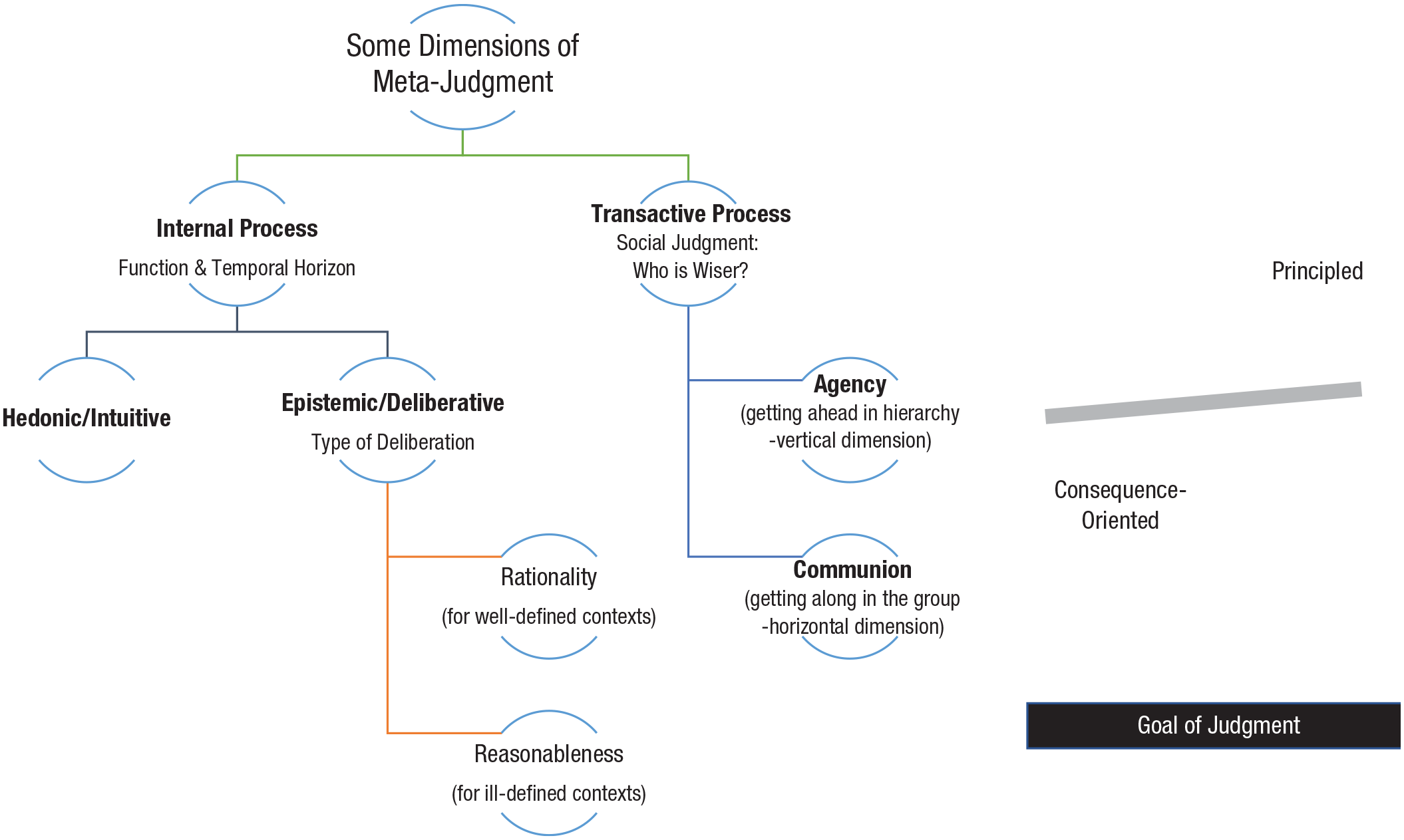
Example dimensions of metajudgment. People may encounter a plurality of judgmental standards that they flexibly adapt to guide and evaluate judgment in everyday contexts. Within each branch, the options are typically treated as independent such that people switch between them on the basis of the demands of the situation. However, across branches, different dimensions can be applied concurrently, allowing for a blending of judgmental standards. For example, an individual might consider both the goals (e.g., prioritizing principles over consequences) and the process (e.g., favoring intuition over deliberation). The angled gray bar refers to the weighting of different goals. The “transactive” branch refers to instances in which individuals decide they should outsource their judgment to external sources (vs. chiefly rely on internal processes), raising the question of whom to outsource the judgment to (e.g., other people or AI systems). In these cases, metajudgment involves assessing the social-cognitive characteristics of the external agent, such as their perceived agency (ability/assertiveness) or communion (morality/friendliness), to determine the appropriate source of judgment.
Some folk theories of judgment may recommend pursuing judgment in a principled fashion or attending to consequences (see Fig. 1). Folk theories may also vary in favoring judgment based on internal cognitive and affective information processing or external strategies involving outsourcing one’s judgment to other people or an AI system. Folk theories further distinguish types of internal strategies: intuitions driven by affective hunches and deliberations driven by reasoning. Finally, they may distinguish within the category of deliberative judgment, distinguishing rational judgment, which uses reasoning to apply abstract, decontextualized rules that generalize across situations, from reasonable judgment, which uses reasoning to discern what is the best course of action in a particular situation.
Consider how these different aspects of metajudgment come into play when democratic citizens reflect on what standards should be used to decide about voting in an election. Citizens may consider different goals of judgment, such as whether to vote to prevent a disliked politician from being elected (consequence focus) or to perform their civic duty regardless of its impact on the election outcome (principle focus), mapping on utilitarian and deontological ethics (Alexander & Moore, 2021). Irrespective of goals, they may consider whether it is more appropriate to base voting decisions on one’s beliefs and feelings about the candidates or rather on others’ judgments, such as endorsements by prominent individuals and groups. Here, folk theories also provide standards for evaluating the judgmental competence of external agents that one may outsource judgments to, such as deciding whose endorsements are worth following. Further, citizens may consider the appropriateness of basing their voting decision on gut feelings about which candidate looks more competent or a careful consideration of the candidates’ credentials and positions. Finally, they may consider a rational preference that followed a general rule such as always choosing the candidate who best serves their self-interest, or a reasonable preference for discerning which candidate best balances a range of conflicting interests in the community at a particular time.
Emerging Patterns in Metajudgment Research
Although systematic research on metajudgment is still in its infancy, some patterns have emerged from examining how people’s preferred standards of judgment vary at the micro level across specific situational contexts and at the macro level across cultural groups.
Preference for internal versus transactive strategies
Research has investigated people’s metajudgments about preferences for internal or transactive strategies (Fig. 1). Participants from Canada, China, Ecuador, Germany, India, Japan, Morocco, Peru, South Africa, South Korea, Slovakia, and the United States were asked whether they would prefer internal strategies (i.e., follow one’s internal deliberation or gut feelings irrespective of what others say) or transactive strategies of judgment (i.e., follow recommendations from family, friends, or wisdom of crowds irrespective of internal deliberations). They were also asked which strategies they considered wise and to rate the extent they would expect feeling good choosing each. People in most societies favored and considered internal strategies wise and anticipated feeling better choosing them (Grossmann et al., 2024). Concurrently, a nonnegligible amount of shared variance in judgmental preferences was due to country-specific (preferred = 3.3%; wise = 3.5%), situation-specific (preferred = 7.5%; wise = 7.6%), and person-specific (preferred = 20.3%; wise = 24.6%) differences, with endorsement of internal preference ranging from 58% among Hindu-speaking Indians to 85% among Slovakians. Critically, individualists were more likely than collectivists to choose internal strategies.
However, there are instances in which people defer to others, particularly experts or even AI systems, when making judgments. Research on learning from testimony highlights children’s willingness to rely on information provided by others, especially when the informant is perceived as knowledgeable or trustworthy: Children are more likely to trust testimony from informants who have demonstrated expertise or reliability in the past, and they are sensitive to cues such as confidence, consensus, and plausibility when evaluating the credibility of testimony (for review, see Harris et al., 2018).
This tendency to defer to others extends to adulthood, as evidenced by research on deference to expert advisors and AI. Decision makers are more likely to follow advice from advisors who express high confidence in their recommendations, even when the advisors’ expertise was not explicitly stated (Sniezek & Van Swol, 2001). Furthermore, people seem willing to defer to AI advice when the task is perceived as objective and the AI’s decision-making process is transparent (Castelo et al., 2019; Oktar & Lombrozo, 2022) but hesitate to fully rely on AI medical recommendations compared with advice from human experts (Longoni et al., 2019), possibly because AI is perceived as lacking the experience of human experts (Hou & Jung, 2021).
These findings suggest that although people generally prefer internal strategies for judgment, they are willing to defer to others, including experts and AI systems, under certain circumstances. The perceived expertise and trustworthiness of the informant, the nature of the task (e.g., objective vs. subjective), and the transparency of the decision-making process influence people’s metajudgments about when to rely on external sources of judgment.
Preferences for qualities in external sources of judgment
When engaging in the transactive process of relying on others’ judgment, metajudgments about whom to consult lead people to consider distinct dimensions of judgmental competence. As commonly observed in person perception (Abele et al., 2021), people evaluate others along two fundamental dimensions: agency (related to getting ahead) and communion (related to getting along). This finding is largely mirrored in a cross-cultural study on the evaluation of judgmental competence that found that people from 12 different countries across five continents consider both socioemotional competence (involving a combination of agency, communion, and morality) and reflective orientation (tracking general reflective ability) when assessing the wisdom of others (Rudnev et al., in press). These dimensions are reflected in the labels “agency” and “communion” (Fig. 1), capturing the plurality of competencies people value in external sources of judgment.
The plurality of the types of external judgmental sources is further highlighted by research on leadership and decision-making that reveals that people’s preferences for more or less differentiated individuals as external sources of judgment vary depending on the situational context. In times of crisis or uncertainty, people may prefer leaders who engage in practical and concrete “sensemaking” (Mumford et al., 2007) and provide clear, decisive guidance, even if that means simplifying complex information (Bligh et al., 2004). Conversely, in more stable situations or those that require long-term planning, people may prefer individuals who exhibit higher levels of cognitive complexity and can consider multiple perspectives (Tetlock, 1983).
Research on the perception of wisdom in cultural-historical exemplars provides further insight into the distinct qualities people value in external sources of judgment. People recognize and appreciate different forms of wisdom, such as practical wisdom (exemplified by strategic, pragmatic leaders in a time of a crisis), philosophical wisdom (exemplified by individuals who engage with complex, abstract ideas), and benevolent wisdom (exemplified by compassionate, empathetic leaders promoting welfare and positive social change; Weststrate et al., 2016).
Preference for intuitive versus deliberative judgment
Colloquial accounts of decision-making involve choosing between one’s “gut” or “head”—a distinction compatible with “System I” and “System II” accounts of judgment, respectively (Kahneman, 2011). Although such models are simplified and may not necessarily depict the working of the mind (e.g., De Neys, 2023; Hammond, 2007), there is a question about metajudgmental beliefs: When do people believe it is appropriate to rely on intuition or deliberation? Research has revealed systematic patterns in people’s preferences for intuitive versus deliberative strategies for judgment (Hsee et al., 2003). For instance, Americans think that judgments should be based on deliberation (vs. intuition) when problems are complex (vs. simple), precise (vs. fuzzy), sequential (vs. holistic), and objective (vs. subjective; Inbar et al., 2010). Conversely, Americans consider intuition to be a more reliable basis for judgment when authenticity is a priority (Oktar & Lombrozo, 2022) and when they have greater self-perceived expertise (Pachur & Spaar, 2015).
New research expanded on variation in intuitive versus deliberative preference beyond North Americans (Grossmann et al., 2024). Participants from the same 12 countries described above were asked whether they would prefer/consider wise intuitive or deliberative strategies of judgment across a range of scenarios. Overall, intuitive strategies were selected only 27% of the time, ranging from 13.2% selection of intuitive strategies by participants in Morocco to 39.7% in Canada. Much of the variance in favoring intuitive strategies was person-specific (preferred = 20.0%; considered wise = 25.2%). However, substantial shared variance was also explained by the situation (preferred = 3.6%; considered wise = 3.5%). In comparison, variability by country was more modest (preferred = 2.0%; considered wise = 3.2%) although still meaningful given close to a 20% difference in preference between Chinese individuals and Canadians.
Preference for rational versus reasonable deliberation
Beyond intuition and deliberation, folk theories of judgment also systematically distinguish various types of deliberation (see Fig. 2). Several lines of evidence indicate that people recognize rationality and reasonableness as distinct types of deliberative judgment that are useful in distinct judgmental contexts (Grossmann et al., 2020). Analyses of natural language patterns show that people have a nuanced interpretation of the terms “rational” and “reasonable” in Spanish, Portuguese, Russian, Urdu, and Mandarin languages, underscoring a potential cross-cultural consistency in these conceptual separations. “Rational” is linked to abstract thinking, encompassing qualities such as logic, systematic reasoning, and emotional suppression. Conversely, “reasonable” is linked to social consciousness, fairness, interpersonal sensitivity, and kindness. Some work also indicates that lay concepts of “reasonableness” include both descriptive norms about what most people would do and prescriptive norms about what people should do in everyday situations (Jaeger, 2020; Tobia, 2018). Practically, these observations suggest that a rational individual is perceived as exhaustively weighing options to choose the highest paying job, whereas a reasonable counterpart is perceived as prioritizing a position that also considers social and civic norms.
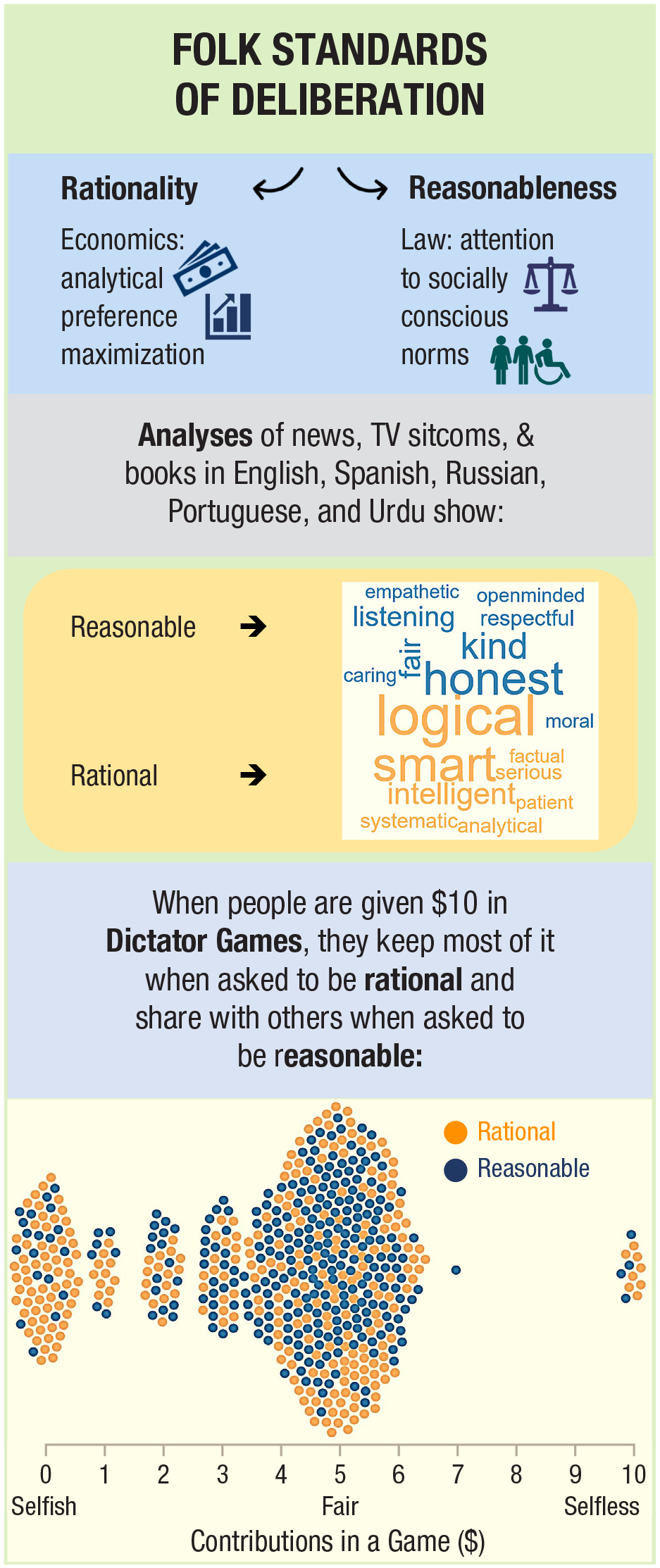
Variable folk standards of deliberate judgment. Like the preference-maximizing economists, people in many countries treat rationality as self-serving, logical, and void of social-contextual concerns. At the same time, like in the common law, people consider reasonableness as context-sensitive, socially conscious, and balancing personal preferences with others’ concerns. Data from Grossmann et al. (2020).
Statements reflecting rational judgment also indicate greater specificity and certainty: The definite article “the” more frequently preceded “rational” (vs. “reasonable”) in English-language corpora (Grossmann et al., 2020). In contrast, the indefinite article “a” more commonly preceded “reasonable” (vs. “rational”), suggesting that reasonableness is more flexible and adaptable than rationality. Beyond semantics, rational individuals aim to optimize, whereas reasonable individuals seek satisfactory outcomes, suggesting a higher need for certainty in well-defined contexts of lay rationality compared with ill-defined contexts of lay reasonableness (Table 1). Critically, further experiments show that the same person would strategically favor the rational or reasonable standard depending on the features of the situation, consistent with the metajudgment framework. For example, in situations in which their interests are in conflict with those of others, people say that they would prefer to have a rational (vs. reasonable) agent to negotiate on behalf of their side but a reasonable (vs. rational) agent to negotiate for the other party’s side (Grossmann et al., 2020). For instance, a person may favor a rational lawyer who prioritizes their client’s self-interest yet a reasonable judge who treats them with procedural fairness. Table 1 summarizes an ongoing program of research that shows insights that can emerge from an investigation of rationality and reasonableness as example folk theories that guide metajudgment.
Framework Distinguishing Folk Theories of Rationality and Reasonableness
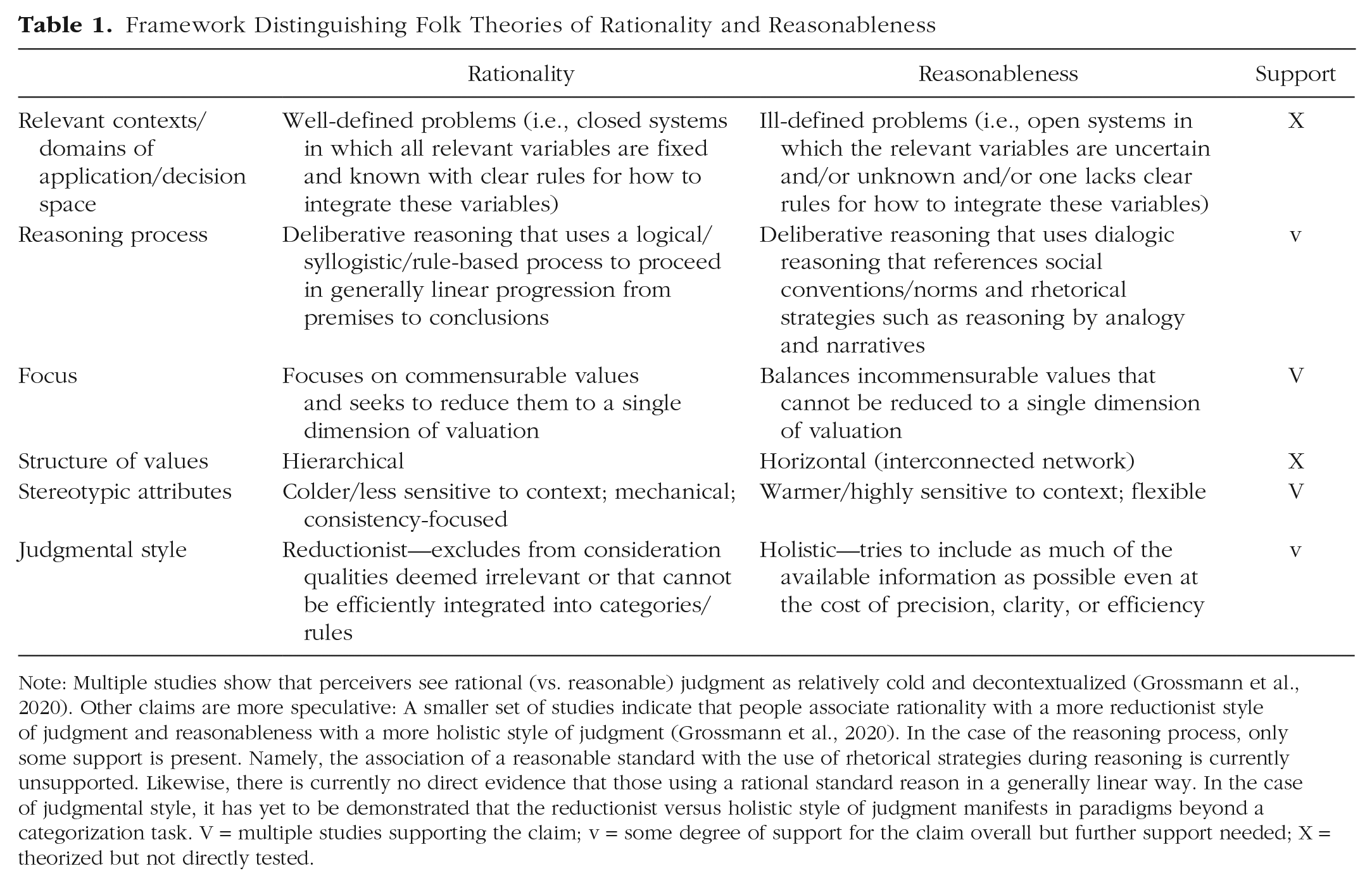
Note: Multiple studies show that perceivers see rational (vs. reasonable) judgment as relatively cold and decontextualized (Grossmann et al., 2020). Other claims are more speculative: A smaller set of studies indicate that people associate rationality with a more reductionist style of judgment and reasonableness with a more holistic style of judgment (Grossmann et al., 2020). In the case of the reasoning process, only some support is present. Namely, the association of a reasonable standard with the use of rhetorical strategies during reasoning is currently unsupported. Likewise, there is currently no direct evidence that those using a rational standard reason in a generally linear way. In the case of judgmental style, it has yet to be demonstrated that the reductionist versus holistic style of judgment manifests in paradigms beyond a categorization task. V = multiple studies supporting the claim; v = some degree of support for the claim overall but further support needed; X = theorized but not directly tested.
Why Variability Across Situations but Apparent Consensus Across Cultures?
The emerging pattern in metajudgment research indicated substantial consensus on preferred strategies across cultures but variability across situations. At least for some folk standards such variability is systematic. Cultures that differ in their languages and social organization not only recognize similar distinctions between intuitive and deliberative judgment (Grossmann et al., 2024) but also distinguish between rational and reasonable approaches to deliberative judgment (Grossmann et al., 2020). Furthermore, across the diverse range of cultures that have been examined, people show an overall preference for internal over external strategies of judgment, and within the category of internal strategies they prefer deliberative over intuitive approaches (Grossmann et al., 2024). At the same time, within each sample the strength of these preferences for internal (vs. transactive) and deliberative (vs. intuitive) approaches varies systematically across judgmental scenarios.
The relatively greater cross-cultural (vs. cross-situational) convergence in preference for specific judgment strategies and the shift in preferences depending on the situation suggest that distinct judgment standards are suited for coping with distinct, adaptive challenges that may be recurrent features of the human experience. Situational affordances may prompt people to align their judgment standards to fit distinct adaptive demands. For instance, the analytical approach characterized by rationality may be judged useful for reasoning about problems in closed systems in which all the relevant parameters are definable, whereas the more holistic approach characterized by reasonableness may be judged useful for reasoning about problems in open systems in which some of the relevant parameters are unknown, changing, or cannot be precisely defined. Computational models can be useful for testing these propositions (e.g., Lieder & Griffiths, 2017).
Critically, our argument does not require a uniform distribution of situations across cultures. Even if cultures differ in the relative frequency of situations requiring different standards of judgment, as long as corresponding types of situational affordances occur regularly enough, people within those cultures may develop and apply each of these standards. Moreover, although metajudgment itself may be a generalizable phenomenon across cultures, cultural differences in the application of distinct judgmental standards and the relevant contexts may be nonnegligible, and some folk standards may be culture-specific, inviting a more thorough investigation of cultural differences in future research (e.g., by examining Indigenous cultures).
Conclusion and Future Directions
People possess rich folk theories guiding their judgment adaptively based on situational demands. Contrary to a one-size-fits-all approach, the same person may define good judgment according to multiple standards: Sometimes it’s about individual discernment; other times it involves expert consultation. Sometimes it is to trust your gut, and other times it’s to carefully deliberate. Sometimes it requires one to be rational, and other times it requires one to be reasonable. This adaptability is central to competent judgment, making metajudgment a vital component of judgmental competence.
The systematic study of metajudgment is critical because misunderstandings may arise when scholars and institutions assume that laypeople use a particular judgment standard that is different from what they actually use. For example, scholars may incorrectly infer errors and biases when laypeople use different criteria, such as reasonableness instead of rationality, to guide their decisions (Tetlock, 2002). Misunderstandings also emerge when lay standards of judgment do not match institutional standards. For example, a judge may instruct jurors to assess the reasonableness of a defendant’s actions, but these jurors’ concept of “reasonableness” may not match the legal definition (Kneer, 2022).
Future work should explore whether individual metajudgment differences predict practical judgment quality in everyday life. The evidence reviewed shows that individuals’ preferences for judgment strategies vary across the scenarios they were asked about, but there are also substantial individual differences in the strength of these preferences: Individuals who switch their judgment strategies more across situations (i.e., those with higher intraindividual variance in judgment strategy choice calibrated to contexts) may score higher on measures of judgment and decision-making effectiveness than those who apply the same judgment strategy regardless of context.
Another research direction would involve folk theories about judgmental biases. Previous research indicates that laypeople are familiar with a variety of motivated biases in human judgment (e.g., overoptimism, egocentrism, in-group favoritism; Pronin & Hazel, 2023). Metajudgment research could build on work to examine whether laypeople believe that intuitive versus deliberative strategies and rational versus reasonable strategies differ in their risk of being distorted by judgmental biases. People may have nuanced theories of judgmental biases, in which they perceive that the context changes the relative susceptibility to bias of various judgmental strategies. Furthermore, folk theories may consider some judgmental standards to be normative in certain contexts in which cognitive scientists consider them to be biased. For example, laypeople consider it normatively appropriate to adjust their skepticism of evidence depending on its moral consequences, whereas many scholars define this as biased judgment (Cusimano & Lombrozo, 2021; Tetlock, 2002).
Finally, the next phase of metajudgment research should attempt to capture intraindividual variation in metajudgment across diverse naturally occurring contexts (see also Brunswik, 1955). Using this approach, researchers could collect rich information on the variety of standards people use to guide their judgments. This will facilitate the development of more robust models of judgment and choice, further enriching our understanding of the complexities involved in everyday decision-making.
