




Abstract
Giving is a unique attribute of human sharing. In this review, we discuss evidence attesting to our species’ preparedness to recognize interactions based on this behavior. We show that infants and adults require minimal cues of resource transfer to relate the participants of a giving event in an interactive unit (A gives X to B) and that such an interpretation does not systematically generalize to superficially similar taking events, which may be interpreted in nonsocial terms (A takes X). We argue that this asymmetry, echoed in language, reveals the operations of a mechanism of event construction where participant roles are encoded only when they are crucial to rendering an action teleologically well-formed. We show that such a representation of giving allows people to monitor the direction (who gave to whom) and kind (what was given) of resource transfer within a dyad, suggesting that giving may be interpreted as indicative of a relationship based on long-term balance. As this research suggests, advancing the study of the prelinguistic representation of giving has implications for cognitive linguistics, by clarifying the relation between event participants and syntactic arguments, as well as social cognition, by identifying which kinds of relational inferences people draw from attending to acts of sharing.
The active transfer of resources (giving) is a distinctive feature of human sociality. In contrast to other primates, which share in a passive and reluctant manner, our species regularly engages in giving among kin and non-kin alike. Such an act of targeted resource delivery fulfills social and economic goals: It ensures that material benefits flow to specific recipients while signaling the donor’s personal stakes in promoting the recipients’ welfare (Gurven, 2004). Unlike alternative sharing practices (e.g., tolerated taking; Bliege Bird et al., 2018), the selective and prosocial nature of giving makes it well suited to establish key relationships with valuable social partners. The pervasive role of giving across the ethnographic record and its prominent role in scaffolding key associations suggests that humans must be competent in leveraging and appropriately identifying this action. Here, we review multiple lines of evidence supporting the claim that humans evolved dedicated mechanisms for representing giving events.
The Giving Schema: Structure, Contents, and Function
A suitable characterization of giving actions entails three distinct participant roles (giver, givee, and object) standing in a precise causal and teleological relation: The giver acts on the object with the goal of transferring it to the givee. Unlike other relations entailed in giving, these participant roles are explicit constituents of the event (Wellwood et al., 2015). In other words, they are psychologically foregrounded elements of giving, without which an appropriate interpretation of the action cannot be established. We should thus expect any mechanism dedicated to representing giving—a “giving schema”—to embed assumptions about the number and kinds of participant roles that this concept entails. These assumptions define the set of high-validity cues that a giving event needs to exhibit in order for the schema to identify its representational target. These cues should be minimally sufficient for recognizing instances of giving without capturing superficially similar but functionally distinct actions, such as displacing an object or taking it from someone (Frankenhuis & Barrett, 2013).
A number of developmental findings about the prelinguistic representation of giving are compatible with the operations of such schema. For instance, infants notice to the removal of an object from an interaction culminating in giving, but not hugging, suggesting an appreciation of the constitutive role that the object occupies in transfer events (Gordon, 2003). Similarly, after having been familiarized to an agent giving an object to another, infants look longer at the giver performing the same transferring action but without a recipient present (displacing) or pushing the object away from the previous recipient (taking), thus suggesting that they specifically apprehend giving as a possession transfer to someone (Tatone et al., 2015).Moreover, infants exposed to a giving event detect when the giver and recipient switch roles, indicating their encoding, only if the resource transfer was carried out efficiently (e.g., if the giver places an object on the ground forcing the recipient to pick it up, infants do not detect the reversal; Schöppner et al., 2006).
Although these findings suggest selectivity in the application of the giving concept, others point at a striking open-mindedness in its instantiation. For instance, even when exposed to skeletal illustrations of giving, featuring a limbless geometrical shape pushing an object into the proximity of a passive recipient, infants robustly ascribe to this action the goal of giving (e.g., Tatone et al., 2015), despite the absence of interactive cues (e.g., the recipient reacting to the transfer) that normally accompany such interactions in real life. More strikingly, when presented with an ambiguous event in which an agent pushes an object away as a side effect of approaching another, infants interpret the object’s displacement as the agent’s primary goal when it culminates in a giving-diagnostic outcome (i.e., the object ends in the vicinity of another agent; Tatone et al., 2019). This suggests that merely bringing an object next to a passive agent acting as putative recipient is a “teleological attractor” that compels infants to infer a transfer-mediated interaction.
Prelinguistic Asymmetries in the Representation of Giving and Taking Events
Infants’ proclivity to interpret acts of transfer as interactive does not fully generalize to the mirrored image of giving (i.e., taking). When presented with agent A taking an object from agent B, infants tend to interpret the action as a nonsocial instance of object acquisition (i.e., omitting the original resource possessor: A takes X). This is shown by the fact that infants fail to discriminate this action from a similar transfer event in which agent B stays outside the event frame as a mere bystander (Fig. 1a; Tatone et al., 2015). A similar asymmetry has been also obtained using a manual-search task (Stavans & Csibra, 2023). Infants are presented with two dolls engaging in a giving or a taking action, which are then placed inside a box (Fig. 1b). Subsequently, two dolls are retrieved from the box: either the same ones (no change) or an old and a new one (change). When allowed to search inside the box, infants search longer after having witnessed a novel doll being taken out but only when the dolls previously participated in a giving event, suggesting that this interaction prompted infants to register the identity of the giver-recipient pair (and thus to search longer for the missing participant).
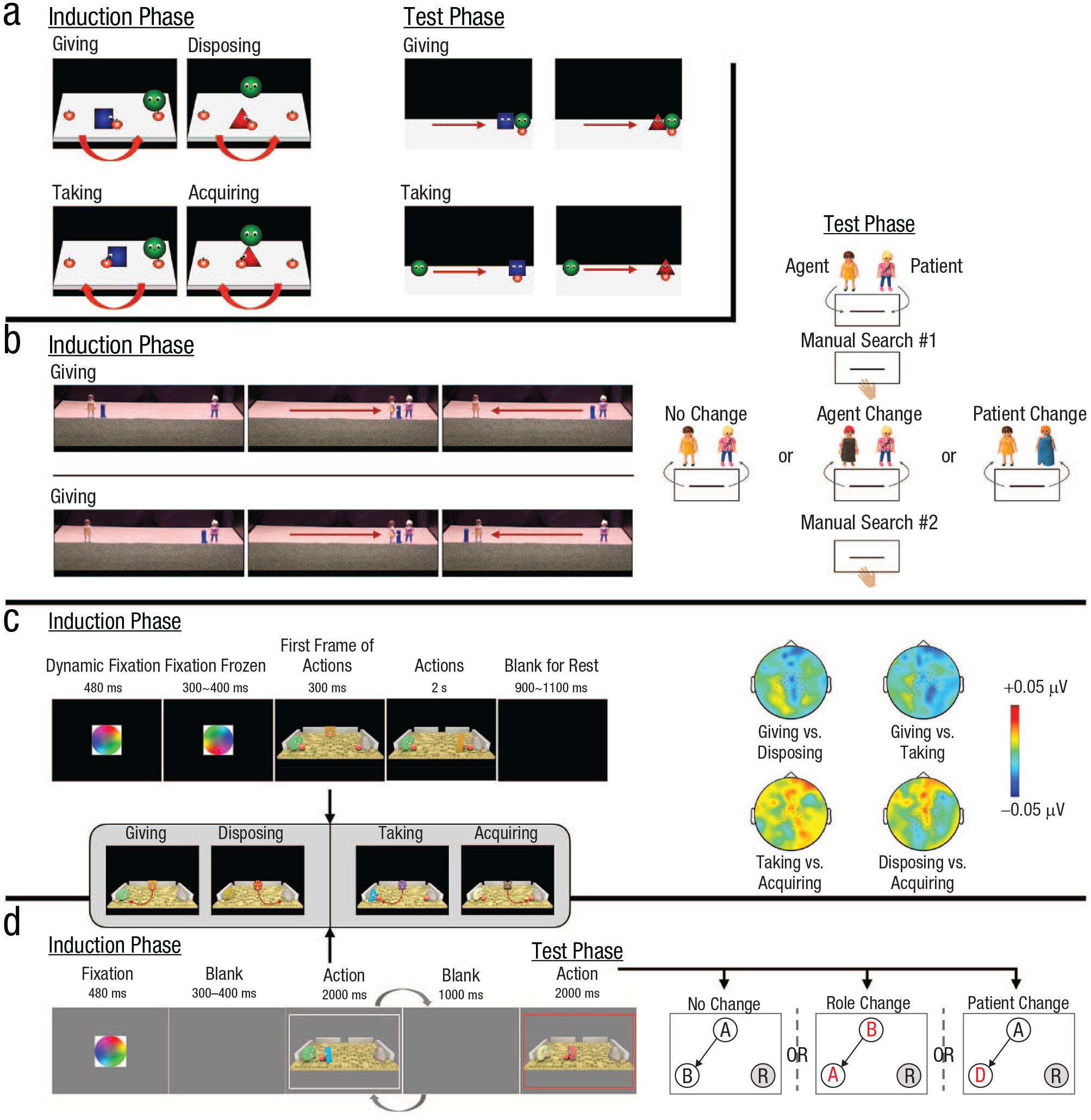
Experimental designs testing asymmetries in the representation of giving and taking events. (a) Looking times (Tatone et al., 2015). Infants are familiarized to one agent engaged in a social transfer (giving or taking) and another in a nonsocial transfer (disposing or acquiring) and then shown each agent at test performing the social transfer. Infants look longer to the goal change (from nonsocial to social) in giving but not in taking. (b) Manual search (Stavans & Csibra, 2023). Infants are exposed to two dolls engaging in giving or taking, which are then are placed inside a box. After the experimenter takes out two dolls from the box, either the same old ones (no change) or an old and a new one (change), infants are allowed to search inside the box. Infants search longer in the change trial but only when the dolls previously interacted via giving. (c) Electroencephalogram recording (Yin et al., 2020). Adults are presented with an agent pushing an object towards (giving) or away (taking) from a social target (animate agent) or a nonsocial one (rock). They show stronger alpha-band suppression for events involving social versus nonsocial targets but only in the giving case (i.e., transfer towards the target). (d) Change detection (Yin et al., 2022). Adults are exposed to the aforementioned events and required to respond if they detect a change in a test stimulus, consisting of a role swap between active and passive agent or an identity change of the passive agent. Adults are better at detecting a change of the passive agent when this featured as the patient of a transfer event rather than a bystander, but only in the giving case.
Converging measures of this asymmetry have also been identified in adults. Yin et al. (2020) recorded the brain responses of adults passively presented with transfer events directed at or away from social versus nonsocial targets (Fig. 1c). They found stronger suppression of alpha-band oscillations (an electrophysiological index of the number of agents considered to participate in observed actions; Yin et al., 2017) for giving than for taking or disposing (i.e., pushing an object next to a nonsocial target). In contrast, no difference was found when comparing responses to taking and acquiring (obtaining an unpossessed object). Likewise, in a change-detection paradigm requiring participants to memorize featurally distinctive pairs of agents engaging in transfer events, adults were better at detecting changes in pair composition if the agent being replaced acted as the patient of the action rather than its bystander but only in the giving case (Fig. 1d; Yin et al., 2022). These findings, which mirror the representational asymmetry documented in infants, may be interpreted in one of two ways: (a) infants and adults represented taking as entailing a patient, despite this not being a psychologically foregrounded participant in the representation, or, more radically, and (b) apprehended taking purely as an object-directed action directed at the acquisition of an object. Although the evidence reviewed cannot adjudicate between these two possibilities, it nonetheless shows that the asymmetry between giving and taking emerges robustly across measures and age groups. However, this should not be taken to imply that people struggle in general with representing taking as a patient-directed action. Rather, it shows that the same information that suffices to trigger the deployment of the giving concept (i.e., the presence of a passive agent standing as putative patient) is not sufficient to trigger a corresponding social taking concept but is captured by a structurally simpler action concept that may not entail the takee.
To an extent, this asymmetry can be related to well-known differences in the syntactic requirements of “give” and “take” verbs across languages: The former mandates patients to be made syntactically explicit, whereas the latter does not (Kittilä, 2006). This difference has been explained in terms of distribution of semantic roles: In “give,” agent and patient refer to distinct participants, whereas in “take,” they can refer to the same participant: the taker, who is at once the agent causing the transfer and the one experiencing its effects (Newman, 1996). This account, however, does not explain why the takee, who is deprived of their possession, could not be similarly considered a potential experiencer of the action. It is possible that an apparent taking event always triggers two partly overlapping, and potentially competing, concepts: (social) taking and (nonsocial) acquiring. In cases where the takee is an otherwise passive source of the seized object, people may favor interpreting the action as acquiring owing to its structural simplicity. This interpretation provides an adequate explanation for the agent’s behavior as directed to the gains of resource acquisition, irrespective of further social effects. Under this reading, the asymmetry in patient encoding thus reflects the operations of a common prelinguistic system of event construction that selects the minimal number of participant relations necessary to render an action teleologically well-formed. In the case of taking, the object provides a reward that accounts for the taker’s action without the need of considering in its effects on the takee (and therefore its involvement). Although this account is primarily intended to explain the different conceptual prominence accorded to patients in the representation of giving and taking, it may also explain why the syntactic elaboration of the patient argument is more permissive in “take.” Caution must be exercised, however, when arguing for potential homologies between syntactic and conceptual structures. Unlike action concepts, the well-formedness of verb constructions can be preserved even if some entailed relations do not show up as overt syntactic arguments (e.g., “I sold the car”; “She donated to charity”). Because of this, the mapping between participant relations in event concepts to the syntactic categories of a verb is unlikely to be straightforward (Perkins et al., 2022; Williams, 2015).
Nonetheless, several proposals assume broad correspondences between the syntactic elaboration of thematic roles and the conceptual relevance of underlying event participants. Two prominent accounts in cognitive linguistics rest on this assumption: thematic hierarchy and goal bias. Originally presented as a theory of grammar purporting to explain the syntactic position of specific arguments (e.g., as subjects, objects, or obliques; Pinker, 1989; Strickland, 2017), the scope of thematic hierarchy has since expanded to suggest that this ordering may reflect asymmetries in the psychological prominence of participant roles. Buttressing this reading, recent experimental evidence indicates that children and adults rapidly assign and distinguish agent and patient roles across linguistic and nonlinguistic tasks while showing a more labile representation of instrument roles (for a review, see Ünal et al., 2021). Such findings point to a stable ranking of thematic roles across events but cannot adequately account for the asymmetry discussed here as it concerns differences in the encoding of a participant (the patient) whose event role and salience should be comparable between actions of the same event class (i.e., possession transfer). An alternative account that may explain such asymmetry is the goal bias. This phenomenon describes the general tendency to assign higher prominence to goals than to sources, which givee and takee may be respectively mapped onto (Papafragou, 2010). However, most of the evidence for this bias comes from studies involving motion events with spatial goals (Lakusta & Landau, 2005), which are argued to represent a distinct categorical cluster from that of recipients (Rissman & Majid, 2019; Ziegler & Snedeker, 2018). Cautioning against this goal-bias account is also a recent study by Chen et al. (2022), which showed that, although adults mention more frequently givees than takees when asked to recall an action, they do not differ in their visual encoding (in apparent contradiction with Yin et al., 2022).
The seeming incongruence between Chen et al.’s (2022) results and the findings reviewed earlier is in fact consistent with the idea that two goal hypotheses (taking and acquiring) compete for attention when one observes an actor seizing an object from someone. Given this ambiguity, it should be expected that even subtle contextual cues underscoring the takee’s involvement (e.g., marking the takee’s active possession of the object by having them hold it, as in Chen and colleagues’ study) may encourage an interpretation of taking as patient- inclusive. Compatibly with this idea, when the takee is observed resisting the forcible expropriation of an object (Gazes et al., 2017) or nonverbally acknowledging its receipt (Tatone & Csibra, 2020), infants adopt a social interpretation of taking. As we discussed, however, these cues are not necessary to set up a representation of giving as interactive. The spontaneous assignment of the recipient role to a passive agent who acquires possession of an object without actively partaking in the interaction is the signature feature of an evolved schema designed to identify socially relevant outcomes. Without such schema, it would not be possible to tag the active transfer of a resource as a potential goal state, insofar as the voluntary imposition of personal costs that this outcome entails violates the assumptions of utility maximization that people routinely leverage in assessing the goal-directedness of instrumental actions (Gergely & Csibra, 2003; Jara-Ettinger et al., 2016). The sensitivity to giving outcomes that the schema supplies instead reflects the nonimmediate utility that accrues to givers by securing a relationship with valuable social partners via resource donation.
From Interactions to Relations: The Link Between Giving and Reciprocal Exchange
The proposal that giving indicates a potential relationship within which the giver recoups their altruistic investments helps explaining why people tend to interpret this event as a dyad-specific interaction (A gives to B) rather than as an act revealing an individual disposition (A is a giver). An event representation that ties a giver’s action to a particular recipient, rather than generalizing it to novel targets amenable to fill the same role, is what we would expect if the donor’s utility derived from the long-term consequences of benefiting a specific social partner (Tatone et al., 2015). But what kinds of returns do people expect to accrue to givers from the observation of giving?
Two recent findings suggest that preverbal infants may interpret giving as instantiating relations based on long-term balance (i.e., a coordination rule by which disparities in social investment are leveled through reciprocal acts of altruism; Fiske, 1992). First, when familiarized to an actor manipulating a single object (a context in which lack of sensitivity to changes in object identity has been repeatedly reported; e.g., Woodward, 1998), infants encode its identity if the event could be construed as an act of giving, but not of taking (Tatone et al., 2021). Second, even when induced to interpret both giving and taking in structurally equivalent (interactive) terms, infants encode the direction of object transfer only in the representation of giving (Tatone & Csibra, 2020). These two kinds of information (i.e., who gave what to whom), which are essential to detect reciprocal transfer and possible differences in the value of transferred goods (proxied by resource identity), help observers monitoring the resource flow between partners in the service of assessing its long-term balance.
Beyond developmental evidence, the proposal that giving may prime reciprocal exchange is consistent with experimental evidence from bargaining games (Keysar et al., 2008) and virtual foraging tasks (Kaplan et al., 2018), as well as ethnographies of sharing (Gurven, 2004), showing that people preferentially use active transfer to catalyze return-contingent sharing. More generally, this proposal adds to a growing literature on early naive sociology, which suggests that, by the 2nd year of life, infants interpret various resource-mediated interactions as tokening distinct types of relationships, from priority of resource access (cueing dominance; Mascaro & Csibra, 2012) to commensal eating (cueing kin-like relations; Thomas et al., 2022).
Conclusions and Open Questions
The evidence reviewed here supports three major conclusions about humans’ representation of giving. First, humans are endowed with a dedicated schema that relates the participants of a giving event within a coherent semantic frame. This action schema emerges early in development and robustly guides infants toward the identification of giving events, as evinced by their remarkable attunement to subtle cues of transfer. Second, giving and taking are not two faces of the same coin: Although giving is an obligatorily social action, taking is only facultatively so. This asymmetry, echoed in language, may indicate a shared prelinguistic mechanism of event construction whereby the slotting of participants in the representation depends on their role in rendering the action well-formed. Finally, infants treat giving as a cue of relationships based on long-term balance, as evinced by their encoding of information suited to monitoring resource flow within a dyad. This suggests that, alongside other behaviors, infants may attend to the occurrence of giving to discover and track social relations in their surroundings.
There are important caveats to these conclusions. First, although we argued that the asymmetry between giving and taking may stem from a general mechanism of event representation that foregrounds participants on the basis of their contribution to an action’s well-formedness, we did not assess the explanatory scope of this proposal beyond transfer events. Second, the studies supporting the claim that giving induces the representation of reciprocal-exchange relations all featured interactions occurring in socially underdeterminate contexts. In everyday life, social encounters often exhibit additional relationally informative cues (e.g., the identity of the agents involved), which may modulate the types of relational inferences drawn. Considering that giving occurs in a number of nonreciprocal relational arrangements, including family provisioning and tributary transfer between people of different status, the evidence reviewed here does not warrant concluding that the diagnostic inference between giving and balanced peer relationships would not be revised in the presence of additional cues. Relatedly, our emphasis on the social significance of giving should not imply that taking actions fail to support relational inferences. In fact, when taking bears telltale cues of patient involvement, infants interpret this action as instantiating a long-term relationship based, for instance, on dominance, if taking was perceived as forceful (Gazes et al., 2017), or communal sharing, if it was perceived as tolerated (Tatone & Csibra, 2020).
Recommended Reading
Frankenhuis, W. E., & Barrett, H. C. (2013). (See References). A comprehensive analysis of the function, content, and development of action schemas advocating for an “islands of competence” model of action understanding.
Kaplan, H. S., Schniter, E., Smith, V. L., & Wilson, B. J. (2018). (See References). An experimental test of the emergence of reciprocal exchange in a virtual foraging paradigm showing that people spontaneously shift from taking to reciprocal giving in response to variance of resource acquisition.
Tatone, D., Hernik, M., & Csibra, G. (2019). (See References). A proof-of-concept study of the early sensitivity to cues of transfer showing that 1-year-olds interpret outcomes of possession transfer as relevant goal states even when collaterally produced.
Widlock, T. (2016). Anthropology and the economy of sharing. Routledge. A critical review of sharing across subsistence societies emphasizing how distinct transfer practices convey different expectations of reciprocation and recipient accountability.
Wilson, V. A., Zuberbühler, K., & Bickel, B. (2022). The evolutionary origins of syntax: Event cognition in nonhuman primates. Science Advances, 8(25), eabn8464. A review of the current research on thematic roles suggesting that agent-based event decomposition may be a competence shared with other nonhuman primates.
