




Abstract
Societies are increasingly divided about political issues such as migration or counteracting climate change. This attitudinal polarization is the basis for intergroup conflict and prevents societal progress in addressing pressing challenges. Research on attitude change should provide an answer regarding how people might be persuaded to move away from the extremes to take a moderate stance. However, persuasive communication often most strongly affects those who hold a moderate attitude or are undecided. More importantly, barely any research has explicitly aimed at mitigating extreme attitudes and behavioral tendencies. Addressing this gap, this article summarizes research demonstrating that (different types of) intraindividual conflicts might be a means to mitigate polarized attitudes. Goal conflicts, cognitive conflicts, counterfactual thinking, and paradoxical thinking facilitate cognitive flexibility. This, in turn, seems to initiate the consideration of alternative stances and mitigate the polarization of attitudes. We discuss the limitations of the existing research and the potential of this approach for interventions.
Societies are increasingly divided about political issues and policies addressing significant societal challenges such as migration or climate change. A plurality of attitudes and viewpoints in a society is generally desirable because it is a sign of freedom of opinion. Polarization, however, which is characterized by an irreconcilable disagreement about key societal topics and low respect for those holding opposing opinions (Finkel et al., 2020), is disconcerting. It endangers societal cohesion and the functioning of democracy and prevents societies from addressing current challenges (Jost et al., 2022).
Therefore, interventions that mitigate extreme attitudes and low respect toward people and groups holding attitudes deviating from one’s own are desperately needed. As a response, researchers have developed individual-level interventions to change beliefs and feelings and correct misconceptions about out-groups (i.e., countering misinformation; Hartman et al., 2022). These interventions effectively improve out-group perceptions, but unfortunately, interventions specifically targeting those holding extreme attitudes are lacking (Voelkel et al., 2023). Moreover, research on changing strong or extreme attitudes has repeatedly shown that these attitudes are quite resistant to change (Howe & Krosnick, 2017) and that persuasive communication often most strongly influences those who hold moderate attitudes (Betsch et al., 2015).
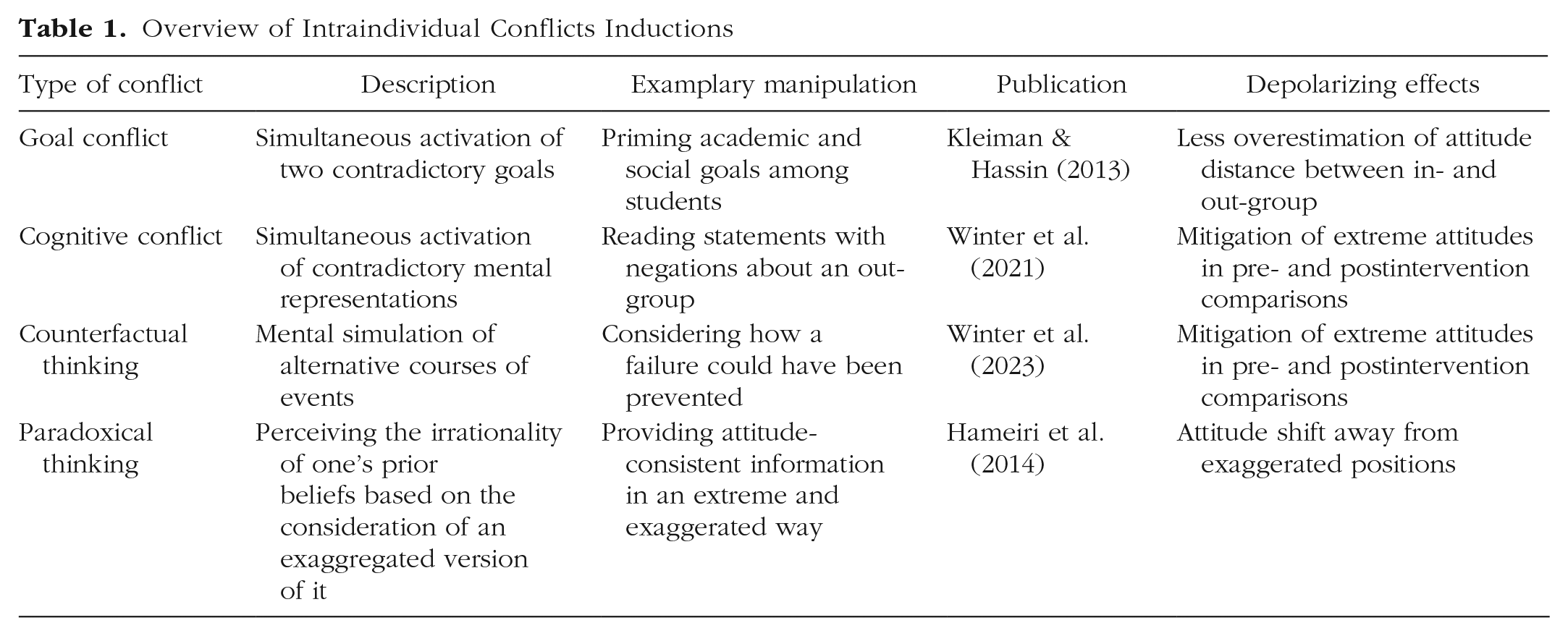
This article summarizes research addressing a potential means to tackle the challenge of polarization by targeting those holding extreme attitudes: the induction of intraindividual conflicts. First, we outline why intraindividual conflicts should reduce polarized attitudes. Then we discuss different approaches to induce intraindividual conflicts and how these affect attitudes (for an overview, see Table 1).
Overview of Intraindividual Conflicts Inductions
The Impact of Intraindividual Conflicts
Intraindividual conflicts occur when two contradictory goals are simultaneously salient (a goal conflict; e.g., wanting to enjoy high-calorie food and losing weight) but also when cognitions do not align or are for other reasons unexpected (e.g., a priest in front of a mosque). In addition, simulating alternative courses of an event (i.e., counterfactual thinking) or facing an exaggerated version of one’s own opinion (i.e., paradoxical thinking) elicits intraindividual conflicts. To solve such conflicts, people need to restructure their representation of the situation with the aim of integrating the conflicting elements in a consistent experience. The mental operations involved in doing so require flexibility and, once activated, remain active even after the immediate conflict has been resolved. Thus, after experiencing an intraindividual conflict, people show higher cognitive flexibility within the same context and beyond. In short, intraindividual conflicts activate a so-called flexibility mindset that subsequently influences information processing (for an overview, see Sassenberg et al., 2022). On the basis of this carryover effect of mental operations facilitating flexibility, intraindividual conflicts can mitigate polarized attitudes.
We argue that this attitude change requires unfreezing and moving away from the original stance. Both operations are signs of cognitive flexibility (Hecht et al., 2014; Mednick, 1962). Each intervention that paves the way for at least one of them should have the potential to mitigate extreme attitudes. Resolving intraindividual conflicts is one class of tasks that elicits unfreezing and moving. When describing research on conflict-based interventions in what follows, we point to the aspects of the respective intervention that might evoke these mental operations. It should be noted that this is speculative in most cases given that unfreezing and moving have not been systematically studied in this context.
Goal conflicts
When striving to achieve a goal, people often face a conflict because what is necessary to reach one goal (e.g., preparing for an upcoming exam) might prevent reaching another goal (e.g., meeting friends at a party). Accordingly, people show higher cognitive flexibility after experiencing a goal conflict. Kleiman and Hassin (2013) asked participants to judge whether a string was a word or not. In the goal-conflict condition, more than two thirds of the words were related to either of two conflicting goals (e.g., studying and partying), whereas in the control condition all words were neutral. Afterward, participants had to select information that either confirmed or disconfirmed an initial description of a person (i.e., the trait hypothesis-testing task). Participants selected more disconfirming information in the goal-conflict condition than in the control condition, providing evidence for higher flexibility and unfreezing (i.e., considering giving up one’s initial position). Similarly, thinking about a fictitious situation with conflicting goals or task demands (here, cooperating and competing with the same person) facilitated flexibility in a brainstorming task. Participants generated ideas from a more diverse set of underlying categories, implying that they stopped thinking about one category (unfreezing) and turned to another (moving; Landkammer & Sassenberg, 2016). In both cases, goal conflicts induced cognitive flexibility, which might create the basis for attitude depolarization.
One indicator of polarization is the overestimation of differences between attitudes of in-groups and out-groups. Stern and Kleiman (2015) provided evidence that goal conflicts can reduce this tendency: Writing about one’s own conflicting goals reduced the overestimation of differences—here between Democrats and Republicans—compared with a control condition (i.e., writing about one’s morning). In sum, these studies indicate that goal conflicts can reduce one aspect of polarization—the perceived difference between the in-group and the out-group attitude.
Until now, no direct evidence has shown that goal conflicts can also change people’s attitudes regarding a polarized topic. However, there is research pointing in this direction. Becker et al. (2023) showed that after recalling conflicting goals (see Stern & Kleiman, 2015), interindividual differences in impulsivity no longer predicted a preference for immediate over delayed rewards in choice tasks. Hence, goal conflicts reduced behavioral responses in line with traits. Similarly, goal conflicts might mitigate the impact of people’s long-standing (trait-like) attitudes or prejudices on their position in a specific situation regarding a polarized topic—an effect that has been shown for other types of intraindividual conflicts as described below.
In sum, there is evidence that activating goal conflicts by presenting words related to a goal conflict or by recalling one’s own goal conflicts elicits higher flexibility and (in separate studies) less overestimating of the attitudinal difference between in-group and out-group. Direct evidence for the mitigating impact of goal conflicts on polarized attitudes is lacking. Giving up one schema and restructuring one’s perception as is required during goal conflicts might activate the unfreezing and the moving operations, respectively.
Cognitive conflicts
People experience cognitive conflicts when they are confronted with stimuli that are inconsistent with each other or with their schema-based expectations (e.g., a priest in front of a mosque). To make sense of such a situation, they need to mentally restructure it (e.g., the priest wants to improve relations with other religions)—eliciting a flexibility mindset. Gocłowska et al. (2013) found, for instance, that confronting people with descriptions of individuals who violate gender stereotypes (e.g., a female mechanic) requiring unfreezing resulted in higher cognitive flexibility (compared with stereotype-consistent individuals). Further evidence suggests that this effect is stronger for people high in epistemic motivation (Gocłowska et al., 2014). This finding suggests that the readiness to invest effort in elaboration and cognitive restructuring is required to resolve a cognitive conflict.
Cognitive conflicts may also be activated through more subtle means such as using negations (e.g., “not open”) rather than affirmations (e.g., “closed”) in communication. Negations are usually processed in two steps. Recipients activate the negated term (e.g., “open” when reading “not open”) in the first step, whereas in the second step they understand the actual meaning (i.e., “not open”). The process required to understand the actual meaning of a negation (but not the one needed to understand an affirmation) resembles the resolution of a cognitive conflict (Dudschig & Kaup, 2018). While processing negations, readers have to detach from their initial representation of the statement, which can be considered a case of unfreezing. Processing negations should thus assert a positive influence on cognitive flexibility. Indeed, Winter et al. (2021) found support for this prediction. We also showed that the cognitive flexibility elicited by processing negations mitigates attitude polarization. After reading a text with negations about a group toward which attitudes are polarized (e.g., “asylum seekers are not criminal”), those initially holding a particularly negative attitude about that group became more moderate—but not after reading a text with the respective affirmations (e.g., “asylum seekers stick to the law”) or in a no-text control condition (see Fig. 1b). A mediation analysis (see Fig. 1a) and a causal chain analysis (i.e., manipulating the negations vs. affirmations and cognitive flexibility in separate studies) indicated that messages with negations elicited cognitive flexibility, and this flexibility, in turn, caused the depolarization of extreme attitudes (see Fig. 1c).
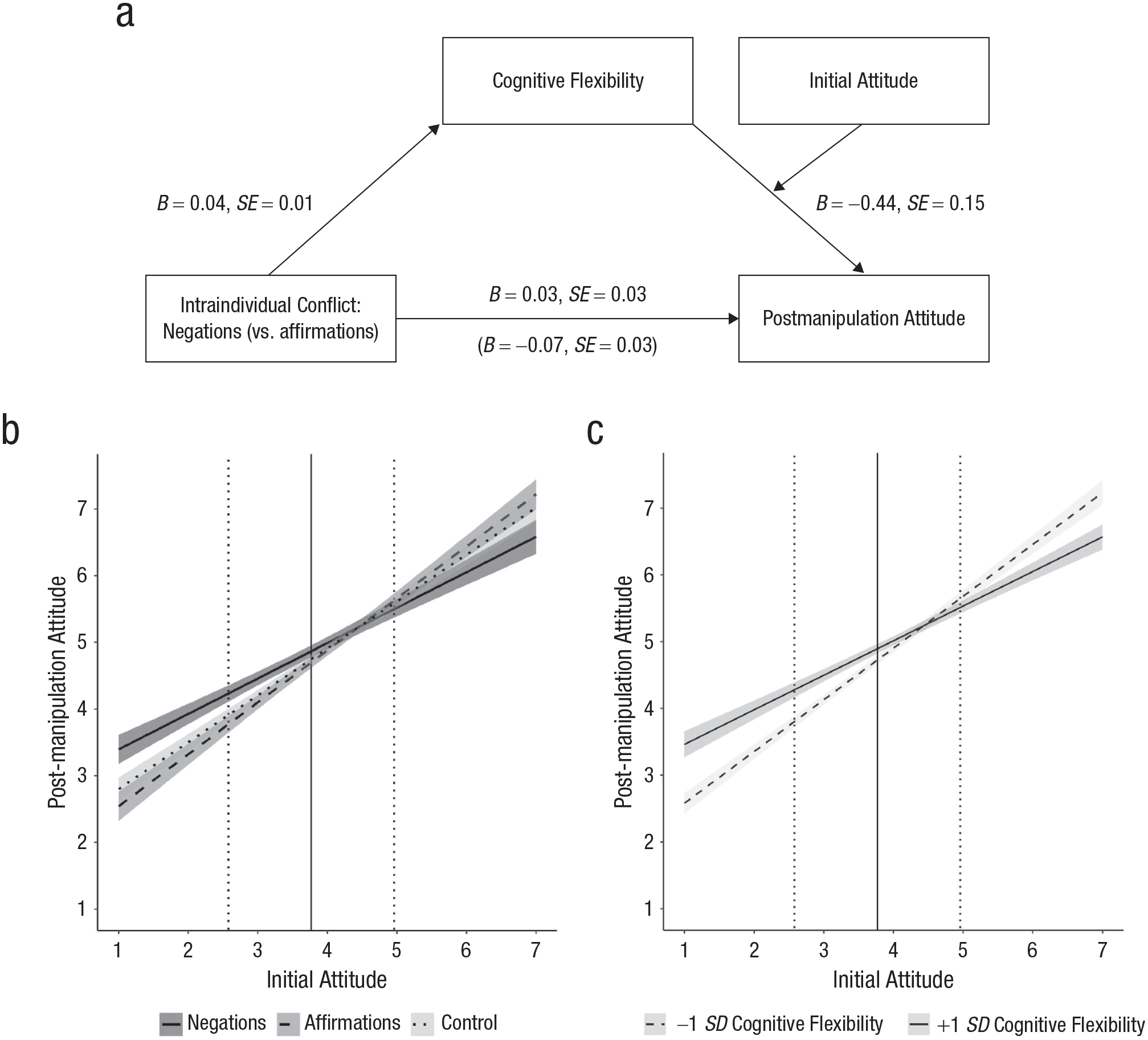
The effect of negations (vs. affirmations and no-text) on postmanipulation attitudes dependent on premanipulation attitudes. The panels display (a) a moderated mediation analysis for the impact of cognitive conflict on postmanipulation attitude via cognitive flexibility depending on initial attitude, (b) postmanipulation attitude as a function of cognitive conflict (negations vs. affirmations vs. control) and initial attitude, and (c) postmanipulation attitude as a function of (measured) cognitive flexibility and initial attitude. In (b) and (c), shaded areas represent the 1 SE margin, the solid vertical line represents the sample mean of the variable depicted on the x-axis, and the dotted vertical lines mark 1 SD below and above the mean, respectively. This figure is an adapted version of Figure 2 from Sassenberg et al. (2022), which was published under the terms of the Creative Commons Attribution License (http://creativecommons.org/licenses/by/4.0).
Cognitive conflicts can also result from a complex or diverse representation of the own group, implying frictions and inconsistencies that should require unfreezing. And indeed, depolarization of attitudes toward out-groups can also be caused by stressing the diversity of an in-group. It should be noted, however, that this effect is small and thus less meaningful for applied contexts (r = .07; Winter & Sassenberg, 2021).
Taken together, cognitive conflicts elicit flexibility when the epistemic motivation is high enough to resolve the conflict. Even resolving subtle forms of conflicts that occur while reading negations (rather than affirmations) can elicit cognitive flexibility and, in turn, the depolarization of attitudes. In this case, the unfreezing operator is most likely activated by giving up the initial representation and eliciting the cognitive conflict, and the moving operator resolves the conflict. Another less direct form of cognitive conflict is provoked by counterfactual thinking.
Counterfactual thinking
People spontaneously generate counterfactual thoughts such as “If only I had taken my umbrella, I would be less wet” or “What if it would not have rained?” in response to negative events. These counterfactuals represent mental simulations of alternatives to reality. Among other things, they elicit higher cognitive flexibility (Markman et al., 2007). The specific form of flexibility depends on the type of counterfactuals. Subtractive counterfactuals involve simulating what would have happened if a particular event had not occurred (“If only I had not done X . . .”). This requires giving up the mental representation of the course of action, implying unfreezing. Subtractive counterfactuals elicit a so-called relational processing style: flexible thinking in relation to an activated dimension or concept. Examples are changes along a stereotype dimension or generating ideas within an activated set of concepts. Thus, relational processing implies flexibility in the sense that associations between activated concepts are loosened. In contrast, additive counterfactual thinking, that is, simulating consequences of additional actions (“If only I had done X . . .”) does not require giving up the mental representation of the cause of action but adding something, which comes (if anything) closer to moving than to unfreezing. Additive counterfactuals result in an expansive processing style characterized by integrating additional thoughts beyond activated concepts and usual associations (Markman et al., 2007).
Given that depolarization requires changing attitudes along one dimension (rather than switching concepts), subtractive rather than additive counterfactuals might be suited to mitigating polarized attitudes. In line with this prediction, Winter et al. (2023) demonstrated that subtractive but not additive counterfactuals altered the attitudes toward an out-group among those holding an initially polarized attitude about this group—the politically right tended to trust immigrants more, and the politically left tended to trust immigrants less than before. In these studies, subtractive counterfactual thoughts were primed in a context unrelated to migration or induced by topic-related rhetorical questions in a speech about migration (“But would not perhaps much less have happened, if [. . .] we had not met those who sought protection so enthusiastically?”).
Overall, activating subtractive but not additive counterfactual thinking has the potential to depolarize attitudes. Additive counterfactuals seem to rely less on the unfreezing operation, which might be a reason for this differential effect, but future research should test this speculation. Research has shown that counterfactuals elicit flexibility and depolarization. However, evidence combining both measures and providing evidence for the assumed process is lacking so far.
Paradoxical thinking
Paradoxical leading questions are an approach based on intraindividual conflicts that has been shown to reduce polarized attitudes in intractable intergroup conflicts (Hameiri et al., 2018). They are called paradoxical because they do not rely on attitude-inconsistent information to change attitudes. In contrast, the messages are, in principle, consistent with recipients’ attitudes but are presented in an exaggerated manner. Knab et al. (2021), for instance, asked right-wing German participants, “Why do you think that Christmas will be abolished within the next few years due to the increase in refugees?” The fact that people can be shifted away from their position by providing an (exaggerated) attitude-consistent message is considered a “paradox.” Paradoxical thinking interventions such as these mitigated negative attitudes toward out-groups, especially among those with the most negative initial attitude (Hameiri et al., 2018; Knab & Steffens, 2022). The intraindividual conflict that seems to be at work here results from confronting recipients with exaggerated versions of their own attitudes that go beyond socially accepted beliefs. The effort to distance oneself from these extreme positions and to show that one is still close to accepted positions seems to reduce polarization. The confrontation with the exaggerated positions presumably challenges the validity of recipients’ beliefs, thereby causing unfreezing (Hameiri et al., 2018). The urge to show that one holds a less extreme position could result in the actual moving.
Knab et al. (2021) provided evidence that intraindividual conflicts and cognitive flexibility play a role in producing the effects of paradoxical thinking interventions. They found that especially people holding antirefugee attitudes showed higher cognitive flexibility after responding to paradoxical leading questions regarding refugees. Again, evidence for the process from paradoxical questions via flexibility on the depolarization of attitudes is lacking.
Summary and Implications
The research summarized here has shown that intraindividual conflicts can help to mitigate polarized attitudes. There is evidence that this applies across different forms of conflicts, including goal and cognitive conflicts, subtractive counterfactual thinking, and paradoxical thinking. Similar effects have been found in research on debiasing attitudes and decisions. For instance, explicit instructions to “consider the opposite” (Lord et al., 1984) and to take a second attempt to make an estimate based on different assumptions (“dialectical bootstrapping”; Herzog & Hertwig, 2009) led to a more positive evaluation of opposing viewpoints and better estimates, respectively. All of these interventions can potentially prepare people either (a) to unfreeze their current stance or (b) to move toward a different position. Some might plausibly activate both processes (i.e., goal conflicts), whereas others emphasize the unfreezing operation (i.e., subtractive counterfactuals). These differences are, however, rather subtle. Any task or instruction with the potential to prepare individuals for these operations could serve as a cornerstone of an intervention against extreme attitudes. Intraindividual conflicts might also elicit negative affect, but we did not find evidence that is driving the impact of goal conflicts (e.g., Becker et al., 2023). Therefore, we assume that flexibility is the relevant process variable.
The paradoxical leading questions and some of the counterfactual thinking interventions elicit the intraindividual conflict within the context of the polarized attitudes. In contrast, other interventions use a priming procedure to activate the mental operation that afterward needs to carry over to the setting in which the polarized attitudes are relevant. On the one hand, interventions in the context might lead to stronger effects given that they do not lose momentum while carrying over. On the other hand, they might be experienced as attempts to influence and, thus, elicit reactance that reduces their impact. Priming procedures exert their influence more subtly (and, thus, cause less reactance) but, at the same time, lose strength because of the need to carry over to another context. Therefore, it is hard to predict which type of intervention is more effective without directly testing them against each other.
All intraindividual conflicts seem to elicit a flexibility mindset, increasing people’s readiness to consider giving up their extreme positions. Evidence for this was provided by studies showing that all four forms of intraindividual conflicts elicit higher cognitive flexibility. For some (but not all) forms, there was also evidence for a link between flexibility (elicited by the conflict) and the depolarization of attitudes. Additional evidence for this link and a more detailed analysis of the processes should be targeted by future research.
In the summarized work, flexibility has been measured using different indicators such as the inclusion of rare exemplars in cognitive categories (e.g., Winter et al., 2021), the consideration of many categories in idea generation (Landkammer & Sassenberg, 2016), less confirmatory hypothesis testing (Kleiman & Hassin, 2013), or the performance on the Remote Associates Test (Markman et al., 2007) to mention just the most frequently applied measures (for a summary, see Sassenberg et al., 2022). Given the breadth of the measures with which the impact of intraindividual conflicts on cognitive flexibility has been demonstrated, this effect seems to be stable and generalized beyond specific measures.
It is important to note that intraindividual conflicts can also have polarizing effects under specific adverse conditions. Ditrich et al. (2019) elicited counterfactual thoughts with an interpersonal focus on responding to others. Under these particular conditions, they lead to the flexible devaluation of others’ arguments and, consequently, even more polarized attitudes (see also Effron, 2018). Hence, an essential precondition for the depolarizing effect of intraindividual conflicts seems to be that they are activated concerning one’s own rather than others’ thoughts and stances.
The research summarized here mainly addressed polarized attitudes in experimental settings. However, for paradoxical thinking, a field study demonstrated that interventions based on intraindividual conflicts elicited effects that lasted at least 1 year and affected actual election behavior (Hameiri et al., 2014). In addition, research on people who repeatedly experience intraindividual conflicts in a domain because of intercultural experiences or regular specific activities has shown that these people are more cognitively flexible (Leung et al., 2008). Moreover, they represent conflicts and out-groups differently (Landkammer et al., 2019; Sassenberg & Matschke, 2010). Thus, even though research on long-term effects of interventions based on intraindividual conflicts beyond paradoxical thinking is lacking, there are good reasons to believe these conflicts could be used to design scalable and sustainable interventions against attitude polarization.
In sum, intraindividual conflicts—including goal and cognitive conflicts, subtractive counterfactual thinking, and paradoxical thinking—contribute to mitigating polarized attitudes because they elicit cognitive flexibility. These effects occur when the conflicts are elicited within the context of the attitude object (e.g., paradoxical thinking) or outside this context (e.g., primed counterfactuals). Inducing intraindividual conflicts is thus a strategy that has the potential to contribute to the mitigation of polarized attitudes in society.
Recommended Reading
Hameiri, B., Porat, R., Bar-Tal, D., Bieler, A., & Halperin, E. (2014). (See References). Intervention study based on paradoxical thinking.
Kleiman, T., & Enisman, M. (2018). The conflict mindset: How internal conflicts affect self-regulation. Social and Personality Psychology Compass, 12(5), Article e12387.
Easily accessible review of research on the impact of goal and cognitive conflicts.
Sassenberg, K., Winter, K., Becker, D., Ditrich, L., Scholl, A., & Moskowitz, G. B. (2022). (See References). Review, more detailed than the current article, covering research on flexibility mindsets.
Winter, K., Scholl, A., & Sassenberg, K. (2021). (See References). Empirical article showing the impact of cognitive conflicts elicited by negations on changes of polarized attitudes toward out-groups.
