



Abstract
Nearly everyone keeps secrets, but only recently have we begun to learn about the secrets people keep in their everyday lives and the experiences people have with their secrets. Early experimental research into secrecy sought to create secrecy situations in the laboratory, but in trying to observe secrecy in real time, these studies conflated secrecy with the act of concealment. In contrast, a new psychology of secrecy recognizes that secrecy is far more than biting our tongues and dodging others’ questions. Our secrets can consume mental space before and after concealment situations, and even the secrets that require no active upkeep can burden the secret keeper. The current article reviews recent insights into the many ways in which our secrets relate to personal and relational well-being and what follows from revealing our secrets.
Daily life is filled with communication. We speak to our colleagues, chat with friends, argue with family members, and share intimacies with our partners. But hidden from these daily interactions are the things we do not say. For every kind of social relationship, people sometimes hold back. Secrecy, it turns out, is incredibly common. But what are the consequences of keeping secrets?
Until recently, we had only glimmers into secrecy processes and their outcomes, and this is because prior work rarely examined real secrets and the many experiences people have with them. Rather than study lab-invented secrets and artificial social interactions within the confines of the lab, a new body of research studies the secrets people keep and the many experiences people have with their real-world secrets. The shift to studying real secrets and how people experience their secrets has led to a new psychology of secrecy.
Of course, any moniker that includes the word “new” will eventually describe something that is, well, old (e.g., the New School, new age music). Rather than born yesterday, the “new” in the “new psychology of secrecy” is inspired by the “new” of the New Look psychology that arose in the late 1940s, which suggested that if we are to understand the human mind, we must move beyond the idea of humans as merely responsive to stimuli (see Greenfield, 2016). Just as the New Look suggested psychologists should study how internal states like motivations influence how stimuli are processed and interpreted, the new psychology of secrecy reviewed here demonstrates that secrecy is far more than biting our tongues and dodging others’ questions. Rather than solely a reaction to conversations that impinge on the secret (Smart & Wegner, 1999), much of the experience of secrecy occurs on our own time, in our own heads. To understand secrecy and its effects, we must understand the inner workings of the mind: why it so often revisits secrets and how those secrets are mentally processed (Slepian, 2022).
Among many other research questions, the new psychology of secrecy explores how people reflect on their secrets and how often they encounter them, the motivations underlying the secrets, and the reported harm of the secrets to well-being. This broader approach has led to several new insights into how secrecy relates to important outcomes, like relationship quality and personal well-being.
Keeping Secrets
Seeking full experimental control over the situation, early studies invented secrets in the laboratory or asked participants to conceal an aspect of themselves while interacting with another individual. But in trying to observe secrecy in real time, these studies conflated secrecy with the act of concealment within conversation. This is problematic for three reasons: (1) You can inhibit speech during conversation for several reasons other than secrecy (e.g., politeness, political correctness, wanting to avoid a conflict), (2) not all secrets require active concealment within conversation (i.e., some are never relevant to a conversation), and (3) our secrets often exist before concealment opportunities arise (e.g., someone cheats on their partner, and immediately decides to keep it secret in that moment).
It is for these reasons that Slepian and colleagues (2017) defined secrecy not as an action but as an intention. The intention for secrecy can be distinguished from general orientations toward privacy (e.g., how close someone needs to be for you to let them in). For example, a person may not wish to discuss their sex life at work for reasons of privacy, yet the fact that a person is sexually active may not be secret. The moment one intends to hold specific information back from one or more others, however, is the moment that person has a secret, and that secret can have effects well before one has the opportunity to conceal the secret in conversation. In a formalization of this model, Slepian (2022) outlined that people encounter their secrets in one of two broad contexts: A secret can come to mind either in a context relevant to the secrecy intention (e.g., a social interaction) or in a context unrelated to the secrecy intention (e.g., mind wandering to the secret outside of a relevant social interaction). Whereas mind wandering to a secret can slide into repetitive thinking (or prompt coping efforts and planning), concealing a secret within a social interaction leads to some mix of monitoring, expressive inhibition, and alteration of speech. Figure 1 presents this model as well as a depiction of which secrets are most common among a sample of 50,000 people. By studying this set of secrets, researchers can make conclusions that generalize to the broader universe of secrets people keep (Slepian & Kalokerinos, 2024).
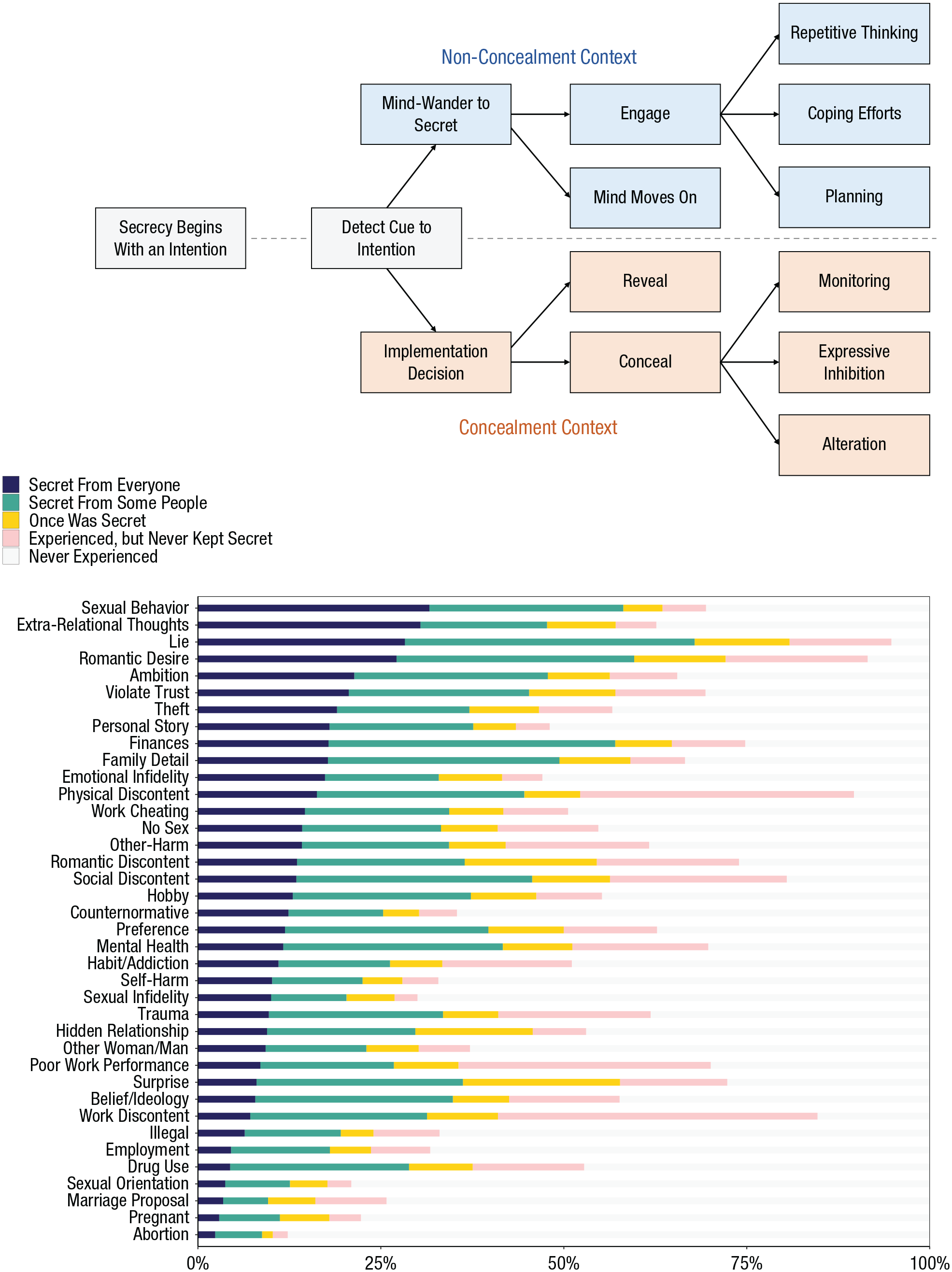
A broader view of secrecy. Top panel is adapted from Slepian (2022) and outlines the two broad contexts in which secrets come to mind. Bottom panel illustrates which secrets people most frequently have.
For the reason that people do not typically carve out time on their calendars to think about their secrets, the typical instance in which someone thinks about a secret is having encountered a cue (internal or external) to the secret, which prompts thoughts about the secret. Of the two experiences, being reminded of a secret (outside a concealment context) is the more common experience, whereas concealing a secret is relatively rare (Slepian et al., 2017). Interpersonal concealment—actively preventing a conversation partner from learning the secret—can occur only during an interaction with someone from whom the secret is to be kept and while talking about something related to the secret. Yet, people have ample time outside these moments to think about and reflect on their secrets.
The harms of our secrets
Although intuition might suggest that the secrets we most frequently conceal would most harm our well-being, this is not the case. Concealment can be taxing, but frequent concealment of secrets is not associated with stress (Liu et al., 2024; see Slepian, 2022, p. 556). Several studies show that the more frequently people’s minds wander to their secrets (outside of concealment contexts), the more those secrets harm their well-being, with no additional harm observed from frequent concealment (e.g., McDonald et al., 2020; Slepian et al., 2017; Slepian, Greenaway, & Masicampo, 2020; Slepian & Moulton-Tetlock, 2019).
Mind wandering to secrets can bring about psychological harms for a variety of reasons, including increasing feelings of shame (Slepian, Kirby, & Kalokerinos, 2020), isolation (Slepian et al., 2019), uncertainty (Slepian & Koch, 2021), and inauthenticity (McDonald et al., 2020; Slepian et al., 2017). Multiple measures of such burden (i.e., preoccupation, rumination, mind-wandering frequency) are related to lower life satisfaction, anxiety, and loneliness (Bedrov & Gable, 2023; Bedrov & Leary, 2021; Davis et al., 2021; Slepian et al., 2017), and the harm associated with frequently thinking about secrets appears to be culturally universal (Slepian, 2024).
Given these harms, why do people so frequently think about their secrets? Secrets tend to be about ongoing issues, unresolved matters, and current concerns, and the mind prioritizes content with these features (Slepian, 2022). There is no finish line for the intention to keep a secret. After any successful concealment, one may still need to conceal in the future. Being easily reminded of the secret will facilitate any need for concealment. But this sensitivity to the secret can also explain why people frequently think about their secrets outside of concealment contexts (Davis & Brazeau, 2021).
Once the mind swerves to the secret, it can get caught in unhelpful loops of thinking that run back into the secret and the many negative emotions that come along for the ride (e.g., shame, isolation, inauthenticity). Indeed, a longitudinal study of people keeping a secret from their partner found that as preoccupation with a secret rose and fell, so did negative affect (Davis, 2023). In turn, an experience-sampling study that surveyed people every 2 hr found that negative emotion at one time point predicted a greater likelihood of mind wandering to the secret at a later time point (Bianchi, Greenaway, Moeck, et al., 2024). These findings suggest the potential for vicious feedback loops between negative affect and repetitive thinking, which is characteristic of harmful rumination (Nolen-Hoeksema et al., 2008).
To keep a secret from others deprives oneself of the social support that those others can offer (Slepian & Moulton-Tetlock, 2019). And thus, keeping a secret involves a motivational conflict between connecting with and receiving others’ support and the desire to keep the secret hidden. Simply thinking about a secret can evoke a sense of fatigue as a function of this motivational conflict (Slepian et al., 2019). Similarly, keeping a secret from someone can be associated with feeling socially distant from that person (Bedrov & Gable, 2023), and often when secrets come to mind, so do feelings of isolation (Slepian et al., 2019).
People report wanting to work through their secrets, particularly to the extent they report a secret as significant (Slepian, Greenaway, & Masicampo, 2020). Yet one reason why people may fail to effectively manage a secret on their own is poor emotion regulation. The more people perceive a secret to be significant, the more people ruminate on that secret and try to distract themselves from it (Bedrov & Gable, 2023; Bianchi, Greenaway, Slepian, & Kalokerinos, 2024). Problematically, the people who develop a habit of not approaching others for needed help are also the people who have poor emotion regulation (e.g., Larson et al., 2015; Masuda et al., 2017).
Another reason why people may fail to effectively cope with secrets is feelings of guilt over keeping the secret in the first place. People recognize that close others may feel they have the right to know certain information, which the secret keeper may feel obligated to reveal (Bedrov & Gable, 2023). Keeping a secret means escaping punishment for any wrongdoing, and secrecy also deprives oneself of instrumental support, and thus simply thinking about a secret can, respectively, prompt self-punishing behaviors (Slepian & Bastian, 2017) and a desire for others’ advice (Duan et al., 2023).
Repetitively thinking about a secret from a partner is associated with lower relationship quality (Slepian et al., 2017), and it seems that such preoccupation is a symptom of low-quality relationships rather than a cause (Davis & Tabri, 2023). This suggests the possibility that poor relationship quality gives rise to harmful secrets more than secrets harm relationships. Secrecy seems less harmful in high-quality relationships (Bedrov & Leary, 2021) perhaps because secrecy within healthy relationships more effectively protects the relationship without compromising it (Levine, 2022; McDonald et al., 2020). Still, secrets might have harms here. In addition to not upholding relationship standards, a way in which a secret could hurt a relationship is if by keeping the secret, secret keepers become emotionally unavailable to their romantic partners (but see Tausczik et al., 2016).
Several open questions remain. Do people know which secrets are better kept from their partners? Can secrecy be a feature of healthy relationships, and if so, how? Establishing causal processes will be highly difficult in this domain. Rather than comparing people with each other, a more profitable approach to answering these questions would be to compare secrets with one another (Slepian & Kalokerinos, 2024). That is, which secrets hurt relationships most, and why? This is an open question for future research.
Coping with secrets
In the absence of discussing the secret with a trusted other, what can people do to cope more effectively? Rather than berate oneself, one can reflect on the behavior in question and how a different behavior can be chosen next time. By this manner, shifting appraisals away from shame and toward guilt can enhance feelings of coping efficacy (Liu et al., 2023). Focusing on prosocial aspects of the secrecy (e.g., maintaining social harmony) is also helpful (e.g., by reducing feelings of inauthenticity; McDonald et al., 2020). Yet, if secrecy is more selfish than prosocial, then a prosocial framing would be more a delusion than a healthy perspective that stays true to relational values. Additionally, as opposed to simply rehashing the past-, present-, and future-focused thinking will be more helpful for finding a path forward (Slepian, Greenaway, & Masicampo, 2020).
There are several additional complications when it comes to the interplay between secrecy and well-being. For instance, the content of the secret relates to its well-being outcomes (Slepian et al., 2023; Slepian & Koch, 2021). Specifically, prior work finds that secrets can be conceived of as existing along three dimensions. A series of multidimensional scaling studies found that when comparing commonly held secrets to each other, people naturally used three dimensions to mentally arrange the secrets: how immoral, how relational, and how goal oriented the secrets seem (Slepian & Koch, 2021). Each content dimension was related to an experience with secrecy: Immoral secrets evoke the most shame, secrets low in relationality evoke the most social isolation, and secrets low in goal orientation evoke the most uncertainty. Although people do consensually perceive a category of secret as occupying a certain place in this three-dimensional space (e.g., a secret about drug use tends to be seen as immoral), what matters most is a person’s actual experience (e.g., a person may not perceive their drug use as immoral and therefore not feel ashamed; when secrets keepers identify nonharms like these, this can boost coping efficacy; Slepian & Koch, 2021).
In exploring the dimensions of secrets and their corresponding harms, two common secrets were excluded from the three-dimensional space: surprises and marriage proposals. These secrets are uniquely positive in valence, and indeed, such secrets have different psychological properties. Rather than being fatiguing and burdensome, positive secrets are often energizing and vitalizing (Slepian et al., 2023). Importantly, these effects could not be attributed to valence alone. Positive secrets are more intrinsically motivated, whereas more prototypically negative secrets are more extrinsically motivated; and when a behavior is framed as extrinsically motivated, it can be fatiguing, whereas the same behavior framed as intrinsically motivated can be energizing (Slepian et al., 2023). Hence, the motivation for the secret matters as does its content, and how these properties of secrets influence their impacts is an important area for future research.
When controlling for what makes the habit of secrecy harmful (e.g., anxieties about opening up, preoccupation with the secret, poor emotion regulation), holding a secret may not hurt well-being, and can even benefit well-being, such as by avoiding negative outcomes that would result from revealing the secret (Kelly & Yip, 2006; Maas et al., 2019). One approach to navigating these complexities is to—rather than take a person-level measure of well-being (which may be a cause of secrecy rather than a symptom)—take a secret-level measure of well-being, asking individuals to report on the well-being harm of a given secret (Slepian & Kalokerinos, 2024). For example, although both might be bad for a relationship, a secret about serial infidelity would likely cause more harm compared with a secret about an isolated event years ago. By comparing secrets with one another, we can gain insight into which secrets are most harmful, and why.
People who have the habit of turning inward in times of distress have poor coping and poor emotion regulation, in general, but which secrets hurt well-being and which ones benefit well-being remain largely open questions—especially with respect to variables like how long the secret has been kept, from whom the secret is kept, who else knows the secret, the motivations underlying the secret, and the broader social context.
Revealing Secrets
One of the best ways to cope more effectively with a secret is to reveal the secret to the right person. Revealing a secret to a person that the secret is kept from is termed confession, whereas revealing a secret to a third party is termed confiding (Nguyen & Slepian, 2022).
Confession, of course, is sometimes the right thing to do, for example, if the person the secret is kept from would expect the other person to share the secret or if someone is somehow being harmed by not knowing the secret. At the same time, a confession could damage the relationship or even destroy it. Little research exists on confession, and so more research is needed in this space. Confiding, in contrast, has received more attention, and confiding secrets in others typically goes better than expected (Kardas et al., 2023) and yields benefits for the secret keeper (Slepian & Moulton-Tetlock, 2019) and the confidant as well (Slepian & Greenaway, 2018).
People prefer to confide in people who are compassionate (i.e., who will be nonjudgmental and empathic), and they also prefer to confide in people who are assertive (i.e., who will push the secret keeper toward helpful actions; Slepian & Kirby, 2018). These two traits align with the two forms of social support that confiding can provide, emotional and instrumental support. In turn, being confided in is associated with feeling closer to the person (Slepian & Greenaway, 2018) and feeling trusted by the person (Schweitzer et al., 2022). By age 6, children understand that sharing a secret with another is a signal of relationship closeness (Liberman & Shaw, 2018).
To the extent that people receive social support from confiding in another, people show higher feelings of coping efficacy and lower repetitive thinking about the secret (Slepian & Moulton-Tetlock, 2019). The typical response to confiding is a helpful one, but in the rare event that the confidant responds very negatively, confiding can backfire, predicting lower well-being as a function of lower coping efficacy (Slepian & Moulton-Tetlock, 2019). A confidant can also become an unwanted reminder of the secret in question (Kim et al., 2021). But it seems that on balance, confiding pays dividends to well-being, as people typically report that confiding yields social support.
If confiding entangles the confidant into the problem (e.g., if they are close to the target of the secret), being confided in can be a source of burden (Slepian & Greenaway, 2018; Zhang & Dailey, 2018). And if the confidant believes the secret to be morally objectionable, they are more likely to reveal the secret to a third party as a form of punishment (Salerno & Slepian, 2022), even when doing so risks negative judgments from others and potential damage to the relationship (Hart et al., 2024; Liberman, 2020).
Discussing our secrets with others typically yields benefits, and this is likely because people tend to choose their confidants carefully. People who are well poised to help (i.e., compassionate, assertive), who will see the secret in a similar way (i.e., have a similar set of morals), and who will not become overly burdened by the secret (i.e., will not excessively ruminate on the secret or have to frequently conceal it on the secret keeper’s behalf) are more likely to keep the secret safe and help the secret keeper cope more effectively with the secret.
Conclusion
We all keep secrets at some point in time. And most people right now hold multiple secrets, including those that have been kept for years. As secrecy has been linked with lower well-being, it is fortunate that these kinds of harmful and long-term secrets cannot be realistically recreated in the laboratory. Rather than conceiving of secrecy as an action of concealment during conversation, the new psychology of secrecy takes a broader view of the phenomenon. Secrecy begins with an intention and can bring harm to well-being even before the secret keeper encounters a conversation that touches on the secret. By examining people’s multiple secrets and the multiple experiences people have with their secrets, we can paint a more accurate picture of real-world secrecy and how it relates to some of the most important qualities of life: relationship quality and personal well-being. We’ve recently learned much about secrecy, but there is still much to be revealed.
Recommended Reading
Bedrov, A., & Gable, S. (2024). Keeping and sharing secrets at the interpersonal level. Social and Personality Psychology Compass, 18, Article e12942. Considers the sociality of secrets and implications for close relationships.
Slepian, M. L. (2022). (See References). A process model of secrecy: Secret-relevant thoughts are cued in one of two broad contexts, evoking distinct processes with unique implications for well-being and relationship quality (see Figure 1).
Slepian, M. L. (2022). The secret life of secrets. Crown. Presents a broad and accessible overview of the psychology of secrets.
Slepian, M. L., Chun, J. S., & Mason, M. F. (2017). (See References). Introduces a broader view of secrecy, defining secrecy as an intention, and explores the common secrets people keep and how people experience their secrets.
