




Abstract
This article presents new evidence on the prevalence, dynamics, and hedonic correlates of experienced love from data describing the emotion, well-being, and time use of a diverse sample of 3,867 U.S. adults every half hour for 10 days (N = 1.12 million) supplemented by a hedonic snapshot of an additional 7,255 adults. The findings allude to the seemingly functional and adaptive nature of love and to similarities across binary gender—men and women reported comparable degrees of (passionate) partner love overall, elevated partner love after prolonged same-day separations, substantially elevated well-being in love’s presence, and reduced (but not extinguished) partner love in mature marital cohorts. The gender differences that were found—women reported more child love than men, and men exhibited a less pronounced reduction in partner love across cohorts—are also consistent with functional accounts of love that recognize the varying role of men and women in the formation and sustenance of relationships.
Given its presumed indispensability for relationships, physical and mental health, and even longevity (see Levin, 2022), the proliferation of theories seeking to explain the causes, dynamics, and consequences of love, across its many forms, is unsurprising. These evolutionary, sociocultural, social-psychological, and clinical accounts offer sometimes varied perspectives on how men and women conceptualize, experience, and express their love (e.g., Aron & Aron, 1986; Buss, 2019; Eagly & Wood, 1999; Frank, 1988; Hazan & Shaver, 1987; Perrin et al., 2011; Sternberg, 2019; Tooby & Cosmides, 2005).
Despite its potential for clarifying our theoretical understanding, empirical evidence on love is limited. Existing research on prevalence predominantly focuses on partner love; often draws on small, nonrepresentative samples; and provides a mixed account of differences by gender (hereafter, “gender” refers to binary identities only; e.g., K. K. Dion & Dion, 1975; K. L. Dion & Dion, 1973; Gonzaga et al., 2001; C. Hendrick & Hendrick, 1986; Montgomery, 2005). Studies of passionate and companionate love—two types of partner love routinely distinguished by Western psychology and laypersons (e.g., Berscheid & Hatfield, 1969; Fehr, 1994; Hatfield et al., 2020)—offer a similarly mixed account. For example, some studies have found greater companionate love among women (e.g., Hatfield et al., 2008; Sprecher & Regan, 1998) and passionate love among men (e.g., Sumter et al., 2013), whereas others have documented modest or nonsignificant differences (e.g., Harrison & Shortall, 2011; Murstein & Tuerkheimer, 1998). And although most theories predict the decay, or transformation, of partner love over the course of a relationship (see Acevedo & Aron, 2009), some social-psychological and evolutionary accounts allow for passion even in later stage relationships (Aron & Aron, 1986; Buss, 2019).
One explanation for the absence of a consensus empirical account is the practical challenge associated with defining, conceptualizing, and measuring love. Academics have alternatively defined love as an attitude, motivational state, and emotion and have advanced several conceptual taxonomies and typologies to capture its phenomenological complexity (see Fehr, 2019). Although scales and indices have emerged to measure such constructs, their complexity poses difficulties for large-scale administration (Fehr, 2019).
This article seeks to address these challenges using proprietary data from an experience sampling method (ESM) study offering unparalleled detail as to the time use, emotion, and well-being of a large sample of U.S. adults. The ESM approach allows participants to document their in-the-moment experiences of love as they perceive it. This approach aligns with the perspective of researchers who stress the importance of examining experiences in their “natural, spontaneous” settings (Bolger et al., 2003). The validity of the approach is also suggested by studies indicating that laypeople generally define love as an emotion (Shaver et al., 1987) with similar prototypicality across gender and without the fine-grained distinctions often highlighted by scholars (Fehr, 2019; Fehr & Broughton, 2001). Moreover, ESM data are understood to exhibit fewer biases than retrospective and reflective measures (e.g., Sudman et al., 1996).
Statement of Relevance
Although artists, philosophers, and psychologists have asserted the centrality of love for relationships, well-being, and longevity, scholars have yet to produce a comprehensive empirical account of how men and women experience love. This investigation—leveraging high-frequency data from mobile-phone diaries on the time use, emotion, and well-being of several thousand U.S. adults—aspires toward such an account. In contrast to popular proclamations, this article documents striking similarities across gender in the experience of love, including the overall prevalence of partner love, the elevation of love in the early stages of relationships and after prolonged same-day partner separations, and substantial increases in well-being in love’s presence. However, men reported less child love and sustained less severe declines in partner love across marital cohorts than women. Across similarities and differences, the findings allude to an adaptive, universal, and highly functional emotion that may play a central role in relationship formation and sustenance.
Three features of these data position them as uniquely compelling for emotions research, even relative to other ESM studies. First, unusually high compliance (participants were generously paid to complete reports) and demographic diversity (mobile devices were provided to those without one) alludes to high ecological validity. Second, the ability to observe multiple emotions affords strategies for assessing and addressing plausible forms of response bias that might otherwise confound the interpretation of gender differences in emotional experience (e.g., one could address potential gender bias in the willingness to report any positive emotion by comparing the overall gender gap in love with the gender gap conditioned on instances in which participants report any positive emotion). Finally, the high-frequency, longitudinal nature of the data coupled with the breadth of measured variables permits analyses extending beyond descriptions of prevalence to those seeking to illuminate—under specified assumptions—causes, dynamics, and consequences.
Open Practices Statement
Neither of the studies described in this article was preregistered. The code for Studies 1 and 2, as well as the data for Study 2, are available on the OSF (https://osf.io/ywerk/). However, the data for Study 1 are proprietary and are not publicly available. Procedural details for each study are described in the article and in the Supplemental Material available online.
Study 1
Method
The first study leveraged data produced by a media research firm that enlisted U.S. participants (n = 3,867) to complete an iPhone-based electronic diary every waking half hour for 10 days (N = 1,126,113). The diary captured details of time use, location, emotional experience, and well-being and was supplemented by an end-of-day mobile questionnaire and background information from recruitment/onboarding instruments. Participants were unaware of the goals of the current research. Additional details on data origins, sample recruitment, diary curation, variable construction, and analyses are included in the Supplemental Material. The analyses of these anonymized data were exempted from review by the Carnegie Mellon University Institutional Review Board.
Participants
The primary data describe the time use and hedonic experiences of a diverse sample of English-speaking 18- to 64-year-olds from the contiguous United States recruited from a preexisting, nationally representative commercial panel (GfK MRI). The study, administered across four waves from 2012 to 2013, paid participants $100 to $150 depending on the wave. Data were provided for every participant-day with at least 16 half-hour reports and an end-of-day entry, excluding participants without 7+ days of qualifying data. On the basis of the initial recruitment goal of 1,000 participants per wave, approximately 97% of participants produced compliant data. The average participant completed 291 reports, or 29.6 reports across 9.85 days.
Procedure and data
Participants were prompted to complete a diary entry via mobile push notification every waking 30-min interval for 10 days. Completing a diary entry involved proceeding through a series of app screens that queried participant location (e.g., home), activity (e.g., chores), social time use (e.g., with a partner), media consumption (if relevant), emotional experience (with respect to 15 specific emotions defined by the firm), and well-being during the preceding period. Specifically, participants reported their (a) social time use from a menu of response categories depicted by a thumbnail graphic and text, (b) emotional experience by selecting one or more distinctly labeled emojis from a scrollable screen (the word “loving” and a smiling emoji with hearts denoted love), and (c) mood on a 1 (bad mood) to 5 (good mood) scale and arousal on a 1 (relaxed) to 5 (alert) scale. 1
The current research draws primarily on social time-use, emotion, and well-being variables along with data on demographics. Notably, the social time-use variables permitted love to be examined by an inferred target (e.g., partner love). To facilitate this analysis, I focused on categories of theoretical interest and high empirical frequency: partner, children, family (a composite of siblings, other family, and parents), and friends. Indicators of “exclusive” time use for these focal categories (in addition to time alone) were further constructed to denote time use in the specified category exclusive of time concurrently spent with a member of another focal category. Table 1 summarizes the demographic characteristics and social time use for participants.
Summary of Demographic Variables and Social Time Use (Study 1)
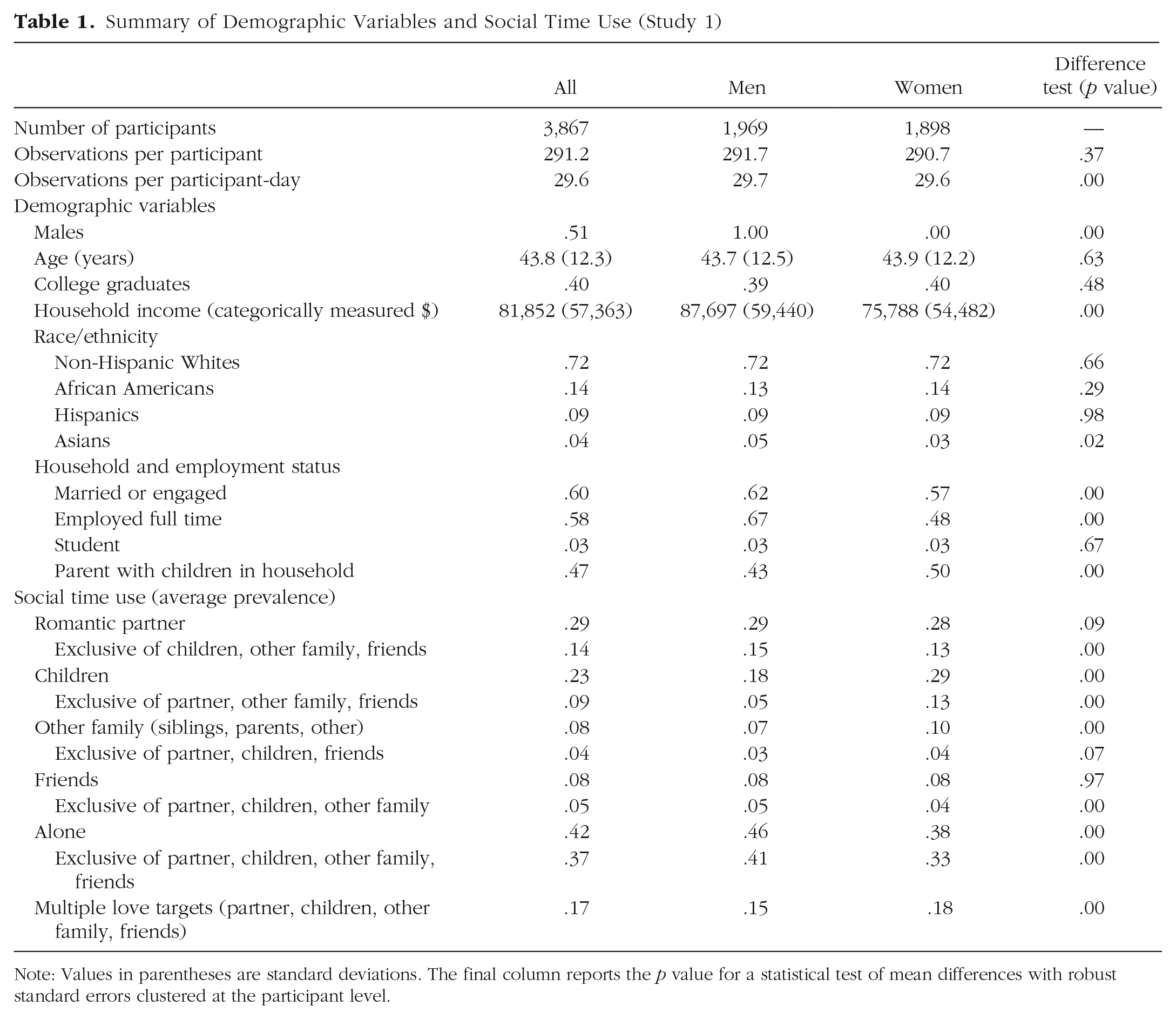
Note: Values in parentheses are standard deviations. The final column reports the p value for a statistical test of mean differences with robust standard errors clustered at the participant level.
Results
Overall prevalence, variance decomposition, and gender gap
Participants reported love in 3.2%, 95% confidence interval (CI) = [2.9, 3.5], of periods, making it the ninth most prevalent emotion overall (of fifteen) and the sixth most prevalent positive emotion (of seven). Between-subject variance explained 31% of the overall variation in reported love and 41% of love in the exclusive presence of a partner (hereafter, partner love). Men reported love in 2.3%, 95% CI = [2.0, 2.8], of periods, significantly less often than women, who reported love in 4.0% of periods, 95% CI = [3.5, 4.5], p < .001. The absolute magnitude of the gender love gap was third largest among emotions, exceeded only by gaps in confidence and exhaustion.
Given potential compositional differences across gender, a covariate-adjusted gender gap in prevalence, γ, was estimated with the following equation:

Here, Loveit refers to per-period reported love, Male indicates binary gender, and
Heterogeneity by other demographic categories
Although every observed demographic category reported love with nontrivial frequency, there were notable differences in average prevalence. For example, Black participants reported covariate-adjusted love far more frequently, b = 0.022, 95% CI = [0.008, 0.036], p = .003, than the non-Hispanic White baseline average of 0.028. Asians, b = 0.001, 95% CI = [−0.011, 0.013], p = .843, and Hispanics, b = −0.003, 95% CI = [−0.012, 0.006], p = .472, did not differ in average prevalence relative to the same baseline. The estimates additionally imply 30- to 39-year-olds reported love 33.8% more frequently than 18- to 29-year-olds, b = 0.010, 95% CI = [0.000, 0.020], p = .061, baseline = 0.030, and 36.2% more frequently than 40- to 49-year-olds, b = 0.009, 95% CI = [0.000, 0.018], p = .052, baseline = 0.028. Neither marital, b = 0.000, 95% CI = [−0.008, 0.007], p = .967, or parental, b = 0.006, 95% CI = [−0.002, 0.013], p = .136, status significantly predicted prevalence. Last, households in the lowest income category (< $50,000) reported love 44.9% more frequently, b = 0.016, 95% CI = [0.008, 0.024], p < .001, than the 0.024 baseline average of higher income counterparts, with no significant differences across the four remaining income categories.
Gender gap by love target
I assessed the gender gap in love across focal targets (partner, children, other family, friends) via two strategies. First, I reestimated the covariate-adjusted gap after restricting samples by exclusive focal-category time use. Second, I estimated the gap separately for demographic categories theorized to be correlated with relevant social time use (marital/parental status). Table 2 reports gap estimates in absolute and relative terms. Although men reported less covariate-adjusted love than women across all focal categories, the relative gender deficit for men was largest when with friends (43%), b = −0.016, 95% CI = [−0.031, −0.001], p = .041, baseline = 0.037, and children (41%), b = −0.026, 95% CI = [−0.039, −0.013], p < .001, baseline = 0.064, and smallest when with a partner (23%), b = −0.014, 95% CI = [−0.026, −0.001], p = .038, baseline = 0.061. Presenting the comparison differently, when reporting love, men were 28% more likely than women to be with a partner, b = 0.057, 95% CI = [0.007, 0.106], p = .026, and 52% less likely to be with children, b = −0.109, 95% CI = [−0.082, −0.135], p < .001. The heterogeneous pattern of this gap across inferred targets parallels the covariate-adjusted estimates across marital/parental status.
Decomposing gender gap in love by social time use
To better understand its determinants, I decomposed the overall gender love gap into gender differences in three component factors: average time use (e.g., women spending more time with children), time-use coefficients (e.g., women reporting love more frequently when with children), and the interaction of these two factors (e.g., women spending more time with children leads to a higher likelihood of love in their presence). The mean was decomposed with a technique routinely used to interrogate group differences in economic and health outcomes (Neumark, 1988; Oaxaca, 1973). The exercise used linear-regression models to predict average counterfactual love for men at the participant level (after adjusting for demographics) assuming the average time use of women (fixing coefficients), the average time-use coefficients of women (fixing time use), and both the time use and time-use coefficients of women.
The exercise strongly associated the gender gap in covariate-adjusted participant-level love, b = 0.0125, 95% CI = [0.006, 0.019], p < .001, with gender differences in average time-use coefficients, b = 0.009, 95% CI = [0.003, 0.015], p = .005, and the interaction of average time use and time-use coefficients, b = 0.006, 95% CI = [0.002, 0.010], p = .007—but not differences in average time use alone. Further analyses indicated that gender differences in factors specifically associated with children predicted 79% of the overall gender love gap.
Love across cohorts of marital duration
To explore the long-run dynamics of heterosexual partner love, I compare cohort couples varying in their marital duration. Figure 1 plots the average share of exclusive partner time use (Fig. 1a), the average likelihood of love during exclusive partner time use (Fig. 1b), and the overall prevalence of partner love (Fig. 1c) across gender and cohort. After adjusting for demographic covariates (including age and income), those in later cohorts (3+ years) reported 36.7% less partner love than those in earlier cohorts (≤ 2 years; p = .061; baseline = 0.014). This cross-sectional difference resulted largely from a 33.8% reduction in the likelihood of love when with a partner across cohorts (p = .084; baseline = 0.072) rather than a shift in average time use. Although coupled men and women did not differ in overall prevalence of partner love (p = .504) or in the likelihood of love when with a partner (p = .258), women appeared to drive observed differences across cohorts. Specifically, women reported partner love 58.9% less prevalently overall, b = −0.011, 95% CI = [−0.021, −0.001], p = .034, baseline = 0.019, and 55.2% less frequently when with a partner, b = −0.051, 95% CI = [−0.102, 0.001], p = .054, baseline = 0.092, in later versus earlier cohorts (compared with 0.4% less prevalently, p = .879, and 9.2% less frequently, p = .701, for men).
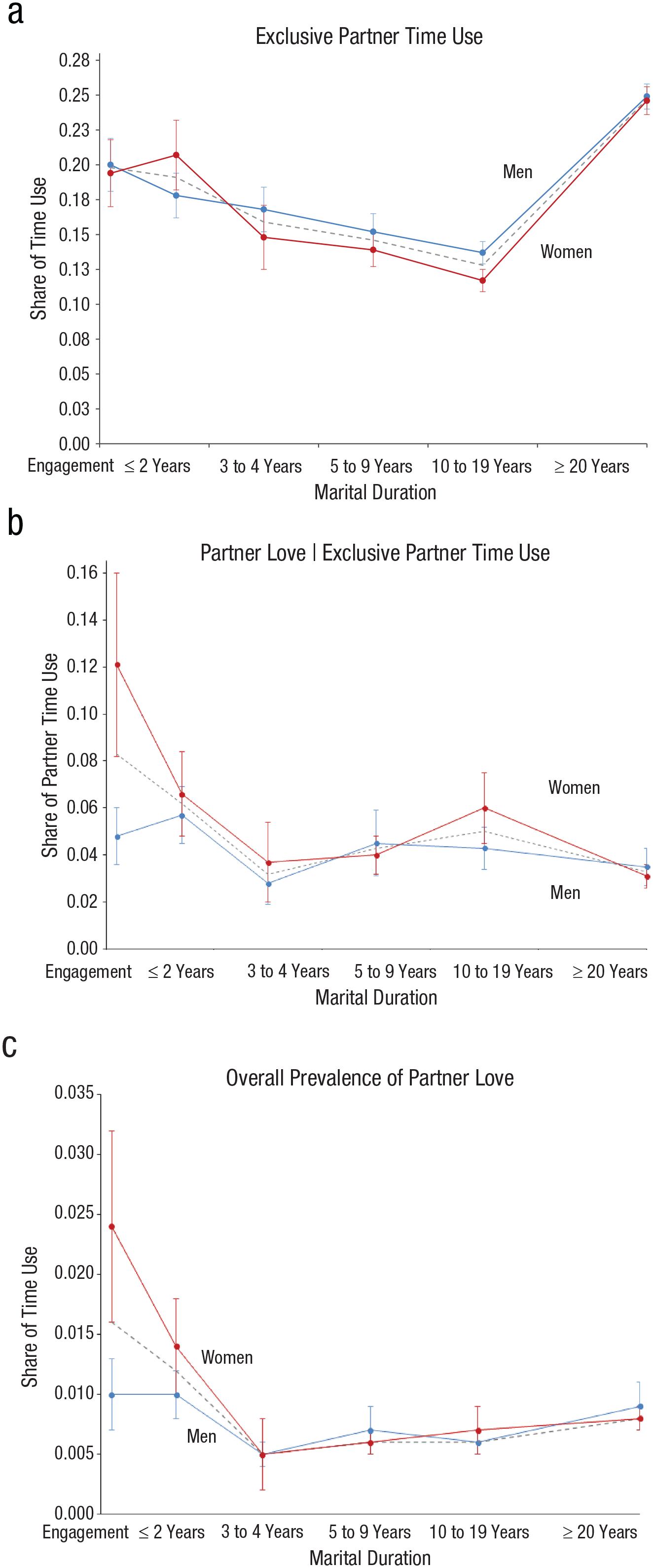
Partner love across gender and marital cohorts. This figure displays the average prevalence of exclusive partner time use (a), the average likelihood of reported love during exclusive partner time use (b), and the average overall prevalence of partner love (c) across gender and marital cohorts (Study 1). Dashed lines indicate estimates pooled by gender. Error bars indicate ± 1 standard error.
The data also permit inferring passionate partner love from the concurrence of love and excitement, an emotion often invoked in discussions of passionate love. Overall, coupled participants reported “excited love” in 0.73%, 95% CI = [0.54, 0.92], of partner interactions, with no covariate-adjusted gender difference (p = .926). Later cohorts reported excited love 53.0% less frequently than earlier ones, b = −0.009, 95% CI = [−0.019, 0.001], p = .091, baseline = 0.017. Despite the interaction not rising to statistical significance, the relative reduction in excited love among women across cohorts (−79.5%), b = −0.017, 95% CI = [−0.037, 0.004], p = .118, baseline = 0.021, more than doubled that of men (−30.5%), b = −0.004, 95% CI = [−0.011, 0.003], p = .257, baseline = 0.013. Notably, despite less (excited) partner love across cohorts, mature cohorts still reported nontrivial (excited) partner love.
To clarify the relationship between partner love and contemporaneous well-being, Figure 2 compares the average predicted change in within-participant mood during exclusive partner time use and instances of partner love across cohorts. Exclusive partner time predicted a modest increase in mood, b = 0.029, 95% CI = [0.016, 0.042], p < .001, baseline = 3.91, largely driven by men, b = 0.046, 95% CI = [0.028, 0.064], p < .001. This overall positive association between partner time use and mood was substantially less pronounced in later, b = 0.018, 95% CI = [0.005, 0.031], p = .008, relative to earlier, b = 0.094, 95% CI = [0.050, 0.138], p < .001, cohorts (indeed, women in later cohorts exhibited a slightly negative nonsignificant effect, p = .560). Partner love predicted a far more substantial, and sustained, increase in mood, b = 0.380, 95% CI = [0.339, 0.420], p < .001. This relationship did not statistically differ across gender (p = .772) or earlier and later cohorts (p = .648). Nevertheless, Figure 2 depicts a reversal in the gender ordering of effect size across earlier and later cohorts, b = −0.176, 95% CI = [−0.391, 0.039], p = .109.
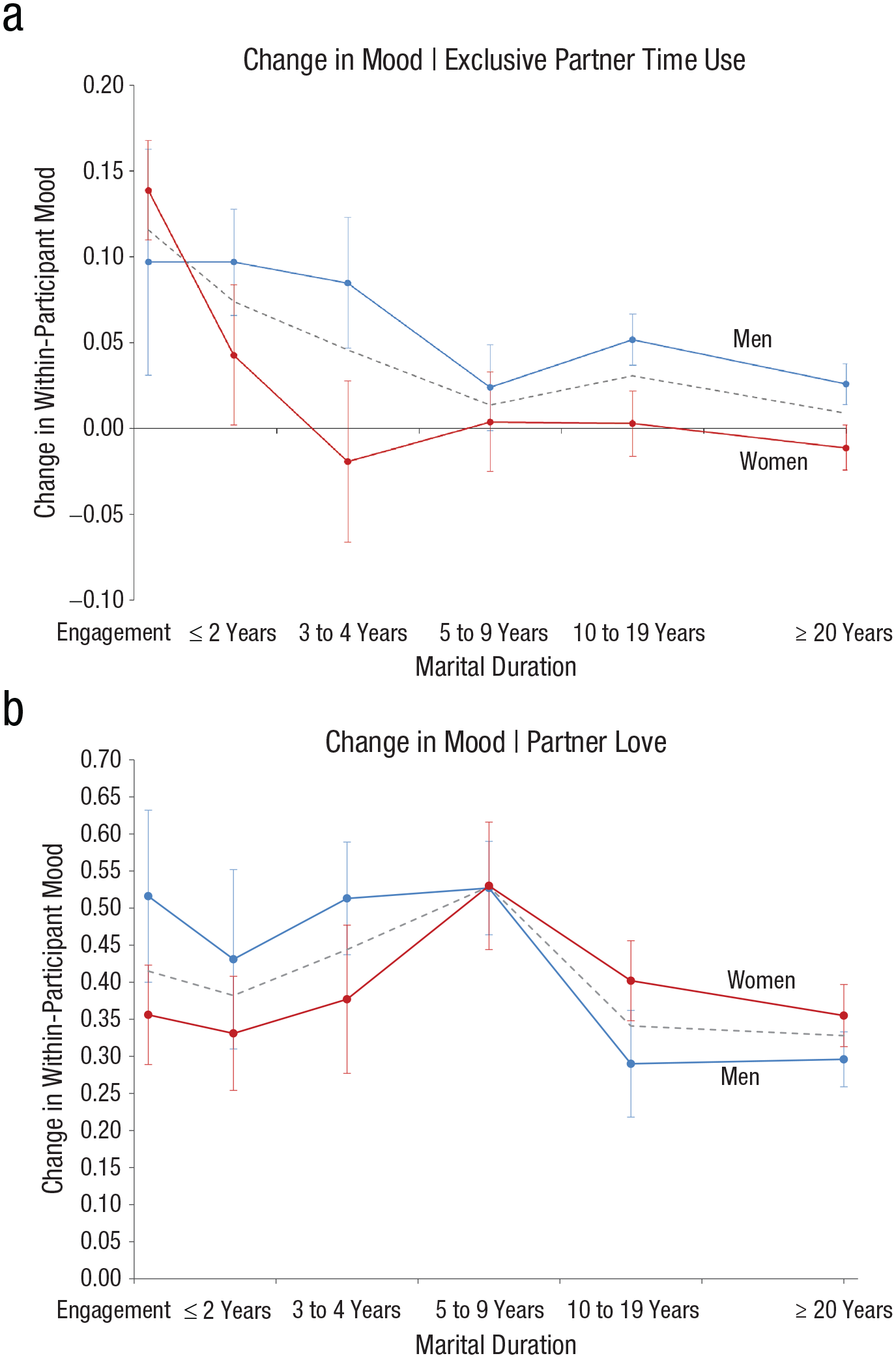
Change in mood and partner time use/love across gender and marital cohorts. This figure displays the average predicted within-participant change in mood in the exclusive presence of a partner (a) and in the presence of partner love (b) across gender and marital cohorts (Study 1). Dashed lines indicate estimates pooled by gender. Error bars indicate ± 1 standard error.
Short-run dynamics of partner love
Next, I investigated the short-run dynamics of partner love by inspecting the differential propensity of coupled participants to report partner love after separations of varying lengths. The analysis was implemented by assigning every—including nonexclusive—partner interaction an hours-of-separation variable from 1 to 12+ signifying the elapsed time since the most recent same-day partner interaction, excluding each day’s first interaction. For the resulting 27,008 partner separations across 2,224 participants, the change in within-participant likelihood of love during the partner reunion was computed.
Figure 3 displays the change in within-participant partner love after same-day separations for the specified range. The figure, and corresponding regressions, allude to elevated partner love after separations of any length with a significant trend break after roughly 8 hr, b = 0.011, 95% CI = [0.004, 0.019], p = .003. The elevation in love after separations of this length was more than twice as large for women (37%; p = .004) as it was for men (15%; p = .195), but this difference was not significant (p = .145).
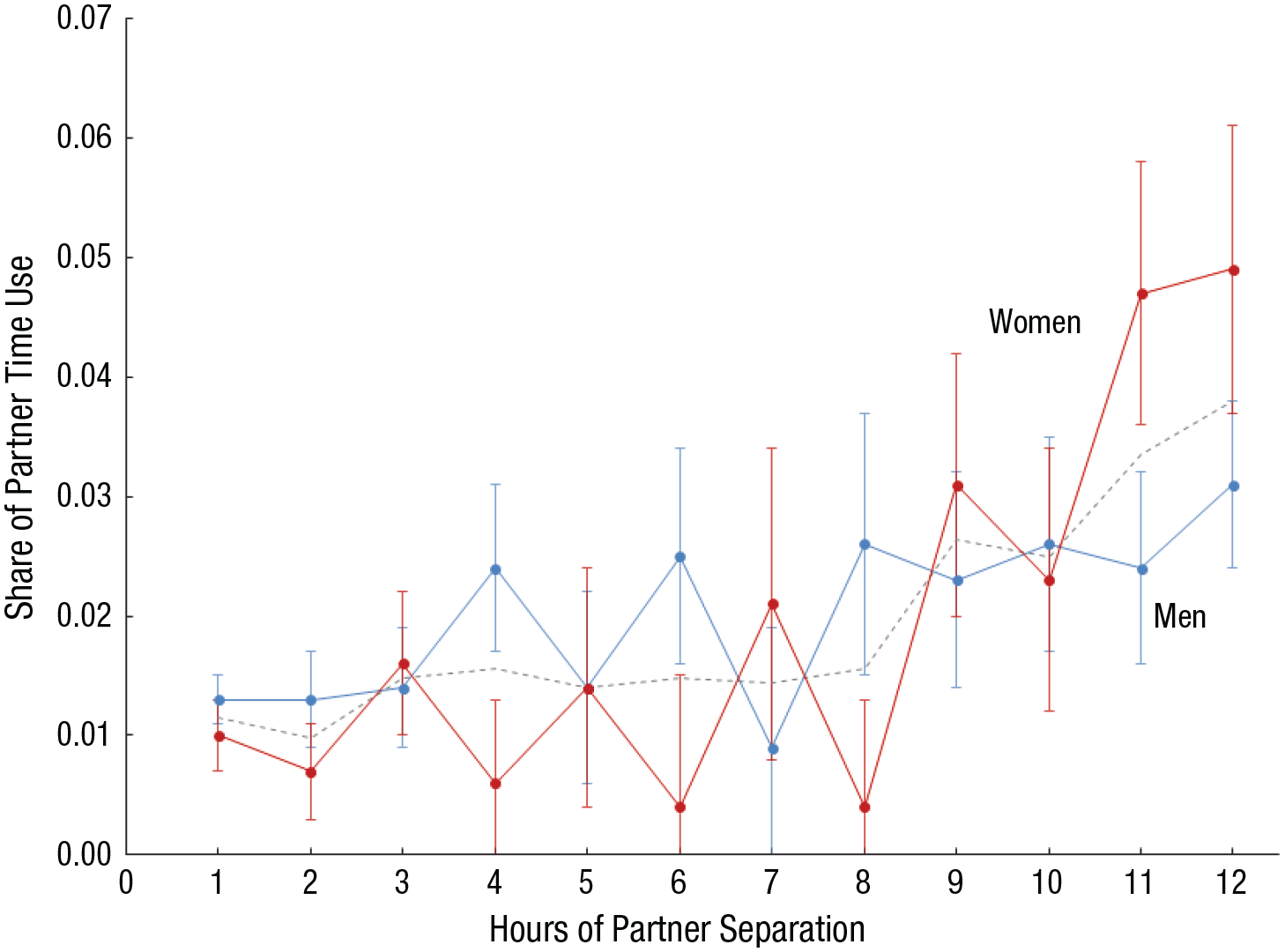
Hours of partner separation. This figure displays the average predicted change in the likelihood of love, adjusted for within-participant variation, in the (potentially nonexclusive) presence of a partner by gender and hours of same-day partner separation (Study 1). The sample is restricted to married/engaged participants and excludes the first partner interaction of each day. Error bars indicate ± 1 standard error.
Partial correlation of love and well-being
The relationship between love and well-being (mood, happiness) more generally was then assessed by estimating their partial correlation conditioned on contemporaneous social time use and emotion:

The parameter φ recovers the average predicted change in participant well-being,
Differential reporting of emotion by gender
Finally, I attended to the possibility that the observed gender differences in love reflect systematic gender differences in willingness to report rather than differences in experience. I addressed this potential bias by estimating the gender gap under varying assumptions regarding the hypothesized nature of bias. For example, assuming the unbiasedness of love conditioned on the expression of any emotion yielded an unbiased conditional gap estimate of −0.014, 95% CI = [−0.020, −0.007], p < .001. Alternatively, assuming unbiasedness of love conditioned on the expression of any positive emotion yielded an unbiased conditional love gap estimate of −0.016, 95% CI = [−0.022, −0.009], p < .001. Finally, assuming unbiasedness of love among participants reporting at least one instance of love during the study yielded an unbiased love gap estimate for the appropriately restricted sample of −0.014, 95% CI = [−0.025, −0.002], p = .027. The similarity of these estimates with the baseline estimate (b = −0.013; Table 2) and the nonsignificant difference in overall emotional expression across men and women (p = 0.512) does not suggest significant gender bias in the willingness to report love.
Gender Gaps in Experienced Love (Studies 1 and 2)
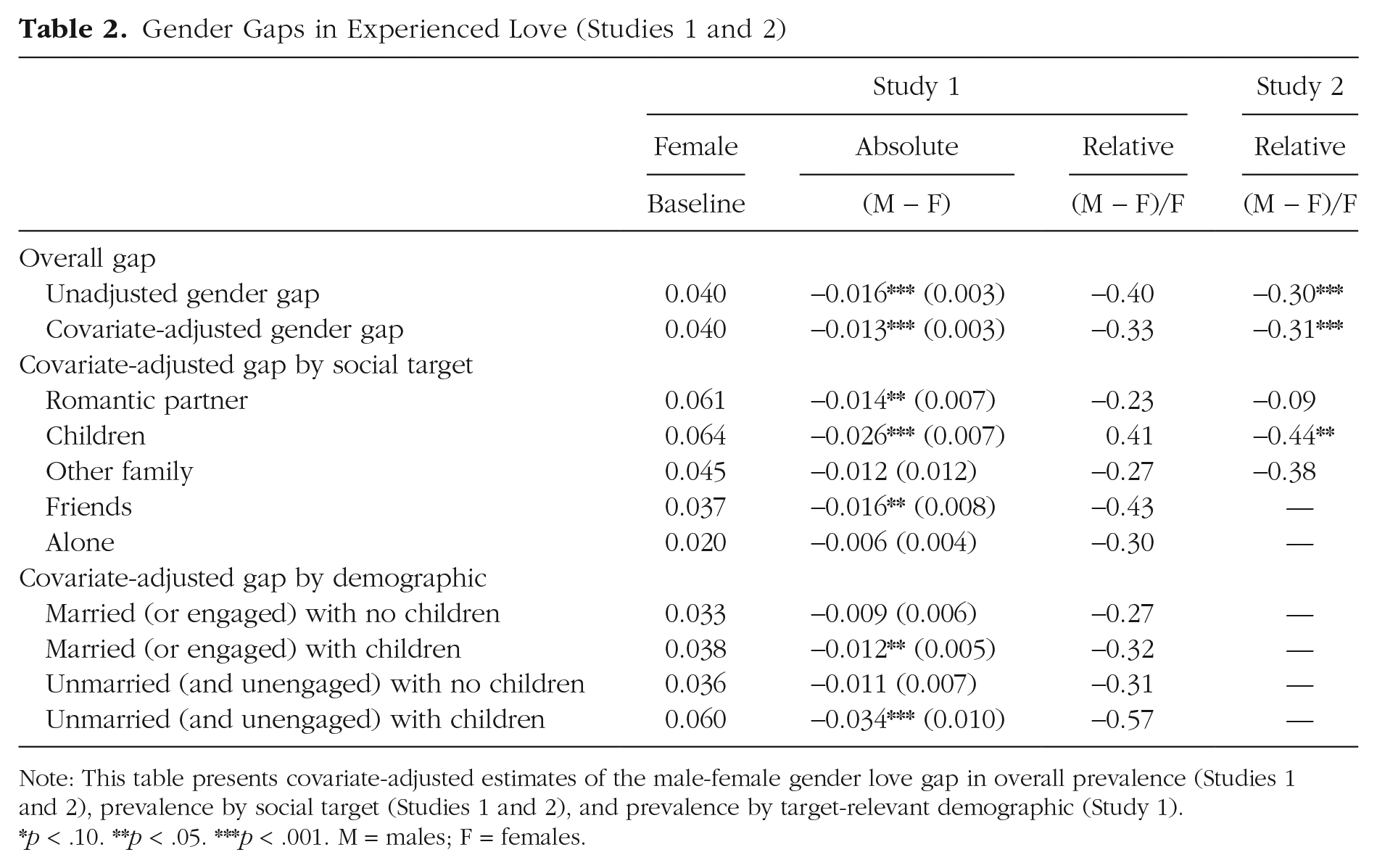
Note: This table presents covariate-adjusted estimates of the male-female gender love gap in overall prevalence (Studies 1 and 2), prevalence by social target (Studies 1 and 2), and prevalence by target-relevant demographic (Study 1). *p < .10. **p < .05. ***p < .001. M = males; F = females.
Study 2
While Study 1 estimated the overall prevalence of love across a diverse sample, conclusions regarding prevalence by love target (e.g., partner, child) and type (e.g., passion, companionship) relied on inferences from data on social time use and another emotion. Study 2 was designed to provide additional insight into the prevalence of love overall and by gender across explicitly differentiated target and type from a large, naturalistic, online sample. The study was approved by the Carnegie Mellon University Institutional Review Board.
Method
The second study was administered to a diverse population of online U.S. users in June 2014 via Google Surveys (GS), a now defunct market-research tool that deployed brief surveys for websites seeking to monetize content access. Although GS was paid for 500 responses to a five-question survey (508 completed all five questions), the intent was to analyze responses from the substantially larger samples of first-question impressions (n = 25,354) and responses (n = 7,255). The first screening question queried which, if any, of four emotions the website visitor experienced in the last hour: worry, love, excitement, and anger (randomized but for a none-of-the-above option). Those reporting love (n = 778) proceeded to a second question that elicited the target of such love (a romantic partner, a child, another family member, a place or thing) and a third that queried its type (companionship, passion, caregiving; both randomized but for a none-of-the-above option). The final two questions elicited sex and parental/marital status. Inferred demographic data, available for more than one half of participants, indicated a diverse sample across gender, age, and location (see Supplemental Material).
Results
Overall prevalence and gender gap
These data yielded two measures of love prevalence: 3.1%, 95% CI = [0.029, 0.033], of total impressions, and 10.7%, 95% CI = [0.100, 0.114], of first-question responses indicated experienced love during the preceding hour. Perhaps more instructively, the absolute male-female difference of 4.3%, 95% CI = [0.0242, 0.0618], p < .001, among those for whom gender was inferred, implies men experienced love 30% less frequently than women (31% after covariate adjustment).
Love by target and type
Among completed responses, love was most frequently directed toward a partner (53.3%), followed by a child (20.9%), other family (13.8%), none of the above (9.3%), and a place or thing (2.8%). To characterize the gender love gap by target, the male deficit in targeted love was calculated assuming the gender ratio of first-question respondents accurately described second-question responses. This approach, which likely overestimated the male deficit and its precision (see Supplemental Material), suggested a relative male–female love deficit of 9.4% for partner love, b = 0.004, 95% CI = [−0.008, 0.016], p = .494, baseline = 0.044; 43.7% for child love, b = 0.010, 95% CI = [0.002, 0.018], p = .010, baseline = 0.023; and 38.1% for other family love, b = 0.005, 95% CI = [−0.001, 0.011], p = .110, baseline = 0.012. An alternative strategy that permits explicit demographic controls is to estimate the differential gender likelihood of reported love toward each target. These estimates indicated men, relative to women, were 25.6% more likely to direct love toward a partner, b = 0.122, 95% CI = [0.035, 0.210], p = .006, baseline = 0.477, and 48.9% less likely to direct love toward a child, b = −0.134, 95% CI = [−0.065, −0.203], p < .001, baseline = 0.274.
Participants explicitly reporting partner love most frequently characterized such love as passionate (49.5%), followed by companionate (41.3%) and caregiving (5.5%). Figure 4, which depicts the covariate-adjusted male–female difference in characterization across marital status, conveys moderate, but not significant, differences in characterization among the full sample, with men interpreting love as directionally less companionate and more passionate than women—companionship: b = −0.087, 95% CI = [−0.208, 0.034], p = .159; passion: b = 0.047, 95% CI = [−0.072, 0.166], p = .439; caregiving: b = 0.044, 95% CI = [−0.013, 0.100], p = .127. The figure also conveys a large and significant interaction across gender and marital status in the characterization of passionate partner love, b = 0.298, 95% CI = [0.058, 0.538], p = .015, reflecting a 55.3% reduction in passion for married versus unmarried women, b = −0.330, 95% CI = [−0.511, −0.148], p < .001, compared to a nonsignificant 22.7% reduction for men, b = −0.104, 95% CI = [−0.311, 0.103], p = .324.
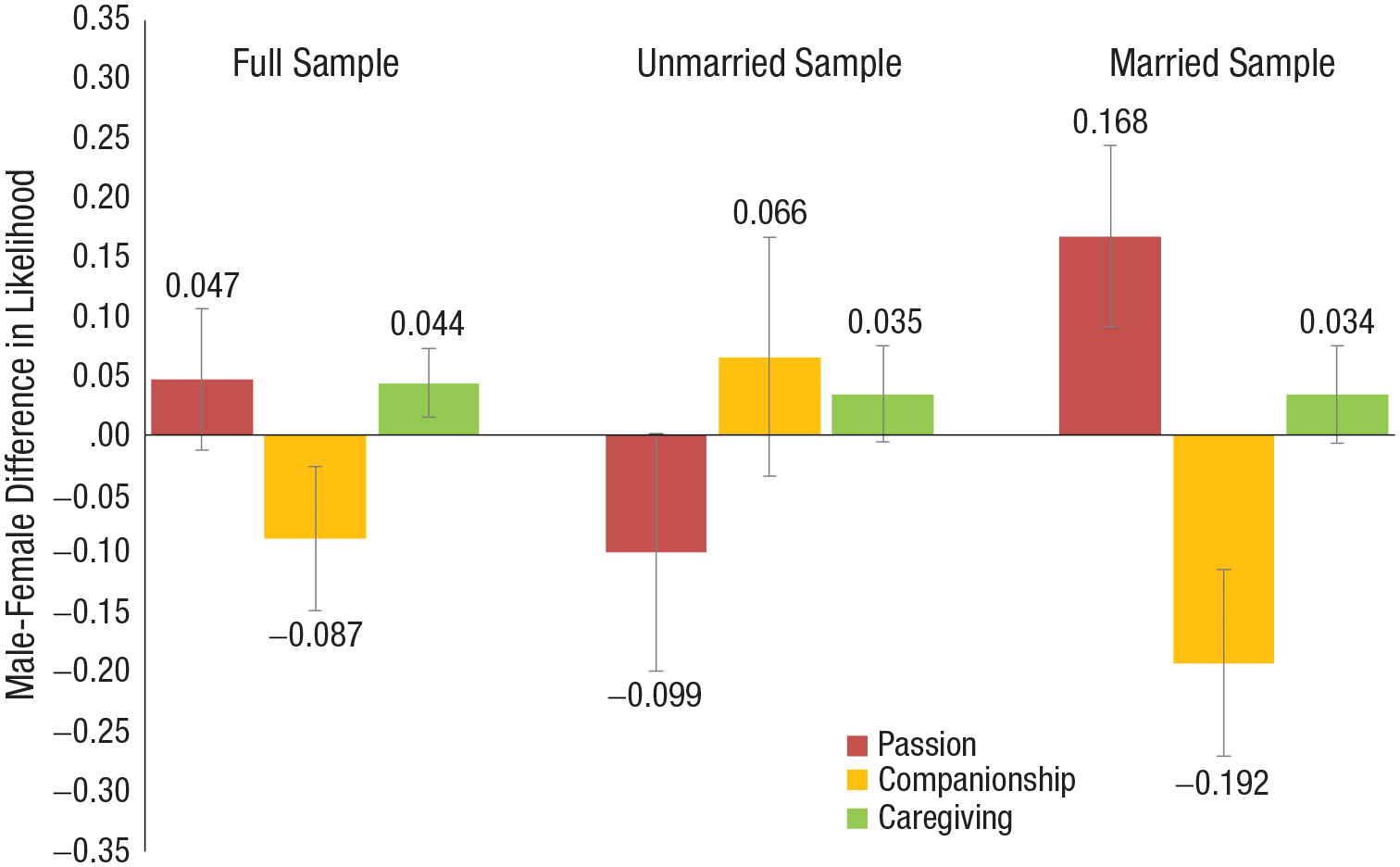
Male–female difference in characterization of partner love across marital status. This figure displays the estimated male–female differential likelihood of characterizing partner love across type (passion, companionship, caregiving) across marital status (Study 2). Each estimate was generated from a separate regression of love type on an indicator for gender and a vector of demographic covariates, including marital status (full sample regressions only), parental status, inferred age, and inferred income. Error bars indicate ± 1 standard error.
Discussion
Across two studies offering exceptional detail on time use, emotion, and well-being, this article provides new evidence on love’s prevalence by target and type, its short- and long-run dynamics, and its association with well-being. The first contribution of the article is to characterize the prevalence of love from a diverse and high-compliance sample of U.S. adults. The analyses revealed that although love is infrequent relative to other emotions and varies across race/ethnicity and income—Black and lower income participants reported substantially more love than counterparts—it was nontrivially expressed by every demographic category. This demographic heterogeneity supports assertions as to the cultural universality of love (e.g., Jankowiak & Fischer, 1992) while still allowing for potential sociocultural variability in experience or expression. Only hope, confidence, and happiness registered lower shares of overall variation explained by within-participant variability than did love (69%), emphasizing the dispositional nature of love relative to other emotions in the data.
A second contribution is to provide insight into gender differences in the prevalence and conceptualization of love. Although men were less likely to report love than women, the gender gap varied by inferred love target, with larger differences in child love and smaller differences in partner love. Indeed, among the married/engaged, no significant gender gap was found in partner love or in the share of excited partner love (a potential proxy for passionate love). The second study implies a relative gender gap in love of nearly identical magnitude to the first study and no significant difference in partner love. Additionally, the second study indicates men and women characterize their partner love similarly, at least with respect to passion.
What might account for the gender differences in overall prevalence? A statistical mean decomposition attributed 79% of the gap to systematic gender differences in experiences with children (resulting both from gender differences in average child time use and the likelihood of experiencing love in their company). Although a strict causal interpretation requires strong assumptions (for discussion, see the Supplemental Material), the decomposition and the heterogeneous gender gaps by inferred target support the possibility that children may play an outsized role in explaining the overall gender gap in love. There are several possible explanations for why women were more likely to report love when with children than men. For example, there may be systematic gender differences in the type or quality of child time use. However, comparing the most common activities with children undertaken by men (talk: 0.29; eat/drink: 0.21; relax: 0.18; chore: 0.13) and women (talk: 0.34; eat/drink: 0.22; chore: 0.18; relax: 0.15) does not reveal meaningful disparities. Another possibility is that men and women differ in their conceptualization or willingness to report child love. However, analyses of other emotions offer no evidence consistent with such bias (notably, men were more likely than women to report any positive emotion when with children, p < .001). It is also possible that the heightened propensity of women to report love when with a child resulted from unobserved differences in the quality of time use, increasing hedonic returns to accumulated child time use, or innate/learned differences in the likelihood of experiencing such love (see Buss, 2019).
The third contribution of the current article is to present new evidence explicating the dynamics of partner love. In the short run, the evidence supports the proverb that (temporal) distance makes the heart grow fonder because both men and women reported elevated within-participant partner love after any same-day separation and extreme elevation after lengthy separations. The assumptions required for causal interpretation of these estimates—namely, that lengthy separations are conditionally exogenous (for additional discussion, see the Supplemental Material)—may be plausible to many readers.
In the longer run, covariate-adjusted comparisons across marital-duration cohorts indicated a significant decline in partner love and excited partner love across marital duration (Study 1). These patterns resulted largely from differences in the likelihood of love when with a partner rather than differences in partner time use. The cohort comparisons are consistent with theories of love that posit a decline and/or evolution in (passionate) partner love as relationships progress (e.g., Berscheid, 2010; Carswell & Impett, 2021) and studies documenting declining relational satisfaction during the initial stages of marriage (see Buhler et al., 2021). Indeed, the proxy for relationship satisfaction that was used in this study—the predicted in-the-moment change in within-participant mood associated with partner time use—suggests a reduction in relational well-being in later relative to earlier cohorts. However, partner love, when experienced, predicted a massive increase in mood across marital cohorts for both genders, an increase equivalent to about 3 times the hedonic difference between a typical Saturday and Monday (days with the highest/lowest mood). A causal interpretation of these patterns requires assuming the independence of reported love conditioned on covariates (including age) and adjusting for survivorship bias (see Supplemental Material). With respect to the latter, if divorce is negatively correlated with partner love, the true relational decline in partner love may be larger than that suggested by the cross-sectional comparisons. Notably, the most mature couples in Study 1 reported (passionate) partner love with nontrivial frequency—rejecting assertions as to its complete atrophy and consistent with the claims of Acevedo and Aron (2009).
The cohort comparisons also reveal an intriguing gender difference. In Study 1, the reduction in (passionate) partner love, and its association with well-being, across earlier and later cohorts was more pronounced for women than men. It is possible these patterns simply reflect gender differences in survivorship (or other forms of) bias across cohorts (e.g., partner love may be differentially predictive of divorce across gender). A more theoretically meaningful possibility is that such patterns reflect gender differences in the progression of partner love. The literature suggests potential mechanisms consistent with such an interpretation such as gender differences in the expression of partner love over time (e.g., perhaps because of varying dynamics involving sex and accommodation in relationships; e.g., Schoenfeld et al., 2012) or gender differences in relational burdens involving household or child care (e.g., Ciciolla & Luthar, 2019). Evidence for this latter mechanism was found in the time-use data showing coupled women spent more time engaged in chores (p = .032) and cooking (p = .034) in later versus earlier cohorts, whereas coupled men spent increasingly more time relaxing (p = .055) and sleeping/napping (p = .016).
The final contribution of this article is to leverage data with high-frequency longitudinal variation to characterize the contemporaneous relationship between love and in-the-moment well-being. After controlling for detailed time use and the presence of other emotions, variation in love was found to substantially predict within-participant variation in well-being. The marginal increase in well-being predicted from the presence of love (statistically indistinguishable by gender) exceeded that of all but one other positive emotion and was more than twice the hedonic difference between a typical Saturday and Monday. A causal interpretation requires the arguably plausible assumption of conditional exogeneity—that is, controlling for social time use and other emotions, variation in love was uncorrelated with time-varying factors also correlated with within-participant mood (see Supplemental Material). The pronounced association of love and well-being from these analyses is consistent with research asserting the functional importance of love for health, self-esteem, and longevity (see Levin, 2022).
Important limitations should be noted. First, men and women may systematically differ in how they define love or in their willingness to report it when prompted by our elicitation. Although such possibilities cannot be ruled out, they are mitigated by the analysis of the discriminant validity of the elicitation that is presented in the Supplemental Material, the similarity between the baseline estimates and estimates conditional on the expression of other (positive) emotions, and the similarity of estimates across distinct representations of love across studies. Perhaps a more important limitation is that, because of the absence of explicit, or naturally occurring, randomization of love, a causal interpretation of potential causes, dynamics, and consequences relies on statistical and theoretical assumptions. Although the high-frequency, longitudinal nature of the data and the ability to condition on time use and other emotions improve the plausibility of such assumptions, to facilitate informed interpretation, the Supplemental Material provides a more detailed discussion of causal identification.
Conclusion
Across studies, this investigation provides an empirical account of a functional, situationally dependent, demographically pervasive and adaptive emotion that seemingly helps to facilitate and sustain relationships and strongly predicts in-the-moment well-being (consistent with Berscheid & Ammazzalorso, 2001; Frank, 1988; Gonzaga et al., 2001; Tooby & Cosmides, 2005). In arguable contrast to the differences suggested by some theory and popular characterizations (e.g., Gray, 1992), this evidence points to largely similar experiences of love, particularly partner love, across gender. The differences that were found (e.g., differences in partner love across earlier and later relational cohorts and differences in the prevalence of child love) seem consistent with evolutionary or otherwise functional accounts that posit gender differences in the importance of love for maintaining child and partner relationships. In this regard, a central takeaway from these findings is to emphasize the utility of differential empirical predictions as to the prevalence, dynamics, and consequences of love for adjudicating between existing theories. For example, one could potentially leverage estimates of between- and within-participant variation to assess the plausibility of theories of love based on individual differences (e.g., attachment theory) if such models were more formally parametrized.
Supplemental Material
sj-docx-1-pss-10.1177_09567976231211267 – Supplemental material for Experienced Love: An Empirical Account
Supplemental material, sj-docx-1-pss-10.1177_09567976231211267 for Experienced Love: An Empirical Account by Saurabh Bhargava in Psychological Science
Footnotes
Acknowledgements
I thank Jim Spaeth and Alice Sylvester for generously providing data, Karim K. Kassam for seminal contributions to an earlier version of this manuscript, and Julie Downs, George Loewenstein, Carey Morewedge, and referees for useful feedback.
Transparency
Action Editor: Yoel Inbar
Editor: Patricia J. Bauer
Author Contributions
Saurabh Bhargava is the sole author of this article and is responsible for its content.

Notes
References
Supplementary Material
Please find the following supplemental material available below.
For Open Access articles published under a Creative Commons License, all supplemental material carries the same license as the article it is associated with.
For non-Open Access articles published, all supplemental material carries a non-exclusive license, and permission requests for re-use of supplemental material or any part of supplemental material shall be sent directly to the copyright owner as specified in the copyright notice associated with the article.
