



Abstract
The public has something of an obsession with love languages, believing that the key to lasting love is for partners to express love in each other’s preferred language. Despite the popularity of Chapman’s book The 5 Love Languages, there is a paucity of empirical work on love languages, and collectively, it does not provide strong empirical support for the book’s three central assumptions that (a) each person has a preferred love language, (b) there are five love languages, and (c) couples are more satisfied when partners speak one another’s preferred language. We discuss potential reasons for the popularity of the love languages, including the fact that it enables people to identify important relationship needs, provides an intuitive metaphor that resonates with people, and offers a straightforward way to improve relationships. We offer an alternative metaphor that we believe more accurately reflects a large body of empirical research on relationships: Love is not akin to a language one needs to learn to speak but can be more appropriately understood as a balanced diet in which people need a full range of essential nutrients to cultivate lasting love.
One goal of relationship science is arguably to help people improve their relationships, but often, despite thousands of papers on relationship science and maintenance (e.g., Ogolsky et al., 2017), empirical findings do not make it to the public. Instead, the most public-facing theories about relationships lack empirical foundations (for an example, see Johnson et al., 2022). One of the most well-known lay “theories” about relationships that has proliferated in the public sphere, but does not have strong empirical support, is the love languages. Chapman’s book The 5 Love Languages has gained immense popularity since its initial publication in 1992, 1 having sold over 20 million copies worldwide and been translated into 50 languages. The love languages have also been applied in relationship counseling and government initiatives, such as a $20 million relationship education and counseling program subsidized by the Australian government (as cited in Bunt & Hazelwood, 2017). Nevertheless, relative to its immense popularity, there is a paucity of scholarly attention in psychology paid to empirically testing the love languages. In this review, we critically evaluate existing research on love languages, discuss potential reasons for its popularity, propose an alternative metaphor that could replace the love languages, and emphasize the importance of bridging the gap between popular lay theories and relationship science.
Empirical Review of the Love Languages
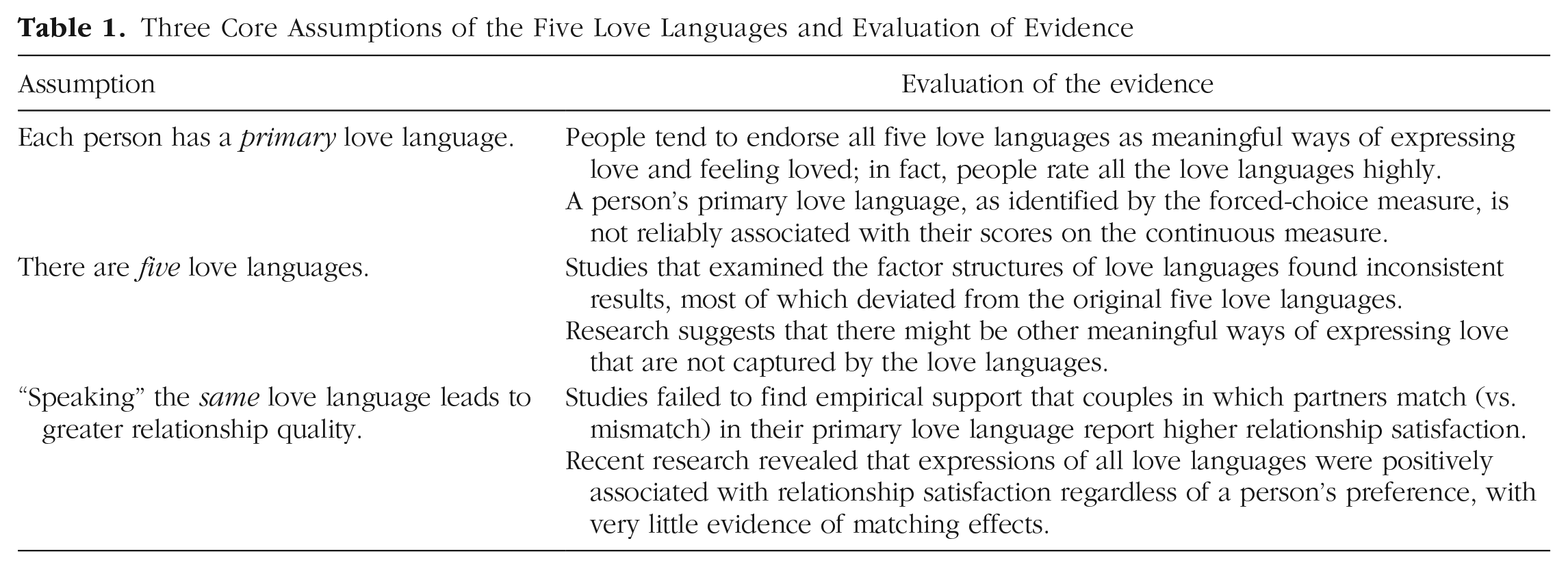
Chapman (2015) argues that there are systematic differences in people’s preferred ways of expressing and receiving love, labeled love languages. His ideas are built on three core assumptions, each of which we critically evaluate based on existing research (see Table 1). First, each person has a primary love language that they rely on the most for expressing and feeling love. Second, there are five love languages: (a) words of affirmation (verbal expressions of appreciation, compliments, or encouragement), (b) quality time (intentional time spent together with undivided attention), (c) receiving gifts (visual tokens of appreciation), (d) acts of service (practical support through actions), and (e) physical touch (from holding hands to sexual interactions). Last, most relationship problems stem from partners speaking different (vs. the same) love languages. On the basis of the assumption that the five love languages are “as different as Chinese from English” (Chapman, 2015, p. 15), Chapman suggests that partners cannot understand or feel loved when speaking in “foreign” love languages. In sum, according to Chapman, the key to happy and successful relationships is for partners to discover, learn, and speak each other’s primary love language.
Three Core Assumptions of the Five Love Languages and Evaluation of Evidence
To identify people’s primary love language, Chapman (2015) developed a measure with 30 forced-choice items, known as the Love Language Personal Profile (LLPP; https://5lovelanguages.com/quizzes/love-language). Despite the popularity of the LLPP, with over 30 million people having taken the quiz (Fetters, 2019), the measure imposes several limitations for application in research as each love language is evaluated in a zero-sum fashion compared with the other languages. Specifically, for each item, respondents select the one they find more “meaningful” between two response options (e.g., “We hold hands” for physical touch vs. “My loved one gives me a gift” for gifts), which cannot capture peoples’ independent preferences for each love language. Hence, researchers have developed Likert-type scales by adapting Chapman’s items and descriptions of the love languages (Cook et al., 2013; Egbert & Polk, 2006; Goff et al., 2007).
Assumption 1: each person has a primary love language
Although there is only a limited body of empirical research on love languages, the work that does exist does not provide strong support for the validity of the love languages’ core assumptions. First, contradicting the notion that “we speak only our primary language” (Chapman, 2015, p. 15), studies have consistently demonstrated that people tend to endorse all five love languages as meaningful ways of expressing love and feeling loved (Bunt & Hazelwood, 2017; Cook et al., 2013; Egbert & Polk, 2006; Mostova et al., 2022; Polk & Egbert, 2013; Surijah et al., 2020). Specifically, the ratings on the Likert-type measures consistently exhibit highly skewed distributions, with most ratings falling above the midpoint of the scale and average ratings hovering around 4 on a 5-point scale for all five love languages.
Consequently, studies have shown that a person’s primary love language, as identified by the forced-choice LLPP measure, is not reliably associated with their scores on the continuous measure (Mostova et al., 2022; Polk & Egbert, 2013; Surijah et al., 2020), such that a person’s forced-choice primary love language does not surface as their highest-rated love language on the continuous measure. For example, Polk and Egbert (2013) found that a majority of their sample were categorized as having quality time or physical touch as their primary love language when using the forced-choice measure, but gifts showed the highest mean score using the Likert-type measure. In fact, comparisons across studies show that the number of people categorized as having gifts as their primary love language was as low as 0% to 4% of the sample when using the forced-choice LLPP measure (Hughes & Camden, 2020; Mostova et al., 2022; Polk & Egbert, 2013) but as high as over 50% of the sample when selected on the basis of the highest score on the continuous scale (Bunt & Hazelwood, 2017). These findings discount the notion that each person has a primary love language and illustrate that people value all five love languages but perhaps in different contexts. For example, if they had to choose, most people might favor spending quality time with their partner over receiving gifts, as it is something they can do more frequently with their partner in daily life, but if they were to independently rate each love language, they might rate receiving gifts as quite meaningful because it represents an occasional but special way in which their partner communicates their love.
Assumption 2: there are five love languages
In addition to the findings that all five love languages are highly endorsed, studies have found substantial positive correlations (rs = .54–.75; e.g., Egbert & Polk, 2006) among peoples’ ratings of all five love languages. These findings not only contradict the notion that people are restricted to a primary love language, but they also render the fivefold organization of the love languages questionable. Although some studies claim to find support that the five love languages represent somewhat distinct and separable constructs (e.g., Egbert & Polk, 2006; Goff et al., 2007; Surijah & Septiarly, 2016), the results across studies are inconsistent, finding support for a three-factor (Surijah et al., 2020), a four-factor (Surijah & Kirana, 2020), and a five-factor structure (e.g., Cook et al., 2013; Surijah & Sari, 2018), all of which significantly deviated from the proposed five-love-languages structure. Despite some conceptual overlap across factors found in these studies (e.g., “sacrificial love,” “intimate love”; Cook et al., 2013; Surijah et al., 2020), there are also significant inconsistencies across their results, leaving it inconclusive whether the five love languages truly represent a meaningful framework for understanding the various ways people express and feel love.
Meanwhile, even if it were true that the five love languages as proposed by Chapman (2015) represent somewhat separable constructs, it is important to consider that they may not encompass all the meaningful ways that people express and feel love. Whereas the love-language measures were developed on the basis of Chapman’s top-down descriptions, a more comprehensive understanding of how people communicate love would require a bottom-up approach. In fact, research on relationship maintenance that has used such an approach, in which people are asked what they do to maintain a satisfactory relationship, identified seven distinct relationship maintenance behaviors, some of which overlap with Chapman’s (assurances are similar to words of affirmation) but others that are not captured in the love languages, such as integrating a partner into one’s broader social network and developing effective strategies to manage conflict (Stafford, 2011). It is plausible that Chapman’s oversight in recognizing these behaviors as meaningful expressions of love may stem from his reliance on a homogenous sample of couples who are all married, religious, and mixed gender and likely share traditional values. For example, the love languages do not include mention of support for a partner’s autonomy or personal goals outside of the relationship, factors that have been associated with relationship satisfaction (e.g., Knee et al., 2013) and might be more meaningful to couples with egalitarian values.
Assumption 3: “speaking” each other’s love language
Although there is limited evidence for the presence of primary, or five, love languages, several studies have nevertheless attempted to test Chapman’s (2015) third key assumption that partners who “speak” the same love language report greater relationship quality. One way that researchers have tested this assumption is by investigating whether partners who have the same (vs. a different) primary love language are more satisfied. Yet none of these studies found empirical support that couples in which partners match (vs. mismatch) in their primary love language report higher relationship satisfaction (Bland & McQueen, 2018; Bunt & Hazelwood, 2017; Polk & Egbert, 2013; Surijah et al., 2020). A second way that this assumption has been tested is by examining whether people report greater relationship satisfaction when their partner expresses love to them in their preferred love language. Although a few studies argue to have found support for this assumption (Hughes & Camden, 2020; Mostova et al., 2022), the methodological limitations of these studies render it possible that the results simply reflect the main effects of any type of expression. For example, Hughes and Camden (2020) examined only the effects of a partner’s expression of the person’s “primary” love language, which was associated with greater relationship satisfaction, but it is possible that receiving expressions of love in any form could have relationship benefits regardless of a person’s preferences. In fact, recent work that employed rigorous analytical methods to test all possible combinations of a person’s preferences and their partner’s expressions revealed that expressions of all love languages were positively associated with relationship satisfaction regardless of a person’s preference, with very little evidence of matching effects (Chopik et al., 2023). These null matching effects are not surprising considering that existing research on matching in other domains, such as in conflict (Busby & Holman, 2009) or language styles (Bowen et al., 2017), has demonstrated that matching is not uniformly associated with positive outcomes and the implications of matching depend on specific forms or contexts of the interaction.
Insights From Relationship Science: Love as a Nutritionally Balanced Diet
Despite weak empirical evidence for the love languages, it is still one of the most well-known lay theories on relationship processes. Popular social media sites like TikTok have daily content on love languages; the hashtag #lovelanguages has more than 500 million views. The love languages is likely popular because it comes with a quiz that can be used as a quick diagnostic tool for self-reflection, provides a label that can be used as a shorthand for people to discuss their needs, and suggests a straightforward way to improve relationships. Unfortunately, these features that have the greatest appeal to the public also undermine scientific accuracy by oversimplifying relationship processes and categorizing people in rigid or limited ways. For the general audience, strictly adhering to the love-language label may lead them to undervalue other expressions of love outside of their “primary” love language, dismiss the full range of emotional needs and preferences that go beyond the limited scope of five love languages, or discount potential or current partners who do not “match” their primary love language.
Another key reason for the popularity of the love languages is its use of intuitive metaphors, which may resonate with people and convey an easily digestible message free of scientific jargon. As relationship scientists, if we take seriously the goal to bridge the gap between popular lay theories about relationships and relationship science, we suggest that the love-languages metaphor could be replaced with another simple, intuitive metaphor: The process of maintaining successful, loving relationships is akin to keeping a healthy, balanced diet. Whereas Chapman’s (2015) language metaphor implies that people can feel love only when their partner speaks their love language, the healthy-diet metaphor suggests that people need multiple essential nutrients to maintain satisfying relationships. Although people can certainly stay alive if they consume only some ingredients (e.g., carbs), we ultimately need all key nutritional ingredients (e.g., carbs, protein, fat, vitamins, minerals) to be in the best state of health. Likewise, although people might be able to successfully maintain their relationships even if they are missing a particular ingredient (e.g., lack of physical touch in long-distance relationships), the best relationships will be ones in which partners spend time together (quality time; Aron et al., 2022), express appreciation (words of affirmation; Algoe, 2012), show affection (physical touch; Jakubiak & Feeney, 2019), help and support each other (acts of service; Feeney & Collins, 2015), and make each other feel special (which is presumably the intention behind gifts; Komiya et al., 2019), among other behaviors (e.g., support for personal goals and autonomy) not captured in Chapman’s five love languages.
Of course, this does not mean that all expressions of love will be equally important to all people and in all situations. Just as there are times when people might have particularly strong needs for certain nutrients (e.g., a marathon runner needs extra carbs), people might benefit more from specific expressions of love at certain times, such as physical affection during times of stress (Jakubiak & Feeney, 2019). In addition, just as some people with chronic health conditions benefit more than others from nutritional supplements (e.g., anemic people need supplemental iron), relationship science has shown that people with chronic relationship insecurities, for example, people higher in attachment avoidance who tend to have issues trusting in their partner’s love and care, experience even greater benefits when their partner expresses appreciation (Park et al., 2019). The message delivered to the public could then be that instead of there being only one key thing that people need to do to make their partner feel loved, people should make sure they have a nutritionally balanced relationship, and if they feel that something is missing, they could discuss that imbalance (unmet need) with their partner. In fact, one of the reasons why so many people feel that Chapman’s (2015) book has helped their relationships might be because it provides partners an opportunity to reflect on, discuss, and respond to one another’s needs, which is indeed a fundamental principle in relationship science (responsiveness; Reis et al., 2004).
In sum, although popular lay theories might have people believe that there is a simple formula for cultivating lasting love, empirical research shows that successful relationships require that partners have a comprehensive understanding of one another’s needs and put in the effort to respond to those needs (Ogolsky et al., 2017; Reis et al., 2004). As relationship scientists, our aim is to dispel the notion that there is a simple and straightforward fix for improving relationships. Research has empirically debunked other simplified lay beliefs, for example, that women are the barometers of relationships (e.g., “Happy wife, happy life”; Johnson et al., 2022) and that men and women are so different that they might as well be from different planets (Carothers & Reis, 2013). However, if we intend to replace popular relationship lay theories with evidence-backed information, we must acknowledge the importance of disseminating relationship science in an easily understandable and accessible manner but, simultaneously, in a way that accurately reflects our findings. Although striking the right balance between digestible and comprehensive knowledge can be challenging, researchers have the capacity and responsibility to make the effort to communicate with the public, which could be supported with training in knowledge dissemination and incentivizing these efforts. The popularity of love languages reflects a significant public interest in improving relationships. A more proactive engagement from researchers with the public could help address this demand, reducing the public’s reliance on anecdotal evidence and lay theories. In conclusion, perhaps the ironic lesson learned from evaluating the popular (yet now empirically debunked) concept of love languages is that researchers need to “speak” science in a language that the public can more readily connect with and understand.
Recommended Reading
Itzchakov, G., Reis, H. T., & Weinstein, N. (2022). How to foster perceived partner responsiveness: High-quality listening is key. Social and Personality Psychology Compass, 16(1), Article e12648. https://doi.org/10.1111/spc3.12648. Provides an overview of perceived responsiveness, one of the fundamental principles in relationship science.
Johnson, M. D., Lavner, J., Mund, M., Neyer, F., Park, Y., Harasymchuk, C., Muise, A., & Impett, E. A. (2022). (See References). Provides an example of rigorous empirical research testing (and debunking) a popular lay belief about gender and relationships.
Ogolsky, B. G., Monk, J. K., Rice, T. M., Theisen, J. C., & Maniotes, C. R. (2017). (See References). Provides a systematic review of the literature on relationship maintenance and an integrative model that highlights the diverse ways through which partners sustain their relationships.
Sharkey, J. A., Feather, J. S., & Goedeke, S. (2022). The current state of relationship science: A cross-disciplines review of key themes, theories, researchers and journals. Journal of Social and Personal Relationships, 39(4), 864–885. Provides an overview of the current state of relationship science, including the proliferation of articles in recent years.
Footnotes
Acknowledgements
We could like to thank William Chopik and Hanieh Naeimi for their helpful comments on a previous draft of this article.
Transparency
Action Editor: Robert L. Goldstone
Editor: Robert L. Goldstone
Author Contributions
E. A. Impett, H. G. Park, and A. Muise contributed equally. All of the authors approved the final manuscript for submission.
