




Abstract
We suggest that individuals with obsessive-compulsive disorder (OCD) experience difficulty accessing their internal states, including their feelings, emotions, preferences, and motivations. Instead, they rely on proxies to inform them of these states—that is, discernible substitutes in the form of fixed rules and rituals, observable behavior, and indexes. The Seeking Proxies for Internal States (SPIS) model of OCD proposes that compulsions, obsessions, indecision, and doubt result from seeking and using such proxies. The SPIS model not only accounts for these OCD symptoms but also sheds new light on normal processes of action control, metacognition, decision-making, and introspection.
Keywords
People with obsessive-compulsive disorder (OCD) typically suffer from both obsessions and compulsions (American Psychiatric Association, 2013). Obsessions are intrusive thoughts or images that are distressing to the person experiencing them, for example, worrying that one might cause a fire by forgetting to turn off the stove or that one could die from accidental contact with a dangerous contaminant. Obsessions often lead to compulsions, which are behaviors (or mental acts) aimed to alleviate the distress caused by the obsessions. Compulsions are often conducted according to fixed and strict rules, for example, checking that all the appliances in the house are unplugged before leaving or washing one’s hands following an extended, ritualized procedure. People with OCD also tend to closely monitor their own actions and thoughts and often have trouble making even seemingly trivial decisions.
We propose that the common cause of these symptoms is a difficulty that persons with OCD experience in accessing their internal states, including feelings, preferences, and memories. This difficulty sets in motion the process depicted in Figure 1, whereby one resorts to proxies—relatively discernible indexes of internal states (e.g., learning text by heart as a proxy for understanding, or counting hours since last meal as a proxy for hunger). If the proxy provides the desired information, the process terminates, but if it does not, the process continues, with further questioning of one’s internal states and seeking more proxies. Our model of OCD is called Seeking Proxies for Internal States, or SPIS (Dar et al., 2021). Its cyclic structure implies a continuum in the number of times one goes through its stages. We suggest that this continuum corresponds with the extent of OCD-related pathology.
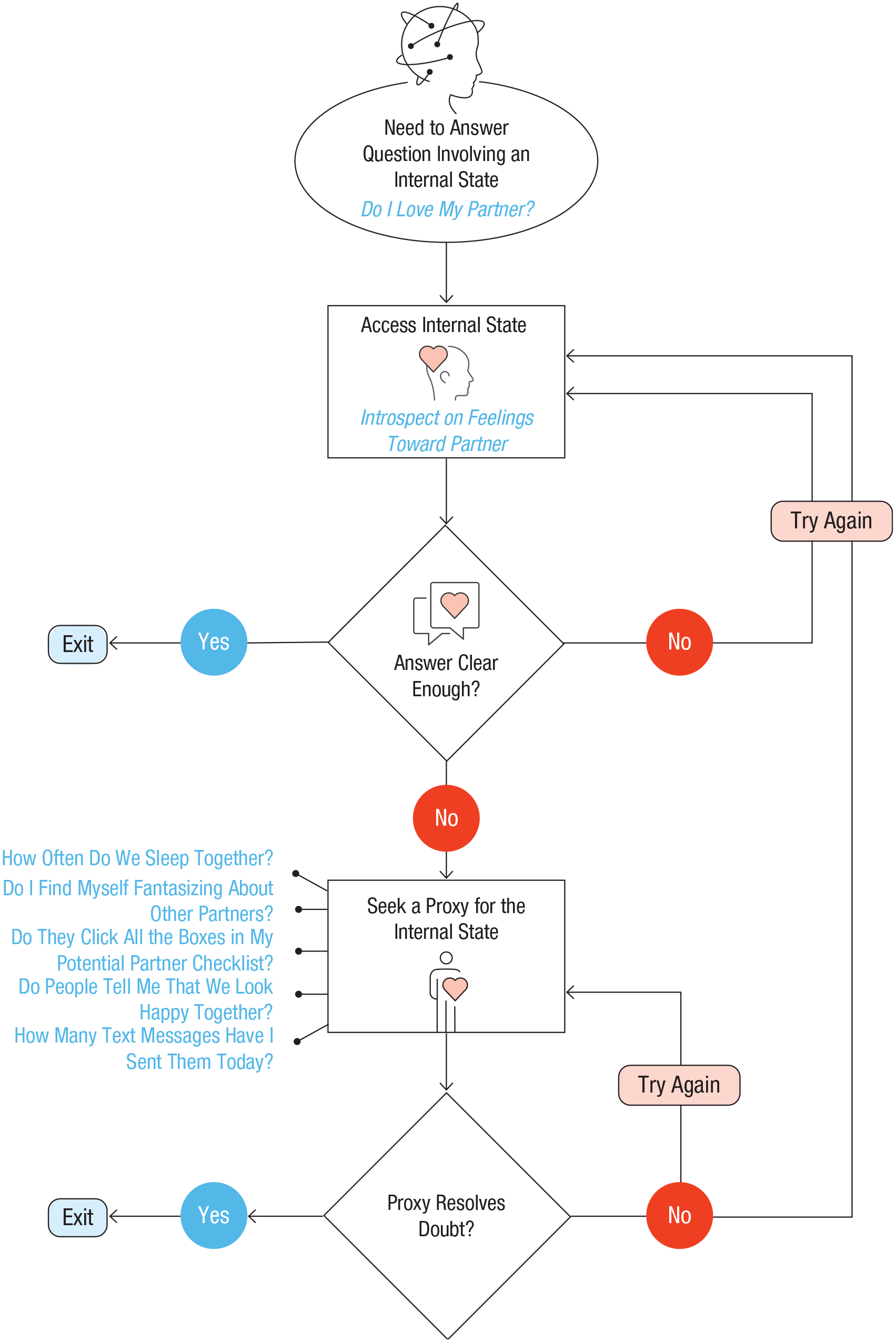
The process at the core of the SPIS model starts when a person needs to answer a question involving an internal state, such as “do I love my partner?” Accessing this internal state may or may not provide a clear answer. If the answer is clear the process terminates. If it’s not, the person may try to access the internal state again or seek a proxy for it, such as counting the number of text messages exchanged daily. The proxy may or may not resolve the doubt. If the doubt is not resolved, the process is repeated. According to the SPIS model, OCD is characterized by attenuated access to internal states, which increases the likelihood of repeated looping through the process.
The process postulated by the SPIS model is set in motion when a person wishes to answer a question about their internal state. In our example, the question is about feelings toward one’s romantic partner, which is a typical concern for people experiencing relationship-centered OCD (Doron et al., 2014). The person introspects on their internal state, which might or might not provide them with a clear answer. If the answer is sufficiently clear, the process is terminated. If the answer is not clear, the person can try to reaccess their internal state or seek a proxy, such as counting the number of text messages they sent their partner in the past week. The proxy may or may not resolve the question; if not, the individual may find themselves continuously looping through the steps depicted in the flowchart. This repeated cycle is the SPIS model’s portrayal of obsessional doubt, which is a core symptom of OCD. Due to the difficulty individuals with OCD experience in accessing internal states, they are less likely to receive clear answers from their attempts to access their internal states. Ironically, repeated attempts to access one’s internal state tend to diminish its clarity, motivating further reliance on proxies.
Importantly, the SPIS model assumes that (a) distinct internal states exist, (b) people can introspect on these states, (c) these introspections can be more or less veridical, and (d) people generally believe in all of the above. This means, for example, that hunger exists (and is different from arousal, fatigue, or stress), that people can introspect on how hungry they are, and that they might reach the wrong conclusion about their hunger (e.g., believe that they are hungry when they are in fact anxious). We believe this is also true for other internal states, meaning that people can introspect and be right or wrong about their satisfaction, love, preferences, and feeling of understanding. Next, we discuss how deficiency in the ability to access internal states can disrupt normal processes of action control, metacognition, decision-making, and introspection.
Action Control
Some goal-directed actions have a clear endpoint. For example, the goal of reading War and Peace is met when one reaches the end of the book’s last page. The endpoint for other goals, however, may be less clear. An important class of such goals involves avoidance (e.g., escaping, preventing)—for example, how far should we travel to get away from a forecasted tornado? When disinfecting a place to prevent disease, when should we stop? Theories of action control suggest that to terminate action when pursuing avoidance goals, people rely on a feeling of relief or a sense of having done enough (Liberman & Dar, 2009). But what if a person finds it difficult to access these internal states? We suggest that people with OCD struggle when pursuing goals that depend on internal states for their termination. Consequently, they resort to using proxies, such as rules, procedures, behaviors, and environmental stimuli, to instruct them when to stop. For example, unable to access a sense of satisfaction with how clean their hands feel, they might resort to rules such as “wash until you finish a whole bar of soap” or “wash each finger 10 times.”
Not only avoidance goals rely on internal states for stopping. Sometimes an internal state is itself the goal. For example, an artist may strive to work on a painting until they feel satisfied with the result; a sunbather may deem their goal accomplished when they feel fully relaxed. The SPIS model predicts that people with OCD would steer away from such goals and, when pursuing them, would shift toward using proxies to inform them about how they are progressing and when they should stop.
We examined this prediction in a series of studies that used biofeedback as a proxy for internal states. The biofeedback apparatus collects physiological data via electrodes and presents indices of specific internal states on a computer monitor (e.g., galvanic skin response as an index of relaxation). We found that participants with high levels of OCD symptoms, as well as those with clinical OCD, were inaccurate in judging their own levels of relaxation and muscle tension when the biofeedback was not available, and actively sought this proxy. Moreover, these participants relied on the biofeedback proxy to gauge their internal states even when provided with fabricated “biofeedback” that bore no relationship to their actual physiological state (Lazarov et al., 2010, 2012a, 2012b, 2014). Importantly, relaxation and muscle tension are not typical OCD concerns (unlike cleanliness, safety, or morality); therefore, these findings suggest that the deficiency in accessing internal states among individuals with OCD is a general one. 1
Metacognition
Many people have intrusive negative thoughts. They might imagine strangling their boss, engaging in inappropriate sexual acts, or accidentally stabbing their child. For most of us, such thoughts do not cause much distress and can be easily dismissed as being “just a thought.” But people with OCD often feel driven to repress or “neutralize” such distressing thoughts. These efforts inevitably fail, leading to recurrence of these thoughts and to mounting distress.
To understand this obsessional cycle, it is useful to consider how people normally manage to dismiss intrusive negative thoughts. One possibility is that such thoughts are balanced out by an assessment of one’s emotions and motivations. If a person clearly feels that they love and want to protect their child, then the thought that they might hurt the child would be less scary, more easily dismissed, and less likely to elicit suppression attempts. When motivations and emotions are less accessible, however, negative thoughts not only take central stage but may become proxies for inferring one’s “real” motivations and emotions. For example, a person might infer that a thought about hurting their child indicates deep-seated resentment and a motivation to carry out the action. To make things worse, failure to suppress this thought, which is perfectly normal, might be interpreted as further evidence of dreaded motivations and emotions (Forster & Liberman, 2004).
Decision-Making
Models of rational economic behavior (Von Neumann & Morgenstern, 1944) expect decision makers to search as long as the possibility exists of finding a better alternative, taking into account the cost of continued search. One classic criticism of this model, from the “bounded rationality” perspective (Simon, 1990), is that this approach could lead to incessant search and that in many situations people would be better off if they stopped searching once a satisfactory alternative is found.
How would people stop searching for alternatives if feelings of satisfaction are difficult to access, as the SPIS model postulates for OCD? Schwartz and his colleagues (2002) proposed a “maximizing” decision-making style, marked by excessive and often futile search for the best possible alternative, which contrasts with the more adaptive “satisficing” style, whereby the search for alternatives terminates once a satisfactory result has been achieved. Consistent with the predictions of the SPIS model is the tendency for people high in OCD symptoms to be maximizers (Oren et al., 2018). Ironically, their decision-making style is closer to normative economic models that assume full rationality than to models of bounded rationality.
Introspection
Accessing internal states can also be done for its own sake rather than in the service of another process, such as decision-making or action control. We often ask ourselves questions about our own emotions, feelings, and preferences: Do I love my partner? Do I have genuine religious feelings? Did I understand what I have just read? For some people, the answers to these questions are readily and clearly accessible. Others, who find it difficult to introspect about their internals states, might turn to proxies to indirectly inform them about their internal states. To determine whether they love their partner, for example, they may ask themselves how frequently they text the partner or whether other people say that they seem happy together (Fig. 1).
Studies using an emotional intelligence test (Mayer-Salovey-Caruso Emotional Intelligence Test; Mayer et al., 2002) revealed that although people with OCD symptoms and with clinical OCD have intact semantic knowledge about emotions (e.g., if you insult someone, they will feel offended), they are less accurate in gauging their experienced emotions (e.g., identifying their feelings in response to abstract art; Dar et al., 2016; Lazarov et al., 2022). When responding to emotional pictures, moreover, participants with high levels of OCD symptoms had no difficulty distinguishing between positive and negative pictures, but their ratings of the extent of both positivity and negativity were less reliable (Lazarov et al., 2020).
People with OCD symptoms also report difficulties in assessing everyday internal states, including hunger, interpersonal closeness, preferences, and a sense of understanding. Here, too, they rely on proxies, such as their own behavior, the opinion of others, and objective indices such as course grades. Supporting this observation, scores on a questionnaire that assesses self-reported reliance on proxies for internal states in daily life correlated positively with OCD tendencies and with clinical OCD (Liberman & Dar, 2018).
We contend that difficulty in introspecting on internal states is directly related to obsessional doubt (e.g., O’Connor et al., 2005), which often leads to repeated checking or demanding reassurance from others. Doubt in OCD typically revolves around internal states, such as one’s morality, motivations, emotions, or level of understanding, rather than, for example, the validity of news reports or accident statistics. According to the SPIS model, a person experiencing obsessional doubt is stuck in a process of looping through the steps illustrated in Figure 1. From this perspective, obsessional doubt stems from two necessary conditions: attempting to assess one’s internal state and having diminished access to that state. For example, a person who does not wonder whether they feel love, or who can easily introspect on their feelings, would not experience obsessional doubt regarding that internal state.
The SPIS Model in Context
The SPIS model builds on previous accounts of OCD-explained compulsions in terms of a dysfunction in the system that normally provides a feeling of completion (e.g., Summerfeldt, 2004), safety (e.g., Szechtman & Woody, 2004), or being “just right” (e.g., Wahl et al., 2008). The SPIS model goes beyond these accounts in two essential aspects. First, these models are bound to typical OCD-related contents. For example, the dysfunctional feedback system in Szechtman and Woody’s (2004) theory is constrained to the domains of safety and security, and that of Summerfeldt (2004) accounts primarily for compulsions of symmetry, counting, and checking. In contrast, the SPIS model is not confined to specific content domains, and some of our findings involve domains that are not typical of OCD (e.g., muscle tension). Second, compulsions in these models do not serve a function but rather are understood as by-products of a malfunctioning feedback system. In contrast, the SPIS model assigns a functional role to compulsions: They are proxies used in lieu of vague internal states.
Outstanding Questions
How do people learn to access their internal states?
Theories of social-emotional development suggest that children learn to access internal states when they share experiences with others and when others reflect emotional experiences back to them (e.g., saying “It must have been scary”; Fonagy, 2002). Once again, it is possible to learn about the pathological from the normal. Specifically, we suggest that diminished access to internal states may stem from at least two factors. The first is having experiences that are unique and therefore not shared by others. One example is sensory dysregulation, the tendency to experience a wide range of stimuli as aversive (e.g., being irritated by the sound of human speech). Children with sensory dysregulation live in a social world in which their inner experiences may not be shared by others. They may therefore learn to forgo attempts to share their experiences, which might consequently hinder their ability to correctly access and label specific internal states. Consistent with this proposition, sensory hypersensitivity was associated with frequency of rituals in kindergarten children and with OCD symptoms in adults (Dar et al., 2012).
The second factor that might impede the development of the ability to access internal states is disrupted social communication, due to either deficient social skills or life circumstances. The SPIS model would predict, for example, that people with autistic spectrum disorders, who have deficits in empathy and social communication, would exhibit deficient access to internal states and heightened OCD symptoms. Indeed, several studies have reported evidence of these associations (e.g., Zandt et al., 2007). To put it more speculatively, traumatic events that evoke guilt and shame might generate an entire sphere of unshared internal states, which over time might become difficult to access.
Weak signal, noise, or high threshold?
The SPIS model proposes that persons with OCD have difficulty accessing internal states. It is unclear, however, whether the source of this difficulty is (a) internal states that produce a weak signal (e.g., lower levels of emotional reactions), (b) “noise” that obscures the signal (e.g., many emotions occurring simultaneously, obscuring distinctions between them), or (c) a high threshold for detecting internal states (e.g., when an emotion must be particularly strong to be identified). So far, our findings are more consistent with the weak-signal and noise accounts than with the high-threshold account. A higher threshold for relief, for example (i.e., lower levels of muscle tension to pass the criterion for relief), would not explain lower accuracy in achieving designated levels of muscle tension. Future studies can further test these possibilities using novel analytic techniques, such as mathematical models of decision-making and signal detection.
Does OCD vary by culture?
Do some types of OCD develop in response to a societal emphasis on specific internal states? For example, some societies expect people to feel love and attraction toward the partner they intend to marry, whereas others treat marriage as a functional arrangement in which objective considerations take precedence. We predict that the former type of society would have a higher prevalence of relationship-focused OCD, which involves incessant monitoring and questioning of one’s feelings toward one’s partner (Doron et al., 2014). Similarly, some religions require followers to feel a sense of devotion to, or love for, the Lord. The SPIS model would predict that such requirements would provide fertile ground for OCD symptoms to develop (Dar et al., 2021). Future research could examine, more generally, whether cultural variations in OCD symptoms can be traced to culture-specific emphases on particular internal states.
Emotions in OCD
Emotions may systematically differ in how the self-monitoring processes depicted in Figure 1 affect them. For example, whereas interpersonal closeness appears to dissipate with repeated monitoring (Shapira et al., 2013), anxiety might in fact intensify (as, for example, during panic attacks). It would be important to classify emotions on this dimension of “resilience to monitoring” and examine whether emotions that are more resilient to monitoring tend to be more frequent among people with OCD, as our model would predict.
Implications for Treatment
The SPIS model has unique implications for psychotherapy. Therapists can use this model to explain to clients with OCD how their symptoms—including reliance on fixed rules, compulsive rituals, and decision-making difficulties—are related to diminished access to internal states. Understanding the persistence of intrusive thoughts in terms of the SPIS model, as due to the lack of counteracting information from other internal states, may provide great relief to clients who are often worried that they may harbor deadly impulses or inappropriate sexual desires. Recognizing that relying on proxies is motivated by the need to obtain clarity about internal states can help clients replace extreme proxies with equally clear but not extreme ones. Finally, the SPIS model can motivate the development and testing of interventions to enhance access to internal states. For example, we expect that mindfulness training could improve access to internal states and would thereby lead to reduction in OCD symptoms.
Conclusion
We proposed to conceptualize OCD symptoms as emanating from diminished access to internal states, which disrupts processes of action control, metacognition, decision-making, and introspection. We believe that approaching OCD from this perspective can teach us not only about OCD but also about the normal unfolding of these basic psychological processes.
Recommended Reading
Boyer, P., & Liénard, P. (2006). Why ritualized behavior? Precaution systems and action parsing in developmental, pathological and cultural rituals. Behavioral and Brain Sciences, 29(6), 595–613; discussion 613–650. https://doi.org/10.1017/s0140525x06009332. Presents a broad perspective on why people engage in rituals, not only in the context of obsessive-compulsive disorder (OCD) but also in the context of religion and culture.
Dar, R., Lazarov, A., & Liberman, N. (2021). (See References). A review that summarizes the SPIS model and the supporting emprical evidence.
Lazarov, A., Liberman, N., Hermesh, H., & Dar, R. (2014). (See References). Empirical studies with clinical OCD participants that demonstrate how both genuine and false biofeedback are used to study reliance on proxies.
Liberman, N., & Dar, R. (2009). (See References). Examines the question of how people monitor progress and terminate goal-directed action; presents the pathology in action control characteristic of OCD in the context of normally functioning action control systems.
Shapiro, D. (1965). Obsessive-compulsive style. In Neurotic styles. Basic Books. An extremely well-written chapter from a classical book on personality styles, whose original and insightful description of obsessive-compulsive people inspired the SPIS model.
