



Abstract
Increasingly, we are required, encouraged, and/or motivated to track our behavior, presumably to improve our life “quality.” But health and life-satisfaction trends are not cooperating: Empirical evidence for success is sorely lacking. Intelligence has been tracked for more than 100 years; perhaps this example offers some hints about tracking’s overall social impact. I suggest that Huxley’s Brave New World offers a relevant long-term extrapolation and that popular recent tracking activities will accelerate “progress” in that dystopian direction.
You can’t make flivvers without steel—and you can’t make tragedies without social instability. The world’s stable now. People are happy; they get what they want, and they never want what they can’t get. They’re well off; they’re safe; they’re never ill; they’re not afraid of death; they’re blissfully ignorant of passion and old age; they’re plagued with no mothers or fathers; they’ve got no wives, or children, or lovers to feel strongly about; they’re so conditioned that they practically can’t help behaving as they ought to behave. And if anything should go wrong, there’s soma. Which you go and chuck out the window in the name of liberty. Liberty!
Increasingly, we are required, encouraged, and/or motivated to track what we do and how well we do it, in spheres of life ranging from job performance, diet, sleep, and exercise to likes and dislikes, physiology we cannot directly control (e.g., heart rate, blood pressure, sugar and hormone levels), and even our genomes. Others track us increasingly, too. Tracking brings “standards” about desirable and undesirable levels, “rights” and “wrongs,” and reactions, especially when data look “bad.” Ideally, this tracking fosters health and well-being, countering current inauspicious population-level trends toward more chronic physical illness (e.g., BGD 2019 Viewpoint Collaborators, 2020) and psychological distress (e.g., National Institute for Health Care Management, 2020). But does it accomplish that? What goes with tracking psychologically and socially needs much more attention than it is getting, especially given that trends toward increasing rates of illness and distress have accelerated alarmingly and already-large socioeconomic differences have widened during the COVID pandemic, according to frequent news reports.
One Long-Running Tracking Example
A psychological characteristic for which quite extensive tracking began about 100 years ago might provide clues about tracking’s likely social consequences: This characteristic is intelligence, or, more precisely, IQ, which is how this “capacity,” which is readily observed at least informally, is measured. Table 1 outlines the key points of the argument I articulate in this article. Intelligence, via IQ, is among the most reliably measured psychological constructs (e.g., Mackintosh, 2011), as indicated by test-retest reliability, relative life-span stability, strong correlations among test forms, locally meaningful reliability in cultures disparate from those in which tests were developed, and—what is probably most socially relevantly—its huge nomothetic net, that is, the set of constructs with which it is consistently associated. This set is face valid (i.e., makes intuitive and theoretical sense) and includes constructs that are important in people’s lives, such as educational achievement, occupational performance and status, mental and physical health, social status and resources, financial wherewithal, and relative freedom from debilitating stress (e.g., Neisser et al., 1996).
Key Points Underlying This Article’s Arguments About the Consequences of Tracking Intelligence and Extrapolations From This Example
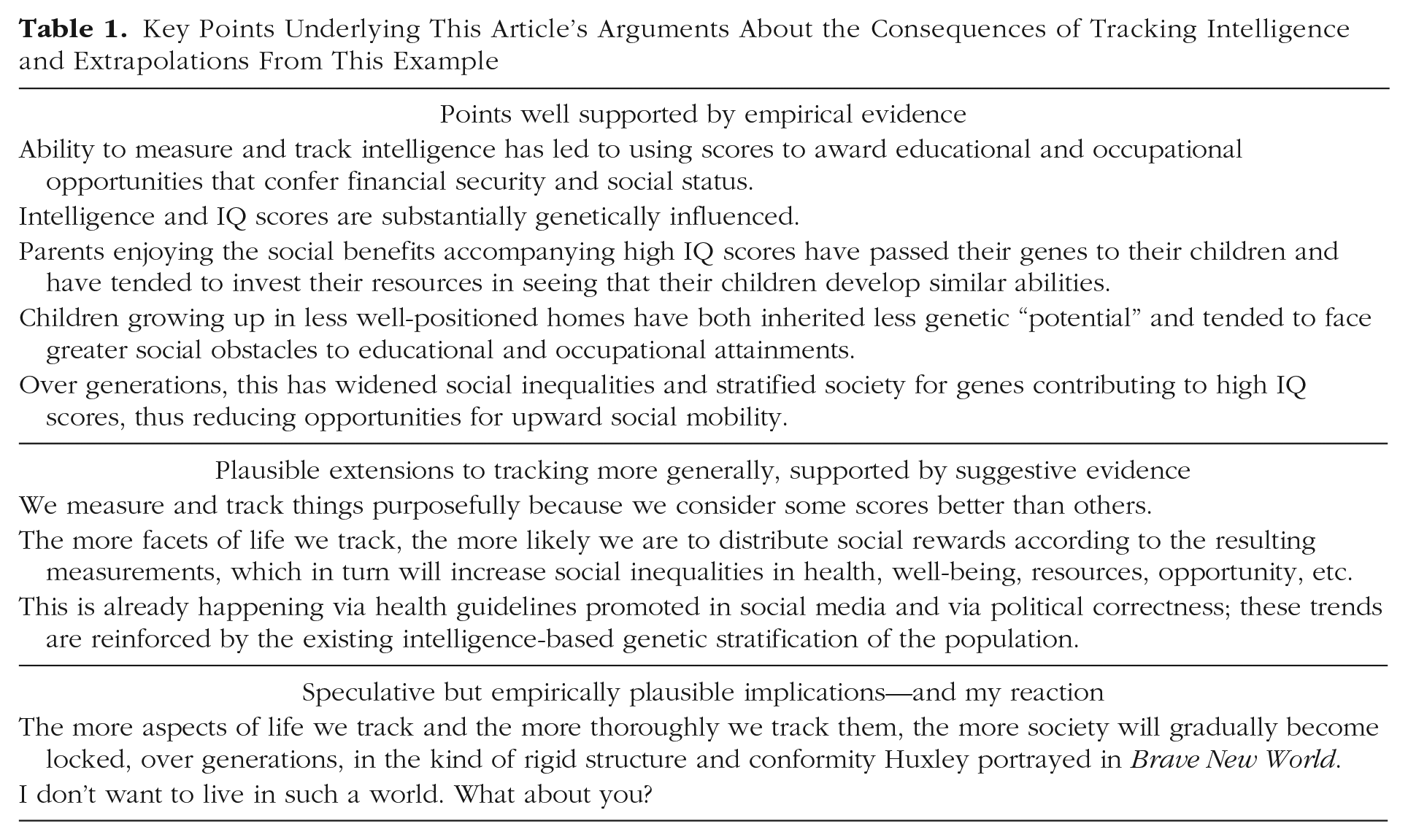
IQ has never been tracked in everyone, never mind daily or even yearly, but large swaths of the population have been tracked—and had results applied to them. Whatever intelligence is, it develops functionally throughout the life span: Babies can do none of the tasks used to measure it, and performance on such tasks declines in old age. But IQ has normative developmental patterns. Scores thus remain relatively stable throughout life, in the sense that people who test better than most others of their age at any one point tend to do so throughout life, and people who test worse than most others of their age at any one point tend to continue to test worse throughout life. This has made IQ scores useful in deciding who “merits” social favors: access to higher education and professions that confer status, financial security, and fulfillment, which in turn have “bought” clean, safe environments and facilitated the rest of the nomothetic net. Individuals receiving these benefits have been well positioned to pass potential to test well to their children, too, via parenting practices, familiarity with intellectual culture, financial resources that facilitate learning opportunities, social connections and resources, opportunities to pursue recreational interests, life satisfaction, sense of purpose, stability, and relative freedom from debilitating stress (e.g., Lugo-Gil & Tamis-LeMonda, 2008). From the beginning, IQ testing seemed to help identify people with capabilities appropriate to the positions and opportunities they were being selected for, so it came to be used more and more frequently and in more settings. Its beneficiaries used their social positions to develop technologies that have eliminated need for expensive personnel in many jobs demanding less formal education. Thus, indirectly, IQ tracking’s beneficiaries have reinforced its consequences, increasingly leaving those who do not test well behind.
This thesis is not at all unique to me (e.g., Markovits, 2019); the basic idea dates back at least to the New Testament (King James Bible, 1769/2017, Matthew 25:29) and has been informally rephrased as “them that has gets.” It has always been controversially received, and the controversy has been politically motivated. It does not conjure an attractive social picture, but that does not mean it is irrelevant. Existence of such a situation goes against democratic principles. But to do anything about it, we need to acknowledge its possibility.
Even these environmental features are not the full story. Intelligence, as measured, consistently shows strong genetic influence (e.g., Neisser et al., 1996). Genetic variance in intelligence also correlates with the genetic variance that is equally consistently observed on its nomothetic net—and biological parents pass the genes involved on to their children. At the same time, they cannot help but use their intelligence in parenting, and most parents also invest large portions of their material resources in their children. Thus, whatever genes have to do with development of ability to score well on IQ tests interacts with the environment in influencing achievement as well as other outcomes throughout the net. Many thousands of genetic variants are involved (Davies et al., 2011), but aside from more than 1,000 that are known to affect IQ negatively but together account for little of its variance (Reichenberg et al., 2016), scientists have little idea how. Scientists do know, though, that no single combination of genetic variants is key. Moreover, these variants do not exert their influences independently of their environments, including other variants. I also cannot overemphasize the importance of people’s psychological reactions to those environments and, especially, the responses of individual-specific genomes to those environments. The range over which any one genome may potentially express intelligence in the forms of both IQ scores and daily life is wide. It is through these genetically and environmentally reinforced personal and material resources that the advantages of testing well—and the disadvantages of testing poorly—are passed from one generation to another.
Genes initiate synthesis of proteins, huge molecules that form preliminary building blocks of life physiology—components such as neurotransmitters, hormones, hemoglobin, and digestive enzymes, all of which vary in level within and across humans and play multiple roles in maintaining bodily and brain functions. Thus, genes themselves are only very distantly involved in observable behavior and appearance. This individual genetic variation and its downstream variation in physiological expression indicates that what genetic variants “do” varies with environmental stimuli and the carrying organisms’ behavioral “decisions.” For example, the same genetic variants underlie many different bodily functions, and one variant can “step in” for others quite often. In other words, genes do not “determine” behavior or much of anything readily observable; rather, they offer basic “toolboxes” that humans—and all organisms—use (consciously and unconsciously) to cobble together the means to navigate the world. Intelligence is just one characteristic psychologists have articulated to try to understand the means people apply, and IQ is the way intelligence is measured. Our toolboxes do vary in their potential to manifest IQ, but they all do this within very broad ranges, and specific expression is tightly interrelated with the contexts we choose and fall into throughout our lives.
That so much of IQ’s broad nomothetic net has ended up being transmitted intergenerationally has de facto widened social and genetic stratification by IQ-testing ability. This process has accelerated over time through technological development, especially as this shifted from primarily automating physical tasks to increasingly automating mental tasks (Duncan & Murnane, 2011). What does this mean for humankind’s future? Aldous Huxley (1932) provided one potential window on the answer almost 100 years ago in his classic novel Brave New World.
“Brave”? New World
In Huxley’s futuristic society, all human reproduction takes place via artificial insemination. Eggs are taken surgically from specially selected financially compensated women and fertilized by sperm taken from men similarly selected as matches for castes with specific levels of intelligence. All “decantations” (births) are planned to maintain economically optimized caste structure. Once decanted, babies are raised in caste-distinct crèches. Babies in a given caste receive uniform conditioning to understand their world as organized so that everyone is necessary and desired in the social body and to find their own caste’s life conditions as most personally satisfying. They are conditioned to the caste roles they will play, the specific jobs they will hold, and the accepted ways to think about and behave in all aspects of life. With appropriate maturity, they are introduced to soma, society’s readily available, safe, healthy ultimate aphrodisiac and euphoria inducer. Every aspect of life is organized and tracked, and anyone who dares to deviate or stumbles into deviating is socially ostracized, often even physically banished.
We have been heading in this direction since intelligence tracking began. Or so at least I strongly suspect. And emerging technology only seems to accelerate the process. Though indirectly, Belsky et al. (2016) offered strong evidence that intelligence tracking is associated with and thus likely has contributed to the troubling increasing social inequalities and health problems I have outlined above. Of course, the association between intelligence tracking and the social patterns Belsky et al. noted no more proves causation than association ever does, and much of what has gone on probably would have occurred anyway because it began long before intelligence tracking. But the synchronous acceleration of tracking with other social processes since Belsky et al.’s analysis is suggestive.
Belsky et al. (2016) reported application of a polygenic score for educational attainment to the outstandingly suited Dunedin Study (Poulton et al., 2015). The Dunedin sample included 91% of infants who were born from April 1972 through March 1973 and had at least one parent resident in Dunedin, New Zealand, when the offspring reached age 3. Participants have been followed frequently ever since, with extremely high retention, for assessment of a wide range of physical, psychological, and environmental variables. The sample is thus highly representative of its source population and arguably offers the most thorough data ever available to study human development. Belsky et al. had access to relevant variables when the offspring were ages 3, 5, 7, 9, 11, 13, 15, 18, 21, 26, 32, and 38.
A polygenic score (Chabris et al., 2015) is calculated by regressing some observable characteristic (phenotype) on millions of genetic loci within the 0.1% of the genome on which humans commonly vary, after judgmental “weeding,” or “pruning,” for relative independence from other variants and establishment of some loose criterion for statistical significance. Thus, polygenic scores usually are based on thousands of variants, with miniscule coefficients. Despite this, they usually account for little phenotypic variance. The polygenic score in Belsky et al.’s (2016) study was no exception. For studies that, like this one, are designed to identify other characteristics and “life outcomes” with which genetic variants contributing to educational attainment are also associated, it is important that the polygenic score be derived in a sample to which it is applied, to avoid simply capitalizing on sample-specific genetic structure. Belsky et al.’s score was derived from a large consortium study of more than 125,000 people; initially, more than 100,000 of them were tested for variants associated with educational attainment, and the associations were then replicated in the rest of the sample (Rietveld et al., 2013). This made Belsky et al.’s an especially strong study because the scoring had been replicated in a second sample.
Although Belsky et al.’s (2016) scores accounted for little total variance in either educational attainment or the other variables assessed in the Dunedin Study, results told a consistent story. Participants with higher polygenic scores tended to have been born to more advantaged homes. Their scores predicted attainments ranging from preschool developmental milestones such as walking and talking to reading ability, scores on standardized testing, and occupational aspirations in childhood; to adult economic outcomes such as educational attainment, occupational status, financial stability, income, and even geographic and upward social mobility; and to personal factors such as intelligence at all assessed ages, interpersonal and self-control skills, mate’s economic status, and physical health. In short, children lucky enough to have inherited the genetic potential to develop socially rewarded personal characteristics tended to have been similarly lucky to have been born into relatively advantaged homes to parents offering financial and cultural resources enhancing their opportunities to create similarly or even better-positioned lives for themselves. But the opposite was true for those not so fortunate.
Over several generations, this kind of gene-environment correlation always tends to increase population variance (e.g., Falconer, 1960). This is not necessarily a problem, but it becomes one when linked with these kinds of socially rewarding constructs in societies valuing equal life chances because the correlation leverages individual differences, which tends to widen socioeconomic inequalities. This is exactly what has been happening over the past 60 years, especially in economically developed countries (e.g., Duncan & Murnane, 2011). Since Belsky et al.’s (2016) work, other studies have replicated its findings and/or extended them at both phenotypic and genetic levels. For example, Armstrong-Carter et al. (2020) observed that mothers with higher educational attainment had experienced healthier conditions during pregnancy, and even their polygenic scores for educational attainment stripped of variants their children shared were associated with their children’s academic and developmental outcomes at ages 4 through 7. This offered direct evidence that the mothers’ variants influencing educational attainment contributed to the home environments they provided. An all-too-plausible explanation for the widening social inequalities is that genes that positively influence economic and social success are becoming increasingly concentrated among those born into it, and that those who are not born into it are increasingly blocked from reaching it.
These inequalities are frequently decried by the media and politicians, and government policies are announced to reduce them. Despite this, inequalities not only have persisted, but have grown (e.g., Duncan & Murnane, 2011). The possibility that inequality’s “stickiness” has a genetic basis is about as politically incorrect as anything gets, which may explain how little attention it has received. Belsky et al. (2016), for example, ignored it. Nevertheless, we constantly indirectly reinforce this inequality in our choices of residence, life partners, occupations, friendships, and even leisure activities. Many people already make reproductive choices that directly increase it, for example, by aborting fetuses with genetic “defects” such as trisomy 21 (which causes Down syndrome) or seeking partners on dating websites or egg or sperm donors at least partly on the basis of indications of intelligence, such as graduation from a prestigious university, but also on the basis of political “correctness” and tracking indications, such as social-media likes. Such practices will likely increase as the application of polygenic scores catches on and the cost of genetic testing drops.
Extending Tracking Beyond Intelligence
Evidence for the patterns I have noted thus far is strong and consistent, though indirect. However, other explanations are possible, especially regarding gene-environment interplay; some explanations are more strongly genetically deterministic than mine, and others more completely rooted in social forces. Studies that can distinguish clearly among them are lacking because they would require the kind of artificial crossbreeding and cross-fostering (exchanging newborn offspring among two or more of their biological mothers) limited to plants and nonhuman animals by ethical constraints. Such empirical tests are also constrained by standardizations imposed on IQ measures and other tests of cognitive abilities to make them comparable over time and among people of different ages (Johnson, 2013). That said, consider my interpretation as given, for the sake of argument. In extending what I have argued has gone on with tracking intelligence to tracking our lives more generally and frequently, I am admittedly speculating. I do not believe this leaves my interpretation less important, though: It is consistent with many current trends often reported in the news, and we need to think ahead to potential consequences more and leave less to wait until those consequences materialize overwhelmingly (e.g., climate change, pandemics).
Huxley was perceptive about many social trends but completely missed the emergence of the technologies that brought the Internet and the microchips that make personal mobile devices such as phones, computers, GPSs, heart rate monitors, and pace counters possible. Thus, he also missed the emergence of worldwide intercommunication and its intertwined social-media culture. In his novel’s world, social uniformity and conformity are designed and maintained via government policy. Modern society also has plenty of government engineering—especially visibly in the current pandemic—but we are also imposing social uniformity and conformity upon ourselves via the ways in which we use and rely upon these technological devices, despite our claims to prize and strive for appreciation of social diversity. Increasingly, society is splintering into factions holding different political and religious views, consuming different material and information products, living different lifestyles, and tending to experience different levels of health and well-being. In Huxley’s world, these differences are imposed by design, but we are largely bringing them on ourselves. Like it or not, these emerging factions are linked with both what is measured as intelligence and its genetic underpinnings, if only because so many of these differences involve financial wherewithal. We are on the way to creating something like Huxley’s intelligence-based castes and to the uniform behavior and thought he depicted within their bred-to strata (though well short of his world’s acceptance and appreciation of people of all physical appearances and abilities, designed in though it is).
Many people (especially those reaping the social rewards) seem to like this “progress,” too, despite emerging trends of increasing psychological distress and greater prevalence of chronic lifestyle-related illnesses, such as diabetes and heart disease. But the accompanying social unrest is troubling. A popular solution seems to be development of algorithms targeting well-being and health and providing the means to constantly track, for example, diet, daily physical exercise, sleep habits, stress, healthy aging, alcohol consumption, mental stimulation, prescription management, and even resting heart rate, blood pressure, and glucose tolerance. That is not all: Increasingly, we track and monitor not just themselves but others, too: ourselves so we know how we “measure up” and what to work on to reach standards, and others to censure them and/or exhort them to “do better.”
Who does this most? The young in general, as well as people who can most afford to, financially and psychologically. Who is it that can most afford to? Those with the highest levels of what is measured as intelligence and its underlying genes—those who also tend to populate the highest governmental levels and chart social policy. Before long, I suspect, this crew will work out how to design social unrest and psychological distress away: develop a soma and some kind of guaranteed-income and occupation structure (however dull some of the jobs are) so that everyone will be “content” and “safe,” and then convince voters that it is all in their interest, so that it comes to fruition.
Did you take 10,000 steps today and eat your five-a-day? Are your Instagram postings getting liked to your satisfaction?
Recommended Reading
Belsky, D. W., Moffitt, T. E., Corcoran, D. L., Domingue, B., Harrington, H., Hogan, S., Houts, R., Ramrakha, S., Sugden, K., Williams, B. S., Poulton, R., & Caspi, A. (2016). (See References). A particularly strong and thorough study of genetic links between educational attainment and developmental “outcomes” at many points in the first half of the life span.
Bouchard, T. J., Jr., & McGue, M. (1981). Familial studies of intelligence: A review. Science, 212(4498), 1055–1059. https://doi.org/10.1126/science.7195071. An excellent summary of the strong evidence for genetic influence on intelligence-test scores that was available well before genome sequencing.
Davies, G., Tenesa, A., Payton, A., Yang, J., Harris, S. E., Liewald, D., Ke, X., Le Hellard, S., Christoforou, A., Luciano, M., McGhee, K., Lopez, L., Gow, A. J., Corley, J., Redmond, P., Fox, H. C., Haggarty, P., Whalley, L. J., McNeill, G., . . . Deary, I. J. (2011). (See References). A report on one of the most thorough studies indicatinggenetic links to intelligence-test scores by tracing them to specific genetic variants, in the process establishing that there are no single variants with major links to normal-range scores and instead many thousands of variants with tiny associations.
Duncan, G. J., & Murnane, R. J. (Eds.). (2011). (See References). Characterized by an Amazon reviewer as an excellent source of information for anyone studying causes of poverty and consequences of poverty on child development and/or concerned with rising income inequalities and their effects on educational outcomes in the United States (but actually applicable not just to the United States and more so today than when it was written).
Huxley, A. (1932). (See References). A well-known classic dystopian novel.
Lugo-Gil, J., & Tamis-LeMonda, C. S. (2008). (See References). A quite thorough review of the evidence for links between children’s early home environments and their cognitive development, though without acknowledgment of the genetic background shared by children and their parents.
Marcus, G. F. (2008). Kluge: The haphazard construction of the human mind. Faber & Faber. A lively description of human brain evolution that illustrates usage of what I have referred to here as humans’ genetic “toolbox.”
