




Abstract
Previous thinking has often categorized emotions as either pleasant or unpleasant or examined to what extent they are functional or dysfunctional. We suggest that researchers should consider the positivity or negativity of discrete emotions on both dimensions: subjective feelings and constructiveness of outcomes. We discuss how, across contexts, a specific emotion can potentially be categorized differently within the framework. We further suggest that this approach is particularly useful in unique, complex contexts that involve clashes among goals, interests, or values, such as violent intergroup conflicts. Using this context, we demonstrate how emotions that feel good to people can lead to behaviors and attitudes that sustain violence and thwart conflict resolution, whereas emotions that promote conflict resolution are often unpleasant. Such clashes may depend on the presence of embedded contextual factors, such as group membership and relative power. Thus, this framework will be useful for examining specific emotions while taking contextual factors into consideration. Finally, we examine several important questions stemming from our framework and suggest directions for future research.
The question of how to categorize emotions has been occupying affective scientists for decades (Gross & Barrett, 2011; Scherer, 2005), an interest that has yielded several coexisting conceptualizations of emotion. These, by and large, have added to the complexity of understanding and researching emotions. To resolve some of this complexity, many emotion theorists have proposed to classify emotions broadly as either positive or negative. Interestingly, however, most of these classifications have not clarified exactly what this distinction refers to. Most researchers have taken these terms to refer to how people feel, with positive referring to pleasant sensations and negative to unpleasant sensations. But this is not the only dimension to which the positivity and negativity of emotions may relate. Indeed, theories following the constructivist view of emotions (Averill, 1980; Barrett, 2012) have focused on the extent to which the behavioral tendencies elicited by emotions are constructive or destructive (Frijda, 1986; Lazarus, 1991), with positive outcomes referring to ones that are good for the individual or the social environment (Fredrickson, 1998) and negative outcomes referring to ones that are bad for the individual or the social environment. Accordingly, we argue that it is also important to consider the positivity or negativity of the outcomes of emotions when attempting to classify them.
These two different dimensions—subjective feelings and measurable outcomes—have not been explicitly differentiated from one another in past theories, possibly because they often overlap. For example, anger (classified as a negatively valenced emotion) is associated with an urge to attack and has accordingly been found to predict aggression, both of which are considered negative outcomes (Fischer & Roseman, 2007). Happiness, on the other hand, is often associated with positive outcomes, per the broaden-and-build model (Fredrickson, 1998), which specifies that experiencing positive emotions feels good and leads to individual positive outcomes by expanding personal resources.
In this article, we argue that although these two dimensions go hand in hand in many situations, they are in fact independent from one another and that it is therefore important to consider both dimensions when studying emotions. We further argue that the differentiation between the two dimensions is particularly useful when examining certain contexts that are especially conducive to clashes between how good an emotion feels and the good it does. As we elaborate below, we suggest that one such context is intergroup conflict. Accordingly, we propose a framework for understanding emotions, first classifying them along two independent dimensions: “feel good”–“feel bad” and “do good”–“do bad.” Next, we propose that this framework should be used to examine emotions while taking important contextual factors into consideration, as the location of discrete emotions along each of these spectrums is situationally determined rather than absolute (for similar arguments, see Barrett, Mesquita, & Gendron, 2011; Greenaway, Kalokerinos, & Williams, 2018). To demonstrate our point, we examine one context in which the consideration of both dimensions as independent from one another is especially useful: intergroup conflicts. We then provide suggestions for relevant future directions.
Feeling Good or Bad and Doing Good or Bad
The first dimension focuses on individuals’ affective experience of emotions. In line with previous literature on dimensional models of emotions (e.g., Bradley & Lang, 1994; Reisenzein, 1994), emotions may be categorized on the basis of their valence, meaning the extent to which they feel pleasant or unpleasant to the individuals experiencing them (Barrett, 2006). This is a key feature of the circumplex model (Russell, 1980), which maps emotions in terms of valence (pleasantness vs. unpleasantness) and arousal (degree of physiological activation). Thus, emotions such as anger and fear are categorized as unpleasant (having negative valence), whereas hope and pride are examples of emotions that are considered pleasant (having positive valence).
The way emotions feel to the individual constitutes only one way of looking at the positive-versus-negative distinction in emotion research. The other central dimension in our proposed framework focuses on the behavioral and attitudinal outcomes or tendencies associated with each emotion. In line with the constructivist view (Averill, 1980; Barrett, 2012), positive outcomes refer to behavioral tendencies that produce benefit or constructive consequences for the experiencers or their surroundings (e.g., goal pursuit or interpersonal helping), whereas negative outcomes refer to behavioral tendencies that produce harm or destructive consequences for the experiencers or their surroundings (e.g., aggression or disengagement).
Taken together, the first step in this framework results in an initial categorization of each emotion in one of four quadrants: “feel bad”–“do bad,” “feel bad”–“do good,” “feel good”–“do bad,” and “feel good”–“do good.” Indeed, although it is possible that the “feel” dimension overlaps with the “do” dimension (i.e., “feel good”–“do good” and “feel bad”–“do bad” quadrants), emotions that feel pleasant to the individual can also promote negative outcomes, and emotions that feel unpleasant to the individual can promote positive outcomes (i.e., “feel good”–“do bad” and “feel bad”–“do good” quadrants).
For example, and as a starting point (see Fig. 1a), both anger and pride can be placed in the “do bad” quadrants because of the behavior they elicit—for example, aggression (Averill, 1983; Baumeister, 2001)—although anger typically elicits negative valence (feel bad), whereas pride involves positive valence (feel good). On the other hand, hope and guilt can both be considered “do good” emotions because they commonly induce constructive behavior such as goal pursuit and making amends, respectively (Čehajić-Clancy, Effron, Halperin, Liberman, & Ross, 2011; Cohen-Chen, Halperin, Crisp, & Gross, 2014). Once again, however, they belong in different “feel” quadrants, as hope is associated with positive valence (feel good), whereas guilt involves negative valence (feel bad).
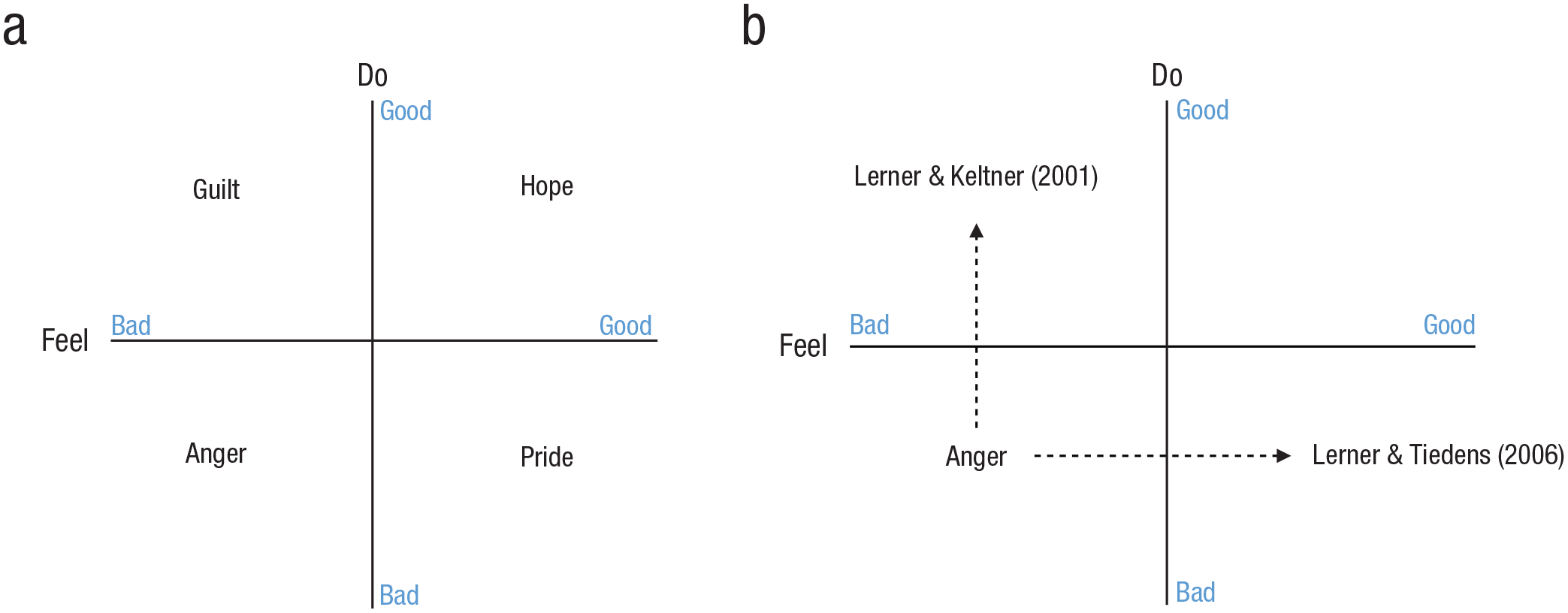
Emotion categorization. Discrete emotions can be categorized along a circumplex comprising two dimensions: “feel good” versus “feel bad” and “do good” versus “do bad” (a). Various factors can influence where discrete emotions are placed (b). Even emotions that are traditionally “feel bad” and “do bad” can, under certain circumstances, be pleasant to the individual (Lerner & Tiedens, 2006) or bring about constructive outcomes (Lerner & Keltner, 2001).
Importantly, however, the placement of the emotions within these four quadrants is malleable, as certain contextual factors may influence where emotions are placed in terms of both valence and behavioral tendencies. One example is anger (see Fig. 1b), initially placed in the “feel bad”–“do bad” quadrant because of the properties listed above. However, anger can also be experienced as pleasant, particularly when individuals focus on the empowerment it gives them to pursue consequent goals (Lerner & Tiedens, 2006). Anger may even, in some situations, be constructive, as it is associated with tendencies such as risk taking (Lerner & Keltner, 2001) and can improve personal outcomes in competitive situations, such as negotiations (Tamir, 2016).
It is worth noting that in certain situations, it may be useful to make a further differentiation within the function dimension depending on for whom the function of an emotion is constructive versus destructive. In other words, extending ideas put forth by Averill (1994), we suggest that it is possible to differentiate between outcomes for the individuals experiencing the emotions and the outcomes for their surroundings. An example of this is pride, a “feel good” emotion that was found to lead individuals to undertake increased responsibilities at work. Although this may be beneficial to their team as well as their organization, it also led to increased exhaustion (Baer et al., 2015), generating divergent outcomes for the self and the group. In recognition of these complexities, we suggest that unique contextual features should be considered when categorizing emotions. Accordingly, below, we focus on one unique context and apply our framework to the understanding of emotions within it.
Examining Emotions in Contexts of Intergroup Conflict
As stated above, everyday contexts and situations often lead to overlap between how good an emotion feels and its potential to lead to good outcomes. Nonetheless, our suggested model is useful for numerous instances in which such overlap is absent, as detailed above. Furthermore, we contend that our model becomes especially helpful in contexts involving complex social relations and particularly when clashes are present among goals, interests, or values. This incongruence can emerge within and between individuals (e.g., in addiction or work relations) and within and between groups (e.g., in negotiations, collective action, and conflict). One context in which the application of our model may be particularly useful is intractable intergroup conflict (see Kriesberg, 2007), in which emotions that feel good to people and are functional for individual well-being in the short term often lead to behaviors and attitudes that sustain conflict and prevent conflict resolution, thus preventing collective improvements in survival and well-being in the long term (see Halperin & Pliskin, 2015). For example, whereas pride in the context of intergroup conflict feels pleasant to those experiencing it, it may directly motivate intergroup hostility (de Figueiredo & Elkins, 2003). Conversely, emotions that promote conflict resolution often do not involve positive affect or promote personal instrumental goals and therefore do not intrinsically motivate people to experience and act on them (Tamir, 2016). For example, scholars examining specific emotions in conflict, such as guilt (Wohl, Branscombe, & Klar, 2006) and shame (Behrendt & Ben-Ari, 2012), have demonstrated that they lead to constructive outcomes in the context of conflict resolution but have also conceded that they do not feel good to those experiencing them (Halperin, 2016).
Several features of intractable intergroup conflict may crucially determine whether any given emotion feels good or bad. The first is that conflict-related emotions are often shared with other group members (Smith, Seger, & Mackie, 2007). Feeling emotions similar to those of other in-group members is a pleasing experience in itself, satisfying individual needs to belong (Baumeister & Leary, 1995), as evident by activation in brain regions that are responsible for reward processing (Lin, Qu, & Telzer, 2018). Accordingly, sharing emotions with other group members—even emotions that would otherwise be unpleasant—can be a pleasant experience (see Goldenberg, Halperin, van Zomeren, & Gross, 2016). For instance, Porat, Halperin, Mannheim, and Tamir (2016) demonstrated that the drive to belong motivates group members to feel sadness during commemoration events. Furthermore, group members may derive pleasure from feeling certain emotions not only because they are felt by others, but also because those emotions increase a sense of belonging through connection to group ideals and values, justifying conflict-supporting collective narratives (Bar-Tal, 2013). For example, fear of the out-group may feel good because it reinforces the sense of in-group victimhood, which is a sought-after resource in conflict (Noor, Shnabel, Halabi, & Nadler, 2012).
But can the extent to which an emotion does good or bad also be influenced by contextual and specific features? There are indeed several features of intergroup conflict that may crucially determine whether an emotion does good or bad. One factor is a group’s relative power within a conflict, which underlies both how its members interpret events (Saguy, Dovidio, & Pratto, 2008; Wright & Lubensky, 2009) and the resources available to it and may determine whether a given emotion fits into the “do good” or the “do bad” quadrants. Indeed, a group’s power is known to determine how functional it is for group members to experience certain emotions. Hope, for example, arises when imagining a desired future outcome (Snyder, 1994) and can generally be classified as a “feel good” emotion (Ellsworth & Scherer, 2003). In terms of attitudinal outcomes, it is known to inspire conciliatory attitudes needed to promote conflict resolution (Cohen-Chen et al., 2014), thereby also making hope a “do good” emotion. However, recent work has shown that among members of low-power groups, hope for harmonious relations with the out-group can actually decrease motivation to collectively act for change-promoting intergroup equality (Hasan-Aslih, Pliskin, Van Zomeren, Halperin, & Saguy, 2019). Thus, for low-status groups in conflict, some forms of hope could be classified as “do bad.” Another relevant contextual factor is the stage within the conflict’s development. Many negative intergroup emotions (e.g., anger, fear, and even hatred), despite feeling bad, may be functional (i.e., do good) at the individual level, because they provide a sense of meaning and membership in the group while facilitating individual coping with an uncertain reality (Bar-Tal, 2013). However, during conflict, when opportunities emerge for conflict resolution, these same emotions are likely to obstruct the recognition or advancement of such opportunities, proving dysfunctional for the interests of both the in-group and the out-group (Halperin, 2016). Thus, these same emotions can be categorized as “do bad” emotions on the societal level.
Burning Questions and Future Directions
Theoretically, this framework serves to further deepen understandings of affective phenomena, bringing together two different perspectives on the positivity and negativity of emotions that have in the past separately highlighted their pleasantness or their functionality. We argue that mapping emotions along both dimensions simultaneously allows for a better understanding of the emotions themselves, as well as ways in which the context changes their experience and function. One important implication of introducing this framework is to inform and guide the formulation of burning questions used to design future research. We believe that such research could benefit from exploring the features that determine how good or bad emotions feel to individuals, on the one hand, and the good and the bad they generate for those individuals and their surroundings, on the other hand. For those individuals working to change emotions in complex contexts, it is particularly important to recognize both (a) whether such change is helpful or harmful and (b) the potential challenges to promoting such change. In the following paragraphs, we raise important questions that relate to this framework and suggest potential future directions that may help in answering these questions.
First, as discussed above, the “do good”–“do bad” dimension for categorizing emotions may, under certain circumstances, further be broken down to differentiate between the functionality of an emotion for the persons experiencing it and the functionality for that person’s group or broader surroundings. Such differentiation could result in a more complex model, generating a 2 (functional for individual) × 2 (functional for group) × 2 (valence) framework. Such a distinction may not always be useful across contexts, and we therefore have not introduced it as a fundamental dimension of our model, but future emotions research could benefit from further elaboration on the complexities of the function dimension.
Another important question is what other unique contexts stand to benefit from the proposed framework. We suggest that contexts characterized by frequent clashes between goals or values may be especially appropriate for the application of an approach that considers the pleasantness and the functionality of emotions separately but simultaneously. These include instances of interpersonal or intergroup relations in which individual and group goals are at odds, such as romantic relationships and work dynamics. However, even intrapersonal dynamics, such as addiction, in which individual goals (hedonic vs. instrumental) are internally incongruent, can result in clashes between the “feel” and “do” dimensions.
A third question related to our proposed framework is how people experience potential clashes between how good an emotion feels and the extent to which it does good. Here, it would be important to design paradigms to independently manipulate each dimension, thereby enabling an examination of how the interaction of the two dimensions relates to motivations to both feel an emotion and act on the action tendencies associated with it. It is also worth examining what behaviors individuals employ to cope with clashes between these dimensions. For instance, does feeling good about a “do bad” emotion lead to cognitive dissonance, and does such dissonance, in turn, affect attitudes and behaviors? Such research may extend work on mixed emotions, tackling the coexistence of negative and positive affective states (Kreibig & Gross, 2017; Williams & Aaker, 2002).
Finally, a practical approach may address whether and how this framework can be used to develop interventions to tackle and improve a range of social phenomena. Future work could harness people’s motivation to experience “feel good” emotions to promote the potential “do good” properties of emotions. Indeed, if an emotion can become a “feel good” emotion under the appropriate circumstances, inducing emotions that “do good” for the experiencers, their groups, and their surroundings may become less challenging.
Recommended Reading
Halperin, E. (2016). (See References). A book focusing specifically on emotions in the context of intractable conflicts.
Lerner, J. S., Li, Y., Valdesolo, P., & Kassam, K. S. (2015). Emotion and decision making. Annual Review of Psychology, 66, 799–823. A comprehensive review of the different (and sometimes unexpected) ways in which discrete emotions affect behavioral intentions.
Tamir, M. (2016). (See References). A review on motivation to experience, focusing on the various utilitarian functions of discrete emotions
