




Abstract
Regret is a common emotion that has important links with decision-making in adults. Recent research suggests that the ability to experience regret emerges relatively late in development. By around 6 years, most children will experience regret, but the likelihood of experiencing this emotion increases across childhood and into adolescence. The developmental emergence of regret seems to affect children’s decision-making: Children who experience regret about a choice are more likely to make a better choice next time, and regret also seems to help children learn to delay gratification and behave more prosocially.
Keywords
Suppose you decide to hit the snooze button on your alarm. You wake up late and miss your bus; you think “If only I hadn’t hit the snooze button!” and feel regret. The next time your alarm goes off, you get up. The experience of regret helped you make a better decision next time. Or suppose you are deciding whether to move to an unfamiliar country. It is a risk, but you decide to go because you predict that you would regret staying at home forever: Anticipating future regret guides your choice. Regret is ubiquitous and powerful: It is one of the most frequently mentioned emotions in conversation (Shimanoff, 1984) and affects a huge variety of everyday choices (e.g., Richard, van der Plight, & DeVries, 1996; Shih & Schau, 2011).
Given the importance of regret, psychologists have been interested in when children first experience it. One reason for doubting that very young children experience regret is that it requires a particular type of cognitive skill: counterfactual thinking (Roese, 2005). Regret is underpinned not only by thoughts about what actually happened (missing the bus) but also by thoughts about what would have happened if one had chosen differently (making it to work on time). Although some psychologists believe that counterfactual thinking is an early-emerging skill (D. S. Weisberg & Gopnik, 2013), Beck, Riggs, and Burns (2011) summarized evidence suggesting that regret is beyond the capabilities of young children because it requires cognitive control processes that are underdeveloped until middle childhood, specifically those that permit holding both the actual and counterfactual outcomes in mind, mentally switching between them, and comparing them.
When Do Children First Experience Regret?
The word regret is not learned until around 9 years (Dale & O’Rourke, 1981), which creates an empirical challenge for psychologists who wish to measure this emotion in children. Although there is controversy over how best to measure regret, most psychologists have done so by asking children to make simple choices and then report how they feel using pictorial emotion scales (see Fig. 1). In the boxes task, children choose between two boxes to win a prize. They see what they have won (e.g., one token) and then use a scale to report on how they feel about their choice. Next, they are shown what they would have received had they chosen differently (counterfactual outcome; e.g., five tokens) and asked to make a further emotion judgment. It is assumed that children experience regret if they report feeling sadder on viewing a counterfactual outcome that is better than the actual outcome. There is some disagreement over when children first experience regret; estimates vary from 4 to 5 years (D. P. Weisberg & Beck, 2012) to 9 years (Rafetseder & Perner, 2012), in part because of methodological differences between studies, particularly in the way emotion scales are used. Certainly by the time children are 6 years old, the majority of them seem to be able to experience regret (Burns, Riggs, & Beck, 2012; O’Connor, McCormack, & Feeney, 2012; van Duijvenvoorde, Huizenga, & Jansen, 2014). In more complex tasks, there is a further developmental increase across childhood and into adolescence in the likelihood of experiencing regret (Habib et al., 2012; but see Burnett, Bault, Coricelli, & Blakemore, 2010).
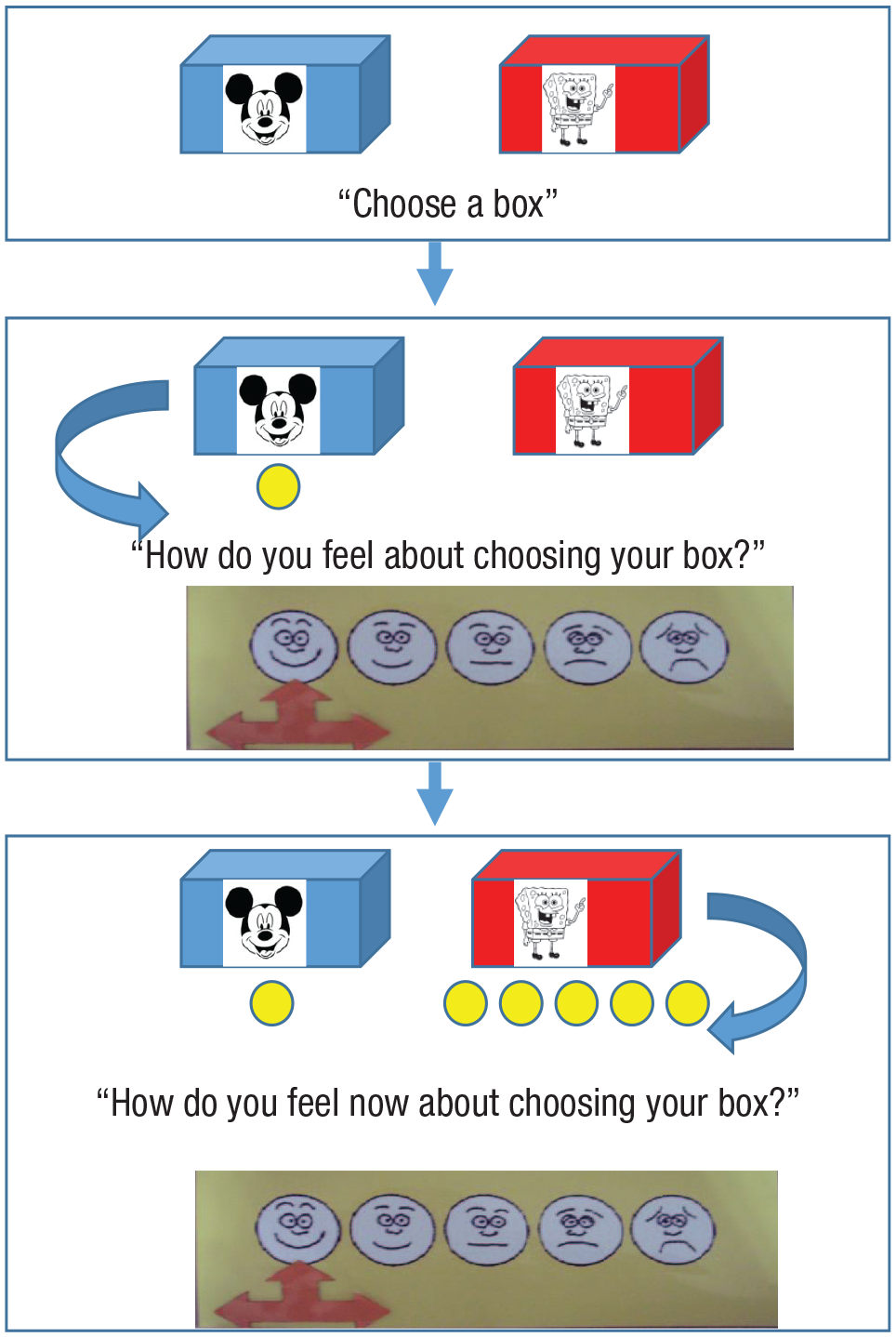
The boxes task typically used to assess regret in children. Children first choose between two boxes to win a prize (tokens that can be swapped for stickers). Then they see the actual prize they chose and rate their emotion on a simple faces scale, Finally, children are shown that they would have won a better prize if they had chosen the other box and then are asked to give a further emotion rating. In the depicted version of the task, children use a three-pronged arrow to make this final rating, having been trained previously to choose the upward-pointing prong if they feel the same, the rightward-pointing prong if they feel sadder, and the leftward-pointing prong if they feel happier.
Regret primarily occurs following a poor outcome for which one is personally responsible: Adults rarely report feeling regret regarding outcomes that were not their fault (Zeelenberg, Van Dijk, & Manstead, 2000). Indeed, in the boxes task, children are more likely to report feeling sadder if they themselves have chosen between the boxes rather than if the experimenter made the choice (O’Connor, McCormack, Beck, & Feeney, 2015; D. P. Weisberg & Beck, 2012). One might argue, however, that the boxes task is not ideal because children are not genuinely responsible for the outcome—they simply choose at random between two options. Studies with adults involve more meaningful choices, often using economic decision-making tasks in which participants choose between gambles that vary in risk (Camille et al., 2004). It is possible to adapt the boxes task so that it, too, is a risky decision-making task; we asked children to choose between a “safe” box (50–50 chance of winning, e.g., either 7 or 10 tokens) or a “risky” box (50–50 chance of winning, e.g., either 16 or only 1 token). We found that most 6- to 7-year-olds experienced regret when they chose the risky box but got a poor prize, in line with findings from adults (McCormack, O’Connor, Beck, & Feeney, 2016).
Regret and Children’s Choices
Research on regret in adults suggests that they adopt a strategy of anticipating the regret they would feel after choosing options that appear attractive but are ultimately disadvantageous. Anticipation of regret leads them to avoid such choices. Notably, patients who do not experience regret because of brain damage do not learn to avoid such choices (Camille et al., 2004). The fact that the ability to experience regret affects adult decision-making suggests that when children acquire the ability to experience regret, it will have a knock-on effect on their decision-making. A series of studies (O’Connor, McCormack, & Feeney, 2014) supported this suggestion. We gave children a version of the boxes task and measured whether they experienced regret. We then retested children the next day using the same boxes task; we hypothesized that children who experienced regret about their choice on the first day would be inclined to selectively switch their choices on the second day. We found that this was indeed the case: There was an association between experiencing regret on the first day and appropriately switching choices on the second day, even when we controlled for age and verbal ability.
In another study (McCormack, O’Connor, Cherry, Beck, & Feeney, 2019), we examined whether experiencing regret helped children learn to delay gratification. We reasoned that if children regretted not waiting for a reward that turned out to be better than a more immediately available option, they might be more likely to wait in the future. Children were shown two boxes and told that the boxes each contained a prize but that they were currently locked; one box would automatically unlock when a small 30-s hourglass ran out (short-delay box), and the other would unlock when a large 10-min hourglass ran out (long-delay box). Children were informed that when a box unlocked, they would receive the prize inside but that they could have the contents of only one box. At this stage, children did not know that the short-delay box contained fewer candies than the long-delay box.
Unsurprisingly, most children opened the short-delay box. We then showed them the contents of the long-delay box and examined whether they felt sadder on seeing what they would have obtained if they had waited, our regret measure. We saw the children again the next day and again allowed them to choose between the short-delay or long-delay box. We found an association between regretting not waiting on the first day and the likelihood that children waited for the long-delay box to open, even when controlling for age and IQ. This suggests that regret might help children learn to delay gratification; this is interesting because “hot” emotional responses are sometimes portrayed as being something that “cold” cognition needs to overcome for delaying gratification (Metcalfe & Mischel, 1999). If we are right, one specific type of emotion, namely regret, may be beneficial in supporting prudent decision-making.
Although regret affects 6-year-olds’ simple decisions, there are further developmental changes in more complex tasks. On trials in Feeney, Travers, O’Connor, Beck, and McCormack’s (2018) task, participants received a coin each time they opened one of a series of eight boxes but lost their coins if they opened the box containing a pirate. On trials in which participants banked their coins, they then saw how many boxes they could have opened before encountering the pirate. If participants regretted the missed opportunity to win further coins, they should have opened more boxes on the next trial. It was not until participants were 8 years old that choices seemed to reflect regret in this way, and adults’ choices showed greater responsivity to regret than adolescents’ choices. Habib et al. (2015) also reported that when a risky decision-making task was set in a social context, adolescents, unlike adults, did not reliably regret choices that led to a loss or wish to alter such choices. Taken together, these findings suggest that the effects of regret on decision-making increase even throughout adolescence.
Experienced Versus Anticipated Regret
These studies indicate that regret may help children make better decisions, but we know little about exactly how. One issue is whether it is the experience of regret that directly affects children’s decision-making or whether, more indirectly, it is the anticipation of future regret. For example, in the case of the delayed-gratification task, a plausible interpretation is that children decided to wait because they anticipated that they would later regret taking the smaller, more immediate reward. Indeed, most research with adults has focused on the idea that it is the anticipation of regret that affects decision-making and that people make choices that they hope will minimize future regret. Thus, regret-related interventions in health psychology have been designed to encourage people to anticipate, for example, the regret they might feel if they failed to get screened for cancer and then became ill (Connolly & Reb, 2005).
Anticipation of regret, however, is likely to require additional cognitive skills because it involves not only thinking counterfactually but also considering counterfactuals that one might entertain in the future and their emotional impact. Indeed, although most 6-year-olds can experience regret, they cannot reliably predict that they will feel sadder when they find out about a counterfactual outcome that is inferior to an actual outcome (Guttentag & Ferrell, 2008; McCormack & Feeney, 2015). McCormack and Feeney reported that it was not until children were around 8 years old that they could reliably anticipate when they would feel regret. This finding means that the previously described studies are best interpreted as indicating that the experience of regret has a direct impact on 6-year-olds’ decision-making, because children of this age do not seem to be able to anticipate this emotion. This difficulty anticipating regret is developmentally significant given that anticipation of regret plays a role in adults’ everyday decision-making. Once children can anticipate regret, their decision-making is likely to change in important ways, although little is currently known about the effects of this later-emerging skill, which is particularly likely to be important in adolescents, who are faced with novel choices that may have a long-term impact (e.g., whether to use contraception; Richard et al., 1996).
Children’s Interpersonal Regrets
So far, we have discussed regret regarding choices that yielded only a suboptimal outcome for the choosers themselves. However, adults also experience regret over choices that have a negative impact on another person, known as interpersonal regret. For example, one might regret a selfish choice such as going to a party instead of visiting an ill parent. There is some debate over whether interpersonal regret can be properly differentiated from guilt; some researchers have argued that guilt and interpersonal regret are identical (Berndsen, van der Pligt, Doosje, & Manstead, 2004). However, the two emotions can be dissociated and are linked to somewhat different action tendencies (Breugelmans, Zeelenberg, Gilovich, Huang, & Shani, 2014), with regret being specifically associated with the tendency to make different choices (e.g., someone who feels guilty about passing a beggar without giving them money might nevertheless continue not to give to beggars, but someone who regrets not donating is likely to change their ways). The distinction between interpersonal regret and guilt is important from a developmental perspective, because guilt seems to be observable long before the age at which children experience regret (from 2 years; Kochanska, Gross, Lin, & Nichols, 2002). One possible way of distinguishing the two emotions may be in terms of whether counterfactual thought is necessarily involved: Whereas regret is defined as an emotion that is underpinned by representations of what might have been, guilt may not necessarily require such representations. Guilt might be, in its most basic form, a response to the actual outcomes of one’s choices (that someone has been harmed) rather than based on what would have happened if one had chosen differently (that the harm could have been avoided). If this is correct, then interpersonal regret may emerge developmentally later than guilt.
Uprichard and McCormack (2019) attempted to examine interpersonal regret. Children had to collect stickers to win a prize; there was one sticker left over, and children were asked whether they wanted to donate it to the next child who would play the game. Most children decided to keep the sticker. They then saw that the next child did not have enough stickers to win a prize, but at this stage, they did not know whether the sticker they had kept was the one that the next child was missing. Children tended to report that they felt sad about the next child not being able to win a prize; they were then shown that they had kept the specific sticker the other child needed and asked about their emotions again. We interpreted children reporting feeling even sadder as evidence that they regretted keeping the sticker that would have helped the other child. We found that 5- to 6-year-olds did not seem to experience regret on this measure, but children a year older did. Furthermore, children who experienced regret about not donating the sticker were more likely to then act prosocially in a separate task. This latter finding suggested that interpersonal regret can result in children acting more kindly. In further studies, researchers could try to tease apart the developmental emergence of regret and guilt and examine the effect of regret on moral development. They could also examine whether personal and interpersonal regret emerge simultaneously.
Conclusion
Recent research has suggested that regret is a sophisticated emotion that develops relatively late in childhood and that its emergence may affect different types of decision-making. The ubiquitous nature of regret in the lives of adults provides a good reason for closely studying this emotion in children, and there are still many unanswered questions about the developmental significance of regret. In particular, little is known about how regret affects children’s and adolescents’ real-life decisions outside of a laboratory context, including morally significant decisions. Understanding the development of regret is of practical significance, because such understanding could feed into the design of interventions to improve decision-making in both children and adolescents.
Recommended Reading
Beck, S. R., & Riggs, K. J. (2014). Developing thoughts about what might have been. Child Development Perspectives, 8, 175–179. A concise introduction to the development of counterfactual thinking.
O’Connor, E., McCormack, T., & Feeney, A. (2014). (See References). The first study to find a link between regret in children and their decision making.
Zeelenberg, M., & Pieters, R. (2007). A theory of regret regulation 1.0. Journal of Consumer Psychology, 17, 3–18. A comprehensive but accessible discussion of the nature and function of regret in adults.
