




Abstract
Decision-making competence refers to the ability to make better decisions, as defined by decision-making principles posited by models of rational choice. Historically, psychological research on decision-making has examined how well people follow these principles under carefully manipulated experimental conditions. When individual differences received attention, researchers often assumed that individuals with higher fluid intelligence would perform better. Here, we describe the development and validation of individual-differences measures of decision-making competence. Emerging findings suggest that decision-making competence may tap not only into fluid intelligence but also into motivation, emotion regulation, and experience (or crystallized intelligence). Although fluid intelligence tends to decline with age, older adults may be able to maintain decision-making competence by leveraging age-related improvements in these other skills. We discuss implications for interventions and future research.
People of all ages face decisions that affect their health, finances, and well-being. Making good decisions should help them to obtain better outcomes. Decision-making competence refers to the ability to follow decision-making principles that have been proposed by models of rational choice. Table 1 describes tasks that assess adherence to each of six decision-making principles, selected to cover complementary components of the Decision-Making Competence measure (Bruine de Bruin, Parker, & Fischhoff, 2007; Parker & Fischhoff, 2005). In this article, we focus on two of these components because of their differential relationships with age and the insights they provide about the skills the Decision-Making Competence measure taps into across the life span. The first task, Applying decision Rules, entails identifying the best option among alternatives with multiple attributes, such as health treatments or consumer products (Bruine de Bruin et al., 2007; Parker & Fischhoff, 2005; Payne, Bettman, & Johnson, 1993). The second task, Resistance to sunk costs, entails abandoning investments with irrecoverable losses if alternatives provide better future outcomes (Arkes & Blumer, 1985).
Tasks in the Decision-Making Competence Measure and the Principles They Assess
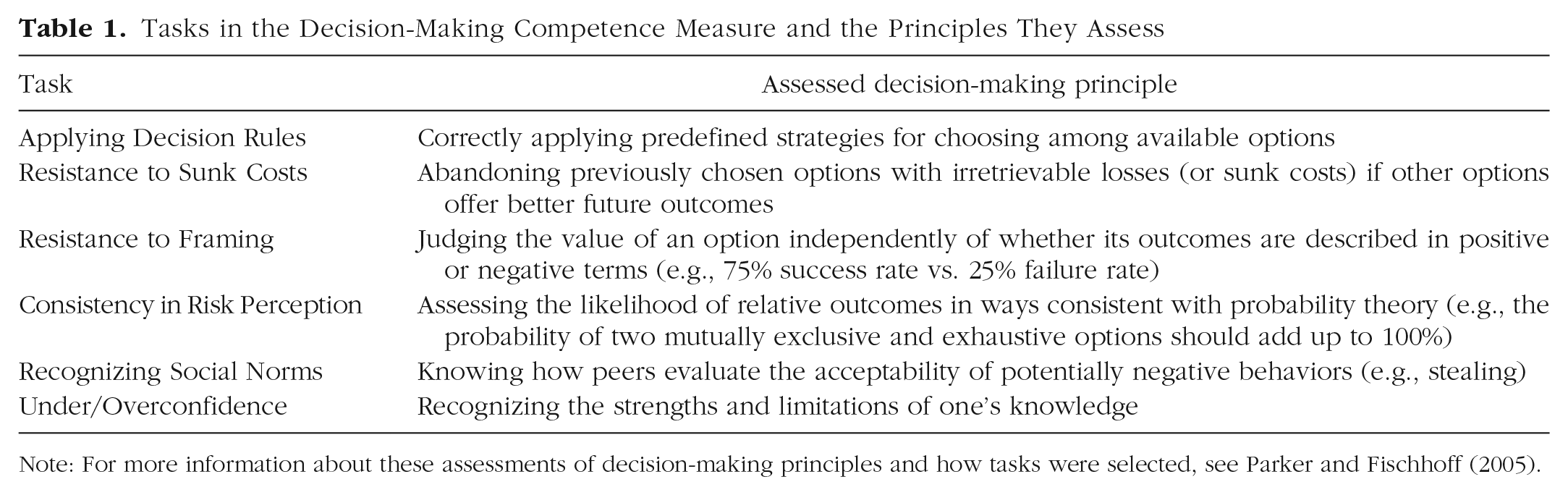
Note: For more information about these assessments of decision-making principles and how tasks were selected, see Parker and Fischhoff (2005).
Initial Psychological Tests of Decision-Making Principles
Decision-making researchers have long suggested that adhering to the decision-making principles of rational choice can be cognitively demanding (Edwards, 1954). To understand when people violate these decision-making principles, researchers have typically designed careful experimental manipulations of the conditions under which decisions were made. For example, studies have found that people are less able to apply decision rules when the rules are more complex, the number of options increases, or time pressure is added (Payne et al., 1993). Studies have also found that people are more likely to become concerned about “wasting” prior investments and to violate the sunk-cost principle when irrecoverable losses are larger (Arkes & Blumer, 1985).
Because these studies focused on when decision-making principles were violated, they paid little attention to who would be more prone to such violations. Progress on understanding individual differences was further hampered by three additional features that were common to the research. First, each study typically assessed adherence to one decision-making principle at a time without asking whether individuals who were better able to follow one principle were also better able to follow others. Second, other skills were rarely measured, leaving it unclear how decision-making competence was similar to or different from, for example, fluid intelligence. Third, performance was typically measured on artificial decision tasks, which may not capture how people actually make decisions in their lives.
Individual-Differences Measures of Decision-Making Competence
Studies of individual differences in decision-making competence began with several concurrent research programs. Each suggested that there are stable individual differences in the ability to adhere to different decision-making principles. In samples of undergraduate students, Stanovich and West (1998) found that performance was positively correlated across a suite of tasks that assessed adherence to different decision-making principles. In a sample of younger and older adults who completed a different set of decision tasks, Finucane and colleagues (2002) also found that performance was positively correlated. We created a battery of tasks assessing adherence to the decision-making principles displayed in Table 1, suited to adolescents (Parker & Fischhoff, 2005) and adults (Bruine de Bruin et al., 2007). With both samples, we found that performance was positively correlated across the presented tasks. Figure 1 shows examples of the two tasks, one assessing performance on the Applying Decision Rules task and the other assessing performance on the Resistance to Sunk Costs task.
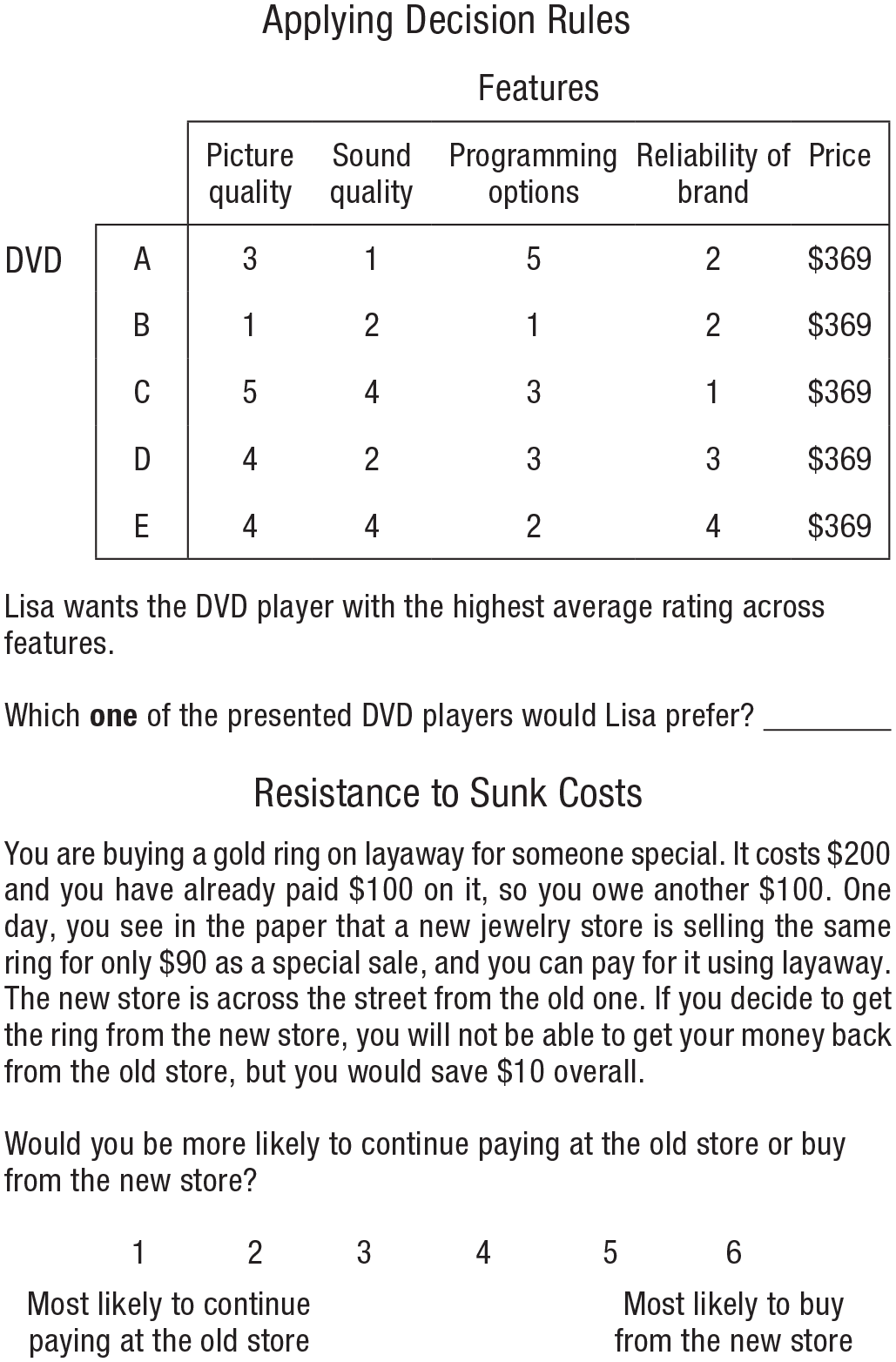
Example items from the Applying Decision Rules and Resistance to Sunk Costs components of the Decision-Making Competence task.
Over the past 15 to 20 years, a growing body of evidence has replicated these positive correlations across the tasks in the Decision-Making Competence measure. Studies using our Decision-Making Competence measure have replicated that finding with, for example, early and late adolescents in the United States (US); undergraduate students from Italy, China, and Slovakia; adults in the US, United Kingdom, and Sweden; US adults with autism spectrum disorder; and Swedish adults with attention-deficit/hyperactivity disorder (Bavolar, 2013; Bruine de Bruin et al., 2007; Del Missier et al., 2017; Del Missier, Mäntylä, & Bruine de Bruin, 2012; Del Missier, Mäntylä, Hansson, Bruine de Bruin, & Parker, 2013; Eberhardt, Bruine de Bruin, & Strough, 2019; Levin et al., 2015; Liang & Zou, 2018; Mäntylä, Still, Gullberg, & Del Missier, 2012; Parker & Fischhoff, 2005; Weller, Levin, Rose, & Bossard, 2012). In an 11-year longitudinal study, we found positive correlations between tasks on the Decision-Making Competence measure as well as between assessments at age 19 and age 30, suggesting robustness in performance on the Decision-Making Competence measure over time (Parker, Bruine de Bruin, Fischhoff, & Weller, 2018).
There is also evidence for the predictive validity of our Decision-Making Competence measure, as seen in correlations with real-world outcomes. Adolescents with higher overall Decision-Making Competence scores were less likely to report behaviors that suggest poor decisions, such as juvenile delinquency and drug use (Parker & Fischhoff, 2005). Adults with higher overall Decision-Making Competence scores reported fewer negative life events on the Decision Outcome Inventory, such as Type II diabetes and bankruptcy (Bruine de Bruin et al., 2007). Moreover, Decision-Making Competence scores at the age of 10 to 11 years predicted interpersonal problems 2 years later (Weller, Moholy, Bossard, & Levin, 2015). Thus, despite using hypothetical decision tasks, Decision-Making Competence tasks appear to measure abilities that are relevant to real-world outcomes.
More Than Just Intelligence?
Decision-making competence was originally hypothesized to be a cognitive skill related to fluid intelligence (e.g., Bruine de Bruin, Parker, & Fischhoff, 2012). Various studies have indeed found moderate positive correlations between overall performance across our Decision-Making Competence measure and fluid intelligence (e.g., as measured with Raven’s Standard Progressive Matrices), executive cognitive functioning (e.g., inhibition, monitoring, and shifting), and numerical skills (Bruine de Bruin et al., 2007; Del Missier et al., 2012; Del Missier et al., 2013; Del Missier et al., 2017; Parker & Fischhoff, 2005; Weller et al., 2012; see also Toplak, West, & Stanovich, 2011).
However, there is also increasing evidence suggesting that decision-making competence may be conceptually distinct from fluid intelligence. First, correlations between overall Decision-Making Competence scores and life events reported on the Decision Outcome Inventory remain after analyses control for fluid intelligence (Raven’s Standard Progressive Matrices), as well as crystallized intelligence (Nelson-Denny Reading Test), socioeconomic status, and demographics (Bruine de Bruin et al., 2007). This finding suggests that the tasks on the Decision-Making Competence measure may capture skills other than fluid intelligence that have relevance to life outcomes. Second, correlations between performance and fluid intelligence differ across the Decision-Making Competence tasks, which suggests that they tap different skills. For example, performance correlates more strongly with measures of fluid intelligence for the Applying Decision Rules task than for the Resistance to Sunk Costs task (Bruine de Bruin et al., 2012; Del Missier et al., 2012; Del Missier et al., 2013; Parker & Fischhoff, 2005). Third, decision-making competence may tap into more than just fluid intelligence, as seen in its additional positive correlations with motivation, emotion regulation, and experience (Carnevale, Inbar, & Lerner, 2012; Eberhardt et al., 2019). Individuals who are motivated to think harder about complex tasks (also referred to as need for cognition) may perform better on tests of numeracy and decision-making competence (Bruine de Bruin, McNair, Taylor, Summers, & Strough, 2015; Carnevale et al., 2012). Emotional skills may support decision-making competence by enhancing the interpretation of past experiences and new information, directing attention, and facilitating comparisons between options (Peters, 2006). Individuals who have more experience with specific decisions may not need to deliberate as much about those decisions, because they have acquired crystallized intelligence and have already learned what to do (Li, Baldassi, Johnson, & Weber, 2013). Thus, decision-making competence may reflect a combination of intellectual, motivational, emotional, and experience-based skills.
Age Differences in Decision-Making Competence
Given the well-documented age-related declines in fluid intelligence, researchers investigating age differences in decision-making competence initially hypothesized that older adults would perform worse than younger adults. However, findings suggested that this was not always the case (Bruine de Bruin et al., 2012). Figure 2 shows the varying patterns of age differences in performance for tasks assessing adherence to the decision-making principles presented in Table 1. For example, older adults performed worse than younger adults on the Applying Decision Rules task but better on the Resistance to Sunk Costs task. Possibly, applying decision rules is more cognitively demanding and hence requires greater fluid intelligence, which declines with age. Resistance to sunk costs may benefit from accumulated life experience; older adults find it easier to walk away from poor decisions with sunk costs because they have learned to worry less about losses (Bruine de Bruin, Strough, & Parker, 2014; Strough, Schlosnagle, & DiDonato, 2011).
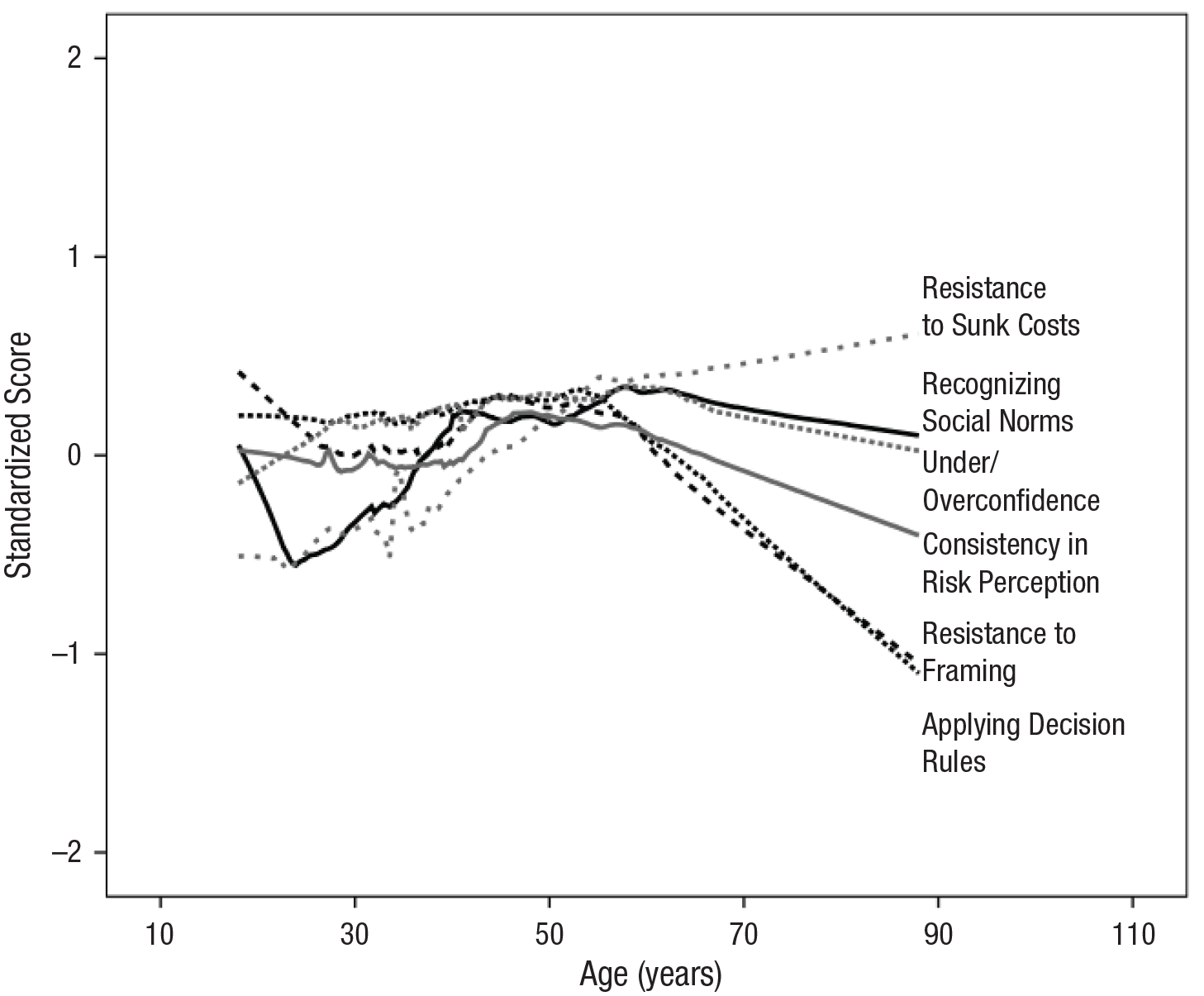
Age trends in performance on each of the six tasks on the Decision-Making Competence measure. Higher standardized scores reflect greater decision-making competence. Data from Bruine de Bruin, Parker, and Fischhoff (2007); figure adapted from Strough, Parker, and Bruine de Bruin (2015).
In addition to fluid intelligence, it has been suggested that motivation, emotions, and experience may also contribute to age differences in decision-making competence. For example, older adults appear more motivated to work on tasks that they find cognitively less demanding and more personally relevant (Bruine de Bruin et al., 2015; Carstensen, 2006; Hess, Queen, & Ennis, 2013), to be less affected emotionally by negative experiences (Bruine de Bruin et al., 2014; Carstensen, 2006), and to have more life experience to guide their decisions (Li et al., 2013). Thus, age-related decline in fluid intelligence may be counteracted and possibly overcome by age-related improvements in experience and emotion regulation (Eberhardt et al., 2019; Li et al., 2013).
Implication for Interventions
Better understanding of how fluid intelligence and other skills support decision-making competence should facilitate the design of interventions. Below, we briefly consider directions for future research into potential cognitive, motivational, emotional, and experiential interventions for promoting decision-making competence.
In one intervention that aimed to provide cognitive support, Zwilling and colleagues (2019) found that a group that received training in core cognitive abilities improved decision-making competence compared with an active control group (in which participants practiced processing visual information faster). Effects of cognitive training can be enhanced by high-intensity cardio-resistance fitness training, which improves connectivity in the brain (Zwilling et al., 2019). Rosi, Vecchi, and Cavallini (2019) found that prompting older people to ask metacognitive questions (e.g., What is the main information?) was more effective than general memory training for improving performance on the Applying Decision Rules task. This finding is in line with suggestions that older adults perform better when they are asked to explain their choices (Kim, Goldstein, Hasher, & Zacks, 2005). Additional intervention approaches have aimed to reduce the need to rely on fluid intelligence. Using simple instead of complex decision rules may decrease cognitive demands and cause fewer errors (Payne et al., 1993). Reducing the number of options also reduces cognitive demands and may especially help older adults to improve their choices (Tanius, Wood, Hanoch, & Rice, 2009).
Other interventions have aimed to increase motivation for making decisions. Simplifying decisions along the lines suggested above may motivate people to engage more with their decisions. Framing decisions as more personally relevant may especially motivate older people (Hess et al., 2013). Motivational barriers to making decisions may potentially also be overcome by providing decision support and by designing choice environments that draw attention to recommended options.
In addition to targeting cognition and motivation, interventions may attempt to enhance the emotion regulation that people need to apply their decision-making competence. For example, correlational evidence suggests that encouraging people to focus on the positive may reduce their concerns about losses and improve their resistance to sunk costs (Bruine de Bruin et al., 2014). Additionally, framing information in positive terms may increase older adults’ motivation to use it in their decisions (Carstensen, 2006).
Finally, interventions may aim to provide people with the experience they need to master decision-making principles. For example, Larrick, Nisbett, and Morgan (1993) found that training was associated with recognizing the relevance of the sunk-cost principle and applying it. A high school history curriculum that emphasized decision-making principles in decisions made by historical figures improved students’ decision-making competence and their subject-matter learning (Jacobson et al., 2012). These findings suggest that practicing the application of decision-making principles in protected settings may improve transfer to real-world settings.
Next Steps
Models of rational choice have proposed decision-making principles. Psychological research on decision-making has developed carefully crafted decision tasks that assess adherence to those principles. Individual-differences research in decision-making has developed and validated measures of decision-making competence based on these approaches. Those measures have led to a growing body of research on the nature of decision-making competence and its relationship to fluid intelligence, motivation, emotion, and experience. We have seven suggestions for next steps.
First, a wider range of decision-making principles and related skills could be added to the suites of existing measures to better assess decision-making competence and illuminate the skills it taps into (as in the Comprehensive Assessment of Rational Thinking; Stanovich, West, & Toplak, 2016). Second, measures of decision-making competence may be used to validate measures of self-reported decision-making styles, which are designed to assess, for example, how much individuals perceive themselves to be avoidant or spontaneous decision makers (Appelt, Milch, Handgraaf, & Weber, 2011; Dewberry, Juanchich, & Narendran, 2013; Parker, Bruine de Bruin, & Fischhoff, 2007). Third, more diverse and nationally representative samples are needed to improve understanding of the interplay between decision-making competence (and its components) and other skills and experiences. Fourth, creating national norms for decision-making competence may inform policies about legal protections. Fifth, a fuller picture is needed regarding decision-making competence across the entire life span, from childhood through older adulthood (Weller, Levin, & Denburg, 2011). Sixth, longitudinal studies are needed to disentangle developmental changes from cohort effects (Parker et al., 2018). Seventh, intervention studies targeting specific skills could help to identify causal mechanisms in improving overall decision-making competence and its components (following Jacobson et al., 2012).
The development of validated measures of decision-making competence provides theoretically grounded methods for understanding how such competence develops across the life span, how it relates to life events, and how it varies with individuals’ cognitive and emotional skills, experience, and other characteristics. That knowledge should help people of all ages to make better decisions, leading to better life outcomes and well-being.
Recommended Reading
Bruine de Bruin, W., & Parker, A. M. (2017). Individual differences in decision-making competence in different age groups. In M. E. Toplak & J. Weller (Eds.), Individual differences in judgement and decision making: A developmental perspective (pp. 127–146). New York, NY: Routledge. Discusses research on individual differences in decision-making competence in greater detail than the present article.
Fischhoff, B., & Broomell, S. B. (2020). Judgment and decision making. Annual Review of Psychology, 71, 331–355. Discusses research on individual differences in decisionmaking competence in other contexts.
Footnotes
Acknowledgements
W. Bruine de Bruin is now at the Sol Price School for Public Policy, the Department of Psychology, the Schaeffer Center for Health Policy and Economics, and the Center for Economic and Social Research at the University of Southern California. We thank our many collaborators, particularly Fabio Del Missier, who provided helpful comments on this manuscript, as did Irwin Levin and two anonymous reviewers.
Transparency
Action Editor: Randall W. Engle
Editor: Randall W. Engle
