




Abstract
To obtain flakes like zirconia particles at relatively low temperature, the synthesis method for producing zirconia particles on the surface of salt particles that serve as a template is examined. The produced particles are incorporated as reinforcement in the poly(methyl methacrylate) matrix to obtain a composite material. The particles were characterized by the X-ray diffraction, Fourier-transform infrared spectroscopy, and image analysis. The morphology of the particles and composites was examined using a field emission scanning electron microscope. Composites prepared with synthesized particles were compared to those containing commercial zirconia particles to estimate the possibility of use of synthesized particles as reinforcement. The influence of the 1 wt% of zirconia particles in composite material on the mechanical properties was studied using microhardness measurements and dynamic mechanical analysis. The results obtained show that the addition of 1 wt% of zirconia particles increases the mechanical properties of the composite relative to the pure polymer matrix.
Introduction
Zirconia is one of the important ceramics, which, due to its high mechanical strength and fracture toughness, is widely used. The biocompatibility of zirconia enables its use as a biomaterial. Electrical, mechanical, optical, and thermal properties of zirconia are resulting in a wide application, such as structural materials, thermal barrier coating, solid oxide fuel cell electrolytes, and semiconductor materials. It can also be used as a catalyst in various reactions, such as isomerization of alkanes, dehydration of an alcohol, and nitrogen oxide decomposition. 1 Due to its good mechanical properties and biocompatibility, the zirconia is increasingly used as an implant in the field of dental medicine. 2 Zirconia has been synthesized by different methods, such as combustion synthesis, ion exchange, solid-state reaction, sol-gel synthesis, glycothermal processing, Pechini method, and a wet chemical method. 3,4
Zirconium dioxide (ZrO2) is a ceramic material that has become attractive due to its mechanical, thermal, and chemical properties and is becoming also very important as reinforcement in polymer matrix composites. 5 It may be used in transparent optical devices, 6 electrochemical capacitor electrodes, oxygen sensors, 7 fuel cells 8 as catalyst support 9 and as a biomaterial. ZrO2 has several crystal structures and the mechanical properties are dependent on the dominant crystal structure of the powder. The crystallinity of zirconia is defined as monoclinic at room temperature; at higher temperatures, it is tetragonal and cubic. Cubic and orthorhombic phases were detected in nano-sized zirconia. 10
Nanocomposites are increasingly studied in recent years especially those that are made of the polymer matrix and inorganic filler due to the ease of preparation, good mechanical and chemical properties, and ease of preparation and handling. Such composites combine the properties of inorganic materials (such as rigidity and thermal stability) with the properties of organic materials (e.g., flexibility, dielectricity, ductility, and processability). 11
Poly(methyl methacrylate) (PMMA) is an excellent material, which, due to its properties, has a wide application in optical fibers, optical discs, and lenses. PMMA, in combination, with inorganic materials, such as SiO2, TiO2, or zirconium oxide (ZrO2), makes hybrid materials having high strength and thermal stability. 12,13
Composites enable adjusting the properties by choosing the adequate matrix as well as the reinforcement. As a matrix material, polymers are often considered for their ease of handling and good forming properties. The morphology and the crystal structure of the reinforcement have a decisive role for the composite properties. 14 The aim of this article was the preparation of ZrO2 particles from the soluble zirconium salt deposited on a template like a salt crystal and the study of the influence of those preparation conditions on the properties of the obtained particles viewed as the reinforcement in the composite material. Mechanical properties of the prepared composite material were studied using the microhardness and dimethyl acrylate (DMA). The characterization of obtained particles was done by X-ray diffraction (XRD), Fourier-transform infrared (FTIR) spectroscopy, and image analysis.
Experimental procedure
Materials
For composite preparation, acrylic resin (commercially available as Biokril, Galenika AD, Serbia) was used as a polymer matrix. It was a two-component starting kit—powder and liquid. The powder consisted of PMMA polymer and initiator benzoyl peroxide. The liquid part contained MMA monomer and a small amount of ethylene glycol dimethyl acrylate used as a chemical activator. Biokril powder was characterized as follows 14,15 : Mn = 1.27 × 10⁵ g Mol−1, MW = 3.82 × 10⁵ g Mol−1, with a polydispersity, PI = 3.01, and content of MMA was 4.3 wt%. For the preparation of Zirconia by salt method, starting materials were ZrCl2O · xH2O powder (ThermoFisher (Kandel), Germany), ethanol, and NaCl (Lach-Ner, s.r.o., Czech Republic). For comparison, the commercial micro-sized Zirconia (ZrO2 M), Sigma Aldrich, was used as inorganic reinforcement.
Preparation of particles
For the salt template method, a quantity of 125 mg of ZrCl2O · xH2O was dispersed in 30 ml of absolute ethanol with vigorous stirring for 1 h. After that, the solution was mixed with 100 g of NaCl fine crystalline powder and dried at 65°C with stirring during 24 h. The mixture was heated with a ramp rate of 2°C min−1 under an Ar atmosphere and annealed at 280°C for 2 h. Further treatment included annealing at 750°C for 5 h with a ramp rate of 1°C min−1 under a mixture of NH3 (10%) and Ar. The product was washed by deionized water to remove salt and centrifuged at 3000 r min−1 for 30 min. The sample was vacuum-filtrated and collected for further treatment. Finally, the powder was annealed at 1150°C during 5 h in Air atmosphere. The obtained particles were marked as ZrO2 N.
Preparation of composites
To obtain essential information about the as-synthesized particles, the composite samples were prepared. For the preparation of pure acrylic resin (PMMA), the producer instructions were followed: liquid has been poured in a glass container and the powder was added in a ratio of powder to liquid 2:1 in weight, with continuous mixing performed for 40–45 s. The aluminum mold was filled with solution, closed, and then heated to 70°C for 1 h, followed by the increase of temperature up to 100°C for 30 min, to reduce the content of the residual monomer. 14 For the processing of composites, the same procedure was used with synthesized and commercial particles. Particles were dispersed in the liquid part of starting kit in an ultrasonic bath for 1 h. The mixture was added to the (PMMA) powder and placed in the mold. The thermal treatment was the same as for the pure resin. The particle content in both composites was 1 wt%. In our previous research, composites with 1, 3, and 5 wt% of pure zirconia and acryl resin were processed, and the best impact and overall mechanical behavior were achieved with 1 wt% of reinforcements. 11,15 In accordance with these findings, this research introduces a comparison of composites with 1 wt% of synthesized and commercial particles. The composites with synthesized and commercial zirconia particles are denoted as PMMA/ZrO2 N and PMMA/ZrO2 M, respectively.
Characterization methods
The morphologies of the ZrO2 particles and composites were examined using a field emission scanning electron microscope (FE-SEM), TESCAN MIRA3 XMU, operated at 20 kV. Morphological parameters of particles were determined using the image analysis tools (Image-Pro Plus 6.0, Media Cybernetics Inc., Cambridge, UK). 16
X-ray powder diffraction (XRPD) patterns were recorded with an Ital Structure APD2000 X-ray diffractometer in a Bragg–Brentano geometry using CuKα radiation (λ = 1.5418 Å) and step-scan mode (range: 20−80° 2θ, step-time: 0.5 s, step-width: 0.02°).
The structural analysis of ZrO2 particles and composites was performed by single-beam FTIR using a Nicolet 6700 spectrometer (Thermo Scientific) in the attenuated total reflectance (ATR) mode using a single bounce 45°F Golden Gate ATR accessory with a diamond crystal and an electronically cooled DTGS detector. The spectra were the co-addition of 64 scans at 4 cm−1 spectral resolution and were ATR corrected. The Nicolet 6700 FT-IR spectrometer was equipped with OMNIC software and recorded the spectra in the wavelength range from 2.5 µm to 20 µm (i.e. 4000 cm−1 to 500 cm−1).
The microhardness of the composite systems was characterized using micro Vickers hardness value (HV) tester Leitz, Kleinharteprufer DURIMETI using an original quadrangular pyramid diamond indenter with an angle of 136°. 17 To obtain reproducible HV, microhardness of PMMA composites without particles and PMMA composites with ZrO2 particles was measured applying a load of 500 g for 25 s. For each sample, three indents were performed at room temperature according to ASTM E384-16. 18 Image-Pro Plus program was used to obtain the diagonal lengths from images obtained by the optical microscope, Carl Zeiss—Jena, NU2. The average results of diagonal were taken from the reported measurement for calculation of microhardness using the following equation:

where P (kgf) stands for the applied load and d (mm) is the length of the indentation diagonal. 19
The dynamic mechanical analysis was used to examine the performance of the PMMA matrix composite reinforced using ZrO2 particles. The data obtained from this analysis included the storage modulus (G′), tangent delta (tan δ), and the glass transition temperature (Tg). The storage modulus reveals the ability of the composite to store elastic energy associated with recoverable elastic deformation. Together with tan δ, the storage modulus describes the behavior of the composite under stress in a defined temperature range. DMA was performed on a DMA Q800 (TA Instruments) under a nitrogen atmosphere in the single cantilever mode. Storage modulus and loss factor (tan δ) were determined for rectangular specimens of size 35 × 13 × 3 mm3 at a frequency ω = 1 Hz. The temperature range was changed from room temperature to 160°C at a heating rate of 3°C min−1. 20
Results and discussion
Microstructure of the particles and composites
The SEM micrographs and diameter distributions of prepared ZrO2 particles are shown in Figure 1.

(a) The SEM micrographs of ZrO2 particles and (b) diameter distribution. SEM: scanning electron microscope.
The diameter distribution was obtained from the image of the specimen showing a large number of agglomerated particles. Using Image Pro-Plus software, single particles were selected on the image and two diameters of each recognized particle were measured. Based on these measurements, the software recognized formed agglomerates. 21,22 The obtained result indicates that the obtained particles were fine, having diameters mostly under 100 nm. Several particles that were larger are possibly agglomerates of two separated particles that cannot be distinguished on the image clearly.
The morphology and the distribution of zirconia particles were examined using scanning electron microscopy. The cross-sectional view obtained from the composite fracture surfaces using SEM is shown in Figure 2. The particles were in both cases very fine in diameter and well distributed in the structure. Composites with commercial zirconia particles had small agglomerates, which are arranged in a polymeric matrix, leading to reduced mechanical properties compared to composites with synthesized zirconia particles.
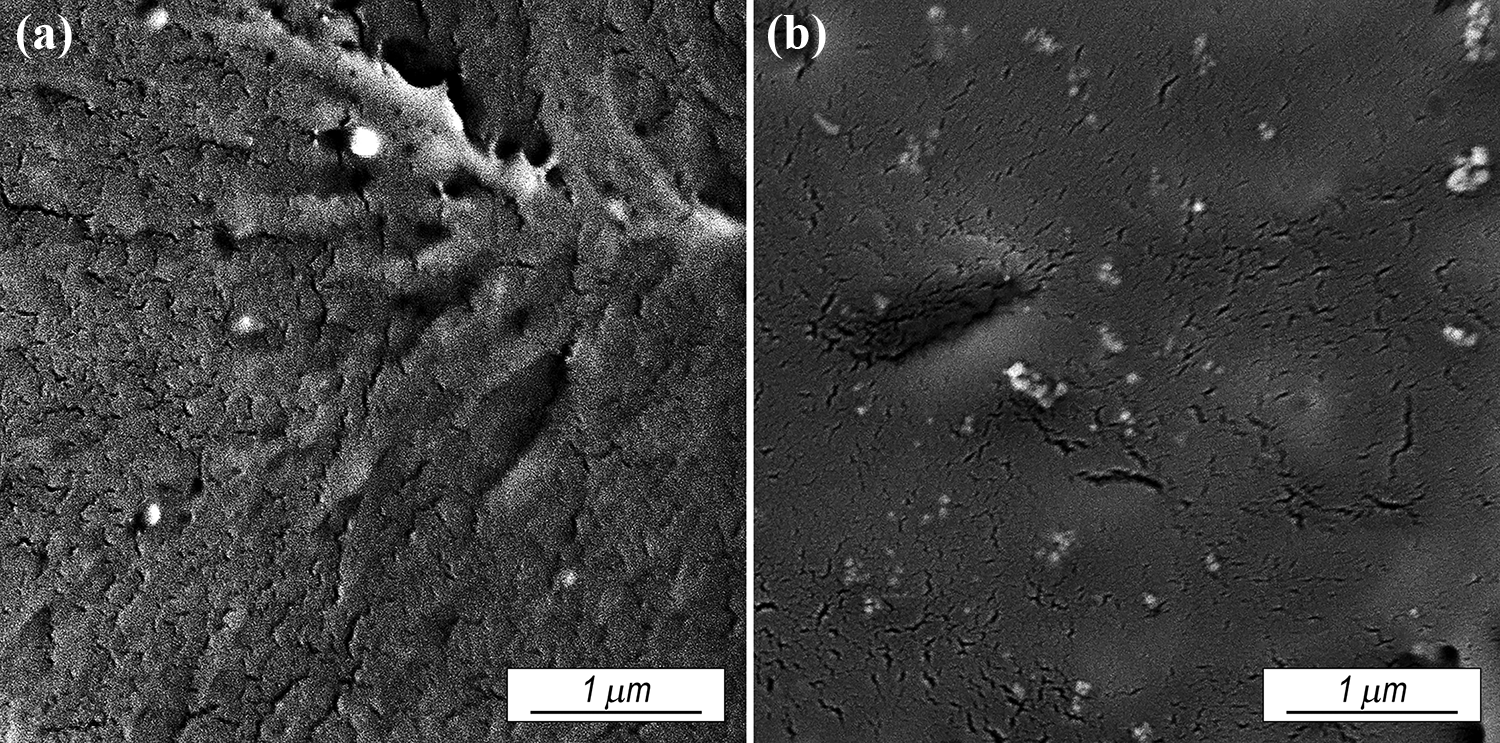
Cross section of the fracture surface of studied composites (a) the composite with synthesized particles and (b) the composite with commercial particles.
XRD analysis of particles crystal structure
XRD is used to identify the crystalline structure (Figure 3). By the XRPD technique, the ZrO2 phase was confirmed by comparison of the XRD data to the standard card 72698-ICSD and Zr7O11N2 by card 157959-ICSD. The program PowderCell 23 was used for approximate phase analysis. The mean crystallite size of ZrO2 and Zr7O11N2 phase was estimated from the most intensive diffraction peaks by the program PowderCell.

XRD patterns of ZrO2 M particle and ZrO2 N particles at 750°C and 1150°C. XRD: X-ray diffraction.
The sample (ZrO2 N) identified at 750°C in the presence of two phases: m-ZrO2 and Zr7O11N2. The approximate mass ratio of the two phases in the sample is 60:40 = m(ZrO2):m(Zr7O11N2). Unit cell parameters of m-ZrO2 phase are a = 5.1475, b = 5.2253, and c = 5.3213. Unit cell parameters of Zr7O11N2 phase are a = 9.5973 and c = 17.6910. At 1150°C in the sample identified the mass ratio of the two phases 93:7 = m(Zora2):m(Zr7O11N2) particles. In the sample (ZrO2 M), two polymorphic crystalline phases ZrO2 were identified: monoclinic m-ZrO2 and tetragonal t-ZrO2. The approximate mass ratio of the two phases in the sample is 64:36 = m-ZrO2:t-ZrO2. The identification of the m-ZrO2 phase was performed by comparing the experimental values with the card 72698-ICSD and the t-ZrO2 phase with the 66781-ICSD card. In the preparation of composites, the powder synthesized at 1150°C was used. The commercial powder was used for the purpose of comparing the mechanical properties that are obtained using those two types of the crystal structure.
Structure characterization via FTIR spectroscopy
The FTIR spectra of obtained particles and composites are shown in Figure 4.

FTIR spectra of ZrO2 N particles, pure PMMA, and composites with 1 wt% of ZrO2 N particles. FTIR: Fourier-transform infrared; PMMA: poly(methyl methacrylate).
The FTIR spectra of the synthesized zirconia particles, PMMA matrix, and obtained composite are presented (Figure 4). The FTIR spectrum of Figure 4 showed no visible band around 3400 cm−1 assigned to the symmetric stretching of OH bonds corresponding to physically adsorbed water on the solid. The band noticed at 584 cm−1 can be assigned to Zr-O bond vibrations in monoclinic ZrO2. 24 The intense vibration noticed at approximately 1100 cm−1 may be assigned to the zirconyl bond (Zr=O). 25 The weak broadband at 526 cm−1 has been reported to be related to crystalline ZrO2. 21
The ethylene C–H stretch bands for PMMA, PMMA/ZrO2, and composites at 2998, 2951, 2924, and 2850 cm− 1 were sharp 26 and in similar positions for both of samples (Figure 4). The spectra display a typical carbonyl C=O stretch band (approximately 1725 cm− 1). Other bands present in the spectrum of PMMA are a doublet of medium intensity in the region of 1500–1425 cm− 1, a medium-to-strong band approximately 1146 cm− 1, and a medium-intensity band at 750 cm− 1. 27 Two characteristic peaks at region 1140–1160 cm− 1 related to the methyl ester groups of PMMA. One can notice that there is no appearance of new bond vibrations or the change of peak position, suggesting that there was no obvious effect of particle incorporation in the PMMA matrix.
Microhardness of composites and dynamic mechanical analysis
Micrographs of micro Vickers indentation for the outer surface of composites with 1 wt% of ZrO2 particles are shown in Figure 5.

Micrograph of micro Vickers indentation for composites: (a) PMMA, (b) PMMA/ZrO2 M, and (c) PMMA/ZrO2 N. PMMA: poly(methyl methacrylate).
The obtained values of the microhardness and dynamic mechanical analysis of the composite based on PMMA and with 1 wt% of the different particles are presented in Table 1.
Mechanical properties of PMMA and PMMA composites reinforced with zirconia-based particles.

PMMA: poly(methyl methacrylate); HV: hardness value.
Microhardness of composites with the addition of 1 wt% of the ZrO2 N particles increases by 23% compared to the pure matrix material while increasing in a composite containing 1 wt% ZrO2 M particles 17.3%. The properties of zirconia modifications were studied and calculated from the structural crystal parameters showing that the modulus, bulk, shear, and Young are higher for the monoclinic compared to the tetragonal structure. 28 The difference between the powders used is essential in the presence of monoclinic crystal modification of zirconia in synthesized particles; they consisted essentially of monoclinic modification, commercial ones had only 60%, and the improvement of hardness is proportional to the quantity of monoclinic structure in the reinforcement.
The addition of ZrO2 influences the mechanical properties, as observed by DMA analysis (Figure 6). The storage modulus has been measured for the matrix material and the composites, and it was revealed that 1 wt% of synthesized particles ZrO2 N in the sample slightly improved the storage modulus in the glassy state (G′GS) (around 2%). The commercial particles gave even a larger increase of the storage modulus at low temperatures. The storage modulus in the rubbery state (G′RS) had the largest value for the pure matrix, and the addition of particles decreased the modulus at elevated temperatures. The glass transition temperature remained essentially the same as the particles seem not to build the chemical bond between the matrix and the reinforcement.

Changes in the storage modulus for the PMMA matrix and composites reinforced with ZrO2 particles. PMMA: poly(methyl methacrylate).
On the other hand, synthesized ZrO2 N particles gave the material a larger value of hardness, as measured by the Vickers method. The hardness is higher, compared to the samples with commercial zirconia particles. This difference in the mechanical behavior of ZrO2 N and ZrO2 M could be explained in different crystal structure and content of m-ZrO2. In addition, the presence of Zr7O11N2 in synthesized zirconia leads to different dynamical properties and toughening mechanism. 29 –31
Conclusion
Zirconia particles were synthesized by the salt template method. The obtained particles had flake-like morphology and fine dimensions. Composites having PMMA as a matrix and synthesized zirconia particles have improved mechanical properties, such as storage modulus and microhardness. The results were compared to the composite obtained using commercial zirconia powder. The hardness of the composite with synthesized particles was better compared to the composite processed with commercial zirconia, which can be explained via the crystal structure of reinforcing particles and their content of monoclinic crystal structure. The storage modulus was comparable for both synthesized composites and was superior compared to the pure matrix material in the glassy state. The storage modulus was inferior to the matrix in the rubbery state. The glass transition temperature was not changed and that subjects that the chemical bonding was not established between the particles and the matrix material.
Footnotes
Acknowledgements
The authors wish to acknowledge Galenika enterprise for the cooperation in the discussion of the results and provision of the polymers used in their production.
Declaration of conflicting interests
The author(s) declared no potential conflicts of interest with respect to the research, authorship, and/or publication of this article.
Funding
The author(s) disclosed receipt of the following financial support for the research, authorship, and/or publication of this article: This research has been financed by the Ministry of Education, Science and Technological Development of the Republic of Serbia as a part of the project TR34011.
