




Abstract
Novel therapies are urgently needed to combat the severe cytokine storm syndromes induced by coronavirus disease 2019 (COVID-19). An increasing number of preclinical and clinical investigations of stem cell and derivatives therapy for COVID-19 were being carried out, among which several studies have preliminarily demonstrated the safety and possible efficacy of stem cell transplantation therapy, providing a hint to solve the tricky situation of anti-COVID-19.
Coronavirus disease 2019 (COVID-19) is a severe acute respiratory disease caused by severe acute respiratory syndrome coronavirus 2 (SARS-CoV-2). So far, there has no specific antiviral treatment or available vaccines for COVID-19. Oxygen therapy, including supportive therapy and mechanical ventilation in cases of respiratory failure, remains the primary treatment intervention for patients in severe conditions. COVID-19 can trigger a destroying immune overreaction in the body and stimulate the immune system to produce large amounts of inflammatory factors, and then cause cytokine storm 1 . It still lacks effective methods of preventing and reversing the cytokine storm. Steroid therapy seems effective in some cases; however, it has the side effect of reducing the activity of the immune system of patients 2 . Some research revealed that stem cell transplantation therapy could not only prevent the immune system from releasing cytokine storm but also promote the endogenous repair, which may help solve the tricky situation of anti-COVID-19.
Stem cells, especially mesenchymal stem cells (MSCs), have been proved to have the potential of self-renewal and multidirectional differentiation as well as a strong anti-inflammatory and immune regulatory function. MSCs, the dominant type of stem cells in clinical application, can inhibit the abnormal activation of T lymphocytes and macrophages and induce their differentiation, respectively, into regulatory T cell (Treg) subsets and anti-inflammatory macrophages. MSCs can reduce the occurrence of cytokine storms by inhibiting the secretion of proinflammatory cytokines, such as interleukin 1(IL-1), tumor necrosis factor-alpha (TNF-α), IL-6, IL-12, and interferon-gamma (IFN-γ). With the secretion of hepatocyte growth factor, keratinocyte growth factor, IL-10, and vascular endothelial growth factor (VEGF), MSCs are also believed to alleviate acute respiratory distress syndrome (ARDS), repair and regenerate the damaged lung tissues, and even resist fibrosis 3 .
Preclinical data suggested that systemic MSC administration could significantly reduce respiratory virus (Influenza strains H5N1 and H9N2)-induced lung injury 4 . Lanjuan Li et al. 5 conducted a clinical study of using MSCs to treat ARDS patients induced by epidemic influenza A (H7N9) infection, showing MSCs transplantation significantly reduced the mortality of ARDS (17.6% died in MSC group vs 54.5% died in the control group). These studies have provided a hint for COVID-19 treatment using MSCs. Some researchers assumed MSCs might present two kinds of molecular biological antiviral mechanisms in the context of COVID-19 4 . One possible mechanism is to elevate the levels of MSC-specific IFN-stimulated genes, which could function as mediators of antiviral protection in a secondary response to IFN, and then lead to the induction of these genes and broad viral resistance. The other way is that MSCs could present a mix of intrinsic and inducible innate antiviral defenses, leading to therapeutic benefits in COVID-19 patients.
The first COVID-19 pneumonia case with stem cell therapy was a 65-year-old woman, whose severe symptoms effectively improved 21 days after receiving the treatment of human umbilical cord MSC (hUCMSC) transplantation 6 . The patient was initially treated, according to the guideline, with lopinavir/ritonavir, IFN-α inhalation, oseltamivir, and moxifloxacin, Xuebijing, methylprednisolone, and immunoglobulin. Besides, she was subjected to the non-invasive mechanical ventilator due to poor oxygenation. As the vital signs continually worsened, the patient was injected with hUCMSCs with α1 thymosin (Table 1). After the second injection, the patient’s serum albumin, C-reactive protein, and alanine aminotransferase/aspartate transaminase gradually decreased and vital signs got improved. Three kinds of T cell subsets, CD3+, CD4+, and CD8+, significantly increased. After the third injection, the vital signs and most of the clinical laboratory parameters of the patient came back to normal. The results suggested that hUCMSCs could be a potentially effective treatment option combined with other immune-modulating agents.
Data of Clinical Studies of Stem Cells Treating COVID-19 Pneumonia.
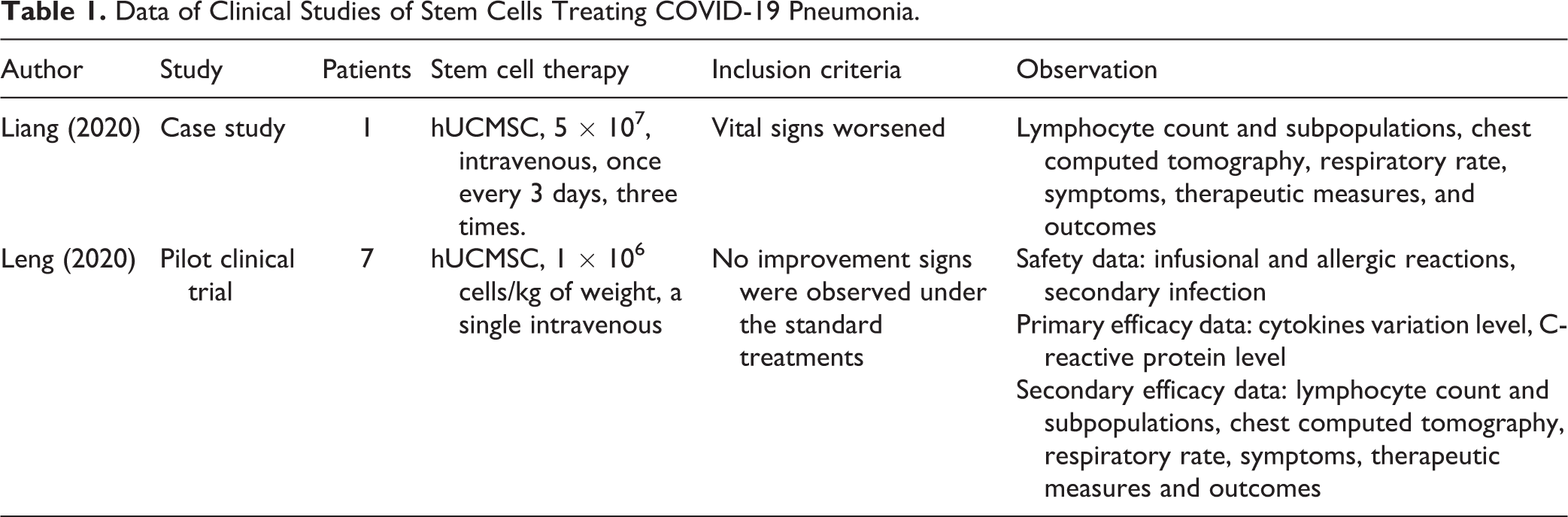
Chunhua Zhao et al. 7 conducted a pilot trial of using stem cell transplantation therapy to treat seven patients with COVID-19, in which the clinical symptoms of all the participants significantly improved 2 days after hUCMSCs transplantation (Table 1). Peripheral lymphocyte levels of the participants increased and activated cytokine-secreting immune cells, including CXCR3+ CD4+ T cells, CXCR3+ CD8+ T cells, and natural killer CXCR3+ cells, disappeared after 3 to 6 days, indicating that the participants’ immune status improved. Meanwhile, significantly decreased TNF-α levels and increased IL-10 were observed in the hUCMSCs-treated group. After 14 days, the MSCs in vivo which were examined by gene expression profiling, were ACE2− and TMPRSS2−, meaning they were free of COVID-19 infection. These results provided preliminary evidence of the feasibility, safety, and effect of stem cell therapy in treating patients with COVID-19 pneumonia.
CD147, along with ACE2, was found as the receptors for SARS-CoV-2 of invading host cells. Medications that target CD147, for instance, azithromycin, were suggested to be combined with ACE2− stem cell transplant as a modified method 8 . At the same time, some stem cell derivative therapies have also received attention. Leukemia inhibitory factor released by stem cells, a factor that participates in opposing the cytokine storm in lungs during viral pneumonia, failed to exert clinical effect due to its being cell-based. The novel method of “LIF Nano” based on the synthetic nanotechnology of stem cells was with a 1000 times increase in potency, emerging as an alternative stem cell-based therapy to satisfy the huge need for clinical application 9 . The findings of the paracrine mechanism of MSCs indicated that MSCs secretome could be a promising cell-free therapeutic tool for treating acute and chronic lung diseases. MSCs secretome can activate endogenous stem cells and regulate the inflammatory response by releasing biologically active substances. It displays the effects of anti-inflammation, immunomodulation, regeneration, and remains highly stable in vivo, showing a potential advantage in the future application 10 .
Footnotes
Authors’ Contributions
CW was a major contributor in writing the manuscript. XW performed analysis in relevant research and was the second contributor in writing the manuscript. XL made substantial contributions to the conception and substantively revised the manuscript. All the authors read and approved the final manuscript.
Declaration of Conflicting Interests
The author(s) declared no potential conflicts of interest with respect to the research, authorship, and/or publication of this article.
Funding
The author(s) disclosed receipt of the following financial support for the research, authorship, and/or publication of this article: This work was funded in part by the National Key Research and Development Program of China Stem Cell and Translational Research (CN) (2016YFA0101003).
