




Abstract
Mind–body interventions (MBIs) have many health benefits, such as reducing stress, modulating blood pressure, and improving sleep and life quality. The long-term practice of Tai chi, an MBI, also increases the number of CD34+ cells, which are surface markers of hematopoietic stem cells, so prolonged Tai chi practice may have antiaging effects. We developed the day easy exercise (DEE), an innovative MBI, that is easy to learn and requires only a small exercise area and a short practice time. The aim of this study was to explore whether DEE, like Tai chi, has antiaging effects after short-term practice. Total 44 individuals (25 to 62 years old) with or without 3-month DEE practice were divided into young- and middle-aged groups (≤30 and >30 years old) and peripheral blood was collected at 0, 1, 2, and 3 months for analysis of CD34+ cells. The number of CD34+ cells in peripheral blood remained unchanged in control young- and middle-aged groups. After DEE, the number of CD34+ cells in peripheral blood was increased over time in both young- and middle-aged groups. For young-aged adults, the cell number was markedly increased by threefold at 3 months after DEE, and for middle-aged adults, the increase was significant from the first month. DEE practice indeed increased the number of CD34+ cells in peripheral blood and the increase was more significant for older people in a shorter time. This is the first study to provide evidence that the DEE may have antiaging effects and could be beneficial for older people.
Introduction
Mind–body interventions (MBIs) are alternative therapies that focus on the association among mind, body, brain, and behavior and their effects on diseases or disorders. Many MBI techniques involve relaxation techniques or stress-resistance methods and, thus, can improve psychosocial and physical health 1 –3 . Tai chi and yoga are common MBIs with many beneficial effects, such as reducing cardiovascular risk factors, reducing inflammatory cytokine levels, improving T helper cell function, affecting virus-specific immune responses, and improving quality of life and psychological status 4 –8 . After long-term Tai chi practice in young people, the blood proportion of CD34+ cells, a surface marker of hematopoietic stem cells (HSCs), is increased 9 . HSCs are responsible for the lifetime maintenance of hematopoietic function 10 . The number of HSCs is reduced during aging, and possible mechanisms include loss of restricted telomere DNA 11 , repeated exposure to radiation 12 , and continuous reduction of proliferative capacity 13 . Thus, HSCs are used as an indicator of aging. Tai chi practice enhances the production of CD34+ cells probably because it induces vasodilation and increases blood flow by decreasing the activity of the sympathetic nervous system 9 . Therefore, Tai chi practice may have antiaging effects.
Although MBIs (such as Tai chi and yoga) have significant benefits for mental and physical health and diseases, practicing MBIs is limited by several conditions, such as the time needed to practice, the difficulty in learning, the area required for exercises, and the need for long-term and uninterrupted practice for effective benefits.
We developed the day easy exercise (DEE), an innovative MBI that combines Tai chi, yoga, Qigong, extreme stretching, muscle movement, and coordinated meditation. Each step of the DEE has a specific angle, and mode and sport mode. DEE has advantages over other MBIs, including the need for only a small exercise area, being easy to learn, and the practice time is short. The aim of this study was to assess whether DEE, like Tai chi, has antiaging effects by evaluating the proportion of CD34+ cells in blood before and after DEE practice in participants aged 25 to 62 years. We here demonstrated that the number of CD34+ cells in peripheral blood was increased over time in both young- and middle-aged groups after DEE practice but placebo control groups remained unchanged. The young group showed a marked threefold increase in CD34+ cell number at 3 months after DEE practice, and the middle-aged group showed a significant increase from the first month. Therefore, DEE practice indeed increased the number of CD34+ cells in peripheral blood and such increase was more significant in older people, which suggests that DEE may have antiaging effects.
Materials and Methods
Study Design and Participant Recruitment
The study was designed by retrospective cross-sectional study. We randomly recruited 40 participants to participate in DEE training and 32 participants for the placebo control group and gave them questionnaires including variables such as name, sex, age, body weight, height, education, occupation, sports habits, medical history such as cardiovascular disease, diabetes, or anemia, hepatitis B or C virus infection, nephropathy, and if there is any regular drug intake or treatments. For the placebo control group, 32 participants were recruited. Seven participants refused for 3-month sample collection and three participants were unable to receive biochemical tests on time. A total of 22 participants who met the criteria were enrolled in the study and were separated into 2 groups: young-aged group (age ≤30, n = 13) and middle-aged group (age >30, n = 9) (Fig. 1A). In DEE training group, 10 participants refused to continue practicing for 3 months for personal reasons and 8 participants were unable to receive biochemical tests on time. Total 22 participants who met the criteria were enrolled in the study and were separated into 2 groups: young-aged group (age ≤30, n = 10) and middle-aged group (age >30, n = 12) (Fig. 1B). All participants were recruited from National Taiwan University Hospital Hsin-Chu Branch and Fu Jen Catholic University Hospital. The inclusion criteria were (1) age 25 to 62 years, (2) able to stand on their own, (3) able to have a blood test, and (4) obtaining a physician’s permission to participate in DEE. Exclusion criteria were (1) pregnancy, (2) critical illness, (3) declining to exercise, and (4) blood collection not possible.

Participant screening, randomization, and completion assessment. (A) Placebo group: participants without DEE practice for 3 months. (B) DEE group: participants with DEE practice for 3 months.
This study was approved by the Institutional Review Board (IRB) for research ethics at the National Taiwan University Hospital Hsin-Chu Branch, Taiwan (IRB project identification code: 105-047-E). All procedures in this study were conducted in accordance with IRB and written informed consent was obtained from the participants for their anonymized information to be published in this article.
Blood Sample Collection and Lipid Profile Measurement
The fasting blood samples of the vein (5 ml) from all participants before (control group) and at 1, 2, and 3 months after DEE practice were collected using a tube containing no anticoagulant (BD Vacutainer Cell Preparation CPTTM) and the samples were stored at −70°C until analysis. Plasma triglyceride (TG), total cholesterol, and high-density lipoprotein (HDL)-cholesterol were measured using a commercial kit (Wako Chemicals, Richmond, VA, USA). Low-density lipoprotein (LDL)-cholesterol was estimated using the Friedewald equation: (LDL-cholesterol) (mg/dl) = (total cholesterol) – (plasma TG/5) – (HDL-cholesterol).
Analysis of CD34+ Cells and Immune Cells by Flow Cytometry
Peripheral whole-blood samples were collected before DEE training (0 month) or at 1, 2, and 3 months after DEE training (1, 2, and 3 months). The same time points were collected in the placebo control. Approximately 2 to 5 ml of blood was collected using BD K2EDTA vacutainer tubes for each time point. For determining absolute cell number, 50 µl whole blood was stained with antibody cocktails. For determining CD34+ cell number, 1 ml whole blood was stained with anti-CD45 (phycoerythrin (PE) conjugate, 2.5 μg/ml, Cat. No. 347464) and anti-CD34 (BV421, 1 μg/ml, Cat. No. 562577). For isotype control, 100 µl whole blood was stained with anti-CD45 (PE, 2.5 μg/ml, Cat. No. 347464) and mouse IgG isotype control (BV421, 1 μg/ml, Cat. No. 562438). After 20 min of staining, erythrocytes were lysed by BD FACS lysis solution (Cat. No. 349202). Cells in BD Trucount tubes were analyzed on LSRFortessa X-20 systems straightaway (BD Bioscience, Franklin Lakes, NJ, USA). In these cells stained with CD34 or mIgG isotype control, fixation was performed by BD FACS fixation buffer (Cat. No. 554655). Next day, cells were washed by staining buffer and were analyzed on LSRFortessa X-20 systems. The gating strategy of CD34+ cells was gated on CD45+ cells, then compared to mIgG isotype control which seted BV421+ cells below 0.1%. All data were analyzed with FlowJo software (BD Bioscience).
For T and B cell number calculation, the surface markers for the corresponding cells were anti-CD3 antibody conjugated with PerCP (total T cells) and anti-CD19 conjugated with fluorescein isothiocyanate (total B cells).
DEE Protocol
DEE is an innovative MBI combining Tai chi, yoga, extreme stretching, muscle movement, and coordinated meditation. Each step of the DEE has a specific motion and holding time. Each participant practiced DEE twice a day, 30 min each time for 3 months. During the 30 min of the DEE, meditation music and soft music were allowed.
The DEE exercise consists of 10 steps (Fig. 2) and a cycle of 10 steps takes 10 min, so participants practiced the DEE exercise 3 cycles in 30 min. In the first cycle, participants relaxed all the key parts of the body such as ankle, knee, waist, back, and neck, one-by-one independently. In the second cycle, participants performed more precise actions including angles, patterns, and movements of each part. In the third cycle, from the bottom to the upper body, the key parts of the body were moved through the more depth-limited stretch of the core muscle groups, which are linked together and integrated. The training steps are presented in the film. The link URL is as follows: https://photos.app.goo.gl/7p1DZrYqk8NRzMCg9.

The 10 steps of the day easy exercise (DEE). (A) Step 1: stand still and move the center of gravity to the right foot, then lift the left heel. After 10 s, slowly put down the left heel, and stretch the calf to the knee. (B) Step 2: move the center of gravity to the right leg, and lift the left heel. After 5 s, slowly lower the left heel, pull up the calf, lift the perineum, put down the calf, and press the body forward. (C) Step 3: turn the body to the right 45°, and lift the left heel. After 10 s, put down the left heel, pull up the calf, and lift the perineum. (D) Step 4: lift the left heel and move hands to the chest. After 10 s, slowly put down the left heel, stretch the calf, and stretch the back muscles. (E) Step 5: turn the body from the right 90°, straighten the arms back, extend the head forward to look at the back, and lift the left heel. After 10 s, slowly put down the left heel. (F) Step 6: move the center of gravity to the right and then lift the left heel. After 10 s, slowly put down the left heel, and stretch from the calf to the knee. (G) Step 7: move the center of gravity to the right again, then lift the left heel. After 10 s, slowly put down the left heel, stretch from the calf to the perineum, and lean back. (H) Step 8: turn the body from the right 45°, lift the left heel, lift the hands wide open up to the shoulder width, then pull up to 180°. After 10 s, slowly put down the left heel, pull up the calf, lift the perineum, and pull up the abdomen. (I) Step 9: lift the left heel and slowly lower the left heel, pull up the calf, and put the arms wide open for 10 s. (J) Step 10: lift the left heel and slowly lower it, pull up the calf, tilt the head back, and stretch the neck.
Statistical Analysis
Data are expressed as mean ± standard error of the mean. Results were analyzed by Student’s paired t-test. All statistical analyses were performed with SPSS software (IBM Corp., Armonk, NY, USA). P <0.05 was considered statistically significant.
Results
A total of 40 and 32 participants were enrolled in DEE practice or placebo control groups. The 44 remaining participants were all Taiwanese and had at least a university education. Participants ranged in age from 25 to 62 years. The 44 participants were divided into 2 groups by age: ≤30 years (n = 10 for DEE and n = 13 for placebo, young-aged group) and >30 years (n = 12 for DEE and n = 9 for placebo, middle-aged group). Table 1 showed the baseline characteristics of participants and there was no significant difference between young and middle-aged groups in body mass index. Levels of TG, total cholesterol, HDL-cholesterol, or LDL-cholesterol did not differ after DEE practice for young- and middle-aged groups (Table 2).
Baseline Characteristics of the Study Participants.

All of the 44 participants were Taiwanese and educated higher than senior high school.
IQR: interquartile range.
Lipid Levels Before and After DEE by Age Groups.

Young-aged group ≤30 years (n = 10) and middle-aged group >30 years (n = 12). Data are mean ± standard error of the mean. P-value compared to before DEE by Student’s paired t-test.
DEE: day easy exercise; HDL-cholesterol: high-density lipoprotein cholesterol; LDL-cholesterol: low-density lipoprotein cholesterol; SEM: standard error of the mean.
The number of CD34+ cells remained unchanged in the placebo young- and middle-aged groups (Table 3, Fig. 3A, B). In DEE practice group, before DEE practice (0 month), the number of CD34+ cells were 6.5 ± 5.38 and 4.7 ± 2.31 cells/µl for young and middle-aged group, respectively. After DEE practice, the cell number in both groups was increased over time (Table 3, Fig. 3C, D). The increase in CD34+ cell number in the young group became significant from the second month after DEE practice (12.3 ± 5.85 cells/μl), and about a threefold increase in the third month (18.5 ± 5.64 cells/μl) as compared with 0 month (Fig. 3C), whereas the increase in the middle-aged group was significant from the first month (8.8 ± 4.73 cells/μl), with about a twofold increase (Fig. 3D). The number of total T and B cells was also analyzed. Total T cell number in both young and middle-aged DEE practice groups was increased over time, but total B cells remained unchanged (Table 4).
The CD34+ Cell Number in DEE and Placebo Groups by Participant Age.
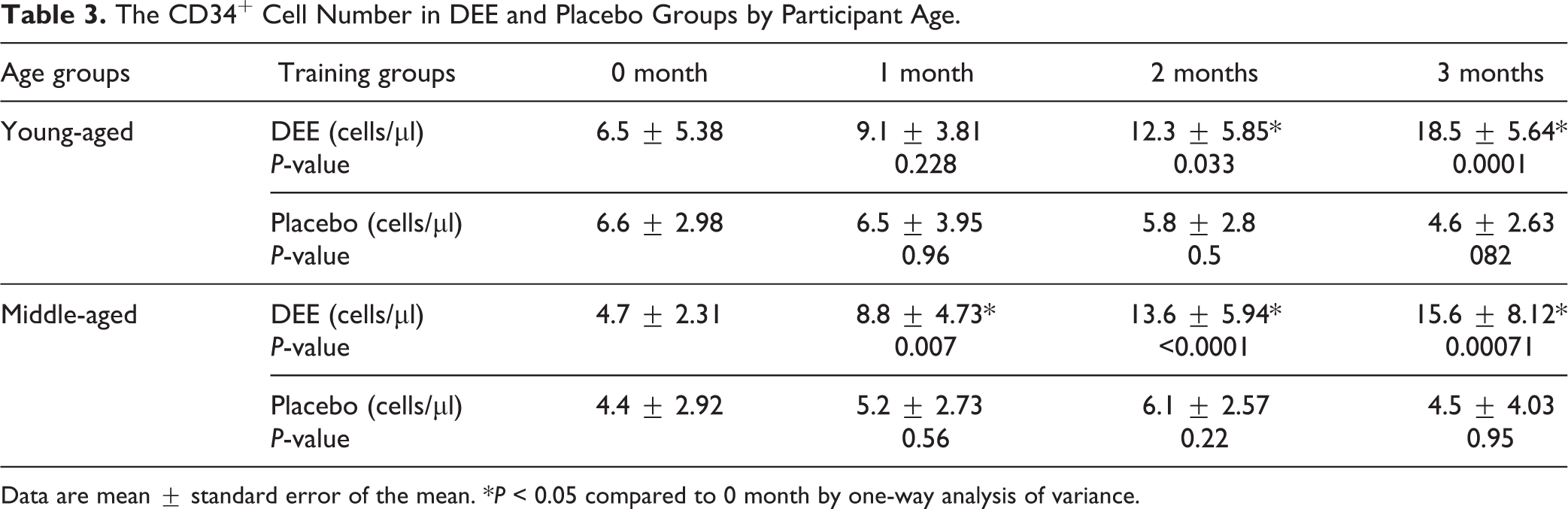
Data are mean ± standard error of the mean. *P < 0.05 compared to 0 month by one-way analysis of variance.

The increase in CD34+ cell number over time. CD34+ cell number in peripheral blood for placebo (A, B) and DEE (C, D) groups of participants (young-aged [A, C] and middle-aged [B, D]) detected at 0, 1, 2, and 3 months. Data are mean ± standard error of the mean (black lines); The P-values are done by one-way analysis of variance.
T and B Cell Number in DEE and Placebo Groups by Participant Age.

Data are mean ± standard error of the mean. *P < 0.05 compared to 0 month by one-way analysis of variance.
Discussion
We have demonstrated in this study that DEE practice increased the number of CD34+ cells, which are surface markers of HSCs, or indicators of aging, in peripheral blood over time in both young and middle-aged groups. In young participants, the CD34+ cell proportion was markedly increased by threefold at 3 months after DEE practice, whereas in the middle-aged group, it was significantly increased from the second month.
The participants in our study were between 25 and 62 years old. This group represents the main population of Taiwanese society, in whom high body mass index and abnormal levels of TG, total cholesterol, and LDL are also consistent with those in many industrialized countries. We excluded the older population (>65 years old) because previous studies have indicated that 80% of people older than 65 have at least one chronic disease 14 , so we minimized disruptive factors such as chronic diseases and medications. The age group of this study should provide simpler and representative conditions to explore the effects of DEE practice on CD34+ cell number and immune responses. We found that DEE practice had no significant effect on TG, total cholesterol, HDL-cholesterol, LDL-cholesterol levels, and B cells for both groups. Total T cells were increased in both groups.
Consistent with a previous study finding that the proportion of HSCs in human peripheral blood ranged from 0.01% to 0.03% 15 , our mean proportion of CD34+ cells before DEE practice was 0.0122 ± 0.0015%, which confirms that the experiments we adopted to collect blood and detect the number of CD34+ cells were similar to those of other studies.
CD34+ is an indicator of aging 9,16 , and the number of CD34+ cells in peripheral blood of mice is known to decrease with age 17 . The number of CD34+ cells was slightly lower in the middle-aged than young group at 0 month (4.7 ± 2.31 cells/µl vs 6.5 ± 5.38 cells/µl in the DEE group, 4.4 ± 2.92 cells/µl vs 6.6 ± 2.98 cells/µl in the placebo group) (Table 3). Our data were consistent with the suggestion of age-induced decrease in CD34+ cell number, although the decline was not apparent due to less age differences between the two groups.
Tai chi and yoga may be beneficial in delaying aging and regulating the immune response by increasing the CD34+ cell number and regulating CD34+ cell function, respectively 9,18 . In agreement with data from Tai chi studies, in both our age groups, the proportion of CD34+ cells was increased over time after DEE practice. Our data demonstrate that DEE practice could be more effective in older than younger people, given that the middle-aged group showed significant changes in cell number from the second month.
In adult, the majority of CD34+ cells reside in the bone marrow (BM) where they undergo self-renewal, but some CD34+ cells travel from the BM to the peripheral blood and vice versa. An increased level of CD34+ cells in peripheral blood is likely due to that more CD34+ cells are mobilized from BM stromal cells to enter the circulation. It has been reported that sympathetic nerves may regulate HSC trafficking 18 –20 . Tai chi practice increases the number of CD34+ cells in peripheral blood by reducing sympathetic nervous system activity and increasing blood flow 9 . Given that the content of our DEE practice includes some Tai chi movements, we speculated that the DEE may use similar mechanisms to increase the number of CD34+ cells.
Yoga can regulate the lineage specificity of the differentiation of CD34+ cells or self-renewal capacity in patients with HIV-1 infection by potentially regulating signal transducer and activator of transcription 21 . Although our study did not explore the effects of DEE practice on CD34+ differentiation and self-renewal, an increase in proportion of CD34+ cells likely enhances CD34+ differentiation into red blood cells and myeloid lineages. In addition, the cytokine interleukin-3 likely plays a role in the proliferation of HSCs 22 , but we have no direct evidence showing the association between MBI and interleukin-3 level. Nevertheless, our DEE practice may possibly modulate cytokine levels to increase the number of HSCs. Estrogen is another factor to regulate the proliferation of HSCs 23 . It was reported that women have lower circulating CD34+ cells compared with men, but estrogen level weekly correlated with CD34+ number 24 . Although it is still unclear whether DEE practice increases estrogen levels in women, estrogen may not be a dominant factor on circulating HSC change in women.
The differences between DEE and traditional exercises were compared and are listed in Table 5. DEE training steps are more dynamic rather than fixed modes. The DEE exercise consists of 10 steps and a cycle of 10 steps takes 10 min, so a 30-min practice includes 3 cycles. Participants relaxed the key parts (ankle, knee, waist, back, and neck) of the body from the first cycle, then gradually performed more precise actions in the second and third cycles. The 30-min training session twice a day can reduce the physical burden of participants who lacked continuous exercise habits, allow participants to maintain a relaxed mood during practice, and raise their interest. According to the previous studies, the Metabolic Equivalent of Task (MET) of Tai chi is 2.5 to 6.5 25 ; Yoga MET is between 1.5 and 2.9 26 ; the MET of Qigong is 1.78 ± 0.20 27 . The main principle of DEE comes from Tai chi and yoga and DEE is a moderate activity. Therefore, we speculated that DEE MET may be between 4 and 5.
The Differences Between DEE and Traditional Exercises.

Our DEE has several advantages over Tai chi and yoga practice: (1) shorter practice time: DEE effective cycle was 10 min, but yoga and Tai chi are 1 and 2.5 h, respectively 9,28 ; (2) smaller practice area: the area required for DEE practice is much smaller than that for yoga and Tai chi; (3) easy to learn: to learn a complete set of routines, DEE, yoga, and Tai chi require 1, 6, and 3 months, respectively; (4) shorter effective time: 3 months’ DEE practice was able to increase the proportion of CD34+ cells, whereas Tai chi requires 1 year of practice. Given these advantages, DEE is a suitable daily exercise, especially for older people.
Limitation
In this study, one participant (<30 years old group) was diagnosed with cancer during the DEE training, and CD34+ cells were largely proliferated. We defined this participant as false positive data. One participant (>30 years old group) had a sudden drop in the number of CD34+ cells due to a disturbed lifestyle. The participant was defined as false negative data. Therefore, the false positive or false negative rate in our experiments was 4.5%.
People who did not exercise frequently had soreness after the DEE practice, and 30% of people suffered from mild muscle soreness for 2 to 3 days. The injured status and practice time should be considered in people who have just been injured. The DEE exercise may relieve pain or discomfort caused by injury in a short period of time, but it could also enhance some injured conditions such as the inflammatory reaction and pain, if the practice time is too long. Some movements in the DEE exercise have large-amplitude motion, so pregnant women are not suitable.
Conclusions
We demonstrated that DEE, an easy-to-learn practice with a short practice time and small practice area, could increase the proportion of CD34+ cells in peripheral blood of adults after short-term practice, with the increase more effective in older than younger people. Accordingly, DEE practice is a suitable antiaging exercise, especially in older people.
Footnotes
Acknowledgments
We thank the Cell Sorting and Analysis Core Facility of Biomedical Translation Research Center, Academia Sinica for streamline service and analysis of flow cytometry. This work was supported by funds from the Ministry of Science and Technology, Taiwan (MOST 105-2320-B-008-003, MOST 106-2320-B-008-004-MY3).
Ethical Approval
This study was approved by the Institutional Review Board (IRB) for research ethics at the National Taiwan University Hospital Hsin-Chu Branch, Taiwan (IRB project identification code: 105-047-E).
Statement of Human and Animal Rights
All procedures in this study were conducted in accordance with the Institutional Review Board (IRB) for research ethics at the National Taiwan University Hospital Hsin-Chu Branch, Taiwan (IRB project identification code: 105-047-E).
Statement of Informed Consent
Written informed consent was obtained from the patient(s) for their anonymized information to be published in this article.
Declaration of Conflicting Interests
The author(s) declared no potential conflicts of interest with respect to the research, authorship, and/or publication of this article.
Funding
The author(s) disclosed receipt of the following financial support for the research, authorship, and/or publication of this article: This work was supported by fund from the Ministry of Science and Technology, Taiwan (MOST 105-2320-B-008-003, MOST 106-2320-B-008-004-MY3). The funders had no role in study design, data collection and analysis, decision to publish, or preparation of the manuscript.
