




Abstract
Global challenges like biodiversity loss cannot be understood without essential knowledge about evolution. However, evolution is one of the most misunderstood concepts among the general public. Informal learning environments like natural history museums offer great potential for learning about evolution by showing the latest scientific findings in their exhibitions. But to date, there is a lack of evidence about museum visitors’ understanding of evolution. Therefore, this study aims to identify which evolutionary key concepts and misconceptions are applied by visitors when asked to explain evolutionary scenarios. Using an online survey, visitors (n = 122) were asked to answer two open-response ACORNS items. Overall, respondents tended to use relatively few key concepts in their responses. Although museum visitors are considered a highly educated group, our surveyed visitors seem to have a poor understanding of evolution. The key concepts and misconceptions identified might help develop future exhibitions and educational programs/activities.
Keywords
Introduction
In recent years, the number of people who have doubts about science has increased, and the coronavirus pandemic has also caused a split in society (Boyle, 2022). Doubts in science can have several causes, such as lack of trust, ineffective science communication, or difficulty understanding scientific relationships (Allchin, 2022). This is well illustrated by the example of evolution. Evolution is a fundamental concept in biology, and global challenges such as pandemics, climate change, and biodiversity loss cannot be understood—and thus addressed—without essential knowledge about evolutionary processes (Brandt et al., 2022; Carroll et al., 2014). Hence, knowledge about evolution is necessary for informed decision-making in these contexts. While the topic of evolution is a suitable way to discuss how science works and the power of scientific thinking (Gay, 2012), evolution is one of the most misunderstood concepts by the general public (Kampourakis, 2014; National Science Board, 2012). One reason for this is a widespread lack of understanding related to the scientific process and the evidence supporting evolution (Gay, 2012). Recent research suggests that focusing on science as a process and directly addressing misconceptions can improve people’s understanding of evolution (Johnston et al., 2022).
Misconceptions about particular topics, such as evolution, can arise from coherent, intuitive conceptual frameworks used to understand, explain, and predict the world (Coley and Tanner, 2012). They are often rooted in early childhood, emerge in daily life through everyday experiences or interactions with the physical world (Ferguson et al., 2022), and may persist into adulthood (Bloom and Weisberg, 2007). Even when the topic of evolution is taught in school, numerous studies have shown that students still have inadequate knowledge about evolution or develop persisting misconceptions (Beniermann, 2019, Kuschmierz et al., 2020a; Evans, 2005; Yates and Marek, 2014). This is often not due to students’ lack of exposure to the relevant content (Evans et al., 2010), but rather to misconceptions rooted in everyday thinking, religious beliefs (Meadows et al., 2000), textbooks (Barrass, 1984), unprepared teachers (Tolman et al., 2021) and the immense consumption of popular media that do not report scientifically correct information about evolution (Ferguson et al., 2022).
This applies not only to school students but also to college students (Alters and Nelson, 2002; Fiedler et al., 2017; Bishop and Anderson, 1990; Wescott and Cunningham, 2005), (pre-service) teachers (Kuschmierz et al., 2020b; Yates and Marek, 2014), and to the general public (People for the American Way [PFAW], 2000) including natural history museum (NHM) visitors (Guisti, 1994; Stein and Storksdieck, 2005). For the last group, Evans et al. (2010) argued that “if museum visitors do not grasp evolutionary principles, it seems unlikely that other members of the general public would do so” (p. 327). This is because NHM visitors are often well educated (Korn, 1995), less likely to endorse creationist ideas (Spiegel et al., 2006), and generally more interested in the subject of natural history. Therefore, NHM visitors’ misconceptions are not likely to be attributed to a mere lack of exposure to the relevant content (Evans et al., 2010).
Informal learning environments like NHMs offer great potential for learning about evolution and gaining a better understanding of evolutionary contexts (Diamond and Evans, 2007; Spiegel et al., 2006). Evolution is an example of a difficult concept that many NHMs try to address with their visitors (Mujtaba et al., 2018). Moreover, museums reach many diverse groups of people and are places of cultural and, in the case of NHMs, natural science education for all ages. As scientific museums and often research institutes, NHMs hold evidence that help scientists to describe and understand the world’s biodiversity and evolution of life (Evans et al., 2010). Moreover, NHMs strive to inspire and engage visitors with the natural sciences, including scientific knowledge and evidence (Gay, 2012). As a result, most NHMs present the latest scientific findings and objective evidence of evolution in their exhibitions (MacFadden et al., 2007) and aim to comprehensibly explain the subject to audiences. They are, therefore, credible places for performing science as well as learning and thinking about evolution.
According to the definition of the International Council of Museums (ICOM), museums are places that aim to contribute to the education of the public (ICOM, 2022). They seek to promote the knowledge of their visitors in an informal and interesting way. In the case of evolution, they aim to present evolutionary concepts in an understandable manner. But to date, there is a lack of evidence about museum visitors’ understanding of evolution and how museums should deal with it. Therefore, this study aims to investigate the understanding of evolution of NHM visitors by identifying which evolutionary key concepts and misconceptions are applied by NHM visitors when asked to explain evolutionary scenarios. Several studies (e.g. Aptyka et al., 2022; Fiedler et al., 2024; Göransson et al., 2020; Hartelt and Martens, 2024; Nehm and Ha, 2011; Nehm et al., 2010, 2022; Opfer et al., 2012) that have looked at key concepts and misconceptions of other target groups, such as students or pre-service teachers, will help in this endeavor as they enable a comparison of results.
Theoretical background
(Scientific) explanations of evolutionary scenarios
An important educational goal in science is the ability to explain natural phenomena (McCain, 2022). As Kampourakis and Niebert (2018) stated, “Explaining is one of the most important endeavors in science, as it is structured around explanatory aims” (p. 237). An explanation (1) has to have the appropriate form (i.e. a “because. . .” answer to a “why. . .” question; Kampourakis and Niebert, 2018), (2) has to be logically coherent, and (3) scientifically correct (Taber, 2014). Furthermore, Kampourakis and Niebert (2018) point out the importance of causal explanations in biology and focus on the two important distinctions: (1) developmental and evolutionary explanations for the origin of biological phenomena and (2) causes of effects and the processes through which these effects are brought about. Explaining the origin of biological phenomena is an important goal in biology education. Hence, it is important that students understand both the structure of these explanations (causes and processes), as well as the pluralism that characterizes them (traits are the result of both evolution and development).
From an assessment standpoint, eliciting explanations of evolutionary change, instead of descriptions, are highly useful for probing students’ causal understanding of evolutionary change (Opfer et al., 2012). Moreover, the types of concepts that students use to explain evolutionary change are also highly interesting because they reveal students’ thinking about evolutionary processes (Nehm et al., 2010; Opfer et al., 2012). However, many studies have shown that students do not always use scientific explanations correctly. In this context, Evans et al. (2012) emphasize the importance of cognitive construals as intuitive explanatory frameworks that contribute to the emergence of both comprehension of and misconceptions about key concepts of evolution.
Evolutionary key concepts
Key concepts used to explain evolutionary change (by natural selection) have been extensively studied and described in the literature (e.g. Beniermann et al., 2023; Bishop and Anderson, 1990; Nehm and Ha, 2011; Nehm and Reilly, 2007; Opfer et al., 2012). In line with this literature, relevant key concepts for explaining evolutionary change include causes of variation that occur at the genetic level (e.g. mutations and recombination), variation of individuals in a population (i.e. genotypic, phenotypic, or morphological characteristics), the differential survival potential of individuals, and selection factor or limited resources (i.e. abiotic and biotic selection factors, like food, predators, pollinators, or light, which act on all living organisms). Additional key concepts are “survival of the fittest” and changes in the distribution of variation, which refers to the frequency of different genotypes in a population changing over time, and the increase in the number of certain genotypes, which can become a population trait. In addition, the heritability of variation, or the extent to which a trait is transmitted from parents to offspring, provides another key concept. Students believe that i.e. “better-adapted individuals” can reproduce better, while “less-adapted individuals” can reproduce less effectively (key concept: differential reproductive success). The key concept competition encompasses a situation in which two or more individuals or populations compete for resources that are not available to all. In contrast, non-adaptive ideas refer to any non-adaptive factors contributing to evolutionary change, such as genetic drift or allopatric speciation.
Evolutionary misconceptions
A misconception (also referred to as alternative conception, naïve conception, or preconception) is a common idea inconsistent with scientific explanations (Taber, 2014). It appears to be tenacious and retained in the presence of formal instruction unless explicitly addressed (Trowbridge & Wandersee, 1994). Indeed, misconceptions usually develop in early childhood as part of an intuitive yet naive understanding of the world (Coley and Tanner, 2012), which persist into adulthood when left unchallenged and can be held by both novices and experts (Gregory, 2009).
Beyond that, misconceptions can be acquired informally not only through life experiences and interactions with the physical world but can also be acquired through social or even religious attitudes (Ferguson et al., 2022). Intuitive theories about how people understand biological principles can also lead to misconceptions (Coley and Tanner, 2012). Misconceptions can be magnified by unsuccessful teaching strategies in science classes (Gunyou, 2015), which is sometimes the case for evolution (e.g. Wescott and Cunningham, 2005; Yates and Marek, 2014). Numerous studies have uncovered that misconceptions about evolution are widespread and occur frequently (for a detailed overview, see Gregory (2009) as well as Harms and Reiss (2019)). A fundamental problem in evolution education is that many school students hold high levels of misconceptions about basic evolutionary principles like natural selection, adaptation, speciation, or phylogeny (Harms and Reiss, 2019). However, recent research shows that misconceptions can be mitigated, especially when explicitly addressed during lectures (Nehm et al., 2022).
A variety of misconceptions about evolution are known from the literature, the most common of which are Lamarckian, teleological (finalist), and anthropomorphic ideas (Coley and Tanner, 2012; Kampourakis, 2014; Nehm et al., 2010; Opfer et al., 2012). The Lamarckian understanding suggests that (1) evolutionary changes can occur due to the use or disuse of organs (Kampourakis and Zogza, 2007; Nehm et al., 2010), and (2) individuals can pass acquired traits down to their offspring 1 (Graf and Soran, 2011; Kampourakis, 2014). Teleological ideas (or design-based explanations) describe the characteristics and actions of entities or groups as having a goal or being inevitable, with traits evolving to serve specific purposes (Kampourakis, 2020; Opfer et al., 2012). A special form of teleological ideas is anthropomorphic thinking, in which human characteristics are attributed to organisms or nature itself, and evolutionary change is, therefore, perceived as an active choice (Gregory, 2009; Nehm and Schonfeld, 2008).
Natural history museum visitors’ understanding of evolution
Informal learning environments like museums have become some of the most important educational resources (Liu, 2018). In Germany, more than 16 million people visit museums involving the (natural) sciences yearly (Institut für Museumsforschung (Institute for Museum Research), 2021). In general, museum visitors have a high interest in evolutionary topics (Evans et al., 2010; Spiegel et al., 2006; Stein and Storksdieck, 2005). Collection-based NHMs have the unique opportunity to foster the visitors’ understanding of evolution (MacFadden et al., 2007). Through their principal repositories of collections, they represent much of the objective evidence for evolution. Scientific findings that constitute the basic evidence for evolution are shown in real specimens and related exhibits displayed in NHMs (Diamond and Scotchmoor, 2006; Suarez and Tsutsui, 2004).
For several years, results of opinion polls or museum evaluation studies have tried to shed light on how the general public understands the concept of evolution and possible problems with its application in everyday life (e.g. Gallup and Gallup, 1999; National Science Board, 2012; People for the American Way, 2000; Spiegel et al., 2006). However, most of the literature covering NHM visitors’ understanding of evolution is older than 12 years and has only been conducted in English-speaking countries like the United States, Canada, Australia, and Great Britain (e.g. Abraham-Silver and Kisiel, 2008; Evans et al., 2010; MacFadden et al., 2007; Spiegel et al., 2006, 2012; Storksdieck and Stein, 2006; for an overview until 2005, see Spiegel et al. (2006)). The mentioned studies indicate that museum visitors have an incomplete understanding of evolutionary concepts. For instance, MacFadden et al. (2007) revealed that while museum visitors understand that fossils are evidence of evolution, they still have a poor understanding of evolutionary mechanisms. Most participants (95% of museum visitors surveyed) understood relative geological time but only a third (30%) of them understood biological change in terms of natural selection (MacFadden et al., 2007). Yet compared with the general public, museum visitors are slightly more likely to endorse an accurate definition of evolution and report familiarity with the topic (Evans et al., 2010; Storksdieck and Stein, 2006). Abraham-Silver and Kisiel (2008) found that in a comparative study of museum visitors in Australia, Britain, Canada, and the United States, there was widespread confusion regarding the mechanisms of evolution and in particular natural selection, with 75% of visitors misunderstanding the topic. Then again, Spiegel et al. (2006) showed that visitors’ explanations differed depending on their prior museum experience, which means people who visited a museum more often were more likely to use evolutionary terms in their responses.
Research question
Studies on museum visitors’ understanding of evolution are often over a decade old. Our primary contribution is to update and expand the existing literature on NHM visitors’ understanding of evolution, focusing on using key concepts and misconceptions in their explanations. Given that many previous studies are outdated or have only partially explored this topic, our research aims to identify the key concepts and misconceptions that NHM visitors apply when explaining evolutionary scenarios. This leads to our central research question: Which evolutionary key concepts and misconceptions do NHM visitors apply in their written explanations of evolutionary scenarios?
Methods
The data reported here were part of a larger survey composed of various instruments to measure evolution acceptance (i.e. ATEVO: Beniermann, 2019; GAENE: Smith et al., 2016; I-SEA: Nadelson and Sutherland, 2012; MATE: Rutledge and Warden, 1999), evolution understanding (ACORNS: Nehm et al., 2012; Opfer et al., 2012), and self-reported demographic and background variables such as age, gender, highest educational level, and personal religious belief (based on a 5-point Likert-type-scale question “Do you consider yourself a religious person?” with response options: 0 = No, 1 = Rather no, 2 = Neither nor, 3 = Rather yes, 4 = Yes). All instruments and questions were administered in the same order, with personal variables at the end of the survey. Only those data sources directly involved in the present study will be treated (see Supplemental Online Materials [SOM] A1 and A2 for an overview of the survey and questions relevant for this article).
NHM exhibition—survey location
The data collection took place in an NHM in Berlin, Germany. The museum is a research museum focusing on evolution and biodiversity science. In addition, there is an exhibition area and a research collection with more than 30 million items covering zoology, paleontology, geology, and mineralogy. People can visit the exhibition 6 days a week (with roughly more than 880.000 visitors per year). The permanent exhibition and regular special exhibitions give insights into current research at the museum and showcase original research objects to the public. Visitors are encouraged and inspired to find their own route into science and experience “Evolution in Action” rather than following a given pathway. While the exhibition is currently divided into six halls that focus on different themes, the theme of evolution is omnipresent. Besides a large dinosaur exhibition in two halls, which includes both seminal and current research, there is also a hall that explicitly exhibits evolutionary topics and tries to visualize evolutionary processes (e.g. natural selection). In addition, there are rooms for the scientific collection, taxidermy, and the formation of the earth and our solar system. Although information about major evolutionary processes can be found throughout each room, the questions asked in the survey (see research instrument) did not address the exhibition. Hence, the survey had no direct connection to the exhibition. Although this is not ideal, the survey was conducted in a quiet location in the middle of the exhibition. This was for organizational reasons and is reflected in the limitations.
Survey administration and ethical approval
In September 2020, we invited NHM visitors to participate in our study voluntarily. The survey was administered via tablets as an online survey during a regular museum visit. Visitors are encouraged and inspired to find their own route into science and experience “evolution in action” rather than following a given pathway. Museum visitors consented to publish their de-identified data by participating in this survey. Because the present study was part of a larger project, the entire research plan, procedure, and instruments were reviewed and approved by the Ethical Committee of the IPN—Leibniz Institute for Science and Mathematics Education, Kiel, Germany.
Research instrument
We examined how NHM visitors explain evolutionary scenarios by identifying the key concepts and misconceptions they use. To achieve this, we selected two scenarios from the ACORNS instrument (Assessing COnceptual Reasoning about Natural Selection; Nehm et al., 2012; Opfer et al., 2012), which assesses understanding of evolution through open-ended questions (Table 1). The two questions varied in difficulty to gain insights into visitors’ evolutionary knowledge.
ACORNS questions used in the survey, including an example for a scientific answer.
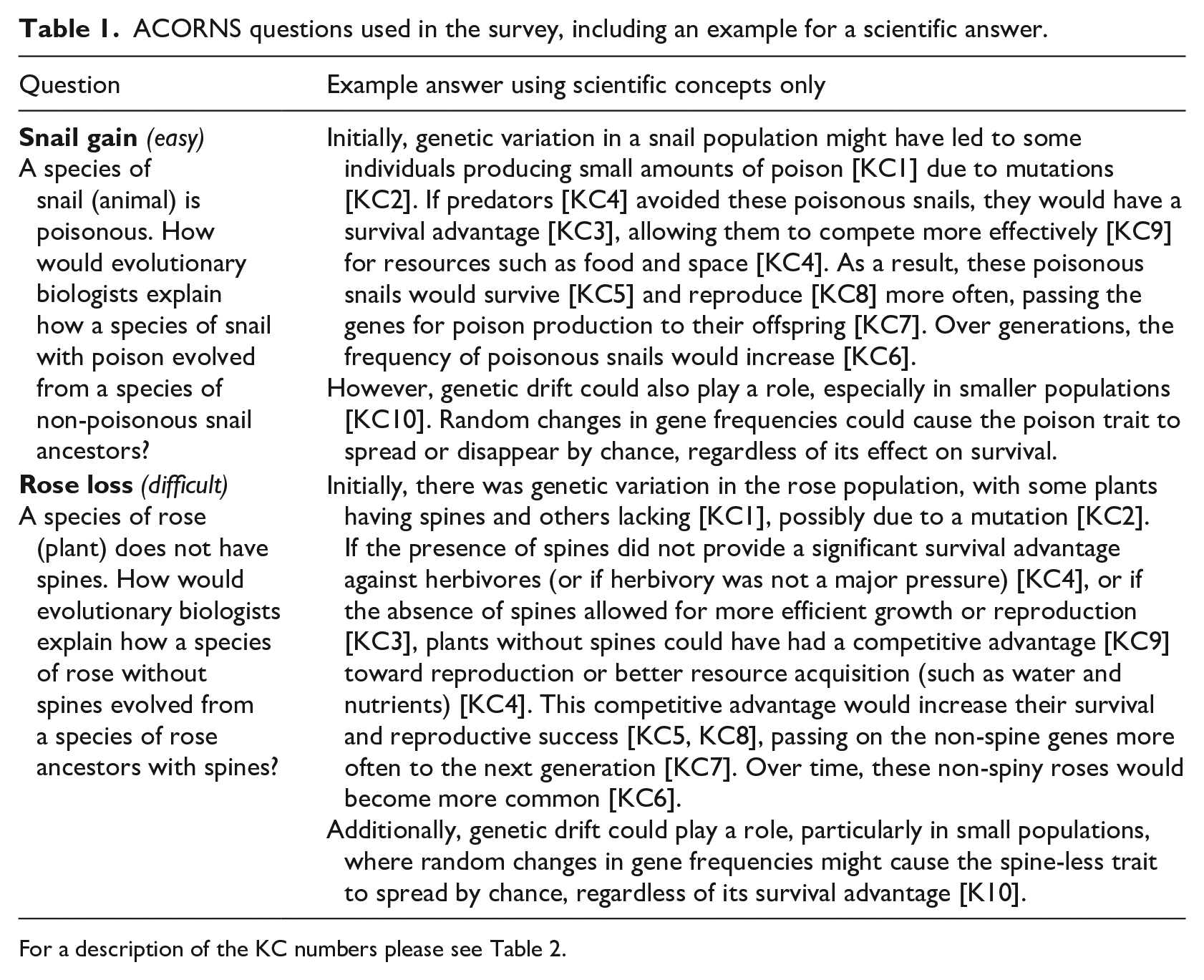
For a description of the KC numbers please see Table 2.
Answers were analyzed by coding the presence (= 1) or absence (= 0) of key concepts (KC) and misconceptions (MC) using an established and refined scoring rubric (Table 2 and SOM A3 for the complete code manual; Fiedler et al., 2017; Nehm et al., 2010). Two researchers independently reviewed 25% of the answers, achieving agreement levels of 75–100% for key concepts and 80–100% for misconceptions (see SOM A4 for concept agreement rates and Cohen’s kappa values). Any disagreements were resolved through discussion.
Description of key concepts and misconceptions coded within this study.
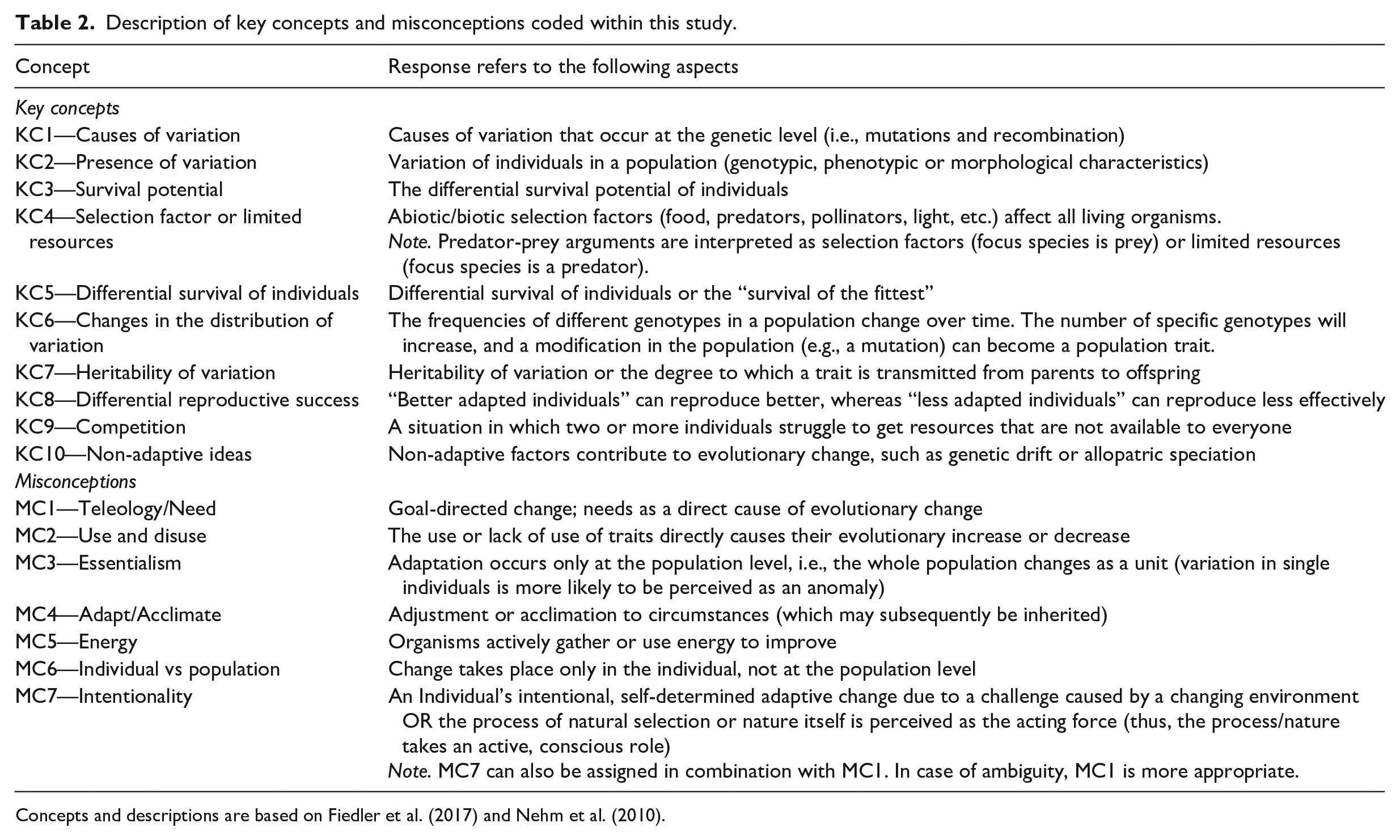
Concepts and descriptions are based on Fiedler et al. (2017) and Nehm et al. (2010).
We then calculated the number of key concepts and misconceptions appearing in the answers for each scenario and across the scenarios to evaluate the frequency and diversity of concepts and misunderstandings used by the NHM visitors. This approach provides valuable insights into participants’ understanding of evolution (Nehm et al., 2010; Opfer et al., 2012).
Sample characteristics
A total of 209 NHM visitors (56.9% female, Mage = 31.9 years) participated in the overall data collection. However, in this article, only those participants who answered both ACORNS items were considered, which resulted in a sample of 122 NHM visitors (53% female, Mage = 31.8 years). Therefore, the response rate of the survey was 58.4%. More than half of these visitors (56%) have graduated from high school. About 20% of the visitors surveyed had a bachelor’s or master’s degree, and almost 5% had a PhD as their highest degree. In relation to religious denominations, 44% of the NHM visitors surveyed did not identify themselves as belonging to any religion, while 27% described themselves as Catholics, 20% as Protestants, and 3% as Muslims. On average, our participants considered themselves rather not religious (M = 1.07, SD = 1.36) based on our 5-point Likert-type-scale question.
Results
All key concepts (KC, range 1–10) were found in our data set (see Figure 1), except for the non-adaptive ideas (KC10) in the rose loss item. On average, respondents used 2.16 (±1.95) key concepts in the snail gain item and 1.24 (±1.27) in the rose loss item. In terms of key concept diversity (KCD), which reflects the range of different key concepts used across both items, the average was 2.57 (±2.16).
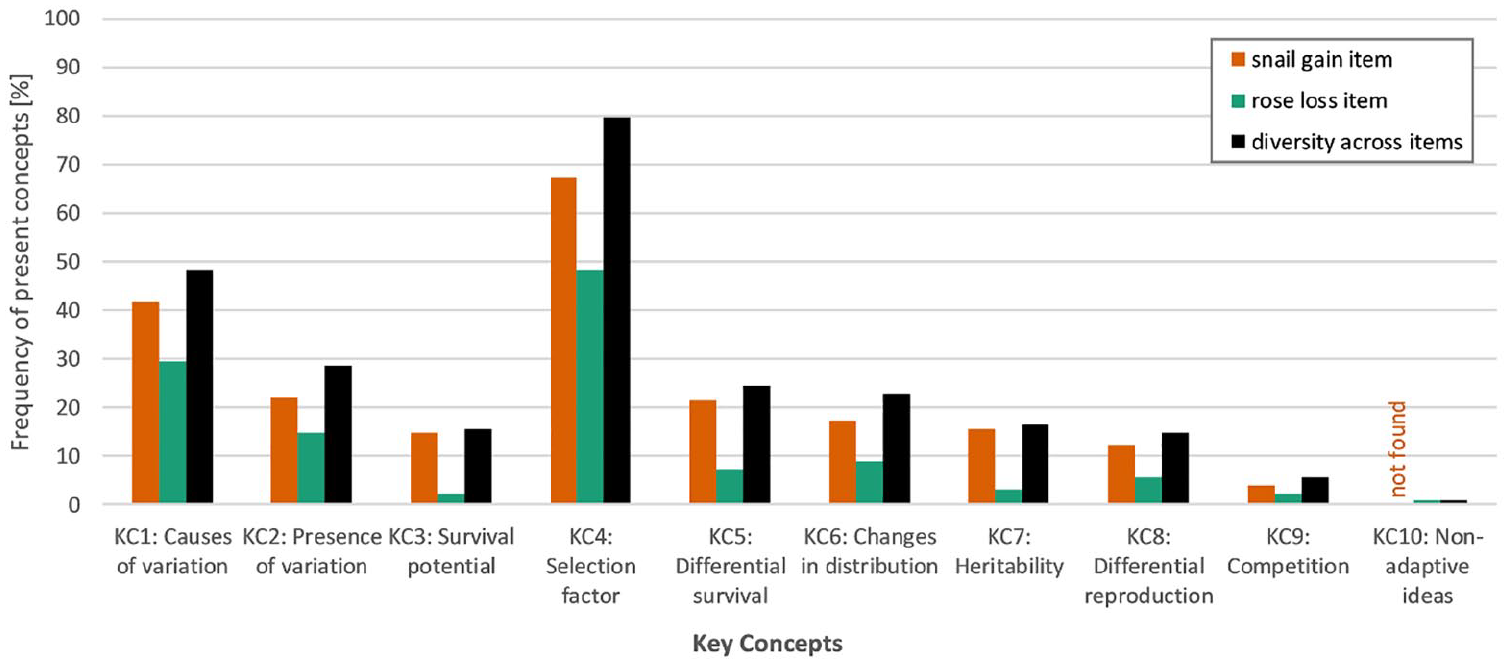
Frequency of individual key concepts mentioned by visitors (n = 122) for the snail gain and rose loss ACORNS scenarios, along with the diversity of concepts used across both items (i.e. the key concept was mentioned at least once in any of the items). Selection factor (KC4) was most frequently mentioned, especially for the snail gain item, while non-adaptive ideas (KC10) were not or only rarely found.
More concepts were mentioned for the snail gain item, with the most frequently mentioned being causes of variation (KC1) and selection factors (KC4), which were referenced by over 40% and 64% of respondents, respectively. Other concepts like the presence of variation (KC2) and differential survival (KC5) were also commonly used, though less frequently.
For the rose loss item, the same key concepts were used but at lower frequencies. The most mentioned were — similar to the snail gain item—related to the concepts’ causes of variation and selection factors, but only around 30% to 48% of visitors referred to these. Several concepts, such as survival potential (KC3), heritability (KC7), and competition (KC9), were rarely mentioned, with mention rates below 10%.
With regard to misconceptions, almost all of them appeared in the explanations, except for the misconceptions of use/disuse (MC2). Overall, participants mentioned an average of 0.87 (±1.05) misconceptions for the snail gain item and 0.86 (±0.93) for the rose loss item (see Figure 2). Across both items, an average of 1.38 (±1.15) different misconceptions was used.
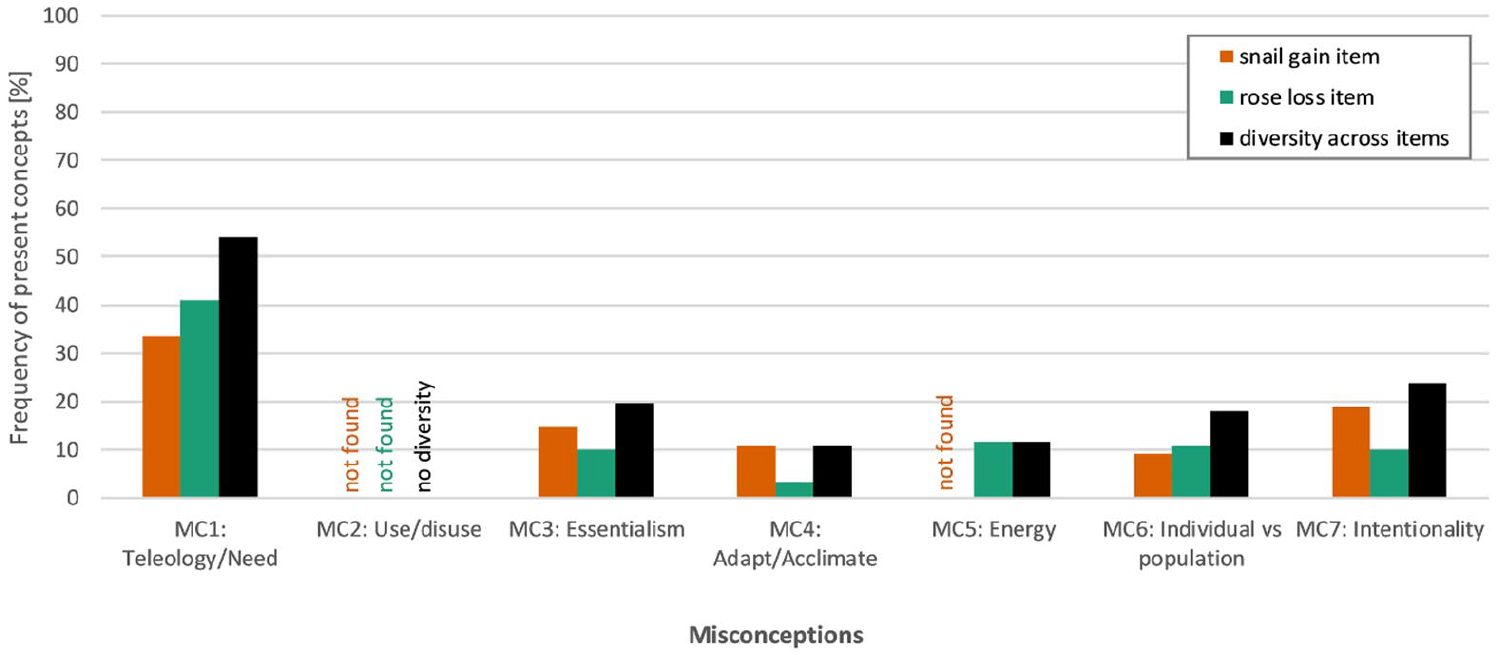
Frequency of individual misconceptions mentioned by visitors (n = 122) in the snail gain and rose loss ACORNS scenarios, along with misconception diversity across both items (i.e. misconception was mentioned at least once in any of the items). The misconceptions “Teleology/Need” and “Intentionality” were most frequently mentioned, while “Use/Disuse” was not found in any answers, and “Energy” was only mentioned in the rose loss item.
The most frequent misconception was teleology (MC1, the idea that evolution has a purpose), which was mentioned by 34% of participants for the snail gain scenario and 41% for the rose loss scenario. Other misconceptions, such as essentialism (MC3, the belief that traits are inherent to a species) and intentionality (MC7, the idea that organisms have specific intentions for change), were mentioned by around 15%–20% of participants. Misconceptions like adapt/acclimate (MC4) and individual vs population (MC6) were less frequent.
For the rose loss item, four misconceptions appeared with a frequency of about 10%, including essentialism and intentionality, as well as individual vs population and energy (KC5).
Discussion
This study aimed to identify which evolutionary key concepts and misconceptions German NHM visitors apply when asked to explain evolutionary scenarios.
Overall, more key concepts were found in the snail gain item than the rose loss item. This finding is consistent with those from other studies (e.g. for German samples: Aptyka et al., 2022, Fiederler et al., 2024; Göransson et al., 2020; Hartelt and Martens, 2024, for US-American samples: Nehm and Ha, 2011; Nehm et al., 2012, 2022). Furthermore, the results indicate that in the context of trait loss, the association of genetic changes with phenotypic changes is more difficult for museum visitors to understand than in the context of trait gain. This is reflected in the low frequency of central concepts such as inheritance or genetic variations. In the school context, it has been shown that concepts related to genetics can be more challenging for learners (Sievers et al., 2022) due to the invisibility of genes and/or the multiple levels of organization required to link genes to phenotypes (Göransson et al., 2020).
Explanations for evolutionary losses were associated with significantly greater numbers of naïve biological elements across all contexts, while explanations for evolutionary gain involved a significantly larger number of key concepts of natural selection. It has been shown that items about feature loss and feature gain produce different types and frequencies of naïve ideas (Harding et al., 2021; Nehm and Ha, 2011; Nehm et al., 2012, 2022). The question of gain loss seems to be conceptually more difficult for museum visitors and students. Studies have also shown that students are often unaware of specific examples of trait loss and, therefore, have misconceptions about it (Harding et al., 2021; Smith, 2017). This could also apply to our museum visitors.
If the misconceptions are considered more closely, it becomes apparent that the misunderstandings of use/disuse (MC2) and energy (MC5) are almost absent in our explanations. This may not be surprising because our featured snail has no poison that could be used directly. Hence, NHM visitors may not have been triggered to use this misconception in their answers. This could probably be different if we had used a feature that can show gradual variation within a population and might be more connected with a “fitness” component such as speed in cheetahs (see also Göransson et al., 2020).
Yet, in line with previous research (e.g. Aptyka et al., 2022; Hartelt and Martens, 2024; Nehm et al., 2012, 2022), we can underline that explanations for evolutionary change are different when focusing on animals or plants. For instance, the intentional misconception (MC7) was more common for the animal (snail) item, while the teleological explanations (MC1) were more common in plants (rose item). Plant evolution seems to be more difficult for museum visitors to understand, perhaps because there are often fewer plants with which they are familiar. However, not all forms of teleological thinking are equally problematic. For instance, the realization that out of necessity an organism needs to change to survive in a particular environment and that this change cannot be achieved intentionally is an important step in a learning progression (Spiegel et al., 2012). The energy misconception (MC5) also occurs primarily in trait loss because the idea that it requires less energy to not develop a trait than to grow one appears intuitive. This is also a typical finding in Nehm and Ha’s (2011) study.
When comparing our general number of key concepts and misconceptions to the findings of other research studies (e.g. for German samples: Aptyka et al., 2022, Fiedler et al., 2024; Göransson et al., 2020; Hartelt and Martens, 2024 for US-American samples: Cofré et al., 2017; Harding et al., 2021; Nehm and Ha, 2011; Nehm et al., 2012, 2022; Opfer et al., 2012), similar key concepts and misconceptions could be identified. Even though museum visitors are suspected to be a relatively highly educated group (Korn, 1995) compared with the general population (i.e. in our case: more than 50% have high school diplomas in contrast to 34% of the total population and around 20% have a university degree in contrast to 19% of the total population based on Statistisches Bundesamt, 2023), our surveyed NHM visitors still seem to have a low understanding of evolution when considering the applied concepts in their explanations. Compared with other studies from Germany, it is apparent that the NHM visitors surveyed, despite having a good school education, tend to give answers that can be compared with high school students–albeit slightly better (e.g. Aptyka et al., 2022, Fiedler et al., 2024; Hartelt and Martens, 2024; Scheuch et al., 2021). Answers from university students, (pre-service) biology teachers, or creationists (e.g. Beniermann et al., 2023, Fiedler et al., 2024; Göransson et al., 2020), however, are more elaborate than those from museum visitors. This could be explained by the fact that these groups have dealt more intensively with the topic of evolution through their studies or their strong interest.
Studies from the United States also indicate higher knowledge in groups of university students, biology teachers, and biologists using similar open-response questions (e.g. Beggrow and Sbeglia, 2019; Nehm and Ha, 2011; Nehm et al., 2012). In general, university students, (pre-service) biology teachers, and biologists have a high school diploma or equivalent and a university degree or are aiming for one. Their choice of course typically also indicates a strong focus on the topic of evolution–or at least should do.
Limitations
Even if the survey was not directly related to the exhibition, it is important to mention that museum visitors have already visited part of the exhibition before participating in the survey. Ideally, they should have been interviewed before the visit. However, this is difficult, as the entrance area is not particularly suitable for interviews and visitors like to go straight into the exhibition once they have arrived before they are willing to take part in interviews. However, we made sure that the content of the exhibition had nothing to do with the questions of the study and that the concepts examined were not addressed in the exhibition. We therefore assume that this does not have a significant influence on the results.
Conclusions and implications
The results presented here and those of other studies (e.g. Evans et al., 2010; MacFadden et al., 2007; Spiegel et al., 2012) indicate that most adults beyond high school age have difficulty understanding the mechanisms of evolution. Therefore, research should go beyond merely documenting that evolution is difficult to understand; it must examine the obstacles that stand in the way of understanding (MacFadden et al., 2007). This should be addressed in further research studies. For example, museum visitors could be interviewed after encountering evolution exhibits. In addition, focus group discussions before and after the museum visit may reveal what visitors need to better understand the topic of evolution or its mechanisms of evolution better. It would also be conceivable to accompany museum visitors during their visit and encourage them to think out loud to find out more about the barriers and challenges in understanding evolution.
Spiegel et al. (2012) showed how a single visit to an interactive exhibition on evolution can have a positive effect on museum visitors’ understanding of evolution–even if the effects are only gradual changes. In doing so, they also emphasize how beneficial it can be when exhibitions are based on current research on evolution (Evans et al., 2010; Spiegel et al., 2012). Through museum visits and NHM’s online presence, museum visitors can learn about science on evolution in a way that is rarely possible otherwise: visitors can meet scientists, explore exhibitions on entire themes, engage with interactive displays, and use digital technologies (Mujtaba et al., 2018).
To support museum visitors’ understanding of evolution, it is worth taking a look at studies conducted in school context. It has been shown here that non-traditional, student-centered teaching can improve knowledge about evolution (Cofré et al., 2018; Glaze and Goldston, 2015). Learning in a research-based paleoanthropology laboratory in a study by Bayer and Luberda (2016) was able to increase knowledge of human evolution in high school students. Such aspects should be considered when designing exhibitions (e.g. establishing paleontological laboratories in the exhibitions) and especially when developing visitor-centered educational programs in NHMs. The impact of such approaches should also be evaluated.
In line with Gay (2012) and Spiegel et al. (2012), we also suggest that exhibition and educational programs (e.g. guided tours) should be developed in the future that link better to visitors’ prior knowledge and interest (Moormann et al., 2024). The key concepts and misconceptions identified in this study might help develop future museum exhibitions on evolution and museum educational programs or activities. The specimens and information in the NHM exhibition should address key concepts that visitors are familiar with more explicitly and also clearly introduce new ones (not only within a long text). In addition, the wording could also be used in the exhibition texts that explicitly counteracts misconceptions, such as by referring to a typical naïve idea and providing the actual scientific explanation. Conversations in guided tours or educational programs between museum educators and visitors about exhibits on display offer great potential for stimulating interactions about evolution compared with simply engaging with static exhibits, which also carry a greater risk of conflict and misunderstanding (Gay, 2012). Ideally, investigations on the effectiveness of museums as sites of learning about evolution should integrate established principles of developmental and cognitive psychology with the experimental capabilities that a museum offers. Indeed, effective communication of evolution to the public can only be achieved if museums pursue a research program that adequately informs them about how their educational interventions influence visitors’ thinking (Diamond and Evans, 2007). Hence, NHMs should develop appropriate research-based approaches to foster their educators’ skills, knowledge, and confidence. Museum guides need to be well trained to communicate correctly about evolution in dialogues with NHM visitors. For instance, the NHM in London (UK) offers their museum guides one-day training courses. It is also advantageous that museum educators know about any misconceptions and key concepts to address them directly (Gay, 2012). In this context, it would be interesting to survey museum educators to find out whether they are aware of certain misconceptions and/or hold similar ones themselves. Either way, it would be interesting and important to continue research in both directions, looking not only at visitors, but also at the guides as avenues to support learning about evolution at NHMs.
Supplemental Material
sj-docx-1-pus-10.1177_09636625251355890 – Supplemental material for Natural history museum visitors’ use of key concepts and misconceptions in written explanations of evolutionary scenarios
Supplemental material, sj-docx-1-pus-10.1177_09636625251355890 for Natural history museum visitors’ use of key concepts and misconceptions in written explanations of evolutionary scenarios by Alexandra Moormann, Anna Beniermann and Daniela Fiedler in Public Understanding of Science
Footnotes
Acknowledgements
We thank all the participating visitors for spending their time with us during their museum visits. Thank you also to our student assistants for their help in data collection. A special thanks to our colleague for her critical reading and language corrections.
Ethics approval and consent to participate
The current study followed the American Psychological Association’s (APA) Ethical Principles of Psychologists and Code of Conduct. By participating in this survey, museum visitors consented to publish their de-identified data. Because the present study was part of a larger project, the entire research plan, procedure, and instruments were reviewed and approved by the Ethical Committee of the IPN—Leibniz Institute for Science and Mathematics Education, Kiel, Germany.
Funding
The author(s) received no financial support for the research, authorship, and/or publication of this article.

Data availability statement
Relevant data (in an aggregated form) are available upon request to the corresponding author.
Supplemental material
Supplemental material for this article is available online.
Notes
Author biographies
References
Supplementary Material
Please find the following supplemental material available below.
For Open Access articles published under a Creative Commons License, all supplemental material carries the same license as the article it is associated with.
For non-Open Access articles published, all supplemental material carries a non-exclusive license, and permission requests for re-use of supplemental material or any part of supplemental material shall be sent directly to the copyright owner as specified in the copyright notice associated with the article.
