




Abstract
Intermediaries such as (digital) media use trust cues in their content, that is, information and linguistic markers that present public audiences reasons for trusting scientists, scientific organizations, and the science system. Trust cues refer to dimensions of trust in science such as expertise, integrity, benevolence, transparency, and dialogue. Because digital media environments are expected to be heterogeneous in content, the sources of trust cues, characteristics of objects of trust in science (e.g. the gender of scientists), and their impact on public trust in science may vary. In our quantitative content analysis, we identified trust cues across several sources of scientific information (n = 906) and examined their heterogeneity in digital media environments. Our results reveal journalism as the most important source for trust cues and that scientists are the most prevalent object of trust—with female scientists being underrepresented. Differences across (digital) media imply varying impacts on public trust in science.
Keywords
Scientific information, applied when using technology, making medical decisions, and considering ecological trends (e.g. Hendriks et al., 2015), is important in people’s everyday decision-making. Because publics are somewhat dependent on science and scientific information, their trust in science is among the most important variables to engage with such information (e.g. Plohl and Musil, 2021; Saffran et al., 2020). Today, most people get in contact with science and receive scientific information through (digital) media (e.g. European Commission, 2021; Wissenschaft im Dialog, 2023), including in Germany, where nearly the entire population uses the Internet (e.g. ARD/ZDF–Forschungskommission, 2023), and online media is an important source of scientific information (e.g. Wissenschaft im Dialog, 2023). Given those trends, (digital) media are intermediaries of trust in science, and in that role, they mediate trust via trust cues. When it comes to science, trust cues are information, language, and linguistic markers used in content that provide public audiences, as subjects of trust, reasons to trust in science (e.g. Schröder et al., 2025). They enable public audiences to evaluate whether they should trust scientists, scientific organizations, and the science system as objects of trust. Because media content can indeed evoke trust in science (Guenther et al., 2024), in this article we use the term trust cues as shorthand for trust-evoking cues. 1
At a time when scholars are discussing and fearing a decline in public trust in science (e.g. Kennedy and Tyson, 2023) and when findings of media’s effects on trust in science remain mixed (see also Guenther et al., 2024), 2 it seems beneficial for researchers to focus on specific aspects of media content—for instance, the trust cues used. Although scholars have yet to focus on such cues, studies on audiences have provided hints of their effectiveness. For example, research has shown that communicating open science practices, which are directly linked to transparency, positively affects trust in science (e.g. Rosman et al., 2022; Song et al., 2022) and that assessments of trust improve when scientists correct themselves and communicate uncertainty (e.g. Altenmüller et al., 2021; Ratcliff and Wicke, 2023). Because those insights suggest that trust cues can indeed evoke trust in science, the intermediaries of such trust deserve a closer look.
Intermediaries of trust especially warrant attention in digital media environments, where a heterogeneity of actors and content means that diverse interests can access diverse audiences (e.g. Brossard and Scheufele, 2022; Huber et al., 2019; Schäfer, 2016). In digital media environments, not only professional journalists but also non-journalistic actors communicate about scientific issues and therefore become relevant sources of content about science (e.g. Taddicken and Krämer, 2021; Weingart, 2017). For the same reason, audiences face the risk of receiving misleading or false information, particularly in populist, non-mainstream media (e.g. Frischlich et al., 2022) and social media (e.g. Jennings et al., 2021; Xiao et al., 2021) compared with journalistic media. For that reason, digital media environments have been serving as an explanation for declining public trust in science (e.g., Weingart and Guenther, 2016). That means that when analyzing trust cues in content about science, differentiating professional journalistic, populist/non-mainstream, social, and other Internet-based media (e.g. blogs) is crucial to capturing the heterogeneity of actors and content in digital media environments.
The same heterogeneity also affects objects of trust, especially scientists and their representation in terms of gender. To date, research has generated mixed findings concerning scientists’ gender and trust in science. For instance, some studies have demonstrated that trust assessments indicating expertise are associated with male scientists due to stereotypes, whereas others have revealed that participants tend to have higher trust in female than in male scientists (e.g. Hubner and Bullock, 2024). Owing to those discrepancies, the gender of scientists should be included in analyses of trust cues, for it can afford additional insights into how objects of trust are represented.
Altogether, investigating how trust cues in scientific content vary across different (digital) media (i.e. journalistic, populist, social, and other Internet-based media) and based on scientists’ gender, can clarify how those factors may affect public trust in science. A deeper, more detailed analysis of media content could also illuminate recent developments regarding public trust in science. In those ways, such research can form a foundation for further analyses of media’s effects on trust in science and elucidate the trust relationship between science and digitized publics. Thus, in our study, we asked the following overarching research question: How does the use of trust cues in content about science vary across different (digital) media and genders of the scientists represented?
1. Theoretical background
Trust is a multifaceted concept that has been examined in various fields of study and thus has numerous definitions. In this article, we view trust from a sociological-theoretical perspective within communications research (e.g. Reif and Guenther, 2022; Schröder et al., 2025), which characterizes trust as a mechanism for reducing complexity (e.g. Kohring, 2016; Luhmann, 2014). For instance, when a subject of trust has trust in an object of trust, it means that the subject has confidence in the object to achieve future tasks and/or expectations and, in turn, is willing to risk the possibility that such tasks and/or expectations might not be achieved (e.g. Giddens, 1990; Kohring, 2016). In that way, the subject makes itself vulnerable (e.g. Goldenberg, 2023; Mayer et al., 1995; Reif and Guenther, 2022; Resnick et al., 2015). However, trust is crucial for dealing with complexities in modern societies (e.g. Luhmann, 2014). In the context of our research, focused on public trust in science, an especially valuable concept is epistemic trust, which means depending on science as a producer of reliable knowledge, both its inherent validity and its perception as a secure, dependable source of information (e.g. Origgi, 2012; Sperber et al., 2010).
Trust cues in content about science
Bentele’s (1994) theory of public trust, which recognizes media’s role in the trust relationship between science and its publics, 3 suggests that public trust has emerged as a distinct form of trust within the public sector. According to the theory, trust in individuals, organizations, and systems is influenced by information conveyed through media, including facts, events, and messages (e.g. Bentele, 1994; Reif, 2021). Our conceptualization of trust cues aligns with Bentele’s theory of public trust (1994) insofar as it focuses on media content (for an overview, see Schröder et al., 2025) and emphasizes the importance of content about science. By extension, trust cues are conceived as influential linguistic components in content about science that present public audiences with reasons to trust in science, specifically by addressing established dimensions of trust in science. Thus, trust cues are an operationalization of those dimensions. 4
When it comes to trust in science, multiple dimensions have been distinguished, including the well-established dimensions of expertise, integrity, and benevolence (e.g. Hendriks et al., 2015, 2016; Mayer et al., 1995). Albeit initially developed for science at the micro (e.g. Hendriks et al., 2015) and meso levels (Mayer et al., 1995), their applicability at the macro level has also been conceptualized (e.g. Reif and Guenther, 2022) as well as empirically tested and validated (Reif et al., 2024). Moreover, in recent research, new dimensions have been suggested, including openness (e.g. Besley et al., 2020) and, considering the reciprocal concept of dialogue behind public engagement with science, transparency and dialogue (e.g. Reif and Guenther, 2022). Indeed, Schröder et al. (2025) included transparency and dialogue, which can also be applied at all three levels, in developing the concept of the trust cues. Because all dimensions of trust in science can be referred to by trust cues, we refer to them as expertise, integrity, benevolence, transparency, and dialogue cues, respectively. For each dimension, respective trust cues were identified by Schröder et al. (2025) in a qualitative pilot study with a diverse media sample. The result of this study was a list of 35 trust cues identified, with definitions and examples.
In this regard, expertise illustrates science’s capacity to identify, evaluate, and target problems by using specialized knowledge acquired through education, experience, and qualifications (in the respective fields of research). Thus, expertise cues refer to mentions of the academic education, professional experience, and qualifications possessed by a scientific object of trust, including their academic degree(s), organizational affiliation, and/or their reputation (e.g. Hijmans et al., 2003; for all definitions see also Reif et al., 2024). Integrity means the assurance of objectivity, validity, and reliability achieved by adhering to scientific standards and processes. As such, integrity cues refer to mentions of independence (e.g. funding sources), assurances of scientific quality (e.g. uncertainties in research and peer review), and references to scientific standards and processes in general (see also Guenther et al., 2019). The dimension of benevolence refers to science’s orientation toward ethical norms and moral values as well as awareness of its responsibility to society (see also Hendriks et al., 2015). In that regard, benevolence cues address ethical norms, social responsibilities (e.g. in researchers’ communication of research-related risks or their assessment of public events and current affairs), and benefits for society that science might provide (e.g. science-based recommendations). Transparency refers to the expectation that scientific actors should make research and related scientific information publicly accessible; by extension, transparency cues refer, for example, to comprehensible language that also includes technical terminology and the accessible presentation of research results (e.g. Reich, 2011; Reif, 2021). Concerning the dimension of transparency, it is important for science to be transparent regarding its research and not necessarily for a piece of science-related information to be communicated transparently. For example, if journalists mention a research project’s funding source, this information is communicated transparently (by journalists, not by scientific actors) but does not allow public audiences to evaluate science itself being transparent but rather to evaluate its independence. Dialogue refers to science that participates in and enables interaction with public audiences (e.g. Reif et al., 2024). Thus, dialogue cues mean the participation of scientific objects of trust in public events, their journalistic media presence and direct media presence (e.g. use of social media), and their public engagement in research. Dialogue presupposes a certain form of reciprocity (i.e. questions can be asked, and interaction can occur). Such reciprocity distinguishes dialogue from transparency, which refers to science being transparent but without considering interactions.
Taken together, all dimensions can be addressed by actors at the macro, meso, and micro levels (e.g. Reif and Guenther, 2022; Schröder et al., 2025). In our study, we investigated the extent to which trust cues can be identified at each level. Apart from our study, few content analyses have (indirectly) considered those five dimensions of trust in science or analyzed linguistic markers that can be interpreted as trust cues (e.g. Welzenbach-Vogel et al., 2021; for an overview see Schröder et al., 2025). Table 2 presents an overview of all trust cues that we examined, their respective superordinate categories, and the dimensions of trust in science that they refer to (see also Schröder et al., 2025). These trust cues have not been quantified yet to examine their prevalence across (digital) media.
Heterogeneity in (digital) scientific content
With the Internet and digitalization, a wide range of communicators have gained access to (digital) public spheres that allow them to bypass journalistic selection criteria (e.g. Pavlik, 2000). Consequently, a variety of actors can now express themselves online and thereby reach public audiences (e.g. Brossard, 2013; Schäfer, 2016; Schröder and Guenther, 2024; Taddicken and Krämer, 2021). For that reason, digital media can facilitate greater heterogeneity in content, the sources of trust cues, and objects of trust in science.
In this article, heterogeneity in terms of content is defined from the perspective of trust as a multidimensional concept, such that scientific content can refer to expertise, integrity, benevolence, transparency, and dialogue expressed via a range of trust cues. Aside from journalists, various science communicators have emerged online to address scientific topics using multiple sources with diverse interests. In social and other Internet-based media, science public relations professionals, political and governmental actors, bloggers, and other communicators with broad influence online—for instance, influencers—may discuss such topics. In populist media, by contrast, alternative experts and state propaganda may emerge (e.g. Weingart, 2017), and online sources may thus share misleading and/or false information, as seems to be more prevalent in populist, non-mainstream media (e.g. Frischlich et al., 2022; Taddicken and Krämer, 2021) and on social media (e.g. Jennings et al., 2021; Xiao et al., 2021) than in journalistic media. Last, heterogeneity in objects of trust in science encompasses science performed at multiple levels, including scientists (i.e. micro level), scientific organizations (i.e. meso level), and the science system (i.e. macro level). Recognizing the heterogeneity of (digital) media environments and the complexity of trust, in our first research question (RQ1) we asked: How does the use of trust cues differ across (digital) media with respect to (a) the dimensions of trust in science, (b) science as the object of trust at different levels (i.e. micro, meso, and macro), and (c) their sources?
Scientists play an especially important role in journalistic media because journalists, in their coverage of science, typically search a human angle, which is also a news factor in science journalism (e.g. Amend and Secko, 2012; Guenther, 2019). In light of that trend, scientific actors at the micro level may also be important in other types of media. Concerning how scientists are represented, previous research has revealed that female and male scientists are not equally represented in science media coverage (e.g. Fletcher et al., 2021; Kitzinger et al., 2008; Mitchell and McKinnon, 2019; Niemi and Pitkänen, 2017), in terms of not only frequency (e.g. citations and voices heard) but also certain characteristics (e.g. stereotypes; Chimba and Kitzinger, 2009; GMMP, 2020; Joubert et al., 2022; Kitzinger et al., 2008; Mitchell and McKinnon, 2019). That imbalance is negative in critical ways. After all, although women contribute significantly to scientific progress and gender diversity is supposed to drive innovation (e.g. Hofstra et al., 2020), 5 female scientists are significantly underrepresented compared with their male counterparts in the coverage of science (e.g. GMMP, 2020) in various types of media (Kitzinger et al., 2008). In the context of trust in science, initial research has revealed qualitative similarities and differences between female and male scientists. For instance, when describing a scientist’s expertise, their qualifications were in the spotlight regardless of their gender. However, the personal biographies detailing scientists’ motivations in their work were provided only for female scientists, whereas scientific advice conveying their benevolence toward society was provided only for male scientists (Schröder, 2025). On that basis, quantitative gender differences in the context of public trust in science can be assumed.
Differences in gender representations are also tied to journalists’ selection of sources and framing processes (e.g. Niemi and Pitkänen, 2017) as well as to their own gender. Gender aside, journalists covering science predominantly cite male scientists while limiting their references to female scientists (e.g. GMMP, 2020; Kitzinger et al., 2008); however, female journalists choose sources who are women significantly more often than male journalists do (GMMP, 2020). Thus, taking journalists’ gender into account might provide additional insights into how it impacts the representation of gender in science coverage.
Considering all of the above, in our study we hypothesized that gender accounts for the heterogeneity of scientific objects of trust in science as well as in selecting sources of science coverage, which seems important for analyzing trust in science. For additional insights into that issue, in RQ2 we asked: How does the gender of the object of trust in science at the micro level relate to (a) the dimensions of trust in science, (b) the trust cues represented, (c) the sources of trust cues, and (d) the gender of the source?
2. Methodology
To answer the RQs, we conducted a quantitative content analysis of a sample of content from (digital) media sources most frequently used by public audiences in Germany to gain information about science (e.g. European Commission, 2021; Wissenschaft im Dialog, 2023).
Sample selection
We considered the heterogeneity of (digital) media environments and sought a sample encompassing outlets and accounts typically accessed by German publics when using media to acquire scientific information (e.g. European Commission, 2021). Next, we constructed four groups for comparison: (1) professional journalistic (i.e. print and online) media, including diverse outlets and formats that nevertheless all follow the same professional logic; (2) right-wing populist, non-mainstream media, which depart from journalism’s logic and are more likely to contain misleading and/or false information (e.g. Frischlich et al., 2022); (3) social media, for the purpose of better comparability, all with a reference to scientific accounts or contents; and (4) other Internet-based media (i.e. blogs and news aggregators), given their dissimilarity to the other groups. Table 1 provides an overview of the sample.
Sample overview.
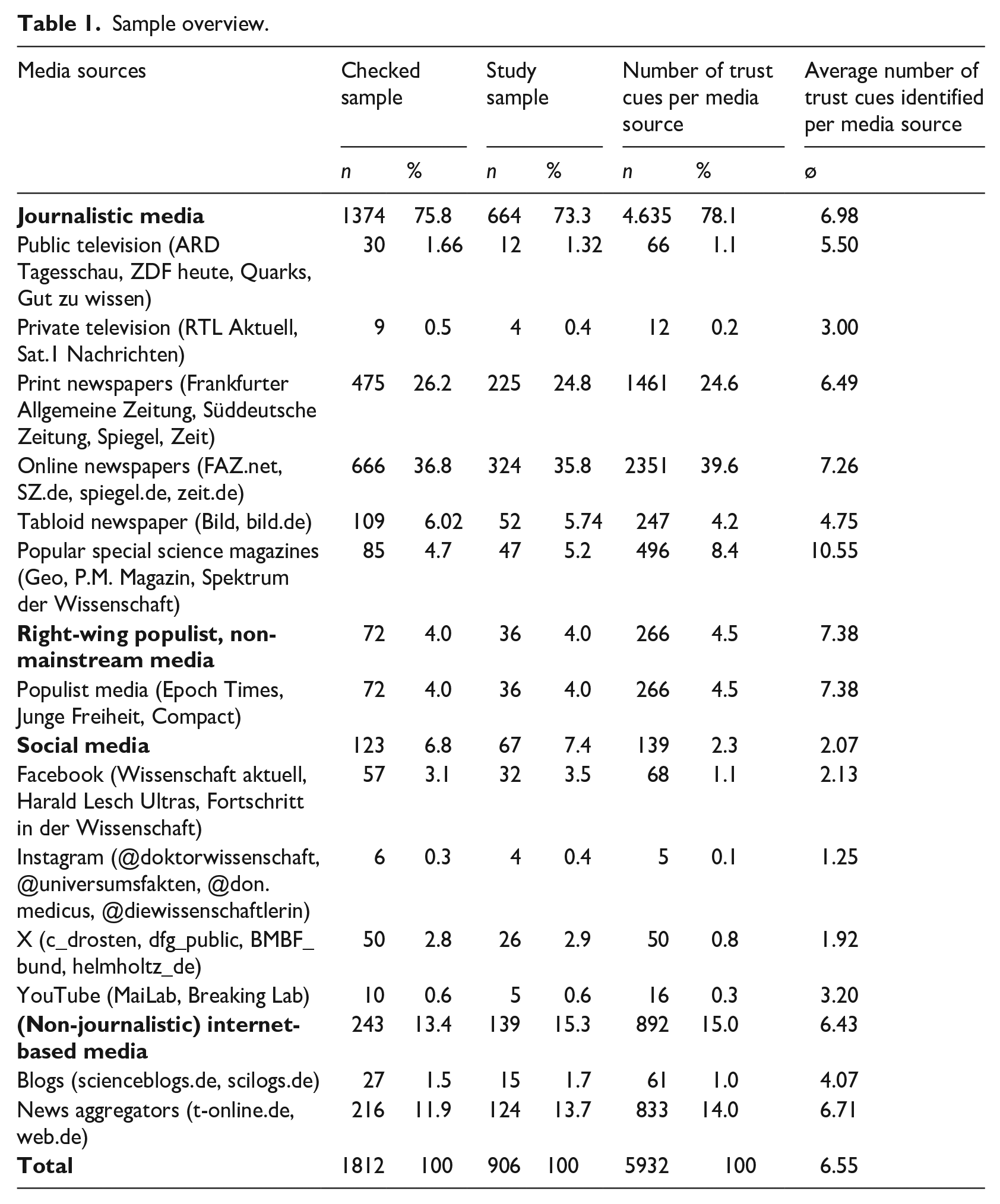
Media content was collected for a full year, in seven constructed weeks from March 2022 to March 2023. Given the extensive array of media sources involved, we relied on multiple databases and methods for sample generation. 6 When possible, established search strings were used for the selection (Guenther et al., 2019; Schröder et al., 2025); 7 in cases that precluded using those search strings, we collected the content manually. The material was checked if it contained (1) an object of trust connected to science and (2) trust cues, and in total, n = 1812 were considered to be relevant. On that basis, we constructed a representative, randomized sample with half of those relevant pieces (n = 906).
Quantitative content analysis
In our quantitative content analysis, we followed a deductive approach with the help of a standardized codebook (see Document S1 in the Supplemental Material) developed based on inductive, qualitative content analysis in a previous study (Schröder et al., 2025). The codebook contains the 35 trust cues shown in Table 2. Because we wanted to compare various types of media, we focused exclusively on text and thus coded articles (i.e. print and online media), transcripts of videos (i.e. from TV and YouTube), and texts of individual posts (i.e. from social media). This poses a limitation that we will discuss later.
Overview of trust cues, superordinate categories, and dimensions of trust in science.
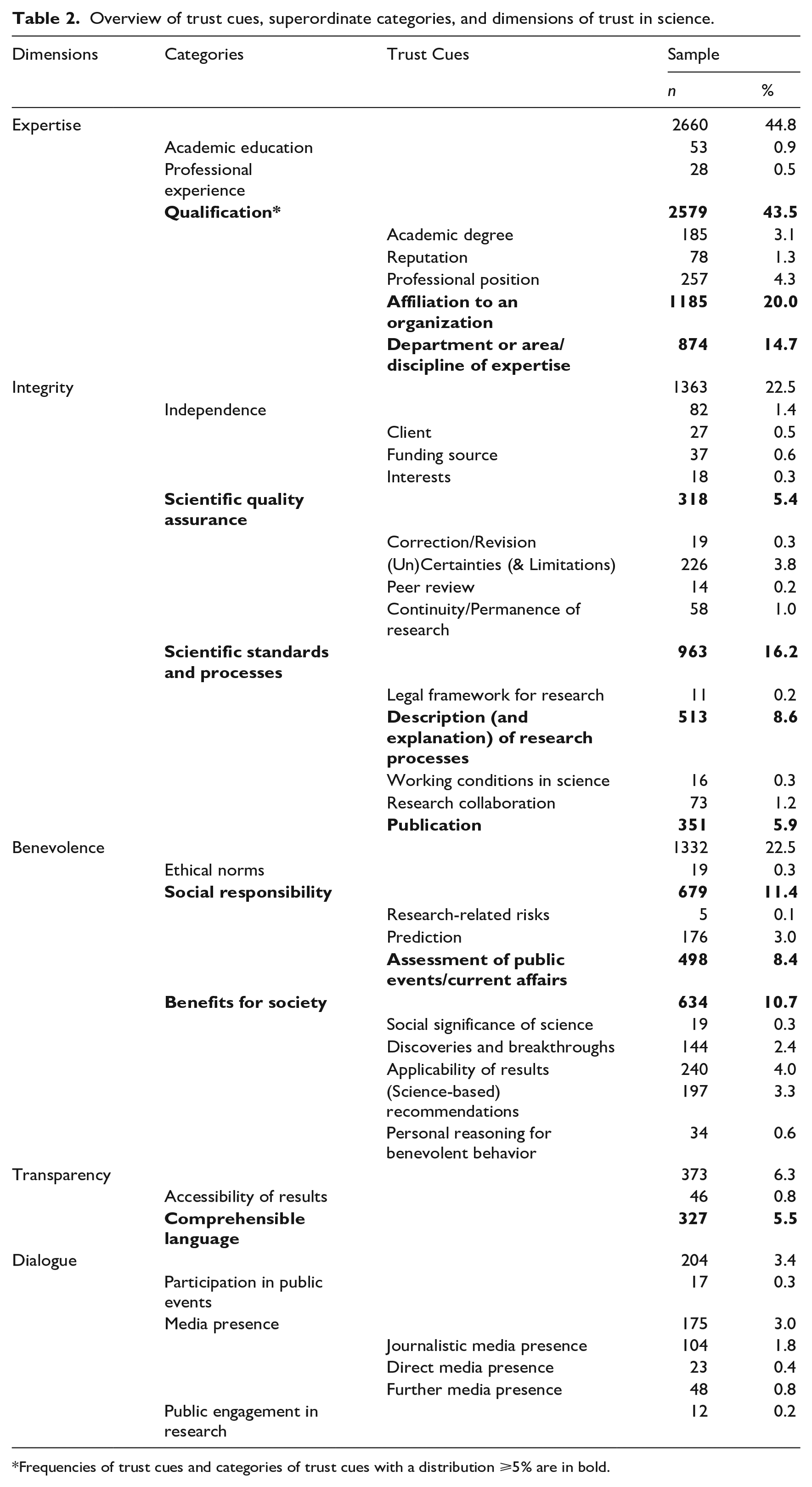
Frequencies of trust cues and categories of trust cues with a distribution ⩾5% are in bold.
Four coders were trained and performed all coding, 8 which considered three formal criteria—media source (α = .99, CR = .99), media type (α = .99, CR = 1), and type of author (α = .80, CR = .91)—and four content-related criteria for each trust cue: 9 the source providing the respective trust cue (e.g. journalists, scientists, or social media users; α = .76, CR = .85), the source’s gender (α = .83, CR = .89), the level of each object of trust (i.e. micro, meso, or macro; α = .74, CR = .93), and the gender of micro-level objects of trust (α = .88, CR = .92).
To answer RQ1, we used descriptive statistics and chi-square tests. For RQ2, by contrast, we considered only micro-level codes that were clearly connected to female and male scientists (e.g. name mentioned or pronoun used). The categories “female,” “male,” and “other” were considered during the codebook’s development and the coding process; however, no coding for “other” was performed.
3. Results
Frequencies of trust cues (RQ1)
In total, we coded n = 5932 trust cues. Most trust cues were identified in journalistic media, followed by Internet-based media, populist media, and social media, and the cues most often referred to the dimension of expertise, followed by integrity, benevolence, transparency, and dialogue. Regarding the number of trust cues in relation to the amount of content from each type of media source, articles contained most trust cues in populist media, followed by journalistic media, further Internet-based media, and social media. However, a closer look revealed tremendous differences within the category of journalistic media; most trust cues were found in science magazines, followed by online and printed newspapers, public TV, and, trailing far behind, tabloid newspapers and private TV (see Table 1). The most common category of trust cues referred to qualification (i.e. dimension of expertise) and most often referred to the department or area of expertise and affiliation to an organization. Other categories of trust cues frequently referred to represented benevolence (i.e. social responsibility and benefits for society), integrity (i.e. scientific quality assurance and scientific standards and processes), and transparency (i.e. comprehensible language), as shown in Table 2.
Dimensions of trust in science (RQ1a)
The trust cues differed significantly across media types, χ2(12, n = 5932) = 83.361, p < .001, V = .068. In journalistic media, most trust cues found referred to expertise, followed by integrity, benevolence, transparency, and dialogue. This order is also true for social media, but with a higher frequency of integrity and benevolence cues, whereas transparency and dialogue cues appeared less often. Meanwhile, although expertise cues were also the most frequent in populist media, benevolence cues were the second-most common, followed by integrity cues and, further behind, dialogue and transparency cues. That order described further Internet-based media as well, in which benevolence cues were also the second-most frequent (see Table 3).
Frequencies of trust cues across (digital) media referring to dimensions of trust in science, different levels, and sources.
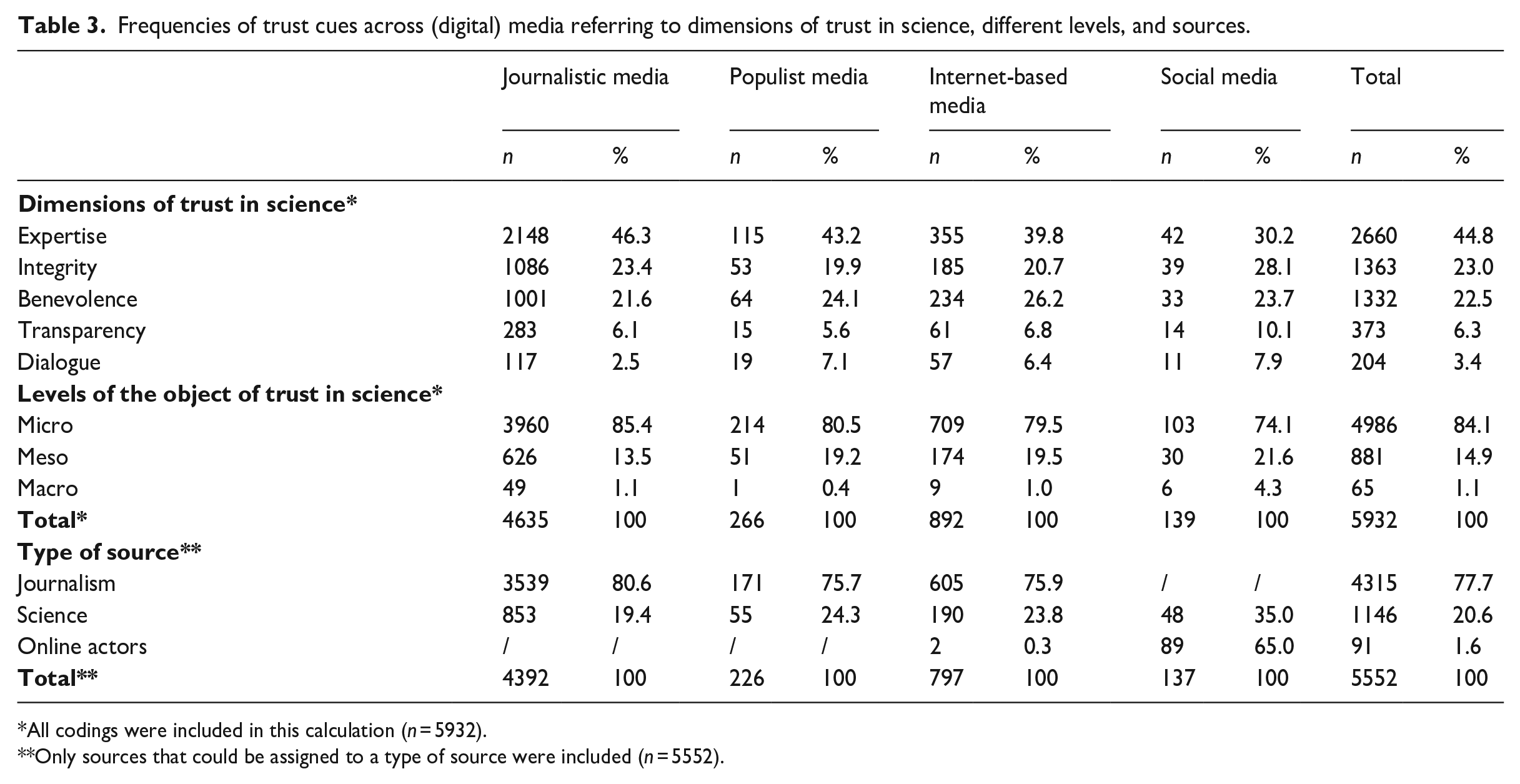
All codings were included in this calculation (n = 5932).**Only sources that could be assigned to a type of source were included (n = 5552).
Levels (RQ1b)
Significant differences additionally emerged between the use of trust cues connected to scientists (i.e. micro level), scientific organizations (i.e. meso level), 10 and the science system (i.e. macro level) across different (digital) media, χ2(6, n = 5932) = 46.113, p < .001, V = .062. Overall, trust cues mostly referred to science at the micro level, followed by science at the meso level and science at the macro level, meaning that the science system was rarely addressed. At the same time, proportionally more trust cues referred to the macro and the meso levels on social media despite occurring in very few cases (see Table 3). Micro-level objects occurred with the greatest frequency in journalistic media.
In general, although each dimension of trust was identified at all levels, not all trust cues were found at each level. At the macro level, trust cues referring to academic education and professional experience (i.e. expertise), participation in public events and media presence (i.e. dialogue), and the accessibility of results (i.e. transparency) were not identified. At the meso level, only trust cues referring to academic education (i.e. expertise) were absent, whereas all trust cues were identified at the micro level.
Sources of trust cues (RQ1c)
The sources of trust cues, namely journalism (e.g. journalists and news agencies), science (e.g. scientists and scientific organizations), and online actors, 11 differed across the media types, χ2(6, n = 5552) = 3570.726, p < .001, V = .567. Because journalistic content was the most prevalent type of media in the sample, journalism was unsurprisingly also the chief source of trust cues, followed by science and online actors. That ranking also held true when examining journalistic, populist, and other Internet-based media separately. On social media, online actors were the most common sources of trust cues, followed by science (see Table 3), and proportionally the greatest prevalence of trust cues from science was found on social media, followed by populist media. However, in absolute terms, science as a source was most common in journalism, thereby implying that source heterogeneity varied across (digital) media and, consequently, that trust cues may be used differently depending on the source of trust cues.
Gender of objects of trust (RQ2)
To answer RQ2, we considered only micro-level codings, 26% of which were for female scientists (n = 950) and 74% of which were for male scientists (n = 2684).
Dimensions of trust in science (RQ2a)
No significant difference emerged between the dimensions of trust in science addressed and the gender of the object of trust (see Table 4). That is, the most frequently addressed dimensions were the same for both genders: expertise, followed by benevolence, integrity, dialogue, and transparency.
Frequencies of dimensions of trust in science, categories and trust cues, sources of trust cues, and gender of the sources.
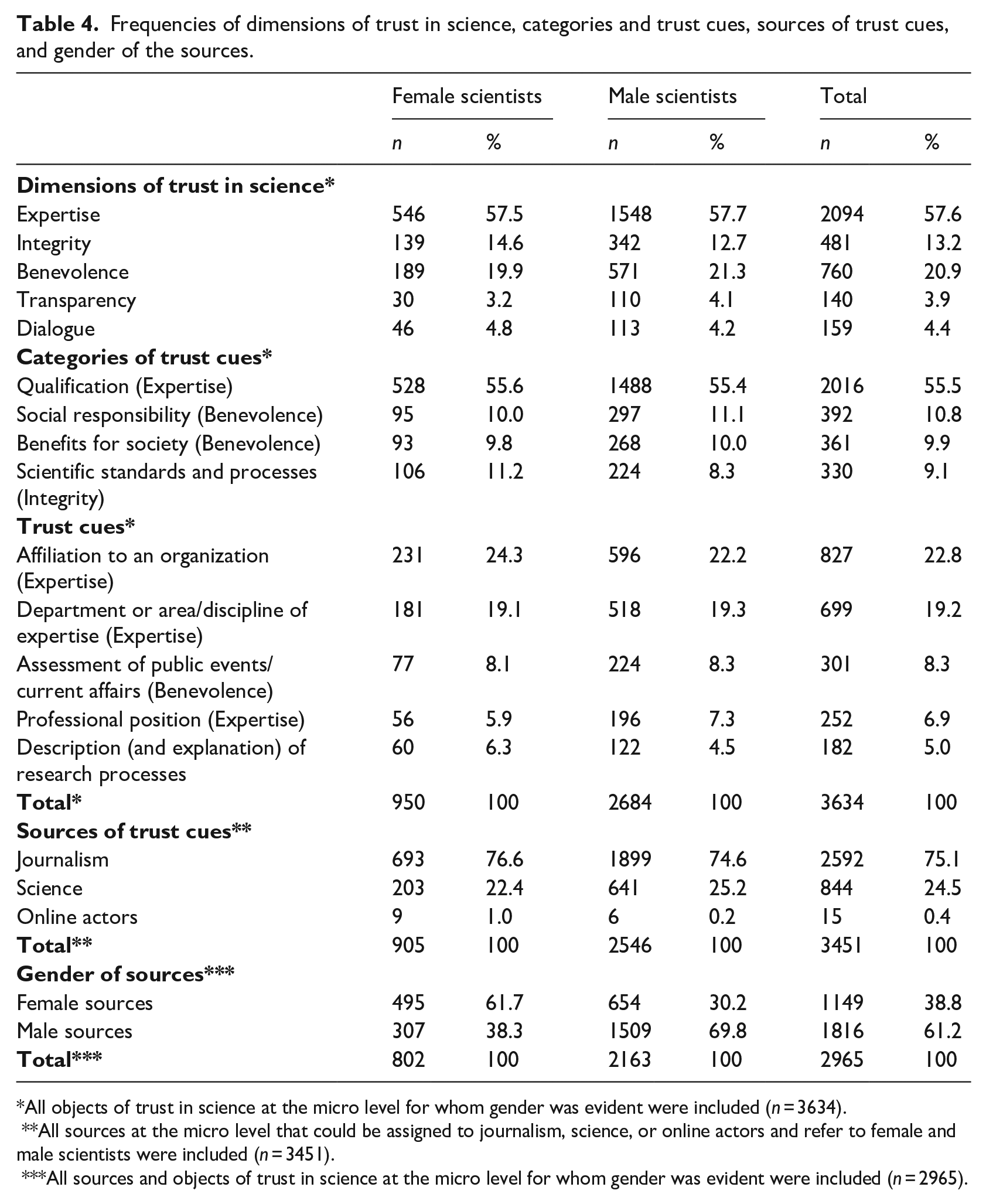
All objects of trust in science at the micro level for whom gender was evident were included (n = 3634). **All sources at the micro level that could be assigned to journalism, science, or online actors and refer to female and male scientists were included (n = 3451). ***All sources and objects of trust in science at the micro level for whom gender was evident were included (n = 2965).
Trust cues (RQ2b)
Regarding trust cues and their superordinate categories, no significant gender differences were identified, meaning that female and male scientists were generally referred to in similar ways. Even so, examining the general distribution of trust cues could yield additional insights.
Overall, of all categories, 12 the following were most frequently mentioned for scientists: qualifications (i.e. expertise), social responsibility and benefits for society (i.e. benevolence), and scientific standards and processes (i.e. integrity).
Concerning trust cues, the most prevalent overall were organizational affiliation (i.e. expertise), department or area/discipline of expertise (i.e. expertise), assessment of public events or current affairs (i.e. benevolence), professional position (i.e. expertise), and descriptions (and explanations) of research processes (i.e. integrity). 13 On that basis, expertise seems to be the dimension of trust in science most often referred to, whereas transparency and dialogue seem to play only a minor role.
Sources of trust cues (RQ2c)
In general, all sources of trust cues referred to male scientists more often than female scientists in the context of trust in science. Furthermore, significant differences emerged regarding the sources of the cues and the gender of the object of trust, χ2(2, n = 3451) = 11.254, p < .01, V = .057: Journalistic media more often referred to male than female scientists, and those differences were similar for science as a source. However, this was not the case for online actors, who referred to female scientists more often than male scientists, even though there are fewer cases of online actors (see Table 4).
Gender of sources (RQ2d)
Significant differences also emerged between the gender of the source and the gender of the scientist referred to, χ2(1, n = 2965) = 244.357, p < .001, ϕ = .287. In the overall analysis (see Table 4), most trust cues that were clearly attributable to a source pertained to men, with significantly fewer directed toward women. Furthermore, whereas female sources of trust cues referred to both female and male scientists with almost equal frequency, for male sources of trust cues, the situation is different: they referred mostly to male scientists and only in a few cases to female scientists. From another angle, most trust cues used for female scientists originated from female sources of trust cues whereas most trust cues for male scientists came from male sources of trust cues.
4. Discussion
In our study, we investigated (digital) media as intermediaries of trust in science, with particular focus on the heterogeneity of digital media environments in terms of content, sources of trust cues, and objects of trust in science. In the process, we considered trust in science to be a multidimensional, multilevel construct and performed a quantitative content analysis of the most important sources that public audiences in Germany use to engage with science. Four of our findings merit sustained attention.
Key finding 1: Overall, expertise was the dimension of trust in science most frequently referred to, although differences across (digital) media also emerged
Our content analysis revealed that all dimensions of trust in science were addressed in all media types, with expertise cues being the most prevalent trust cues overall. As a consequence, exposure to expertise cues could exert the strongest trust-evoking impact on public audiences. At the same time, the dimensions of trust manifested to varying extents across diverse media types. Whereas social media placed greater emphasis on transparency and dialogue cues, populist and other Internet-based media prioritized benevolence as the second-most frequent dimension of trust in science. Thus, the media types emphasized different aspects, that is, dimensions of trust in content about science, and therefore media types are indeed heterogeneous in terms of their contents. That finding also implies varying effects of media types on audiences’ trust in science.
Key finding 2: Journalism is probably the most important source for trust cues
Considering the sources of trust cues that we investigated (i.e. journalism, science, and online actors), journalism contributed most to trust cues overall; science surfaced as the second-most frequent source, followed by online actors. That pattern generally held across journalistic, populist, and other Internet-based media; even so, on social media, online actors were the primary source, followed by science. Because most media content in our sample comes from journalistic sources, it is unsurprising that most sources also came from journalism. By extension, journalism could be the most influential source for audiences’ assessments of trust in science. The second-most common source was science because scientists were (in)directly quoted, provided insights, or even contributed entire pieces (e.g. in blogs) as a means to discuss scientific topics. This implies that communication by science itself plays an important role in evoking trust. Interestingly, science more often featured in populist media than other types of media. We did not assess tonality, and thus no inferences about pro- or antiscientific communication could be made from the data. However, in the coding process, coders had the impression that populist media are not inherently against science but instead have their own experts and are hostile only to certain scientific topics (e.g. gender, COVID-19, and climate change-related issues). Based on our results, social media seem to provide more heterogeneity in sources of trust cues than other types of media.
Key finding 3: Trust cues mostly referred to scientists
Concerning scientific objects of trust, trust cues predominantly pertained to science at the micro level, specifically to scientists. That finding suggests that tendencies toward personalization, as a noteworthy news factor in science media coverage (e.g. Amend and Secko, 2012; Guenther, 2019), could be transferred to other types of media as well. Nevertheless, on social media, trust cues more often related to the macro and meso levels than they did in other types of media. The increased emphasis on objects of trust in science at the meso level in social media may be attributed to the fact that organizations can communicate by using those platforms. However, the strong focus on the micro level in the sample prevented us from assessing whether different media types are heterogeneous in terms of objects of trust in science across the micro, meso, and macro levels. Nevertheless, individuals at the micro level potentially have the strongest impact on audiences’ trust, with possible spillover effects to the meso and macro levels.
Key finding 4: Concerning trust in science, our sample showed that female scientists are underrepresented, although Internet-based media have the potential to change that
Focusing on scientific objects of trust at the micro level, we did not identify any significant differences in the trust cues used and the dimensions of trust in science referred to between female and male scientists. Thus, female and male scientists were generally referred to in similar ways, even though how they were presented in terms of context and stereotypes may have varied (Schröder, 2025). Quantitatively speaking, however, women were underrepresented. Even so, such was not the case for online actors, who primarily referred to female scientists. Female sources of trust cues referenced both female and male scientists, albeit with men slightly dominating. The opposite, however, was true for male sources of trust cues, who referred to male scientists far more often than women. The gender of the sources of trust cues thus seems to have a major effect on the representation of female scientists in science media coverage, a finding that aligns with research showing the connection between the gender of the source and the scientists mentioned (e.g. GMMP, 2020; Kitzinger et al., 2008). However, findings with respect to the gender of the source can be partly explained by the fact that sources and objects of trust cues can be identical (e.g. a female scientist is quoted describing her academic education or a male scientist is quoted explaining his study). Nevertheless, journalism seems to mirror an imbalance in the scientific community, at least in Germany, namely that most individuals in the research landscape, especially in senior positions, are men (Nationale Akademie der Wissenschaften Leopoldina, 2022).
When linked to recent developments regarding public trust in science and its decline (e.g. Kennedy and Tyson, 2023; Weingart and Guenther, 2016), our findings show that different media refer to trust in science in different ways and that contents, sources of trust cues, and objects of trust in science may be more heterogeneous on social media and to some degree also in populist and Internet-based media than in journalistic media. Although those outcomes do not clearly indicate any potential positive or negative impacts of (digital) media on trust in science, our findings do reveal variations in which types of (digital) media mediate trust in science.
Based on our findings, future research should focus on how audiences perceive trust cues used in content about science and how such perceptions, along with differences between female and male scientific objects of trust, affect them. At the same time, audiences do not access information from only one medium but from a variety of media that together form their media repertoire. For that reason, only the composition of an individual’s media diet and the trust cues contained therein provide insights into the effects on trust in science. Future research should thus explore the extent to which exposure to trust cues in different media repertoires affects the stability or dynamics of trust in science within audiences (e.g. Guenther et al., 2024).
Beyond that, we identified trust cues solely at a textual level. To more precisely depict digital media and draw conclusions about the mediated environment of trust (in science), scholars need to conduct expanded content analyses that include multimodal elements such as (audio)visual and platform-specific cues that could serve as further heuristics (e.g. Metzger and Flanagin, 2013).
Limitations
Our findings come with limitations. The most crucial ones pertain to the sample, which was representative of the collected material but included only media mirroring the average media use by German publics (European Commission, 2021). Based on this media use, we chose exemplary media outlets and accounts and collected data from them during constructed weeks over the course of a year. Thus, only a selection of existing channels and accounts dealing with scientific content in social media were included. For that reason, although the data are representative of the overall data collected and of specific media outlets and accounts in our sample, they are not representative of media types in general (e.g. journalistic media in general).
In addition, regarding the content investigated, our analysis considered the textual level only, and the results pertain to science in general, not to specific scientific topics. For that reason, we could only approximate the content that audiences encounter about science in digital media environments.
Last, we considered trust cues to be trust-evoking and viewed trust and distrust as distinct concepts (e.g. Luhmann, 2014; Reif and Guenther, 2022; Resnick et al., 2015). Therefore, a separate analysis would be required to determine whether distrust can also be analyzed using those and/or different cues. Nonetheless, it is also possible that trust cues can be applied to alternative experts (e.g. in populist media).
Supplemental Material
sj-docx-1-pus-10.1177_09636625251337709 – Supplemental material for Mediating trust in content about science: Assessing trust cues in digital media environments
Supplemental material, sj-docx-1-pus-10.1177_09636625251337709 for Mediating trust in content about science: Assessing trust cues in digital media environments by Justin T. Schröder and Lars Guenther in Public Understanding of Science
Footnotes
Declaration of conflicting interests
The author(s) declared no potential conflicts of interest with respect to the research, authorship, and/or publication of this article.
Funding
The author(s) disclosed receipt of the following financial support for the research, authorship, and/or publication of this article: The research presented in this paper is part of the project “The Trust Relationship between Science and Digitized Publics” (TruSDi), funded by the Deutsche Forschungsgemeinschaft (DFG, German Research Foundation)—456602133. Grant applicants are Monika Taddicken (TA 712/4-1) and Lars Guenther (GU 1674/3-1). The project is coordinated by Anne Reif and supported by Peter Weingart in an advisory capacity. Further members of the research group are Justin T. Schröder, Evelyn Jonas, and Janise Brück.

Data availability statement
The data that support the findings of this study are available from the corresponding author [JTS], upon reasonable request.
Supplemental material
Supplemental material for this article is available online.
Notes
Author biographies
References
Supplementary Material
Please find the following supplemental material available below.
For Open Access articles published under a Creative Commons License, all supplemental material carries the same license as the article it is associated with.
For non-Open Access articles published, all supplemental material carries a non-exclusive license, and permission requests for re-use of supplemental material or any part of supplemental material shall be sent directly to the copyright owner as specified in the copyright notice associated with the article.
