




Abstract
Many conspiracy theories implicate scientists and science. We investigated the impact of exposure to scientific conspiracies about biotechnologies. Across three preregistered online studies (Ns = 1,000), participants who read information about conspiracies involving agribiotechnology companies or biobank scientists were more likely to endorse conspiracies. Other effects of exposure to conspiracy information were mixed. In Study 1, reading about an agricultural biotechnology conspiracy had a small significant effect on reducing intentions to eat genetically modified food. In Study 2, exposure to a conspiracy involving biobank scientists decreased support for biobanks, mediated by decreased trust in biobank scientists. In Study 3, this conspiracy had no effect on wider beliefs of the role of science in society (science populism), nor support of genetically modified food-promoting policies. Overall, we found that exposure to conspiracies involving scientific claims increased conspiracy belief endorsement and can further negative effects. However, the effects of conspiracies on science populism appear limited.
1. Introduction
Conspiracy theories are narratives which attribute the cause and/or cover-up of an important event or phenomena from the public to a powerful and secretive group of malicious conspirators (Douglas et al., 2019). Understanding the phenomenon of conspiracy belief has proved challenging due to its complex and multifaceted nature. Nevertheless, the volume of research into conspiracies has grown steadily in recent years, accruing evidence of their harmful effects (Douglas, 2021) across a broad range of domains including the rejection of the safety and/or efficacy of vaccinations (Jolley et al., 2022). With science and technology playing an ever-increasing role in everyday life, alongside a promise of societal benefits, emerging technologies also face challenges from conspiracy theories.
The COVID-19 pandemic illustrated the importance of medical biotechnology in addressing a global challenge through the rapid development and then distribution of vaccines (Ball, 2020). However, it also highlighted how a worldwide response involving vaccination, mask-wearing, quarantine and movement restrictions based on scientific expertise became a polarising issue. These interventions became the subject of misinformation and conspiracies for some (Lindholt et al., 2021). One understudied scientific area susceptible to these narratives is biotechnology, which involves the use of living organisms to produce industrial products in areas such as agriculture, food and healthcare/medicine.
The effects of conspiracies on public support for scientific evidence and associated future intentions have been examined in the context of climate change. In one study, reading claims that climate change was an elaborate hoax, and that scientists are motivated to perpetuate the myth to obtain research funding, reduced reported intentions to reduce one’s carbon footprint (Jolley and Douglas, 2014b). Other research found that individuals exposed to narratives emphasising the vested interests of corporations associated with emissions reduction decreased the strength of their belief in anthropogenic climate change (van der Linden, 2015), especially when it involved an unfamiliar (and controversial) technology such as carbon capture (Bolsen et al., 2022). Thus, it appears that exposure to conspiracy rhetoric can undermine support for both individual action and technological solutions to address climate change. Furthermore, this effect may be most influential when audiences are less familiar with the technologies and may not have formed evidence-based opinions and beliefs about the issues (Bolsen et al., 2022). Experimental studies in other scientific domains – including vaccination (Chen et al., 2021; Jolley and Douglas, 2014a) – offer similar conclusions. This suggests that exposure to narratives advancing a conspiracy involving scientists may adversely impact individuals’ beliefs and future intentions related to claims by authorities based on scientific technologies.
The focus of the present research is on the impact that science-related conspiracies have on biotechnology scepticism. That is, how do these narratives involving scientific biotechnologies affect individuals’ future intentions and policy support? We investigate this in the context of two understudied, and less familiar, scientific biotechnology domains: genetically modified (GM) food (an agricultural biotechnology development) and medical biobanks (a collection of biological samples for use in future research). The following sections will review the literature on attitudes towards GM food and medical biobanks in Australia. We will then outline how the rejection of science and technologies is associated with conspiracy theories, and finally consider whether distrust in scientists and science-related populism can explain why scientific conspiracy theories may act to increase biotechnological scepticism.
Public support for GM technologies, biobanks and conspiracy theories
Public scepticism towards GM technology in Australia has remained stable since the Australian Federal government introduced legislation to regulate gene technology in 2000 and all states and territories placed a moratorium on GM canola crops in 2003 (Mewett et al., 2008). A study examining public attitudes towards GM food spanning a decade (2003–2012) indicated that support was consistently low and associated with mistrust of scientists and food safety regulators including governments (Marques et al., 2015). This is consistent with a recent 2021 Federal government report indicating that the majority of Australians hold negative or neutral views towards GM food (Donnelly et al., 2021). Negative sentiment towards GM technologies was also evident in findings examining trust in scientists across different domains. In a large representative sample of Australians, Tranter (2023) reported that the lack of trust in scientists as a source of information on GM crops was the highest (21% mistrust; 38% unsure), as compared to other contentious scientific issues such as vaccination science (10% mistrust; 20% unsure) and climate change science (20% mistrust; 22% unsure). Taken together, these findings suggest that, overall, an appreciable percentage of the Australian public holds negative attitudes to GM technology and do not trust GM scientists.
Research investigating public attitudes towards biobanks globally, and within Australia, tells the same story. Biobanks house a collection of biological materials (plant, animal, human) to promote future medical research discoveries, such as identifying causes and early disease detection, and the development of personalised treatments or cures (Commonwealth Scientific and Industrial Research Organisation (CSIRO), n.d.; Walshe et al., 2024). In a representative sample of Australians, 71.3% indicated that they did not know enough about medical research involving biobanks (Critchley et al., 2020). A systematic review of the use of human biological material for research purposes not only found that awareness of biobanks was low globally, but also found trust towards biobanks goes hand in hand with level of support and decreased perception of the risks relating to privacy and confidentiality of samples (Domaradzki and Pawlikowski, 2019). This is supported in a recent systematic review of the commercialisation effect on public attitudes towards biobank and genomic repositories, finding that concerns about privacy, confidentiality and data security are important for biobank participation, and that distrust in pharmaceutical industries and governments were frequently mentioned concerns (Walshe et al., 2024). Within Australia, research suggests that individuals signalled privacy protection and ethical conduct as priorities for biobanks (Critchley et al., 2017), and low trust was associated with lowered intentions to participate in biobank research by tissue donation (Critchley et al., 2015). Thus, given the general lack of awareness of this area of biotechnological research, trust in organisations and scientists – functioning as a heuristic to reduce the complexity of the social world (Siegrist et al., 2000) – is likely to play an integral role in biobank support.
Mistrust in authorities is a central element of conspiracy theories, given they are predicated on secrecy and cover-ups. For GM foods, narratives often refer to the malevolent global takeover of the agriculture industry by biotechnology corporations (Uscinski and Parent, 2014). However, research on the consequences of conspiracy theories on support for scientific innovations is lacking (Jolley et al., 2022). There is only indirect evidence for a causal effect on attitudes and intentions to use or offer policy support for GM from a few cross-sectional studies. One study found that the general belief that information is suppressed by scientists in order to deceive the public and out of financial self-interest was uniquely and negatively associated with GM attitudes (Marques et al., 2021). Another study also reported a small negative association between conspiracy belief and GM food attitudes (Lewandowsky et al., 2013). Finally, research into emerging food innovations reported a small association between increased conspiracy belief (alongside hygiene disgust and food neophobia) and rejection of cultured meat (Wilks et al., 2019). This suggests that beliefs emphasising secrecy, cover-ups and malevolent global takeovers by scientists and corporations are important factors in shaping scepticism towards GM and biotechnologies more generally.
Populist rejection of scientific technologies
Reasons for the rejection of scientific technologies are varied and domain-specific (Rutjens et al., 2018). Few people categorically reject science, but some may be motivated to reject a particular scientific enterprise if they feel that it poses a threat to their core ideological attitudes or worldviews (see Jylhä et al., 2023; Rutjens et al., 2018 for reviews). In the case of GM scepticism, research across 24 countries highlighted that while scientific illiteracy was a consistent positive correlate, so too was a lack of general belief in the worthiness of science and the scientific method (i.e. faith in science) alongside the perceived corruption of science by corporate interference (Rutjens et al., 2022). Other research has also found that conspiracy mentality (i.e. an underlying preference for conspiracy explanations) was significantly associated with the conspiratorial belief that GM organisms (GMOs) cause cancer and involve a corporate cover-up (Landrum and Olshansky, 2019).
A shared psychological basis for understanding the association between conspiracy theory beliefs and the rejection of scientific technologies may lie with populism. While a contested concept, populism may be defined as an ideology viewing an antagonistic divide in society between the virtuous people and the corrupt elite, where ‘politics should be an expression of the volonté générale (general will) of the people’ (Mudde and Kaltwasser, 2017, p.6). van Prooijen (2018) identified three elements of populism that may be central to conspiracy theorising, namely the mistrust of political and social elites (anti-elitism), the self-belief that populists alone represent the true voice of the people (anti-pluralism) and a belief in the superiority of their nation and mounting threat from outsiders (threatened nationalism). This perceived struggle between the people and the establishment constitutes a dichotomous view of society along battle lines between good and evil, the virtuous ‘us’ versus the elite ‘them’, a Manichean worldview strongly associated with conspiracy belief (Oliver and Wood, 2014; Thielmann and Hilbig, 2023; Uscinski et al., 2022).
There is evidence of an association between conspiracy beliefs and political populism (Christner, 2022; Uscinski et al., 2022). Anti-elitism in the form of generalised (Thielmann and Hilbig, 2023), and specific (Eberl et al., 2021), mistrust in science and research is an important link between the conspiracy belief and populism. Notably, political distrust has been found to be most strongly associated with populist anti-elitism as well as conspiracy beliefs concerning government malfeasance and the cover-up of information (Papaioannou et al., 2023). Moreover, this political populism (i.e. anti-elitism and anti-pluralism) is positively associated with scepticism in several scientific domains including vaccine hesitancy (Kennedy, 2019) and climate change denial (Huber, 2020). It is therefore plausible that a specific form of populism focused on science may explain why some people reject scientific technologies. This science-related populism is conceptualised as a perceived hostility between ordinary citizens and a scientific elite over both epistemic truths and decision-making sovereignty (Mede and Schäfer, 2020). As such, individuals who disagree with scientists over claims of the safety of GM food or risks relating to the privacy and confidentiality of medical biobank samples may believe these innovations are contrary to the will of the people through adoption of this technology by stealth. Furthermore, they may also believe scientists, governments and corporations involved in these scientific innovations are orchestrating a conspiracy to hide risks.
No research to date has investigated the role of populism in relation to biotechnological scepticism. However, emerging research provides indirect evidence of populism’s association with both scientific scepticism indicators and conspiracy belief. Mede et al. (2022) found that individuals with stronger science-related populism attitudes were less educated, have less contact with science and have lower scientific literacy – the latter consistently found to be associated with GM scepticism (Rutjens and van der Lee, 2020; Rutjens et al., 2022). Yet, while there is reasonable theoretical and empirical evidence to suggest an association between science-related populism and conspiracy belief, the causal direction of this association remains unclear. Mede et al. (2021) proposed conspiracy beliefs as either an antecedent or consequence of science-related populism, while van Prooijen (2018) suggested that (political) populism could have a bi-directional association with conspiracy belief. Here, an aim of our research is to investigate whether exposure to conspiracy theories involving scientists has an effect on science-related populism. We take this approach in testing one plausible model, whereby exposure to conspiracy belief is an antecedent of science-related populism as an initial step in ascertaining this causal effect, but acknowledge that the reverse or a bi-directional effect may be the case.
The present research
Research on the consequences of conspiracy theories as they relate to scientific technologies remains limited (Jolley et al., 2022). Understanding the role that these narratives may have in the rejection of scientific biotechnologies will offer insight into public perceptions of complex and socially controversial issues such as climate change, food security and biomedical research. Examining less publicised and developing scientific research areas, such as those involving biotechnologies, is important in understanding whether narratives involving science-related conspiracies have meaningful consequences on the acceptance of emerging technologies.
Thus, our specific aims in three preregistered studies were to examine (a) the effects of exposure to GM science conspiracy theories on conspiracy belief and intention to eat GM food (Study 1); (b) whether exposure to conspiracy theories involving biobank scientists decreases policy support for medical biobank research, and whether this is explained by decreased trust in scientists (Study 2); and (c) whether exposure to this broader scientist-centred medical biobank conspiracy theory decreases support for more distal GM policies, and if this is explained by an increase in science-related populism attitudes (Study 3). In line with previous experimental research that has examined the consequences of conspiracy theories (Jolley and Douglas, 2014a, 2014b; Jolley et al., 2020; Natoli and Marques, 2021), we randomly allocated participants to read a conspiracy theory, a conspiracy theory that was followed by information to debunk it, or a control condition text not involving a conspiracy theory. In all studies, this approach enabled us to test for the effect of exposure to a conspiracy theory simultaneously against the same conspiracy theory followed by a debunk, and accounting for the control condition. Critically, it enabled the simultaneous test of mediations across all three conditions in Studies 2 and 3.
2. Data analysis and preregistration
Data were analysed using R version 4.3.0 (R Core Team, 2023; see Supplemental Online Materials (SOM) for specific package details). We applied an alpha level (p < .05), reported unstandardised effects with frequentist 95% confidence intervals and interpreted our results using effect size conventions (Cohen, 1992). All data, syntax and study materials including codebooks are available on the Open Science Framework https://osf.io/5eh8b/.
3. Study 1
Study 1 was preregistered https://osf.io/2dr85/. We hypothesised that exposure to pro-conspiracy information about GM foods would decrease intentions to eat GMOs, relative to exposure to anti-conspiracy information that included a debunk and accounting for the existing levels in the control condition (H1).
Method
Participants
A sample of 309 Australian residents (155 females, 153 males, 1 non-binary) was recruited online via Prolific Academic (https://prolific.com), a reliable and popular crowdsourcing platform for behavioural research (Palan and Schitter, 2018), and paid £0.60GBP for their time (~5 minutes). We preregistered a small effect size f = .176, requiring a total of 300 participants to reach a power of .80 (α = .05, two-tailed test), based on a previous study with a similar design (Jolley and Douglas, 2014b). 1
Ages ranged from 18 to 85 years (M = 36.24, SD = 12.71). The sample was somewhat non-religious/spiritual, with a mean importance rating of 2.76 (SD = 2.00; 1 = not at all important, 7 = extremely important). Participants identified as more politically progressive than conservative (1 = conservative, 7 = progressive) on economic (M = 4.82, SD = 1.28) and social issues (M = 4.97, SD = 1.33). All participants were required to be proficient in English. 2
Materials and procedure
Participants were invited to complete the online QuestionPro questionnaire through the Prolific platform. Following informed consent, which did not fully disclose the true nature of the study but rather described the study as one investigating beliefs about certain food and food policy in Australia, participants were instructed to pay close attention to an excerpt from an online article and not rush through as the page would be shown for a minimum of 30 seconds before they were allowed to proceed. 3 They were then randomly allocated to one of three article conditions (pro-conspiracy, anti-conspiracy and control) and then answered all scales and items in the order presented below. Participants were then debriefed as to the true nature of the experiment and given an opportunity to withdraw their data. All studies were completed as per our University ethics approval (HEC23087). Study materials are in the SOM.
Conspiracy articles
The pro-conspiracy article presented various conspiracy theories suggesting that the AgriBio industry is knowingly hiding information about the safety of GM food products, exerting their market influence to suppress alternative natural food products in favour of their products and overclaiming their benefit as a solution to food shortages. The article followed a similar structure to previous conspiracy exposure experimental studies (e.g. Jolley and Douglas, 2014b), and included theories found on online forums and websites, as well as phony statistics (see SOM for full text). The structure of the anti-conspiracy article was similar; however, it debunked the conspiracy narrative by emphasising the power of industry regulation and transparency of the AgriBio sector as well as safety information about GMOs. The control condition article did not refer to any conspiracy theories. Instead, it debated the pros and cons of having a cat or a dog as a pet.
AgriBio conspiracy scale
A six-item scale was created to assess the effectiveness of the experimental manipulation by asking participants to rate their agreement with a series of conspiracy theories related to the AgriBio industry. Participants rated items (e.g. ‘Important food health and safety findings are concealed from public knowledge’) on a Likert-type scale (1 = strongly disagree, 5 = strongly agree). An exploratory factor analysis indicated a single factor (see Table S1 SOM). Items were averaged, with higher scores indicating higher agreement with AgriBio conspiracy theories (α = .92).
Intentions to eat and try GM food scale
Two items were adapted from previous research (Wilks et al., 2019) to measure intention to eat or try GM food over the next month (e.g. ‘I would be willing to try food containing Genetically Modified Organisms’). Participants rated these items using a 5-point scale (1 = definitely not, 5 = definitely). Items were averaged, with higher scores indicating greater intention to try or eat GM food (Spearman’s rho ρ = .89).
Demographics
Questions were included to assess age, gender, religiosity/spirituality and political ideology.
Results and discussion
Manipulation check
Two separate Welch’s t-tests (unequal variances) were used to determine whether the experimental manipulation had the intended effect across conditions. Belief in AgriBio conspiracy theories was significantly higher in the pro-conspiracy condition (M = 3.27, SD = 1.09, n = 96) as compared to the anti-conspiracy condition (M = 2.45, SD = 0.86, n = 109; t(179.89) = 5.94, p < .001, Cohen’s d = .84), and compared to control (M = 2.73, SD = 0.83, n = 104; t(176.91) = 3.91, p < .001, Cohen’s d = .56). The experimental manipulation was therefore successful.
Hypothesis testing
A multiple regression analysis was conducted, testing the effect of pro versus anti-conspiracy condition (D1) on GM food intentions, when controlling for pro-conspiracy versus control (D2). These dummy coded contrasts allowed for the comparison between the pro- and anti-conspiracy conditions, accounting for existing levels as assessed by the control condition (Aiken et al., 2012). Consistent with our hypothesis (H1), those in the pro-conspiracy condition (M = 3.10, SD = 1.30, n = 96) reported significantly lower intentions to try and eat GM food (B = −0.37, p = .03; CI95 =−0.71, −0.03), as compared with those who read text of a conspiracy that was subsequently debunked in the anti-conspiracy condition (M = 3.47, SD = 1.20, n = 109), and accounting for intention levels in the control condition (M = 3.18, SD = 1.22, n = 104). 4
Study 1 found that exposure to a scientific conspiracy involving malevolent plots including cover-ups about the safety of GM food by the agriculture and biotech industry significantly reduced intentions to eat GM food. These findings are consistent with non-experimental findings which report a negative association between general beliefs in conspiracy theories and support for GM food (Lewandowsky et al., 2013; Marques et al., 2021). Of central importance, this study provides evidence for a small significant causal effect of exposure to conspiracies on behavioural intentions. This causal effect on future intentions is consistent with past experimental literature in various scientific domains (Jolley and Douglas, 2014a, 2014b; Natoli and Marques, 2021; van der Linden, 2015).
This study provides an important contribution to the literature investigating the consequences of conspiracy theories involving scientific technologies that may be less publicised. It suggests that following exposure to text purporting a sinister plot by a biotechnology corporation involved in the development and promotion of GM food, individuals were more likely to agree with conspiracy narratives about the suppression of information from the public as well as cover-ups around the safety of this technology (as assessed by the manipulation check), and report weaker future intentions to try or eat GM food. Conversely, the findings can also be interpreted as evidence for small but significant debunking effect (Ecker et al., 2022), as the presentation of a conspiracy involving a cover-up by the agribiotechnology sector followed by a refutation emphasising transparency and credibility increased GM food consumption intentions.
4. Study 2
In Study 2 (preregistered; https://osf.io/ctgz2/), we examined the impact of scientist-focused conspiracies on policy support for a different and unfamiliar biotechnology. Here, we examined a narrative involving scientists engaging in a cover-up of the real reasons why medical biobanks are being set up, suggesting hidden government agendas and the cover-up of information. In Study 1, the focus was on the impact of scientific conspiracies relating to agribiotechnologies on individual future intentions, while in Study 2, we considered the impact on a collective action response. Specifically, our attention widened to policy support as an indicator of scientific scepticism of medical biobank research, given its broader implications as a political and socially relevant outcome.
We hypothesised that exposure to pro-conspiracy information about scientists would decrease support for biobank research policies (H2a); exposure to pro-conspiracy information about scientists would decrease trust in scientists working in biobanks (H2b); and exposure to pro-conspiracy information about scientists would decrease support for biobank research policies indirectly through decreased trust in scientists (H2c).
Method
Participants
Study 2 included 343 participants (166 females, 168 males, 9 non-binary) from Australia recruited via Prolific who did not participate in other studies and were proficient in English. We used pwrSEM (Wang and Rhemtulla, 2021) to define the required sample size for a dummy coded condition (D1, D2) predicting support for biobank policies, with a single mediator (trust in scientists). 5 Parameter estimates were based on Study 1 as well as conservative best guesses and specified both direct and indirect effects. Details are reported in the preregistration.
Participants were paid £0.90GBP for their time (~6 minutes). The sample ranged from 18 to 65 years (M = 34.48 years, SD = 10.73), and a majority reported university-level education (70.6%). Participants varied in spirituality/religiosity, with a mean importance rating of 2.75 (SD = 1.96), and identified as more politically progressive than conservative on social issues (M = 5.18, SD = 1.27) and economic issues (M = 4.85, SD = 1.24).
Materials and procedure
Informed consent provided limited disclosure of the true nature of the study, inviting participants to take part in a study investigating beliefs about research and science policy in Australia. The Study 2 procedure was largely identical to Study 1 but included a mediator following the manipulation check and before the outcome measure. Following the random allocation to one of three article conditions (pro-conspiracy, anti-conspiracy and control), participants completed the scientists conspiracy scale, trust in scientists scale, policy support for biobanks and a familiarity with biobank research item. Participants were debriefed and given an opportunity to withdraw their data. Study materials are in the SOM.
Conspiracy articles
The pro-conspiracy article presented information about scientists covering up the real reasons behind the need for medical biobanks, malevolent reasons for collecting human genetic material including setting up a national database and their links to pharmaceutical companies. The structure of the anti-conspiracy article was similar. However, it debunked the conspiracy theory by emphasising the reasons for scientists working in biobanks and the regulation and controls involved. The control condition was identical to Study 1.
Scientists’ conspiracy scale
A six-item scale was created to assess the effectiveness of the experimental manipulation by asking participants to rate their agreement with a series of conspiracy theories related to the scientists working in the medical biotechnology industry. Participants rated items (e.g. ‘Important scientific findings are concealed from public knowledge’) on a Likert-type scale (1 = strongly disagree, 5 = strongly agree). An exploratory factor analysis indicated a single factor (see Table S2 SOM). Items were averaged, with higher scores indicating higher agreement with Scientists Conspiracy Theories (α = .89).
Trust in biobank scientists
Four items were used to measure trust in scientists working in biobanks, adapted from McCright et al. (2013). Participants were asked to indicate their level of trust in biobank scientists using a 5-point scale (1 = completely distrust, 5 = completely trust). An example item reads, ‘Create knowledge that is unbiased and accurate?’ Items were averaged, with higher scores indicating higher trust in biobank scientists (α = .84).
Policy support for biobank research
Five items were used to measure policy support for biobank research adapted from a scale focusing on agribiotechnology (Jennings, 2019). An example item reads, ‘Biobank research should be banned’. Participants rated these items using a 5-point scale (1 = definitely not, 5 = definitely). Following reverse scoring to aid interpretation, items were averaged with higher scores indicating greater support for policies in favour of policy support for biobank research (α = .61). 6
Biobank familiarity
A single item was used to assess familiarity with biobanks (Critchley et al., 2020), asking ‘prior to this study, did you know enough about medical research involving biobanks?’ with a No/Yes/Unsure response scale. A majority reported no (79.0%), 12.25% unsure, and 8.75% yes.
Results and discussion
Manipulation check
Two Welch’s t-tests established that the experimental manipulation was successful. Belief in Scientists Conspiracy Theories was significantly higher in the pro-conspiracy condition (M = 2.66, SD = 0.95, n = 110) as compared to the anti-conspiracy condition (M = 2.06, SD = 0.84, n = 118; t(217.26) = 5.00, p < .001, Cohen’s d = .66), and compared to control (M = 2.21, SD = 0.82, n = 115; t(214.87) = 3.72, p < .001, Cohen’s d = .50. The size of the mean differences was consistent with Study 1.
Hypothesis testing
Descriptive statistics across conditions are reported in Table 1.
Study 2 – means and standard deviations for the outcome variables across conditions.
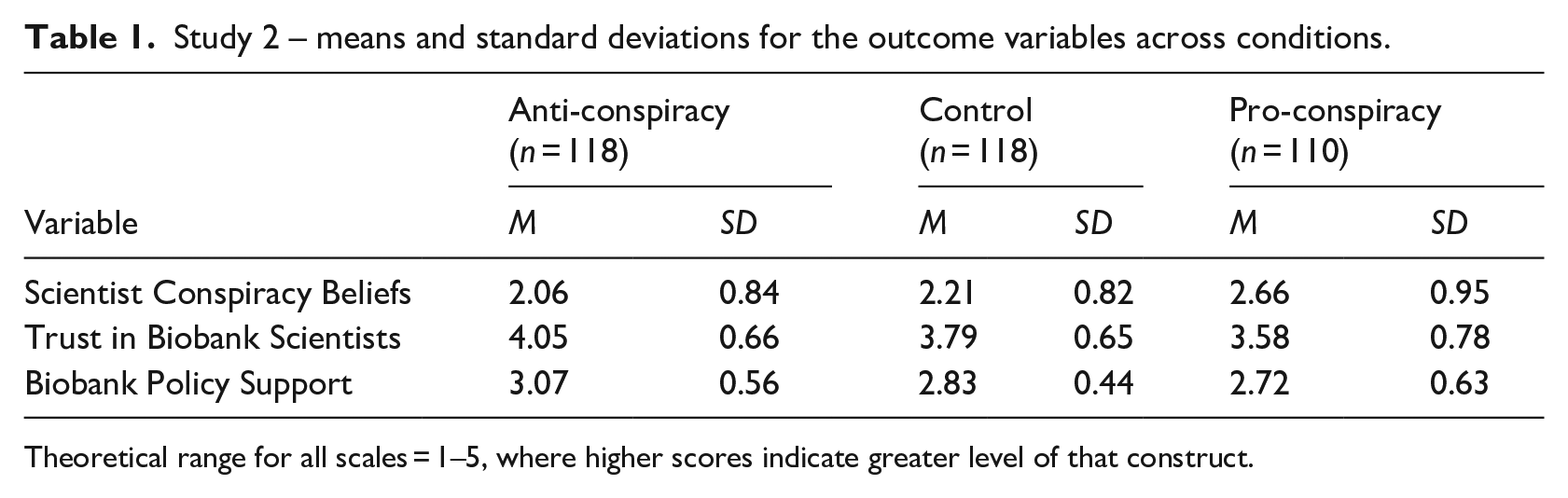
Theoretical range for all scales = 1–5, where higher scores indicate greater level of that construct.
A mediation analysis was conducted examining the effect of pro-conspiracy versus anti-conspiracy (D1) articles on GM food policy support, as mediated by trust in scientists, when controlling for pro-conspiracy versus control (D2). Consistent with hypotheses, exposure to scientist conspiracy theories significantly decreased biobank policy support, directly and indirectly through decreased trust in scientists (see Figure 1).
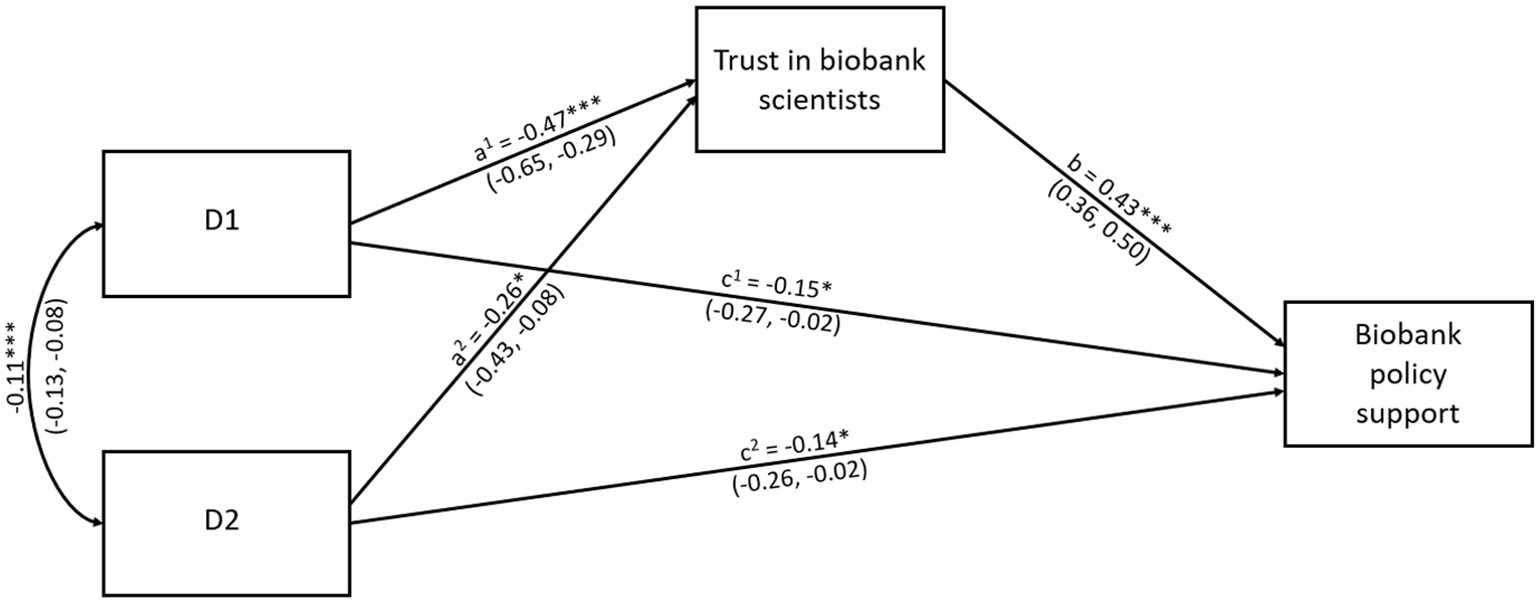
Mediation model of conspiracy exposure on biobank policy support.
As compared with the anti-conspiracy condition and accounting for the control condition, those in the pro-conspiracy condition reported significantly lower levels of trust in scientists working in biobanks (H2b), and this was associated with lower levels of biobank support. There was also a direct effect from exposure to biobank support, suggesting that exposure to conspiracy theories about scientists working in biobanks (as compared to the anti-conspiracy condition and accounting for control) led to significantly lower support (H2a). Following bootstrapping (bias-corrected and accelerated 10,000 cycles), in line with the hypothesis (H2c), there was a significant indirect effect (a1b = −0.20, p < .001; CI95 = −0.30, −0.12), suggesting that exposure to scientist-related conspiracy theories significantly decreased trust in scientists, which in turn was associated with lower support for biobank policy.
Study 2 provided support for the hypotheses that exposure to a conspiracy theory narrative involving biobank scientists decreased policy support for biobank research, and that this effect was indirectly explained by decreased trust in scientists. Findings are consistent with research that conspiracy theories decrease trust in government institutions (Einstein and Glick, 2015) and medical authorities (Jolley and Douglas, 2014a; Natoli and Marques, 2021). They also speak to the importance of trust as a heuristic of researchers involved in complex and emerging areas of science in general (Siegrist et al., 2000) and in biobanks (Walshe et al., 2024), especially when the public is unfamiliar with these technologies. In our study, fewer than 1 in 10 participants indicated they were familiar with biobanks, consistent with previous local and international findings (Critchley et al., 2020; Domaradzki and Pawlikowski, 2019).
Overall, our findings suggest that conspiracy theories involving scientists working in biobanks can erode biobank policy support, extending the findings from Study 1 beyond an individual future intention to one indicative of a collective action. Future research should examine whether conspiracy theories also lower individual intentions to participate in biobank research (Critchley et al., 2015). Our results should be confirmed with additional measures, given the reliability of our biobank policy support measure was lower than expected. Consistent with Study 2, these findings also suggest a small debunking effect of correcting a conspiracy narrative on both belief in conspiracies and policy support for medical biobanks. In a third study, we examined whether these conspiracies involving scientists in biobanks could have more distal effects.
5. Study 3
In Study 3 (preregistered; https://osf.io/b4t7a/), we once more examined the impact of a scientific conspiracy on GM food scepticism. Here, we build on Study 2, which examined a scientist biobank conspiracy specific to an outcome of policy support for medical biobanks, by investigating whether this same conspiracy theory has a causal effect on policy support for a more distal but related biotechnology – GM food. We deliberately studied this medical biobank narrative which placed scientists within a conspiracy but did not make specific claims about GM food. Such conspiracy information could affect GM food scepticism by undermining the broader perceived authority of science in society and fuelling science-related populism. As in Study 2, our focus is on policy support as a closely related (Lyons et al., 2019), but more politically and socially relevant collective action outcome than the individual behavioural intentions relating to GM food (Study 1).
We hypothesised that exposure to pro-conspiracy information about scientists would decrease support for GM food policies (H3a); exposure to pro-conspiracy information about scientists would increase science-related populism (H3b); exposure to pro-conspiracy information about scientists would decrease support for GM food policies indirectly through increased science-related populism (H3c). In all cases, we examine pro-conspiracy information relative to exposure to the anti-conspiracy condition which includes a debunk, accounting for existing levels as assessed by the control condition.
Method
Participants
Study 3 included 348 participants (173 females, 172 males, 3 non-binary) from Australia recruited via Prolific who did not participate in previous studies. We used pwrSEM (Wang and Rhemtulla, 2021) to estimate the required sample size, as per Study 2, with values reported in our preregistration. 7 Participants were paid £0.90GBP for their time (~7 minutes). The sample ranged from 18 to 81 years (M = 34.21 years, SD = 11.79), and a majority reported university-level education (69.2%). Participants varied in spirituality/religiosity, with a mean importance rating of 2.69 (SD = 1.91), and identified as more politically progressive than conservative on social issues (M = 5.05, SD = 1.33) and economic issues (M = 4.83, SD = 1.17).
Materials and procedure
As with the previous two studies, potential participants were invited to a study investigating ‘beliefs about certain food and food policy in Australia’. Study 3’s procedure was largely identical to Study 2, involving random allocation to one of three article conditions, but included a different mediator (science-related populism) following the manipulation check and before the outcome measure (policy support for GM foods). Participants were debriefed and given an opportunity to withdraw their data. Study materials are in the SOM.
Conspiracy articles
The three articles were identical to Study 2.
Scientists’ conspiracy scale
The same measure from Study 2 was used and deemed reliable (α = .90).
Science-related populism
Eight items were used to measure science populism (Mede et al., 2021). Participants rated these items using a Likert-type scale (1 = strongly disagree, 5 = strongly agree). An example item reads, ‘Our society should rely more on common sense than on scientific studies’. Items were averaged, with higher scores indicating higher science populism (α = .77).
Policy support for GM foods
Five items were used to measure policy support for GM foods (Jennings, 2019). An example item reads, ‘Strict regulations should be placed on GMO production’. Participants rated these items using a 5-point scale (1 = definitely not, 5 = definitely). An exploratory factor analysis indicated a single factor (see Table S4 SOM). Following reverse scoring to aid interpretation, items were averaged with higher scores indicating greater support for policies in favour of GM food (α = .81).
Results and discussion
Manipulation check
Two Welch’s t-tests indicated that the experimental manipulation was successful. Belief in Scientists Conspiracy Theories was significantly higher in the pro-conspiracy condition (M = 2.76, SD = 0.89, n = 115) as compared to the anti-conspiracy condition (M = 2.14, SD = 0.88, n = 115; t(227.99) = 5.32, p < .001, Cohen’s d = .70), and compared to control (M = 2.22, SD = 0.88, n = 118; t(230.82) = 4.71, p < .001, Cohen’s d = .62). The size of the mean differences was consistent with Studies 1 and 2.
Hypothesis testing
Descriptive statistics across conditions are reported in Table 2.
Study 3 – means and standard deviations for the outcome variables across conditions.
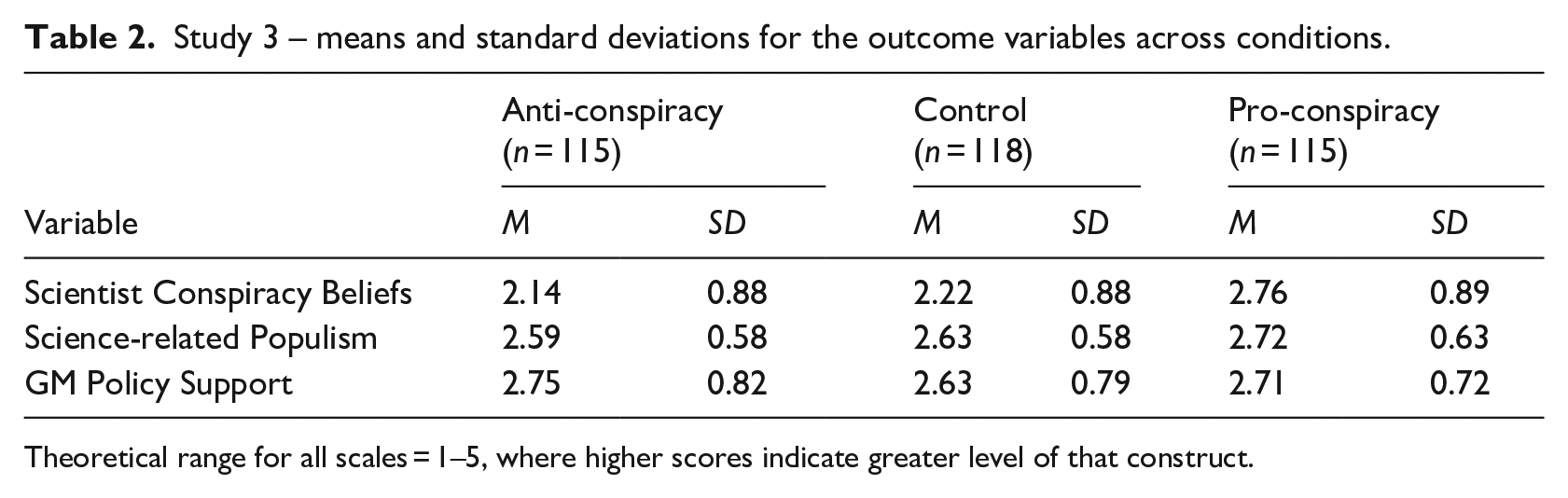
Theoretical range for all scales = 1–5, where higher scores indicate greater level of that construct.
A mediation analysis was conducted examining the effect of pro-conspiracy versus anti-conspiracy (D1) articles on GM food policy support, as mediated by science-related populism, when controlling for pro-conspiracy versus control (D2). Exposure to scientist conspiracy theories did not significantly alter GM food policy support, directly or indirectly through science-related populism (see Figure 2).
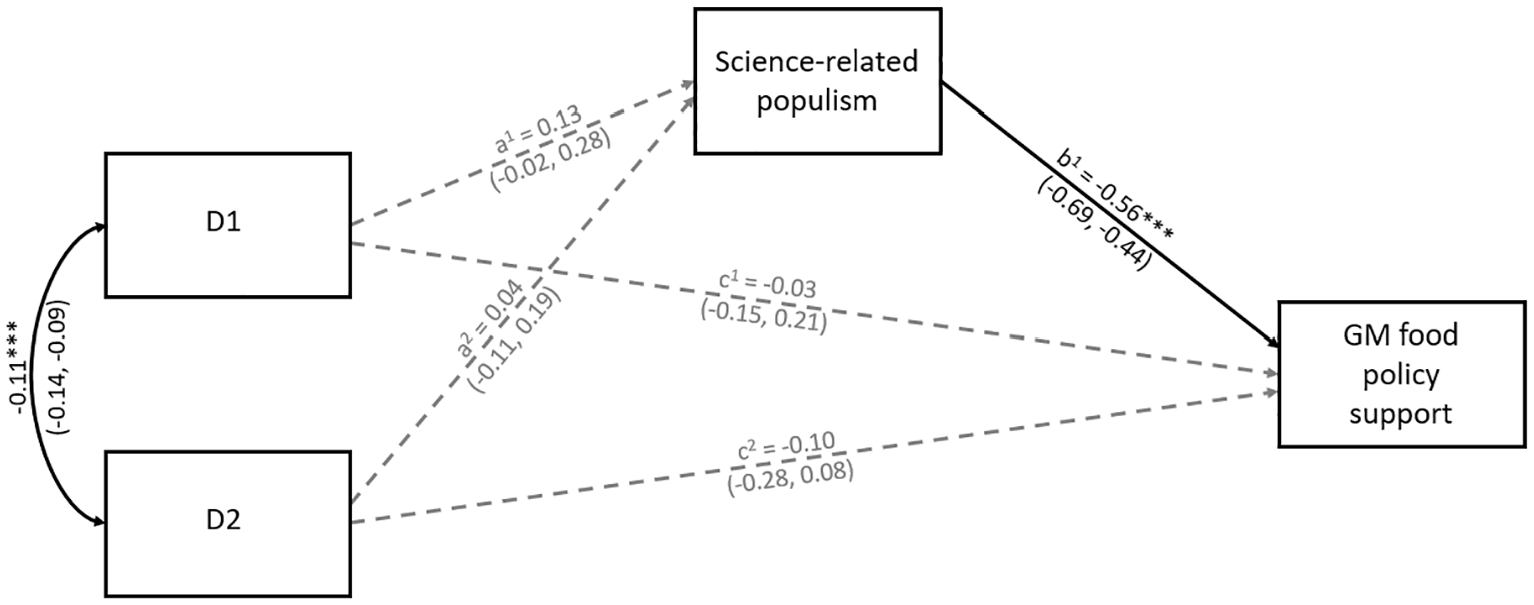
Mediation model of conspiracy exposure on GM food policy support.
Those in the pro-conspiracy condition did not report higher levels of science-related populism (H3b). There was also no direct effect on GM food policy support (H3a). However, higher levels of science-related populism were associated with lower support for GM food policy. Given no difference across conditions, we examined the zero-order correlations collapsed across conditions. Consistent with expected directions, increased belief in scientist conspiracy theories was strongly and positively associated with science-related populism (r(348) = .68, p < .001), and moderately and negatively with support for GM food policies (r(348) = −.43, p < .001). Increased science-related populism was moderately and negatively associated with GM policy support (r(348) = −.43, p < .001).
Overall, the hypotheses in Study 3 were not supported. 8 While there was evidence from exploratory correlational analyses that belief in scientist-related conspiracy theories was associated with less support for GM food policy, and both with increased science-related populism, there was no evidence for either a direct or indirect effect, from exposure to scientist conspiracy theories to GM policy support. This may suggest that the effects of scientific conspiracy theories on more distal, but related fields, are limited. This point will be elaborated further in the general discussion below. Finally, while the exploratory tests found associations in the predicted directions between all variables including a strong positive association between science-related populism and belief in scientist conspiracy theories, it remains an open question as to whether conspiracy beliefs are an antecedent or consequence (Mede et al., 2021) or have a bi-directional association (van Prooijen, 2018) with science-related populism. A general discussion and implications are outlined below.
6. General discussion
Across three preregistered studies, this research has provided some evidence for the negative effects of exposure to conspiracies relating to two biotechnological fields. In Study 1, exposure to scientific conspiracies involving agricultural biotechnology companies had a significant but small effect on decreasing intentions to eat or try GM food. In Study 2, we extended these findings using a different conspiracy topic involving biobanks and found that exposure decreased policy support for biobank research, and this effect was mediated by decreased trust in scientists. Study 3 attempted to test whether this same conspiracy involving biobank scientists could have more distal effects on support for GM food policies but found neither a direct nor an indirect effect through science-related populism.
Implications
This research provides strong empirical evidence for the conditions under which exposure to science-related conspiracies influences scepticism towards biotechnology. Previous experimental research has demonstrated that conspiracies in well-publicised domains, such as climate science and vaccinology, can have negative effects on individuals’ attitudes and intentions (e.g. Jolley and Douglas, 2014a; van der Linden, 2015), and also that conspiracy narratives may be most potent when individuals are unfamiliar with technologies (Bolsen et al., 2022). Existing research has considered the cross-sectional associations between the rejection of less publicised, but controversial, scientific technologies (e.g. Landrum and Olshansky, 2019; Lewandowsky et al., 2013). However, to our knowledge, the current findings provide the first experimental evidence of a causal effect of exposure to conspiracies relating to two biotechnical fields, agricultural food biotechnology and medical biobanks, on future intentions to eat GM food and support for GM and biobank policies. Together, the study findings provide evidence for increased belief in science-related conspiracies following exposure to a conspiracy narrative (manipulation check). Furthermore, Studies 1 and 2 found specific effects on indicators of scientific scepticism in the form of GM food intentions and biobank policy support, respectively. However, exposure to conspiracy theories in one domain, medical biobanks, did not influence policy support in a related domain, GM food (Study 3).
Experimental evidence for the consequences of exposure to conspiracies most often involves proximal attitudinal and behavioural intentions across environmental (Bolsen et al., 2022; Jolley and Douglas, 2014b (Study 1); van der Linden, 2015), political (Jolley and Douglas, 2014b (Study 2)), medical (Chen et al., 2021; Jolley and Douglas, 2014a (Study 2); Natoli and Marques, 2021 (Studies 1 and 3)) and social outcomes (Jolley et al., 2020 (Studies 1 and 2)). Our findings contribute to this literature and offer a plausible explanation of their likely circumscribed effects. Our research suggests the presence of small proximal effects following a one-off exposure to scientific conspiracy theories, but the evidence for wider effects on beliefs about the role of science in society and scepticism towards related biotechnology fields appear limited.
Trust in scientists, science and deference to scientific authority is theorised as being antecedents of scepticism towards scientific technologies. Consistent with past research (e.g. Eberl et al., 2021), our research provides evidence that decreased trust in scientists involved in biobank research and wider negative beliefs about science and scientists in society are associated with decreased support towards biobank and GM policies, respectively. Given that these are also associated with increased belief in conspiracies, together, our three studies speak to the important role that trust in authorities including scientists has on scepticism to biotechnologies. However, while exposure to a conspiracy narrative describing medical biobank scientists involved in a malevolent plot, including a cover-up against the public, increased distrust in those biobank scientists (Study 2), it had no effect on increasing broader populist beliefs around science (Study 3). Thus, the causal link between this science-related conspiracy theory and this strain of populism remains unclear (Mede et al., 2021).
Limitations and future research
Researchers have expressed concern over the impact of scientific conspiracies in general (Rutjens and Većkalov, 2022), the impact this may have on beliefs about the wider role of science in society (Rutjens et al., 2018), and the impact these beliefs may have on the success of technological solutions to societal problems (Marques et al., 2021). Our experimental research suggests that effects of exposure to specific scientific conspiracies about biobanks on more distal attitudes towards scientific technologies such as GM, and the role of populist beliefs about scientists, are small, nonsignificant and potentially ephemeral. Future studies could examine these effects with different stimuli, over longer timeframes, or repeated exposures. Given that science-related populism is strongly associated with conspiracy belief, it is important to further understand how addressing either may improve approaches to limiting any effects of misinformation narratives involving malevolent acts of cover-up within scientific domains on individual intentions or policy support. Future research may consider examining associations between belief in science-related conspiracies, science-related populism and scepticism towards scientific technologies over time, using modelling approaches to assess the (bi)directional impact of these variables over time (e.g. Liekefett et al., 2021).
A further limitation of our research is that our sample consisted of mostly well-educated Australian adults who opted to participate in online research. While we do not believe this undermines the overall interpretation of our findings, the small though mostly significant effects of scientific conspiracy theories on biotechnology scepticism may under-estimate population-level effects, given that GM scepticism is negatively associated with increased scientific literacy (Rutjens et al., 2022). Future research may wish to examine how conspiracy effects on biotechnology scepticism are associated with individual differences in general science attitudes, or specifics such as biotechnology knowledge, given that formal education level and specific knowledge may have independent effects (Simon, 2010). A final point is that while we debriefed participants, it is critical for researchers to ensure these practices, given the narrow chance that studies may alter public misunderstanding following experimental manipulations involving made-up conspiracy theories (Imhoff and Lamberty, 2017).
7. Conclusion
Conspiracies involving scientific technologies that are less familiar to the public can decrease trust in scientists and increase scepticism, and in these studies, particularly when the outcome was proximal. Across three studies, we demonstrated that exposure to conspiracy narratives involving two biotechnologies, GM science and biobanks, increases belief in the existence of a conspiracy involving corporations and scientists. Furthermore, we demonstrated that this leads to increased scepticism in the form of lowering intentions to eat GM food and policy support for biotechnological research, with the latter effect indirectly explained by a decrease in trust in scientists involved in that research. However, we also found that these effects may be specific to the type of scientific innovation and do not appear to undermine policy support for a related biotechnology, nor have a causal effect on beliefs in science-related populism.
Supplemental Material
sj-docx-1-pus-10.1177_09636625241300896 – Supplemental material for The effect of scientific conspiracy theories on scepticism towards biotechnologies
Supplemental material, sj-docx-1-pus-10.1177_09636625241300896 for The effect of scientific conspiracy theories on scepticism towards biotechnologies by Mathew D Marques, John R Kerr, Arthur A Stukas and Jim McLennan in Public Understanding of Science
Footnotes
Acknowledgements
Mathew Marques would like to acknowledge the late Professor Christine R. Critchley, whose mentorship and inspiration continue to guide and motivate his research.
Data availability statement

Funding
The author(s) received no financial support for the research, authorship and/or publication of this article.
Supplemental material
Supplemental material for this article is available online.
Notes
Author biographies
References
Supplementary Material
Please find the following supplemental material available below.
For Open Access articles published under a Creative Commons License, all supplemental material carries the same license as the article it is associated with.
For non-Open Access articles published, all supplemental material carries a non-exclusive license, and permission requests for re-use of supplemental material or any part of supplemental material shall be sent directly to the copyright owner as specified in the copyright notice associated with the article.
