



Abstract
Numerous studies have explored internal factors such as cultural values and acquired knowledge accounting for how people engage with science. However, it remains unclear how external factors embedded in science texts relate to audience engagement. A content analysis of 298 text-based popular science news articles and their following 5852 reader comments was conducted in two Israeli audiences, science-minded and general readers, to explore how the accessibility strategies embedded in these articles relate to cognitive, affective, and behavioral engagement. Findings indicated similar patterns of relationship between accessibility strategies and engagement expressions for both audiences; however, the relationships were more pronounced for general readers compared to science-minded readers. Using jargon and a narrative writing style increased the odds of positive emotions in reader comments, whereas addressing socio-scientific issues increased the odds of cognitive expressions. These results may contribute to a fuller understanding of ways to drive meaningful public engagement.
Keywords
Public engagement with science is key to well-informed and active citizenship (National Academies of Sciences Engineering and Medicine, 2017). Democratic societies are founded on citizen engagement and expect citizens to help set the agenda for science (Irwin, 2014), particularly in today’s age of post-normal science, where “wicked problems” have significant social implications and require societies to make painful trade-offs (Scheufele et al., 2021; Shasha-Sharf and Tal, 2023). Science coverage in the media provides opportunities for active engagement, influences people’s trust in science, and shapes how they apply scientific knowledge in everyday life (Dunwoody, 2021). Since the Internet has become the most widely used space for disseminating scientific information, specifically science news (National Science Foundation, 2020) and considering the importance of public participation in science-related discussions (Reincke et al., 2020), it is crucial to understand better what can foster or hinder people’s engagement in this digital space. While there has been considerable research on the internal factors explaining how and why people engage with science, such as personal characteristics, cultural values, and knowledge acquired throughout life (Buxton and Lee, 2010), there is still much to be learned about how external factors incorporated into the content itself affect the ways in which the message reaches people and affects public engagement. Considering the intricate interplay between internal and external factors influencing engagement, we tackled both aspects and examined how external factors integrated into scientific texts correlate with user engagement across two distinct audiences characterized by differing internal factors.
The extent to which individuals engage with science is contingent on the accessibility of the scientific content, which often contains complex terminology and abstract concepts that can significantly influence reader comprehension and confidence and discourage individuals from fully engaging (Freeling et al., 2021). To enhance accessibility, science popularization in the media employs different practices, including contextualizing and explaining scientific content using terms and metaphors understandable by wider audiences to achieve engagement and facilitate non-experts’ comprehension (Dunwoody, 2021). In this study, these practices are termed accessibility strategies, that is, design elements and key attributes incorporated into the text to help readers understand the content and make it more appealing. Some accessibility strategies contribute to clarity (e.g. explanations and examples), while others facilitate visualization (e.g. pictures and videos), relevance (e.g. by referring to current issues and illustrating applications), or style (e.g. narrative; McTigue and Slough, 2010). The term “accessibility strategy,” as we use it here, differs from its usage in other areas of online communication, where it typically refers to measures for enhancing web accessibility for audiences with disabilities, such as using readable fonts (Friedman and Bryen, 2007).
We examined text-based science news articles because written text remains one of the most dominant ways various publics consume scientific knowledge. According to a Pew Research Center report (2017: 23), 54% of all adults consume science news through online general news outlets and science magazines. This is also true in Israel (Israel Ministry of Science and Technology, 2015).
This study focuses on science news websites (SNWs), a type of science communication that falls under the “amplifier platforms” that allow scientists to engage with and affect a broader audience beyond academia (Riedlinger et al., 2023). These websites generate and publish popular science news, like the materials produced by “Scientific American” but seldom participate in commentary-style endeavors like those pursued by “The Conversation.” They create spaces and opportunities for public engagement with science by distributing their content to general and social media outlets and enabling readers to comment and discuss.
SNWs integrate scientific expertise with journalism (Ginosar et al., 2022); however, their positioning differs from science journalism’s. They lean toward affirmative and less critical science writing than traditional science journalism (see Rensberger, 2009). Despite not being professional journalists, their contributors, who have advanced degrees in science and may, in some cases, be working scientists, adhere to some journalistic principles like identifying newsworthy stories, providing comprehensive and diverse information, fostering a dialogic approach, and maintaining openness to diverse voices (see Meier, 2019); however, they often lack the watchdog role. Nevertheless, underlying connections and overlaps exist between the accessibility strategies employed by SNWs and common news values, including relevance, geographical proximity, immediacy, and controversy (see Guenther et al., 2021).
Our capacity to generalize could be somewhat limited to the type of articles published on SNWs; however, it is worth noting that no significant differences were found in public engagement with science news written by scientists using journalistic practices of science popularization compared to engagement with science news articles authored by professional journalists when both were published on the same general news platforms (Barel et al., 2020).
This study explores whether and how different accessibility strategies used in text-based popular science news relate to the resulting reader engagement, aligning with previous studies examining the interactions between article content and comments (e.g. Holton et al., 2014). While recognizing that engagement can already be triggered by the topic announced in the headline without reading the article (Rostami et al., 2014) and that certain users may peruse comments prior to reading the article itself and comment (Williams and Hsieh, 2021)—thus potentially rendering the comments independent of article characteristics—we still deem it significant to explore prevailing patterns. We accomplished this by examining the natural online engagement of readers in two distinct audiences. Specifically, we ask,
How do accessibility strategies used in popular science news predict reader engagement, and how do these accessibility strategies serve different audiences?
In so doing, we take initial steps toward identifying which accessibility strategies might enhance cognitive engagement, evoke positive and negative affective engagement, and promote behavioral engagement—aiming to contribute to a fuller understanding of ways to drive meaningful public engagement.
1. Theoretical background
Communication studies define engagement as audience investment of time, attention, and emotions in media content that requires active reader participation, internalization of the message, and reactions to it (Broersma, 2019). Unlike passive exposure, engagement is a multidimensional construct encompassing an individual’s active involvement in a given activity (Christenson et al., 2012). Fredricks et al. (2004) defined three dimensions of engagement: Cognitive, Affective, and Behavioral. Cognitive engagement refers to learners’ psychological investment in learning activities, such as expending mental effort, using flexible problem-solving, and choosing challenging tasks to understand better what they learn. Affective engagement refers to positive or negative emotions that are generated by learning situations. Positive emotions include enthusiasm, interest, satisfaction, and enjoyment, whereas negative emotions include boredom, anxiety, and frustration. Behavioral engagement refers to learners’ outward manifestations of involvement that are directly related to their learning processes, such as attendance, compliance, and academic initiatives. These three dimensions intersect and are reciprocally related (Blanchard, 2018). They can come into play in formal science education settings such as classrooms (Sinatra et al., 2015) and in informal settings such as watching YouTube science videos (Dubovi and Tabak, 2021).
Online engagement
With its networked technologies, the online environment has fundamentally reshaped communication and restructured how people seek and interact with scientific knowledge (Brossard, 2013). These technologies blur the boundaries between science journalists, scientists, and general audiences (Brüggemann et al., 2020), depriving legacy media of their exclusiveness in distributing scientific knowledge and science journalists of their privileged roles as gatekeepers and watchdogs (Fahy and Nisbet, 2011). The contemporary new media information ecosystem has become pluralistic, participatory, and social, enabling a digital public sphere of engagement and debate through active user interactions (Davies and Hara, 2017). Today, users who once were seen as a passive audience can interact with content and each other in various forms and at different levels of engagement, thus making their presence felt (Bucchi, 2017).
Generally speaking, comments indicate a deeper level of engagement than adding emojis and sharing since users express their thoughts, beliefs, and feelings, exposing their opinions and concerns in writing (Taddicken and Krämer, 2021). Although comments can be less thoughtful, more impulsive, or aggressive than previous forms of audience participation (e.g. letters to the editor), they allow diverse public voices to be heard and provide an opportunity for discussion and debate (Hille and Bakker, 2014). User comments not only represent audience perspectives and provide a window into authentic public knowledge (Laslo and Baram-Tsabari, 2021), opinions (Orr and Baram-Tsabari, 2018), and sentiments (Lasser et al., 2020), but they also influence other users’ attitudes about science (Jennings and Russell, 2019), affect their trust in science (Anderson et al., 2014), and shape how they apply scientific knowledge (Khosla and Pillay, 2020). Tabulating the volume of comments, emojis, clicks, and shares can be used as a rough index of user activity (e.g. Kahle et al., 2016; Yang et al., 2022).
The dominance of the online space has led to an updated operationalization of the notion of engagement, which needs to consider media outlets and user perspectives in terms of the relative affordances and dynamics of media-user engagement (Yousuf, 2018). Cognitive and Affective engagement, for example, can be reflected in the content of users’ comments when users express their concerns, opinions, and feelings. Behavioral engagement can be extrapolated from the number of words in a comment, the number of comments, as well as actions such as adding emojis and sharing on social media platforms (Dubovi and Tabak, 2021). Our analysis implemented these three dimensions as an analytical framework and defined public engagement as visible online actions readers take in response to digital popular science news.
Science popularization and diverse audiences
Scientific content, typically decontextualized, written formally, and containing complex and specialized terminology, is likely to alienate non-expert audiences from the subject matter, impeding them from experiencing science (Freeling et al., 2021). Individuals vary in interest, knowledge, attitudes, and information about scientific issues. While some audiences are passionate about science and have considerable knowledge, others take a minimal interest and have a limited understanding of scientific concepts (Metag and Schäfer, 2018). Research indicates that these variations can be linked to age brackets, genders, and educational attainment; for example, higher online consumption of scientific knowledge is correlated with males holding college degrees (Schäfer et al., 2018). This raises the question of how less enthusiastic audiences engage with science and whether the duplicate popular science accounts have varying benefits for different audiences.
Science popularization in the media employs a diverse array of strategies to improve accessibility and foster audience engagement (Dunwoody, 2021) such as by minimizing jargon (e.g. Bullock et al., 2019) and providing explanations (e.g. Sevian and Gonsalves, 2008) to enhance clarity, or by referencing current affairs (e.g. Badenschier and Wormer, 2012) and socio-scientific issues (e.g. Brüggemann et al., 2020) to make scientific content relevant and related to audiences’ everyday lives. Narrative writing is also frequently utilized to cultivate audience engagement with science issues, keep readers’ attention, and help them understand, process, and recall science-related information (ElShafie, 2018). Table 2 and Supplemental Appendix A present the list of accessibility strategies examined in this study.
2. Methodology
The accessibility strategies utilized in popular science news articles and the manifestations of cognitive, affective, and behavioral reader engagement in linked comments were identified using deductive content analysis informed by pre-determined criteria extracted from the literature (Krippendorff, 2013). Correlations were calculated to determine the relationships between these accessibility strategies and the three dimensions of reader engagement. While originally published on SNWs, some of the items were republished in general news media, that is, Ynet, 1 the most widely read general news outlet in Israel, with a broad readership, suggesting that it reaches a diverse audience and essentially encompasses the general public; thus, enabling replication and comparison of manifestations of engagement of SNW readers (i.e., a science-minded audience) and Ynet readers (i.e., general Israeli audience). These two audiences differed, as shown in Table 1.
Demographics of Science News Website (SNWs) readers compared to the general Israeli population.
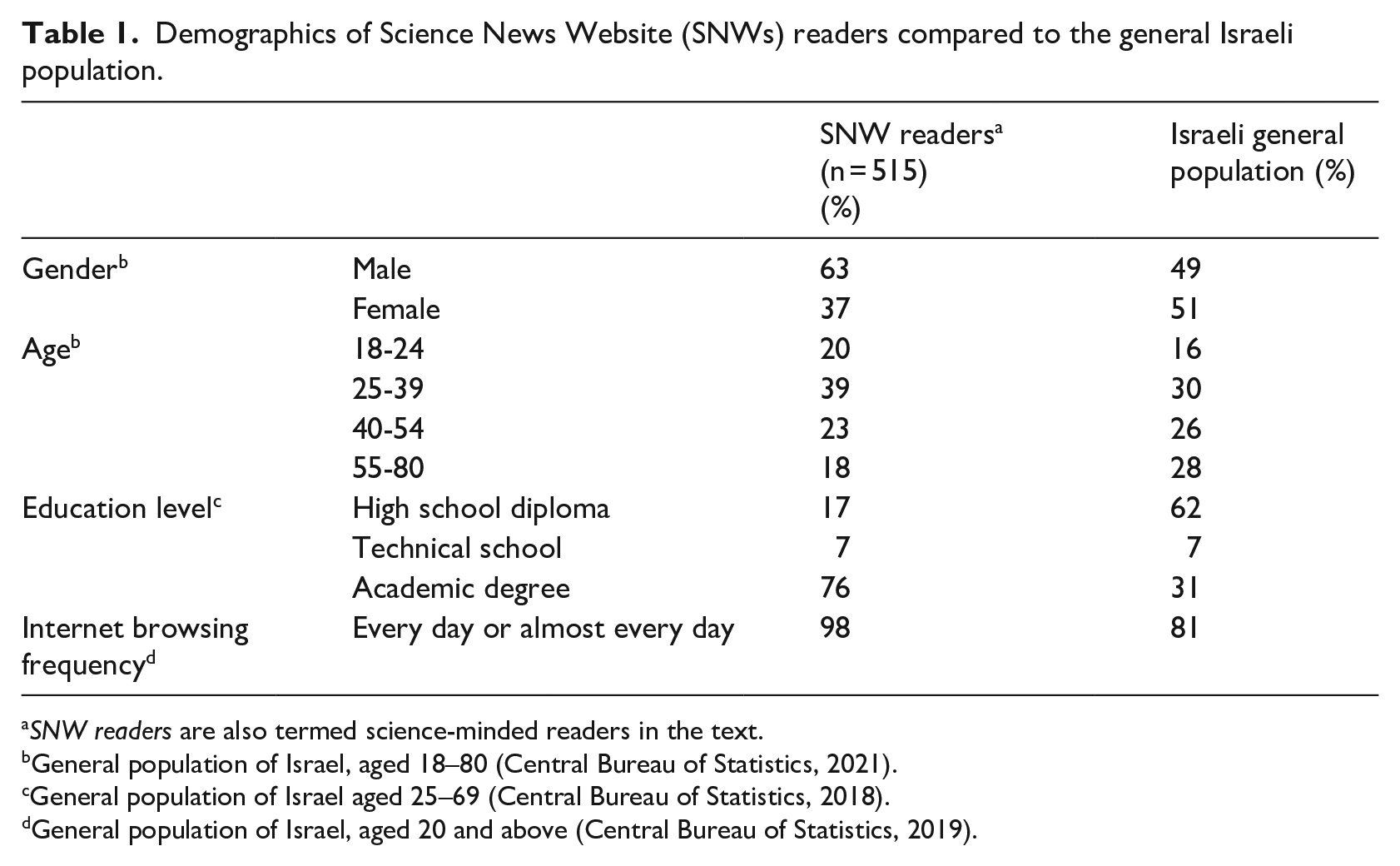
SNW readers are also termed science-minded readers in the text.
General population of Israel, aged 18–80 (Central Bureau of Statistics, 2021).
General population of Israel aged 25–69 (Central Bureau of Statistics, 2018).
General population of Israel, aged 20 and above (Central Bureau of Statistics, 2019).
Data sources
Four leading Israeli SNWs were examined in this study. Although there are only four, they are the dominant Israeli websites that publish a wide range of scientific content. The four SNWs provide popular science news written by science experts in a journalistic style (Ginosar et al., 2022). These websites met the three pre-determined inclusion criteria of (1) coverage of various science topics, (2) a publishing frequency of at least four times a week, and (3) cultural prominence (Baram-Tsabari et al., 2020). Although the websites differ in ownership (e.g. established organizations with financial support versus volunteer-based initiatives) and staff size and professionalism, they share significant common ground. These SNWs generally have similar science communication objectives and employ comparable practices to deliver popular science news (Zimmerman et al., 2024). Each website also operates a corresponding Facebook page to disseminate its news items. Two websites also distribute some of their items on general news media, such as Ynet, a popular general news outlet, to reach a larger 2 and more diverse audience.
SNW readers
Demographic data were gathered through online questionnaires posted on the Facebook page of each of the websites as well as on one website’s homepage. Respondents were asked about their gender, age, education level, and Internet browsing frequency. Table 1 presents the demographics of SNW readers (n = 515) compared to benchmark data (i.e. the adult general population in Israel).
Analysis showed that SNW readers differed from the general public: 63% of the participants were males, relatively younger, more educated, and 60% worked or were enrolled in STEM (Science (such as Biology, Physics, Earth sciences), Technology, Engineering, and Mathematics) fields. Analogous demographic patterns have been identified among enthusiastic readers of science blogs (Jarreau and Porter, 2017). According to a Pew Research Center report (2017), active science news consumers who seek out science news at least a few times a week are more likely to be male college graduates. Since the participants in this study fit that description, they likely represented typical active consumers of science topics. In addition, half of the respondents reported reading science news on other digital sources as well, such as blogs and online forums and described themselves as science-minded and science enthusiasts with a keen interest in science issues (Zimmerman et al., 2024).
Hereafter, SNW and Ynet readers will be termed science-minded and general readers.
Data collection
Science news items
All the science news items published by the SNW staff during the last three sequential months of 2019 were collected for analysis (N = 298). This period was chosen since it is the closest to the time preceding COVID-19, which massively displaced all other science topics, whereas we were interested in routine coverage. The number of published science news items on each website during this period differed by less than a standard deviation for all quarters of 2018 and 2019. Since the websites maintain consistent publishing frequencies and deal with similar topic areas throughout the year, the items collected for these 3 months would likely reflect their output fairly. The topic distribution 3 of the news items broke down into 30% Medicine & Health, 20% Life Sciences, 25% Environmental Sciences, 29% Technology & Space, and 19% Physical Sciences. Twenty percent of these items (n = 59) were republished on Ynet, the most dominant online general news outlet in Israel (see Supplemental Appendix B for topic distribution). Only three of the four websites allowed comments on their site platform, whereas all four allowed comments on their Facebook pages, along with emoji reactions and sharing items. Ynet allowed comments as well.
Reader engagement
Reader engagement was defined as visible responses by readers online to popular science news items. These included comments, emojis, and shares. Accordingly, all the corresponding comments to the news items were collected, resulting in 5852 comments: 433 from the Websites, 2704 from the Facebook pages, and 2715 from Ynet. It is worth noting that we could not ascertain whether the commenter read the article fully, partially, or not at all before responding. In the analysis, we treated all comments equally, similarly to Holton et al. (2014), and extracted their characteristics based on predefined categories, as outlined in the following section. In addition, the number of comments, emojis, and shares was also recorded for each item.
Analytical scheme and analysis
Accessibility strategies
Accessibility strategies are elements of design incorporated into the text to help non-experts understand the content. The analytical scheme for analyzing accessibility strategies in news items was crafted drawing from an extensive range of literature encompassing the enhancement of textual accessibility in general and scientific contexts. Our starting point was the analytical framework suggested by Baram-Tsabari and Lewenstein (2013) for scientists who communicate their science to diverse publics. Their framework was adjusted to suit the current research goals. For example, one of the guidelines is to select appropriate content (i.e. engaging, interesting, and relevant to a particular audience). This general guideline was modified to specific accessibility strategies referring to local events and current affairs. Thirteen accessibility strategies were included in the codebook and classified into four clusters termed Clarity, Visualization, Relevance, and Style, each of which captured a specific aspect of accessibility (Table 2).
Analytical scheme of the accessibility strategies used in the science news articles.
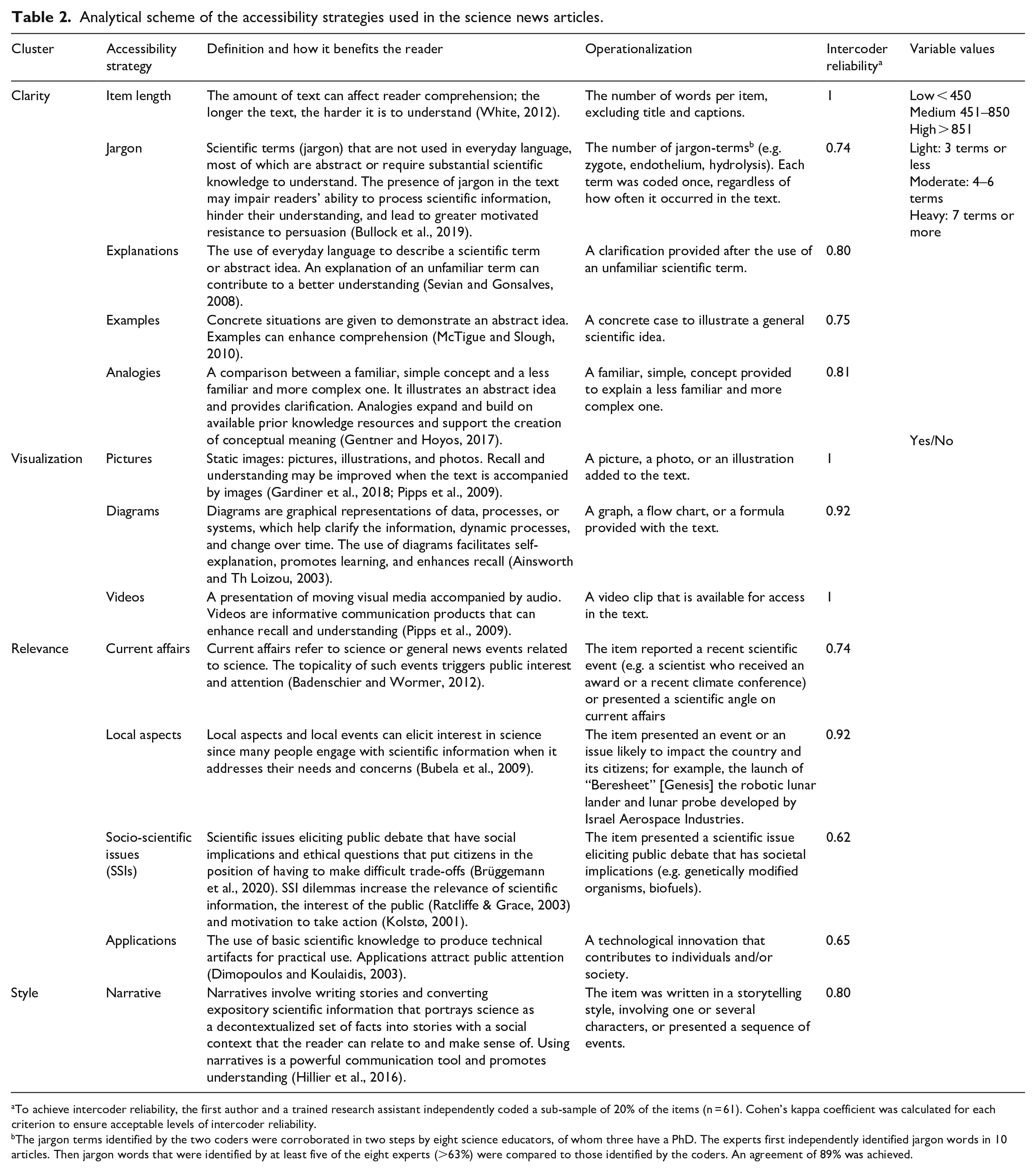
To achieve intercoder reliability, the first author and a trained research assistant independently coded a sub-sample of 20% of the items (n = 61). Cohen’s kappa coefficient was calculated for each criterion to ensure acceptable levels of intercoder reliability.
The jargon terms identified by the two coders were corroborated in two steps by eight science educators, of whom three have a PhD. The experts first independently identified jargon words in 10 articles. Then jargon words that were identified by at least five of the eight experts (>63%) were compared to those identified by the coders. An agreement of 89% was achieved.
The codebook was face-validated by five science education researchers and was tested and revised several times until a detailed and accurate version was achieved. The first author and a trained research assistant coded the items. To achieve intercoder reliability, they independently coded a sub-sample of 20% of the items (n = 61). Cohen’s kappa coefficient was calculated for each criterion to ensure acceptable levels of intercoder reliability (Table 2). All the coding discrepancies were discussed until a consensus was reached before their inclusion in the analysis. For selected examples of the accessibility strategies in the news items, see Supplemental Appendix A.
Acknowledging that readers’ interest may vary depending on the article’s topic, potentially influencing reader engagement and introducing confounding factors. Thus, we categorized the news items into five science fields: Medicine & Health, Life Sciences, Environmental Sciences, Technology & Space, and Physical Sciences—to unveil predominant relationships.
Reader engagement expressions
The coding framework for reader engagement was developed in the following three steps to measure the Cognitive, Affective, and Behavioral dimensions of engagement based on (1) an analysis of 300 reader comments to identify preliminary categories; (2) adjustments based on the analytical framework proposed by Dubovi and Tabak (2020, 2021); (3) iterative refinement of the categories by coding another 300 reader comments to improve the analysis accuracy. We defined the following two analytical units: (1) individual science news items for which we calculated the number of comments, emojis, and shares for each item. These parameters were considered to reflect readers’ behavioral engagement; (2) individual reader comments where the analysis focused on text content to pinpoint cognitive and affective engagement expressions (Table 3). Each comment could include all these categories, several or none. Examples of reader comments for various articles are presented to demonstrate the different categories of engagement expressions but not to draw comparisons between the levels of engagement across the two audience types. The more significant occurrence of cognitive engagement expressions observed among science-minded readers compared to general readers likely originates from their higher levels of education and their inclination toward science. Two trained research assistants coded the comments. For intercoder reliability, they independently coded a sub-sample of 10% of the comments (n = 590). Cohen’s kappa coefficient was calculated for each variable to ensure acceptable levels of reliability; the values ranged from 0.66 to 0.81 (Table 3). All coding discrepancies were discussed until a consensus was reached.
Analytical scheme of the three dimensions of engagement in science-minded and general readers, adapted from Dubovi and Tabak (2020, 2021).
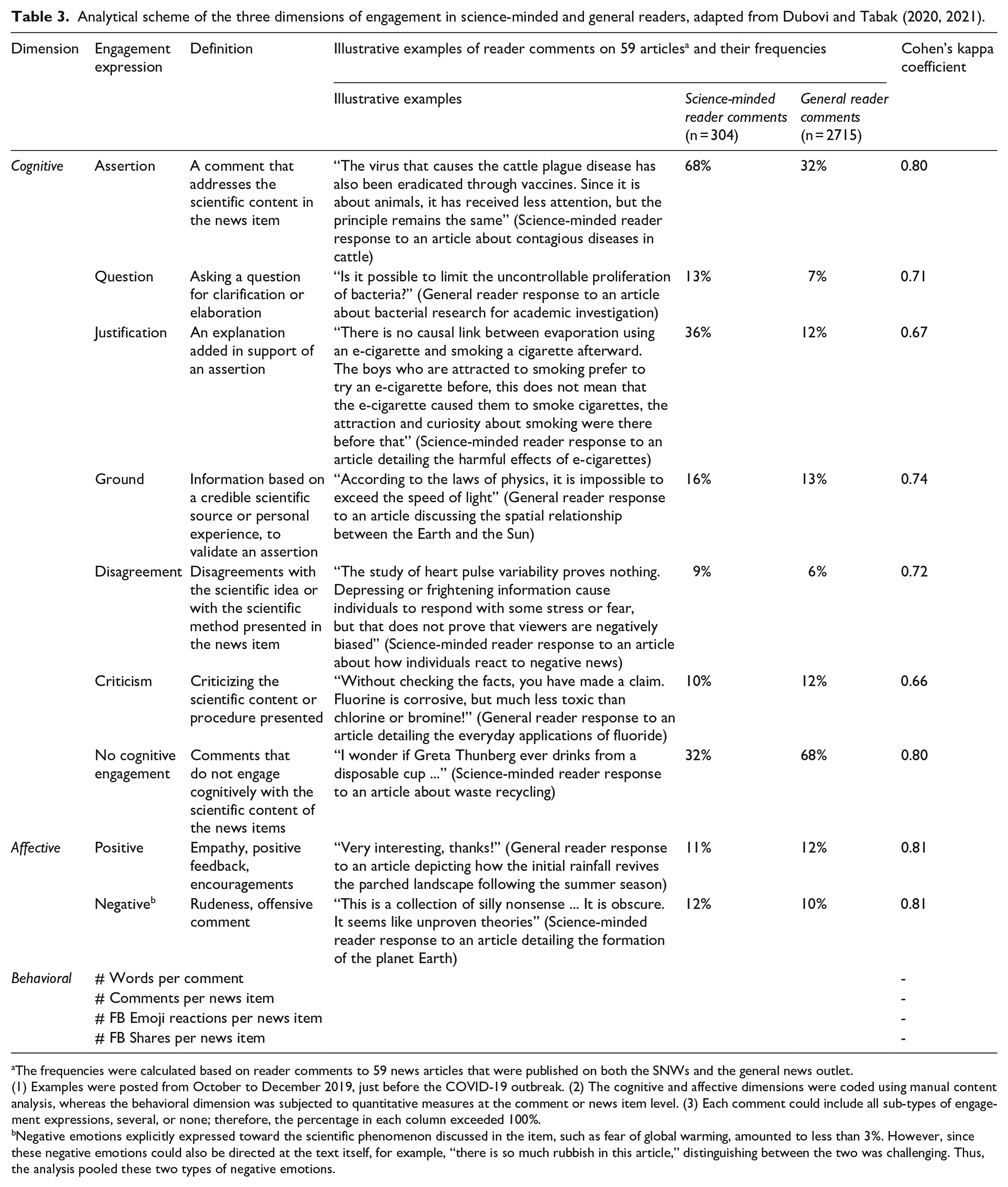
The frequencies were calculated based on reader comments to 59 news articles that were published on both the SNWs and the general news outlet.
(1) Examples were posted from October to December 2019, just before the COVID-19 outbreak. (2) The cognitive and affective dimensions were coded using manual content analysis, whereas the behavioral dimension was subjected to quantitative measures at the comment or news item level. (3) Each comment could include all sub-types of engagement expressions, several, or none; therefore, the percentage in each column exceeded 100%.
Negative emotions explicitly expressed toward the scientific phenomenon discussed in the item, such as fear of global warming, amounted to less than 3%. However, since these negative emotions could also be directed at the text itself, for example, “there is so much rubbish in this article,” distinguishing between the two was challenging. Thus, the analysis pooled these two types of negative emotions.
An additional variable, Cumulative Cognitive, was calculated to obtain the total of the six cognitive engagement expressions (ranging from 0 to 6).
Considering the variations in the occurrence of engagement expressions between science-minded readers and general readers (Table 3) and acknowledging that the level of engagement may be affected by internal factors such as demographic differences outlined in Table 1, we conducted separate analyses to examine the relationship between accessibility strategies and reader engagement within each audience group.
Statistical analysis
Correlations
Due to the nested nature of comments within items, the following procedure was carried out to associate comments to news items: the mean value of all comments related to each item was calculated for each cognitive and affective engagement expression. The number of comments for each item was used as a weight vector. Correlations were tested either by Spearman weighted correlations calculated by the weightedCorr (wCorr) function in R for ordinal variables (i.e. Item length and Jargon) or by Point biserial correlations calculated by a weighed correlation procedure using the cov.wt function in R for the binary variables (e.g. Explanation, Example, Analogy).
The multiple comparisons in this study increase the chances of a spurious result and the likelihood of getting a false-positive result with each subsequent test. Traditional adjustments that account for the multiple comparisons involve inflating the p-value and widening the confidence interval as a function of the number of comparisons. However, when analyzing data that contain numerous comparisons, such as the data in this study, these adjustments are difficult to defend since they reduce Type I errors (the probability of rejecting the null hypothesis when it is true) at the expense of remarkably increasing Type II errors (the likelihood of accepting the null hypothesis when the alternative is genuine), making the presence of real relationships insignificant (Bender and Lange, 2001; Perneger, 1998). Therefore, some estimation of the relative cost of each type of error needs to be applied. In social studies that include many tests, as in this study, adjustment for multiple comparisons is less critical as long as an explicit statement accompanies it; this transparency lets readers use their judgment as to the relative weight of the conclusions (Rothman, 2014).
Predictive modeling
A multilevel regression model 4 was conducted to test the predictive validity of the explanatory variables against the likelihood of cognitive and affective reader engagement. The model included 13 explanatory variables (i.e. accessibility strategies). A generalized Linear Mixed Models procedure with the log link function and a binary distribution was used for the binary dependent variables (Positive emotions, Negative emotions) and a negative binomial distribution for the count dependent variable (Cumulative cognitive).
Statistical analysis
Statistics were performed either by SPSS 28 (IBM, Armonk, NY) or R.
3. Findings
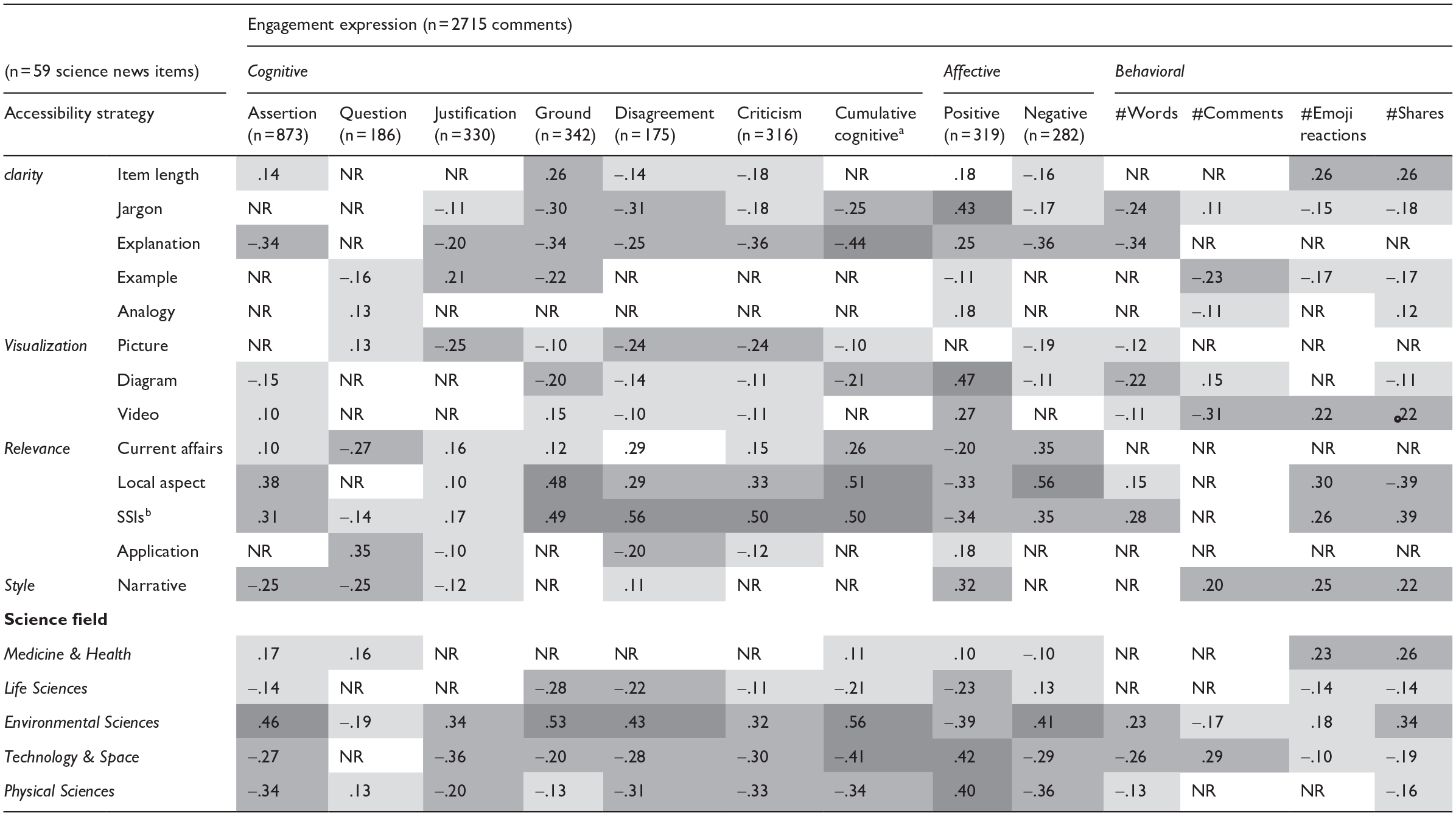
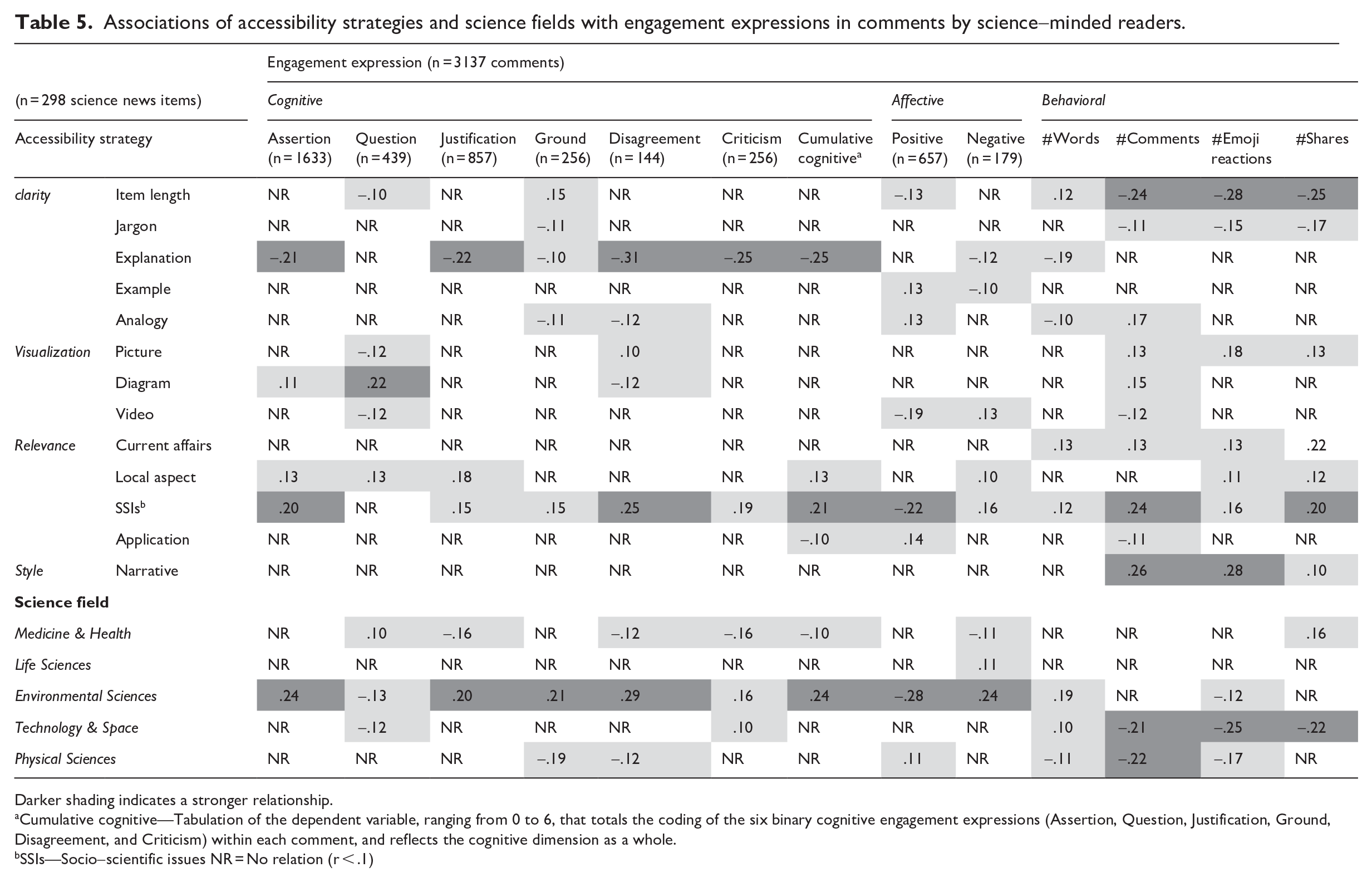
Tables 4 and 5 present the associations of accessibility strategies and science fields with engagement expressions in general and science-minded readers, respectively. A comparison of these tables indicates a more significant number and more robust relationships for general readers than science-minded readers, with a higher r coefficient value of 0.56 versus 0.28. That said, both audiences exhibited similar patterns of relationships between accessibility strategies and engagement expressions.
Associations of accessibility strategies and science fields with engagement expressions in comments by general readers.
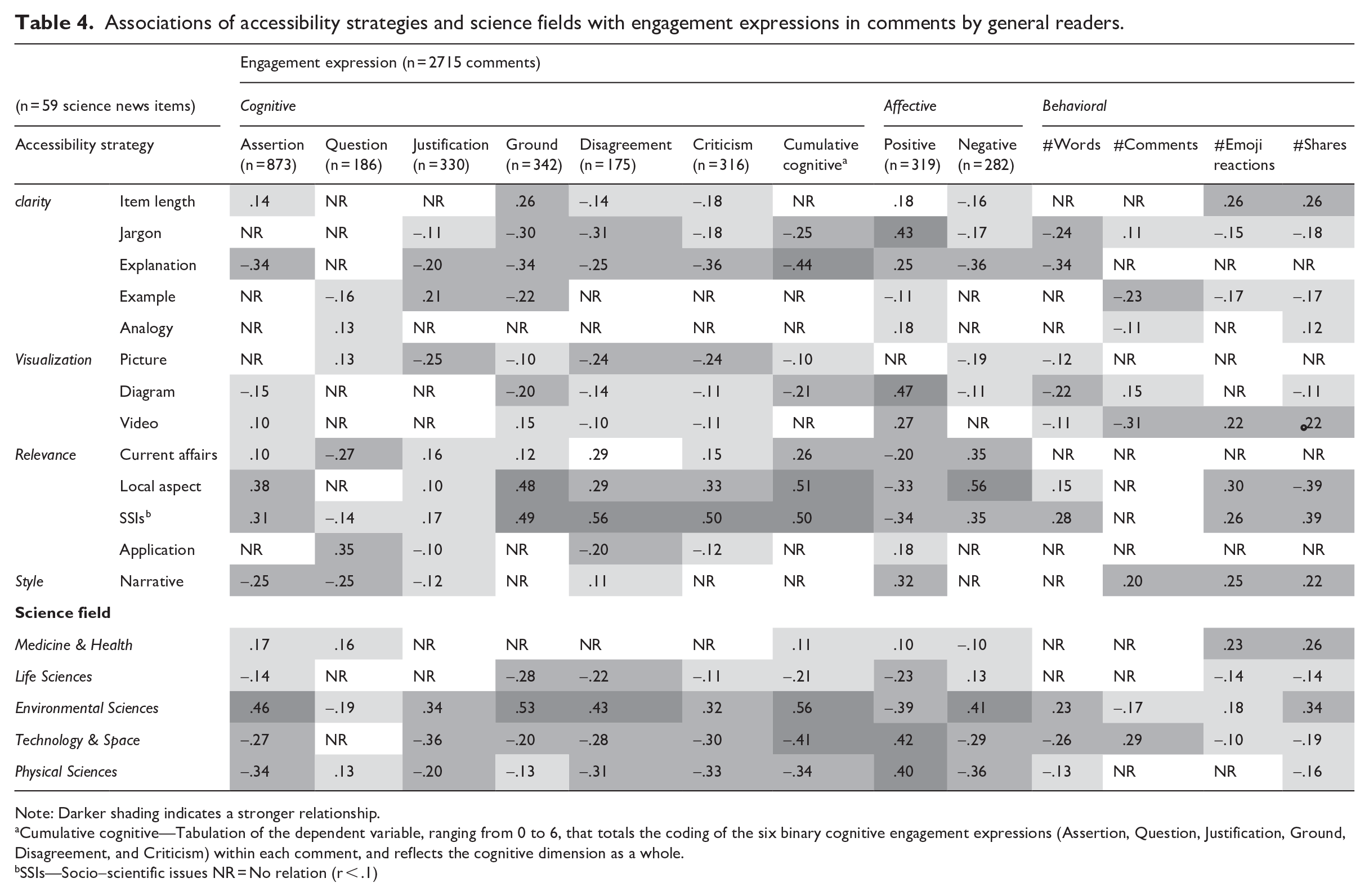
Note: Darker shading indicates a stronger relationship.
Cumulative cognitive—Tabulation of the dependent variable, ranging from 0 to 6, that totals the coding of the six binary cognitive engagement expressions (Assertion, Question, Justification, Ground, Disagreement, and Criticism) within each comment, and reflects the cognitive dimension as a whole.
SSIs—Socio-scientific issues NR = No relation (r < .1)
Associations of accessibility strategies and science fields with engagement expressions in comments by science-minded readers.
Darker shading indicates a stronger relationship.
Cumulative cognitive—Tabulation of the dependent variable, ranging from 0 to 6, that totals the coding of the six binary cognitive engagement expressions (Assertion, Question, Justification, Ground, Disagreement, and Criticism) within each comment, and reflects the cognitive dimension as a whole.
SSIs—Socio-scientific issues NR = No relation (r < .1)
Very broadly, accessibility strategies categorized under the “Clarity” cluster were more strongly associated with fewer cognitive expressions, more positive emotions, fewer negative emotions, and a shorter word count. Accessibility strategies categorized under the “Relevance” cluster were more strongly associated with more cognitive expressions, fewer positive and negative emotions, and a higher word count. A more fine-grained observation fleshed out the subtle differences between patterns.
Some patterns were intuitive. For example, using a narrative style in a news item elicited numerous comments from both general readers and science-minded readers (r = .20 vs r = .26) and more positive emotions among general readers (r = .32).
Other patterns, however, were counterintuitive. There was an inverse association between cognitive expressions and positive emotions. In general readers (Table 4), this trend was observed for jargon, explanations, and diagrams, which were all correlated with more positive emotions (r = .43, r = .25, and r = .47, respectively), but with a lower level of cognitive engagement (jargon r = –.25; explanation r = –.44; diagram r = –.21). The same pattern was observed in science-minded readers (Table 5) but was only present for explanations and to a lesser extent.
Regarding the breakdown of news items by their scientific subfield, Physical Science news items displayed a consistent pattern of association with higher levels of positive emotions (r = .40) and fewer cognitive expressions (r = –.34).
An analysis of the associations between accessibility strategies revealed that explanations were linked to jargon levels
Another notable pattern was the direct association between cognitive expressions and negative emotions. In general readers (Table 4), this was particularly evident for socio-scientific issues (SSIs) and local aspects. Items that used these accessibility strategies were more highly associated with more cognitive engagement expressions in reader comments (r = .50 and r = .51, respectively) but also more negative emotions (r = .35 and r = .56, respectively). The same pattern was observed in science-minded readers (Table 5) but to a lesser extent.
As stated above, it proved challenging to analyze specific accessibility strategies in isolation from one another. SSIs were linked with local aspects
In addition, reader comments that expressed negative emotions also included disagreements (34.8%, n = 111); the same was observed for criticism (37.4%, n = 214). Moreover, 81.8% (n = 261) of the comments expressing disagreement also expressed criticism.
Accessibility strategies as predictors of reader engagement
A multilevel regression analysis indicated that several accessibility strategies predicted reader engagement expressions (for the full results, see Supplemental Appendix C). The findings highlighted two main points. For the cognitive dimension, socio-scientific issues (SSIs) emerged as a positive predictor of cognitive engagement expressions in both audiences. Items addressing SSIs increased the likelihood that readers would express cognitive engagement 1.48–1.99 times more than items that did not. However, engagement in the affective dimension could be predicted in general readers but not science-minded readers. Specifically, the high use of jargon and narrative were positive predictors of readers’ positive emotions. The higher the jargon level, the greater the odds of positive emotions (up to 4.28-fold). In addition, items written in a narrative style were 2.91-fold more likely to elicit positive emotions than items not written in a narrative style. In the opposite direction, addressing local aspects in the science news items decreased the odds of readers expressing positive emotions by 5.62-fold and increased the odds of negative ones by 2.81-fold.
4. Discussion
In an ever-changing world, where issues grounded in science have crucial implications for societies, empowering individuals through engaging and relevant science communication is essential to enable a fair and sustainable society (Joubert et al., 2019). What are the characteristics of engaging communication? Do the hallmarks of our trade, namely, less jargon, a narrative style, and relevance, yield the expected engagement outcomes? Are these outcomes similar for different types of audiences?
Our findings show that the reality of online engagement with science news is nontrivial, suggesting that different accessibility strategies may serve distinct audiences differently. This reasoning is based on the correlation analysis, which indicates that while relationship patterns were similar, general readers exhibited a greater quantity and intensity of connections between accessibility strategies and engagement expressions than science-minded readers. It is also supported by the multilevel regression analysis showing that accessibility strategies can predict affective engagement expressions in general readers but not science-minded readers. According to Hidi and Renninger (2006), an advanced personal fascination with science could act as a “shield,” diminishing the significance of the text’s appeal in terms of situational interest. That is, when a reader possesses a deep interest in a subject, the allure of the text may become less pivotal. However, further research is needed to fully understand readers’ rationales for reading and commenting to draw more definitive conclusions about whether science-minded readers are indifferent to the use of specific strategies.
SSIs emerged as the only accessibility strategy that positively predicted cognitive engagement expressions in both audiences. As such, referring to SSIs in science news increases readers’ likelihood of cognitively expressing themselves. This is congruent with the literature reporting that science-related topics involving controversies interest high school students and promote higher-order thinking (Shasha-Sharf and Tal, 2023). Reader comments that include cognitive expressions are a desirable outcome since they can contribute significantly to debates in the public arena (Dubovi and Tabak, 2020). They can also inform science communicators about publics’ opinions and concerns (Metcalfe, 2019). Thus, science communicators should consider the potential benefits of incorporating SSIs in popular science news to motivate audiences’ cognitive engagement.
However, addressing SSIs and local aspects also correlated with more negative emotions. Local aspects were a positive predictor of negative emotions and a negative predictor of positive emotions in reader comments. It may be the case that local aspects do not directly increase the odds of negative emotions but rather induce negative emotions through their connection to the SSIs. The widespread acknowledgment of the controversial nature of SSIs (Kolstø, 2001) may explain their direct relation to negative emotions. Many comments expressing disagreements concurrently expressed criticism and negative emotions accompanied both. This was even more true for articles presenting a local point of view that touched on readers’ environments. However, since articles within the Environmental Sciences domain, which often explore contentious and polarizing topics, exhibited correlations with heightened cognitive expressions and increased negative emotions, we recognize that the article’s topic could confound the analysis of other potential correlations.
Given that framing science in broader societal and moral implications tends to evoke a more intense and possibly polarized reaction, in contrast to coverage that maintains a narrower factual focus, the overarching query should be centered around whether it is wise to provoke engagement if it is also inclined to elicit a negative tone. On one hand, negative emotions can lead to flaming and incivility or degenerate into a toxic environment that negatively affects both the cognitive and affective aspects of debates (Wang, 2020). Moreover, readers often use negative emotions and impolite comments as interpretational lenses of the inferred content, which can affect readers’ perceptions of the information in the main text (Anderson et al., 2014). On the other hand, negative emotions can also be interpreted as advantageous in particular educational contexts rather than solely being perceived as harmful to motivation, performance, and learning (Rowe and Fitness, 2018). Modern educational research has progressively emphasized the significance of socio-emotional aspects in fostering academic advancement and socio-cognitive growth, stressing the diverse roles of negative emotions in learning and achievement (Hod et al., 2020). For example, a certain level of negative emotion was required to boost engagement, and a certain degree of stress improved performance (Rowe and Fitness, 2018). Intense negative emotions may also lead to heightened audience attention, increased sharing, and secondary spread of news information (Dai and Wang, 2023). Hence, readers who convey negative emotions can potentially encourage greater audience engagement with deeper involvement. However, it remains crucial for administrators to oversee the conversation to mitigate incivility and polarization (Meyer et al., 2019).
The inverse relationship between cognitive expressions and positive emotions demonstrated in this study raises the question of whether positive emotions are somehow traded off against cognitive expressions in reader comments. Although our findings do not directly answer this question, they point to several possible interpretations. The findings indicated that using explanations and diagrams correlated with fewer cognitive engagement expressions. This is surprising because using explanations to clarify jargon and complex ideas or diagrams to graphically represent information such as data, processes, and systems is expected to improve the clarity of science texts (Tarkhova et al., 2020). One would expect cognitive expressions to increase rather than decrease when the message is more apparent. These findings, however, may be related to the intersection of jargon and explanation, that is, the higher the jargon level, the more explanations are provided. Hence, explanations may not directly relate to fewer cognitive engagement expressions but were confounded with jargon. Thus, the heavy use of terminology in a text is the real reason why there were comments with fewer cognitive expressions. Research has shown that jargon hinders knowledge processing fluency, and providing explanations to clarify this technical language does not reduce the negative effect of jargon (Shulman et al., 2020). Therefore, a text overloaded with jargon might be illustrated by diagrams and clarified with explanations but remain vague, making it difficult for non-experts to generate cognitive expressions. This is yet another red flag to keep in mind when writing scientific text. However, the use of jargon also predicted positive emotions in readers’ comments.
Why did more jargon predict higher positive emotions in reader comments? One possible explanation may be related to confounding with explanations. Despite readers’ difficulty understanding, they seem to appreciate the writers’ efforts to provide explanations to clarify the text, for example, “I found this article very interesting, thanks a lot! I learned a lot from it” (a general reader’s response to an article about the effects of radioactive nuclear waste that has been detected in the deepest parts of the ocean). Another explanation may be related to confounding specific topics. We found that news items classified under the Physical Sciences category were associated with more positive emotions and fewer cognitive expressions. Since these items were previously reported to employ a greater range of accessibility strategies and with greater prevalence than items in the other four science fields (Zimmerman et al., 2024), this further bolsters the likelihood that readers genuinely value the writers’ efforts to enhance the clarity, relevance, and appeal of their texts.
Previous studies have pointed to the interplay between the cognitive and affective engagement dimensions; for example, affective responses to science news have been found to affect risk assessment judgments (Blanchard, 2018). This may imply that although achieving public cognitive engagement remains crucial, expressing positive emotions is equally desirable. Positive emotions indicate a positive reading experience, which in turn may facilitate and stimulate further engagement. According to Williams and Hsieh (2021), individuals’ inclination to peruse comments before reading an article influences their expectations regarding its content. Particularly, comments conveying positive emotions will likely enhance people’s interest in engaging with the article.
An alternative explanation regarding the correlation between the utilization of jargon and more positive emotions, as well as fewer cognitive expressions, could stem from the possibility that a text incorporating jargon might lead readers to believe they have encountered a superb article, inducing a sense of personal satisfaction; however, it is not sure at all whether they genuinely comprehend the content they are perusing.
The narrative style proved predictive of positive emotions and showed a correlation with a greater number of follow-up comments, thereby strengthening arguments for the benefits of storytelling. Narratives can stimulate reader interest and sustain their attention better than an expository text that mainly focuses on decontextualized descriptions (Hillier et al., 2016).
5. Limitations
The findings of this study should be viewed as an initial exploration into the connections between accessibility strategies and reader engagement rather than a definitive guide for crafting “more engaging texts.” Several limitations should be addressed. First, the analysis could not discern whether the commenter entirely, partially, or did not read the article before responding or if other factors related to the article, such as the title, influenced readers’ comments. This could potentially make the comments independent of content characteristics. Yet, through the analysis of hundreds of articles and thousands of comments, discernible trends could be identified. Second, analyzing reader comments is challenging since they are usually brief, relatively flippant, and sometimes ambiguous; for instance, to distinguish rhetorical questions from genuine inquiries. More than two coders confirmed the coding of vague comments. Third, the multiple comparisons prevented us from calculating the significance of the associations (which are only reported for the regression). Finally, confounding factors (e.g. science fields, SSIs and local aspects, jargon and explanations) curtailed our ability to associate specific strategies with specific outcomes. Subsequent research employing experimental designs, incorporating a control-of-variables strategy, and possessing the capability to assess evidence derived from controlled experiments, followed by the correlation of said evidence with hypotheses or theories, has the potential to offer more definitive insights into the relationships observed in this study.
6. Conclusion
This study represents initial progress in illustrating the versatility of organic reader engagement of popular science news in terms of text accessibility strategies, pinpointing the potential facilitators and obstacles to public engagement, albeit with varying benefits for distinct audiences. Specifically, science texts that use explanations to enhance clarity or are written in a narrative style may be perceived by non-expert readers as a positive experience, whereas mentioning SSIs may encourage readers to engage cognitively. We suggest readers’ positive emotional expressions may be no less critical than cognitive expressions regarding further engagement. By highlighting the predictability of accessibility strategies for reader engagement, this study lays the groundwork for future research, providing insights to facilitate meaningful public engagement with science.
Supplemental Material
sj-docx-1-pus-10.1177_09636625241252561 – Supplemental material for Cognitive, affective, and behavioral engagement with science news predicted by the use of accessibility strategies in science-minded and general audiences
Supplemental material, sj-docx-1-pus-10.1177_09636625241252561 for Cognitive, affective, and behavioral engagement with science news predicted by the use of accessibility strategies in science-minded and general audiences by Ifat Zimmerman, Tali Tal and Ayelet Baram-Tsabari in Public Understanding of Science
Footnotes
Funding
The author(s) disclosed receipt of the following financial support for the research, authorship, and/or publication of this article: This work was supported by the Israel Ministry of Science Technology and Space, grant #3-15725. The open access publication for this article was funded, in part, by MALMAD - the Israeli Inter-University Center for Digital Information Services.

Supplemental material
Supplemental material for this article is available online.
Notes
Author biographies
References
Supplementary Material
Please find the following supplemental material available below.
For Open Access articles published under a Creative Commons License, all supplemental material carries the same license as the article it is associated with.
For non-Open Access articles published, all supplemental material carries a non-exclusive license, and permission requests for re-use of supplemental material or any part of supplemental material shall be sent directly to the copyright owner as specified in the copyright notice associated with the article.
