



Abstract
Research on scientist perceptions tends to focus on either stereotypes (white, male) or social evaluations (competent but cold), sometimes yielding incongruent conclusions (e.g. scientists are simultaneously seen as moral and immoral). Across two preregistered correlational studies (N = 1091), we address this issue by simultaneously assessing stereotypes and social evaluations and their association with two key outcomes: trust in scientists and science career appeal. We find that stereotypes and social evaluations are distinct types of perceptions—they correlate slightly, stem from different worldviews, and predict partially different outcomes. While western enculturation and religiosity predict stereotypes, right-wing political ideology negatively relates to social evaluations. Stereotypes are associated with lower science career appeal among stereotype-incongruent individuals, while social evaluations predict more trust in scientists and higher science career appeal. This work thus sheds light on the psychological pathways to trust in scientists, as well as on the perceived appeal of becoming a scientist.
Keywords
The COVID-19 pandemic has taken a toll on scientists. Not only did trust in scientists decrease in many countries (Algan et al., 2021; Kennedy et al., 2022), but the pandemic also affected scientists in a more personally significant manner: 38% of surveyed scientists who published on COVID-19 experienced harassment ranging from insults to death threats (O’Grady, 2022). While scientists are often praised for their positive qualities such as intelligence, they also trigger negative stereotypes. Stereotypes of scientists include not only social ineptness (Ferguson and Lezotte, 2020) but also images of mad geniuses who threaten the world (Haynes, 2003) or perpetrators of various immoral acts such as human cloning (Reis and Galvão, 2004) and even serial murder (Rutjens and Heine, 2016). Considering the existence of these negative perceptions in the context of crises like the COVID-19 pandemic, it is perhaps not very surprising that some scientists are subject to harassment. However, research on the perceptions of scientists and their predictors and outcomes is scarce. Theoretical gaps in how scientist perceptions are structured could be one of the reasons for diverging conclusions stemming from research on stereotypes and evaluations (e.g. scientists are simultaneously stereotyped as dangerous and perceived as moral). In addition, this lack of systematically obtained insight into scientist perceptions obstructs the development of evidence-based interventions aimed at the following two key outcomes: public trust in scientists, and interest in pursuing a career in science. Gauging this interest among groups that do not conform to the stereotype of scientists (e.g. white, male) directly relates to the important question of how to diversify science.
In the present research, we combined two lines of research on scientist perceptions—(1) stereotypes of scientists and (2) social evaluations of scientists. Teasing these two types of perception apart, we investigated their respective antecedents (worldviews) and outcomes (trust and science career appeal). In doing so, we aimed to enhance understanding of scientist perceptions, and open avenues for the development of precise evidence-based interventions that aim to increase trust in science and diversity among scientists.
First, we briefly review two research lines on scientist perceptions. Then, we discuss antecedents of these perceptions and focus on the five most prominent worldview variables identified in previous work. Subsequently, we review research on two of the arguably most important outcomes of public perceptions of scientists: trust in scientists and perceived science career appeal. If stereotypes and social evaluations are equivalent, they should show an overlap (i.e. high correlation), and share antecedents and outcomes. If the opposite is true, there should be little overlap (i.e. low correlation), and they should have different antecedents and outcomes. Figure 1 depicts an overview of the conceptual model.
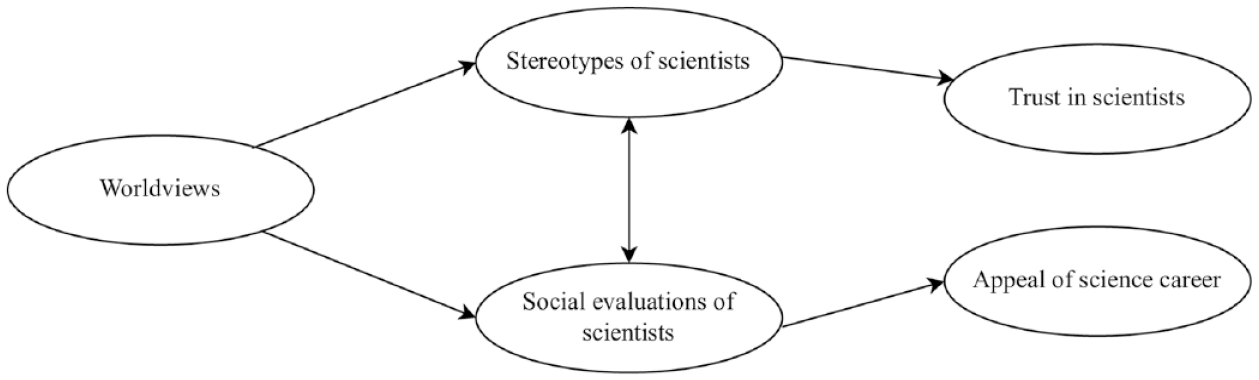
Conceptual model of the present research investigating the structure of scientist perceptions, their antecedents, and their outcomes.
Two parallel research lines on scientist perceptions: Stereotypes and social evaluations
Stereotypes about scientists
The importance of scientist perceptions was recognized early, when seminal research investigated how people (mostly children or students) see scientists. For example, Mead and Métraux (1957) asked students to complete statements about what they think a scientist is. Chambers (1983) devised the draw-a-scientist task, counting the number of stereotypical attributes drawn (e.g. lab coat). Generally, this research shows that scientists are stereotyped as intelligent, socially inept, and performing dangerous experiments (e.g. Beardslee and O’Dowd, 1961; Finson et al., 1995; Sala de Gómezgil, 1975). Further research has documented the “mad” scientist stereotype, where many scientists in popular—Western—culture are portrayed as crazy and dangerous (Basalla, 1976; Haynes, 2003). A recent review of work on the image of scientists finds support for these seminal observations (Ferguson and Lezotte, 2020), although the “mad” scientist stereotype has become less prominent (Haynes, 2016).
Overall, research suggests that “scientist” evokes an image of an extremely smart, but not very social and even potentially dangerous, middle-aged-to-old, white, bearded man, who is wearing glasses and works in a laboratory filled with books and instruments. This image is quite specific, rich, and detailed, and may be modeled after various widely known scientists such as Einstein, Newton, and Bell (Miele, 2014; Narayan et al., 2009; Rubin et al., 2003). More recently, with the development of social evaluation models, these information-rich stereotypes have been reduced to more systematic but also two-dimensional social evaluations.
Social evaluations of scientists
The stereotype content model (SCM; Fiske et al., 2002) suggests that stereotypes about social categories can be reduced to two dimensions: warmth (whether someone has good or bad intentions) and competence (whether someone is able to achieve those intentions). Other models underscore the importance of other dimensions (e.g. the difference between warmth and morality; Ellemers, 2017; Leach et al., 2007). The most recent integration of five models of social evaluations agrees on two dimensions of which each has two sub-dimensions (Abele et al., 2021). These include competence (intelligence/capability) and assertiveness (confidence/dominance) which comprise the agency dimension, and morality (honesty/fairness) and warmth (friendliness/care) which comprise the communion dimension (Abele et al., 2016; Abele and Wojciszke, 2014). Research on scientist evaluations that employed these models yielded consistent results: Scientists are seen as extremely competent (which is seen as their prototypical trait), very moral, and moderately warm (Fiske and Dupree, 2014; Fujiwara et al., 2022; Gligorić et al., 2022; Rutjens et al., 2022). Though this work somewhat overlaps with research on scientist stereotypes (e.g. scientists as brilliant), social evaluations are not as detailed but stem from reductionist techniques used for analyzing perceptions of various groups. That is, a stereotypical image includes characteristics that are not part of social evaluations (e.g. gender, various attributes such as books). While some of these characteristics can signal social evaluations (e.g. gender stereotypes of scientists as men could signal competence and coldness; McPherson et al., 2022), these are not equivalent. What is more, these two research lines also point to different conclusions: Whereas the “mad and dangerous” stereotype emerged from research on stereotypes, work on social evaluations suggests that scientists are evaluated as relatively moral. However, differences or similarities between these two lines of inquiry have never been investigated. Equally strikingly, research on antecedents of scientist perceptions is scarce, and it is therefore unclear why people differ in perceptions in the first place.
Antecedents: Where do scientist perceptions come from?
A better understanding of scientist perceptions and the potential differences between stereotypes and social evaluations depends on knowing where these perceptions stem from. While some studies on scientist perceptions focused on socio-demographic variables (e.g. age, gender, education; Losh, 2010), Besley (2015) systematically investigated a large number of predictors including experience with science such as museum visits and science knowledge. He discovered that science knowledge and taking science courses—but not experiences like museum visits—were the most important predictors (though see Thomson et al., 2019 who found that museum visits were associated with more stereotyping). However, it was acknowledged that “relatively small amounts of variance were explained by the constructed models” (Besley, 2015: 12). Although this study did not find much evidence for the effects of media exposure, other studies suggest that media consumption may influence how scientists are perceived (e.g. Steinke et al., 2007; Tan et al., 2017).
While other work also recognizes the importance of certain worldviews in scientist perceptions (e.g. political ideology; Hardy and Tallapragada, 2021), the role of various worldviews has not been systematically explored in one study. This is surprising given that worldviews help shape attitudes toward science and scientific findings (Hornsey, 2020): Liberals have more positive attitudes toward science than conservatives (e.g. Blank and Shaw, 2015; Gauchat, 2012), while religion and science can be seen as two opposing ways of explaining existential questions, and so some religious people have less positive perceptions of scientists (Beauchamp and Rios, 2020) and are more skeptical about certain scientific discoveries, such as evolution (Ecklund et al., 2017) or COVID-19 vaccines (Tippins et al., 2023). Like religiosity, spirituality can also be in contradiction with science as it relies on intuitive and subjective experiences in determining truth (Hanegraaff, 1998; Lindeman et al., 2019), and it is a consistent predictor of vaccine skepticism and low faith in science (Rutjens and Van der Lee, 2020). Moreover, the relationship between a conspiratorial worldview and science attitudes has been well documented, so that individuals prone to conspiracy theories tend to reject scientific findings (Lewandowsky et al., 2013; Van der Linden, 2015; also see “conspirituality,” where a conspiratorial mind-set is merged with spirituality, Halafoff et al., 2022). Finally, as discussed earlier, the stereotype of the “mad” scientist is deeply embedded in western culture, which means that the extent to which one is encultured in Western society could influence perceptions of scientists (Haynes, 2003; see Farland-Smith, 2009). Overall, although it is clear that worldviews play important role in science attitudes, systematic research on their precise role in scientist perceptions is lacking. In addition, their relative importance has not been tested. Based on the aforementioned work, we selected five worldview variables: political ideology, religiosity, spirituality, conspiracy mentality, and western enculturation. We next turn to the two of the most obvious outcomes of scientist perceptions—trust in scientists, and the appeal of a career in science.
Outcomes: What is the role of scientist perceptions?
How people perceive scientists can have far-reaching consequences. Arguably, one important consequence is trust in scientists, which is crucial in securing public buy-in regarding various science-based policies. In other words, meeting a certain threshold of public trust in scientists facilitates the acceptance of policies such as vaccination programs and sustainable consumption patterns (Algan et al., 2021; Motta, 2018). Whereas research on how stereotypes relate to trust is scarce, studies on the role of social evaluations of scientists are more numerous, arguing that social evaluations are components of trust (Besley et al., 2021; Fiske and Dupree, 2014; Hendriks et al., 2015).
However, research on how stereotypes (but not social evaluations) relate to the willingness to pursue a scientific career is ampler. If a stereotypical scientist is perceived as a white middle-aged-to-old man, this could form a barrier for people who do not conform to this stereotype to consider a career in science themselves. Multiple studies supported this notion, many of which focus on gender and ethnicity (e.g. Cundiff et al., 2013; Hurtado et al., 2009; Lane et al., 2012; Master, 2021; Nosek et al., 2009; Schinske et al., 2015, 2016; Sharp et al., 2022).
The present research
The primary aim of this research was to explore how the two research lines identified earlier relate to each other. Improving and honing understanding of perceptions of scientists is key in the wake of societal problems in which scientists play a crucial—and sometimes very public—role (e.g. the COVID-19 pandemic, climate change; KNAW, 2022). To understand the relationship between stereotypes and scientist evaluations, we investigated their relationship with five worldview predictors (political ideology, religiosity, spirituality, conspiracy mentality, western enculturation), and two outcomes (trust in scientists and science career appeal). We conducted two preregistered studies. Study 1 (online convenience sample; N = 532) focused on worldviews as predictors of scientist perceptions (stereotypes and evaluations) and trust in scientists as the outcome variable. Study 2 (online Prolific sample, N = 559) served as a replication and extension which added a measure of science career appeal. To investigate the role of stereotypes in more detail in Study 2, we used quota sampling in order to obtain two subsamples—one congruent and one incongruent with the scientist stereotype (middle-aged-to-old, white male). All materials, data, and analysis scripts for R are disclosed at the Open Science Framework (https://osf.io/b3qt5/). Pre-registration for Study 1 is available on https://osf.io/q2x67 and for Study 2 on https://osf.io/7wk4e. It is important to note that our research was conducted using non-representative samples from different countries and utilized different sampling strategies, which means that the generalizability of the findings remains to be tested (though note that it has been shown that psychological effects depend more on the relationships between the variables that are studied than on the sample or setting; Klein et al., 2018).
1. Study 1
Method
Sample
For Study 1, we aimed for a minimum of 250 participants, which is required for correlations to stabilize (Schönbrodt and Perugini, 2013). The sampling strategy included convenience and snowball sampling (e.g. Reddit), which resulted in 586 participants. After excluding the participants who failed the attention check (had not selected the instructed option; n = 28), completed the survey faster than 5 minutes (n = 4), or were outliers on Mahalanobis distance on all measured variables (n = 20), 532 participants remained. No analyses were performed before data exclusion. The sample (Mage = 29.22, SD = 10.82) was relatively balanced in gender (50.3% female, 43.4% male, 6.3% other). Given the recruitment strategy, the sample was diverse in terms of country origin, with the majority being from the United States (41%), followed by the Netherlands (18%), the United Kingdom (10%), Canada (6%), and Germany (5%), whereas the rest indicated other countries. Most participants were highly educated (56.6%) as they had an undergraduate or graduate degree. The rest included individuals who had less education than high/secondary school (1.5%), completed high/secondary school (12.2%), and students (29.7%).
Procedure and materials
The study was approved by the Ethical Review Board of the University of Amsterdam. Study 1 consisted of an online survey programmed in Qualtrics. After giving their consent to participate, participants indicated their age, gender, educational level, and country of origin. Next, they completed five worldview measures (randomized order) and measures about scientists (evaluations, stereotypes, and trust; randomized order). Besides the measures of worldviews and perceptions of scientists, the survey also contained measures of epistemic motivations, which were a part of another project and will therefore not be mentioned further. The survey took about 12 minutes to complete.
Political ideology was measured using two items. One item measured political ideology on social issues and the other measured political ideology on economic issues (1 = left-wing, 5 = center, 9 = right-wing). Both questions were provided with examples of what social issues (e.g. minority rights, gender equality) and economic issues (planned vs free-market economy) entail, as well as an explanation for what it means to be left-wing or right-wing (Gligorić et al., 2021). The correlation between the two items was high, r = .66.
Religiosity was measured using the 5-item Centrality of Religiosity Scale (CRS-5; Huber and Huber, 2012). The scale included items such as “To what extent do you believe that God or something divine exists?” and “How often do you take part in religious services?” The answers were given using a five-point scale (label phrasing depended on the question). The CRS-5 had good reliability (α = .85).
Spirituality was measured with two items: participants indicated to what extent they consider themselves to be a spiritual person and to what extent other individuals consider them to be a spiritual person, using a seven-point Likert-type scale (1 = not at all, 7 = very much; Rutjens and Van der Lee, 2020). The correlation between the two items was high, r = .83.
Conspiratorial mentality was measured with the seven-item subscale “Conspiracy Theory Ideation” (CTI) of the Conspiracy Mentality Scale (CMS; Stojanov and Halberstadt, 2019). Participants indicated their agreement with statements such as “The government or covert organizations are responsible for events that are unusual or unexplained” using a seven-point Likert-type scale (1 = strongly disagree, 7 = strongly agree). The scale had good reliability (α = .83).
Western enculturation was measured by adapting the Acculturation, Habits, and Interests Multicultural Scale for Adolescents (AHIMSA; Unger et al., 2002). In this study, the eight statements from the original AHIMSA were presented with each of them ending with “western culture.” The statements (e.g. “The people I fit in with best are from Western culture.”) were rated using a five-point Likert-type scale (1 = strongly disagree, 5 = strongly agree). The scale had good reliability (α = .80).
Stereotypes of scientists
To measure the extent to which individuals endorsed stereotypes of scientists, we selected the most prominent attributes of the scientist stereotypes. This selection was made from the meta-analysis of the Draw-A-Scientist Checklist (Ferguson and Lezotte, 2020), a checklist developed to identify how stereotypical people’s drawings of scientists are (Chambers, 1983; Finson et al., 1995). From this checklist, we took the 10 characteristics that are perceived to be the most stereotypical of scientists, in descending order: male sex, Caucasian/white, symbols of research (e.g. microscope), indoor work, middle-aged-to-old, lab coat, eyeglasses, symbols of knowledge (e.g. books), technology, facial hair. Participants were asked to judge how accurately these attributes reflected their image of scientists (1 = not accurate at all to 5 = extremely accurate). Higher scores indicated a more stereotypical perception. Apart from the stereotypical attributes, we added five distractor attributes that were not part of the analysis (e.g. bicycle riders, musical instruments). The scale showed good reliability, α = .82.
Social evaluations of scientists
Participants reported their social evaluations of scientists, which were based on four dimensions of the Dual Perspective Model (DPM; Abele and Wojciszke, 2014). All dimensions were rated using a seven-point bipolar scale (–3 to 3) with adjectives belonging to each dimension (Abele and Hauke, 2020; Abele et al., 2016). Dimensions included competence (e.g. little capable to very capable), assertiveness (e.g. not at all self-confident to very self-confident), morality (e.g. little fair to very fair), and warmth (e.g. little caring to very caring). The reliabilities of all four measures (Cronbach’s α) were good: for competence, assertiveness, warmth, and morality, they were .83, .69, .81, and .83, respectively.
Trust in scientists was measured using the four-item General Trust in Scientists Index (McCright et al., 2013). Using a five-point Likert-type scale (1 = completely distrust to 5 = completely trust), participants answered to what extent they distrust or trust scientists (e.g. to “create knowledge that is unbiased and accurate”). The scale showed good reliability (α = .82).
Results and discussion
Correlations between measures of worldviews, scientist stereotypes, social evaluations, and trust are provided in Table 1. There are several things to note. First, worldview variables are not highly inter-correlated (except religiosity and spirituality), which is suitable for testing the relative importance of predictors in scientist perceptions. Second, social evaluation measures show medium to high intercorrelations, suggesting a general positive evaluation. However, these evaluations have small correlations with stereotypes (warmth correlates negatively, which is in line with the stereotype). Most interestingly, not stereotypes, but social evaluations are related to trust in scientists.
Correlation between worldviews and scientist measures (stereotypes, evaluations, and trust).
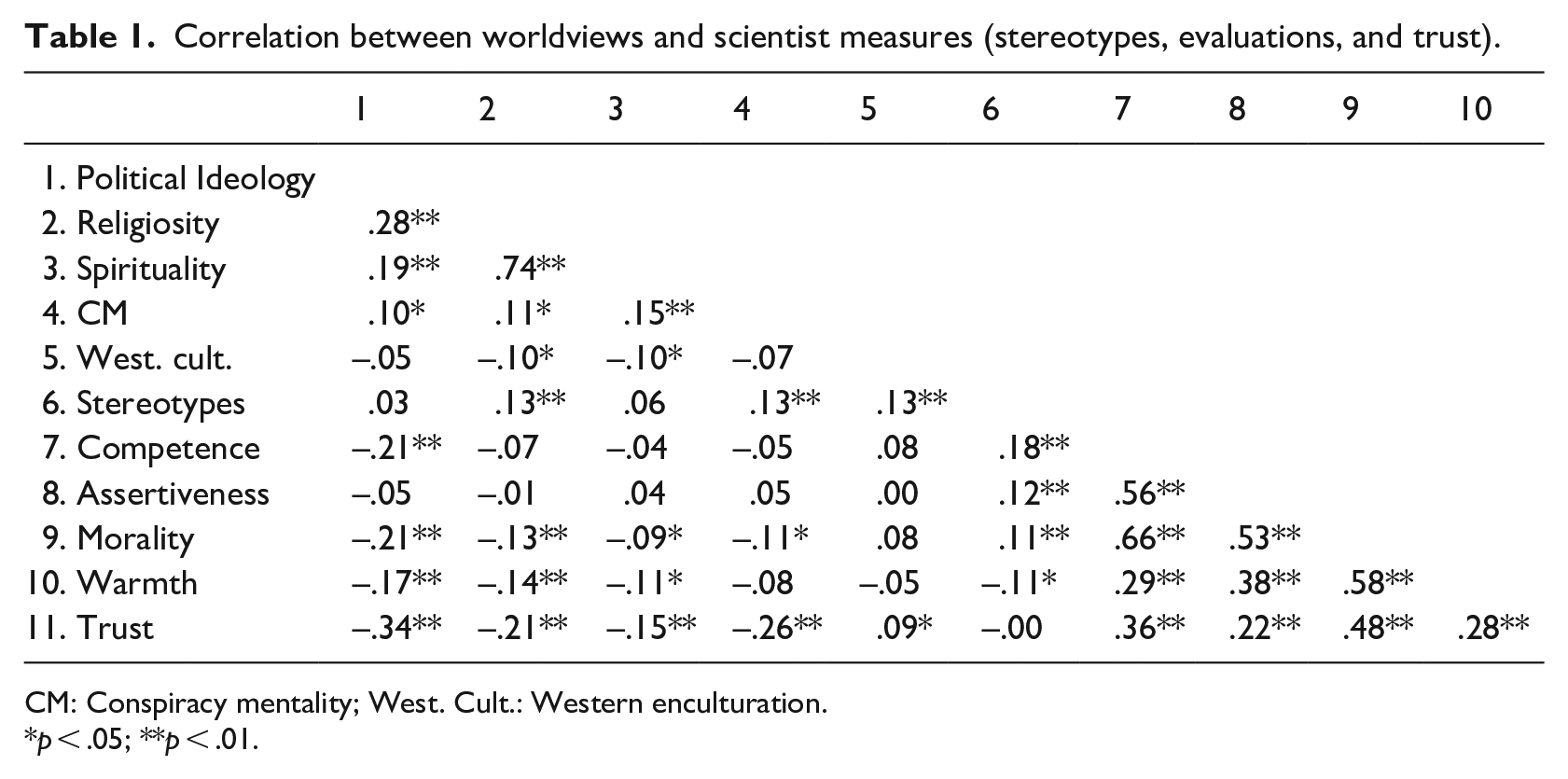
CM: Conspiracy mentality; West. Cult.: Western enculturation.
p < .05; **p < .01.
Next, we conducted a path analysis (fully saturated model), in which we investigated how worldviews predict stereotypes and scientist evaluations, subsequently predicting trust. Results are displayed in Figure 2. There are three important things to note. First, stereotypes of scientists have different predictors than social evaluations. While religiosity and western enculturation predict stereotypes, political ideology does not, and the opposite is true for social evaluations (note that the only common predictor is conspiracy mentality). Second, political ideology is the most important worldview variable in predicting scientist evaluations (more right-wing participants perceived scientists as less competent, moral, and warm). Finally, echoing the zero-order correlations, not stereotypes, but social evaluations (only morality) are related to trust in scientists.
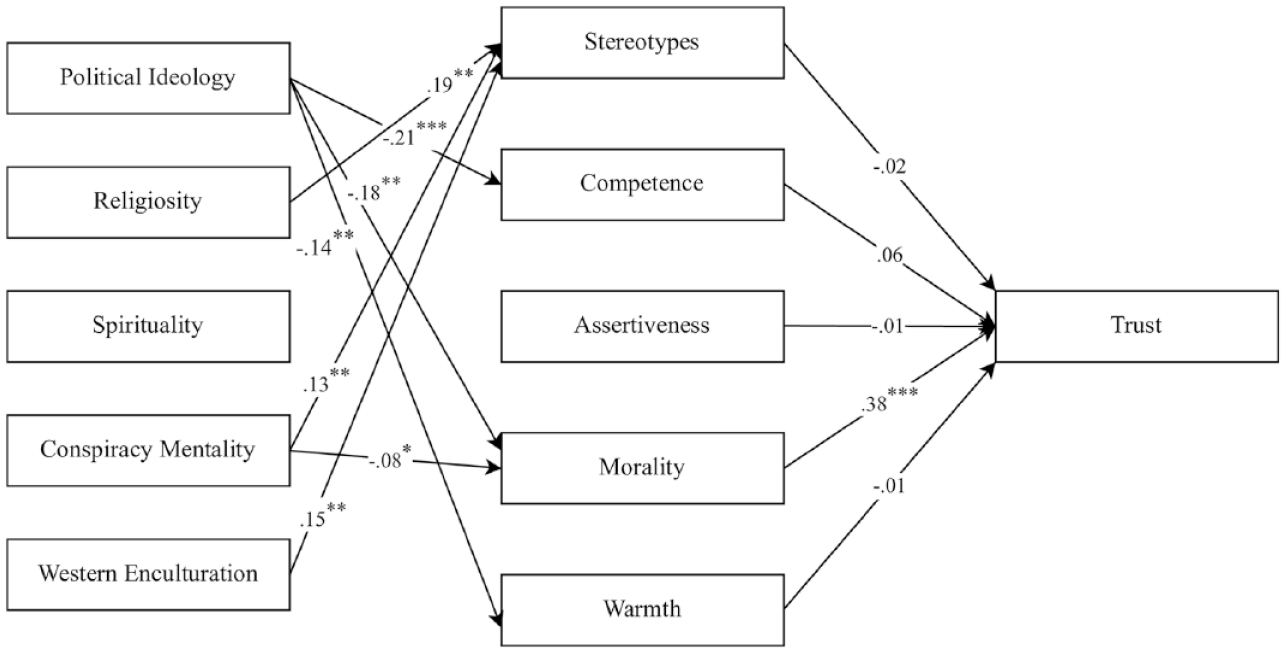
Path analysis of worldviews predicting scientist stereotypes and evaluations, which then predict trust. For readability, we present only significant paths from worldviews on stereotypes and evaluations.
2. Study 2
Study 1 showed that stereotypes and social evaluations of scientists have different predictors: Religiosity and western enculturation were associated with more stereotyping, while right-wing political ideology predicted more negative social evaluations. We also found that social evaluations—not stereotypes—are related to trust in scientists (all had positive zero-order correlations; though only morality was significant when all evaluations were entered). In Study 2, we aimed to replicate these findings utilizing a different sample and extend them in two ways. First, we added a behavioral measure of trust. Second, we aimed to explore how scientist stereotypes and social evaluations relate to the science career appeal. We were specifically interested in testing whether scientist-stereotype-incongruent people (young, non-white, non-men) who endorse a stereotypical image of scientists (middle-aged-to-old, white men) would indicate work in science to be unappealing; while scientist-stereotype-congruent people (middle-aged-to-old, white men) who endorse a stereotypical image of scientists would report they perceive work in science as highly appealing.
Method
Sample
We recruited 600 US participants from Prolific since we aimed to have 200 participants in each group (stereotype congruent, incongruent, and mixed). This was based on the required minimum sample (191) to detect the correlation of r = .2 (α = .05, power = .80). We excluded participants who failed an attention check question (n = 4), completed the survey too fast (4 minutes; n = 16), and multivariate outliers (n = 21). No analyses were performed before data exclusion. The final sample was made of 559 participants (238 men, 313 women, and 8 indicated “other”; Mage = 38.9, SD = 15.5). Regarding education, 0.5% indicated education less than high/secondary school, 25.9% had completed high/secondary school, 12.7% were students, 45.4% had an undergraduate degree, and 15.4% had a graduate degree. Regarding ethnicity, most participants identified as either White/Caucasian (64.6%), Asian (17.2%) or Black/African-American (9.3%).
Materials
After signing the consent form, participants reported their demographics. Next, they completed the same worldview measures (political ideology, religiosity, spirituality, conspiracy mentality, western enculturation) from Study 1 in a randomized order. Next, participants completed the block of measures that included social evaluations from the DPM model, stereotype scale, and trust in scientists (Study 1). All scales showed good reliability (αs ⩾ .83). Compared to Study 1, we also calculated scores on stereotypes of scientists only focusing on demographics, that is, to what extent participants stereotype a scientist as an old, white male. Participants also completed additional measures in Study 2—another measure of trust and measures related to the science career.
Trusting behavior: Influence granting task (IGT)
We also measured trust in scientists using a task in which participants were presented with a pressing problem that is affecting every citizen, and which would require the help and advice of various scientists. Participants had 100 points of decision power to distribute across seven different parties offered, which also included scientists. Granting the decision-power to scientists indicated higher levels of trust in scientists. We developed and piloted this measure for a different project (Gligorić et al., 2024; for more information, please see osf.io/d5zcj).
In the final set, participants answered questions about a career in science. They first responded if they have ever worked as a scientist for at least 3 months (80 yes and 479 no), and whether they currently work as a scientist (24 yes and 535 no). Next, they answered a 5-item scale measuring how appealing a science career seems to them (five-point bipolar scale; for example, boring—interesting; Tyler-Wood et al., 2010). Finally, those participants who responded they did not work as a scientist, completed another scale of interest in working as a scientist (aspirations of working as a scientist). Participants were asked to imagine themselves in a position before making a career choice when answering questions. They indicated agreement with six statements (e.g. “I would like to work in a career involving science”) using a five-point scale (1 = fully disagree to 5 = fully agree). We constructed this measure by taking three items from both aspirations in science (DeWitt et al., 2013) and orientation toward a future in science (Hampden-Thompson and Bennett, 2013). Both appeal and aspiration scales showed high reliabilities (α = .91 and .96, respectively).
Results and discussion
Correlations between used measures are given in Table 2. Replicating the results of Study 1, worldview variables are not highly inter-correlated, while social evaluation measures are again highly correlated, suggesting a general positive evaluation. Again, scientist stereotypes show relatively low correlations with social evaluations (though warmth was not correlated). Finally, mirroring the results of Study 1, while stereotypes are not reliably related to trust (two significant correlations out of four, opposite signs), more positive scientist evaluations are related to higher trust in scientists (all eight correlations).
Correlations between worldviews (first set of variables), scientist stereotypes (second set), scientist evaluations (third set), and science career (fourth set) measures.
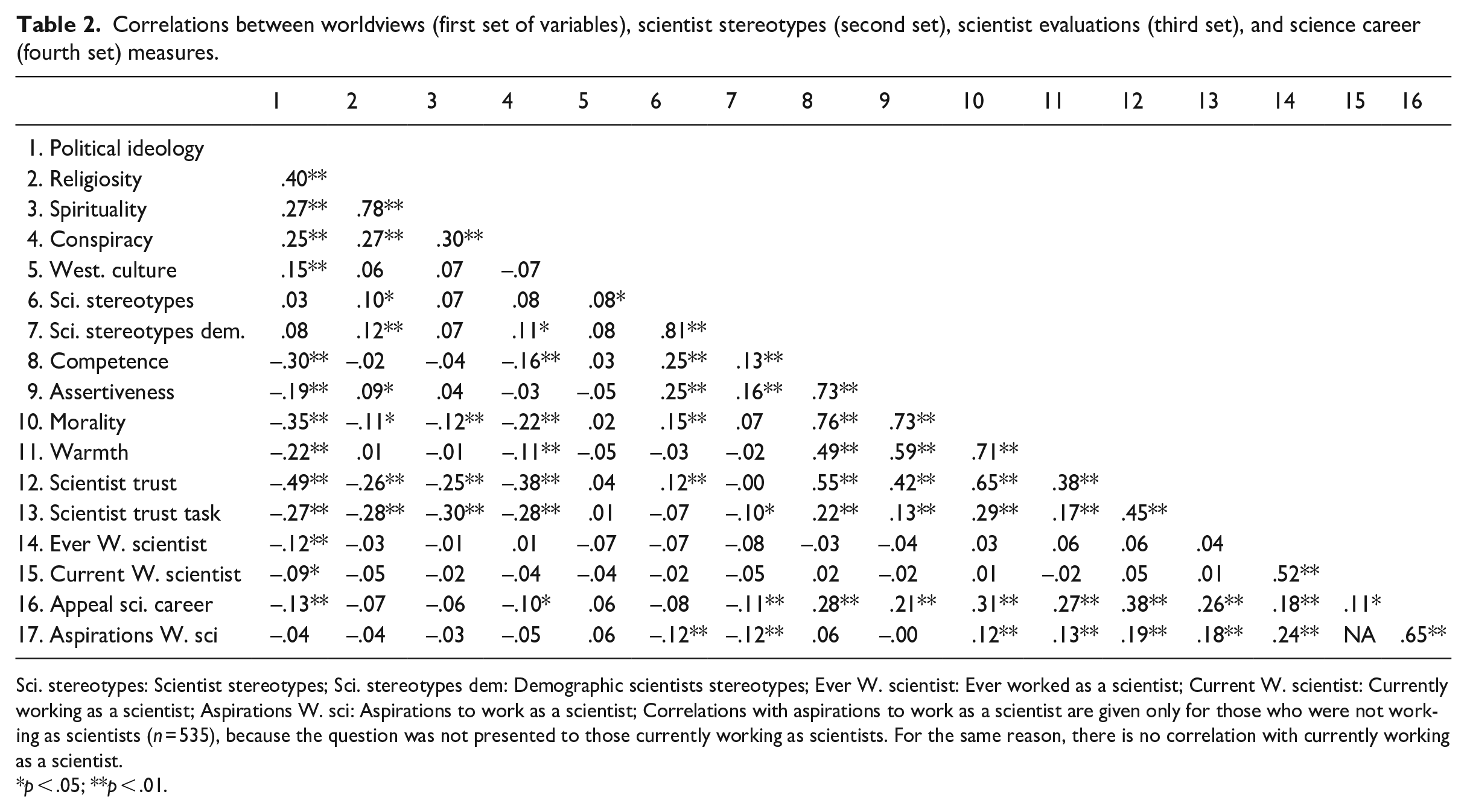
Sci. stereotypes: Scientist stereotypes; Sci. stereotypes dem: Demographic scientists stereotypes; Ever W. scientist: Ever worked as a scientist; Current W. scientist: Currently working as a scientist; Aspirations W. sci: Aspirations to work as a scientist; Correlations with aspirations to work as a scientist are given only for those who were not working as scientists (n = 535), because the question was not presented to those currently working as scientists. For the same reason, there is no correlation with currently working as a scientist.
p < .05; **p < .01.
To investigate these relationships in more detail, we conducted a path analysis (fully saturated model) in which we investigated how worldviews predict stereotypes and scientist evaluations, which then predict trust and science career appeal. The results are summarized in Figure 3. Several results deserve attention. First, as in Study 1, stereotypes of scientists are predicted by religiosity and western enculturation, rather than other worldviews. In contrast, political ideology is the most important predictor of scientist evaluations: right-wing individuals perceive scientists as less competent, assertive, moral, and warm. Second, not stereotypes of scientists, but social evaluations (especially morality) predict trust. Third, both stereotypes and social evaluations predict the science career appeal. To investigate how stereotypes predict science career appeal, we ran the same path model for two sub-samples: stereotype incongruent (young, that is, 30 years old and younger, non-white, non-men; n = 166) and congruent (40 or more years old white men; n = 187). The effect of stereotypes on the science career appeal was driven by the stereotype-incongruent sample, and there was no effect of stereotypes in the stereotype congruent sub-sample.
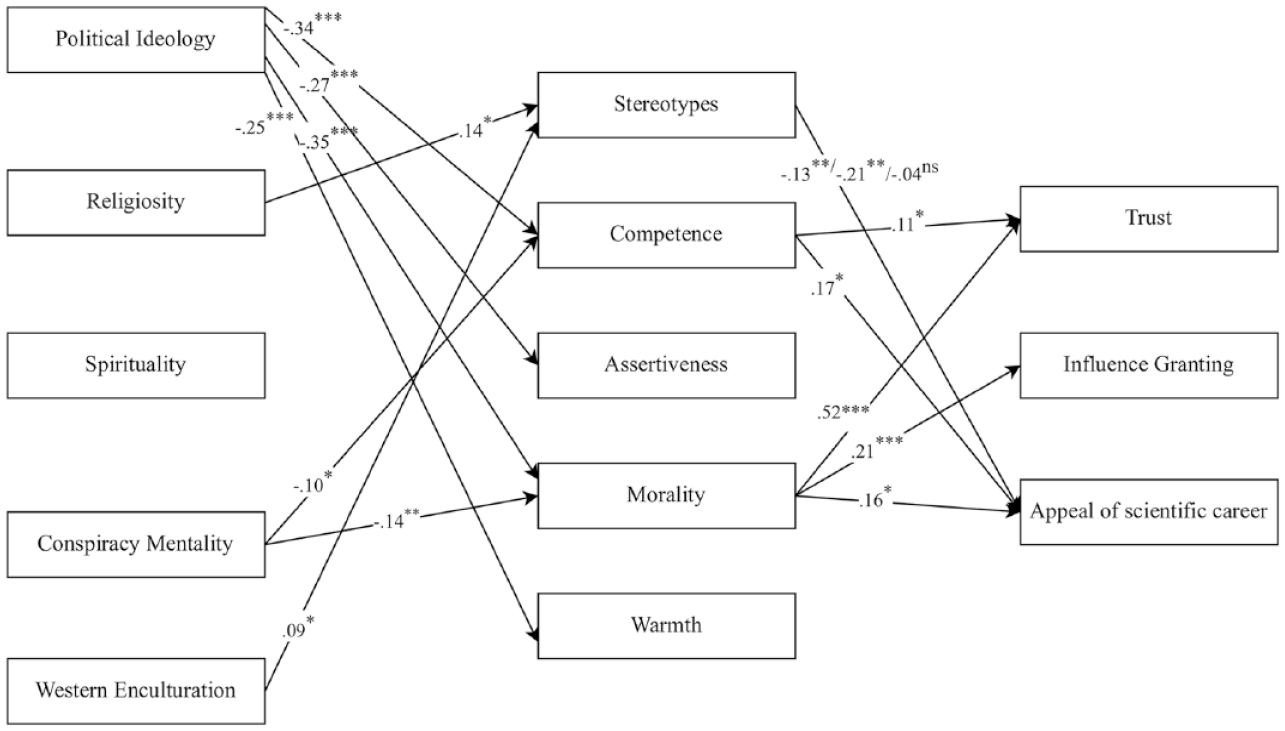
Path analysis of worldviews predicting scientist stereotypes and evaluations, which in turn predict trust and science career appeal. Only significant paths are displayed. 1 We provide values of three effects of stereotypes on the science career appeal; (1) for the whole sample, (2) for the stereotype-incongruent sub-sample, and (3) for the stereotype-congruent sub-sample. Calculating stereotypes by only focusing on three demographic features (extent of having an image of a scientist as an old, white male) yielded almost identical results.
3. General discussion
The current work integrates two research lines on scientist perceptions: stereotypes and social evaluations. Across two studies, we found that stereotypes and social evaluations of scientists are two different types of perception that are generated by different worldviews: stereotypes emerge from religiosity and western enculturation, while right-wing political ideology and to a lesser extent conspiracy mentality predict negative social evaluations of scientists. They are also associated with relatively different outcomes—while stereotypes are unrelated to trust in scientists, more positive social evaluations (competence and morality) are associated with more trust in scientists. In addition, both less stereotyping and more positive social evaluations independently contributed to the increased appeal of a science career.
Scientist perceptions: Stereotypes and social evaluations
The current work reveals interesting dynamics between stereotypes and evaluations. We previously noted that social evaluation models result from a reduction of multiple traits that groups are perceived to possess (Fiske et al., 2002). As such, social evaluations proved useful in understanding both the science career appeal and trust in scientists. However, due to relatively low overlap with stereotypes, focusing only on evaluations can underestimate the complexity of social perceptions, at least when it comes to perceptions of scientists. This study demonstrates that a better understanding of scientist perceptions requires it to be taken in its detailedness.
Worldviews shaping scientist perceptions
While some previous research investigated contributors to scientist perceptions (e.g. experience with science, media exposure; Besley, 2015), it did not investigate the role of a key antecedent of science attitudes—worldviews (Hornsey, 2020; Rutjens et al., 2018b). While the relevance of political ideology has been recognized previously (Agley, 2020; Blank and Shaw, 2015; Gauchat, 2012), we demonstrate that it has a most prominent role over and beyond other worldviews. Several reasons for this association have been put forward: the first is that scientists, who challenge the status quo, threaten the conservative worldview with discoveries and change they inevitably bring (Gauchat, 2012; Nisbet et al., 2015). Another reason is that conservatives perceive (certain) scientists as advancing liberal values, therefore distrusting liberal scientists, and not the scientific method per se (Cofnas et al., 2018; Mann and Schleifer, 2020). The current studies corroborate that political ideology is an important driver of social evaluations of scientists.
The role of conspiracy mentality in science attitudes has started getting more attention (Rutjens and Većkalov, 2022), especially in light of the COVID-19 pandemic during which various conspiracy theories surged (Imhoff and Lamberty, 2020; Pertwee et al., 2022). Scientists are suitable target candidates for conspiracy theories—they are often perceived as an elitist group working in relative isolation (Douglas et al., 2019; Rutjens et al., 2018a).
The role of scientist perceptions in trust and career appeal
Discovering that social evaluations (competence and morality primarily) predict trust in scientists is in line with various trust models that assume the central role of social evaluations in trust (Besley et al., 2021; Hendriks et al., 2015; Mayer et al., 1995). However, we are aware of only one other study that directly tested the role of social evaluations on trust in scientists, which also observed a prominent role of competence and morality (Gligorić et al., 2024). It is interesting that stereotypes were not found to be reliably related to trust, which can be explained by the fact that stereotypes include positive, negative, and neutral traits.
Science career appeal, however, was found to be predicted by scientist stereotypes as well as social evaluations. The effect of stereotyping emerged only for individuals who do not conform to the scientist stereotype (i.e. young, non-white, non-male), but not for those who do. This finding has obvious practical implications: to increase the science career appeal, a two-pronged approach might work. One route could focus on improving social evaluations of scientists (e.g. Zahry and Besley, 2019, 2021), while the other route would include the countering of stereotypes—particularly when targeting individuals who are dissimilar from the scientist stereotype.
Limitations, future research, and conclusion
Some limitations of the current research need to be mentioned. First, some measures were short, consisting of only two items per scale (e.g. political ideology, spirituality). However, their respective items showed high intercorrelations, and the relationships were consistent across the two studies. Moreover, these measures have been well-validated in previous research. Second, both studies were correlational, so causal inferences cannot be made. Although the direction of effects is conceptually plausible (e.g. it is more logical that worldviews affect scientist evaluations rather than vice versa) and based on other research (e.g. the role of evaluations in trust), future research should test them experimentally. Given the significant role of perceptions of morality (also see Bender et al., 2016), future research should focus particularly on this dimension. Future research should clarify paradoxical perceptions of scientists as moral, with the evil/mad stereotype of scientists who are capable of severely immoral deeds. Finally, our research was conducted using non-representative (and predominantly the United States) samples, so the generalizability of the findings remains to be tested.
In conclusion, we found that different perceptions of scientists (stereotypes and evaluations) are associated with different antecedents and outcomes. Future research should acknowledge the complexity of scientist perceptions by distinguishing between stereotypes and social evaluations of scientists. This will not only help to further inform ways to increase trust in scientists, but also provide insights into ways to encourage people to pursue a science career, especially those who come from backgrounds that do not mesh with the scientist stereotype.
Footnotes
Funding
The author(s) disclosed receipt of the following financial support for the research, authorship, and/or publication of this article: parts of this research were funded by the European Research Council Starting Grant awarded to Bastiaan Rutjens (No. 849125).
