



Abstract
Communicating uncertainties is central to science communication, yet evidence on its effects is inconclusive. In an online experiment with a quasi-representative sample in Austria (N = 1126), we investigated the effects of message (uncertainty type) and audience characteristics (science-specific attitudes/beliefs) as potential moderating factors on risk perception and policy support in the context of microplastic health effects. Uncertainty communication, specifically communicated lack of scientific consensus (consensus uncertainty), triggered lower risk perception (small effect), and indirectly decreased policy support through message credibility and risk perception. These negative effects were lower (and not statistically significant) when communicating the remaining knowledge gaps (deficient uncertainty). Beliefs about science as a debate were positively associated with risk perception, trust in scientists with policy support and preference for information about uncertain science with both. However, these audience characteristics did not moderate the effects of uncertainty communication. The results highlight the importance of considering uncertainty types in environmental and health risk communication.
Keywords
1. Introduction
Uncertainty is an inherent element of science and scientific knowledge (Kampourakis and McCain, 2019). Science communication, however, often refrains from conveying the uncertainties associated with scientific knowledge in order to increase simplicity and clarity for non-expert audiences (Ebeling, 2008), or avoid potentially adverse effects, such as reduced credibility (Stocking, 1999) or greater public confusion (see Lofstedt and Bouder, 2021). Some scholars also assume that the public has difficulties processing ambiguous information and prefers certainty (see Lofstedt and Bouder, 2024; Lofstedt et al., 2021), and therefore recommend caution in reporting uncertainties (König et al., 2024). By contrast, other authors argue that the public is capable of handling uncertainty (Jensen, 2008), and there has been a growing demand for greater transparency in evidence communication including the disclosure of uncertainties (e.g. Blastland et al., 2020; van der Bles et al., 2020), for example, in the context of food safety (European Food Safety Authority (EFSA), 2019). As the current body of evidence on the effects of communicating scientific uncertainty to the public is inconclusive (see Gustafson and Rice, 2020), it is crucial to further develop our understanding of whether, when and for whom communicating uncertainty influences perceptions of potential risks and the acceptance of associated regulatory measures. Here, we test the effect of different types of message characteristics (type of communicated uncertainty) as well as audience characteristics (science-specific attitudes and beliefs) on risk perception and policy support in the context of microplastics in the food chain, where scientific uncertainties remain, particularly regarding potential effects on human health.
Uncertainty around effects of microplastics on human health
Microplastics are small plastic particles in the size range between 0.1 or 1 μm and 5 mm (SAPEA, 2019). They mainly result from the breakdown of larger plastics and their presence is ubiquitous, including in drinking water and food/drink products, which is also one of the main pathways of microplastics into the human body (besides inhalation; WHO, 2022). Scientific evidence about human health effects of exposure to microplastics is currently unclear (SAPEA, 2019; WHO, 2022), with some studies suggesting negative effects on the digestive, nervous, respiratory, reproductive and cardiovascular systems (Liu and You, 2023; Marfella et al., 2024; Yan et al., 2022), while others claim that most research does not accurately reflect the real-life conditions of humans (Mills et al., 2023). Consequently, uncertainty remains, posing considerable challenges to communication (e.g. Wardman et al., 2021). Importantly, microplastic concentrations are expected to increase, and following the precautionary principle, calls for regulatory measures have been increasingly raised. These calls come from those directly involved in the issue (e.g. agriculture, food industry, gastronomy; Fian et al., 2024), from leading scientific experts in plastic pollution (Bergmann et al., 2022; Thompson et al., 2024), and governments (e.g. the high-ambition coalition in the UN negotiations for a Global Plastics Treaty).
Notably, despite scientific knowledge gaps, public concern about microplastics has been found to be high (e.g. Fian et al., 2025; Kramm et al., 2022). Microplastics in food top the list of health concerns among the Austrian and German public (AGES, 2022; BfR, 2023), and people have expressed their desire for more information about the effects of microplastics (Fian et al., 2024). In a previous study in Austria (Fian et al., 2025), socio-demographic and psychological predictors of risk perception and policy support in the context of microplastics among the public were identified, of which perceived scientific consensus on health risks was a key one. Thus, the challenge here is to balance the adequate and ethical expression of current inconclusive scientific knowledge, while facilitating informed decision-making regarding an issue that will ultimately require public policy acceptance.
Uncertainty around communicating uncertainty
The role and effects of uncertainty in science communication have been a subject of study for decades (e.g. Frewer et al., 1998; Johnson and Slovic, 1995), with results suggesting positive, negative and null effects on various outcomes (e.g. attitudes, risk perceptions, behavioural intentions, trust, credibility; see Gustafson and Rice, 2020 for a review). 1 For instance, Schneider et al. (2022) found that the communication of scientific uncertainties had negative effects on perceived trustworthiness and use of information in decision-making in a public health context. This negative effect of uncertainty communication on trustworthiness of the information source was also found for other issues, such as global warming or immigration (van der Bles et al., 2020). Similarly, ‘hedged’ information (meaning that it included indicators of scientific uncertainties) on COVID-19 vaccine research resulted in less favourable vaccine attitudes and intentions, and less trust in scientists and news reporting (Ratcliff et al., 2024). Likewise, communicating uncertainties resulted in lower risk perceptions of pandemic vaccine-preventable diseases (Han et al., 2018). Conversely, Jensen (2008) found that scientists were perceived as more trustworthy when the news coverage of their findings on cancer research was ‘hedged’ as uncertain. Finally, several experimental studies found no significant effects when manipulating uncertainty. For instance, Gustafson and Rice (2019) found no effects for three out of four different uncertainty types across three different issues on beliefs, risk perceptions and behavioural intentions. Similarly, Ratcliff and Wicke (2023) recently found no main effects of uncertainty disclosure on news credibility, scientists’ trustworthiness or willingness to participate in genomic research. Thus, while some scholars argue against the communication of uncertainty due to potential adverse effects, the empirical evidence remains mixed.
Message characteristics: Types of uncertainty
In response to these inconclusive findings, researchers have increasingly emphasised the importance of distinguishing between different types of uncertainty (Guo et al., 2025; Gustafson and Rice, 2019, 2020; Ratcliff, 2021). In this study, we focus on two prominent types: deficient uncertainty and consensus uncertainty. Deficient uncertainty (sometimes referred to as epistemic or scientific uncertainty, although with slightly varying definitions across studies) reflects the inherently uncertain nature of science, including the presence of knowledge gaps and limitations (Guo et al., 2025). Consensus uncertainty pertains to conflicting evidence or disagreement among experts. While most typologies also include technical uncertainty (i.e. related to measurement errors or statistical limitations), this type was not included in the current study due to lack of relevant quantitative estimates in our context.
The review by Gustafson and Rice (2020) found considerably more consistent patterns of results after differentiating between different uncertainty types. Specifically, for outcomes related to trusting scientists and following their recommendations, communication of consensus uncertainty (i.e. disagreement or controversy among experts) consistently demonstrated negative effects. By contrast, communicating other uncertainty types showed mixed or even positive effects. For instance, in terms of behavioural intentions, Markon and Lemyre (2013) found that mentioning expert disagreement reduced adherence to a risk message, whereas deficient uncertainty had no effect on message effectiveness in the context of drinking tap water. However, results remain inconsistent across studies. Communication of deficient uncertainty has shown mixed effects: positive, negative or null effects, depending on the context (see Gustafson and Rice, 2020). A more recent review by Guo et al. (2025) reported that consensus uncertainty showed negative effects on attitudes, but not credibility perceptions, while epistemic (including deficient) uncertainty positively affected credibility ratings. No effects were found for behavioural intentions. Importantly, individual-level audience characteristics have been found to moderate how individuals perceive and engage with information about science (see Gustafson and Rice, 2020).
Audience characteristics: Individual moderating factors
Science communication scholars have emphasised the importance of recognising the heterogeneity of public audiences (Scheufele, 2018), and previous literature has identified several individual variables that moderate the effect of uncertainty communication (e.g. prior worldviews and topic opinions, trust in science and scientists, the perceived role of uncertainty in science; see Gustafson and Rice, 2020). For this study, we decided to focus on science-specific attitudes and beliefs as potential moderators of interest, as they have been found to play a role in people’s beliefs about microplastics and plastic-reducing measures (see Fian et al., 2024).
Beliefs about science
Interpretations of scientific uncertainties are likely to be influenced by an individual’s prevailing epistemic beliefs about science and conceptions of its purpose, specifically whether science is regarded as a search for absolute truth or as a debate between alternative positions This is rooted in different philosophical models of science and the status of scientific uncertainties within each of these models. According to the classical model, only one true answer to scientific questions can exist. Conversely, the alternative or Kuhnian model of science proposes that the function of science is to debate different versions of truth (see Rabinovich and Morton, 2012). Previous research indicates that people who view science as a debate are more convinced by high-uncertainty messages related to climate change risks than those who view science as a search for truth (Rabinovich and Morton, 2012). In line with this, for those who view science as a search for truth, perceived scientific consensus was found to be a stronger predictor of climate change beliefs across four European countries (Bertoldo et al., 2019).
Trust in scientists
While the trustworthiness of the information source (i.e. the scientist) has frequently been treated as an outcome variable in uncertainty communication experiments, it has also been posited as a potential moderating variable. For instance, higher scientific consensus was found to be a predictor of greater environmental policy support, but only for people with high trust in scientists. For those with low trust, higher consensus paradoxically decreased policy support (Aklin and Urpelainen, 2014). Conversely, in a 27-country study, Većkalov et al. (2024) recently found that communicating the scientific consensus on climate change effectively increased worry (but not policy support), especially among individuals with lower trust in climate scientists.
Preference for information about uncertain science
Finally, Ratcliff and Wicke (2023) recently proposed a new science-specific uncertainty preference concept, namely preference for information about uncertain science (PIUS), which was found to moderate the effect of uncertainty disclosure on scientists’ trustworthiness and news credibility in the context of neurogenomic research. Specifically, communicating uncertainty resulted in higher trust and credibility, but only when PIUS was high. Similarly, PIUS moderated the effect of uncertainty ‘hedges’ on credibility, and on COVID-19 vaccine attitudes and intentions. In other words, negative effects were only found for those with lower PIUS (Ratcliff et al., 2024).
This study
The present study is conducted in the context of microplastics in food and drink, where public concern has been found to be high (e.g. AGES, 2022), while research on the health effects of exposure to microplastics is ongoing (e.g. WHO, 2022). Although significant knowledge gaps remain, evidence is argued to be sufficiently strong to apply the precautionary principle (Thompson et al., 2024). However, previous research suggests that uncertainty surrounding microplastic risks could be a hindering factor in terms of policy support (Fian et al., 2024, 2025). The challenge, therefore, lies in achieving a balance between the adequate and ethical expression of current scientific knowledge, while facilitating informed decision-making.
Based on Ratcliff and Wicke’s (2023) recent conceptual framework, we propose a model that includes two types of factors influencing the effect of uncertainty communication, namely message characteristics (i.e. type of uncertainty) and audience characteristics (i.e. beliefs about science, trust in scientists, PIUS). While various outcome variables have been studied previously, here we focus on risk perception and policy support, given that perceived risk and citizen behaviour regarding support of regulation have received comparatively less attention than message-aligned attitudes or perceived source credibility (see Gustafson and Rice, 2020). In the context of microplastics, we argue that including policy support as a variable of interest is crucial since a lot of the sources and pathways of microplastics into the human body are beyond the control of individuals and require systemic changes on the regulatory level. We differentiate between support for (a) pull policies (e.g. incentives) and (b) push policies (e.g. bans) as a previous study in the context of microplastics found different patterns for the two policy types (Fian et al., 2025). We investigate direct effects of message and audience characteristics on risk perception and policy support and explore indirect effects through risk perception on policy support. The conceptual framework and proposed model are shown in Figure 1. The present preregistered study is conducted in the context of Austria, a country recently found to rank among the European countries with the lowest levels of trust in scientists in a 68-country study (Cologna et al., 2025), making it an interesting case study in terms of science-specific attitudes and beliefs.
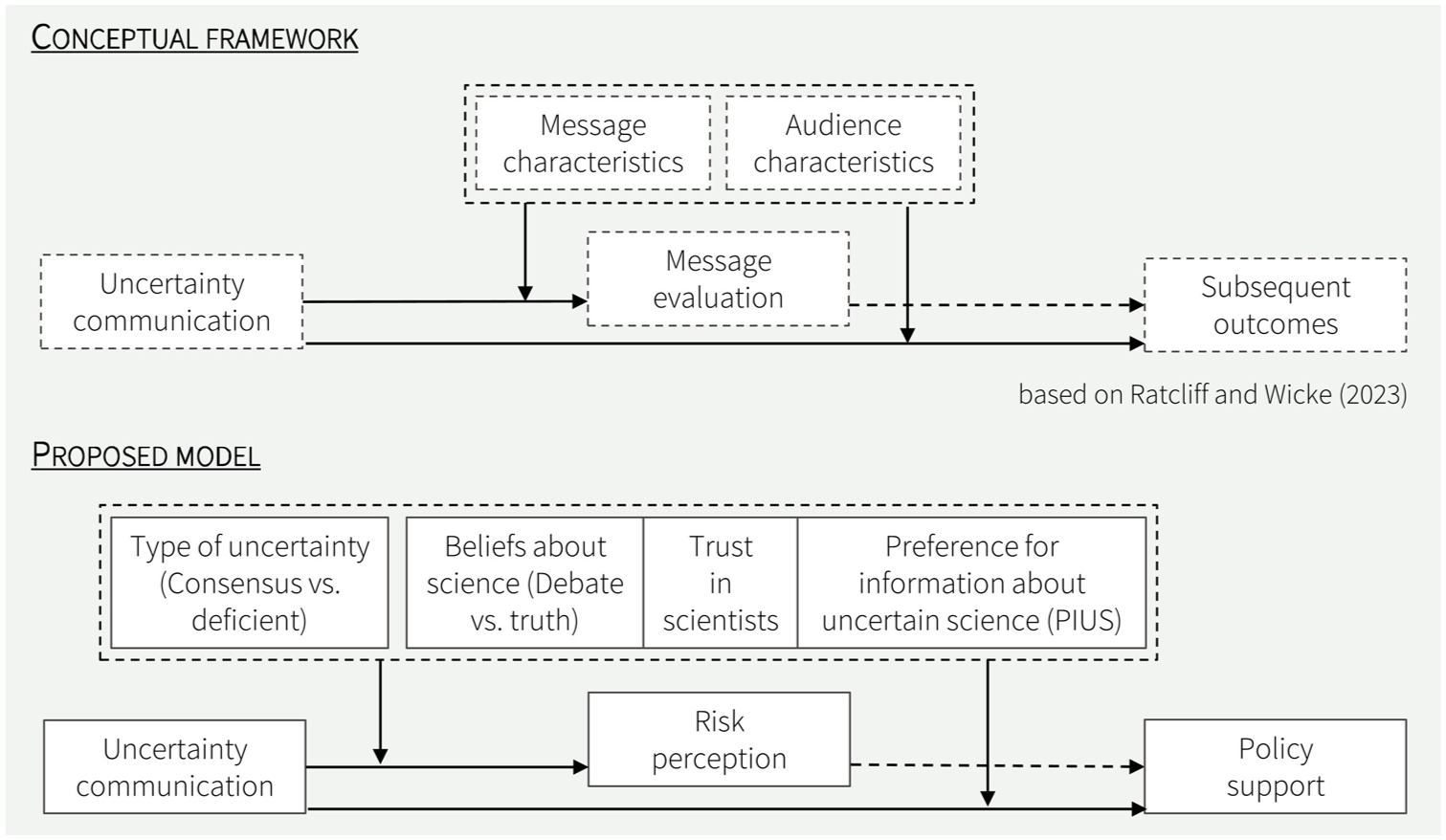
Conceptual framework and proposed model of variables and relationships examined.
Hypotheses and research questions
Based on the experimental studies discussed above as well as correlational research identifying positive links between perceived scientific consensus and risk perception and policy support in the microplastic context (Fian et al., 2025), we expect the following:
H1: The communication of no uncertainties will trigger higher risk perception (H1a), pull policy support (H1b) and push policy support (H1c), compared with the communication of consensus uncertainty and deficient uncertainty.
As the type of uncertainty communicated has been identified as a significant factor in determining the effects (e.g., Gustafson and Rice, 2020), we expect the following:
H2: The communication of deficient uncertainty will trigger higher risk perception (H2a), pull policy support (H2b) and push policy support (H2c), compared with the communication of consensus uncertainty.
Furthermore, we are interested in individual-level variables potentially moderating the effect of the uncertainty communication. Based on previous research (Aklin and Urpelainen, 2014; Rabinovich and Morton, 2012; Ratcliff and Wicke, 2023), we investigate the following research questions:
RQs: Do (1) beliefs about science, (2) trust in scientists or (3) preference for information about uncertain science (PIUS) moderate the effects postulated above?
Finally, previous research has identified a mediation model from perceived scientific consensus through risk perception to policy support (see Fian et al., 2025; van der Linden et al., 2019). Considering these findings, and in response to a call for more integrated and process-oriented theoretical frameworks (Ratcliff and Wicke, 2023), we explore a mediation model where communication of uncertainty goes through risk perception to policy support.
2. Methods
Data were collected in November 2024, online on Qualtrics via CINT, an international market research company, in accordance with data protection guidelines and regulations, and informed consent was obtained from all participants. Payment was in accordance with CINT’s wage standard. Ethical approval was granted by the Ethics Committee of the University of Vienna (01256) on 14 November 2024. The study was preregistered on the Open Science Framework (https://doi.org/10.17605/OSF.IO/TKDNG). The survey was presented in German.
2.1. Participants
Participants were required to be at least 18 years old and currently living in Austria. We obtained a quota sample to approximate the distribution of age, gender and region within the Austrian population. An a priori power analysis in G*Power (Faul et al., 2007) for the planned multiple regressions including all predictors and interactions indicated a minimum sample size of N = 1070 to detect a small effect (f² = 0.02; given the absence of prior studies with directly comparable designs) at α = .05 and a power of [1−β] = .90.
The final analytical sample after exclusions (see Supplemental Materials for details) was N = 1126, of which 52.7% identified as women, 46.7% as men and 0.6% as neither or preferred not to say. The mean age was M = 42.65 (SD = 15.91), ranging from 18 to 84 years. Full demographic information can be found in Supplemental Table 1. A soft launch (N = 64) was conducted to allow for final survey adjustments.
2.2. Study design and procedure
The study employed a between-subjects design with three randomly assigned conditions: consensus uncertainty (N = 368), deficient uncertainty (N = 376), and no uncertainty/control (N = 382). It was advertised as a study on ‘Opinions and reactions of people in Austria around science and different common media topics’. After giving informed consent, participants completed measures about their attitudes and beliefs about science (see section 2.3 Materials), followed by a distractor task to minimise any bias spilling over from the pre-intervention measures to the experimental part. They were informed that they would read two newspaper articles, randomly selected from 20 common media topics. In reality, all received the same distractor article (a short article on the release of the movie ‘Mustafa: The Lion King’) and one of the three versions of an article about microplastics. After the distractor (with one follow-up question), participants were introduced to the microplastics topic, answered two pre-intervention questions (subjective knowledge, prior assumptions) and then read the randomly assigned article (see section 2.3 Materials). Comprehension and manipulation checks followed. Post-intervention measures included message credibility, risk perception, policy support and socio-demographics. An attention check was included, and participants who failed, were screened out. The study concluded with the debrief form. Median completion time was 10.35 minutes.
2.3. Materials
2.3.1. Experimental stimuli
Participants received a one-page hypothetical online newspaper article about microplastics in food and drink and a new research study. All versions included a definition of microplastics, major sources and pathways into the human food chain, and some benefits of plastics in the food sector for balance. Subsequently, a recently published study was described, indicating that microplastics may have negative impacts on human health. In the ‘no uncertainty’ (control) condition, no limitations or knowledge gaps were mentioned. In the ‘consensus uncertainty’ condition, a lack of scientific consensus was described by adding information about disagreement in the scientific community about potential health effects. Finally, in the ‘deficient uncertainty’ condition, existing unknowns were highlighted through information about knowledge gaps regarding potential health effects and by highlighting a need for further research. These uncertainty frames, inspired by Gustafson and Rice (2019), were embedded in the subtitle, the first and the last paragraph of the articles (see Supplemental Materials for the full vignettes). The survey required participants to spend at least 40 (control condition) or 60 (other conditions) seconds viewing the article before proceeding.
2.3.2. Measures
The full survey including all items can be found in Supplemental Tables 2 (German) and 3 (English, including further details). All English instruments were translated to German using a standard forward-back translation procedure. Measures are described in order of appearance.
Beliefs about science were measured with a single item adapted from Rabinovich and Morton (2012), reflecting views of science as a debate (higher values) versus search for truth (lower values; also see Bertoldo et al., 2019; range: 1–7; M = 5.23, SD = 1.55). The distribution was acceptable to use the single-item as a moderator (skewness = −0.69, kurtosis = 2.93).
Trust in scientists was assessed with a single item adapted from Hmielowski et al. (2014); range: 1–7; M = 5.28, SD = 1.47. The distribution was acceptable to use the single item as a moderator (skewness = −0.83, kurtosis = 3.42).
Preference for information about uncertain science (PIUS) was measured with a 7-item scale (Ratcliff and Wicke, 2023; range: 1–5; α = .85, M = 3.94, SD = 0.70).
As pre-intervention variables, participants also reported subjective knowledge about microplastic health effects (see Fian et al., 2025) and prior assumptions about perceived scientific uncertainties.
Following the intervention, we included a comprehension check, which was answered correctly by 66% of participants. As preregistered, comprehension checks did not result in any exclusions of participants. However, we ran additional analyses to compare comprehension check passes between conditions, and sensitivity analyses of the main analyses by including comprehension performance as a covariate. Comprehension varied slightly by condition, but follow-up analyses showed that these differences did not affect the experimental findings. The results are presented in Supplemental Tables 12 and 13. 2
Perceived scientific uncertainty served as manipulation checks, including three items referring to deficient, consensus and no uncertainty.
Message credibility was measured with three items (Appelman and Sundar, 2016; Hendriks and Jucks, 2020 for German version; α = .83, M = 5.50, SD = 1.13).
Risk perception was assessed with a 7-item measure (Fian et al., 2025; van der Linden, 2015; range: 1–7; α = .91, M = 5.17, SD = 1.20).
Policy support was measured with items inspired by Swim and Geiger (2021), classifying policies based on (1) who is targeted (businesses vs. individuals), (2) what is targeted (use vs. after-use) and (3) how is compliance motivated (incentive vs. disincentive). In addition, some policy measures were included that did not fit into this scheme, motivated by the Global Plastics Treaty. Following Fian et al. (2025), we created two indices (range 1–100): ‘pull’ (α = .88, M = 77.95, SD = 17.42) and ‘push’ (α = .86, M = 68.50, SD = 21.66). A principal component analysis confirmed the two factors (see Supplemental Table 4). For the exploratory analyses, a combined index was used (α = .91, M = 73.59, SD = 17.78). Means and confidence intervals (CIs) for all policy support items can be found in Supplemental Figure 1.
Finally, participants reported information on frequency of information exposure channels (see Supplemental Table 5), and socio-demographic information (i.e. age, gender, education, political orientation, region).
2.4. Analyses
As preregistered, we examined the main effects of uncertainty communication and potential moderation effects of individual-level variables using three regression analyses with orthogonal planned contrasts comparing both uncertainty conditions together against control (Field et al., 2012) and interaction terms predicting (a) risk perception, (b) pull policy support and (c) push policy support, respectively. This was followed by exploratory follow-up regression analyses using dummy coding to additionally examine the difference between control condition and each uncertainty condition separately. Finally, we conducted preregistered exploratory path analyses to examine potential indirect effects. Analyses were conducted in R (v4.4.2) using base R stats and the PROCESS macro. Data and code are available at: https://osf.io/yp8ke.
3. Results
3.1. Preparatory analyses
We conducted manipulation checks to test whether the experimental manipulation was successful, using independent t-tests and Benjamini–Hochberg correction for multiple testing. All manipulation checks exhibited medium to large effects in the intended directions, except for one, which was anticipated in our preregistration due to the subtlety of the intervention and overlaps between aspects of consensus and deficient uncertainty. Full results can be found in Supplemental Table 6.
Prior to the main analyses, we tested whether there were significant differences across experimental conditions in relevant variables. One-way ANOVA models with experimental conditions as the independent variable and beliefs about science (F (2,1123) = .09, p = .910), trust in scientists (F (2,1123) = .23, p = .794), PIUS (F (2,1123) = .32, p = .739), political orientation (F (2,1123) = .58, p = .560), subjective knowledge (F (2,1123) = .67, p = .512) and prior assumptions (F (2,1123) = .23, p = .799) as the dependent variables did indeed not yield any significant differences. For credibility, significant group differences became apparent (F (2,1123) = 8.70, p = < .001). Pairwise t-tests using the Benjamini–Hochberg procedure to correct for multiple testing found message credibility to be significantly higher in the control versus the consensus condition (p = .001), and higher in the deficient versus the consensus condition (p = .001). Thus, as preregistered, we included message credibility as an additional predictor into our analyses (also see Ratcliff and Wicke, 2023).
The moderator variables were weakly to moderately correlated (r = .15 – r = .40). Bivariate correlations between all measures can be found in Supplemental Table 7. The distributions of all outcome variables across the experimental conditions are visualised in Figure 2. Descriptives of all measures for the full sample and the three conditions, respectively, can be found in Supplemental Table 1.
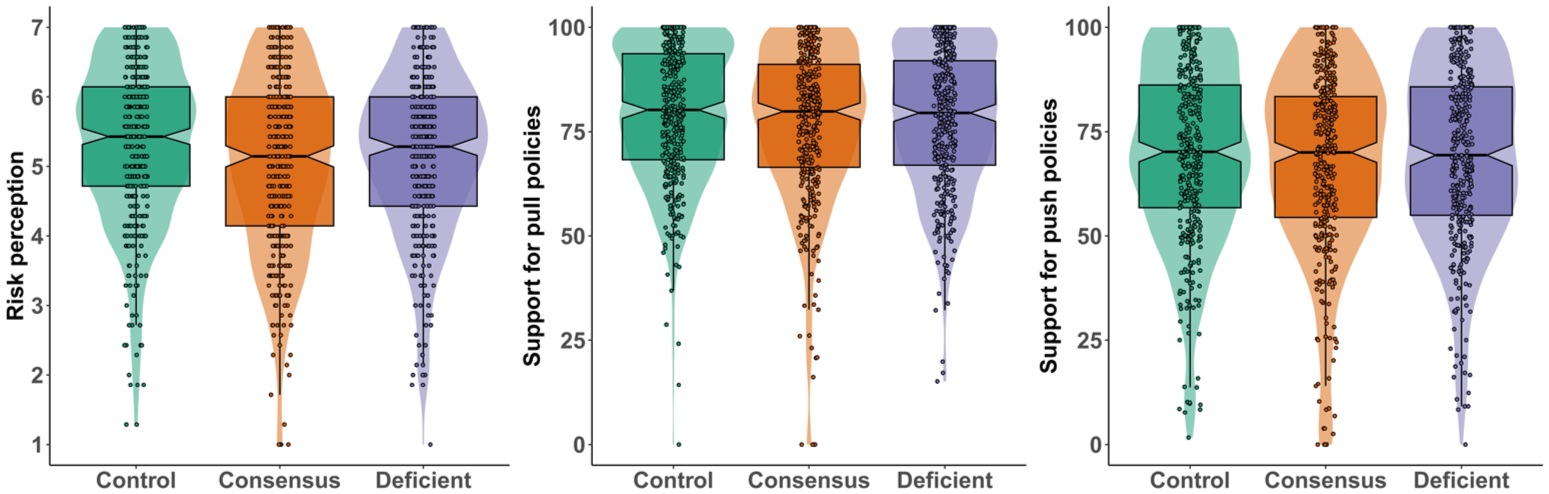
Violin and box plots showing the distributions of outcome variables across experimental conditions.
3.2. Main analyses
Assumption checks for the regression analyses are reported in the Supplemental Materials. We created two planned contrasts to test the preregistered hypotheses: Contrast 1 for H1 (no uncertainty vs. both uncertainty conditions) and Contrast 2 for H2 (consensus uncertainty vs. deficient uncertainty). In a first step, we included these two contrasts: the individual moderator variables and credibility in the models. In a second step, we added the interaction terms of each moderator with each contrast variable. The moderator variables were mean-centred before analysis. The results can be found in Table 1, reported separately for each outcome variable. Standardised coefficients (β) and 95% CIs for the final model for each of the respective outcome variables can be found in Supplemental Tables 8 to 10 to help assess the magnitude and relative strength of the predictors.
Regression analyses predicting the three outcome variables.
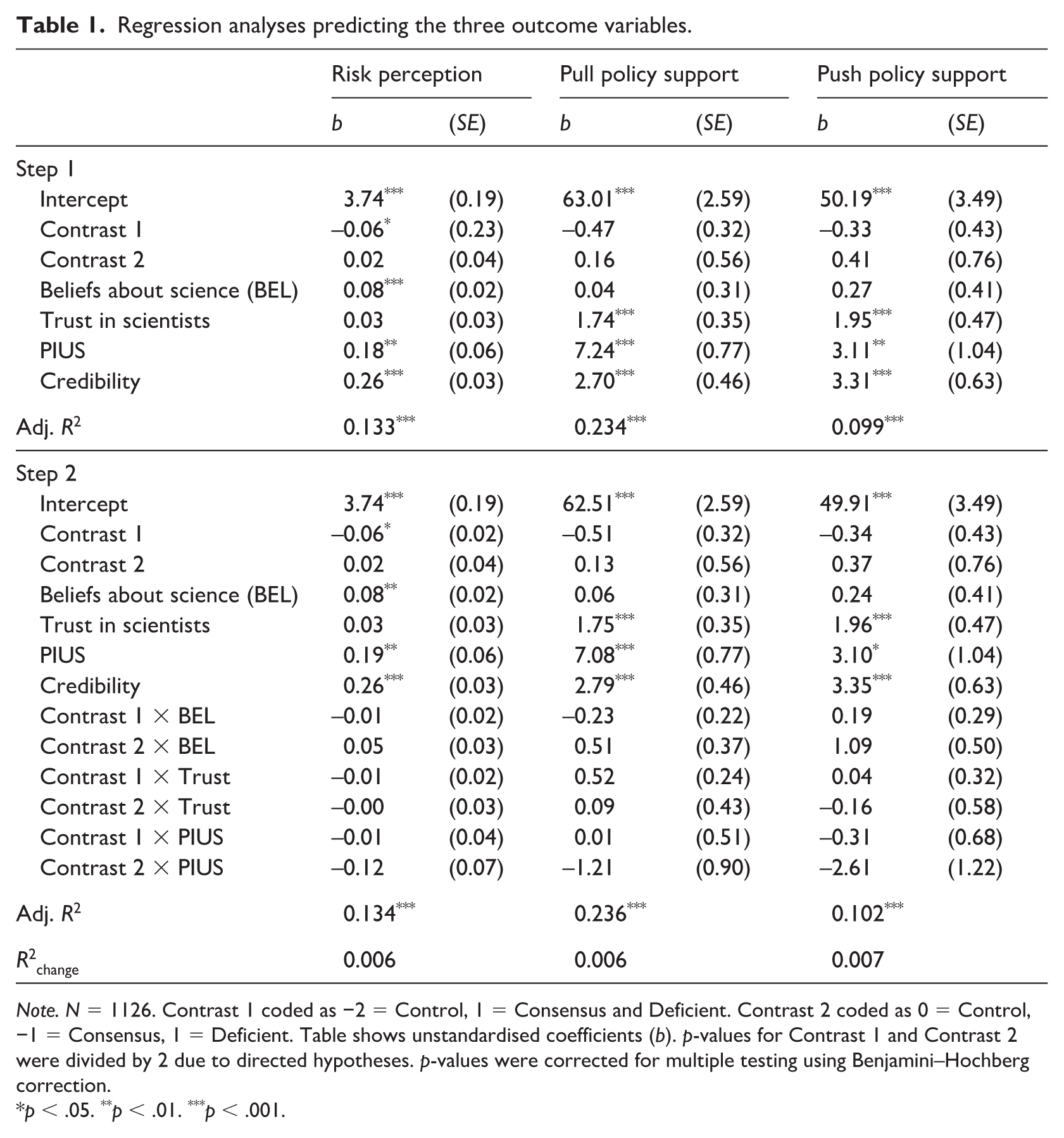
Note. N = 1126. Contrast 1 coded as −2 = Control, 1 = Consensus and Deficient. Contrast 2 coded as 0 = Control, −1 = Consensus, 1 = Deficient. Table shows unstandardised coefficients (b). p-values for Contrast 1 and Contrast 2 were divided by 2 due to directed hypotheses. p-values were corrected for multiple testing using Benjamini–Hochberg correction.
p < .05. **p < .01. ***p < .001.
Risk perception
The first model explained 13% of variance (adj. R² = .133, p < .001). Risk perception was lower when uncertainty was communicated (vs. no uncertainty; b = −0.06, p = .012), supporting H1a. We did not find higher risk perception in the deficient compared with the consensus condition, and thus, no support for H2a. In terms of individual-level variables, higher beliefs about science as a debate (vs. as search for truth; b = 0.08, p < .001) and higher PIUS (b = 0.18, p = .002) were associated with higher risk perception. Finally, higher message credibility (b = 0.26, p < .001) was linked with higher perceived risk. Adding the interaction terms did not improve the model, and no interaction was statistically significant, answering our additional RQs.
Pull policy support
The first model explained 23% of the variance (adj R² = .234, p < .001). No effects of experimental conditions, and thus no support for H1b and H2b were found. Regarding individual-level predictors, higher trust in scientists (b = 1.74, p < .001) and higher PIUS (b = 7.24, p < .001) were associated with higher support for pull policies. Moreover, message credibility (b = 2.70, p < .001) was positively linked with pull policy support. Again, adding the interaction terms in a second step did not improve the model, and no interaction reached statistical significance, answering our RQs.
Push policy support
The first model explained roughly 10% of the variance (adj R² = .099, p < .001). Similar to pull policy support, the experimental conditions showed no effect, disconfirming H1c and H2c. Also, higher trust in scientists (b = 1.95, p < .001), higher PIUS (b = 3.11, p = .003) and higher message credibility (b = 3.31, p < .001) were associated with higher support for push policies. Adding the interaction terms again did not improve the model, and we found no significant interactions between experimental conditions and individual moderators, answering our RQs.
3.3. Unpacking the role of consensus versus deficient uncertainty
As Contrast 2 did not yield significance for risk perception and policy support, we conducted exploratory follow-up analyses using dummy coding for deficient and consensus uncertainty with the no uncertainty (control) condition as a reference (this step was anticipated in the preregistration). For these analyses, we combined pull and push policy support into one policy support index. Analyses showed that only consensus uncertainty (vs. control) triggered lower risk perception (b = −0.19, p = .027), while the deficient uncertainty did not lead to lower risk perception. We found no effect of uncertainty communication on the combined policy support measure. The rest of the results largely replicated the main analyses (see Table 2). Standardised coefficients (β) and 95% CIs for the exploratory dummy models can be found in Supplemental Table 11.
Exploratory regression analyses with dummy variables.
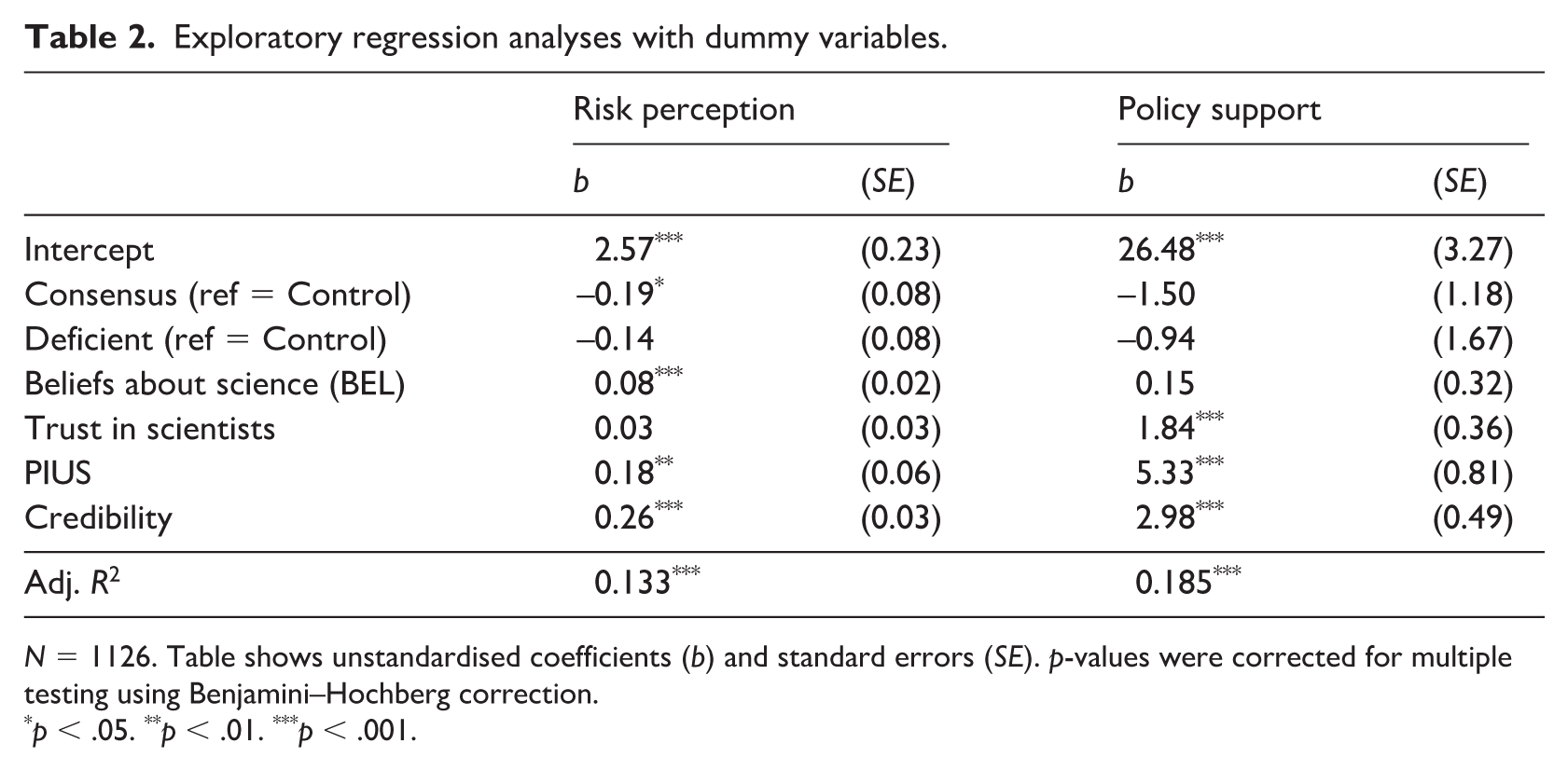
N = 1126. Table shows unstandardised coefficients (b) and standard errors (SE). p-values were corrected for multiple testing using Benjamini–Hochberg correction.
p < .05. **p < .01. ***p < .001.
3.4. Path analyses
To further investigate the underlying processes, as preregistered, we used path analyses to test whether there was an indirect effect of the uncertainty communication on policy support through risk perception, focusing on consensus uncertainty as the key type of uncertainty. We ran Hayes’ model 4 (Hayes, 2018) using bootstrapping with 10,000 samples. First, we tested the following path: Consensus uncertainty (vs. control) → risk perception → policy support (N = 750). The mediation was significant (b = 2.15; Boot SE = 0.73; 95% Boot CI: −3.65, −0.79). Thus, communicating consensus uncertainty (vs. no uncertainty) had an indirect negative effect on policy support through lower risk perception. Standardised path coefficients are reported in Supplemental Figure 2, and a full summary of the total, direct and indirect pathways including 95% CIs, SEs, p-values and BH-corrected p-values can be found in Supplemental Table 14.
Given the high explanatory value of message credibility in our main models, and based on theoretical considerations (see Ratcliff and Wicke, 2023), we additionally tested an exploratory serial mediation model using Hayes’ model 6 (Hayes, 2018): Consensus uncertainty (vs. no uncertainty) → message credibility → risk perception → policy support (N = 750; not preregistered). Here, the indirect effect of the uncertainty communication on policy support through both mediators was significant (b = −0.76; Boot SE = 0.25; 95% Boot CI: −1.30, −0.31). Both indirect effects through credibility alone (b = −0.87; Boot SE = 0.29; 95% Boot CI: −1.50, -0.35), and through risk perception alone (b = −1.13; Boot SE = 0.58; 95% Boot CI: −2.33, −0.02) were significant. Standardised path coefficients can be found in Figure 3, and a full summary of the total, direct and indirect pathways including 95% CIs, SEs, p-values and BH-corrected p-values can be found in Supplemental Table 15.
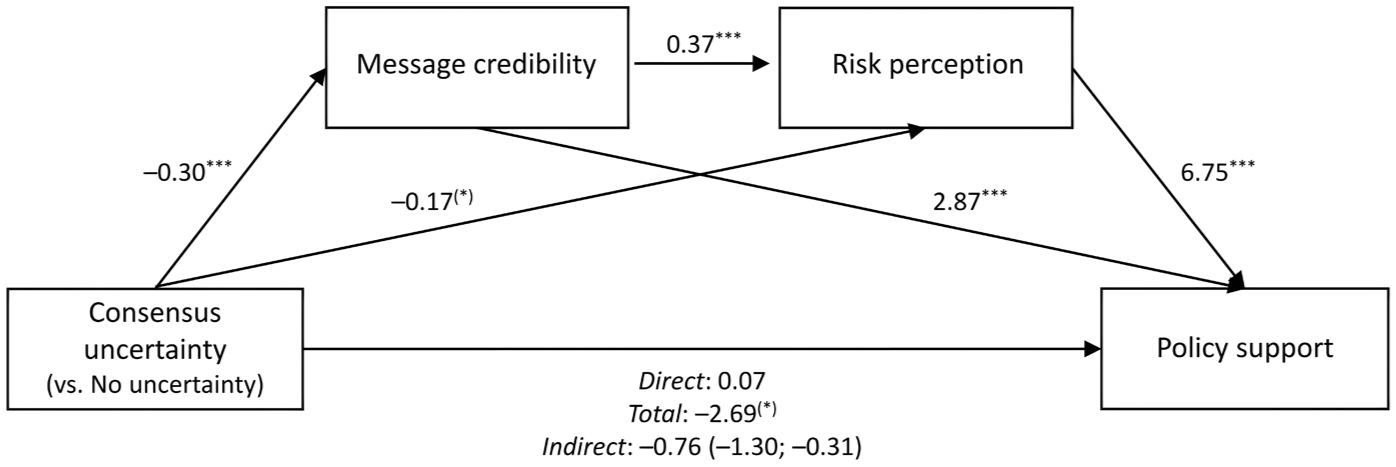
Exploratory serial mediation model from consensus uncertainty (vs. no uncertainty) via message credibility and risk perception on policy support.
4. Discussion
In order to facilitate effective risk communication and regulatory decision-making, it is crucial to further develop our understanding of the factors that influence perceptions of potential risks and the associated regulatory measures when communicating scientific uncertainty. Previous evidence on the effects of uncertainty communication is mixed (see Guo et al., 2025; Gustafson and Rice, 2020), and calls have been raised for more research on characteristics of the message as well as the audience which may serve to explain the observed heterogeneity in results (see Ratcliff and Wicke, 2023). Thus, in this study, we investigated the effects of different types of message characteristics (i.e. type of uncertainty) as well as audience characteristics (i.e. science-specific attitudes and beliefs) on risk perception and policy support in the context of microplastics and its potential health effects.
What is being communicated? Characteristics of the message
In line with our expectations, the communication of scientific uncertainties around microplastic health effects resulted in lower risk perception compared with the absence of uncertainties, but this was a small effect. However, we did not find the expected difference between the two types of communicated uncertainty, namely consensus and deficient uncertainty when comparing them directly. To further investigate differences between uncertainty types, we conducted exploratory follow-up analyses comparing each of them with the control condition. Our results suggest that only consensus uncertainty (vs. no uncertainty) decreased risk perception, while effects for deficient uncertainty were smaller and not statistically significant. First, this aligns well with previous correlational research on microplastic risk perception that found high perceived scientific consensus around health risks to be a predictor of increased risk perception, even though that previous research did not include deficient uncertainty as well (Fian et al., 2025). Moreover, it mirrors a body of work on the positive effects of consensus messaging (e.g. Većkalov et al., 2024), and perceived scientific consensus as a ‘gateway’ to increased worry about climate change and, in turn, greater support for public action (van der Linden, 2021; van der Linden et al., 2015). Thus, it appears that the social signal in this type of consensus communication holds particular value.
Second, our findings on risk perception further add to the body of literature on the distinct effects of communicating consensus uncertainty (see Gustafson and Rice, 2020). Notably, unlike other types of uncertainty, consensus uncertainty indicates that there are experts or evidence contrary to the claim, thereby also justifying dissenting or denying positions. Moreover, as recently proposed by Orchinik et al. (2024), people learn both from and about scientists when presented with consensus messages. Specifically, ‘low consensus’–messages may lead individuals to make negative inferences about scientists’ characteristics (e.g. skills, trustworthiness). To go a step further, it may also lead to unfavourable conclusions about science in general, and not just about the debated topic or the scientists debating (Johnson et al., 2024).
Third, while we did not observe a significant direct effect of consensus uncertainty on policy support in our main analyses, our exploratory mediation model suggested a significant indirect pathway through message credibility and risk perception. This pattern is indicative of an indirect-only mediation (Zhao et al., 2010), where the predictor influences the outcome exclusively via mediating variables. This suggests that exposure to consensus uncertainty reduces policy support not directly, but through its negative impact on message credibility, which in turn reduces risk perception, a key driver of policy support (see Fian et al., 2025). These initial findings highlight the importance of considering mediated mechanisms that may remain undetected in simple regression models, and may suggest that policy attitudes could be more distal outcomes which are likely influenced by additional factors not captured in the present research. Interestingly, our findings on the potential credibility-undermining effects of uncertainty communication stand in contrast to the recent review by Guo et al. (2025), who found no negative effects of consensus uncertainty communication on perceived credibility. However, given the exploratory nature of the path analyses, we urge caution in interpreting the effects and encourage further research to follow-up this finding and the underlying processes.
Importantly, communicating deficient uncertainty specifically did not have significant negative effects on either risk perception or policy support when directly compared with the ‘no uncertainty’ condition, even though participants recognised the presence of (deficient) uncertainty in the manipulation check. Considering that science communicators frequently do not have the option of adequately and ethically communicating about scientific findings without mentioning uncertainty, this is an important insight. The findings of this study provide a degree of reassurance that the communication of scientific uncertainties does not necessarily decrease individuals’ concern or their support for policies that could mitigate microplastic pollution. As recently recommended by Renn (2024), uncertainty communication should be preceded by a critical analysis about the uncertainty type that needs to be addressed. Based on our results, the communication of deficient uncertainty may present a lower-risk approach to ensuring transparency, while avoiding undesirable effects on public support of policy actions. In instances where there is indeed noteworthy discourse and disagreement within the scientific community, the balance of perspectives presented should be evidence-based, to prevent misrepresenting the extent of scientific disagreement (König et al., 2024).
Who is being communicated to? Characteristics of the audience
In addition to the characteristics of the message, we were interested in characteristics of the audience potentially associated with effects of uncertainty communication. Specifically, we investigated several science-specific attitudes and beliefs (i.e. beliefs about science, trust in scientists, PIUS) as potential moderating factors. The underlying assumption here was that uncertainty communication can exert distinct effects depending on an individual’s attitudes and beliefs. In contrast to previous studies (e.g. Aklin and Urpelainen, 2014; Rabinovich and Morton, 2012; Ratcliff and Wicke, 2023), our research revealed no moderation effects. One potential explanation is that prior moderation effects were observed for topics situated in a more politicised or identity-relevant context, where individual differences may play a more active role in shaping responses. For instance, trust may only moderate the effect of uncertainty communication in the context of more polarised issues, such as climate change, while (micro-)plastics has been found to be less politicised (Fian et al., 2025; Holmberg and Persson, 2023). In accordance with this, Guo et al. (2025) recently found different effects of uncertainty communication for health and environmental issues.
While we did not find moderation effects, the individual-level variables – although not part of our original hypotheses – showed significant main effects, suggesting they may exert their effect directly rather than through interaction with uncertainty type. Specifically, we found that participants with a model of science as debate reported higher risk perception irrespective of the newspaper article they read. Higher trust in scientists was not related to risk perception (c.f. Fian et al., 2025), but to higher support for both policy types (pull and push), and this association was independent of experimental condition Finally, PIUS was positively associated with both risk perception and policy support, but again, the effect was not dependent on experimental condition. While modelled as separate predictors, these science-related constructs likely exhibit conceptual and statistical overlap. For example, individuals who prefer uncertainty disclosure may also hold more flexible epistemic beliefs about science or report higher trust in scientists (Ratcliff et al., 2024). This complex interrelationship may have reduced our ability to detect clear moderation effects. Future research should consider more integrated or multivariate models, and examine how these constructs interrelate.
Taken together, these findings suggest that audience characteristics matter, but likely in more complex and nuanced ways than simple moderation models capture. First, the lack of significant interaction effects does not mean these variables are irrelevant, but rather that their influence may be more additive or context-dependent. Second, it may be worthwhile to reconceptualise these constructs as outcomes rather than static traits. Nevertheless, the findings suggest a potential role for individual-level audience characteristics in predicting risk perception and policy support in the context of scientific uncertainties. Efforts to promote beliefs about science as a debate, trust in scientists and PIUS may help individuals constructively engage with issues characterised by current scientific uncertainties, but where precautionary action is advised such as microplastic pollution (Thompson et al., 2024). In fact, uncertainty communication may itself have the potential to be a contributing factor here. For instance, scientists being transparent about knowledge limitations (i.e. deficient uncertainty) can result in them being perceived as more intellectually humble by the public, which was found to increase trustworthiness and intentions to follow the scientist’s recommendations (Koetke et al., 2024). Similarly, frequent exposure to uncertainty may increase public preference for such disclosures (Ratcliff et al., 2024). Consequently, the investigation of science-related individual-level audience characteristics also as outcome variables of (repeated) uncertainty disclosure may represent a promising future research direction.
Limitations and further directions
Several study limitations and potential future directions should be considered. First, our findings may not be generalisable across different scientific issues. Research suggests that the effects of uncertainty communication vary by topic domain (Guo et al., 2025; Gustafson and Rice, 2019), and certain characteristics of microplastics and how they are perceived by the public may be context-specific (e.g. relatively high prior assumptions of risk). Second, for reasons of ecological validity, our uncertainty manipulations were relatively subtle, which may have resulted in weak effects. Moreover, a one-time message is not likely to result in large or long-term effects, which should be addressed in future longitudinal study designs. Third, only 66% of participants answered our comprehension checks correctly, despite all of them passing an attention check. While the comprehension check referred to a general part in the vignettes that did not differ between experimental conditions, it does suggest that some participants may not have fully understood the materials. Comprehension varied slightly by condition, but follow-up analyses showed that these differences did not affect the experimental outcomes. Future research could employ stronger comprehension checks (e.g. affirmative questions) or methods like paraphrasing tasks to encourage deeper processing. Finally, while (online) newspapers remain a primary source of information for the public, in our sample, the frequency of daily use of Social Media for the purpose of staying informed was almost twice as common as for online newspapers (see Supplemental Table 5). Future studies could thus test whether the observed patterns generalise to other information channels, especially considering the importance of message credibility in this study. Another interesting approach would be to test whether the message source (e.g. politicians as opposed to scientists) moderates the effect of uncertainty communication, particularly with a focus on uncertainty surrounding the effects of regulatory measures.
Finally, it is important to reflect on the terms ‘positive’ and ‘negative’ effects in this context. We referred to ‘positive’ effects to denote an increase in risk perception and policy support. While there is little controversy about considering an increase in policy support as ‘positive’ (i.e. desirable) if there are explicit recommendations by scientists to implement precautionary regulatory measures (see Thompson et al., 2024), this is less straightforward for risk perception. Research suggests a clear positive association between risk perception and policy support in this context (Fian et al., 2025); however, it is questionable whether high public perceptions of risks are justified and ‘desirable’ in the context of an issue where there is inconclusive evidence about the existence of an actual risk.
5. Conclusions
This study’s findings contribute to the body of evidence on effects of communicating scientific uncertainties to the public. Specifically, we investigated the role of message as well as audience characteristics for risk perception and policy support in the context of health effects of microplastic pollution. Results indicate that uncertainty disclosure is likely to be received more favourably when referring to knowledge gaps rather than lack of consensus between scientists. In fact, communicating a lack of scientific consensus had negative effects on message credibility, and, in turn, on risk perception and policy support. Moreover, the high importance of science-specific attitudes and beliefs such as beliefs about science, trust in scientists and PIUS, independent of the uncertainty manipulation, highlights a need to better understand the interplay of existing individual-level characteristics (e.g. public understanding of science as a process that encompasses uncertainties, or public trust in scientists). For this, the transparent disclosure of current knowledge gaps and limitations could itself play an important role.
Supplemental Material
sj-docx-1-pus-10.1177_09636625251410494 – Supplemental material for Communicating scientific uncertainties: Effects of message and audience characteristics in the context of microplastic health risks
Supplemental material, sj-docx-1-pus-10.1177_09636625251410494 for Communicating scientific uncertainties: Effects of message and audience characteristics in the context of microplastic health risks by Leonie Fian, Nina Vaupotič, Isabel Richter, Albert A. Koelmans and Sabine Pahl in Public Understanding of Science
Footnotes
Acknowledgements
The authors thank the members of the Citizens, Environment and Safety (CES) Research Group at NTNU Trondheim for input on the study design, and Dr. Takuya Yanagida for advice with data analysis.
Ethical considerations
Ethical approval was granted by the Ethics Committee of the University of Vienna (01256) on 14 November 2024.
Consent to participate
All participants provided informed consent to participate in this study. They were informed about the study’s procedures, potential risks and their right to withdraw at any time without consequences. After the study, they were debriefed about the study’s purpose.
Consent for publication
All participants provided consent for the publication of anonymised data and findings derived from this study.
Author contributions
LF: Conceptualisation, Methodology, Formal analysis, Investigation, Writing – original draft, Writing – review & editing, Visualisation.
NV: Conceptualisation, Methodology, Writing – review & editing.
IR: Conceptualisation, Methodology, Writing – review & editing.
AK: Conceptualisation, Methodology, Writing – review & editing.
SP: Conceptualisation, Methodology, Funding acquisition, Writing – review & editing.
Funding
The authors disclosed receipt of the following financial support for the research, authorship and/or publication of this article: This project has received funding from the research platform ‘Plastics in the Environment and Society (PLENTY)’, funded by the University of Vienna ( ). The funders had no role in the conceptualisation, design, analysis, decision to publish or preparation of the manuscript.
Declaration of conflicting interests
The authors declared no potential conflicts of interest with respect to the research, authorship and/or publication of this article.
Supplemental material
Supplemental material for this article is available online.
Notes
Author biographies
References
Supplementary Material
Please find the following supplemental material available below.
For Open Access articles published under a Creative Commons License, all supplemental material carries the same license as the article it is associated with.
For non-Open Access articles published, all supplemental material carries a non-exclusive license, and permission requests for re-use of supplemental material or any part of supplemental material shall be sent directly to the copyright owner as specified in the copyright notice associated with the article.
