



Abstract
Viewers’ responses to Orphan Black (2013–2017), a popular, genetics-themed sci-fi television series, reveal much about public understanding of the ethical challenges associated with genetic science. In this article, we assess how fans of Orphan Black process the bioethical themes that are prominent in the show through an analysis of 182 viewer-created blog posts. Using a mixed methods approach, our findings reveal that Orphan Black’s fans distill the essence of the show down to its characters’ fight for autonomy. Furthermore, fan blogs reveal two notable pathways through which this bioethical principle is explored: gender and reproduction. Viewers draw striking connections between the moral problems they observe on screen in Orphan Black and those they see in the real world—both today and in a possible future—particularly as those problems affect women. While existing scholarship acknowledges these themes in the show itself, our approach demonstrates science fiction fans’ active participation in meaning-making and bioethical reasoning and offers a novel approach to studying fan-generated content for public understanding of science research.
Keywords
1. Introduction
When the Canadian science fiction thriller Orphan Black first aired on BBC America in 2013, it captured the attention of a small but dedicated following. The haunting pilot episode, which opens with a woman who watches her mirror image jump in front of an oncoming train, kicks off a compelling plot of scientific, corporate, and government conspiracies related to a top-secret cloning experiment responsible for the creation of a group of genetically identical, yet astonishingly unique, women. Over the 5 years that the series aired, these women and their “sisters,” all of whom are portrayed skillfully by the Emmy-winning Tatiana Maslany, must go up against corrupt scientific research institutions, religious extremists, the military, and other competing factions in order to fight for control of their bodies and lives. Viewers fell in love with the show’s diverse cast of characters, whose community and humanity remained squarely at the heart of the series. This loyal fanbase rapidly began to adapt the show’s plot points and reinterpret them on social media, blog sites, and fan fiction platforms.
Given its rich subject matter, it is no surprise that Orphan Black has been the topic of an extensive body of academic literature. The show has been analyzed for its portrayal of feminism and gender politics (Goulet and Rushing, 2019; Lieberman, 2018), queer representation and alternative family structures (Casey and Clayton, 2021; Dillender, 2018; Sheldon, 2018), bioethical issues (Greene and Robison-Greene, 2016; Pence, 2016), and scientific accuracy and realism (Greene and Robison-Greene, 2016; Griffin et al., 2017; Pence, 2016). Understandably, the focus of the majority of these texts has been on the show itself, not its fans. While one scholar has emphasized viewer responses to the show’s lesbian, gay, bisexual, transgender, queer, questioning, intersex, asexual+ (LGBTQIA+) representation (Scettrini, 2016), little analysis has explored Orphan Black’s fandom as a resource for understanding the show’s impact on attitudes toward science.
On a multitude of online venues, viewers scrutinize, celebrate, and expand upon even the most obscure Orphan Black material. At the time of the series’ premiere, there were only a few precedents for television shows that actively engaged with their viewership. Key Internet age predecessors such as The X-Files (1993–2002, 2016, 2018), Lost (2004–2010), and Supernatural (2005–2020) supported fan activity to a certain extent (Allair, 2018; Bojalad, 2019; Tenbarge, 2020). Nonetheless, the majority of television shows prior to Orphan Black sought to control their fans’ work and remained resistant to their input. Orphan Black, by contrast, encouraged its fanbase to develop online responses to the show, eventually using artwork and ideas generated by viewers in subsequent episodes. As a result, writing produced by Orphan Black’s fandom offers an unusual, and we will argue, authentic representation of viewer perspectives on the series. The engagement of the show’s fanbase with its themes of genetics and bioethics thus creates an opportunity to explore the ways that fans interpret the portrayal of science and its social implications on screen. Understanding how the media represents the bioethical implications of genetic science and technology is an important task. Equally important is understanding how viewers make sense of these representations, particularly for a show with such strong fan activity. Furthermore, while many investigators have drawn on methods from the social sciences to survey public opinions about the implications of genetic science, fandom presents an alternative pathway through which to explore the views that people volunteer on the subject.
Research on fan-generated content is notably lacking from public understanding of science scholarship. While film and television have been analyzed within the field (Kirby, 2003; Orthia, 2010; Weingart and Pansegrau, 2003), there has been little focus on fan responses to the portrayal of science in popular media. By turning to the Internet, where fans share their thoughts openly, in their own words and of their own volition, we hope to glean new insights into lay meaning-making and bioethical reasoning that will enrich the findings from other approaches such as surveys, focus groups, and analyses of film and television shows themselves.
Fan activity, which is often seen as fringe, deeply personal, and sometimes even pathological, has historically been sidelined from the production of knowledge. Moreover, fandom and the cultural forms produced by it are often associated with the tastes and practices of marginalized groups, especially women and queer people. But, as an area of investigation deeply grounded in feminist epistemology and methodological frameworks (Hannell, 2020), fan studies’ engagement with the personal, the subjective, and the emotional offers an underutilized approach to studying the public understanding of science. Fans of Orphan Black, unlike academics, are not concerned with how accurate the science is in fictional genres. Hence, this article does not examine the accuracy of Orphan Black’s depiction of genetic science but rather focuses on what fans of the science-fiction series highlight as most important to them: the bioethical and biopolitical implications of the show’s depiction of science and technology.
Fans map these issues as they are raised by Orphan Black onto real-life social, political, and personal concerns about gender, reproductive technology, and bodily autonomy. Often, they react to these connections in strikingly emotional ways, marking a divergence from the kind of interpretations that typically emerge from survey data. Fan-authored interpretations capture what viewers say sua sponte, unconstrained by the interests of the investigator. Inevitably, their perspectives are contextualized by a larger community of voices, but the existence of this social context is a strength, not a weakness, of fan studies. Attending to the words of viewers who see themselves as participants in a whole community of viewers—the “Clone Club,” as they call themselves—enables researchers to distinguish representative perspectives from outliers.
The active engagement of fans with both the show itself and its community of viewers offers an alternative to the deficit model of the public understanding of science, which frames public skepticism about the value of scientific progress and emerging technology as a product of ignorance (Sturgis and Allum, 2004). Fan studies offers a powerful challenge to this conception by emphasizing forms of active engagement that have been historically neglected (Sturgis and Allum, 2004). Fans are a particular kind of public. While their interactions may not necessarily be representative of the population at large, they are nonetheless symptomatic of a vibrant community of views that is worthy of inquiry.
The Internet provides an opportunity for anyone to write about science and contribute to the development of a shared understanding of it without the limitations of conventional publishing and media gatekeeping (Miah, 2005). In the case of Orphan Black, the democratization of this conversation—a well-documented phenomenon in fan culture at large (Jenkins, 1992; Pugh, 2005)—in the context of fan blogs creates a focus not on the state of genetic science, but on the state of society (Gross, 1994). By diverging from the methodologies of survey and media content analysis traditionally employed by the deficit model, a fan studies approach demonstrates what Jasanoff describes as a contrasting “appreciation of the places where science and technology articulates smoothly with one’s experience of life . . . and of the trustworthiness of expert claims and institutions” (Jasanoff, 2000). Our approach challenges the deficit model conception of the public as passive, cognitively limited recipients of scientific content and instead suggests a rich, interactive relationship between portrayals of science on screen and viewer interpretations of its consequences in real life.
2. Method
Sampling
In this article, we assess how fans of Orphan Black process the bioethical themes and genetic science that are prominent in the show through an analysis of viewer-created blog posts. We ask what bioethical concepts viewers of Orphan Black register explicitly when writing about the series. The category of “blog post” in our analysis encompasses discussions of Orphan Black published in blog form in professional venues as well as on personal websites. We consider the show’s fandom as contextual, with blog posts of all kinds located within it. Writers of all backgrounds who cover Orphan Black are, themselves, viewers of the show. Furthermore, many professional journalists are avid fans, and their contributions to the larger Orphan Black conversation are readily accepted by the fandom. Fans look to journalists and professional writers for interpretations of the show, just as they look to them for interviews and privileged inside information. Conversely, informal conversations between fans that appear in personal blogs, social media posts, and fan fiction may inform the direction of Orphan Black pieces published on more established Internet outlets.
In the wake of Orphan Black’s success BBC America arrived at what was, at the time, a radical decision: let the fanbase, which identifies itself as the “clone club” across a variety of social media platforms, create fan art and fan fiction freely, without the supervision of the network (Koblin, 2017). On social media platforms, viewers were invited to submit their fan art for a chance to have it featured in upcoming marketing campaigns for the show, vote on what artwork should hang on the walls or what food certain characters should eat in the next season, and communicate directly with the series’ actors and creators (Koblin, 2017). As a result, the relationship between personal and professional blog accounts—much like the relationship between the show’s fans and creators—is reciprocal, messy, and manifested materially in the digital world via a variety of mediums.
This study employs a mixture of quantitative and qualitative methods. Quantitative analyses were used to examine the prevalence of themes and motifs, and to group them into categories. We then took an inductive approach to our qualitative analysis of the actual language used to discuss bioethical concepts in viewer-created blog posts. In total, we collected 220 1 blog posts about Orphan Black, ranging in sources from the online site of the New York Times to personal WordPress blogs. Blog posts were gathered by conducting keyword Google searches using a “snowball” strategy. Beginning with a broad search for “Orphan Black review,” the prominence of bioethical issues in viewer discussions of the show was revealed and additional search terms emerged directly from these results. For example, a general search led to the discovery of a blog post about feminism. A keyword Google search for “Orphan Black feminism” was then conducted, which turned up additional keywords such as “autonomy,” “control,” and “consent.” A search for Orphan Black and each of the new keywords was then conducted. This process was continued until our search strategy reached a saturation point and no new blogs were being located. Throughout this process, a judgment was made on the part of the researchers as to what posts contained actual engagement with and analysis of the show as opposed to promotional content like press releases and programming announcements. Notably, the kind of engagement with Orphan Black that we sought was not isolated to any particular type of blog posts. Our data set ranges from long, academic-style analyses of the show’s connection to postmodern philosophy (Blog 27), to lighter pieces about Tatiana Maslany’s wardrobe (Blog 178). Bioethical language appears in both of these posts and many in between. Nonetheless, this sample is not intended to be exhaustive, and it is certain that the still-growing body of online texts discussing Orphan Black has not been completely captured by this data set of 220 blog posts.
The power of blogs has been recognized by many disciplines over the years, especially in the early 2000s. Jenkins (2006) considered blogs to be a part of the next evolution of media because they are uniquely positioned between “grassroots participatory media and the concentrated power of corporate/governmental media.” However, there are far fewer studies using blogs to analyze fandom—most previous studies of blogs have instead focused on the blogosphere’s impact on politics (e.g. Davis, 2009; Farrell and Drezner, 2007; Sandvoss, 2013). Fan studies, on the contrary, have maintained a disciplinary preference for examining social media and fan fiction. When blogs are referenced, it is primarily whole Tumblr or LiveJournal pages that are being studied as the unit of analysis (ex. Fathallah, 2018; Misailidou, 2017). These platforms can be best described as “microblogging” websites, where individuals may maintain an informal short-form personal blog. In this respect, they resemble other social media platforms like Twitter, with which they are often grouped together. In comparison, our methodological focus on individual blog posts as the object of analysis is innovative in studies of fandom.
We chose this medium because it does not constrain writers to the same content and character limits of social media platforms, therefore allowing fans to explore their ideas about the show in greater depth. Nonetheless, blog posts are subject to other limitations. Pieces published on professional platforms may be shaped by the preferences of editors or the time constraints of deadlines. While blog posts tend to be cohesive, stand-alone examples of fan engagement that are easily accessible to researchers and outsiders, they are often intended for a wider audience than the fan community they are associated with and this may affect the tone, style, and content of what is included or excluded from a piece. This limitation may also be beneficial, as the goal of blog posts is to communicate effectively with lay audiences that might not be experts on science or with the plot of Orphan Black itself. This low barrier to entry encourages broad engagement with fan blog posts, and in turn, wide participation in the development of a shared understanding of science on screen and its bioethical implications. We hope that the insight gained through this textual analysis will show that blogs are a rich site for understanding how fans process and understand themes in popular media, and that more studies utilizing blogs are warranted in the future.
Coding
We used an applied thematic approach to code, analyze, and interpret qualitative data from the blog posts we gathered (a complete list of the codes we used is available in the Supplementary Material). While some of our codebook refers to terms that can be observed explicitly in our data set, as is often the case with the word “autonomy,” for example, we did not approach the coding process like a word search. Instead, codes were intentionally developed from recurring themes and concepts that were described by bloggers using a wide variety of language. An initial selection of blog posts was read by members of our interdisciplinary research team, who then compiled, reviewed, and consolidated emerging codes to construct an initial codebook. Researchers then coded another selection of blog posts independently before meeting to compare code applications, resolve disagreements, and refine the codebook. Using this process, the codebook underwent several iterations before being finalized, at which point three researchers worked independently to code all 220 blog posts using MAXQDA. Thirty-eight of these blog posts were determined to be industry generated promotional works that held minimal substantive and original content about Orphan Black and were consequently eliminated from this analysis, leaving a final data set of 182 blog posts.
A feminist conception of bioethics emerged directly from this process. We understand the term “bioethics” to refer not only to the traditional principles of beneficence, nonmaleficence, autonomy, and justice, but also to the institutional, social, and political contexts in which these principles operate, including “contextual features that may perpetuate patterns of inequality or power imbalance” (Eckenwiler et al., 2008:162). This formulation is grounded in our data, where fans of Orphan Black veer away from classical bioethics as defined by Beauchamp and Childress (2019) and instead draw attention to the connection between science, ideology, and institutions. We did not set out to write a paper on Orphan Black and feminist bioethics. Rather, as themes like consent, patriarchy, and control emerged from our data in messy, overlapping ways, it became clear that fans were linking these ideas and relating them to fictive scientific practice on screen and actual scientific practice in real life. We explore the way that fans interpret the connection between science and society further in the qualitative analysis presented below.
3. Results
Quantitative findings
Each blog post featured between 1 and 72 coded segments of text, with an average of 14.34 coded segments per blog post. In total, 2609 segments were coded across the data set. The most prevalent code was autonomy, which appeared in 93 of the 182 analyzed blog posts—just over half of the data set. Womanhood was the second most common code, appearing in 81 blogs as seen in Table 1. This table presents the number of blog posts in which the most prominent codes appeared.
Most prevalent codes.
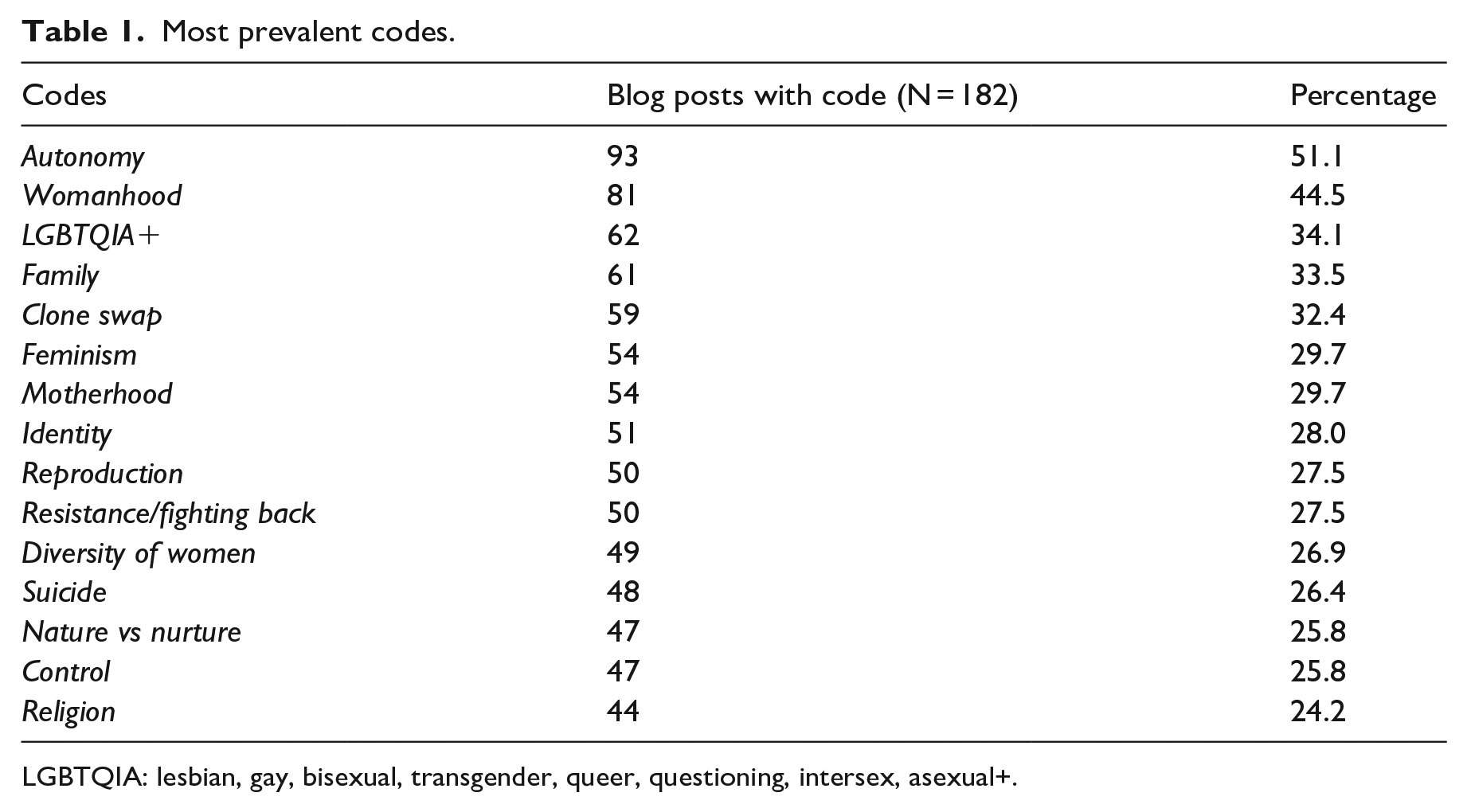
LGBTQIA: lesbian, gay, bisexual, transgender, queer, questioning, intersex, asexual+.
For autonomy to come up more frequently than womanhood—which is an obvious element of the characters’ identities and so central to the show’s premise as to arguably be inseparable from it—speaks volumes of the importance of this concept to fans of the series. Since Beauchamp and Childress first published their influential text on biomedical ethics in 1979, autonomy has been widely considered to be of utmost importance by Western medicine (Taylor, 2009). Defined as “a norm of respecting the decision-making capacities of autonomous persons,” this is a standard that is, at its core, concerned with consent and self-direction (Beauchamp and Childress, 2019).
Throughout Orphan Black the clones are consistently denied autonomy by those who aim to control them. Furthermore, their free will is restricted by the nature of their relationship to each other: given their identical appearances, the actions of any one clone may be mistaken for the actions of one of her clone sisters, creating a unique opportunity for clones to harm each other and restrict each others’ agency (Greene and Robison-Greene, 2016). That lay viewers have internalized the vocabulary of autonomy—most often qualified by bloggers as “bodily autonomy”—which was first developed as expert terminology by bioethicists in the 1960s and 1970s, is especially interesting and indicative of the weight of representations of bioethics in popular culture. One of the goals of the subsequent section is to parse the varying social, sexual, and bioethical concerns that fans reference when they invoke the concept of autonomy.
Womanhood’s rank as the second most widely used code is not surprising. Like genetics, gender provides another constant backdrop to the show—that is, when it is not being discussed explicitly. This code denotes a biocultural concept and refers to discussions of women’s experiences. The main cast of clones is women and their experiences throughout the series are described as undivorceable from this aspect of their identities. Other codes relating to gender, such as motherhood (54), feminism (54), and reproduction (50), also appeared in a high number of blog posts. It is arguable that everything in Orphan Black is ultimately related to womanhood, although viewer responses indicate that it is the issue of autonomy that is interpreted as uniquely connected to gender in the eyes of fans.
Reproduction represents one area through which issues pertaining to autonomy are explored in Orphan Black, and there is a strong connection between reproduction and control, as well as reproductive technologies and loss of consent in fan blog posts. Reproduction was the ninth most prevalent code in our data set, appearing in 50 out of 182 blog posts. While control and loss of consent appeared less frequently overall, their association with reproduction and reproductive technologies reveals more pathways through which women’s autonomy is violated in the eyes of fans of Orphan Black.
The term “cloning” does not appear in Table 1 for the simple reason that cloning is everywhere in our data. As the very premise of the series, it is impossible to separate it from virtually any discussion of the show. As such, we did not code for cloning itself. Among fans of the show, discussions of the ethics of cloning generally came up in other contexts, chiefly those of family, identity, and autonomy. As pointed out in Blog 72, these themes are often overlooked in other outlets, “with critics focusing on the ethics of cloning, but not the sense of bodily autonomy and the right to control your own genetics.” We were surprised that fans of the show seemed less concerned with the morality of cloning than with the impact of genetic science on women’s autonomy. The fans’ divergent set of concerns is one of the principal insights that our approach adds to existing academic approaches to the show. Eugenics also did not appear as one of the most prominent codes, in part because the bulk of Orphan Black’s explicitly eugenics content is concentrated in seasons two and five. Although LGBTQIA+ themes were prevalent in our data set, Orphan Black’s queer representation has already been discussed extensively in the academic literature (Casey and Clayton, 2021; Dillender, 2018; Pence, 2016; Scettrini, 2016; Sheldon, 2018) and thus will not be the focus of this article.
These results demonstrate the bioethical principle of autonomy’s salience to Orphan Black fans and suggest two major areas for further exploration of viewer interpretations of this concept: gender and reproduction. To this end, we will consider the association between womanhood and autonomy, and reproduction and control, in greater depth below.
Qualitative findings
Womanhood and autonomy
It is not a coincidence that Orphan Black’s main cast of clones are women. The struggles they face throughout the series are a product of their gender, and fans identify their womanhood as a key factor in the denial of bodily autonomy they must fight back against. It is thus arguable that gender is so embedded in Orphan Black as source material that it would be impossible for it not to appear, if only through implication, in the content that fans create about the show. Given this, womanhood’s relationship to autonomy may be inferable even without the explicit discussion of women’s experiences that we frequently find in these blog posts.
References to womanhood in Orphan Black blog posts, however, are still significant. When viewers unambiguously point out something about a show, they are making a statement about what elements of the series they think merit discussion. That fans do talk about womanhood, regardless of whether or not it is always implied by the show itself, indicates a particular kind of engagement with the content they are consuming. By making the implicit explicit, fans demonstrate what they find salient about the series and what they hope others will recognize in it as well. Many distill the very essence of Orphan Black down to the relationship between womanhood and autonomy, even if they do not always use these words. Here is one example among many in our data set: In effect, this show could be summarized with one simple description: mothers and daughters fighting against a patriarchy that aims to control their bodies. (Blog 1)
Viewers dig deeper and highlight a variety of characteristics of the relationship between womanhood and autonomy, including men’s role in cultivating it. Just as it is not a coincidence that the main group of clones are women, fans believe it is also not a coincidence that the majority of the show’s villains are men. As the primary perpetrators of injustice in Orphan Black, men are seen as responsible for denying the female protagonists autonomy both because of their clone status and because of their gender—two characteristics that mark them as “lower” (Blog 164) than those in power: It’s also significant that those trying to limit the clones’ freedom are all men: the smirking scientists who claim ownership over the clones; the duplicitous monitors that keep tabs on their every waking moment; the fanatical religious order that’s trying to eliminate them all together. All men, all trying desperately to keep control of these miraculous women’s bodies. (Blog 43)
Fans highlight the gendered power imbalances present in the Orphan Black universe. Men’s efforts to control the clones are strengthened by the support of institutions, and these institutions are strengthened by their ability to control information. A number of viewers point out that characters’ autonomy is violated both directly by physical boundary crossing, as well as indirectly by the withholding of information from the clones about their bodies: [The male clones] have a key difference from their female counterparts, though: While the women are not aware of their status, the men are self-aware, and know they’re genetic copies. Even on Orphan Black, men are given more knowledge, control, and choices when it comes to their own bodies. (Blog 72)
The main cast of female clones is kept in the dark about their origins up until they discover the truth for themselves, which kicks off the start of the series. When the audience eventually meets their male clone counterparts, however, it is revealed that the same is not true for the men. Although it is worth noting that women were not the sole targets of this secret cloning experiment, viewers point out that women’s autonomy was nonetheless uniquely violated by this incomplete access to information.
While Orphan Black’s creators may not have been particularly subtle with the gender dynamics of the show, fans seek out the nuances in this area. In particular, they emphasize how the characters’ struggle for autonomy mirrors women’s experiences in real life. This is made more salient by Orphan Black’s setting in a world that closely resembles our own. By using the science fiction genre to develop high-stakes plot lines about genetic technology taking place in a real and relatable (although undisclosed) location in North America, the risks explored on screen feel immediate to many viewers: Orphan Black is a story about women who stand up and take back what’s theirs: the decision on what to do with their bodies. In contemporary times, the series is one of the most crucial productions, that helps to understand and educate about what it means to be a woman, and to be free. (Blog 169)
While many fans and scholars have pointed out that Orphan Black’s science is ultimately fiction, viewers still interpret the crux of the story—women fighting for their autonomy—to be distinctly rooted in reality. The feasibility of human cloning aside, its consequences require little extrapolation from reality for fans of the show. They see the attacks on women’s autonomy in Orphan Black as an unsurprising extension of the world we already live in, and as a critical example of popular media’s power to educate about it: The characters of the show are not simply fighting for their lives, but they’re fighting for a right to their bodies and their biology. They’re fighting to not have their bodies invaded because of “science.” They’re fighting to have the rights to their bodies that they have been denied. In a world where there are women who are still fighting for this right, this is a message that will resonate with many. (Blog 116)
It is worth noting the political context that Orphan Black was released into. Airing from 2013 to 2017, the series spanned the presidential campaign and eventual election of Donald Trump in 2016. It is possible that the show’s popularity was a consequence of this particularly fraught moment in American history. The perceived pertinence of Orphan Black’s bioethical content—especially to women—is a product of this climate. While we sought out viewer interpretations of the bioethical questions raised by the prospect of future advances in genetic science and technology as they are portrayed in science fiction, fans also focused on the way Orphan Black reflects existing injustices in our present world. A notable amount of the conversation about womanhood and autonomy among Orphan Black bloggers thus frames bodily autonomy as a women’s rights issue, and emphasizes its social justice and political implications in relation to its bioethical ones. Fans see these as connected, especially in the context of reproduction, where social norms and policy decisions may affect the accessibility of reproductive health care, funding for research, and the development of standards of care. These concerns are central to the feminist movement, which entered the bioethical conversation in the mid-1980s as questions about the increasing medical control of women’s childbirth experiences were on the rise (Rapp, 2000).
The focus on the relationship between violations of women’s autonomy in the show and the cultural climate in real life outside of the medical or scientific context is pervasive. Lay viewers make sense of Orphan Black’s bioethical material through the lens of social problems, which can easily be analogized from the show to what fans observe in their everyday lives. The cultural climate in society at large does, after all, have an effect on the perceived moral permissibility of what happens behind the closed doors of these institutions, and it is precisely this dynamic—first highlighted by scholars of feminist bioethics—that Orphan Black viewers emphasize in their interpretations of the series. Here is a blog excerpt typical of many that connects a lack of bodily autonomy to other forms of discrimination against women: Orphan Black is about women vs. the system. While the men are nothing more than empty suits, the misogynist system they’re a part of gives them power. Leekie’s idea to reduce women to man-made synthetic wombs, Duncan’s project of creating an endless supply of “little girls,” Henrik’s religious rape—these ideas, not the men, are the real threats. And since the men who run these projects have wealth and institution on their side, they are able to provide real road blocks to the clones, even though the women are far more intelligent and proficient. (Blog 60; emphasis added)
Men are seen as violating women’s bodily autonomy, something that enrages many bloggers, by harnessing institutional power that viewers trace back to the misogynistic ideologies of their society—a society all too close to our own. The consequences of this pathway become bioethically pertinent in the context of Orphan Black’s ever-present backdrop of rogue genetic science, from which the series’ plot can never be separated. Fans acknowledge the fault of science as an institution (Blog 111), scientists as individuals (Blog 42), or most directly, scientific control over women’s bodies, as in the excerpt below: It’s impossible to explore themes about the creation of human life without discussing the nature of that creation and how children are born in the first place. This is often elided in discussions about the programme, with critics focusing on the ethics of cloning, but not the sense of bodily autonomy and the right to control your own genetics. The show itself does not shy away from these issues; eugenics and the desire to pursue perfection is very heavily stressed and explored from a number of perspectives. In the context of the show, the clones represent a complex multi-year experiment, pitting human autonomy against scientific control of women’s lives and bodies. (Blog 72)
All of these areas intersect at reproduction, where gender, autonomy, social justice, and bioethics converge in the real world and on screen in Orphan Black.
Reproduction and control
One of the primary pathways through which the connection between womanhood and autonomy is explored by Orphan Black bloggers is reproduction. In blog posts fans discuss reproduction extensively, particularly in connection with control, and their interpretations are illuminating. The level of detail in this excerpt about reproductive issues is typical of many posts: Apart from the revelation in the first season finale that the clones’ very genetic code is restricted intellectual property, which left philosophical questions about self-determination and ownership of humans hanging in the air, a number of different but recognisable reproductive anxieties have manifested themselves in the sisters’ bodies: single motherhood and financial/social insecurity; biological infertility; forced pregnancy; involuntary sterility; the emotional knottiness of surrogacy; the prospect of never being a mother at all. (Blog 85)
Fans understand the control of reproduction to be a primary way in which women’s right to autonomy is infringed upon in the series: passages coded for control appeared 80 times in our data set. While academic accounts of Orphan Black emphasize the way that cloning raises questions about self-determination and freedom (Goulet and Rushing, 2019; Greene and Robison-Greene, 2016; Pence, 2016), fans primarily link the characters’ loss of reproductive control to their gender rather than their genetic status. Given this, advances in genetic science are risky because of their potential to exacerbate existing inequities and injustices, rather than create new ones. More specifically, many blogs emphasize the prospect of advances in reproductive technology as a motivating factor in the pursuit of control over women’s bodies, and as a reason behind the development of the show’s primary cloning program—from which a host of other bioethical issues extend. In this way, reproduction is interpreted by fans as being both a way to control women and a reason to control women, as in the excerpt below: According to tags embedded in their very DNA, the women are “owned” by the organization that created them, and this extends to any children they may produce. In this sense, Orphan Black is the extreme realization of a world in which women are utterly deprived of reproductive autonomy. They are unable to have children on their own, and if assisted reproductive technology or other tools are used, their children don’t belong to them and they theoretically don’t control their fate. (Blog 72)
Within the show’s universe, the control of reproduction—particularly through the development of new reproductive technologies—offers an opportunity to constrain the agency of not just women, but also the children they produce. Feminist activists have been skeptical about the consequences of the medicalization of childbirth and the rise of reproductive technologies for a long time (Rapp, 2000). A dark example of these concerns, Orphan Black’s corrupt scientists, if successful, see advances in reproductive technology as an opportunity to turn their power over women’s bodies into power over humanity as a whole (Blog 177). However, fans are careful to highlight that the serious risks associated with reproductive technologies are the fault of the men and institutions that misuse them, not of the women who seek reproductive autonomy. One blogger sums up this dynamic well: . . . the show emphasizes that the evil lies not in the clones’ ability or inability to procreate biologically but in the control exercised by outside forces on their choice to procreate. (Blog 10)
In this context, the relationship between reproductive technology and loss of consent in Orphan Black blog posts is striking but perhaps unsurprising. These two codes were closely connected in our data set and highlight the risks of rogue, abusive science and the prioritization of experimentation and scientific advancement over all else. Moreover, because these conversations often revolve around reproductive technology, in particular, the way that fans raise the issue of consent is twofold: both the traditional bioethical mandate for patients to give informed consent in medical and research encounters (an important derivative of the principle of autonomy; Varkey, 2020), and the legal requirement for individuals to freely give consent to sexual activity, are invoked by viewers of the show. This excerpt emphasizes the bioethical context for an egregious failure to provide informed consent: Let’s start with Helena. She allows Henrik to inseminate her with the embryos that he fathered, demonstrating just how little she understands about the process by asking what a cervix is and showing only a rudimentary understanding once it’s been explained to her. Her ignorance of the matter would, at the very least, make any consent she gives to this procedure highly suspect. (Blog 63)
Although Helena’s forced insemination is only the latest chapter in a history of horrific abuse, it is her inability to consent to the use of these reproductive technologies that Blogger 63 emphasizes. This is a recurring theme in fan accounts of the show, which point out the myriad ways that Orphan Black’s villains use the “black box” of their technology to obscure their true motivations from patients and research subjects. Another example comes in the form of a cutting-edge fertility program called BrightBorn, which uses this strategy to blur the line between coercion and choice when recruiting participants (Blog 109). Furthermore, there is something significant about this dynamic taking place within the context of reproduction, where sexuality is inevitably invoked.
Sexual consent is also compromised in some exchanges with the clones’ partners, many of whom are secretly employed as “monitors” by the institutions responsible for the cloning experiment. Frequently, the clones’ partners are not forthcoming to their girlfriends and wives about who they are and what motivates them. Once again, the women of Orphan Black are kept in the dark about their own lives and relationships, and they experience violations of their autonomy via this withholding of information. One blogger highlights this dynamic by referencing an interaction between one of the clones, Cosima, and her partner Delphine: Orphan Black has always confronted the ethics of the science it portrays, most often using Cosima as its mouthpiece for a fierce defense of individual autonomy. Who can forget her powerful proclamation of, “my body. I’m the science,” when she thought Delphine was hiding details of her own biology from her? (Blog 28)
Fans attribute part of the blame for these dynamics to the constant push for scientific discovery. Delphine, who genuinely loves Cosima, still ends up instrumentalizing their romantic relationship for the sake of science. The result is that she, like the corporation for which she works, “turn people into lab rats without their consent” (Blog 133). Given this theme, the proximity of passages concerning reproductive technology and loss of consent makes sense. Once again, bloggers note the connection between how these themes arise in Orphan Black and how they appear in women’s experiences in the real world, particularly in the United States where fans are “looking not just at a possible future in a nation with extremely advanced medical science, but also a highly theoretical series of questions about the nature of reproductive control” (Blog 72). The following excerpt frames the real-world context of advances in reproductive medicine in political, religious, and feminist terms: At a time when issues surrounding women’s bodies and reproductive rights are not just debated, but frequently taken out of women’s hands—more often than not, by the government or religious fanatics (sound familiar?)—this is an increasingly relevant discussion to be had. The fact that it’s playing out on a sci-fi drama on BBC America is far from surprising. Science-fiction has always been reflective of fears currently plaguing society. And by encasing these issues within the trappings of a sci-fi action-thriller, Orphan Black exposes its viewers to radically feminist views without scaring anyone away with the “F” word. (Blog 16)
The resentment in this blog is palpable. When it comes to reproduction and control, viewers expand on their sentiments about the role of systemic injustice and misogyny in the violation of women’s autonomy. The clones’ persecution in Orphan Black is not seen simply as the product of a regressive political climate or the actions of a few hateful villains. Rather, the massive and often invisible power of institutions and ideologies creates a nearly insurmountable challenge to women on screen and in reality. From the perspective of Blogger 16, it would take a radical transformation in patriarchal society for women to take control of the new reproductive technologies being developed by corporate science. Under these circumstances the humanity of those who are being controlled is at best called into question, at worst outright denied. From here the right to autonomy quickly diminishes, as is illustrated so clearly on screen by the various attempts of those in power to harness women’s reproduction. Bloggers are careful to draw attention to this dynamic: As many women know from personal experience, it doesn’t matter how independent you are. It doesn’t matter how smart you are. It doesn’t even matter how connected you are. The game is rigged to begin with to ensure that even the strongest women are subject to having their bodies re-purposed without their consent. (Blog 60)
The nonconsensual repurposing of women’s bodies to serve the goals of institutions is a source of anger and a major theme in fan accounts of Orphan Black. Viewers resist the notion held by the series’ villains that sacrificing the agency of a select few may be made worthwhile if others stand to benefit from their oppression (Blog 126). Instead, fans reaffirm the characters’ humanity and individuality (despite their clone status) and take issue with the organizations that see them as objects that can be manipulated for their benefit: On the series, the female body is a battleground, with the women literally reduced to objects. The more easily controlled or useful the clones’ bodies are (read: able to be reproduced), the more they’re worth to the government-supported scientists and religious fanatics who continuously lay claim to Sarah and the rest of Clone Club. (Blog 16)
When fans discuss reproduction, the bioethical content in Orphan Black becomes even clearer. As both a method and a reason to restrict the autonomy of women, reproduction and its associated technologies illustrate the social, political, and moral pathways through which the risks of genetic science are encouraged or mitigated in daily life, as well as the distinctly bioethical ones—including informed consent and experimental design—that mediate it in medical and research contexts. As such, viewer explorations of the connection between reproduction and control underline the prominence of gendered violations of autonomy in Orphan Black blog posts and illuminate how this relationship came to be on screen, or could come to be in the real world.
4. Conclusion
As genetic science has risen to popular cultural prominence and its place in science fiction has grown (Gibbons et al., 2021), understanding audience responses to the ethical issues associated with this topic grows in importance. By looking to blog posts written by fans of the science fiction series Orphan Black, which is oriented largely around genetics and the bioethical challenges that extend from it, this study offers a different kind of insight into the ways that lay people make sense of emerging technologies and their risks. Rather than examine the show’s source material, or interview its fans, we analyzed viewer-created blog posts to explore interpretations of Orphan Black’s bioethical content volunteered online by its uniquely engaged audience.
Our approach demonstrates science fiction fans’ active participation in meaning-making and bioethical reasoning. Blog posts reveal a rich, interactive relationship between portrayals of science on screen and viewer interpretations of its consequences in real life. While existing public understanding of science scholarship has focused on film and television itself, fan-generated content has been largely overlooked by the field. Our findings demonstrate that this novel methodology offers a different kind of insight into public reactions to the portrayal of science and bioethics in the popular media that is worthy of further exploration.
Fans of Orphan Black are primarily concerned with the concept of autonomy and the ways it is violated—both on screen and in real life. In particular, the connection between the characters’ gender and their fight for bodily autonomy is discussed extensively by bloggers. As fans see it, reproduction is one pathway through which this dynamic is explored by the show, where reproduction and its associated technologies are treated as both a way to control women and a reason to control women. The bioethical issues that appear in Orphan Black are analogized to and even equated with women’s struggles in real life. Fans convey a striking sense of rage in their writing on this topic and do not shy away from responding emotionally to injustice and unethical actions—a feature indicative of a particular audience response to the series rather than the authorial intent behind it. However, rather than focus exclusively on Orphan Black’s villains, who are mostly men, fans trace these problems back to the powerful institutions and misogynistic ideologies that support them. In this respect, cultural attitudes, rather than individual scientists, are blamed as the source of many bioethically fraught moments in the series.
Fans do not regard Orphan Black’s genetic science as inherently evil and instead take a social constructivist view. They are enraged by the potential use of genetic science to manipulate women and control reproduction, not by the dangers of human cloning itself. While bloggers express fury at the ways that men capitalize on patriarchal power dynamics to appropriate these technologies for their own benefit in the show, their responses imply a belief that this is not the way things have to be. While we sought out viewer interpretations of the bioethical questions raised by the prospect of future advances in genetic science and technology, fans more often described the show’s use of the science fiction genre as a tool to reflect present injustices in our world, which they already feel to be more dystopian than we would like to admit.
Fans fear that genetic science will be made dangerous by the social and political contexts it operates within. The emotional reaction to this concern is an important feature of fan blogs that is lacking in academic accounts of the series. Bloggers feel strongly about and personally affected by the ethical issues parsed on screen, and they are vocal about the ways that their personal experiences (especially as women) color their responses. In contrast to the objective, rational, and normative approach of the field of bioethics, fans champion their own subjective connections to the series’ ethical controversies and draw on them openly in their moral interpretations of the show. In the years surrounding the 2016 presidential election in the United States, Orphan Black offered both a cautionary tale about an unjust and unethical world not that different from our own, and the hope that there might be a way to avoid this dangerous and, as fans saw it, imminent future. Viewer responses imply a belief that we have the power to harness emerging technology and use it for good, but that this will only be possible in a world where misogyny and structural and political inequality are addressed. Despite its darkness, this is precisely why fans love Orphan Black so much. It does not shy away from evil, or from the fight to triumph over it: Orphan Black—in so many ways that I cannot even begin to do justice with my words here—is, has always been, to me an allegory of evolution, resistance, and protest. It is a testament to what we can achieve, what we hope to achieve, and what we have yet to imagine that might be achieved through collective and collaborative efforts. (Blog 182)
The salience of these topics to viewers of the series cannot be overstated, and fans are grateful for their portrayal in popular media. Our findings suggest that fandom offers something valuable to the effort to make sense of the impact of genetics on society, and to the public understanding of that impact. For every bioethical complexity explored on screen by Orphan Black itself, there are as many explored, expanded, politicized, and intensified by fans.
Supplemental Material
sj-docx-1-pus-10.1177_09636625231187321 – Supplemental material for Autonomy and bioethics in fan responses to Orphan Black
Supplemental material, sj-docx-1-pus-10.1177_09636625231187321 for Autonomy and bioethics in fan responses to Orphan Black by Ayden Eilmus, Avery Bradley and Jay Clayton in Public Understanding of Science
Footnotes
Acknowledgements
The authors thank their colleagues in GetPreCiSe, especially Ethan Gibbons and Ellen Wright Clayton, as well as the two anonymous reviewers of this paper for helping to draw out the implications of this research.
Funding
The author(s) disclosed receipt of the following financial support for the research, authorship, and/or publication of this article: This paper was supported by funding from the National Institutes of Health for Vanderbilt’s Center for Genetic Privacy and Identity in Community Settings (GetPreCiSe) (grant no. 5RM1HG009034).

Supplemental material
Supplemental material for this article is available online.
Notes
Author biographies
References
Supplementary Material
Please find the following supplemental material available below.
For Open Access articles published under a Creative Commons License, all supplemental material carries the same license as the article it is associated with.
For non-Open Access articles published, all supplemental material carries a non-exclusive license, and permission requests for re-use of supplemental material or any part of supplemental material shall be sent directly to the copyright owner as specified in the copyright notice associated with the article.
