




Abstract
Scientists’ warnings of a climate and ecological emergency have been published recently. They have been criticised as being unattractive to non-scientists. Here, the criticisms are reviewed and comments presented. The path is long between primary research and the daily concerns of hard-to-reach people (e.g., those who are impoverished). It is enough that expert scientists express their findings accurately and intelligibly to all who are receptive. Outside the ranks of the specialist experts, there are many – intellectuals of all kinds, journalists, politicians, business people, and concerned citizens – who are well placed to contribute to the generation of a worldwide groundswell of practical action. The full range of discourse on the ecological issues is divided into four registers: used in primary research; dissemination of specialists’ thinking to non-specialists; discussion with those engaged in public affairs; and discussion with those who face obstacles to becoming engaged with the issues.
Keywords
It is widely acknowledged that humanity faces a climate and ecological emergency, and that our responses to date are far too slow and cautious. The mismatch between danger and appropriate action is partly a problem in the communication of science, to which Public Understanding of Science scholars have made numerous research contributions. This brief essay, from outside the PUS and similar research communities, is offered as a contribution to an urgent practical problem. It considers a very specific class of publication.
1. The scientists’ warnings
2020 saw noteworthy growth in the number of scientists’ warnings – admonitions, often directed explicitly to humanity, about the dire state of our planet’s ecology and the role of human activity in this. What may be considered a distinctive genre has its origin in a leaflet produced by the Union of Concerned Scientists (UCS). World Scientists’ Warning to Humanity (Union of Concerned Scientists, 1992) opens with the blunt warning ‘Human beings and the natural world are on a collision course’. It asserts that the environment is suffering critical stress and that we must accept limits to consumption and population. 1 At that time, there was little chance of so overtly value-laden a message being accepted in the source-referenced and peer-reviewed scientific literature. Being grey literature, it was in the course of time largely forgotten. 2 But the issue had not gone away.
2. A second notice
In 2017, 25 years after its original publication, the UCS warning was brought to renewed attention with the article World Scientists’ Warning to Humanity: A Second Notice (Ripple et al., 2017). In the interval, knowledge about global ecology, including human influences, had become firmer – and even more disturbing. It was possible for an overview, with quantitative data, to be published in a highly respected scientific journal. The core of the article comprises graphs showing the course, from 1960 to around 2015, of nine indicators of global ecological stress. All of these indicators except one, on ozone depleters, show marked increase of stress. In nearly every case, the adverse trend is roughly the same after 1992 as before. Thus, during a quarter-century opportunity, humanity did not heed the UCS warning.
Since those first two warnings, there has been an increasing flow of scientists’ warnings on facets of the general problem. An early and notable one of these is World Scientists’ Warning of a Climate Emergency (Ripple et al., 2020), with a form similar to that of the Second Notice. It displays trends over time in the intensity of 15 human activities with global climate impact, and 14 climate trends. Although the general direction of these trends is adverse, the authors in their conclusion do also point to a recent surge of concern on the part of governmental bodies, schoolchildren, litigants and citizens. Other alarming ecological imbalances have also been the subject of scientists’ warnings, especially from 2020. These include freshwater biodiversity (Albert et al., 2021), microorganisms (Cavicchioli et al., 2019) and many more. 3 The scientists’ warnings that are the subject of this essay differ markedly from earlier warnings stretching back through history, of which the Russell–Einstein manifesto (Russell and Einstein, 1955) and Silent Spring (Carson, 1962) are notable examples.
A major recent development of the genre is notable as a foray from the natural sciences into the highly politicised territory of affluence and survival. Scientists’ Warning on Affluence (Wiedmann et al., 2020) makes strong claims – that by far the largest factor determining ecological impact is consumption and that consumption is more aptly labelled affluence. Time will judge whether the weight of natural science has successfully been brought to bear on a subject (affluence) that is generally studied in a sociological and economic context.
3. To sensitise humanity
The scientists’ warnings go beyond accounts, intelligible to a wide readership, of the current scientific consensus on reliable knowledge about global ecological overload. They attempt to sensitise humanity as a whole to the implications of this knowledge and they enter the domain of policy, recommending radical changes of behaviour in all aspects of human activity. By 2017, the time of the Second Notice, it was clear that humanity was not addressing the issues of sustainable living in the way that the 1992 UCS warning deemed necessary. The warnings were evidently unwelcome. To some extent, people deployed psychological defences (inattention, distraction, data selection, denial) against disagreeable news. Perhaps more important, the news was known to be likely true, but psychic numbing (Slovic, 2020) and inertia inhibited appropriate action. Individuals and groups could respond to clear and present danger, but not to warnings of dangers that were global, novel and (largely) about a relatively remote future.
4. Scholarly responses
The three principal scientists’ warnings – UCS (Union of Concerned Scientists 1992), Second Notice (Ripple et al., 2017) and Climate Emergency (Ripple et al., 2020) – have attracted responses from natural scientists, social scientists and humanities scholars. Some of these responses are endorsements (Skubała 2018a, 2018b) and the others are sympathetic to the aims but critical of the warners’ methods, implicit assumptions, language and effectiveness (Bull et al., 2017; Hartman and Oppermann, 2020a; Kayal et al., 2019). There is objection to the tone of the Second Notice, which is claimed to have been conducted in a top-down manner, and to be saying virtually nothing about poor people (Bull et al., 2017). The Second Notice is also accused (Kayal et al., 2019) of addressing symptoms rather than root causes, normalising the Western lifestyle and neglecting prevailing inequalities.
The inaugural issue of Ecocene (Hartman and Oppermann, 2020a) has the theme Environmental Humanists Respond to the World Scientists’ Warning to Humanity. The editors’ introduction includes an overview (Hartman and Oppermann, 2020b). Two reservations run throughout the collection. One is expressed by Slovic (2020: 46) – ‘I find that the “World Scientists’ Warning” delivers a flood of convincing information about the direness of our climate predicament but does so in a way that smothers . . . the salience of the warning itself’. The other prominent reservation (Hartman and Oppermann, 2020b: 10–11) is that ‘people are much more likely to be influenced and motivated by storytelling, music, and art than by scientifically rigorous presentations of data’.
Specific criticisms include: humanity is not a unified entity (Braidotti, 2020; Yearley, 2020: 19–21); people are vulnerable to psychic numbing when inundated with abstract information (Slovic, 2020: 43); cautionary assertions may be perceived as finger-wagging (Slovic, 2020: 50); and globalist arguments are not easy to reconcile with life as it is lived (Foote, 2020: 55). Other offerings include: climate change should no longer be seen as a purely global problem but must enter the heart of local economies (Blanc, 2020: 134); where geoscientists speak of a planet in crisis, humanists speak for a world where the societal responses to crisis need to be narrated and communicated widely (Castree, 2020: 37); lessons can be learned about the poignant use of language (Slovic, 2020: 45); and those in the environmental humanities, as well as natural scientists, are called to play ‘the watchman’s part’ (Szerszynski, 2020: 97–98).
5. Comments on the scholarly responses
The criticisms (Bull et al., 2017; Hartman and Oppermann, 2020a; Kayal et al., 2019) fully respect the warners’ knowledge but are often severe on their communication skills. The warnings can, however, be afforded a more sympathetic reading. The efforts of Ripple et al. (2017) and Ripple et al. (2020) may not have turned human culture away from a collision course, but they have raised awareness of the UCS warning and its manifold aspects (climate, oceans, forests, biodiversity and more). This is attested by many responses in the scientific and scholarly literature. 4
In terms of technical accuracy, the scientists’ warnings have a good track record. In no particular have any of the warnings been shown to be ‘false alarms.’ Even in terms of being heard, the warnings have been quite successful, the inadequacy of business-as-usual now being widely exposed (Kramer et al., 2019). The real failure is that, except in the one case of stratospheric ozone depletion, collective actions to avert danger have been far short of what is needed. As long as economic growth remains a fetish, identified with human well-being, the global ecological overload will become worse. There are, however, recent signs of cracks in neoliberal hegemony (Kramer et al., 2019).
Some critics of the scientists’ warnings doubt whether telling the scientific truth about climate change and the global ecological crisis is really enough to lead people to action (Armiero, 2020: 150). But the scientists cannot, more than others with agency, be held responsible for the lack of an adequate global political reaction. Might the warning scientists, in their anguish, have taken on too much by directly addressing all humanity? From that point of view, the role of the world’s most informed specialists is to present accurate simplified accounts of what they know to a wider constituency comprising those who have some interest in and knowledge of science. 5 The many graphs in Second Notice and Climate Emergency can be considered in just this way – as a bridge between the specialists’ knowledge base and that wider constituency. The important task of reaching further, to those who have no appreciation of science, but whose lives are affected by it, lies outside the skill-set of most scientists. That task is principally for scholars, journalists and other writers. In this analysis, the responsibility for warning humanity at large is spread widely and is bearable.
6. Sufficient action
The Second Notice showed how insufficient were humanity’s responses to the global ecological emergency. The more recent Climate Emergency warning shows the insufficiency continuing, although it does also see some recent positive developments from governmental bodies, schoolchildren, litigants and citizens. Other positive signs are that scientific conclusions about climate change and biodiversity loss are steadily becoming more reliable and accurate (and thus more persuasive); and that, in the current pandemic conditions, science has gained enhanced respect (Figure 1).
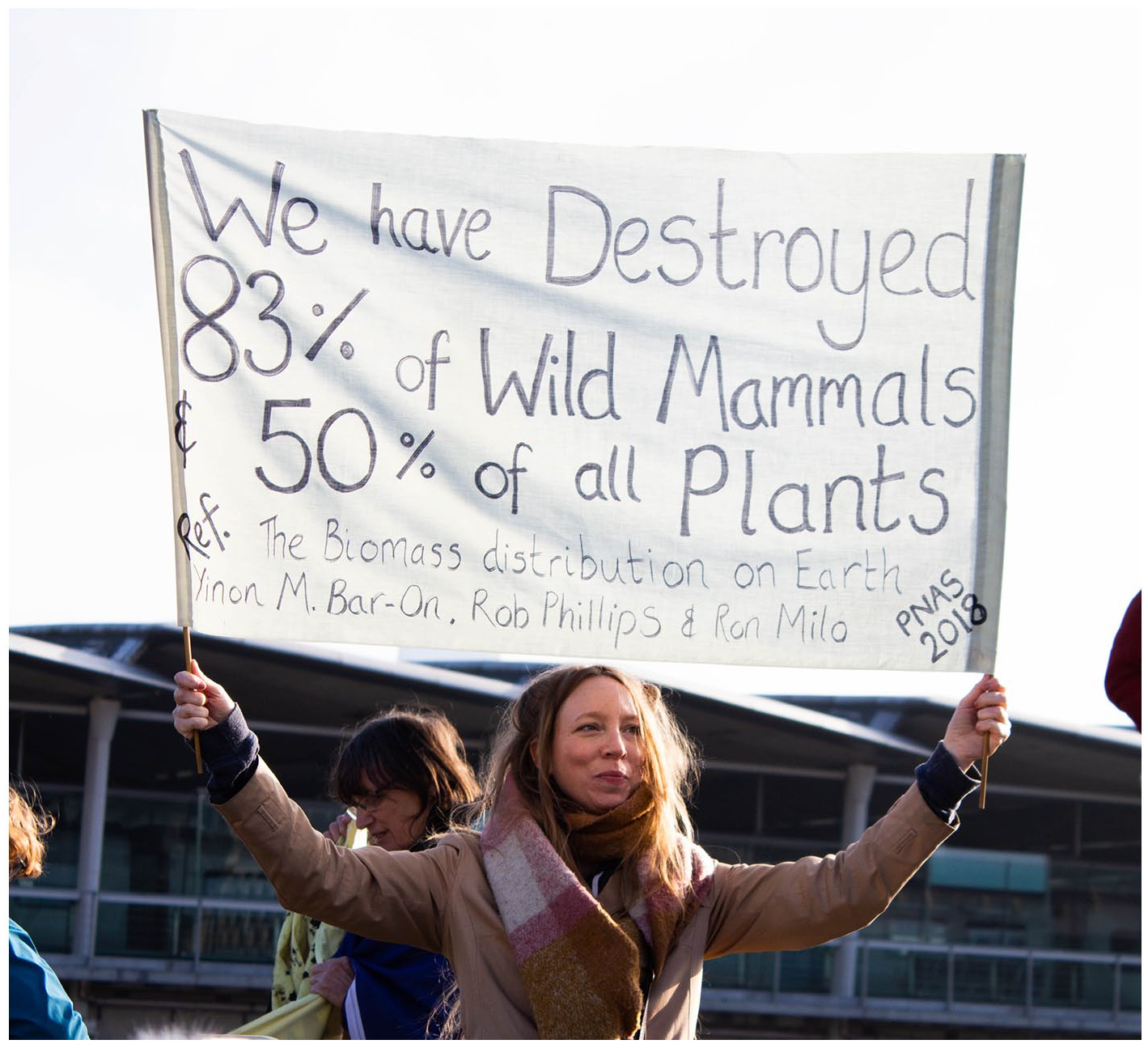
Peer-reviewed primary research papers are not infrequently cited by activist demonstrators, especially when concerned with climate change or biodiversity loss (Hawkins, 2018).
Expert scientists’ warnings will no doubt continue for some time, on further subjects and with improved data. But the greatest problem for now and the foreseeable future is appropriate and sufficient action. Asking the warning scientists to improve their communication skills, to the point where their testimony becomes irresistible, is too much. It is enough that those scientists refine and promote the task that only they can do – producing reliable, relevant knowledge and starting the dissemination process with warnings written for receptive non-specialists. Thus, the first stage is to inform and energise a large cadre of scientifically literate people about the extreme scale and urgency of the danger. The second stage requires the creation of a worldwide groundswell – the active participation of an even larger class of concerned citizens. The input of the few specialist scientists who also have outstanding communication skills is of course welcome. But the huge challenge requires also the skills and energy of all others with something to offer – intellectuals of all kinds, journalists, politicians, business people and concerned citizens. No single linguistic register is adequate for the totality of discourse needed for addressing the challenge.
As a response to the scholars’ criticisms of the scientists’ warnings, it is here proposed that discourse on the great range of the ecological issues can usefully be divided along a line, albeit with fuzzy boundaries, into four registers. The first of these is used in the practice of primary scientific and scholarly research, and is specialised and technical. The next register is used in the dissemination of specialists’ thinking to non-specialists beyond their circle and is at the level of scientifically literate non-specialists. The third register is used for discussion with those explicitly engaged in public affairs and is the medium of the interplay between scientific truth claims and social values. The fourth register is for discussion with a hard-to-reach group – those who face obstacles to becoming explicitly engaged in the ecological issues. These obstacles may be short-term, such as lack of necessities, or medium-term, such as chronic overwork, or long-term, such as consumerist acculturation. Removing these obstacles presents the most difficult challenge in the entire project of developing a global culture of sufficient action.
An easier but still important challenge in the fourth stage is the further development of everyday and empathic language for dialogue with those who are currently hard to reach. A development in the fourth register has occurred recently with the increasing use of the phrase (IPPR Environmental Justice Commission, 2020) climate and nature emergency (or crisis). The novelty here is the replacement of the formal terms ecological or biodiversity, usual in the other registers, by the everyday term nature. The more precise formal terms are suitable in their place, but replacing them in the fourth register by nature may turn out to be a significant contribution to popular outreach. Nature emergency has been taken up with energy by such green campaigners as Climate Scotland (2021).
7. Ultimately, all can contribute
This essay takes on board the points made by the critics of the Scientists’ Warnings. It proposes a flat-line structure within which those with agency – ultimately all – can contribute to sufficient responses to the climate and nature emergency. First must come a groundswell for us humans taking a modest, just and sustainable place within life on earth. Then, those who currently are not in a position to do so may also be empowered to think and act with global and long-term reach.
Footnotes
Acknowledgements
The author acknowledges with thanks the comments from J. Albert, P. Belton, T. Belton, C. Bradshaw, R. Cavicchioli, P. Ehrlich, R. Ennals, R. Jennings, E. Kayal, M. Kayal, T. Lenton, P. Pickbourne, W. Ripple, S. Slovic and V. Spedding.
Funding
The author(s) received no financial support for the research, authorship and/or publication of this article.
Notes
Author biography
 ) is a physicist and a Senior Fellow in the School of Chemistry at the University of East Anglia. He has a long-standing involvement in scientists’ social responsibilities, having – for example – designed and convened a course for natural science students on ‘science, values and ethics’. Subjects on which he has written include nuclear physics education, Martin Ryle, economic language and economy change, the future of work, the modern and the postmodern.
