




Abstract

Between the 1860s and the mid-1880s, one name connected to popular scientific performance stands out in the Dutch contemporary press: known simply under his inherited stage name, Maju presented international developments in science and technology, from Pepper’s Ghost to Edison’s phonograph, to delighted Dutch audiences. Maju’s idiosyncratic background, as well as the breadth of stakeholders and audiences that he engaged with, paints the picture of popular science as an unpredictable broad terrain in the nineteenth century.
As the definition of a field of study and as an analytical category, the term popular science has been the object of discussion for decades. 1 To circumvent the problems that such a characterization might bring to contemporary scholarship, historians such as James Secord (2004), Bernard Lightman (2009), and Jonathan Topham (2009) have proposed alternative approaches to the range of historical practices engaged with science in the nineteenth century. These approaches reinforce the idea of understanding scientific practice as an inclusive, flexible, and interconnected field populated by a myriad of historical actors and settings. An example is the re-appraisal of nineteenth century scientific spectacles from entertainment ventures to embodied and situated public performances which negotiated complex politics of knowledge production (Morus, 2010a: 778). The figure of the science popularizer, a designation in itself still under discussion, also participated in this negotiation, as it conveyed different meanings to different historical actors and could carry either positive or negative connotations (Lightman, 2009: 12). In addition, science popularizers themselves operated from a variety of skill sets, backgrounds, and motivations. I will attempt here to characterize a particular historical actor, Dutchman Levie Kinsbergen Maju (1823–1886) as a science popularizer whose range of practices exemplify the challenging boundaries of the term. I will argue that Maju, who came from the world of entertainment rather than science, played a significant role in the introduction of science and technology to the Netherlands, while being, at the same time, able to navigate successfully between different audiences and institutional settings.
1. From conjuror to lantern lecturer
Levie Kinsbergen was born in Zutphen, a small city in the east of the Netherlands, on 17 August 1823. His birth certificate (‘Levie Kinsbergen’, 1823) names his mother Mietje van Huuks, housewife, and his father Meijer Kinsbergen, showman in Amsterdam. Meijer already used the stage name Maju Kinsbergen or Kinsbergen Maju, before it was adopted by his son (Overijsselsche Courant, 1823). The Kinsbergen family was a Dutch Jewish family with many connections to the entertainment industry, namely itinerant shows in Dutch fairgrounds. 2
During the 1850s, L. K. Maju styled himself as Professor of Sleight-of-Hand and toured the country’s theater venues, coffee houses, and fairgrounds with Soirées Amusantes, which included conjuring acts and experimental physics (Bredasche Courant, 1857; Provinciaal Dagblad van Noord-Brabant en’s Hertogenbossche Stads-Courant, 1852). Between 1863 and 1864, Maju worked in London, where he performed conjuring feats “without any apparatus” at the Royal Colosseum and the Royal Polytechnic Institution under the stage names L. Kinsbergen Maju, Professor of Magic to the King of Holland or Herr Maju, the Great Prestidigitateur (Lloyd’s Weekly Newspaper, 1864; The Globe, 1863). Maju’s association with the Polytechnic turned out to be a fruitful and long-lasting endeavor that widened the scope of his performances. In the following years, Maju exported the Polytechnic’s sensational ghost lecture, Pepper’s Ghost, which would become known in the Netherlands as De Geest van Maju (The Ghost of Maju in a literal translation), and the cabinet-based illusion The Sphinx. The Ghost was performed mainly as an itinerant act on Dutch fairgrounds between 1864 and 1865 (Algemeen Handelsblad, 1864; Rotterdamsche courant, 1865). While it was a very different setting from the rational entertainment environment of the Polytechnic, this choice enabled Maju to include the Ghost in a profitable circuit, reaching audiences across the Netherlands, while making use of his family network. When Maju imported The Sphinx from the Polytechnic in 1866, he skipped the fairground circuit and performed the illusion in permanent indoor theaters throughout the country, following the first very successful performances at the Paleis voor Volksvlijt, which was referred to as the Dutch Crystal Palace (Algemeen Handelsblad, 1866). Later that year, Maju started to add other acts (such as microscopic and agioscopic, or opaque, projection) to the short piece that was The Sphinx and to offer evening programs which included three to four sections, lasted about 2 hours and which he advertised as scientific performances (Utrechtsch Provinciaal en Stedelijk Dagblad, 1866). Maju quickly devised a new repertoire based on magic lantern lectures and technological innovations: the conjuring and magical vocabulary from previous announcements had by now clearly given way to the terminologies of lectures and clarifications “following the Method of the Royal Polytechnic in London” (Algemeen Handelsblad, 1867), which he signed as Maju, no longer Professor of Sleight of Hand, but Member of the Polytechnic. The Polytechnic label that Maju was eager to advertise imparted scientific authority to his performances, an authority which was, nevertheless, connected to entertainment: according to Jeremy Brooker (2007), the Polytechnic was a venue that permitted “a wide range of encounters from small-scale demonstrations of glass blowing to popular lectures on ‘serious’ subjects and burlesque entertainments, loosely brought together under the name of ‘rational entertainment’” (p. 189).
2. Entrepreneurship and scientific spectacle
Nineteenth century scientific performance was an active and expansive field. While science practitioners saw public scientific performances as an opportunity to construct their scientific authority (Morus, 2016: 12), other experts were also involved in creating spectacular displays and in fascinating audiences (Fyfe and Lightman, 2007: 13). Public scientific performances provided not only a place for the demonstration of the newest efforts in the pursuit of knowledge, but also a fashionable event for the celebration of industrial and consumer culture. However, venues where the audience could engage with such performances—such as the Colosseum and the Polytechnic, and where Maju had witnessed it firsthand—simply did not exist in the Netherlands.
3
For him, this market gap might have seemed a timely business opportunity to present this type of public performance, even if in an itinerant fashion. But for the venture to be successful, Maju needed more than his stage and conjuring skills: he needed, for instance, to be able to flawlessly operate complex instruments such as the oxy-hydrogen microscope. The oxy-hydrogen microscope had been a popular act at the Polytechnic since the 1830s (Brooker, 2013: 46), and later at the Colosseum (Lightman, 2017: 27), and Maju performed the magnification of water droplets, living cheese mites and bacteria samples to appreciative Dutch audiences well into the 1880s (Algemeen Handelsblad, 1884; Hoornsche Courant, 1870). But besides successfully manipulating the oxy-hydrogen microscope on stage, Maju also prepared his own microscopic slides. In 1873, in cooperation with the Amsterdam Royal Zoological Society Artis Natura Magistra, he submitted an entry to the International Exhibition of Sea and Fisheries in Berlin: a set of nine prepared microscopic slides displaying the development of salmon (Vlaardingsche Courant, 1873). The Dutch press published a detailed account of Maju’s work: The renowned salmon hatchery of our Zoological Garden has given our fellow townsman Mr. Maju the opportunity to produce a work of art that, we assume, is unique in every respect. In nine prepared microscopic slides it shows the step-by-step development of the salmon. It is a work that bears witness to inexhaustible patience, great ingenuity and no less skill in the preparation, for which we cannot withhold our praise. The first slide shows the embryo in the egg: a dot with a pair of eyes, followed by the various stages in which numerous stripe-long fish flow, until they are suitable for being planted. All prepared slides have been treated with the greatest care; [. . .]. (Het Nieuws van den Dag: Kleine Courant, 1873b)
Maju was awarded the silver medal at the Berlin Exhibition for these microscopic slides and, in the following year, the National Exhibition’s bronze cross in Amsterdam, for the same slide set (Het Nieuws van den Dag: Kleine Courant, 1873a; Nieuw Israelietisch Weekblad, 1875). It is relevant to reflect on Maju’s association with Artis: the zoo was a most exclusive society in which the Amsterdam elite could pursue scientific ambitions in natural history, while it was also at the center of the city’s cultural life (Mehos, 2005: 22–23). So, by collaborating with Artis, Maju expanded his field of business actively from stage performance into natural historical scientific practice.
In the following years, Maju included his salmon microscopic slide set in the repertoire of illustrated lectures he delivered across the Netherlands during the winter season (Provinciale Overijsselsche en Zwolsche Courant, 1876). On his winter tours, Maju gave lectures in a range of venues, such as local philanthropic associations, town halls, and permanent indoor theaters, in large cities such as Amsterdam and Rotterdam, but also in small towns such as Dokkum in the north or Kruiningen in the south of the country.
4
On several occasions, Maju delivered two lectures in the same location: the first for a paying audience, the second for free, with Maju’s fee being taken care of by the local hosting association. One such example is the visit to the village of Aarlanderveen on the 22nd and 23rd of March 1870. According to a newspaper report, the program included microscopic projections, pieces on history and geography, and dissolving views: On both evenings, the lectures were attended by about 400 people, the first evening by a ticket-paying, more well-off audience, the second evening by the common people, with free entrance and refreshments. (Leidsch Dagblad, 1870)
It is interesting to remark on the size of this village; according to the national Dutch census of 1869, Aarlanderveen had a population of about 2700 inhabitants. 5 If the figures given in the report are accurate, this would mean that almost a third of its inhabitants attended the shows. If one considers this case as an illustrative example of Maju’s winter lectures, which he delivered for twenty years, then there is a significant probability that a considerable part of the Dutch population, “well-off audience and common people,” attended his performances at some point.
Even while catering for different audiences, Maju seems to have been quite sure about how he wanted to advertise his lectures; on one occasion, he requested a newspaper to print a correction to clarify that his lecture was not only a “scientific lecture” as they had previously announced, but a “popular-scientific lecture” (Provinciale Overijsselsche en Zwolsche Courant, 1884a, 1884b). In the Netherlands, for the growing infrastructure for popular lectures organized by philanthropic associations since the early 1870s, a popular lecture entailed music, singing, and visual presentations: Those who know how to pair the useful and the pleasant find acclaim; the board members understand that as well. Hence the addition to the meetings of music and singing performances, of presentations of reciting artists and of gas-microscope projections or dissolving views. (Testas, 1872: 356)
While Maju employed his projection apparatus for his popular scientific lectures during the winter season, in the summer season he used the same equipment to provide open-air screenings and festive illumination. Dissolving views in gardens with musical accompaniment was a well-received performance which Maju delivered not only in the Netherlands, but also took to Germany, Belgium, and to the Crystal Palace at Sydenham, London. 6 Another example of Maju’s entrepreneurial ingenuity was the transformation of his open-air projection set-up into an advertising projection screen: in 1877 and in 1883, Maju attracted business owners for paid advertisements that showed “anything that could be photographed, from business addresses to full store windows, buildings or factories” (Het Nieuws van den Dag: Kleine Courant, 1883). To captivate and amuse the audience, the advertising slides were interspersed with series of paintings or comic images (Algemeen Handelsblad, 1877).
3. Showcasing technology across settings and audiences
When in 1878, Maju introduced Edison’s phonograph to the Netherlands, the country was no stranger to his performances, from Pepper’s Ghost to lantern lectures or open-air projections. Maju’s phonograph lecture combined showmanship and entrepreneurial insight: he acquired Edison’s instrument in Paris and transformed it into a touring lecture in which he explained the principles of acoustics and displayed the features of the technology while playing the trumpet and singing (De Tijd: godsdienstig-staatkundig dagblad, 1878; Provinciale Overijsselsche en Zwolsche Courant, 1878). Maju recorded and played back his deliveries, performed duets with pre-recordings and demonstrated pitch changes: according to newspaper reports, this format gave way to comical situations and, thus, ensured a pleasant experience (Algemeen Handelsblad, 1878a). Technology as such was the motive for instruction and entertainment.
The phonograph took Maju to new settings and gave way to a new cooperation enterprise, notably with famous ophthalmologist and Utrecht University professor F. C. Donders (1818–1889). Maju and Donders presented Edison’s Phonograph to the Royal Dutch Academy of Sciences, department of Physics, in the Trippenhuis in Amsterdam, shortly after Maju’s first performances in October of 1878 (Nederlandsche Staatscourant, 1878). Apart from Donders’ scientific explanations, the presentation included similar features from Maju’s solo performances such as his singing and trumpet interpretations (Algemeen Handelsblad, 1878b). According to one account, Donders had come into contact with Maju’s phonograph by visiting one of his lectures at the Odéon theater, the first venue in Amsterdam in which he presented it: [. . .] I still see Prof. Donders listening to Maju, while he explained the working of the sound recorder. And in the next meeting of the Academy of Sciences, the same professor thought it important enough to present to his colleagues the phonograph of Maju [. . .]. (Bataviaasch Handelsblad, 1886)
In the next month, Maju’s phonograph was also presented at the scientific Society Felix Meritis in Amsterdam (Het Nieuws van den Dag: Kleine Courant, 1878). For the rest of the winter season, Maju embarked on a series of public lectures fully dedicated to the phonograph, from the north to the south of the country (Leeuwarder Courant, 1878; Middelburgsche Courant, 1879). Maju’s phonograph lecture is the perfect example of a popular science and technology lecture, in more than one sense; not only did it gain the favor and the interest of the public throughout the country, but it was also delivered across an expressive number of different settings and audiences. From the Royal Academy of Sciences to the provincial lecture hall, Maju entertained and informed both experts and laymen with Edison’s technological sensation (Figure 1).
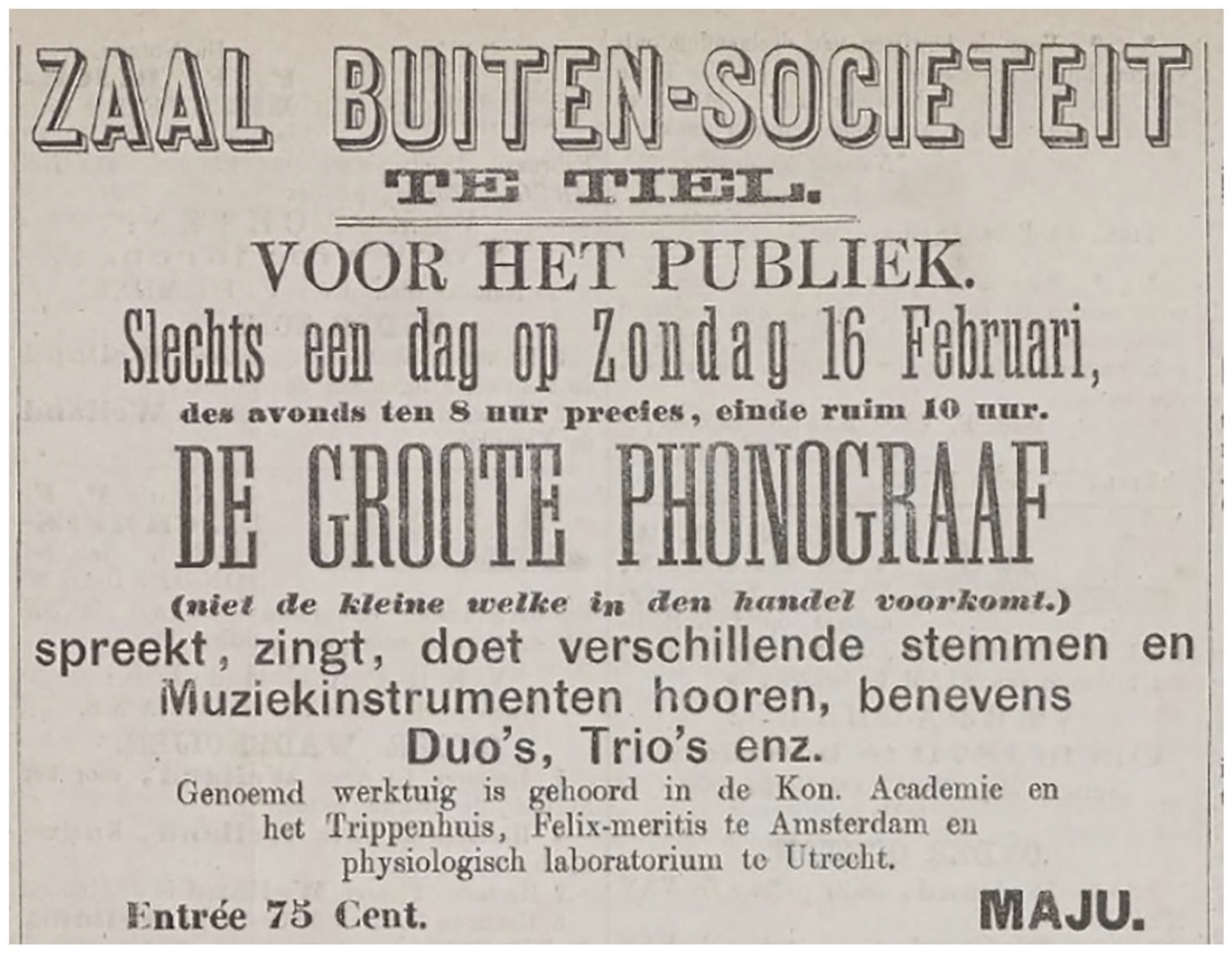
Advertisement for Maju’s Phonograph lecture in the city of Tiel.
Maju’s expeditious access to new technology—in 1880, Maju introduced another novelty to Amsterdam, the telephone
7
—and his ability to put on a successful show across audiences and settings did not render him an uncontroversial figure: some contemporary commentators disapproved of Maju’s lack of scientific training (Zierikzeesche Courant, 1870), while others described him as being “too educated” for a fairground entertainer (Bataviaasch Handelsblad, 1886). Yet, after Maju’s death, the Teylers Museum for Art and Science, in Haarlem, one of the leading scientific institutions of the Netherlands of that period, acquired some of his equipment: a Polariscope, manufactured by James How, “purchased on 3 March 1887 at the Amsterdam auction of the effects of Maju” (Turner, 1996: 164). The curator in charge of Teylers’ Physical Cabinet during this period, Dr Elisa van der Ven, mentioned Maju’s lectures in the guide that he wrote to the collection of Physical Instruments of Teylers Museum in 1898: It is about twenty years ago that Maju—maybe some of you will remember his lectures—travelled the country during the winter and projected in public presentations beautiful color effects that were widely admired. The so-called polarization devices, with which he obtained those color effects, and objects, when he used them, are also found here; No. 732 is the device that Maju himself used and that was purchased from his estate for the museum. (Van Der Ven, 1898: 15)
Maju’s polariscope might well be the last surviving object of his collection of instruments which continues to be in use to communicate science to the public: it can still be seen today, displayed in one of the physics cabinets of the permanent collection of the Teylers Museum. 8
4. Conclusion
Maju’s wide-ranging activities fall under what James Secord designates as commercial science: the business opportunities engaged in science through “authorship, editing, reviewing, specimen dealing, industrial consulting, instrument making, museum curating, lecturing, and showmanship” (Secord, 2000: 437). Yet, he does not conform to the more prevailing historic figure of the science popularizer insofar as he was no scientist, author, social educator, academic, activist, or amateur. Rather, Maju was an entrepreneur whose core activity was in the entertainment industry with a strong focus on importing and exporting performances and technologies. His conjuring background provided a showmanship outlook on his engagement with scientific and technological communication practices; he was in a perfect position to build upon the magical discourse on the wonders of technology, or to use Iwan Rhys Morus’ (2007) phrasing, he “had the means of making the rational magical” (p. 362).
In the nineteenth century, conjurers were considered science popularizers, albeit of an unusual kind (Lachapelle, 2015: 35). And recent studies have investigated the connection of science with stage magic in the nineteenth century culture of visual spectacle (Vanhoutte and Wynants, 2017). But an interesting caveat of Maju’s case is the fact that his performances attracted the interest of both laymen and experts, or, to use Ludwik Fleck’s terminology, 9 he seemed to have navigated easily between esoteric and exoteric circles: examples are the transformation of the salmon slide set from his collaboration with Artis into a section of his popular lectures, the transfer of his phonograph lecture from the Odéon to the Royal Dutch Academy of Sciences, and later throughout the country, and the interest of Teylers Museum in acquiring his lecturing equipment after his death. Maju’s ability to reach across audiences, institutional settings, and discourses make him an interesting case in the history of scientific performance: according to Morus (2010b: 810), in the Victorian landscape of scientific public performance, it would be most unexpected, or maybe downright impossible, to find the same performance at the Adelaide Gallery, or at the Polytechnic, and at the Royal Institution.
The history of science communication is populated with historical figures who were able to leave their ideas, propositions, and rationales well documented for posterity in published works, treatises, lectures, notebooks, and diaries. 10 These primary sources are fundamental for historical investigation. However, these are almost non-existent in the case of non-published, performance-based entrepreneurs who were not science practitioners. But they should also have a position in the history of science communication; 11 Maju’s case is a reminder of all the yet unknown science performers who brought science and technology to nineteenth century audiences. They are examples of how science communication is a much more diverse field than is often thought. At the same time, they also challenge the perspective of science communication as an ancillary activity in the economy of science: rather than seeing performance as a way to communicate science and to establish scientific authority, performers such as Maju saw science as an auspicious resource for their performances.
Footnotes
Funding
The author(s) disclosed receipt of the following financial support for the research, authorship, and/or publication of this article: This work is part of the research program “Projecting Knowledge—The Magic Lantern as a Tool for Mediated Science Communication in the Netherlands, 1880–1940” with project number VC.GW17.079/6214, which is financed by the Dutch Research Council (NWO).