




Abstract
Within science and technology studies, there is an established tradition of examining publics’ knowledge of, trust in, access to and engagement with science, but less attention has been paid to whether and why publics identify with science. While this is understandable given the field’s interest in bridging gaps between publics and producers of scientific knowledge, it leaves unanswered questions about how science forms part of people’s worldviews and fits into cultural politics and conflict. Based on 123 interviews and 16 focus groups with mixed religious and nonreligious publics and scientists in the United Kingdom and Canada, this article utilises approaches from the sociology of (non)religion to delineate varieties of science identification. It maps out ‘practical’, ‘norm-based’, ‘civilisational’ and ‘existential’ identifications and explores how these interrelate with people’s social characteristics. The article illustrates how science identification is typically dependent on a constellation of cultural/political influences rather than just emerging out of interest in science.
1. Introduction
Within the field of science and technology studies (STS), there is a well-established tradition of examining publics’ knowledge of, trust in, access to and engagement with science. The empirical study of when, how and why people identify with science is, however, something of a blind spot, having been covered only in research into the self-image of professional scientists (see Carlone and Johnson, 2007; Ecklund et al., 2008). Forms of identification in which people come to regard science as a source of personal meaning, or as forming a central element of a comprehensive philosophy or moral perspective, have been particularly badly neglected in empirical research.
What makes this surprising is that narratives about meaning, morality and purpose permeate popular coverage of science and its place in society, either in polemical debates about science and belief (Coyne, 2015; Dawkins, 2016) or more subtly in the narratives of human wonder, advancement or insignificance that are recurrently found in science documentary programming (Hall, 2019). Science has, of course, long been associated with ideas of human progress. This association forms a central theme of analysis in writing about the history of the concept of science and boundary contests over it (Gieryn, 1999; Harrison, 2015; Lightman, 2012). It is prominent, too, in philosophical scholarship on the phenomenon of ‘scientism’ and discussions of the limits of scientific knowledge (Pigliucci, 2015). Some scholars working in these areas (e.g. Stenmark, 1997) take it for granted that comprehensive conceptions of science have mass appeal, at least in Western societies where ‘scientism’ has recently become associated with uncompromising anti-religious varieties of scientific naturalism. Rarely, however, have social scientific methods been used to explore if, and how, these or other conceptualisations of science inform people’s understandings of life and the good.
The purpose of this article is to interrogate people’s identifications with science. In what follows, we draw on approaches in the sociology of religion – and, in particular, the emergent sub-field of nonreligion and secularity studies (NRSS) – to explore how people come to view an imagined conception of science as significant to their sense of selfhood. Using 123 interviews and 16 focus groups conducted with mixed religious and nonreligious publics and life scientists in the United Kingdom and Canada, we map out four varieties of science identification: what we call ‘practical’, ‘norm-based’, ‘civilisational’ and ‘existential’ identifications. We explore each in turn, examining how these forms of identification intersect with class, community, culture and politics, as well as with each other. What we endeavour to show is how such socio-cultural distinctions – as much as knowledge of or interest in scientific fields – shape the extent and nature of people’s identifications. By developing our typology, we seek to create space for a deeper analysis of the cultural politics of science, one that moves beyond narrow conceptions of public trust and towards acceptance that varied imagined forms of science are embedded in modern culture.
We begin by considering the place – or lack of – of science identification in the study of public attitudes towards science, before introducing NRSS and its potential contribution to STS. After outlining our methodology and the limitations of our study, we then provide an overview of our findings, reviewing the four above-mentioned varieties of science identification in turn. Finally, we consider some political and practical implications of our research, reflecting on how attentiveness to the dynamics of science identification could enable science communication and engagement to more effectively navigate diverse and politically contested contexts.
2. Science identification
Since the mid-twentieth century, there have been various well-documented changes in how public attitudes to science have been measured and debated. Specifically, a focus on science knowledge was supplemented by growing interest in attitudes towards science in the late 1980s and then, in the 1990s and 2000s, in publics’ engagement with scientific institutions (Bauer et al., 2007; Gregory and Lock, 2008). This shift from a top down ‘science literacy’ model through to dialogical ‘science and society’ or ‘public engagement with science and technology’ (PEST; see Davies, 2013) models can in part be explained by policy changes. During the 1980s, science policies were brought into line with national commercial priorities and then in the 1990s – especially, in the United Kingdom, under ‘New Labour’ governments (1997–2010) – emphasised citizen participation in the governance and communication of science. Public policy was not, however, the only force behind these changes. As Gregory and Lock (2008) observe, over time scholars from a wider range of social scientific disciplines became involved in debates about science and society, bringing with them increasingly sophisticated research methods (Sturgis and Allum, 2004).
This increasing methodological sophistication enabled several important changes in analysis of public perceptions of science. It accelerated a move away from approaches (often dubbed ‘deficit model’ approaches) in which researchers are concerned solely with people’s ability and willingness to accept scientific knowledge as determined by state-funded institutions, and greater emphasis on the nature and formation of publics’ views. More attention is now paid to: negotiations between institutions and publics, with knowledge generation no longer being seen as a one-way process (Irwin and Wynne, 2004; Wynne, 1996); the social and psychological factors behind rejection of science (Allum et al., 2014; Hill, 2014b); and how people’s chances of accessing science education and careers is influenced by different forms of social capital (Archer et al., 2015a, 2015b). Yet, despite this growing interest in publics’ social formation and positioning, the field remains guided by the overarching goal of effective communication and public deliberation about scientific research. It remains, that is, broadly oriented around established scientific institutions and its starting point is how science is conceptualised within them, and not by publics themselves. This has left little space to think through how publics envisage the concept of science itself and integrate it into their worldviews. While researchers pay more attention to the psycho-social factors that cause science scepticism (Baker, 2013; Evans, 2011; Hill, 2014b; Shein et al., 2014), publics’ imagining of science remains, by and large, outside the field’s sphere of interest, especially cases where publics identify with an imagined vision of science.
The goal of effectively engaging publics with scientific research is, of course, a perfectly valid concern. We do argue, however, that failing to move beyond knowledge of, attitudes towards and engagement with science towards an exploration of identification with science results in a ‘thin’ conceptualisation of public orientations. When publics are asked about science identification, the results can be striking. In one recent survey, 57% of British and Canadian adults agreed that they ‘feel that science is important to their sense of who they are and how they view the world’. Close to half (the United Kingdom: 44%, Canada: 48%) also said the same about evolutionary science (Elsdon-Baker et al., 2017). Yet research into public views of science rarely examines the intersections between the philosophical and cultural traditions prevailing in society – both religious and nonreligious – and people’s orientations towards scientific theories and the concept of science itself. This contributes to the coexistence in STS of two truisms that seem prima facie incompatible. On one hand, it is widely acknowledged that in the modern world, the concept of science ‘stands metonymically for credibility’ (Gieryn, 1999: 1). On the other hand, it is often claimed that there is a crisis of trust in scientific institutions, which are seen as remote, élite and not part of wider culture (Mathieson, 2017; see also Weingart, 1997: 610). While it is beyond the scope of this article to explain this tension fully, we do suggest it cannot be understood without recognising that ‘science’ has a cultural life that extends beyond scientific institutions and the knowledge they communicate. More awareness is therefore needed of when, how and why people integrate a conception of science into their worldviews.
3. Science identification and the sociology of (non)religion
We propose that the sociology of religion contains useful resources for addressing questions about how people imagine and identify with science. The sociology of religion is already well represented in research into public views of science (see, inter alia, Baker, 2012; Ecklund and Scheitle, 2017; Hill, 2014b). Studies drawing on this tradition, however, typically focus on the effect of religion on science acceptance and rejection, especially evolutionary science (Elsdon-Baker, 2015). Such analyses of religious people’s views of science are increasingly sophisticated, breaking the category of ‘religion’ down into epistemological, moral and social components to complicate the idea that religious rejection is just a matter of competition between knowledge traditions (Evans, 2011, 2018; Hill, 2014a). Religious beliefs are, however, almost exclusively the focus, with ‘religion’ being treated in some analyses as a ‘perceptual filter’ (Allum et al., 2014) or ‘interpretive lens’ (Cacciatore et al., 2016) through which certain people perceive science.
This focus on religion does not, however, do full justice to recent developments in the sociology of religion, which has expanded beyond the study of ‘world religions’ and ‘supernatural beliefs’ to encompass a wider range of knowledge traditions and modes of belonging. Of most relevance to this article is the emergence of NRSS (see Bullivant and Lee, 2012). NRSS grew out of the insight that processes of secularisation do not involve – as the sociology of religion once suggested – the ‘falling away’ of religion but distinctive formations that are worthy of study. One strand of research involves using relational methods (Quack et al., 2019) to examine how people define themselves in contradistinction to an imagined conception of ‘religion’. Alongside this ‘negative’ approach, the field also maps ‘existential cultures’ (Lee, 2015) that promote nonreligious systems of meaning or purpose. NRSS explores the social role of ideas about human progress and rationality, and indeed the role that ‘science’ play's in people’s worldviews is an incipient area of empirical enquiry (Catto and Eccles, 2013).
There are overlaps between NRSS and STS. Both fields involve the study of knowledge traditions once considered ‘rational’ and therefore in no need of sociological explanation. Furthermore, NRSS’s interest in secularised narratives of human meaning and purpose means that it shares themes with Jasanoff and colleagues’ influential writing on ‘socio-technical imaginaries’ (Jasanoff, 2015; Jasanoff and Kim, 2013). In contrast to research into socio-technical imaginaries, however, which typically involve comparative analysis of public policy and spectacle, empirical research in NRSS has paid more attention to personal identity. To use the terminology of a mutual influence, Charles Taylor, while the former examines macro-level ‘social imaginaries’ (Taylor, 2003) the latter is more interested in micro-level ‘sources of the self’ (Taylor, 1992). The potential contribution of NRSS lies, then, in how it shifts attention from how institutions communicate science knowledge to how publics conceptualise science and integrate it into their worldviews. It takes themes discussed in other areas of STS, but treats them in ways that are arguably more relevant to scholars interested in understanding publics’ perceptions of science.
Our study begins from this point. In what follows, we look at cases from our research where an imagined conception of science helped make a person’s life meaningful, informing – or even forming the basis of – their moral positioning, beliefs, or sense of self-worth. Our research is not exclusively concerned with nonreligious beliefs and individuals. We do, however, treat religious and nonreligious populations equally and, as we will see, show how science identification can involve constructing a religious ‘other’. One of the problems with the disproportionate focus on religious belief in research into public views of science is that, simply by omission, it encourages the assumption that nonreligious beliefs are not socially mediated. While religious people are characterised as affected by a ‘perceptual filter’ that intervenes in their views of science, nonreligious people are implicitly presented as perceiving science with 20:20 vision. Or, while there are numerous illuminating analyses of the psychological and social factors that cause a religious person to refuse to accept science, research does not often explore the social factors that contribute to a religious or nonreligious individual’s affirmation of science. We aim to address this is the following analysis, most explicitly in the concluding sections.
4. Research methods
This article is based on research conducted as part of the multi-disciplinary project ‘Science and Religion: Exploring the Spectrum’ (SRES). This project’s aim was to investigate how debates about, and perceptions of, science and religion are socially situated. Focussing on evolutionary science, the research explored when questions of science and belief become salient to individuals, what their beliefs are and how these intersect with wider social and political changes and debates. The qualitative social scientific strand of this project included 123 interviews and 16 focus groups with members of the public (81) and scientists (42) working in the life, biological and medical sciences. The research moved beyond the United States – where most research into science and religion has been conducted – to the United Kingdom and Canada. One of the reasons for this was to examine perceptions of science and religion in relatively secular contexts where nonreligious identities are more prominent.
We selected approximately the same number of religious as nonreligious participants and, beyond this, chose participants purposively to ensure that the belief, age, class, gender and ethnic composition of our sample mapped onto the countries studied. In the case of interviews and focus groups with the public, selection was facilitated by a pre-screening survey that enabled targeted selection not only on the basis of the characteristics above but also people’s interest in science and/or religion. We took steps to avoid over-representation of individuals who maintain a personal interest in public debates about science and religion. Yet, while we sought a balanced sample, we do not use our data here to make representative claims about the extent of science identification. Rather, our analysis provides preliminary descriptions of types of science identification – and how these types of identification align with certain characteristics – with a view to facilitating further qualitative and quantitative examination of this theme. (For full details of our methodology and analysis, see the Supplemental Materials.)
Typology development
Interviews covered participants’ (non)religious formation, interest in the sciences, views on the subject of science and religion and perceptions of public coverage of science and religion. Interviews were semi-structured, following a common script that allowed participants leeway to elaborate their views. While this meant that interviewers did not always ask questions in a set order, all interviews began by asking about interviewees’ biographies and then whether they have a personal interest in science (and if so, how this interest developed). Focus groups covered similar themes but did not begin with questions about participants’ biography and interests. While examples of science identification also emerged in our focus groups, all of which supported our analysis below, in this article we draw primarily on our interview data.
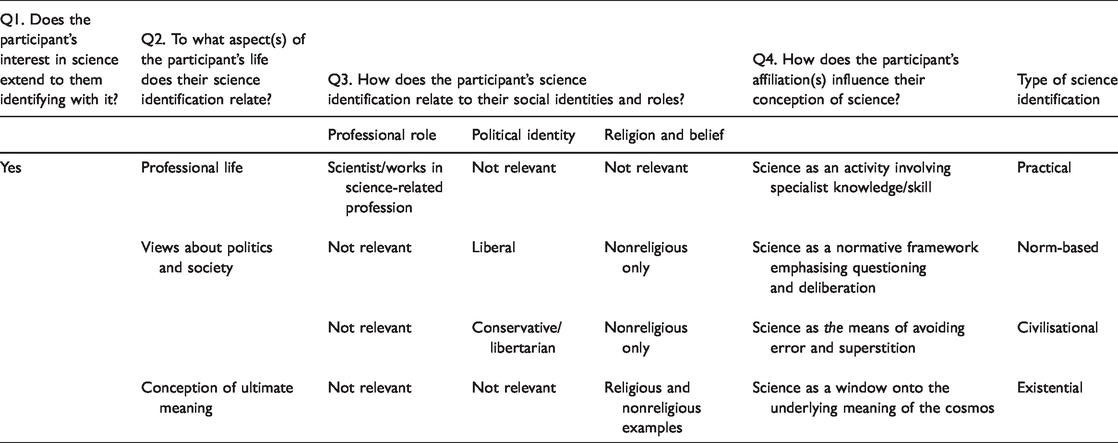
All interviews and focus groups were recorded, transcribed and analysed using qualitative data analysis program NVivo. We coded interviewees’ descriptions of their interest in science into a single ‘node’ and systematically reviewed this to generate the four types of identification outlined below. When a participant appeared to identify with science in some way, we contextualised their comments using written ‘interviewee summaries’ and additional nodes. To develop our typology, as we worked through these data sources we asked the following four questions of each participant:
Does the participant express an interest in science, and if so does this interest extend to them identifying with science (i.e., perceiving science as giving meaning to any aspect of their life)? What aspect (or aspects) of the participant’s life does their science identification inform or relate to (e.g. their family life, professional life, social and political views, conception of ultimate meaning)? Where identification does relate to an aspect of a person’s life, how does this inform or relate to their affiliations and roles (e.g. scientist/layperson, liberal/conservative, religious/nonreligious)? How, if at all, does the participant’s affiliation(s) influence or relate to their conception of what science is and what it means?
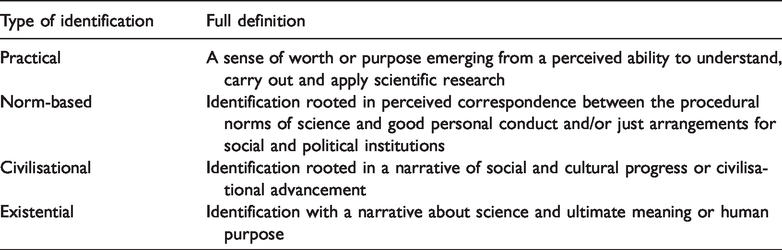
An overview of this process, and the distinctions it led to, is provided in Table 1. As this table shows, identifications emerged that related to three aspects of our participants’ lives: professional life, political views and ultimate meaning. Asking the third and fourth questions allowed us to further refine and elaborate on these identifications. Specifically, in the case of people’s social and political views, we identified a distinction between ‘liberal’ and ‘conservative’ identifications, which led to contrasting conceptualisations of science. The process of review, then, suggested four ways in which social affiliations generated a distinct ‘reading’ of the concept of science, given in Table 2. This fourfold typology exhausted all cases in our dataset where an imagined conception of science was seen by participants as helping make their lives meaningful.
Stages of typology development
Forms of science identification
5. Overview of interest in, and identification with, science
As we focus in this article only on those people who saw science as giving their lives a sense of meaning or worth, we need first to make some general points about our sample. Consistent with findings across the field of the social study of science and religion (Elsdon-Baker et al., 2017; Evans, 2011), virtually no one across our sample was opposed to ‘science’ per se. Even individuals who rejected evolution claimed to view science positively, even if they felt scientists were untrustworthy. Fewer than half of our participants, however, demonstrated clear identification with science. While a keen sense of the social desirability of being educated about scientific research was evident across our sample, most were content to admire science from a distance. Many were mildly interested (‘In passing, like, I’ll read articles and things like that, but I wouldn’t say I’ve got a deep interest, no’: Rachel, UK, public) 1 and a few were disinterested (‘I am quite happy to sit without answers’: Katie, UK, public). As we have explored elsewhere (Jones and Kaden, forthcoming), often participants were only able to speak in detail about science in relation to specific biographical encounters – a job or relative’s illness, for example. We will see below how strong identification with secularism and humanism was associated with certain forms of science identity, but our sample certainly included individuals – such as Vickie, a UK-based leftist secularist – whose atheist identity did not involve making explicit claims about science and was grounded in moral emphasis on the fact that ‘we are all equal’.
Science identification of some form was, as one might expect, common among the scientists in our sample. This identification was not universal, however, and it followed distinct patterns. Some participants – such as Jessie, a UK-based neuroscientist – went on to a PhD because they ‘didn’t know what else to do’. Others saw science work in instrumental terms: they did it because it has medical or other applications. Most significantly, as we will see, there was little evidence in our sample to suggest this group are more likely to see science as a source of ultimate meaning or as the basis of their moral views. Many scientists only engaged with comprehensive worldviews ‘defensively’, for example when teaching about the weaknesses of formal creationist arguments.
One thing that was consistent across both our scientists and publics was that weak and non-identification was more common among religious participants. The religious scientists we interviewed had often given considerable thought to how their beliefs and their work related to one another, but this was typically in response to challenges by nonreligious individuals or (less often) coreligionists. Working in science was sometimes described by such scientists merely as a ‘cool job’ (Oliver, UK, Christian biochemist). This may be a reflection of the fact that our interviews focussed on evolution, a subject that has been publicly associated with conflict between religious and secular groups (Evans, 2011). As we illustrate below, nonreligious participants demonstrated various forms of identification with evolution as an idea, but this was not encountered even among religious participants whose work involved researching evolution.
6. Four types of science identification
We turn now to the four types of science identification that emerged from our data.
Practical identification
By practical identification, we mean a sense of worth or purpose emerging from a perceived ability to understand, carry out and apply scientific research. Unlike the other forms of identity discussed here, this form of identification does feature in the social study of science. For example, Carlone and Johnson (2007) have examined the importance and difficulties of women scientists of colour being recognised as ‘science people’. In their analysis of the beliefs of scientists in the United States, Ecklund et al. (2008) posit that ‘scientist’ – the role – can act as a ‘master identity’ that has priority over religion or ethnicity. Consistent with this research, a majority of our scientist participants evinced a strong identification with science as practice. Helen, for example, Canadian biologist, described how she became interested in science because she had an ‘aptitude’ for it. Similarly, Christa, a Canadian Anglican scientist, did not link science to questions of meaning or morality. For her, religion is about ‘immeasurable’ things like kindness and one’s relation with God, whereas science is about ‘measurable’ things. Her strong identification with science was instead based on a sense of ‘fit’ rooted in her individual ability: I’m an astronomer because I’m an astronomer, I’m, you know, I’m a duck and there’s water […]. [I]t’s almost the path of least resistance. I’ve read, like, Richard Dawkins’s book [The God Delusion] which was a bit heavy for me because some of the words, and not being well educated, I couldn’t understand so I was forever looking in the dictionary. I like, well the science of using materials […]. I’m always interested in what’s going on like modern stuff like graphene […]. Whereas a lot of people, like my friends, they wouldn’t have the foggiest idea what graphene was. They’d be like, ‘Oh?’, the majority of them.
Norm-based identification
We characterise as norm-based identification cases where people perceive correspondence between the procedural norms of science and good personal conduct and/or just arrangements for social and political institutions. Among our interviews that fit this category, ‘science’ was associated with a willingness to choose and to find out for oneself, respond to evidence or exchange reasons in a deliberative process. Among the clearest examples was Kenny, a Canadian post-doctoral biologist based in the United Kingdom, who described scientific principles as fundamental to liberal democracy: [A] lot of people […] decide not to choose or not care [about evolution] because it seems as though day-to-day life can go on without people making a decision on either evolution or religion. While on the surface I think that’s true […] I think it’s dangerous to not promote reason, evidence, argumentation: [it’s necessary] for basic democratic societies to continue the way we kind of want them to continue, rather than going down the line of, like, a Trump-style democracy. I mean atheism is just a rejection of theism, so it’s a starting point. And all the other values and things like that are just based on, you know, scientific findings about, for example, human wellbeing, I think we know certain policy approaches, certain programmes, certain behaviour will have better or worse impacts on other people. So, it certainly informs, sort of, my ethical outlook and the consequential utilitarian, I mean, all of those … those approaches are definitely informed by science for sure; you can’t separate that from atheism.
There were few indications in our data to suggest that science knowledge facilitated such identification; in our sample, levels of norm-based identification among scientists and publics were broadly similar. Rather, ‘science’ in these cases stood in for an individualistic moral framework focussed on inquiry and choice. This framework was affirmed in our sample even by some individuals who had limited knowledge of science or who rejected mainstream scientific research. Kimberleigh, an accountant based in England who identified as an atheist, equated science with questioning: ‘You have to, kind of, discover more things yourself rather than just being told what they are’. She studied maths, biology and chemistry at A-Level (ages 16–18) and expressed frustration at what she saw as the low level of public science literacy. Yet, while she strongly affirmed the truth of evolution in principle, her account of the subject was idiosyncratic: I don’t understand why anybody could think that evolution just wasn’t a thing. It’s all around us every day. Every item that we use is evolving. Our books are now Kindles […]. You know, if you’d come from Mars would you just think that that car had just appeared? No, it started as a couple of wheels and a bicycle, then somebody thought, ‘Oh, I’ll put a motor in it’, and we had a motorbike. Then some really bright person put two motorbikes together, joined the axles, put a seat on it and a steering wheel. And that’s a basic car. [W]ith some alternative therapies, there is something else going on. Because I guess we’re discovering new particles, the Higgs Boson, and there’s some new stuff coming out all the time.
Civilisational identification
In cases of civilisational identification, science forms part of a narrative of social and cultural progress or civilisational advancement. This perspective can be illustrated by quoting Arduino, an Italian biologist based in England: [T]here are a lot of countries where religion is very strong, that potentially could halt and slow down scientific progress simply by preventing the younger generation from understanding their irrational thinking and logical thinking and scientific enquiry […]. In science you need critical thinking. If you have a strong spirituality generally your critical thinking is hampered. Same sex marriage, self-identifying gender […] is, epistemologically, nonsense. We must go by the epistemic truth of the chromosomes. Truth is at the chromosome level. Male chromosomes in the cells do not become female ever, or vice versa. But all this relativism, it’s all to do with making everything slipping and sliding, so that we can’t have values.
In both identifications then, affiliation with science was not linked with science knowledge but loyalty to different – indeed, opposed – sets of cultural politics. Norm-based identification tended to be associated with liberal ideals of deliberative reasoning and choice. Civilisational identification, by contrast, emphasised the danger of religious superstition and tended to be found among libertarians and social conservatives. In a number of cases, civilisational identification involved imagining the West as under threat from religious – especially Muslim – demographic growth: [Islam is] the enemy of everything. It’s the enemy. And we’re just blindly wandering into it. We’re not hanging on to the insights of Enlightenment, which to me is the primacy of reason over dogma. We’re turning our backs on that. And it’s absolutely terrifying. I’m not sure what’s going to happen. Cliff, UK, nonreligious, public
Existential identification
Existential identification involves placing emphasis on science in a narrative about ultimate meaning. ‘Meaning’ here might be understood as involving God (or some other deity) or not. Indeed, in contrast to the previous two varieties of science identification, we encountered existential identification with science in interviews with both religious and nonreligious participants. Some religious individuals like Mickey, a British Baptist Christian and chemical engineer, spoke about how they saw human investigation into and control of nature as offering an insight into God’s work: I used to make chemicals, I used to make dyestuffs and I’d create … I’d have to reflux them at 100 degrees or sometimes under pressure, for 24 hours, to get a reaction […]. And that’s the kind of chemistry we as men could do and yet, okay, you might not say it’s God, you might say it’s nature […]. But I just stand amazed that that happens and that has to be some creator, who’s done this […]. And so much better than we can do it […]. You have cosmic evolution which is the formation of the elements, stars and galaxies, and that has to build up to a certain level where you can have the next phase, which is chemical evolution. […]. [T]hen the third [phase] is the origins of life. Again, you can see a stage up, whereas with cosmic evolution there’s a certain level of complexity and then chemical evolution goes way beyond that, and biological evolution goes way beyond that […]. [Now] the next epoch is almost upon us, where there’s a new form of evolution right around the corner, if we survive long enough to enable it, that goes as far beyond biological evolution as biological goes beyond chemical, as chemical goes beyond cosmic. So there’s an evolutionary staircase here which is cosmic in scope.
It is, however, important to highlight a distinction between the religious and nonreligious forms of existential identification we encountered – a distinction that is evident in the two quotes by Mickey and Carl, above. Existential identification was more common among religious participants. These participants’ identification tended to be, however, weaker in that God was seen as underpinning identification. Science offered a window into deeper meaning or – in the case of Justine, a UK-based community worker and convert to Islam – confirmation of a theistic perspective: ‘For me, science, it does work in harmony with religion but, for me, it proves religion is real’. For our religious participants, what mattered ultimately was faith in Jesus or in some other person or text that mapped out the ultimate destiny of humankind. As Katie, a Christian biologist based in Canada, put it: ‘Salvation is most important’, not the specifics of science.
The weaving of science into an existential vision was less common among nonreligious participants. Many – such as Bryan, a British nonreligious musician – saw science as capable of undermining theistic conceptions of existence but not as acting as a replacement. Bryan, who lost his once strong Christian faith in his 20s, identified as an atheist and humanist and based his worldview in large part on claims about the nature of science, but he still admitted to a sense of ‘loss’. Science did not, for him, imply anything about human meaning. When our nonreligious participants did identify on an existential level with science, however, theirs was a much stronger identification. For the nonreligious individuals who, like Carl, involved science in an account of ultimate meaning science was fundamental. While for the religious participants science supported an existing worldview, for the nonreligious participants science was the worldview itself.
7. Intersecting identifications
How did these different forms of science identification intersect? One can conceive of an individual for whom these identifications form an internally consistent whole. An individual might, for example:
Gain expertise in a scientific field and methods; Come to see those methods as involving norms that are essential to the flourishing of liberal democracies; Begin to view these norms as fundamental to advancing civilisation and thus as worth defending and; Embed this understanding of social progress within a narrative concerning the ultimate purpose of human life and society.
Very occasionally in our dataset, we did encounter cases like this in which the four science identifications cohered and reinforced one another. Arduino, whose account of scientific progress we quoted earlier, was perhaps the clearest example. His understanding of science’s role in facilitating human progress emerged out of his work as an ecologist and, in particular, evolution education activism in Italy. We encountered several cases in which two or three forms of science identification reinforced one another, too. In Mickey’s case above, practical and existential themes fused: he saw God at work in his professional life and in his ability to ‘use science’ to create new materials.
More often than not, however, this coherence was absent, with such logical links being disrupted or subverted by social factors. In some cases, class identities led to one form of identification being pitted against another. In others, science identification was, fundamentally, a form of cultural/political alignment. Liberal emphasis on reasoned debate lent itself to norm-based identification with science, whereas conservative narratives about protection against superstition and fanaticism fed into civilisational identification. Constellations of media and other intellectual influences played a significant part, typically greater than interest in science. In the United States, sociologists of religion (inter alia Evans, 2018; Hill, 2014b) have shown how, rather than being rooted in competition between systems of knowledge, creationist opposition to evolution emerges out of communal loyalties and conflict between conservatives and progressives. Our data strongly indicated that science identification can be regarded in a similar way: as emerging out of cultural communities and opposition to their perceived outgroups.
8. Conclusion
We saw earlier how surveys show that identification with science is, at least in the United Kingdom and Canada, widespread, however because of lacunae in empirical research into public perceptions of science little is known about the nature of this identification and what shapes it. The typology of science identifications in this article is intended as an initial guide to the cultural dynamics that inform how people envisage science and its significance for them. It is not offered as a definitive statement on how people identify with science, but, rather, as a call for further investigation and testing.
Our findings do, however, have some clear implications. What appears plain is that science identification extends far beyond specific institutions and the knowledge generated and communicated by these institutions. Certain groups of people envisage ‘science’ as a central part of their process of moral reasoning, existential beliefs and sense of selfhood, and this appears to have less to do with their familiarity with scientific methods and more with their being shaped by culturally embedded narratives of value and purpose. Furthermore, while our data certainly did not undermine the notion, mooted in the introduction, that substantial numbers of people see science as potentially offering answers to all questions, such ‘scientism’ is just one part of science identification, which is often as much about cultural and moral orientations as philosophical beliefs. Both for religious and nonreligious individuals, our study suggests, cultural and moral formation acts as a ‘perceptual filter’ through which people see science as a concept.
Because of this, however, science identification is implicated in processes of making and maintaining social distinctions. One of the things that research into public views of science has neglected, on account of its side-lining of science identification, is how some people’s support for science is premised on the denigration of groups depicted as opposed to science. The examples of Islamophobia in our dataset offer the clearest illustrations of this. If there is one reason to look further into science identification, it is surely because failing to do so may mean science communication becomes blinded to how certain groups are marginalised by popular narratives about science.
Supplemental Material
sj-pdf-1-pus-10.1177_0963662520923110 - Supplemental material for What science means to me: Understanding personal identification with (evolutionary) science using the sociology of (non)religion
Supplemental material, sj-pdf-1-pus-10.1177_0963662520923110 for What science means to me: Understanding personal identification with (evolutionary) science using the sociology of (non)religion by Stephen H. Jones, Fern Elsdon-Baker, Rebecca Catto and Tom Kaden in Public Understanding of Science
Footnotes
Acknowledgements
The author(s) would like to thank Bernard Lightman, Alexander Hall, Carissa Sharp and Carola Leicht for their comments on early drafts of this article, and the anonymous reviewers for their perceptive suggestions.
Declaration of conflicting interests
The author(s) declared no potential conflicts of interest with respect to the research, authorship and/or publication of this article.
Funding
The authors disclosed receipt of the following financial support for the research, authorship, and/or publication of this article: The research in this article was supported by a grant from the Templeton Religion Trust (grant number TRT0082).

Notes
Author biographies
Supplemental material
Supplemental material for this article is available online.
References
Supplementary Material
Please find the following supplemental material available below.
For Open Access articles published under a Creative Commons License, all supplemental material carries the same license as the article it is associated with.
For non-Open Access articles published, all supplemental material carries a non-exclusive license, and permission requests for re-use of supplemental material or any part of supplemental material shall be sent directly to the copyright owner as specified in the copyright notice associated with the article.
