




Abstract
The role of science popularization remains relatively under-explored in research on contemporary public acceptance of evolution. In this study, we analyse national survey data to interrogate the role Britain’s best-known celebrity scientists David Attenborough, Brian Cox, Richard Dawkins and Stephen Hawking may have played in changing public views of evolution, as well as the role of two creationists: Ken Ham and Harun Yahya. We investigate how well known these public figures are, what their views of religion are perceived to be and, drawing on social identity theory, whether they exert different effects on attitudinal change to evolution among different religious and non-religious publics. Binary logistic regression analysis shows that among Muslim and Pentecostal Christian publics, those familiar with Dawkins as both a scientist and as someone who holds negative views of religion are more likely to have become less accepting of evolution. Conversely, among non-religious publics, Dawkins was the only celebrity scientist associated with higher odds of becoming more accepting of evolution. We suggest that engaging certain religious audiences with the science of evolutionary biology may be more effective when their religious identities are not threatened.
Keywords
1. Introduction
Evolution, and the question of human origins in particular, has sometimes been a contentious scientific topic in public discourse. Some, particularly those affiliated with certain religious traditions, are well known for their rejection of evolutionary theory, while others appear deeply concerned about this perceived ‘anti-science’ attitude. Others still probably neither know nor care much about the subject.
In this study, we investigate which factors are significantly linked with changed attitudes to evolution, by using national survey data to analyse those people who report becoming either more or less accepting of evolution. Many studies have highlighted that religiosity and formal education are significant variables for evolution acceptance (for a review, see Pobiner, 2016); however, the role that science popularization and related public discourses may play in evolution acceptance remains under-explored. Given that in today’s celebrity-permeated world, publics often come to understand ideas through the way that they are embodied by famous individuals (Fahy, 2015), and that a person’s attitudes towards or support for science may be more influenced by affective factors than by knowledge of science (Bauer et al., 2007), we specifically examine the influence of popular science as assessed through familiarity with science’s frontmen – celebrity scientists.
The best-known celebrity scientists in Britain, David Attenborough, Brian Cox, Richard Dawkins and Stephen Hawking, embody different ‘models’ of the relationship between science and religion (Barbour, 2000). Richard Dawkins believes science and religion to be in absolute conflict and Stephen Hawking believed science showed there was no need for a creator. Brian Cox and David Attenborough on the other hand, although both non-religious, say comparatively little about religion or the existence of a God, and could be said to embody an independence model of the relationship between science and religion. There are also public figures such as Ken Ham and Harun Yahya who deny evolution and promote creationism as an alternative, but to date, little is known about the influence of these ‘celebrity creationists’ among different constituencies in Britain.
In this study, we conduct binary logistic regression analyses to examine whether familiarity with celebrity scientists or creationists is significantly linked with changing to become more or less accepting of evolutionary theory among different religious and non-religious publics while controlling for factors related to religiosity and formal education. Drawing on insights from social identity theory developed in social psychology, we test predictions that celebrity scientists who embody science–religion conflict will exert different effects on different audiences, promoting increased acceptance of evolution among non-religious groups who perceive them as identity-affirming and decreased acceptance of evolution among religious groups who perceive them as identity-threatening. We predict that such effects will not be observed for those celebrity scientists who embody science–religion independence.
2. Background
Celebrity scientists
The media [] focus overwhelmingly on individuals, leading to our pervasive celebrity culture where fame has become the most powerful way of understanding ideas in a complex world. Within this culture, a new type of scientist has come out of the lab and into the limelight—the celebrity scientist. (Fahy, 2015: 3)
A framework for analysing scientists in public life, or celebrity scientists, has been proposed by Declan Fahy (2015), and he has called for research on the implications of celebrity science for the public understanding of science. To date, only a couple of empirical studies have been carried out. One study examined the effect of two science popularizers who embody very different relationships between science and religion: Francis Collins, the director of the National Institutes of Health and an evangelical Christian, and Richard Dawkins, well-known atheist and popularizer of evolutionary theory. The authors found that reading about Collins shifted respondents towards a ‘collaborative view of religion and science’ (Scheitle and Ecklund, 2015). Another study addressed the effect of mainstream celebrities (not celebrity scientists) endorsing or rejecting evolutionary theory. Experiments revealed that celebrities, but not experts, influenced acceptance of evolution (Arnocky et al., 2018). These studies convincingly demonstrate the persuasive power of celebrity under experimental conditions, but to date, the influence of celebrity scientists on people’s lived experiences has not been studied.
Celebrity scientists and models of science–religion
Who are the most influential celebrity scientists in Britain today? Preparatory qualitative work carried out by this article’s first author revealed that focus group participants most commonly cited David Attenborough, Brian Cox, Richard Dawkins and Stephen Hawking as famous contemporary scientists they had heard of. Given that these four individuals are viewed by publics as authoritative with regard to science, we refer to all as celebrity scientists, irrespective of their individual scientific qualifications. Three of these four celebrity scientists (excepting Stephen Hawking) have worked to popularize evolutionary theory in Britain through television and popular science books. All four have publicly stated that they do not believe in a deity, but the social identities they present to the public embody different models of the relationship between science and religion. While Dawkins and Hawking believe science and religion to be in opposition to each other, Attenborough and Cox tend to say little publicly about religion. It is therefore pertinent to investigate the role they may have played in public acceptance of evolutionary theory among different religious and non-religious publics.
Religion and non-religion in contemporary Britain
Over the past few decades, Britain has seen a marked decline in those affiliating with its historically largest Christian denominations, Anglicanism and Catholicism, while there has been some growth reported among much smaller, newer networks of Pentecostal and Independent Evangelical Christians (accounting for approximately 0.7% and 0.6% of the population, respectively) who tend to lie towards the more conservative end of Protestant Christianity. There has also been growth among non-Christian religions, the largest of which is Islam (4.9% of the population according to the 2011 Census).
There has been a considerable increase in those identifying as Non-Religious, who now account for more than half (53%) of the population according to the most recent British Social Attitudes survey (NatCen, 2017). This has led to calls within the academy for greater research among non-religious populations to explore the diversity of non-religious worldviews (Lee, 2015). A number of studies have found that science is important in identity formation and meaning-making among some atheist and non-religious subpopulations (Catto and Eccles, 2013; LeDrew, 2013; Madge and Hemming, 2016; Smith, 2011). Drawing on these insights, we therefore consider it important in this study to analyse how both religious and non-religious people come to hold views of a particular scientific topic, evolutionary theory, rather than simply treating non-religion as the reference category against which various religious traditions are compared.
Celebrity creationists
Beginning in 2006, concerns were raised in Britain regarding the supposed influence of organized creationism, both Christian and Islamic (Allgaier, 2014; Williams, 2008). However, to our knowledge, no previous research has ever investigated whether organized creationism has indeed influenced public opinion in Britain. In the present study, we not only test the influence of the mainstream celebrity scientists described above but also test for the influence of two public figures we term ‘celebrity creationists’: Ken Ham and Harun Yahya and briefly describe them here.
Ken Ham is the founder of the US-based Young Earth Creationist organization Answers in Genesis, and is perhaps best known for the Creation Museum and more recent Ark Encounter visitor attraction in Kentucky. The many creationist resources produced by Ham’s organization are of course in English and therefore very easily accessible to British publics. In 2014, 2015, 2017 and 2019, Answers in Genesis have run a UK Creation Mega Conference, and representatives including Ken Ham himself have been speaking about creationism in various locations around the United Kingdom for years.
Harun Yahya is the pen name used by an enterprise founded by Adnan Oktar in Turkey. Harun Yahya began producing anti-evolution material in the 90s and made headlines in 2006 by distributing a large hardback book The Atlas of Creation to educational institutions across Europe. While some have described him as a ‘leading creationist in the Muslim world’ (Paulson, 2009) and perhaps having particular influence among Muslims in Europe, others suggest his influence has been overstated (Moran, 2019).
Social identity theory
In the present study, we acknowledge the importance of a proposed research agenda for understanding the role of celebrity scientists in the public understanding of science, and we also draw on social identity theory established through experimental studies in social psychology. It has been suggested that the reception of scientific information may be related not only to an individual’s beliefs, attitudes and knowledge but also to their social identity. For example, one previous study found that participants were more likely to describe a study as ‘scientific’ if its findings validated their gender identity (Morton et al., 2006). Another study found that gamers were likely to find ways to dismiss research if the findings threatened their social identity (Nauroth et al., 2015). Such findings led us to ask, how might different celebrity scientists have influenced acceptance or rejection of evolutionary theory among different publics by either threatening or affirming people’s social identities?
Given that it has previously been shown that religious identity can be a highly salient social identity with regard to evolution acceptance or rejection (Baker, 2013; Haider-Markel and Joslyn, 2008; Hill, 2014; Miller et al., 2006; Unsworth and Voas, 2018), we analysed national survey data to investigate whether familiarity with the celebrity scientists and celebrity creationists described above shows different effects on attitudinal change to evolution among different religious and non-religious audiences. Our predictions, listed below, are based on the idea that individuals from religious groups are likely to find a celebrity who embodies science–religion conflict identity-threatening, whereas non-religious individuals will not find this threatening, and some may find it identity-affirming.
3. Research questions
Drawing on existing work on celebrity scientists, together with social identity theory developed in social psychology, we make the following predictions:
In general, we would expect familiarity with science celebrities to predict increased odds of becoming more accepting of evolution (and/or decreased odds of becoming less accepting of evolution).
But familiarity with Richard Dawkins may Predict decreased odds of becoming more accepting of evolution (and/or increased odds of becoming less accepting of evolution) among some religious believers who may perceive Dawkins as an identity threat Predict increased odds of becoming more accepting of evolution (and/or decreased odds of becoming less accepting of evolution) among some non-religious people who may perceive Dawkins as identity-affirming
Among Muslims, familiarity with Islamic creationist Harun Yahya will predict decreased odds of becoming more accepting of evolution (and/or increased odds of becoming less accepting of evolution).
Among conservative Protestant Christians, familiarity with Christian creationist Ken Ham will predict decreased odds of becoming more accepting of evolution (and/or increased odds of becoming less accepting of evolution).
4. Data and methods
In this article, we are interested in people who report becoming either more or less accepting of evolutionary theory, and investigate whether familiarity with celebrity scientists or celebrity creationists is linked to a change in view. Previous work showed that people’s views regarding the subject of evolutionary biology and human origins were not particularly consistent and many did not hold to a ‘package’ of beliefs (Unsworth and Voas, 2018). In this article, we analyse those who have given the subject some conscious thought, to the extent that they report having changed their view about it. By doing so, we hope to avoid analysing ‘non-attitudes’ (Taylor and Fiske, 1978).
We include sociodemographic control variables (age, gender and household income) in the binary logistic regressions plus, importantly, variables for the general education level, formal education in biology (and therefore almost certainly in evolution) and religiosity. These variables have consistently been shown to be significantly correlated with evolution acceptance.
All statistical analyses were undertaken using SPSS software.
Sample
The polling company YouGov was commissioned to conduct a survey of the British population in August 2014, and all samples were drawn from YouGov’s online access panel of more than 360,000 British adults. Our survey was fielded with a nationally representative sample, together with oversamples of individuals affiliated with five different religious traditions: Anglicans, Catholics, Muslims, Pentecostal Christians and Independent Evangelical Christians.
We used responses to the following pre-screening question to achieve the religious oversamples: Do you regard yourself as belonging to any particular religion? (If yes) Which of these do you belong to? Answer categories included Church of England/Anglican/Episcopal; Roman Catholic; Pentecostal (e.g. Assemblies of God, Elim Pentecostal Church, New Testament Church of God, Redeemed Christian Church of God); Evangelical – independent/non-denominational (e.g. Fellowship of Independent Evangelical Churches (FIEC), Pioneer, Vineyard, Newfrontiers); and Islam/Muslim.
These five religious samples were weighted for age, gender and social grade 1 and pooled with the nationally representative sample to give the following subsample sizes: Non-Religious, n = 1633; Anglican, n = 1247; Catholic, n = 978; Muslim, n = 815; Pentecostal, n = 322; and Independent Evangelical, n = 532. The ‘Non-Religious’ category comprises respondents who do not affiliate with a religious tradition, and attend religious services infrequently or never.
Binary logistic regression
Dependent variables
Two binary variables were derived from the following multiple-choice survey question: Since first hearing about evolution, my views on evolution and human origins have Stayed about the same Changed to become less accepting of evolution Changed to become more accepting of evolution I have never thought about it.
This question followed a series of eight Likert-type scale items related to evolution and age of the earth (for details, see Unsworth and Voas, 2018).
For the first variable, hereafter referred to as ‘Accept Evo More’, answers to the above question were recoded into a binary variable with 1 = changed to become more accepting of evolution and 0 = stayed about the same OR I have never thought about it. The response ‘changed to become less accepting of evolution’ was coded as missing so that individuals selecting this option were eliminated from analyses.
The second variable used in this article will hereafter be referred to as ‘Accept Evo Less’. Answers were again recoded into a binary variable with 1 = changed to become less accepting of evolution and 0 = stayed about the same OR I have never thought about it. The response ‘changed to become more accepting of evolution’ was coded as missing.
Independent variables
Celebrity scientists and creationists
Familiarity with the four celebrity scientists and two celebrity creationists (described previously) was assessed by asking the following question: Do you associate the following people with science, comedy, sport or none of these? Mo Farah Richard Dawkins Harun Yahya Stephen Hawking David Attenborough Brian Cox Ricky Gervais Ken Ham
Respondents were also able to select an option ‘never heard of this person’.
Responses were coded into six binary variables: Dawkins, Hawking, Attenborough, Cox, Ham and Yahya. For each one, associating the person with science was coded as 1, and all other responses were coded as 0. These variables were used in the binary logistic regression models in Table 2a and b.
For each of the celebrity scientists and creationists, respondents were also asked What is the attitude of the following people towards religion?
Answer options were as follows: very positive, positive, neutral, negative, very negative or do not know.
Based on the descriptive statistics from the previous two items (see the ‘Results’ section), we also created another binary variable specifically for Richard Dawkins, where 1 = respondents who associate Dawkins with science and with a negative view of religion and 0 = all other respondents. Results using this additional variable are described in the text.
Sociodemographic controls
Age and household income are coded as continuous variables. Gender was coded as a dummy variable with male = 1.
Education
The YouGov education variable records the highest level of educational qualification that respondents have attained. This information was recoded into four categories: 1 = no formal qualifications, 2 = school qualifications, 3 = undergraduate and 4 = postgraduate and then coded as dummies using the largest group (school qualifications) as the reference group.
In addition, respondents were asked in which country they attended school age 11–16 years. This variable functions as a proxy to distinguish between first-generation migrants to Britain and second- or subsequent generations; those who did not attend school in Britain will almost certainly be first-generation migrants. This was coded as a dummy variable, Attended secondary school in UK = 1.
Formal education in biology was assessed through the variables studied biology at the A level (age, 16–18 years) and studied biology at university.
Religion
Religious participation was measured by religious service attendance, plus frequency of salah prayer for Muslims. A standard question was asked for current frequency of religious service attendance, and was treated as a continuous variable.
Religious upbringing was assessed using a variant of the standard attendance question: What about when you were around eleven or twelve, how often did you attend religious services then?
Multiple regression: Trust in celebrity scientists
Dependent variables
For each celebrity scientist (Dawkins, Hawking, Cox or Attenborough) or celebrity creationist (Ham or Yahya) that a participant associated with science (see above), they were asked a further question to assess the degree to which they trusted them to present reliable information: For each of the people listed below, do you think they present reliable information about science?
Respondents answered on a 5-point Likert-type scale, ranging from very reliable to not at all reliable. They could also select do not know as an option.
Independent variables
Religion
The five religious groups under study (Anglicans, Catholics, Muslims, Pentecostals and Independent Evangelicals) were coded as dummy variables, using the Non-Religious as the reference category.
Acceptance of human evolution
We tried controlling for respondents’ acceptance of evolution in the regression models by including responses to the following 5-point Likert-type scale item: Humans have developed over time from simpler, non-human life forms
The five response options were as follows: strongly agree, agree, neither agree nor disagree, disagree, strongly disagree.
Open responses
If respondents answered that their views on evolution and human origins had changed, they were asked a follow-up open-response question: In a sentence or two, please say what led you to this change. Please mention any books, people, TV programmes etc. that have been particularly influential.
Note that, to avoid any kind of priming effect, this question appeared in the survey instrument before the item asking about specific celebrity scientists and creationists. Responses to this question were coded inductively. Space limitations unfortunately do not permit a detailed analysis here, but findings are briefly described in the ‘Discussion’ section.
5. Results
Descriptive statistics
When respondents were asked the question, ‘How have you heard about evolution?’, the most popular option chosen was ‘science/nature programmes on television’ followed by ‘studied at school’. Books, newspaper or magazine articles, and conversations with family or friends were the next most popular options (data not shown). These results point to the importance of popular science media in informing people’s ideas about evolution.
The four celebrity scientists analysed in this article (Dawkins, Hawking, Attenborough and Cox) were in general well known to the respondents. A total of 93% associated Stephen Hawking with science, 79.3% associated David Attenborough with science (although only 3.5% said they had never heard of him) and 72.3% associated Brian Cox with science. Dawkins was the least well known, with 49.2% associating him with science and 40.8% reporting that they had never heard of him. About 5.2% and 4.3% associated creationists Harun Yahya and Ken Ham, respectively, with science. Table 1 shows that there are some differences between the religious groups. Familiarity with celebrity scientists is generally lower among Muslims and Pentecostals, although awareness of Dawkins among Pentecostals is slightly higher than most other groups. Perhaps the most striking result is that 76.6% of Independent Evangelicals, a remarkably high percentage, are able to associate Dawkins with science. Harun Yahya was, as would be expected, best known among Muslims, although still only 21.8% associated him with science. Ken Ham was best known among Independent Evangelicals, with 19.8% associating him with science.
Percentage of people from different religious and non-religious groups who were able to associate celebrity scientists (Dawkins, Hawking, Attenborough and Cox) or celebrity creationists (Yahya and Ham) with science.
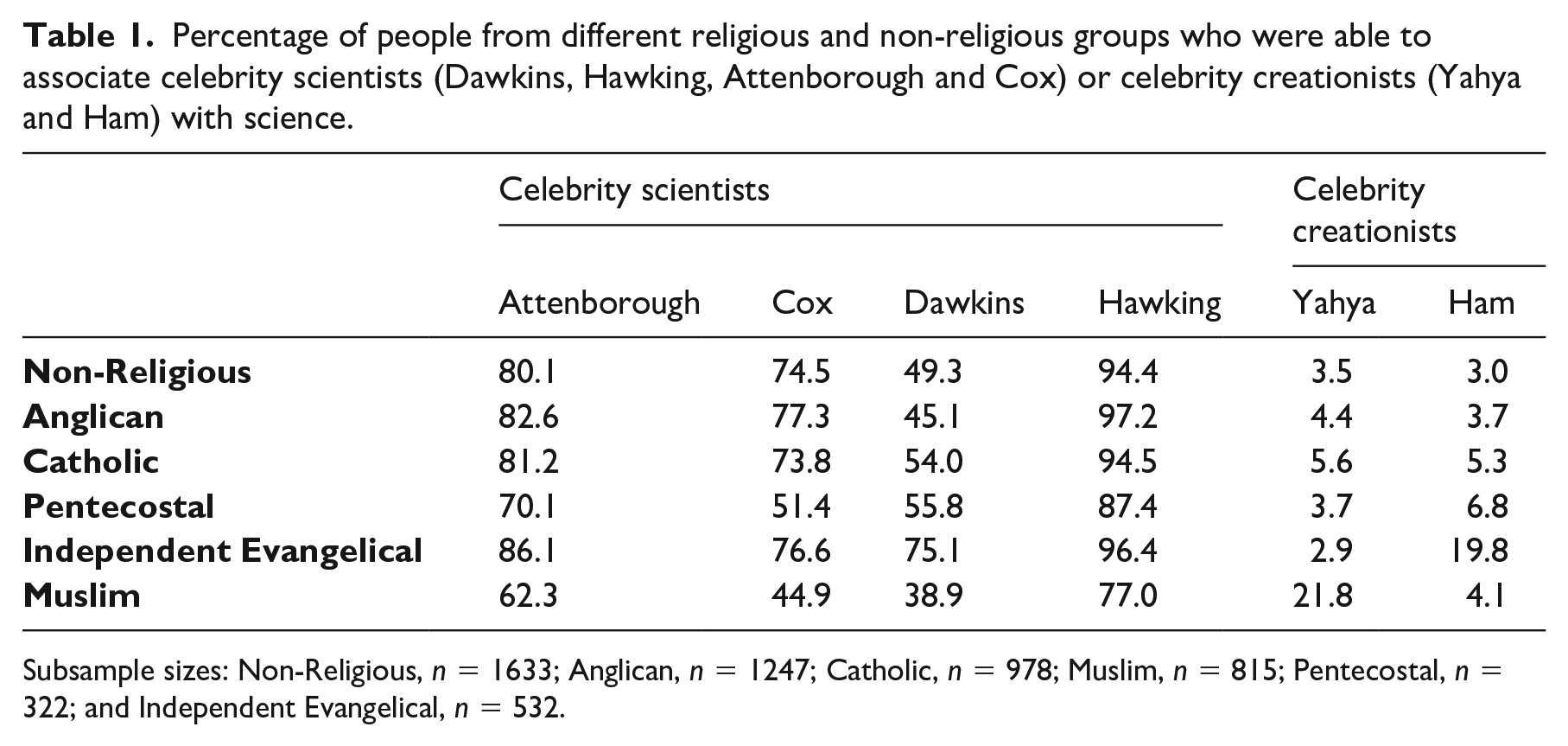
Subsample sizes: Non-Religious, n = 1633; Anglican, n = 1247; Catholic, n = 978; Muslim, n = 815; Pentecostal, n = 322; and Independent Evangelical, n = 532.
Given that we were interested in whether celebrity scientists might be perceived as identity-affirming or identity-threatening by individuals of different non-religious and religious backgrounds, it was important to ask respondents what they believed each of the celebrity scientists’ attitude to be towards religion (see Table S1 in Supplemental Material). A huge majority of respondents in each of the religious and non-religious groups who were able to associate Attenborough or Cox with science said they did not know what attitude these celebrity scientists held towards religion, although some Independent Evangelicals and Pentecostals said Attenborough or Cox held negative views. Fairly similar results are seen for Stephen Hawking, although the percentage of people saying Hawking views religion negatively are higher than for Cox or Attenborough. In contrast, among those who associate Richard Dawkins with science, 90% of Independent Evangelicals, 65% of Pentecostals, 52% of Muslims, 53% of Non-Religious, 50% of Catholics and 48% of Anglicans said Dawkins’ attitude towards religion is negative or very negative.
Those who had heard of each of the celebrity scientists or creationists were also asked to what extent they trusted that person to present reliable information about science (Figure 1). Among the Non-Religious, Anglicans and Catholics, there is high trust in David Attenborough, Stephen Hawking and Brian Cox, with around 90% agreeing or strongly agreeing that these three celebrity scientists present reliable information about science. Trust is somewhat lower among Muslims and lowest among Independent Evangelicals and Pentecostals, and for these three religious groups, trust is markedly lower for Hawking, who embodies science–religion conflict, compared to Cox and Attenborough, who embody science–religion independence. The chart for Richard Dawkins looks considerably different. Even among the Non-Religious, trust in Dawkins is lower compared to the three other celebrity scientists. Strikingly, trust in Dawkins is considerably lower for Anglicans, Catholics and Muslims (57%, 49% and 48%, respectively) compared to the other celebrity scientists. And for Independent Evangelicals and Pentecostals, trust in Dawkins is extremely low, with just 19.8% and 25.1% trusting him to present reliable information about science.
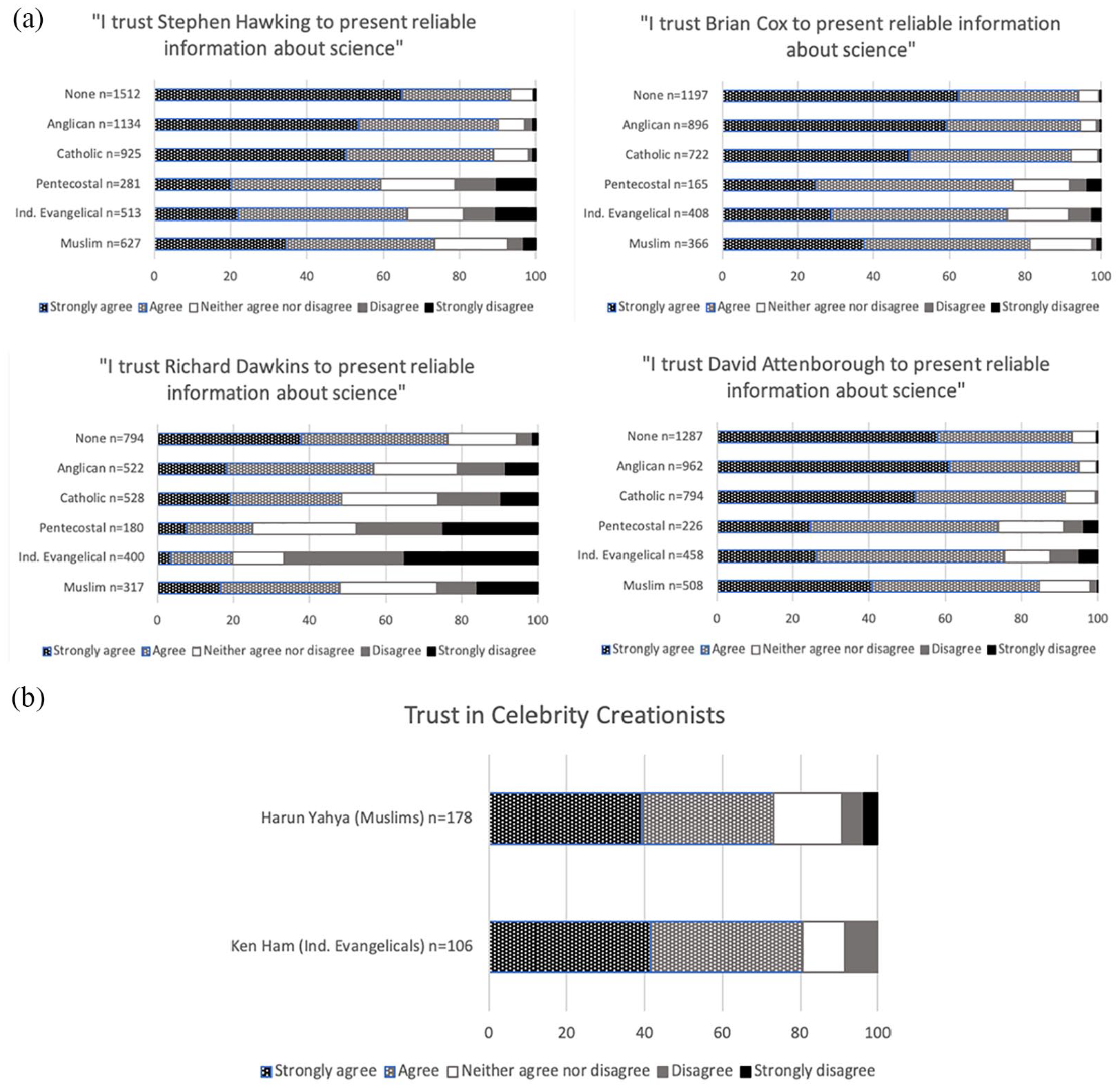
(a) Trust in celebrity scientists to present reliable information about science, split by the religious group. Note that respondents were asked the question about trust only for each celebrity they had correctly associated with science, hence the different subsample sizes shown in each chart. (b) Trust in celebrity creationists to present reliable information about science. Upper bar: Trust in Harun Yahya among Muslims who associate Yahya with science (see Figure 1). Lower bar: Trust in Ken Ham among Independent Evangelicals who associate Ham with science (see Table 1).
Given that the descriptive statistics described in the preceding paragraphs demonstrate that many more people perceive Richard Dawkins to view religion negatively compared to any other celebrity scientist, and given that we are interested in whether celebrity scientists who embody science–religion conflict affect views of evolutionary biology among different religious and non-religious publics, we created an additional variable for use in the binary logistic regressions (described below). This variable combines ‘associating Dawkins with science’ together with ‘perceiving Dawkins to view religion negatively or very negatively’, therefore allowing us to test whether knowledge of Dawkins’ view of religion has any effect on acceptance of evolution.
What about trust in the celebrity creationists? Among the relatively few Muslims who had heard of Harun Yahya, and the relatively few Independent Evangelicals who had heard of Ken Ham, trust was fairly high, with 73% agreeing or strongly agreeing that Harun Yahya presents reliable information about science, and 81% believing the same of Ken Ham (Figure 1b). For both Muslims and Independent Evangelicals, trust in Attenborough and Cox was higher than trust in these celebrity creationists, but trust in Hawking and Dawkins was lower.
When asked whether they had changed their view regarding evolution and human origins since first hearing about it, the majority of people reported that their views had stayed about the same. We consider this to be an indicator of what the default view in each group may be, and in Figure 2, we break down this category to show whether there is a clear default view on human evolution for each group. For Non-Religious, Anglicans and Catholics, this is acceptance of human evolution. Conversely, for Pentecostals and Independent Evangelicals, the default view is rejection of human evolution. The same category for Muslims is far more heterogeneous; around a half reject human evolution, and the other half is equally split between those who accept human evolution and those who neither accept nor reject it.
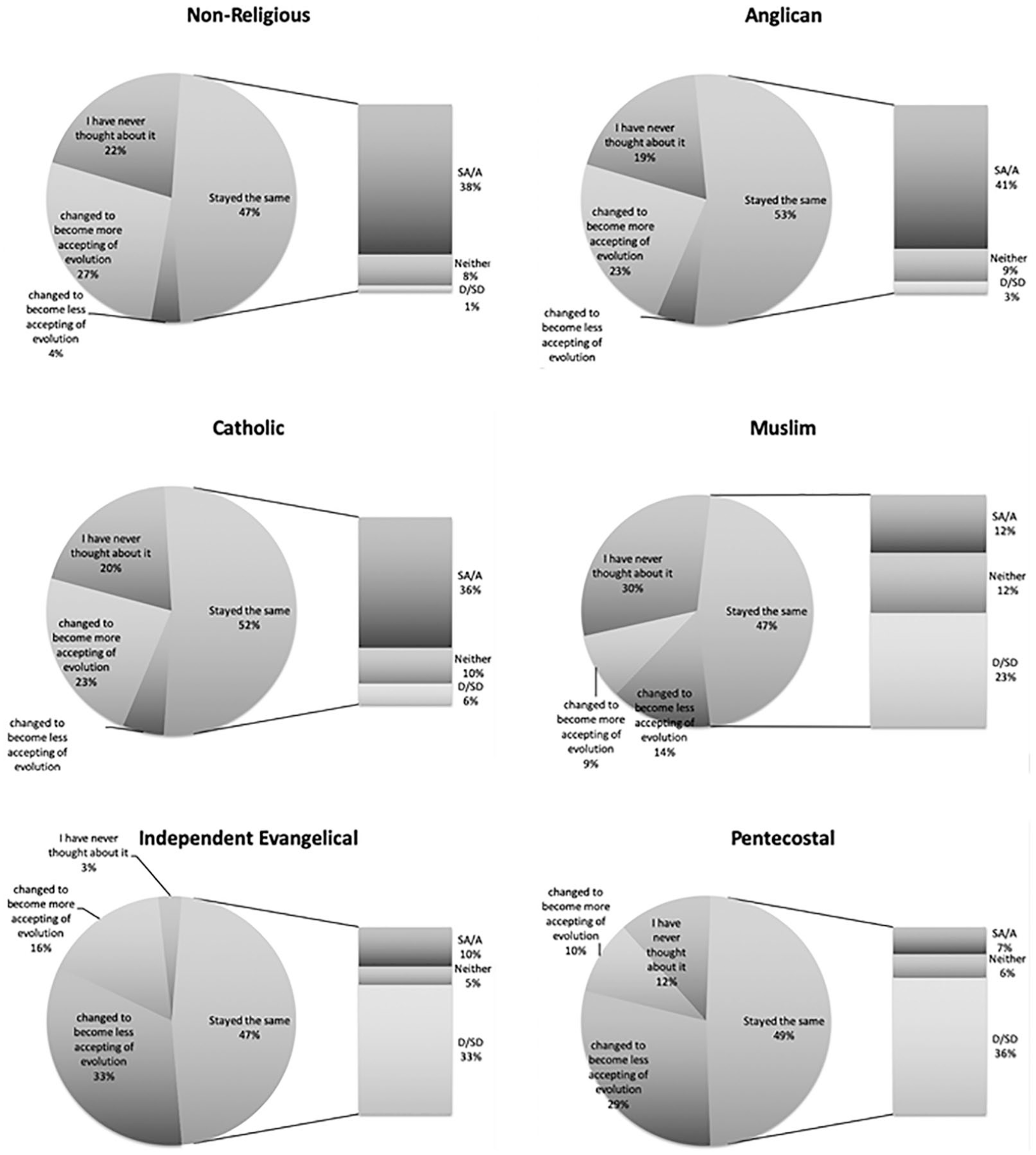
Responses to the survey question ‘Since first hearing about evolution, my views on evolution and human origins have: Stayed about the same / Changed to become less accepting of evolution / Changed to become more accepting of evolution / I have never thought about it’. The bar chart on the right shows a breakdown of the ‘Stayed the same’ category, giving the proportion of people who strongly agree/agree with human evolution, who neither agree nor disagree with it or who disagree/strongly disagree with it. Subsample sizes: Non-Religious, n = 1633; Anglican, n = 1247; Catholic, n = 978; Muslim, n = 815; Pentecostal, n = 322; and Independent Evangelical, n = 532.
We regard the response ‘I have never thought about it’ as an indicator of non-salience, and this varies considerably between different groups: it is very low among Independent Evangelicals (3%) and highest among Muslims (30%).
In this article, we are particularly interested in those individuals who report a change in view regarding evolution, either becoming more or less accepting of it. Presumably those who report a change of view have given some thought to the subject and have most probably engaged with some kind of information or public discourse on evolution. We aim to compare these categories (Accept Evo More or Accept Evo Less) with those who are far less likely to have engaged, that is, those whose views have stayed about the same or those who have never thought about it. Using binary logistic regression, we test the effects of familiarity with the four celebrity scientists and two celebrity creationists described while controlling for important sociodemographic, educational and religious factors.
The reference category (0), consisting of people who have not changed their view, is heterogeneous with respect to acceptance or rejection of evolution. We have therefore also carried out separate analyses in which the reference category is split according to whether people reject or do not reject human evolution. There is not sufficient space to include the data tables here, 2 but these more fine-grained analyses will be referred to where necessary throughout this section.
Becoming more accepting of evolution
Table 2a shows the results of a binary logistic regression analysis for the variable Accept Evo More, that is, comparing individuals who report becoming more accepting of evolution with those whose view has remained the same or who have never really thought about it.
Binary logistic regression using Evo Change More as the dependent variable.
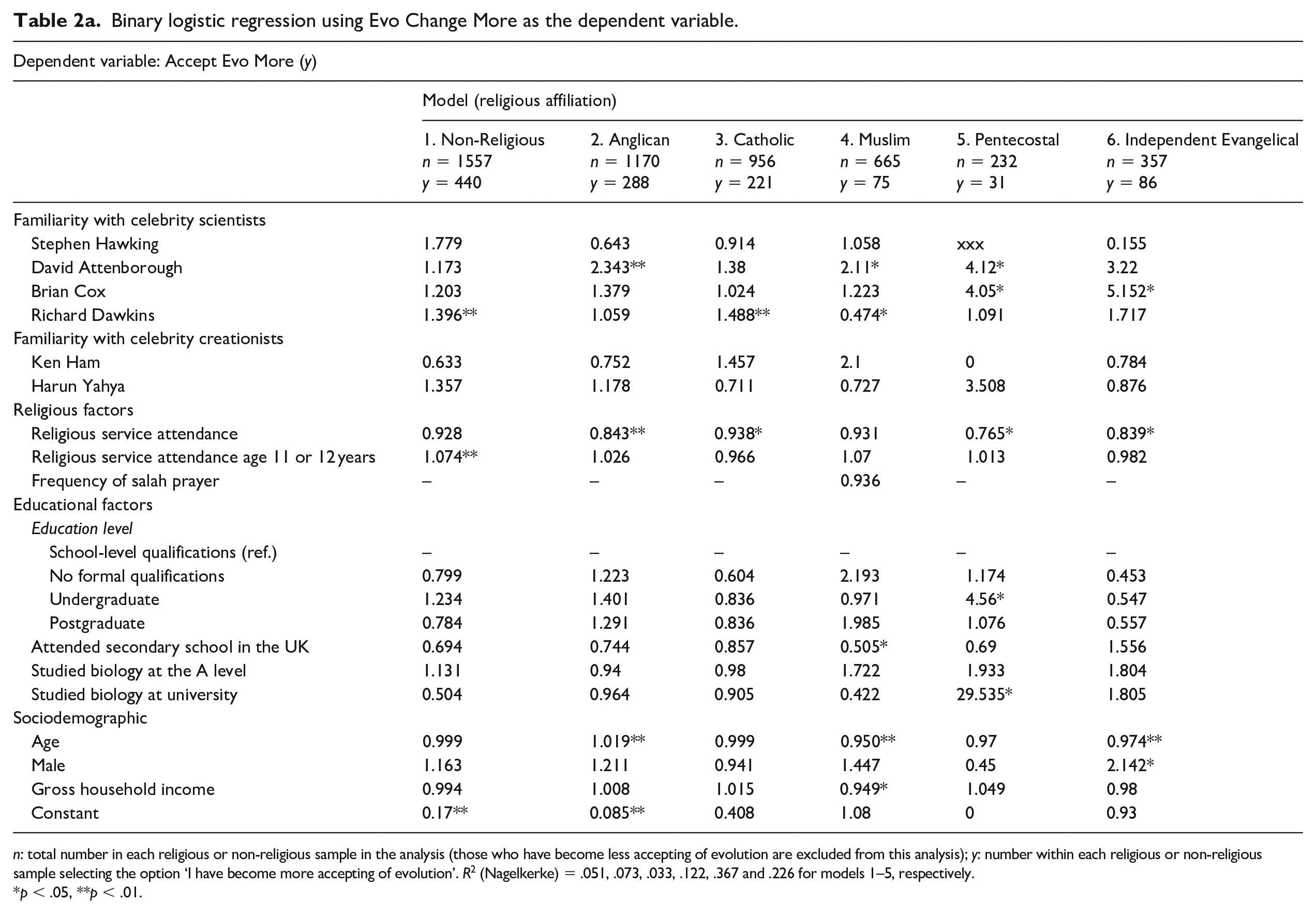
n: total number in each religious or non-religious sample in the analysis (those who have become less accepting of evolution are excluded from this analysis); y: number within each religious or non-religious sample selecting the option ‘I have become more accepting of evolution’. R2 (Nagelkerke) = .051, .073, .033, .122, .367 and .226 for models 1–5, respectively.
p < .05, **p < .01.
For the Non-Religious, associating Richard Dawkins with science significantly increases the odds of becoming more accepting of evolution. Familiarity with the other celebrity scientists included in the analysis has no significant effect. Familiarity with Richard Dawkins also significantly increases the odds of becoming more accepting of evolution among Catholics. The model predicts that the odds of a Muslim becoming more accepting of evolution are more than halved for those who associate Dawkins with science. However, associating Dawkins with science and associating Dawkins with a negative view of religion abolishes the significant effect among Muslims, but results in even higher odds of becoming more accepting of evolution among the Non-Religious and Catholics. We determined that this significant effect among Catholics persists if we analyse churchgoing 3 Catholics only, thereby excluding cultural Catholics (data not shown 4 ). A similar effect size is seen among churchgoing (see note 2) Anglicans, although the result is not statistically significant. More surprisingly, churchgoing (see note 2) Independent Evangelicals who associate Dawkins with science and a negative view of religion also show significantly higher odds of becoming more accepting of evolution. Familiarity with Attenborough is associated with increased odds of becoming more accepting of evolution among Anglicans, Muslims, Pentecostals and Independent Evangelicals, and familiarity with Brian Cox is significant among Pentecostals and Independent Evangelicals.
For the Non-Religious, religious attendance age 11 or 12 years significantly increases the odds of changing to become more accepting of evolution. Among most of the Christian denominations surveyed, frequent current religious service attendance significantly decreases the odds of becoming more accepting of evolution. Frequency of salah prayer is not a significant variable among Muslims when the reference group (0) does not reject evolution; however, it is significant when the reference group rejects evolution. Religious service attendance is not a significant variable for Muslims in any of the analyses undertaken.
Muslims who attended secondary school in the United Kingdom (and are therefore unlikely to be first-generation migrants) are significantly less likely to switch to evolution acceptance, just as, as noted below, they are significantly less likely to switch to evolution rejection. Postgraduate education almost doubles the odds of a Muslim becoming more accepting of evolution, although higher gross household income is correlated with slightly lower odds. Age is inversely correlated with becoming more accepting of evolution, meaning that younger Muslims are more likely to switch to accept evolution than older Muslims. The same age effect is seen among Independent Evangelicals; in addition, this religious group shows the only gendered effect: Independent Evangelical men have more than double the odds of becoming more accepting of evolution compared to women.
Among Pentecostals, undergraduate education in general, or studying biology at university hugely increases the odds of becoming more accepting of evolution.
Becoming less accepting of evolution
Table 2b shows the results of a binary logistic regression analysis for the variable Accept Evo Less; that is, comparing individuals who report becoming less accepting of evolution with those whose view has remained the same or have never really thought about it. Familiarity with celebrity scientists Stephen Hawking and Brian Cox is significantly associated with lower odds of becoming less accepting of evolution among the Non-Religious and Anglicans; however, familiarity with David Attenborough is significantly associated with higher odds among Muslims – although only when the reference group (0) is Muslims who do not reject evolution. Associating Dawkins with science alone does not result in statistically significant effects; however, associating him with science and with holding a negative view of religion is linked with an almost 3.5 times increase in odds of becoming less accepting of evolution among Pentecostals, and a 1.8 times increase in odds among Muslims (data not shown 5 ).
Binary logistic regression using Evo Change Less as the dependent variable.
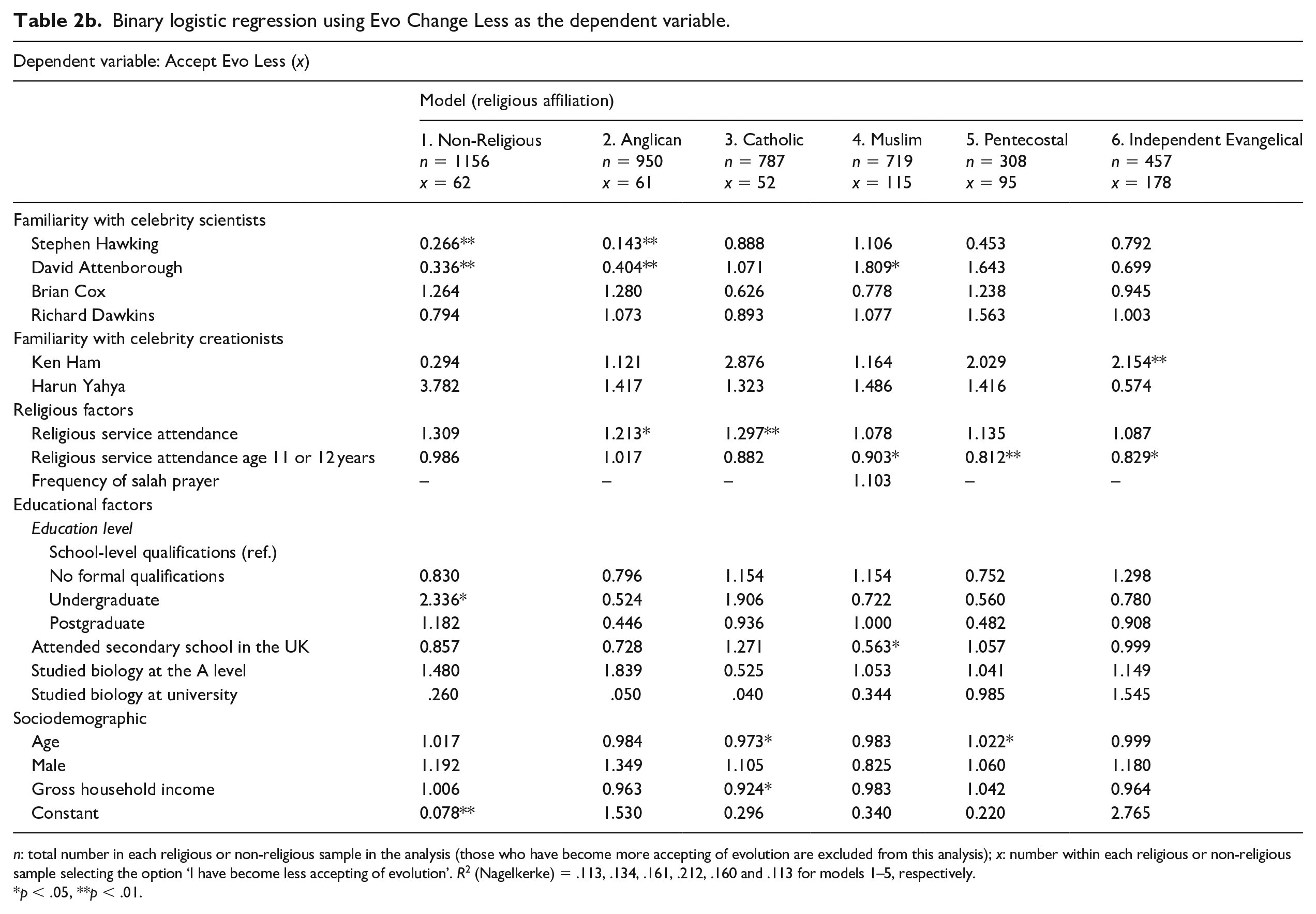
n: total number in each religious or non-religious sample in the analysis (those who have become more accepting of evolution are excluded from this analysis); x: number within each religious or non-religious sample selecting the option ‘I have become less accepting of evolution’. R2 (Nagelkerke) = .113, .134, .161, .212, .160 and .113 for models 1–5, respectively.
p < .05, **p < .01.
What about the effects of the celebrity creationists? Familiarity with Christian creationist Ken Ham increases fivefold the odds of an Independent Evangelical becoming less accepting of evolution when the reference group (0) is composed only of those who do not reject evolution (data not shown); a similar, albeit smaller effect is observed when the more heterogeneous reference group is used (Table 2b). Likewise, familiarity with Islamic creationist Harun Yahya almost doubles the odds of a Muslim becoming less accepting of evolution when the reference group (0) is composed only of those who do not reject evolution (data not shown), but no significant effect is seen when the more heterogeneous reference group is used (Table 2b). Curiously, an effect is also observed among the Non-Religious for familiarity with Harun Yahya. Closer inspection of the data reveals there are three Non-Religious individuals who associate Harun Yahya with science and report becoming less accepting of evolution. Among Pentecostals, celebrity creationists do not exert any significant effect in changing to become less accepting of evolution.
Frequency of religious service attendance among Anglicans and Catholics is associated with higher odds of becoming less accepting of evolution, even though both the default view (as described above) and the official view within these traditions are acceptance of evolution. Conversely, among Muslims, Pentecostals and Independent Evangelicals, it is not current frequency of religious service attendance that is significant, but instead frequency of religious service attendance age 11 or 12 years, and this variable is associated with lower odds of becoming less accepting of evolution. This of course does not mean that individuals from these traditions who attended services as children are more accepting of evolution than those who did not, but that they are less likely to report changing to become less accepting.
Among Muslims, the odds of switching to become less accepting of evolution are almost halved for those who attended secondary school in the United Kingdom compared to those who did not (see also above). Undergraduate education for Muslims and postgraduate education for Pentecostals reduces the odds of becoming less accepting of evolution (where 0 = reject evolution, no change in view. Data not shown). Otherwise, neither general education level nor education in biology is significant for most groups, except for the surprising finding that among the Non-Religious, an undergraduate education is associated with increased odds of becoming less accepting of evolution. Thirty-nine individuals with an undergraduate education fall into this category. Nearly all are White British, they are slightly more likely to be in their early 20s and a quarter studied business.
Trust in celebrity scientists: Multiple regression
So far, we have demonstrated that some celebrity scientists and creationists exert significant effects among some of the religious groups under study with regard to changing attitudes to evolutionary biology (Tables 1 and 2), and that trust in these public figures to present reliable information about science varies considerably (Figure 1). We hypothesized that lower levels of trust could be explained in terms of respondents’ attitude to evolution; that is, we would expect an individual to report reduced trust in a celebrity scientist known to promote evolutionary theory, if they themselves reject evolution. We therefore tested, using multiple regression, whether the differences in trust observed between the different non-religious and religious groups can be explained by people’s own attitude towards evolutionary theory. We tested this for Richard Dawkins and for David Attenborough, who have both done much to popularize evolutionary theory. In Table 3, model 1, we show that Richard Dawkins is trusted significantly less by all the religious groups under study, or, put differently, he is trusted significantly more among Non-Religious participants (β = .256 for the Non-Religious if Anglicans are used as the reference group; data not shown). We see a similar result for David Attenborough, although the effect sizes are considerably smaller, and Anglicans trust Attenborough to the same extent as the Non-Religious.
Multiple regression showing standardized β values and p values for each independent variable using (a) trust in Dawkins and (b) trust in Attenborough as the dependent variables.
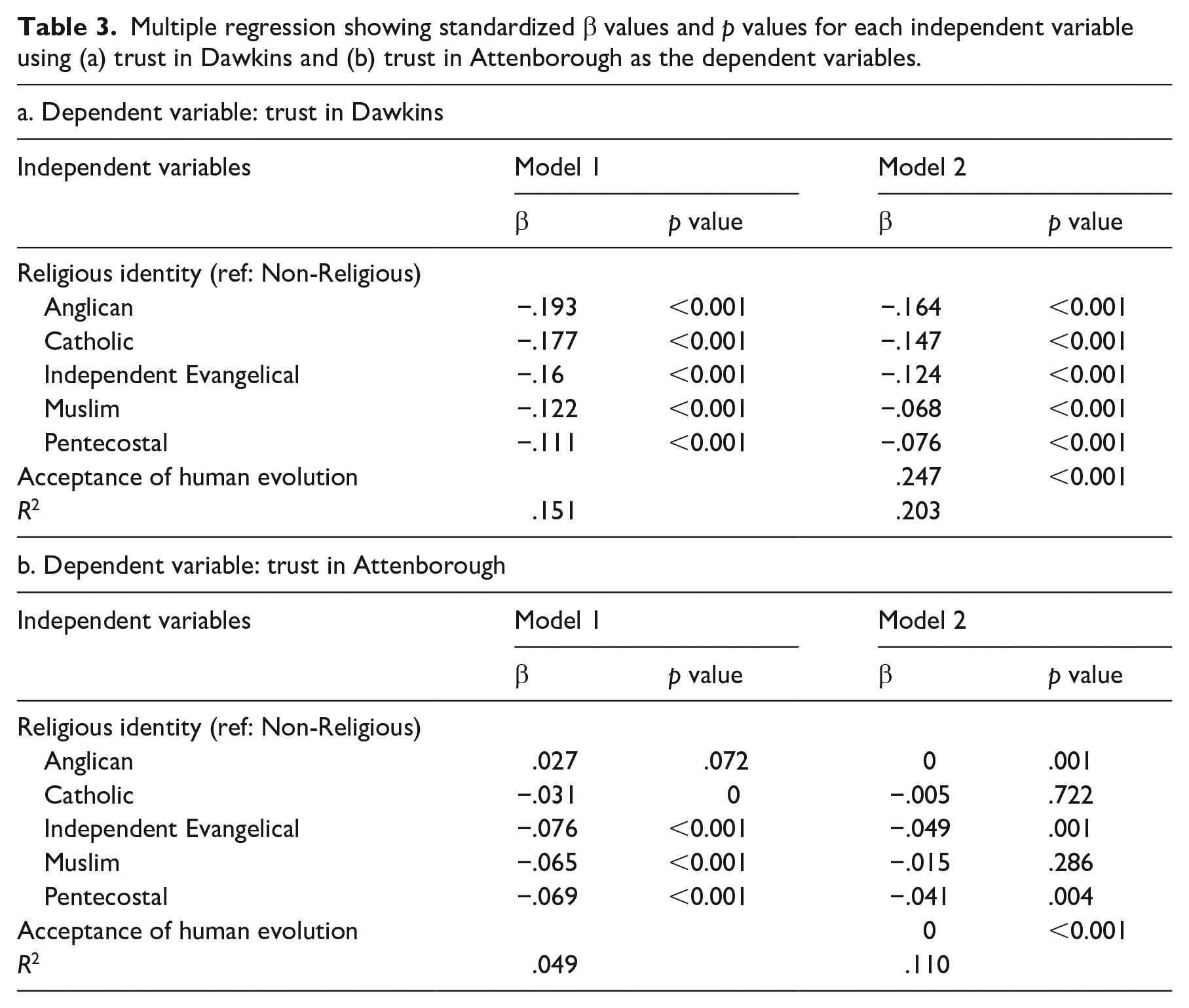
What happens then, if we add acceptance of human evolution into the model? We show the results for this in Table 3 model 2. For trust in Attenborough, the significant negative correlation between affiliating as a Catholic and affiliating as a Muslim is abolished once you control for attitude to evolution. Small negative effects remain for Independent Evangelicals and Pentecostals. However, trust in Dawkins remains strongly negative for all the religious groups compared to the Non-Religious reference group, even after controlling for attitude to evolution. Again, put differently, this demonstrates how strong trust in Dawkins must be among some of the Non-Religious, even compared to mainstream Anglicans for whom acceptance of evolution is rarely an issue.
6. Discussion
We have presented evidence here demonstrating which factors are most significantly associated with an individual changing to become either more or less accepting of evolutionary theory within six different religious and non-religious subsamples. This study demonstrates that people do change their minds regarding evolution, including individuals affiliated with various religious groups. Using binary logistic regression, we find that formal general education, or education in biology, is mostly not significantly correlated with increased (or decreased) acceptance of evolution. Exceptions to this are a positive effect between education and evolution acceptance among Pentecostals and, surprisingly, a negative effect among Non-Religious graduates. Among Independent Evangelicals and Muslims, two religious groups where acceptance of evolution is not the default view, younger people are more likely to report changing to become more accepting of evolution.
We predicted that familiarity with celebrity scientists would on the whole be predictive of people having changed to become more accepting of evolution, which was true in most cases. Uniquely, this study was able to show the different effects of familiarity with celebrity scientists among audiences who differed by religious affiliation. We show for the first time using empirical quantitative data that Richard Dawkins in particular exerts very different effects on different groups. Among the Non-Religious, some of whom may feel that Dawkins’ arguments for the incompatibility of science and religion affirm their own non-religious identities, familiarity with Dawkins is significantly linked with increased odds of becoming more accepting of evolution. Notably, no other celebrity scientists are correlated with becoming more accepting of evolution among the Non-Religious, even though David Attenborough in particular has discussed evolution a great deal in his natural history documentaries, as has Brian Cox in the documentary series Wonders of Life. It was also very marked how many Non-Religious people explained their acceptance of evolutionary theory in terms of their rejection of religion in the open-response section of the survey (data available on request).
Conversely, and confirming another of our hypotheses, Dawkins is positively correlated with becoming less accepting of evolution among some religious people. These significant effects are seen among Pentecostals and Muslims, but only when individuals associate Dawkins with both science and with holding a negative view of religion. This finding supports the idea that some religious believers’ views of evolutionary biology may be affected when they perceive Dawkins as identity-threatening. Furthermore, we demonstrated that the reduced trust in Dawkins evident among religiously affiliated people is not simply limited to disputes about whether evolution is true or not; clearly, even religious people who accept evolution do not trust Dawkins to present reliable information about science.
The data for the Non-Religious, Muslims and Pentecostals therefore confirm our predictions, suggesting that how celebrity scientists affirm or threaten people’s non-religious or religious identities may be very much more persuasive with regard to evolution acceptance than whether people understand and are convinced by the scientific evidence the celebrities present. Of course, it is not possible to establish causation from the analyses presented. It is perfectly plausible that celebrity scientists could directly influence people to change their views of evolutionary biology. But if this kind of causative relationship does exist, it may not necessarily be a straightforward one; for example, for some religious publics, it may be mediated by religious leaders and writers who heighten awareness of identity-threatening public figures such as Dawkins to strengthen their anti-evolution arguments, as demonstrated in a study of conservative evangelical congregations (Unsworth and Ecklund, in press). It also seems likely that people could change their views for other reasons and then find post hoc rationalization in the arguments presented by celebrity scientists. Even if celebrity scientists are not influencing people’s initial change of view regarding evolution, we still consider it an important finding that their outputs may be important in maintaining and strengthening people’s viewpoints.
Although we did not predict an identity threat effect among mainline Anglicans or Catholics familiar with Dawkins, neither did we expect to see Dawkins exert a positive effect (statistically significant among Catholics) on switching to become more accepting of evolution, particularly given that trust in Dawkins among these groups is markedly lower than among the Non-Religious (Figure 1). It may simply be that among these groups, where the default view is acceptance of evolution, those who know most about evolution are also most likely to be aware of Dawkins. We also speculate that individuals from mainline religious traditions may report becoming more accepting of evolution as a form of boundary making between themselves and the Christian traditions they perceive Dawkins to be attacking; for example, one recent study has demonstrated how Catholics engage in boundary making against Protestants when discussing the topic of evolution (Riley, 2019).
The only significant ‘Dawkins Effect’ observed among Independent Evangelicals, which was among those who attend church regularly, was opposite to what we predicted; among churchgoers, knowledge of Dawkins as a scientist and being negative towards religion was linked to significantly increased odds of becoming more accepting of evolution. The uniquely high levels of Dawkins awareness among evangelicals (Tables 1 and S1 in Supplemental Material) do suggest that Dawkins may well be utilized as an identity threat or ‘faith-reinforcing negative reference’ (Smith and Emerson, 1998) more generally within this religious subculture beyond the specific topic of evolution; in our statistical analysis, these high levels of awareness mean that the relatively small number who are not familiar with Dawkins are probably unlikely to have given the topic of evolution enough thought to consider changing their view. Those evangelicals who report changing in the direction of accepting evolution (one in six) are presumably mostly moving away from the ‘default’ position of evolution rejection (Figure 2). This demonstrates a degree of independent thinking, suggesting they have probably engaged in a certain amount of study and reflection, and will therefore almost certainly be familiar with the key figures in the debate, including Dawkins – hence the association between Dawkins and becoming more accepting of evolution. Indeed, in the open-response section, evangelicals who had come to accept evolution commonly cited several information sources, including Dawkins as well as Christian compatibilist authors. Evangelicals who report becoming less accepting of evolution (one in three) are probably either religious converts or people reporting the strengthening of default views. Such people are clearly no more or less likely to be familiar with Dawkins than the reference category consisting of individuals who, although they have not changed their view, may well have heard of Dawkins.
We also investigated the effects of celebrity creationists. Familiarity with Christian creationist Ken Ham was significantly associated with increased evolution scepticism among Independent Evangelicals, suggesting that US creationism does have some purchase here in Britain, although only among a very small subsection of British Christians. Associating Islamic creationist Harun Yahya with science was predictive of increased evolution scepticism among Muslims when the reference group (0) accepted evolution. However, the fears that Harun Yahya has great influence among Muslims in general in the United Kingdom do not appear to be well founded. We were unable to test the effects of those we might term ‘celebrity compatibilists’ (public figures who are religious and pro-evolution), given that there were no obvious high-profile compatibilists for us to use in these models. However, the open-response data highlight that such figures exist within religious subcultures, particularly among some evangelicals.
Interestingly, associating Attenborough with science is correlated with becoming both more and less accepting of evolution among Muslims. Those Muslims who received secondary education outside of the United Kingdom (who are most probably first-generation migrants) are also more likely to become both more and less accepting of evolution. We speculate this could be because both Attenborough documentaries and coming to Britain from elsewhere will raise awareness of evolution, meaning that individuals need to choose a position of either accepting or rejecting evolution on what was previously a non-salient topic for them.
It is of note that all the celebrity scientists analysed here are White and male. Although it is beyond the scope of this study, there may also be gender and race effects at work. For example, why, among Independent Evangelicals, are the odds of a man becoming more accepting of evolution more than twice those of a woman? Is it noteworthy that the two religious groups among which we observe a ‘Dawkins effect’ are those with the highest proportions of ethnic minorities? We strongly recommend that future studies on celebrity scientists tackle these issues.
An important methodological note for quantitative researchers emerges from this study: we need to bear in mind that non-religious is not a neutral category with which to compare religious groups when evaluating views on some aspects of science, most particularly evolutionary theory. This study demonstrates that for some non-religious people, a strong acceptance of evolution may have more to do with a strong rejection of religion than knowledge and acceptance of the scientific evidence supporting evolutionary theory.
The results from our study suggest that engaging certain religious audiences with the science of evolutionary biology is more effective when their social, that is, religious, identities are not threatened, a conclusion that is in line with findings from studies on teaching evolution effectively to religious students in the United States (Barnes and Brownell, 2017). We hope such findings encourage reflexivity among science communicators and educators, for fear that we are otherwise perhaps in danger of ‘creating creationists’ (Elsdon-Baker, 2015).
Supplemental Material
sj-pdf-1-pus-10.1177_0963662521989513 – Supplemental material for The Dawkins effect? Celebrity scientists, (non)religious publics and changed attitudes to evolution
Supplemental material, sj-pdf-1-pus-10.1177_0963662521989513 for The Dawkins effect? Celebrity scientists, (non)religious publics and changed attitudes to evolution by Amy Unsworth and David Voas in Public Understanding of Science
Footnotes
Acknowledgements
The authors would like to thank Colton Cox for assistance with coding the open response data, and the anonymous reviewers for their helpful comments during the preparation of this article. Amy Unsworth would like to thank Denis Alexander and Elaine Ecklund for their support.
Funding
The author(s) disclosed receipt of the following financial support for the research, authorship and/or publication of this article: This research was made possible through a grant (UAB018) awarded under the Uses and Abuses of Biology Programme, The Faraday Institute, St. Edmund’s College, Cambridge, UK.

Supplemental material
Supplemental material for this article is available online.
Notes
Author biographies
References
Supplementary Material
Please find the following supplemental material available below.
For Open Access articles published under a Creative Commons License, all supplemental material carries the same license as the article it is associated with.
For non-Open Access articles published, all supplemental material carries a non-exclusive license, and permission requests for re-use of supplemental material or any part of supplemental material shall be sent directly to the copyright owner as specified in the copyright notice associated with the article.
