




Abstract
This article analyses whether different institutional sources of scientific information have an impact on its credibility. Through a population-based survey experiment of a national representative sample of the Spanish public, we measure the credibility that citizens attribute to scientific information on the evolution of CO2 emissions disclosed by different institutional sources (business associations, government, non-government environmental organisations, international bodies and national research institutions). The findings show that an institutional credibility gap exists in science communication. We also investigate the factors accounting for the credibility of the different institutional sources by examining variables related to knowledge, interest, trust, reputation, deference, attitudes, values and personal characteristics. Exploratory regression analyses reveal that identical variables can produce different effects on the credibility of scientific information, depending on the institutional source to which it is attributed.
Keywords
1. Introduction
Science continues to be one of the most important institutions in society and confidence in science appears to have declined little in comparison with other institutions, although in some controversial aspects of science public opinion is clearly polarised. 1 Citizens identify science as a profession and research organisations (universities, academic entities, etc.) as actors deserving a strong reputation and trust, both in the United States (Funk and Rainie, 2015) and in Spain (Lobera and Torres, 2015).
The credibility of scientific and technical data is important for government information concerning the societal effects of public policies (e.g. James and Van Ryzin, 2017) and its use for policymaking in science and technology (S&T) (e.g. Youtie et al., 2017).
Science as an activity is among the most trustworthy and reliable of institutions, but citizens question the credibility of certain scientific information even when widespread agreement exists. Despite scientific consensus, the credibility of scientific claims or results, such as global warming, is sometimes disputed (Skuce et al., 2016). This paradox leads to analysis of whether the credibility of scientific information related to climate change varies depending on the source of communication.
Previous research has performed a comparative analysis of the credibility of different social institutions (including religious authorities) regarding scientific issues such as climate change, and the way in which confidence in scientific institutions and scientists is associated with trust in other sources (e.g. Cacciatore et al., 2018; Carlisle et al., 2010; Liu and Priest, 2009; Myers et al., 2017; Peters et al., 1997; Priest et al., 2003). This study advances further, in line with the approach of Carlisle et al. (2010), and while maintaining constant the scientific results attributed to scientists, an attempt is made to ascertain whether different sources of the same information affect its credibility.
Comparing the varying levels of trust in different sources of information (such as scientists, the Environmental Protection Agency (EPA), environmental organisations and the media and scientific media), as providers of ‘scientific information on the environment’, Brewer and Ley (2013) have shown that trust in scientists strongly predicts trust in environmental organisations, the EPA and sources of scientific knowledge, suggesting that trust in scientists can serve as an input mechanism to support climate-related action; nonetheless, their non-experimental research design could not confirm that this association was causal.
The contribution of this article is to address the effects that different social institutions through which scientific information is provided have on the increase or decrease of their credibility, a question that has been only partially addressed in the literature. The analysis is an experimental approach, and its added value (as compared with the observational method dominant in the literature) relates principally to the possibility of attaining a stronger internal validity of causality.
The essential aim of this article is to address two research issues. First, to determine whether different institutional sources of scientific communication have an impact on the credibility of information, and second, to investigate the factors accounting for the credibility of each institutional source. To examine such variation, we compare the credibility of scientific information as supplied by business associations, government, environmental organisations, international bodies and national scientific institutions. Our experiment exploits a national representative survey from 2016, in order to assess the degree of credibility citizens award to scientific reports on the evolution of CO2 emissions in Spain.
The next section presents the research questions and formulates the analytical framework. The third section presents the methodology and the experimental design of the study, based on the random allocation of the total sample into five identical groups for their differential treatment. The fourth section analyses the principal results and presents the regression models to explain the factors associated with the credibility of each information source. The study ends with a discussion, the acknowledgement of its limitations and future research lines.
2. Research questions and analytical framework
The objective of our study is to experimentally determine whether the institutional sources of disclosure of scientific information on climate change (in our case, carbon dioxide – CO2 – emissions in Spain) affect citizens’ credibility in scientific information. The research questions guiding the analysis are twofold. First, what is the effect of the information source (intermediation and communication) on the credibility citizens award to science and specifically to the results of science (and its measurement) on climate change? Second, what factors account for the level of credibility of different sources of information on scientific results? The aim is to determine whether citizens find information on climate change produced by scientists more or less credible according to the institutional sources of communication.
The experimental design will provide a direct answer to the first question, by a simple comparison of the differences of the average values of credibility attributed to the different institutional sources. The explanandum is described in terms of institutional credibility gaps 2 and there are certain expectations regarding the gaps likely to emerge. For instance, Ziman (2002) stated that ‘for scientific knowledge to be trustworthy, it needs to be disassociated from material interests’; other empirical research has indicated that the levels of confidence in scientific institutions (Weingart and Guenther, 2016) are likely to be higher than the levels of confidence in government or business associations (e.g. McComas, 2012). It is also likely, as per previous empirical findings in Spain, that the level of confidence in environmental organisations (such as Greenpeace) will be relatively high (Fundación Mapfre, 2015). This is because in Spain the public consider such institutions to be disinterested; it is to be expected that the credibility of Greenpeace as a source of scientific data is the consequence of its public acceptance rather than its cause, a situation that is not consistent with US public opinion. We do not therefore assume cultural equivalence.
The second question explores some of the relevant empirical literature highlighting the role of different variables, which may contribute to explaining the credibility of scientific information from different sources. The present review has identified various approaches pointing to different explanatory factors: (a) knowledge and education, based on the approach of the deficit model, which insists on the role of interests and information regarding science as relevant variables; (b) values and beliefs, culturally based rather than rationally assessed, related to attitudes towards S&T impacts or risk assessments and (c) the difference in trustworthiness and reputation that citizens attribute to different social institutions or professions.
One research line, which explains citizens’ support for scientific issues, is related to knowledge and rational decision-making models. The analysis of scientific literacy (Miller, 1983) and the so-called ‘deficit model’ (Allum et al., 2008) have been the basis for early analyses, highlighting the fact that more informed or knowledgeable citizens are more likely to support science and, therefore, to confer it with greater credibility. The ‘deficit model’ or ‘scientific literacy hypothesis’ assumes that the principal factors shaping the relationship between science and individuals are related to the level of scientific knowledge and personal interest in scientific issues. Research in this line has also found a significant role of a number of socio-demographic factors and political orientation variables. Recently, some results have suggested that the credibility of science regarding the issue of global warming depends on the level of knowledge that citizens have concerning scientific issues; those who lack scientific knowledge feel alienated from public institutions, do not share a common definition of science and tend to rely less on scientists than citizens at the opposite ends of the spectrum (Gauchat, 2011). As a result of the empirical inconsistencies in the ‘scientific literacy hypothesis’ (Bauer et al., 1994; Evans and Durant, 1995), research guided only by this concept has declined over time. More recently, in addition to the classical knowledge factors, attitudinal, beliefs or value variables have been included in the analysis.
A second approach has attempted to come to terms with the fact that increased knowledge and greater scientific education are insufficient when conflicting values are involved. For example, the so-called ‘cultural cognition’ thesis (e.g. Kahan et al., 2011, 2012; Motta, 2018) claims that individuals use two communication modes, one related to ‘information content’ and the other associated with ‘cultural meaning’. In such explanations, the individual values, worldviews, beliefs or so-called ‘value predispositions’ have been found to be relevant in accounting for the public opinion formation process and the general public attitudes towards S&T issues (e.g. Brossard and Nisbet, 2007; Kahan et al., 2009; Scheufele and Lewenstein, 2005; Su et al., 2016). Individuals would be willing to give selective credit to or dismiss evidence in patterns, fitting their values. Also, in opposition to the idea of informed citizens making rational decisions, and linked to cultural approaches, some research has revealed that the individual level of risk perception is a function of factors other than the (perceived) probability of harm (Slovic et al., 1979). Other perspectives highlight the idea of ‘cognitive misers’ whereby individuals use ‘cognitive shortcuts or heuristic devices’ (Tversky and Kahneman, 1981). Among such devices, the levels of trust and trustworthiness are important to understand credibility in scientific information (Reen and Levine, 1991). 3 Social trust and distrust become especially relevant when dealing with complex cognitive problems or when citizens face difficulties in evaluating complicated risks. For instance, social trust in risk management authorities becomes more important when the personal knowledge of the risk is low (Siegrist and Cvetkovich, 2000) and social distrust is also used as a strategy for the reduction of cognitive complexity faced with risks difficult to evaluate (Earle and Cvetkovich, 1995). In this line, Priest et al. (2003) confirmed that trust in institutions was more important than knowledge of science to understand the support for science; they constructed a measurement device (a ‘trust gap hypothesis’) to underline their argument that the assessment of the level of confidence should be established in comparative terms, paying attention to differences among actors. Attitudes or specific beliefs related to trust, such as deference to scientific authority in scientific issues, also appear very important to the understanding of the support for emerging technologies (Anderson et al., 2012). Reputation and credibility of professions (scientist) is also relevant (Gauchat and Andrews, 2018) as much as epistemic authority (Kruglanski et al., 2005).
In the specific domain of climate change (Nisbet, 2011), recent findings related to institutional confidence and information trustworthiness highlight the role of trust and mistrust in scientists, influenced by the media, as predictors of the credibility of information (e.g. Nisbet and Kotcher, 2009). There is evidence that trust in scientists effectively influences beliefs in the existence of climate change (Gauchat, 2018), since it acts as an intermediate variable between the use of the media and the belief in climate change. This would contribute to explaining why the conservative media display an active mistrust of scientists compared with their more liberal counterparts (Hmielowski et al., 2014). The credibility of scientific information regarding climate change is related to the high levels of confidence scientists enjoy (Brewer and Ley, 2013), although other social actors (informal communicators such as health professionals) are also important as information sources (Sleeth-Keppler et al., 2017).
In sum, the credibility of scientific information concerning climate change may be seen as a phenomenon in which, faced with the impossibility of obtaining personal and direct measures related to the results, trust and other forms of institutional confidence, as cognitive shortcuts, might play relevant roles. In addition to the dimensions of trust and confidence, we will also integrate in our analysis other key dimensions, such as knowledge and values. We adopt an experimental approach, in line with recent agendas in the field (Priest, 2014), 4 to address some of the methodological deficits of the dominant observational research.
By credibility, we mean the degree of believability in the facts and data presented to the interviewees in our survey. By reputation or prestige, we mean the degree of social appreciation of certain professions. By confidence or trust, we refer to the degree of trustworthiness which respondents attribute to institutions or other persons. As a convention, we use credibility to refer to the information provided by a specific institutional source, confidence to refer to institutions in general and trust to refer to the relationship among individuals.
3. Methodological design: A population-based survey experiment
The observational character of most previous research findings implies limitations related to internal validity and causality and, if reduced cross-sectional data are used, those findings have restrictions of external validity as well.
The ‘population-based survey experiments’ (Mutz, 2011) or ‘factorial surveys’ (Auspurg and Hinz, 2015) occupy an important place among experimental methods 5 compared to general field experiments (Gerber and Green, 2011) or to laboratory experiments (Morton and Williams, 2010). The most attractive feature of survey experiments is that as they are performed on a representative sample of people outside the laboratory, they benefit from a potentially high degree of external validity; this article uses a representative sample of the Spanish adult population. This is coupled with a similarly high degree of internal validity because the researcher maintains control over the experimental conditions, to the same extent as in the laboratory. One of the most relevant features of this approach is related to the randomised control trials (Imbens and Rubin, 2015); in this survey, the experimental approach is implemented through the randomisation of the treatment groups. Consequently, the results of the survey experiment are both easily generalisable and appropriate for testing causal hypotheses. In this context, the contribution of this study is principally related to the implementation of an adequate experimental design, to improve the two types of validity (Campbell, 1971).
Integrating the experiment in a representative national survey
Our experiment employed the 2016 Spanish Social Perception Survey of Science and Technology (EPSCYT 2016; Fundación Española de Ciencia y Tecnología (FECYT), 2017); the survey was constructed using a representative sample of the adult population in Spain and implemented through personal interviews, in late 2016, with 6357 valid responses. 6
To address some of the caveats and limitations identified in the practice of survey experimentation (e.g. Van Ryzin and Lavena, 2013), our methodological design incorporated certain improvements: (a) the respondents are a representative random sample of the population, instead of volunteers, (b) the total samples and sub-samples are representative of the Spanish population, (c) we refer to specific scientific information on the variation of CO2 emissions and not to general statements, (d) interviewees are offered real CO2 emissions data, between 2011 and 2015, and not hypothetical ones, (e) the issue on which they are questioned is operationalised through variables that are not directly measurable by personal experience in everyday life and (f) the questions refer to real and specific institutions connected with climate change issues and not generalisations or abstract categories.
The experiment consisted of a question with five variations (the various sources of scientific information), which were randomly assigned to the respondents. The various sources of communication of scientific information act as treatments. The same true information on the status and evolution of CO2 emissions in Spain produced by researchers was presented as disclosed by five different institutional sources:
The European Automobile Manufacturers Association (ACEA) (termed ‘business association’)
The Spanish Ministry of Agriculture and Fisheries, Food and the Environment (termed ‘government’)
The United Nations Intergovernmental Panel on Climate Change (termed ‘IPCC’)
Greenpeace, a non-governmental environmental organisation (termed ‘Greenpeace’)
A partnership between the National Research Council (CSIC) and Spanish universities (termed ‘universities and R&D institutions’)
We use the last of these as a baseline group (a control group), because the treatment in this case is information produced by scientists and disclosed by scientific institutions themselves. By measuring the credibility of the information disclosed by different sources, we estimate, in comparative terms, the impact of institutions on the existence of a gap in the credibility of scientific information sources.
Implementation of the experiment
Upon reaching question 15 of the questionnaire, the interviewees were randomly assigned to the five groups constituting the experiment. The process of applying the experimental design to the survey is presented in Figure 1, which includes the formulation of the questions and the identification of the treatment groups.
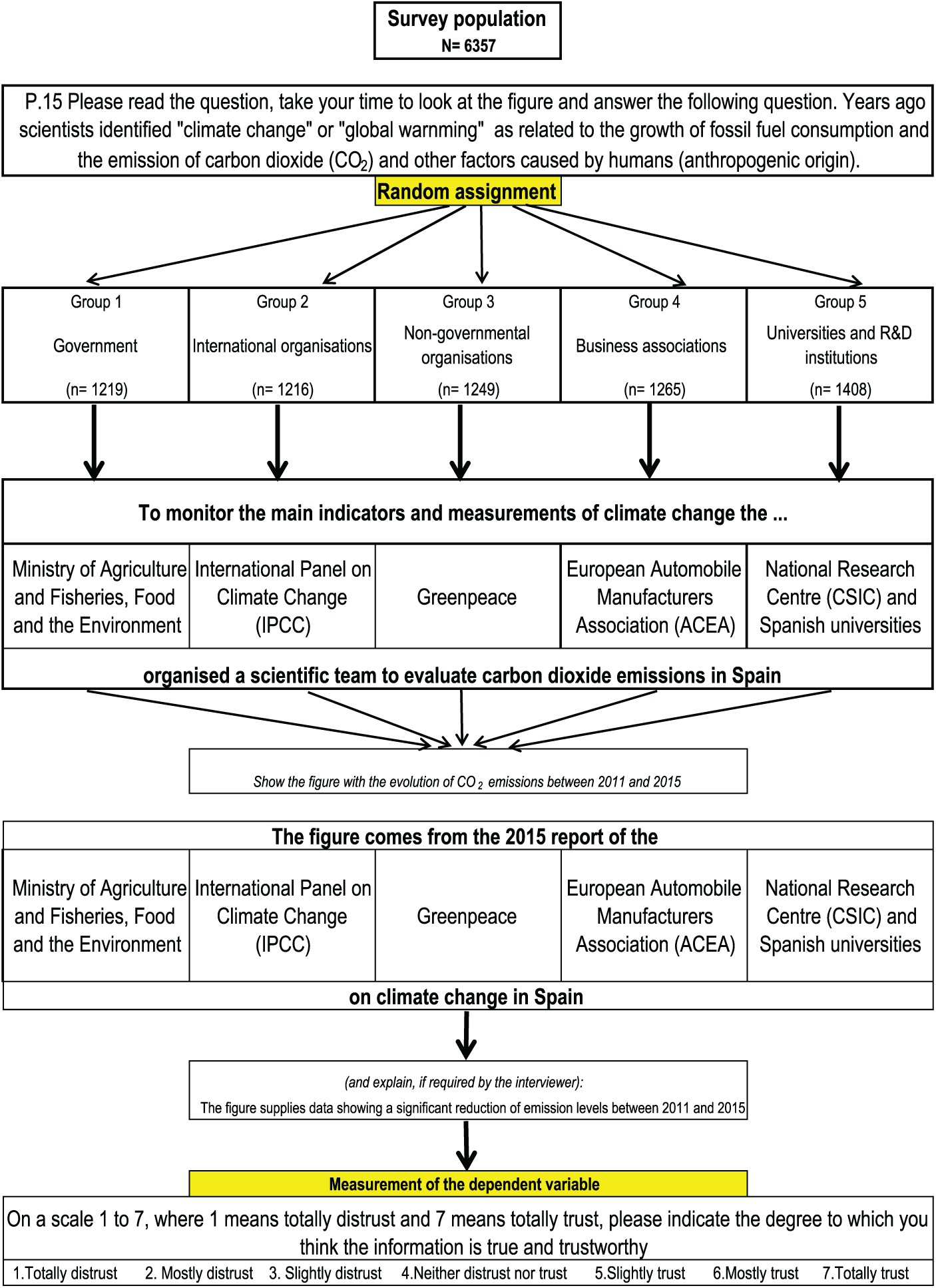
General description of the survey experiment.
The graph shown to respondents (Figure 2) was the same for all the five treatment groups and indicated the level of CO2 emissions of Spain, in tonnes per capita, between 2011 and 2015. The graph shows an 11% reduction in emissions between the two selected dates, indicating an improvement in the situation.
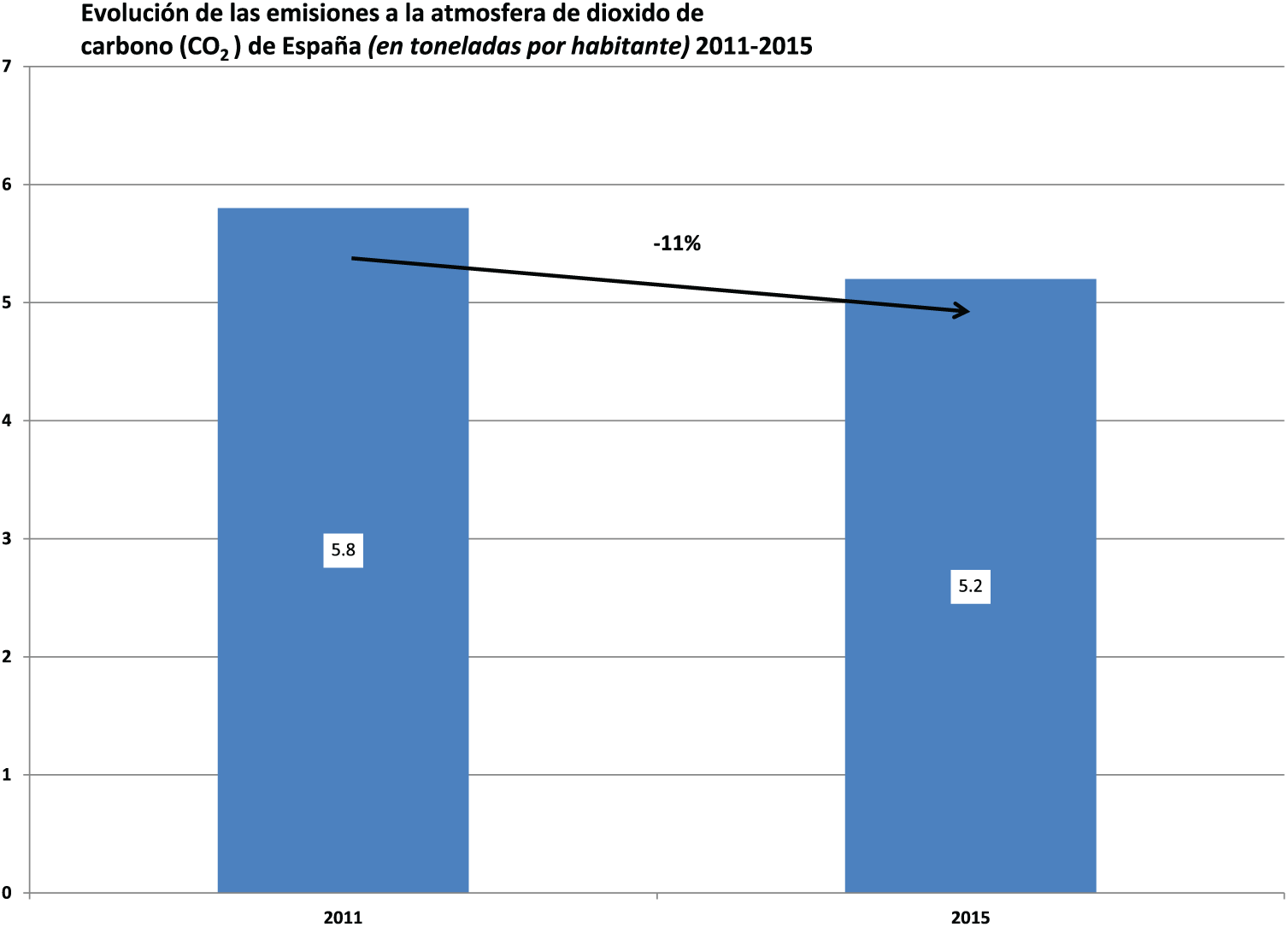
Graph presented to all interviewees (evolution of the emission of carbon dioxide (CO2) in Spain – in tonnes per capita – 2011–2015).
In order to measure our key dependent variable, after viewing Figure 2, the respondents were asked to rate on a scale from ‘totally distrust’ to ‘totally trust’ (the Likert-type scale was 1 to 7) to what extent they believed the information was credible (true or not), and whether they had confidence 7 in the source.
4. Information credibility and the institutional confidence gap
To analyse the results of the experiment, we first performed analyses to test the existence of statistically significant differences in the credibility of the information from different sources. Subsequently, in order to investigate the factors associated with the credibility differences, we applied ordinary least squares (OLS) regression models in an exploratory way to determine the factors related to the various communication institutions.
Does the source of communication have effects on its credibility?
An initial examination of the data confirms that the source of scientific information affects its credibility. The distribution values for all five treatment groups, on a scale of 1 to 7, appear to indicate that citizens confer only limited credibility to information on climate change, regardless of the source from which it comes; over a quarter of the interviewees report that they neither distrust nor trust information on climate change (scale value 4) across sources. The percentage of those who trust (values 5 to 7) surpasses that of those who distrust (values 1 to 3) in the cases of universities and R&D institutions (40.0% vs 29.6%), the IPCC (37.7% vs 34.0%), and Greenpeace (37.5% vs 32.2%); therefore, citizens give greater credibility to the information supplied by one of these three sources. By contrast, since the percentage of those who trust is lower than those who distrust, less credibility is given to the information provided by the government (34.6% vs 38.2%) and by the business association (29.5% vs 41.5%). In sum, the credibility of the information regarding climate change disclosed by scientific institutions (baseline group), the IPCC and Greenpeace clearly surpasses that enjoyed by business and government. Figure 3 shows the average level of credibility awarded to information on the evolution of CO2 emissions in Spain for each treatment group.
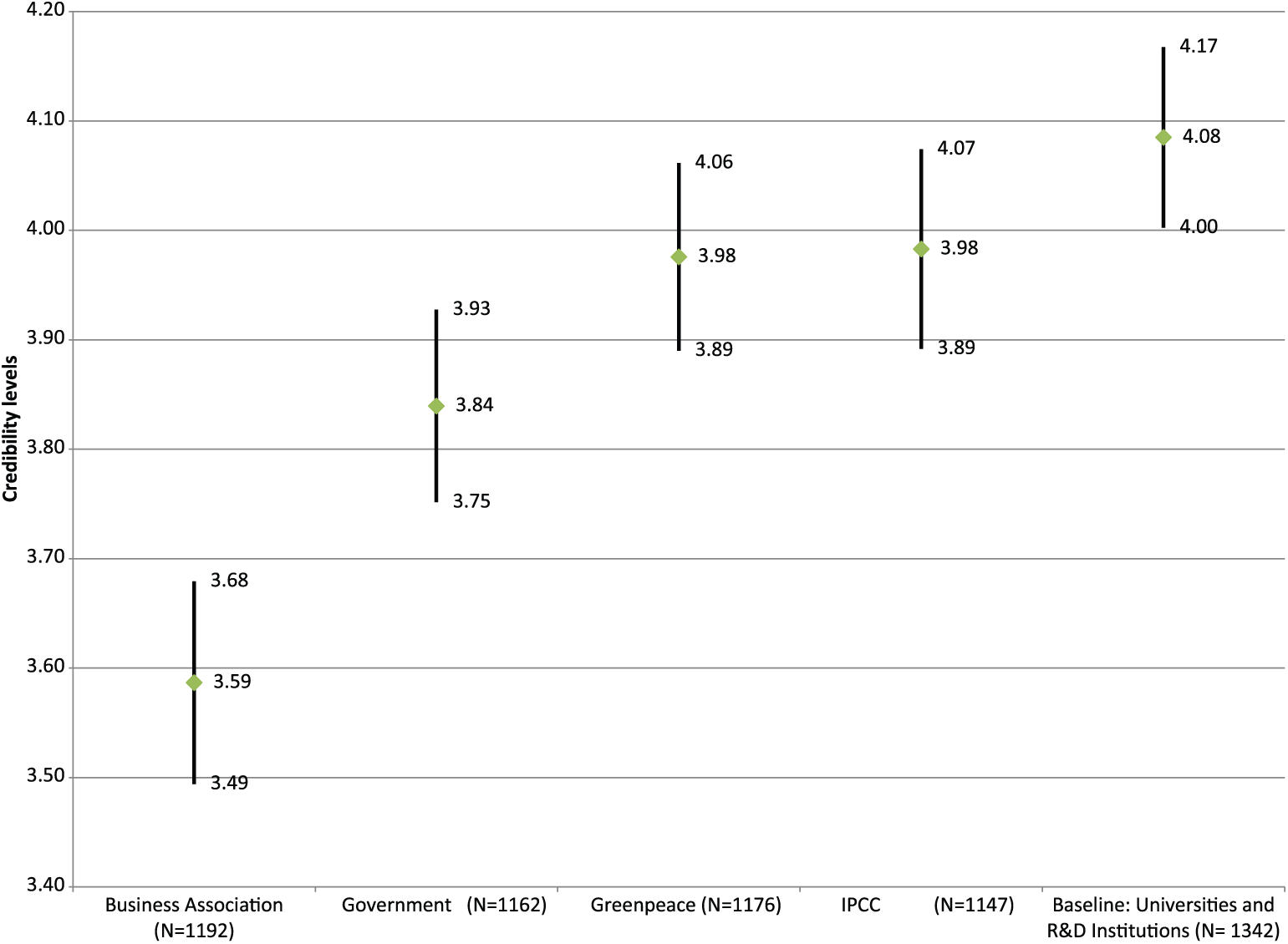
Credibility of information on climate change.
Analysis reveals that the differences between the means of some of the treatment groups are statistically significant, 8 a sign that information sources have an effect on the credibility of information. The source generating greatest credibility is the baseline group; the least credible is the group whose source of communication was the business association, its credibility statistically significantly lower than that of the other groups.
The groups whose sources are business and government report mean values of credibility statistically different from the baseline group, while mean credibility conferred by the other two treatment groups (the IPCC and Greenpeace), do not differ significantly from the baseline group. Thus, we cannot state that those who were told that the information came from a report by the IPCC or Greenpeace were less likely to give credibility to the information than those receiving the information from universities and R&D institutions.
Which factors explain credibility in different sources of communication?
In order to explore the causes of the differences in credibility of the communication sources, we framed certain independent variables in the questionnaire, using the three empirical explanatory research lines identified in Section 2.
The first of these, grounded in the deficit model, considers citizens’ rationality and their knowledge of and interest in S&T and the environment. The deficit model claims that if citizens do not have positive attitudes towards science it is because they are not sufficiently informed about scientific or environmental issues.
The second line, derived from ‘cultural cognition’ arguments, refers to attitudes and values towards science, which we extract from an analysis or evaluation of their general effects, benefits and costs or environmental impact, the attribution of priority to science in public budgets or deferential attitudes towards scientific authority.
The third approach is based on the idea of limited rationality and the use of shortcuts in reasoning and is linked with the literature on trust; within this approach, mention should be made of the importance of interpersonal trust, institutional confidence and the reputation or prestige of professions.
Corresponding to these three research lines, three groups of variables (plus the control variables) were included in the models.
We included variables measuring the ‘interest’ (in ‘S&T’ and in ‘environmental issues’), the ‘information level’ (on ‘S&T’ and on ‘environmental issues’) and a self-assessment of the level of ‘S&T education’.
We incorporated three dichotomous variables indicating those ‘having a positive view of the balance of S&T effects’ (scientific optimistic), ‘having a positive view of the effect of S&T on the environment’ (environmental hopeful) and giving ‘budget priority for S&T’. 9 In addition, we include the variable ‘deferential attitude towards scientific authority’, measured by the degree of agreement with the statement that ‘scientific knowledge is the best building block to elaborate laws and regulations’.
We included three sets of independent variables measuring the level of ‘reputation of the profession or activities of “scientists”’, ‘businesspersons’ and ‘politicians’, the degree of ‘confidence’ in various institutions, for instance: ‘universities’, ‘public research organisations (PROs)’, ‘non-governmental associations’, ‘businesses’ and ‘government and public administration’, and the level of ‘interpersonal trust’ measured by a question regarding the extent to which the respondent trusted most people. Table 1 presents the list of variables selected and their descriptive statistics. 10
Descriptive statistics of the independent variables.
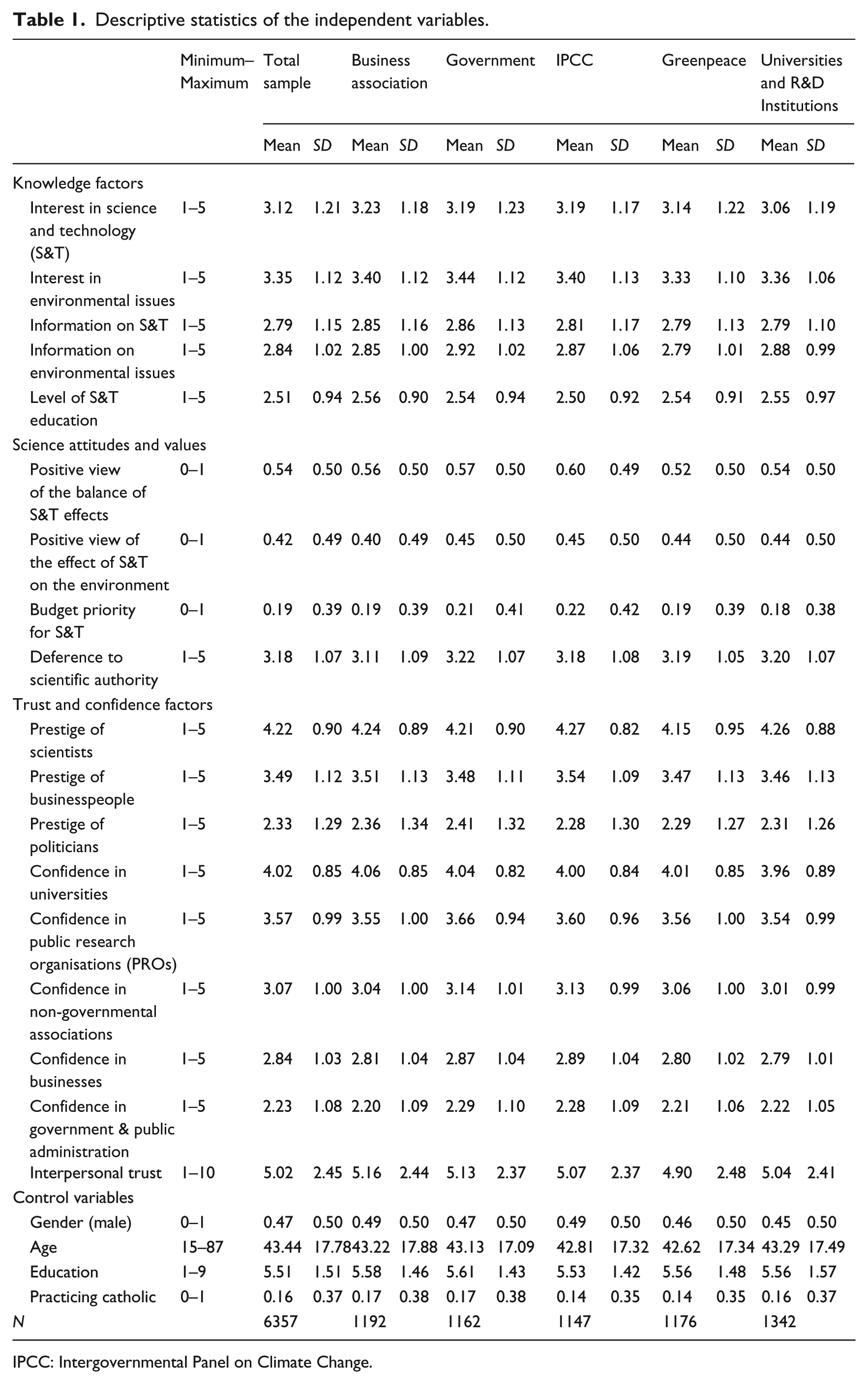
IPCC: Intergovernmental Panel on Climate Change.
It should be noted that some analytically relevant variables were left out of the analysis, given that their response levels were too low (e.g. 25% of non-response on the ideological scale or almost 30% on the income level scale), leading to a reduction in the number of cases available for the analysis.
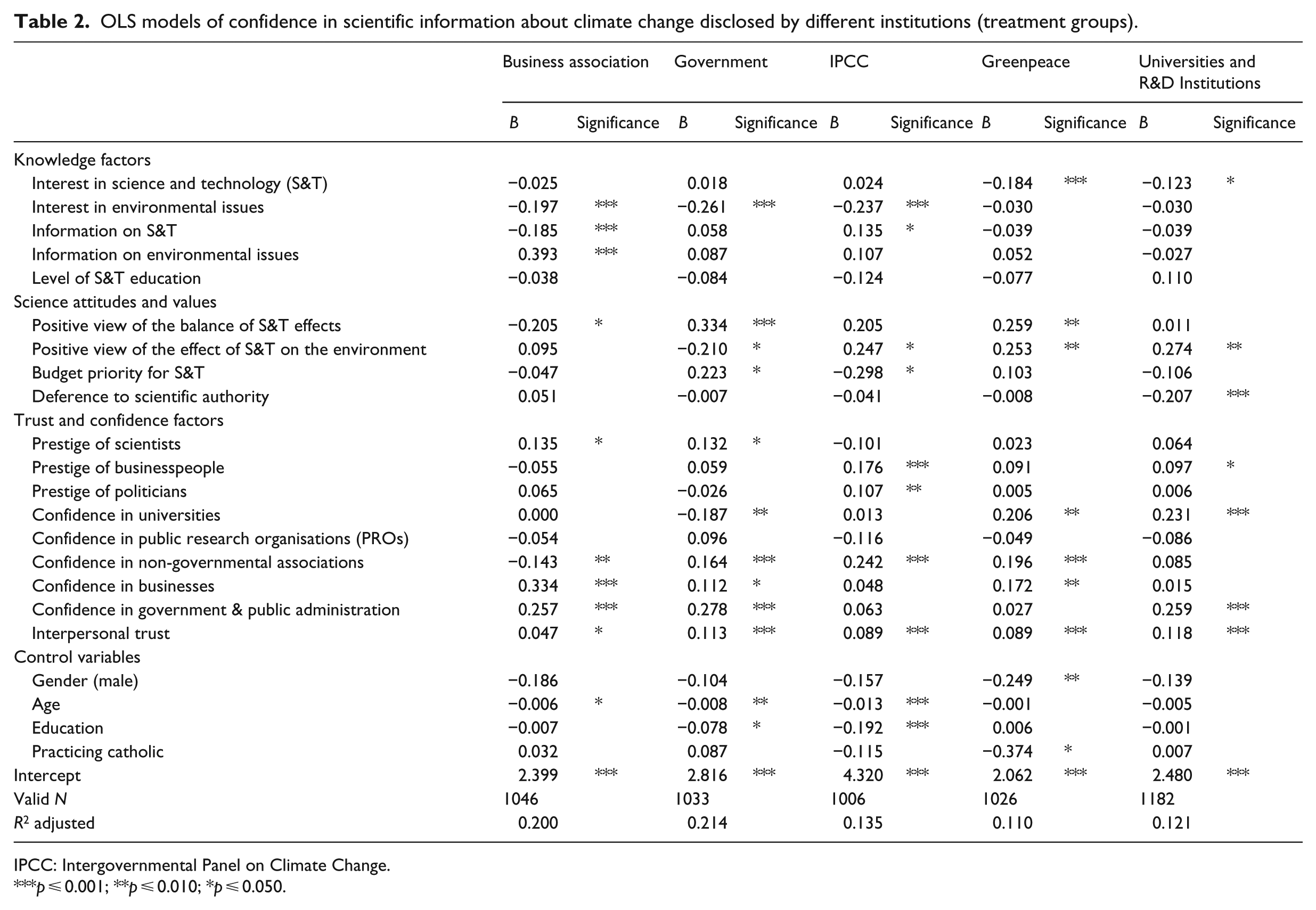
The OLS regression models constructed for each of the groups determine the effects of each independent variable on the probability of increasing or decreasing the credibility of the information provided by the various sources. For the continuous variables, the coefficient represents the difference in the predicted value of the credibility of the source for each unit of difference in the independent variable; for the dichotomous variables, the coefficient represents the average difference between the reference group and the comparison group in the credibility they award to the source. Table 2 presents the models for each of the treatment groups.
OLS models of confidence in scientific information about climate change disclosed by different institutions (treatment groups).
IPCC: Intergovernmental Panel on Climate Change.
p ⩽ 0.001; **p ⩽ 0.010; *p ⩽ 0.050.
The OLS models were run for each treatment group, since we assume that the effects of the variables (or some of them) may change according to the nature of the institutional source of scientific information. 11
The best predictor of the credibility of business sources is confidence in ‘businesses’ and in ‘governments and public administrations’, information on ‘environmental issues’ also produces strong positive effects. Among the most influential predictors of the information credibility of government, we find that confidence in ‘governments and public administration’ and ‘interpersonal trust’ have a positive direction, while ‘interest in environmental issues’ has a negative effect. Confidence in ‘non-governmental associations’ and ‘interpersonal trust’ are among the strongest predictors of the credibility of IPCC and Greenpeace; however, increases in ‘interest in environmental issues’ and ‘age’ reduce the credibility of communication from IPCC while more ‘interest in S&T’ reduces the credibility of Greenpeace. For our baseline, group information credibility strongly increases with ‘interpersonal trust’, confidence in ‘government and public administration’ and in ‘universities’, but diminishes with ‘deference to scientific authority’, a fact which may be consistent with some type of ‘ambivalence’ hypothesis.
The group of variables related to interest in and knowledge of science and environmental issues produce diverse effects on the various treatment groups. First, increases in interest in ‘S&T’ and ‘environmental issues’ are, when significant, always related to a reduction in the level of credibility of the sources. Moreover, ‘interest in S&T’ is significantly associated with reduced levels of credibility of the information from Greenpeace, universities and R&D institutions. Higher levels of ‘interest in environmental issues’ are associated with lower levels of credibility of information from business associations, government and the IPCC as sources of climate change communication.
Second, the level of information on environmental issues increases the credibility of communication from business associations and IPCC. Finally, higher levels of information regarding S&T reduce the credibility of business sources but increase the credibility of IPCC information.
The effects of the group of variables measuring attitudes to science and values also vary across treatment groups. For example, a positive view of the balance of S&T effects (scientific optimists) increases the credibility of the information from government and Greenpeace but reduces the credibility of information from business sources. Similarly, the information credibility of the Intergovernmental Panel on Climate Change (IPCC), Greenpeace and universities and R&D institutions is higher for individuals with a positive view of the effects of S&T on the environment, but this positive view reduces the credibility of government information sources. Respondents who allocate budget priority to S&T grant higher credibility to government sources and lower trust in the IPCC. Finally, our indicator of deference to scientific authority was only significant in the case of communication from universities and R&D institutions but was negatively associated with its credibility as a source.
For the third block of variables related to professional prestige, institutional confidence and interpersonal trust, the effect is more stable across sources and has the bigger contribution to the explained variation. In general, increases in the values of these variables mean that higher credibility is granted to the communication source. For example, the prestige of scientists is related to higher levels of the credibility of business and government sources. A greater appreciation of the profession of businesspeople, net of other factors, increases the credibility of the IPCC and universities and R&D institutions, and the greater the prestige awarded to politicians the more credible is information from the IPCC.
There are five independent measures of institutional confidence, with different results across groups. Although in general higher levels of institutional confidence are associated with greater credibility of the information, there are a few exceptions. For instance, greater confidence in universities predicts an increase in the credibility of Greenpeace and universities and R&D institutions but a reduction in the credibility of government sources. Individuals with more confidence in associations (consumer, environmentalist, etc.) grant higher credibility to scientific information from government, the IPCC and Greenpeace, and less to business sources. Higher levels of confidence in firms increase the credibility of scientific communication from business, government and Greenpeace, all things being equal. A greater confidence in governments and public administration increases the credibility of climate change information from business associations, government and university and R&D institutions. Finally, for all the treatment groups, increases in interpersonal trust levels predict a higher credibility of scientific information, and this holds true regardless of the source.
All the control variables have consistent effects across treatment groups, when statistically significant. The descriptive analysis has shown differences in the degree of credibility that men and women award to different sources; women confer higher levels of credibility in general, but the fact is that in the multivariate models, gender only has a significant effect with regard to the higher credibility of Greenpeace as a source. As regards other personal characteristics, as age increases respondents grant a lower credibility to information provided by business associations, government and the IPCC. A similar effect is found with education levels, because their increase reduces the credibility of communication from government and the IPCC. The practising of religion (Catholic) negatively affects the credibility of information from Greenpeace.
5. Discussion and implications
This article presents the results of a survey-based experiment. It analyses the credibility citizens attribute to scientific information (on the evolution of CO2 emissions) disclosed by different institutional sources. It finds that an institutional credibility gap exists in scientific communication in Spain; citizens generally attribute significantly different credibility to scientific information on climate change, depending on the source of disclosure.
The findings are quite robust; significant differences were found in the credibility that citizens confer on scientific communication from government, business associations and universities and R&D institutions. Despite having provided the same information, produced by scientists, on the evolution of CO2 emissions in Spain to various treatment groups, the differences among three of the groups are significant. These differences allow us to rank the credibility of information from highest to lowest, depending on the source. Thus, information is more credible if supplied by the scientific institutions themselves than supplied by the government or the business sector. In addition, the information provided by the government is more credible than that supplied by business associations. At the same time, the information provided by the IPCC or by Greenpeace was also significantly more credible than the information provided by business associations.
Finally, it should be noted that the credibility of the information provided by universities and R&D institutions, the IPCC and Greenpeace was not significantly different in statistical terms, although it was slightly higher for universities and R&D institutions. The superior credibility of Greenpeace as a source of scientific information is also noteworthy, especially considering that it is an environmental organisation involved in activism. Considering evidence from other countries (e.g. the United States), this appears to be culturally determined.
The differences in the average credibility awarded to business associations, government and scientific institutions appear to be consistent with the initial theoretical expectations emerging from previous literature. They indicate a certain scale of credibility, in which universities and R&D institutions enjoy the highest level of confidence and business institutions the lowest.
Furthermore, an attempt has been made to understand which factors or variables determine the credibility of the scientific information provided by the various institutions. The most relevant conclusion from the analysis is that the effect on the credibility of scientific communication, of variables such as interest, informedness, attitudes, beliefs, confidence and trust is differentiated depending on the source to which that science communication is attributed.
Overall, the results show that the influence of the factors associated with knowledge (interest and information in S&T and environmental issues) on the credibility of information from business, government, IPCC and Greenpeace sources are important and specific, but appear to be more limited for the baseline group. The finding that higher interest in environmental issues results in lower credibility of some sources might reveal that more interested people are generally more critical towards related information.
Attitudes, general values and positive views related to S&T and their impact on the environment have minor and contradictory effects; information on climate change increases or decreases the probability of credibility depending on the source.
In general terms, the factors that appear to be most relevant in understanding the credibility of the different sources belong to the sphere of interpersonal trust and institutional confidence. The higher reputation of some of the actors usually predicts increased levels of credibility of the institutional sources. Measures of institutional confidence, when significant, have a positive impact on credibility, with some interesting exceptions: confidence in associations reduces the credibility of business communication and confidence in universities and R&D institutions reduces the credibility of government sources. Likewise, interpersonal trust is a factor that significantly increases the credibility of all sources.
The article emphasises some practical results of interest for the communication of science, for policies and their public communication; the effectiveness of strategies based on education and scientific dissemination in contentious or controversial topics may be limited by the confidence that different institutions generate. Thus, the article reveals the consequences of communicating scientific facts through different institutional sources in terms of credibility.
The credibility of scientific information regarding climate change is higher when the source is perceived as closer to scientific institutions, and is lower when it is linked to businesses and governments, as previous research has argued. Interpersonal trust and confidence in scientific institutions act as the principal mechanism of intermediation in this relationship; this must be taken into account by policymakers and business managers when communicating information of a scientific nature.
Because the study was a population-based survey experiment, it can be argued that the results have sound internal validity (cause-effect evidence) as well as at least plausible external validity (generalisability). Nonetheless, since the participants in the experiment were a random sample of the Spanish adult population, some of the results (e.g. the credibility of Greenpeace as a source) could be culturally moulded.
Certain methodological limitations should be acknowledged; the principal of these is related to the use of indicators constructed from a single element, especially for the key variables in the analysis. To the extent that these measures fail to capture the potentially multidimensional nature of credibility, they can also provide incomplete information.
In addition, only one scientific information item was tested (the evolution of CO2 emissions), and only one graph was presented, so more tests of this kind must be performed with other scientific information items and other types of scientific measurements before these results can be more broadly generalised. It is to be hoped that follow-up studies will be performed, to further test the credibility of scientific communication.
Another limitation concerns the content of the information provided, the graph showing an improvement in conditions. Given the interest in testing whether people doubt the veracity of the information provided, it made sense for the graph to show real data. However, it can be argued that people would not be as sceptical (especially for some institutional sources of information) if the information showed an increase in CO2 emissions. 12
In sum, the results of this experimental study provide some preliminary yet encouraging evidence that the general public may be willing to believe scientific institutions more than any other actor when reporting scientific issues, even controversial ones. This is important, because credibility in the eyes of the public is a necessary assumption in order to reap many of the benefits of scientific communication. However, additional research along these lines is needed in order to provide further evidence that this assumption of credibility holds true across other scientific issues and topics.
FECYT provided us with the opportunity to include a question in the questionnaire and design the experiment to analyse the credibility of information sources in a survey whose main purpose was related to classical approaches to the public understanding of science. Although the survey includes a number of important factors integrated in our models, either as explanatory variables or as controls of other variables, it is true that some potentially relevant variables could not be finally incorporated in the questionnaire, due to restrictions of space. On this point, it would be relevant to include specific measurements of the personal assessment of the gravity of climate change emission, the degree of environmentally friendly behaviour of respondents, involvement in associations as social movements or the general and domain-specific scientific knowledge of respondents, among others.
Future research could address these limitations by using panel data to allow for stronger causal inferences, the employment of multiple indicators to increase reliability and validity in the measurement of key variables, the use of additional surveys to test the extent to which results can be generalised to other audiences and the inclusion of additional predictors of trust and confidence, as well as more sensitive measurements of religious beliefs, political ideology, socio-economic status, social network involvement, mass media consumption and so on as long as acceptable response levels are achieved.
Footnotes
Acknowledgements
A previous version of the article was presented at the ‘13th Conference of the European Sociological Association (ESA), RN24–Science and Technology’ held in Athens (Greece) on 29 August–1 September 2017 and at the ‘6th Atlanta Conference on Science and Innovation Policy, 2017’ organised by the School of Public Policy at Georgia Tech, in Atlanta (USA), 9–11 October 2017. It was also presented in seminars at the Department of Political Science and International Relations of the Autonomous University of Madrid (Spain) on 6 February 2018 and at the Centre for Organizational Research and Design (CORD) at the School of Public Affairs, Arizona State University, Phoenix (USA) on 12 March 2018. The authors thank the participants for their comments and suggestions. The authors owe special thanks to José Ramón Montero, Barry Bozeman, Monica Gaughan, Malcolm Googin, Stuart Bretschneider, Lily Hsueh and Justin Stritch for their comments and criticisms. Also, they would like to thank Susanna Priest for comments and suggestions to an earlier draft. They are grateful to the anonymous reviewers from Public Understanding of Science and to Susan Howard for their comments and suggestions during the review process. They also thank the Fundación Española de Ciencia y Tecnología (FECYT) for giving them the opportunity to redesign the EPSCYT 2016 survey factorially and for providing access to the resulting data.
Declaration of conflicting interests
The author(s) declared no potential conflicts of interest with respect to the research, authorship and/or publication of this article.
Funding
The author(s) disclosed receipt of the following financial support for the research, authorship, and/or publication of this article: This work was supported by the Spanish Ministry of Economy and Competitiveness (Grant CSO2016-79045-C2-1-R) and FECYT.
