




Abstract
Mistrust of science has seeped into public perception of the most fundamental aspect of conservation—extinction. The term ought to be straightforward, and yet, there is a disconnect between scientific discussion and public views. This is not a mere semantic issue, rather one of communication. Within a population dynamics context, we say that a species went locally extinct, later to document its return. Conveying our findings matters, for when we use local extinction, an essentially nonsensical phrase, rather than extirpation, which is what is meant, then we contribute to, if not create outright, a problem for public understanding of conservation, particularly as local extinction is often shortened to extinction in media sources. The public that receives the message of our research void of context and modifiers comes away with the idea that extinction is not forever or, worse for conservation as a whole, that an extinction crisis has been invented.
1. Introduction
Language is alive. It is creative and dynamic. It is malleable to a specific time, place, or context. English is well known for being a language that readily borrows foreign words and meanings and a language that readily adapts to new eras, technologies, and concepts. There are multiple words for just about any given meaning and multiple meanings for many words. This flexibility gives a language breadth and makes it interesting and useful in a variety of contexts. But this very flexibility could make one ask, “At what point does a word that has acquired many meanings become meaningless?” This question is particularly germane to the sciences.
Science is a human endeavor, so it comes as no surprise that scientists can be just as careless and lazy with language as the lay public (Cottee-Jones and Whittaker, 2012; Hodges, 2008; Peters, 1988; Salt, 1979). Controversy arises when a term is used in a way it should not be when a perfectly good term is already available. A familiar example is when theory is used when hypothesis or principle is meant, as in “His theory is calcium availability affects clutch size” or “In theory, we should use a nonparametric test because the data are not likely to be normal.” What biologist can deny that this laxity has hindered public understanding of science? We need only to think of a key battle cry of creationists—“evolution is ‘just a theory’”—to see the confusion wrought. Faced with this problem, biologists can strive either to reappropriate the word or to coin a term that means theory in the scientific sense and thereafter use this synonym wisely and cautiously.
Theory is hardly the only word faced with “the demise of a scientific term” (Peters, 1988), a process that begins when a term’s meaning seems obvious but is interpreted differently by users. Such a term becomes a pseudocognate, a term that itself seemed intuitive when coopted from linguistics (where it refers to false cognates) and redefined for ecology (e.g. Cottee-Jones and Whittaker, 2012; Salt, 1979). It is often the case that definitions of such terms become broad enough to encompass whatever anyone wants them to be—that is, they become omnibus terms, which have such a wide range of meanings that many will feel a need to clarify, focus, or reappropriate the terms, often by adding adjectival modifiers in an effort to retain original meaning (e.g. theory becomes scientific theory). Even so, writers and, especially, speakers are likely to drop modifiers in favor of brevity, leaving us, eventually, with a panchreston, a term so broad and so inclusive it can mean just about anything to just about anyone (Cottee-Jones and Whittaker, 2012). This unfortunate process could be averted if we defined terms clearly and stuck with those definitions. Why invent a new word or add a modifier when a perfectly serviceable term exists already?
It is in this spirit we examined use of the term extinction, prompted by our curiosity, borne of our broad experience with the conservation literature, of whether the term has become a panchreston. Although the term has a long history, it has for at least the past 150 years been reserved, biologically speaking, for a species no longer in existence (Ladle and Jepson, 2010), but now it is used in a multitude of contexts. A Google search yielded over 48 million hits for the term, everything from the reasonable mass extinction to the odd political extinction. Changes in definitions have caused many ecologists to adopt modifiers to the term extinction, a term that in principle is an absolute, like unique or pregnant. Yet we now have terms such as local extinction, regional extinction, population extinction, and global extinction, the first three of which can be shortened to extirpation whereas the last is simply redundant. Even Wikipedia, every lazy student’s favorite web site, defines local extinction as a synonym of extirpation.
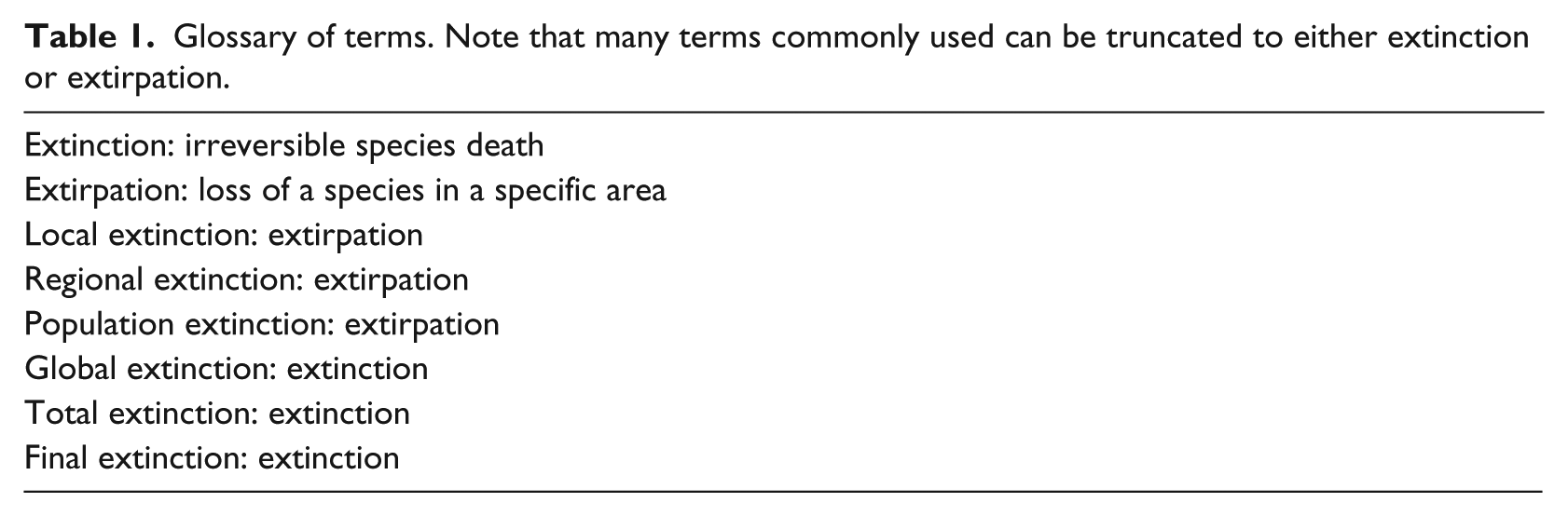
We assert that this issue is not a semantic one, nor is the problem restricted to abuse by public and social media. The issue is about scientists both saying what we mean (Table 1)—to deviate is at best sloppy and at worst fraudulent, depending on motive or lack thereof—and conveying that message clearly and honestly to the public. In this era where distrust of science is, perhaps, at an all-time high, we posit that frequent misuse of the term extinction will result in the term failing to spark the sense of urgency needed for grass roots conservation action and policy change, a concern akin to but separate from “crying wolf” about extinction (Ladle et al., 2004).
Glossary of terms. Note that many terms commonly used can be truncated to either extinction or extirpation.
We examined how the term extinction has been used in the scientific literature since the 1870s. We discovered that prevailing usage changed with theoretical advances in biogeography and population biology in the 1960s. As usage shifted or became less specific—that is, extinction no longer meant only a species’ disappearance from this earth—communication with the public has contained more sensation and less matter-of-fact clarity, enough so that we now have a disconnect between how scientists and the lay public understand extinction. In the public’s eyes, extinction may not be forever, a belief that will do nothing but hurt conservation efforts.
2. Scientific usage and understanding of extinction
Scientists in myriad fields use the term extinction. It is used in chemistry when gases evanesce and in astronomy when galaxies dissipate. It is used in the social sciences when languages, cultural traits, or even cultures die out. Where social science and medicine meet, a psychologist may recommend that a neurosurgeon cause the extinction of a behavior by the surgical extinction (i.e. removal) of a part of the brain that controls that behavior. All of these uses have the same underlying principle, that of annihilation or disappearance of an item, tangible or not.
The lay public tends to think of extinction in terms of the biological sciences, but how do biologists define the word? We assert that the knee-jerk reaction of almost all biologists is that extinction refers to a disappearance of a species from the Earth, a definition that would jibe with the lay public’s view, which has been shaped by a lifetime of talk of dinosaurs and other extinct megafauna. Perhaps, one would even appeal to authority and note that Darwin (1896) defined extinction as when a “species ceases to exist” (p. 97). Many a conservation biologist may argue that such a definition is the only realistic one for the term.
But how do biologists actually use the term? This question surfaced repeatedly during our journal group discussions as it seemed we read paper after paper that lamented the extinction of hundreds of birds every year (Figure 1). Students wondered how it was that some continued to conduct research on these birds when, according to that week’s paper, the birds were extinct. This disconnect led us both to explore how often biologists used extinction in ways other than the absolute, irreversible loss of a species (i.e. Has extinction become a pseudocognate?) and, if so, to ask when extinction evolved from “a species ceases to exist” to a synonym of extirpation.
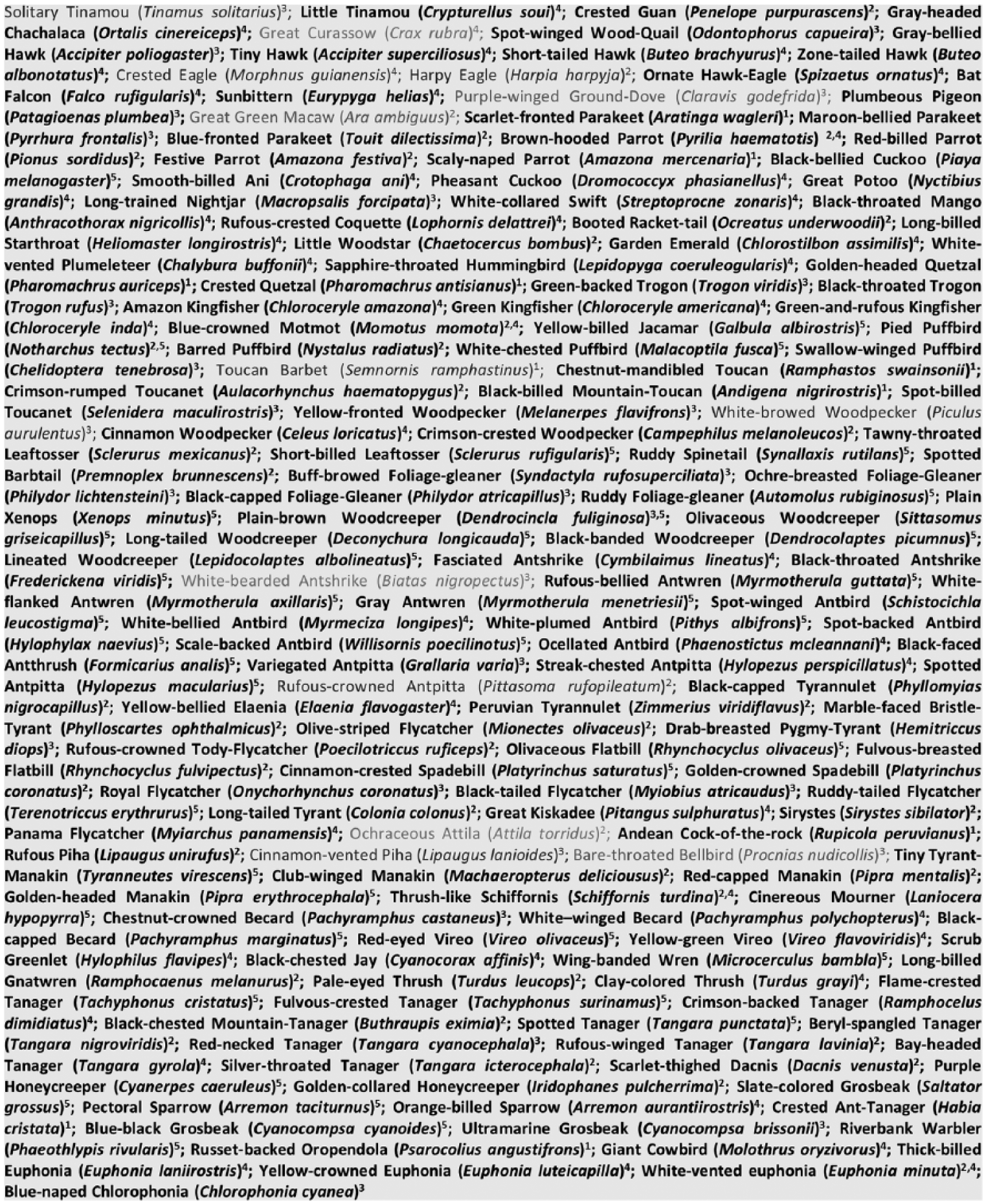
Extant extinct species. Species designated as “extinct” in a sample of five Neotropical bird studies, although all 158 species are extant, 92% of the species are of “least concern” according to the IUCN.
We answered these questions by means of an extensive search of abstracts of scientific literature for variations of the terms extinction and extirpation. We included in our search nine journals—Biotropica, Conservation Biology, Diversity and Distributions, Ecological Applications, Ecology, Nature, Proceedings of the National Academy of Sciences USA, Proceedings of the Royal Society B, and Science—with a breadth that ranged from general science to specialization on conservation, biogeography, or ecology. Publication dates ranged from 1869 to 2011. We searched each journal’s online portal and entries for it in the ISI Web of Knowledge database. We limited search results to the biological sciences (i.e. we excluded results that related to anthropology, psychology, neurology, astronomy, or geology). For each paper that suited our needs, we recorded the journal name, year, principal affiliation of the authors (university, government, or non-governmental organization (NGO)), study organism (e.g. bird, mammal, invertebrate), and theoretical perspective of the paper (e.g. island biogeography, conservation, metapopulation dynamics). We read the title and abstract to determine whether extinct (or its variants) was used correctly. In doing so, we adhered to strict definitions of extinction, the utter disappearance of an organism, and extirpation, the loss of an organism from only a specific area. We deemed certain terms, such as local extinction, regional extinction, or population extinction, to be erroneous use of a modifier of a word that is, in principle, absolute, and other terms, such as total extinction or final extinction, to be erroneous in their redundancy. We considered extinction risk to be acceptable when used in general terms, but in some cases, such as when the authors delved into population viability analysis, we equated the term with population extinction.
3. Extinction—A historical timeline
Our scoring of 2045 scientific papers indicated that the use of extinction has changed through time (Figure 2). Usage of the term as an absolute was generally high until a distinct drop in the 1960s, during which fewer than half of papers used the term “correctly.” The rate of correct use dropped to only ~30% by the 1970s, but the trend has since recovered and stabilized to around 60% of papers. Our data were bolstered by results from ngram (http://books.google.com/ngrams/), an engine that allows one to search for appearance of a specific term over time across publications Google has archived. We searched for use of the terms extinction, local extinction, and extirpation. It was no surprise to find that use of extinction has increased markedly or that use of local extinction spiked upward in the 1960s, but we were discouraged to see that use of extirpation has fallen off in recent decades (Figure 3).
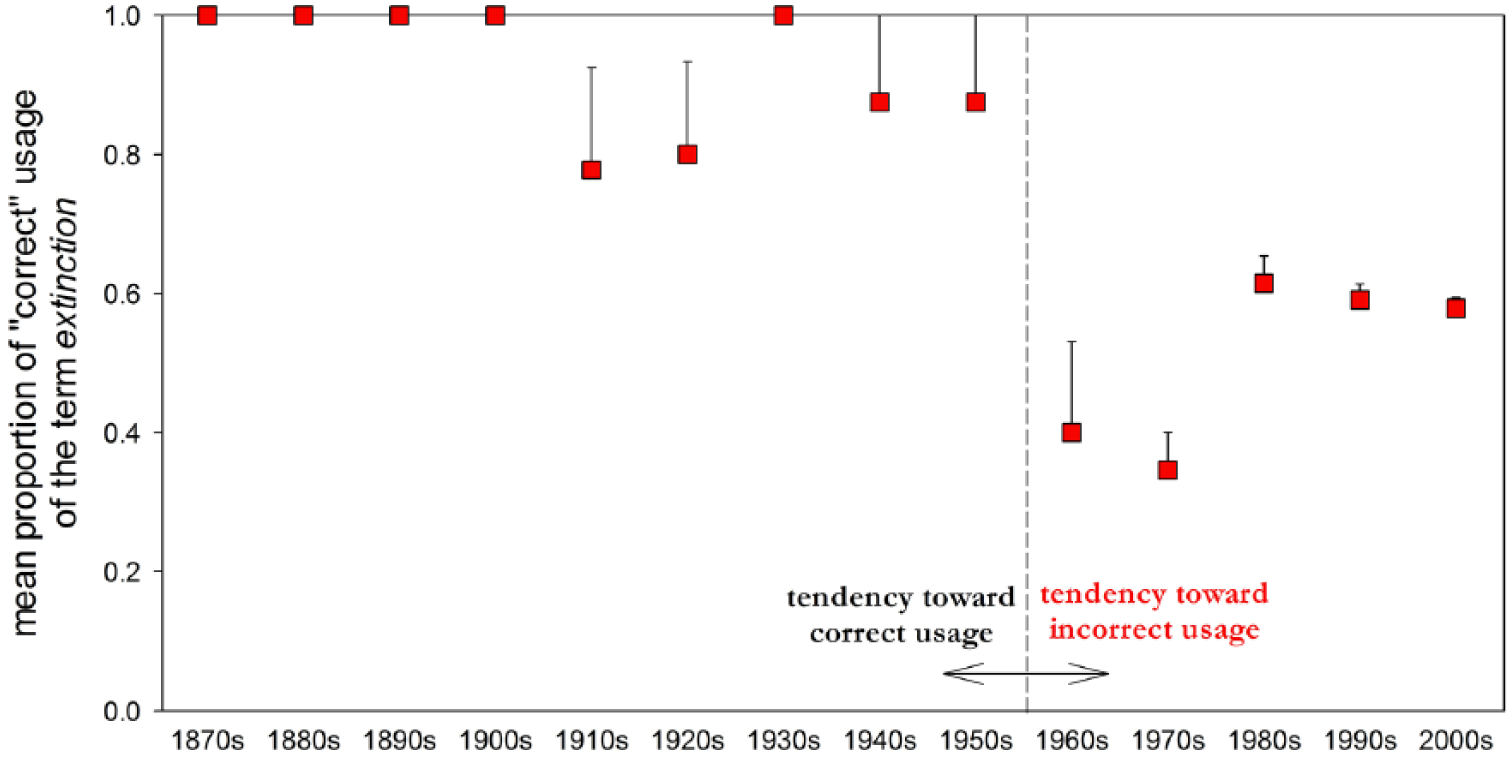
An examination of the scientific literature (2045 journal papers) shows that extinction has become conflated with the relatively more benign term extirpation, even though the latter is what is meant in the vast majority of cases.
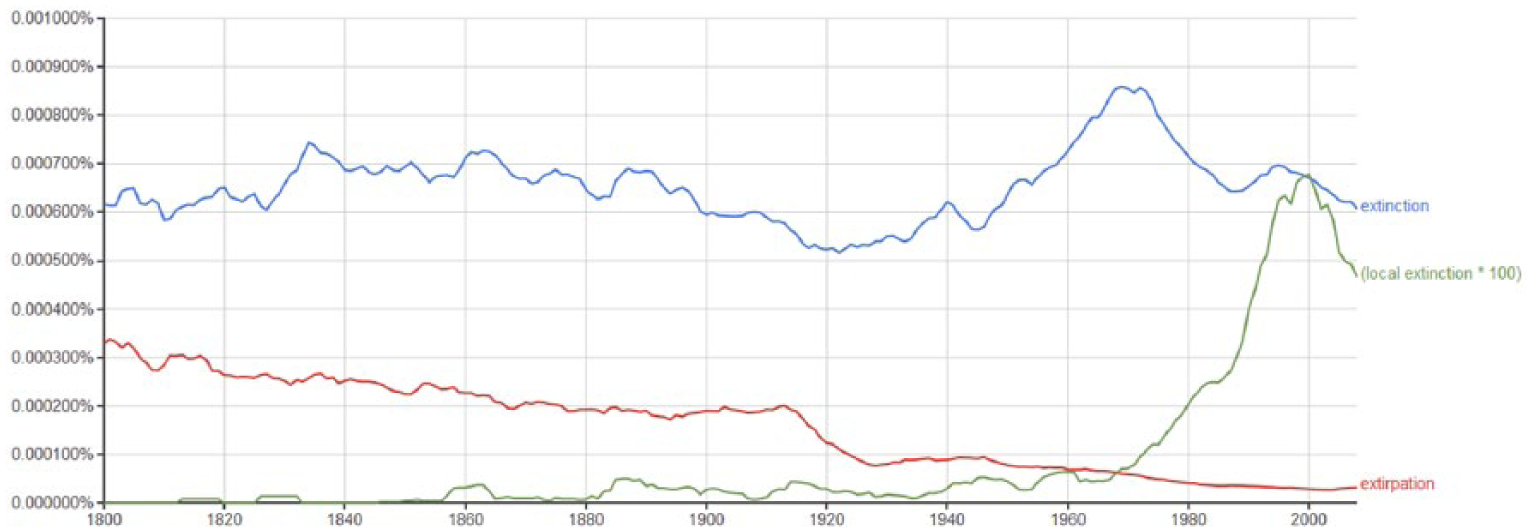
Prevalence of the terms extinction, extirpation, and local extinction (note the different scale), per Google’s ngram (run 14 January 2015), from 1800 to present. Usage of extinction has been more or less stable, usage of extirpation has declined steadily, and usage of local extinction spiked upward beginning in the late 1960s.
So what happened in the 1960s and 1970s to explain the demonstrable change in how scientists used extinction? We suggest the principal culprit was the theory of island biogeography (MacArthur and Wilson, 1963, 1967). We do not deny that this theory marked an important conceptual advance in ecology, but we would be remiss to pretend it did not conspicuously employ extinction to mean extirpation from an island. The problem was exacerbated by introduction of metapopulation theory in the late 1960s (Levins, 1969), a theory that used extinction in a similar way, in this case as disappearance from a patch rather than utter destruction. These influential theoretical advances set the subsequent tone (see Hanski and Gilpin, 1997), forcing scientists to modify extinction if the term was to be understood unambiguously.
Still, these theories were hardly the first places to use extinction in place of extirpation, as various publications that predate them modified the term extinction in needless ways. For example, an early, influential ecology textbook (Andrewartha and Birch, 1954) discussed the “extinction of a population” in a section ironically titled “Some reflections on the greatly misunderstood subject of ‘extinction’”—but even then the authors segued into a discussion of species extinction. Even so, it has become rare to find an unmodified use of the term extinction, and some usages in the ecological literature, such as “temporary extinction” (Opdam and Wascher, 2004) and “knowledge extinction” (Papworth et al., 2009), defy logic.
Change in usage of words is expected in any language. English always has been and always will be a moving target. Given this reality, it is easy to argue that we ought to accept change in use of extinction as inevitable and move on with our lives. But it is not that simple. As with the words irony and unique, whose usage is changing slowly from a specific meaning to something more nebulous (O’Conner and Kellerman, 2009), the word extinction has no true synonym in English. If the specific meaning of extinction vanishes, we cannot fall back on another word that has the same meaning. Our only recourse is to clutter the language with modifiers. Needless clutter is bad enough, and something we all ought to eschew, but the term extinction is used in so many different ways now that it is nearly, if not already, a panchreston (Cottee-Jones and Whittaker, 2012). As such, extinction without a modifier is used frequently when extirpation is meant. As an example, a random selection of a mere five recent studies of avian response to deforestation yielded 158 species of Neotropical birds that were designated as extinct even though all of these species are extant, and 92% are classified by the IUCN as being of “least concern” (Figure 1).
4. Public usage and understanding of extinction
Up to this point, the argument we present could be considered purely academic. We assert that the ramifications extend far beyond linguistic or etymological circles, chiefly because public understanding of science continues to plummet, which widens the rift between how scientists communicate with each other and how their findings are understood by lay people, the latter of which is much more likely to jibe with a policy maker’s view. As but one example, in an assessment about the debate that surrounded the premature claim that the Ivory-billed Woodpecker (Campephilus principalis) was not extinct, Jackson (2006) noted that … public opinion is molded more by sound bites than by science. As seems inevitable, given the news media’s need for spontaneity and reporters covering subjects they know little about, bizarre and often misleading news articles have been widespread in both the general and birding-specific popular media …
We thus might sum up public usage and understanding of extinction as schizophrenic, and it is no wonder given all of the conflicting messages lay people receive. There is a complex mixture of comprehension and conflict that we feel falls into three categories.
Extinction is whatever we want it to be
Dr Spaceman (of 30 Rock fame) once said, “Science is … whatever we want it to be.” Substitute extinction for science to understand where we are. Public usage of the term extinction differs markedly from that of conservation scientists. In the popular press anything can face extinction, from baseball teams (“MLB: Giants’ 2-0 win leaves Tigers on verge of extinction,” Naples Daily News, 27 October 2012) to movie theaters (“Osio Cinemas faces down its own extinction,” Monterey County Weekly, 25 October 2012). Educational systems face extinction (“Education system must adapt or face extinction, say experts,” Express Tribune, 2 November 2012). Independent (“Save the independent voter from Extinction,” Huffington Post, 29 October 2012) and conservative voters (“Is Romney to lead conservatives to self-extinction?,” renewamerica.com, 25 August 2012) are at risk, as are Facebook apps (“How to save social readers from extinction,” CNN Money, 14 May 2012). But at least the venerable cuckoo clock had a stay (“After brush with extinction, cuckoo clocks are back,” Deutsche Welle, 30 August 2012). And of course, popular usage is also prone to message morphing. A story about sports cartooning being an art form in decline, “Lost occupation, lost art as sports cartooning declines,” (New York Times, 24 April 2012) is later headlined as “Sports cartoons face extinction,” (Herald Tribune, 25 August 2012). On the surface, these examples all seem benign, and some even evoke laughter, but their trivial use of the term extinction desensitizes us to the seriousness of a species ceasing to exist.
Too big a problem
Stories that grab the public’s attention are big. We all know that sensationalism sells. We like to believe it is different with science, but it is not, particularly in a scientific culture that is increasingly market driven. This is the principle behind why a scientific paper’s title, “Extinction risk from climate change” (Thomas et al., 2004), does not seize the public’s attention but “Revealed: How global warming will cause extinction of a million species” (The Independent, 8 January 2004) does. Cynicism aside, let us consider how the public views such stories. A gasp might be the initial reaction, then disbelief. If the reader absorbs the idea that a million species will die off within his or her lifetime, what then? Nowadays, such a pending catastrophe would elicit a flurry of tweets or blogs that could lead one to believe that hundreds and perhaps thousands of species go extinct daily (Ashlin and Ladle, 2006) not to mention how these numbers can be compounded if one considers the estimated number of undescribed species given our incomplete knowledge of the world’s biodiversity (Ladle and Whittaker, 2011: 58; Scheffers et al., 2012). Such numbers tend to be taken at face value, so how can one comprehend such magnitude of species loss, let alone cope with it and do something about it? This is where the concept of disaster fatigue enters the conservation discussion (Patten and Smith-Patten, 2011): it is easy to feel the problem is too great and thus beyond control, a conclusion that leads to discouragement and inaction.
Extinction is forever … but only for dinosaurs
The answer to the question “Is extinction forever?” ought to be straightforward: extinction is utter destruction, ergo it must be forever. Yet there is considerable confusion about what seems a simple conclusion. What many conservation biologists view as axiomatic, particularly across geological time and in light of evolutionary theory, does not necessarily reflect the public’s view. Most of us were introduced to the concept of extinction as children, when we learned about the age of dinosaurs. If one asks a child “Are dinosaurs still alive?” then he or she will reply “No!” If one proceeds to ask the child, or many an adult for that matter, “What does it mean that the dinosaurs are no longer on earth?,” then a blank stare might be expected. If the term extinction is introduced and defined, the situation gets messy in a hurry, as a vague idea that some species are no longer around and a coherent understanding of extinction as the utter destruction of a species are two distinct concepts in the public mind (Poling and Evans, 2004).
Such a distinction receives a boost from headlines that trumpet “Good News! Birds thought extinct return to harvested rain forest” and “‘Extinct’ birds reappear in rainforest fragments in Brazil.” These are but two verbatim headlines that spread like wildfire across the Internet in June 2011 (e.g. livescience.com, Smithsonian science, Scientific American pod cast, news.yahoo.com, escience.com, optimist.co.nz, newscandy.com, greenforum.com, planetaryruin.com, goodnewsnetwork.org, and twitter.com) about research that documented avian recolonization of regenerated forest fragments in Brazil (Stouffer et al., 2011). The press release to accompany the paper’s publication read, “The extinction process started with bird species leaving or dying out. Now, they’re coming back. ‘A handful of species have ‘gone extinct,’ but many more species are in flux,’ [the lead author] said. ‘They come and go’” (“Study shows birds return to harvested rainforest areas in Brazil,” Louisiana State University, 22 June 2011). This press release included a quote by a representative of the US National Science Foundation that provided context to the research results: “By combining one of the first controlled fragmentation experiments in tropical forests with the opportunity for long-term observation, this study provides verification that local extinction is accompanied by continual recolonization … The results bolster island biogeography theory.” But the press release shape-shifted into statements void of context such as, “Bird species previously believed to have gone extinct due to deforestation in sections of the Amazon rain forest have nearly all reappeared over the past 20 years” and “The White-plumed Antbird is one of the bird species that has gone ‘extinct,’ then returned, several times to portions of the Amazon rain forest.” Such statements were repeated on many blogs, some of which were aimed at public understanding of science, yet the take-home message was that common birds could go extinct and then rematerialize.
The above story is not a fluke. The level of public comprehension and confusion about irreversibility is well illustrated by the seemingly innocent question “Is extinction forever?” on something like Yahoo! Answers (http://answers.yahoo.com). This is not a question anyone should have to ask, but posing it is understandable when one finds news stories with headlines like “Back from the dead: One third of ‘extinct’ animals turn up again” (Mail Online, 29 September 2010) and “Dodon’t say I’m extinct; Meet the living dead … Animals we were told had died out” (The Sun, 29 September 2010). The latter story continued on to say that Hardly a week goes by without scientists telling us that yet another animal species has joined the dodo and become extinct. At first glance it’s enough to leave even the most cynical racked with guilt over their carbon footprint. But the doom of many creatures is much like early reports of writer Mark Twain’s death—greatly exaggerated.
Both stories attempted to convey findings of a research paper about rediscovery bias in mammals (Fisher and Blomberg, 2011). We view as unfortunate the authors’ decision to write that “A substantial proportion (more than a third) of mammal species that have been classified as extinct or possibly extinct, or flagged as missing, have been rediscovered” because such word choice captured attention and, via honest misunderstanding, transformed into misleading headlines. The story even made the “Animal Death-Watch” series on Global Shamming (http://globalsham.blogspot.com), a blog devoted to climate change denial, with the headline “One third of ‘extinct’ animals AREN’T.”
Humans worldwide have become dissociated with nature (Pergams and Zaradic, 2008), a disassociation that arguably has led to the devaluation of nature (Smith-Patten and Patten, 2008). This trend does not bode well for conservation biologists who wish to get the public to care about bona fide extinction of plants and animals that are little more than images that occasionally waft across a television or computer screen. Technology has freed us from much labor, but it also has freed us from much direct contact with nature, which tends to make us worry less about nature’s fate. Ever more realistic computer animation and more fervent propositions to clone extinct animals, such as the Wooly Mammoth (Jørgensen, 2013), to say nothing of fantastical films such as Jurassic Park, blur lines further. Even a rudimentary understanding of extinction would suffice if the public grasped that it is not limited to cataclysms that happened eons ago—as with the mass extinction of the dinosaurs—but is a contemporary, ongoing ecological problem. Yet research indicates that “The urban lay population, unlike evolutionary biologists, apparently considers the extinction of the dinosaurs to be an exception, not a rule: They are unwilling to view extinction as a realistic threat to life on earth” (Poling and Evans, 2004). An inability to view extinction as a contemporary issue, as well as to grasp what extinction actually means, is an obvious (and vast) problem for conservation biologists.
5. Conservation scientists: Victims of “the media” or tricksters?
The title of a recent news story, “British butterflies could face extinction if droughts continue” (The Telegraph, 2 November 2012), easily could make a reader think that butterflies as a whole would soon be wiped out throughout Britain, a definite cause for alarm. A read of the article would not dispel this impression when it includes lines such as “If butterflies do not recover from the battering they received during the last drought, they could be wiped out completely if another drought hits.” If the reader does his or her homework to find the actual research paper (Oliver et al., 2013), it is clear that the study presented data that populations of a single species, the Ringlet (Aphantopus hyperantus), have not responded well to extreme drought in parts of Britain. Not only did the news story conflate the Ringlet with “butterflies” and extend parts of Britain to the whole country, further investigation by the intrepid reader would reveal the Ringlet is a common species that ranges across much of Eurasia and only recently expanded into the United Kingdom. Although the species has not been formally evaluated by the IUCN Red List, it has been described as “one of the few species that is doing well, with evidence of increases in both distribution and population. It is not, therefore, a priority species for conservation efforts” (UK Butterflies, http://www.ukbutterflies.co.uk/and Butterfly Conservation, http://www.butterfly-conservation.org/). One digs further only to realize that the paper did not mention extinction at all, not even “local extinction.” The news story alone did that. In that story, one of the paper’s authors was quoted to say “If populations don’t recover by the time the next drought hits, they may face gradual erosion until local extinction.” Without doing all of that background research, we would be lead to believe that UK butterflies face a conservation crisis. Would this apparently reasonable but faulty conclusion be the blame of the scientists, the media, or both?
Public trust of science has deteriorated (Gauchat, 2011; Haerlin and Parr, 1999). Many causes have been posited, from elitism of scientists to willful ignorance on the part of the public, and it is clear that many cultural and political forces shape the relationship between scientists and the lay public (Gauchat, 2011). A key culprit appears to be “commercialization of research” (Haerlin and Parr, 1999), which has led many a scientist to feel an increased need to hype findings, an action that worsens the problem (Master and Resnik, 2013). We worry that—in the face of elevated competition to secure shrinking grant funds, publish in established journals, and land tenured academic positions—the temptation to hype, to be heard amid the ever-increasing din of social and traditional media, has prompted researchers to sacrifice linguistic accuracy in favor of “selling” their findings. In doing so, we use words and phrases, in a press release if not in the more staid research paper, sure to capture media attention. Purely for visceral impact, and definitions be damned, extinction has more caché than extirpation.
The trajectory of media reports about a recent research paper (Canale et al., 2012) is an instructive example of how science can morph as it proceeds through public outlets into something the initial research does not support. The message in this highly publicized example changed tremendously during its broadcast life (Figure 4). The author’s intent was “to estimate local extinction rates of midsized and large mammals and model predictors of extirpation at a regional scale.” Their occupancy models indicated that the forest fragments they studied in the Atlantic Forest of Brazil were “heavily depleted of their charismatic mammals.” In this case, “charismatic mammals” meant 18 medium to large, “ubiquitous,” easily recognized, and “coarse-scale forest habitat generalists.” Their discussion included the statement that “the largest game species were virtually extinct across the entire study region,” a statement that was exaggerated to become “[we] found that remaining habitat fragments had been virtually emptied of their forest wildlife [emphasis ours]” (University of East Anglia press release, 14 August 2012), a visceral description that found its way readily into news stories, blogs, and websites. In this case, the press release issued by the scientists themselves explained how the morphing occurred (see Sumner et al., 2014, for similar examples).
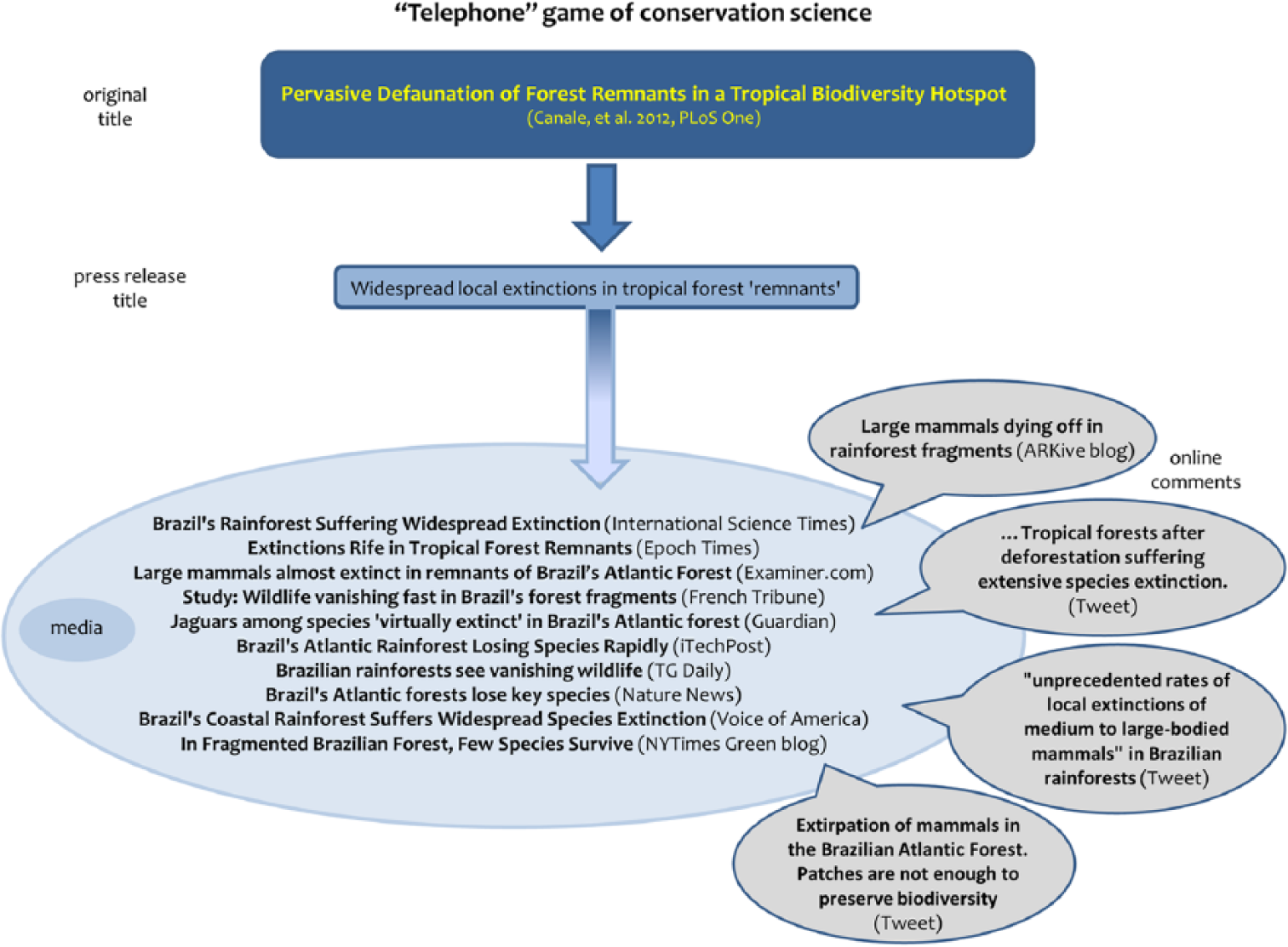
An example of how the message about “extinction” changed from the initial research paper through press release and public media to social media. Note how defaunation became local extinction, which itself became extinction (or species extinction).
A similar morphing occurred with a highly publicized, and later heavily cited, paper in Nature about the threats of climate change (Thomas et al., 2004). Ladle et al. (2005) analyzed how the paper’s message spread through the media and how and why the message morphed the way it did. The Nature study identified—predicated on specific assumptions from climate change models and niche models—the proportion of 1103 species that might go extinct by 2050. This message was lost quickly in the media; instead, their message was that upwards of a million species were going to die off within our lifetime. How did the message change? The finger was pointed directly at the lead author and the press release issued by the University of Leeds (Ladle et al., 2005), an oft-cited quote from which illustrates the exaggeration: “If the projections can be extrapolated globally, and to others groups of land animals and plants, our analyses suggest that well over a million species could be threatened with extinction as a result of climate change.” Indeed, the headline on the press release was “Climate change threatens a million species with extinction.”
Another example of how scientists need to take care with their message kicks off with a quote: “Each year, numerous species which are thought to have disappeared are rediscovered.” One may think this quote is from some media outlet’s misconstrued story of research findings, but it is an actual quote from the scientific paper (Scheffers et al., 2011) and was reproduced in at least seven news stories. The research paper and news stories went on to discuss how a purported rediscovery of a species did not entail the recovery of that species or imply that it had been declared extinct, yet the sound bite conveyed that numerous species are rediscovered every year. It is doubtful that many people took the time to scrutinize the original paper; only those who did realized that the research was misleading. In some cases, species included in the analyses had not been rediscovered at all, the prime example being the Ivory-billed Woodpecker (Sibley et al., 2006), and in the majority of cases, species simply had not been seen since their original scientific discovery (Ladle et al., 2011), a common situation in many tropical countries where natural historians are sparse or the political climate prohibits research, sometimes for decades. Species also go undetected because, for example, they are easily confused with other species or their habitats are difficult to access. Examples include the Large-billed Reed Warbler (Acrocephalus orinus), which is confined to war-torn parts of Southeast Asia and was “lost” in museum collections, and the Cone-billed Tanager (Conothraupis mesoleuca), a rare bird of virtually impenetrable reaches of flooded, closed-canopy gallery forests of the western Brazilian cerrado that for decades was known only from the type specimen, collected in 1938, until it was “rediscovered” in 2003 in a national park well away from the type locality simply because appropriate habitat could be accessed. Neither of these birds was thought to be extinct, yet both were included in this research about “rediscoveries” (Scheffers et al., 2011). How does publicity of such papers shape the public’s view of extinction?
6. Credibility in conservation science: Have we created our own crisis?
We do not dispute that if we talked only among ourselves (i.e. to other biologists), then the meaning of any particular use of extinction, qualified or unqualified, would nearly always be clear. But because we want our work to be consequential—to attract attention, to change policy, to have an on-the-ground impact, or to garner grant dollars for further important research—we may tilt subconsciously toward hype and exaggeration in an effort to elicit favorable publicity. As with getting our meaning across, if all such publicity were confined to the research community, then perhaps we would understand implicit caveats and adjust the message accordingly, yet the message is not confined to our community: the very point of publicity is to spread the message to the public. Accordingly, both what we say and how we say it matter deeply. We cannot assume that loose usage of extinction will be understood, and one need only surf the blogosphere to get a sense of how careless messages are perceived. Consider this quote from Global Shamming: “Extinction is an oft-reappearing story from the environmentalists looking to scare us about their little myth of global warming. Meanwhile, plenty of new species are discovered all the time” (22 November 2010). The blogger (“GW Denier”) professes to be “a scientific professional, though in the biological arena … not climate science” (his ellipsis). We do not know how many readers this blog has or how many of those readers take such messages at face value, but the ubiquity of comparable comments, such as “When environmental ‘scientists’ have a vested interest in ‘crises’ because they’re what drive research grants, how interesting that we’re warned of crisis after crisis when none, in fact, exist. [Signed,] Pappadave, Oklahoma City, USA” (Mail Online, 29 September 2010), makes us shudder.
Perhaps these examples are extreme, but we doubt it. A plethora of studies have shown how public understanding of science, including basic scientific principles and methodologies, has declined sharply and continues to decline. Worldwide, a majority of the lay public lacks basic scientific knowledge, conflates scientific issues, does not trust scientists, and has dwindling interest in environmental issues (Directorate General for Research, 2008; Gallup Poll Trends, http://www.gallup.com/poll/1615/Environment.aspx#3; Jensen and Hurley, 2012; Reynolds et al., 2010; Twenge et al., 2012). The result is a lay public who does not know whom to trust and feels misled by scientists, “the media,” and bloggers alike.
So, whereas we may not know the full extent of the problem, research papers that trumpet rediscoveries or reversals of extinction—as have the examples we noted above—will only feed misplaced skepticism and mistrust. And so we need to ask ourselves why we feel the need to conflate extirpation and extinction. Is it because extinction grabs the public’s attention while extirpation lacks comparable pizzazz? Does use of the word extinction “sell” our research to granting agencies and journals? In other words, where does an accurate portrayal of the state of the world end and hype of our work begin? Whatever the root cause, collectively we have fallen into insidious overuse and misuse of extinction as we shun extirpation despite meaning the latter in a decided majority of instances. It may be that scientists have created their own extinction crisis, one separate from the real extinction crisis the planet faces.
7. Concluding remarks
It is clear that use of extinction versus extirpation has changed over time and that the public has a different sense of what extinction means relative to how many conservation biologists use the term. We further argue that this disconnect between how the lay public and researchers use the term has led to a degrading of public understanding of science, what amounts to a lack of, and decline in (Mccallum and Bury, 2013), appreciation for what the current extinction crisis really is and why it matters so very much. The question now is what we can do to reverse course.
We could use extinctum, akin to Dawkins’ (2009) use of theorum as a replacement for theory, a word used in distinctly separate ways in science and by the lay public (and many a careless scientist). In lay speech, theory is used as a synonym of hypothesis or principle or even guess; it does not mean a coherent explanation to account for a wide body of facts and to predict new relationships. This confusion explains why evolutionary biologists must contend with earnest doubt tossed at them that evolution is “just a theory.” To follow Dawkins’ lead would be to coin extinctum to mean what the word extinction used to mean—the utter disappearance of a species—yet introduction of new terms seldom succeeds (Hodges, 2008).
Likewise, using another word, for example, annihilation, as was suggested by an anonymous reviewer, may put the onus for species loss squarely where it is deserved, but it may also backfire as being perceived as merely for sensationalism’s sake. We could instead use clarifying phrases that aim to bring “more culturally meaningful rhetoric of extinction that aligns scientific evidence, cultural frames, institutional frameworks, and organizational interests,” such as those espoused by Ladle and colleagues (Ladle and Jepson, 2008, 2010; Ladle and Whittaker, 2011), in an interdisciplinary attempt to solve the problem. Such an approach may be profitable in the scientific realm, but qualifiers are often dropped when a message is disseminated.
Alternatively, we could attempt to reappropriate the word extinction, to ask colleagues and editors to restrict the term’s use to its classical biological meaning only, to dispense with all qualifiers and modifiers of the term, and to force use of extirpation whenever that term is actually meant. Such an effort may be doomed to failure. Not only may the language already have evolved to the point that the problem cannot be undone—a problem words such as theory and unique also face—but enforcement of use will invariably engender accusations of language snobbery, prudery, and conservatism. And there is that insidious worry familiar to behavioral ecologists: what to do about cheaters? What of those colleagues more interested in attention than in accuracy, more drawn to hype than concerned with ramifications of their word choice?
Faced with these concerns to continue to use modifiers, or to coin a term or reappropriate the original, it may be that the best solution is to increase science education and awareness, whether through novel educational tools (Moyer-Horner et al., 2010) and sociological approaches (Ladle and Jepson, 2008, 2010), better-informed social media (Ashlin and Ladle, 2006), or lucid popular articles that explain the extinction crisis and its inherent subtleties. An engaged, thoughtful public will know when a researcher tilts toward hype. The resultant backlash will, eventually, dampen or eradicate those instincts and help to curtail sensationalizing and overselling of research findings, chiefly because scientists control their own message and do not wish to be embarrassed. We cannot ensure that our words will be disseminated accurately, but we can rein in our egos, our bleeding hearts, and our best intentions before we communicate with the public. Let us act before we collectively rue the day when the dismissive “it’s only a theory” begets “it’s only extinction.”
Footnotes
Acknowledgements
We thank the various people who provided feedback and encouragement when we presented preliminary findings at the June 2012 annual conference of the Association for Tropical Biology and Conservation in Bonito, Brazil. We also thank Richard J. Ladle and an anonymous reviewer for direct comments to the manuscript.
Funding
This research received no specific grant from any funding agency in the public, commercial, or not-for-profit sectors.