




Abstract
How environmental and climate challenges that often evoke strong negative emotions are communicated and responded to is of great importance. These include forest fires, plastic pollution and flooding that can produce fear, sadness and powerlessness. Images are important to this communication, yet how these challenges are captured through visual communication tools and to what outcomes requires further research. This article comparatively measures responses to different environment-related imagery with a climate movement-derived audience, using an original photo-elicitation survey and a semantic differential approach. This article's analysis holds implications for environmental and climate communication with existing and potential movement members. Findings include how negative imagery with threat or vulnerability themes had the strongest emotional reactions and possible usefulness, with this offering a notable counterpoint to commonly received suggestions within current literature that advocate avoidance of such themes.
Introduction
Wildfires, drought and deforestation are among the environment and climate-related challenges communicated visually. However, different image themes, including in photographs, illustrations and cartoons, are understood by audiences in multiple ways with implications for images’ potential influence as communicative tools. This is an important point for reflection about communicating pressing challenges in a way that influences viewers to act. The analyses presented by this article consequently question literature suggestions around image usage that may evoke negative emotional reactions like anger, sadness and worry, while drawing attention to space for further study of environmental and climate movement visual communication that could meaningfully contribute to understanding in this important arena during a time of crisis (Manzo, 2010; O’Neill and Nicholson-Cole, 2009; Rebich-Hespanha and Rice, 2016). The research questions are: How do environment and climate movement members respond to different climate-related imagery? And, what is the perceived usefulness of these images in practice based on image themes and evoked feelings?
These complexities are explored through a ‘nature’ semantic differential within a photo-elicitation survey involving photographs embedded in the questionnaire. The semantic differential involves measuring the meanings people associate with given words or images through a choice of opposing adjectives along a scale. Conducted with different environmental and climate movement groups’ rank-and-file members, how respondents understood the most common visual themes within movement communications, identified through an earlier content analysis, was revealed.
Findings suggest images with threat or vulnerability (negative) themes, depicting loss, suffering and natural disasters, were the most evocative and potentially useful. This runs counter to much existing literature and provides space for reflection about what constitutes possibly ‘influential’ imagery when communicating climate and environmental challenges. Influence is understood as an image's ability to draw viewers’ attention and inform beliefs and behaviours, including donating to campaigns or participating in protest. Negative imagery may be an evocative tool for movement groups and others wishing to inspire engagement and activism among existing and potential members. This would represent a ‘success’ that could influence uninvolved individuals sharing movement concerns to contribute to movement activities (Chapman et al., 2016; Jasper and Poulsen, 1995).
Adopting a focus on movement actors’ visual communication practices and possibilities to galvanise engagement among sympathetic yet uninvolved individuals, this article contributes to existing climate and environment-related visual studies by extending understandings beyond oft-researched mainstream media imagery and public responses.
Literature
Images as study objects
Visual studies emphasise images’ position as complex, powerful and emotionally evocative communication mediums permeating society (Delicath and DeLuca, 2003; O’Neill, 2020). Images can build identities reflecting specific social relations and narratives (Arvidsson and Caliandro, 2016; Baele et al., 2020; Hellmann, 2022), evidence events (Becker Ohrn, 1975; Veneti, 2017), support protest recruitment (Jasper and Poulsen, 1995), and advertise brands (Goffman, 1976; Widener, 2022). Their creation and use are not neutral, while their (emotive) meanings and consequences differ between audiences, speaking to their polysemic nature (Kirova and Emme, 2006; Krause and Bucy, 2018; Nicholson-Cole, 2005; Rose, 2001). Specific elements’ emphasis over others plays into this (Benjamin, 1969; Gariglio, 2016; Guenther et al., 2024; Hellmann, 2022), as seen in apocalyptic gas mask imagery where the mask denotes toxic pollution and an environment hazardous for human health, yet may obfuscate related issues like social inequalities in vulnerability and exposure to environmental or climate risks based on wealth or race, for example (Dunaway, 2008). Images are therefore an important and meaningful study object that are never static but actively involved in meaning construction and challenging between creator and viewer (Rose, 2001).
Images in climate and movement research
However, attention granted images among climate change and/or social movement studies remains limited, resulting in calls for further visually oriented research (McGarry et al., 2019; O’Neill, 2020; O’Neill et al., 2015; Pearce et al., 2020). These are calls addressed by this article, situated at the intersection between climate change, visual sociology and movement studies. It examines the visual communication of environment and climate-related themes by social movement actors and their possible influences on audiences.
Chapman et al. (2016) investigated understandings of climate imagery through representative focus groups in the UK and Germany, highlighting credibility and authenticity's importance. O’Neill (2020) analysed UK and US mainstream media (MSM), finding shifts from distancing to contestation frames whereby reporting became centred on tensions and decision-making elites rather than presenting climate change as a challenge impacting only places far away from the audience. Others with similar approaches found human-centred narratives and local impacts key to audience engagement (Duan et al. 2017; León et al., 2022; O’Neill and Nicholson-Cole, 2009). These studies largely analysed Western MSM images, a shortfall addressed here.
This includes research examining visual depictions of climate protesters, suggesting that UK-based MSM has begun representing activists in a positive light (Hayes and O’Neill, 2021). Centring activists, but considering movement, not MSM images, McGarry et al. (2019) analysed activist self-construction. They examined how ‘normalcy’ – a relatability demonstrated through participation in everyday activities like cooking and cleaning – constructed an identity countering governmental narratives of criminality. Similar attempts to increase familiarity were found within worker mobilisations’ adaptation of cultural icons, including saints and superheroes (Mattoni and Doerr, 2007). Jasper and Poulsen (1995) found that animal rights groups successfully used images to galvanise people without movement ties to participate in protest through ‘moral shocks’ from emotionally evocative images of animal suffering.
Image effects
The environment and climate imagery literature discusses how images could influence viewers. This includes how negative frames containing threat or risk, like natural disaster photographs, can overwhelm audiences through the strong emotive reactions produced. The argument is that negative images discourage viewers to believe that actions they could take amount to ‘drop[s] in the ocean’ (Manzo, 2010: 203; Hoggett and Randall, 2018; O’Neill and Nicholson-Cole, 2009; O’Neill et al., 2015; Rebich-Hespanha and Rice, 2016). Negative images producing negative feelings may therefore be unsuitable for engaging viewers and encouraging action.
Suggestions thereby concern reducing viewer-issue distance by emphasising relatable human stories that produce sympathy through credible narratives (Chapman et al., 2016; León et al., 2022; O’Neill and Smith, 2014; Wang et al., 2018), while also showing local issues and places familiar for viewers (Duan et al., 2017; Nicholson-Cole, 2005; O’Neill and Nicholson-Cole, 2009). Such images could thus have more potential influence when communicating environmental and climatic themes to raise awareness or inform attitudes.
This literature speaks into a debate around how optimistic or pessimistic communication could (dis)engage different audiences and presents a complexity for research (Chapman et al., 2017), with authors finding that hopeful messaging may increase a sense of personal efficacy to act on climate change (Geiger et al., 2023), but could also produce complacency (Hornsey and Fielding, 2020). Reversely, personal efficacy has also been linked to threat-laden communication (Skurka et al., 2023). This article thereby measures audience responses to images across multiple axes, including image content perspectives, evoked feelings and perceptions of how different images could be useful, to unpack the relation between image content, affect and usefulness with greater nuance (Chapman et al., 2017; Hornsey and Fielding, 2020).
For social movements, images’ possible usefulness based on subject representation and emotional response could be understood in terms of turning ‘adherents’ into ‘constituents’ (Melucci, 1996). Constituents are current movement supporters, including volunteers and those donating financially via ‘cheque-book’ membership. Adherents are uninvolved but remain prospective constituents given shared issue concerns (Crossley, 2002; McCarthy and Zald, 1977). Understanding what images may be more influential and motivate support for activities is an important area for reflection. Jasper and Poulsen's (1995) study well-highlighted this when movement imagery reached adherents and, through emotional evocation, captured attention and encouraged protest participation. Strategic image usage could be seen here as a success through this influence over adherents, and activists have been observed to form practices to cope with strongly emotional climate themes to sustain engagement as part of what Hoggett and Randall (2018) call the ‘activist trajectory’.
In summary, the present article has an interest in unpacking some of the complexities around understanding audience perspectives on different types of environmental and climate imagery, focused here on three movement group types and their members representing different demographic profiles. In so doing, common claims around the influence of positive and negative environmental and climate imagery are addressed with the use of a semantic differential approach and complementary questions about perceived image usefulness alongside the feelings they evoke, thereby making a unique contribution to ongoing debates.
Data and methods
Image identification
Data was derived from a visually-oriented semantic differential survey module. A content analysis of environmental and climate movement imagery was first conducted to support this. This involved constructing an image bank containing n = 724 photographs, cartoons and illustrations depicting ‘nature’. Nature was broadly defined to capture movement actors’ own representations with collected images ranging from urban trees to mountain landscapes and animal motifs as artistic impressions serving as decorative backgrounds. Images were collected weekly for one month through 20 select groups’ social media (X, Instagram), including Greenpeace and Extinction Rebellion (XR) as examples, in late 2021. The understanding here was that movement organisations and NGOs have a central role in communicating with both their members and the wider public on environment and climate-related matters (Pandey, 2015), and all selected groups had active national branches using social media as part of their activities.
Images were collected while excluding accompanying text like captions, but text inside images was analysed. This is important to acknowledge since surrounding text can contribute to meaning production and communication, thereby holding the possibility to influence viewer reactions to images (Benjamin, 1969; Dunaway, 2009; O’Neill, 2020). Captions and other accompanying text, therefore, can be purposely designed for certain ends, including through emphasising select information (Hellmann, 2022; Walsh, 2015).
A stratified random sample where an equal number of images for four group types was drawn from the bank to achieve equality in group type representation (n = 144). This allowed for different image themes and nature representations to be reflected in the coding stage without analyses becoming dominated by one group's visual communication style or issue concern, which might differ from others’, accounting also for the different frequencies by which images were posted by groups. The group typology was based on movement studies characterising three broad environmental and climate mobilisation waves that, while simplifying movement history, is useful for comparative purposes. The typology considered differences between higher and lower degrees of radicalism and institutionalisation (Doherty et al., 2007; Saunders, 2008, 2012). The latter denoted formal membership structures, government partnerships and charitable status. The former reflected direct action participation as the use of chains to attach oneself to construction equipment, for instance, contrasting against lobbying and petitioning activities without this confrontational (‘radical’) repertoire (Garland et al., 2023; Koopmans and Rucht, 2002).
First, Conservationists are concerned with environmental preservation and restoration, have formal organisational structures and avoid protest participation. These were represented here by the WWF and organisations like the UK's National Trust with higher institutionalisation and lower radicalism. Greenpeace and Friends of the Earth represented Reformers with higher institutionalisation and radicalism. Both emerged in the 1970s and engaged in radical protest (Delicath and DeLuca, 2003), but became increasingly institutionalised over time (Doherty et al., 2007; Pandey, 2015; Saunders, 2008, 2012).
Responding to Reformer institutionalisation, Radicals emerged in the UK in the 1990s and were central to anti-roads protests around that time (North, 1998; Saunders, 2008), but had emerged in the US a decade previous through groups like Earth First! (Delicath and DeLuca, 2003). XR, Just Stop Oil and Letzte Generation fall into this category (Garland, 2024). With higher radicalism and lower institutionalisation, XR was this type's representative. Demonstrative Outsiders represented by Fridays for Future were identified with lower radicalism and institutionalisation, and characterised by demonstrations involving more youthful constituents.
Image coding and themes
Iterative and inductive coding took place through which key image features were recorded, including stylistic (image form), denotative (depicted entities) and connotative (symbolic) aspects (Hellmueller and Zhang, 2019), and six key themes were identified within movement actors’ visual communications (Braun and Clarke, 2006). These themes were ‘conservation’ including habitat restoration, ‘globality’ as a whole-world focus, ‘vulnerability’ regarding a susceptibility to risk for humans or nature, ‘radicalism’ as depictions of protest, ‘threat’ as imminent danger and ‘aesthetic beauty’ presenting clean environments. Solutions imagery, in terms of common depictions of renewable energy as a key example (Manzo, 2010), was not prominent in the image sample (one image). Six images, judged by the researcher as best representing these centrally recurring themes based on the image sample and climate image literature, were embedded into a photo-elicitation survey instrument conducted with rank-and-file members from three group types, ethically excluding Demonstrative Outsiders (legal minors) (EUI, 2019; Townsend and Wallace, 2016).
Figure 1 presents these images reflecting, left to right: conservation; the Blue Marble (globality) and polar bear (vulnerability) as two climate icons; protest (radicalism); wildfire (threat); landscape (aesthetic beauty). Selecting images representing key movement communication themes allowed analysis into the possibly influential and emotive power of these as communication tools for those with environmental and climate-related concerns.

Survey images representing recurring movement image themes.
The Blue Marble was previously found to be recognisable yet without producing strong emotional reactions (Dahmen et al., 2018). This image, produced by NASA's Apollo programme, is historic, well-known and has been linked to ideas of an interconnected ‘us’ (O’Neill and Smith, 2014; Sachs, 1999). With protest, banners and open mouths were associated with participant energy, adding to messaging and emotive responses (Veneti, 2017), and they can be intentionally staged to gain media attention as ‘image events’ (Delicath and DeLuca, 2003: 315; Garland, 2024). Viewer responses have nevertheless been linked to predispositions surrounding protest itself and is thus highly subjective (Chapman et al., 2016).
The landscape image presented a picturesque scene without visible human presence, well-capturing Western constructions of the natural environment as a passive aesthetic object. This arguably creates a problematic distance between the human subject and natural object (Wylie, 2007). Although solutions imagery was not prominent, the conservation image included a textual element framing the content as a solution-oriented success story grounded in successful tree planting schemes, which should be more encouraging than negative-themed imagery (Dahmen et al., 2019). This includes the polar bear as a negative (global warming) icon that, like Blue Marble, has a long history of use but is deemed overused, parodied and now lacking in salience (Chapman et al., 2016; Dunaway, 2009; Rebich-Hespanha and Rice, 2016). The influence of the conservation image including the framing text, compared to receptions of the same image without text, was not measured in this research but could be of interest and importance for future studies (Hellmann, 2022; Martinec, 2013; O’Neill, 2020).
Lastly, wildfire imagery is not counted among climate icons yet has been frequently used, reflecting news coverage of wildfires in Australia and elsewhere. While not treated in much existing literature, these threat-heavy visuals represent a negative image form commonly considered as disempowering and to be avoided (Manzo, 2010; O’Neill, 2020).
Survey sample
Distributed through movement groups’ emails and hosted online, the survey response rate was 23% with a sample of n = 137 movement members across three European nations; most being Radicals (50%) and Reformers (38%), then Conservationists (12%) who were less accessible given formal and passive membership structures, like cheque-book membership (Rootes, 1992). Table 1 presents survey respondent demographics and indicates that results reflect the image perceptions from an audience that includes those of different ages, employment, social class and similar. A listwise filter removing all cases with missing data was used, returning an acceptable sample (n = 104) for semantic differential analyses (Peugh and Enders, 2004). This sample remained in-keeping with relevant literature (Klandermans and Smith, 2002; Osgood, 1979; Walgrave and Verhulst, 2011).
Survey respondent demographics.
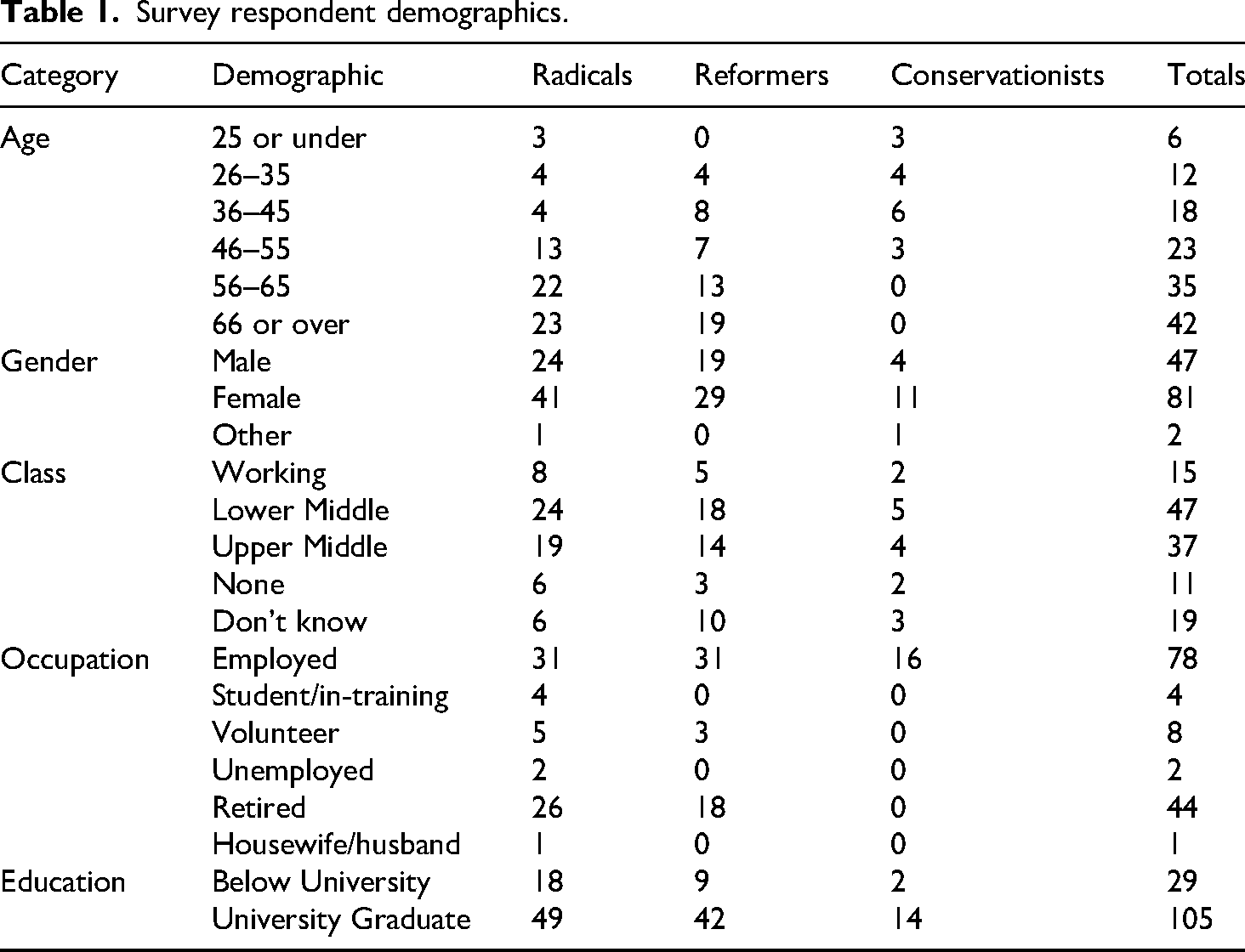
Given the sample and number of scales, the data comprised 9984 survey question responses (1664 per image) for analysis. Lastly, the three country contexts (the UK, Netherlands and Sweden) were chosen following a wider project's interests and were sites for original group emergence, supporting a comparative group study following the typology. Specifically, XR was first established in the UK and Fridays for Future in Sweden before becoming international. Resultantly, XR local group cover most major UK, Dutch and Swedish cities and regions. These exist alongside well-established conservationist organisations (for instance, the National Trust (the UK), Natuurmonumenten (Netherlands) and Naturskyddsföreningen (Sweden)) and ‘Reformer’ groups like Friends of the Earth and Greenpeace.
Each country therefore presents a well-developed, diverse and active movement context to study environmental and climate-related visual communication while reflecting upon ways to reach adherents through possibly influential imagery. The central comparative unit of analysis for the present study remained the movement group and select imagery.
Semantic differential (SD)
To investigate the understandings and potential emotive or motivational responses related with each image, SD was used. Developed by Charles Osgood (1952, 1979) through work on communication and language in psychology, SD commonly involves Likert scales with opposing adjectives. Results are subject to factor analysis to group adjectives, identifying ‘meaning’ categories around a given concept (Divilová, 2016; Norbergh et al., 2006). For example, Osgood (1952) analysed meanings around concepts like ‘polite’ with adjective pair scales like ‘active-passive’ and ‘good-bad’.
The present study involved 16 binary adjective pairs along seven-point scales developed to investigate image meaning and reception through two sub-concepts. These were perceptions of the natural environment representation (‘nature representation’) and how this made respondents feel (‘image feeling’). Images replaced Osgood's word-based concepts to understand the meanings attributed to them. Each scale point does not hold a unique value or meaning, as in many Likert scales, but rather indicates the closeness of a given image to either of the opposing adjectives as perceived by respondents. Central values were understood as potential ambivalence where respondents felt either adjective was possible and was not necessarily a rejection of both (Gardner, 1987; Norbergh et al., 2006).
A multiple-choice question concerning image usefulness followed, with options being: raising awareness of environmental or climate issues; influencing attitudes or behaviours; informing debate on these challenges; promoting environmental group membership or protest participation; catching people's eye through visual style; and, ‘none of the above’ where no communicative influences were perceived. Responses to this multiple-choice question were then analysed in conjunction with the semantic differential data to understand how different image perspectives and feelings could relate to image usefulness.
With SD, meaning is commonly divided into three categories referred to as ‘EPA’ (Osgood, 1979; Skrandies, 2011). Evaluation concerns whether a concept (image) is more good than bad, for instance. This best captured nature representation. Potency reflects the concept's general character, like strong or weak. Activity concerns a concept's form or movement with scales like fast-slow. The latter two denoted image feeling, with Activity branching into image usefulness. Table 2 presents this study's scales, grouped according to their expected relation to meaning's Evaluation-Potency-Activity components.
Expected evaluation-potency-activity scale groupings.
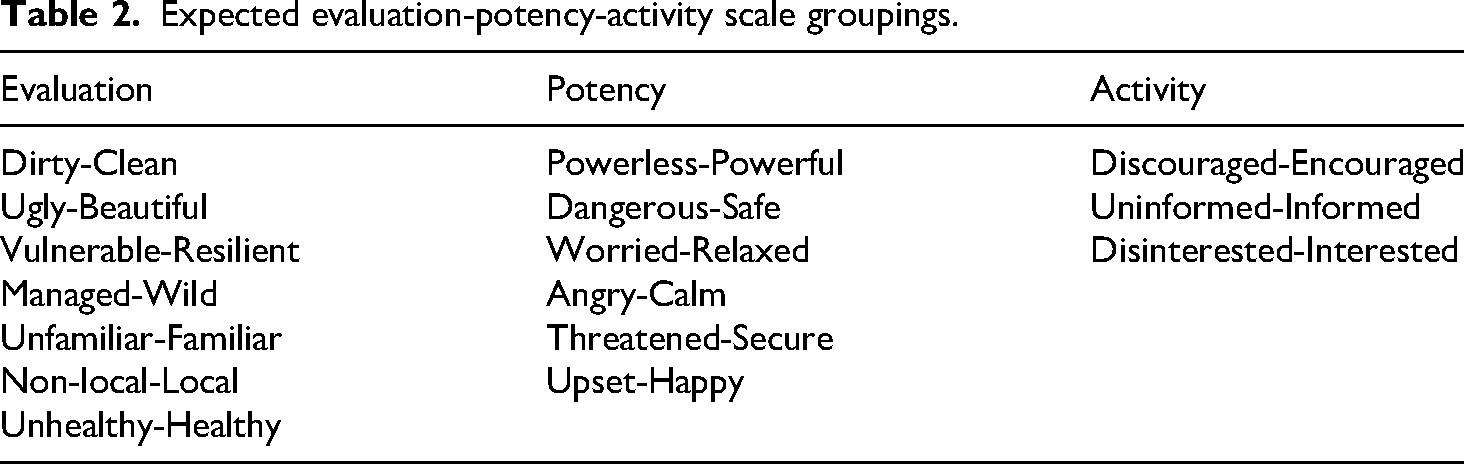
EPA was first identified by Osgood (1979) through factor analysis and later supported by others taking the same approach (Divilová, 2016; Norbergh et al., 2006; Skrandies, 2011). Consequently, factor analysis was also adopted to identify variables latent within the data that measure phenomena of interest (Bandalos and Boehm-Kaufman, 2009; Bollen and Arminger, 1991; Rhead et al., 2015). Here, the focus is on identifying image meaning and its reception by viewers, using factor analysis to confirm the expected presence of EPA with semantic differential data, similarly to other SD studies (Table 2), rather than to create scales based on latent variables as it may more generally be used with non-SD data. Factors, as latent variables within the data, were identified with eigenvalues above 1.0 (Kaiser's criterion) with oblimin (oblique) rotation applied, allowing for correlation and independence between factors (Bandalos and Boehm-Kaufman, 2009; Krabbe, 2016). Factor loadings reflecting item correlation or belongingness to factors was set at a minimum of 0.5.
The EPA meaning structure was identified in this research consistent with expectations and existing literature, and this additionally served as a check of content validity, suggesting that the SD scales measured what they were designed to measure (Cronbach and Meehl, 1955; Divilová, 2016; Krabbe, 2016).
Regarding reliability, it can be seen how some items were influential outliers producing additional factors beyond EPA (Bollen and Armiger, 1991), namely ‘Localness’, ‘Familiarity’ and ‘Knowing’. Standardised residuals (±2 or above) can also indicate outliers by providing information around the suitability of the data for factor analysis based on expected and actual value differences. This raised questions about the ‘unfamiliar-familiar’ scale, although others remained within the acceptable threshold. Particular caution in interpretation should therefore be maintained with this scale and the aforementioned factors.
Cronbach's alpha was additionally used to test the extent items under each factor were consistent with one another (Cronbach and Meehl, 1955). With a 0-1 range, most factors returned results between .70 and .91, indicating a good level of internal consistency overall (Carmines and Zeller, 1979). Caution should nonetheless be retained for the ‘unfamiliar-familiar’ and ‘non-local-local’ scales for all images, and the ‘managed-wild’ scale for the Blue Marble, polar bear and landscape, which returned lower results. Complementing this, uniqueness scores indicating unexplained variance in the item-factor fit was examined with lower scores desirable (Krabbe, 2016). Most items had scores of around 0.3, above exceptions remaining, supporting suggestions of acceptable scale consistency overall. Supplemental Appendix 1 relays results by image.
Results
Images with negative themes of threat, risk and/or vulnerability (polar bear and wildfire) will be especially analysed since these speak most to literature suggestions around influential climate and environmental communication.
A long-standing motif, the polar bear became an immediately understandable ‘visual shorthand’ for global warming (Wang et al., 2018: 9). It is among the ‘iconic’ climate images alongside drought, smokestacks and glacial melt (Manzo, 2010; Rebich-Hespanha and Rice, 2016). However, frequent usage has arguably reduced its salience and galvanising potential. Notable are claims that while icons can be powerful and remain in viewers’ memories (Dahmen et al., 2018; Hellmueller and Zhang, 2019), emotive visuals motivating calls for action, like the polar bear, can nonetheless have short-lived influence. One example of this powerful yet short-term salience is the image of Aylan Kurdi, the Syrian child refugee who was found lifeless on a Turkish beach in 2015, having died trying to reach Europe, which also underlined claims about human story importance behind engagement (Dahmen et al., 2018; Hellmueller and Zhang, 2019; Orgad, 2013).
This salience loss was suggested since the polar bear has become a cliché and parodied by climate sceptics (Aklin and Urpelainen, 2013; Chapman et al., 2016; Pearce et al., 2020). Through frequent usage, audiences have built familiarity, so it may not capture attention or generate emotional responses like before. It may also discourage, given the distance the challenge is from viewers, the issue's size and the absence of solutions (Dunaway, 2009). This resulted in suggestions to avoid using polar bears within environment and climate-related communication (Chapman et al., 2016; Dunaway, 2009; Pearce et al., 2020). Perhaps in line with this, polar bears were present in only 4% of the image sample, although it still represented a comparatively recurrent and unique single theme typifying the ‘vulnerability’ code developed from image sample content. Survey respondents were expected to continue perceiving a negative nature representation given its synecdochic character, but emotional reactions would be ambivalent, reflecting salience reduction. Limited usefulness within communication strategies would result.
Wildfires were expected to convey negative representations but with greater emotional salience and usefulness through depicting forests engulfed in flame, sometimes foregrounding people. Expectations around this image's emotive influence and use were grounded in how, unlike polar bears, wildfires were not used as frequently as iconic climate imagery. Yet, they were more present in the image bank, representing 7% of all images as one of the most shared single-issue images collected. This arguably relates to issue-attention cycles since collection occurred in late 2020 when MSM coverage increased in Western nations where wildfires were unfolding, including Australia and the US. Similar occurred in Europe in 2021 during survey data collection.
Wildfires could tap into public concern for ongoing disasters that have not enjoyed historic use in environmental and climate communication, like polar bears. They could have larger emotional impacts on respondents, including since wildfires were happening closer to home in Europe. Wildfires could seem more local while capturing human stories, like the survey's firefighter, otherwise absent in polar bear imagery. This underlines how wildfires threaten both the environment and society and may result in more perceived usefulness by reducing viewer-issue distance.
Figures 2 and 3 present the SD data with group type response means as measures of central tendency plotted along each scale for nature representation and associated feelings. Respondent perspective similarities were immediately discernible, particularly for evoked feelings. For the polar bear (Figure 2), respondents reported its nature representation as fairly clean, beautiful and wild, slightly familiar, dangerous, unhealthy and, lastly, strongly vulnerable. These responses arguably reflect the polar bear's synecdochic association with global warming and thus vulnerability, danger and familiarity. Non-localness reflects the Arctic setting, possibly creating issue-viewer distance (Duan et al., 2017). It was nonetheless perceived to hold appealing landscape features.
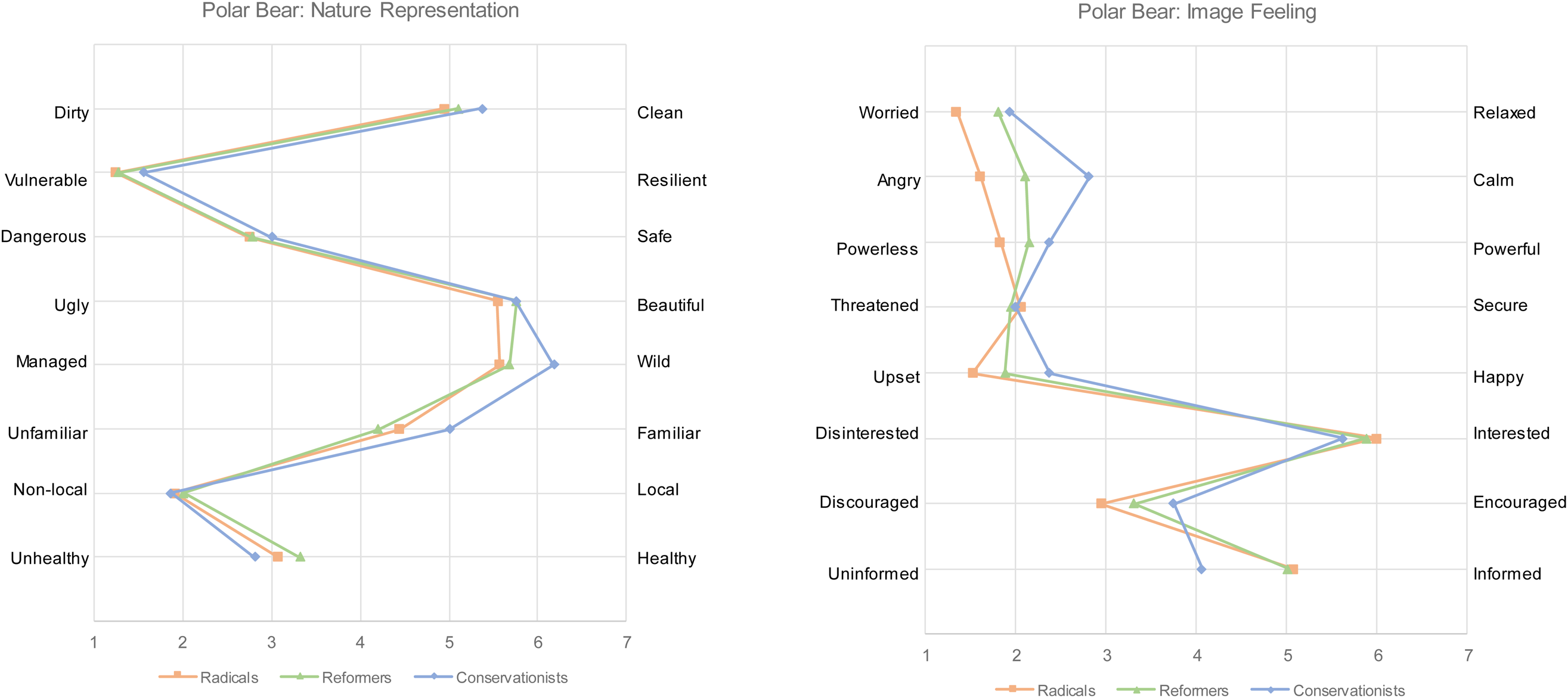
Polar bear semantic differential, n = 104.
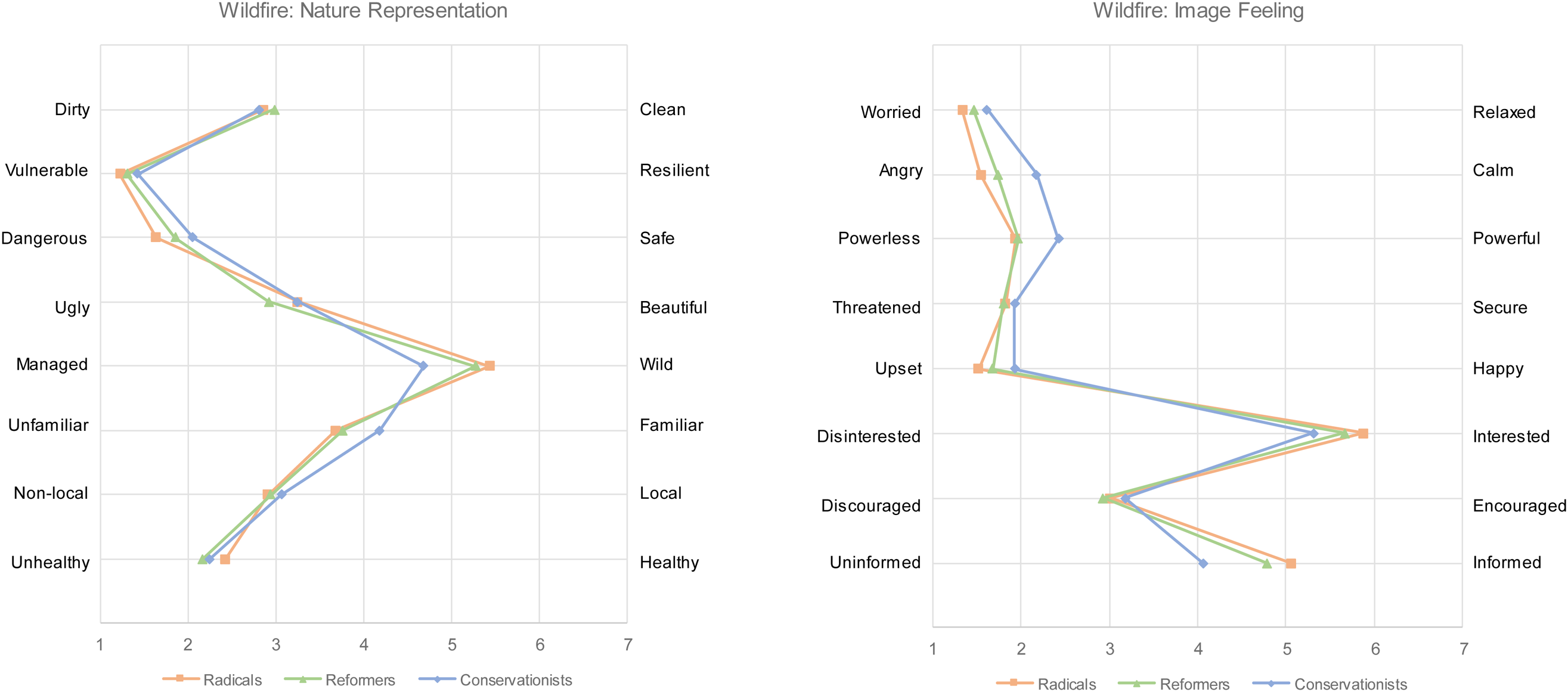
Wildfire semantic differential, n = 104.
Overall, respondents felt strongly worried, angry, powerless, threatened and upset, but interested. Respondents felt slightly discouraged and informed, but more ambivalently for Conservationists. This suggests two important points. First, the nature representation continued to be negatively read following this image's synecdoche status (global warming). Second, it retains strong emotion-related power. This latter finding runs counter to claims that, through prolonged use and parody, the polar bear lost salience and usefulness within climate and environment-related communication (Chapman et al., 2016). This is not necessarily the case, and the polar bear was shown here to keep its original evocative strength.
Wildfire results shared a similar pattern to the polar bear (Figure 3). Differences include the wildfire being less beautiful and clean, but other results remained in-keeping. This indicated that the wildfire presented a negative nature representation achieved in the absence of pre-existing synecdoche status, without which the polar bear would perhaps only be beautiful, clean and wild. Emotional responses to these images were relatively equal, underlining the polar bear's continued salience compared to strong, shocking and more directly threatening wildfire visuals. Respondents across group types were largely congruent concerning understandings of images’ nature, representation and subsequent emotive impacts.
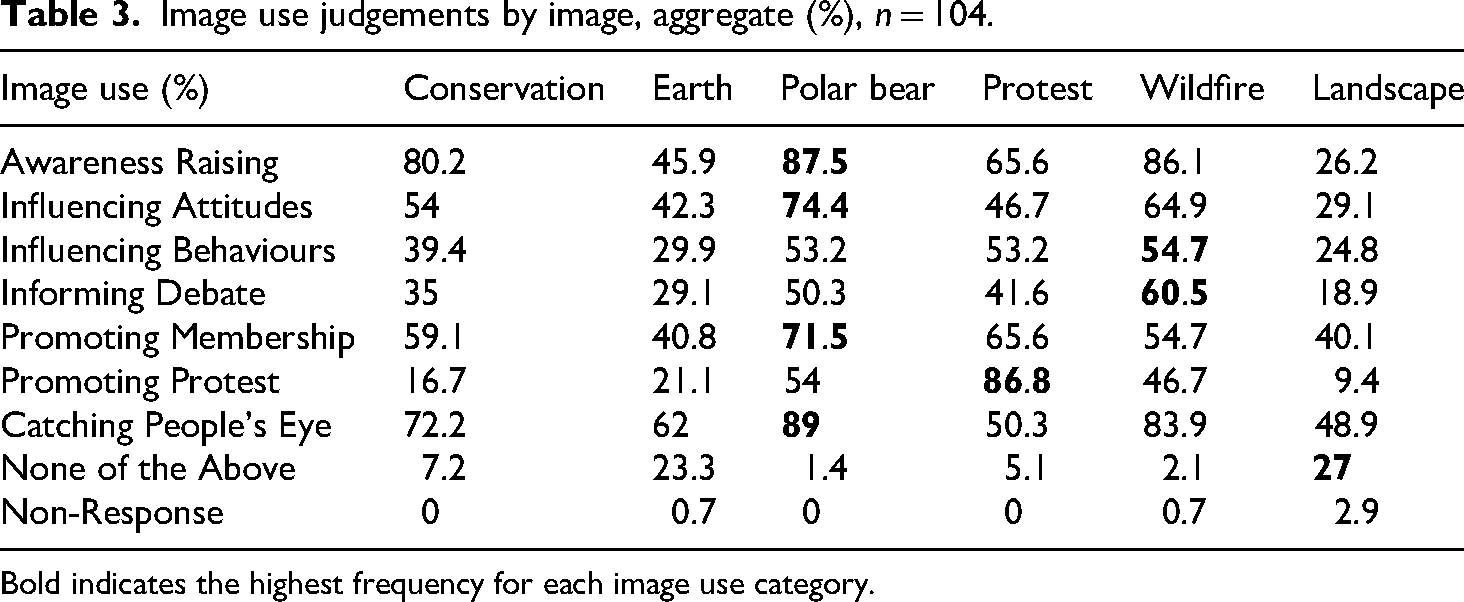
Although strong negative emotional reactions occurred, questions remain about whether and how these images could be useful communication tools. There are concerns that strong negative emotions, like with wildfires and polar bears, overwhelm and disengage viewers (Hoggett and Randall, 2018; Manzo, 2010; Rebich-Hespanha and Rice, 2016). Building on the SD, respondents were asked how each image could be useful. Table 3 summarises options and aggregate responses as the percentage respondents agreed each use could be possible.
Image use judgements by image, aggregate (%), n = 104.
Bold indicates the highest frequency for each image use category.
The highest two frequencies across use categories were found for the polar bear and wildfire. The exception was promoting protest participation, where the protest image had the highest result, which may be an artefact of literal readings of this image. The polar bear and wildfire had the next highest protest participation possibilities. Supplemental Appendix 2 reports all images’ nature representation and feeling results, predominantly showing ambivalence across most image feeling scales with largely positive understandings about nature representations. Cross-group congruence was notable. These positive representations contrasted against the polar bear and wildfire's negativity by producing little emotional influence and being of limited perceived use. The image with the most positive feelings – landscape – was the least useful.
Discussion
SD and image use data strongly suggested that images with clear negative themes through depicting threat, vulnerability and/or risk held the most notable possibilities for emotional effects and use. Contrasting with numerous studies, this negativity did not reduce images’ overall potential to influence through overwhelming viewers and causing disengagement with a sense that personal actions count for little (Hoggett and Randall, 2018; Manzo, 2010; Rebich-Hespanha and Rice, 2016). Instead, respondents who indicated collectively that the polar bear and wildfire were the most negative representations that also made them feel in the most negative ways, indicated that these images held the greatest possible usefulness from catching people's eye and raising awareness to influencing behaviours and promoting group membership. To recall, these findings reflect perceived image usefulness based on the sampled audience's perceptions of image content and evoked feelings, and do not measure actual attitudinal or behavioural change in light of image exposure.
The data suggested how localness and/or human stories may not be required for influential communication around the environment and climate (cf. Chapman et al., 2016; Duan et al., 2017; León et al., 2022; Wang et al., 2018). Polar bear data questioned literature on these points given its higher usefulness despite human absence and its distant geographical setting. Image feeling results also queried ideas of lost salience (Chapman et al., 2016; Pearce et al., 2020). Resultantly, the polar bear could still play an important role within environment and climate communication. Caution should nonetheless be maintained with such images since they can reproduce a simplistic, possibly romanticised, Western lens of the Arctic that ignores the experiences and agency of people like the Inuit (Brode-Roger, 2021), reflecting critiques of Western nature constructs of ‘landscape’ or ‘wilderness’ and the problems they create for their inhabitants (Brígido-Corachán, 2017; Cronon, 1996; Wylie, 2007).
Imagery evoking strong negative reactions could therefore be the most influential, even with seeming contradictions whereby the polar bear and wildfire images were simultaneously perceived as discouraging, as an example of their negative framing, yet potentially more useful overall. This highlights the importance of considering different forms of ‘negative’ reaction more specifically, and to added nuance in research in this area (Chapman et al., 2017). Studies suggested differentiating approach and avoidance reactions, where the latter creates the disengagement and discouragement discussed within the literature. Here, feelings of disgust can produce avoidance reactions, but fear and anger can draw people in and improve their memory about what they see (Newhagen, 1998; Saunders et al., 2012). This indicates how greater emphasis on this difference concerning influential environmental and climate communication is needed, given how results showed that actors should not shy away from strong negative themes since they may be among the best to use. These findings support Milkoreit's (2017) ideas around how dystopic future imaginaries may galvanise people to act to avoid those outcomes, alongside Jasper and Poulsen's (1995) moral shocks.
This claim – that negative imagery may be the most influential to use in the environment and climate arena – is highlighted further by how survey images presenting positive nature representations often evoked ambivalent feelings. Here, and again where positive feelings were associated with images, judgements of their ability to motivate as communicative tools suggested less usefulness.
This highlights possible benefits to reflecting on the images selected for communicating environmental and climate themes, including which visual materials may help movement actors (and others) raise awareness of challenges and create wider engagement. Many studies focused on visual climate communication have argued that negative images of suffering and disaster should be avoided in favour of more encouraging positive frames (Dunaway, 2009; Manzo, 2010; O’Neill et al., 2015; Rebich-Hespanha and Rice, 2016). A key difference, however, is the present article's focus on social movement images rather than MSM and group member reactions, which may be like adherents’ whom such groups may wish to engage. This presents both a limitation and a unique insight. Specifically, this article's focus means that its findings should not be generalised to the wider public, acknowledging also inherent complexities in image reception and audience diversity (Chapman et al., 2017; Rose, 2001). Findings may nonetheless indicate general image themes and feelings which could be useful to use with both existing movement members and those who are sympathetic to environmental group concerns as a specific sub-section of the population, warranting further study.
Similar claims exist in studies delineating problem- and solution-oriented imagery, where the former commonly presented negative themes, including climate impacts like flooding (Dahmen et al., 2019). Negative problem frames were found to engage audiences less than positive solution framing, showing successful responses (akin to the present article's conservation image), while neutral imagery was argued to have the largest behavioural influence (contrasting with Blue Marble results). These authors also drew upon small-n surveys, yet maintained an MSM focus.
This relates to elaborations on fear-based climate imagery that was found to produce viewer-challenge distance despite making climate change seem important, resulting in limited short-term engagement and disempowerment (O’Neill and Nicholson-Cole, 2009). Also argued was that fear-inducing imagery's overuse may reduce image salience, produce fatalism (Manzo, 2010), and damage viewers’ trust in civil society-provided climate information (O’Neill and Nicholson-Cole, 2009).
However, it is contended that visual communication targeting those with climate concerns (adherents) may find negative themes advocated against in MSM-heavy studies to have a greater possible influence than suggested. Moreover, while O’Neill and Nicholson-Cole (2009) centred on fear alone as a central climate image theme (also Dunaway, 2009), images can simultaneously produce different negative emotions, and this wider range of reactions, including anger, worry, sadness and threat, was captured through the SD approach. Recalling the iconic image discussion that included the much-maligned polar bear, these can be powerful and influential over viewer's emotional response and subsequent action when deeply negative, as demonstrated by Aylan Kurdi photographs in 2015 (Dahmen et al., 2018; Hellmueller and Zhang, 2019).
The present article's findings, suggesting that negative climate imagery could be influential and encourage concern and action, are also supported by how climate anxiety was used as the key driver behind protest recruitment in New York City. Here, images of flooding, a negatively themed image representing anxieties (Dahmen et al., 2019), were combined with symbols connotating capitalism within a problem-framing circulated through movement social media (Greenwalt, 2021). In short, negative emotions reflected in similarly negative and problem-oriented visuals online showed an influential possibility often overlooked by climate imagery literatures, but which could support engagement with those holding concerns around environmental degradation and the climate; thereby addressing ‘silences’ around issues that could be deemed too negative to engage others with (Wright and Irwin, 2024: 3).
Derived from a survey of existing environmental and climate movement members, data spoke most explicitly to this societal group's perspectives and understandings of each commonly used movement image. This includes their engagement-creating potential through catching people's eye or raising awareness of wildfires, protest or conservation. Since these images represented central and recurring movement visuals, they could have been familiar and less emotive for members, although, crucially, this was not found with wildfires and polar bears.
The finding that negatively-themed images producing strongly negative emotions are the most useful indicated one possibly influential form of communication when targeting movement members, including to raise awareness of new issues, maintain donations and mobilise for protests. For these and other ends, negative images would represent a potential success for movement groups. Through this study's comparative typology distinguishing between radicals, reformers and conservationists, these successes could be achieved using negative imagery as a tool with members from across these different movement groups that present alternative degrees of radicalism and institutionalisation, and possibly different views of how to address environmental and climate challenges. The similarities in how images were received across these group types are interesting and suggest a degree of convergence around how common communication themes, such as vulnerability and globality, are read by audiences even though images are polysemic and could have resulted in limited similarities across the groups compared, including in relation to group type characteristics and the range of demographics survey respondents represented (Table 1).
Attention should turn to what some social movement studies have conceptualised as ‘adherents’ as those sharing interests, concerns and/or sympathy with movement groups. Based on this similarity between these adherents and survey respondents (constituents), some of this project's insights may remain true for adherents concerning understandings of nature representations, related feelings and how each image may be influential. Analyses suggested that, for capturing potential members’ attention and aiding in their recruitment, negative emotion may be strongly beneficial. Such visual materials might facilitate movement actors’ access to important resource pools supporting their continued mobilisation.
However, it may also be important to understand the ways in which images perceived as presenting difficult themes or evoking negative feelings in audiences could affect individuals experiencing climate anxiety. There is the possibility that the use of such imagery, although potentially useful to raise awareness or influence pro-environmental behaviours, including among those with climate anxiety, may have a detrimental effect upon the mental wellbeing of those already experiencing this form of anxiety (Ogunbode et al., 2022). Further studies of climate anxiety in relation to climate communication materials are therefore suggested.
Conclusion
In conclusion, the visual communication of environmental and climate challenges is important and can influence attitudes and behaviours. The image is significant for its possible use in issue or actor portrayal and argumentation that is not fixed but changeable according to image producers, editors and, ultimately, viewers; producing complex, polysemic objects for study. Based on a multi-method analysis of imagery representing recurring themes across different movement groups’ online visual communication, this article's key contention is that images producing strong negative emotional reactions may actually be among the most useful. This represents a potential success when conceptualising images as mobilisation tools that could influence existing movement members and reach those sympathetic to their concerns, holding the potential to increase their engagement in societal debates or movement activities around these crucial challenges. This is a novel finding for the visual environment and climate communication literature that is grounded in a complementary social movement, not MSM, approach to pressing questions of visual communication's potential influence in this arena.
The data and analyses provided an alternative to common literature narratives while opening the door for further research of possibly influential visual communication in climate, environment and social movement studies, where greater visual-based research is recommended. It has done so through shifting attention away from the more prominent MSM and general public data, towards social movement imagery and members, which grant different insights into these phenomena and the influential possibilities of various visual themes. This article further highlighted the usefulness of a ‘nature’ semantic differential approach with photo-elicitation in analysing meaning and emotional influences. Studies developing on this approach could make important visual contributions to existing literatures. This would seem meaningful in a time of crisis and mobilisation.
Supplemental Material
sj-docx-1-env-10.1177_09632719261458976 - Supplemental material for Understanding environmental and climate imagery: A ‘Nature’ semantic differential and implications for influential communication
Supplemental material, sj-docx-1-env-10.1177_09632719261458976 for Understanding environmental and climate imagery: A ‘Nature’ semantic differential and implications for influential communication by Joshua Garland in Environmental Values
Supplemental Material
sj-docx-2-env-10.1177_09632719261458976 - Supplemental material for Understanding environmental and climate imagery: A ‘Nature’ semantic differential and implications for influential communication
Supplemental material, sj-docx-2-env-10.1177_09632719261458976 for Understanding environmental and climate imagery: A ‘Nature’ semantic differential and implications for influential communication by Joshua Garland in Environmental Values
Footnotes

Ethical considerations
The Ethics Committee at the University of Milan, Italy, deemed that formal ethical approval for this research was not required.
Consent to participate
Although ethical approval was not required from the University of Milan, the survey from which this article draws began with an information and informed consent sheet. Acceptance of this served as a prerequisite for survey access by participants.
Consent for publication
Informed consent was collected for the present study, including the use of survey responses for academic journal publications.
Funding
The author discloses receipt of the following financial support for the research, authorship, and/or publication of this article: This work was supported by the University of Milan, Italy [doctoral scholarship] and revisions partially supported by the Swedish National Research Council (Formas) [grant number 2022-01835], project ‘ICARUS: Illuminating power dynamics in Cross-scale Adaptation for more Resilient and jUst futureS’.
Declaration of conflicting interests
The author declared no potential conflicts of interest with respect to the research, authorship, and/or publication of this article.
Data availability statement
Data are not available.
Supplemental material
Supplemental material for this article is available online.
References
Supplementary Material
Please find the following supplemental material available below.
For Open Access articles published under a Creative Commons License, all supplemental material carries the same license as the article it is associated with.
For non-Open Access articles published, all supplemental material carries a non-exclusive license, and permission requests for re-use of supplemental material or any part of supplemental material shall be sent directly to the copyright owner as specified in the copyright notice associated with the article.
