



Abstract
This article examines three contrasting approaches to an environmentally sustainable population via two criteria: normative desirability, and practical achievability within meaningful timescales for addressing the environmental crisis. Drawing on Strong Structuration Theory, we analyse the ‘ecocentric’, ‘equal shares’ and ‘pragmatist’ positions on sustainable population size. The ecocentric approach, advocating populations of 100 million to 2 billion based on notions of intrinsic value and biocentric equality, fails both criteria due to its contested philosophical foundations and inadequate conception of the relationship between values and action. The equal shares position, clustering around 3 billion living at equal welfare levels within planetary boundaries, demonstrates greater normative robustness by drawing from pluralistic frameworks like the Sustainable Development Goals, but remains practically unachievable within a meaningful timeframe due to demographic momentum and the political implausibility of required consumption sacrifices in wealthy nations. The pragmatist position, exemplified by Earth4All's ‘Giant Leap’ scenario, offers the most viable pathway forwards, by focusing on gradual transitions rather than absolute sustainability thresholds. This approach envisions global population peaking at 8.5 billion mid-century before declining to 6 billion by 2100. Our Strong Structurationist analysis reveals why rapid transformations in fertility preferences, consumption patterns or value orientations face structural constraints due to agents’ complex hierarchies of purposes and drive towards ontological security. The pragmatist position succeeds by working within existing motivational structures while gradually achieving sustainability goals, offering a potential pathway towards environmental restoration and human flourishing within timescales meaningful to current generations.
Keywords
Introduction
The question of how many people Earth can sustainably support has gained renewed attention amid contemporary environmental challenges. Since 1970, when the global population was less than half its current size, humanity has consistently exceeded Earth's biocapacity, consuming resources at a rate 70% beyond what the planet can regenerate (Lin et al., 2018; McBain et al., 2017). This ecological overshoot occurs alongside multiple environmental pressures including climate change, biodiversity loss, resource depletion and ecosystem degradation.
However, discussions of sustainable population remain characterised by significant disagreement and methodological diversity. As Joel Cohen (1995) observed, published estimates of Earth's carrying capacity vary considerably, suggesting substantial uncertainty in this field. This variation reflects not only technical disagreements about resource availability or technological capacity, but also fundamental differences about what should be sustained, for whom, and at what cost. Cohen's insight that values and choices, alongside natural constraints, influence determinations of Earth's ‘carrying capacity’ warrants further investigation in contemporary sustainability research.
This article addresses this gap by examining three approaches to environmentally sustainable population via two evaluative criteria: normative desirability based on particular values, and practical achievability within timescales meaningful for addressing current environmental crises. Rather than attempting to calculate a specific population figure, we critically investigate the underlying assumptions, ethical foundations and implementation pathways that shape different visions of sustainability.
Our analysis is grounded in Strong Structuration Theory (SST) (Stones, 2005), which provides crucial insights into why well-intentioned sustainability proposals often fail to gain traction. By examining how agents’ deeply embedded dispositions, hierarchies of purposes and ontological security needs interact with broader social structures, we can better understand the gap between aspirational ideals and achievable reforms, and analyse why certain sustainability proposals may encounter implementation challenges. This approach proves particularly relevant for assessing the social and political feasibility of different population strategies.
The temporal dimension of this analysis is informed by demographic projections indicating that global population will likely peak and begin declining within this century (Lutz, 2023). If population decline continues as projected, the sustainable population levels examined here may eventually be achieved. The critical question becomes whether population can peak and decline to sustainable levels quickly enough to prevent irreversible environmental damage and widespread suffering. We focus on what can realistically be accomplished by century's end, as it is uncommon for policymakers to focus on environmental targets beyond 2100 – especially given widespread temporal discounting (Polasky and Dampha, 2021; Sparkman et al., 2021) and the fact that concern for future generations operates most effectively within three-generation timeframes (Graham et al., 2017). This choice is thus largely shaped by political practicability, though an additional factor is that technological uncertainty makes the use of timelines on the scale of decades, rather than centuries, more feasible.
We examine three distinct positions: the ‘ecocentric’ approach, which prioritises nature's intrinsic value and advocates dramatic population reduction to restore ecological harmony; the ‘equal shares’ position, which focuses on the maximum population that could be sustained at a given threshold of human wellbeing within natural boundaries, if resources were distributed equally; and the ‘pragmatist’ approach, which adopts similar normative foundations to the ‘equal shares’ position but drops the focus on equal resource distribution and introduces an explicit commitment to gradualism, that is, achieving sustainability and population goals gradually over time (The ecocentrist and equal shares positions usually do not specify the timescale on which their objectives should be achieved).
Crudely, ecocentric authors specify a much smaller population ranging from 100 million to 2 billion, with little consensus among them, whilst estimates from the equal shares position range from 1 to 10.4 billion but tend to cluster around 3 billion. The pragmatist position, most clearly represented by Callegari and Stoknes (2023), introduces an explicit temporal dimension, where global population reaches 8.5 billion in 2050 before falling to 6 billion in 2100 (Earth4All, 2024).
In terms of desirability, we argue that given widespread disagreements in environmental ethics, positions which are compatible with a wide range of value-systems will be preferable. The ecocentric position fails here, as it is wedded to an absolutist yet highly contentious notion of intrinsic value. The equal shares and pragmatist positions perform better, as they take their cue from more deliberative ethical theories.
Our analysis also reveals tensions between normative ideals and practical implementation in sustainability discourse. While the ecocentric and equal shares positions offer substantive critiques of current trajectories, both require transformations in human behaviour, consumption patterns, and social organisation that face significant implementation challenges within relevant timescales. We argue that these two approaches direct insufficient attention to demographic momentum and, relatedly, have an inadequate model of the relationship between values and action – in Strong Structurationist terms, the agents’ ‘hierarchy of priorities’ and their internalised expectations of what constitutes a ‘normal’ lifestyle.
In a context where environmental degradation accelerates daily, the most ethically sophisticated proposal becomes irrelevant if it cannot gain sufficient support to be implemented. The pragmatist position, while less normatively pure, offers an alternative approach by working within existing institutional and motivational structures. Nonetheless, the pragmatist position by no means entails business-as-usual. Achieving a population of 6 billion at good levels of human wellbeing and with compatible environmental conditions by 2100 would require massive (but still plausible) efforts to end poverty, curb inequality, empower women, improve food-system health and shift to clean energy. While difficult to achieve, the position at least represents a plausible alternative to our current trajectory, which is normatively dire and thus cannot be regarded as ‘sustainable’.
We begin by setting out our theoretical framework, then examine and critically appraise the three approaches to sustainable population.
Theoretical framework: desirability and achievability
Ehrlich and Holdren's (1972) IPAT equation shows that environmental impact (I) results from the interaction of population size (P), affluence (A) and technology (T), focusing on macro-level social systems in environmental sustainability debates. While affluence often equates to consumption, Cohen (2010) notes that IPAT reveals little about how values and culture shape the translation of affluence into consumption choices. Individual choices accumulate into significant collective environmental change. These choices closely relate to normative issues: what constitutes the principal object of moral concern (nature or human welfare), the nature of human need and welfare, and tolerance of inequality. Thus, normative desirability is critical to sustainable population discussions.
However, Cohen's implied voluntarism requires scrutiny. Changing established lifestyles requires more than individual choices and value-changes – any consideration of sustainable population must assess the achievability of normative goals given current societal constraints. We employ SST (Stones, 2005) to bridge voluntaristic and structural approaches to social change, providing a framework for evaluating how far proposed value and behavioural shifts are feasible within existing social orders.
SST makes explicit the relationship between agents and the structural conditions that enable or constrain change. It distinguishes between external structures – such as institutional norms, economic arrangements and policy regimes – and internal structures, including agents’ dispositions, normative commitments and conjunctural understandings of their social context. By analysing how these dimensions interact – how actors draw upon, reproduce or transform structural conditions – the framework clarifies the structural and agential limits of proposed pathways to sustainability. From this perspective, calls for radical economic transformation confront deeply sedimented external structures and internalised expectations that restrict the willingness or capacity of most actors to depart from established consumption and livelihood practices. SST therefore illuminates why a more pragmatic orientation – one that seeks feasible pathways of change within existing constraints – emerges as both analytically and normatively defensible. This does not entail accepting the status quo, but rather recognising that durable change depends on mobilising agency in ways that resonate with prevailing structural conditions and cultural understandings. In this sense, SST underpins a reformist rather than revolutionary conception of achievability, oriented toward gradual transformation through feasible shifts in practice and policy.
Stones’ SST builds on Giddens’ (1984) structuration theory but shifts focus from abstract ontology to specific agents and structures in empirical situations. Stones retains Giddens’ central concept of the ‘duality of structure’ – structure as both medium and outcome of action – where agents draw upon structures through everyday practices, reproducing or changing them. However, Stones’ ‘quadripartite cycle of structuration’ disaggregates this duality into four interlinked aspects:
external structures – autonomous to individual agents, forming the acknowledged and unacknowledged conditions of action. internal structures – the inner lives of agents consisting of their transposable dispositions or habitus (including their worldview(s)) and their conjuncturally specific knowledge of external structures. active agency – how agents draw on their internal structures in social practices. outcomes – the intended and unintended consequences of action resulting from acknowledged and unacknowledged conditions.
This approach proves particularly useful for analysing the sustainable population literature as it bridges wider social structural contexts with agents’ ‘inner lives’ – their values, aspirations and often tacit ‘hermeneutic frame’ or worldviews critical to identity and social normality. SST acknowledges potential conflicts between internal structures, recognising that agents have contextually dependent ‘hierarchies of purposes’ and must prioritise among conflicting values and objectives. Any analysis of value orientations and willingness to accept changes in social practices requires a multidimensional approach that systematically acknowledges how conflicts and inconsistencies between reported values arise from wider social contexts.
Review of the ecocentric 1 approach
For many proposing a radical environmental agenda, the root cause of the expansion of the human enterprise (including human numbers) and consequent environmental crisis is anthropocentrism, the dominant human-centred worldview which sees human interests as paramount and nature as only of instrumental value. In contrast, ‘ecocentric’ or nature centred approaches typically regard nature as having intrinsic value and ecocentrism as key to solving the environmental crisis (Kopnina et al., 2018; Washington et al., 2017). The principle of ‘biocentric equality’ – the idea that human interests have no greater value than those of other species or, indeed, of the natural world in general – is also common amongst some ecocentrists, particularly Deep Ecologists (see Devall and Sessions, 1985; Kopnina, 2016; Naess, 1989). It follows that ‘Humans have no right to reduce … [nature's] richness and diversity except to satisfy vital needs’ (Devall and Sessions, 1985: 70 – emphasis original) and that a ‘substantial decrease of the human population’ is compatible with the flourishing of human life and necessary to the flourishing of non-human life (Devall and Sessions, 1985: 70).
While, by definition, ecocentrism's objective is to replace the dominant human-centred worldview with nature-centredness, human interests are not treated as marginal. Indeed, human wellbeing and flourishing are conceived as inextricable from the flourishing and wellbeing of nature. However, while ‘vital needs’ are left deliberately vague in recognition of varying social and environmental conditions (see Devall and Sessions, 1985; Sessions, 1995), the attention paid by some writers (Crist, 2019; Devall and Sessions, 1985; Washington et al., 2017) to the lifeways and values of hunter-gatherers (with some indicating hunter-gatherers as the sole historical example of true sustainability (Oelschlaeger, 1991; Washington 2015)) signals a more minimalist approach to need. Working from a broadly similar perspective, Callicott and Mumford (1997) provided a more precise definition of sustainability as ‘meeting human needs without compromising the health of ecosystems’ (p. 32).
Whilst consistently calling for a global population reduction, ecocentrist writers rarely state the actual figure they believe to be sustainable – and when they do, they frequently do not provide a reason for why that population size is sustainable. Perhaps most importantly for the purposes of this article though, the timescales over which a sustainable population might be achieved is either not mentioned or only mentioned in vague terms.
In a 1982 interview, Deep Ecology's founding figure, Arne Naess, argued that a population size of 100 million would be desirable (Bodian, 1982). This incredibly small 2 figure probably reflected Naess’ sentiments regarding the value of wilderness and the low ecological impact of the small-scale ecocentric communities which he regarded as models of true sustainability, but the precise reasoning behind the figure was left unstated. In 1969, Gary Snyder argued for a total global population of around 1.8 billion (Sessions, 1995), but failed to justify this specific figure. Sessions (ibid) claimed that ‘…population biologists argue that 1 to 2 billion people worldwide, living comfortably at a basic needs consumption level, would be maximum for what Naess calls “wide” ecological sustainability’ (Ibid, 370), but did not cite his sources.
Recently, Washington and Kopnina have more thoroughly explored the issue of the Earth's ‘carrying capacity’ from an ecocentric perspective and endorsed Crist's (Cafaro and Crist, 2012) claim that the critical question is what population size and consumption levels can humanity sustain without transforming Earth ‘into a human colony founded on the genocide of the nonhuman’ (Washington and Kopnina, 2022:1011). Reviewing the range of ‘carrying capacity’ estimates, Washington and Kopnina note that the ecocentrically ethical population would be 1.2 billion people. Crist (2019), on the other hand, has argued that the repudiation of anthropocentrism and the establishment of an ‘ecological civilisation’ would mean around 2 billion people could be sustained in sufficient comfort, citing Daily et al.'s (1994) energy calculus (see the next section).
In summary, the ecocentric focus upon the conservation and revitalisation of a certain conception of the natural world is closely coupled with their conception of an authentic human relationship with nature. For ecocentrists, the restoration of ecological harmony and hence sustainability rests upon these foundations and necessarily entails a significant reduction in both material consumption and population size.
Review of the equal shares approach
The ‘equal shares’ approach to a sustainable world population focuses on achieving a ‘good life’ for all human beings – both the present world population and all future generations (O'Neill et al., 2018). Sustainability here refers to maintaining a good life for all people within environmental boundaries. Proponents argue that this goal necessitates radical redistribution from the Global North to the Global South, since achieving an ‘optimum’ population (in terms of both size and sustainability) requires that everyone live at a given welfare standard and no higher.
The equal shares position has its roots in long-running debates about ‘ecologically optimal’ population size. In 1994, Pimentel and colleagues estimated the Earth's carrying capacity, calculating that 0.5 ha of well-managed land per capita could sustainably feed around 3 billion people, though only 1–2 billion could live in relative prosperity (1994). Their 2010 review concluded that 2 billion could be sustained at a European lifestyle (Pimentel et al., 2010). Taking global energy consumption as proxy for all consumption and impact, Daily et al. (1994) arrived at an optimum figure of 2 billion based on 6 TW total global consumption and 3 kW per person for a good life within environmental limits. However, Tucker (2019) rejects Daily et al.'s energy calculus and adopts a biogeographical approach informed by Ecological Footprint analysis to arrive at a sustainable population of 3 billion at European welfare levels.
Lianos and Pseiridis (2015) estimate the optimum global population that could be supported at a sustainable Gross World Product consistent with a good standard of living for all. Taking the average European level of welfare as their standard, they calculate that 3.1 billion could be sustained without exceeding the planet's biocapacity. Dasgupta and Dasgupta (2017) find that the number of people that could ‘under present technologies and institutions, be sustained at a living standard of 20,000 international dollars’ stands at around 3.6 billion (Dasgupta, 2019: 109).
Although, not explicitly setting out to address the question of sustainable population, O'Neill et al. (2018) make a significant contribution to the equal shares position. Taking a planetary boundaries approach, they show that the basic physical needs of 7 billion people could be met, but only if resources were equally distributed. However, to achieve a more substantive ‘good life’ for all within planetary boundaries, redistribution is necessary but not sufficient. Fulfilling more qualitative Sustainable Development Goals, such as social support, secondary education and life satisfaction, would require between two and six times the level of resources associated with basic needs, potentially undermining ‘the Earth-system processes upon which development ultimately depends’ (O'Neill et al., 2018: 93). Thus, meeting higher welfare standards requires not only redistribution and ‘degrowth’ strategies, but a two to six fold improvement in ‘provisioning system’ efficiency. Without such improvements the trade-off between population size and welfare implies that only between 1.2 and 3.5 billion people could enjoy a ‘good life’. O'Neill et al. conclude that providing a ‘good life’ for all within planetary boundaries necessitates radical global redistribution, economic degrowth in the Global North, substantial increases in global provisioning system efficiency and stabilisation of world population at 7 billion or fewer.
Schlesier et al. (2024) have recently tackled the ‘good life for all’ question by employing the ‘decent living standard’ (DLS) approach and argue that decent living standards (which they confusingly term ‘basic needs’) for the UN's projected 2085 peak population of 10.4 billion could be met within planetary boundaries. However, this ‘requires far-reaching dietary changes, minimal consumption and completely defossilized energy systems. This is possible with currently available technologies, however, we cannot find evidence for ecological space for providing luxury’ (Schlesier et al., 2024: 7). While luxury is left undefined, it is not clear that the DLS employed by Schlesier et al. is equivalent of the ‘good life’ specified by O'Neill et al. (2018) – importantly, ‘high life satisfaction’ is not specified as part of the model. Compared to others, Schlesier et al.'s model appears to be somewhat of an outlier in the equal shares tradition, particularly since the UN's peak population date imposes a hard deadline for the comprehensive social and technical changes envisaged to occur.
While equal shares estimates of optimum population have ranged between 1 and 10.4 billion, there appears to be convergence around 3 billion people as the likely maximum compatible with a ‘good life’ for all. Even if these figures underestimated the globally sustainable population by 100%, they would still be below current and projected population sizes, implying an ‘upper bound’ closer to O'Neill et al.'s estimate of 7 billion.
Critique of the ecocentric and equal shares positions
Having outlined the ecocentric and equal shares positions, we now assess their value based upon our criteria of ‘desirability’ and ‘achievability’. We argue that the ecocentric concept of a sustainable world population meets neither of those criteria. Meanwhile, although the equal shares position seems more desirable, we argue that the timescales involved in reducing the population to these figures and the difficulties of converging towards equality mean that its achievability becomes somewhat utopian in terms of addressing the impending environmental crisis.
Desirability
Desirability of the ecocentric position
Any evaluation of different normative perspectives on a sustainable world population must begin by acknowledging that environmental ethics – indeed ethics in general – is a field of substantial uncertainty and disagreement (Chalmers and Bourget, 2023). Given this uncertainty, perspectives on sustainable population will be preferable if they are robust to a wide range of ethical assumptions.
On that measure, the ecocentric position is highly questionable. As previously noted, the ecocentrists examined here rely heavily on the notion of ‘intrinsic value’ in nature and ‘biocentric equality’ to counter conflicting ethical perspectives, such as those from a justice-based or welfarist perspective, which argue that it would be wrong to dramatically reduce human population and consumption levels to satisfy the needs of the biosphere as a whole. 3 However, ecocentrist ethical foundations are insufficiently robust since environmental ethicists strongly disagree about whether nature as a whole can possess ‘intrinsic value’ (Hourdequin, 2021; O’Neill, 1997). More fundamentally, the construct to which ecocentrists attach intrinsic value – an authentic wild ‘nature’ – is highly suspect.
As Cronon (1996) showed, ‘wilderness’ is a historically developed ideological construction. All societies affect their environment, and hunter-gatherers frequently extensively manage their territories and have significant impacts upon them (Feeney, 2019; Samways, 2023). Concomitantly, wedding sustainability to wilderness has the potential to eclipse and demote the value of ecosystems changed over thousands of years by traditional farming. Such ecosystems are often themselves deeply important to national cultural imaginations. Moreover, without management, the abandonment of traditionally farmed land could cause the loss of highly valued companion species and, sometimes, lower levels of biodiversity (Queiroz et al., 2014; Salaverri et al., 2019). Similarly, ecocentrist attempts to define sustainability via objective-seeming notions such as ‘ecosystem health’ are inescapably normative, more reflective of observers’ preferences than the actual functioning of ecosystems (Calow, 1992; Lancaster, 2000). Indeed, Callicott and Mumford's use of ecosystem health as a sustainability benchmark is inextricably linked with the problematic discourses of wilderness, intrinsic value, and authenticity mentioned above (see Hourdequin, 2021; Samways, 2023).
Desirability of the equal shares position
While the ecocentric perspective is clearly flawed, the equal shares approach performs somewhat better in terms of compatibility with a wider range of ethical theories. For example, the ‘safe and just space’ framework – employed by authors in the equal shares tradition such as O’Neill et al. (2018) – is a more environmentally-sensitive version of the United Nations’ Sustainable Development Goals (SDGs) (UN, 2024). The SDGs are inherently pluralistic, covering a broad range of social, economic and environmental objectives. They draw on Amartya Sen's ‘capabilities approach’ (e.g. Sen, 2009) which stresses the capability of individuals in actually-existing societies to live their lives in ways that they value. Given its emphasis upon the SDGs, the equal shares position is also compatible with policy frameworks across a variety of nations (O’Neill et al., 2018).
A plausible objection to the perspective relates to the potential incompatibility with ethical perspectives centred on non-human welfare. However, the welfare of current and future human populations itself depends heavily on nonhuman ecosystems. The interests of many nonhuman species are thus defended by the equal shares approach. Samways (2022) calls this concept ‘ecologically enlightened anthropocentrism’. Such a concept sidesteps arguments relating to intrinsic value (O’Neill, 1997) and the value of environments devoid of human influence (Cronon, 1996), while still preserving an intuitive-seeming attention to non-human welfare. Although the interests of some species – most obviously factory-farmed animals – do not neatly coincide with human interests, furthering those animals’ interests would probably not restrict the population size specified by the equal shares position, which is the central concern of this article. Indeed, reducing meat consumption in favour of plant-based alternatives, as Schlesier et al. (2024) indicate, would support a larger human population. Thus, there is little contradiction between animal welfare and the equal shares position.
In sum, the equal shares perspective on human population is compatible with a broad range of ethical perspectives – including those focused on nonhuman welfare. It is therefore more normatively sound than the ecocentric position.
Achievability
Difficulty of achieving adequate cuts in global population
We now turn to the achievability of the ecocentrist and equal shares traditions. Both would require unachievably rapid reductions in global population size to meaningfully tackle the current environmental crisis.
The ecocentric position possesses a unique attribute that makes it especially difficult to achieve: its focus on ethical transformation as a prerequisite to social transformation. The achievement of an ecocentric civilisation of less than 2 billion people focussed on material sufficiency and the flourishing of nature pivots on the notion that orientation to nature determines environmental impact through the conscious regulation of material practices including consumption and fertility choices.
Following the ‘anthropocentrism thesis’ (Samways, 2023, 2024), ecocentrists make the intuitively appealing claim that orientation to nature is instrumental in environmental impact and that hunter-gatherer societies confirm this claim. However, the simple equation of values interpreted as nature centred with particular environmental outcomes is empirically questionable and lacks a sufficiently sophisticated account of the inner lives of agents and their relationship to action (Samways, 2023, 2024).
Our Strong Structurationist perspective emphasises the agent's ‘hierarchy of purposes’, involving a negotiation between the dispositions that constitute their inner ‘hermeneutic frames’ and particular social and physical contexts (Giddens, 1984; Stones, 2005; Samways, 2023, 2024). While agents are frequently knowledgeable about their conditions of action, unacknowledged conditions often lead to unintended consequences including negative environmental impacts. The highly habitual nature of daily life means that connections between agents’ inner lives, their actions and outcomes are complex. Many high environmental impact practices remain almost entirely unconsidered by agents and additionally are constrained by external socio-technical structures rendering them closed to any active sense of choice. Thus, agents’ orientation to nature cannot be demonstrated to have any simple instrumental relationship to their actions vis-à-vis nature.
Regarding population change specifically, an ecocentric orientation to nature cannot be shown to determine human population size. The relatively low rates of pre-industrial population growth (typical of both hunter-gatherer and agricultural societies) are due to high rates of infant and child mortality rather than low total fertility rates (TFRs) (Cleland and Wilson, 1987). There is no evidence that the orientation to nature of any society, including hunter-gatherers, has impacted their fertility (Feeney, 2019). Indeed, reliable evidence for widespread conscious fertility regulation in pre-industrial societies is almost entirely absent (Cleland and Wilson, 1987). Even the recent fertility decline in OECD countries cannot be accounted for by intentionality alone since reported ideal family size consistently exceeds that actually achieved (OECD, 2016). Other projects within agents’ hierarchy of purposes, such as women's increased labour force participation, have unintentionally affected fertility outcomes (Beck and Beck-Gernsheim, 2002).
We now turn to common objections to both the ecocentric and equal shares positions. It will be recalled that ecocentrist estimates of sustainable population size range from 100 million to 2 billion, while equal shares estimates cluster around 3 billion. O'Neill et al. (2018) and Schlesier et al. (2024) represent exceptions, believing 7 billion and 10.4 billion respectively could be sustained at a ‘good life’ with substantially improved global provisioning systems and fairer resource distribution. This subsection is not applicable to O’Neill et al. and Schlesier et al., although our arguments in the following section (on consumption levels) certainly are.
Our main objection relates to the meaningfulness of the timescales required to achieve such population sizes for addressing the environmental crisis. While slowing population growth will attenuate future environmental change (Bradshaw and Brook, 2014), demographic momentum means that timescales for reducing population size are very lengthy. Bradshaw and Brook concluded that even with ‘a hypothetical move toward a worldwide one-child policy by the end of the century’, achieving 1–2 billion would take a minimum of 140 years (Bradshaw and Brook, 2014: 16611, 16614). Other modelling showed that if global TFRs of 1 or 1.5 were achieved by 2050, a global population of 3 billion would not be met until well into the next century (Basten et al., 2013).
Although fertility rates in many developed countries have fallen below 1.5 (O'Neill, 2025), a global reduction in average TFR from the current 2.3 to 1.5 would represent an impressive shift in deeply held sentiments about childbearing and ideal family size. Such values are among the most deeply embedded of all human dispositions (Dasgupta and Dasgupta, 2017). Since sub-Saharan Africa will drive most population growth over the next century, the shift from current average TFRs of 4.3 (World Bank Open Data, n.d.) will be most significant in this region.
From our Strong Structurationist perspective, fertility preferences are largely understood as part of the agent's habitus – their frequently unarticulated social dispositions and expectations that flow from cultural background and form part of identity. While these aspects of inner life are not immutable, the rapid transformation required to achieve a global average TFR of 1.5 by 2050 (Lutz, 2023 – see Figure 1), let alone 2030 (Tucker, 2022), would involve significant disruption at both individual and social levels. Modelling by Vollset et al. (2020) suggests that even an (optimistic) reduction of global population to 6.3 billion by 2100 would have far-reaching negative effects on economy and society. The negative impacts of attempting to reach 3 billion or lower by our meaningful date of 2100 would clearly be far more severe.
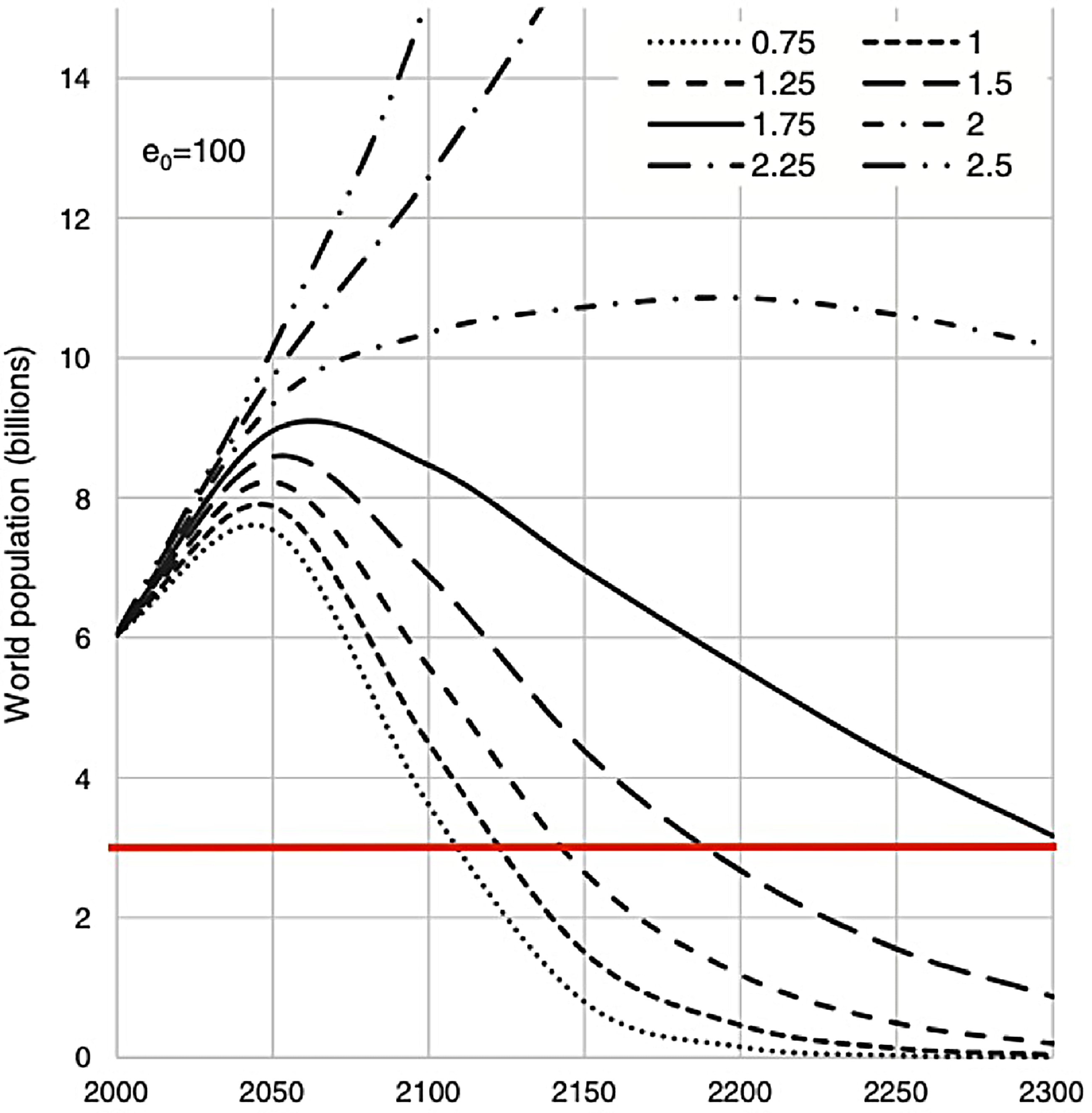
World population scenarios over the next three centuries with different long-term fertility levels (TFR) achieved by 2050, and assumed average life expectancy at birth will not increase beyond 100 years (horizontal line indicating population level of 3 billion).
An ambitious programme of development and redistribution, of the kind outlined in our preferred pragmatist position below, might set us on a trajectory where a population of 3 billion emerges toward the end of the next century. 4 Yet we believe that as an explicit objective, a population of 2 or 3 billion by such a distant date would not be regarded as meaningful by present day electorates or policy makers, and we would also note that technological uncertainty makes a fixed ‘sustainable population’ figure on the scale of two centuries extremely difficult to forecast. This differs from a scenario where such population levels emerge as an unintended consequence of achieving a better life for all while averting environmental change within a tangible timeframe – a long-term trajectory that might be viewed by current populations as positive in the abstract.
Difficulty of achieving adequate cuts in global consumption
It also seems unlikely that the drastic sacrifices in rich-world consumption called for by ecocentrist and many equal shares authors could be achieved by the end of this century.
We can quickly dispense with ecocentrist positions which idealise hunter-gatherer societies (Manes, 1990; Oelschlaeger, 1991) and gloss over the constraints on flourishing imposed by high mortality rates and short lifespans caused by poverty and disease (Gurven and Kaplan 2007; Volk and Atkinson, 2013). While few contemporary ecocentrists would advocate returning to hunter-gatherer lifestyles, the celebration of technical simplicity, connection with nature and low material consumption, although appealing in the abstract, is significantly out of sync with the actual, mainly urban, highly mediated lifestyles of most people in the Global North.
More moderate ecocentrist authors such as Crist (2019), who embraces modern technology and its welfare advances, envisage ‘drastically reducing consumption’ by ‘deindustrializing food production, localizing economies, and greatly reducing global trade’ (Crist, 2019: 6). Her proposals are more in alignment with those of authors in the equal shares tradition to whom we now turn.
The consumption reductions called for by some equal shares authors are also unlikely to be tolerated in the Global North. O'Neill et al. (2018) argue that with transformed global provisioning systems, 7 billion people could potentially enjoy a ‘good life’ where basic needs and qualitative SDGs are met. Yet their condition of ‘sufficiency in resource consumption’ (92) results in an extremely low per capita consumption level compared with that currently underpinning living standards in rich countries – all of which substantially overshoot planetary boundaries.
More importantly, O'Neill et al. note that no single country currently provides a ‘good life’ whilst remaining within planetary boundaries – indicating the great challenge of achieving such a scenario globally in a short timeframe. Even if developing countries restricted themselves to edge-cases like Costa Rica, which achieves a ‘good life’ whilst almost remaining within planetary boundaries, rich nations would still require drastic consumption cuts to ‘dramatically reduce their biophysical footprints by 40–50%’ (Hickel, 2018: 18).
Schlesier et al.'s (2024) modelling accepts the UN's median population projection of over ten billion by century's end and sets out conditions under which such a population might be environmentally sustainable. While the technological changes are feasible, the social changes required are exacting, with substantial rich-world consumption cuts and ‘far-reaching dietary changes’ (a vegan diet with the exception of seafood).
It is hard to imagine rich nations undertaking large consumption cuts in time to address our present environmental predicament. Büchs and Koch (2019) maintain that current societies are locked into a growth-based economic model, meaning major degrowth would present significant challenges to short-to-medium-term wellbeing. Although planned degrowth differs from economic depression, its objective is to considerably lower biophysical throughput, necessitating rapid declines in material living standards. Rapid rates of change disrupt agents’ habitus – those taken-for-granted social practices closely linked with identity and feelings of safety or, in the terminology of SST, ‘ontological security’. Büchs and Koch observe that ‘people's identities and life goals are closely aligned with the idea of growth – shaped by ideas of social progress, personal status and success through careers, rising income and consumption’ (2019: 160).
Empirically, consumption reductions exhibit an especially well-established negative relationship with subjective wellbeing (Büchs and Koch, 2019: 156). Even flatlining living standards would likely clash with deeply embedded expectations of ever-improving health and wellbeing in affluent nations. These expectations stem from tacit understanding that the future will follow predictable regularities of the past – as such, they are also part of the individual's habitus and can generate powerful feelings of dislocation when disrupted (Koch, 2020).
Schlesier et al.'s dietary change requirement, meanwhile, would require a revolution in an aspect of habitus that is amongst the most deeply sedimented of all, and a disruption of practices closely associated with cultural identity. Even in wealthy regions with trends toward reduced meat consumption, the number of people entirely excluding animal products remains extremely small (Vegan Society, n.d.). More importantly, globally, animal product consumption continues to grow rapidly, largely as a function of growing incomes (Ritchie et al., 2019).
Although we by no means wish to suggest that significant changes in consumption patterns are impossible or even net-negative, all of the above suggests that the extremely rapid reductions in consumption suggested by O’Neill et al. (as well as authors such as Crist (2019)) would likely generate intractable opposition among the affluent populations of the Global North, making such a project electorally unviable. Of course, many in the equal shares tradition use average European living standards as their target (Lianos and Pseiridis, 2015), which would be much more acceptable to rich-world populations. However, adopting such high standards for everyone on earth – total equality at very high resource consumption levels – necessarily implies a much smaller optimum population. These arguments then fail for the reasons given in the previous subsection.
The pragmatist position
The third approach, which we term the ‘pragmatist’ position, is exemplified by the Earth4All Initiative's investigation of a sustainable global population size (Callegari and Stoknes, 2023). Like the ‘equal shares’ tradition, Callegari and Stoknes specify a desirable human welfare standard while noting that its achievement relies upon respecting environmental limits. This standpoint sidesteps contentious arguments about intrinsic value while still supporting environmental wellbeing.
Earth4All's optimistic scenario – termed the ‘Giant Leap’ – calls for five social and technical ‘turnarounds’ by 2100: achieving an income for everyone on Earth of at least $15,000 per year; reducing global and national inequality; empowering women; instigating food system change for human and planetary health; and transitioning entirely to renewable energy. The first turnaround is notable, as $15,000 is the figure required to meet human wellbeing as defined by the SDGs (Randers and Collste, 2023). Since the SDGs are normative goals deliberatively determined by a wide range of actors, the pragmatist position is compatible with various value-systems and has relatively high normative desirability.
The approach departs from the equal shares tradition in its emphasis on social achievability. Callegari and Stoknes note that their turnarounds ‘are designed as policy and investment roadmaps that will work for the majority of people. They are not an attempt to create some impossible-to-reach utopia’ (Callegari and Stoknes, 2023: 20). In contrast, the equal shares position is unlikely to be achieved this century.
A key reason for the pragmatist position's achievability is its gradual approach to realistic objectives over meaningful timescales. While Callegari and Stoknes specify an ambitious reduction in the number of people living on under $15,000 per year to roughly zero by 2100, that fall takes place over several decades (Randers and Collste, 2023). The authors’ temporal modelling contrasts with the thought-experiments of the equal shares tradition, where the global welfare target is binary: either satisfied (sustainable) or unsatisfied (unsustainable). The pragmatist position shows that the welfare standard can be approached continuously across time – if we are on track to meet it at an acceptable future date, without degrading environmental systems to a degree unacceptable to our values, such a scenario should count as ‘sustainable’.
Similarly, the authors treat planetary boundaries not as limits within which we must immediately constrain ourselves, but as thresholds to which we can gradually return. Their Giant Leap scenario is ‘sufficient to start reversing the current unsustainable human threats to ecosystems’, but recognises that ‘many of Earth's nine life-supporting systems cannot be fully returned to a safe operating space by 2050 or even 2100’ (Callegari and Stoknes, 2023: 24). We might not return to within planetary boundaries by 2100, but we can be on the path to doing so at some future date, in contrast with the base run scenario in which irreversible earth-system flips seem more likely.
Callegari and Stoknes explicitly do not provide an ‘ecotopia-scenario where humanity and Earth's systems live in… mid-term Holocene conditions’, which they consider unachievable this century (Callegari and Stoknes, 2023: 37). Instead, they highlight normative issues such as ‘Who takes the decision on what is a tolerable level of planetary risk?’ and ‘By when should the economy's pressure on the planetary boundaries be back within safe zones? In 1, 20, 50, 80 or 120 years?’ (Callegari and Stoknes, 2023: 38). We believe these are the right kinds of questions to ask.
What does this imply for sustainable world population? The pragmatist position focuses on meaningful timescales and pathways to objectives rather than specifying an absolutely sustainable population. By the end of the century population will be lower than it presently is but significantly higher than that specified as sustainable by the ecocentrist or equal shares positions, and humanity will not be living within planetary boundaries. In the Giant Leap scenario world population peaks at 8.5 billion in 2050 before falling to 6 billion by 2100 (Callegari and Stoknes, 2023).
Earth4All takes the historically demonstrable, cross-regional, negative correlation between birth rates and GDP as the ‘causal bedrock’ of their model. There is considerable debate about this relationship (Cleland and Wilson, 1987; O'Sullivan, 2023) and in reality, the expected fertility transition in much of sub-Saharan Africa, where most future population growth will occur, has not kept pace with economic development (Bongaarts, 2017). The acceleration of Africa's fertility transition will be critical to achieving Earth4All's Giant Leap. They acknowledge the importance of policies specifically aimed at reducing fertility, either directly or indirectly, such as those addressing women's access to contraception, healthcare, education and opportunity (Randers and Collste, 2023). The potential efficacy of these policies is demonstrated by Vollset et al.'s (2020) modelling where meeting the contraceptive and education aspirations of the SDGs leads to a population of 6.29 billion by 2100. The population size detailed by Earth4All therefore seems feasible, even if not achieved via GDP growth alone.
Unlike the ecocentrist and equal shares positions, the pragmatist position does not require drastic rich-world consumption sacrifices. In Callegari and Stoknes’ Giant Leap scenario, inequality almost halves by 2100, but is not eliminated (Earth4All, 2024). Achieving a global baseline income of $15,000 annually does not imply that everyone will be living at that threshold and no higher. Global GDP per capita in the Giant Leap scenario grows to $55,000 in 2100 (Earth4All, 2024) – greatly above today's global average, which is around $15,000 (Randers and Collste, 2023). This suggests that rich-world living standards are largely maintained 5 .
Such a cautious approach is warranted. There is little evidence that heightened environmental concern has led to willingness to radically change established lifestyles (Alcock et al., 2017; Cocolas et al., 2021; Fisher et al., 2018; Ramos et al., 2020). From our Strong Structurationist perspective, this is explained by the embeddedness of high-impact practices in everyday life, closely connected with agents’ ontological security.
However, our theoretical perspective does not suggest that all change is implausible. In pursuing their everyday lives, agents triage their ‘hierarchy of purposes’ in the context of particular social structural conditions. Those conditions include the influence of ‘macro agents’, such as national governments and regulatory agencies (Mouzelis, 2008). While more immediate priorities in ordinary peoples’ hierarchy of purposes may override their genuine environmental concerns, such concerns nonetheless represent a basis on which governments can introduce restrictions on high-impact practices. However, legislation that is too radical will disrupt other priorities more elevated in agents’ hierarchy of purposes, eroding legitimacy and risking reversal at the ballot box. The perceived trade-off between economic growth and environmental security varies widely across social groups (Gugushvili, 2021). Thus, the consumption reductions envisioned by the ecocentrist and equal shares positions, which require people to constantly prioritise their environmental values, are unlikely to succeed compared with the more feasible changes specified by Earth4All's Giant Leap.
The Giant Leap's ‘five turnarounds’ are by no means business-as-usual. Tackling global inequality, for example, requires that the richest 10% of national populations take no more than 40% of national incomes (Callegari and Stoknes, 2023). Nonetheless, the alternative – Callegari and Stoknes's base-run scenario, termed ‘Too Little Too Late’ – entails increased inequality and ecological footprint, massive wildlife losses, and heightened risks of regional societal collapse. That comes in exchange for a higher world population, but it would not be a world in which most people would want to live. Faced with that scenario, the pragmatist position constitutes our greatest plausible hope.
Conclusion
This article has examined three distinct approaches to environmentally sustainable population through the dual lenses of normative desirability and practical achievability within meaningful timescales. Our analysis reveals fundamental tensions between aspirational ideals and implementable pathways in sustainability discourse.
The ecocentric position, while offering a compelling critique of anthropocentrism, fails on both evaluative criteria. Its reliance on contested philosophical foundations – particularly intrinsic value in nature and biocentric equality – renders it incompatible with a variety of moral theories as well as undermining its broad social acceptability. More critically, the ecocentric emphasis on value transformation as a prerequisite for social change overlooks the complex relationship between agents’ worldviews and their actual behaviours within existing structural constraints.
The equal shares approach demonstrates greater normative robustness, drawing from pluralistic frameworks such as the SDGs and the capabilities approach that accommodate various ethical perspectives while maintaining a focus on both human and environmental welfare. However, its achievability remains questionable given the demographic momentum that would delay population reductions to 3 billion until well beyond 2100, and the politically implausible consumption sacrifices required of Global North populations within meaningful timescales.
Our Strong Structurationist analysis illuminates why both positions struggle with implementation. Agents operate within hierarchies of purposes where environmental concerns, however genuine, must compete with more immediate priorities embedded in habitus and social identity. The rapid transformations demanded by the ecocentric and equal shares positions – whether in fertility preferences, consumption patterns or value orientations – would disrupt the ontological security that grounds agents’ everyday social lives, generating resistance that undermines the political viability of these perspectives.
The pragmatist position, exemplified by Earth4All's Giant Leap scenario, offers a more promising alternative by acknowledging these structural realities while maintaining ambitious environmental and social goals. By focusing on gradual transitions toward greater sustainability rather than the achievement of absolute thresholds, and by avoiding consumption sacrifices that would destabilise existing social arrangements, this approach provides a pathway that could plausibly gain broad democratic support across nations.
Critically, the pragmatist position recognises that sustainability is not a binary state but a trajectory – we need not achieve perfect ecological balance immediately, but rather establish credible pathways towards it while addressing pressing human needs. A world population of 6 billion by 2100, living at improved welfare levels while beginning to reverse environmental degradation, represents neither the ecocentric ideal nor the equal shares optimum, but it constitutes a realistic foundation for longer-term sustainability.
While we acknowledge that sustainable population calculations have value in illustrating the trade-offs between environmental impact, consumption and population size, our analysis suggests that meaningful progress on environmental challenges requires abandoning perfectionist visions that neglect implementation constraints, in favour of ambitious but achievable reforms working with existing motivation structures. While this may disappoint those seeking radical transformation, it provides hope that humanity can begin addressing the environmental crisis without requiring fundamental alterations to existing ethical sentiments or social organisation that have proven historically elusive.
The choice is not between an ideally sustainable world and environmental collapse, but between different degrees of sustainability achievable through different pathways. In a context where demographic momentum and deeply embedded social practices constrain rapid change, the pragmatist position represents our most viable route toward a future that, while imperfect, offers both human flourishing and environmental restoration within timescales meaningful to current generations.
Footnotes
Acknowledgements
We would like to thank David Wadley for commenting on an earlier draft of this article and the anonymous reviewers whose comments helped us clarify our position. Thanks also to Rob Stones for his ongoing intellectual support and encouragement.

Funding
The authors received no financial support for the research, authorship, and/or publication of this article.
Declaration of conflicting interests
The authors declared no potential conflicts of interest with respect to the research, authorship, and/or publication of this article.