




Abstract
Ecological grief is a widely experienced response to the world's rapidly intensifying environmental crises and motivates people to take environmental action. Experiences of ecological grief vary, however, depending on the wider values and attitudes of the groups experiencing it. This paper describes, for the first time, the experiences of ecological grief amongst environmental activist Christians. The paper draws on findings from a survey (n = 319) and recent qualitative interviews (n = 62) with Christian environmental activists from six organisations in the UK. Research with these environmental activists shows that they understood ecological grief in relation to four main theological themes: (a) damaging creation, (b) wrecking a gift, (c) failing to steward well, and (d) harming divinity. This paper argues that these four areas can be gathered under the single theme of breaches in relationship with God and with extrahuman life. That is, ecological grief, for these environmental activists, involves a sense of rupture in relationship to God and other non-human lifeforms. This argument is developed and framed through theological and philosophical literature concerning gift-giving, environmental stewardship, creation theology, and divine immanence. The resulting account is a unique and relationally focused description of the experience of ecological grief.
Keywords
Introduction
As climate change and other ecological crises continue to intensify, feelings of ecological grief in response are becoming increasingly common. There has been a proliferation of recent reports of grief connected with various forms of ecological loss from across the world (Ágoston et al., 2022; Amoak et al., 2023; Whale and Ginn, 2017). This is particularly acute amongst younger age groups. A 2021 study of 10,000 people aged 16–25 years from 10 countries found that 42% reported feelings of ecological grief (Hickman et al., 2021).
Studies on experiences of ecological grief reveal that the experience is typically associated with ‘experienced or anticipated ecological losses, including the loss of species, ecosystems and meaningful landscapes due to acute or chronic environmental change’ (Cunsolo and Ellis, 2018). Ecological grief is generally felt with respect to losses to particular places of ecological importance, particular forms of environmental knowledge, and to intangible losses, including individual and collective identity, belief, and group cohesion (Cunsolo and Ellis, 2018: 276–7; Pihkala, 2024a: 6–8). Research into ecological grief, therefore, must be context-sensitive and open to the ways in which these experiences vary across different groups and are framed by their worldviews and assumptions. For instance, whether the grief is related to experiences of the loss of Caribou for Canadian Inuits (Cunsolo et al., 2020), the Great Barrier Reef for Australians (Marshall et al., 2019), or biodiversity in the Philippines amongst their significantly affected youth (Aruta, 2023).
Religious worldviews and values are also an important, yet unresearched, contextual frame for giving meaning to experiences of ecological grief. Despite the fact that Christians make up 29% of the global population (Hackett et al., 2025), there is a paucity of research into experiences of ecological grief amongst Christians. This research is scarce and limited to a few articles that have focused on how religious people can cope with ecological grief (Pihkala, 2025), how difficult eco-emotions, including eco-grief, can be engaged with constructively (Pihkala, 2024b), and a collection of short articles featuring a handful of diverse self-conceptualisations within particular Christian contexts (Malcolm, 2020). The reason for the paucity of research may be due to the fact that, since the publication of White Jr's (1967) article criticising the inherent anthropocentrism of Christian theology, Christians as a group have been deemed to lack interest in environmental issues. This view has been supported by evidence from social science, which has recently argued that ‘Christians are the least environmentally friendly demographic’ (Bickley et al., 2024; see also Konisky, 2018). Hence, Christians are sometimes overlooked as a group who care about ecology, and hence are not a target for studies in ecological emotions. More generally, research on the ecological emotions is still a very new area, currently in its infancy, and major research studies are still relatively new.
However, understanding the emotional experience of grief towards ecology amongst Christians is important for at least three reasons. First, ecological grief can motivate pro-environmental behaviour (Kovács et al., 2024), and given the size of the global Christian population (29%), and hence the substantive contribution Christians could make towards environmental care (Malcolm and Scott, 2025), it is important to understand what could motivate them towards taking pro-environmental action. Second, ecological grief ‘can be predictive of mental health difficulties such as depression, psychological distress and clinical anxiety’ (Lawrance et al., 2022: 464), and this might include Christians as well, though such negative mental health consequences have primarily been found to be the case within indigenous communities with a strong connection to place (Middleton et al., 2020). Third, and as this paper argues, some Christians experience ecological grief in ways that are unique to that group, and so generalised descriptions of ecological grief will not do justice to their distinctive experiences.
This paper provides an account of the uniqueness of Christian experiences of ecological grief by listening to the voices of Christians who care strongly for the environment, and interpreting their experiences in light of concepts and ideas from Christian theology. The paper draws on 62 qualitative interviews carried out with UK-based Christian environmentalists during 2023. As we will see, this data reveals four different theological themes within which expressions of ecological grief were made. These are ecological grief with respect to (a) damaging creation, (b) wrecking a gift, (c) failing to steward well, and (d) harming divinity. The paper gives examples of each of these themes from the interviews, and argues that they each are connected by a single, overarching theme – that they mark breaches in a person's relationship to God and extrahuman life. It is in this sense that the experience of ecological grief is felt distinctively amongst these Christians. This paper therefore defends a relational theory of ecological grief, according to which some Christian experiences of ecological grief involve, not only the felt loss of natural environments and ecological systems, but also the loss or damage to a relationship with God and extrahuman life.
These findings are part of a wider developing literature on the relational components of ecological grief. For instance, the work of Kałwak and Weihgold (2022) takes ecological emotions broadly to show the human need for ‘relationships for their emotional wellbeing, be it to realize that there are others who feel the same or be it to find peer examples’. Other work focuses on the importance of mourning for ecological grief. According to Burton-Christie (2011), lasting ecological restoration depends on deep expressions of grief and mourning, whilst Varutti (2024) argues that a lack of mourning for ecological losses is a negation of our relationship with, and act of derealisation of, nonhuman life. So, ecological grief may provide opportunities to relate to others through collective expressions of grief and lament, and in so doing, recognise the Other that humans have neglected through practices of environmental damage and destruction. And beyond this, according to Bailey and Gerrish (2024), ecological grief also provides ‘opportunities for local people to build relationships and develop new skills, such as growing food and working collectively with others, natural systems and non-human life’.
The next section of this paper outlines the methods involved in the research study, and describes how the theory outlined and defended in this paper was arrived at. The paper then defends the relational account in the context of the wider literature on ecological grief by drawing extensively both from interview data and theological theory. The paper concludes with a discussion of next steps for research and practical applications of the work.
Studying Christian environmentalists
Christians in many countries are becoming more involved in a range of forms of environmental advocacy and activism (Koehrsen et al., 2023; for the history of Christian environmentalism, see Conradie et al., 2023, section 2; and Nita, 2016). In the context of the UK, where this research was based, environmental advocacy and activism takes place across a range of contexts. For instance, the national Church of England (CofE) has adopted a policy to achieve carbon net-zero within the organisation by 2030. 1 This involves a transition to renewable energy sources within its significant building stock, especially schools and cathedrals. The Church of England also delivers training to ministers and lay ministers on creation care, and supports the Eco Church scheme run by A Rocha, which equips ‘churches to care for God's creation’. 2 A similar commitment to sustainability and carbon transition has been developed in the Catholic Church of England and Wales (CCEW), which has a net-zero target of 2028, and through the Guardians of Creation project, provides environmental education in Catholic schools. 3
Other groups focus more on development and campaigning work. For instance, CAFOD (Catholic Agency for Overseas Development) have turned their anti-poverty work to campaigning around environmental issues and the impacts of climate change, as have similar organisations like Christian Aid, the Salvation Army, and Tearfund). 4 Operation Noah, which launched in 2004 as the campaigning ‘sister organisation’ of the environmental group Green Christian, campaigns to secure Church of England divestment from fossil fuels and to rewild church land. 5 The social movement group Christian Climate Action (CCA) was formed in 2012 to engage in political activism within the broader environmental movement (Harmon, 2020). Since 2018, CCA have described themselves as the ‘Christians in Extinction Rebellion’. They engage in acts of political campaigning, protest and demonstration.
Research was carried out in 2023 on the beliefs and motivations of six groups from these UK-based Christian environmentalist organisations as part of the Religion, Theology and Climate Change Project. 6 We sampled environmentalist Christians working across Catholic and Protestant church dioceses, international development agencies, and activist groups. These groups were (1) the CofE Diocese of Manchester; (2) Operation Noah; (3) Christian Climate Action; (4) CAFOD; (5) the CCEW Diocese of Salford; and (6) the CofE Diocese of Oxford (for a full overview of organisations, see Malcolm and Scott, 2025 and Deane-Drummond and Malcolm, 2025). The numbering of these organisations from 1 to 6 is reflected in the numbering of the interview quotations in the following section. The numbering was randomly generated to protect anonymity.
The research with these groups had two main stages: a survey and a range of qualitative interviews. The survey was administered online using Qualtrics from May to August 2023 and received 319 responses. Participants were recruited through email lists and WhatsApp groups distributed by organisational gatekeepers. No incentives were provided for completing the survey, which took a mean time of 9 min to complete. The survey included questions covering ecotheological beliefs, influences on advocacy and activism, and emotions and activist actions relating to climate change (for full details, see the Survey Supplement).
One survey question asked interviewees to state the three primary feelings they felt when thinking about climate change from a list of options, including an open text box. Many different emotions have been recorded as responses to climate change and environmental harm more broadly (for an overview, see Pihkala, 2022). Several emotions, in particular, have been subject of strong scholarly interest in the context of the environmental crisis, which Kovács et al. (2024) identify as being anger, anxiety, sadness, guilt, motivation and hope. We aimed to include these affective states, or variants of them, given their apparent central importance to motivating environmental action. On this basis, we directly selected ‘motivated’ and ‘hope’. However, for the other feelings, we chose slightly stronger variants where they seemed more salient to our target population of activists and highly motivated environmentalists. This is particularly the case since this survey was used primarily to elicit qualitative responses during interviews, rather than to carry out statistical analysis, in which case responses would have been scaled instead of categorical. So, rather than anger, we selected ‘rage’ for its stronger political connotations, which has been found to relate to environmental activism (Bergman, 2023; Brosch, 2025; Curnow et al., 2021). For similar reasons, we chose ‘grief’ rather than sadness, which is also an important motivator for environmental activists (Knops, 2024), and ‘panic’ and ‘helpless’ over the more common feelings of fear or anxiety. We also selected ‘regret’ and ‘failure’ instead of guilt since guilt has stronger theological connotations that we wanted to avoid in our Christian sample. We also wanted to cover more positive emotions, and so we included ‘optimism’, as well as ‘pessimism’ for balance.
Despite the use of less common environmental emotions terms, the strongest feelings we recorded are closely related to the more common environmental emotions (see Chart 1).
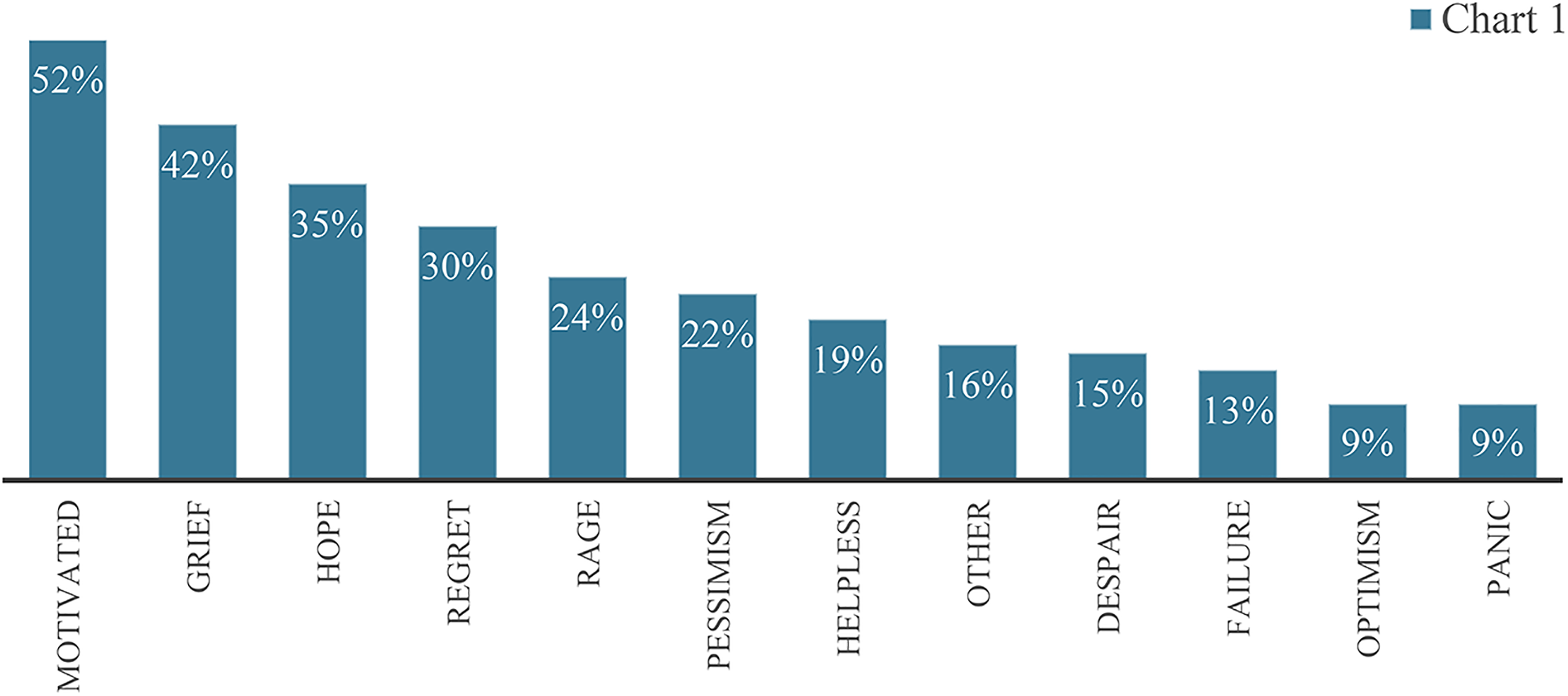
Top 3 feelings about climate change.
Motivation and hope were both in the top 3 of respondents’ primary feelings, whilst regret (in place of guilt) and rage (in place of anger) were in the top 5. And for the purposes of this paper, 133 people (42%) from the full survey sample selected grief as one of their three primary feelings – the second most frequently selected item. This may have been higher if participants could have selected ‘sadness’, though they might simply be substituting sadness for grief. Some studies offer both options, and sadness is sometimes more common (e.g., Hickman et al., 2021). Grief was also selected proportionally slightly higher amongst the interviewee sample, where it was selected by 32 of the 62 people (52%). These figures do not represent the extent to which the research participants experienced grief – it seems plausible that many more people experienced grief to some degree. It simply marks that grief is a primary feeling for many of the participants, and that those participants recognise grief to be a major part of their emotional landscape around climate change. As has been found by others too (Ágoston et al., 2022), grief may also provide a motivational role in environmentalist work. Whilst these self-reports of ecological emotions provide a helpful guide, they are limited since people may not always be able or willing to report exactly what they feel. Hence, these reports were probed further during interviews to gain a clearer understanding of how the participants understood their grief experiences.
In-depth interviews (n = 62) were carried out from August–December 2023. The content of the interviews was structured around responses to the survey (see Interview Guide Supplement), and explored faith background and motivations for environmentalism, ecological emotions, views on justified forms of activism, ecotheological beliefs, and views on organisational challenges. Interview times ranged from 40 to 90 min (mean = 71 min). Interviews were conducted by the four members of the project team using Dictaphones, uploaded to a secure, password-protected university sever, and assigned a three-digit ID number, which was then prefixed by the number of their organisation (e.g., no.1 for Diocese of Manchester interviewees, followed by three digits, such as 015. These numbers appear in the next section after each interview quotation). The interviews were transcribed by a third-party university-approved company, in line with GDPR regulations, and located by ID number. Following transcription, audio files of interviews were deleted, and transcribed files were redacted for personal information.
Interviewees were recruited through an initial questionnaire with follow-up and organisational gatekeepers. Thirty-six interviewees were Anglican/Church of England, twenty-five were Roman Catholic, and one was ‘other’ Christian. Thirty-eight were female, twenty-three male and one non-binary. Thirty-four were above 55 years old (54%), and nine were below 34 years old (14%). Fifty-one were ethnically white, eight belonged to another ethnic group and three preferred not to say. For political ideology, 60% were ‘Left’, 16% were ‘Centre’ and 3% were ‘Right’; 21% preferred not to say.
All 62 interviews were transcribed and analysed using NVivo 12 by two members of the project team (one of whom is the author of this paper) from January to April 2024, following a process of thematic analysis (Braun and Clarke, 2006). Initial coding used a deductive framework based on the survey questions with 7 top-level codes and 93 sub-codes, with a further 17 codes added inductively (see the Codebook_General Supplement). The main bulk of these codes (n = 47) relate to theological themes, whilst 17 relate to ecological emotions. Between the two researchers, a total of 33 references were identified under the ‘grief’ code. These codes were then analysed, in June 2024, for theologically relevant content, and then sub-coded by theological theme. Four main themes in which grief was expressed in relation to theology emerged: creation, gift, stewardship and kingdom, and divine immanence (see the Codebook_Grief Supplement). A conceptual account was then developed from the participants’ self-identified grief experiences, which is described in the next section.
A relational theory of ecological grief
General experiences of ecological grief
The experience of ecological grief felt by the participants in this research must first be understood in relation to the wider experience of ecological grief (also sometimes referred to as ‘environmental’ or ‘climate’ grief), which has emerged as a major area of research in the last few decades (for a summary of the literature, see Pihkala, 2024a). It builds on the general understanding of grief from the fields associated with therapeutic psychology, in which grief is understood as the experience and felt ‘response to the loss of significant, core aspects of our assumptive world’ (Harris, 2019: 14). This can include loss of people with whom we hold significant relationships, as well as perceptions, values, meaning, beliefs and, saliently, our lived environments, including the natural world. When grief concerns nature, ecology and the natural environment, it is a grief reaction towards ‘the loss of ecosystems, animal life, plant life, and/or the destruction of the planet’ (Kevorkian, 2019, 2004).
What is the focus of the loss, and how the loss is felt, will be dependent on the individual and their different psychological dispositions, attachments and value orientations (Barnett et al., 2016). For instance, ecological grief may be associated with both tangible and intangible losses to physical ecological systems, ways of life and culture, environmental knowledge, or anticipated future losses of place, land and species (Cunsolo and Ellis, 2018: 276–78). Since the losses associated with ecological grief ‘begin in the deep past and extend into the deep future’, such grief ‘exceeds the span of human seasons, lifetimes, epochs, and even species-being’ (Saint-Amour, 2020: 139). This can make what is lost appear nonfinite, with the future merely a place of catastrophe (Head, 2016: 49), making ecological grief a chronic experience in which the losses associated with ecological grief are ‘ongoing without a foreseeable end and there are constant reminders of what has been lost and the potential of what will be lost with time’ (Kevorkian, 2019: 222). Ecological grief can also feel disenfranchised, as when ‘others fail to acknowledge or legitimate one's grief’ (Ratcliffe, 2022: 211), and can require rituals, including in engaging forms of activism (Pike, 2017: Ch7), for processing the emotional experience associated with ecological grief (Menning, 2017).
These general descriptions of ecological grief cohere with accounts given by the Christian environmentalists in the present study who expressed grief as one of their primary feelings connected to climate change. For instance, one person said that they felt ‘grief because I find the world really beautiful. I love hiking, walking, pilgrimages … I just love the beauty that we are surrounded by. I love penguins and the worst thing recently … is the Emperor Penguins are becoming extinct and I just think, how can we do that?’ (4002). This person's grief begins from a place of love and wonder for the natural world – close to what some people have called ‘biophilia’ (Fromm, 1964). When the place they love is destroyed, and the creatures it contains are driven to extinction, this triggers a felt experience of loss that registers significant sadness. As another person said, ‘mostly I feel sad for all the woodland and the wonder that we've lost – all the species that we've lost’ (5002). These experiences were widely felt within our study participants. One person spoke of growing up near a beloved mountain, normally covered in snow year-round, but where global warming had left it ‘never looking so bare’ (2012). Another talked about their local river being ‘one of the most beautiful rivers ever’, but now ‘full of chicken manure … [which] is absolutely destroying it’ (4003).
The Christians we interviewed clearly experience a form of ecological grief in terms of a felt loss to ecosystems, animal and plant life, and harm to the planet. However, their experience also had a unique framing that went beyond this general experience of felt grief. The framing for their grief is, as we would expect, partly in line with their Christian beliefs – it has a theological framing, which shapes, and in some ways enhances their grief experiences. The next sections develop this account, and connect the experiences to the larger theme of loss of or breaches in relationship to God.
Damaging creation
This section outlines how the uniqueness of the grief experiences of the participants is felt in relation to environmental loss as harm to God's creation. The participants do not experience, for example, biodiversity loss, species extinction, pollution and environmental degradation simply as losses to ecology and environment, but as damage to creation (see Wirzba, 2015). Participants consistently referred to the world as creation, with this appearing in every single one of the 62 interviews, always with multiple references. This section gives examples of how grief is expressed in relation to damage to creation, which occurs explicitly in 4 cases. It is then argued that, when placed within a theological anthropology of humans as created beings – Hall's (2004) relational account of imago Dei – we can see how damage to creation could be taken to undermine a relationship between God and humanity.
To see how some participants see ecology and environment – what they refer to as ‘nature’
7
– as creation, consider this expression of grief from one interviewee: the grief is a sense of loss. When I think about just how awe-inspiring creation is … when we see nature we feel that it is overwhelmingly beautiful … So, the grief is over that majesty and beauty and wild amazingness. (3009) You know these species that have gone and it's not like they've just gone to another place or they're in a zoo. They've literally – God's creation will literally no longer see them, and there's some things that we don't know that we've lost, like the deep-sea mining and going into the beauty of the deep sea floor, that we've not even studied yet. (5002)
So, how is the extrahuman natural world (what is sometimes referred to as ‘nature’, including by the participants in this study) different from creation? And what effect does this have on the experience of ecological grief? One way to answer these questions is to begin with an account of humans as created beings. Within a Christian theological anthropology, such accounts generally begin from the creation sagas of Genesis 1–2, where humans are described as being created in the ‘likeness’ (v.26) or ‘image’ (v.27) of God. One interpretation of this symbol of imago Dei is in terms of relationship. In the work of Douglas John Hall, for instance, the imago has as its essence an ‘underlying presupposition that the human creature is created for relationship, that is, that relatedness-in-love is our very essence and vocation as creatures of the God who is love. We image God in loving’ (Hall, 2004: 132). According to Hall, our relatedness-in-love has ‘three distinctive foci: God, other human beings, and extrahuman creation’ (Hall, 2004). The first two – God and humans – are clearly captured in Jesus’ summary of the Hebrew law in Matthew 22:37-40 – to love God and neighbour. The third aspect of the relational dimension – the extrahuman creation – is taken by Hall to be implicit in the Hebrew laws and creation narratives of the Torah, but must be ‘made explicit in our historical moment because of the crisis of nature’ (Hall, 2004).
Being related-in-love across these three dimensions is, for Hall, a matter of ‘being-with’ in coexistence, which entails ‘being-for’ in ‘proexistence, and ‘being-together’ in communion, community, and covenant (128). When we fail to be related-in-love – when we break from this relational ontology – we distort our human nature as created for this purpose. The expression of this is ‘being-alone’, which involves ‘being-against’ in estrangement and alienation, and either ‘being-above’ in pride, or ‘being-below’ in sloth (Hall, 2004). For Hall, this is just what it means to sin, which is ‘simply the negation (or the attempt at negating) of the relational structuring of the being for which we were created’ (Hall, 2004).
There was evidence from the interviewees that they endorsed something like this account of humans as being in relationship with the extrahuman creation, alongside their relationship to God and other humans. For instance, 18 of the interviewees described other animals as their neighbour, and 30 explicitly claimed that ‘creation’ had intrinsic value. For example, one person spoke of their practices of landscape photography as ‘one of the ways in which I enter into a connection with my creaturely kin’ (2011). They went on to say that they spend time in nature so that they can see more clearly how the human-other creatures’ relationship, and how that connection, can be used in a way that inspires awe and wonder. In a way that makes you marvel, in a way that can point towards a kind of interaction between humanity and everything else, which is positive rather than negative; which is fruitful rather than destructive. (2011)
Viewing non-human lifeforms as creaturely kin erodes a hierarchical stance, which sees humans as superior to nature. As another person expressed it: ‘to think of creation as a hierarchy doesn’t help … But what is helpful is to think of the unique beautifulness of every single created thing, and they’re all part of a pattern and an order’ (4009). This was explicitly connected to the idea that humans are relational beings, and are in relationship with all forms of life. As one person put it, thinking of ourselves as ‘separate from nature [where] we must dominate nature’ leads to a rupture of our relationship with each other and with nature because we then want to hoard and collect, whereas when we are in equal relationship with nature, there's this idea of even hoarding any resource already knocks something out of balance and is clear in its impacts very quickly. (2005)
The relational ontology between humans and extrahuman life as creatures, and God as creator, provides a framework for understanding grief responses to the loss of nature as creation. 8 For not only is there a felt experience of the loss of animal species and destruction to the environment, much of which is viewed as beautiful and awe-inspiring, but moreover, as a loss of relationship. Grief is often most pronounced to humans when what is lost is a person or thing with which we had a relationship. And, on the account offered by Hall, when we are against the creation, then we experience an alienation or estrangement from it. But through this alienation with the wider creation, humans also experience an alienation from the God who created it. To take the words of Jenkins (2008: 93), ‘Environmental lament and redress begin from a primary spiritual communion of humanity and earth, assumed into personal experience with God’. And it is this alienation that the practices of contemplation and nature-connectedness of our interviewees are aiming to resolve – to restore a being-with in loving communion with the creation. And so the felt loss of nature can be understood also as a felt loss of relationship to the rest of the created order, and to God as creator, both to which humans were made to be in communion.
Wrecking the gift
A second layer to the relationship between creator and creation within which ecological grief was felt by the interviewees was in connection to the theme of gift. This section first discusses how participants viewed creation as a gift, which occurred in 38 of the transcripts, and explores how gift-giving underpins a relationship by looking to the work of anthropologist Hénaff (2010). It then reviews instances where grief is explicitly expressed with respect to the destruction of gift, of which there were 5 clear examples, and argues that this expresses the undermining of a relationship.
For the research participants, creation is not merely deemed to be made by God, but also gifted by God to humans: ‘God created the natural world and gifted it to us’ (1005). For some participants, moreover, as we’ll see presently, the gift of creation is thought of as gifted to all of life: ‘creation is … God's gift to us, but actually, it isn’t just about us’ (1004; see also Oliver (2021)). How can we understand the idea of gift as underpinning a relationship between God as gift-giver, and humans, and indeed all of creation, as gift-receiver (Saarinen, 2005)? Whilst numerous authors have written on this theme, particularly within continental philosophy and sociology (Derrida, 1996; Mauss, 2001), one helpful treatment is in the recent work on ceremonial gift by Hénaff (2010).
According to Hénaff, in many premodern societies, exchanging goods is for the purpose of establishing bonds of recognition and relationship. Due to this, it was important for gifts to be given and received in ceremonial contexts: ‘Ceremonial gift exchange manifests a fundamental structure of reciprocity as a condition for all social life in the human species’ (138). Giving and receiving gifts ceremonially was ‘to recognize one another through the back-and-forth circulation of presents … The end of the gift is neither the thing given … nor even the gesture of giving … but the creation or renewal of an alliance. Ceremonial gift exchange is a relationship’ (134). 9
Now, the idea of creation as a gift from God cannot be analogous to ceremonial gift exchange, or to gift economies (Kimmerer, 2024), since gifts cannot be given back to God. But the point can still apply that the giving of creation to the life contained within it can still be the basis for a relationship between giver and recipient, and that this is the point of God giving creation as a gift, to make a ‘bond between participants’ (Hénaff, 2010: 208–9) – to make a relationship between God and creation. But whilst the creation cannot respond in kind with a gift to the creator, it can respond with either refusal of the gift, or with thankfulness for it. This point has recently been developed by Wirzba (2015). If it is the case that gift-giving underpins a relationship, then in refusing the gift, the receiver ‘expresses a rejection of the gift and a rejection of the giver’ (135). However, showing gratitude for the gift with thanks – to say ‘thank you’ – ‘is to affirm the ‘you’ as a vital and appreciated presence in one's life … to give a gift to another and to give thanks for a gift received—these are acts that express one's respect for others and one's desire to be in continuing relationship with them’ (Wirzba, 2015).
If God's gift of creation cannot be reciprocated in gift exchange, but only acknowledged with thankful gratitude, then what kind of a gift is it? One answer is to follow the language around the giftedness of God's son in John 3:16: ‘For God so loved the world that he gave his one and only Son’. Here Christ is given as a gift in love, and if Christ is given in love, then so perhaps is the creation. As Douglas Hayhoe puts it, Christ is ‘the greatest expression of God's love … [and] if Christ is God's greatest gift, then surely creation is God's second greatest gift’ (Hayhoe, 2017: 106). To at least the same extent, or indeed perhaps to a much greater extent than ceremonial gift-exchange, a gift given in love would also underpin a relationship between giver and receiver. As the creation is offered in love, when received in thankful gratitude, a relationship is built between giver and receiver.
Two ideas would naturally follow from this idea of a gift given in love. First, it provides reasons for caring for the gift, namely, that doing so preserves the loving relational bond between giver and receiver. And second, if the receiver of the gift then goes on to trash or destroy this gift, clearly this will undermine the relationship, for it marks an insult against, and even a rejection of, the giver. Both of these ideas were evidenced in participant interviews, suggesting that they thought of creation as a gift given in love underpinning a relationship. For instance, one person said, in general terms, that ‘seeing the natural world, and the provision it gives to us, as a gift should alter the way that we interact with it,’ and they go on to add that ‘we should be treating the created world with much more respect and I think this comes from this idea of it being a gift’ (1005).
Another interviewee developed this point in relation to a gift given from someone whom you love: if it's a gift, if it's something freely given, then we should be grateful for it. And for many of us I suppose that would include taking care of it. If someone that you love very much gives you something, you tend to look after it more … [F]or me, something that's a gift should be respected and honoured in a way and taken care of. So yeah, I think certainly for some people, that is an important part of the message, that it's a free gift and we need to care for it. (1008)
The view of creation as a gift, underpinning a relational bond between humans and God, was widespread in the interviews. But interestingly, the interviewees also expressed the view that the gift, and its relational implications, extends beyond the human, to the rest of creation as well. As one person explicitly stated it, ‘I don’t think that creation is gifted to humans alone. The whole of creation is gifted to all of creation’ (1025). For some, that includes both sentient and non-sentient forms of extrahuman life: surely sentient animals experience the joy of life and creation around them. One can see animals enjoy their environment … and so, they too experience that gift … but in that sense, it's certainly a gift to animals, and I think therefore by extension in a sense, it's a gift to inanimate objects. The mountains that are beautiful, it's a gift to them as well. In some sense, creation is a gift to every bit of it. (2002)
From this place of relationship between God as gift-giver in love, and creation as gift-receiver in thankful gratitude, come expressions of grief over damage to the gift. One person said that ‘if you love God, that comes with a sense that you love what they made. You wouldn’t want to damage what someone has made’, and within this frame of receiving creation from a God who is loved, this person said that they felt so deeply sad that we live in a world where we have the capacity to make the world a good place to live in, as well as to destroy it, and we seem intent on the short-termism that means we destroy the world. (3010)
Other interviewees were more indicative about this connection: I feel a grief because the God who is abundant, that we read about in scripture, and is abundant because it is evident in our own lives, has in love, given us all that we have on the earth, and there's a grief about spoiling that … So, that makes me really sad. (1024)
The ecological grief felt by these environmentalists can be understood as, in part, a sense of loss of right relationship to God when the gift is viewed as one given in love, and subsequently damaged by the recipient. But there is another way in which a gift can be given, which creates a very different relational context, but again, a place from which the interviewees expressed their grief. This is the sense in which a gift can be given in trust. To see this difference, consider an example in which parents gift a car to their daughter. They could give this freely, without expectation of return. Alternatively, they could give it to her to learn how to drive, expecting her to return it in good condition. The first instance resembles a gift given in love, whilst in the second, the gift is given in trust, and in this instance, the gift still belongs, ultimately, to the giver. When given in trust, the reasons for caring for the gift are different. Here, we care for the gift because we want to respect and not to damage someone else's property, especially since doing so would be bad for our relationship. The gift of the car is an act of entrusting from parents to child, perhaps in the hope of inspiring trustworthiness in her (Pace, 2021), which is given due to the parent-child relationship. Analogously, the creation is gifted to humans to care for and to enjoy, though it ultimately remains God's property. Humans are to care for this creation, at least in part, because it would damage their relationship to God if they destroyed it, in the same way it would damage the parent-daughter relationship if she flagrantly destroyed the car.
The idea of gift in trust invokes the traditional idea of stewardship – important both within and outside of religious groups (Plummer et al., 2022; Welchman, 2012). As Willis Jenkins puts it, in this sense ‘humans receive creation as gift by receiving stewardship responsibilities for it, and they receive both in virtue of God's way of possessing—by giving, risking, and trusting’ (Jenkins, 2008: 82). And within this idea of stewardship, we find the third dimension to the expression of ecological grief amongst the interviewees.
Failing to steward well
This section describes how expressions of grief are related to stewardship and the kingdom. The theme of stewardship was the most common theological code across the participants (n = 94), being discussed in 51 of the 62 interviews. It also occurred the most frequently amongst the grief codes, appearing in 13 cases. The section begins by reviewing instances of grief expressions within stewardship. It then explores the related theological theme of kingdom, which occurs 11 times within the grief codes. Looking at theological work relating to stewarding the land, and how restoring the land is connected to building God's kingdom, particularly in the biblical theology of Brueggemann (1977), the section argues how failure to steward the land and to support a just kingdom indicates a breach in right relationship to God.
As where participants saw the creation as a gift, so too did they see that creation is to be stewarded. As one person put it: God created everything, not just the humans. Humans were asked to be stewards of that creation, but everything was created by God in the first place. His interest is that we steward, nurture, care for and preserve … creation. (6008)
In its most basic form, the idea here is that God created the earth and asked humans to look after it on God's behalf. And within this, there are clear expressions of sadness and guilt amongst the interviewees for a failure to carry out this task: there's a regret for how we are living, how I am living, that it's not more sustainable, not more showing good stewardship of creation. And some of that is a general feeling and some of it is specific, around specific choices that we may have made or I have made. So that's probably, I’d say, regret, which is – there's a guilt mixed in with that. But it's not just guilt, it's sadness as well. (4018) The grief comes in when you look at what we’re doing to the earth. If you’re Christian, then we would conceive of it as God's earth, and we’re absolutely ruining it for other humans. (3003)
Whilst this simple framing of this person's ecological grief may be accurate, looking more closely at the interviewees’ wider responses provides a richer and more nuanced account of how they understand this relational fracture. In brief, they connected their stewardship responsibilities to the more general requirement of ethical Christian living to pursue justice and righteousness. On some Christian theological accounts, God's justice is carried out in the event of the crucifixion and resurrection, which has as its aim to reconcile humanity back to God, and requires humanity to bring justice to ‘the world through acts of mercy, care for the poor, for prisoners, and the weakest’ (Hassell, 2011). In their sense of failure to attain this justice, they viewed their relationship to God as fractured, and they experienced grief and as a result.
To begin to see this, we first need to see that the moral standards towards which the Christian environmentalists took themselves to be held are guided by what it is to enact values of God's kingdom. The idea of ‘kingdom values’ is generally taken by Christians to be developed and promoted by Jesus, most notably in the Sermon on the Mount (France, 2007: II; see Matthew: 5–7). Such values include, for instance, justice, peace, forgiveness and equality. In some recent thought, these kingdom values have been suggested as a basis for Christian environmentalism (Yordy, 2008), and many of our interviewees took a similar position. For instance, one person said that ‘to partner with God in doing something about [climate change] … is part of being one step closer to the kingdom being restored’ (1019). In speaking about the work of the Church, and the lives that Christians should live, one person said, We need to build a kingdom, but what is the kingdom? … It's about changed lives, but because of the way that we are impacting the world, those changed lives can have an impact on the way that we treat nature. So I think creation, and the treatment of the environment, is part of what we need to preach, or show the world that as a Christian, as a follower of Christ, it's not just looking after human beings, it's also looking after the wider space in which we live. (1005)
The idea of a coming kingdom of God is often related to an eschatological future – a vision of the end-times – in which God renews the earth, as found in The Book of Revelation (ch. 21; see Conradie, 2006). The idea here is that this future state of being, where peace and justice reign, is partially realised now on the earth (Dodd, 1936), wherever justice and peace are attained, including environmental justice. Part of attaining environmental justice, for these environmentalists, is to see the earth restored or renewed. This work is to be partially achieved now, but is to be fulfilled at the return of Christ: our work to bring in the Kingdom of God is not in vain, because … Christ will come and will finish the job that we can’t finish but that we are working on. So, we will see a world in which there will be justice … It will mean the healing of the earth, the restoration of the earth. (2012)
So, the kingdom of God, including a vision of ecological restoration, is a desired state of affairs for these Christians, but also a moral requirement to bring to fruition. This builds on an earlier Biblical theme from the Hebrew scriptures in which the land that was given to the Israelites to settle was a gift from God to be cared for in a way that promoted justice. The idea of land as gift was developed in detail by Brueggemann (1977) in his treatment of the giving of the land to Israel. He says that giving ‘The land to Israel is a gift. It is a gift from Yahweh and binds Israel in new ways to the giver’ (45). The land is given for ‘satiation’ (46) – to a previously landless people – and as such is a gift of blessing. But as Brueggemann points out, ‘The gifted land is covenanted land … [Yahweh] gives gifts and makes claims … the same land that is gift freely given is task sharply put. Landed Israel is under mandate’ (51–2). The mandate for Israel to carry out – that to which they are covenanted – is the law of Torah, which involves creating a just society. But such justice incorporates justice for the land, as with agrarian principles like jubilee and practices of gleaning (Davis, 2008). Moreover, when this covenant is broken, some of the resulting consequences forecast in the prophetic literature involve ecological catastrophe (Northcott, 1996).
Amongst the interviewees, a perceived failure to live up to kingdom values, especially those of justice, is a significant site for experiences of ecological grief. They often expressed grief within a frame of an experience of personal or collective (e.g., the church) failure to live up to kingdom values. For instance: the grief is the impact that it has on people and the fact that it largely does fall on the people that are the most vulnerable and have the least resources to protect themselves. And yet is caused predominantly by those with the most resources, and the most ability to protect themselves from the impact. (1008) I’m part of the generation that did the most damage … it's really since the forties and fifties that it's gone much more seriously wrong and we’ve exploited the planet unmercifully … So I feel that regret is not a big enough word, and that we have failed, terribly much … But then I feel very complicit in it … so the grief for all of that is overriding. I feel very grieved indeed. (3005) in the last 60 years, is it 70% of wildlife populations have gone? This is on my watch. How many generations there has been on this planet and this generation, my generation, has decimated what God has made, and so there's that guilt … it's my fault. It's guilt and shame … I haven’t done enough. (2016)
The complex sense of grief expressed by these environmentalists is that of a feeling of loss connected with guilt over moral failure, leading to self- and other-blame (see also Jensen, 2019). 10 The sense of ecological grief is bound up with a sense of loss of moral standing where there was a requirement to uphold certain values. Those values are understood in a framework of God's kingdom, as a place of justice and peace, but also ecological wholeness. And the failure to uphold kingdom values involves the failure to steward God's creation, which creates a fracture in the divine-human relationship. Stewardship ‘situates the specific call to care for the earth within a general divine call to faithful relationship’ (Jenkins, 2008: 77). By failing to care for the earth, humans break faith with God, and cause a breakdown in relationship, recalling the narratives from the Hebrew Bible – as with the Israelites given the gift of the land, a failure to care for this land justly led to a fracture in their relationship with God since they broke their covenant. And in this breach of relationship, ecological grief seems to be felt and expressed by these Christian environmentalists.
Harming the divine
A fourth dimension to the expression of ecological grief amongst the interviewees concerns divine immanence. This idea is less common and more suggestive than the other areas, occurring explicitly in only 3 instances, but it deserves a brief discussion. As the section explains, when God is viewed as immanent, then sometimes damage done to creation is thereby viewed as damage done directly to God. For some participants, grief was expressed in relation to this idea, and the section argues that this can be deemed as undermining someone's relationship to God.
One view that was popular amongst the interviewees was the idea of the immanence of God. This was discussed in 51 of the interviews, and was coded 92 times. In recent theological thought, God is immanent when God is present within creation, as opposed to transcendent, and thus removed from creation (Westphal, 2019). God can be entirely and only present within creation, which is a pantheistic view, or present within the entirety of creation, but also transcendent beyond it, which is a panentheistic view (Tabaczek, 2024).
The interviewees often expressed a panentheistic view, for instance, ‘God is present, God is present in the soil … God is everywhere in equal amounts’ (4009). And this view was often connected back to the idea of creation: A core understanding of what it means to be created … is that God is absolutely present in and to everything that God has created in a way that no creature can be present to another creature. That absolute presence of God is present in everything; so God is everywhere. (2011)
For other interviewees, a panentheistic view ‘is a sign of the sacredness of the material’, which gives reasons for engaging in creation-care: ‘how we deal with that creation becomes more important to misuse it, abuse it, to destroy it or to exploit it for our own narrow ends, becomes less justifiable, because it is of God’ (1003).
11
From here, it is possible to extrapolate that harm done to the earth is in some way harm done to the divine presence within it – if the creation is ‘of God’ then harm to the creation is harm done to God. One person expressed a view very close to this: God lives in everything, and that's why everything that we are doing against nature is an act against God also … God lives and is embedded in everything that is alive for us, and we need to take care of it and love it. (4007)
There was one interviewee, however, who did give explicit expression to this view, and moreover, did so in the context of the central Biblical narrative of grief for Christians – the crucifixion of Jesus: what's happening to the earth, that God, you know, the suffering, what's been inflicted upon the earth, is being inflicted upon God. So when, if you watch Mel Gibson's [The Passion of the Christ, 2004], you know, the scourging [by the Romans], now that's exactly - so the scourging of the planet is also the scourging of God. It is, and what we’re doing is we’re crucifying creation. (5011)
Conclusions
Through analysis of rich qualitative research, this paper has described the widespread feeling of ecological grief felt by Christian environmentalists. Their felt ecological grief is framed within theological categories that relate them to God and the extrahuman creation. Harms done to the creation through, for example, biodiversity loss and environmental degradation, are not only felt as losses in themselves, but rather, are also felt as breaches in communion with God and the wider extrahuman creation, for which they feel they are to be in positive, right relationship. These breaches mark a second layer to the grief experience – not only a loss to essential, beautiful and valuable forms of natural life, but as a loss of relationship to those things, and to the God who made them, gifted them to humans, and requires humans to care for them. These conclusions point to a potential functional role for ecological grief in the context of Christian theology: to tell us that we are out of a healthy relationship with God and the nonhuman world on which we depend.
As noted in the Introduction 1, the only current studies on Christianity and ecological grief concern pastoral care (Pihkala, 2025, 2024b), and none so far describe the conceptual framing for the experience within Christian theology (although for an environmental hermeneutics account from the current study, see Deane-Drummond and Malcolm, 2025). Further research should explore how other Christian groups understand ecological grief for themselves, alongside the other main ecological emotions. A survey could be developed to test the concepts here, and further qualitative research could outline additional themes.
Understanding ecological grief for Christians has shown itself to be important because of how it moves many Christians to care for the planet. The Christians in this study acknowledge the relationality of ecological grief, in their case, in terms of a breach in relationship with both God and the extrahuman creation. But with such experiences provide motivations and opportunities to collectively re-commune with the created world, with God, and to create space for life to flourish again in ecological wholeness. 12
Supplemental Material
sj-docx-1-env-10.1177_09632719251383213 - Supplemental material for Relational experiences of ecological grief amongst environmental activists
Supplemental material, sj-docx-1-env-10.1177_09632719251383213 for Relational experiences of ecological grief amongst environmental activists by Finlay Malcolm in Environmental Values
Supplemental Material
sj-docx-2-env-10.1177_09632719251383213 - Supplemental material for Relational experiences of ecological grief amongst environmental activists
Supplemental material, sj-docx-2-env-10.1177_09632719251383213 for Relational experiences of ecological grief amongst environmental activists by Finlay Malcolm in Environmental Values
Supplemental Material
sj-docx-3-env-10.1177_09632719251383213 - Supplemental material for Relational experiences of ecological grief amongst environmental activists
Supplemental material, sj-docx-3-env-10.1177_09632719251383213 for Relational experiences of ecological grief amongst environmental activists by Finlay Malcolm in Environmental Values
Supplemental Material
sj-xlsx-4-env-10.1177_09632719251383213 - Supplemental material for Relational experiences of ecological grief amongst environmental activists
Supplemental material, sj-xlsx-4-env-10.1177_09632719251383213 for Relational experiences of ecological grief amongst environmental activists by Finlay Malcolm in Environmental Values
Footnotes

Funding
The author disclosed receipt of the following financial support for the research, authorship, and/or publication of this article: This work was supported by the Arts and Humanities Research Council (grant number AH/W004089/1).
Declaration of conflicting interests
The author declared no potential conflicts of interest with respect to the research, authorship and/or publication of this article.
Supplemental material
Supplemental material for this article is available online.