



Abstract
A frequent justification in the literature for using stated preference methods (SP) is that they are the only methods that can capture the so-called total economic value (TEV) of environmental changes to society. Based on follow-up interviews with SP survey respondents, this paper addresses the implications of that argument by shedding light on the construction of TEV, through respondents’ perspective. It illuminates the deficiencies of willingness to pay (WTP) as a measure of value presented as three aggregated themes considering respondents’ unintentionality, their retraction once they understood that their WTP could be decisive in cost-benefit analysis and the inherent incompleteness of WTP. We discuss why the TEV discourse persists, how it conceals rather than reveals broader notions of value and in what ways our results support the development of alternative approaches that truly endorse plurality in environmental valuation and decision-making.
Keywords
Introduction
Despite decades of critique (e.g. Diamond and Hausman, 1994; Spash, 1997; Hausman, 2012) stated preference methods (SPs), which rely on surveys to elicit people's hypothetical willingness to pay (WTP) money for environmental gains, are still some of the most common methods suggested by economist for measuring non-marketed values of nature (Hanley and Czajkowski, 2019). The demand for monetising nature's value with methods like SP has even grown in recent years (Hanley and Czajkowski, 2019; UN, 2020) and can be expected to continue to do so with the roll-out of the concept of nature-based solutions (Van Zanten et al., 2023) and the recent ‘Dasgupta Review’ on ‘the economics of biodiversity’ (Dasgupta, 2021), which must be seen as serious promotion of scaled-up use of monetary valuation of nature, including with SPs (Isacs, 2021; Spash, 2021; Spash and Hache, 2021). 1
A frequently repeated argument for the usefulness of SPs in environmental valuation is that they are the only methods capable of capturing the so-called ‘total economic value’ (TEV) of an environmental change, meaning that apart from use values they include hard-to-monetise non-use (or passive use) values and use values for which observable (revealed) preference data are not available (e.g. Kling et al., 2012; Johnston et al., 2017). Non-use values refer to the fact that people may consider an environment valuable because they benefit from knowing it is preserved for future generations (called bequest values), enjoyed by other now living human beings (altruistic values) or from the mere knowledge that ecosystems and other living beings exist (existence values). Hence, the TEV argument implies that a monetary estimate can (in fact) apprehend preferences for temporal and spatial distribution of values, both between humans and between humans and non-humans. 2 This purported ability gives SPs, as Johnston et al. (2017: 321) put it, ‘a unique role in welfare analysis’.
The aggregated WTP of SP respondents is meant to serve as the measure of the social benefit of environmental changes in cost-benefit analyses (CBA), which are central to the development of environmental policies in many countries (World Bank Group, 2010; OECD, 2018). The standard decision-rule in a CBA says that a project should be carried out only if the total benefit of the project outweighs the total cost. Thus, as persistently used for arguing that nature has much greater worth to humans than shown by market values, meaning to give it greater weight in policy assessments such as CBA (e.g. Pearce and Moran, 1994), the TEV framework is well-intended. Yet the potential for completeness of WTP implied by TEV is not innocent. Indeed, using the qualifier ‘total’ suggests that SPs, and hence monetary valuation, can encompass the most relevant economic effects of a policy. But as Kenter et al. (2014: 99) highlight, while values related to social and ethical concerns may be implicitly elicited by TEV-based assessments such as SPs, they are likely to be ‘both incompletely captured and poorly understood’. This points to the importance of in-depth knowledge about how TEV is constructed and the implications of its purported comprehensiveness.
This paper examines these issues through the experiences of an actor that is rarely consulted regarding WTP's role in policy appraisal: the SP survey respondent. We interviewed seven SP respondents to explore the construction of TEV and discuss the potential implications of the ‘TEV interpretation’ of WTP when considering the perspective of respondents themselves. Based on respondents’ accounts of the connection between their WTP and the value of the environmental change they were asked about in the survey, the study sheds new light on the severe deficiencies of WTP as an indicator of the value of environmental changes to society.
Our results may not surprise readers of Environmental Values and particularly Clive Spash's work. Indeed, we triangulate recent research finding that neither SPs nor CBA are necessarily that influential in policy-making processes (see e.g. Primmer et al., 2018; Dehnhardt et al., 2022): given SP respondents’ perspective, this is hardly surprising. Yet, as we suggest, the alleged ‘totality’ of SPs warrants scrutiny not only because of what it does or does not do to decision-making directly, but because it illustrates the flaws of how value and valuation is ontologically conceived in neoclassical theory and analysis (Isacs, 2021). By detailing that, we contribute to uncovering how neoclassical analysis affects reality indirectly – its performativity (Boldyrev and Svetlova, 2016). We believe this is key to understanding why scientifically flawed arguments from neoclassical economics are so pervasive and persistent in environmental policy, an explanation Clive Spash recently called for (Spash, 2022).
In the next section, we briefly review some of the literature that has addressed SPs from respondents’ perspective. Section 3 presents our methodology, including details about survey design, sampling, the generation of interview data and our interpretive analytical approach. In Section 4 we present the results, through a narrative and so-called data-structure, which delineates how we proceeded from coding of transcripts to the three aggregate themes that constitute our main findings. In the concluding Section 5, we relate our results to relevant research and discuss their implications.
Previous Research
In theory, in trying to report a WTP, people are expected to consider inputs into the formation of their preferences given their budget constraint, such as how much they care about an environmental change and how important it is compared to other issues (Diamond and Hausman, 1994), and their preferences are assumed to be well-considered and coherent (Tinch et al., 2019). Conversely, they are not expected to relate their WTP to broader concerns over policy actions or the environment in general (Svedsäter, 2003), because WTP is only supposed to mirror the benefit from a marginal change in the specific object of value that is studied, irrespective of how this change comes about. But that other factors influence WTP is well-known in the literature (e.g. Spash, 2000; 2008a), as are other theory-practice gaps with respect to what SPs actually capture (e.g. Kahneman et al., 1999; Spash et al., 2009), and evidence of their incongruity with respect to human sociality continues to surface (Bardsley et al., 2022).
Few studies have addressed WTP from the perspective of SP respondents, and even fewer used qualitative techniques (Rakotonarivo et al., 2016; Vass et al., 2017). Early on, Schkade and Payne (1994) used verbal protocol analysis to check customary interpretations of WTP by asking respondents to verbalise their thoughts while replying to an SP questionnaire. They found that factors other than the expected economic trade-offs were frequent and significant determinants of WTP, such as cost-sharing (‘doing your fair share’) and charitable donations, and that only one per cent of the sample considered the ‘worth’ or ‘value’ of the environmental good when stating their WTP. Using group discussions alongside an SP survey, Burgess et al. (1998: 25) found that valuing nature in monetary terms was ‘an alien idea to laypeople’, and in Clark et al. (2000), respondents experienced significant difficulties in expressing the worth of the environmental improvement in both monetary and non-monetary terms, partly because of feelings that values for nature were not commensurable with money. When told how WTP figures are typically interpreted and used in policy analysis, many of Clark et al.'s respondents expressed distress that their responses might be used in a way they had not anticipated. Similarly, Svedsäter (2003) asked respondents to think aloud while answering a standard WTP question and showed that they hardly understood its underlying rationale, not even when it was thoroughly presented to them, but tended to answer the question anyway. His respondents were concerned with what others would pay or fail to pay and seemed not to understand that the value was actually up to them. More recently, Macknight and Medvecky (2021) revealed how participants in an SP experiment struggled to conform to the logic of trade-off thinking, act on abstraction and the particular scarcities specified. Their participants seemed uncomfortable with the idea that their choices reveal their ‘true’ preferences (p.19). By contrast, in Brouwer et al. (1999), who combined an SP with focus groups, a majority of the participants considered the overall approach acceptable and accurate enough to inform decision-making (but notably preferred deliberation to the SP).
Thus, from previous research, we know that respondents’ perspective (further) reduces SPs’ validity, defined as the degree to which they measure the theoretical construct in question (WTP). But in-depth empirical studies based on respondents’ experiences have not, to our knowledge, been done in interpretive research to explore the construction of TEV, where the main interest is not to test theoretical consistency.
Methodology
The empirical study was based on two main data sources: the WTP responses to an SP survey and semi-structured follow-up interviews with a sub-group of the respondents to that survey. These were collected in connection with a series of research workshops with 32 participants held in the area called ‘8-fjords’ on the Swedish west coast in September-October 2016 (see Isacs et al., 2022), where the broader aim was to explore and develop methods for describing the value of the marine coastal environment in the area. Both the survey and the interviews were tested in two pilots in Spring 2016. Below, we present the design of the survey and the interviews, the two-step sampling procedure and how we analysed our interview data. More survey material can be found in the supplementary material (S1-S2). Further details about the qualitative analysis and interview transcripts may be obtained upon request from the first author.
The survey
The SP survey and its action scenario were designed according to best practice in SP literature (e.g. Johnston et al., 2017), including detailed illustrations (Figure 1) and information on the ecological status of the marine environment in the ‘8-fjords’, expected environmental improvements of proposed policies and information about the CBA decision-rule, that is, it was explained that if the value of the environmental improvement was larger than the cost of achieving it, actions were justified (see S2). An open-ended WTP question (Håkansson, 2008) was used and the payment vehicle was a yearly tax. A set of supporting questions ended the survey to evaluate the content validity (Kling et al., 2012), such as the extent to which respondents understood the survey information, considered how much they would want to pay if the scenario was real, and were certain about their WTP.
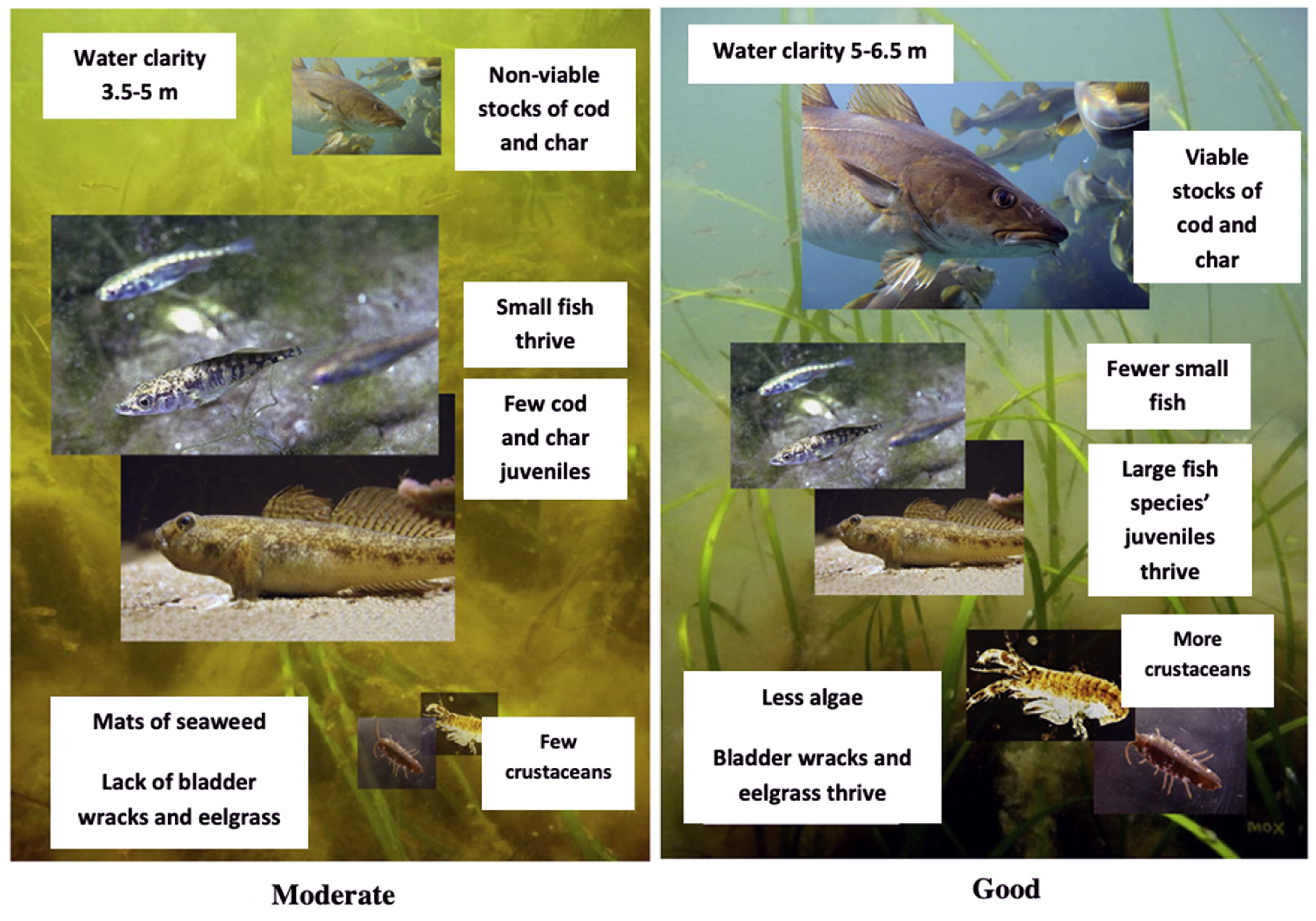
The action scenario used in the stated preference survey. Left: Ecosystem status before the suggested policy intervention. Right: Improved ecosystem status showing the environmental improvements which participants were asked how much they were willing to pay for. Source: The authors. Photos in figure: Background and crustaceans, Per Moknes; Cod, Joachim S. Müller, Creative Commons; Stickleback, Ron Offermans, Creative Commons; Black goby (Gobius niger), © Biopix: JC Schou.
Similar to much qualitative research, the primary aim was not to acquire external validity through generalisability, but to gain deeper insight into our research subject (Onwuegbuzie and Collins, 2007). The initial 32 workshop participants were selected from the five municipalities around the ‘8-fjords’ area using non-random strategic sampling to include a wide range of perspectives (Onwuegbuzie and Collins, 2007) from citizens in the area. When recruiting, we combined announcements in two local newspapers with snowball and convenience sampling, that is, asking persons from selected networks to suggest people potentially interested in joining and choosing individuals that were available and willing to participate (ibid.). To somewhat alleviate self-selection bias, we sought to keep the information as neutral as possible (Setälä and Herne, 2014) by entitling the workshop ‘What does the coastal environment mean to you?’, describing it as part of a research project that aimed to ‘provide input to the long-term management of the coast’ and offering a compensation of SEK 1,360 (EUR 142 in September 2016) for full-day participation including lunch.
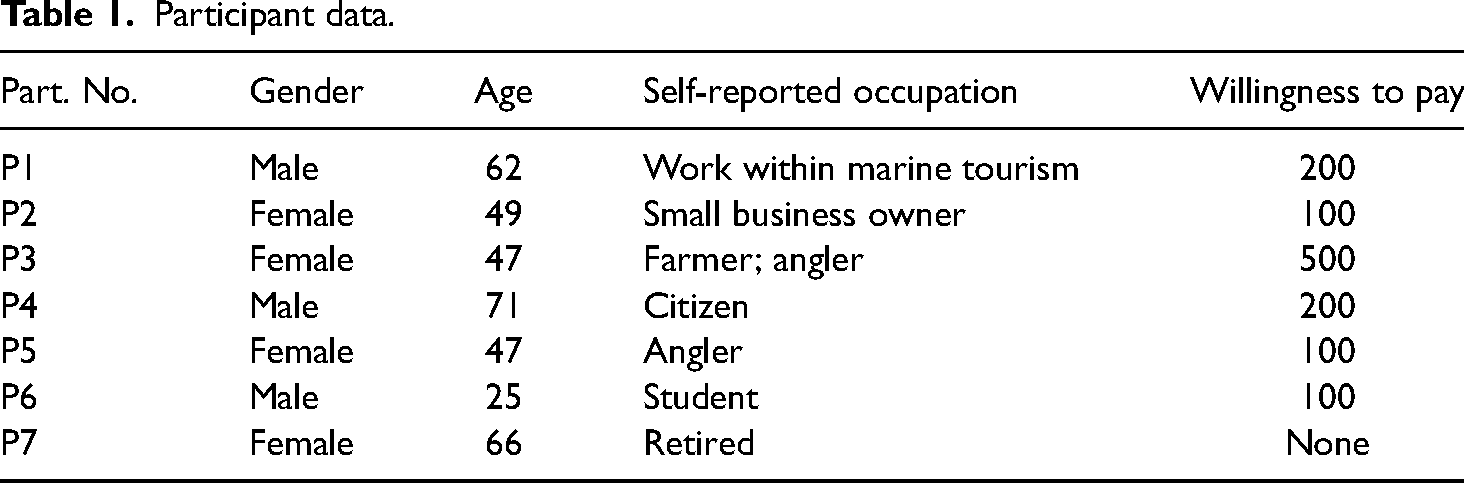
For the follow-up interviews, we then used a mix of typical case (gender, middle age, a positive WTP), extreme case (younger, a WTP of zero) and convenience sampling (our time restraints and participants’ availability) based on the 32 workshop participants’ survey answers (see S1). Of the seven selected interviewees, six were thus largely representative for the WTP sample as a whole and one had the less typical WTP of zero, but all had various backgrounds (Table 1).
Participant data.
Participant data.
All participants gave their informed consent. For the sake of anonymity, all details that could reveal the identity of participants have been excluded in the reporting of the study.
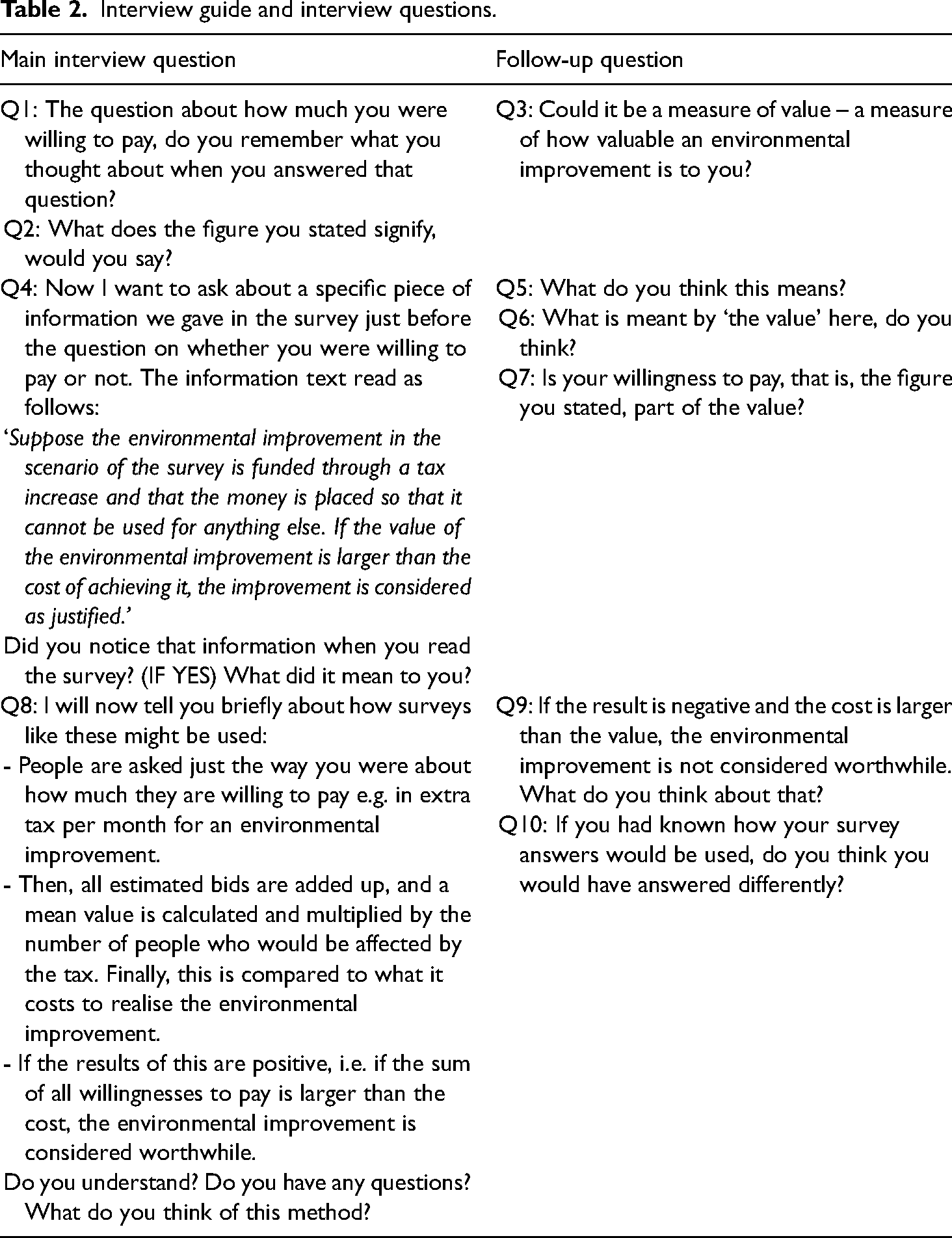
The interviews took place over the phone one month after the workshop. As semi-structured, the interview questions were predefined but open to certain changes, such as forms of questioning and follow-up questions (Kvale, 1996). An interview guide served to ensure that essentially the same information was obtained from all interviewees. Table 2 shows the interview questions (Q1-Q10) in focus in this study. While some initial questions addressed the entirety of the workshop, the majority focused on the SP survey as a means to capture the value of the environmental change presented in the survey's action scenario. To enable the participants’ own perspectives on key phenomena to emerge and prevent them from becoming sensitised to the research issue, we made sure to keep the sequence of questions (Corley and Gioia, 2004). For example, the term ‘value’ was initially not mentioned when referring to WTP or the value of the environmental change but instead referred to as ‘how important’ or ‘how valuable’ they considered the environmental change to be to them (Q1-Q2). 3 Then, when addressing the concept of value more specifically, we also posed leading questions, such as Q3 where we asked whether they thought their WTP could be ‘a measure of value’. To strive for disambiguation in the later analysis, we constantly posed clarification questions (Kvale, 1996).
Interview guide and interview questions.
Interview guide and interview questions.
We used a data-driven analytical approach (Braun and Clarke, 2006); starting from the perspective of respondents, we moved between closeness and distance to the research material to explore how respondents construct and understand a predefined theoretical construct such as WTP. In that sense, our approach can be regarded as abductive (Danermark et al., 2018) and interpretive, since we focused less on the frequency of measurable occurrences of a phenomenon (Gioia et al., 2013).
The analytic process was similar to constant comparison (Eisenhardt et al., 2016), meaning continuously moving back and forth between raw data (the interview transcripts), noted codes and themes and emerging conceptual claims to acquire data reduction. Drawing on Saldaña (2016), the coding was carried out in five broad cycles using a mix of methods. Initial coding line-by-line (Cycle 1-3) identified a variety of phenomena in the data relating to people's perception of what WTP was and was not, their view on the link between WTP and the ‘value’ of the environmental improvement, whether or not their beliefs and behaviours confirmed standard economic theory, and their views on the effectiveness and legitimacy of the SP approach. We then assembled categories of codes into themes (Cycle 4) and explored relationships between them (Braun and Clarke, 2006). The final coding (Cycle 5) involved careful reflection, integration of categories and emerging patterns, exploring a ‘bigger picture’ and suggested meanings beyond what was directly said (Saldaña, 2016) and, in turn, what this said about the ‘TEV interpretation’ of WTP from the perspective of the respondents. To ensure trustworthiness, we used peer debriefing by engaging two researchers not involved in the initial part of the study to assess the plausibility of emerging conclusions (Corley and Gioia, 2004).
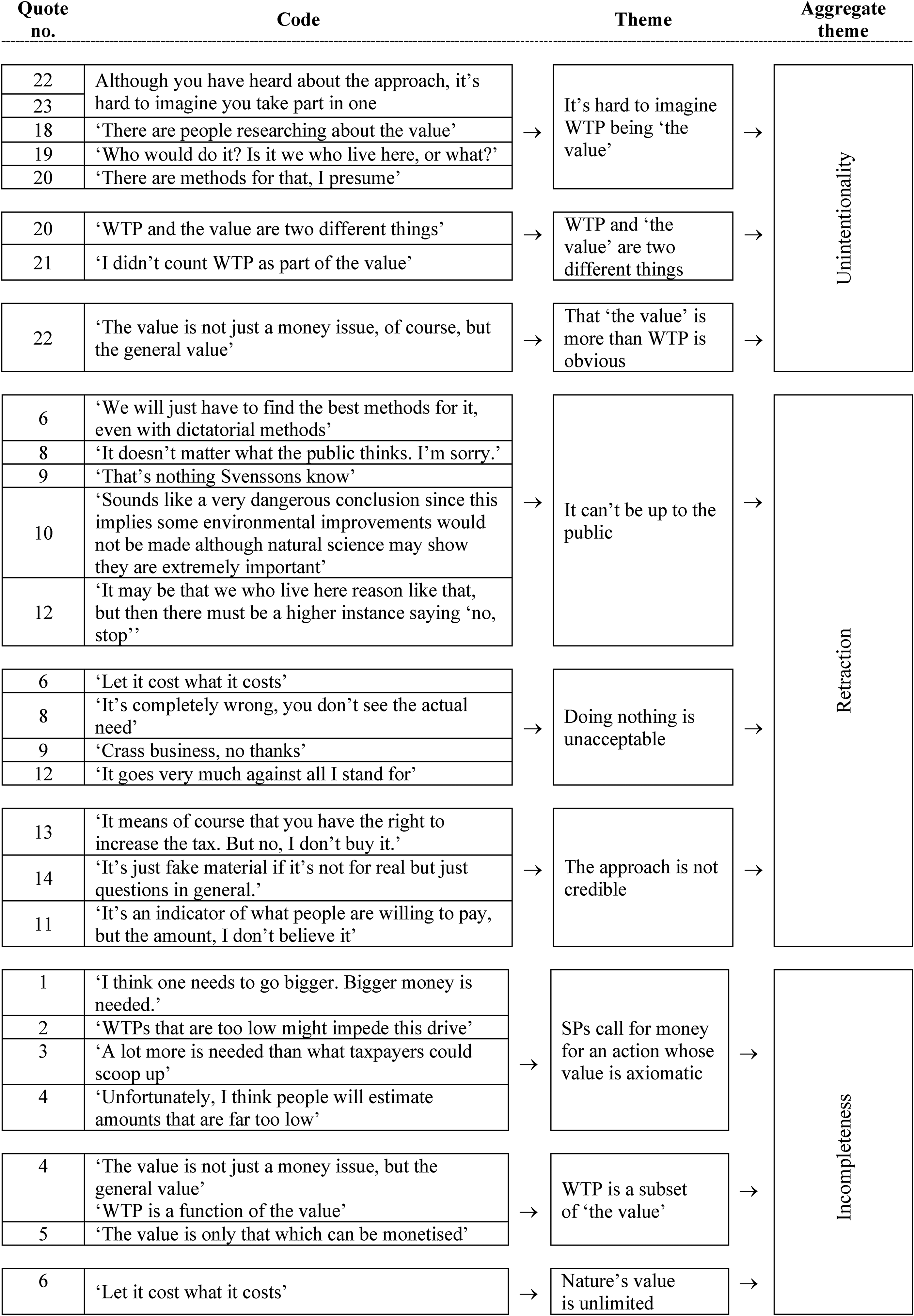
In organising the results, we drew upon the Gioia methodology (Gioia and Thomas, 1996) for presenting analyses of qualitative data and data-to-theory connections. It delineates categories of themes from the data in two steps, from codes to themes to aggregated themes, and visualises this in a figure called ‘data-structure’ (see Figure 2) where the experiences of the interviewees are kept in the foreground through in-vivo excerpts (i.e. language used by the interviewees) (Gioia et al., 2013). The data-structure is then supported by a table with evidence containing more extensive excerpts of representative quotations for each theme and corresponding codes (see Appendix 1, Table A1).
Data structure.
Before we go on, we will address a few general concerns regarding our methodology. Although we strived for depth and rich descriptions, as often, our sampling processes could not realistically aim to maximise the number of perspectives on the research issue (the reader might for example find that our interviewees had relatively strong pro-environmental values, although in a Swedish context they are probably more common than not), and it is possible we did not reach thematic saturation. Resource constraints limited this. Yet, even if the extent to which our findings would appear in a large-scale SP survey cannot be determined by a study like this, we believe they are useful for gaining deeper insights into the ambiguities around typical interpretations of SP studies and so speak of larger issues because they are specific (cf. Frandsen and Kärreman, 2016).
Also, although the interviews were conducted in an exploratory manner to develop knowledge together with the informants, we also analysed data afterwards. Final research accounts authored solely by the researchers risk becoming distorted and decontextualised, which raises ethical dilemmas (Hargreaves, 2008). A quality check against some interviewer biases is then that informants dare to speak freely and contest the interviewer during the interview (Kvale, 1996). We think this applies in our case, as shown by several of the selected quotations in the paper and Appendix 1, but recognise that it is possible that our participants do not wholly share the final perspectives we offer.
Results
We identified three main aggregate themes in the interviewees’ responses: 1) Unintentionality, 2) Retraction and 3) Incompleteness. Below we interpret the results along these themes and present our findings with a narrative (i.e. the text below) and a data-structure (Figure 2). In the narrative, the interview questions are referred to as Q1-Q10 (see Table 2). Numbered quotes refer to those in Figure 2, if not otherwise stated.
Unintentionality
Initially, the interview data caused mainly ambiguity. On one hand, many interviewees reasoned in terms indicating that their WTP was both well-considered and fairly consistent with the theory behind SP. Several considered their budget constraints, as the theory requires, said WTP depends on ‘understanding’, ‘knowledge’ or ‘what you get for the money’ and seemed to mean it somehow measured how valuable the environmental change was to them. In fact, three interviewees even argued that the link between WTP and ‘the value’ was self-evident; P5 said WTP ‘is about the value, how we value our environment and our oceans, of course’; P7, who bid a WTP of zero in the survey due to too low a pension, claimed ‘the value of a healthy environment can very well be measured in money terms’, adding, unprompted, that this was mirrored in house prices in the area. On the other hand, five of the interviewees’ WTP bids were clearly arbitrary. In answering Q1, P3, for instance, laughed and said ‘To be honest, I thought I had to put down a figure to be able to advance in the [survey] system’, and P4 hesitantly said ‘I just plucked a figure out of the air that wouldn’t feel too burdensome.’.
When reading them the survey information text about the CBA decision-rule and asking what they thought ‘the value’ of the environmental improvement meant in that information (Q4-Q7), several interviewees also seemed to contradict themselves. Those who had previously talked about WTP in terms of worth, even ‘value’, were then against equating WTP with ‘the value of the environmental improvement’. For example, P7, who just had claimed ‘the value of a healthy environment’ is monetisable, reacted to Q6 by claiming the value ‘can’t be measured in money’ and then added ‘Who would estimate the value? Is it we who live here, or what?’. Similarly, P4 seemed puzzled when Q4 was posed and asked, unprompted, if ‘the value’ was measured in ‘kronor and ören’ (‘pounds and pence’), adding ‘There are methods for that, I presume’. When P3, after having said ‘the value’ depended upon ‘how important this specific environmental improvement is’, got a follow-up question about how she thought this could be appraised, she laughed, and said ‘Well, hahaha, who am I to know that? But there are people researching such things…’.
In short, it seems it had not even occurred to the interviewees that ‘the value’ in this context was meant to be equated with their WTP. This finding was further confirmed by the fact P1 and P5, who at the end of the interview said they had heard about the CBA approach, in no way signalled they understood that they had basically just been part of one. P1 also said it was obvious that ‘the value is not just a money issue, of course’, and P2 and P4 explicitly claimed WTP and the value were ‘two different things’ – P2 even said she ‘didn’t count WTP as part of the value’, as the value meant ‘the worth to us in other ways’.
Based on these findings, our first aggregate theme emerged from our understanding that, from the perspective of the interviewees, their WTP had little to do with their conception of nature's value and how it should be understood. A conscious ‘valuation’ it certainly was not. As for valuation, it was unintentional.
Retraction
One of the most striking patterns in the data related to how all interviewees reacted when we explained how WTP is used in CBA (i.e. the implication of the decision-rule). During the interviews, we first described the consequences of a positive net value outcome (CBA+), that is, when the total benefit is larger than the total cost and actions are justified (Q8), and then the consequences of a negative ditto (CBA-) (Q9). Notably, none of the interviewees seemed to have paid any particular attention to the decision-rule. Although four interviewees (P3, P4, P6, P7) were sceptical of the (CBA+) case, only P6 was explicitly so because of what it implied in principle: ‘If you use that method, my answer is ‘not good’. […] It will be low if some people estimate a very low figure, which might make it more difficult to succeed with this drive.’. Continuing, P6 laughed and explained that either outcome would be ‘completely wrong, you don’t see the actual need’. The remaining six interviewees seemed not to fully understand the CBA criterion until the (CBA-) case was presented to them, and then all but two (P7 and P4) were strongly against using WTP in a CBA once they realised that it could lead to no action being taken. P3, for example, reacted strongly with ‘Crass business, no thanks’.
As many as four interviewees also gave answers to Q8 and Q9 that were erratic with respect to the theoretical conjectures of economic thinking: P1, who in the (CBA+) case said the rule seemed reasonable and ‘one has to start somewhere’, said the (CBA-) outcome sounded ‘very dangerous’; P2 went from stating the approach was ‘brilliant’ to it being ‘against all I stand for’ in the negative case. P7 and P4 doubted the method in general, revealed a mistrust in decision-makers and felt that WTP estimates were too ambiguous to deliver anything substantial or trustworthy.
Furthermore, once they had understood the (CBA-) case, five interviewees indicated they thought the issue of determining the value of the environmental improvement should not be up to the public but rather taken care of by experts. P3, for instance, said, ‘that's nothing the average Swede knows’ and P2 suggested some ‘higher instance’ should say ‘No, stop!’ if people were not prepared to pay or did not appreciate the environment enough. P5 thought measures had to be taken ‘even with dictatorial methods’.
Summing up all interviewees’ various expressions of discontent at this stage of the interview, it was clear that they had not understood how their participation in the survey could come to be used, and once they did – once the purpose and potential decisiveness of WTP in CBA was understood – they essentially retracted from it.
Incompleteness
One of the first cycles of categorising the codes revealed that several participants seemed to perceive the WTP question as a means to call for potential contributions towards realising the environmental improvement presented in the survey scenario. Theory-wise, this is a problem, because SPs aim to elicit only the value of the object of worth (the improvement of the environment), whatever it may be, and irrespective of its realisation or means of funding. Implicit in most respondents’ accounts was however that they not only perceived the WTP question as a call for financial support to realise the scenario; they also seemed to take the benefit of the scenario for granted, as if the value of action was axiomatic. For example, four interviewees explicitly thought that people would not be willing to pay enough compared to what seemed ‘needed’, and P6 called the survey a ‘drive’, which he thought must be improved and directed towards those ‘unwilling to pay’ to make sure things happen. The fact that most (without being asked to) gave some sort of suggestion about how the survey should be designed to make people want to pay, arguing things like ‘people need to feel part of a solution’ or that ‘information about positive health impacts’ could trigger WTP, supports this further.
This hardly supports the interpretation that the WTP of our interviewees can be meaningfully interpreted as some sort of total of the value of the environmental change they were asked about. The most evident sign of the latter were the answers by P1 and P3 in responding to Q5-Q7, when they indicated that WTP was something of a subset of the value of the environmental change, P3 by saying that by ‘the value’ one can only imply water quality and the fish stock, ‘There's not much more you can make calculations of’, and P5 by quite drastically claiming ‘no matter how we measure the value, let it cost what it costs […] We’ll just have to find the best methods for it, even with dictatorial methods’, implying that to her the actual value of the environmental measure was essentially unlimited.
As the aggregate conceptualisation for these themes, we conclude that rather than an estimate of something of a ‘total’ value, if anything, WTP was an inherently incomplete value of the environmental change to our interviewees.
Discussion and Conclusions
Our results detail the theory-reality gap of SP practice. They illuminate the deficiencies of WTP as a measure of value to society and how misleading its purported comprehensiveness is, considering, respectively, the respondents’ unintentionality, their retraction and the inherent incompleteness of WTP. Our interviewees’ notion of the value of the environmental change seemed not to invoke any thoughts about WTP being the value, which is the fundamental idea behind neoclassical analysis, and once they understood the potential decisiveness of their WTP in a CBA, they rejected it. These findings align with earlier studies, such as Burgess et al. (1998), Clark et al. (2000) and Svedsäter (2003), and with longstanding critique in the literature of using SPs for social benefit measurement in environmental decision-making tools such as CBA. They also support more recent empirical research on pluralistic approaches to valuation. For instance, in another Swedish study, Stålhammar and Pedersen (2017) used focus groups following a visit to a recreational area and showed that their participants experienced the value of nature as self-evident and were puzzled when asked how they thought the benefits could be valued.
The respondents’ unintentionality illustrates the flaws of how valuation is ontologically conceived in neoclassical theory (Isacs, 2021). Although SPs are meant to address the values that choice-making in markets cannot handle, the valuation they are presumed to permit is still equated with individuals’ choice: the decision to pay (or not) is assumed to be a conscious, intentional act of commensuration of the relative welfare obtained by the things they choose (a so-called trade-off), and their WTP is taken to reveal the strength of their ‘true’ preferences (e.g. Hanley and Czajkowski, 2019). That is, despite the claim that behavioural economics has cleaned up the most disturbing interpretations of rationality within neoclassical theory, the fallacy of preference utilitarianism, where value equals increasing human welfare (only), which equals preference satisfaction, which equals choice, remains – in SPs (e.g. Carson and Groves, 2007) as well as other analyses in environmental economics (e.g. Dasgupta, 2021). The collision with our respondents’ perspective is obvious. A ‘total’ value as strictly anthropocentric and possible to monetise amounts to appropriation of their apparent experience of nature's value.
Respondents’ retraction then sheds light on the legitimacy that SPs can possibly achieve. As Spash et al. (2009) have claimed, since SP respondents’ motives are not only consequential but based also in deontological and virtue ethical positions (both of which can explain notions of incommensurability), aggregating WTP as a basis for policy fails to represent public opinion. Macknight and Medvecky (2021) argued likewise, that the seemingly neutral technical SP devices are actually means of power, because they impact who is allowed to speak for nature, and how. Our findings in terms of respondents’ retraction from the intended consequences of their participation, and experts’ interpretation of it, confirm such claims, and point to the irony of the argument from some neoclassical economists, that using SP democratises decision-making by including people's preferences and getting away from expert rule (Banzhaf, 2009). SPs and CBA are both undemocratic and unethical. Recently, Bardsley et al. (2022) showed that WTP for climate change mitigation was higher when richer respondents of an SP were to bear higher costs than when no explicit information was provided about cost distribution, which is the usual procedure in SP surveys. Since most respondents favoured implementation of climate change policy which they themselves would contribute towards, this does not simply reveal a desire to penalise the rich; rather, it undermines the individualism of SPs, at both a practical and a fundamental level. Now, five of our interviewees’ withdrawal indicated that they thought they were not knowledgeable enough to determine the value of environmental improvements; instead, they thought it should be done by experts. However, rather than as a desire for increased expert control – an idea that stems back to Plato (Brooks, 2006) – this could be interpreted as the participants seeing themselves as not having sufficient knowledge to put a monetary value on the environment, but that they could possibly express the value in other ways.
The inherent incompleteness of WTP points to the implications of the TEV interpretation. It is often said that TEV is neither meant to be understood as capturing all imaginable values nor being about ethics (e.g. Pearce and Moran, 1994; Hansjürgens et al., 2016), but it clearly aspires to a certain comprehensiveness. And this is not a coincidence: the TEV interpretation only confirms that an SP is the only means through which concerns for intra- and intergenerational justice and other living beings can empirically enter into mainstream economic analyses without breaking the neoclassical interpretation of value as preference satisfaction (cf. Hausman, 2018: 200). SP experts’ ultimate plea is that a carefully constructed WTP should mirror how much the environmental change in question influences respondents’ ‘well-being’ (e.g. Carson and Groves, 2007). Another defence is that a WTP figure is more useful than no number in typical policy assessment, such as CBA (see e.g. Kling et al., 2012; Costanza et al., 2014; Dasgupta, 2021). This argument implies, as Røpke (2005: 280) notes, that the only possible form of valuation is monetary and has to be dealt with by experts. Thus, considering our results, and the fact that respondents may not even count WTP as a part of nature's value, this is simply unsatisfactory. It says more about the lack of creativity of positivist researchers than about realism and crowds out broader notions of value by drawing resources and attention away from approaches with potential to embrace value pluralism. 4
Thus, although SP researchers may be relatively alone in believing that WTP can measure something like TEV, their discourse has a function for which SP and CBA researchers alike should take greater responsibility. As part of mainstream economic ideas and concepts, they are performative (e.g. Muniesa et al., 2007); they construct and change social reality. For instance, although Bishop et al. (2017: 253) provide convincing arguments that their SP results probably do measure a lower limit for what Americans are prepared to pay in additional taxes to avoid future oil spill damage, when they associate this to ‘the total economic value lost’ (our emphasis) they not only aspire to construct this lower (yet somehow, abstrusely, sufficiently economic) value; they also equip and restrict our imagination of what that value is about, and when it is used to make any kind of decision it has a ‘productive’ function (Andersson, 2016: 36). This is how social constructions have material implications. Similarly, when a monetary estimate is uncritically claimed to measure the ‘existence value’ of ‘an entire culture, religion, and way of life’ (that of the Hopi tribe in Arizona, US), as do Carson et al. (2020: 936), this is not only insensitive; when this estimate is used in actual decision-making it can arguably be life-changing.
The results of our study speak to the importance of existing alternative approaches to environmental valuation. WTP is at most one out of many different, incomplete and incommensurable, value indicators relating to human-nature relationships. This means any value assessment needs to start from the premise that values cannot be expected to lend themselves to measurement, comparison and aggregation of numbers (Holland, 2002). Once recognised, the acknowledgment of values as plural and incommensurable may help cultivate both legitimacy and creativity in policy appraisal. A growing number of studies show that deliberative approaches to environmental valuation, which Spash was early to call for (e.g. 2008b) and others increasingly recognise (e.g. Arias-Arévalo et al., 2018; Jacobs et al., 2018; Pascual et al., 2017), can address issues of both information gaps and ethical and democratic considerations around complex issues (e.g. Dunford et al., 2018; Kenter, 2016; Caselunghe, 2018; Nordbrandt, 2020). They reveal that in groups’ communicative reasoning, valuation is not about addressing values as trade-offs, but rather as difficult, moral conflicts that have to be resolved through compromise and considerations of appropriateness (e.g. Isacs et al., 2022). It speaks to the fact that incommensurability, not commensurability, is grounded in human experience (ibid.). This requires a greater attentiveness to the politics of valuation, and that decision-making is a continuing process, not discrete events, where time and history are essential parts of its legitimacy (O’Neill et al., 2008). Indeed, if cautiously designed (Mansbridge et al., 2006; Sprain and Black, 2018), deliberation holds the potential for democratic renewal (see e.g. Fishkin, 2018).
To conclude, whereas Hansjürgens et al. (2016: 222) are perhaps right in that TEV can be used as a conceptual framework for considering ‘the fact that individuals hold values’ for many different reasons, we question that it is a suitable heuristic for showing, as they argue, that the array of values captured by monetary valuation methods such as SPs is in fact broader than what critics commonly claim. By contrast, we suspect that the frequent reference to SPs’ comprehensiveness means that ethical concerns in policy analysis that use SPs are inadequately articulated and so conceals rather than reveals the actual implications of choice when used in environmental decision-making. For reasons of appropriateness the typical reference to WTP as a measure of the ‘total’ economic value should therefore be avoided, because it is misleading. It could also aid self-reflection on part of SP economists regarding the truly ambiguous nature of WTP and help them shift the focal question in SP research – from what Clive Spash rightly has called a naïve search for the right method to produce fictional welfare estimates (Spash and Hache, 2021), towards studies of the actual reasons for people's willingness to pay (and not) for environmental policy-making. People need to ‘deliberate values’ rather than being expected to express all sorts of values through money.
Supplemental Material
sj-docx-1-env-10.1177_09632719241231509 - Supplemental material for ‘I didn’t count “willingness to pay” as part of the value’: Monetary valuation through respondents’ perspectives
Supplemental material, sj-docx-1-env-10.1177_09632719241231509 for ‘I didn’t count “willingness to pay” as part of the value’: Monetary valuation through respondents’ perspectives by Lina Isacs, Cecilia Håkansson, Therese Lindahl, Ulrika Gunnarsson-Östling and Pernilla Anderssno in Environmental Values
Supplemental Material
sj-docx-2-env-10.1177_09632719241231509 - Supplemental material for ‘I didn’t count “willingness to pay” as part of the value’: Monetary valuation through respondents’ perspectives
Supplemental material, sj-docx-2-env-10.1177_09632719241231509 for ‘I didn’t count “willingness to pay” as part of the value’: Monetary valuation through respondents’ perspectives by Lina Isacs, Cecilia Håkansson, Therese Lindahl, Ulrika Gunnarsson-Östling and Pernilla Anderssno in Environmental Values
Supplemental Material
sj-docx-3-env-10.1177_09632719241231509 - Supplemental material for ‘I didn’t count “willingness to pay” as part of the value’: Monetary valuation through respondents’ perspectives
Supplemental material, sj-docx-3-env-10.1177_09632719241231509 for ‘I didn’t count “willingness to pay” as part of the value’: Monetary valuation through respondents’ perspectives by Lina Isacs, Cecilia Håkansson, Therese Lindahl, Ulrika Gunnarsson-Östling and Pernilla Anderssno in Environmental Values
Footnotes
Acknowledgements
The authors want to thank the study participants and are grateful to Susanne Baden, Gothenburg University, and to Niclas Åberg and Sara Ejvegård from ‘8 fjordar’ for invaluable assistance and support. The article is part of Lina Isacs’ doctoral dissertation at KTH Royal Institute of Technology, Sweden (see Isacs, 2021).
Funding
The author(s) disclosed receipt of the following financial support for the research, authorship, and/or publication of this article: This work was supported by the Swedish Research Council Formas [grant number 2014-01619].
Supplemental Material
Supplemental material for this article is available online.
Notes
APPENDIX 1
Selected representative data from interviews supporting the codes and interpretations behind the main findings expressed as the three aggregate themes Unintentionality, Retraction and Incompleteness, respectively. Quotations are labelled with numbers (Quote 1-23), corresponding to the codes and themes in the main text's Figure 2. All quotes are translated from Swedish.

| Quote no. | Aggregate themes and representative quotations from all interviewees | Code |
|---|---|---|
| Unintentionality | ||
| 18 | Q9-FOLLOW-UP [HOW CAN YOU FIND OUT [HOW IMPORTANT THIS SPECIFIC ENVIRONMENTAL IMPROVEMENT IS]?]: ‘Well, hahaha, who am I to know that? But there are people researching about such things…’ (P3) | ‘There are people researching about the value’ |
| 19 | Q6: ‘Who would estimate the value? It's a valuation of the environment and that can be different [for different people]. That can’t be measured in money, or, if it comes to the fishery it might, but the environment in large is very difficult to measure in money. […] Who would do it? Is it we who live here, or what? And do we all need to agree?’ (P7) | ‘Who would estimate the value? Is it we, or?’ |
| 20 | Q4: ‘When you pay for something it's in pounds and pence, and the value is not in pounds and pence then, or? Do you have a double standard, or? Hehe… The value of an environmental improvement, is that valued in pounds and pence then too? There are methods for that, I presume, but the value is often that you experience something, emotionally, and that you feel good, etcetera, so it becomes a bit like apples and pears when you compare them. […]’ Q7: ‘No, I think that's two different things. It's hard to compare them to each other. […] If I take a trip at sea with my boat it's hard to translate that into money, what my experience is worth…’ (P4) | ‘There are methods for that, I presume’ ‘WTP and “the value” are two different things’ |
| 21 | Q6: ‘[The value] is not the economic value but the value to us […] everything from nature experiences to piece of mind’ Q7: ‘I didn’t count that [WTP] as part of the value […] How we value this environment – and that has not at all any economic… – rather, the worth to us in other ways.' (P2) | ‘I didn’t count WTP as part of the value’ |
| 22 | Q5: ‘It means to ask the respondent to focus specifically on the economic aspect of the whole thing, and to value this environmental improvement from an economic perspective, which is a crucial way of reasoning but not the only way’. Q6: ‘It's very diffuse in this case since the value is not just a money issue, of course, but the general value, which is almost always very high. Since every single species and every single environmental habitat needs protection and the value of that protection is very high, it almost can't be measured in money. […] The value is what people or society considers it to be worth’. Q7: ‘Yes, the willingness to pay is a function of that value. The higher I set it, either as an individual or as society does, the higher the willingness to pay’. Q8: ‘Really? Okay, okay…’ Q10: ‘In fact, I thought of this when answering – “you can't put too small a number here”, I thought, I'm well aware that this type of reasoning exists among decision-making agencies in our society… If this survey and all other surveys signal that people are unwilling to pay, decision-makers would conclude that they won't pay anything either. I was aware of that risk already’. (P1) | ‘The value is not just a money issue, of course, but the general value’ Even if you have heard about the approach, it is hard to imagine that you have participated in one. |
| 23 | Q9-FOLLOW-UP [HAVE YOU HEARD ABOUT THESE METHODS BEFORE?]: ‘Yes, I have, many years ago when I went to university […] but I haven’t thought in these terms for very, very long… But in the back of my head, I have it, of course, that one often uses them when making political decisions etcetera, that they have those…that one measures such things, the cost against the value. […]’ Q10: ‘I think I’d have wanted to state a higher value then, maybe’. [WHY, DO YOU THINK?] ‘Because it's so important. […] when I sat there answering I thought I have to make some calculations, think about how it looks for us and such things, a little petty and suddenly, somehow, but no matter what, it doesn't matter what it costs…’ (P5) | Even if you have heard about the approach, it is hard to imagine that you have participated in one. |
| Retraction | ||
| 8 | Q9: ‘It's completely wrong, I mean either way’. [WHY?] ‘Because you don't see the actual need. It doesn't matter what the public thinks. I'm sorry. Hahaha! […] No, I don't think you can reason like that, you can't reckon like that. We humans… we have a very hard time thinking far ahead in time and if I'm supposed to stand here today and say that “Well, if in ten years we'll be able to catch loads of fish – that doesn't help us today!.” That's how I think people reason. And if too many reasons like that you’ll never be able to do anything about any problem. It becomes weird’. (P6) | ‘It's completely wrong, you don’t see the actual need' ‘It doesn't matter what the public thinks, I'm sorry.' |
| 9 | Q8: ‘Nooo, but it's not the effect of the action you evaluate then… You’ve had the action done but you don’t know what the gain is… […] that's an ugly one, I think […] that's the benefit in relation to people's willingness to pay, and not in relation to the actual environmental gain…’ Q9: ‘Crass business - no thanks […] you need to think about which investments are actually the most important. And that's nothing Svenssons know.’ (P3) | ‘That's nothing Svenssons know' ‘Crass business, no thanks' |
| 10 | Q8: ‘a lot of variables are hard to take into account in such a calculation. There are quite a lot of assumptions. But one has to start somewhere, so it's not that bad. It would be interesting to know what used to be the outcome of these type of surveys. […] I don't think it's a bad method at all. But you must be aware of its limitations. […] It's just a calculation’. Q9: ‘It sounds like the municipal chief economist's attitude in this matter. It sounds like a very dangerous conclusion since this implies some environmental improvements would not be made although natural science may show they are extremely important […] It may in fact be a result of information failure’. Q10: ‘If these kinds of willingness to pay surveys would be the only decision support, I don't think it's a good method, because what people are willing to pay is in fact just a matter of attitude. It gives no answer about the importance of the measure from a scientific point of view, which can be huge although people don't want to pay’. (P1) | ‘Sounds like a very dangerous conclusion since this implies some environmental improvements would not be made although natural science may show they are extremely important’ |
| 11 | Q8: ‘you just throw out a figure that comes to mind without knowing what you talk about at all […] The only thing you may get out of it, I think, is an indicator of that people are willing to pay. But the size of that… I don’t believe in it’. (P4) | ‘It's an indicator of that people are willing to pay, but the size, I don't believe in it’ |
| 12 | Q8: ‘Considering that's quite close to how I thought myself I’d be dumb if I didn’t say it's brilliant, but it's very logical and to me it seems very reasonable to make the calculation in that way. I think it's good’. Q9: ‘It goes very much against all I stand for… an extremely cynical way of reasoning’. Q9-FOLLOW-UP [WHEN YOU SAY VALUE AND PRICE-TAG, IS THERE A DIFFERENCE?]: ‘Well, no but I think it's a combination. Whether we are to answer the question how much we are prepared to pay, or if we were to say like this, that “this doesn’t have such a large recreation value” or, “no, we don’t use this that much” or “no, this is of no particular importance.” It may be that we who live here reason like that, but then there must be a higher instance saying ‘No, stop!’… We cannot let an environment die just because those living there can’t appreciate it. […] I mean, everything is connected. All life. I couldn’t come to terms with such a way of reasoning’. (P2) | ‘It goes very much against all I stand for’ |
| 13 | Q5: ‘It means of course that if it's predicted that you will get a better environment you have the right to increase the tax. But eeh… No, I don't buy it because we pay such a high tax already as it is and this thing with earmarking, I don't believe in. It's been promised before with other money which was supposed to go to schools and this and that. And it never does. And no one is held responsible’. (P7) | ‘It means of course that you have the right to increase the tax. But no, I don't buy it’ |
| 14 | Q1-FOLLOW-UP: ‘the value of a healthy environment can very well be measured in money terms […] of course it can. Absolutely’. Q8: ‘You don’t get a concrete figure… Since people don’t know what they answer to, really […] It's no real decision-making material. It's a thought material. It's just fake material if it's not for real but just questions in general’. (P7) | ‘It's just a fake material if it's not for real but just questions in general’. |
| 6 | Q6: ‘What you include in the value, I think it's a cultural-historical value and a purely spiritual value to humans and also the economic value as regards fishing, for example, and tourism and a pure ethical value, or… Ah, it's hard to find the right word… for, the mere “life value” […] that no matter what we have no right to destroy nature, or, it has its own value’. Q8 + Q9: ‘It depends how you bring about the value, because I think… […] it's the most important thing we have, I think. It's our earth and our nature and our animals and our ecosystem, which we have no right to destroy, so no matter how we measure the value, let it cost what it costs to reconstruct what we have destroyed, that's how I think. […] We’ll just have to find the best methods for it, even with dictatorial methods, and then let it cost what it costs’. (P5) | ‘Let it cost what it costs’ |
| Incompleteness | ||
| 1 | Q1: ‘To have individuals donate a one-hundred-krona bill… Well, that becomes nothing. No, I don't think this thing with paying seems particularly good. I think one needs to go bigger. Bigger money is needed’. (P7) | ‘I think one needs to go bigger. Bigger money is needed’. |
| 2 | Q1: ‘I wrote down a symbolic figure because I think those who are dealing with this have to show more than they do today what they have done these last years, I think, in order to make people willing to pay. More’. Q7: ‘I think there are individuals who are willing to pay almost anything, but it might not be them that we should focus on. Isn’t it those who are unwilling to pay that we should focus on?' Q8: ‘If you use that method [CBA + ] my answer is “not good.” […] It will be low if some people estimate a very low figure, which might make it more difficult to succeed with this drive. At the same time, I think they should showcase something they've done before they can do some kind of improvement. […] That would make people more receptive to a tax increase’. Q8-FOLLOW-UP [DO YOU THINK PEOPLE READ IT AS THAT ‘THEY WANT US TO PAY MORE TAX’?] ‘Hopefully not. Hopefully they read it as that “they’re about to do something good here, which has to be paid for”’. (P6) | ‘Too low WTPs might impede this drive’ |
| 3 | Q1-FOLLOW-UP [HAVE YOU THOUGHT ANYTHING ABOUT WHY THE WTP QUESTION WAS POSED?]: ‘…maybe one wants to check, so to say… What attitude do inhabitants of the coastal municipalities have towards this [thing] with contributing financially more than today? Through tax, so to say. […] I think most of those living here would agree to that we should protect our waters and our coast and all that, but the question is what you are prepared to do. Are you prepared to sacrifice something yourself, and how important is it then, when you have to weigh it against other things? To see what's just talk and what's action, which I can think is super interesting. Of course, it also comes down to what means you have […] you may desire this from the bottom of your heart but not have the economic means. That's a dilemma, of course’. Q3: ‘I doubt one would get all that's needed for doing these large efforts by just raising the municipal tax in Stenungssund, I really doubt that. I think a lot more is needed than what taxpayers could scoop up, so there's need for some kind of national emergency plan, perhaps’. (P2) | ‘A lot more is needed than what taxpayers could scoop up’ |
| 4 | Q1: ‘I know that I first compared the amount to what I donate to charity, such as Doctors without borders and other such things, per month. And that's a few hundred. I thought that this could be equal to that […] But when later I had thought a bit more […] I reckoned, that first of all, this might not be an amount on top of everything. It might perhaps also be a question of tax revenues and moreover… this effort, to protect our habitat, is much more important than all other questions, of course, how deserving they may be’. Q2: ‘It's very elastic, I mean, when you first see the amount… your reaction depends on a lot of factors. In part how much I think it's worth, and then how much I can afford, how much I believe in that which the money is going to. It has to be a credible [policy] measure. If it's a credible measure, which I happen to have strong feelings for, well, then the willingness to pay becomes very high’. Q5: ‘It means to ask the respondent to focus specifically on the economic aspect of the whole thing, and to value this environmental improvement from an economic perspective, which is a crucial way of reasoning but not the only way’. Q6: ‘It's very diffuse in this case since the value is not just a money issue, of course, but the general value, which is almost always very high. Since every single species and every single environmental habitat needs protection and the value of that protection is very high, it almost can’t be measured in money. […] The value is what people or society considers it to be worth’. Q7: ‘Yes, the willingness to pay is a function of that value. The higher I set it, either as an individual or as society does, the higher the willingness to pay’. Q9: ‘Unfortunately, I think people will state much too low amounts, at the end of the day, especially concerning environmental issues they don’t have pretty close to themselves’. (P1) | ‘The value is not just a money issue, of course, but the general value’ ‘WTP is a function of the value’ ‘Unfortunately, I think people will state much too low amounts’ |
| 5 | Q6: ‘I think one means water quality and the fish stock. There's not much more you can make calculations of. There are other positive environmental effects that are hard to measure in money’. Q7: ‘Yes, I think so. […] since you get more back than you gave, I think it's a smart investment’. (P3) | ‘Value is only that which can be monetised’ |
| 6 | Q6: ‘What you include in the value, I think it's a cultural-historical value and a purely spiritual value to humans and also the economic value as regards fishing, for example, and tourism and a pure ethical value, or… Ah, it's hard to find the right word… for, the mere “life value” […] It's what we ended up with [in the group exercise], that no matter what we have no right to destroy nature, or, it has its own value’. Q8 + Q9: ‘It depends how you bring about the value, because I think… […] it's the most important thing we have, I think. It's our earth and our nature and our animals and our ecosystem, which we have no right to destroy, so no matter how we measure the value, let it cost what it cost to reconstruct what we have destroyed, that's how I think. […] We’ll just have to find the best methods for it, even with dictatorial methods, and then let it cost what it costs’. (P5) | ‘Let it cost what it costs’ |
References
Supplementary Material
Please find the following supplemental material available below.
For Open Access articles published under a Creative Commons License, all supplemental material carries the same license as the article it is associated with.
For non-Open Access articles published, all supplemental material carries a non-exclusive license, and permission requests for re-use of supplemental material or any part of supplemental material shall be sent directly to the copyright owner as specified in the copyright notice associated with the article.
