



Abstract
In this paper I consider various shifts in my research and understanding stimulated by seeking how to combat social ecological crises connected to modern economies. The discussion and critical reflections are structured around five papers that were submitted to Environmental Values in an open call to address my work. A common aspect is the move away from neoclassical environmental economics, and its reductionist monetary valuation, to a more realist theory and multiple methods. This relates to my work on environmental ethics, plural values, stated preference validity and deliberative monetary valuation. Expanding beyond the narrow confines of mainstream orthodoxy has involved exploring a range of other disciplines (e.g. applied philosophy, social psychology, human geography, political science, social anthropology, history of thought and philosophy of science) and learning from this literature to rethink economics and develop social ecological economics. A broad range of subjects are covered here, including: personal responsibility, social practice, psychology of the individual, participatory processes, value (intrinsic, instrumental and relational), Nature–society relationships and interdependencies, critical realism and the conduct of unifying interdisciplinary science. I end with a series of comments concerning the failings of orthodox economics and the conduct of scientific research for social ecological transformation.
Keywords
Introduction
Over 40 years ago, when I began formally training as an economist, the connection of the economy to environmental problems was pursued by relatively few in the profession and they were rather marginalised. If you introduced yourself as studying the environment and economics people were generally mystified and disinterested. Ecology and environmentalism had been headlined in the early 1970s and a decade later nobody seemed much concerned about pollution, species loss or resource depletion. Environmental economics had lost its radical edge and become pre-occupied with optimal control modelling and efficient pricing via a tax set to reflect damages converted into money values. Externality theory was erroneously attributed to Arthur C. Pigou and deployed by Chicago school economists to remove blame for pollution from industrial polluters and the capitalist market system (Spash, 2021b). Environmental pollution and resource depletion were primarily regarded as problems concerning intergenerational equity and discounting, that is, low-priority things affecting some distant future generations.
Well, the future has arrived! A younger generation is deeply disturbed by the state of the world both socially and ecologically. On the environmental side human induced climate change tops the crisis list for most people, followed by mass extinction of species and biodiversity loss, and then a long line of pollutants and human activities (noise, light, surface sealing, genetic modification, species introduction and manipulation, land use change). On the social side are increasing inequity, exploitation, inhumanity, violence and violation of human rights, securitisation and wars. The structural reality of social ecological economic systems was never addressed by orthodox economists’ idealised abstractions. In fact, the problems were always as much spatial as intemporal, as evident in cost-shifting (Kapp, 1978 [1963]), unequal exchange (Hornborg, 1998; Hornborg, 2017) and the colonial exploitation required to maintain supply chains (Brand and Wissen, 2017; Brand and Wissen, 2021).
Today, the systemic failures of economic structures create angst, fear and depression. One set of reactions is to maintain business-as-usual based on denial that problems even exist and, when that fails, blame others who are then vilified. Amongst those who accept the problems are real there have arisen various forms of apologia for maintaining capital accumulating economies (Spash, 2020a). This includes what Brand (2016) has termed a ‘new critical orthodoxy’ that undertakes a radical diagnosis of the ecological crises, but then recommends ‘transformation’ as a processes embedded in current institutions without systemic change. A set of more seriously reformist reactions have seen the revival of open criticism of capitalism, a rise in civil disobedience, protest and calls for direct action (e.g. Malm, 2021). Movements like degrowth have arisen that critique economics and seek to establish fundamentally alternative economic systems.
While seeking to identify and address the real causes of harm of the innocent, both human and non-human, a disturbing finding is the extent to which economics itself has been a causal mechanism preventing change for the better. Comprehensively rethinking economics – its definition, aims and conduct – forms a connecting thread across the five papers I will review in the following sections. These were compiled by the editors of Environmental Values in response to an open call for contributions relating to or inspired by my work. Claudia Carter provides a good starting point by summarising the process of my changing ideas in a chronological sequential set of stages: problem identification, developing alternative evaluation methods, philosophy of science and social ecological economics. This tracks my move from naïvely believing in reform via economic incentives to realising the necessity for new institutions and radical systemic change.
Contrary to the fact-value dichotomy, explanatory descriptive social science entails criticism of ideas in society. Research exposes erroneous and bad causal claims and associated ideas, as well as the institutions that promote them. Critical realism explains how this then entails a responsibility on the part of the researcher to act in ways consistent with their findings. For social ecological economists this means acting in accord with established warranted beliefs about social and ecological reality, and related environmental and social value commitments (Spash, 2012, 2024). Iana Nesterova reflects upon the personal implications of taking seriously the requirement to align ones scientifically informed value commitments and daily practices. Academic pursuits can then align with activism. The consequences are far reaching and involve an ongoing process with challenging psychosocial dimensions and self-identity issues.
Individual psychology, socialisation and behaviour formed a large part of my research and built from my interest in understanding environmental values and ethics. This latter aspect inevitably entailed extensive criticism of orthodox economics, as evident in the remaining three papers of this special issue. Rachelle Gould et al. review my criticisms of monetary valuation, which include economics being value laden, denying incommensurability and imposing value monism. They argue in favour of adding to the dichotomy of instrumental and intrinsic values a relatively new category called relational values. I critically reflect on their presentation of my work and the meaning of relational value. The case study by Lina Isacs et al. explores the values of respondents who answer stated preference surveys concerning environmental change. I note how this reaffirms my (and others’) arguments for regarding economists’ stated preference studies as misrepresentations of peoples’ actual values. In a second stated preference case study, Jacob Ainscough et al. criticise the design and appropriateness of mainstream economic attempts to add deliberation to legitimise monetary valuation. They contrast this with an alternative arbitrated group deliberation built on participatory and democratic principles. I discuss their contribution in relation to my work on deliberative monetary valuation and, more generally, value articulating institutions.
In the following sections, I explore these five papers in the order just given: Claudia Carter, Iana Nesterova, Rachelle Gould et al., Lina Isacs et al. and Jacob Ainscough et al. Before proceeding, let me thank all the authors for their contributions and the anonymous reviewers and editors for their invisible work. I deeply appreciate the opportunity, offered by this special issue, to reflect upon and clarify some aspects of my research and positions on environmental values, economic science and social ecological transformation.
Economics, public policy and the ecological crisis
Claudia Carter provides a good and insightful chronological overview of my work as a professional economist which she divides into three phases covering my move from the mainstream orthodoxy of environmental economics to developing the alternative paradigm of social ecological economics. Here I add to her account some personal anecdotes and reflections. I very much appreciate the overview she has provided but will start by making one qualification.
Claudia Carter states that my ‘attempts to bring different factions and disciplines together (even within heterodox economics) have encountered difficulties and been limited’ and she thinks have mainly concerned economists and ecologists. I would not deny difficulties and limits in interdisciplinary endeavours but feel this is misleading. There are a variety of ways in which I have brought together ‘different factions and disciplines’, and I believe with some noted success, including several activities in which Claudia Carter was herself heavily involved. There were a range of international research projects that were inherently interdisciplinary and undertaken at a time when seriously applying such approaches was rare (as Claudia Carter notes). Similarly, a decade of running the European Society for Ecological Economics (ESEE) involved troubleshooting across disciplines and national interests and established the ESEE as the most progressive regional society in the field. This also included organising two international conferences that brought the entire community together with long lasting impacts. I also helped Dick Norgaard in establishing the constitutional foundations for the International Society for Ecological Economics (ISEE), international regional society participation and preventing disintegration in light of domination from the United States (Spash, 2023). Then there is, of course, my work for Environmental Values as Editor-in-Chief, which expanded its interdisciplinarity, both in terms of board members and papers published. My own research activities also reach across more than just ecological and economic sciences. For example, working on biodiversity loss involves engaging with a range of natural and social scientists covering disciplines such as botany, zoology, ecology, conservation, planning, economics, philosophy, social psychology, sociology and politics. I have been involved in projects, conference participation and publications in a variety of communities (e.g. conservation, degrowth, philosophy, history of thought, political economy and social psychology). Then there is my teaching, which for the past 12 years has included running an interdisciplinary and heterodox master’s programme in social ecological economics and policy that involves a dozen different research institutes and at any one time between 100 and 120 students from diverse disciplinary backgrounds. Having made this qualification, let me turn to the substantive presentation by Claudia Carter of the three phases she identifies in my work.
The first is what she refers to as ‘problem identification’, and involved my emerging recognition of the extent to which economics fails to address reality. My focus on environmental policy is evident in all my university dissertations which relate to air pollution problems – B.A. sulphur and nitrous oxides (acid rain), M.Sc. tropospheric ozone and Ph.D. greenhouse gases. In terms of recognising public policy failures Claudia Carter cites my early work on human induced climate change via enhancement of the greenhouse effect published some 35 years ago (Spash and d'Arge, 1989). She correctly mentions that ‘the need for action by the current generation on global warming seemed already clear’. Indeed, the back-tracking on action ever since the late 1980s has been phenomenal.
The Intergovernmental Panel on Climate Change (IPCC) became a talking shop and an excuse for too many politicians to optout of mitigation by claiming ‘more evidence’ was required. Capitalist business as usual, euphemistically termed ‘the economy’, had to be protected, and showing that action was costly and the benefits small became part of the game (e.g. Nordhaus, 1991a, 1991c, 1991b). Here the promotion of ‘evidence-based science’ can also be seen as problematic. Requiring empirical evidence prior to action means awaiting actualisation of extreme climatic disaster events, by when preventative action is by definition too late. An increasing frequency of catastrophic climatic events has left denialist politicians unmoved because they have managed the threat to their political base of support by pouring doubt on science. Even within the pro-action community, climate science-policy saw conversion from precautionary mitigation based on scenario analysis to adaptation based on risk management. Converting strong uncertainty to probabilistic risk assessment contradicts the simple fact that unique climatic events cannot be given a statistical probability of occurrence because they are not regular or repeatable events (Spash, 2002a). The fallback position is to get experts to provide spurious subjective probabilities. Such science-policy fails to recognise the necessary role of judgement based on understanding of biophysical and social-economic structure, and the need for ethically committed decision making, as well as the need for broader inclusive deliberative participation in such policy.
Over the 35 years since NASA scientist James Hansen testified to the Senate in the United States, about the disastrous consequences of greenhouse gas emissions from fossil fuels predicted by structural understanding of biophysical reality, trillions have been spent on fossil fuel exploration, extraction, pipelines and new sources (e.g. fracking and tar sands). That climate denialism and ‘think tanks’ have been funded by the oil and gas corporations has been well documented (Spash, 2014b; Oreskes and Conway, 2010). Each time serious policy initiatives have been on the agenda serious reversals were created by misinformation campaigns and orchestrated personal attacks on scientists. This arose because greenhouse gas mitigation means the end of fossil capitalism and requires extensive government intervention to achieve peaceful social ecological transformation of modern economies. In 1989, Hansen was a politically naïve scientist who seemingly believed that the Senate would change everything based on NASA's scientific structural understanding of the climate. Today he is a climate activist who has been arrested several times.
There are many lessons in the failure of public policy on greenhouse gas mitigation and not least amongst them is the role of an unscientific and deeply flawed climate economics (Spash, 1993a, 1994a, 1994b, 1996, 2002a: 3091, 2007b, 2007d, 2007c, 2008b; Baer and Spash, 2008; Spash and Gattringer, 2017). There has been slow, but increasing, recognition that climate economists who focus public policy on growth, investment, rates of return to capital and discounting are acting without any regard to the actual phenomena they are supposedly addressing. Recently a group of climate economists (e.g. William Nordhaus, Richard Tol, David Anthoff, Francisco Estrada, Simon Dietz, James Rising, Thomas Stoerk and Gernot Wagner) have be called savant idiots, climate simpletons or just simply idiots (see Ketcham, 2023). There is something unethical in treating climatic catastrophe as an optimisation problem for economic growth modellers, fiddling with calculus while the planet burns. The longer this practice persists the more it appears as a form of insanity. Unlike some, I do not see the likes of Nicholas Stern and Joseph Stiglitz as the good guys here, because they similarly deny reality and seek to maintain a development model based on colonial capital accumulating growth and social ecological exploitation.
Such realisations took time. While I had been trained to think that getting monetary values into the system could solve environmental problems, I was well aware that the methods of cost-benefit analysis (CBA) were problematic and employed a narrowly defined value. I was researching just how narrow and working on refusals to trade-off, inviolable rights, intergenerational ethics and deontology. As Claudia Carter remarks, I did not pursue a second edition of a book on CBA and the environment (Hanley and Spash, 1993), despite the publisher, Edward Elgar, telling me himself that it was ‘a minor classic’. There might have been an opportunity to bring critical positions into the environmental CBA community, but I concluded this was training people in fundamentally flawed methods. I saw first hand how applications were conducted and the ease with which numbers were created, manipulated and even fabricated.
A classic example is a study valuing the externalities from aggregates extraction in order to justify a new tax. This was commissioned by the then recently elected Labour government of Tony Blair. After completion of an open-ended format contingent valuation study, in which I was involved, the Treasury Department decided a second study was required. The economists brought-in were prepared to ‘incentivise’ respondents to produce numbers via a closed format (dichotomous) choice approach. I was not involved but kept-on to attend consultation meetings. At one of these, a Treasury official asked the new experts how many respondents could be cut while still claiming a stated preference survey was valid. The answer, they agreed, was up to 30%! The state of the art involved various techniques to prevent large numbers and protest bids. Despite this, the final report used a 25% discount rate to reduce the money values. When I was asked for my final input before publication, I requested that they remove my name from the report, which they did. This kind of experience informed my critique of the contingent valuation method (CVM) (Spash, 2008a), and recognition that the newer dichotomous choice approach was even worse. The anecdote appears like an episode of ‘Yes, Minister’, but exemplifies how stated preference methods can operate in purely strategic terms to justify a predetermined policy requirement, and respondents’ real values are purposefully ignored (see Isacs et al., 2023).
Getting inside policy circles reveals how scared people are to rock the boat or point out failures and inadequacies in evidence. During the various projects cited by Claudia Carter, our research community engaged with government agencies and civil servants and held workshops with them that produced open reflections and discussions. Some such as Ronan Palmer (2000) from the Environment Agency were prepared to put fairly candid views in print. Others heavily qualified their positions and protected their agencies in light of our project findings. For example, showing the array of environmental valuation methods available deconstructed the position that ‘there is no alternative’ to CBA but led to a pragmatic pluralist argument to allow its continued use (Burney, 2000). A basic contradiction here is supporting value pluralism while using methods based on value monism. Unfortunately, the existence of multiple methods is too often used as an excuse for ‘anything goes’.
Developing alternative evaluation methods, as a means for change, is the second phase in Claudia Carter's account. My aim, in collaboration with fellow researchers, became to firmly establish the diversity of methods and explore their different uses and qualities. I planned to write an evaluation textbook that placed CBA in context, as I was doing in my teaching, but only managed a couple of co-edited volumes (e.g. O'Connor and Spash, 1999; Getzner et al., 2005). I was designing and coordinating large projects, and managing an interdisciplinary team of some 20 or so researchers, which engaged my time in administration, facilitation of others’ work and networking. Modern managerialist metrics misguide and fail to value much of what constitutes research—unsuccessful grant applications, workshops, meetings, discussions, project reports and grey literature. The team work and international networks were highly productive and innovative, and I was able to display some of this later when compiling the Handbook of Ecological Economics (Spash, 2017a). There I brought together a full range of alternative methods in a substantive section with multiple authors covering: multi-criteria mapping (White, 2017), Q methodology (Davies, 2017), participatory approaches (Blackstock, 2017), the Numeral, Unit, Spread, Assessment and Pedigree (NUSAP) framework (van der Sluijs, 2017), multi-criteria evaluation (Greco and Munda, 2017), deliberative monetary valuation (Kenter, 2017), participatory modelling (Videira et al., 2017), input–output analysis (Erickson and Kane, 2017) and sustainability indicators (Roman and Thiry, 2017).
A major part of the teamwork in this period was on participatory approaches. We explored ideas and worked around the topics of public engagement and problems and potentials of participatory institutions (e.g. citizens juries) compared with stated preference methods (O'Neill and Spash, 1998). We engaged with the work of human geographers Jacque Burgess, Judy Clark and Carolyn Harrison on deliberative inclusive participatory approaches (Burgess et al., 1988a; Burgess et al., 1988b) and their critiques of CVM (e.g. Burgess et al., 1998). There was interaction with political scientists, such as John Dryzek (2000) and, his then doctoral student, Simon Niemeyer, who came to study with me for a year leading to a joint publication (Niemeyer and Spash, 2001). Exploring the implications of participation for economic valuation led me to introduce the termed deliberative monetary valuation (Spash, 2001b); see discussion of Ainscough et al. below. Around the same time, I coordinated an international team working on social psychology and economics in environmental research (Spash and Biel, 2002). I was exploring the role of institutions, ethics and attitudes in the context of individual valuation and choice, and this led to a series of articles (Spash, 2002b; Ryan et al., 2009; Ryan and Spash, 2011, 2012). Ideas were developing of value articulating institutions (O'Neill and Spash, 2000), and this was stimulated by engaging with Arild Vatn (2005: see chapter 12).
However, as Claudia Carter explains: ‘even if improved valuation studies introduce more meaningful measures and results, this does not necessarily lead to better decisions because political, power and profit interests may sideline or trump social ecological interests and values’. The role of scientific knowledge in society is intertwined with how vested interests operate. As noted above, over 30 years of international climate research, and consensus under the auspices of the IPCC, has failed to result in effective curtailment of rising greenhouse gas emissions, let alone reduce them. There have been piles of reports, and endless meetings to produce more reports, and funding for more research, as if lack of information were the issue, rather than lack of political will to address the social ecological structure of modern economies. As Claudia Carter explains, ‘The trouble is not a lack of data, knowledge or insights, but an erosion of principled decision-making for the long-term wellbeing of society and ecosystems’.
Such concerns were reflected in the collective research efforts of European social ecological economists on science and technology studies (STS) and post-normal science relating to sustainability and valuation (O'Connor, 2000; O'Connor et al., 1998). This stood in opposition to claims that monetary valuation produced facts about people's true preferences, and also the pragmatic position that representing Nature's value in simple monetary numbers appearing in Science or Nature would change public policy. Post-normal science emphasises the process, such as NUSAP, by which valid scientific knowledge of high quality can be established (Funtowicz and Ravetz, 1990). Under a set of recognisable circumstances – strong uncertainty, indeterminacy, high stakes, potential catastrophe, value conflicts – the need is for public engagement. A core concern is to challenge top-down, expert techno-optimism and unjustifiable quantified risk management, while exposing the biased values informing environmental policy. I was engaged in various exploratory projects, addressing these topics, that ran for about a decade from the mid-1990s. I also found post-normal science particularly useful for analysing the epistemic failings of the Stern review on climate economics (Spash, 2007b). Post-normal science and STS engagement further stimulated my interest in philosophy of science.
Philosophy of science constitutes part of the third phase that Claudia Carter highlights, with the other part being social ecological economics. When writing new foundations for ecological economics (Spash, 2012), I incorporate critical realism, which I first came across in the 1990s attending workshops, seminars and conferences run by Tony Lawson. My renewed interest was stimulate by discussions with Tone Smith and later meeting Armin Puller and Andrew Sayer after a conference presentation (Spash, 2017b). Claudia Carter notes my explorations of philosophy of science in terms of ontology, epistemology and value theory (axiology), and that this work has supported my development of social ecological economics (Spash, 2024). These aspects were first brought together with my coverage of the conflicting paradigms and pragmatic strategies being employed under the broad banner of ecological economics (Spash, 2011, 2013), which led to my proposing a scientific approach that emphasised ontology and epistemology in contrast to the dominant focus on pluralist methodology (Spash, 2012). Strong, critical and principled argument certainly does not accept all positions as equally valid but rather seeks to judge between ideas and theories. An anything goes pluralism is rejected and instead the role of judgemental rationalism is recognised as necessary for deciding between theories on epistemic grounds. Normally (scientific) collectives build-on an understanding held in common and unifying problems of concern, and if emancipatory then something they oppose and seek to change. Social ecological economics uses critical realism as under-labourer to clarify and justify the grounds on which such unity of science can operate to address ongoing crises and actualise transformation (Spash, 2024).
Social ecological economics combines a critical perspective that rejects mainstream economics with the potential for unity across a range of heterodox schools and more generally unity and integration in science (Spash, 2024). The breadth, heterodoxy and interdisciplinarity of social ecological economics is evident in the 50-chapter Handbook of Ecological Economics (Spash, 2017a), where I brought together 63 authors from a variety of disciplines, besides heterodox economics (ecological, institutional, post-Keynesian, Marxist and feminist), including: architecture, development studies, ecology, philosophy, political ecology, political science and sociology. In recent years, I have been outlining the positive directions and research agenda of social ecological economics (Spash and Guisan, 2021; Spash and Smith, 2019; Spash, 2020c, 2024). Claudia Carter provides an insightful overview of the developing transformative agenda. In summary, social ecological economics emphasises and supports critical thinking and discussion, descriptive realism and causal explanation. A social ecological economic system requires that people accept shared responsibility for addressing the ongoing multiple crises and that the response is not merely placed on individual action but seen as a shared social responsibility. In public policy terms, dealing with the structural causes of crises is emphasised over end-of-pipe ‘solutions’ and adaptation to an ever degraded environment. Systemic change is sought to address, rather than patch-up, impacts from a range of practices, for example, competitive cost-shifting, inequity, exploitation, injustice, colonialism and economic growth. Social ecological transformation of capital accumulating competitive economic systems is a central issue and objective.
Social ecological transformation and the individual
The critical realist concept of explanatory critique, and its deconstruction of the fact-value dichotomy, provides a good foundation for social ecological economics as a revolutionary transformative science (Spash, 2024). Social science research is not value free even when attempting to be purely descriptive as to causal explanation, because it reveals what is wrong with prevalent ideas and identifies individuals and organisations that spread falsehoods. As Collier (1998: 446) argues, scientific explanation of social institutions is a precondition of criticising and changing them, but sometimes entails beginning the work of their subversion. There is emancipatory potential arising from revealing the practices and beliefs that reproduce unsustainable and unjust social relations (Puller and Smith, 2017: 18). That places a responsibility on the researcher to do something about reforming problematic social structures and belief systems, but also their own behaviour.
Iana Nesterova addresses how undertaking scientific research relates to our self-understanding and has implications for personal practices, which constitute our identity and way of being. Referencing critical realism and citing Roy Bhaskar, she notes that scientists should aim for unity of theory and practice. That is, how we conceptualise the world, including our value commitments, should align with how we operate in the world. Her article provides a brave and honest personal account of the challenges of being true to one's beliefs about the causes of social ecological crises. Her transformative journey started from recognising the divorce between her radical academic commitments and conformity to prevalent norm driven behaviours. Personal transformation aims to address the value conflicts involved in these mismatches. For Iana Nesterova this led to a process of ongoing self-reflection on daily practices and ways of being.
We are all familiar with the value action gap, such as anti-corporate campaigners using Gmail accounts, Marxists drinking Coca-Cola or climate activists flying. The result is cognitive dissonance, which people try to reconcile by appealing to various justifications for maintaining practices that contradict their stated values, even where changing behaviour would appear rather straight forward. Inconvenience and personal cost are typical explanations for inaction. Consequentialist arguments, that make individual actions appear meaningless and so unnecessary, are also employed and would dismiss many of the actions that Iana Nesterova discusses. For example, posing the rhetorical question ‘if I stop fly what difference does it make to climate change?’, and concluding that there is no individual responsibility for such things as greenhouse gas mitigation (e.g. Kasperbauer, 2016). Such arguments contrast with deontological ethics, based on the right action, but I think closer to Iana Nesterova's position is virtue ethics, or neo-Aristotelian ethics of eudaimonia, where acts are constitutive of achieving a good or meaningful life. What she describes is a process of empowerment through personal practices, taking back control via many very simple actions of caring that appear inconsequential but embody an expression of one's values and persona. They can be the start of deeper transformation.
What Iana Nesterova then recounts is her experience confronting tensions and structural problems when, as an informed social ecological economist, one seeks to tread lightly on the planet and make allowance for others both human and non-human. Anyone who has tried knows the value conflicts and difficulties that arise both in biophysical and social terms. Modern production involves multiple polluting and socially exploitative activities, but the complexity of modern supply chains works against simple action. Avoiding insecticides and pesticides by buying organic fruit and vegetables confronts the purchaser with products shipped around the world (e.g. Chilean organic apples in UK supermarkets). A vegan avoiding leather shoes is confronted with plastic products from a notoriously polluting petrochemical industry. Economists’ ideas of individuals making trade-offs between known consequences with given costs and benefits simply fail to even approximate the issues involved.
Focussing on individuals and their isolated practices easily treats the world as if already in a Panglossian perfect state, because it appears to be the world people have chosen (Mishan, 1971). For example, all environmental problems can be explained away as due to consumer preferences, that is, failing to buying ‘green’ products. The argument typically appeals to unquestionable exogeneous preferences and the concept of consumer sovereignty as found in neoclassical and Austrian economics with roots in classic liberalism (Fellner and Spash, 2015). Neoliberals assume market structures provide individuals with the greatest freedom from coercion and reject challenging markets politically or by collective action (e.g. unions). An anti-regulatory position here is based on defining freedom negatively as non-domination and emancipation as liberating individuals from the coercive power of State intervention and interference in personal choice by other individuals.
That capitalist markets fail to produce or supply what is ethical, just and equitable is part of the structural problem that such liberal theories fail to recognise. In contrast, Marxist theory identifies capitalism as a social structure that forms material and social conditions (e.g. power, class relations and property rights) backed by legal institutions acting on behalf of capitalists. Structure and technology go hand-in-hand to create lock-in and are purposefully used by capitalists to do so. The Coronavirus crisis provides a good example where hi-tech corporations exploited the opportunity to promote surveillance, home schooling, telehealth, smart cities, exclusively electronic money commerce (removing physical currency), driverless vehicles and 5G super connectivity (Klein, 2020). Governments committed to growth economies supported such corporate lobbying to ‘save the economy’ (Spash, 2021c).
Structural lock-in occurs both physically, socially and through institutional practices. For example, mobile phone use has become socially normalised, although avoidable. However, avoidance of technology changes once certain practices become impossible, as with the introduction of security procedures requiring text messaging for everything from buying a train ticket to banking and government services. Similarly, the attempts to move to digital currencies and spread of QR codes are premised on ownership of smart phones. Technologically driven norms change to make dissenters from technological change abnormal and eventually lead to their becoming ostracised (a common intergenerational issue).
What then becomes evident is the need to understand how different social structures restrict or enable the potential for self-emancipation and deliberate social transformation. Methodological individualism fails to recognise that the social is more than the sum of its parts and group dynamics have emergent properties. Individual humans do not exist in isolation but as social beings whose actions relate to others either negatively (e.g. conspicuous consumption) or positively (e.g. care). Those dynamics create feedback loups that affect behaviour and become institutionalised (e.g. racism and consumerism), as explained by the concept of cumulative causation (Kapp, 2011). This reveals the ongoing tension between theories devoted to either structure or agency rather than their interconnection. As Castoriadis (1991: 166) explains, an individual can neither be free on their own, nor under all forms of social structure.
Iana Nesterova recounts the social and psychological challenges that deep transformation entails in a largely unchanging society. Social structure and norms of behaviour are institutionalised in expectations at work such as using a smart phone, car or flying. If group norms are violated then social disapproval is likely to follow. Changing personal practices is not just challenging personally but confronts institutional barriers and challenges others’ practices simply by exemplifying alternative ways of being. Consider the case of climate scientist Kevin Anderson who travelled by train from the UK to China to attend a climate conference, but was criticised by, and publicly defended himself against, fellow climate researchers who flew. Challenging unsustainable practices occurs simply by non-conformity to those practices, and it inevitably challenges others engaged in those practices, whether colleagues, family or friends.
The relationships humans form during their lifetimes create associations and attachments that are constitutive of their identity and help them live with vulnerability and uncertainty. An individual's identity develops in the context of social and ecological relationships. Social ecological transformation requires policy interventions that involve changing manifestly unsustainable practices, but unstainable practices are maintained because of a person's psychosocial biography. So, this means that removing practices can create vulnerability. Successful intervention will then need to recognise and address people's vulnerabilities and attachments. The fact that individuals and their practices are embedded in societal structures and institutions means both must change together to achieve social ecological transformation (Spash, 2016).
Living in modern consumerist capitalist society means being subject to the creation of ones identity via products and the ensuing creation of social relations via in-group/out-group consumer behaviour. As Iana Nesterova explains, one result of actions like avoiding the latest fashions and gadgets is that people engaged in these activities no longer regard you as in their group. Corporate marketing purposefully targets this mechanism in its advertising, product differentiation and pricing policies. Conspicuous consumption is encourage as a means of showing social status (Veblen, 1991 [1899]), but is inherently limited and continuously undermined by others’ consumption (Hirsch, 1977).
In his book on behavioural economics, Peter Earl (2022: 431–447) explores the challenges of environmental transformation. He contrasts materialism with environmentalism using two hypothetical Australian couples: one united in status driven consumerism, including designer babies, and the other divided over what constitutes being ‘green’. His deep green character is described as inspired by my writings and facing value conflicts and challenges, rather similar to Iana Nesterova in reality. His account of modern materialism exemplifies the extent to which it has become embedded in people's behaviour and constructs their identities. As Peter Earl notes, ‘there has been a tendency for consumption to resemble an arms race between status-hungry consumers that manifests itself in larger and larger products’ (Earl, 2022: 443).
Despite the rhetoric of (neo)liberalism and Austrian economists, consumerism is not freedom. Being free requires a sustained effort against internal and external forces that constantly try to impose their meanings on individuals, holding them captive and impeding alternative possibilities. I believe that Iana Nesterova's approach to a particular mode of being matches Cornelius Castoriadis’ ideas that personal freedom involves rejecting being a passive product of one's psyche and history. Being an active co-author of one's own life involves practices of introspection, critical reflection and deliberation in order to distance oneself from internalised behaviours, routines, beliefs and desires, and requires critically evaluating practices as to their meaning, validity and desirability. An individual aspiring to be free is engaged in a continuous struggle in which they aim to attain an active relationship to, and engagement with, their own psyche and societal influences, while accepting that they are unable to fully control them. Practices of self-engagement, emancipation and self-empowerment are important mechanisms for achieving freedom (Windegger and Spash, 2023).
Valuing relations between society and Nature
Our sense of who we are involves interactions with the natural world as mediated via cultural practices. Engaging in interdisciplinary projects on environmental values made this evident while stimulating my interest in the combination of ethics, attitudes, norms and institutional context. For example, as I learnt from Jacquie Burgess, sense of place is very much about a person's psychosocial biography. When I went to work at the Commonwealth Scientific Industrial Research Organisation (CSIRO) in 2006 my research proposal included investigating Aboriginal relations with Nature via the environmental values held by different social groupings (e.g. from the outback to city, within and across tribal groups), and the extent to which their conceptualisations matched or diverged from Western ones. That project never materialised, primarily because of my fight with the CSIRO over emissions trading (see Spash, 2014b). However, the proposal indicates the direction that emerged from the European networks and projects on environmental values in which I was involved.
Within that research community, John O’Neill and Alan Holland were key to the philosophical reflections on why the environment matters to humans and summarised this in terms of living from, in and with the world (O'Neill et al., 2007: 1–4). The idea of ‘living in the world’ has aspects of sense of place, local aesthetics and connections to social and cultural meanings of Nature as constitutive of our worldly experiences and so our personas and communities. This appears to correspond to what Gould et al. call relational values, while ‘living from’ and ‘living with’ correspond broadly to what they term instrumental and intrinsic values, respectively.
Relational values form a recent conceptual category. In Gould et al., all works referenced that use the term in the title have appeared since 2017 and 60% of those in the past 3 years. The concept was adopted by the Intergovernmental Science-Policy Platform on Biodiversity and Ecosystem Services (IPBES) under an approach named ‘Nature's contribution to people’ (Díaz et al., 2018). In part this derived from concerns over the restrictive perspectives on the values of Nature imposed in public policy and more specifically the exclusion of Indigenous peoples and local communities (IPLC). As Spash and Smith (2022) note, these IPLCs challenge the hegemonic discourse of market value and economic growth, and represent non-Western forms of non-instrumental reasoning. The development seems to align with the aforementioned direction taken towards psychosocial aspects of environmental values.
Indeed, Gould et al. argue that relational values can provide a response to some of my critical reflections on evaluation methods and specifically with respect to environmental CBA and the role of (preference) utilitarianism in economics. They identify three broad critical arguments in my work: the ethical basis of economics which typically claims to be value free, problems of commensuration that they frame as ‘aggregation of substitutable preferences’, and the limited scope of permitted values (e.g. monetary and quantifiable). Relational values are then described as taking this agenda of value concerns forward. To date, I have only briefly commented on relational values a few times and have remained somewhat sceptical as to its potential contribution (Spash, 2020b, 2022; Spash and Smith, 2022). My substantive concerns have been the lack of clarity as to what constitutes the distinctiveness of a relational value, as opposed to other value, and, leading on from this, the role such a value is expected to play in policy. I note the concept is used in Gould et al. as a set of values (plural), but what exactly constitutes the distinct value here remains unclear.
Paraphrasing Gould et al., relational values are defined as preferences, principles and virtues associated with relationships that go beyond means to an end and that exist between humans and nature, and among humans spatially and temporally through nature. They are regarded as describing a set of values missing from existing approaches to environmental valuation. However, while contrast with instrumental and intrinsic values, and framed as a break from them, what constitutes a relational value is actually defined in terms of these two categories. Relational value might then appear as a form of synthesis, because Gould et al. attribute it with ‘instrumental threads’ as well as being ‘non-substitutability in principle’ like intrinsic value. In Table 1 of Gould et al. (see their paper), intrinsic value is defined as concerning ‘Entities that are ends themselves, whose value is expressed independently of reference to people’, while instrumental value is ‘What entities provide to people as a means to an end’. Elsewhere, they state that, ‘This dichotomy represents two understandings of nature's value: “nature for its own sake” (regardless of reference to people's needs or preferences) and “nature for us” (as provider of benefits and services to society)’.
Realms of Value Under DMV.
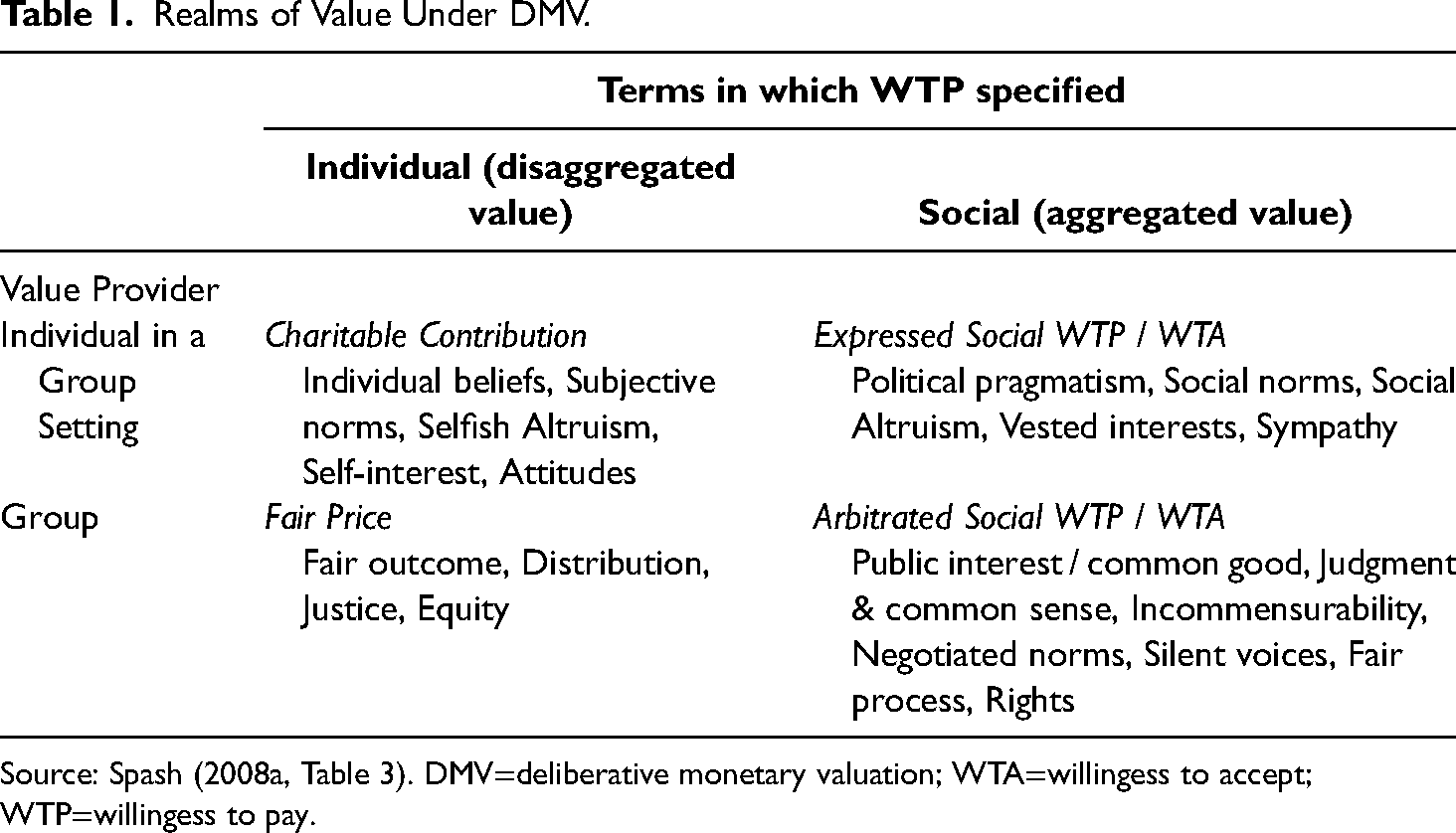
Source: Spash (2008a, Table 3). DMV=deliberative monetary valuation; WTA=willingess to accept; WTP=willingess to pay.
The dichotomy here appears problematic because it is presented as equating intrinsic value exclusively with the non-human and instrumental value exclusively with the human. In terms of instrumental values, the means-ends definition given by Gould et al. is equally applicable to non-human entities. That is, there can be instrumental values in the absence of humans. Non-humans can live and flourish having their own ends and means to meet them. At the same time, intrinsic value is not limited to non-humans and the standard versions of all three major Western ethical theories include claims about intrinsic values. As Spash and Clayton (1997: 152) note: ‘A utilitarian philosophy sees only instrumental value in acts but intrinsic value in the consequences of those acts. Human welfare, or happiness, is then seen as the only intrinsically valuable thing: an anthropocentric value system’. Deontologists take conformity to principles of right action to be intrinsically valuable, and virtue ethicists take virtue or eudaemonia to be intrinsically valuable. Intrinsic value is present, but plays different roles, in each of these theories (McShane, 2017). As this indicates, intrinsic value has a variety of forms, but does not stand in opposition to human ethical theories. The debate is rather whether intrinsic value is also applicable to non-humans and, if so, in what form.
I also find Gould et al. are too eager to classify my work within their own dichotomous framework – ecocentric versus anthropocentric, intrinsic versus instrumental, deontological versus utilitarian – with the overall aim of promoting relational values as a third way. More specifically, they claim that: ‘Spash often relies on a dualistic, oppositional framework (intrinsic versus utilitarian (monetary) values; non-anthropocentrism vs. anthropocentrism). He largely neglects alternative articulations of value […]’. I feel this is rather misleading and, because there is no reference to my work here, I am not sure where the dualism is meant to occur. Thirty years ago I did contrast intrinsic and utilitarian values in conservation (Spash and Simpson, 1993, 1994) and in my critical reflections on natural capital and sustainability (Spash and Clayton, 1997). However, my empirical work on values had no simple dichotomy, as claimed here, and intrinsic value does not appear in such work, even going back to my earliest publication on biodiversity valuation (Spash and Hanley, 1995). This, as well as later work, is formulated around non-compensatory choice and rights-based beliefs (see overview in Spash, 2000b).
Several of the papers Gould et al. reference in connection with my use of intrinsic value are also misleadingly cited. One does not even include the term intrinsic value (Spash, 2000b), while others recognise intrinsic value in humans and/or acts not just non-humans and their collectives (Spash, 1997, ), or do not use the term as implied and relate to the misuse of the term by economists (Spash, 1999, 2006a), and/or briefly mention it as supporting variety in individual motives and ethical approaches (Spash, 2008c, 2015, 2022). The most recent of these references actually connects to relational values and states the following: “The intrinsic vs instrumental value debate is also something that, while fading in and out of focus, has never gone away. Most recently it has reappeared in the discussion of a relational environmental value (Neuteleers, 2020; Norton and Sanbeg, 2021; Deplazes-Zemp and Chapman, 2021). While different positions and interpretations exist as to the meaning of intrinsic value in Nature, there remains at core something that, while challenging to conceptualise, is hard to dismiss (Vetlesen, 2015: Ch. 3). As McShane (2007) has argued, it is something that appears central to environmental ethics, and also has relevance for valuation as (mis)conceptualised by environmental economists (McShane, 2017). There is in this the concern for understanding and connecting to the otherness in Nature (Hailwood, 2000).” (Spash, 2022: 8)
Similarly, Gould et al. offer a misleading interpretation when they state that: ‘Spash discusses anthropocentrism and economic utilitarianism together (Spash 2015), tacitly implying that using and transforming nature reduces it to a mere means to human ends’. In fact, the article Spash (2015), that they cite, only uses the word ‘anthropocentric’ once and does not discuss it in relation to economic utilitarianism. What I stated was that: “A shift is perceptible in conservation from the protection of Nature for non-instrumental and ecocentric reasons such as duty of care, prevention of harm and protection of non-humans to the anthropocentric, instrumental and economic. Matching the rise of neoliberal political economy, the role of Nature has become exclusively that of value provision in the global economy.” (Spash, 2015: 550)
I think briefly explaining what I did in my research may help clarify some of the misleading interpretations and especially with respect to my work on utilitarianism and intrinsic values. My Ph.D. supervisor, Ralph d’Arge, was interested in intergenerational ethics and explored different rule based ethics (e.g. Benthamite, Rawlsian, Pareto criterion and elitist), although still all placed within a utilitarian framing (e.g. d'Arge et al., 1982). So, I became familiar with such aggregative utilitarian theories. However, I worked on intergenerational rights in contrast to welfarism and specifically within the context of the enhanced greenhouse effect and exploring the ethics of compensation for deliberate harm (Spash and d'Arge, 1989; d'Arge and Spash, 1991). My work on rights did not originate with intrinsic value nor was it simply equated with that value approach. Neither did my original work on utilitarianism restrict itself so narrowly as Gould et al. imply when they state (footnote 1) that ‘Utilitarianism is a rich and complex moral philosophy that is greatly simplified in Spash's analysis’. The simplification to preference utilitarianism (a term they do not employ but is appropriate) is not mine but that of my object of study, namely the economics profession! Similarly, my empirical research referencing utilitarianism and rights (deontology) was motivated by environmentalism as the object of study and investigating the hypothesised prevalence of these alternatives, that is, how people actually express values and why.
From my Ph.D. onwards, I was interested in values beyond those found in economics. Intrinsic value as a concept formed a challenge to the position in environmental economic valuation, but more generally to the rising neoliberalism and the price-making market trade-off approach. As a researcher, I was interested in whether people actually held that such values exist in Nature and the implications for refusals to make trade-offs. This lead me into the work on lexicographic preferences, because while refusals to trade-off are excluded in economics this form of preference allowed it into the theory, even if it was relegated to being an anomaly. So, my research 30 years ago oriented around the complex of rights, refusals to trade, lexicographic preferences and intrinsic values in Nature. This research related to the use of environmental CBA and preference utilitarianism using CVM to survey respondents about their actual values and not simply to obtain a monetary willingness to pay/accept. I explored that potential both in my Ph.D. research on climate change (Spash, 1993b), and initial work on biodiversity (Spash and Hanley, 1995). My later work then built from these foundations.
While I can see connections to the concerns for plural values that then arose, I feel the dichotomous approach presented by Gould et al. misses some important aspects of the debate. The meaning of a relational value also remains unclear. For example, instrumental values are of essence relational for a given entity, involving its means for achieving a given end. Yet relational value is stated to go beyond means to an end, but what exactly is the additional element? A phrase like ‘Nature's contribution to people’ can easily be taken to be exclusively instrumental, as appears to be the case in practice (e.g. see Brauman et al., 2020), and despite claims of difference from ecosystems services it is ‘still rooted in the MA [Millenium Ecosystem Assessment] ecosystem services framework’ (Díaz et al., 2018: 271), and relational values are rather easily classified as such (Helseth et al., 2023). Relational values would then, at best, appear to be just a larger category of value into which instrumental values fall. In this case, the approach would merely be a new dichotomy, that is relational (subcategory instrumental) versus intrinsic values. An argument against this position is the definition of instrumental values as ‘always substitutable in principle’, while relational values are ‘non-substitutable in principle’. However, this definitional distinction appears flawed because something uniquely instrumental for a given end is by definition non-substitutable in principle. So, substitutability is not the defining feature of instrumental value. My point here is that the concept of value remains indistinct.
Pinning down exactly what is meant by relational value is far from easy. Gould et al.'s definition, borrowing from the IPBES, involves ‘preferences, principles and virtues associated with relationships’. This would imply the value could be preference based, related to some principle or embedded in virtue ethics. How are such diverse approaches meant to relate to the same category of value? For example, is the value subjective as in preferences or objective as in a virtue and how could it be both? In my previous readings on the topic I found there seemed to be a close proximity between relational values and the Aristotelian concepts of eudaemonia, virtues, flourishing and the good life, but what then is the distinction from virtue ethics? There are many loose ends here, but as mentioned earlier, and discussed by Gould et al., there is a line of reasoning that does connect to concerns I and others have raised. Overall, I maintain the conclusion of Spash and Smith (2022: 329) that ‘Even though relational values seem to suffer from vagueness, complex definitions and potentially having confusing overlaps with instrumental and intrinsic values, they are an important expression of the discontent with current polices and of the ongoing struggle to (conceptually) capture the complex relationships humans have with Nature.’
At the end of their discussion, Gould et al. raise issues of validity and accept the need for avoiding ‘anything goes’ pluralism, but what criterion of validity might be employed is left unspecified. As occurs in the IPBES typology, there remains a tension between a supposedly neutral empirical description, where whatever values arise are meant to be equally valid, and identifying what is necessary to avoid social ecological crises and exploitation. A clear rejection of the fact-value dichotomy then occurs because research can identify institutions denying the existence or relevance of certain values. Not just any institutions will achieve the kind of goals, such as environmental justice, that Gould et al. reference as desirable. More specifically, capitalism, with its commodification and financialisation, is a denial of Nature and human psychosocial interdependence with non-humans (Vetlesen, 2015).
Value suppression and value articulating institutions
O’Neill and Spash (2000) note that environmental economics tries to measure preference intensity but ignores the reasons for stated preferences. The plurality of reasons behind people's values is noted by Gould et al. to raise questions as to their role in ‘decision making’, or what I would refer to as decision processes. They remark that my work ‘stops short of showing how we might get there’, although they then note I have worked on institutional design. In fact, the role of deliberative institutions, processes and their design has been something explored in my research for over 20 years (Spash, 2001a, 2001b, 2007a, 2008a; Niemeyer and Spash, 2001) and in collaboration with others via various research grants and projects (e.g. Kallis et al., 2006). This has concerned a variety of reflections on deliberative inclusive participatory process in relation to a model of human psychosocial behaviour involving ethics, attitudes, norms and set within an institutional context.
In developing this approach, I was originally looking behind what people are actually doing when answering a stated preference survey. This revealed scientific flaws in environmental economics, including its framing of choice within the institutions of market capitalism and interpretation of Nature as only being valuable if expressed as a money metric. Relating to this, Lina Isacs et al. use qualitative methods to explore what people actually think they are valuing when engaged in stated preference value elicitation. Revealing the failings of the stated preference approach to environmental values leads to the need for expanding upon the means by which people are able to express and articulate their actual values. This is addressed by Jacob Ainscough et al. who conduct a deliberative process that investigates valuation as a communal activity in contrast to being a matter of tapping into isolated individual exogenously given and preformed preferences. Both studies are something of a retrospective for me on the failings of mainstream economic valuation.
The study by Isacs et al. immediately brought to mind the research I and colleagues were doing into environmental valuation some 25 years ago. In particular, I was reminded of Jacquie Burgess and Judy Clark and their Pevensey Levels case study on CVM (Burgess et al., 1998, 2000; Clark et al., 2000), and was glad to see that work referenced by Isacs et al. The parallel with their study is the concern with actually probing respondents as to their own understanding of the willingness-to-pay figures they have given, and their knowledge of the valuation process into which they are feeding, with its related public policy implications. The question is what do people actually want to articulate rather than what they are incentivised and manipulated to do (i.e. preference economisation and moralisation, see Lo and Spash, 2013). Environmental economists have then persistently ignored participants’ actual values because their stated preference methods have successfully provided a money number assumed to reflect unquestioned and fully (or at least well) informed preferences.
The claim that there are ‘true preferences’ has long been undermined and orthodox dissenters in economics often talk of endogenous preferences. However, as with much else in mainstream theory the logic is never taken to its ultimate conclusions – choices are not preferences, preference utilitarianism is fundamentally flawed, appeals to truth lack any substance – and the core theory remains intact. Isacs et al. reference environmental economists, like my former colleague Nick Hanley, still persisting with such mainstream dogma as ‘true preferences’, despite the evidence and the lack of meaning given to truth in such a concept.
Isacs et al. conducted follow-up interviews with respondents to a stated preference survey. They identified various aspect of respondents’ perceptions and understanding of their willingness-to-pay: its relationship to the environmental improvement being evaluated, the extent of conformity to economic theory, and the legitimacy attributed to the approach and its use. They found willingness-to-pay had little connection to respondents’ concepts of valuing the natural world. The CBA process into which this might feed was unfamiliar to respondents and so opaque and hidden. Once this was revealed there were general retractions by respondents from the valuation process.
The contrast with environmental economists’ claims is stark. Isacs et al. summarise this orthodox position on respondents as follows: ‘the decision to pay (or not) is assumed to be a conscious, intentional act of commensuration of the relative welfare obtained by the things they choose (a so-called trade-off), and their WTP is taken to reveal the strength of their “true” preferences (e.g. Hanley and Czajkowski, 2019)’; cited by Isacs et al. The divorce from reality could hardly be larger. Isacs et al. find the use being made of stated preferences and CBA both undemocratic and unethical. They exemplify how economists perversely employ monetary values by referencing a recent study claiming to measure the existence value of the Indigenous American Hopi tribe's culture! In light of such treatment of Indigenous communities’ values one can see why relational values have arisen. What Isacs et al. point to is the need to address valuation within an appropriate institutional context. The desire of their interviewees is to expresses their values and contribute to worthy projects, but not as environmental economists want them to do. This is exactly why many of us working on environmental values moved to exploring deliberative inclusive participatory processes.
Lina Isacs has also worked with Jasper Kentner to highlight the communicative rationality of group deliberation and the failure of economists’ trade-off approach to relate to participant concerns over value conflicts and ethics (Isacs et al., 2023). They have identified the need for processes that allow for compromise and respect incommensurabilties, rather than assuming them away or regarding them as irrational. Jasper Kentner has been particularly engaged in researching deliberation in relation to monetary valuation, as evident in authoring or co-authoring 13 papers referenced by Ainscough et al. in their contribution to this special issue.
Ainscough et al. discuss a theory of deliberative monetary valuation that parallels the framework I put forward synthesising and contextualising such practice in stated preference work (Spash, 2008a). My research related to alternative value articulating institutional designs based on group deliberation. In fact, I think that work can help clarify some aspects of the paper by Ainscough et al. and what their case study is actually doing. Their stated aim is to conduct a deliberative monetary valuation process in a research project ‘exploring participants’ preferences between fair prices […] as opposed to […] conventional individual willingness-to-pay’. The former is meant to be elicited under what is termed deliberative democratic monetary valuation (DDMV), while the latter adds deliberation to obtain a shadow exchange price, termed a deliberative preference (DP) approach. I am not convinced that this terminology adds much over my earlier classification, but appreciate that what is being highlighted by DDMV is a specifically democratic aspect that they relate to my work with Alex Lo (Lo and Spash, 2013). Unfortunately, the case study adds two more approaches – deliberative value formation and deliberative mini-publics – absent from, and so unrelated to, their theoretical discussion. However, what concerns me is the potential loss of useful distinctions due to the reduction to the dichotomous categorisation into DP versus DDMV. In my reviews and resulting synthesis of the literature on deliberative monetary valuation I proposed a four-way classification (Spash, 2007a, 2008a), which I believe still has advantages and is reproduced here in Table 1.
A particular aspect relevant for the study by Ainscough et al. is the understanding given to a fair price, which as noted is central to their research question. Fair prices are defined as ‘an appropriate price to expect those in society to pay’, but then used for both the outcomes of DP and DDMV (see Table 1 in Ainscough et al. and also Kenter, 2017). In their Scottish case study this is elicited as a percentage of council tax, which is a local government tax based on the value of domestic property and used to fund local public services. On this basis, the approach appears closer to participatory budgeting than setting a price. While Ainscough et al. recognise this divorce from market prices and exchange value they still maintain the result expresses ‘the monetary worth’ of an environmental change. However, it seems to share characteristics of what I termed an arbitrated social willingness-to-pay. As they state: ‘The valuation derives its legitimacy as an expression of an agreed position through inclusive process and reasoned, non-coercive debate, or a workable compromise between those who would have to live with the consequences’. The issue is how to fairly raise government taxation to achieve a public project and not how much is fair for an individual to pay (per unit) in order to receive a good or service, the amount of which they can choose. The distinction is, I think, one worth making and actually developing further.
Historically the concept of fair or just prices applied to a market transaction, but one where the exchange price had a moral pegging. Such a difference in instituted processes is discussed by Polanyi (1957) in terms of exchange at set prices versus bargaining/haggling in an antagonistic process in price-making markets. The latter he believed was universally banned for food and foodstuffs in primitive and archaic society (Polanyi, 1957: 255). Whether this was universally the case or not, what seems clear is that the occurrence of unjust prices, such as arose by withholding staples such as grain to inflate prices for profiteering, repeatedly lead to riots as capitalism spread. The crowd tried to enforce a moral economy (Thompson, 1993). Capitalism and legitimation of price-making markets for everything diminished the idea of a fair or just pricing. For Polanyi, the process of arriving at a set-price offers the potential for social integration as opposed to the antagonism of price-making markets.
Besides raising the concept of a fair price, my four-way classification, as shown in Table 1, also recognised that environmental economists’ adoption of deliberation to legitimate stated preferences resulted in charitable contributions, rather than a welfare theoretic value of an environmental change, species or ecosystem. The contrast is between buying and expecting to receive a range of benefits as opposed to merely supporting a good cause, where the amount given is liable to be invariant with factors economists regard as key to determining an economic value and variant with supposedly (economically) irrelevant psychosocial factors (Spash, 2000b). I identified such charitable contributions as arising under standard non-deliberative stated preference approaches. Under the preference economisation approach (Lo and Spash, 2013), which elicits an individual stated preference within a group deliberative setting, a charitable contribution seemed even more likely and institutionally incentivised.
A key point here is how different institutional designs elicit different forms of non-equivalent money amounts. This can be related to the formation of preferences during a value elicitation process (Spash, 2002b), but actually goes well beyond this and the focus on preferences themselves, which I have criticised (Spash, 2008c). Thus, I reject the idea that stated preference approaches actually elicit a value in accord with economic theory or that ‘[i]ntegrating deliberation into valuation is a potential solution’ to its problems as stated by Ainscough et al. The best efforts of neoclassical economists to force respondents into preference economisation cannot address the ethical and value conflict issues or those raised by Isacs et al. Instead, the form of value articulating institution chosen actually relates to different ways in which public policy is itself being formulated and how provision of a given environmental change is intended to be organised, for example, market with set prices, local government project, trust fund or charity, socially regulated commons. The money value being elicited is dependent on the institutional arrangement for providing the environmental change in question. Beyond this, value articulating institutions do not need to be monetary at all, any more than does social ecological provisioning (Spash and Ryan, 2023).
Concluding remarks
As under a dogmatic paradigm, the orthodox mainstream operates a system of conformity to ideas of prices as efficient allocators, competitive markets, freedom as preference based choice, a narrow utilitarian ethics, and productivist growth. There is also a prescriptive approach to epistemology that defines what makes a real economist – mathematical formalism, modelling, arithmomorphism and quantification. Outside of their own circle, mainstream orthodox economists simply ignore social science research findings and operate in a totally closed paradigmatic community that reproduces their unscientific claims. Here we could place the old guard including of environmental economists such as David Pearce, Partha Dasgupta, Karl Goran Maler and William Nordhaus. Despite the inadequacies of their work it persists. For example, Dasgupta and Maler have been repeatedly honoured by factions of the ecological economics community and most recently by the Indian Society at their conference in 2021. The ideological loading and scientific inadequacies of Nordhaus’ climate economics work have long been recognised (Daily et al., 1991; Spash, 2002c), but have failed to affect his being lauded and given the highest international prize in economics (namely the Sveriges Riksbank Prize in Economic Sciences in Memory of Alfred Nobel). That the term savant idiot is now being applied to such climate economists is a reflection of wider recognition of the problems with orthodox mainstream economics (Ketcham, 2023).
A more subtle position is orthodox dissent where economists claim to recognise heterodox and broader social science critiques, and may even criticise the orthodoxy, but still maintain most of its core tenets (Spash, 2024). Here we find many of the environmental economists regarded as being critical and progressive. A prominent example is Nicholas Stern, who recognises a range of problematic issues, and whose highly publicised report on climate economics Claudia Carter references as using ‘a multi-criteria approach rather than narrowly CBA’. However, as I have explained, he actually focussed and headlined the CBA chapter from the report in public talks, press releases and debates, and this remains as flawed as the work of others whom he has criticised (Spash, 2006b, 2007b, 2007c). He has also consistently promoted growth as good for the climate (Spash, 2014a). Along with Stiglitz, he criticises Nordhaus and Richard Tol (Ketcham, 2023), while having employed the same unreconstituted growth and value theory. Orthodox dissent is a popular position found in a range of supposedly alternative literature including doughnut economics, circular economies and wellbeing economics let alone green growth (see Spash, 2021a).
I have argued for a more radical rejection of mainstream thought and theory (Spash, 2024). Clearly, science progresses by rejecting ideas and theories, using epistemic criteria to support that judgement, and rationalises grounds for rejection informed by philosophy of science. As this special issue shows, the paucity of some economic research does not require a lot of angst over its validity. However, the persistence of bad theories and approaches in economics is deeply disturbing and why papers like those of Isacs et al. and Ainscough et al. are still necessary despite similar work in the past.
In critically reflecting on and rejecting theories some worry that unity is lost and any new theory becomes intolerant in the same way as the dogmatic paradigm it rejects. Here I believe there is some confusion. The search for unity through common understanding lies at the heart of science. Science seeks knowledge of causation and given biophysical and social reality there is the possibility for recognising concepts held in common. While this involves socially constructed thought objects they should be based on social ecological reality, which then provides a basis for grounding knowledge claims. More generally, communication requires that we understand the concepts being used by others, but that does not mean all concepts and theories are equally valid, which is akin to eclecticism. Achieving interdisciplinary engagement is something I take seriously but reject as being achieved via eclecticism. There is a prevalent tendency to jump from rejecting dogmatic systems of naïve objectivism to accepting ‘anything goes’, including that which was rejected. A process of post-modern influence in the social sciences has seen the rise of anti-realism, promotion of diversity as inherently good and a radical relativism. Yet, concern for real social problems inevitably results in wanting to identify and conceptualise the real common causes of social ecological crises. Talk of multiple ontologies quickly leads to contradictions, because its advocates simultaneously seek to claim that there are no universal concepts while identifying and proposing universal concepts of social causation, such as colonialism, capitalism, growth, commoning, sufficiency, justice, equity, gender and so on. Avoiding dogmatism does not require rejecting science or realism. Instead, this requires being both critical and reflective while aiming to identify and validate claims about biophysical and social reality, which means claims of others will be invalidated, and researchers should make that explicit and act upon their findings.
In a recent interview I was asked, by Oliver Petit, ‘Isn't it dangerous or counterproductive to stigmatise the work of certain colleagues?’ (Spash et al., 2023: 6). Of course this is a rhetorical question that implies not only that it is most certainly wrong to criticise others in this way but this is actually what I do. Actually, I regard my work as having sought common understanding while remaining critical and not being afraid of exposing flaws, whether in my own or others approaches. Some years ago, I was trying to published an updated study, addressing biodiversity and ecosystem valuation (Spash, 2000a), that paper critically reviewed my own earlier work, which one referee took to be an indication of the paucity of my approach. Apparently, one should neither be self-critical nor seek to learn nor improve. A similar issue is the difficulty of publishing studies that fail in some way, such as valuation studies or participatory approaches that do not produce the expected results. The problem with economics is not its failings but its failure to learn from them. Recognising this and seeking to learn is exactly why I moved away from environmental and resource economics, despite having established good standing in the field early on, and also why I am highly critical of various positions held in ecological economics, such as new resources economics and new environmental pragmatism (Spash, 2013, 2024).
Indeed, what Olivier Petit had in mind when asking his question was my classification of ecological economics into seven different positions based on the hypothesised mixed adoption of what I termed three camps consisting of two opposing paradigms (mainstream and heterodox economics) and a political strategy based on a simplistic naïve pragmatism (Spash, 2013; Spash and Ryan, 2012). The contradictory position of many in ecological economics is to adopt an eclectic pluralism, sometimes confused with political toleration, while simultaneously wanting to reject orthodox mainstream theory (see response to my critiques in Spash, 2024). My scientific aim has been to rather look at people's claims and evaluate them and reject what fails to match reality, and/or is inadequate, judged by a variety of epistemic criteria (e.g. coherence, descriptive realism, non-contradiction and practical adequacy), while accepting I may be wrong in my judgements. This requires being open to revising positions, but not without being convinced by rational argument and debate.
What often goes unrecognised is that debates about economics go well beyond the narrow confines of the economics profession. There are multiple disciplinary contributions and contributors from a range of backgrounds, such as political scientists like Ulrich Brand, human geographers like David Harvey and Andrew Sayer, anthropologists such as Alf Hornborg and David Graeber, philosophers like Alan Holland and John O’Neill, and feminists such as Ariel Salleh and Corinna Dengler. In developing social ecological economics one aims is to openly recognise and engage with these different perspectives and seek common understanding. What unifies such diverse researchers is the desire to improve the world and contribute to positive ethical transformation away from its current trajectory. Interdisciplinary engagement and critique leads to better understanding of causal mechanisms and open systems reality. The challenge is to convert that into action at multiple spatial scales to achieve transformation to social ecological provisioning systems that are constituted of institutions that make for meaningful and worthwhile human lives and allow for non-human flourishing.
Navigating through these times of social ecological crises, with the hope of achieving progressive transformation, both in economics as a discipline and actual economies, has been my journey as an academic economist and environmental activist. Reading through and reflecting on the papers in this issue shows both the challenges and progress. There is clear recognition of the failings of economics, the need for alternatives and importance of interdisciplinarity. There are unifying ideas about the need for value articulating institutions while recognising that their design can bring forward or suppress values and is never neutral. Perhaps most interesting there is recognition of the complex psychosocial aspects of human interactions with Nature and how this involves the creation of self-identity. In the end, social ecological transformation will require structural change and personal transformation.
Footnotes
Acknowledgements
I thank the publishers at White Horse Press (Andrew, Alison and Sarah Johnson) and the editors of the journal Environmental Values for creating this special issue. I also appreciate the time and effort taken by the contributors in relating to my work.
Declaration of conflicting interests
The author declared no potential conflicts of interest with respect to the research, authorship, and/or publication of this article.
Funding
The author received no financial support for the research, authorship, and/or publication of this article.