




Abstract
Daylight saving time (DST) affects millions of people in various everyday situations and is a common topic of debate in legislative parliaments around the world. This paper presents a literature review on the effects of the clock change and DST on electricity usage, health, crime rates, road safety, and economic aspects. This addresses a gap in current literature reviews, as there is a lack of linked analyses considering these research fields. We show that there are partial positive effects on crime rates and road safety generally that result from the delay in ambient light availability. This contrasts with the clearly negative effects on health and the economic aspects, which are mainly driven by the disturbed circadian rhythm and the resulting sleep problems. Furthermore, we find that the initial idea of DST to save electricity will probably no longer apply and may even lead to increased usage. This literature review provides a basis for future research and promotes interdisciplinary research by summarizing current findings in a cross-disciplinary manner and identifying research gaps and opportunities. Furthermore, the findings may guide policy-making discussions and decisions.
Keywords
Introduction
Daylight saving time (DST) is a clock change policy that more than 1.2 billion people in over 70 countries experience seasonally every year. Clocks are usually set forward 1 h from standard time to DST in spring and set back 1 h from DST to standard time in fall. When DST was introduced by many countries, little research had been done on the effects of clock change on people (Monk and Aplin, 1980). It is now known the clock change, and DST can have an effect on various areas of society, such as electricity usage (e.g., Bellia et al., 2020; Graf et al., 2023), health (e.g., Poteser and Moshammer, 2020; VoPham et al., 2018), crime rates (e.g., Domínguez and Asahi, 2023; Tealde, 2022), road safety (e.g., Fritz et al., 2020; Gentry et al., 2022; Salas Rodríguez and Hancevic, 2023), and various economic aspects (e.g., Giuntella and Mazzonna, 2019; Gregory-Allen et al., 2010). Accordingly, it has been part of the social debate for many years and is a regular topic of debate in legislative parliaments around the world (e.g., European Parliament, 2019; Parliament of the United Kingdom, 2002; United States House of Representatives, 2023).
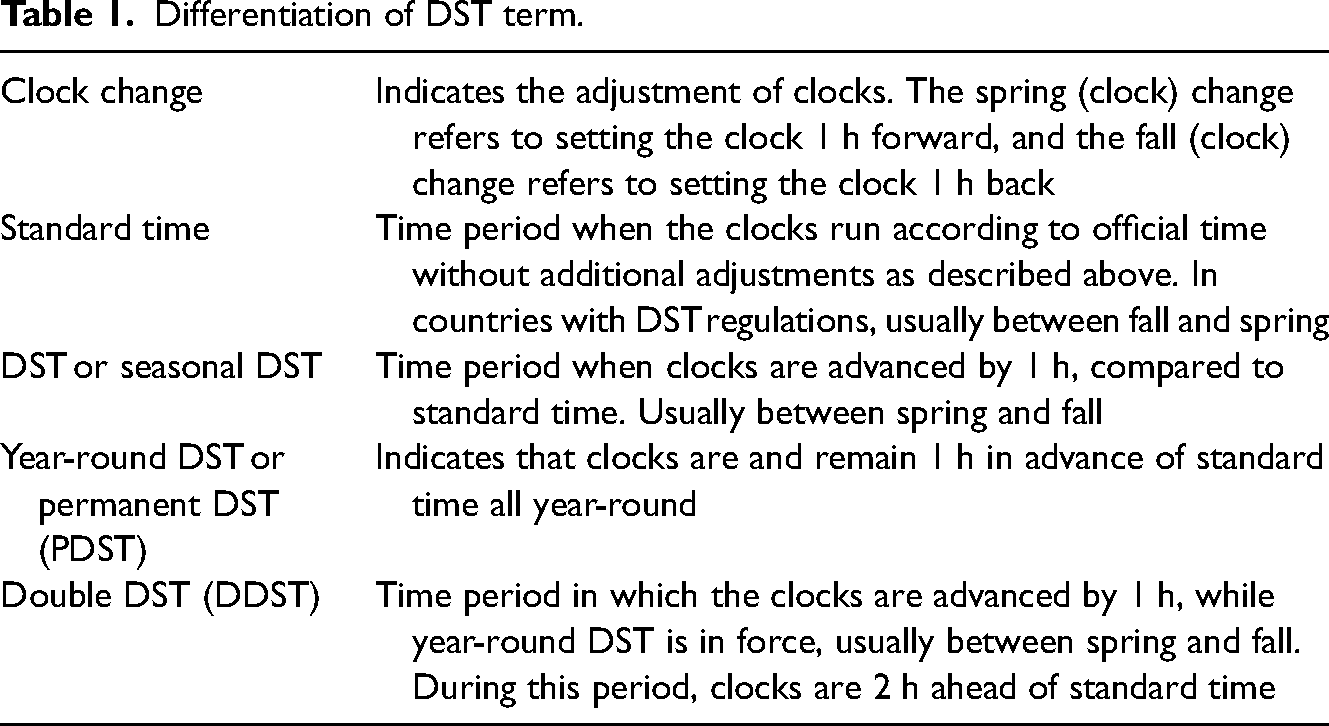
The aim of this literature review is to summarize the existing work on the effects of clock change and DST on the five areas mentioned above. This addresses a gap identified in current literature reviews, because such a holistic and interlinking review of existing research findings has not yet been conducted. So far, literature reviews on the effects of DST are mainly limited to just one effect. The present paper thus provides a basis for future research within the respective areas of influence and enables interdisciplinary research. This is of particular importance, as the various areas are interlinked by the changes in DST, and a holistic perspective is therefore necessary, for example, to take account of changes in legislation. As the use of technical terms in relation to DST differs to some extent in different research areas, Table 1 lists all terms with the corresponding meanings that are relevant to this literature review.
Differentiation of DST term.
For this purpose, the historical background of DST is presented at the beginning of the paper, followed by a detailed explanation of the influencing factors that lead to effects through the application of DST. The five areas are then reviewed in sections 4 to 8, based on the existing literature. These sections are structured to introduce the effects on the respective topic. Subsequently, studies that examine the topic regarding short-term effects of clock change, and long-term effects of DST or PDST, are summarized. In the discussion, key theses are identified and possibilities for research gaps and opportunities and further interdisciplinary research are pointed out.
History of DST
In the period before the progression from agricultural to industrial societies, people set their clocks according to the midday sun of their location (van Tienoven, 2019). The results of the International Meridian Conference (1884) laid the groundwork for the establishment of time zones that are valid worldwide today, even though some delegates put a lot of effort into keeping the civil day flexible (Barrows, 2010). These 24 time zones each cover 15 degrees of latitude and are aligned with the course of the sun, providing the basis for the discussion of seasonal DST. The first documented thought on optimizing the use of daylight was from Franklin (1784). In a rather exaggerated essay, he describes how the inhabitants of Paris could reduce energy costs by using daylight more effectively, based on an exemplary calculation (Aldridge, 1956). In 1810, the Spanish National Assembly decided to hold its sessions 1 h earlier in the summer months (Luxan, 1810). In this way, the sessions were adapted to the varying morning brightness levels throughout the year. This concept already contains the main aspects of DST used today. Both the temporal limitation of the application period and the seasonal characteristics are recognizable. Almost a hundred years later, George Vernon Hudson wrote a paper in which he suggested adjusting the clock to match working hours with daylight, so as to reduce the use of artificial light (Royal Society of New Zealand, 1895). His proposal was to set the clock forward (back) 2 h on October 1 (March 1) to delay sunset in the summer months (Hudson, 1898). This corresponds to the same seasonal approach used by the Spanish National Assembly, as New Zealand is in the southern hemisphere. To Hudson's regret, his idea was judged impracticable by the members of the Royal Society of New Zealand (1895). Willett (1907) advocated the temporary clock change in England and wrote a pamphlet on this subject. In a later edition of the pamphlet, Willett (1914) suggested setting the clock 1 h forward (back) on a Sunday in spring (fall), which is still the usual DST practice in many countries today.
The world's first temporary DST was approved by the Port Arthur Council in 1908 at the request of John Hewitson, so that the citizens of Port Arthur (known today as Thunder Bay) in Canada had their clocks set forward 1 h for 2 months in the summer (Prerau, 2005). For the first time, DST was introduced nationwide in 1916 in Germany as an economic measure, by the Imperial Office of the Interior (Reichsamt des Inneren, 1916). During World War I, a further 30 countries adopted DST (Prerau, 2005). A year-round DST was implemented in the USA from 1942 to 1945 and in 1974 and in Russia from 2011 to 2014.
So far, 143 countries have tried DST at least once. In 2023, 71 countries used DST which affected more than 1.2 billion people. Mexico is a current example of where DST has been largely abolished. The bill to abolish the DST was approved by the Chamber of Deputies in 2022 (Cámara de Diputados, 2022). The European Union is an example of where the process of abolishing DST has failed to date. The European Commission (2018) initiated the process in 2018. Afterwards, the European Parliament (2019) gave its approval, but the European Council did not approve the proposed directive, so that it was not possible to implement the abolition.
Influencing factors
As Von Goethe (1786) observed during his Italian journey, sunrise and sunset are influenced by seasonal changes and geographical location and thus affect social life. All three approaches by Luxan (1810), Hudson (1898), and Willett (1914) are based on the same underlying desire to mitigate the seasonal effects of early sunrises. The clocks that dictate the social schedule are adjusted, while the course of the sun and the corresponding times of sunrise and sunset continue to follow the seasonal trend. Figure 1 illustrates this seasonal trend using sunrise and sunset times for Greenwich (UK). The use of DST delays sunrises (compared to the social schedule) in the summer months, which are characterized by particularly early sunrises. This procedure inevitably leads to delayed sunsets (compared to the social schedule), which take place later in summer anyway due to seasonal effects.
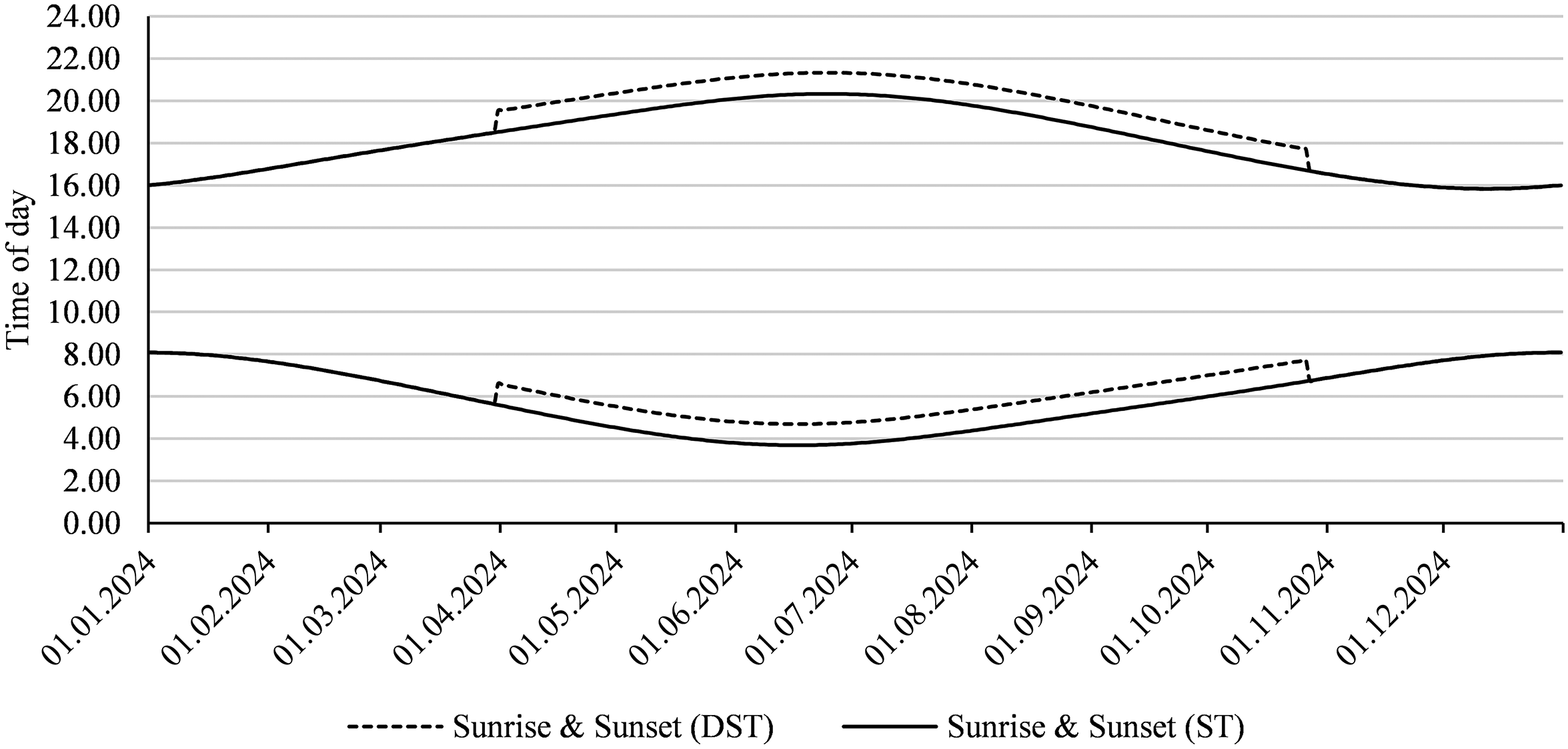
Sunrise and sunset times for Greenwich (UK).
The seasonal effect of sunrise and sunset times is also influenced by the latitude. The further away from the equator, the greater the variations throughout the year. This is particularly evident in the change in daylight hours. Figure 2 shows the annual course of daylight per day using four examples located at different latitudes: Oslo (59.91°), Prague (50.09°), Naples (40.83°), and Cairo (30.04°). This reveals that the further away from the equator, the greater the seasonal effect of earlier sunrise and later sunset. The longitude has no effect on the total daylight time. Cities that lie on the same longitude observe almost the same amount of daylight time per day.
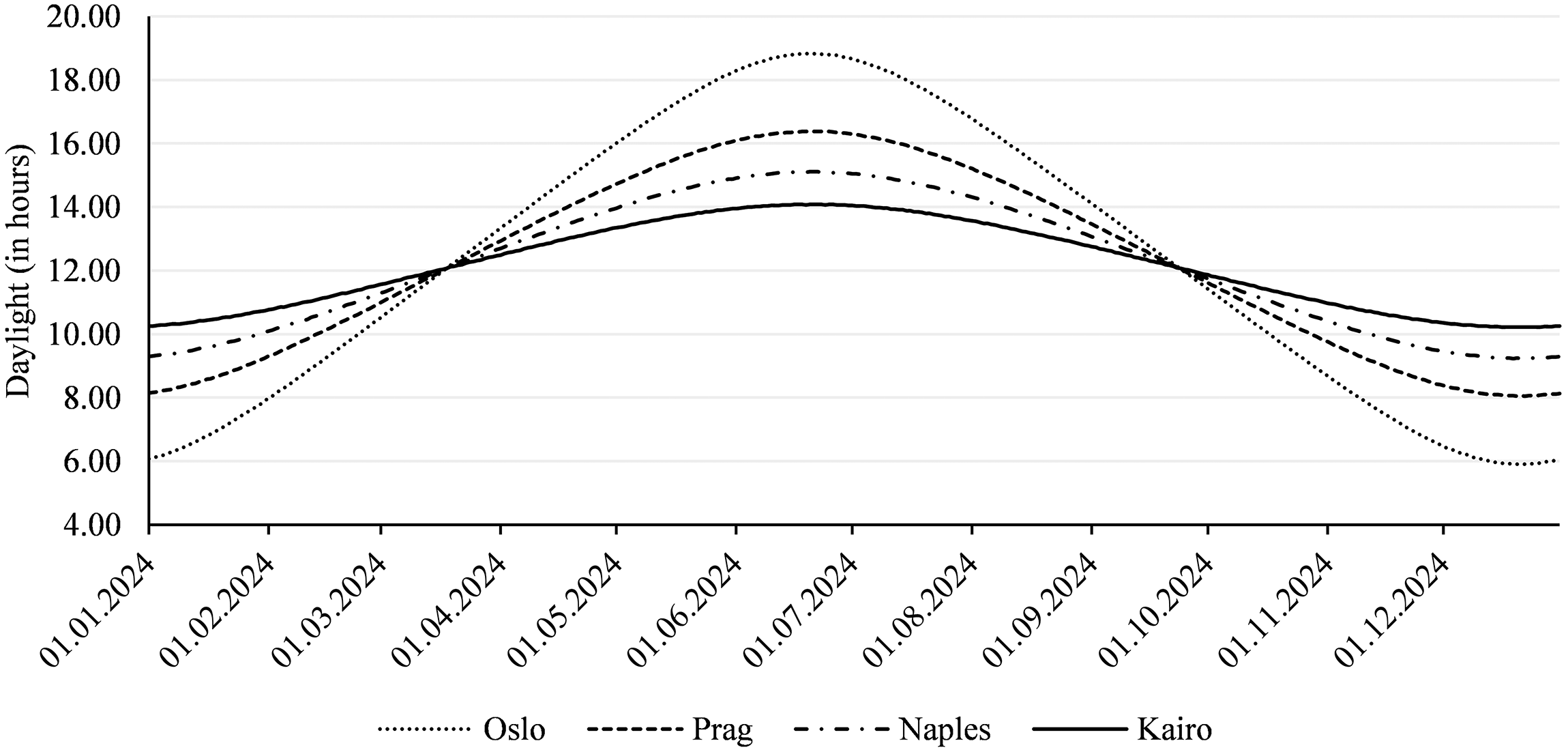
Seasonal change of daylight per day at different latitudes.
This effect of altered sunrise and sunset times is the origin of all impacts on energy usage, health, crime rates, road safety, and economy. It is also the starting point for influencing the circadian rhythm, social jetlag, and sleep loss. As these effects are of particular importance for several areas and contribute significantly to the level of explanation in this paper, they are explained in detail below.
According to current scientific findings, it is generally recognized that DST influences circadian rhythm (Rishi et al., 2020). The circadian rhythm is inherent to most animals and plants (Karatsoreos et al., 2011) and influences a variety of human body functions (Borbély et al., 2016). The circadian rhythm is mainly influenced by daylight and darkness (Duffy and Wright, 2005; Roenneberg et al., 2003) and is thus closely related to the sun clock (Roenneberg et al., 2007). The sun reaches a zenith about every 24 h and marks the middle of the day at this time (Loske, 1970). This nearly 24-h solar day rhythm applies to all chronotypes. Regulators known as zeitgebers (time givers) used to ensure that all chronotypes followed a nearly 24-h solar day rhythm through the process of entrainment (Roenneberg and Merrow, 2016).
In our industrial society, social schedules are no longer based on the position of the sun, but on an artificial clock time determined by set time zones (Gentry et al., 2022; van Tienoven, 2019). The time that is valid within these time zones is called the social clock (Roenneberg et al., 2019a). Figure 3 shows the extent to which the sun clock deviates from the social clock on an annual average using Europe as an example. In general, the DST increases the deviation. Today, people's lives are still partly influenced by the sun clock but are affected by the time zones set (Jankowski et al., 2014). But people no longer get up in the morning according to their personal chronotype preference. Rising times are determined by the social construct related to working hours and alarm clocks. This can lead to the phenomenon of social jetlag, which is quantified as the difference in day-to-day behavior between working days and days off (Roenneberg and Merrow, 2016; Wittmann et al., 2006). The effect is strongest in people with a late chronotype (Wittmann et al., 2006) and for persons living on the western border of a time zone. The issue with social jetlag is that the resulting disruption in the circadian rhythm increases the likelihood of health risks (Rishi et al., 2020). This, in turn, may negatively impact various areas, which is why it is important to consider the broader effects across different domains. The effect of social jetlag is related to DST, because sleep timing is altered. While sleep timing on days off follows the seasonal pattern of varying sunset times, this does not happen during DST (Kantermann et al., 2007). For example, Borisenkov et al. (2017) showed that for adolescents, social jetlag increases in a permanent DST setting.
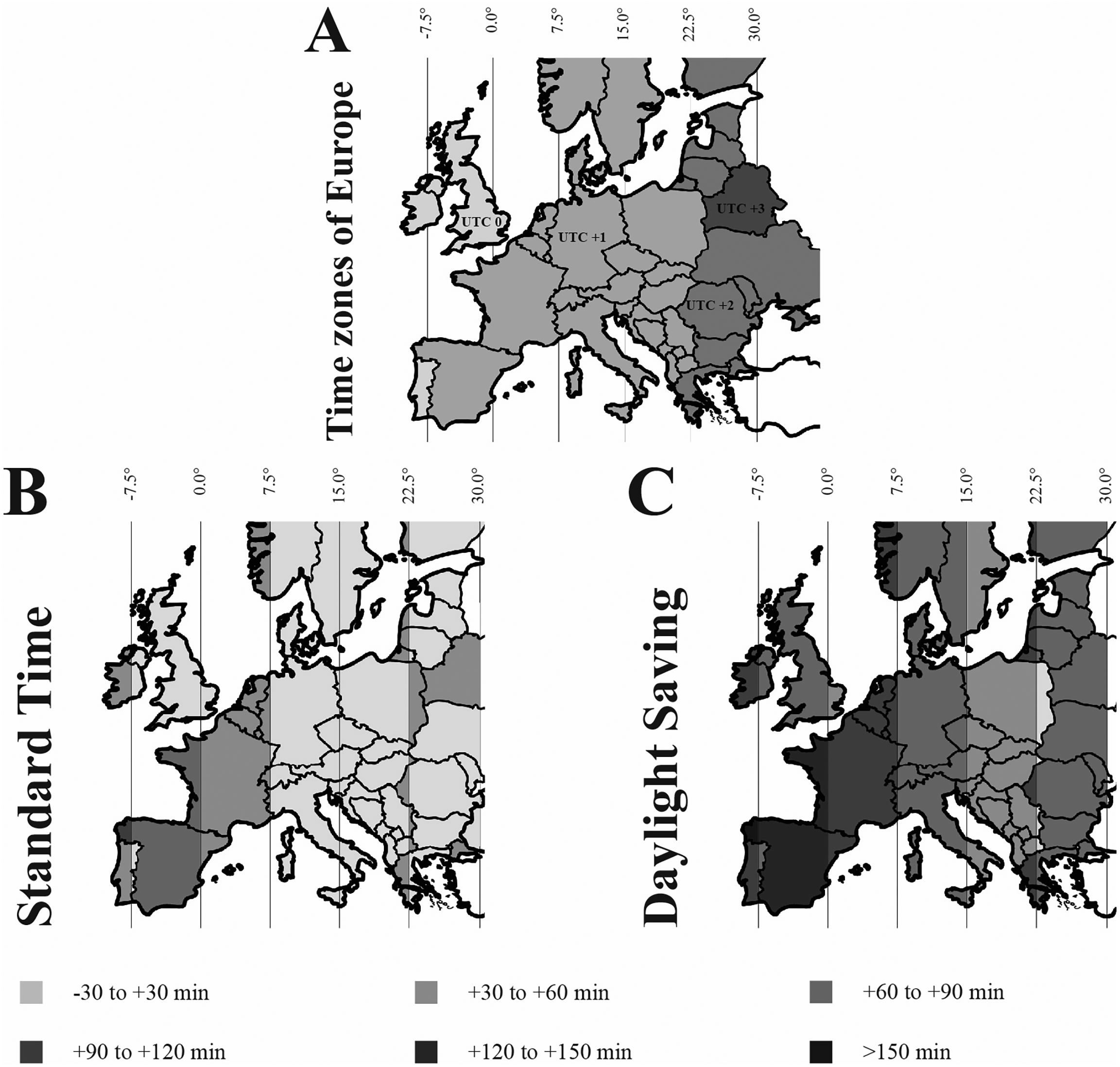
Deviation between sun clock and social clock. (A) Time zones of Europe during standard time. (B) Deviation during standard time in minutes. (C) Deviation during DST in minutes.
This aspect leads directly to the last important overarching effect, the increased sleep disruption. DST and the clock change alter sleep behavior because sunset is delayed, and therefore, people tend to go to bed later (Borisenkov et al., 2017; Gibson and Shrader, 2018; Giuntella and Mazzonna, 2019; Hamermesh et al., 2008; Jagnani, 2018). While the sleep time shifts backwards, the rise time on working days remains unchanged, resulting in shorter sleeping hours. This sleep deprivation exacerbates the already widespread sleep deprivation. A recent meta-analysis shows that around 25% of people have shorter sleep durations than recommended (Kocevska et al., 2021) and eight out of ten teenagers sleep to less than they should (National Sleep Foundation, 2024). Furthermore, one in five employees and teenagers suffers from excessive daytime sleepiness (Melamed and Oksenberg, 2002; National Sleep Foundation, 2023), and about one in five young adults has sleep problems (Kolip et al., 2022). During DST and 2 weeks after the spring change, this fatigue can increase (Medina et al., 2015; Schneider and Randler, 2009), as social jetlag is associated with persistent fatigue (Wittmann et al., 2006). After the spring change, the sleep rhythm may be disrupted (Monk, 1980), causing people to sleep less than usual in the first few days (Barnes and Wagner, 2009; Heacock et al., 2022; Medina et al., 2015; Michelson, 2011), and sleep quality decreases (Costa-Font et al., 2024; Lahti et al., 2008b). In the first few days after the fall change, people tend to sleep longer than usual (Heacock et al., 2022; Jin and Ziebarth, 2020; Michelson, 2011; Monk and Folkard, 1976), but sleep quality also deteriorates through increased nocturnal restlessness (Lahti et al., 2008b). According to their chronotype, morning type (evening type) people are more likely to be negatively affected in their sleep quality by the spring (fall) change (Lahti et al., 2008b). How long the impairment of the sleep-wake rhythm caused by the clock change lasts varies from person to person. According to various different studies, the adaptation may take between 1 day and up to 2 weeks (Harrison, 2013; Monk and Folkard, 1976; Valdez et al., 2003).
Compared to standard time, sleep behavior also differs during DST. This results in people getting around 20 min less sleep per day during DST (Gibson and Shrader, 2018; Giuntella and Mazzonna, 2019; Kantermann et al., 2007). The sleep behavior is still affected by the sun clock and circadian rhythm, but is no longer in accordance with the rising and working times determined by the social clock. To counteract this sleep deficit, people would have to go to bed before sunset. However, the circadian-dependent alerting at the end of the day makes it difficult to fall asleep in this so-called forbidden zone for sleep and is particularly pronounced in adolescents (Lavie, 1986; Monterastelli et al., 2024). Furthermore, there is a significant negative correlation between brightness and sleep quality (Little et al., 2012; Xu et al., 2021). People who sleep in moderate brightness take longer to fall asleep (Cho et al., 2013) and wake up more often (Cao et al., 2021; Cho et al., 2013) than people who sleep in the dark. Hasegawa-Ohira et al. (2019) assume that sleep quality is reduced due to light exposure, because the sympathetic nervous system is activated during sleep, which is essential for performance enhancement in stress and emergency situations. This is a widespread problem, as more than one in three people are disturbed by brightness during sleep, especially in the summer months (Xu et al., 2021).
Research on these effects is made difficult by the large number of external influences that affect the study results. Consequently, studies are often not directly comparable. Influences that affect the observations include the geographical location (e.g., Bergland and Mirza, 2017; Verdejo et al., 2016) as well as temperature and humidity (e.g., Choi et al., 2017; Flores and Luna, 2019). As a result, studies that examine effects at different latitudes and longitudes are not directly comparable. Another characteristic is that the studies were published over a period of several decades. Using the example of electricity usage, consumption patterns have changed (Aries and Newsham, 2008; López, 2020; Momani et al., 2009) and will continue to do so in the future (Boßmann and Staffell, 2015; Castillo et al., 2022; International Energy Agency, 2023). Studies published at different times are likewise poorly comparable. Furthermore, social and economic factors must be included on the basis of the specific research area. This factor is particularly important for studies in the areas of crime rates and health. Finally, the insufficient availability of data in the winter months is a problem. In recent years, there have been few opportunities to research year-round DST and thus to obtain actual observation data in winter months with DST. As a result, many findings for these periods of the year rely on models in order to provide predictions.
Electricity usage
Impact on electricity usage
Reducing energy usage is part of the core idea behind DST. The underlying principle is that people consume more energy when they are at home and awake when no daylight is available (Fong et al., 2007b). The change in sunrise and sunset times throughout the year provides daylight earlier in the morning and later in the evening during the summer months than in the winter months (see Figure 2). The spring change theoretically causes people to get up an hour earlier during DST, which means that the already longer evening light in summer is increased by another hour. This means that if no more energy is consumed in the morning due to getting up earlier and less energy is consumed in the evening due to the longer daylight hours in the evening, energy consumption should decline.
The majority of publications relating to energy usage and DST deal with the amount of electricity consumed. On the one hand, the studies look at total electricity consumption to measure the achievement of the original aim of DST. On the other hand, another important research factor is peak demand, which is particularly important because it influences the generation costs (Chong et al., 2011; Crowley et al., 2014) and therefore has a direct impact on energy-intensive industry sectors. DST may influence peak demand in consideration of the fact that this peak usually occurs in the evening (e.g., Hancevic and Margulis, 2018; Kudela et al., 2020). As DST could primarily have energy savings in the evening, this evening peak could be smoothed.
Studies on electricity usage
The effects of DST on electricity usage have frequently been investigated in various studies. Based on this, two extensive meta-studies were carried out by Aries and Newsham (2008) and Havranek et al. (2018). The latter shows that an overall effect of 0.34% less electricity consumption is found, but this effect is close to zero if only high-quality studies with reliable analytical methods are included. Aries and Newsham (2008) point out in particular that economic, geographical, and climatic factors influence the results and that an effect of DST on electricity consumption is mainly recognizable in residential buildings. Both meta-analyses use studies from 1970 to 2007, respectively, and 2016 for their analyses, and many of the analyzed studies use data from before the new millennium. As consumption behavior in electricity usage is constantly changing (Castillo et al., 2022), it is questionable how relevant such studies are for today's purposes. As the previous literature is already discussed in detail in both meta-analyses, this literature review focuses on studies published from 2010 onwards.
First, findings from studies investigating the difference between standard time and DST are discussed. Information on each study and the main findings are provided in Table A1 in the Appendix. Current studies do not provide a clear picture of whether the use of DST actually currently reduces electricity usage. Both increased consumption (e.g., Hancevic and Margulis, 2018) and savings (e.g., Flores and Luna, 2019) are shown in various studies. A frequent explanation for the potential savings is that the additional electricity usage in the morning is less than the savings in the evening (Choi et al., 2017; Rivers, 2018; Von Blanckenburg and Strauch, 2016). In particular, because more natural light hours in the evening can be used during DST, electricity usage decreases (Bellia et al., 2020; Hillman and Parker, 1988). Wolff and Makino (2013) also show that people watch less TV during DST. Instead, there are more outdoor leisure activities, especially in the evenings (Sexton and Beatty, 2014; Wolff and Makino, 2013), resulting in less electricity usage (Fong et al., 2007b). Hancevic and Margulis (2018) as well as López (2020) show, in contrast to these studies, that the additional consumption in the morning exceeds the savings in the evening. These findings are in line with Shaffer (2019), who shows that darkness in the morning increases electricity usage when people are already awake. According to López (2020), one reason for this change in recent findings may be that the increasing use of LEDs reduces the proportion of energy consumed for lighting, and therefore, the savings effect of DST decreases. In addition, people sleep less during DST (Kantermann et al., 2007), spending this time awake at home (Sexton and Beatty, 2014), potentially increasing energy consumption (Fong et al., 2007b). The increased use of electricity-powered air conditioners (Guven et al., 2021; International Energy Agency, 2018) may also explain the increased consumption during DST (e.g., Kotchen and Grant, 2011). On the other hand, DST potentially reduces the electricity usage of air conditioning systems in office buildings (Eggimann et al., 2023). It is also interesting that Bergland and Mirza (2017) and Fong et al. (2007a) conclude from their results that regions closer to the equator tend to have higher savings. This statement cannot be confirmed by current studies from Spain, in the south of Europe, where an increase in consumption is evident (Graf et al., 2023; López, 2020).
Peak demand for electricity is a second frequently investigated parameter. Particularly in view of the fact that a significant increase in peak demand is expected in the coming years (Boßmann and Staffell, 2015), smoothing demand is an important issue. Whether DST reduces electricity demand peaks has been examined by fewer studies than overall electricity usage. However, almost all results show that demand peaks are smoothed during DST compared to year-round standard time (e.g., Choi et al., 2017; Hancevic and Margulis, 2018). The meta-study by Aries and Newsham (2008) reaches the same conclusion. These results are supported by findings that people do more outdoor activities during DST in the evening (Sexton and Beatty, 2014; Wolff and Makino, 2013).
In addition to analyzing whether DST reduces electricity usage, investigations also consider whether an extended DST (EDST) has positive effects. In other words, does an EDST duration also promote the desired reduction in electricity usage? For this literature review, six analyses are identified that address this question, three of which are government reports. Information on each study and the main findings are provided in Table A3 in the Appendix. With regard to overall electricity consumption, studies consistently show that an EDST leads to no or very small savings (e.g., Belzer et al., 2008; Kandel and Sheridan, 2007). These results may indicate that DST is not effective in reducing electricity consumption in some countries, because the chosen period is not optimal. It is important to note that the EDST only values additional time in the spring and fall. Results from this area cannot be interpreted directly throughout the entire year.
Another important scenario in investigating electricity usage is the comparison between standard time and PDST. The latter can be equated with an eastward time zone shift. We identified seven studies, for which information and the main findings are provided in Table A2 in the Appendix. All publications that examine this scenario use models or load curve data for the analysis. The results of these studies show potential savings in total energy usage (e.g., Chong et al., 2011). In addition, it is consistently shown that the peak demand is smoothed, particularly in the evening (e.g., Hillman, 1993), and that this could save costs in the winter months (Hill et al., 2010). It should be noted that no findings include actual observations for the winter months. Whether the electricity consumption during this period corresponds to the assumed parameters is therefore an open question and requires further research.
Few studies have been published on other forms of energy and their usage during DST. Ebersole et al. (1974) find indications of reduced consumption of motor fuel usage, whereas Hecq et al. (1993) show an increase. For the usage of heating gas, the sparse literature also only allows assumptions to be made. Whereas Ebersole et al. (1974) show no change in usage, Bouillon (1983) and Rock (1997) point out that the energy demand for heating gas tends to increase during DST. From today's perspective, these sources are of little or no use, as both the data quality is inadequate in some cases and consumer behavior has changed over time.
Summary
Whether the use of DST reduces electricity usage has not yet been conclusively clarified. Whereas older publications often show savings, more recent studies show fewer savings and often even increased usage (Havranek et al., 2018). The recent studies selected in this literature review find savings in electricity usage related to lighting energy, but when adding factors such as heating and cooling appliances, the effect is leveled or reversed. Added to this is the difficulty of comparing the studies, depending on geographical, climatic, and economic conditions. The findings of each study are therefore limited in geographical and temporal terms. Only the conclusion that, with DST and PDST, peak demand is probably lower than under standard time is consistent in the majority of publications. However, studies with difference-in-difference methods are particularly necessary for obtaining more reliable results with PDST, as so far only models and simulations are available.
In order to answer the question of whether or not DST leads to savings or increased usage, it is also necessary to consider whether other measures are more suitable. Giacomelli-Sobrinho et al. (2022) show in their model that the implementation of an energy trading scheme in Brazil could result in four times more electricity savings than with the DST measure. The original goal of DST may no longer be achievable with DST in the future, but rather with alternative measures that reduce both electricity consumption and peak demand.
Health
Impact on health
The majority of the literature reveals negative effects on people's health in the short term after the clock change and in the long term during DST. The disruption of the circadian rhythm and resulting sleep deprivation are repeatedly cited as the main factors (e.g., Borisenkov et al., 2017; McHill et al., 2014). Related to this, position papers and press releases from the American Academy of Sleep Medicine (American Academy of Sleep Medicine, 2022; Rishi et al., 2020), the Sleep Research Society (Malow, 2022), the Society for Research on Biological Rhythms (Roenneberg et al., 2019b), and the American Medical Association (2022) point to the health disadvantages of DST practice and unanimously advocate the adoption of year-round standard time. In further statements, Meira e Cruz et al. (2019) and Roenneberg (2019) argue in favor of year-round standard time, and Ekmekcioglu et al. (2019) additionally point out that the disadvantages of year-round DST outweigh the advantages.
The issue is that the resulting disruption in the circadian rhythm increases the likelihood of health risks (Rishi et al., 2020). One reason is that some body functions, such as the cortisol response (Hadlow et al., 2014), do not adapt to the new social clock during DST, but continue to follow the sun clock. Another aspect of why DST may have a negative impact on health is the influence on sleep. Sufficient sleep duration and sleep quality in harmony with the circadian rhythm have positive health effects (Czeisler, 2015; Luyster et al., 2012; Van Cauter et al., 2008), whereas sleep deprivation and circadian disruption are associated with negative health effects (Akerstedt, 2000; Goel et al., 2009).
Studies on health
In consideration of the health consequences, acute myocardial infarction (AMI) and cardiovascular disease, cancer incidence, mental health, physical activity, and obesity, as well as study results on other medical areas, are examined. For each area, first, the short-term effects of clock change and then the long-term effects during DST are presented below.
The influence of clock change on the incidence of AMI is regularly studied. This topic has already been the subject of a literature review (Manfredini et al., 2018) and a meta-analysis (Manfredini et al., 2019). They show, in this meta-analysis including seven studies, that the risk of AMI is about 5% higher in the first 2 weeks after the spring change, but no difference is observed after the fall change. An overview of the studies in our literature review with four additional studies can be found in Table A4 in the Appendix. When looking at these new studies, it is noticeable that Rodríguez-Cortés et al. (2023) show significantly more AMI after the fall change, confirming the results of Čulić (2013). Overall, it is striking that most studies find a significant increase on Sunday or Monday after the spring or fall change (e.g., Čulić, 2013; Sipilä et al., 2016a), supporting the findings on negative short-term effects of clock change. Tanaka and Koizumi (2024) is the first study to examine an observation period of 4 weeks following the clock changes, showing a significant increase in AMI cases after the spring change. Studies with longer observation periods are needed to investigate whether there is also a long-term effect during DST. This has not yet been investigated. So far, it has not been proven that the clock change or DST increases the overall incidence of AMI and whether there is a long-term effect. Sandhu et al. (2014) and Sipilä et al. (2016a) assume that the clock change alters the time of occurrence, but leaves the number of incidents unchanged. As the only study to show long-term results on AMI, Giuntella and Mazzonna (2019) indicate that late sunrises and sunsets (like under DST) increase AMI rates by 19%. The clock change may also have short-term impacts on other cardiovascular disease, such as an increased risk of atrial fibrillation after the spring shift (Chudow et al., 2020), which is generally increased by the sleep loss (Christensen et al., 2018; Genuardi et al., 2019). On the other hand, it has been shown that hospital admissions with cardiovascular disease decrease for a short period following the fall shift (Jin and Ziebarth, 2020). The persistent sleep deprivation during DST is likely to worsen conditions in patients with cardiovascular disease (Giuntella and Mazzonna, 2019).
Several studies suggest, as a long-term effect, that the risk of some types of cancer increases due to the disruption of the circadian rhythm (e.g., Gu et al., 2017; VoPham et al., 2018). The permanent exposure to later sunrise and sunset as well as misaligned time due to DST and the associated disruption to the circadian rhythm may therefore increase the incidence of cancer. The sunset of residents west of the time zone’s reference median takes place later than for inhabitants east of the reference median. Studies show that the risk of multiple cancer types increases from east to west within a time zone, whereby disparity effects by age and race were found (Gu et al., 2017; VoPham et al., 2018). Comparing a western and eastern group at a time zone boundary yields the same result that people living on the western boundary of their time zone are more likely to develop various types of cancer (Giuntella and Mazzonna, 2019). Borisenkov (2011) shows that a year-round DST results in higher cancer incidence and cancer mortality, by comparing the incidences of the western border (geographical time zone UTC + 2) and the eastern border (geographical time zone UTC + 3) of the European part of Russia which sets the official set time zone UTC + 3. In contrast, Niu et al. (2024) show, for hormonally associated cancer types, that the risk of breast cancer increases west of the reference median but decreases for prostate and thyroid cancer. In people aged 65 and older, Cook (2022) published the first study to show that EDST may reduce the cancer death rate.
The influence of clock change and DST on mental health has been studied, particularly in relation to depression and suicide. The results of a poll by the National Sleep Foundation (2023) show that people who sleep less than 7 h tend to report higher levels of depressive symptoms. It is clear that sufficient sleep is important for the regulation of emotions (Goldstein and Walker, 2014) and making emotional decisions (Killgore et al., 2012). For instance, when the sleep-wake cycle or circadian rhythm is disrupted, mental health can be negatively affected (e.g., Foster et al., 2013; Grandin et al., 2006; Menet and Rosbash, 2011). Referring to this issue, several studies show that people are more dissatisfied in the first few days after the spring change (Costa-Font et al., 2024; Kountouris and Remoundou, 2014; Kuehnle and Wunder, 2016) and report discomfort during the entire DST (Alencar et al., 2017). However, no results have been published in this context regarding the fall change. As mentioned above, the spring change is associated with a short-term increase in mental disorders (Zhang et al., 2020), and after the fall change, unipolar depression episodes increase 11% in the first week (Hansen et al., 2017). No increase was observed for manic episodes after both clock changes (Jin and Ziebarth, 2020; Lahti et al., 2008a), and Olders (2003) even points out that the prevalence of depression decreases with later sunrises, so that year-round DST would reduce the prevalence of depression. On the other hand, year-round DST may worsen the social jetlag of adolescents suggesting that circadian disruption and temporary sleep deprivation have a harmful influence on adolescent mood (Borisenkov et al., 2017). Reis et al. (2023) show higher rates of suicide in western parts of a time zone compared to eastern parts, and Winsler et al. (2015) show, in a self-report study, that permanent sleep deprivation increases the suicidal thoughts and attempts of adolescents. Disruption of the circadian rhythm may be a potential destabilizer for at-risk individuals (Berk et al., 2008). Some studies find an increase in suicides after both clock changes (Berk et al., 2008; Lindenberger et al., 2019; Osborne-Christenson, 2022). This is countered, however, by the study of Shapiro et al. (1990), showing no change in suicides or inpatient admissions to psychiatric facilities following a clock change.
Furthermore, the influence of clock change and DST on physical activity and obesity was investigated fourfold. Although it is known that physical activity improves physical and mental health (e.g., Mikkelsen et al., 2017; Ruegsegger and Booth, 2018), over 30% of people worldwide engage in insufficient physical activity (Strain et al., 2024). Hillman (2010a, 2010b) points out that an early dawn limits people's access to sports activities. These statements are in line with the results of Holmes et al. (2009) showing that the use of hiking trails increases during DST. However, other studies show that during DST, the level of physical activity stays the same (Rosenberg and Wood, 2010; Zick, 2014), and there are some varying results in children (Goodman et al., 2014). Instead of the level of physical activity, the timing of exercise is changing (Zick, 2014), so that less exercise is done in the morning and more in the evening (Rosenberg and Wood, 2010). This is in line with the observation that people spend more time outside in the evening (Sexton and Beatty, 2014; Wolff and Makino, 2013). On the other hand, it is likely that disruption of the circadian rhythm and the spring change briefly reduces the performance of athletes (O'Connor and Kancheva, 2022; Winget et al., 1985), and the risk of injury to adolescent athletes may increase (Milewski et al., 2014). This is probably due to the loss of sleep, as athletes with sufficient sleep achieve better and safer results in some respects (Mah et al., 2011). Wolff and Makino (2013) estimate, in their working paper, that an increase in physical activity during DST corresponds to a higher daily calorie consumption. Somewhat contradictory studies show that due to insufficient sleep, appetite increases, unhealthy food is consumed more frequently when the circadian rhythm is disturbed or with greater social jetlag, and therefore a higher calorie intake occurs (Arab et al., 2023; Krishnan and Johnson, 2023; Reutrakul and Van Cauter, 2018). The higher calorie intake as a short-term effect following the spring change was recently demonstrated for the first time by Janakiraman et al. (2024). In addition, the consumption of alcoholic and caffeinated drinks increases when people experience social jetlag or have a disturbed circadian rhythm (Hasler et al., 2014; Wittmann et al., 2006). These findings are in line with studies that reveal how a disrupted circadian rhythm, sleep loss, and social jetlag lead to faster weight gain (Giuntella and Mazzonna, 2019; Karatsoreos et al., 2011) and are risk factors for obesity among adults, adolescents, and children (Arab et al., 2024; Cespedes Feliciano et al., 2019; Lowry et al., 2012; Moreno et al., 2021; Roenneberg et al., 2012). This is because the circadian rhythm is linked to the metabolic system (Arble et al., 2010), and adequate sleep duration is important for the metabolism (Van Cauter et al., 2008). While adequate sleep has positive metabolic effects (Reutrakul and Van Cauter, 2018), sleep patterns against the circadian rhythm slow down energy metabolism (McHill et al., 2014) and glucose metabolism (Buxton et al., 2012). These results are in line with studies similarly showing that a disturbed circadian rhythm alters metabolism negatively (Karatsoreos et al., 2011; Rusu et al., 2019) and can be associated with some metabolic diseases (Arble et al., 2010).
Beyond this specific issue, Zhang et al. (2020) studied a variety of diseases and the changes in incidence in the short-term after both clock changes and revealing numerous effects for different subgroups. Individual studies on other specific medical topics are occasionally published. As short-term effects after the spring change, Liu et al. (2017) show significantly higher embryo loss in artificial inseminations performed shortly before the change, and Sipilä et al. (2016b) demonstrate that ischemic strokes and renal failure may occur more frequently. Moreover, a worsening in the pathogenesis of patients with inflammatory bowel diseases is to be expected as a long-term effect during DST (Föh et al., 2019). Weaver et al. (2018) show that sleep loss in adolescents leads to higher levels of alcohol, tobacco, and drug use. These results are in line with several studies linking the disruption of the circadian rhythm to increased drug abuse (Hasler et al., 2012; Hasler et al., 2014; Logan et al., 2014; Menet and Rosbash, 2011; Webb, 2017). Whether the clock change or DST has an influence on mortality rates has been poorly researched to date. Poteser and Moshammer (2020) show a higher mortality rate, and Lindenberger et al. (2019) find more autopsies in the first week after the spring change. With regard to the fall shift, Poteser and Moshammer (2020) and Lindenberger et al. (2019) find no effect. The results from Lévy et al. (2022) contradict these findings, but Klerman et al. (2024) show that the Lévy et al. study has major statistical issues and confirms rather than contradicts the previously shown effects.
Several studies indicate whether the workload in medical facilities is affected by the clock change. On the one hand, there are studies that reveal more admissions to the emergency room (Ferrazzi et al., 2018) and more work accidents after the spring change (Barnes and Wagner, 2009; Depalo, 2023). In addition, more patients fail to attend medical appointments in the week after the spring change (Ellis et al., 2018). Other studies, however, show no increase in accidents with hospitalization after both clock changes (Lahti et al., 2008a) or fewer hospital admissions after the fall change (Jin and Ziebarth, 2020). The impact of DST could also have a negative effect on the quality of work in hospitals, as the most common risk factor for error by doctors is fatigue (Ulmer et al., 2009). As sleep duration decreases under the effect of DST, this could lead to an increase in errors.
Summary
Overall, the area of health is the most intensively studied when it comes to researching the effects of the clock change and DST. Various expert groups have stated in position papers that short- and long-term negative consequences are due to clock change and DST. For example, most studies show a significant short-term increase in AMI after the spring change, resulting in an ongoing cost of $20,176 per patient per year (Bishu et al., 2020). Whether this short-term effect results in more AMI overall, or whether these are only condensed into a short period after the spring change, is currently unclear and requires further research. The data from health research is otherwise very consistent in terms of the negative effects of the clock change and DST, including various subgroups like sex, age, and race. Of particular note is that the expected positive effect of more exercise and sport during DST is barely evident, and the behavioral change in food intake caused by disruption of the circadian rhythm reverses this possible health-promoting effect. This means that there are hardly any findings and arguments in favor of DST use from a health perspective, making the demand for a year-round standard time reasonable.
Crime rates
Impact on crime rates
According to the routine activity approach, a crime can be committed, if a potential offender, a suitable target, and the absence of adequate protection coincide (Cohen and Felson, 1979). Based on Becker's model of crime (Becker, 1968), the rational potential offender constantly weighs up the risks and benefits of committing a crime. By altering the environment of potential offending, as attempted by the situational crime prevention approach, a potential offender can be influenced in his or her weighing up, so that the perceived risk increases (Chalfin et al., 2022; Clarke, 1983). Ambient light, the sum of natural light and public light (Tealde, 2022), is a key driver of criminal activities (Domínguez and Asahi, 2023). DST typically delays sunrise and sunset by 1 h, so that the availability of natural light is shifted back by 1 h as well. This change causes natural light to be available 1 h later in the evening. Light serves as a protection mechanism for the crime object, as increasing ambient light increases the potential offender's risk of detection (Cornish and Clarke, 2003; Tilley and Sidebottom, 2014). Various field studies have shown that improving ambient light through public lighting reduces crime rates in the evening and at night (Chalfin et al., 2022; Farrington and Welsh, 2006; Painter and Farrington, 1997).
On the other hand, darkness is generally associated with a higher risk of crime, and people feel less safe in the dark (Crosby and Hermens, 2019). This insecurity may lead a potential offender, in their perception, to consider a person as a feasible target (Book et al., 2013; Cohen and Felson, 1979; Richards et al., 1991; Sakaguchi and Hasegawa, 2006) and therefore be more likely to commit a crime (Becker, 1968). Furthermore, empirical studies show that more robberies (Davies and Farrington, 2020; Van Koppen and Jansen, 1999), more hit-and-runs (Castriota and Tonin, 2023), more car crime (Davies and Farrington, 2020), and more homicides (Cortes et al., 2021) occur in the dark. These findings are relevant when considering the change of brightness. During DST, 1 h of darkness is shifted to the morning, when less crime occurs, and 1 h of brightness is shifted to the evening, when more crime occurs (Calandrillo and Buehler, 2008; Doleac and Sanders, 2015; Van Koppen and Jansen, 1999).
Another effect that can influence crime rates is sleep loss that may be triggered by the clock change and has been observed during DST. Increased aggressiveness is also linked to fatigue (Hoshino et al., 2009; Yoo et al., 2007) and sleeping problems (Kamphuis et al., 2012; Krizan and Herlache, 2016), thereby possibly increasing crime rates. Furthermore, studies show that there is a correlation between aggression by young children and sleeping problems (Reid et al., 2009) and crime rates of youth who are frequently sleepy and tired (Raine and Venables, 2017). It is assumed that sleep deprivation reduces activities in the prefrontal cortex and its functional connection to the amygdala and is thus interpreted as the biological basis for the expectation of uncontrolled, reactive aggression (Yoo et al., 2007). These findings are contrary to Pilcher et al. (1997) and Shin et al. (2005), who found no increased aggressiveness associated with shorter sleep duration or worse sleep quality. Conversely, Taub (1977) shows that people with longer sleep durations are less aggressive and hostile, whereas Umbach et al. (2017) found an increase in assaults during a short period following the fall change.
Studies on crime rates
The short-term effect of clock change in spring and fall in crime rates has been widely studied. In order to analyze this effect, the occurrence of crime in a given period before and after the change is compared. As the clock change causes a 1-h shift in the daylight hours, this setting is used as a natural experiment to measure whether natural light influences crime rates. Information on the individual studies is provided in Table A5 in the Appendix.
The study findings in which an effect of these short-term observations was investigated are ambiguous. For example, the data from three studies (Doleac and Sanders, 2015; Fotios et al., 2021; Tealde, 2022) show an increase in robberies shortly after the spring change, while two other studies (Domínguez and Asahi, 2023; Munyo, 2018) show a decrease. The same applies to theft, for which Munyo (2018) and Tealde (2022) identify lower crime rates after the spring change, while Domínguez and Asahi (2023) and Fotios et al. (2021) find no short-term effect. A more consistent picture emerges for burglary, homicide, murder, and rape. For the most part, no effects are found that are due to the spring change. Only Toro et al. (2019) show a drop in homicide. The effect of the fall change is less frequently studied, and most studies have found no short-term effect. Table 2 shows a systematic categorization of study results with short-term effects.
Short-term effect on different types of crime.
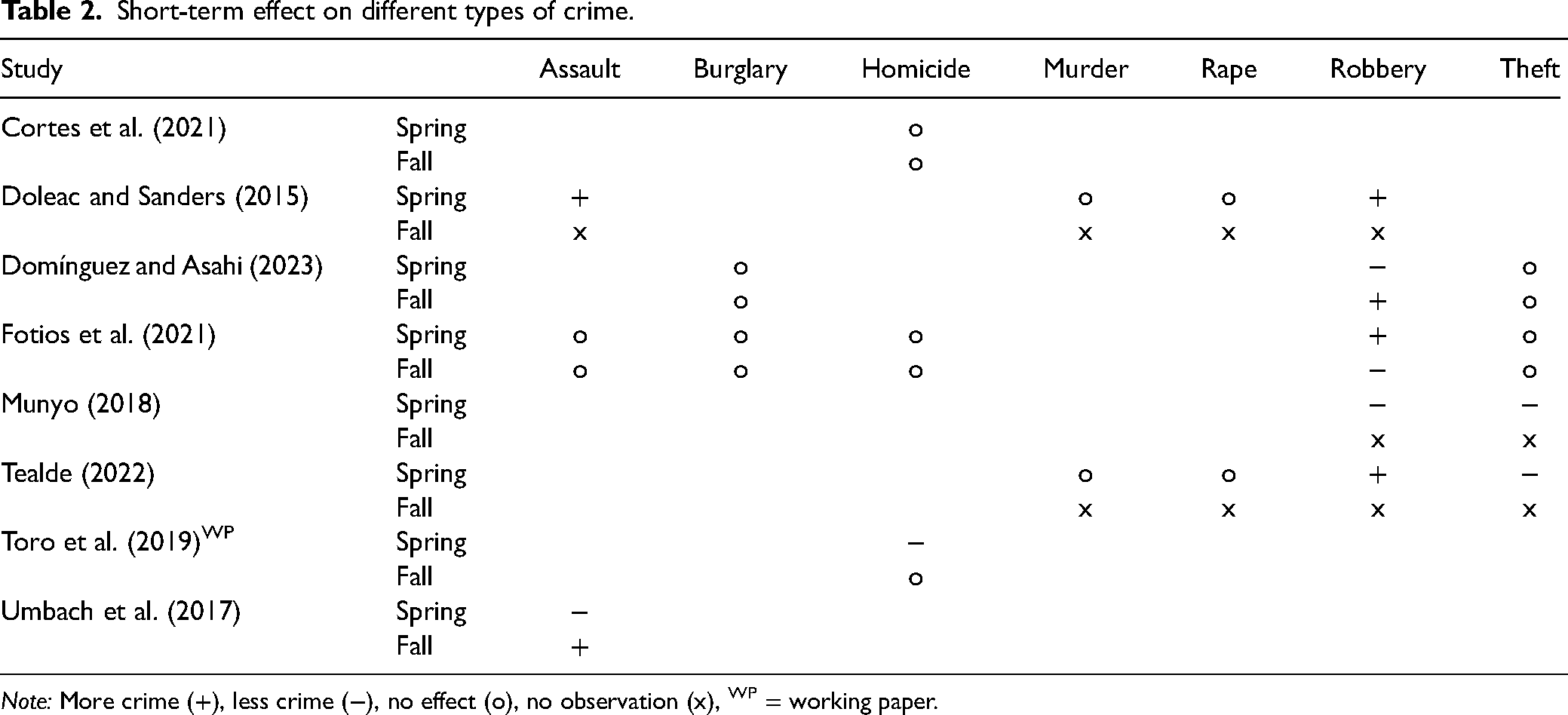
Note: More crime (+), less crime (−), no effect (o), no observation (x), WP = working paper.
While short-term effects have often been studied, there is a lack of observational data for long-term effects that occur during DST. Furthermore, the only findings regarding long-term effects are derived using estimates based on the results of short-term effects. These estimates show a decreasing total crime rate (Domínguez and Asahi, 2023), as well as for various crimes such as homicide by firearms (Toro et al., 2019), robberies (Doleac and Sanders, 2015), and thefts (Tealde, 2022). No effect was found with regard to murder and rape (Tealde, 2022). To what extent these estimates really reflect the actual long-term effect, and whether decisions regarding year-round standard time or year-round DST can be made on this basis, must be questioned, as crime rates are affected by seasonal fluctuations (Cohn, 1990; Corcoran and Zahnow, 2022; Farrell and Pease, 1994).
Summary
Overall, the findings of the short-term effects are ambiguous, and frequently no effects can be found. Only for assault, robbery and theft, do more than one study demonstrate an effect. A reliable statement on whether spring or fall change influences other crime rates cannot be derived. The currently available estimates on long-term effects only provide indications of a possible influence. If these estimates reflect the actual trend of sinking crime rates during DST, this is an important finding. The estimated rounded crime costs of murder at $8,980,000, rape at $240,000, assault at $107,000, and robbery at $42,000 (McCollister et al., 2010) indicate that each prevented crime saves society money. The underlying principle is that as long as more crimes are committed in the dark evening hours than in the dark morning hours (Calandrillo and Buehler, 2008; Doleac and Sanders, 2015; Van Koppen and Jansen, 1999), the increased availability of natural light in the evening during DST could help reduce crime and thus provide societal benefits. Whether this effect is applicable to youth crime is questionable, as most crimes are committed by young people in the early afternoon, at a time when there is no change in ambient light due to DST (Office of Juvenile Justice and Delinquency Prevention, 2022). Furthermore, it is unclear whether these findings also apply in winter with year-round DST, as for example, most domestic burglary and motor vehicle theft take place in the winter months (Farrell and Pease, 1994), which have not been taken into account.
Road safety
Impact on road safety
The visibility and perception of objects are key drivers in traffic accidents (Owens and Sivak, 1993; Plainis et al., 2006; Sullivan and Flannagan, 2004), as a short processing time and thus stopping distance increases (Plainis and Murray, 2002). These factors are influenced by ambient light (Crawley, 2012; Gegenfurtner et al., 1999; Owens and Sivak, 1996), so that fewer car accidents occur during day than at night (Bünnings and Schiele, 2021; Laliotis et al., 2023; Rice et al., 2003) and fatal accidents increase in the dark (Broughton et al., 1999; Plainis et al., 2006; Sullivan and Flannagan, 2002, 2004). As ambient light is affected by the clock change and during DST, road safety may be affected too, especially when brightness is changed during rush hours in the morning and evening (Cunningham et al., 2022; Ferguson et al., 1995; Owens and Sivak, 1993). Most studies show that traffic accidents increase with increased darkness in the morning (Owens and Sivak, 1993) and decrease with increased brightness in the evening (Bünnings and Schiele, 2021; Huang and Levinson, 2010; Laliotis et al., 2023). Pedestrians and cyclists in particular benefit from better visibility in traffic due to daylight (Owens and Sivak, 1996; Plainis et al., 2006), as they are particularly frequently involved in fatal accidents in the dark (Broughton et al., 1999; Owens and Sivak, 1993; Sullivan and Flannagan, 2002).
Fatigue is another key driver in car accidents and has a negative effect on road safety (Dingus et al., 2006; Dobbie, 2002; Drake et al., 2010; European Road Safety Observatory, 2021; Herman et al., 2014; Howard et al., 2004). Especially for young drivers, drowsy driving is a road safety issue (McCartt et al., 1996; Pack et al., 1995). Decreased sleep duration and quality, resulting from clock change and DST (e.g., Giuntella and Mazzonna, 2019; Little et al., 2012; Michelson, 2011; Xu et al., 2021), promote fatigue and therefore negatively affect road safety (Connor et al., 2002; Pack et al., 1995; Stutts et al., 2003). This is due to the fact that fatigue reduces performance, making accidents more likely (MacLean et al., 2003; Powell et al., 2001; Powell and Chau, 2010). Skills necessary for driving a car that decline under fatigue include reaction time (Goel et al., 2009; Horowitz et al., 2003; Lim and Dinges, 2008), alertness during monotonous tasks (Anderson and Horne, 2006; Kroemer, 1992), perception and peripheral vision (Phillips, 2014; Rogé et al., 2003), and psychomotor and cognitive performance (Banks and Dinges, 2007; Durmer and Dinges, 2005; Ratcliff and Van Dongen, 2009). These findings are supported by studies examining people who suffer from sleep apnea (e.g., Ellen et al., 2006; Strohl et al., 2013), which causes poor sleep quality and extreme fatigue (Aldrich, 1989; Strohl et al., 2013).
Furthermore, studies have shown that risk-taking (McKenna et al., 2007; Phillips, 2014; Venkatraman et al., 2007; Wheaton et al., 2016) and aggressiveness (Hoshino et al., 2009; Kamphuis et al., 2012; Krizan and Herlache, 2016) may increase with fatigue. Both factors tend to increase the risk of car accidents. Despite the large number of studies that support the above findings, a few contradictory findings have been published. Schaffner et al. (2018) find no influence on cognitive performance and risk behavior with regard to the period of DST. Likewise, Pilcher et al. (1997) and Shin et al. (2005) show that aggressiveness does not increase due to shorter sleep duration or poorer sleep quality.
Furthermore, DST affects also the circadian rhythm (Rishi et al., 2020), resulting in social jetlag (Wittmann et al., 2006), which can have a negative impact on road safety (Hicks et al., 1998). In addition, people with social jetlag generally consume more alcoholic beverages (Wittmann et al., 2006). As alcohol is a major cause of car accidents (Carvalho Ponce et al., 2011; Dingus et al., 1987; Gjerde et al., 2011; Lasota et al., 2020), and in particular the combination of fatigue and alcohol consumption increases the risk of accidents (Hicks et al., 1998), this in addition could negatively affect road safety.
Studies on road safety
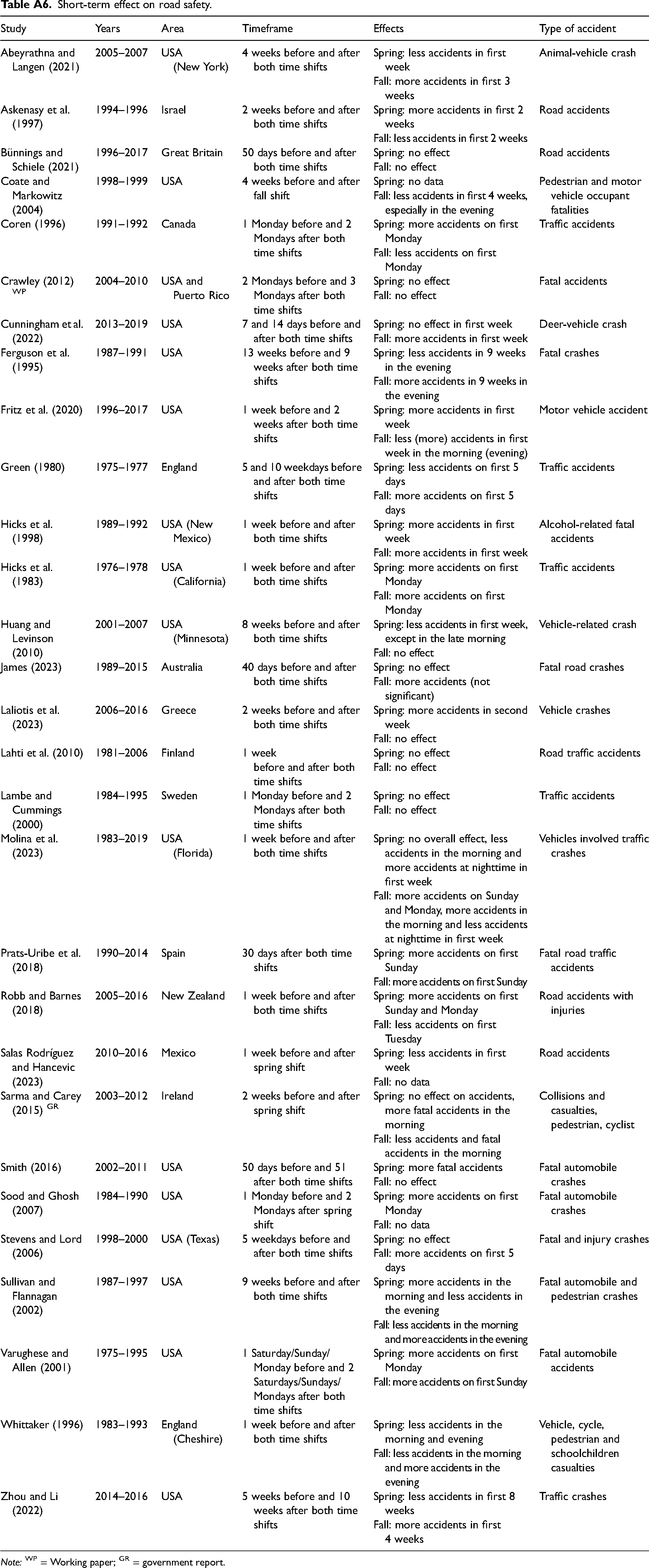
The short-term effect of clock changes on road safety has frequently been studied. To analyze the effect of clock change on road safety, the number of accidents in a period before and after the change is compared. Information on each study and a summary table of the main findings on short-term effects are provided in Table A6 in the Appendix. In some cases, the clock change setting is used as a natural experiment to test the influence of daylight.
The results for the spring change on the first 2 days after the change are very consistent. All studies that found an effect show an increase in non-fatal or fatal accidents on these days (e.g., Hicks et al., 1983; Prats-Uribe et al., 2018). In the first 2 weeks after the spring change, studies show either an increase or a decrease in accidents (e.g., Askenasy et al., 1997; Salas Rodríguez and Hancevic, 2023), but fatal accidents are more likely to increase during this period (e.g., Hicks et al., 1998). Nevertheless, most studies show that the short-term effect of spring change is a reduction in both non-fatal and fatal accidents in the mornings and evenings. It should also be mentioned that four out of eight studies with data from European countries, and three studies with American data, showed no effect. In a recent pilot study by Orsini et al. (2023), a driving simulator experiment is used as a new approach to investigate the short-term DST effect on drivers. The results show that the performance of participants after the spring change is worse than before the change, thus supporting the empirical findings on short-term effects (Orsini et al., 2023).
Following the fall change, more fatal accidents occur in the first days and weeks than in the same period before the clock change (e.g., Stevens and Lord, 2006). The same applies to the evenings, and only in the mornings are fewer fatal car accidents observed (e.g., Sarma and Carey, 2015; Sullivan and Flannagan, 2002). The results regarding non-fatal accidents for the short-term effects after fall change are less consistent. Depending on the study, more or less accidents are reported. All that can be deduced is a trend towards fewer accidents in the morning (e.g., Fritz et al., 2020). A total of seven studies show no short-term effect due to the fall change. Although the results are less clear, the study results on fall change show that more (fatal) accidents occur, especially shortly after the clock change (Molina et al., 2023), apart from in the morning hours.
While the short-term effects have often been studied, there is also a lack of concrete observations on long-term effects in this area. Most of the results are provided by estimates based on the identified short-term effects and tend to highlight the benefits of DST (e.g., Bünnings and Schiele, 2021; Laliotis et al., 2023). The extent to which these estimates can assess the actual effect of DST or year-round DST needs to be verified. Road accidents are affected by seasonal fluctuations (Fritz et al., 2020), which is why findings based on data from a period before and after the clock changes do not necessarily allow conclusions to be drawn for the whole year. This would require actual observational data from a natural experiment. Ebersole et al. (1974) and Meyerhoff (1978) do this for the spring months in 1973 and 1974, taking advantage of the enactment of the Emergency Daylight Saving Time Energy Conversation Act of 1973 (United States Congress, 1973), and Sood and Ghosh (2007) investigate the effect of EDST in the USA. The problem is that these approaches do not fully address the criticism mentioned above, as only a further period is considered, but still no year-round results. An important approach to solving this issue is used by Gentry et al. (2022), using a setting similar to DST. The comparison between people living within the official time zone and west of this time zone indicates that people under DST-like conditions have more than 20% higher fatality rates (Gentry et al., 2022).
Similar results are observed in studies investigating the influence of driver fatigue apart from car drivers. For example, truck drivers and pilots regularly sleep less than the recommended 7 h (Maki et al., 2022; Watson et al., 2015). Due to prolonged working hours, insufficient sleep, and poor sleep quality, truck drivers have a high risk of driving with fatigue (Ren et al., 2023). As a result, it is estimated that one in three fatal truck accidents in Australia occur in part due to fatigue (Casey et al., 2024). Furthermore, the performance of pilots under sleep deprivation decreases (e.g., Lopez et al., 2012; O’Hagan et al., 2020). These results are an indication that these individuals may also be additionally affected by the clock change or DST and that their safety decreases.
Summary
Although road safety is often investigated, the results between studies vary considerably. The short-term increase in accidents in the following 2 days after the spring change is probably related to the negative effects on sleep duration and quality. The reduction in accidents in the morning and evening, which is also frequently observed, is probably due to the improved lighting conditions during rush hour. The short-term effects following the fall change reveal overall more fatal accidents. This increase in fatal accidents might have a particular impact on young drivers, as they are at the highest risk of fatal accidents, especially due to fatigue and in summer months (Pack et al., 1995; Radun and Radun, 2006; Sweeney et al., 2004). Regarding the long-term effects, the estimates based on the short-term effects tend to show positive effects with year-round DST. If this reflects reality, PDST would have a positive impact on society. Seasonal fluctuations show that more accidents occur in summer than in winter (Fritz et al., 2020), so it remains unclear whether these estimates correctly reflect the actual pattern.
Economic aspects
Impact on economic aspects
In previous research on the effects of clock change and DST, economic aspects have largely been neglected. Those few studies that have looked at this issue directly use the clock change as a treatment in order to measure the impact of sleep deprivation. This effect can indeed be caused, as the duration and quality of sleep decrease in the short term after the spring change and during DST (Kantermann et al., 2007; Michelson, 2011). The areas of work productivity, workplace accidents, and school and academic performance, as well as the stock market performance, are included in our review.
Studies on economic aspects
Sleep is an important factor influencing work productivity (Gibson and Shrader, 2018; Krueger, 1989). As one in four people regularly sleep too little, and one in five employees suffers from excessive daytime sleepiness (Kocevska et al., 2021; Melamed and Oksenberg, 2002), this results in an economic loss of billions of dollars every year (Hafner et al., 2016; Hillman et al., 2006). This effect can be amplified by the clock change and DST, because sleep duration and sleep quality decreases in the short term after the spring change and throughout DST (Kantermann et al., 2007; Michelson, 2011). An important study in this field by Giuntella and Mazzonna (2019) shows that employees living on the western boundary of their time zone are paid less than employees living on the eastern boundary, due to the lower labor productivity and missed work days. The setting used, with two groups in close geographical proximity to each other but with different time zones, allows conclusions to be drawn about the effect of DST. Both groups experience the same course of the sun at almost the same time, but at different hours, so that people east of the time zone border are exposed to significantly longer evening brightness than the western group. As a short-term effect, it has also been shown that cyberloafing, meaning the private use of the internet during working hours (Lim, 2002), increases briefly after the spring change, probably caused by reduced sleep duration or sleep quality (Wagner et al., 2012). This results in a deficit of work hours performed and economic damage to the company. This is in line with numerous findings showing that reduced productivity can also be attributed to other factors that are favored by sleep deprivation, like a decrease in alertness (Phillips, 2014; Williamson et al., 2011), psychomotor skills (e.g., Goel et al., 2009; Vgontzas et al., 2004), and cognitive performance (e.g., Cajochen et al., 1999; Ratcliff and Van Dongen, 2009).
Workplace accidents are another aspect that must be included in the consideration of DST from an economic perspective, as they reduce productivity (Barnes and Wagner, 2009). Fatigue among workers is significantly associated with an increased risk of workplace accidents (Akerstedt, 1995; Melamed and Oksenberg, 2002; Uehli et al., 2014) and is one of the main causes of accidents in industrial production (Philip and Akerstedt, 2006). Well-known industrial accidents such as the Union Carbide chemical accident, the reactor accident at the Three Mile Island nuclear power plant, the Chernobyl nuclear disaster, and the Exxon Valdez oil tanker accident are also due partly to errors caused by fatigue (Colten and Altevogt, 2006). After the spring change and during the DST, accidents at the workplace increase (e.g., Depalo, 2023; Koçali, 2023), and treatment errors by doctors increase in the short term as well (Kolla et al., 2021). With regard to permanent sleep reduction during DST, the findings of Akerstedt et al. (2002) can be interpreted as meaning that long-term sleep difficulties increase the likelihood of fatal workplace accidents. In contrast, Holland and Hinze (2000) find no change in the accident frequency on construction sites, following both changes as short-term effects.
The impact on school and academic performance also needs to be considered. From an economic point of view, it is crucial to know whether sleep loss due to DST negatively affects school and academic performance, because inadequate education is directly linked to lower economic growth, which has negative consequences for an economy in the long term (Hanushek and Woessmann, 2012; Piopiunik and Wößmann, 2011). The American Academy of Sleep Medicine recommends a minimum sleep duration of 9 h for children aged 6 years and older and a minimum sleep duration of 8 h for teenagers aged 13 years and older (Paruthi et al., 2016). More than half of middle and high school students in the USA do not adhere to this recommendation and regularly sleep less than recommended (Weaver et al., 2018; Wheaton et al., 2018). This is problematic, as sleep loss is a risk to academic success (Owens, 2014) and healthy sleep duration can have a supportive effect on adolescent learning (Tarokh et al., 2016). With regard to DST, Gaski and Sagarin (2011) show that the average SAT score of students in regions with DST is significantly lower than that of students in regions without DST.
These results are in line with Wolfson and Carskadon (1998) who show that worse grades are associated with later bedtimes, and O'Brien and Mindell (2005) indicate the same for longer weekend delay. In a recent review, Johnson and Malow (2023) summarize important findings regarding the abolition of DST and a reform of school start times. Among other things, they conclude that permanent standard time improves the sleep duration of students (Johnson and Malow, 2023). This could ultimately have a positive impact on school performance and, building on this, positive economic effects.
The final economic consideration in this review is the stock market, which is influenced by various non-financial factors, such as hours of sunlight (Kamstra et al., 2003), temperature variations (Cao and Wei, 2005), cloud cover (Hirshleifer and Shumway, 2003; Saunders, 1993), or lunar phases (Dichev and Janes, 2003; Yuan et al., 2006). Whether the clock change has an influence on the stock market was first investigated by Kamstra et al. (2000), who show that clock changes cause a daily loss of several billion dollars annually. This was followed by an interchange of views between Pinegar (2002) and Kamstra et al. (2000). The former found that these results were not robust, which Kamstra et al. (2002) refuted in a counter-statement. However, several subsequent studies were unable to identify a significant effect triggered by clock changes and DST (Conte and Steigerwald, 2007; Gregory-Allen et al., 2010; Müller et al., 2009; Worthington, 2003). So far, only Mugerman et al. (2020) have also been able to identify an effect and show that on the first day after the fall change, markets perform more bearishly than usual. This means that average prices on the stock market are decreasing and volatility is increasing at the same time (Haase and Neuenkirch, 2023).
Summary
Based on the current research results, it can be assumed that the clock change and the DST have primarily negative economic effects. This is mainly due to the fact that after and during the measure, the already existing sleep deprivation of employees and students is worsened. The fall in productivity and the higher probability of workplace accidents have a direct impact on companies. The negative consequences on school and academic performance can damage an economy in the long term. Positive long-term effects of DST can only be shown for the convenience retail sector. Beckwith (2022) reports at a hearing, as a representative of the National Association of Convenience Stores, that the longer evening brightness created by DST increase the level of commerce. This statement is supported by Farrell et al. (2016), who show that the clock change has a short-term impact on credit card spending. While more is paid by credit card for 30 days after the spring change, considerably less is spent for 30 days after the fall change (Farrell et al., 2016). Whether these results are actually due to the influence of DST is debatable, as seasonal effects can also contribute to this observation. Overall, this area has the greatest need for research, as there has clearly been too little direct DST-related research to date.
Discussion
Over 70 countries use a seasonal policy to shift more light from morning to evening clock time, known as DST, every year affecting more than 1.2 billion people. This policy was originally used to save resources in order to reduce energy usage (Zerubavel, 1982). To this day, the topic is still widely discussed, including institutions such as the European Parliament (2019). Our literature review is the first comprehensive one that summarizes the short-term effects of clock changes and long-term effects of DST in different areas. For this purpose, the known effects on electricity usage, health, crime rates, road safety, and economic aspects are analyzed in detail. From an overall perspective, it is evident that current research on the effects of the clock change and DST does not generally provide consistent results. Yet, certain tendencies can be derived regarding some positive and negative outcomes. A look at the results reveals some useful connections between the findings. All positive effects are achieved by shifted ambient light conditions. This lowers the evening electricity peaks, lowers the early evening crime rate partly, and probably reduces car accidents during rush hours in the short term. But we do not have adequate data to determine whether these can offset the negative effects mainly driven by disturbed circadian rhythm, social jetlag, and the resulting sleep problems. Particularly evident are the associated medical and economic disadvantages. A summary of the main results of each area is given at the end of each section.
The findings of this literature review emphasize the importance of a structured and multidisciplinary approach when it comes to the effects of clock changes and DST. The change in time in relation to the sun influences the factors of ambient light, circadian rhythm, social jetlag, and sleep behavior, which in turn have various effects on the analyzed areas. The difficulty in the analysis is the interlinking and interaction of these effects, which can only rarely be observed in isolation. This literature review is the first to provide an information basis for legislative decisions on the implementation or abolition of DST, as well as a decision for or against a year-round standard time or year-round DST. Our analysis is to a certain extent limited, as the included studies are limited by a number of restrictions within the study design. These include the geographical location of the study area with the associated climatic differences, the economic and social environment, and the timing of the study. These factors complicate the comparability and transferability of study results, so that generally valid statements are not possible. With regard to political decisions and legislative procedures, this means that individual regionally appropriate and comparable studies should be included in the decision-making process.
The literature review nonetheless offers a range of practical options for future research. With regard to electricity usage, it should be determined whether the current trend is continuing and whether lighting energy accounts for a decreasing share. If this is confirmed, the effect of savings during DST may be reversed in the long term. Alternative regulatory options, as shown by Giacomelli-Sobrinho et al. (2022), should be further investigated and considered in this context. The medical literature already contains a large body of data on the effects of clock changes and DST, most of which is uniformly in favor of year-round standard time. From our point of view, it is important to research how this knowledge can be more effectively communicated to the public, since there is a gap here. In a survey, four out of five people in Norway stated that the decision for year-round standard time or DST should be made on the basis of expert recommendations, but stated that they prefer DST, contrary to the recommendation of experts (Bjorvatn et al., 2021). For the areas of crime rates and road safety, the investigation of future natural experiments regarding year-round DST could provide information about effects in winter and the prevailing weather conditions. Such an opportunity could perhaps arise in Europe if the European Union introduces year-round DST. The current discourse in the European Union on the abolition of DST also constitutes a research opportunity for economic aspects. In addition to the question of whether the member states should introduce year-round standard time or year-round DST, the investigation of new time zones and the economic impact of time differences would also be an important field of research that has barely been researched to date. A very early study by McCallum (1995) shows that time zone differences between neighboring countries weaken trade. It is necessary to research whether this is still the case today when digital communication is used. An excellent opportunity for future research will arise in Mexico in the coming years. The partial abolition of DST enables a direct comparison in the summer months between DST and year-round standard time. The data for the border areas of Chihuahua, Coahuila, Nuevo León, and Tamaulipas with DST can be compared with the remaining parts of the areas and thus provide information on the effect of DST. An opportunity for future research beyond that already applied might be a game theoretical approach. This would be interesting in terms of decision-making behavior for or against a year-round DST. Taking the European Union as an example, this decision has an influence on the member states, whereby neither of the two options is probably optimal for all countries, that is, a situation in which some countries are harmed by a decision. The findings derived from this could be important for guiding political decisions.
In our opinion, the year-round standard time is preferable to both DST and year-round DST. This assessment is supported in particular by the health and economic benefits, as well as the decreasing benefits of the historically limited advantages in electricity usage. The comparatively small and inconsistent effects in the areas of crime rates and road safety are overshadowed by these advantages. Future research should thus pursue interdisciplinary approaches in addition to research questions within one area. In any event, the question of an alternative to the clock change is on in which many aspects need to be considered. A model that takes all effects into account, evaluates, and constantly adapts them would be a helpful tool for policymakers.
Footnotes
Declaration of conflicting interest
The authors declared no potential conflicts of interest with respect to the research, authorship, and/or publication of this article.
Funding
The authors received no financial support for the research, authorship, and/or publication of this article.

Appendix
Short-term effect on road safety.
| Study | Years | Area | Timeframe | Effects | Type of accident |
|---|---|---|---|---|---|
| Abeyrathna and Langen (2021) | 2005–2007 | USA (New York) | 4 weeks before and after both time shifts | Spring: less accidents in first week Fall: more accidents in first 3 weeks | Animal-vehicle crash |
| Askenasy et al. (1997) | 1994–1996 | Israel | 2 weeks before and after both time shifts | Spring: more accidents in first 2 weeks Fall: less accidents in first 2 weeks | Road accidents |
| Bünnings and Schiele (2021) | 1996–2017 | Great Britain | 50 days before and after both time shifts | Spring: no effect Fall: no effect | Road accidents |
| Coate and Markowitz (2004) | 1998–1999 | USA | 4 weeks before and after fall shift | Spring: no data Fall: less accidents in first 4 weeks, especially in the evening | Pedestrian and motor vehicle occupant fatalities |
| Coren (1996) | 1991–1992 | Canada | 1 Monday before and 2 Mondays after both time shifts | Spring: more accidents on first Monday Fall: less accidents on first Monday | Traffic accidents |
| Crawley (2012) WP | 2004–2010 | USA and Puerto Rico | 2 Mondays before and 3 Mondays after both time shifts | Spring: no effect Fall: no effect | Fatal accidents |
| Cunningham et al. (2022) | 2013–2019 | USA | 7 and 14 days before and after both time shifts | Spring: no effect in first week Fall: more accidents in first week | Deer-vehicle crash |
| Ferguson et al. (1995) | 1987–1991 | USA | 13 weeks before and 9 weeks after both time shifts | Spring: less accidents in 9 weeks in the evening Fall: more accidents in 9 weeks in the evening | Fatal crashes |
| Fritz et al. (2020) | 1996–2017 | USA | 1 week before and 2 weeks after both time shifts | Spring: more accidents in first week Fall: less (more) accidents in first week in the morning (evening) | Motor vehicle accident |
| Green (1980) | 1975–1977 | England | 5 and 10 weekdays before and after both time shifts | Spring: less accidents on first 5 days Fall: more accidents on first 5 days | Traffic accidents |
| Hicks et al. (1998) | 1989–1992 | USA (New Mexico) | 1 week before and after both time shifts | Spring: more accidents in first week Fall: more accidents in first week | Alcohol-related fatal accidents |
| Hicks et al. (1983) | 1976–1978 | USA (California) | 1 week before and after both time shifts | Spring: more accidents on first Monday Fall: more accidents on first Monday | Traffic accidents |
| Huang and Levinson (2010) | 2001–2007 | USA (Minnesota) | 8 weeks before and after both time shifts | Spring: less accidents in first week, except in the late morning Fall: no effect | Vehicle-related crash |
| James (2023) | 1989–2015 | Australia | 40 days before and after both time shifts | Spring: no effect Fall: more accidents (not significant) | Fatal road crashes |
| Laliotis et al. (2023) | 2006–2016 | Greece | 2 weeks before and after both time shifts | Spring: more accidents in second week Fall: no effect | Vehicle crashes |
| Lahti et al. (2010) | 1981–2006 | Finland | 1 week before and after both time shifts | Spring: no effect Fall: no effect | Road traffic accidents |
| Lambe and Cummings (2000) | 1984–1995 | Sweden | 1 Monday before and 2 Mondays after both time shifts | Spring: no effect Fall: no effect | Traffic accidents |
| Molina et al. (2023) | 1983–2019 | USA (Florida) | 1 week before and after both time shifts | Spring: no overall effect, less accidents in the morning and more accidents at nighttime in first week Fall: more accidents on Sunday and Monday, more accidents in the morning and less accidents at nighttime in first week | Vehicles involved traffic crashes |
| Prats-Uribe et al. (2018) | 1990–2014 | Spain | 30 days after both time shifts | Spring: more accidents on first Sunday Fall: more accidents on first Sunday | Fatal road traffic accidents |
| Robb and Barnes (2018) | 2005–2016 | New Zealand | 1 week before and after both time shifts | Spring: more accidents on first Sunday and Monday Fall: less accidents on first Tuesday | Road accidents with injuries |
| Salas Rodríguez and Hancevic (2023) | 2010–2016 | Mexico | 1 week before and after spring shift | Spring: less accidents in first week Fall: no data | Road accidents |
| Sarma and Carey (2015) GR | 2003–2012 | Ireland | 2 weeks before and after spring shift | Spring: no effect on accidents, more fatal accidents in the morning Fall: less accidents and fatal accidents in the morning | Collisions and casualties, pedestrian, cyclist |
| Smith (2016) | 2002–2011 | USA | 50 days before and 51 after both time shifts | Spring: more fatal accidents Fall: no effect | Fatal automobile crashes |
| Sood and Ghosh (2007) | 1984–1990 | USA | 1 Monday before and 2 Mondays after spring shift | Spring: more accidents on first Monday Fall: no data | Fatal automobile crashes |
| Stevens and Lord (2006) | 1998–2000 | USA (Texas) | 5 weekdays before and after both time shifts | Spring: no effect Fall: more accidents on first 5 days | Fatal and injury crashes |
| Sullivan and Flannagan (2002) | 1987–1997 | USA | 9 weeks before and after both time shifts | Spring: more accidents in the morning and less accidents in the evening Fall: less accidents in the morning and more accidents in the evening | Fatal automobile and pedestrian crashes |
| Varughese and Allen (2001) | 1975–1995 | USA | 1 Saturday/Sunday/Monday before and 2 Saturdays/Sundays/Mondays after both time shifts | Spring: more accidents on first Monday Fall: more accidents on first Sunday | Fatal automobile accidents |
| Whittaker (1996) | 1983–1993 | England (Cheshire) | 1 week before and after both time shifts | Spring: less accidents in the morning and evening Fall: less accidents in the morning and more accidents in the evening | Vehicle, cycle, pedestrian and schoolchildren casualties |
| Zhou and Li (2022) | 2014–2016 | USA | 5 weeks before and 10 weeks after both time shifts | Spring: less accidents in first 8 weeks Fall: more accidents in first 4 weeks | Traffic crashes |
Note: WP = Working paper; GR = government report.