




Abstract
In the 20th century, Australia’s Great Barrier Reef emerged as a political battleground when governing bodies planned to turn its coral territories into a vast mining zone. But in the 21st century, as the temporalisation of the Reef exerts increasing influence on the governance, securitisation and anticipation of planetary futures, coral time has emerged as a new site of political and imaginative conflict. Responding to this shift from territory to temporality, how can we pay closer attention to those skilfully making coral time? In this article, I introduce ‘dimensional friction’ as a tool for considering how the temporal structure of corals intersects with the temporal structure of global climate science in a coring laboratory. Based on my fieldwork at the Australian Institute of Marine Science, I analyse simultaneously discursive, technical, and imaginative problems that emerge when scientists transform the mineral skeletons of corals into time data. Dimensional friction appears whenever this skeletal matter is manipulated, surfacing the lab-based production of vertical time-depth but also suggesting other ways of temporalising (and corporally appropriating) coral time. Viewed in this way, coral cores might be better understood as ‘temporal volumes’ rather than chronostratigraphic records amenable to linear timelines and trajectories.
Keywords
Once folded into dreams of endless oceanic abundance, coral reefs now tell a different story about the passage of time in Earth's tropical oceans. It is a story characterised by changing configurations of loss. And it is told, in part, by scientists in laboratories who have learned to interpret layered growth patterns inside the skeletons of reef-building corals. Coded into these crystalline mineral structures are the histories of sea-surface temperature, water turbidity, pollution, weapons testing, bleaching events, and more — histories of coral decline.
Like ice cores, tree rings and other ‘proxy records’, the cores extracted from reef-building corals are used to produce otherwise-inaccessible histories of the planet from the era before climatic changes were monitored in real time. But history is not all that takes shape in the process of reading and interpreting coral proxies. These records also point forward in time. Anticipatory regimes, concerned with predicting planetary-scale climatic changes, use the data from ‘coral chronometers’ (Knutson et al., 1972) to thicken the imagined trajectories of saltwater environments and the planet itself, producing timelines that stretch to 2050, 2100 or 2300 (Ainsworth et al., 2016; Cornwall et al., 2021; Hoegh-Guldberg et al., 2007; Morato et al., 2020; Sully et al., 2022).
To learn how coral time is made, I visited the coring laboratory at the Australian Institute of Marine Science (AIMS) in 2018 and 2019. In the laboratory at AIMS, cores drilled from corals arrive not as clocks or calendars but as temporal volumes. To make coral time calculable, the dimensions of those volumes must be continually negotiated through techniques that work the intersection between the mineral growth of coral skeletons and the temporal architecture of global climate science. Understanding how this intersection is negotiated can reveal the ways that a vertical and stratigraphic logic structures the contemporary temporal imagination, especially in the context of the Anthropocene.
AIMS is a government research facility built on a remote coastal headland roughly 50 km south of Townsville, a city of 180,000 on Australia's north-eastern coast. Overlooking the western edge of the central Great Barrier Reef, AIMS houses one of the world's largest coral core archives, containing more than 10,000 fragments. The archive is part of a laboratory where those fragments are analysed by scientists such as Janice Lough and Neil Cantin, who have developed key techniques for reading the histories of corals.
To describe the production of coral time in AIMS, I am drawing on two related approaches in anthropology and STS: the tradition of laboratory studies, with its fine-grained descriptions of scientific practices (Gusterson, 1996; Latour and Woolgar, 1986; Lynch, 1985; Traweek, 1992); and ethnographic accounts of proxies (including ice coring, dendrochronology, and other incremental records) that ground the temporal structures of global climate science in situated techniques and formations, which may extend beyond the strict boundaries of the lab (O’Reilly, 2016; Ramírez-i-Ollé, 2018; Schinkel, 2016; Skrydstrup, 2012). The dating practices at AIMS are implicated in the broader work of anticipation that structures global climate science. According to Cantin, a coral ecophysiologist, the cores at AIMS have been used to provide ‘important checks on the performance of global climate models’ and to ‘predict future climates in a warming world’ (Cantin, 2014: np). Cantin, Lough and the laboratories at AIMS were also involved in processing coral cores taken from North Flinders Reef in the Coral Sea, which became one of the 12 candidates for the official start of the Anthropocene Epoch (Zinke et al., 2023).
An increasing amount of time data can now be drawn from the skeletal growth patterns of coral, yet there remains a dilemma in this temporal work: corals do not grow timelines. They grow layered mineral volumes with distinct dimensions produced by their hyperbolic surfaces (Figure 1).
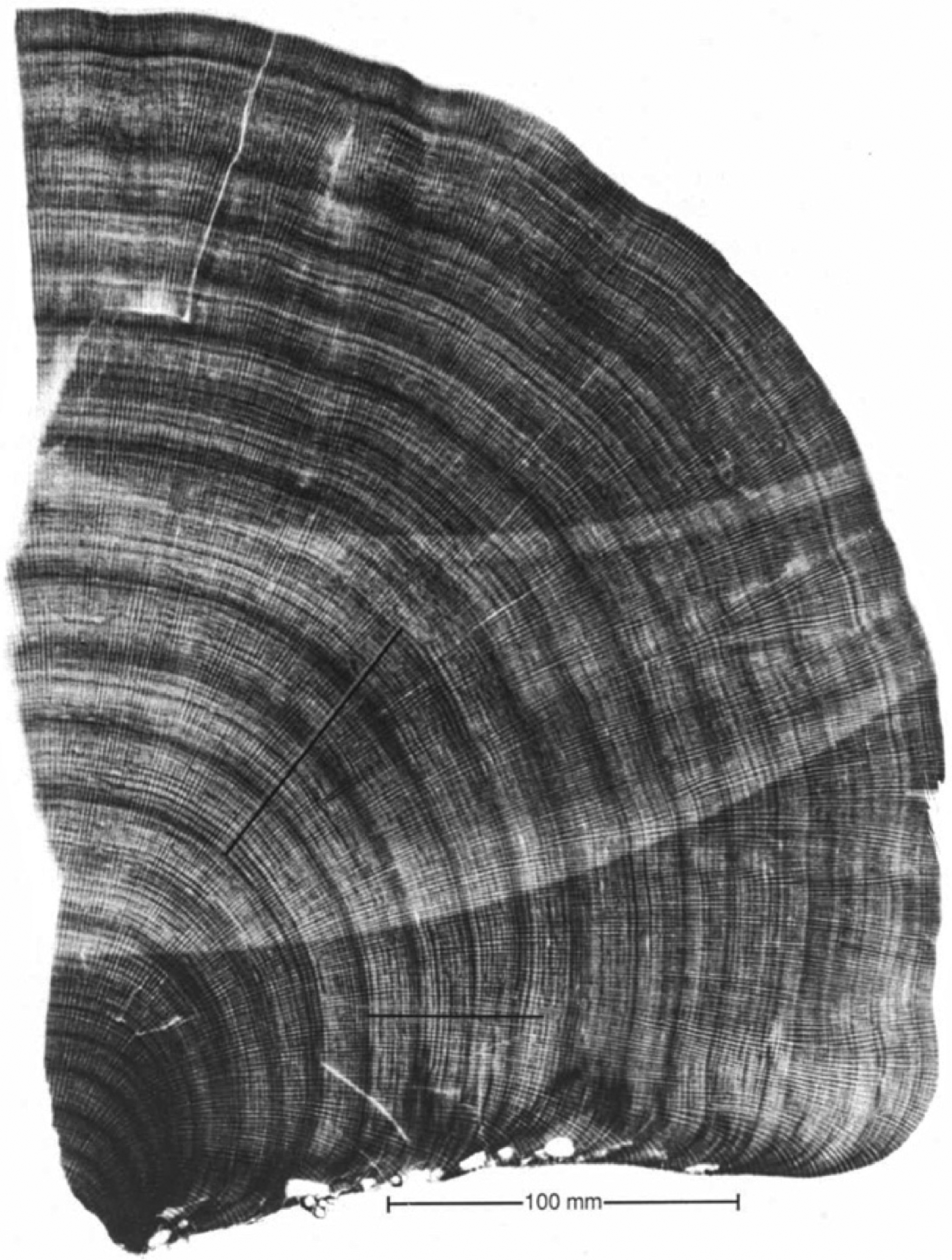
An X-ray image displaying the layered growth patterns within a 6 mm-thick slice cut from the skeleton of a Porites lobata coral that had grown on the Great Barrier Reef. Each pair of darker and lighter bands corresponds to one calendar year, and the finer bands correspond to monthly changes. Pale-coloured zones crossing through the image are artefacts from the mechanical saw blade used to slice the skeleton. Reprinted from Barnes and Lough (1989) The nature of skeletal density banding in scleractinian corals: fine banding and seasonal patterns. Journal of Experimental Marine Biology and Ecology 126 (2): 124. Copyright (1989), with permission from Elsevier.
Australia's Great Barrier Reef and the politics of coral time
The Great Barrier Reef, Earth's largest reef system, is not immune to the narrative arc of corals in the 21st century. After 2035, the Great Barrier Reef is predicted to undergo bleaching events twice each decade, and annually after 2044 (Heron et al., 2018). However, around seven mass-bleaching events have already occurred since 1998, with five of those events taking place in the past decade: 2016, 2017, 2020, 2022 and 2024. Like clockwork, reports in newspapers and magazines declare each event unprecedented and inevitable, a ‘grim milestone’ on our deepening passage into a world defined by rising emissions (Cave, 2022). A sense of urgency and time running out pervades the discourse. Many scientists now believe we have entered a timeline in which the coral-dominated ecosystems of the past millennia are in decline (Birkeland, 2015; Elias, 2018; Hoegh-Guldberg et al., 2007; Hughes et al., 2018, 2019). Coral reefs have become ‘a sign and measure of the imminent catastrophe facing life on earth’ (Braverman, 2018: 3). It is a catastrophe accompanied by highly charged and uneven forms of politics; asymmetries determine who is affected by losses, who can participate in restoration and research, and even who can witness coral death (Moore, 2019, 2021). Power imbalances also emerge through the timelines of the Great Barrier Reef, as trajectories bending toward loss threaten to radically alter the guarded futures of Australia's energy, mining and agricultural sectors. In 2021, in response to the losses resulting from bleaching events, a United Nations committee suggested the Great Barrier Reef be added to the list of World Heritage in Danger, requiring Australia to take ‘accelerated action at all possible levels’(UNESCO WHC, 2021: 86). Instead, Australia sought to accelerate its coal-mining operations and fought the ‘in danger’ recommendation through global lobbying. In 2022, following a change of political leadership in Australia, a less combative relationship with UNESCO emerged and the government promised to improve water quality on the Great Barrier Reef and reduce stress from commercial fishing (Readfearn, 2023). However, for some coral scientists, these responses have still failed to address the root causes of declining conditions (Hughes, 2023). The issue transcends the management of a bounded territory.
In the latter half of the 20th century, the politics of coral space emerged as a distinct ‘battleground’ in which the use and fate of the Great Barrier Reef were decided (Wright, 1977). Governing bodies, hoping to turn the reef into a vast mining zone, battled grassroots environmentalists in the 1970s for control of reef territories. The results of this conflict and the concomitant ‘Save the Reef’ campaign led to the creation of the Great Barrier Reef Marine Park in 1975 (Lloyd, 2022), a protected spatial zone bounded by a notional line where mining and other activities are strictly prohibited. However, the boundary no longer works as intended. How does a notional line hold back a warming ocean is indifferent to bounded management plans, policy changes or zoning restrictions?
In the 21st century, the politics of coral time has emerged as a new battleground. The coring laboratory at AIMS is just one site where the epistemic ground is produced for the politics of coral time and the much larger war that politics is bound up in – a war fought ‘in the hallucinatory register of how the future is simulated’ (Adams et al., 2009: 257). On the Great Barrier Reef, this takes shape as a struggle over trajectories and timelines as much as a war over emissions, ecosystem services, or even life itself. It is a struggle that exceeds the bounds of the Reef. Coral cores are no longer only representatives of the coasts, reefs and oceans where they were extracted from. Through the information in their layered, strata-like skeletons (Figure 2), corals and other proxies of all kinds have become ‘objects of the earth system’ and of global climate science (Sörlin and Isberg, 2021: 723). They have been folded into larger planetary-scale trajectories that stretch backward and forward in time.
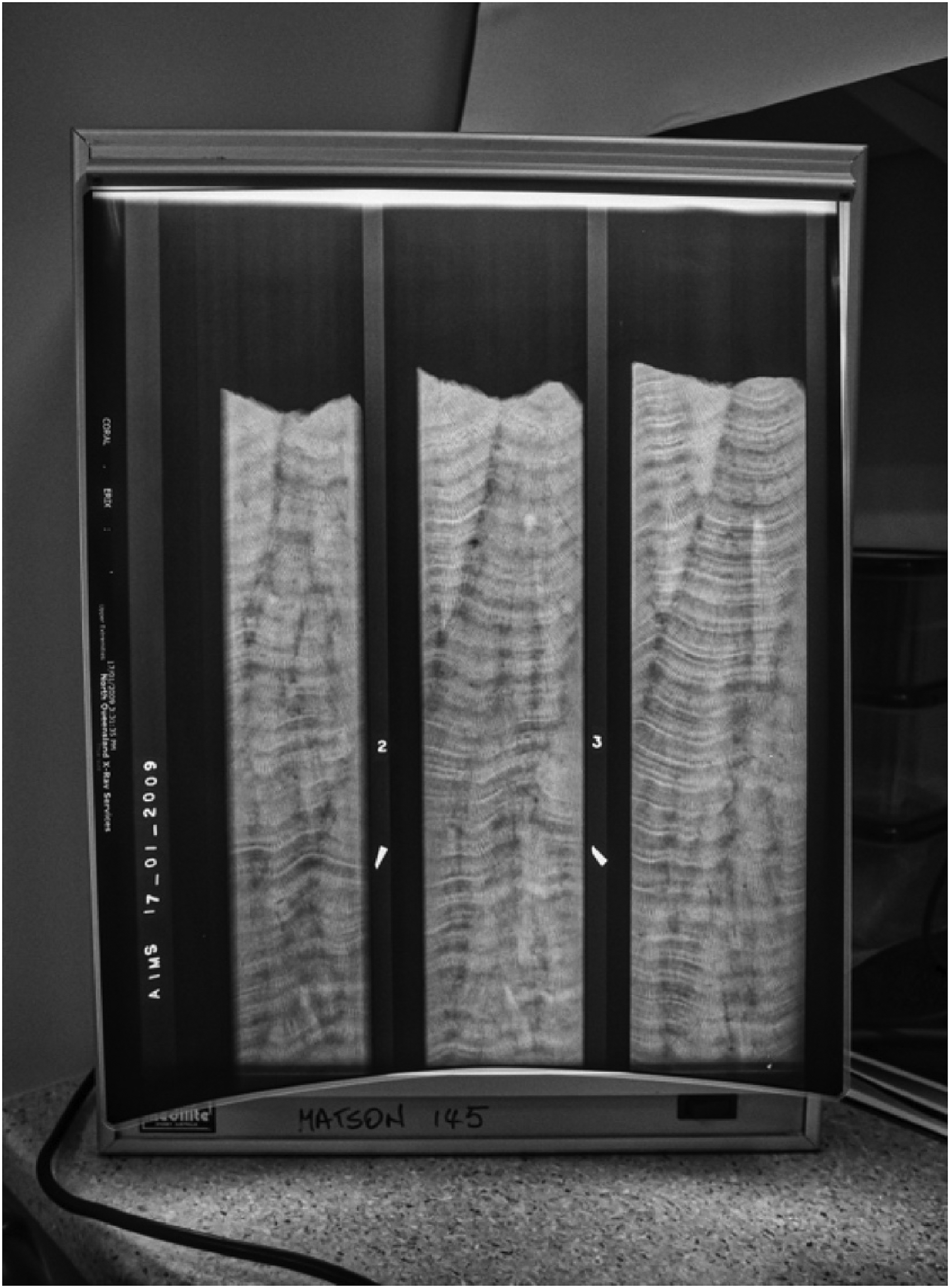
An X-ray on a lightbox in AIMS shows the undulating growth patterns in a coral skeleton used by scientists to produce historical records and anticipate future trajectories.
Vertical temporalities in global climate science
To anticipate the future, global climate modellers require large sets of similarly structured time data with historical depth. Assembling and synchronising these records gives climate models their predictive power. That is, anticipation is only possible because different sets of time data, extracted from dissimilar proxies, are made to align with each other. Schinkel's ethnographic account (2016) of scientists who produce environmental proxies from algae and algae fossils shows how this alignment – what he calls chronological compatibility – structures political conceptions of the climate. The politics of climate change relies on the ‘intricate and often invisible work of ensuring comparability’ between proxies (Schinkel, 2016: 392). These comparisons are highly complex, involving a diverse array of techniques specific to the properties of each record, and the blending of seemingly incommensurable material proxies plucked from heterogeneous ecological contexts (Skrydstrup, 2017: 75). A data set may incorporate information from an ice sheet near Summit Station in Greenland, a cedar forest on the Japanese island of Yakushima, a coral colony in the West Flower Garden Bank reef off the U.S. coastline (Figure 3), along with other records from other sites.
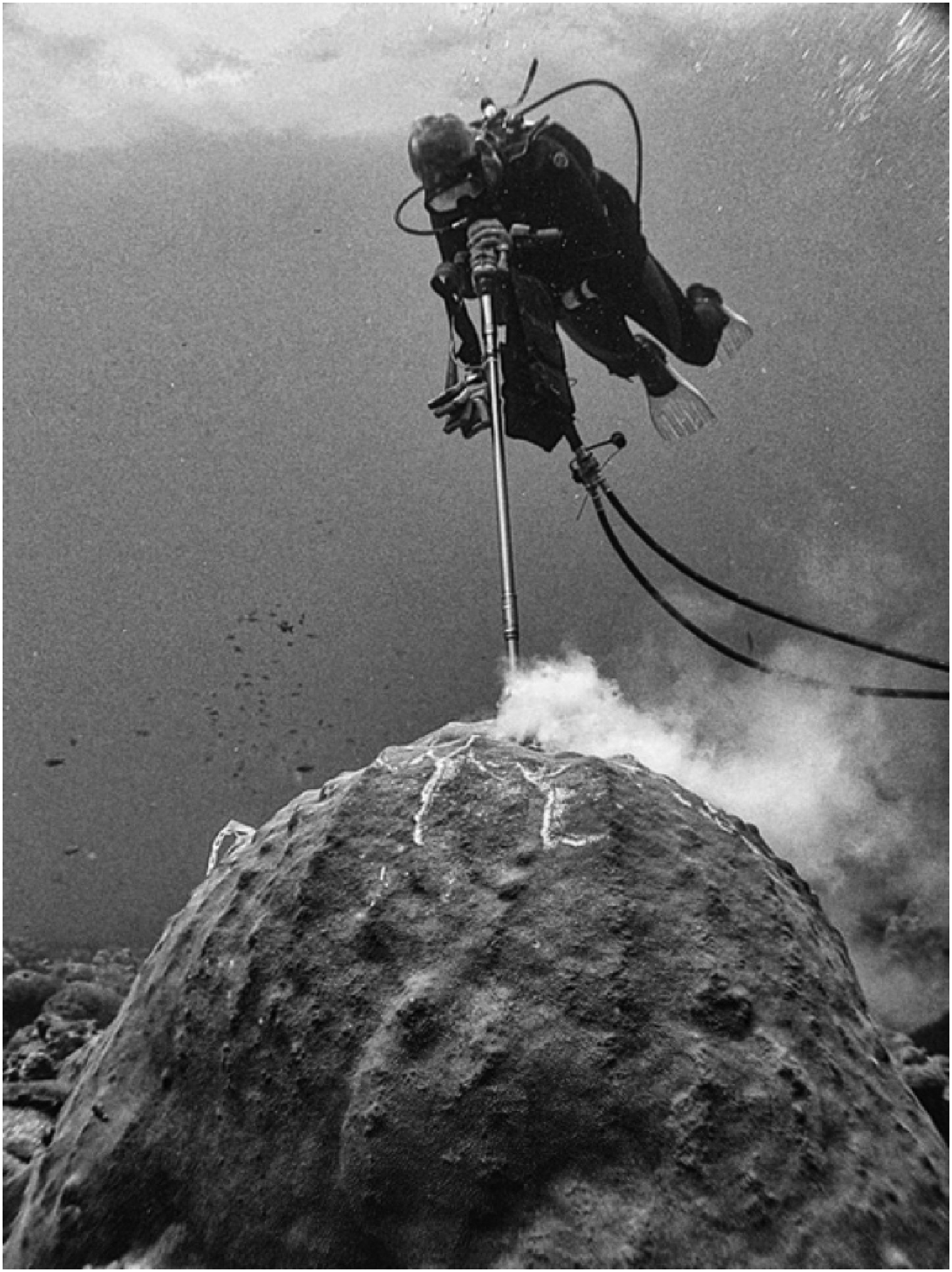
A diver drills a vertical core from a large Porites coral at the U.S. Flower Garden Banks National Marine Sanctuary. Copyright Emma Hickerson/Flower Garden Banks National Marine Sanctuary. Used with permission.
What makes these records chronologically compatible is a vertical temporal orientation in which history physically extends downwards. Vertical time-depth is integral to the work of geologists and archaeologists, who rely on excavation and extraction to produce records of the past (Simonetti, 2014, 2015). To produce time from proxies, scientists often ‘read’ their layered records like geologists ‘read’ layers of stone by translating the relative positions of structure and matter inside a core into chronostratigraphic units. It is an approach, Rosol argues, that has turned the Earth into a kind of experimental laboratory filled with ‘geological analogues’ (2015: 40). This approach has come to define the speculative work of climate modelling, in which trees, ice, corals and other proxies spatiotemporally echo the stratified cross-sections of Earth.
The temporal structure of global climate science has been ethnographically outlined mostly through accounts of ice coring work (O’Reilly, 2016; Skrydstrup, 2012, 2016, 2017). The focus on ice is justified: Many of the foundational techniques and temporal concepts required for working on incremental records were developed and deployed through ice coring research in the mid-20th century when geophysicists discovered glaciers as climate archives (Achermann, 2020; Isberg, 2018). The ensuing turn to the vertical in climate science was driven by a mix of geopolitical tensions, militarisation, scientific endeavour, stratigraphic dating methods, and the technical capabilities of oil drilling (Benson, 2020; von Hardenberg and Mahony, 2020). Through ice coring work, the temporal structure of global climate science shifted, temporally and spatially, ‘from the horizontal to the vertical, from the present to deep time’ (Isberg, 2018: 6; see also Achermann, 2020 and Antonello and Carey, 2017). The vertical became, according to Hardenberg and Mahony, a temporal proxy that enabled ‘epistemic revolutions to take place’ (2020: 597, 603). Through these revolutions, time-depth gave global climate science its vertically oriented temporal structure. But though this broad 20th-century story is well outlined, grounded perspectives at smaller scales are still missing. How, ask Hardenberg and Mahony (ibid. 604), does the vertical influence laboratory work? How does it determine the representations that science makes of the world? At AIMS, up close, I found approaches to time that showed the limits of viewing Earth as a laboratory filled with ‘geological analogues’. Other problems emerged between the temporal structure of global climate science and the extracted skeletons of reef-building corals.
Dimensional friction
It was Janice Lough, a senior principal research scientist at AIMS, who first showed me the labour of the coral core scientist. Assembling a planetary timeline, she told me, is like making a ‘jigsaw puzzle’ – one she has been studying for ‘30-odd years’ (Lough and Barnes, 1989, 1990; Lough and van Oppen, 2018). The pieces for this jigsaw time image of Earth are made from diverse proxy records of past environmental conditions. Most pieces, however, have not been fashioned from coral cores because the records corals produce are relatively short, typically spanning decades or centuries. Much longer histories can be pulled from ice and sediment cores, some of which contain records of environmental conditions millions of years ago. The relative shortness of coral proxies makes them more like tree rings than ice. But though ‘tree rings are an important source of proxy climate records’, Lough explains, ‘they obviously don't grow in the tropical oceans, which are of interest because first of all, they're the heat engine of the global climate system’. What corals contribute to the ‘puzzle’ are high-resolution records of relatively recent changes in tropical oceans. This is significant because, between 1971 and 2010, the ocean has taken up more than 90% of the excess energy trapped in the climate system, and this absorbed heat will eventually be released back into the atmosphere (Zanna et al., 2019).
In the AIMS archive, Lough opens a metal drawer full of cores. ‘I want you to see this’, she says. The tubular cores inside are cream-coloured, heavy like rocks, and appear as almost-undifferentiated masses of calcium carbonate (Figure 4). Lough points out a core with an undulating pattern of small holes at one end. ‘You can see there the little calyces where the little coral animals would sit’, she tells me. ‘Even in something that's several metres high, it is only that thin layer on the outside edge where the coral animal is living’. The rest? ‘Basically, empty skeleton – except it is not empty because it contains history’. It is a history that Lough interprets by working and reworking a core's height, weight, density, width, depth and other qualities. These dimensions define many of the problems that come to matter as coral time is produced at AIMS.
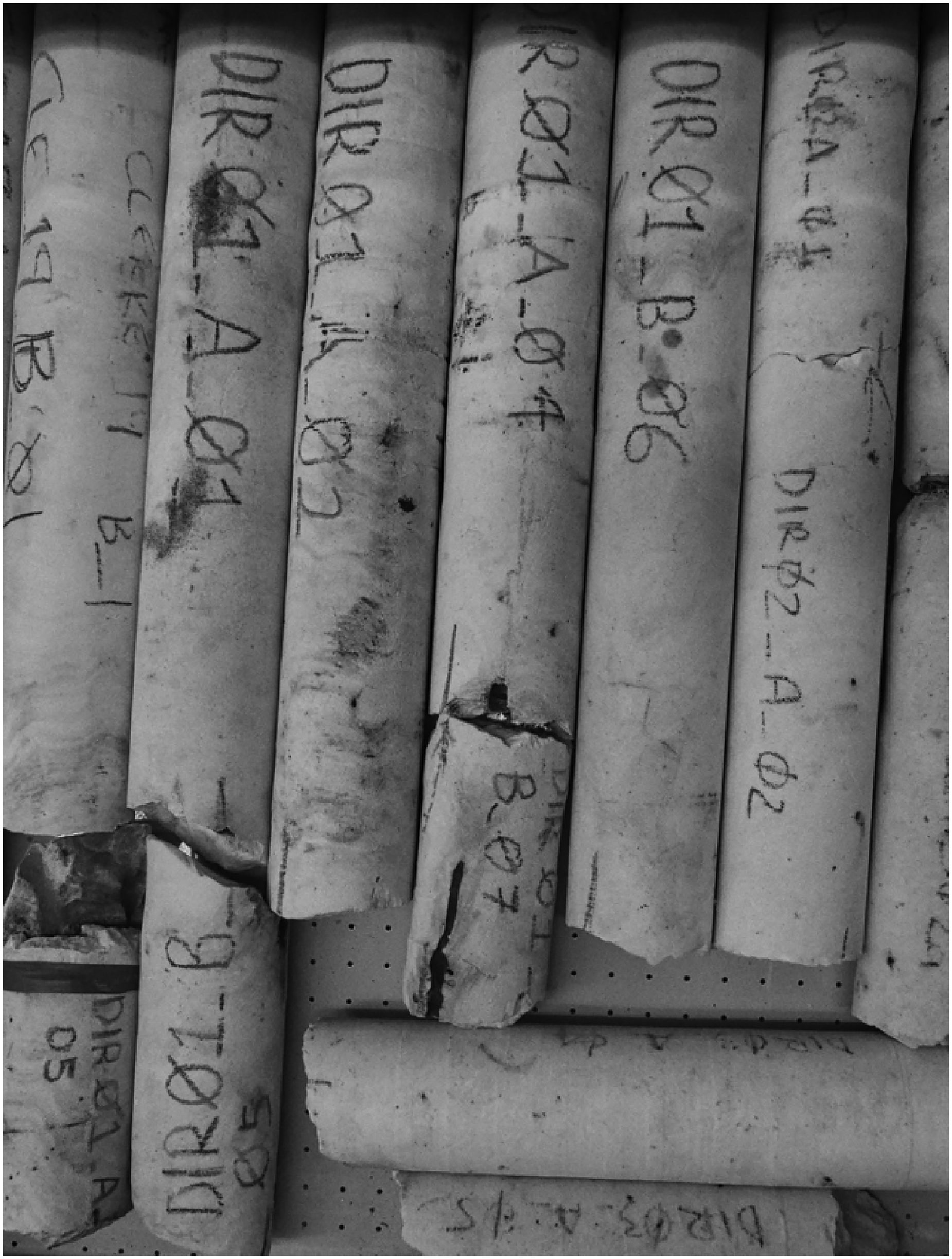
Coral cores in a drawer at the AIMS archive. Cores are broken into fragments, which makes them easier to handle. Codes written on each fragment indicate the location of the coral colony it was taken from and how adjacent fragments fit together.
Guided through the coring laboratory, I noticed certain kinds of friction emerging when corals were produced as temporal puzzle pieces. These frictions lead scientists (and ethnographers of laboratory times) deeper and deeper inside the coral matrix, from encounters with massive colonies growing on the reef to the layered mineral structure of an individual core and into the microscopic ‘weave’ of a carbonate skeleton. Across these scales of analysis, the lab-based work of dating suggests that vertical time depth is not all that determines how a coral is turned into a timeline. The laboratory is a site where strict temporal order is produced, but it is also a space where different orientations to time might gestate (Bear, 2016; Gell, 1992; Munn, 1992) – and perhaps even a different way of framing the larger political struggles that the Great Barrier Reef is implicated in.
To surface these and other possibilities, I introduce dimensional friction as an analytical framework revealing the intersecting temporal structures that make coral proxies comparable. By directing attention to the rub between what appear to be ‘natural’ proxies and ‘cultural’ timelines, dimensional friction clarifies how proxy records such as corals are produced as time. In addition to being turned into lines of time, these mineral objects are always being dimensioned – dimensionally produced – as time data is extracted. By paying attention to the ways dimensions are shifted and produced through lab techniques, it is also possible to make space for the distinct kinds of temporal work performed by colonies of coral animals that grow layered skeletons.
I engage these spatial dimensions in the context of the laboratory with the help of geographers and philosophers who have considered new modes of theorising the politics of space and territory by engaging the frictions between volume and verticality. Built on Sloterdijk's Spheres trilogy and Virilio's framing of the Second World War as a three-dimensional conflict, Elden's ideas about the ‘depth of power’ enabled volume to emerge as a more generative problem than verticality or area (2013). This has allowed geographers such as Bridge to nuance volume with anticipation and climate change (2013: 57; see also Adey, 2013). Volume and time have also been elaborated through the ocean work of Peters and Steinberg who build on Serres’ notion of ‘repetitive, but dynamic’ rhythms to gesture toward a kind of ‘churning’ volumetric ontology of ocean time (2015: 256). Volumes are never static. As Billé has stressed, engaging these flowing, three-dimensional spaces ‘previously beyond the realm of human intervention’ is an engagement with territory that outlines how sovereignty has been extended into polar regions, the upper atmosphere, the ocean and the Earth's interior (2020: 5). Sovereignty has also been extended into previously incalculable temporalities, and politics follows in the wake of this expansion. Just as new forms of geometry made cartographic and land-surveying projects possible (Elden, 2013), the techniques that produce proxy records have made new time maps and trajectories possible.
In some ways, a focus on dimension (and volume) echoes an earlier spatialising impulse in anthropological thought, particularly in the work of those who focused on topologies (Callon and Law, 1997; Mol and Law, 1994) and global ontologies (Tsing, 2005). Ethnographic approaches to space also guided the approach I took during fieldwork in the laboratory at AIMS: thinking, making, working and wielding time is always materially situated in space (Munn, 1992). As an intervention, I intend dimensional friction to bridge the spatialising work that took hold in earlier decades and the temporalising work demanded of us by the 21st century. I use it as an edge-finding strategy that gets beyond the limits of stratigraphic orientations as they come into being in the laboratory, and which helps define how coral intersects with the temporal structure of global climate science.
What do I mean by ‘friction’? In his analysis of Earth System Science, Edwards introduces two forms of friction related to the difficulty of assembling and comparing climate proxies: friction is ‘the struggle to assemble records scattered across the world’ and metadata friction is ‘the labor of recovering data's context of creation, restoring the memory of how those numbers were made’ (2010: 461). These frictions emerge from inherent clashes between the temporal structures of proxies and those of the disciplines that seek to synchronise them – the internal architecture of a tree, coral or ice sheet does not readily conspire with the tools of global climate science. For Edwards, this means we will never have ‘a single, unshakeable narrative of the global climates past’, only versions that together produce ‘a shimmering mass of proliferating data images, convergent yet never identical’ (2010: 460).
Edwards’ friction appears as a rub, chafing or resistance that eventually brings one or more versions of the planet into fuzzy focus. But Tsing offers a slightly different view in Friction: An Ethnography of Global Connection (2005). Tsing's friction makes and unmakes hegemony across scales, and following this making and unmaking is the challenge for those hoping to describe how the global emerges. The risk in this descriptive work is that the model, the globe itself, will overwhelmingly define the forms of friction that come to matter. This is why Tsing refuses to privilege the scale of the global ‘above all others’ and instead, with ethnographic hunger for the particular, follows ‘globemaking interactions much closer to the ground’ (ibid. 112, 115). This helps explain my interest in understanding the practices and techniques of coral core scientists as they work in the laboratory, as opposed to focusing on the work of integrating time data into climate models or planetary timelines.
In much of the literature on coring and proxies, a focus on large scales (and models) tacitly privileges the planet above all else. By bending toward the scale of climate models, the interactions that come to matter are the ways that a polyphony of proxy data and timelines are incorporated into a vast continuous record of Earth (Antonello and Carey, 2017; Edwards, 2010; Isberg, 2018; Jordheim, 2014; Salazar, 2018; Sörlin and Isberg, 2021). The frictions that emerge here are often those that appear as ‘a paleoclimatic value’ travels ‘through the data/model architecture of modern paleoclimatology’ (Rosol, 2017: 123). Tracking what I call dimensional friction is a means of following planet-making interactions at smaller scales, as a scientist directly manipulates the material dimensions of a climate proxy, such as a coral core. This is not a rejection of the role of the model – for there is ‘no data without a data model’ (ibid.) – but is rather a means of reframing the temporal structure of global climate science in an embodied sense, to acknowledge the ways that planetary time is corporeally appropriated.
The dimensional labour of the coral core scientist
The air is cool inside the lab at AIMS. To the uninformed visitor, the series of rooms that form the coral core lab might resemble a stonemason's workshop, with hollow drill bits and mineral fragments lying on metal benches. At the centre of the space is the archive, where more than 10,000 cores and fragments are held in rows of metal shelves. Around us, the technologies that produce the temporal structure of global climate science sit silently: machines for milling and drilling (Figure 5), machines that measure density, and devices for reflecting light. There are X-rays on the walls, images from scanning electron microscopes, photographs and research posters.
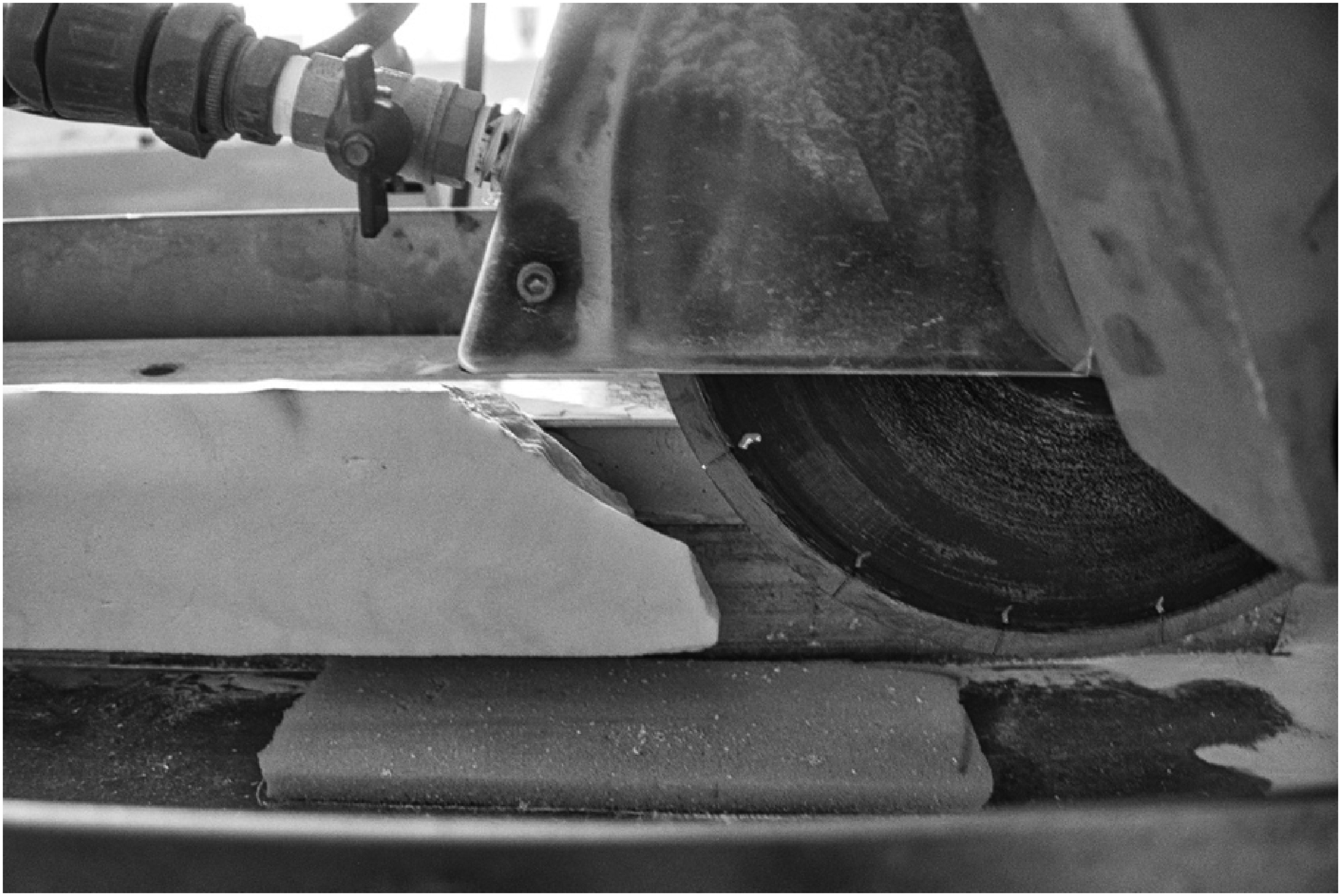
In the AIMS laboratory, a milling machine slices circular coral cores into 7 mm-thick slices, which is necessary for X-ray imaging. Through this process, the layered-grown patterns in the coral skeleton become visible and can be interpreted as time data by scientists.
Lough passes me a coral core. ‘Hold this’. It is a tube as long as my forearm and about 10 cm in diameter – heavy, like a rock. ‘That's because it is’, she replies. ‘It's calcium carbonate’. This almost-solid mineral mass was extracted vertically from a living coral colony with a hollow-barrelled drill. How do they do it? Lough directs me to a photograph on the wall behind us, past the customised milling machine from Taiwan (which slices cores thin for X-raying). In the turquoise image, two wetsuit-clad divers float underwater around a boulder-shaped coral selected for coring. The photograph was probably taken in the 1980s, Lough thinks, when AIMS first started coring ‘up and down the Great Barrier Reef’. In the photo, a drilling device resembling a tripod has been firmly attached to the top of the coral colony. A handle on the device allows the divers to lower a hollow drill into the coral and extract a series of vertical tubes from its skeletal matter.
Lough does not see the pieces in the drawers around us as discrete, disconnected fragments. They are distributed sets of vertical columns that together form extended records of the recent and distant past, with time moving backwards as she travels down through each assembled core. For coral core scientists, a longer set of fragments from one colony means a longer proxy record, access to more time data and the possibility of producing a longer time series.
Most cores in AIMS’ archive were extracted by divers in a single day, and are relatively short, measured in centimetres. They contain continuous records of only decades or centuries. Ice cores, on the other hand, can take years to extract with records stretching into deep time. As a comparison, consider the longest continuous climatic record: the EPICA (European Project for Ice Coring in Antarctic) Dome C ice core drilled between 1996 and 2004 (Grisart et al., 2022). Extending more than 3 km, it contains a record of around 800,000 years. Coral time tends to be shorter, patchier, more fragmented and spatiotemporally distributed. To produce a long time series (of ocean temperature changes, for example) multiple cores taken from different corals on different reefs must be assembled and aligned. But though ice cores and coral cores are materially distinct, the work of producing them as planetary proxies involves a shared orientation to time. In both coral and ice coring work, as in other disciplines that rely on excavation to produce planetary trajectories, time is understood to materialise stratigraphically through vertical time-depth.
To describe how coral cores and global climate science intersect in the lab I will introduce three moments at AIMS when technical pressure was applied to coral cores as they became ‘pieces’ in a planetary time-puzzle. In these moments, dimensional friction emerged through simultaneously discursive, technical and imaginative problems that lured coral core scientists into the carbonate structures that form tropical reefs. These problems engage the matter and morphology of massive coral colonies growing on the Great Barrier Reef, the shifting growth axes in extracted skeletons, and lastly, the volumetric ‘weave’ of carbonate coral structures. They are problems that suggest the vertical is an inadequate analytic for capturing the complex ways that corals and global climate science intersect.
Friction I: Massive corals and the problem of planetary delegation
Coral skeletons become proxies through the same logics that allow glacial ice, pine trees and ocean sediments to also become planetary delegates. Regardless of the context they’re pulled from, proxies become proxies through ‘the logics of surrogacy and vicarity’ (Mulvin, 2021: 7), which selectively grant representative power. In the case of corals, only specific colonies acquire this power. To understand the process of delegation, Mulvin suggests paying attention to the practices – forms of embodied labour – that are ‘indispensable to the maintenance of knowledge infrastructures’ like Earth System Science or planetary timelines (Mulvin, 2021: 11). However, coral proxies don’t only become proxies through the embodied labour of scientists, they also become proxies because of their own embodied labour. They grow over time. In the AIMS laboratory, the logics of surrogacy and vicarity are critically mediated by the material dimensions of this labour.
It was Richard ‘Rick’ Braley who first taught me how to spot the living corals most likely to become planetary delegates. Rick is a marine biologist from the United States who has been living for decades on Yunbenun (Magnetic Island) in the Great Barrier Reef. He studies giant clams – keystone species of many tropical coral reefs – with a focus on aquaculture methods (Braley, 1984; Braley et al., 2018). Some of his clams were transplanted to one of the island's reefs, Geoffrey Bay, around 30 years ago and today they have grown to almost a metre long and sit open-mouthed in the reef just off the beach. A series of bright yellow buoys mark out their positions for tourists visiting Geoffrey Bay's snorkel trail. But as dark green algae colonise and camouflage the buoys’ bright surfaces, the trail disappears.
The sea was rough when Rick asked me to help him clean the trail markers. He handed me a paint scraper and a stiff-bristled brush, and we swam out into murky water. As we scrubbed, he told me about the reef growing somewhere below us. There is a big coral out here, he said. ‘I’ll find it for you’. And in between cleaning, he would dive into the turbid water and hunt. ‘It might be the oldest living thing on the island … 300, maybe 400-years old’. I asked what it looks like. ‘Blue or purple, I think, and big’. He stretched out his arms as we bobbed on the surface, to show me the size. He told me it was a Porites species, part of a genus of ‘massive’ corals that can grow skeletons resembling boulders. The older the coral, the bigger the skeleton; and the bigger the skeleton, the longer the historical record.
We held our breath and dove again. Through the murk, the coral appeared below as a kind of sunken moon, almost 2 m in diameter and coloured a light lilac blue. The coring happens from the top, Rick told me on the surface. Researchers come from AIMS – he pointed to the unseen research facility across the channel – with hollow-barrelled drills, and once they find the right spot along the growth axis they drill down into the coral, and then carefully extract the core and break it into sections, numbering them in a unique way so they can rebuild the core once it arrives in the laboratory. Once extracted, he said, divers fill the top of the hole with a carbonate plug and the coral colony, a thin film of living tissue wrapped around the carbonate skeleton, will eventually grow over the wound. I asked if people had drilled this exact coral. ‘Maybe … probably’. I dove to look for signs of extraction, but I couldn’t make out the characteristic round bump of a freshly inserted plug. What records lay inside?
In 1987, a series of cores was drilled from a large Porites coral colony somewhere below us (from this coral or one like it) revealing a composite record of 168 years from 1820 to 1987 (Erler et al., 2016). In 2012, a 52-cm-long core was drilled from a similar Porites nearby (Lewis et al., 2016). These are just two of many cores taken from Porites corals at reefs around Yunbenun and other islands in the Great Barrier Reef. And most, if not all, are stored in the archive at AIMS, alongside fragments from other Porites skeletons.
‘We just like Porites’, Lough tells me in the lab. Corals from this particular genus are chosen over more than 100 other genera for two reasons. Firstly, they’re ubiquitous and grow across different environmental conditions. Second, they ‘tend to have nice clear bands that are fairly easy to interpret’. Other corals, such as branching or encrusting species, have skeletons with growth patterns that are difficult to read, Lough says, because the amount of extractable skeleton may be too limited or too complex and convoluted. Porites tend to grow solid globe-like skeletons that make coring easier, producing stratified records like those extracted from boreholes or ice sheets. This similarity is not coincidental. The selection criteria for a viable coral core is determined by certain desired dimensional qualities shared with borehole records and ice cores. The goal is to recover a growth pattern that reveals vertical time-depth: a layered stratigraphic record that can be synchronised with similar dimensionally constrained records.
Porites tend to be more aligned with the techniques of global climate science than other corals, but the process of determining which Porites species or colonies will make good delegates is not always straightforward. This is due to the taxonomic and morphological complexity of the Porites genus. With its ever-shifting subset of species, this genus is an ‘excellent example of extreme taxonomic confusion’ (Stat et al., 2012: 14). Species boundaries continue to shift. To date, of the almost 200 nominal Porites species that have been described, only 68 are now considered valid and 43 are classed as ‘taxon inquirendum’ because they are disputed or incompletely defined (Hoeksema and Cairns, 2023). This taxonomic confusion is partially related to morphological complexity: Porites species can appear as helmets, boulders, hummock mounds, flat plates, or even branches (Figure 6).
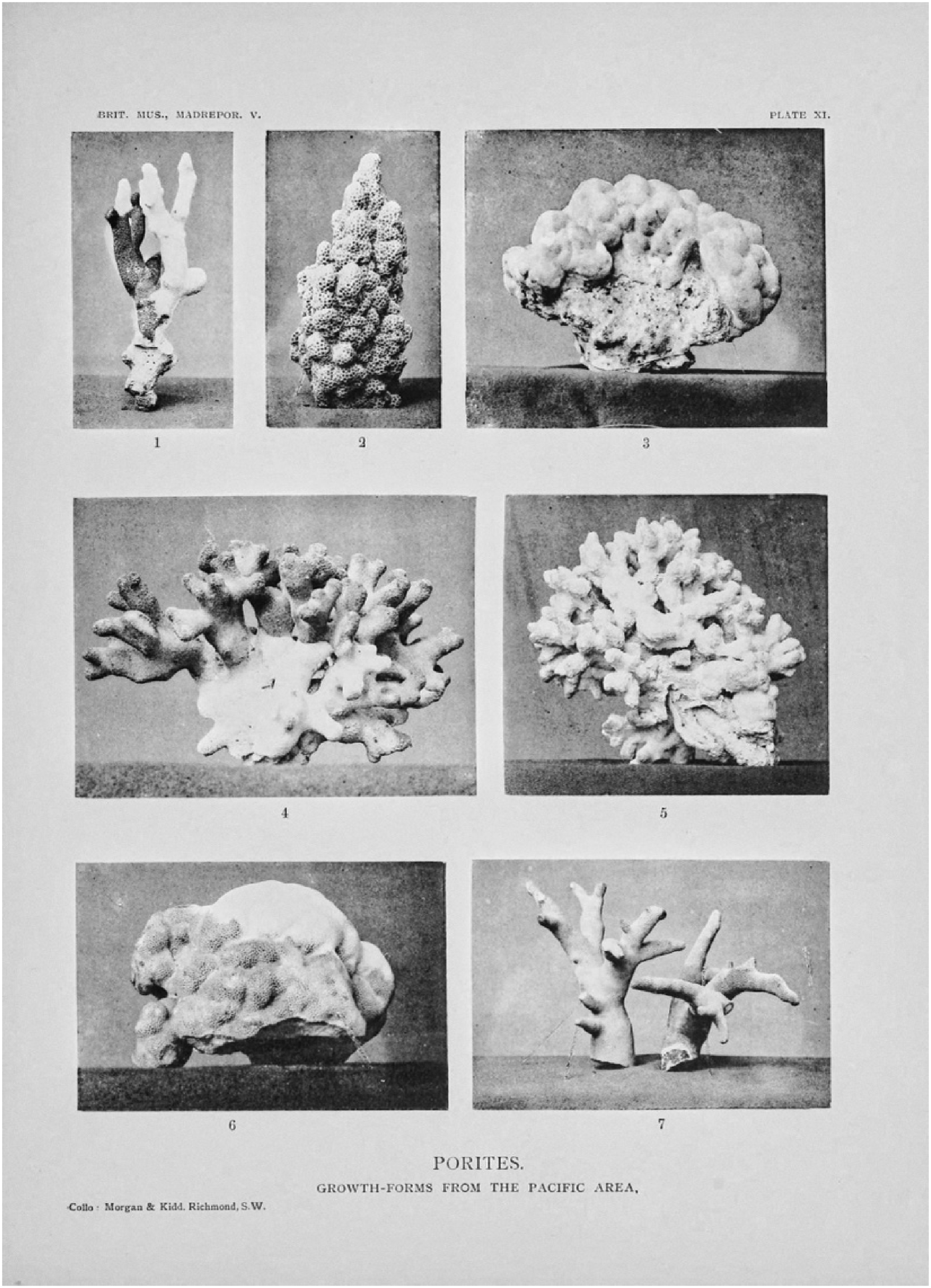
Corals in the Porites genus can take on many different forms.
Within the genus, and even within each species, only certain coral colonies with specific dimensional qualities become useful to the lab work of scientists like Lough. Colonies that have grown round and smooth are most desirable for the clearly layered patterns they produce – that is, colonies most likely to have grown their skeletons in a way that stratigraphically mimics the steady accumulation of geological strata. On the reef, finding an ideal drilling site is a constant negotiation between the techniques of the laboratory and the unique dimensions of an individual coral's growth. In this way, the AIMS laboratory echoes itself out into the Great Barrier Reef, determining which kinds of coral growth will synchronise most smoothly with vertical time-depth. But though the technical limits of the laboratory produce the conditions that determine which corals make good time, the growth of those corals is never fully resolved. Coral time is defined by the work of extraction and negotiation.
A similar exchange has been noted in accounts of ice coring. Achermann describes the ways that climate scientists seeking an ideal ice core needed to reckon with the ‘full three-dimensional complexity’ of an individual glacier, even when their conclusions became less and less bound to local contexts (2020: 19). The logics of surrogacy and vicarity are continually mediated by that complexity in the work of coring. Even in the submerged work of choosing a viable planetary delegate, dimension emerges as a crucial framework for materially grounding the temporal structure of global climate science.
Friction II: Growth and the problem of time ‘going off-axis’
To become a vertical stratigraphic record, extracted Porites cores must pass through a series of physical and ontological transformations in the laboratory. At AIMS, the transformation often follows a familiar pattern. First, cores are sectioned into 7 mm slabs using a customised milling machine, then sonicated to remove surface contamination and dried (Erler et al., 2016). Once cut, cleaned and dried, a ‘slice’ is ready to be X-rayed, which exposes the undulating mineral densities of the skeleton and allows them to be read as a series of horizontal bands. These bands mark out annual periods: ‘high-density’ bands tend to form in summer, Lough tells me, and ‘low density in winter’.
Lough holds up an image of an X-ray and points out a tight pattern of darker and lighter stripes. One calendar year corresponds closely to a pairing of a single higher-density band grown in the warmer half of the year and a single lower-density band grown in the cooler half of the year. The challenge for Lough is interpreting precisely where one year ends and another begins for the coral. Once determined, more granular work can then take place by extracting and testing the skeletal matter from a series of dated bands in a core (or slice). When scientists produce a chronology from this information, creating a time series, coral cores can become proxies for a range of historical anthropogenic environmental changes. Agrochemical run-off, coastal development, and even tourism are identified via changes in barium and manganese concentrations through the skeleton (Prouty et al., 2008); fertiliser applications via phosphorus (Mallela et al., 2013); the Opium wars via mercury (Sun et al., 2016) and nuclear bomb isotopes via 14C (Andrews et al., 2021). But first, before any of that proxy work can take place, coral core scientists must develop the age model of a coral by aligning growth patterns with Gregorian calendar years. This, Lough tells me, is ‘determined by counting the growth bands’. As bands are not visible to the naked eye, dating work is not done directly. Instead, slices are interpreted through images and visualisations that reveal the internal structure of the skeleton.
The image in Lough's hands is covered in marks from a ballpoint pen, and next to each pair of density bands she has begun determining the coral's age model with handwritten dates: 1900, 1899, 1898, 1897, 1896 (Figure 7). To make these interpretations, Lough doesn’t only rely on X-ray images. She can also overlay information from luminescent bands (traces of soil acids caught in the skeleton, revealed under blacklight), which show records of flooding from freshwater rivers adjacent to reefs or show periods of heavy rain. She also uses the output from a gamma densitometer – ‘probably the only one in the world’ – which measures troughs and peaks of skeletal density to help determine the banding pattern more accurately. By triangulating this information, Lough can begin to determine an accurate sequence of years running down the core.
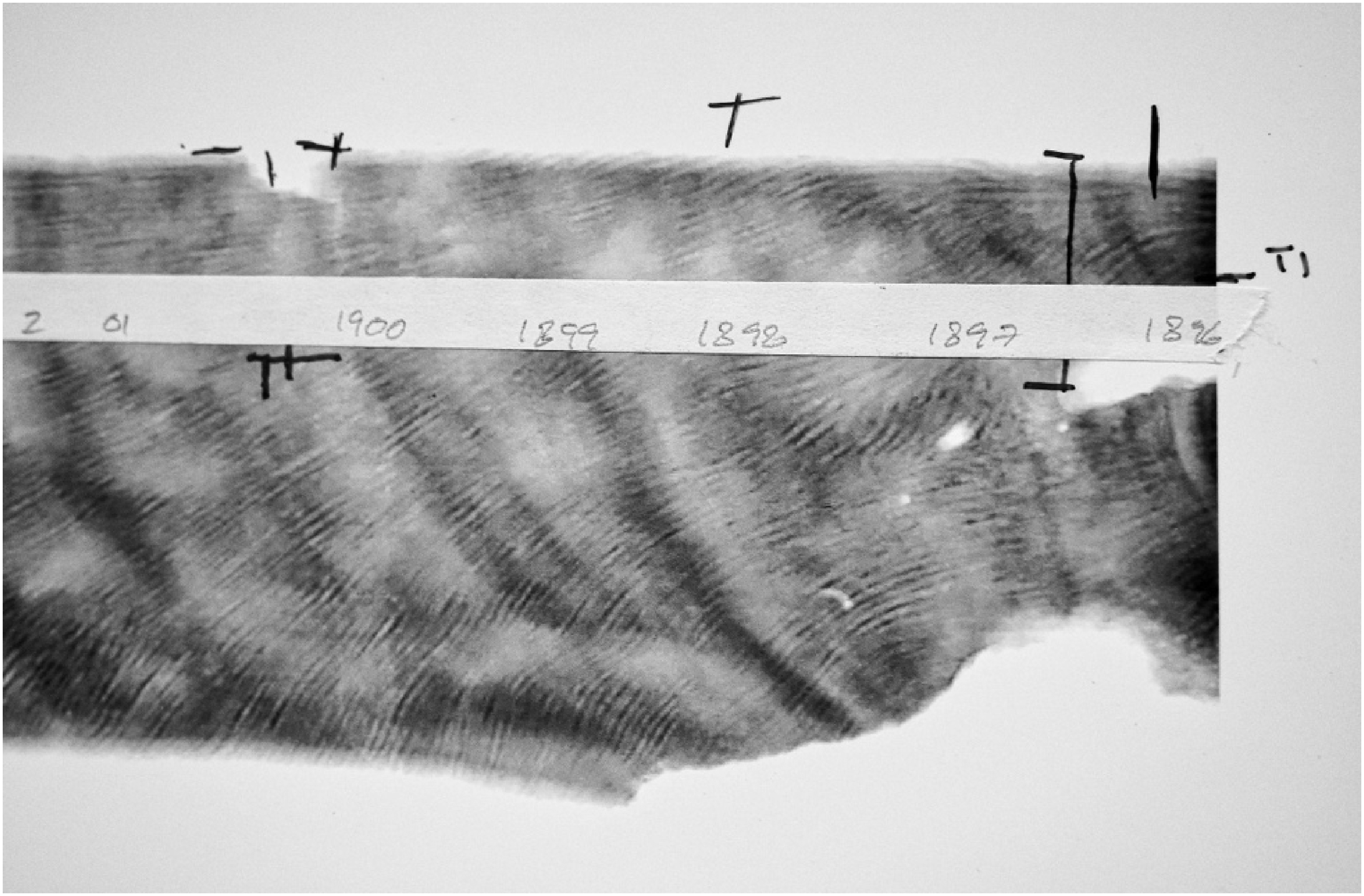
Marks and approximate dates on an image of an X-rayed slice help scientists at AIMS produce the age model of a coral, converting its growth patterns to years and months.
But ‘they don’t always grow in nice straight lines’, she says. If these bands cannot be determined, a core may be deemed unusable. ‘You’ve got a period here where it's nice and clear’. Lough points to a section on the X-ray image displaying the familiar stratigraphic pattern. ‘Bands, here and’ – pointing to a section that is becoming wobbly – ‘even here’. But then, she says, 'it's gone off-axis – gone totally off-axis.'
The problem of time going off-axis subtends a dimensional friction that emerges when the temporal structure of global climate science rubs up against forms of growth that are not readily available to models based on vertical time depth. Much of the work of coral core scientists involves negotiating with time that has ‘gone off-axis’. This time is either wrestled into the logic of calendar years or discarded as unviable.
Lough holds up an X-ray image printed on a sheet of A3 paper. Held vertically, a mimetic transformation begins, with the flattened image mirroring the orientation of the coral colony it came from. Propping the paper up on a metal shelf in the archive, she points to the uppermost section, ‘the top of the colony’ where the living corals grew their skeleton. But the mimetic transformation is incomplete: corals do not grow like straight sheets of paper. ‘Instead of just going vertically … instead of just growing like that, it might sort of tip like that’, and she bends the flattened image toward us; ‘or tip like that’, and then bends it away. Through the paper, the coral can only tilt along a single axis. Lough explains that on the reef, however, the colony would have shifted along multiple axes. Corals have a larger growth axis, but also smaller growth axes determined by the collective growth of different sections in the colony.
So how does Lough negotiate this friction? She holds up another X-ray, showing a core with clear and convoluted bands. Sometimes she will draw distinct axes over the image with a pen to show the ways the skeleton has tipped. The work of interpreting a flattened image of a coral skeleton involves continually assessing how the wider colony grew in three dimensions and selecting specific pathways through coral growth to make an age model. In the image, Lough shows me how the banding pattern becomes clearer in some sections and blurry in others. To navigate these changes and produce an age model, she visualises multiple axes of growth in the skeleton. ‘I’ll do an initial guess at the dates’. She begins to draw a finger across the image, ‘I’ll usually take a punt, so that's 1931, the years going back’, her finger moves further along the image, ‘so this is a sort of middle section, 1896’. Beyond, the image turns into a mass of marbled, convoluted layers (Figure 8). ‘Sometimes things can get a bit messy’.
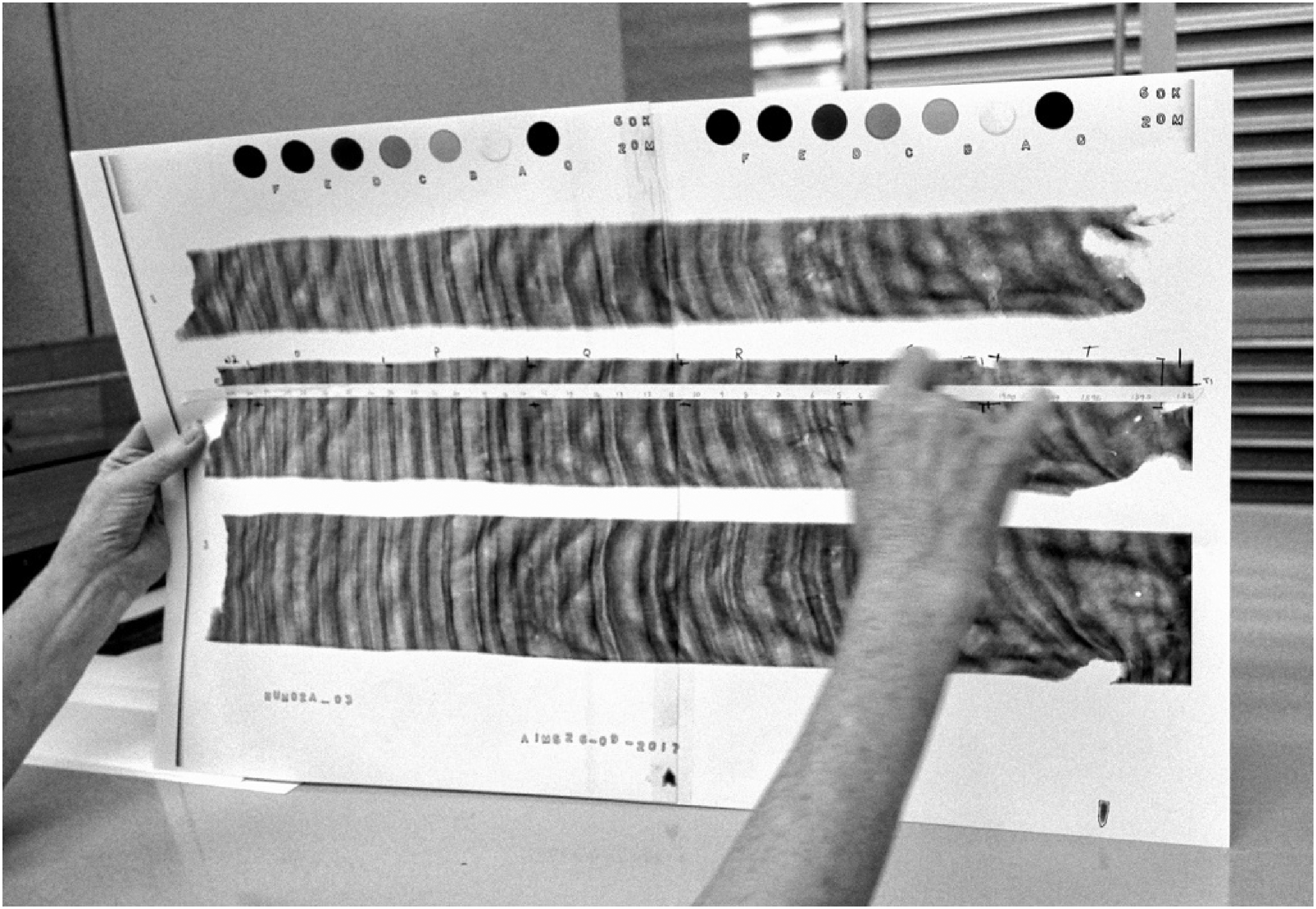
Layered growth bands (far left) go off-axis (far right).
Through X-ray images, Lough is negotiating the flattened record of a vast colony containing thousands of genetically identical coral polyps that moved together as they grew their skeleton. This growth can produce mineral layers like strata, or convoluted patterns like the marbling of oil on water. Thinking about friction in this sense does not mean the density bands are producing wobbly or crooked timelines. The friction here represents a rub between a flattened sense of vertical time-depth and a complex materialisation of volumetric growth. Some slices have gone so far off-axis that the ‘record’ appears as a blur of mineral waves, a temporal structure almost unintelligible to the surveying eye of global climate science. As corals are dimensionally shifted from skeleton to core to slice to X-ray and image, the friction of growth manifests through shifts in axes that demand a critical engagement with volumes and their dimensions. Paying attention to corals that have ‘gone totally off-axis’ suggests that engaging with the laboratory work of the coral core scientist requires an analytical shift: from thinking through the consolidation of proxy data into grand timelines to engaging with the dimensional work of corporeally appropriating temporal volumes.
Friction III: Moon memories and the ‘venetian-blind problem’
The story of coral time, Lough tells me, begins in ‘the early 1970s when some American scientists went to Enewetak Atoll’. These scientists – David W. Knutson, Robert W. Buddemeier, and Stephen V. Smith from the University of Hawaii – were experts in oceanography, chemistry, and geophysics who travelled to study how corals in the Marshall Islands, particularly around Enewetak, were affected by U.S. nuclear tests in the mid-20th century. Lough tells me that the researchers made a breakthrough when they laid coral slices directly on X-ray film and, after 40 days, saw exposed traces of Strontium 90 from specific bomb tests as a series of radioactive bands in the film. They persuaded a local doctor to X-ray the same coral slice, and in the resulting image saw a clear sequence of density bands. By matching these to the exposed traces of Strontium 90, which corresponded to the timing of specific tests, they demonstrated that variations in the skeletons of reef-building corals contained an annual and seasonal chronology (Knutson et al., 1972: 272). Perhaps most significant was the discovery that these patterns could be measured using available laboratory techniques, allowing certain coral skeletons to easily be turned into chronostratigraphic records. In the ensuing decade, coral core scientists understood more about the ways that layering in the coral skeleton took on a recursive logic, with fine-grained growth lines appearing even deeper within the patterns discovered by Knutson, Buddemeier and Smith.
Lough takes me to a large image on the wall that shows a few centimetres of a coral core seen through the lenses of a scanning electron microscope. It reveals the skeleton as a mineral net with intersecting vertical and horizontal struts producing a mesh of white calcium carbonate enclosing black interstices of saltwater. This is the coral's microstructure, made of crystal aragonite – a form of calcium carbonate that coral polyps use to grow their skeletons. Lough describes it as ‘a knitting pattern’, which is woven tighter or looser, depending on the season. ‘The other thing that you can see’ – Lough points out the tight, connected lines running through the image – ‘see this very thin line here, thin line there, thin line, thin line, thin line’ (Figure 9). Amid the woven carbonate net grown by coral polyps is a pattern of smaller lines called dissepiments. The coral will ‘lay down a dissepiment and then it starts extending again, then it’ll lay down another dissepiment and basically that’s separating the living tissue layer from the dead skeleton below, but the neat thing is the time, the timing of this is monthly. They’re reading the moon.’
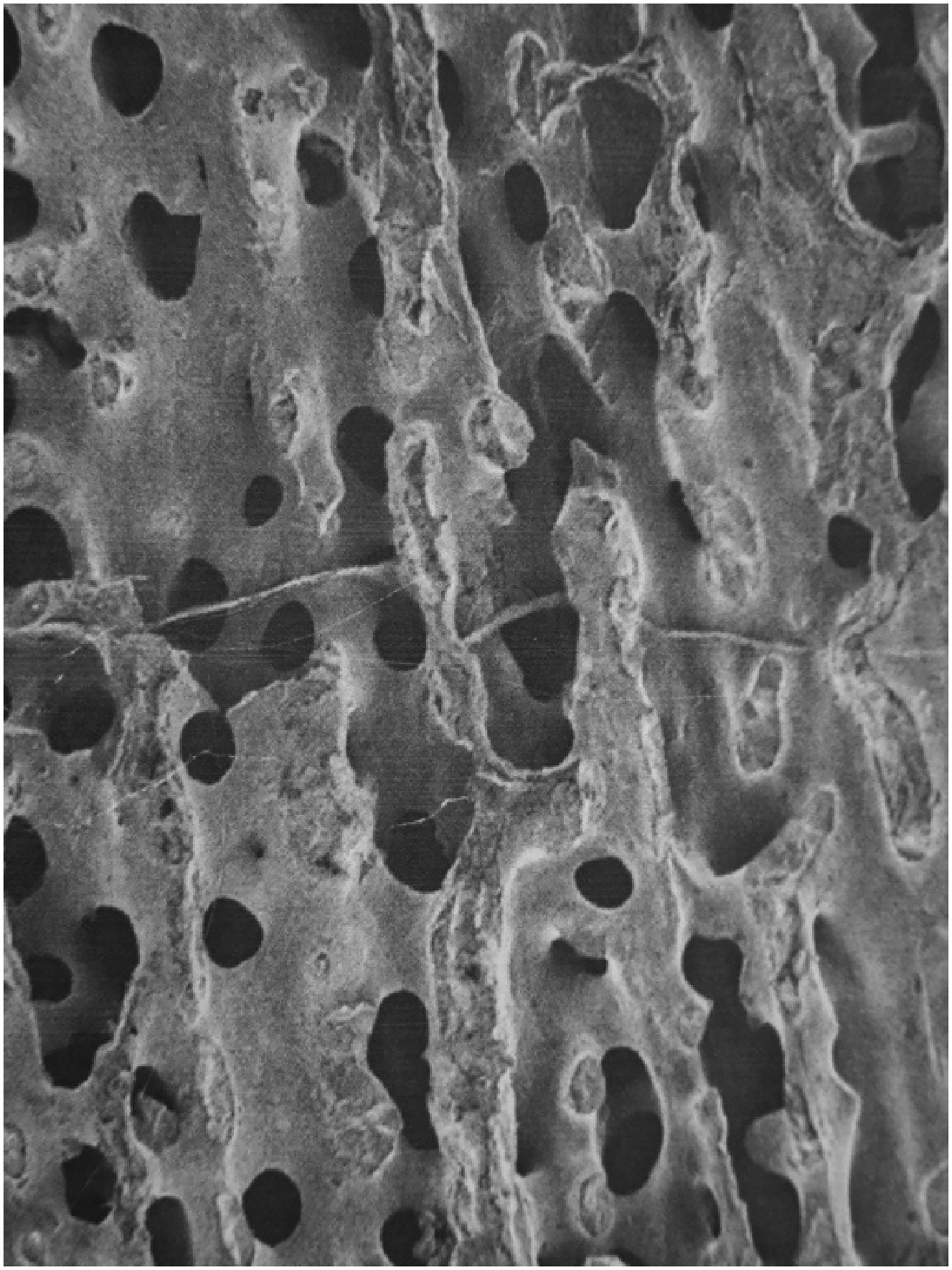
An image from a scanning electron microscope shows a thin dissepiment running left-to-right (in the centre of the image).
In the 1980s, these moon-memory bands were still not well understood. In 1989, alongside fellow coral core scientist David J Barnes, Lough wrote about an emerging problem with the lunar-linked fine bands within the larger seasonal banding pattern. They described these as ‘a series of alternating dense bands 1 mm wide and less dense bands up to 3 mm wide’ (Barnes and Lough, 1989: 119). The annual bands of dense and less-dense layers identified in Enewetak corals appeared to hold their own series of dense and less-dense layers, suggesting a more fine-grained temporality to the growth of corals – stratigraphic time-depth, all the way down.
Barnes and Lough wanted to understand why the bands were visible in some X-rays, but not in others. Calling this the ‘venetian-blind problem’, they argued that the difference lay in whether the sample came from a smooth-surfaced colony, which was ‘likely to have the fine bands reasonably well aligned with the X-ray beam’, or from a colony with bumpy surfaces, which was likely to have bands that would ‘curve through the thickness of the slice, making their resolution by X-radiograph even less likely’ (Barnes and Lough, 1989: 130). Alignment and misalignment between the temporal structure of Porites corals and lab technologies explain why the fine bands appeared clear in some parts of the X-ray images and invisible in others. The question in the laboratory then became one of how to open and close the ‘blinds’ to turn the cores into legible stratigraphic records.
In line with Tsing's notion of friction as world-making, this problem of fine banding produced new techniques for working the intersection between corals and global climate science. These techniques produced cores materially (in terms of their calcium carbonate lattices), taxonomically (in terms of species morphology), and stratigraphically (in terms of a flat vertical record), but also dimensionally. In the same way that Lough manipulated her piece of paper ‘tipping this way and that’ to help me visualise a core going off its axis in three dimensions, she and Barnes manipulated their Porites core as it was X-rayed. A figure in their 1989 paper gives an example of this dimensional work in action (Figure 10). It shows seven different X-ray images of the same core, each at a slightly different angle. Through this process of dimensional shifting, the fine bands were made to subtly open and close in each infinitely compressed X-ray image, allowing glimpsed traces of volumetric growth curving through the thickness of the slice.
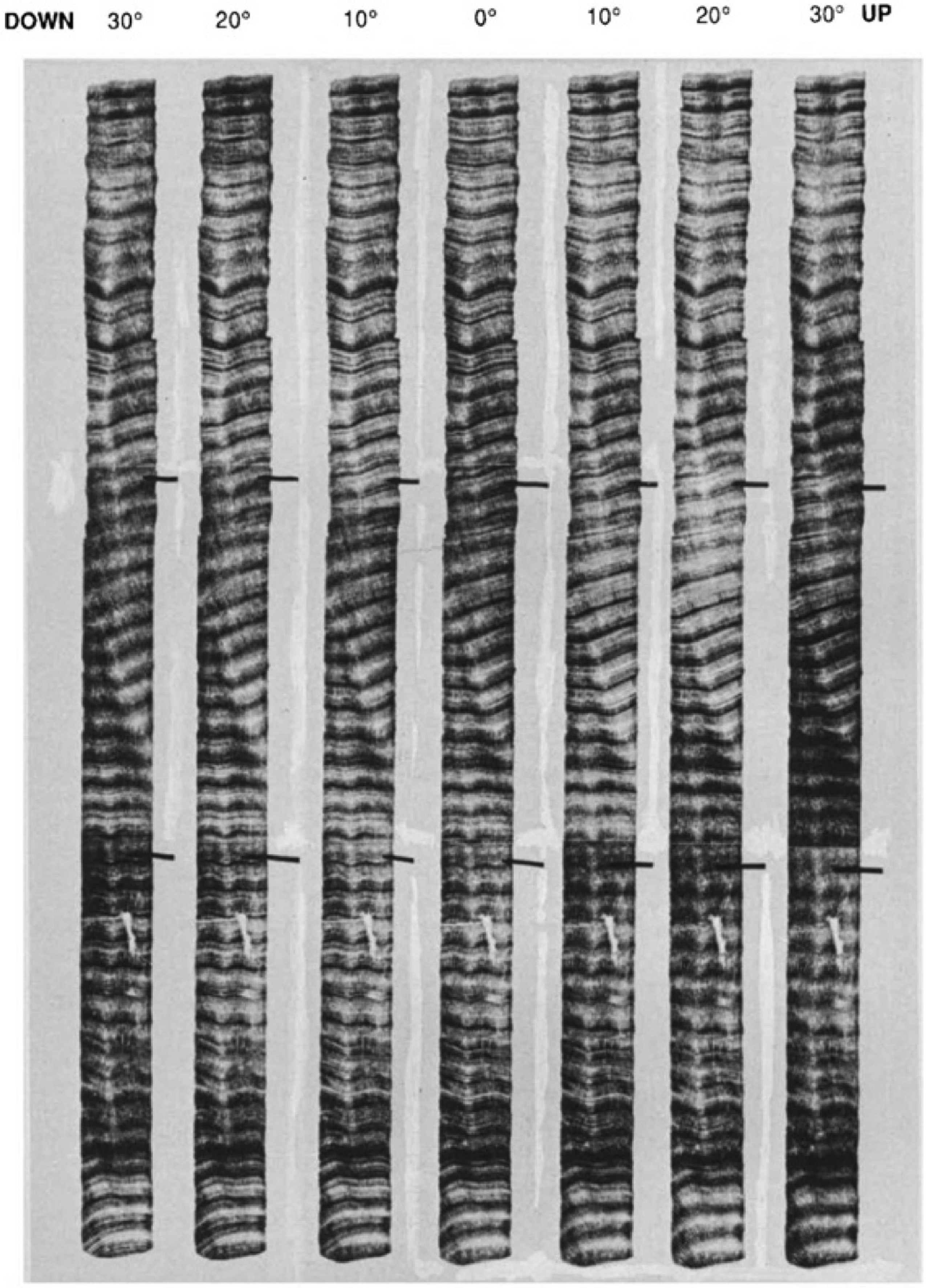
The ‘venetian-blind problem’: In their 1989 article, Barnes and Lough showed different views of a single 6-mm-thick slice, extracted from a coral on the Great Barrier Reef. To reveal the skeleton's fine banding pattern, the slice was X-rayed lying flat (the central image, marked ‘0°’), and also X-rayed while tilted up or down by different degrees (10, 20, and 30).
The ‘venetian-blind problem’ has rarely been referenced in the years since the 1989 paper was published. Like ‘off-axis’ cores, corals with growth that is not square to the techniques of temporalisation are not always useful to the work of producing timelines. I relate this relatively minor issue in the annals of coral coring research because it demonstrates that, even when working the minute temporal structure of Porites corals, time data is not only determined by verticality. Put another way, noticing dimensional friction is a way of describing knowledge infrastructures without succumbing to the grand planetary scale of global models, the Anthropocene, or even ‘our own model of development, our own industrial modernity’ (Bonneuil and Fressoz, 2016: 27). A focus on dimension invites descriptions that ground the grand scales of planetary trajectories in the specific material and ecological contexts of proxy time data itself.
Conclusion: Temporal volumes
My observations in the lab and archive at AIMS offer one set of responses to the dominance of the vertical. The work of Lough and others like her, conditioned by both global climate science and the materiality of proxies, cannot be adequately described or theorised through verticality. Instead, coral time emerges through a constant negotiation with dimension. But what about other labs and field sites where different proxies are produced?
Dimensional friction appears to be fundamental to the work of producing proxy records and integral to the practice of engaging time through depth. This is because geological records and analogues do not sit still; biogeochemical cycles, like the ocean itself, constantly churn, disrupting, overlaying, and transforming layered records. As Rosol writes, ‘the climatic record stored in terrestrial and marine archives, in stone, ocean sediment, and ice is extremely perturbed’ (2017: 121). This is why models of the global environment can appear more like ‘fluid objects’ than ordered trajectories and timelines (Hastrup, 2012: 17). The unsettledness of climate proxies, one cause of dimensional friction, contributes to a view of the climate system as non-deterministic (Antonello and Carey, 2017; Rosol, 2017; Yusoff, 2008).
Friction also appears because the temporal structures of perturbed records are dimensionally orthogonal to the technics and temporal orientations of climate science. As Simonetti has observed, tensions emerge when vertical time-depth ‘mixes with other temporal trajectories’ (2015: 2). But there is more at stake here than clashing orientations and trajectories. These frictions are material and technical. During fieldwork with coring scientists in Greenland, Skrydstrup noticed these kinds of problems appearing when drills became stuck or drilling fluid ruined the integrity of research data (2012: 165).
All of this seems to suggest that the layered patterns in coral cores and other proxy records are too perturbed, Daedalian or wonky to be chronostratigraphically captured, and therefore, the models and trajectories that rely on proxy data are not necessarily veridical. This is not the conclusion I want to draw. It is facile because it lacks nuanced fidelity to the complex labour of the coral core scientist. Here I follow Rosol, who has argued that uncertainty is not a productive framework for analysing the relationships between proxy data and global models: ‘Contrary to the cries for expurgated and sterilized certainty, it is ambiguity, vagueness and the impermanence of knowledge that needs to be tolerated, if not even embraced, as productive epistemic categories’ (2017: 134).
Focusing on dimension and how it is constantly defined and worked in the lab helps describe a specific set of problems that outline the always-uncertain temporal structure of global climate science within the close work of producing proxies. Through dimension, a set of problems arise that provincialise the vertical, prompting further questions. What conditions the emergence of dimension through friction in laboratories? How is this friction defined and ‘solved’ as proxy records become time data? Has dimensional friction naturalised certain temporal practices, or produced new forms of calculation?
But dimensional friction is an unsatisfying and perhaps even unhelpful analytic if all it produces is a taxonomy of problems that arise in the production of time data from proxy records. To end, I want to point toward some of the ontological problems that lie underneath dimensional friction and pose some tentative ways of addressing the politics of coral time, and the larger war being fought ‘in the hallucinatory register of how the future is simulated’ (Adams et al., 2009: 257).
The first problem is that dimensional friction is an effect. It is evidence, a symptom, even a proxy within a proxy. If the vertical has been provincialised, what has expanded? Noticing dimensional frictions in the laboratory can draw attention to the practices of acting on volumes, which involves working and reworking heights, distances, sizes, weights, densities, widths, interstices and so on. These measurable qualities do not just sit still, waiting to be measured, they are also more-than-three-dimensional with complex histories and changing imagined uses. Engaging dimensional friction means viewing coral cores not as records of vertical time-depth but rather as temporal volumes. As an effect of volume, dimensional friction should matter to our accounts and theories of time because it matters to the techniques that produce temporal models of the past and future. It guides the possibility of chronological comparison, and it scaffolds the politics of climate change.
This approach is not without its risks. Descriptions of volumes or voluminous states can easily become unhelpful abstractions when abstraction ‘is the form that the techniques of territory take’ (Adey, 2013: 52). Similarly, descriptions of time can become equally obscure when the techniques that produce them take an abstract, camouflaged form (Munn, 1992; Nixon, 2011). As an analytic tactic, the dimensional accounts for these risks by grounding descriptions in the making (and growing) of time. This tactic ensures that time, as Simonetti insists, is not defined ‘in advance of how people appropriate their worlds corporeally’ (2015: 16–17). Within the domain of the laboratory, thinking volumes – or really, the ways their dimensions are continually defined and worked – is a way of acknowledging, following Munn (and Bourdieu before her), ‘the co-constitution of time and space in activity’ (1992: 97), but also the flowing, perturbed co-constitution of time and matter. Articulating dimensional friction traces the outlines of temporal volumes, grounding the possibility of a different politics of coral time: one not only defined or theorised through the calculative logic of verticality or binaries of certainty and uncertainty. How might political imaginaries of time shift when the veridical becomes tethered to the problems of volumes and their dimensions?
In the AIMS laboratory, a sign is propped up on a metal workbench, behind a milling machine (and underneath a photograph of divers extracting a coral core). It reads, in capital black letters, ‘CORING INTO THE PAST’ (Figure 11). The form of travel promised by the technical labour of the coral core scientist is sometimes a descent into vertical time-depth. It is also a fraught passage into temporal volumes, with dimensions that go beyond depth. Thinking of planetary delegates in this way is not so much a passage into the scale of colossal timelines or climate models, but instead a mode of grounding the techniques and tensions that make those arching, abstract relationships to time possible.
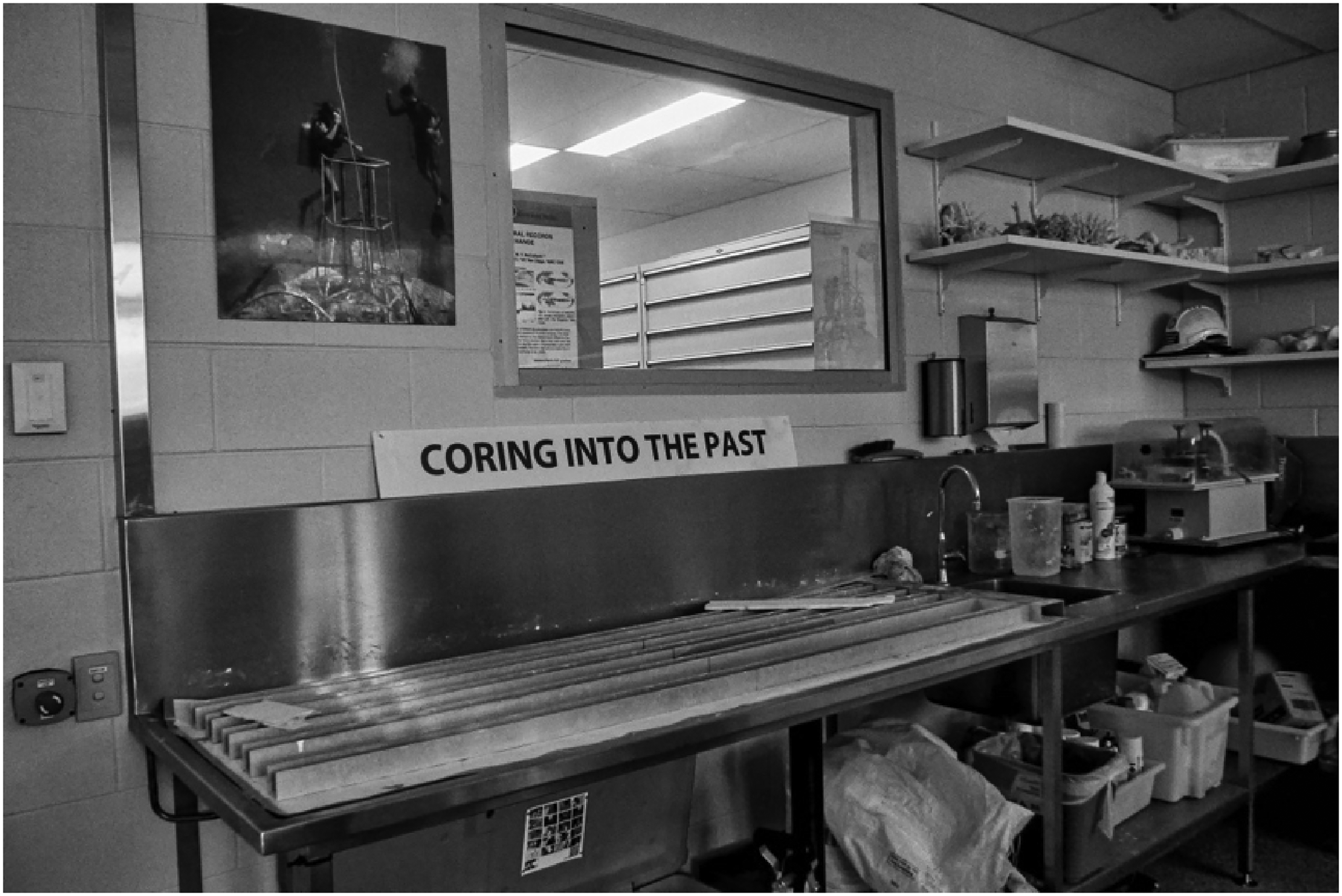
A sign in the coral core laboratory at AIMS.
Footnotes
Acknowledgements
I would like to thank Janice Lough for her generosity and patience during my time at the Australian Institute of Marine Science and also thank the special issue editors, Rachel Douglas-Jones and Kristin Diana Hussey, for providing crucial editorial guidance. An early version of this article was outlined in a paper presentation for the second international Temporal Belongings conference in 2021.
Declaration of conflicting interests
The author declared no potential conflicts of interest with respect to the research, authorship, and/or publication of this article.
Funding
The author received no financial support for the research, authorship, and/or publication of this article: This research was supported by an Australian Government Research Training Program (RTP) Scholarship.
