




Abstract
To move beyond its industrial era mechanistic paradigm, western education needs to include knowledges that enable students to think with and engage an increasingly complex world. The teaching and learning of complex time is one such knowledge, and pattern thinking and understanding are useful for this undertaking. As part of their teaching practice, the author developed and implemented a patterns-based design and educational strategy called spiraltime patterning with secondary school students more than a decade ago. Recently, the approach was implemented with university students as part of a doctoral inquiry project that focused on general complexity thinking and understanding. Spiraltime patterning is designed to perturb the dominance of linear temporalities and reposition them within a multitemporal patterning of complex time. The broad aim of this work is to contribute to transformational education, by facilitating temporal coherence and wellbeing for students, through embodied understanding of time as a complex phenomenon.
Introduction
Spiraltime patterning offers a novel educational strategy for considering time differently. It is an approach to operationalising time for wellbeing and learning. The approach facilitates embodied experience for students as complex time-beings (to use a Baradian term, 2017), with and within ongoing complex temporal emergence. This relational approach expresses the view that a healthy experience of time emerges from coherent patternings of temporal rhythms, and linear temporalities can be useful when engaged in a balanced way. A complex perspective of time includes a diversity of individual temporal patternings, that are dynamic, and differ at various times for everyone. The calibration of temporal commons is also included as helpful when cooperation is required. In considering various temporalities we can ask, what is the relationship between them? How do they shape each other? What are the resulting affordances and constraints? Who benefits and in what way? These questions form a basis for applying knowledge of complex time.
Using pattern thinking to stimulate complexity understanding, this educational approach includes multilevel spiralling patterning and a range of ecological metaphors. It is simple enough to be adapted for primary school aged children, and complex enough for use in secondary and higher education. Spiraltime patterning can be introduced to students within a range of different disciplines and curriculum topics or can be a topic on its own. It can also be included as a metaknowledge, as a transdisciplinary engagement with the temporal dimension of all topics. At the time of writing this article, no other educational program for the direct teaching and learning of complex time was discoverable, placing the spiraltime design and strategy as an original contribution to education.
Western education was developed and continues within a Newtonian mechanistic paradigm. It is founded on the view of progress that includes controlling and training children to be obedient, civilised, cogs/resources in the machine of capitalist society (Murris and Kohan, 2021). This educational paradigm is manifest through chronological means, with adherence to rigid temporal linearity, considered a central indicator of a successfully civilised and educated student (Murris and Kohan, 2021). Alhadeff-Jones (2017) describes the temporal pressure that occurred with the industrial revolution as continuing and increasing within education through the focus on efficiency and accelerated learning. This temporal effect is also occurring in higher education, with the increasing commodification and condensing of learning (Taylor and Taylor Neu, 2023). Alhadeff-Jones builds a clear and thorough argument that agency and autonomy are both influenced through temporal arrangements, as education ‘determines the way that we relate to time and the heterogeneous rhythms of existence’ (2017: 3). He calls for an organising principle through which to question and engage with diverse temporalities within education, an approach that can hold multiplicity, paradox, tension, and change, without attempting to reduce complexity (Alhadeff-Jones, 2017, 2020). Such an approach would privilege temporal multireferentiality in the same way that complexity thinking and understanding embraces material multicausality and diversity as generative. The spiraltime patterning approach to the teaching and learning of complex time is one such organising principle. Questioning temporalities is a recent direction in work that seeks to shift western education from its imperialist and colonialist beginnings (Murris and Kohan, 2021; Murris and Bozalek, 2023). With complexity thinking and understanding placed as one of the vital skills for students in the 21st century (Luksha et al., 2018; Lutz, 2021), engaging with time as a complex phenomenon through complexity-based patterning has the potential to contribute to transformational and decolonising education that is responsive to the needs of today's students.
This work began in 1990 from an embodied personal experience of time as dynamic and openly multiple. It continues to emerge in a way that defies the possibility of an absolute then and now, before and after. I developed the spiraltime design at that time to support young people to navigate the pressures of reductive capitalist measurements of achievement and success. I also wanted to ameliorate some of the reductive aspects of educational processes, with a particular focus on linear school time, all without needing to change the entire education system. The educational aim was/is to facilitate embodied engagement with life and becoming as complex phenomena for students, through using a visual language of patterns and metaphors. A storied account of this seeding of spiraltime patterning is included here, not to describe a past event, but to continue the reworking of the past as a living emergence in this present, and into the future to come. Later, academic inquiry grounded this knowledge emergence, inspired by the work of theoretical physicist Karen Barad (2007, 2014, 2017), whose feminist posthumanism reworks time, space and being, to queer the boundaries of individuality, subjectivity, and objectivity, as well as epistemology, ontology and ethics, to re-open a radically relational and participatory universe. Barad describes matter, time and being as iteratively diffractional becoming (2007). Recently the works of Murris (2020), and Murris and Kohan (2021) have strengthened my understanding of Barad's work, particularly in relationship to education.
I had the opportunity to implement the spiraltime patterning with secondary school students aged 13, 14 and 15, over a period of five years between 2005 and 2010. In response to an observed need of the students in my classroom, the design was implemented to support wellbeing and learning. I was seeking to perturb the broad imposition of a reductive linear temporality upon the complexity of learning and becoming. I observed that school time generated a breathless race for the students, against each other and against abstract linear time, through a punishing regime of temporal boxes to fill and lines to get across. Spiraltime patterning was implemented as an embodied metaknowledge for experiencing and engaging with time as a complex phenomenon.
As described in detail below, the patterning itself expresses complex attributes. With seven phases fractally repeated across three levels of a spiral form, and a range of design features and ecological metaphors, spiraltime patterning can express a diversity of possible temporal configurations. Being a form of the simple patterns found at every level of scale in the organisational emergence of life, from the sub-quantum to the cosmic (Diez Faixat, 2021), spiraltime patterning is bioaligned design, placing it to be a potential source of coherence between people and life (Sheehan, 2003; Wahl, 2016). The use of patterns to understand and generate coherence with complex phenomena is not new, as Indigenous cultures continue to use multidimensional patterning this way. Thus, spiraltime patterning can be described as an indigenist knowledge. It is a form of decolonising design, connecting with the many Indigenous cultures today that conceptualise time as a complex phenomenon (Awâsis, 2020; Buhre and Bjork, 2021; Stanner, 2011; West-Pavlov, 2012).
Spiraltime patterning is one of four patterns in an overall design I have called Complexity Patterning, which is the foundation of a broad educational approach for the teaching and learning of complexity thinking and learning (Brown, 2019, 2021). Implementation of the approach in my secondary school classrooms was documented through informal reflection. However, positive impact with the students was motivation enough to pursue a PhD to formally investigate using patterns-based design for the teaching and learning of complexity thinking and understanding. Complexity Patterning was subsequently implemented with a range of university students within doctoral inquiry workshops between 2015 and 2020 (Brown, 2019, 2021), and is now beginning to be implemented more broadly within higher education.
Whilst proving to be very effective in the development phase with secondary students, the spiraltime dimension of Complexity Patterning was not the main focus of the doctoral inquiry workshops for a variety of reasons. Ironically, time constraint was one of them. COVID-19 then prevented further face to face workshop opportunities. Spiraltime patterning is introduced here the way it was initially designed, as implemented with the secondary school students, and through its brief introduction to the university students in the doctoral inquiry workshops. This synthesis then paves the way for more formal inquiry into the spiraltime approach to the teaching and learning of complex time. An invitation to implement this work in an alternative high school setting was extended after a presentation of this material at an in-house post-graduate conference. This possibility will be explored in the future, as a step towards realising the aim of this work being a contribution to transformational education.
To set the context for detailing spiraltime patterning as an educational strategy for temporal knowledge making, the way the term complexity is used here is first clarified. Following is an overview of the conceptualisation of complex time engaged here, and then a tracing of the temporal entanglements that stimulated the emergence of spiraltime patterning and continue to be diffracted through this work. Implementation with the secondary students is then detailed, followed by implementation with the university students in the doctoral inquiry workshops. Finally, the limitations of the spiraltime patterning approach are discussed, together with possibilities for further inquiry towards increasing understanding of not only this educational strategy, but also the transformational potential of the teaching and learning of complex time.
Complexity, deep complexity and patterning
The term complexity is used in an expanded way in this article to include the emergence of life from the quantum and sub-quantum fields, and the entangled participatory complicity of all beings, including people, within what is described as the deep complexity paradigm (Brown, 2019, 2021). The deep complexity perspective includes the way the term complexity is used in different complex systems approaches, which describe complex phenomena as self-organising, through non-linear relational dynamics as the central principle of continuing emergence (Hager and Beckett, 2019; Morin, 2008). Complex phenomena are openly connected across scale, as well as functionally bounded in some way. They are not only connected but entangled from the particular to the general, from local to global (Rinaldi, 2021). Complex systems theory generally describes complex phenomena as beginning with parts which then interact, with the ensuing relational dynamics generating emergent properties that cannot be discovered in the parts (Rinaldi, 2021; Teixeira de Melo, 2020). Here, this perspective is expanded to include the view that parts are not fundamental but are an emergence of differencing that occurs from within entangled relational dynamics that precede them (Barad, 2007). This is difference as intra-active cutting-together-apart that holds the generative paradox of part/phenomena relationality (Barad, 2007, 2014). In this way, the attributes of complex phenomena are described as emerging from the relational co-generativity of entities, expressed through all apparent binaries, including part/whole, form/flow, culture/nature, and order/chaos, through non-linear multicausality.
The deep complexity perspective is based in a patterning ontology, contrasting with a classical atomistic ontology. According to physicists Diez Faixat (2021), and Ivaldi and De Santis (2021), the beginnings of differentiation is a patterning of harmonic fluctuations within the sub-quantum field which then informs the quantum field, manifesting space, time, and matter. The authors describe toroidal and spiral pattern dynamics as foundational in these processes. They also theorise time as a multitude of temporalities emerging from the internal relationality of the diffractive differencing of matter into bounded entities (Diez Faixat, 2021; Ivaldi and De Santis, 2021). This perspective acknowledges diverse expressions of life as mutually co-constitutive in ways that continue to influence ongoing relationality and emergence of increasing complexity. It is also the basis for understanding complex time as internally relational. Using patterns and patterning dynamics to generate knowledge of/with/about complex phenomena aligns with this view of patterning as a fundamental principle of life's coming-into-being. It also aligns with the human capacity to build knowledge of life's complexity using pattern thinking (Brown, 2019, 2021; Yunkaporta, 2019) and the inherent human tendency to use ecological metaphors for complexity understanding (Lakoff and Johnson, 1980, 1999, 2003). It is the purposeful calibration of knowledge making strategies to life's dynamics (Wahl, 2016). These alignments and the relative simplicity of Complexity Patterning contribute to this educational approach having a low cognitive load for students.
As a knowledge making strategy, Complexity Patterning and spiraltime patterning express the deep complexity paradigm, moving away from abstract representationalism towards embodied participation and complicity in the emergence of the phenomenon of focus (Brown, 2019, 2021). The inseparability of subjectivity and objectivity is central in this approach, which also applies to time, with us all literally participating ‘in the very world-ing of the world’, with all technology and human action co-constituting material/discursive conditions that are sedimented into objectively measurable marks/traces in the world (Barad, 2017: 73). We can say that we, and all entities, are performatively time-ing in a temporally participative way that defies any absolute separability of the experience of time and conceptualisations of the material phenomenon of time. Based on Barad's perspective, spiraltime patterning reworks time from being a backdrop for human life, to an integrated and entangled complex phenomenon. This concept of participatory time is not to place humans as exceptional. With all beings simultaneously participating, this perspective highlights the inherent responsibility of all we do within the entangled nature of complex time.
A complex conceptualisation of time
Complex time is conceptualised here to include the temporalities of all species and ecological entities, and the transtemporality of past and future, all patterning within a dynamic present. Internal relationality between diverse rhythms and temporalities is incorporated within the spiraltime design, which introduces complex time not as additive of various temporalities, but as constituted through the paradox of internal and external relationality. In this agential realist perspective, just as material entities are co-generated, whereby difference itself is an expression of internal relationality, so too are diverse temporalities (Barad, 2007, 2014, 2017). Pattern thinking and understanding is a useful approach to engaging with this relationality of temporalities.
The conceptualisation of complex time in this article emerged initially from an embodied temporal experience as described in the next section. This continuous and dis-continuous experience of time was then diffracted through Barad's reworking of classical notions of time in their interpretation of quantum field physics, in which they describe time as a ‘multiplicity of paths, histories and situatedness of time’ (2017: 61). Barad (2007) also describes any notions of scale between the quantum and macro worlds as humanly constructed demarcations. A diffractional patterning of many temporalities in any moment and across both space and time perturbs notions of the ‘the future unfolding predictably from the past’ (Barad, 2017: 61). In this view, the present is a deep patterning of the past that is not gone and the future that is not away sometime else, within a thickly salient and also distributed present (Hodgson, 2018). This aligns with the perspective of diverse temporalities being relationally emergent as described by Bastian (2012), and the continuing relationality that is present now as everywhen within Australian Indigenous cultures (Stanner, 2011). Barad (2017), similarly describes a thick-now, that defies linear notions of future improvement or a fixed past, with all of history's effects, all temporalities, diffractively happening in the present. It is this patterning that the spiraltime design seeks to engage and express. The complexity of temporal diffraction is expressed through fractal patterning in the spiraltime design, with the telling of time that is a making of time through configurations of rhythms and qualities expressed through a range of concepts and metaphors.
Engaging with time as a complex phenomenon does not exclude linear temporalities. Clock time, school time, chronological views of development, and the modern project of progress are defined here as forms of linear temporalities, with Barad explaining that even though clock hands go in circles, clock time is thought of as a linear progression (2017: 60). Linear time is open to being reworked within an understanding of time as complex (Barad, 2007, 2017; Murris and Kohan, 2021; Rosiek and Snyder, 2020). In the implementation of spiraltime patterning, linear temporalities are repositioned, from expressions of a unitary and universal conceptualisation of time, to reductive temporalities amongst a patterning multitude. They are placed as exerting agency that is appropriate within certain parameters, as having practical uses, and simultaneously dis-placed as a measure of becoming, learning, and self-worth for students. The spiraltime patterning expresses the possibility of a more nuanced, more diverse temporal agency within becoming, learning and relationship of all kinds. Such agency is distributed across all entities and actors in any situation through the many diverse rhythms of the more-than-human all around us (Bastian, 2009). The spiraltime design offers a strategy for distributed agency based co-generative temporal relationality.
The temporal diffraction of spiraltime patterning
A time in my past-present continues to diffractively pattern through this work. My interest and relationship with time as a complex phenomenon began when my brother took his own life at the age of 15, in 1990. I had moved out of home when he was one year old. As a very successful sportsman, student, and professional actor, he had shown no signs of depression or personal struggle before deciding to leave, and his death was a complete shock to us all. There was a two-year period of no-time and all-time for me (Brown, 2021). Putting together aspects of family history, pieces I could find out from his friends and school buddies, passages of his writings, and my time at school, as well as thinking deeply about my own experience of time as asynchronously textured, I concluded that my brother may have been experiencing temporal dissociation such that he had lost the sense of his own existence (Brown, 2021). Perhaps he had slipped out of time.
An embodied perspective emerged within me of the temporality of both school and modern life for young people as a damaging mixture of the demands and rigid linearity of academic and other achievements. I envisaged a mix that sought to feed young people into the linear capitalistic machine of society, through the pressure to succeed quickly, together with the youth worship of the western world, and in the world of media particularly. I was also aware of the lack of the temporal anchoring of intergenerational relationality for many young people, and the acute lack of rites of passage as temporal punctuation for identity, relational transformation, and the re/configuration of temporal coherence. I resolved to contribute to the disruption of linear time within education through exploring and teaching a multilayered transtemporal conceptualisation of time to young people. I wanted to assist them to know that becoming ourselves can be a non-chronological and asynchronous experience of multitemporality, that dynamic change within diverse rhythms is normal, and that the past and the future live within the present. In short, time is complex; it is a configurational emergence of many temporalities and rhythms, our own and those of others, both human and more-than-human. I wanted young people to know that becoming takes a lifetime, that learning continues, and that life is worth living.
A horizontally and vertically spiralling walk, from a small park tucked near a narrow creek bed to a soaring headland on Gadigal Country overlooking Sydney Harbour, became my path for re-constituting my coherence and re-calibrating my capacity to engage with the social and professional temporalities of the world once more. The soft shallow rhythm of the running water in the creek on its way to the harbour, to the vast and deep temporality of harbour/ocean and sandstone cliffs were my anchors in time and space. I began training as an outdoor youth educator and designed the spiraltime patterning to be taught in workshop style education in a setting of high ropes based relationship with, and learning about, trees. Spiraltime included the temporal rhythms of the other species and phenomena we live with, expressed through the patterning and ecological metaphors. The design became one of four integrated patterns that expressed being and becoming as functionally bounded and dynamically co-constituted across space, time and meaning. Spiraltime patterning and the design for a youth centre bearing my brother's name, ended up on the shelf whilst I raised children, completed an education degree, and moved into teaching.
Secondary teaching
When I began full-time teaching in a secondary school in Australia, I observed some of the students were not as present as they could be. There was a strange resignation that was not based on lack of ability to learn. It was something else. I observed young people of 13 and 14 years of age expressing in various ways that they had already failed at learning, at becoming themselves, at life. That they were already too late, way behind, can’t catch up, will never get there, and many other expressions of being out of time. Students expressed that educational success had left them behind, and their future was dissolving before them (Brown, 2021). The rigidity of school time, and the wider view of linear time as human progress, with its accompanying tropes of war and climate disaster as inevitable, contributed to a general temporal despair that appeared to dissolve motivation and engagement. Everything I had thought about my brother came flooding back to me.
As discussed above, conclusions drawn by educational theorist and practitioner Alhadeff-Jones (2017, 2020) verified my observations with the secondary students. He describes how linear mechanistic time standardises and commodifies all learning, resulting in alienation and disassociation from subjective temporalities and therefore the experience of existence for students. The contradiction between the complex time of living, and the reductive rigidity of clock/school time, can generate an insidiously tacit and unsolvable double bind, which can cause ‘defensiveness, confusion and helplessness’ leading to temporal dissonance and trauma, self-alienation and even psychosis (Alhadeff-Jones, 2017: 104). The idea of wasted time is connected to punishment, leading to chronophobia, a temporal terror (Lee, 2004). I observed that living in the grip of linear time contributed to mental health issues in a way that is broadly unrecognised in education, and it is put forward here that the teaching and learning of complex time can contribute to addressing this situation for students.
The temporal double bind is of another order of magnitude for Indigenous students. Indigenous culture is often imagined as an historical artifact, placing Indigenous students as anachronous, wiping their existence from the present, and the future (Deloria, 2004; Kothari, 2020; Rifkin, 2017). Subsequently, to be authentically Indigenous, claims to current agency are forfeited, and claims to current and future participation and agency often require leaving indigeneity in the past where it belongs. This double bind is a form of temporal and existential violence, described by Fabian (2014) as schizochronic. A complex approach to time that includes differently configured temporal perspectives within a complex conceptualisation of time may support wellbeing and academic participation for Indigenous students (Wilson et al., 2020). As pattern thinking and understanding is a language and relational strategy for knowledge of and co-generative engagement with complex phenomena in many Indigenous cultures (Yunkaporta, 2019), and many Indigenous cultures already express a complex conceptualisation of time (Awâsis, 2020; Buhre and Bjork, 2021), a patterns-based approach to the teaching and learning of complex time may be particularly appropriate for Indigenous students. Engaging with time as a complex phenomenon is a powerful contribution to decolonising pedagogies in colonial educational settings.
Based on the Newtonian mechanistic physics of repetition without change, clock-time separates human experience from the complex temporal processes of life (Adam, 1998; Bastian, 2012). This effect has incalculable ramifications according to Nobel Prize winning physicist Prigogine (1997, 2014), including disappearing life itself (Canales, 2015; Stanner, 2011). New conceptual tools are needed (Adam, 2006; Alhadeff-Jones, 2017, 2020; Bastian, 2012), with purposeful temporal design (Bastian, 2016; Pschetz and Bastian, 2017; Pschetz et al., 2016). Alhadeff-Jones (2017) states that there is currently little to no engagement and analysis of time in education, and that a perspective of complex time is required. He recommends a perspective that challenges the assumptions of linear time and includes all the temporalities of the more-than-human world as well as those within cognitive and cultural worlds: a ‘pluralist chronosophy’ (Alhadeff-Jones, 2017: 37). He calls for an organising principle in education that can hold multiplicity, paradox, tension and change. The spiraltime approach is one contribution to this broad educational need. This work takes up this challenge and provides an educational approach that is nuanced enough to express complex time and is also simple enough for a wide range of students.
Implementing the spiraltime patterning
The spiraltime approach is a cognitive and educational strategy, designed to open up ways of telling the time. It is a form of alternative temporal design (Bastian, 2016; Pschetz and Bastian, 2017; Pschetz et al., 2016). Rather than teaching about complex time as abstract information, implementing spiraltime patterning facilitates an experiential and embodied understanding, and therefore contextually anchored, knowledge. It is designed to stimulate a foundation of temporal literacy through thinking with complex time, by beginning with the students’ own lives, their own experience of becoming and change, towards understanding themselves as complex time-beings. Using ecological patterning, metaphor, and other design elements, spiraltime patterning expresses many of the concepts of complexity experienced in life and living, including non-linearity and non-symmetry, co-generative relationality, and emergence. It also aligns with quantum field physics concepts such as indeterminacy, entanglement and transtemporality.
The implementation information that follows is for example only, as detailed curriculum is outside of the scope of this article. With students of secondary age and above, a general discussion based on the question, ‘what is time?’, is a helpful beginning. This sharing of ideas can be interspersed with extracts from non-fiction and fiction that define time in linear ways. The focus is to illustrate the hegemony of linear conceptualisations of time in western knowledge. Information about the mechanistic temporal paradigm, its main principles, genesis, and development can also be shared. I have found secondary school students are comfortable with the term paradigm, when it is introduced with familiar examples and simple language, such as the thinking, language, all arrangements, and actions of individuals and groups; a particular way of going in the world. Examples can be explored such as the allopathic medicine paradigm and the naturopathic medicine paradigm, and the capitalistic paradigm, and the current educational paradigm. The idea that each of these paradigms has a particular view of time in the world and in our lives can be explored. The relative advantages of linear temporalities can also be discussed.
Discussions can then broaden to how students experience/feel about time in their lives? An activity of writing, art or other creative approach can be used to express students’ thoughts and ideas. The rhetorical question ‘If time as a straight line is a recent invention, how else is time conceptualised?’ Ideas of many rhythms and a diversity of qualities in variously experienced and lived temporalities, for people and other species, can be introduced and discussed. I have found it effective to leave the space open for students to generate non-linear ideas. It is helpful to use examples from life, with human experiences that are more start, stop, start, go backwards, leap forward, stop, begin again…being more common than steady incremental progressions.
Investigation of transtemporality can be introduced in various ways, such as exploring the oldest seed ever sprouted and grown, and how this enacts the potential future as already present, in the now-past and manifest in the present-now. Or, how far back we can follow the affordances and constraints of our own ancestral transtemporality, and how far into the future these influences extend. Similarly, the collapsing of linear time and scale in the ongoing effects of nuclear bomb detonation could be explored (Barad, 2017). The fact of the constellations we see now being a range of light from different pasts, from stars that may not exist in the same form any more, is also an everyday example that can be experienced directly (Bozalek and Murris, 2023). In these explorations, the limitations of the structure of the English language in attempting to describe non-linearity and transtemporality can open opportunities for critical thinking and exploration of ways of expressing non-linear knowledge.
Once the concept of time as complex is being considered, spiraltime patterning can be introduced as a helpful way to express time that is not linear. A rationale for patterns through general pattern understanding comes first. This begins with exploring ecological patterns and their attributes. For example, how patterns within ecologies enable the emergence and continuation of form, as well as flow, exchange and change. Simple attributes can be explored for young students, with a spiral being different than a circle as it goes around yet moves ‘forward’, to complexity concepts for mature students such as non-linear and stochastic dynamics, and paradox, including iterativity/evolution. In simple terms how things both change and stay the same. A range of ecological spiral patterns found across scale are introduced, such as galaxies, water and wind vortexes, tree and plant growth patterns; these are all familiar examples. Once the visual and conceptual foundation of ecological patterning is established, spiraltime patterning can then be introduced as one useful approach to thinking about and expressing complex time. The conceptualisation of time in diverse cultures and knowledges can also be explored.
The spiraltime design (see Figure 1 below) includes seven temporal phases, with all seven repeated in a fractal manner across three levels. The phases are not necessarily experienced chronologically, with sequence, duration, rhythmicity, relative pace and intensity, and other qualities, being contextual and dynamic. The levels visually express how the phases pattern through each other. There is simply no hierarchy of direction, level, or importance of any phase or aspect of spiraltime patterning. More than one phase can be active in any moment, with multitemporality and transtemporality expressed through the combinations of phases active across the three levels. Combinations of temporalities are dynamic; they can be harmonious, contradictory, and antagonistic, as well as complimentary, corresponding, and synergetic (Alhadeff-Jones, 2017). Temporal coherence can encompass tensions between these expressions as well.
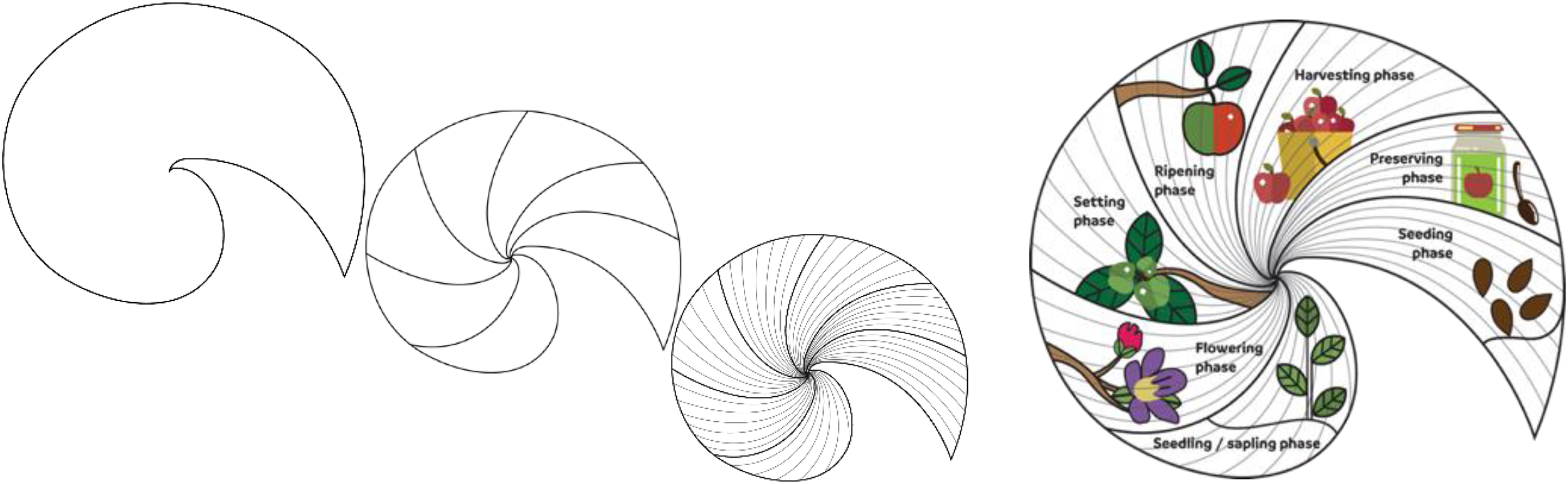
Spiraltime patterning (Brown, 2021).
Figure 1 shows the three levels of the spiraltime patterning, and the metaphors used in implementation so far. The midlevel shows seven phases, the inner level shows all seven repeated within each midlevel phase, and the outer level shows one phase. The outer level expresses temporal qualities of the lifetime of the phenomenon of focus. This level may also express more than one phase. It may be that not all phases are active in the temporal phenomenon of focus, or that phases are skipped, or there is a re-turn to an earlier phase. An event or situation may emerge in any phase. In this way the salient patterning configuration across all three levels is complex. As mentioned, all the phases and metaphors can be adapted as needed, highlighting the effects of our choices in knowledge making practices. The generation of knowledge and understanding about complex phenomena is central, with no importance on representation or accurate modelling. If implementation of spiraltime patterning stimulates other creative and innovative approaches to engaging with complex time, then it is successful.
All phase boundaries in the design are porous and negotiable, and transitions between them are complex temporalities of their own. More levels can be engaged if required. This knowledge generating strategy is open to discussion and adaptive creativity in a way that can open the concept of temporal complexity further by highlighting what may be unseen or left out. The material, social and political effects of inclusions and absences are brought to attention through design choices. In this way, the edges of temporal knowing and knowledge are open and dynamic. Fundamentally, spiraltime patterning is an approach to complex time as a relational and lived phenomenon.
The metaphors within the phases were designed in the genesis phase of the spiraltime design. The lifecycle of a fruiting tree in phases 1-5, and with the potential for the very human capacity for the transformation of preserving and seeding in phases 6-7, were chosen to provide a familiar, and inherently complex approach to knowledge building about complex time. A multitude of temporalities expressed by other people and the more-than-human are expressed through the metaphors within the phases. These include ecological metaphors such as weather, atmosphere, various soil and nutrient conditions, a range of other species, and the metaphors of the phases themselves based on the cycles of a fruiting tree. These all add to the complex time of the spiraltime patterning.
After discussing the phases, levels and metaphors in detail, an example of a patterning configuration in the educator's life can be shared with the students. Students can then use the design to explore and express their own experience of change and becoming. Patternings can be individually drawn using a blank template, which can be adapted as required, or the design can be up on the board at the front of the room for whole group engagement. It is my experience that students engage with ease with human life and living as temporally complex. A wide range of other temporal phenomena can then be expressed through spiraltime patterning. A classroom lesson, an entire project, and aspects of history and literature are all immediate temporal examples. The relationship of linear and complex temporalities can be engaged along the way. It may be that patterning an event or learning experience is more appropriate for some students, rather than a focus on their own lives.
Table 1 includes information on the qualities attributed to the phases in the implementation documented in this article. The qualities emerge from the use of the metaphors to express diverse rhythms and temporal relationality. As this is a way of telling the time though human becoming, learning and relationality, it was described to students as the patterning of human-time.
Simplified phase qualities.
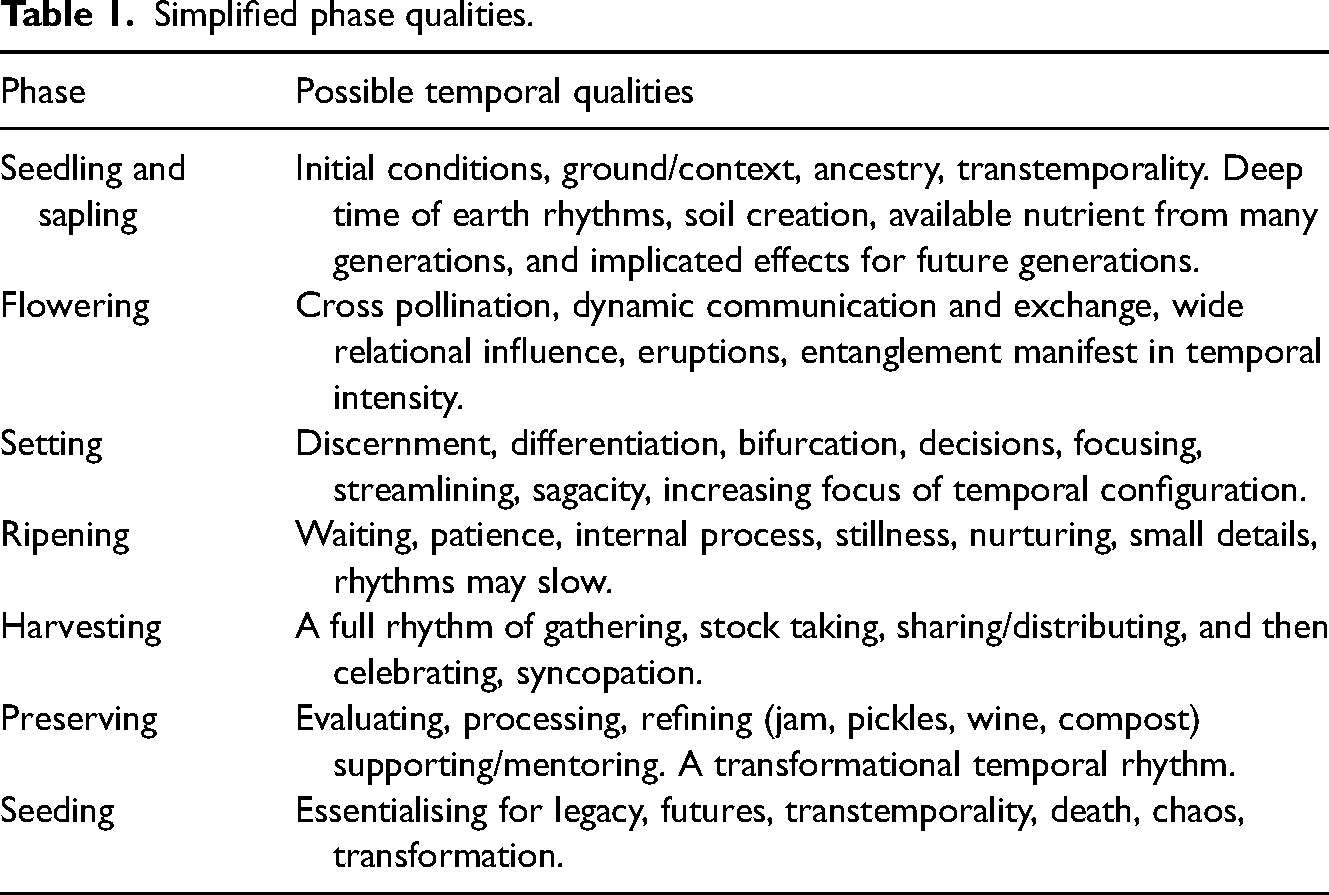
All the phases are patterned through one another. We may be in one phase, with another or other phases active in the same moment/s. In this way, ideas of rigid chronological development are perturbed, for example with the childlike qualities of the seedling and sapling phase experienced as potentially patterning through the elders qualities of the preserving and seeding phases. The dichotomy of the youth and adult binary is reconstituted as a complex patterning of temporal relationality (Murris and Kohan, 2021). Who we are in time, as time-beings, is expressed through the entire spiraltime patterning, all present in a relatively active or latent sense, with salient configurations coalescing through relational situatedness, individual expression, and agentic participation.
The metaphors used in spiraltime patterning are helpful in several ways. Understanding complex phenomena through ecological metaphors is inherent within human cognition (Lakoff and Johnson, 1980, 1999, 2003). This enables engagement with complexity concepts and dynamics without new or technical language, thereby contributing to the low cognitive load of this educational approach. How spiraltime patterning is implemented depends on the ages and needs of the students. For very young students, the metaphors can be engaged with appropriate knowledge of the attributes and growing needs of trees in relationship with environment.
In my secondary classrooms, the students’ lives were engaged as the first phenomenon of focus. The students’ experience of age and its impact on who they experienced themselves to be was engaged in an identity emergence approach to learning. This approach expanded identity beyond any one age and any one moment, into the complex temporality and complex relationality of a patterning perspective of life (Brown, 2019, 2021). With information about which rhythms we were all experiencing on any day, we could design learning around the qualities of the phases, whilst keeping the requirements of linear school time in our sights. As their educator, I took responsibility for managing linear school time whilst supporting the use of the rhythms of the spiraltime patterning as our fundamental learning/becoming dynamic.
Young people are very interested in their own lives and their place in the cosmos, and beginning with people as dynamic complex phenomena themselves is an approach supported by research clarifying that using familiar phenomena is most effective for the teaching and learning of complexity concepts (Yoon et al., 2019). Engaging with phenomena that the students know best contributes to a low cognitive load in educational and psychological terms for this patterning approach. The secondary students in my classroom quickly began to discuss how the spiraltime patterning might apply to their lives and to people they know, with a particular interest in the effects of being stuck in one phase without change as a constraint on wellbeing, and the effect of the pressure to live very different phases than they were experiencing. For example, the students shared the pressure they felt to ‘set’ a particular course in life, to express the setting phase even as young teenagers. We discussed ‘returning’ to the flowering phase at any age, and considered what that might mean for societal expectations and engaging in the other phases. In this way, realisation of the wide diversity of temporal patterning emerges. We also discussed the idea that western society in general might be thought of as stuck in a perpetual harvesting phase, to the point of extreme wealth and resource hoarding, with the composting, enrichment and wisdom generating qualities of the preserving and seeding phases not given as much credence.
We discussed how the qualities of phases could be engaged and let go, decreased and increased, as an agentic strategy for wellbeing and becoming. We also discussed how this disturbed any concept of how maturing and aging were supposed to be experienced, with the qualities and rhythms of all phases open to all of us at any time. Learning and becoming together were engaged as dynamic complex emergence, that continues through a lifetime, that cannot leave anyone behind, no matter the diversity of our own temporal rhythms and patterning. The response from the students was surprisingly not as though this was a difficult new knowledge, but of recognition and relief that the construction of the race of linear time was being clearly acknowledged and challenged.
We considered the ways that different people and diverse cultures calibrate their lives to temporal commons, opening the way to purposefully thinking about temporal knowledge making practices. For secondary students we can ask what impact and agency particular ways of conceptualising time may have, including enablements and/or constraints (Bastian, 2016; Bastian et al., 2020). All knowledge making choices can be questioned for inclusions, exclusions, interpretations, and all effects on us and all others, human and more-than-human. The spiraltime patterning approach can in this way be critically explored for all possible effects. The temporal thinking of the spiraltime patterning can also be engaged as a critical thinking strategy, as a thinking with time, with the qualities and rhythms of each of the phases applied as a way of relating, knowing, and understanding.
Spiraltime patterning can also be utilised specifically for purposefully generating temporal experience, agency, and relationality. For example, it can be used to facilitate transitions, those we design for increasing general wellbeing and coherence, such as rites of passage and ceremonies, as well as navigating change that we didn’t expect. As a language for complex time, spiraltime patterning calibrates consciousness and cognition towards agentic temporal possibilities. With agency shaped, including being enabled or constrained, by the temporal organisation within education (Alhadeff-Jones, 2017), this use of spiraltime patterning is potentially transformative. It also opens thinking to the temporal agency within the many species of the more-than-human world towards purposeful relationality.
The secondary students inspired more formal research, and the spiraltime patterning was subsequently implemented at an introductory level with Liberal Arts Global Studies Degree undergraduate students from Long Island University, New York, who were in Australia as part of the Asia/Pacific segment of their Course. These young people were seeking careers in global environment and sustainability projects. The spiral patterning was shared with the students as part of the Complexity Patterning approach to teaching and learning of general complexity competence, with complex time one of the integrated dimensions of complex phenomena.
Introduction to complexity as an experiential reality is a central goal of this work, and one participant's comment below shows that using the students’ own lives, their identity, as the first phenomenon of focus is effective. I really like your description of complexity. You know it's very often times very vague, and it's used like ‘oh its complex’ and it's used as a way of estranging the idea from yourself, I like that you made it like the complexity that I know, that I deal with every day, and what I am is complex. (Student 2)
Limitations and further considerations
One central limitation with the spiraltime patterning is its incompleteness as a sense making and knowledge making design and strategy. Knowledge systems generally are reductions of the whole, so are always incomplete (Cilliers, 2001, 2013). Complex systems theory as a knowledge system is reductive in that it begins with parts, ignoring the range of dynamics that generate differentiated entities. Although the deep complexity paradigm includes those broader dynamics, it is still a human knowledge system and is accordingly limited. The indeterminacy (Barad, 2007), and unknowability (Barnett, 2004) of aspects of phenomena is demonstrated in the limitations of the spiraltime design. Using this limitation to bring unknowns and knowledge limitations to awareness, can be incorporated by considering spaces, gaps and liminal in-betweens within the patterning. It is an opportunity to embrace uncertainty and indeterminacy as usual. The dynamics of human engagement and co-generativity within phenomena is entangled within this ongoing recalibration of knowledge. The deep complexity paradigm generally forestalls the possibility of absolute knowledges, complete predictability, and the control of total certainty.
In implementing the spiraltime and Complexity Patterning with the university students, a limitation became evident relating to the fact that not all students are visual thinkers. This may relate to visual knowledge being unfamiliar and uncommon in the students’ western educational experience so far, or may point to the need for differentiation in the implementation process for diverse learners. In the doctoral project workshops one student shared: I feel like I don’t get the shapes, I don’t relate to the shapes, and it's not the shape's fault. I can’t think about this, this way, I don’t know. I focus on the details. (Student 4)
As it is now, spiraltime patterning does not include the temporalities of digital technologies. Currently, digital technologies are influencing our experience of time in a wide range of ways (Kitchin, 2023). The focus here on ecological, social, and cultural temporalities provides a foundation from the deep complexity paradigm, as a basis from which digital and all kinds of technological rhythms can be considered as required, contrasting with a mechanistic temporal paradigm being the reference point for all other temporalities. The specific focus of spiraltime patterning is not an inherent limitation so much as indicating room for further design and strategy adaptations.
Diverse students and Indigenous students may have their own patternings to express and engage with complex time and may not find this design appropriate. It is envisaged that spiraltime patterning might stimulate other creative approaches to the teaching and learning of complex time, by laying a foundation for a conceptualisation of time as complex, and people as complex time-beings. As it expresses complexity concepts, the spiraltime patterning provides a sound introduction to complexity thinking as well as pattern thinking and understanding. It expresses a conceptual rigour that is required for creative adaptations and alternative patternings.
As introduced in this article, academic frameworks, both temporal and institutional, limited a more comprehensive exploration of the spiraltime patterning in the doctoral inquiry project. Interestingly, implementation of the spatial/discursive spheres patterning and the dynamically relational tree/mycelial patterning of the Complexity Patterning design, found immediate and easy application across diverse curriculum and student cohorts. Whilst the teaching and learning of complex time seemed less applicable within institutions and settings that are based on linear time, with educational innovation often required to be within accepted temporal parameters. The time for the direct teaching and learning of complex time may be not too far over the horizon and is alive within the present in the traces of this work. It is clear that the spiraltime patterning would be more effectively implemented with a dedicated workshop or series of tutorials. To this end, it is being developed into more comprehensive teaching and learning materials.
Conclusion: Emancipating time and participatory futuring
With quantum field physics describing time as entangled across the past, present, and the future, in the same way that materiality is entangled across space (Barad, 2007, 2017), a complex patterning perspective is indicated. In this perspective, time is emergent, with people as capable of temporal participatory co-generativity in equal measure with our capacity for destruction. In moving beyond the capitalist project of the control of time as expressed in educational institutions (Murris and Kohan, 2021), we can engage an embodied experience of our human capacity for co-generativity through relational complex time. Pattern thinking with spiraltime design is an introductory contribution to developing our co-generative capacities. From the quantum field physics perspective of agential realism, this is not just marking time, it is making time (Barad, 2007).
It is vital to acknowledge that Indigenous Knowledge is permeated with a relationally co-generative perspective of human/more-then-human complexity (Wilson, 2008; Yunkaporta, 2019). Moreover, an extended and complex perspective of time is evident in many Indigenous cultures, with the conceptualisation of a multitemporality perceived as a simultaneous convergence of all times in the complex now (Awâsis, 2020; Stanner, 2011; West-Pavlov, 2012). This places this work with pattern-based design in relationship with Indigenous Knowledge, acknowledging that the re-turns happening in western sciences and education in terms of pattern thinking and understanding are reconfigurations rather than discoveries.
The teaching and learning of complex time in this work is a contribution to the decolonisation of western education. Decolonisation includes more than teaching expanded views of history, and far more than including Indigenous history and culture. It involves the reworking and reconfiguring of concepts of being, time and learning. It is ontological work. It includes understanding that the catastrophes of colonialism are not away in the past but are dynamically continuing in the past-present (Awâsis, 2020; Barad, 2017), and can be re-configured now though engagement with both knowledge and time as complex phenomena. Perception and cognition of time as complex is also a foundation for participatory futuring. In a world of increasing uncertainty and contradiction, calibration of consciousness to the subtle patterning of the future in the present is a much-needed capacity (Hodgson, 2018). Described as protention by Hodgson (2018), the ability to anticipate proximate configurational patterning integrates the subjectivity of mind with the objectivity of known information. Such participatory futuring is an element of deep complexity thinking and understanding.
Complexity Patterning in general, and the spiraltime patterning in particular, introduce both time and time-being as complex relational phenomena. The spiraltime design contributes one educational strategy that places time front and centre, and can be a springboard for increasingly sophisticated temporally focused approaches within education. It can be implemented within curriculum, or as a specific course of study, as a cross-cultural communication and project management strategy, and perhaps it could be effective as an alternative time management strategy for doctoral inquiry projects and other research projects. The design and strategy can be adapted to all ages of students, and currently demonstrates potential as an antidote to the damaging hegemony of linear temporalities in education for all students. A spiraltime patterning approach to time may disrupt the existential problem for young people of the experience of being out of time with deterministic mechanistic time. There is an opportunity to calibrate learning and becoming to the rich patterning of complex time, to the possibilities of indeterminacy and the agentic co-becoming of a participatory universe. In terms of being a transdisciplinary metaknowledge, spiraltime patterning is responsive to the educational needs of today's students in an increasingly complex world.
Footnotes
Declaration of conflicting interests
The author declared no potential conflicts of interest with respect to the research, authorship, and/or publication of this article.
Funding
The author disclosed receipt of the following financial support for the research, authorship, and/or publication of this article.
