



Abstract
This article deals with the workings of time governance in welfare professional settings. A contribution is made to current literature by offering insights into how ‘governing by the clock’ works at the micro-level in everyday interaction and why clock time is purposeful for the operation of power in a welfare bureaucratic context. The main argument posited is that measurability and decontextualisation are characteristics of clock time, facilitating the governance of professionals’ decisions and actions, and ultimately their time use. The argument is illustrated with empirical data from ethnographic fieldwork following social workers responsible for childcare investigations in Sweden. The interaction in focus regards efforts to meet a deadline of four months to complete the investigations inscribed in the Social Services Act. As a start, the article illustrates what relational, task-oriented and clock time approaches can imply for time use and childcare investigations, with the purpose of visualising the characteristics providing advantages of clock time for governance. After that, the more concrete workings of time governance are explored in how the objectified clock time, through these characteristics, works as a resource both for subtle routine and self-governing processes, and when the operation of power is more explicit. It is demonstrated how social workers make meaning, plan and conduct childcare investigations in order to make it possible to meet the deadline, sometimes with trade-offs. The governance relies on the facticity of the objectified time frame and the high knowledge status it is assigned in participants’ interaction. The analysis demonstrates the workings when a seemingly ‘soft’ time limit gets reified and trumps other sources for professional knowledge when decisions are legitimised, sometimes with unintended consequences. By analysing social work as a profession performed at the intersection of different time rhythms, a contribution is made to research on governance and street-level bureaucrats’ dilemmas.
Introduction
This article deals with the workings of time governance in welfare professional settings. A contribution is made to current literature by offering insights into how the ‘governing by the clock’ works in everyday interaction and why clock time is purposeful for the operation of power in a welfare bureaucratic context. The main argument is that measurability and decontextualisation are characteristics of clock time, facilitating the governance of professionals’ decisions and actions, and ultimately their time use. The argument is illustrated with data from ethnographic fieldwork within Swedish social services.
Already in the perquisites for the social work mission is an inherent complexity when it comes to time since it comprises both authority exercising and caring. Public policy researcher Michael Lipsky (1980/2004) named professionals who meet vulnerable citizens as representatives of welfare organisations streetlevel bureaucrats. This concept captures the delicacy of balancing rules and being accountable with professionally guided norms and the needs of the citizens. One way to frame these prerequisites is that professional agency is performed at the very intersection of different time rhythms, and the parallel concerns to be administratively ‘on time’ and work with clients ‘in time’ (Adam, 1995). In a state-governed organisation, the everyday is surrounded by a plethora of more or less imperative bureaucratic time rules, and resources (time and others) are believed to always be limited in relation to needs (Lipsky, 1980/2010; Hassard, 1991). Being ‘on time’ is important in this administrative framing where time is economised and accounted for to politicians and taxpayers. Parallel to such technocratic time scripts, welfare professionals also have to work ‘in time’ with inherent and subjective meanings related to the tasks and the clients: caring, relationship building, professional norms and ethics (Adam, 1995).
Temporality as a framework for understanding human service work has indeed proven to be fruitful for grasping the complexities of the professional every day, for example, in social work, healthcare and childcare. Studies highlight how standardised, rational, bureaucratic or clock time can run parallel, and sometimes challenge or clash with time rhythms that follow, or are inherent to, central meanings embedded in the foundations of care or social work. Early scholarship is found in child nursery research by sociologists Karen Davies (1994) and on authority-based child services by Susan White (1998). Davies demonstrated the incompatibility of bureaucratic ‘clock time’ with ‘process time’ connected to the ‘rationality of care’. White (1998: 63) pointed out that ‘child-care social work may be viewed as the penetration of rational time into the lived time of others, creating a complex dialectic at the interface’. Similar points have later been made in midwifery (Deery, 2008), welfare care workers in general (Hirvonen and Husso, 2012), and emergency healthcare (Bendix Andersen et al., 2018). Lately, Andersen and Torbenfeldt Bengtsson (2019) have shown how the bureaucratic time rules themselves can be the very obstacle to timely care as lived by the service user. Fahlgren’s (2009) and later Juhila et al.’s (2015) studies offer deeper understandings of how one component of linear time – the future orientation embedded in change oriented social work – can create dilemmas for the social worker when clients instead find themselves in a ‘here and now’ orientation with emergency worries.
While these tensions often are described to be inherent in welfare tasks, other scholars highlight what recent public sector restructurings have meant for the possibility of balancing different time concerns and making professionally informed decisions. Following strivings for transparency, efficiency, and more evidence-based routines, measurable aspects of the social worker-client relationship, such as time (when clock based) and frequency, have become more important. This development is reflected partly in the public sector’s import of industry-based management concepts to speed up and reduce ‘time waste’ – such as Lean Manufacturing and Total Quality Management – and in many new statutory time limits (Baines et al., 2014; Hjärpe, 2020; McDonald et al., 2019). As a consequence of increased time-governance, ‘semi-professionals’ like social workers experience a traditionally high degree of autonomy becoming circumscribed (Colley et al., 2012; Evetts, 2009). Some connect these developments to processes of de-professionalisation of the welfare missions and to occupational boundaries being renegotiated (Colley et al., 2012: 375, 381). In Yuill and Mueller-Hirth’s (2019: 1540) study, these developments, culminating in hectic days of control-based paperwork rather than compassionate client work, are the very reasons for stress, burnout, and even disillusionment with the social work career.
Thus, it is not a new observation that there is complexity when it comes to parallel time concerns in welfare work, or that professional practice is subject to increased time governance. Rarer is the exploration of the more concrete workings of bureaucratically framed time when used to govern professionals’ time use. As media scholar Sara Sharma (2012) points out, temporality and time is always about power relations, and the clock is only one chronometer. Why is it, then, that when time use is to be limited and controlled in modern organisations, it is to rational, linear clock time one turns? The present analysis contributes to current literature by offering insights into why clock time is purposeful for the operation of power in a welfare bureaucratic context and how governing by the clock time works at the micro-level. I ask how social workers make it possible to meet time scripts in parallel to other professional concerns and standards. I posit that making time measurable and decontextualised is to make it governable, and demonstrate how objectified clock time, through these characteristics works as a resource both for self-governance and in more explicit power exercise.
These questions are explored in relation to a Swedish case: a 4-month deadline for childcare investigations introduced in the Social Services Act in 1998 with intentions to make the authorities more accountable. In line with a few other studies of temporality in authority-based social work (Fahlgren, 2009; White, 1998), this study is ethnographic and based on a two-year-long fieldwork in a social service setting focusing on participants’ interaction. I highlight the agency of the social workers and the meaning making of the deadline in their everyday work. I will start by giving a short background, situating the case in a welfare governance context.
Time governance and the social services: A Swedish case
Social services’ employees adhere to the general regulations for the authorities’ contact with citizens, one being to provide quick and efficient service (Swedish Public Administration Act 2017: 900 § 9). When it comes to childcare investigations, a directive of ‘expeditious processing’ has been present in the regulations since the 1960s. 1 In 1998, a specified deadline for childcare investigations was introduced within a law package that emphasised a strengthened child perspective (Bill 1996/97: 124). Since then, 4 months is the upper time limit for a social worker to find out if a child is at risk of being physically or mentally harmed, and if so, what interventions are needed (Lundgren and Sunesson, 2020: p. 261).
Severe criticism had been directed at social services’ working methods during the 1990s, especially concerning childcare (SOU 1994: 139, p. 639). Several shortcomings were pointed out by journalists, politicians, clients and researchers (Andersson and Lundström, 2004). Among other things, huge variations in the time use (from a few months to years) was considered problematic from a legal security perspective (Bill 1996/97: 124 p. 109–110). The working methods of the social services were considered to lack systematics, structure or scientific evidence, and to be difficult to evaluate. The new regulations were expected to facilitate the work with supervision and evaluate the social services’ efforts for vulnerable children. The controllable function of the time frame is prominent in the preparatory documents for the law (SOU 1994: 139, p. 152–153). A specified deadline offers both a clear goal to orient the work towards, at the same time as being something that can be measured and evaluated. In that sense, the new law reflects ‘time-typical’ ways, not only for Sweden, of dealing with increased requests for transparency in the public sector (see Baines et al., 2014; Bejerot et al., 2008; McDonald et al., 2019).
An upper limit may not appear to be a particularly remarkable form of time-management. Elsewhere in social services, the time required to perform various tasks is measured in hours and minutes and then reformulated into standards (Andersson, 2010: 317). However, during the fieldwork conducted for this study, the deadline appeared constantly to be the subject of negotiations and dilemmas. According to the Social Care Inspectorate (2017: 4), many municipalities are fined every year due to exceeding the time frame. Thus, difficulties with meeting the deadline are common, motivating it as the case for this study.
Time rhythms, knowledge hierarchies and governance
The theoretical framework for the analysis can be divided into three main points of departure. First, conceptualisations of selected time rhythms relevant for childcare investigative work and their characteristics are used to demonstrate the advantages of clock time for governance. Second, attention is paid to the temporality lens as a way to understand power relations and the exercise of power. Third, an interactionist understanding of reification processes serves to capture the workings of time governance at the micro-level.
Professional practice and time rhythms
Barbara Adam’s (1990, 1995, 2004) dynamic approach to ‘social time’ as an intersection of parallel and sometimes competing time rhythms, is a first theoretical inspiration. An examination of time, states Adam (1995, p. 11; 1990, p. 149), should include all the nuances that time can entail at one and the same time and how they interact or compete. This perspective presumes that in the always dynamic and complex everyday, we find ourselves constantly in and out of tune with different time rhythms. For the present analysis, an understanding based on the separation between decontextualised time rhythms that are ‘on time’ and situational and context dependent rhythms ‘in time’ was chosen.
First, time use can follow inherent meanings of professional life that are connected to processes ‘in time’. Such time rhythms are described as subjective, cultural or socially meaningful (Adam, 2004). One central meaning in human service work is the maintaining of relationships with, and caring for, clients. ‘Process time’ or ‘relational time’ is described as being connected to the rationality of caring and the needs of the care receiver (see, for example, Davies, 1994; Deery, 2008). To solve problems is another meaning of the professional mission and ‘task-oriented time’ can be connected to the definition of the task itself, which subsequently controls the time required (Ingold, 1995). What these understandings of time have in common is that they are linked to socially meaningful activities, defined subjectively, and indissolubly linked to their contexts (Davies, 1994: 280).
In contrast to the time rhythms ‘in time’, a perception of time separated from events and processes appeared with the invention of calendars and clocks (Adam, 1995). 2 The clock’s hours and days are synchronised in the calendar’s months and years, a time that has the same character; it is measurable, divisible (by days, hours, minutes and seconds), controllable, objective, comparable, context-free or ‘empty’. Not least during industrialisation, clock time became important in working life when time was commodified through work contracts (Ingold, 1995). This economised and valuable time suits the economic and administrative reality of organisations because it offers predictability yet builds on efforts of being ‘on time’ (Adam 2004).
The separation of rhythms running ‘in’ or ‘on’ time transpires to be important for understanding the opportunities to govern someone else’s time use since the objective clock-time has a special connection to governance. Adam (1995, 2004) argues that relationships where time is used as an abstract quantity are surrounded by power relations because someone decides what should be considered to be ‘on time’, ‘too long’ or ‘too fast’. The capacity to control people’s time use can most effectively be achieved when time has been decontextualised or separated from events and experiences, and when all time units are given the same value (Adam, 1995: 90). In other words, as long as time is something inherent in a process, or a task itself, and defined subjectively and situationally, it is difficult to control from the outside. To make time measurable is to separate it from its context, enabling claims on time-use from the outside.
Time, power and recalibration
Scholars who pay attention to the fact that time and temporal experience is one way that power relations manifest themselves have also informed my analysis. As soon as time planning or time desires involve others than oneself, it becomes a question of power (Adam, 1995, 2004). The claims for time use one can make on others are affected by one’s social status, which can be symbolically visible in who apologises for taking whose time (Zerubavel, 1976: p. 92). The asymmetrical relationship between bureaucrat and client, for example, is visible in the routines (open hours, meeting time, etc.) always decided in advance by the organisation (Lipsky, 1980/2004).
Media studies scholar Sarah Sharma, just like Adam, acknowledges multiple temporalities and time experiences but deepens the analysis of temporality and the operation of power. Time experiences, even before clocks and calendars, have always been embedded in uneven and subtle power relations and one’s experience of time is always tied to another’s temporality (Sharma, 2013: 315). Sharma exemplifies with how the time of taxi drivers and airport staff is tied to commuting white collar workers, yet with quite different time experiences (2012: 67). One of them is calibrating their time to support the temporal needs of the other. In a critical framework that Sharma calls power chronography, time is understood as multiple, relational, deeply uneven, and always a structuring form of social difference (2011: 440, 2012: 71, 2013: 312).
From Sharma’s power chronography, I borrow the idea that power relations can be visualised through a temporality lens using questions such as: Who dictates the time of who? What way of relating to time is valued as the right one? And, most importantly, who recalibrates (cf reorchestrates 2012: 67) their time according to someone else’s needs or instructions, and how is this recalibration played out? (2011: 443, 2012: 68). Recalibration is, as Sharma puts it with reference to Michel Foucault, ‘the temporal component of biopower: It is the expectation of all good subjects under contemporary capitalism to recalibrate, to find ways to keep up’ (2011: 442). This self-governance refers to the ways in which discrete, subtle and indirect power operates in modern democracies, where responsible citizens are expected to adjust to subtle instructions – anything from health instructions, ideologies, standards and norms. To recalibrate is to find ways of dealing with time given the different points of reference that surrounds us, Sharma states.
Even though Sharma points out that the clock is only one chronometer, and one that we should not take for granted (2011: 441), I have taken inspiration from her framework, precisely to analyse how governing by the clock works with social workers as the subject to the operation of power. As a contribution to Sharma’s interest in finding ‘the normalising temporal order maintained in claims about time and in cultural practices waged in the name of time control’ (2012: 71), I pay attention to how clock time gets taken for granted and institutionalised in the organisational setting, and how these practices lie at the foundation for the operation of power, leading to the final theoretical point of departure.
Reification and knowledge hierarchies
To capture the more concrete workings of time governance at the micro level, I use a classic interactionist understanding of knowledge construction in everyday life. Berger and Luckmann (1967) argued that it is possible to study the processes of knowledge construction empirically in human interaction through language, gestures, symbols and actions taken. ‘Reification’ is particularly relevant for the present study, referring to the process when the human influence is forgotten and knowledge gradually acquires a status as something self-evident and objective. Reification in Berger and Luckmann’s (1967: 58–189) every day or ‘common-sense’ knowledge is a slow process of socialisation over generations. However, the idea that information becomes ‘truer’ the further away from its producers it gets has been used in more concrete organisational contexts and from a shorter time perspective (see March and Simon, 1958/1993). In the present analysis, reification is used to understand how certain understandings of time become taken for granted and surrounded by a higher status as knowledge source, not only in the authority of being law, but in the social workers’ internalised understandings and norms of what an investigation ‘is’ or ‘should be’. The workings of time governance are understood to rest upon these interactive processes and the analysis aspires to show how they can play out in a concrete social work setting. Thus, temporality will be analysed as one of the foundations of knowledge in everyday life, constantly being institutionalised through social interaction. I show how social workers recalibrate using arguments and reasonings that take the clock time limit as the natural staring point, and that the way this knowledge is constructed has real, and sometimes unintended, consequences.
Ethnographic fieldwork in a social service setting
Occasions of data collection.
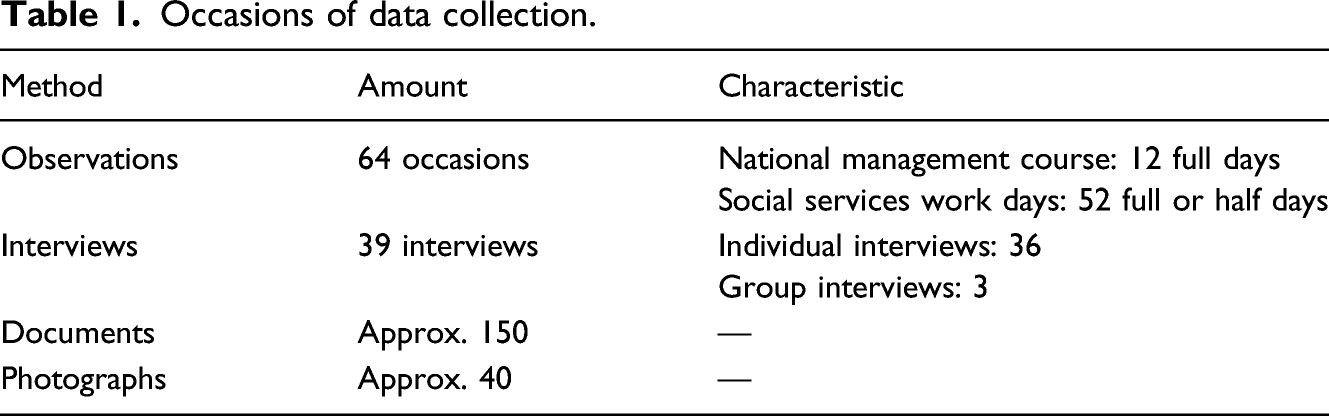
In the fieldwork during 2013–2014, I followed the management team in one municipality, working with an improvement project to target low compliance with statutory investigation times for childcare investigations. Back in the field in 2017, I concentrated on social workers, administrative staff, and middle managers during ‘ordinary’ work days when conducting and reporting on childcare investigations.
As a participant observer, I did not exclusively strive to be a ‘fly on the wall’ or a fully participating member, which can be considered the two extremes within ethnography (Emerson et al., 2011: 1–3; Fine, 1993: 281). I altered from being ‘observer-as-participant’ at times being more restrained, to other times being a more active ‘participant-as-observer’, including taking part in discussions and decisions (Atkinson et al., 2001: 32). An overall aim of using participation as a means to get access to participants’ thoughts had to be adjusted to what was possible in specific situations (Fine, 1993: 282). Observations with a ‘passive’ participatory approach enabled detailed field notes to be taken in place. When participation was more active, field notes had to be complemented afterwards.
Besides continuous ‘mini-interviewing’, I also conducted several tape-recorded individual, pair and group interviews instructed by a semi-structured interview guide (lasting 40–90 min). A twofold purpose of the interviews caused two different positions for the participants: 1. As informants in order to get further information about situations occurring during observations and 2. as reflective respondents to systematised themes.
After transcribing interviews and field notes, a qualitative content analysis was initiated. In a first step, the data were thematically coded along several themes that had emerged during fieldwork, the transcribing, and the first reading. In a second step, the data were re-coded along a fewer set of selected themes. The results presented in this article have emerged through a process of interpretation where data collection, the reading of previous research and theory, and analysing have been altered using a so-called ‘iterative strategy’ (Dellgran and Höjer, 2003: 11).
I have collected all the data as a member of a research project with ethical approval at Lund University. 3 I obtained access to the field initially by approaching representatives of the social services’ management. Prior to the fieldwork, all participants were informed about the study. It was voluntary to participate, and some declined with reference to heavy work load. Fictitious names have been given to the participants and the municipalities.
The language in the gathered material is Swedish. For the present analysis, selected extracts of the data have been translated from Swedish into English.
Analysis
The analysis is structured in three sections, where the main findings about the workings of time governance are reported. In the first section, I illustrate three different time rhythms of relevance to childcare investigations and discuss their characteristics to highlight the purposefulness of clock time for the potentiality to govern someone else’s time. I then move on to explore the concrete micro-processes on which time governance rests. In the second section, I demonstrate self-governing practices where the participants recalibrate their time based on the decontextualised time frame, with both intended an unintended consequence. In the third and final section, I turn to interaction where the objectified time works as a resource for the operation of power and governance in more explicit ways.
Governing childcare investigations ‘in time’ and ‘on time’
What principles may be important for a childcare investigation’s time structure besides the standardised time frame in the Social Services Act? And how do these principles relate to the control of professionals’ decisions and actions? As in other studies on temporality and professional work, I found traces of relational (cf. Hirvonen and Husso, 2012) and task-oriented (cf. Ingold, 1995) approaches. These time rhythms bear relevance for investigative work since it includes problem solving – deciding what the child needs – and creating relationships with the family. In this first analytical section, I start by demonstrating the characteristics of task oriented, relational and clock time and what they mean for childcare investigations. Towards the end of the section, I discuss what these characteristics imply, and why clock time is distinguished when it comes to the governing of someone else’s time use. This discussion is concentrated around the question: who gets to decide when an investigation ends?
Task-oriented time
A task-oriented approach in modern professional practice, according to Ingold (1995, p. 14), means that ‘the experience of time is intrinsic to the performance of skilled activity’. Translated into the context of social services, task orientation can be exemplified by social worker Kalle’s immediate answer to my question of what constitutes a good childcare investigation. He replied: ‘Where you find the essence of the problem and what needs to be done, so to speak’. According to Kalle’s position, in theory, an investigation can continue until he has identified the circumstances that cause a family’s ‘problem’, and he can suggest measures that would change those circumstances. For another participant, manager Sandra, it is not enough to just suggest the measures. In her interpretation of the investigative assignment, the administrator follows the family even further in the process and does not ‘leave’ the case until they have ensured good efforts: We can make an assessment that this child’s problems can be worked on and met, for example through child rehabilitation. Then my role as an investigator is to create that contact and get them [the child rehabilitation staff] to understand our thinking. We cannot end our investigation just by saying “sent to child rehabilitation, now we have done our job”. I think that we have an obligation to initiate the contact and end it [the investigation] when we have seen that the contact works. (Field note, conversation with manager Sandra)
In these examples, neither Kalle nor Sandra relates to any defined time frame; the time issue is secondary in relation to the task. They also have different definitions of what their task is, which means that the time required can vary based on what is subjectively interpreted into the task. Task orientation runs ‘in time’ in the sense that it is inseparable from the context, and what is socially meaningful to the actors. For Kalle, it is to find the problem; and for Sandra, it is to initiate the treatment. This structuring principle, if it had no restrictions, would mean that investigations took different amounts of time, both shorter and longer than 4 months, depending on the nature of the case and the social worker’s perception of their task.
Relational time
Relational time in human service professions is driven by a care rationality that prioritises building relationships over time. The relationship itself is considered to make a difference for the client, and continuity is valued over speed (Deery, 2008; Hirvonen and Husso, 2012). When it comes to authority-practicing social workers, relationship building is a controversial issue since it can be questioned whether a close relationship will challenge a professional’s objectivity (Egelund et al., 2007). Judging by my empirical data, investigation and relationship building are not always easy to distinguish from each other. Administrator Mary describes how she sometimes initiates motivational work during the investigation period. The purpose is for the family to accept interventions on a voluntary basis, in order to avoid compulsory childcare. According to her, such motivational work is fundamentally reliant on the relationship she manages to establish with the family. Relationship building is also described to be a tool that the administrators use in the investigation to gain access to important information from the family. Thus, the possibility to perform the task relies on the time it takes to build a trustful relationship.
In addition, participants could attribute meaning to the relationship with the client going beyond the specific ‘here and now’ of the investigation. This theme emerges when two participants discuss whether it should be seen as good or bad when families who have already been ‘treated’ become the subject of a new investigation. While it could be argued that the returning family has not been helped with their problem the first time, quality-coordinator Aina believes instead that a new contact can indicate a trustful relationship between social services and citizens. She elaborates: I think that you end up in different life crises throughout life and one [crisis] does not have to be the same; it is different when the children are small or when they reach adolescence, so to speak … so it does not have to be something negative that you seek help for on different occasions, but the opposite! (Field note from work meeting)
According to Aina’s elaboration, the social services are a latent companion always on ‘stand-by’ for the family. Clients come and go, in and out of the organisation, and the problems can vary during their life. In that light, the investigation becomes important beyond the concrete problem solving at a specific time, and it will be important to create a relationship over time. This may mean, for example, that social workers choose to invest in a relationship with the family, even if they are not currently able to find a good intervention, or to motivate the family to accept a proposed treatment. Just like task-oriented time, relational time runs ‘in time’ and is intertwined with the contextual circumstances of relationship building.
Clock time
Clock time understandings are easily detected in the organisational context surrounding childcare social workers, not least through standardised working models, process flow charts, and time frames like the 4 months deadline. In this study, clock time manifested itself in many ways; how they talked about the very first temporal orientation they did, or how they constructed their time experience once an investigation landed on their desk. Meticulous time calculations seemed necessary at an early stage to be able to define the space for action and engagement. Note social worker Maria’s calculations in the following quotes: I think that I have four months at my disposition, then, if possible, I end earlier /.../ But you cannot think four months either, you have to have time to write [document] the investigation. If it is not going to be an intervention, it should be sent to the manager who has the delegated right to make that decision. If it is to be a placement, it should go to another manager and to the board that only gathers on certain days. You should also get feedback from the users when they have read the documentation. So, it’s actually three months that you can dispose of in most cases. (Interview with social worker Maria)
Maria describes how her planning at an early stage is defined by the clock. By coordinating several different considerations and by counting time ‘of’ the 4 months that are used by others, she defines her time space for the investigative work. In order not to make a chimera that she has more time than she actually has, she uses the trick of ‘not/.../thinking four months’. Rather than passively obeying the law, Maria uses the given time frame to recalibrate her time and construct the time horizon she can afford in order to accomplish her mission.
As a clear contrast to the task oriented and relational understandings, where time was secondary to the context, time itself is the primary concern in Maria’s statement. The objective time frame orders what is perceived as possible to realise within the investigation, yet the investigation will always be ‘on time’. The centrality of the time dimension was visible in the experience of time as an ‘imposed constraint’ (cf White 1998: 61). It was common for participants to talk about an investigation as tied to a clock that starts ‘ticking down’ on the first day. As social worker Irma put it in an interview, once an investigation landed on her table ‘then the clock starts ticking, then you have four months to go’. Cases that were not completed within the 4 months were referred to as cases ‘ticking overtime’.
In order to take the next step in the analysis, I will discuss these rhythms in relation to their potentiality to govern someone else’s time use.
When does an investigation end?
Time rhythms and their characteristics.
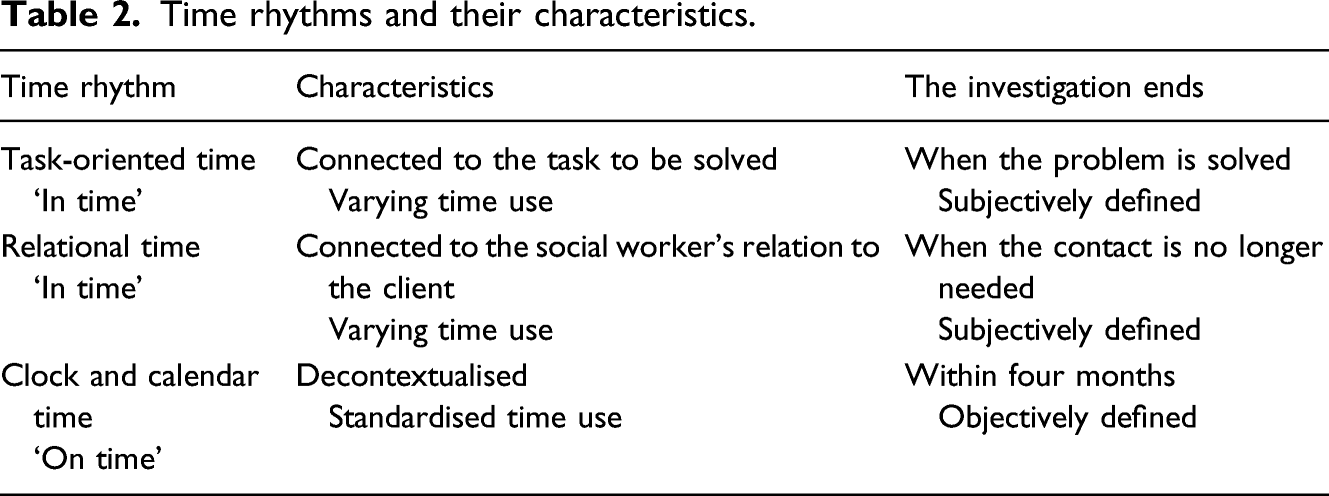
According to the task-oriented time rhythm, an investigation is complete ‘when the problem is solved’, and according to a relational care-rationality, the investigation either never ends or ends when the contact is no longer needed. In these cases, it is subjectively defined by the professional and/or the client when the investigation is no longer needed. Time is dependent on the social meaning given to the work; why the time required is variable to infinity, and unpredictable. According to Adam (1995: 87), these rhythms run ‘in time’ in the sense that they cannot be separated from their contexts and time is secondary to the task or the relation. The power of definition stays with the actors involved in, and with the knowledge of, the context. In contrast, a statutory deadline represents time that is standardised and predictable, and that can be controlled by ‘objective’ and decontextualised parameters. No matter the characteristics of the case, the investigation ends within 4 months; it will always be ‘on time’. The time dimension itself is made primary to task or relation, and the actors adjust accordingly. The main point to be made here is that when the time is separated from its contexts, the professional or the client loses the definition of power as it opens up for claims to be made from the outside. Objectifying the time with measurable parameters is also to make it auditable and controllable. In the following, I will further explore the workings of this governing by the clock and its consequences for the parallel concerns of a social worker.
Reified clock time and self-governance
In the data, governance by the clock often worked through everyday routine practice, and through a not particularly remarkable institutional interaction. This interaction could be described as (at least on the surface) smooth collective self-governing processes where the participants would relate to the time frame recurrently, sometimes check or consult with each other, and adjust their plans and activities. However, by analysing these interactions more closely, these (re)calibrating activities appears to rely on the clock time being reified into a taken-for-granted knowledge, silently playing down other concerns such as professional task-oriented judgements.
It has already been mentioned that different time rhythms do not have to compete with or threaten each other (Adam, 1995). Just as it is assumed that one is always in and out of tune with different time rhythms, the possibility of being simultaneously in sync with several time dimensions exists. For example, in investigative work, a social worker and a parent can build up an alliance within both relational and task-oriented time, and the relationship itself can even make it easier for the professional to perform their task on time. A second example might be when a social worker’s ambitions to solve a task fall within the statutory time frame, and clock time and task-oriented time intersect. However, the almost instant facticity and superiority assigned to the clock time was still visible in the interaction, for example, when managers and social workers met for supervision. In the almost ritual-like interaction of such sessions, the social worker started giving details of the case, followed by a discussion on how best to proceed. An eye would always be cast on the time aspect: The next case concerns a sibling couple and Mary and co-investigator have made some short home visits and observations at home. “But nothing could be observed there”, says Mary and proposes that it is appropriate to make apartment observations for a longer period to be able to find out a little more. Karna looks at the list and encourages Mary “Yes, go for it, the investigation doesn’t expire until August 26, so there is still time”. (Field note from case guide in Tingstad)
The observations that Mary is to make aim to find out if there is a lack of care on the part of the parents. She needs to decide whether they are able to respond to the child’s signals. Her proposal doesn’t pose a threat to the statutory time frame; however, it is clearly in relation to the clock time that manager Karna gives her approval. It is on the condition that ‘there is still time’ that the task is considered legitimate. We see an expression of contextual considerations and task-oriented time and clock time that coexist, provided that the former does not challenge the latter. It is clear which source of knowledge is constructed as most important in this manager-social worker interaction.
The obvious status that clock time has in the field note above might not appear surprising considering that the deadline is sanctioned by law. It is a manager’s explicit responsibility to ensure that the statutory time frame is met, as is done in this supervision. Still, I observed how the law was often chosen as an argument for decisions, even when either a task-oriented or a relational consideration would have been sufficient to lean on. At one meeting, social worker Felicia wants to discuss a case in which she has come to the conclusion that the family does not need any interventions, so she wants to end the investigation. The parents are divorced, and the mother has suggested that Felicia also meet with a half sibling who, according to her, would confirm the father’s flaws. At the meeting, Felicia wants her colleagues’ confirmation that she is doing the right thing ending the case: I feel that the investigation time expires in two weeks, the days are ticking, and I will still finish without effort, so what is the point of meeting this sibling then? (Field note from case meeting in Tingstad)
From the various possible ways to justify the same action (not working further on the case), Felicia chooses to lean on the time argument, which shows the factuality of the time limit. It would have been perfectly legitimate to rely on the professional assessment she had already made. As early as the 1960s, Roth (1963: 110) studied time negotiations between patients and doctors in a ward for tuberculosis patients and observed how norms regarding treatment time itself had become a factor that sometimes surpassed medical assessment. Roth unveiled how the time aspect as an isolated factor became decisive in situations of uncertainty about the patient’s condition. In relation to patients with the same difficulty to diagnose, doctors were more likely to discharge those who had stayed in the ward for a long time, while new entrants were retained to a greater extent. In negotiation with the patient, Roth noted how the doctors referred to the time and not to the patient’s condition (Roth, 1963: 28 ff). Felicia’s action can be interpreted along these lines, with an additive conclusion about knowledge hierarchy: the rational and objective time frame appears as a stronger discursive resource than her own context-based judgement (cf White, 1998: 71). Both the need that the client claims to have, and the administrator’s assessment, are subordinated to the investigation time.
Another and perhaps more problematic manifestation of the reified clock time was as a taken-for-granted norm for how long an investigation should take, no matter its level of complexity. In an earlier example, Maria described how she early on adjusted to the fact that she had 4 months to carry out the investigations, an approach also presented to the family at the first meeting. When social workers are to make a checklist for the first meeting with the parents, Tina suggests: And you should mention something about the time aspect, that you sort of justify why four months are needed. (Field note from administrator meeting)
From the beginning, Tina assumes that the investigation will take 4 months, no matter the complexity of the case. It seems so obvious to her that she will use up the 4 months that she proposes a standardisation of such communication to the family. She constructs both the family’s and her own time orientation by defining the time use early on. Further on, when I meet social worker Sven for an interview, he explains his hesitation to formally end an investigation, as he does not think his manager will approve of it: ‘Well, there is a lot of time left, you can investigate more on this’, he is convinced the manager will say. If the social worker uses up all the allotted time, it becomes proof that the she has done everything she can, he explains. Even though the intention might not be to slow down the investigation per se, but to make it more thorough, it is interesting to note that the time limit, which only sets an upper limit, seems to reify into a norm for how long an investigation should take, regardless of its problems. In the already mentioned study, Roth (1963) identified time as being connected to an ‘averaging effect’ on the tuberculosis treatment. In my study, a similar effect manifested in how the investigative work was already standardised in the first thoughts about the investigation. It could mean speeding up but also slowing down the pace, with the latter to be considered a more unintended consequence.
Summing up the second section of the analysis, I have illustrated self-governance and recalibration relying on clock time being constructed as factual and unquestionable source of knowledge. Measurable time works as a point of reference that governs the interaction and everything that has to do with context – such as the activities to solve the problem – is silently ordered as secondary to the time dimension. Sometimes the work is rearranged even beyond the initial intentions.
Objectified time, power exercise and trade-offs
In this final section of the analysis, I report the findings on the workings of clock time governance in situations when time rhythms are being explicitly negotiated and the operation of power is more direct. In two examples, I will show how task and relationally related arguments are effectively disarmed with rhetoric leaning on the objective time, with implications for professional autonomy and client involvement.
Recalibrating social workers’ time
I observed several occasions where time rhythms competed with each other, and when dedication to one time rhythm forced arrythmia with others. This was often the case when investigation time was about to ‘expire’ and there remained unfinished tasks. On such occasions, the deadline was sometimes downgraded, at least temporarily, and the manager decided to risk sanctions so that the social worker could complete the tasks. Obviously, there was room for discretion, even resistance, at least from the manager when a task was deemed important enough to realise. Against this backdrop it is even more urgent to explore how the statutory deadline operated as a resource for the manager at other times, when the decision was to end the investigation. In one supervision meeting, manager Natalia and social worker Bernt discuss a case where the child and his mother unexpectedly went abroad for a longer stay. Their interaction offers an opportunity to analyse governance enabled by decontextualised clock time, and what the trade-offs can be about: Bernt: The next case is about Viktor. This investigation has been going on for a while now. The father has called and wonders what happens when Viktor comes back on August 10? (Viktor will move to his father in another municipality). Natalia: You take too much responsibility in this matter, and it’s actually my role to make sure we step back a little. You have done an investigation; what is the assessed need? Bernt: Contact person with special skills and support for the parents. Natalia: Ok, then we close the investigation considering that they are abroad and cannot actualise the interventions; we simply end the investigation with the decision of “no intervention”. Bernt: But we know when he will come home … it is … Natalia: Yes, we do, but now it’s about how to do this correctly according to the investigation rules, because we did not know that he would come back when we closed the investigation, we can say. Then you actually have to let it go and see what happens when he gets home. Bernt: But most likely he comes home to his dad who calls me and asks what I can do … Natalia: We can simply ask for help from the new municipality if he is going to live there, but do not just anticipate the events; we will see what happens. (Field note from case guide in Tingstad)
Many things are happening in this interaction, and it is difficult not to note the power asymmetry in the way Natalia firmly dictates how Bernt should go about the investigation. Bernt will have to recalibrate his time use to meet the administrative requirements. Even though time is not apparently central, the conversation can be looked at as a negotiation between two orientations with different temporal implications; one guided by the clock, and one task oriented. What is at stake is whether Bernt should contact the new municipality Viktor is moving to and start preparing an intervention, which fall within what he perceives as his task. The phrasing ‘this investigation has been going on for a while’ could be seen as a way to make Natalia aware that time is running out. Natalia sees an opportunity to back down with reference to the fact that Viktor is abroad and then will move to another municipality. Bernt’s attempt ‘although we know when he will come home’ shows that he does not accept the reasons for ending the investigation that Natalia first puts forward. Natalia responds with an argument about being ‘correct according to the investigation rules’, that is, not exceeding the investigation time. By lifting responsibility from Bernt’s shoulders and providing him with legitimate reasons, she instructs him to end the investigation, pushing the task to the future and another municipality. She achieves her managerial task by confirming the great responsibility Bernt is taking and at the same time formulating instructions that satisfy the law. Several context dependent arguments for engaging in action can easily be neutralised and put as secondary, not with counter arguments on how to act, but by leaning on the measurable aspect of keeping time.
What we could call a task-oriented, long-term approach and a short-term but investigatively correct perspective can be seen to be negotiated with each other, to the detriment of the former. These observations give weight to Hassard’s (1991: 114) formulation that often in modern organisations, socially meaningful time must submit to the rational measurable time. In this case, we can see consequences in terms of intentions of work minimisation or ‘downscaling’ of ambitions and evidence of limited professional autonomy.
Recalibrating clients’ time
In the former example, the organisational hierarchy between the social worker and the manager was visible, and it was discussed how Bernt should recalibrate the time use according to the administrative dimensions. In this last analytic section, I will demonstrate how social workers in their turn also need to involve the clients in the recalibration of time to meet requirements. The participants’ attempts to make the investigation predictable by taking control of the sequence of events took many forms, and sometimes concerned clients who didn’t automatically adapt to the bureaucratic logic. As shown by Fahlgren (2009) and Juhila et al. (2015), clients with a ‘here and now’ instead of a linear future orientation can be problematic for the professionals, who want to respond to the client’s requests yet need to control time. One recurring discussion in my data was the need to include the family in the investigation planning as a way to prevent it from becoming too extensive. The families’ different needs could cause the administrators to ‘derail’ in relation to the specific issues for the investigation. It was sometimes described as a risk to become too involved and ‘dragged into’ the families’ problems since it would extend the time use. At a team meeting, it is discussed how a planning document can be used as a tool to not become too ‘involved’. Unit manager Sandra led the discussion: Sandra: For example, if you decide that the meeting on Friday will be about everyday routines, then it is clear from the beginning that this meeting will be about everyday routines. And if the meeting spaces out and the parents start to talk about money problems, well, then it may be easier to find your way back to what you were talking about. You can say that we will take that topic at next week’s meeting, but today we will talk about everyday routines. And let’s say that I am the co-investigator and I hear that you start to float away, then I can remind the others: “hello, today we are talking about ...” Janina (administrator): And that says a lot about the parents if you constantly get away from the subject. If you have made it clear that today we are going to talk about routines, but you still end up with money … Maria (social worker): Yes, but sometimes you need to let them discuss that for a while, too ... (Field note from team meeting)
In order to keep their own time-pressed schedule, the social workers at this meeting need to involve the clients in the order of the investigation and demand their recalibration of time. Not being able to keep to the plan of the meeting as dictated by the social workers is even framed as being to the disadvantage of the parent subject to investigation. In the example, the social workers want to decide when to deal with different themes and use a planning document as a contract they want to sign with the family. Case-work, in this example, means pushing the client through a pre-defined structure, avoiding ‘bumps’, surprises or unforeseen events. A new or unexpected circumstance that emerges along the way would mean a threatening disruption to the time plan. When it has been carefully defined what the time is to be used for, a client’s additional problems become something disturbing. The administrators need to prepare themselves through good planning. The asymmetrical relationship between social workers and their clients is visible in this data; these efforts of sequence planning leave little room for flexibility, and instructing clients how to behave becomes part of the exercise of power.
A summarising discussion
Theoretically informed by Barbara Adam’s now classic ideas on social and multiple times, and Sara Sharma’s recent thoughts on time and power, this study has explored the operation of power enabled by objectified time in a human service setting. Against the backdrop of inherent time-tensions in the social work profession, and a recent history of increased time governance in the human services sector, the workings of governing by the clock at the micro level was the study’s centre of attention. Childcare investigations, in Sweden subject to a statutory deadline of 4 months, were selected as a case study and the analysis focused social workers’ and front-line managers’ interaction engaging in meeting the deadline. The analysis initially focused the characteristics of task related and relational time rhythms in relation to clock time, illuminating their respective potentiality to govern someone else’s time. After that, the more concrete workings of clock time governance were explored, both when manifested through routine and self-governing processes, and when negotiated explicitly. The empirical exposé enables at least two conclusions to be drawn about the workings of time governance; one related to decontextualisation and measurability, and the other concerning the internalisation of the time limit as a taken-for-granted source of knowledge.
To start with, the analysis serves to conclude that making a work process or an aspect of work measurable is to make it governable, and that all kinds of numbers, standards and benchmarks considered ‘objective’ knowledge are powerful tools for intended change. When it comes to time as an abstract quantity, it is the separation of the time from its context, that is, the events and experiences, that enables claims to be made from the outside, be it by the manager, the politicians, a colleague or a client (Adam, 1995: 90). As long as time use is something inherent to socially meaningful processes – the relation or the problem to be solved – and subjectively and situationally defined by the members – the professional or the client – the power of definition will stay with them. Measures, standards and objective time frames are difficult to argue against due to the facticity and status this kind of knowledge is assigned in modern organisations. This is an important finding against the backdrop of high requests for evidence, transparency, documentation and the metric cultures surrounding the professional exercise in today’s human service organisations (Hjärpe, 2020). This motivates further research on time governance and de-professionalisation.
A second conclusive reflection concerns the processes through which certain ways to relate to time, internalises, reifies and gets taken for granted, provoking actions and non-actions with both intended and unintended consequences. Through the present analysis, it was possible to follow how the processes of recalibration to meet time demands ‘from above’ rely on the efforts of the actors. The social workers made it possible to meet the deadline by constructing early time horizons for the investigation, controlling and watching time, and negotiating with other time rhythms. The fact that the 4-month deadline is regulated by law makes many of the practices appear logical and understandable. To trade off alternative time rhythms can be considered more or less intended consequences of the law. However, it was also apparent how the time frame trumped other sources for knowledge in professional judgements, even when not necessary, and appeared as a norm for a good and thorough investigation, no matter its complexity. These processes can be discussed as more unintended consequences. The intention is not to raise critique on clock time or deadlines per se. It is rather to unveil what is taken for granted in interaction and the consequences that follow, as well as pointing to the complexity of negotiating different meanings with different time aspirations in authority-based social work.
A concluding remark is that a simple time limit implemented with clear reference to increase legal security for clients can, at the same time, become a tool for forcing both professionals and clients to recalibrate their time and make trade-offs with other concerns important for childcare investigative work. The data made it possible to explore the limits of professional autonomy and client involvement. The professionals’ and clients’ relative lack of power was visible in their inability to get more time and in how they had to negotiate and trade off other concerns.
Finally, this study contributes to existing literature in at least three ways: First, it adds to other studies, mainly about healthcare professions, concerning clock time dominance when different temporal logics clash. Most often, such studies have shown how the tensions result in strict time regimes crowding out other approaches, while this study has highlighted the concrete workings of time governance in relation to measurability and the actor’s knowledge construction to make these recalibrations possible. Second, a theoretical contribution is made to Sharma’s power chronography by applying the understanding of recalibration to a micro-interaction context where social workers are the subject to the operation of power. The results strengthen the statement that time can be a purposeful focus for studying power relations. Third, the framing of social work as a profession performed at the intersection of different time rhythms is a contribution to the already extensive street-level bureaucracy research and the discussions about discretion and everyday dilemmas.
Footnotes
Declaration of conflicting interests
The author(s) declared no potential conflicts of interest with respect to the research, authorship, and/or publication of this article.
Funding
The author(s) received no financial support for the research, authorship, and/or publication of this article.
Ethical approval
The data was collected within a project with ethical approval at Lund University, Dnr 2013/348.
Project name: ‘Documents, forms and paperwork-expanding documentation practices within health care and social services’. Project leader: Katarina Jacobsson, professor in social work, Lund University.
