



Abstract
Crisis is a conceptual tool for synchronizing different experiences of time. It is operative in notions of the Financial Crisis, the Crisis of Democracy, the Climate Crisis—and the Corona Crisis. This article explores that synchronization through an empirical inquiry into the different timescapes of the Corona Crisis. It builds empirically on 200 interviews with residents in Norra Botkyrka, which is located at the fringes of Sweden’s capital Stockholm. The thematic analysis shows how the respondents’ different time frames, time orders, tempos, and timings become synchronized through the crisis concept, but also how they invoke active and passive desynchronization. This temporal diversity points out the interplay between social differences and the various ways people are (de)synchronizing with the Corona Crisis.
Keywords
Try to recall just any report on the Corona Crisis. It could be a government statement, a media article, or an academic publication. Now consider how politicians, journalists, and scholars have framed recent phenomena known as the Climate Crisis, the Migrant Crisis, the Financial Crisis, the Food Crisis, or the Crisis of Democracy. What are the similar patterns here?
The concept of crisis aggregates local events into a global phenomenon. A crisis is felt by everyone. Clearly such a universalization eclipses a multitude of individual and collective experiences. More accurately, a crisis can be felt very differently, depending on social differences and structural inequalities. In this article, I look at crisis heterogeneity through the lens of time. Based on a thematic analysis of 200 in-depth interviews, I examine a diversity of experiences and expectations, and how they interlink with different time perceptions and temporal strategies. The question I set out to answer is how different timescapes become synchronized through the universalizing concept of the Corona Crisis.
Synchronization and timescapes
The very concept of crisis, so often assigned to the COVID-19 pandemic, is profoundly temporal. Historians Jordheim and Wigen (2018) argue that “crisis” has replaced the notion of “progress” as a conceptual tool for synchronization of temporal heterogeneity into a globalized temporality. They depart from Koselleck’s observation of progress as a linguistic concept that synchronizes diverse experiences of time across localities and historical epochs. Their argument is that concepts like crisis and progress “perform their conceptual work by synchronizing multiple times – speeds, rhythms, and durations – into one homogenous global time” (2018: 425). The operative of synchronization is, in the words of Jordheim (2014: 513), “the ability to establish a temporal standard that is the same everywhere and for everyone, to adapt and adjust different times, different temporal regimes, to one another, to merge them into one”.
The Corona Crisis is precisely the sort of totalizing concept that synchronizes diverse experiences into a globalized, temporal regime (cf. Antentas, 2020; Lorenzini, 2021), and in that very move obscures the social differences and structural inequalities that underpin the crisis (Opratko et al., 2021; Peckham, 2020). But synchronization is never fully completed as a singular process. In a recent Time & Society article, Jordheim and Ytreberg (2021: 3) elaborate a polytemporality analysis that “take the plurality of time as a starting point for exploring how time is also always subject to ordering in the name of societal cohesion, and how this ordering will always be contested, hence heterogeneous and changeable”. This means that the Corona Crisis, if we consider the philosophical remarks of Giorgio Agamben and Slavoj Žižek, is a particularly strong candidate for synchronization; Agamben (2020) asserted quite early that the crisis terminology injects permanence into an otherwise momentary “state of exception,” and Žižek (2020: 31–36) followed a similar line of thought when stating that the tripartite epidemic, economic, and refugee crisis have merged into a “perfect storm”. But the Corona Crisis is not only synchronized as a punctual event extended through time—it also holds non-synchronicity due to diverse experiences and expectations, a multitude of times and temporalities not yet ordered into the closure of a temporal regime.
Synchronization forms and is formed by a plethora of acts, a jumble of different understandings of time. In this article, I use timescape as a heuristic device to capture that temporal diversity, building on the theorization that the singular and linear perception of time has lost its previous dominance (Rao, 2020; Tamm and Olivier, 2019). The timescape is an analytical concept, coined by sociologist Barbara Adam (1998), to examine polytemporality. Timescapes capture the width of social and political meanings of time. Just as a landscape has various mountains, rivers, and fields, a timescape contains “clusters of temporal features” (Adam, 2004: 143–144). As illustrated in the figure, one such cluster is time frame: temporal divisions, or time units, like era, generation, and lifetime. Another cluster is time order: the particular ordering of the temporal units into sequences depicted as linear, circular, or spiral. Timescapes are also made up of tempo: the rhythm, pace, or standstill of time. Timescapes furthermore include the cluster of timing: juncture (turning point), Kairos (seize-the-moment), and acts of (de)synchronization (Figure 1). Timescape model – a heuristic device to analyze Corona Crisis synchronization in Norra Botkyrka – based on the theoretical works of Adam (2004) and Koselleck (2004).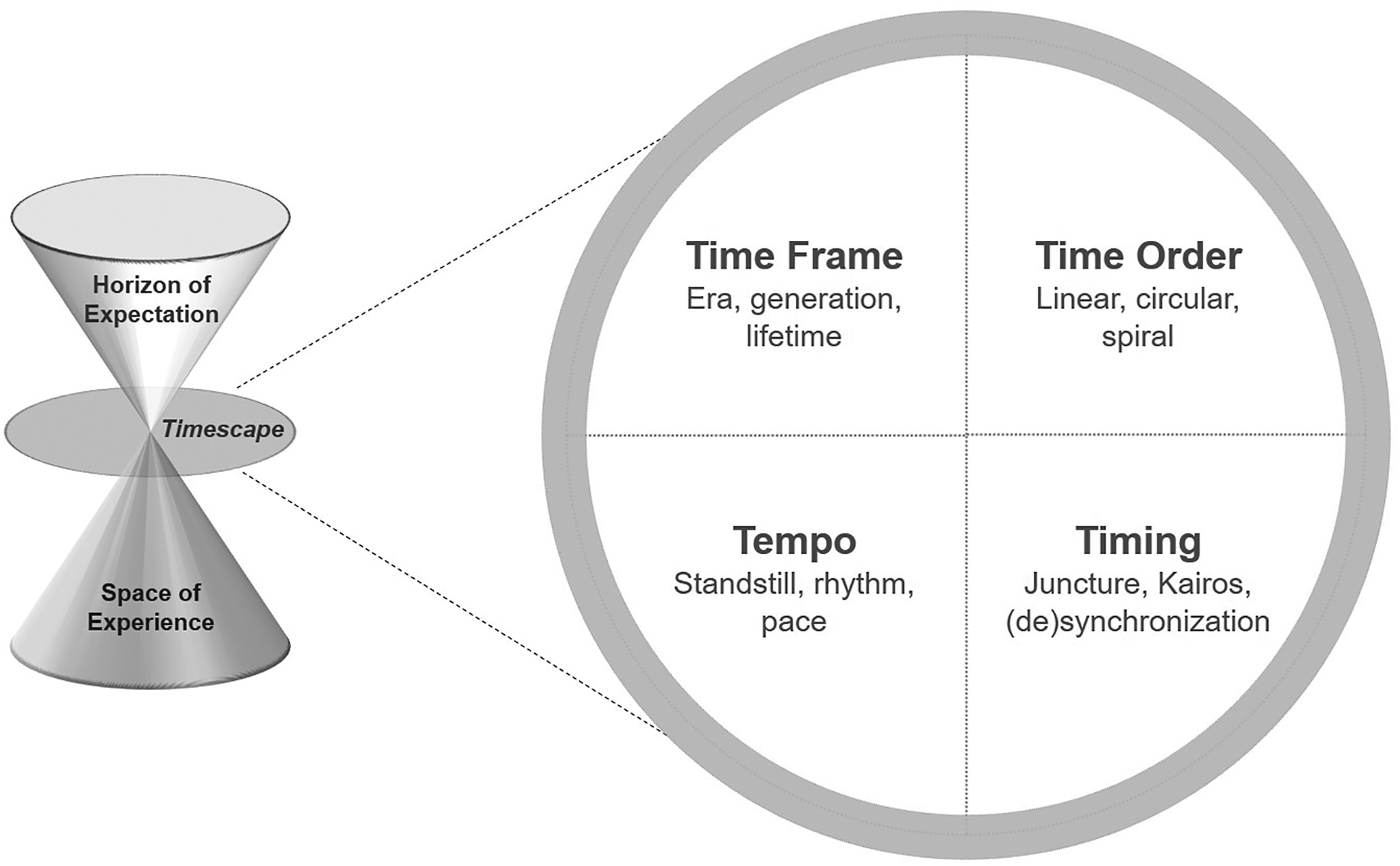
In the figure, which is graphically inspired by theoretical physicist Carlo Rovelli’s (2018: 41–51) depiction of the polytemporality of the present, I have added a diachronic dimension to the timescape conceptualization. I locate timescapes in between experiences and expectations. This diachronic dimension (left hand cones), of a synchronic timescape’s temporal clusters (right hand circle), is inspired by the theorization of historian Reinhart Koselleck (2004): individual and collective memories constitute a space of experience that, in turn, produces diverse prospects and anticipations on the horizon of expectation. The figure’s two meeting cones represent past and future, which differ between individuals and groups as they may contain a variety of experiences and expectations. Between past and future resides the present which, as shown in the right-hand circle, is distinguishable through the temporal clusters of that particular timescape. This figure should be read as a heuristic device to my polytemporality analysis of the Corona Crisis in Norra Botkyrka.
Corona Crisis in Norra Botkyrka
There is little doubt that the perils of COVID-19 are distributed along the familiar axis of inequality. International Corona-studies reveal how people that live in poor countries, regions, or neighborhoods have been disproportionately affected by the pandemic (Clouston et al., 2021; Islam et al., 2021; Shen et al., 2021). Available research also shows that economic vulnerability has increased for people without work-from-home abilities (Bonacini et al., 2021; Higuera, 2020; Shen et al., 2021; Witteveen, 2020), and for women that risk unemployment and domestic violence during child care lockdowns (Czymara et al., 2020; Dang and Viet Nguyen, 2020; Dlamini, 2021). The pandemic has especially hit people exposed to racialization (Gaynor and Wilson, 2020; Kim and Bostwick, 2020; Meghji and Niang, 2021), and psychological impacts are more severe for marginalized social strata (Ali et al., 2020; Dobransky and Hargittai, 2020; Fitzpatrick et al., 2020).
In Sweden, too, the COVID-19 pandemic has affected people quite differently. Corona-related depression and anxiety have been worse for unemployed and low-income workers (Mccracken et al., 2020: 5–6). The virus itself has been more lethal to undocumented migrants that cannot protect themselves through isolation (Lager et al., 2021). Worry about virus infection is higher among elderly, women, and low-paid workers (Kulin et al., 2021), and Swedes in general have dissimilar expectations about their well-being after Corona (Kivi et al., 2020; Kulin et al., 2021). This broad array of experiences and expectations, underscoring that the Corona Crisis is not singular at all, includes a contingent present that builds on historical patterns and extends into the future (cf. Wall and Bergman, 2021). In this article, I follow these temporal aspects of social difference to the points of synchronization.
To outline different ways in which people are synchronizing with the Corona Crisis, I have analyzed 200 in-depth interviews with residents living at the socio-spatial fringes of Sweden’s capital. The municipality of Botkyrka is located in the outskirts of Stockholm. Its northern part, Norra Botkyrka, consists of four areas: Fittja, Alby, Hallunda, and Norsborg. These areas are frequently enlisted by the police as “particularly vulnerable areas” (Polismyndigheten, 2019), which taps into a racialized “militarization of the Swedish suburb” (Thapar-Björkert et al., 2019); Norra Botkyrka suffers from a territorial stigma that exaggerates cultural differences into an alarmistic “hostility to dominant national norms” (Wacquant et al., 2014: 1274). For the residents of Norra Botkyrka, then, social exclusion and inequality have become part of everyday life. As the interview material orbit this theme of social difference, it also becomes useful for analyzing the different temporalities at play in the wake of the Corona Crisis.
The research department at the Multicultural Center in Fittja launched in mid-2020 an interview project aiming to document and archive local voices on the unfolding Corona-pandemic. This documentation project was led by historian Edda Manga, who recruited and educated 17 research assistants to conduct and transcribe two hundred interviews with residents in Norra Botkyrka. The first round of interviews was performed in June/July 2020 and included 115 unstructured interviews that captured a broad register of personal experiences from the pandemic. The second round was performed in February 2021 and consisted of 85 follow-up interviews with respondents from the first round. These interviews were semi-structured, based on a thematic interview guide with questions about the Swedish Corona strategy; the lockdown and health care situations; impacts on the respondents’ personal economy, well-being, and social relations; the respondents’ migratory background and transnational networks; and their reflections on time.
I used the software MAXQDA to analyze the interviews thematically (Bryant and Charmaz, 2012; Kuckartz and Rädiker, 2019). I started by systematically using a lexical keyword search to identify the most relevant interview segments. The leading keywords were “time” and “crisis,” complemented by a series of words with temporal implications: nouns like period, generation, and future; adjectives such as first, next, and last; verbs such as begin, end, and increase; prepositions like before and after; and adverbs like now, when, and earlier. The hits prompted additional lexical searches based on my newly identified keywords. The time-relevant interview segments, identified through my searches, were first submitted to an open coding where each segment was assigned at least one initial code. The open codes were then organized thematically through axial coding (Qureshi and Ünlü, 2020). In the third analytical step, I performed what Kathy Charmaz (2006) calls theoretical coding, a final re-arrangement and revision of the thematic analysis—in dialogue with my theoretical framework of synchronization and timescapes. I used these theoretical codes to identify relevant interview segments for the polytemporality analysis pursued in this article.
In the following pages, I present the results of my analysis. I show how plural experiences of time, among the interview respondents from Norra Botkyrka, imply at once synchronicity and non-synchronicity with the Corona Crisis. These results are here thematically structured on the four temporal clusters of the respondents’ timescapes.
Time frame
The elementary units of the respondents’ time frames were naturally the days, weeks, and months that had passed since March 2020, when domestic transmission of the virus was first confirmed in Sweden (Ludvigsson, 2020), and the World Health Organization simultaneously announced that COVID-19 must be “characterized as a pandemic” (WHO, 2020). The interview respondents typically aggregated these time units into a historically distinguishable era. They depicted it as “historical” (1:69
1
; 1:95
2
; 2:84
3
), stating that “we have not had such a huge crisis for a long time” (1:83
4
). The era was marked by the notion that “this is not a normal time, it’s Corona” (2:152
5
). Some expressed a strong desire to just “return to a normal life” (1:145
6
), others acknowledged that “we live in a Corona-time and have to accept it” (1:132
7
). This epochal perception—era as a time unit in the Corona timescape—operated, in the interview material, as a catalyst for synchronization. A historical period is shared by everyone. And for the respondents, the word crisis signaled assumptions of shared experiences: “the crisis concerns everyone around the world” (1:55
8
). This crisis terminology, invoked by politicians and journalists alike, often left a sincere aftertaste: It’s Corona Crisis on the TV, in the school, everywhere. And the word “crisis” is a charged word. It affects us even if we don’t think about it; it affects us subconsciously, in a negative way. (2:84)
Constant exposure to the omnipresent Corona Crisis was, for this middle-aged resident of Norra Botkyrka, associated with negative feelings. In this interview segment, he portrays synchronization as inescapable; the Corona Crisis is “everywhere” and “affects us even if we don’t think about it”. At the same time, other respondents departed from this crisis-everywhere notion, to actively push back against the gravity of crisis synchronization: People experience different crises […] Sometimes I get depressed from watching the news, affected without noticing. […] I usually turn off the TV when I realize that it affects me. I turn it off. I think positively, listen to music, live on. (1:66
9
)
To mitigate the risk of becoming “depressed,” this respondent actively strives to “think positively, listen to music, live on”. And this strategy follows from what I would call an act of desynchronization; the respondent actively ignores the TV news: “I turn it off”. Such operations to desynchronize with the Corona Crisis were actually a recurrent theme throughout the interview material. The acts of desynchronization, as well as synchronization, were both active and passive, strategic and unintentional. The choice to turn off the TV, like the choice to “not follow” constant reports on fatality rates (2:123
10
), was most likely meant to be asynchronous with the Corona Crisis. Other respondents, however, were more passively desynchronized: My dad was in the war and my mum lived through it. I have heard so much about the war and the misery. I can’t…, I mean, this pandemic: it’s a completely different crisis. I don’t really experience this as a crisis (2:134
11
).
This interview segment highlights how the conceptual gravity of the Corona Crisis is resisted by the respondent’s critical comparison with the recounted experiences from the Second World War, which here undermines the synchronization of heterogenous times and temporal experiences. This segment also exhibits how the time unit generation entangled with the epochal understanding of the Corona Crisis. The respondents often reflected upon how the Corona Crisis would affect “the next generation of kids” (1:22 12 ), and that we now must learn from it to protect and empower “future generations” (1:78 13 ; 2:84).
This generational frame was in turn linked to the individual lifetime, the Chronos between birth and death. Respondents expressed how they had not experienced anything like COVID-19 “in our lifetime” (1:115 14 ; 1:133 15 ), and that it “will not be the only pandemic to experience in our lifetime” (2:316). The respondents also depicted how the lockdown had taken away important parts of their life. They sometimes expressed feelings of being “in a prison” (1:59 17 ; 1:32 18 ). That imprisonment hindered them from participating in social activities (1:51 19 ; 1:73 20 ; 1:17 21 ), and from nurturing their social relations (1:57 22 ; 1:19 23 ; 1:5 24 ). One respondent, regretting that he could not spend more time with his mum in the final days of her life, explicitly said that “it feels like this year has been stolen from me” (2:152). But here the Kairos of Corona, as I elaborate below, also prompted people to “reflect about one’s time, how we live in our time and how we have lived before” (2:151 25 ). Different experiences and expectations of the respondents’ time frames were likewise mirrored in the time order diversity operating in Norra Botkyrka.
Time order
Framing of the Corona Crisis as a distinguishable era, a historical time period, typically invoked a linear time order. One interview respondent portrayed this era as “a dark time, a dark winter time though it’s not really winter” (1:95). The respondents were indeed synchronized in their yearnings for the pandemic to end, that it would elapse “fast, really fast” (2:90
26
), and that “you just want to speed up time to make this end” (2:17
27
). One respondent stated that “this Corona-time, I just hope it will pass” (2:17). The hope they usually saw, on the horizon of expectation, was a functional and accessible vaccine. The perceived ending came closer in the second interview round, when several vaccines had been launched: This year started really well with hope for the vaccination to begin. Even if everyone doesn’t get it at the same time, it still gives hope to people. You see, this will actually end after the vaccination. (2:115
28
)
This linear time order here serves to synchronize the Corona Crisis; it underlines a clear beginning, and that the crisis will “actually end”. But the respondent quoted here also points out the asynchronous aspect that perhaps “everyone doesn’t get it at the same time”. This passive desynchronization was at work also among respondents that expressed little faith, anticipating that they would not get it in time (1:119 29 ; 1:107 30 ; 2:17). Doubts in the vaccine were also accompanied by a broken belief in linear progression. Respondents projected that a slow vaccination procedure would “make this go on forever” (2:3); they saw visions of a “dark future” (2:40 31 ), forecasted that the pandemic would “never end” (1:51), and expressed how such “uncertainty about the future generates a lot of anxiety” (2:9 32 ). Departure from the linear time order, then, interconnected with a desolate horizon of expectation, a prospect that “we’ll have to live with this economy, depression, unemployment. It will all be a circle” (1:115).
This circular time order was marked by endless repetition of daily routines (2:5 33 ; 2:123). An interviewed college student, subjected to distance education, dauntingly expressed: “I basically sit around at home, wake up at seven, start studying at eight and then stop at five. And so it goes on every day” (1:33 34 ). One effect of this unwanted sameness was a shrinking space of experience:
Time is running out, I think. Time moves really fast actually. Maybe it’s because of these monotonous days, where one day is like another, but time is running out and I don’t accomplish anything at all. I think it all just merges somehow, it’s been a year now and, well, it’s still a bit fuzzy. (2:134)
The tedium of circular time, the repetitiveness of “these monotonous days,” here encapsulates how “time is running out” since it “moves really fast”. For the interview respondent quoted here, time drainage means a confined space of experience: “I don’t accomplish anything at all”. Another respondent described how a circular time flow brought misery: “I’m healthy and active. Just sitting here, waiting for the time to pass, feels horrible” (1:145). But temporal circularity was not only seen as passivizing. Some respondents found comfort in watching seasonal shifts and lunar cycles (2:67 35 ), which inspired activity rather than passivity: “There will be a new spring and a new summer, and then I will have my pictures sorted into photo albums; I’ve many projects going on and, well, I’m quite satisfied” (1:64 36 ). Hence, whereas some respondents employed a circular time order to portray confining experiences of endless repetition, others used it to empower themselves, in an act of desynchronization with the Corona Crisis’ state of exception.
My thematic analysis furthermore showed that many respondents found relief, as well as political momentum, in a spiral time order: return to a previous point in time, but on a higher level. Perceiving time as spiral, rather than linear or circular, included the recognition of crisis cyclicity—the notion that similar problems recur but humanity becomes increasingly resilient. Many respondents expected that people had “learned” from this collective experience (1:138 37 ), and that society would now become “better and better in handling these things” (1:83): “I am confident we’ll do it well, now that we know how to respond” (1:30 38 ). I soon return to how this future-oriented aspect of the spiral time order invokes certain timing, and how that enables people to synchronize, or desynchronize, with the different tempos invoked by the Corona Crisis.
Tempo
The tempos of respondents’ timescapes differed both in rhythm and pace. The most typical expression, however, was the experience of an overall standstill, an intermission that felt like “life stopped” (1:115; 1:80 39 ), that “life is on hold” (2:3), “on pause” (1:25 40 ; 1:3 41 ), or “on standby” (2:63 42 ). Temporal standstill interlinked with spatial restraint, the feeling of imprisonment that headlined, as I demonstrated above, the circular time order. The lockdown restrictions did not only hamper participation in civil society activities (1:145; 1:6 43 ; 1:115; 2:51 44 ) but also physical interaction with family and friends (1:97 45 ; 1:80). Standstill was also entangled with demanding experiences of waiting. The respondents were waiting for new governmental decisions (1:65 46 ; 2:5); they waited for hospital appointments (1:4 47 ; 2:136 48 and 2:134), for overdue social insurance payments (1:4), or upcoming employment opportunities (1:15 49 ). Some respondents also portrayed a long waiting period as their bodies slowly recovered from COVID-19 infection (1:48 50 ; 1:95; 2:17), while others simply waited for their turn to come down with Corona (1:119).
These experiences of standstill synchronized with the Corona Crisis as respondents stated that “the whole world has stopped” (1:32), and that “all over the world there is this pandemic that made life stop for a moment” (1:139 51 ). But that movement of synchronization was also contested, in the interview material, due to the experiential variety of rhythm and pace.
As observed also by scholars in other countries (Erll, 2020), the pandemic has generated a dramatic breakdown of ordinary routines—the very rhythm of everyday life. For the interview respondents, this included daily attendance at schools or workplaces (1:83), weekly gatherings in mosques or churches (1:84 52 ; 1:80), and regular or occasional social festivities (1:106 53 ). The rhythm mixed the steady andante of lingering at home, with the social presto of virtual encounters and compressed intervals between activities. Several respondents found this temporal rhythm difficult, as the blurring of “work time and free time” generated an imbalance between activity and recovery (2:3).
These temporal rhythms created, on the one hand, severe limitations of socially important routines. Respondents had to interrupt daily prayers and Friday meetings in the mosque (1:84), pause group exercises at the gym (2:123), and limit social gatherings in restaurants and clubs (1:119; 1:97; 1:5); they felt unable to schedule future activities and therefore forced to “create new life routines” (1:115). On the other hand, different rhythms also opened up for new habits. Respondents reported that “I have begun stretching in the morning and eat a healthier breakfast, since I have more time” (2:141 54 ), and that “my training improved under Corona Crisis” (1:47 55 ). For one respondent, the new rhythm opened up for studying at the university: “Is there a better time than now? No, I cannot get a job so I’ll study instead” (2:19 56 ). New temporal rhythms also rearranged the meeting points for social interaction. Respondents said, for instance, that “I’ve not been at school, but I have spent more time with my family” (2:141), that “I used to call my dad once a week, but now it’s much more frequent” (2:84), and that “we now have lunch meetings online every day, it has become a daily routine” (2:3). Others reported that, in the same vein, they were using more video calls than before, which had reinforced their social relations (2:100 57 ; 2:148 58 ; 1:5).
Intensification of digital communication, due to the accelerated use of internet-connected phones or computers during the pandemic (cf. Mcdowell et al., 2020; Nguyen et al., 2021), indeed requires synchronization across different time zones. But temporal rhythms are also asynchronous since every routine is individually unique. The Corona lockdown therefore relied on, for the residents in Norra Botkyrka, synchronicity as well as non-synchronicity. In my thematic analysis, I particularly noted this double movement regarding pace. Some respondents reported how the pace had accelerated (2:84; 2:73 59 ; 2:138 60 ); they described how “time is like ten times faster than usual” (2:69 61 ), that “time goes a lot faster now when so much is happening” (2:141). But others experienced deceleration, that everything was “slow-moving” (2:60 62 ), “sluggish” (2:5), or “inert” (2:34 63 ); that the flow of time as was “really slow” (2:88 64 ; 2:97 65 ), or “fucking slow” (2:40); that “it’s been the longest year ever” (2:148), a year that “feels like an eternity” (2:130 66 ). Some explicitly expressed ambiguity about the pace they experienced. One respondent said that “it feels like time moves slowly but in fact it goes faster” (2:67), another respondent stated that “my perception of time has changed: it’s so slow but still everything moves fast” (2:83 67 ).
I believe that the ambiguous time pace, with tandem acceleration and deceleration, interplays with the labor of synchronizing with the Corona Crisis. The respondents sought a shared, collective experience of pace to compare their experience with, but instead found themselves reflecting upon ambivalent experiences on the individual level. One respondent found it quite frustrating to “have a lot of time but nothing to do with it” (2:137
68
). Since pace was not really synchronized through the Corona Crisis, experiences became markedly heterogeneous. In this vein of non-synchronicity, respondents suggested that different experiences of pace depended on different life situations: I feel that things happen very fast. Maybe not for everyone. I have so much to do all the time that I don’t even take notice, but my mum tells me it’s slow because she is always at home. And of course, time is slow for me, too, but I still don’t have time to do things. I don’t have enough time. (2:123)
Here, the interview respondent outlines how pace heterogeneity follows from individual activity. As a young adult, she experiences how everything happens “very fast”. She has “so much to do” that she actually “don’t have enough time”. Her mother, on the other hand, says that time moves slowly. The explanation given to this pace difference is that her mother, contrasted with her own active lifestyle, “is always at home”. Similar explanations were put forward by a respondent who pondered that “maybe time is different for people working from home, but we don’t work from home; we are mostly at our workplaces, and so time moves as usual” (2:17). Structural inequalities, like access to remote working, are summarized in a statement of another respondent: “we have managed […], but many have been hit hard” (2:56 69 ).
And if social difference was named by the tempos of the Corona Crisis, timing became the venue for political change.
Timing
The interview respondents typically portrayed the Corona Crisis as a juncture, turning point, a timing that widened the horizon of expectation. This juncture prompted one respondent to “reflect about time, how we live our time, and how we have lived” (2:151). A particularly strong theme here was the human relation to the more-than-human world: I think the pandemic is the universe’s way to show how wrong humans have behaved. It was expected since nature is destroyed. All these factory farms, the food, everything is so wrong; the water and the oceans are destroyed, it’s all about the big industry, making profit. I think nature or the universe, something, came up with this pandemic to force people to stop and think about what they are doing. (2:134)
This pouring list of human wrongdoings leads the respondent to conclude that the COVID-19 pandemic came with a purpose: to force us “to stop and think”. Other respondents said, in the same vein, that “this crisis was needed for us to rethink […] how to live with nature and not against it” (2:84), for instance, by “not traveling by plane” (1:151 70 ), in order for us to “leave the earth undamaged for future generations” (2:84). The juncture could also, respondents argued, push us to “explore a more simple life” (1:9 71 ), abandon “overconsumption” (1:73), and discover that “the meaning of life is not shopping” (1:105). Others reported that the Corona Crisis had been a turning point for them to “appreciate and understand how important social contacts are” (2:3), “to use time and realize the value of community” (2:138). One respondent explained that he now had had a “chance to stop and see how lovely it is to know each other better. This has given me a kind of respect for time” (2:9).
Reflection on the crisis-juncture triggered action, an active use of the momentum to appreciate the here-and-now. This was the timing of Kairos: “to look out from the window and ‘seize the day’” (2:4
72
). Kairos was prompted by the awakened question: “life is short, what do I want?” (2:130). It brought appreciation to the juncture. “I know it’s really bad, with Corona and all, but still I’m grateful for the good times we have had” (2:123). Kairos was a welcoming of time: I’ve realized that we must value time. I now have more respect for the everyday and, this will sound really silly, for how magical the everyday can be. But often there is no time to see it. You know, the small things in life; appreciating these have given me more time to strengthen my closest relations, those I live with. When activities are cancelled, when my husband don’t go to his usual training every Tuesday, then we spend more time together. (2:9)
The interview respondent here portrays how the lockdown, rupturing daily routines and activity cycles, has opened her eyes for “the small things in life” and making her see just “how magical the everyday can be”. Previously she had “no time to see it,” but now the timing of Kairos has produced “more time” for deepened relationships at home. Kairos is the moment she seizes, and this Kairos-timing is out of sync with the dramatic juncture of the COVID-19 pandemic. Kairos becomes an act of desynchronization.
But the possibility to be out of sync with the Corona Crisis is quite dependent on the social differences and structural inequalities that dictate individual life situations. One respondent said that “of course it’s a crisis, but how serious it is depends on the person”; it is graver for “a person that has lost a close relative to Corona” (2:152). Like a response to that prognosis, another respondent stated that “personally, I don’t see the crisis” (1:151). One respondent went even further, disqualifying the crisis conceptualization all together: I don’t see it as a crisis. It’s not the same as a war or something that our grandparents have lived through. In a way this is the biggest catastrophe we have experienced. But it’s also kind of a boring crisis, there is no food shortage or anything. It’s only about trying to keep distance from other people – and that differs from other crises where we must keep together and help each other. (2:3)
Here, the respondent recognizes synchronization but challenges the crisis’ underlying classification. The so-called Corona Crisis, according to the respondent, lacks a most important criterion: that people “keep together and help each other”; it cannot be a shared crisis if it materializes by “trying to keep distance from people”. In this same vein of desynchronization, another respondent described her experience of living in Norra Botkyrka for half a century: They day we got here I felt ‘this is where I want to live!' When we’ll have to move form here, it will be a true crisis (1:118 73 ). For this respondent, crisis included her positive experience of living in Norra Botkyrka and her worried expectation of future displacement—which demonstrates how social differences strongly interplayed with synchronization of the Corona Crisis.
Synchronization of the Corona Crisis
Social differences impel continuity of the pandemic, and structural inequality will surely animate the virus’ afterlife (cf. Tamm, 2015). This heterogeneity becomes even more discernible through the lens of time. My thematic analysis of 200 interviews with residents in Norra Botkyrka demonstrates a wide range of experiences and expectations. The time frames, time orders, tempos, and timings—constituting each individual's timescape—were employed differently by the interview respondents to recollect past experiences and generate expectations about the future. The Corona Crisis was, on the one hand, recurrently referred to as a dramatic event of historic proportions. The crisis terminology here located residents of Norra Botkyrka in the same time as everybody else; the rupture of ordinary routines served to synchronize their experiences with the crisis conceptualization. On the other hand, experiences and expectations were also asynchronous with the crisis. Acts of desynchronization were employed by the respondents, either passively or actively, to make sense of their individual experiences and expectations. Attempts to reimagine time, for instance by creating new temporal rhythms in the pandemic juncture, became a tool for empowerment, an act of resistance, a temporal strategy to be out of sync with the crisis.
Synchronization of the Corona Crisis thus involved movements of desynchronization that, if aggregated enough, might generate contested processes of synchronization. The crisis concept could then include what anthropologist Josep Maria Antentas describes as an etymological, or radical, meaning of crisis: to mark “a milestone in a society’s trajectory, whose depth is proportional to the crisis itself” (2020: 315). I believe the ongoing (de)synchronization with the Corona Crisis has much more to teach us about radical possibilities embedded in, as geographers Jon May and Nigel Thrift have it, “the radical unevenness in the nature and quality of social time” (2001: 3). I have elsewhere argued for sharper focus on subaltern utilization of time, the temporal work underway in communities silenced by majority society (Lundström, 2017). The diversity of people's timescapes could help us understand, as Michell Bastian argues, “how community comes to be conceptualized the way it is, and how it might be understood differently.” (2014: 155–156). In any case, the biological and social horrors of COVID-19 impel us to examine how different sufferings and coping strategies are produced under the pandemic. And with this article, I would add that recognition of (de)synchronization, too, prompts us to challenge the universality of the Corona Crisis.
Footnotes
Declaration of Conflicting Interests
The author(s) declared no potential conflicts of interest with respect to the research, authorship, and/or publication of this article.
Funding
The author(s) received no financial support for the research, authorship, and/or publication of this article.
