




Abstract
The experience of a lack of time due to an increasing burden of urgent tasks is one of the more common challenges created by digital communication media in the network society. This study develops the concept of chronemic urgency to explore urgent messaging using digital media. Chronemic urgency is the urgency users assign to messages received via a specific communication medium. Consistent with a communication perspective, the urgency is a function of both the relationship and the media. This study uses social entrainment theory and expectancy violations theory to conceptualize the chronemic urgency construct. This construct is then examined in a pilot study of the chronemic urgency 773 US-based participants assign to the communication media they use at least on a weekly basis. High chronemic urgency is assigned to messages received through media that (1) are used for urgent communication, (2) are checked more often, (3) are likely to be used by others who wish to contact the user urgently, and (4) are likely to lead to a quicker response. Despite the increasing centrality of urgency in everyday communication in the digital age, researchers and practitioners lack reliable methods to measure chronemic urgency in populations. The findings provide initial indications of levels of chronemic urgency in the US population’s everyday digital communication and create a foundation to better understand contemporary temporal phenomena.
Urgency is a prominent temporal characteristic of the network society (Castells, 2009). Individuals face the constant challenge of managing a steady influx of messages with varying degrees of urgency from a variety of digital and non-digital communication sources across a range of personal and professional relationships. This challenge is fundamentally chronemic or concerning the nature of human temporality as it is bound to interaction (Walther, 2002). In this study, we integrate several related concepts, namely, communicative responsiveness, relational maintenance, and impression management within a chronemic framework to develop a novel temporal construct: the chronemic urgency of digital communication media. This construct measures the urgency users assign to messages they send and receive via each communication medium they use and provides a useful benchmark for the study of urgency in the network society through an exploratory survey of chronemic urgency in several US groups. The findings of the study contribute to our understanding of the manner in which the norms of everyday digital communication reflect a balance between increased temporal flexibility through asynchronicity and mobility and the expectations of constant availability for urgent communication.
Earlier conceptualizations of urgency
Aspects of communicative responsiveness, relational maintenance, and impression management have been addressed in disparate treatments of urgency. Much early research concerned a multidimensional construct called time urgency and focused on its relationship to the Type A behavior pattern (TABP) (Conte et al., 1995; Landy et al., 1991; Mueser et al., 1987; Waller et al., 1999). Time urgency was frequently measured as the latent variable underlying the TABP and broadly concerned a mix of time awareness, time use, and time urgency. Like chronemic urgency, relational maintenance issues were prominent in these early conceptualizations. Time urgency was seen as encompassing such behavioral traits as timeliness in remembering important dates and mastering the flow of activities so as to be attentive to time (Landy et al., 1991). In another line of research similarly concerned with relational maintenance and impression management, Kellermann and Park (2001) studied a construct called situational urgency and its relationship to politeness and efficiency in human interaction. Ballard and Seibold (2004) theorized urgency as a unidimensional construct which reflects construals (or perceptions) of time which are recursively tied to a range of temporal enactments or behavioral manifestations, including multitasking and speed. In conclusion, extant research on urgency identified appropriateness, attention, norms, and expectations as vital to a range of perspectives about the impact of urgency on human behavior.
Below, we further explicate the concept of chronemic urgency within extant theoretical perspectives, demonstrate its unique theoretical and practical purchase, and develop a way to measure it that facilitates comparison across diverse social groups.
Chronemics and digital communication technologies
Research demonstrates the diversity and importance of chronemic cues and response times in online communication (Döring and Pöschl, 2008; Walther and Tidwell, 1995). In particular, these studies reveal the chronemic social norms that underlie online communication. These temporal social norms drive expectations about communication (Farman, 2018), and when these norms are violated, these violations have social consequences that are described by expectancy violations theory (EVT) (Burgoon and Hale, 1988). In brief, EVT suggests that when a person experiences an expectancy violation, this leads to his or her increased attention to the norm that is being violated. This rise in attention is accompanied by them assigning positive or negative valence to the violation. This assignment is influenced by the valence they assign to the violator. For example, an unexpectedly long response time to an email message could negatively influence the evaluation of a job candidate, the candidate’s social and task attraction, and other relational message interpretation variables (Kalman and Rafaeli, 2011). Expectancy violations theory emphasizes the prominence of such chronemic norms, and the social importance attached to possible violations of these norms, and as such is a useful framework to explore the chronemic norms associated with urgency.
Online communication norms emerge and evolve over time, and interlocutors derive social information about their counterparts by observing both adherence to these norms as well as the violations of the expectancies created by the norms (Walther, 1992). Thus, impression formation in online communication is not different from impression formation in traditional forms of communication (Goffman, 1956). It is influenced by both the words that are used, the relationships at stake, as well as by a host of nonverbal cues, including chronemic cues such as long pauses and unresponsiveness (Kalman et al., 2013).
Recent exploratory work by Kalman et al. (2018) studied the ways in which digital natives, members of Generation Z—who receive hundreds of messages a day through their various digital media—approach the communicative task of being reachable and responsive throughout the day and of promptly responding to urgent messages. Based on interviews with participants aged 18 to 22 years, who were also undergraduates, they found that the participants gave high priority to phone calls and to text messages that arrive on their mobile phones, that those messages on these two media were very closely monitored, and that these media were used for urgent communication, for example, for sending urgent messages. Other media were used for less urgent communication and not monitored as closely.
Kalman and colleagues used the Flaherty (2002) concept of temporal agency—which concerns the active “time work” that individuals engage in to modify their own temporal experience—and they coined the term chronemic agency to denote the communicative and relational practices that individuals develop to manage their responsiveness to messages received via digital communication. From this chronemic perspective—centered on time-based practices bound to human communication—it “expresses the relative power that messages and notifications that are received through the medium have on the recipient’s attention and reaction time” (p. 1965). The researchers demonstrated that the participants in the study were able to place the different digital communication media they use on a continuum of message urgency and that there was a strong consensus among the participants that messages received through mobile calling and texting (SMS) were associated with the greatest urgency.
The interviews also demonstrated the diverse and myriad strategies used by participants to monitor their lower chronemic agency messages, revealing that users try to quickly respond to messages (once they were encountered/read)—regardless of the chronemic agency assigned to the medium used. Two of the prominent reasons for responding quickly were that delaying a response increases the likelihood of forgetting to respond altogether and that delaying a response is counter to the prevalent desire to present oneself as a highly responsive person. Finally, the analysis of the interviews suggested that participants used differential chronemic agency to moderate some of the negative aspects of communication overload, by attending to messages on their lower chronemic agency media such as Facebook and Instagram at more convenient times of their choosing and with less frequency.
We develop these qualitative findings on chronemic agency to study urgency in contemporary communication settings and to measure chronemic urgency in a large, diverse sample. This novel construct is measured by asking participants questions pertaining to media that are used for urgent communication, namely, (1) the location of these media on the “very urgent–not urgent at all” continuum; (2) the frequency of checking these media for new messages/notifications/incoming calls; (3) the likelihood these media will be used by others who wish to contact the participants urgently; and (4) the likelihood that the participant will respond quickly to messages or calls that are received on these media.
Temporal perspectives on chronemic urgency
The research described in the previous section demonstrates the importance of chronemics in understanding contemporary usage of communication media. In this study, we draw on the social entrainment perspective to frame two research questions about chronemic aspects of norms and behaviors related to mediated communication. McGrath and Kelly’s (1986) theoretical model of social entrainment borrows the term “entrainment” from the biological sciences to describe how one rhythmic process is “captured” and modified by another cycle. For example, the most prominent entraining cycle in the natural world is the 24-hour-long daylight and nighttime cycle which entrains the many circadian cycles that can be observed in nature.
There is extensive empirical evidence that individuals become entrained to the temporal conditions of their work situations (Kelly and McGrath, 1985; Kelly et al., 1990; Waller et al., 2002; Zellmer-Bruhn et al., 2004). Additionally, there are many other processes and stimuli to which human temporal cycles might become entrained—including routine and regular communication that becomes patterned in particular ways, as reported by Montjoye et al. (2013). The social entrainment perspective suggests that these patterns arise, in part, because of the relationship to others whose messages become exogenous pacers, and influence our chronemic patterns (Ballard, 2007). One sign of successful entrainment is a rhythm of communication that enables a desirable level of responsiveness. If, for example, an organization wishes to complete all incoming orders that arrive by noon within the same workday, and if orders take about 1–2 hours to complete, it is sufficient to collect incoming orders twice a day, probably once at the beginning of the workday and once at noon. But if the organization wishes to shorten its response time, or if the time to complete the order is longer, the frequency of collecting the orders needs to increase.
Continuing the example of order completion from the previous paragraph, it is likely that from time to time, the organization will unexpectedly receive an order that needs to be completed as soon as possible. Such an urgent order will need to disrupt the organizational cycle. This unexpected urgent order would probably be mediated through a person with high agency in the organization, such as a manager, or a well-known client who will contact the person in charge of order processing. Consequently, instead of waiting until the next cycle, the order will be completed immediately. Entrainment is based on some kinds of routine, but life always has nonroutine urgent events that disrupt this pattern, and strategies to attend to nonroutine urgent communication are needed. Thus, we are concerned with both entrained digital communication patterns as well as disruptions to these entrained patterns associated with urgent messages.
While social entrainment theory predicts disruptions to established cyclical patterns by powerful exogenous pacers, it is less suited to explain how people behave when disruptions are the norm, rather than the exception. Ultimately, rather than being cast as rare within a given cyclical pattern or tempo, urgent digital communication is expected. As Ballard and Seibold (2004) observe, our experience of urgency is recursively tied to our pace. Rosa (2013) accounts for this relationship as part of a larger process of social acceleration through three, interrelated yet conceptually distinct, dimensions of modern life—technical acceleration, the acceleration of social change, and the acceleration of the pace of life.
Technical acceleration refers to the “intentional, technical, and above all technological (i.e., machine-based) acceleration of goal-directed processes” that we see in transportation, communication, and production of goods and services (p. 71). While technical acceleration is the most readily visible and most analytically tied to our purposes here, focused specifically on communication, it is tightly bound up with the other two dimensions of social acceleration. For instance, the acceleration of social change is defined as “an increase of the rate of decay of action-orienting experiences and expectations and as a contraction of the time periods that determine the present of respective functional, value, and action spheres” (p. 76). Key to this definition of the acceleration of social change is the contraction of the present. In turn, this contraction shapes and is shaped by the third dimension of (Rosa, 2013) tripartite analysis: the acceleration of the pace of the life, which includes both subjective and objective aspects.
Chronemic urgency is at the intersection of each of these three dimensions. It is experienced in practices associated with technical acceleration, driven by the larger contraction of the present associated with social acceleration, and felt (especially subjectively) as acceleration of the pace of life. The expectation of urgent interaction as both inevitable and frequent—not tied to any cyclical pacers—introduces a socio-temporal arrhythmia devoid of entrainment. Thus, this study considers how individuals are able to simultaneously exhibit both cyclical, entrained digital communication patterns, while also attending to and responding to unexpected, context-free, urgent messages. A summary of extant empirical research and related research questions is elaborated below.
Entrainment and urgency in digital communication
The study by Kalman et al. (2018) provides preliminary evidence for the important influence of urgency on the everyday behavior of users of digital communication technologies and provides evidence that users assign different levels of urgency to messages received on different digital media. It presents a new viewpoint on communication norms in the digital era and proposes a new perspective on urgency that echoes the early work on time urgency and situational agency (Kellermann and Park, 2001; Landy et al., 1991; Waller et al., 1999). The earlier studies identified that time urgency is expressed through awareness to time and related expectations and norms and posited situational urgency as urgency that increases efficiency and politeness in interpersonal interactions (Kellermann and Park, 2001). Owed to social acceleration, especially as it drives and is driven by technical acceleration in the form of digital communication, we now need to cope with an ever increasing volume of messages streaming to us through an increasing number of media and devices. Rather than urgency as the exception, through digital communication, urgency is experienced and managed within a larger context of social acceleration. Thus, the guiding research question of the present study:
Participants in Kalman et al. (2018) study also described a “responsiveness imperative,” or a tendency to respond as soon as possible to every message that requires an answer, regardless of chronemic urgency. This imperative is in line with findings of various studies of online responsiveness and of situational urgency (Kalman and Rafaeli, 2011; Kellermann and Park, 2001). It is also a finding with important applied implications since the urge to respond instantaneously is at the heart of some of the most worrying aspects of online communication. These negative consequences occur when incoming messages lead people to attend to their digital media devices while driving (Bayer and Campbell, 2012), while engaging in work tasks which require concentration (Mark et al., 2018), or while engaging in interpersonal communication tasks where full attention is expected (McDaniel et al., 2018). Therefore, we wish to confirm whether we can identify this imperative in the studied population, as well as the weight of two possible explanations for this behavior described in the study of chronemic agency—(a) to avoid forgetting to respond or (b) to avoid giving the impression of ignoring the sender.
Method
Participants
Based on our interest in the normative influence of social group membership, three diverse groups of participants were recruited as a convenience sample: (1) US-based Mechanical Turk (MTurk) members; (2) administrative employees; and (3) undergraduate students at a US university. 474 MTurk participants were recruited through the MTurk website—an online crowdsourcing labor market operated by Amazon.com (Sheehan, 2018). Participants who met the recruitment criteria (18 years or older US residents who completed at least 50 previous tasks in MTurk and have 95% or higher approval ratings) were sent a link to a Qualtrics questionnaire and were paid 0.50US$ for the several minutes required to complete the survey. Mechanical Turk workers meeting these requirements were highly likely to follow task instructions (Peer et al., 2014). 172 undergraduate (18 years or older) participants were recruited at a southwestern university in the United States in exchange for extra course credit, and 138 members of an administrative (nonacademic) department from the same university were also recruited. Participation was voluntary and participants could withdraw at any time. The participants received a link to a questionnaire (see Supplementary Material), that also included open-ended questions not reported or included in this study.
Survey design
We measure the chronemic urgencies assigned by a large number of participants to messages received through a large range of communication media in order to compare the chronemic norms different users assign to messages on different media. This measurement is carried out using a four-item instrument that is based on the findings of Kalman et al. (2018) and on the early conceptualizations of urgency (Kellermann and Park, 2001; Landy et al., 1991; Waller et al., 1999). The four items that comprise this instrument are detailed in the Supplementary Material.
Respondents are asked about (1) the location of each medium they use at least on a weekly basis on the “very urgent–not urgent at all” continuum. In addition to this component adopted from Kalman et al., we added three more components to the scale. Given the need to respond to urgent messages in a timely manner, and the findings that individuals assign high chronemic urgency to messages received on only a small number of media, and check other media less frequently, the second component of the scale focuses on (2) the frequency of checking each of these media for new messages/notifications/incoming calls. Time urgency and situational urgency require individuals to be aware of norms and expectations and thus assign higher chronemic urgency to media that others they communicate with use for urgent messaging. Thus, the third component of the scale is (3) the likelihood that each of these media will be used by others who wish to contact the participants urgently. Finally, based on the same norms and expectations that define the third component, individuals also assign higher chronemic urgency to messages (or calls) that arrive on particular media, and thus, the fourth component of the chronemic urgency scale is (4) the likelihood that the participant will respond quickly to messages or calls that are received on each of these media.
The participants received a link to a self-administered online survey using the survey platform Qualtrics and consented to participating in the study. Questions 1 and 2 were designed to replicate Kalman et al. (2018) face-to-face interview questions asking participants to place each medium they use on an urgency continuum. It used the Qualtrics’ sliding scale response tool to enable participants to place each of the media they use on a weekly basis, on a scale of 0–100 between “not urgent at all” and “very urgent,” respectively. “Forced response” ensured that each medium was actively rated on the scale and did not remain in the default 0 (not urgent at all) position. This was followed by three questions accompanied by a 7-point scale based on the three behaviors that Kalman et al. (2018) identified as associated with the concept of high chronemic agency media: frequent checking for new messages/calls (question 3), usage by others who wish to urgently contact the user (question 4), and likeliness that messages received on this medium will lead to a quick response (question 5). Each medium selected by the participants in question 1 was explored in questions 2–5 which, together, comprised the items of the chronemic urgency scale.
This was followed by two pairs of questions (a total of four questions) focused on RQ2a and RQ2b, which asked to what extent participants tend to respond as soon as they can (ASAP) to messages received on various media and whether they behave this way to avoid forgetting to respond and/or to avoid giving the impression of ignoring the sender. Each pair focused on a vignette describing a user of one medium (email, text, Facebook wall, or phone) who constantly checks this medium throughout the day and responds as soon as she can. The vignette of the first set (the “forgetting” vignette) explained that the user does so because she thinks she will otherwise forget. The vignette of the second set (the “impression formation” vignette) explained that she responds this way so that others will not think she is ignoring them. The first question in the pair asked the participants whether they too, like the user described in the vignette, will respond as soon as they can to messages that arrive via this medium, and the second question asked whether they too, like the user described in the vignette, will respond as soon as they can to messages that arrive via this medium so as not to forget. Similarly, the second set of questions focused on responding quickly so that others will not think they are being ignored. In summary, each participant received two randomly assigned vignettes (numbered 6 and 7 in the Supplementary Material), each vignette focusing on only one of the four media, and each followed by two question sets: one about forgetting and one about impression formation.
The questionnaire concluded with several demographic questions: gender, age, ethnicity, employment status, state (residency), and education level.
Analysis
Since the chronemic urgency scale was composed of four questions which used two different scales (0–100 for question 1 and 1–7 for questions 2–4), the questions were first normalized by transforming each of the responses to a Z-score that was based on the averages and standard deviations provided by the respondents to each of the four questions (Colman et al., 1997). The chronemic urgency assigned to each medium was then reached by calculating the mean of the four Z-scores and the Cronbach alphas of the urgencies calculated for each medium.
Results
773 participants were included in the study. The questionnaire was completed by 474 MTurk participants, 172 undergrads, and 138 administrators. 11 MTurk participants who completed the questionnaire in less than 90 seconds were removed, leaving 463 MTurk participants. The demographics of the MTurk group were 55% male, mean (median) age 38.05 (35), 79% white or Caucasian, 6% Hispanic or Latino, 7% Asian or Pacific Islander, 9% Black or African American, 1% biracial, 0.6% Native American or American Indian, and 0.6% “other.” (Participants could select more than one ethnic category.) Seventy-three percent were employed full time, 17% employed part time, 8% unemployed, 2% retired, and 1% students. Thirty-four percent of the MTurks reported some college education, 10% a 2-year degree, 35% a 4-year degree, 0.6% a doctorate, 13% high school graduates, 0.3% less than high school, and 6% reported a professional degree. The MTurk participants were from 45 different US states, the largest of which were California (11%), Florida (8%), New York (7%), and Pennsylvania and Michigan (6% each). The demographics of the undergraduate group were 84% female, mean (median) age 19.88 (20), 59% white or Caucasian, 26% Hispanic or Latino, 15% Asian or Pacific Islander, 3% Black or African American, 2% biracial, 0.6% Native American or American Indian, and 0.6% “other.” The demographics of the administrators group were 54% female, mean (median) age 39.18 (36), 75% white or Caucasian, 13% Hispanic or Latino, 8% Black or African American, and 1% of each of the following: Asian or Pacific Islander, biracial, Native American or American Indian, and “other.” Fifty-five percent of the administrators reported a 4-year degree, 35% reported a professional degree, 4% reported a 2-year degree or some college, and the rest reported other educational attainments. Of the three groups, the MTurk group was used as a reference group since it is the largest, as well as closer than the other two campus-based groups to the general US population in regard to demographics such as mean age, racial distribution, and education level (Central Intelligence Agency, 2018).
Mean chronemic urgency and standard deviation by medium and user group, sorted by mean chronemic urgency of the MTurk group.
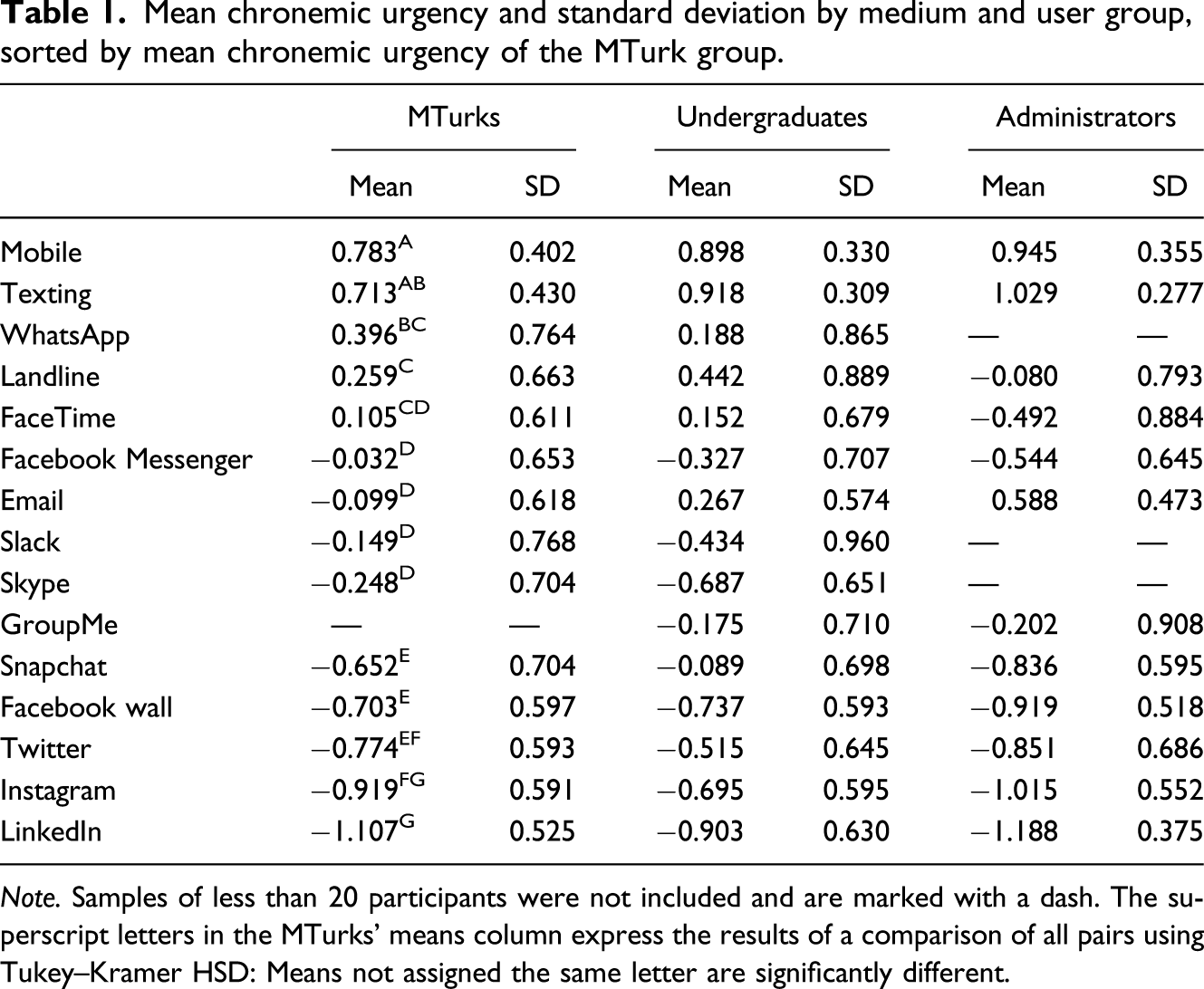
Note. Samples of less than 20 participants were not included and are marked with a dash. The superscript letters in the MTurks’ means column express the results of a comparison of all pairs using Tukey–Kramer HSD: Means not assigned the same letter are significantly different.
In the ranking of the media according to chronemic urgency, it is possible to discern three groups: high chronemic urgency, mid-level chronemic urgency, and low chronemic urgency. Two high chronemic urgency media, mobile calling and texting, have a chronemic urgency of 0.7 and above (group A) and are distinct from a group of midrange media which are assigned chronemic urgencies in the range between +/− 0.4 (groups C and D) which include WhatsApp, landline, FaceTime, Facebook Messenger, email, Slack, and Skype. This group is, in turn, distinct from the low-range media (groups E, F, and G) which include Snapchat, Facebook wall, Twitter, Instagram, and LinkedIn. An interesting exception to this classification is WhatsApp, with an average chronemic urgency falling in the midrange of media (0.4) but which is not significantly different from both group B and group C. This is likely due to the fact that, in many countries, WhatsApp is used in a way that is similar to texting in the United States (e.g., Karapanos et al., 2016; Montag et al., 2015; Shah and Kaushik, 2015; Treré, 2015). Thus, it is probably assigned very high chronemic urgency by US-based users who are in constant contact with international family, friends, and colleagues, but not by other Americans who use WhatsApp on a more occasional basis.
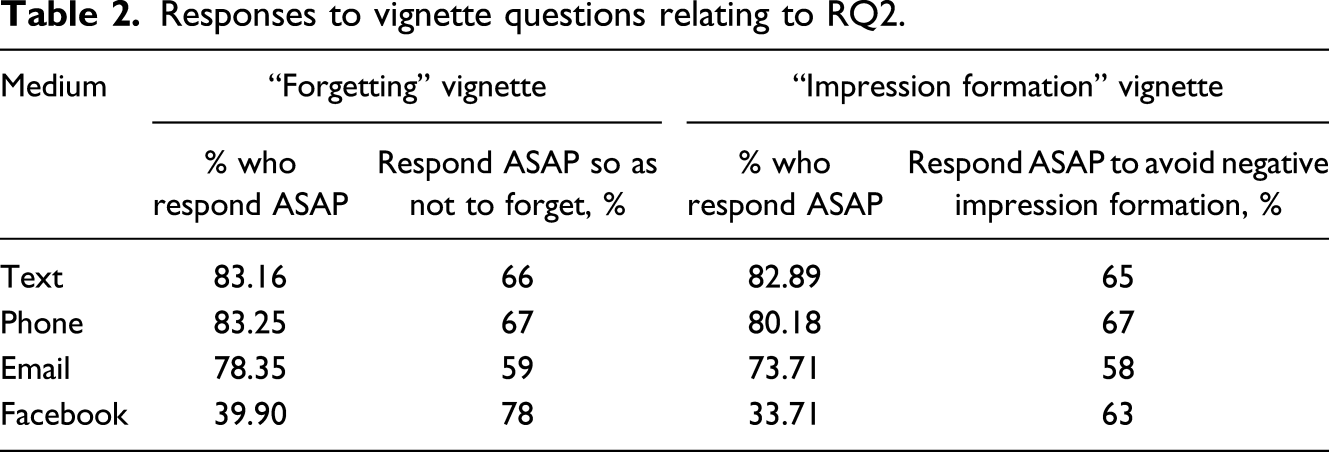
Responses to vignette questions relating to RQ2.
Discussion
Our findings suggest that chronemic urgency assignment is derived from the push and pull of divergent response time norms and availability expectations as well as underlying desires for speed as a form of impression management and efficiency. These all occur while we simultaneously try to (remember to) attend to various forms of communication from different people. Below, we elaborate these four interrelated issues. Following a discussion of specific findings, we address the broader theoretical implications.
Characterizing chronemic urgency
Table 1 helps us to understand the assignment of chronemic urgency. In the MTurk group, messages received through mobile calling and texting are the clear leaders in chronemic urgency, with a mean chronemic urgency of 0.783 and 0.713, respectively—both of which are significantly higher (Tukey–Kramer HSD groups A and B) than messages received through all other media (except WhatsApp, which is discussed later). Their high rank on the chronemic urgency scale is also expressed in the strong consensus (a low SD of about 0.4) of the mean chronemic urgency. These findings suggest classifying messages received through these two media as high chronemic urgency in this population.
Messages received through high chronemic urgency media might exhibit positive externalities. Such positive externalities, as well as the specific affordances of texting and mobile conversation, may lead to “winner takes all” dynamics such that a clear majority of the users assign messages on these two media a disproportionately high level of chronemic urgency. Furthermore, these two media themselves are generic and have been around for a long time: Mobile calling and texting features are ubiquitous and have existed on every mobile phone for some time, not only on smartphones. The combination of abundance and of seniority, as well as path dependency, is one explanation for the high chronemic urgency of messages received through these media.
The seven media whose messages exhibit midrange chronemic urgency are assigned a mean chronemic urgency that is close to zero ( +/− 0.4), but this urgency exhibits a relatively high standard deviation (0.6–0.7) which indicates a lack of consensus about the chronemic urgency that is assigned to them. In other words, some users assign them a high chronemic urgency, others assign them low chronemic urgency, and for others yet, they are midrange. These differences might be explained by the findings by Kalman et al. (2018) that users who identify as belonging to different social circles such as work, school, and family exhibit different chronemic norms. This possibility is demonstrated in the comparison between the MTurk data on midrange chronemic urgency media with that of the undergraduate and administrator participants. In these two groups of participants who study and work at the university, we see email messages being assigned a much higher chronemic urgency, probably since communication on campus with professors and administration occurs predominantly via email.
WhatsApp is a unique medium in that its messages span both the high chronemic urgency and medium-range urgency. It is on both the B and C Tukey–Kramer HSD groups. The mean chronemic urgency for these messages is relatively low (0.4), and the standard deviation is relatively high (0.76). Our interpretation of these data is that in the US population, there is a meaningful minority of the users who assign it high urgency, as they communicate with users outside the United States, where WhatsApp fulfills the role of texting (e.g., Karapanos et al., 2016; Montag et al., 2015; Shah and Kaushik, 2015; Treré, 2015).
Finally, messages received on media such as Snapchat, Instagram, and LinkedIn are assigned a significantly lower mean urgency, and the consensus about their urgency gradually tightens (from 0.7 to 0.5) as the urgency drops. Nevertheless, here too, we see evidence for the idiosyncratic nature of chronemic urgency assignment, with a small but meaningful minority of users whose norms are different and who assign messages on each of these media a level of urgency that is significantly different from the mean. One good example is messages on Twitter, which are assigned a low mean urgency by the MTurk group (−0.77), −0.52 by the undergraduates, and −0.85 by the administrators. Additionally, upon close inspection of the responses to the individual questions which comprise the chronemic urgency construct (not shown), we can see that Twitter messages are monitored quite closely, and even responded quite quickly, but it is not considered by many to be a medium for contacting someone urgently. Obviously, for some users such as journalists (Molyneux et al., 2018), or under some circumstances such as emergencies (Takahashi et al., 2015), messages on Twitter are assigned a high level of urgency. Snapchat is similar in that younger users (undergraduates) assign these messages a much higher level of urgency than older users and that—although, it is not typically used for urgent communication—it is still monitored closely and responded to quickly, probably due to its unique chronemic affordance of messages disappearing after a short period of time.
In conclusion, Table 1 provides a summary of the expectations and behaviors associated with messages received through each of the communication media. At this exploratory stage of research on chronemic urgency, these findings answer some of the fundamental questions about this construct, as well as raise issues that require further study.
Drivers for response times
RQ2 explored the extent to which participants tend to respond as soon as they can to messages received on various media and whether fast responsiveness is motivated by a wish to avoid forgetting to respond and/or to avoid giving the impression of ignoring the sender. Since only a quarter of the participants answered each of the questions (due to the random assignment), the sample size here is smaller, but the findings (found in Table 2) are informative. Clearly, and in line with the findings discussed so far, most users (83%) respond as soon as they can to the two high urgency media included in the questions: text and phone. A large majority of those confirmed that they do so to avoid forgetting to respond, as well as to avoid giving the impression that they are ignoring the sender. Nonetheless, it is not an overwhelming majority, and a significant minority did not agree with each of these statements. Interestingly, the percent of participants who respond ASAP to email messages, a midrange chronemic urgency medium, was somewhat lower (78%). Additionally, messages on Facebook, a low chronemic urgency medium, present a different pattern of user attitudes and behavior. Less than 40% respond to Facebook posts ASAP. Many of those who do, do so for the two reasons discussed here, but they are a minority.
In conclusion, in response to RQ2a, we find some support for a “responsiveness imperative,” but it is clear that this imperative is dependent on the chronemic urgency associated with messages on that medium. Apparently, the responsiveness imperative weakens as urgency drops. In response to RQ2b, we see that when users do feel compelled to respond ASAP, this is justified by wishing not to forget to respond and by wishing to avoid giving the impression of ignoring the sender. These preliminary answers require further exploration.
Social entrainment and chronemic urgency
In social entrainment theory, temporal rhythms are driven based on the relative power of a given pacer. Chronemic urgency helps to express and to illuminate how our rhythms are driven by others in a particular social group—for example, by other family members, by friends, by colleagues—as well as highlights the fact that we are often influenced by multiple powerful pacers. As such, we develop (whether consciously or not) and apply, either explicitly or implicitly, response rules in an effort to develop a manageable rhythm while still signaling where our loyalty lies.
Our findings, in conjunction with the qualitative findings by Kalman et al. (2018), suggest that messages received through low chronemic urgency media are checked periodically. They are not checked frequently throughout the day but rather at intervals determined by each user. Kalman et al. (2018) describe how these intervals are based on each individual’s preferences and unique exogenous pacers. They also show how these pacers reflect the participants’ membership in specific social groups such as school, work, and family. Thus, we see how the concept of chronemic urgency is similar to both time urgency in its link to attentiveness to time (Landy et al., 1991) and to situational urgency in its link to relationships (Kellermann and Park, 2001).
On the other hand, messages received on high chronemic urgency media do not show such entrainment patterns. Urgent messages can arrive on these communication media at any time of the day. It is impossible to know when they will arrive, and thus, these media need to be monitored closely throughout the day. If in the era that preceded the wide availability of digital communication, the physical location of people determined how urgent messages would be conveyed to them (via a coworker, through a landline call to the office or home, face-to-face, or even through a telegram delivered by hand), digital media decontextualizes the messages, and messages related to all domains of our lives arrive on the same media and often also on the same device (e.g., the smartphone).
As the number of media channels increases, we see that only a small number of media (two or three media) are delegated the role of high chronemic urgency. Messages on prototypically low-range and midrange media can still be used in a manner that is more patterned and cyclical based on their entrainment with the many and diverse pacers to which each person must respond. In order to make the system described here work, users assign different levels of urgency to messages arriving via different media. The high mean chronemic urgency assigned to messages on high urgency media and the low standard deviation (high consensus) of the chronemic urgency assigned by different users demonstrate the existence of widely accepted norms about messages on these media. On the other hand, these norms vary across users in regard to the midrange urgency messages. A good example is email, where messages are assigned high chronemic urgency in some organizational contexts where employees are expected to be on top of their email throughout the workday and outside of work hours too (e.g., Orlikowski, 2007; Perlow, 2012), while in other contexts, it is used only for occasional and nonessential communication. Thus, although—in principle—users could focus on messages received through only one or two high chronemic urgency media, the social norms of mediated communication are not uniform and show a high level of variance. Consequently, users need to develop the complex and idiosyncratic communication strategies described by Kalman et al. (2018) and reflected in the findings outlined in Tables 1 and 2.
EVT and chronemic urgency
“Communication expectancies are cognitions about the anticipated communicative behavior of specific others, as embedded within and shaped by the social norms” (Burgoon and Walther, 1990, p. 236). Chronemic urgency provides a novel measure of the social norms that drive chronemic expectations in digital communication. Both the perceived adherence and divergence from these norms serve as important cues that influence impression formation in online communication (Kalman and Rafaeli, 2011). Urgent messages need to be attended within a short period of time. For example, consistent with EVT, our findings demonstrate the high consensus around high chronemic urgency messages received through media such as mobile voice calling and texting. This high consensus enables users to manage their responsiveness to messages which arrive on these media throughout the day. We can thus also predict that expectations for quick responses to messages on high chronemic urgency media will be higher than expectations for responsiveness to messages on low chronemic urgency media. Furthermore, we hypothesize that the consequences of longer response latencies to messages delivered via high chronemic urgency media (versus via low chronemic urgency media) will be stronger, but that these will be moderated by communicator reward valence.
The dynamic and complex picture of norms that is portrayed in our findings enriches the empirical foundation of EVT, providing data that can inform new research on the complex role of chronemic cues in online communication, and particularly in online impression formation.
Who or what is exercising temporal agency?
Our findings raise an interesting theoretical question. When users assign chronemic urgency to a particular communication medium, who or what is the agent exercising the temporal agency? Is it the user or the medium? Is the level of chronemic urgency determined by the affordances of the medium or by the wishes and expectations of the users? It is tempting to look at Table 1 which lists the wide range of chronemic urgencies assigned to different media and conclude that the chronemic urgency is determined by attributes of the medium, but that interpretation ignores the wide range of urgencies assigned by different users to each medium. This range is more evident in messages sent via medium and low chronemic urgency media, where there is a high standard deviation (low consensus) between users on the level of chronemic urgency of messages sent through that medium (e.g., see the above discussion of the chronemic urgency of email, of WhatsApp, and of Snapchat). But even in the two media at the top of the list, there is no full consensus as evidenced by the standard deviation of about 0.3–0.4. Furthermore, although it is common to assume that different communication media have different affordances, this is slowly changing as each medium adds capabilities and options in order to better compete in the crowded ecosystem of communication media. A good recent example is the addition of a “Meet” button in Google’s email app soon after the COVID-19 pandemic drove up the use of video-conferencing apps (Lardinois, 2020). Google enhanced its email, a medium considered asynchronous textual and “lean,” with a “rich” synchronous and visual option. Given the digital nature of communication media, such changes are technologically simple and easy to perform, and we see evidence for such “feature creep” in almost every evolving communication medium.
Thus, the main source of variance in the chronemic urgencies that are assigned to different media is less the technological differences between the media and more in the users and the communication norms of the social groups they belong to. On the continuum between the human (individual) and the technological (medium), our findings place the exercise of temporal agency when determining chronemic urgency heavily on the side of the human agency, with only a limited amount of agency to unique technological features such as Snapchat’s limitation on the viewing of messages. This is in line with Flaherty’s formulation of temporal agency which demonstrates the agency of humans over time.
Applied implications of the findings
Chronemic urgency and associated temporal considerations can explain the strong “pull” of some communication media. This “pull” has significant applied implications in daily life and is mentioned in many contexts, such as separation anxiety from smartphones (Han et al., 2017; King et al., 2013), interfering with relationships (McDaniel et al., 2018), or dangerous distractions by smartphones such as in the case of distracted driving or distracted healthcare workers (Engelberg et al., 2015; Klauer et al., 2014). High chronemic urgency could be a powerful force that attracts users to check some media for incoming messages, as well as strengthens the urge to respond without delay (Frizell, 2015). Interestingly, there is a rough positive correlation between the likelihood that a medium will be used while driving (AT & T, 2015) and the medium’s chronemic urgency. A promising venue of research would be to evaluate the role of chronemic urgency on distracting technology use and its relation to other factors such as curiosity, locus of control, and self-extension. Furthermore, there is a powerful commercial incentive of app developers to increase the chronemic urgency of messages on their app and thus increase the number and length of usage sessions or to increase the probability the user will feel they might miss out on an opportunity to make an attractive purchase. This potential for commercial exploitation of chronemic urgency, and especially the development of algorithms that promote such exploitation (Rughiniș and Flaherty, 2019) is another potential applied aspect of chronemic urgency that should be studied and monitored.
Another speculative implication is that the exceptionally high chronemic urgency of messages received through mobile calling could explain the growing reluctance of users, especially young ones, to make and receive phone calls on their mobile, especially without prior scheduling over text or through another asynchronous medium (Alton, 2017; Brandon, 2017). Although the evidence for this is still anecdotal, given the extraordinarily high chronemic urgency of mobile calling (0.78 in the MTurk sample and 0.9 and 0.95 in undergraduates and administrators, respectively), it is possible that an unexpected mobile phone call feels as obtrusive as an unexpected knock on one’s home door: An acceptable action in urgent cases but not as acceptable (at least in the US culture) for routine communication.
Summary and conclusion
This study of urgency and of its manifestations in the daily use of digital communication media links two research streams that explore chronemics and temporality: Social entrainment and EVT. Social entrainment provides the theoretical framework that places temporality as a central component of social life, in general, and of everyday communication, in particular. Expectancy violations theory points to the importance of norms as shapers of expectations and motivated our search for such norms in the population. The findings reported here demonstrate how chronemic urgency aids in depicting the contemporary temporal landscape dominated by digital technologies in general and digital communication media in particular. Chronemic urgency echoes previous conceptualizations of urgency in everyday life and illuminates the complex temporal reality faced through social acceleration. This reality is characterized by a need to balance temporal affordances that simultaneously allow more flexibility through asynchronicity and mobility, while imposing the constraints of anytime and anywhere availability. Interlocutors achieve this balance by exercising their temporal agency and assigning differential levels of chronemic urgency to messages received through different communication media. While the human experience of urgency is not a new phenomenon, its manifestation is in flux, and chronemic urgency is a useful tool to study urgency in contemporary everyday life.
Supplemental Material
sj-pdf-1-tas-10.1177_0961463X20987721 – Supplemental Material for Chronemic urgency in everyday digital communication
Supplemental Material, sj-pdf-1-tas-10.1177_0961463X20987721 for Chronemic urgency in everyday digital communication by Yoram M Kalman, Dawna I Ballard and Ana M Aguilar in Time & Society
Footnotes
Declaration of Conflicting Interests
The author(s) declared no potential conflicts of interest with respect to the research, authorship, and/or publication of this article.
Funding
The author(s) disclosed receipt of the following financial support for the research, authorship, and/or publication of this article: This work was supported by the Open University of Israel Research Authority under grant 102238.

Supplemental Material
Supplemental material for this article is available online.
Note
Author biographies
References
Supplementary Material
Please find the following supplemental material available below.
For Open Access articles published under a Creative Commons License, all supplemental material carries the same license as the article it is associated with.
For non-Open Access articles published, all supplemental material carries a non-exclusive license, and permission requests for re-use of supplemental material or any part of supplemental material shall be sent directly to the copyright owner as specified in the copyright notice associated with the article.
