




Abstract
Despite the increasing participation of midlife women in sports, and biomedical and consumerist discourses encouraging physical activity, research on intersections of age, gender, and the body in sports is lacking or fragmentary. Based on in-depth interviews with Israeli women aged 40–60 years participating in marathons, ultramarathons, and triathlons, we explore how they experience their participation and how these experiences correspond with normative socio-temporal assumptions about midlife transitions, gender, and the body. Findings reveal that endurance sports enable midlife women to challenge dominant discourses on the “decaying” and “menopausal” body by undoing age and formulating gender narratives that include new identities and negotiations of temporal orders. The interplay between undoing age and redefining gender operates through two mechanisms: “embodied experiences” that introduce the body as a material reality and a source of critical knowledge, and the liminality of mid-age as a life-course transition characterized by the absence of institutional and symbolic anchors. We make a twofold contribution to the critical literature on gender and life course. First, we develop the concept of embodied experiences as a vantage point for understanding the intersections of age and gender. Second, we highlight the potential of participation in endurance sports for negotiating temporal orders and formulate new narratives of femininity and aging.
This year I improved my performance more than ever… I am faster. I broke my records in all distances …. I am perhaps the strongest I have ever been… so, where are the theories I once had about age?…they have vanished. I no longer believe in them. I see it on myself (Yvonne, 48).
Endurance sports have been on the rise in recent decades and are promoted by consumer and neoliberal discourses that associate athletic activity with the values of achievement, success, and personal fulfillment (Hylton, 2013; Liston, 2011). This expansion has occurred in parallel with a significant increase in the participation of women aged 40–60 years in marathons, ultramarathons, and “Iron Wo/Man” triathlons. Running USA (n.d.), a US not-for-profit that promotes distance running, attributes the “marathon mania” to the exponential increase in the share of women participating in marathons, currently about 45%, up from 10% in 1981, noting also the marked increase of women aged 40+ (www.runningusa.org). This trend is mirrored in Israel, where this article is empirically based, and where the proportion of women who completed marathons has risen from 3.4% in 2000 to 14% in 2017 (www.raceview.net).
Research typologies define the age range of 40–65 years as a “transition age” (Settersten and Mayer, 1997). Popular discourse refers to it as “mid-age,” “second age,” or, imprecisely, “menopause.” What draws women to the demanding arena of endurance sports at this point in their lives? How do they negotiate the terms of participation in a context of male predominance that glorifies youth and masculine demonstrations of strength? How does participation in such events affect their lives? Based on in-depth interviews with Israeli women older than 40 years – described here as “midlife” women – we examine how endurance athletes experience their participation in this arena and how their experiences correspond with normative socio-temporal assumptions regarding age, the body, and gender.
Two main reasons guide our research questions. First, as the opening quote implies, and as we learned throughout the interviews, endurance sports are a fertile arena for un/doing age and for examining how these processes relate to gendered perceptions of transitions in the life course of women. Second, despite the dominant public discourse that encourages physical activity and the increase of midlife women engaging in it, research on the intersection of age and gender in sports in general and in the endurance arena, in particular, is lacking or fragmentary. Thus, while the life-course literature critical of taken-for-granted ideas of time and age deals extensively with “transitions” (see, e.g., Elder, 1985; Kohli, 2007), relatively few studies focus on transitions concerning the gendered body of midlife women (Dillaway, 2005; Krekula, 2007). Similarly, while the feminist literature on sports focuses on how the body mediates between sports, gender, and society, it largely overlooks age and temporal transitions (Scraton and Flintoff, 2013), even though feminist research has long recognized the various ways in which doing age and doing gender are mutually implicated in a variety of social arenas (Gullette, 2002; Lahad, 2017). This article aimed to fill the research lacunae of critical scholarships on life course and on gender and sports and expand them in several ways. Empirically, we add the endurance sports arena as a site for the critical examination of the relationship between doing age and gender. Theoretically, we suggest the notion of embodied experiences as a vantage point for understanding the key role that the body, as an ontological and epistemological category, plays in challenging dominant constructions of age and gender and the temporal orders on which they are premised.
Based on the grounded theory, we argue that endurance sports enable midlife women to challenge gendered biomedical and social constructs of the “decaying” and “menopausal” body by undoing age and formulating gender narratives that include new identities and negotiations of temporal orders. As we show, the interplay between undoing age and redefining gender through endurance sports operates through two main mechanisms: (1) the embodied experiences that present the body as both an ontological reality and a way of critically knowing and experiencing reality and (2) the liminality of mid-age as a transition period characterized by the absence of institutional and symbolic anchors.
The following section presents our conceptual framework and situates our research questions in the broader feminist scholarship on life course and gender and sports. After describing the Israeli scene of endurance sports and introducing our research design, we analyze our main findings. The last section discusses our contribution to the broader scholarship on gender and life course focusing on intersections between gender and age.
Life course: Gendered temporal transitions without “midlife” bodies
The underlying idea in life-course scholarship is that interactions between temporal norms, power structures, and social institutions shape the paths, events, and timetables of people’s lives (Elder, 1985; Kohli, 2007). These factors are commonly regarded as constituting a conventional scenario of life (Wingens and Reiter, 2011), operating according to Newtonian views of time as something linear and absolute, detached from social context (Adam, 1991). Conventional scenarios are different from the feelings, memories, and fantasies that make up the experiential course of life (Dillaway, 2005), what Davies aptly called, “embodied time” (1996, p. 583). Tensions and gaps between the conventional and experiential life courses tend to appear primarily during “transitions” – periods of gradual or sudden changes in a situation or function, usually accompanied by new roles and/or movement between social settings (Elder, 1985).
Scholarly analyses of the biological and social factors shaping life-course transitions focus mainly on well-defined, institutionalized transitions such as the transition to early puberty or old age. However, they tend to overlook transitions characterized by liminality such as “middle age” (Gullette, 2002, 2008). Indeed, in the conventional life-course scenario, there is no defined institutional anchor or set of clear temporal boundaries and social expectations associated with middle age. Symbolically, middle age is also framed in ambivalent terms: positively, as a period of optimal performance in the labor market and relationships (Dillaway, 2005) and negatively, as a period of physical decline and depletion (Krekula, 2007; Toothman and Barrett, 2011). The increase in average life expectancy, combined with advances in medicine and technology that delay the onset of “old age,” further blurs the temporal boundaries of middle age and its symbolic meaning.
The socio-temporal ambiguity of mid-age transitions and the absence of institutional anchoring are gender biased. Whereas society tends to ignore biological changes in men, focusing rather on their career life course, it attributes women’s transitions to ill-defined biological factors, which are nevertheless presented as the decisive organizer of women’s lives. Gender bias is also evident in the common cultural narrative that reduces midlife women to a cluster of symptoms connected to the depletion of their reproductive hormones in ways that undermine the social–cultural place of the female body (Dillaway, 2005). Supported by powerful psycho-medical and biomedical discourses, public representations of “menopause” depict “menopausal” women in terms of “deficit”: the loss of sexuality, increased stress, mental deterioration, and general physiological decline. This deficit dictates two kinds of interventions in women’s lives. The first advocates hormonal drug intervention to supplement the biological deficit (Meyer, 2003; Ramirez, 2006); the other presents reconstructive surgical techniques – cosmetic or aesthetic surgery being the most common options – as a means of defeating time (Davis, 2013). These technologies are also related to capitalist and consumerist discourses that glorify youth and beauty as the basis for success. Thus, while the tyranny of age in postmodern society presents age as a resource in itself, it operates as a double standard for women compared to men (Gullette, 2004; Lahad, 2017).
Biased assumptions regarding women’s midlife as deficit, themselves based on linear perceptions of time as “flat” and abstracted from the complexities that lay behind the “dry facts of life” (Davies, 1996: 581), are also evident in critical academic discourse on the intersection between gender and age. For example, in social gerontology, the central lens for questioning gender–age relations is the “double jeopardy” theory, which argues that the combination of ageism and sexism makes aging more problematic for women than for men. However, as Krekula (2007) observed, this thesis is problematic because it emphasizes physical changes, while ignoring the intersections of age and gender with other contexts in the life course, such as career, family, or social relationships.1 Moreover, it conflates physical and social changes, even though, as Dillaway (2005) has shown, many women end their reproductive activity (supposedly the defining marker of “menopause”) via medical technologies long before the biological onset of menopause. Furthermore, in light of increasing longevity, menopause is now more likely to occur in midlife rather than in the last third of the life course.
By questioning the gender biases underlying socio-temporal conventions that privilege chronological age and physical change, feminist scholarship on the life course underscores the importance of a phenomenological perspective that highlights the lived experiences of midlife women. Such a perspective is crucial for understanding temporal transitions as anchored in past, present, and anticipated gendered experiences (Davies, 1996). Moreover, it is by relocating temporal transitions from abstract timelines in a context that we can uncover women’s own agency in doing both gender and age (Adam, 1991; Davies, 1990; Gullette, 2004, 2008; Laz, 2003).
Indeed, despite the fact that as with gender, age also requires a great deal of physical and mental performance in ways that eliminate age as a natural and given marker of identity, only recently has feminist research begun to explore the intersections of gender and age – and of doing gender and doing age – in various social arenas and of their influence on the lives of women. For example, Lahad (2017) revealed how socio-temporal markers construct the discursive position of being single in society as a violation of hegemonic temporal norms, labeling aging single women as damaged and nonnormative. Utrata (2011) highlighted the high social and economic value of women’s youth, forcing grandmothers to perform gender differently from their daughters, themselves mothers too. Moore (2009) examined the history of women’s work, articulating how age intersects with gender and race as a mechanism of instability, segregation, and occupational discrimination.
While this burgeoning scholarship acknowledges the significance of women’s own experiences of age and gender, missing from much of it is the corporeal dimension of the gendered body and its involvement in the processes of doing and undoing gender and age. The sports arena provides an opportunity to examine gender–age intersections where the central material element is the body and where the meritocratic discourse remains dominant. The choice of midlife women to participate in endurance sports reveals the tension between the negating discourses directed toward the midlife woman – as “decaying” bodies and/or as devoid of a social and symbolic place – and the meritocratic discourse within which “everyone is a winner.” We will examine this tension in the next section through a review of feminist and sociological studies on sports that focus on the relationship between the body and gender.
Women and/in sports: Body and gender without age
Seemingly, the centrality of the body as the corporeal anchor in the sports arena justifies the dominance of meritocratic discourses that downplay socially constructed categories of gender and age. However, the intense involvement of the body in sports and the recognition of its duality as both an ontological agent and an epistemological source of knowledge have led feminist research to take an interest in the potential of sports for critical thinking about doing gender (Markula, 2003; Young, 1980).
Thus, alongside classic questions concerning women’s accessibility, inequality, and representation in sports, feminist research has also addressed the stereotypes that track women toward “feminine” sports; the control of women and femininity through the normalization of heteronormativity and heterosexuality, expressed in the demands made of athletes to demonstrate their femininity and heterosexual sexuality; and the social classification of women who participate in physical-oriented sports such as football, rugby, and bodybuilding as masculine (see Scraton and Flintoff, 2013). Identifying the power mechanisms of doing gender in sports has certainly been central in poststructuralist scholarship influenced by Foucault’s work on “the technologies of the self” Markula (2003) and Butler (1990) work on gender fluidity and performance.
More recently, however, feminist scholars have redirected attention to the disruptive potential of undoing gender in sports. Influenced by Merleau-Ponty (2001) work on embodiment as both an active action of the living physical body and the means by which the body interprets and interacts with the social world, these scholars document a broad range of women’s embodied experiences in sports, highlighting the challenging potential inherent in the duality of embodied experiences (Allen-Collinson, 2011a, 2011b; Sykes, 2007). According to Markula (2003), “the technologies of the self” through sports produce not only a demanding code of self-ethics that controls the body but also critical thinking. It also heightens self-awareness, which can potentially undermine what is perceived as “natural” (e.g., femininity, motherhood, and menopause), while challenging identity boundaries and the aesthetic design of the self. If and when the disruptive potential materializes, the embodied practices in sports allow for “regendering”, a kind of “noise” in the normative discourse of femininity and masculinity. In other words, “self-technologies” in sports may be translated into a form of “redefining gender” precisely because they demand the embodied crossing of normative boundaries and the reinvention of the self in ways that challenge the dominant gender discourses.
Studies dealing with the political potential of embodied experiences in sports for undoing and redefining gender underscore the importance of approaching these embodied practices from a phenomenological point of view. However, they seldom address how embodied gender practices in sports intersect with age and aging, nor their broad implications for how midlife women experience life-course transitions and the temporal orders in which they live. This oversight leaves midlife women trapped in the linear biomedical discourse of menopause or in a neoliberal discourse that views sports as a matter of meritocracy and individualism, both detached from a socio-temporal context.
Setting the scene: Endurance sports in Israel
Physical activity in Israel is part of a broader discourse about maintaining a healthy lifestyle and a means of promoting physical fitness. However, until relatively recently, endurance sports have remained the preserve of elite athletes, mostly men.
The expansion of endurance sports into a popular leisure sport began a decade ago. Beginning with a single competitive long-distance competition that was the only such event until 2009, today the country hosts three international marathons (Tiberias, Jerusalem, and Tel Aviv) for participants whose numbers have increased each year. These major events are accompanied by dozens of competitive triathlons, half Iron Man competitions, and a full Iron Man, the Eilat “Isra-Man” – considered one of the most challenging Iron Man competitions in the world. Data from www.raceview.net, a website resource for endurance events in Israel, report that 4 (3.4%) of the 117 marathon finishers in 2000 were women; by 2017, this number had swelled to 2057 (14%) of a total of 14,460.
Initially, endurance sports were largely the preserve of middle-aged men, mostly upper middle class professionals from Tel Aviv endowed with the material and social resources necessary for this demanding activity. Particularly resonant in a militaristic society such as Israel, endurance sports created a space for reconfiguring existing models of Israeli masculinity in two ways. First, for men who had carried out their obligatory army service in combat units, endurance sports were an opportunity for reasserting a masculinity that may have diminished over time. For men who had completed their military service in noncombatant roles, endurance sports were an opportunity for reinvention (Run Panel Israel (2020); Hertzog and Lev, 2019; Tamir and Bernstein, 2013).
As the endurance sports community expanded to include running and triathlons, its ranks gradually became more accessible to women. One means of encouraging the participation of women was the designation of specific training activities for women – the perception being that women had different training requirements and needs. Nevertheless, for the pioneering women – also typically mid-age and upper middle class – it remained difficult to fully integrate into this culture. In part due to the absence of female sporting role models in a country where most of the media coverage revolves around men’s soccer and basketball (Adva Center, 2012); the women were forced to conform to a discourse shaped by Israel’s masculine and overtly militaristic orientation.2 In early competitions, for example, traditional participants’ t-shirts for women were available only in men’s size small.
Today, the presence of women in endurance sports is no longer an exception. Although we lack official data on the subject, evidence of this development comes from the expanding – and highly commercialized – discourse addressing women athletes exclusively. This discourse encompasses issues ranging from sports injuries, medicine, and nutrition to professional equipment and women’s wear.
Another clear indication of the growing appeal of endurance sports is the proliferation of online forums, including dedicated forums for women athletes, introducing new participants to the scene (see, e.g., shvoong.co.il). Given the scant media coverage of women in sports in Israel, and with few role models available in the public sphere, online forums covering the world of endurance sports have become a principal information source for this community in Israel. A common feature of these forums is the stories of women who have dedicated months of training to competitive activity. The recurrent themes in the forum relate to women’s motivation to take up running, swimming, or cycling; the challenges involved in their encounter with the outdoors – asphalt, trails, cycling routes, the swimming pool, and the sea and their experiences in adhering to a new and highly demanding lifestyle.
Transitions are also a recurrent theme for discussion. A particularly strong moment evoked in the forums relates to what participants usually describe as “the sky is the limit” moment, namely, the moment they felt ready to move to competitive events, frequently after a year or so of commitment to the new lifestyle. As one of these women who relied heavily on the online forums, Author 1 found not only a reflection of herself in the stories in the forums but also a great deal of relief in realizing that her personal experience in transitioning from a “couch potato” to an endurance athlete was more than a particular private moment.
Method
Our study draws on semistructured in-depth interviews. We chose this method because it is the most suitable way to make participants’ experiences accessible. It allows them to construct a meaningful “story” out of their emic perspective, while simultaneously enabling us to identify recurring themes and meaningful patterns (Glazer and Strauss, 1967).
On average, the interviews lasted 1.5 h. To promote systematic content analysis while allowing the interviewees to be flexible and spontaneous, we structured the interviews around common questions relating to why, when, and how they became involved in endurance sports and what it meant to them. At the same time, we gave them enough space for their own narratives about topics of their choice such as age, identity, difficulties, self-image, body image, work, family ties, relationships, and friendship. The first author conducted all of the interviews and transcribed them verbatim. Using grounded theory principles (Glazer and Strauss, 1967), we identified central themes around notions of “transitions,” “doing age,” “doing gender,” and “embodied experiences.”
Table of interviewees.
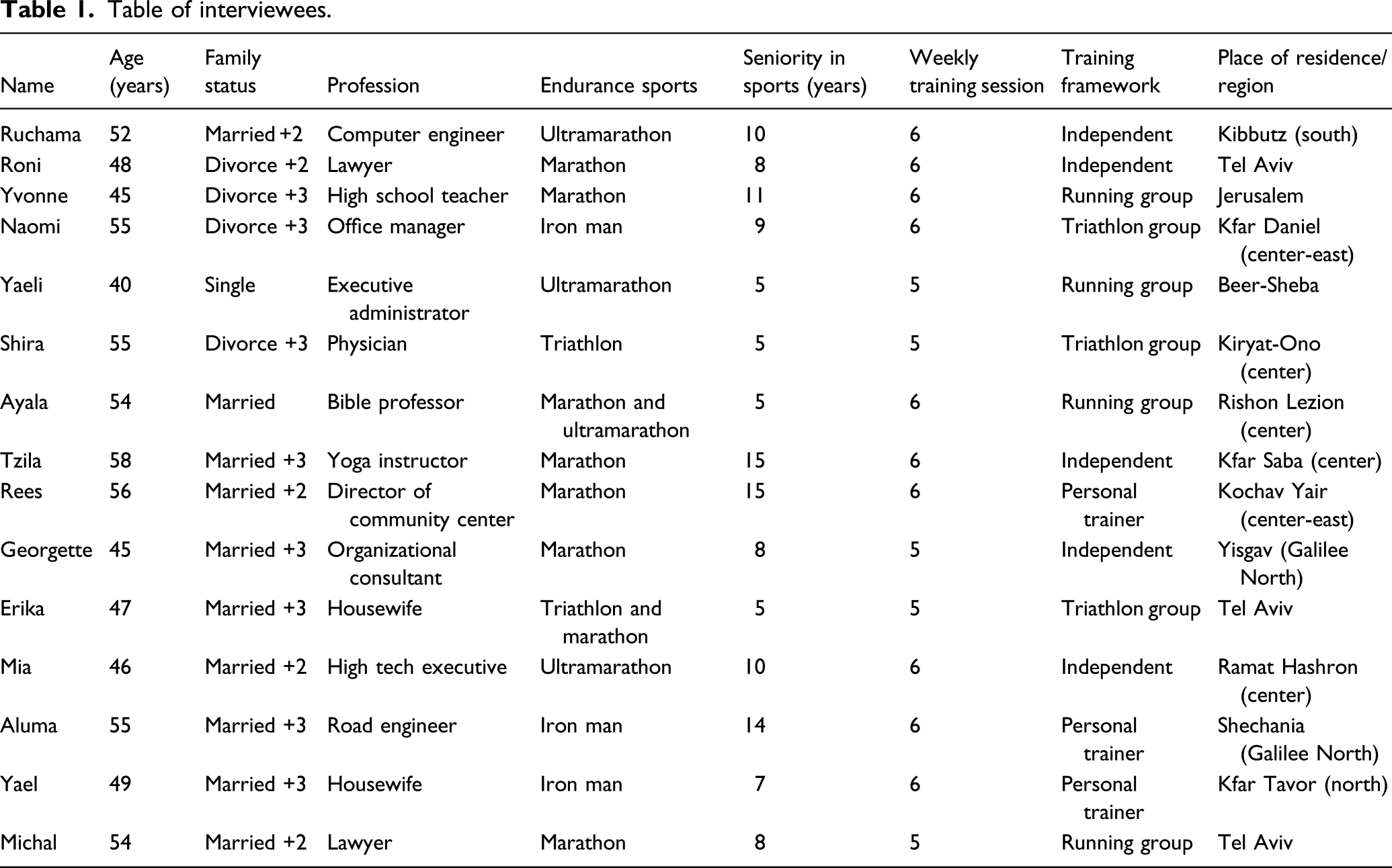
The study began with the first author’s personal acquaintance with two of the interviewees. The other participants were identified through a “snowball” method. The research topic was presented to them in advance by telephone, email, or Facebook messages. The women responded immediately and positively to the interview request and expressed great interest in the topic, often making extra efforts to shift their schedules to accommodate the interview meeting. The location of the interview was determined according to the participant’s wishes. At the meeting, the first author introduced herself and the research and asked for permission to record the interview, also asking them to choose a pseudonym to be used in the study. The fact that the first author also participates in endurance sports made it easier to establish a commonality between the researcher and the interviewees, contributing to a relaxed atmosphere and a mutual sense of comfort. The resulting closeness was manifested by the fact that on a number of occasions after the interview, several of the research participants contacted the interviewer, of their initiative, and asked to expand or clarify certain points that arose in the conversation. On occasion, the author also contacted some of the participants to elicit more information; without exception, all the women responded, sending their replies via e-mail. Most expressed a desire to read the research study once completed. In order to preserve anonymity, we refer to interviewees by their pseudonyms. However, the age of the participants, as cited, is accurate.
Undoing age, redefining gender identity, and negotiating temporal order
Our most significant finding indicates that despite powerful biomedical, consumer, and neoliberal discourses that portray midlife women as in a process of physical and social decline, the research participants derive the meaning of their participation in endurance sports from their embodied experiences in the endurance arena. These embodied experiences confront women with broad temporal aspects of their lives and open up possibilities for undoing the hegemonic paradigms of age, redefining their relationship with their bodies and sense of self-worth, and negotiating gendered temporal orders. Additionally, we also found that the absence of a positive model for representing midlife women allows endurance athletes to formulate new gender narratives and representations of femininity in midlife.
Undoing age: “This number has nothing to do with me”
You know that at some stage, because of age, you start to slow down. But according to the literature, it should have already happened, and I probably go against all the studies (Rees, 56).
One key question we asked the research participants was how they cope with the intense physical activity that endurance sports demand. Surprisingly, most of the respondents chose to note that they engaged in an ongoing internal dialog about their age vis-à-vis the dominant stereotypes of midlife women.
Without exception, the reference to “age” arose immediately at the beginning of the interview. When asked to present themselves, all interviewees chose to begin by stating their name and immediately afterward, their age: “I am Naomi, almost 55 years old” or “I am Ronni, 47 1/2 soon to be 48.” Their body language and intonation also disclosed engagement with age. While some of the women stated their names modestly and in a relatively soft voice, acknowledging their age was often accompanied by a straightening up, accompanied by a rounding up of the number.
When we asked them to reflect on how they experience their age in the endurance sports arena, they seemed glad to be given the opportunity to discuss this issue and present their personal viewpoint. As Yael and Michal described: Although I’m about to be 50 ... I do not feel that way. There are prejudices ... I do not want to deal with it at all right now. I do not know what will happen next ... as long as I feel physically able to do what I do, it does not bother me at all (Yael, 49). If I have reached menopause? Decay? [Grimaces] What a terrible word it is, menopause – no, it does not affect me at all, yet the physical symptoms were horrific (Michal, 54).
Their responses revealed an explicit gap between popular biomedical discourses about menopause and the actual experience of “age.” Some interviewees like Rees who argued that, “I probably go against all the studies,” were very explicit about the gap. Similarly, for Naomi, age seemed to “work in the opposite direction” than prescribed: I feel that I have a chronological age, but I feel completely different about it... I do not know how other people my age feel... I do a lot of things that young people do not even do, and this year is the year of my Iron-Man competition. (Naomi, 55).
The issue of “age” rose again when we asked how their social circles respond to their sporting activity. Tzila, a marathon runner, encapsulated the overall attitude in her response: Don’t you think you’re exaggerating? At your age? It’s dangerous. It’s not for your age anymore. You have to rest. At most, you can do stretching, yoga, or, what’s wrong with Pilates twice a week? (Tzila, 58).
These responses reflect the social expectations of midlife women to wind down and “act their own age.” In some cases, interviewees reported reactions that utterly negated the presence of women of a certain age in endurance sports. In other cases, demands for “doing age” invoked women’s marital responsibilities and heteronormative expectations. Yaeli, a 44-year-old single woman training for a 100-km ultramarathon, described it thus: They tell me: Instead of going to bed at 10 p.m. in order to get up at 5:00 a.m. for a run… at your age, you have to concentrate on family making, get married, and have children...otherwise, you'll regret it (Yaeli, 44).
All of the women were branded as going against what was expected of them at their age. However, Yaeli was also labeled as operating “out of time” as dictated by the temporal regime of the social and biological clock (Lahad, 2017), indicating that at her age she should already have a family and children. In accordance with the prevailing neoliberal rhetoric, she was expected to be an active entrepreneurial individual and “to concentrate on the making” (of a family, a career, and success). The meaning of this statement is both to “do age” and to “do gender” in a way that corresponds with the hegemonic social order that in the Israeli case is anchored in “family-ist” (Fogiel-Bijaoui, 2002) and “pronatalist” (Donat, 2011) orientations placing the family and motherhood above personal preferences. Disobedience to this hegemonic order is accompanied by constant allusions to the costs involved in this deviation.
Thus, our participants seem to challenge the biomedical discourse that condemns midlife women to decline (albeit, as we will show later, without necessarily disrupting heteronormative discourses that place the family as the supreme value). They do so with full awareness of the influence of biological age and cultural stereotypes of midlife women on their lives. Furthermore, it seems that they are not trying to repress or deny age, which they understand as a social convention that is incongruent with their subjective experiences. As Tzila put it, “This year I will be 58, and I say it out loud.” In the following, we examine whether and to what degree age is reflected materially in their athletic activity.
Redefining gender identity: “I love my body more than ever”
So what if my body does not look the way I want it to look. But it allows me to do great things. I love my body more than ever. I have come to terms with it. (Mia, 46)
The corporeal reality of the body in endurance sports is crucial. From the women’s accounts, we learned that the intensity of physical activity demands deep acquaintance with their bodies. This acquaintance is earned through many hours of training, perspiration, injuries, familiarity with different training regimes and their application, specific nutrition, and the appropriate equipment for the activity. Our participants contended that the intensive encounter with their bodies constituted an important learning process for their sports activity. Ronni, for instance, described how the embodied experience taught her to have faith in her body, despite her age: There is something that has to do with the experience [...] in my connection with my body ... which young women do not yet have… it has a great advantage in long-distance runs (Ronni, 48).
Interviewees reported that the acquaintance that they forged with their bodies resulted in feelings of self-confidence, competence, and vitality: I'm very busy with my age now, I am about to turn 50, I started with the hot flashes, and I look at the 50-year-olds who do sports and those who do not ... Not all of them have to be Iron Man, ok? But they are sportswomen ... And there is something about their being, about what they convey to the world ... something in the vitality I convey, in the sense of competence (Yael, 50).
Our participants often alluded to themes such as body trust, self-confidence, and self-efficacy. They presented these factors as a source of knowledge that allowed them to be critical of age-related essentialism, while simultaneously activating this critique as a tool to manage crises. Alumah, a road engineer who entered the triathlon world 14 years ago and has since participated in full Iron Man competitions, explained how the duality of the body as a material limitation to be worked upon and a source of critical knowledge operates: If I do not sleep at night because something is going in my body, hot flashes and/or sleepless nights, for example ... I'm exhausted during the morning run ... So, you can’t ignore it and say that nothing happened ... Is it related to age? Probably so. But because you have confidence and you know everything is temporary and passes ... so, this too shall pass, and everything will be fine (Alumah, 55).
Yvonne, a long-distance runner, noted her sense of emotional transcendence, physical strength, and improved performance, which heightened her self-worth: I improved this year more than ever [...] I’m faster. I have broken personal records this year in all my distances. I am [...], perhaps the strongest I have ever been. I experienced magical moments that are very elusive, as if I am flying, running in a flow, as if my body runs without me so smoothly[...] So, where are the theories I once had about age? ... they have faded and I no longer believe in them. I see it in myself (Yvonne, 45).
Ronnie described her sense of transcendence after crossing the finish line, despite the delusion of time versus the distance within the race: Wow, this is the summit of Everest: there’s no one stronger than me, no one better than me. I can conquer the world, ‘the best to the Air Force’3 [laughs]. It was not easy. A marathon is a hell of a run; you have been there – you know, there are miles you do not feel how they flew, all of a sudden, I was at 20k, as if time was flying or I wasn’t conscious. On the other hand, there are moments, especially between 32-36k…the watch is ticking, time is running out, but the finish line remains so far away. Like time is against me […]; eventually I became a finisher and that felt so awesome. (Ronni, 48).
Yvonne’s words distinguish between a temporal scenario based on “natural” definitions such as birth, maturation, and aging, and “unnatural” time determined by the clock (Urry, 2000). Thus, while “age” cannot be controlled or stopped, clock time, which has become a major factor in organizing modern societies and in formulating social practices, is revealed as a controllable, manageable, and improvable factor. This awareness is a formative aspect of Yvonne and Ronni’s perceptions of their age and abilities and their strengthened sense of self-worth resulting from their performance in endurance sports. However, in the absence of a narrative to draw from, Ronnie also adopted the dominant myths and symbols from the masculine discourse, such as “the best to the Air Force” and “Everest’s summit.”
These feelings confront women with the sports arena’s prevalent discourse in Israel, which tends to distinguish between the “competition” motivation of men and the “participation” motivation of women, in turn intensifying this distinction. For example, the slogans of the women’s triathlon – ‘Every Woman Can’ – and Athena4 – ‘Everyone wins,’ are directed primarily toward increasing women’s participation in sports by emphasizing the participation factor. Commercial companies and sports organizations also employ this principle in recruiting women for endurance sports, whether as consumers or members. In the Israeli context, however, the majority of the participants in the ultracompetitions are still men. In “Sovev Emek” 2019, the most popular ultra-trail run in Israel (66/100/166 km), only 10 of 163 participants were women. Thus, even though the ranks of ultracompetitions in Israel open up, they preserve this arena as masculine, keeping women as merely “participants.”
Some of our interviewees rejected this categorization as “participants,” explicitly declaring themselves to be “competitors.” However, they also emphasized that they had not started out with competitive or achievement aspirations. They maintained that this feature emerged as a by-product of their journey of self-discovery. The experience of success also helped them adopt a discourse that legitimized competitiveness and achievement without resorting to practices of concealment. …and then there was a race ... and suddenly I took my place in the podium, what?! I liked it a lot. It was interesting that for the first time, I was able to show the competitive part of myself openly, not to conceal it because we, women – we just participate ... always in the marathon, you see the men [...] flying, but I'm already experienced, and I say “wait-wait” ... [laughs] at 30k I leap over their bodies (Georgette, 45).
The experience of success led many interviewees to define clear goals and objectives, emulating a dominant practice among men in endurance sports. ... I knew exactly the result I was aiming for... I’ve planned everything so that all my training would lead me to this exact result. In general, I have a good grasp of reality and, obviously, lots of experience (Tzila, 58).
The concept of a woman saying “I am a competitor” in a mainly masculine field produced a range of responses. Some of these responses welcomed the presence of women competitors; others, like those that Yvonne described evoked the tenets of patriarchal power structures: Not only do I do sports but also my attitude towards sports doesn’t work out for them because if I do sports to lose weight, and I’m not competitive, I just came ... to participate …it’s okay ... but to come and be serious and competitive at my age is hard for them ... When they have no answer to my speed ... They say, “You’re not a woman, you’re like a man, well, you, you’re one of the guys, or you’re more man than many men I know.” I keep hearing that a lot, a lot. It is as if a woman can’t be like that; it is messy for them ... Along the way, some people suggested that I was a lesbian, especially when I got divorced.
This negation of Yvonne’s heterosexual femininity, marking her as masculine and a lesbian (and thus, “problematic”) reveals underlying power relations directed at minimizing and diminishing women in the endurance field by preserving the attributes of speed, competitiveness, and strength as masculine traits. Strong, competitive women who violate gender codes and cross gender boundaries are faced with a range of hostile responses – the most blatant being humiliation and the social undermining of their gender and sexuality.
The descriptions presented above indicate that the embodied experiences that endurance sports evoke help the women to challenge dominant social and biomedical discourses assuming a synchrony between biological, social, emotional, and cognitive temporalities (Davies, 1996: 582). By relying on their bodies as a source of strength and power, the women refuse to be passive objects and to some degree, succeed in expropriating knowledge about and exclusive control over their bodies away from the medical establishment. They also disrupt binary conceptualizations of abilities, participation, and competition, while sabotaging male dominance in this arena.
Thus, endurance sports appear to allow women’s bodies to act as a “protesting body” with which age is only an agreed measure and is open to negotiation. However, despite the women’s subjective feelings of competence, strength, and self-worth, the fact that they are required to invest considerable hours of training and exercise confronts them with a gendered temporal hierarchy between family, work, and leisure time.
Negotiating temporal gendered relations: “This is my time, but…”
Feminist studies show that leisure time is a key site for the production and reproduction of gender inequality and power relations (Taniguchi and Shupe, 2014; Thrane, 2010). Accordingly, our participants’ experiences reveal gendered cultural assumptions about socio-temporal orders that conflict with their own choices on how to invest their time.
A central aspect of this conflict is the societal regimentation of women’s leisure time relative to their parental responsibilities: This is most noticeable when a man trains for an Iron Man; he is a great man, and he is The Man! And when a woman does it ... So, they ask: who is with the children on Saturday5 morning when you go biking for 4 or 6 hours? [...] This question will not be directed at a man (Mia, 46). Because first of all, as a mother, the expectations are that I will be there ... and my husband making faces, especially on a Saturday long run. I was always under pressure to finish and return quickly, and I would not stay for a coffee after the run with my friends…, and there was also our ever-present natural guilt as mothers (Yvonne, 45).
Ronni, whose professional occupation involves frequent trips around the world, did not raise the problem of her absence from home for long periods in this context; but when the absence was related to her personal leisure time, she referred to the conditions that she imposed on herself: I have decided, and I stand by my decision until today… to be home by 7:00 a.m., to prepare the girls for school ... I get up at 4:00 a.m., go running in the dark, but I am back in time to send my girls to school. Even though they are grown up already... but until they go to the army,6 that’s how it will be (Ronni, 48).
Yael described the turning point when she put herself first as opposed to her traditional role as a mother, totally devoted to her family, as a family crisis: I had children, and my job was to be there for them, and suddenly, after 20 years, I got up and unilaterally changed the status-quo to “I'm going out” and “I am going out alone” ... There was a big mess, but I think that after 20 years, I convinced myself that I deserved it (Yael, 49).
The emphasis on parental responsibility as a primarily maternal responsibility, together with allusions to the cost and possible future sanctions, was repeated by many of the interviewees, intensifying the tension between the desire for personal leisure time and maternal and family commitments. As a result, the women had to engage in ongoing negotiations, not only with their immediate surroundings but also (and quite possibly, mainly) with themselves. Thus, when Tzila, the marathon runner, recognized the running experience as the “room of her own” – as the intellectual and emotional space without which she could not exist – she forced herself to consciously engage in strategies to please those around her: In order to get what you want and to live your place, you have to please everyone around you – so you can be yourself, to steal this niche. This is the most significant thing in my eyes, that for many years you please others in order to steal the time for yourself…and you support it with the ideology of “the mother of the year,” “the wife of the year,” while all you want is to be left alone, but I am most alive when I run alone (Tzila, 58).
Pleasing strategies take different forms. Michal and Naomi described a variety of coping strategies related to maternal time: In this sport, you need a supportive home ... I made them sandwiches in the morning. [...] I did my training before they got up. One gets up very, very early ... and yes, I always had home-cooked meals for them... (Naomi, 55). When I first started...they were still in school ... I would stop my training at 7:00 a.m. and called home... to make sure they had woken up and took the sandwich I had prepared before I left (Michal, 54).
With regard to intimate time with their spouses: It reached a stage that if my husband wants us to go out, unplanned – completely spontaneously, on Friday at 11:00 p.m., and I set a long run for Saturday, 3, 4, or 5 hours running, then I would not refuse. Because the relationship is more important and with all due respect to sleeping hours ... I will shorten them. I will sleep 3 hours and will be up for the run (Mia, 46).
Mia is a top executive in a high-tech firm, whose business trips and absences are part of her family’s routine. Mia does not give up her running training anywhere in the world and even shares it on various social media platforms. Nevertheless, she is adept at creating a clear socio-temporal order that places couple time and work time above her leisure time.
The women’s testimonies show that the superiority and importance of family time, marital time, and work time are not applied to them alone. They have internalized these expectations about gender roles and standards of good motherhood and partnerhood. They do not regard their choice to participate in challenging and demanding leisure sports as obvious or as solely dependent on their free will. Thus, in addition to strategies designed to please others, the women must also utilize other strategies in order to elicit sympathy and support from their families. As Alumah and Tzila described: Lots of quarrels and arguments on Saturdays when I had to go riding for a few hours, and I quickly realized that if I did not bring him around to me, it would be very bad, so I recruited my husband for bicycle riding on Saturdays (Alumah, 55). I persuaded him to join us for coffee after the long run, so he also sees who I’m running with, and he gets off my case (Tzila, 58).
To these, Yael (49) added the “agreement strategy”: When I trained for the TransAlp Race, there were also 7 and 8 hours of riding training ... I did them on Thursday and Friday by myself ... Yes, even though my team rides on Saturday and it’s much easier to ride together, I was at home on Saturdays. This was the agreement with my husband and family, and I respect this…was it hard? It was hell to ride alone for so many hours.
These quotations are in line with broader research on leisure and gender that identify consistent gender inequalities in the division of time. Thus, even though the entry of women into endurance sports signals that the boundaries between the private and public spheres have changed, the gendered temporal logic that distinguishes between them is still very much present.
Conclusions
What are increasing numbers of midlife women doing in the endurance sports arena, an arena that has become a contemporary form of the secular worship of masculinity, youthfulness, and success? How do they experience their participation and how these experiences correspond with normative socio-temporal assumptions about age, gender, and the body? Bringing together insights from critical life-course analyses of transitions and feminist scholarship on gender and sports, our study illuminates the duality of endurance sports as a social arena where midlife women are expected to “do gender” (Hargreaves, 2002) and “do age” (Laz, 1998). However, as we show, endurance sports are also an arena that opens up possibilities for undoing the hegemonic paradigms of age, redefining gender identity, and negotiating gendered temporal orders.
Our main finding highlights the glaring gap between the invariant timelines and unidimensional temporalities drawn by hegemonic discourses to depict women’ midlife transitions and our participants’ own embodied experiences. These embodied experiences portray the body as a powerful heuristic device for understanding how women experience and make sense of broad temporal aspects of their lives and how they influence their narratives of self.
Thus, on one hand, from the interviewees’ accounts, we learn about the persistence of conventional gender roles and life-course scripts in endurance sports. In the case of “menopausal” women, traditional gender expectations of doing gender and age are bolstered by authoritative biomedical discourses about the female body as sliding into physical stagnation, hormonal depletion, and general decay and by neoliberal discourses demanding the fixing, healing, and upgrading of the body.
However, from the perspective of the women athletes, it is thanks to the material developments that they experience with their own bodies in endless training sessions and demanding competitions that the “decay” model loses its grip, undermining linear perceptions of biological age as “natural” and social definitions of age as an absolute marker of identity and self-worth. Thus, it seems that the body of midlife women that the dominant discourses paint in shades of marginality and social irrelevance is precisely what allows for the deconstruction of chronological conventions about age and for the critique of hegemonic socio-temporal orders. In that sense, our analysis highlights the contribution of endurance sports for understanding time as embodied, that is, for relocating time in the subjects’ bodies “which are in turn enmeshed in history, culture, and space” (Davies, 1996: 583).
Alongside the critical presence of the body, the participation of midlife women in endurance sports is also characterized by “absence.” Our participants alluded to several dimensions of this “absence.” First, there is the absence of a collective narrative in Israel from which women can draw positive images of midlife women in public space generally and in sports in particular. The lack of inspirational models and collective images makes it difficult for them to conceptualize their embodied experience in endurance sports, driving them to imprint into these gap images drawn from masculine and military discourses that are largely detached from Israeli women’s own experience of military service (Sasson-Levy, 2003). The lack of role models is further intensified by the liminality of “midlife” as a transitional stage devoid of institutional and symbolic anchors in the conventional life course where the void is generally filled by negating discourses (Gullette, 2008; Toothman and Barrett, 2011). Thus, whereas for Israeli male athletes, endurance sports provide an opportunity for “reviving” or “fixing” their masculinity, midlife women athletes have either to prove everybody wrong or “reinvent” themselves.
Second, “absence” is also rooted in the gender and age biases inherent in the endurance arena itself. In the Israeli context, this arena draws not only on militarist imaginary, as described above, but also on meritocratic and consumerist discourses. Thus, as our participants described, the meritocratic discourse that uses body performance and male-centered parameters as the main measuring rod, or gendered binaries between “participation” and “competition,” permits marginalizing women in a predominantly male arena. Similarly, the centrality of consumer and health discourses that encourage the cultivation of the body as part of the technologies of the self entices women to enter the arena and partake in the neoliberal credo but leaves gendered temporal hierarchies between leisure, work, and family time intact. From this perspective, our findings are very much in line with broader scholarship on women in sports (Scraton and Flintoff, 2013) showing that allegedly gender and age blind discourses enable the entry of women into new arenas, insofar as they do not unsettle the dominant gender order.
While women’s participation has transformed neither the male-centered definition of endurance sports nor the gendered temporal hierarchies facing Israeli women, we found that it has nevertheless had a transformative effect on the lives of the participants. As we showed, an unintended consequence of midlife women’s participation in endurance sports is that it allows them to acquire new knowledge about their bodies and develop a new narrative toolbox, replete with positive evaluations and images that undermine gender and age as absolute and natural markers, a process known in the literature as “undoing” age and gender (Krekula, 2009). These processes of deconstructing age and redefining gender in endurance sports are fraught with tensions and gendered social expectations. But they are also part of an ongoing inner dialog that women in midlife conduct with themselves based on what they experience with their bodies. Therefore, while gendered social expectations lead women to pleasing strategies and endless negotiations about temporal hierarchies, their bodies tell them otherwise regarding who they are and what they are able to achieve. Moreover, the processes of undoing age and redefining gender narratives are mutually reinforcing. Thus, to a great extent, the possibility of developing a “bond of trust” hitherto nonexistent with their bodies and a reappraisal of their femininity are tied to practices that undo social conventions regarding mid-age and aging as a limited and limiting process.
Surely, the transformative potential of endurance sports is not limited only by gendered expectations. Persistent class and ethnic hierarchies in Israeli society structure the opportunities available to women for participating in a social arena that demands considerable material resources and symbolic legitimacy. The fact that our participants are overwhelmingly middle class and belong to the Jewish majority raises the question of whether the opportunities for participating in and experiencing the transformative potential inherent in endurance sports are open to all Israeli women in the same way. Taking a cue from critical feminist scholarship on leisure sports elsewhere (Taniguchi and Shupe, 2014; Thrane, 2010) and on stratification in Israel (Sasson-Levy, 2003), we can assume that class, ethnicity, and gender intersections play a significant role in structuring the endurance sports arena and experience. Nevertheless, this critical question is a topic for further study.
In conclusion, the embodied experiences of the women involved in the study are embedded in the physical intensity of the body experienced in the endurance sports arena, together with the activation of their critical agency. These embodied experiences invite us to regard “gender,” “body,” and “age” as powerful ontological categories that bear no “natural” correspondence with the dominant epistemological concepts of time and life-course transitions. The recognition of these categories as flexible signifiers of identities and meanings, as sites of cultural conflict, and as the basis for knowledge and action enables us to shift away from abstract timelines and uncover women’s own agency (Davies, 1990, 1996) as they produce new gender narratives of women in midlife. In this sense, our analysis joins Gullette’s (2002)7 call for a theoretical reconceptualization of midlife as a political and feminist act that allows women to constitute themselves as new autobiographical subjects.
Footnotes
Declaration of Conflicting Interests
The authors declared no potential conflicts of interest with respect to the research, authorship, and/or publication of this article.
Funding
The authors received no financial support for the research, authorship, and/or publication of this article.
