



Abstract
Although research on padel has increased in recent decades, the evolution of physiological responses and the analysis of muscular fatigue during competition have been scarcely investigated. This study aimed to analyze the progression of physiological responses and neuromuscular capacity throughout matches in amateur padel players. A total of 52 amateur players participated. Heart rate (HRpeak, HRavg), time in intensity zones (Z1–Z4), and internal load (TRIMPEdwards) were recorded across sets. Countermovement jump (CMJ) and handgrip strength were assessed pre- and post-set. Significant rises were observed in HRpeak and HRavg between set (S) 1 and S2 (p ≤ 0.035, d = −0.16 to −0.17, no effect). Regarding time spent in Z2 and Z3, notable increases were found between S2 and S3 (p ≤ 0.006, d = −0.71 to −0.86). For Z4, significant increases were also observed between S1 and S2 (p = 0.047, d = −0.26), and between S2 and S3 (p = 0.043, d = −0.58). Moreover, TRIMPEdwards significantly increased from S1 to S3 (p < 0.001, d = −1.18) and from S2 to S3 (p < 0.001, d = −1.32), indicating greater physiological demands in the final sets. No performance decline associated with fatigue was observed in CMJ or handgrip tests. The highest physiological demands occurred in the third set, highlighting the need to train cardiovascular endurance and the ability to sustain high-intensity efforts.
Introduction
Padel is an emerging racquet sport that has experienced exponential global growth, establishing itself as one of the fastest-expanding disciplines both in recreational 1 and competitive contexts. 2 This sport is played in pairs on an enclosed 20 × 10 m court, bounded by glass walls and metal mesh, both of which are active components of the game. 3 This intermittent sport, characterized by constant decision-making, induces the production of various myokines that mediate communication between skeletal muscles and the brain, positively influencing brain function. 4 Moreover, padel requires a specific combination of technical, tactical, and physical skills, which has sparked growing interest within the scientific community to understand the actual demands imposed during competition.5,6 However, despite its widespread growth in terms of participation, the number of studies analyzing its physiological and neuromuscular demands remains limited, hindering the development of evidence-based training programs aligned with the sport's specific requirements.
From a physiological perspective, padel is an intermittent sport that combines explosive actions with periods of active and passive recovery. 6 Players perform multidirectional movements, accelerations, decelerations, and high-intensity strokes, which demand a combination of aerobic endurance, anaerobic power, and neuromuscular control.7,8 Previous studies have shown that the average heart rate (HRavg) during a padel match remains at moderately high levels, 9 with notable peaks of higher intensity during key moments of play. 10 However, the progression of these parameters throughout a match and the potential onset of fatigue during competition have been scarcely analyzed in padel, 11 leaving unanswered questions about the actual impact of accumulated effort on player performance.
The analysis of fatigue in padel is essential to understand its effects on performance and to optimize players’ physical preparation. Fatigue can be defined as the reduced ability to maintain performance, resulting from both central and peripheral mechanisms that impair neuromuscular function. 12 Research on this phenomenon remains limited in padel, and existing studies have only reported findings from professional players. 11 The literature suggests that physiological and neuromuscular responses are not significantly affected throughout the course of a match.9,13 However, several authors have reported variations in neuromuscular performance, noting significant increases in jump capacity after the match.11,14 This inconsistency in findings highlights the need for further studies that thoroughly examine the potential onset of fatigue and its impact on player performance. Given that amateur players represent the majority of the padel population worldwide, but their physiological and neuromuscular responses remain scarcely explored, focusing on this group is essential to better understand the specific demands of the sport. Therefore, the aim of the present study was to analyze the physiological and neuromuscular responses during a match in amateur padel players, assessing whether significant changes occur between sets and determining the presence or absence of fatigue. This information may be key to developing more specific and effective training programs tailored to the actual demands of the game.
Method
Participants
A total of 52 amateur male padel players participated in this study, with a mean age of 35.73 ± 11.55 years, a height of 178.3 ± 6.7 cm, a body mass of 79.6 ± 10.6 kg, and a BMI of 25.0 ± 2.5. The sample was selected using non-probabilistic convenience sampling. To be included in the study, participants had to meet the following criteria: (i) have at least one year of regular padel practice experience; (ii) not have sustained any injuries in the previous three months; and (iii) present no medical conditions that could compromise their physical or motor performance during matches and data collection. Each player competed in a single match, allowing for the analysis of 13 matches in total, of which 6 concluded in the second set (2–0), while 7 extended to a third set, with a cumulative match time of 2976 min and 7904 points. The study was conducted in accordance with the ethical principles set out in the Declaration of Helsinki 15 and was approved by the Ethics Committee for Research Involving Human Subjects of the University of the Basque Country (UPV/EHU), under approval code CEISH M10/2024/167.
Procedure
The study was conducted in a certified sports facility under controlled conditions to ensure the accuracy and consistency of measurements. Prior to each match, participants completed a structured warm-up consisting of five minutes of continuous running at moderate intensity, followed by joint mobility exercises and dynamic drills designed to activate key muscle groups involved in padel. After the warm-up, baseline assessments were conducted to evaluate players’ initial physical condition (T0). These assessments included a countermovement jump (CMJ) test and a handgrip maximal isometric strength test. Participants performed two trials of each test. For subsequent statistical analyses, the highest value obtained between the two attempts was selected as the representative measure, thereby ensuring that the data reflected the participant's maximal performance. Once these evaluations were completed, players competed in a doubles-format padel match. Matches were organised according to the competitive level of the players, as determined by an internal ranking system used by the sports performance centre. This system adjusts players’ levels based on their previous match results, thereby ensuring balanced pairings. Throughout the match, various physiological and performance variables were monitored, including heart rate, set and total match duration, the outcome of each set and the match as a whole, and the total number of points played. Immediately after the completion of each set [first set (S1), the second set (S2), and third set (S3), if applicable], players repeated the CMJ and handgrip tests at three-time points: after set 1 (T1), after set 2 (T2), and after set 3 (T3) (Figure 1). The research team carried out all measurements following a standardized protocol.
Measurements
Assessment of Vertical Jump Capacity: Vertical jump capacity was assessed using the countermovement jump (CMJ), performed with both legs and hands placed on the hips. 16 This posture allowed for the isolation of explosive force production in the lower limbs while minimizing the influence of arm movement. 17 Participants were allowed to freely adjust the degree of hip and knee flexion during the countermovement phase in order to optimize execution based on their individual biomechanical strategies.18,19 Jump height was recorded using a high-precision optical measurement system (Opto Jump Next®, Microgate, Bolzano, Italy). 20
Assessment of Isometric Forearm Strength: Isometric forearm strength was measured using the handgrip test, which was performed with the arm fully extended vertically alongside the body. 21 The assessment was conducted using the dominant hand, which is the hand habitually used to hold the racket during play, and each isometric contraction was maintained for a duration of 5 s. A manual dynamometer (5030j1, Jamar®, Sammons Preston, Inc., United Kingdom) was employed to ensure measurement accuracy.
Heart Rate: Heart rate (HR) monitoring was performed using a portable device (Polar V800, Kempele, Finland), following the methodology used in recent research. 9 The data obtained were transferred and analyzed using Polar Flow software (version 4, Polar, Kempele, Fixnland), allowing for the extraction of the following variables: (i) peak heart rate (HRpeak), (ii) average heart rate (HRavg) and (iii) percentage of mean heart rate relative to HRpeak (%HRmean). Additionally, the time (in minutes = min) spent in different cardiovascular intensity zones was determined based on the percentage of HRpeak, in line with previous studies.22,23 These zones were categorized as follows: low (Z1) (<75% HRpeak), moderate (Z2) (75–85% HRpeak), high (Z3) (85–95% HRpeak), and maximal (Z4) (>95% HRpeak). Furthermore, the internal match load was evaluated based on total playing time, considering its distribution across five intensity zones. 24 The quantification method was based on assigning a scoring factor to each zone by multiplying the accumulated time (min) in each by its respective coefficient: Zone 5 (90–100% HRpeak) = 5 points, Zone 4 (80–89% HRpeak) = 4 points, Zone 3 (70–79% HRpeak) = 3 points, Zone 2 (60–69% HRpeak) = 2 points, and Zone 1 (50–59% HRpeak) = 1 point. Finally, total internal load (TRIMPEdwards) was calculated by summing the scores obtained across all zones.24–26 For the calculation of TRIMPEdwards and intensity zones, HRpeak was defined as the highest heart rate value recorded by each player during the entire match, and HRpeak was also calculated for each set to analyze intra-match variations.
Recording of Temporal Variables and Match Outcomes: Temporal variables and match outcomes were recorded using a manual stopwatch and the mobile application Padel Watch (https://padel.watch). The stopwatch was used to quantify the match's total duration and the specific time of each set. The Padel Watch app was used to record the final match score, the outcome of each set, and the total number of points played in each set and throughout the entire match, thus providing a detailed analysis of competitive performance.
Statistical analysis
Data are presented as mean ± standard deviation. The Shapiro-Wilk and Levene's tests were used to assess data normality and homogeneity of variances, respectively. To analyze differences across the different time points of the match for both physiological responses (set 1, set 2, and set 3) and test results (T0, T1, T2, and T3), a repeated measures ANOVA was conducted with Bonferroni post hoc corrections. Effect sizes for each pairwise comparison were calculated using Cohen's d. The qualitative interpretation of these values was as follows: d = < 0–0.1 (no effect), 0.2–0.4 (small effect), 0.5–0.7 (intermediate effect), and 0.8– ≥ 1.0 (large effect) 27 and rb = <0.10 (very small), 0.10–0.29 (small), 0.30–0.49 (moderate), ≥ 0.50 (large). 28 To examine the association between physiological responses and changes in physical performance variables across the full match and individual sets, Pearson's correlation coefficient (r) was used. Correlation coefficients were interpreted qualitatively as follows: 0.00–0.30, negligible; 0.30–0.50, low; 0.50–0.70, moderate; 0.70–0.90, high; and 0.90–1.00, very high.29,30 All statistical analyses were conducted using JASP software (version 0.18.3, Amsterdam, The Netherlands). Statistical significance was set at p < 0.05.
Results
The average total match duration was 57.23 ± 15.72 min, with a mean set duration of 21.65 ± 6.19 min in S1, 20.94 ± 4.43 min in S2, and 28.19 ± 7.23 min in S3. Significant differences were found between S1 and S3 (p < 0.001, d = −1.35, large effect) and between S2 and S3 (p < 0.001, d = −1.35, large effect), with S3 being the set with the longest playing time. Regarding scoring, the average total number of points played per match was 152.00 ± 40.44, distributed as 60.12 ± 15.28 points in S1, 56.39 ± 9.35 points in S2, and 72.59 ± 18.32 points in S3. In terms of average total points per set, significant differences were observed between S1 and S3 (p = 0.020, d = −0.79, moderate effect) and between S2 and S3 (p < 0.001, d = −1.22, large effect). Table 1 presents the results of the players’ physiological responses (HRpeak, HRavg, %HRmean, time in Z1, Z2, Z3, and Z4, and TRIMPEdwards) during the entire match and for each set.
Results of physiological responses for all players across the different sets of the match (S1, S2, and S3).
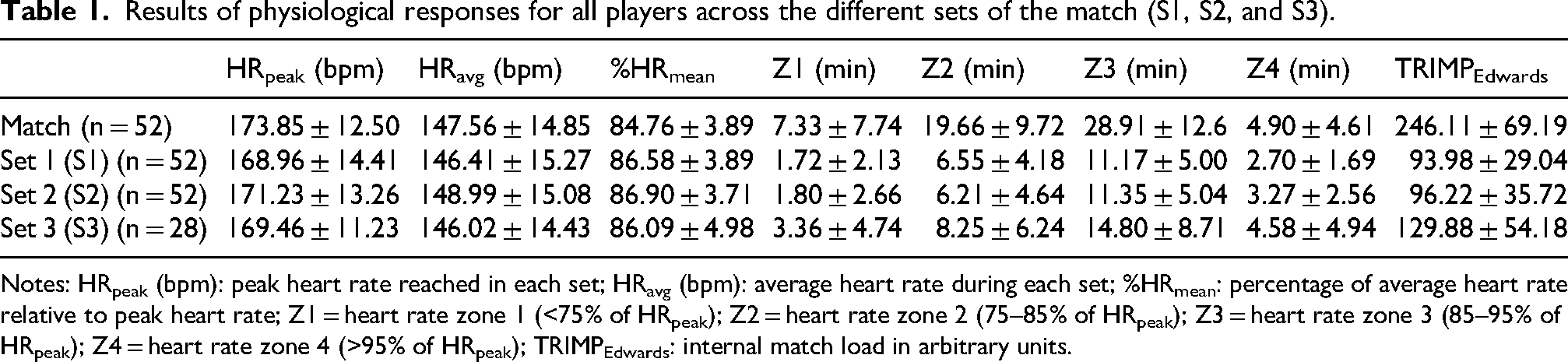
Notes: HRpeak (bpm): peak heart rate reached in each set; HRavg (bpm): average heart rate during each set; %HRmean: percentage of average heart rate relative to peak heart rate; Z1 = heart rate zone 1 (<75% of HRpeak); Z2 = heart rate zone 2 (75–85% of HRpeak); Z3 = heart rate zone 3 (85–95% of HRpeak); Z4 = heart rate zone 4 (>95% of HRpeak); TRIMPEdwards: internal match load in arbitrary units.
Regarding the evolution of physiological responses between sets throughout the match (Figure 2), significant differences were observed between S1 and S2, with increased values in HRpeak (p = 0.035, d = −0.16, no effect), HRavg (p = 0.004, d = −0.17, no effect), and Z4 (p = 0.047, d = −0.26, small). Additionally, differences were found between S1 and S3 in Z4 (p = 0.043, d = −0.58, intermediate) and TRIMPEdwards (p < 0.001, d = 1.18, large), with both variables showing higher values in S3. Lastly, significant increases were observed between S2 and S3 in time spent in Z2 (p = 0.006, d = −0.71), Z3 (p = 0.004, d = −0.86), and TRIMPEdwards (p < 0.001, d = −1.32, large), with all three variables showing higher values in S3.
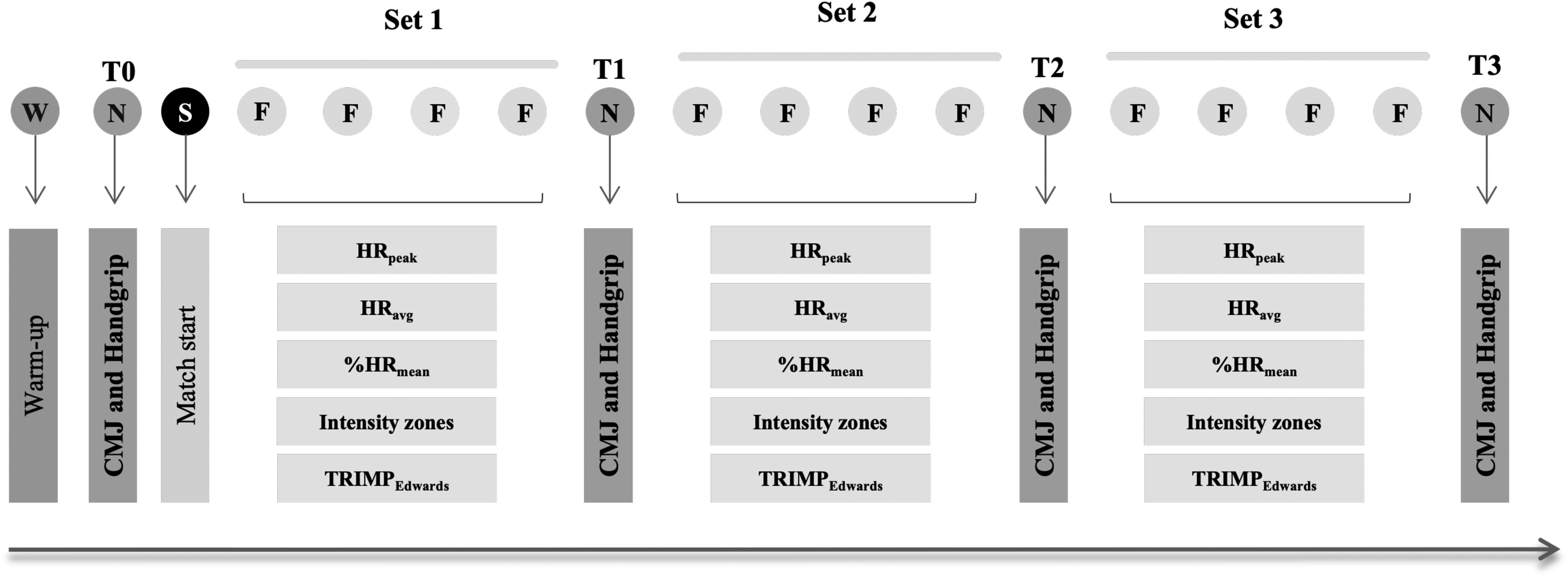
Experimental procedure of the study, illustrating the measurements conducted before the match (T0) and after each set (T1, T2, T3), including countermovement jump (CMJ) and maximal isometric handgrip strength, along with the monitoring of physiological variables during the different sets of the competition.
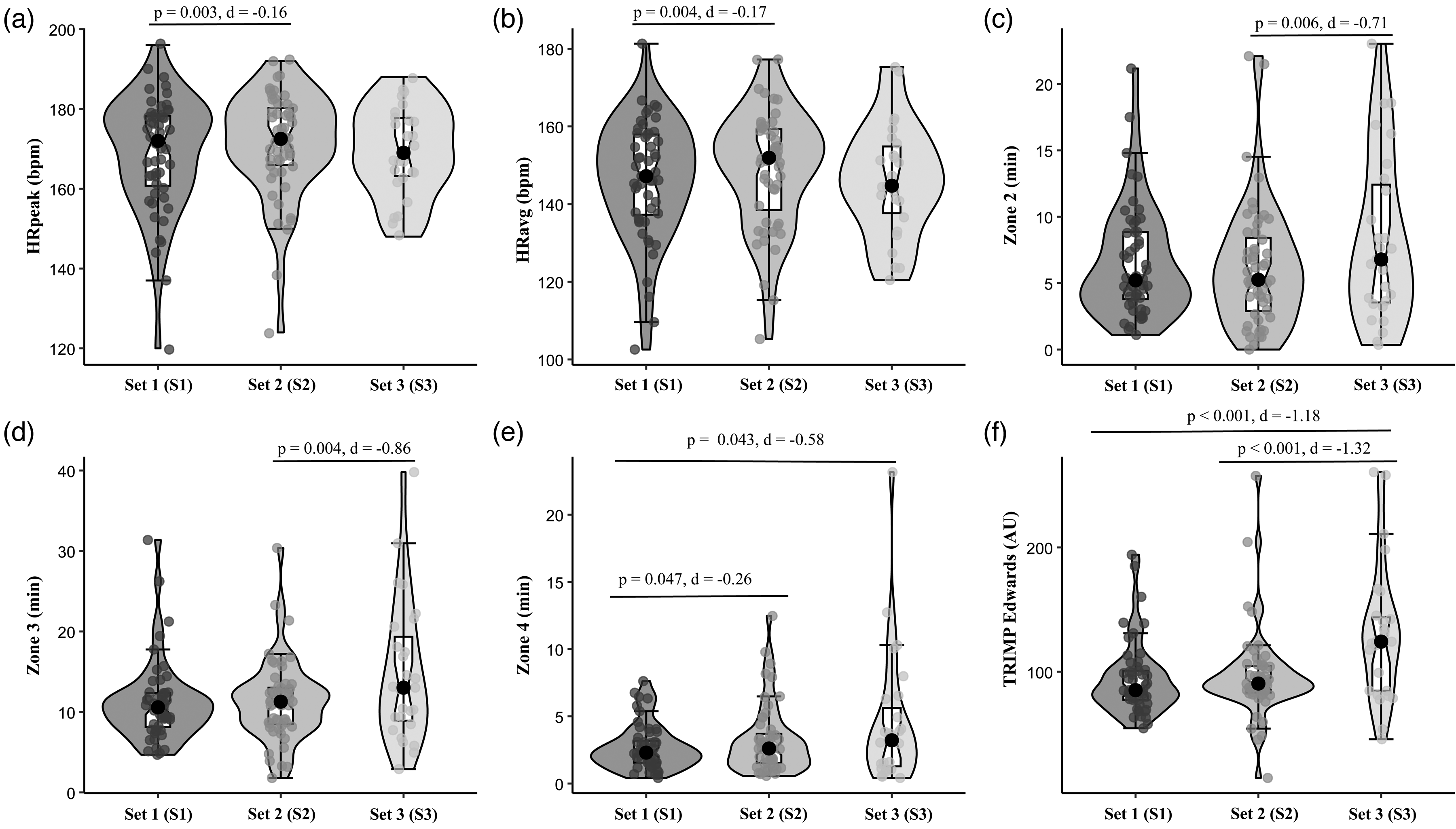
Evolution of physiological responses in amateur padel players: (a) peak heart rate (HRpeak), (b) average heart rate (HRavg), (c) time in cardiovascular intensity zone 2, (d) time in cardiovascular intensity zone 3, (e) time in cardiovascular intensity zone 4, and (f) evolution of TRIMPEdwards across the different sets.
On the other hand, Table 2 presents the results of players’ jump capacity and handgrip strength throughout the match, broken down by T0 (pre-match), T1 (after set 1), T2 (after set 2), and T3 (after set 3).
Results of jump capacity and handgrip strength at different time points during the match (T0, T1, T2, and T3) for the total sample of participants.

Note: T0: initial assessments; T1: after set 1; T2: after set 2; T3: after set 3.
Regarding the evolution of neuromuscular responses between sets throughout the match (Figure 3), significant differences were observed in CMJ values between T0 and T1 (p < 0.001, d = −0.89, large), T0 and T2 (p < 0.001, d = −0.81, large), and T0 and T3 (p < 0.001, d = −0.79, intermediate). In contrast, for handgrip strength, significant differences were found only between T0 and T1 (p = 0.040, d = 0.25, small).
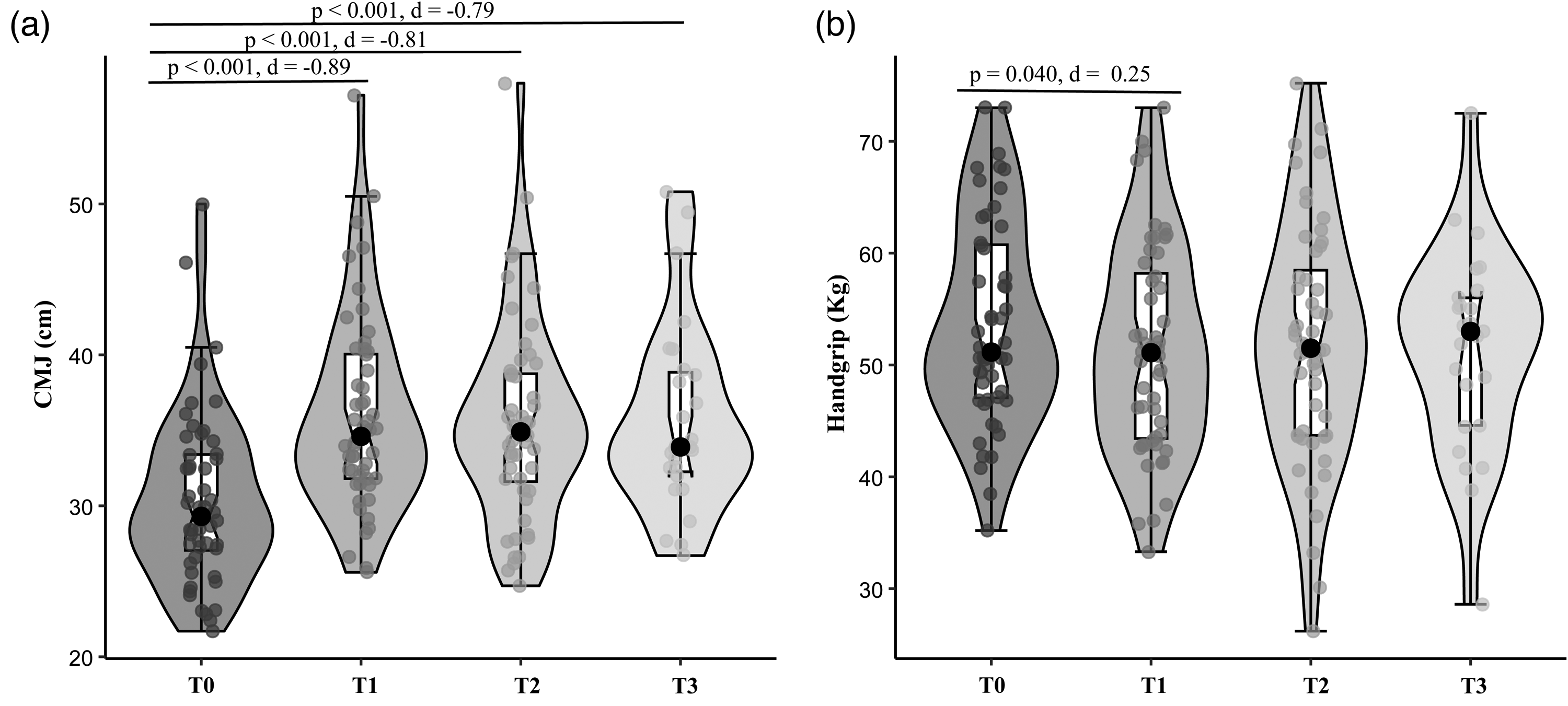
Evolution of countermovement jump (CMJ) capacity and maximal isometric handgrip strength in amateur padel players across the different measurement time points.
The correlation analysis revealed significant associations between various physiological variables and match-related parameters (Figure 4). A positive correlation was observed between the total number of points played and the TRIMPEdwards for the entire match (r = 0.60, moderate, p < 0.001) (Figure 4(a)). Similarly, a positive correlation was found between the total number of points played and the percentage change in jump capacity from the beginning to the end of the match (T0-T3) (r = 0.30, low, p = 0.030) (Figure 4(b)). Lastly, a negative correlation was identified between match duration and the percentage change in handgrip strength from the beginning to the end of the match (T0-T3) (r = −0.34, low, p = 0.013) (Figure 4(c)). However, no significant correlations were observed between physiological responses and changes in neuromuscular capacities across the different sets.
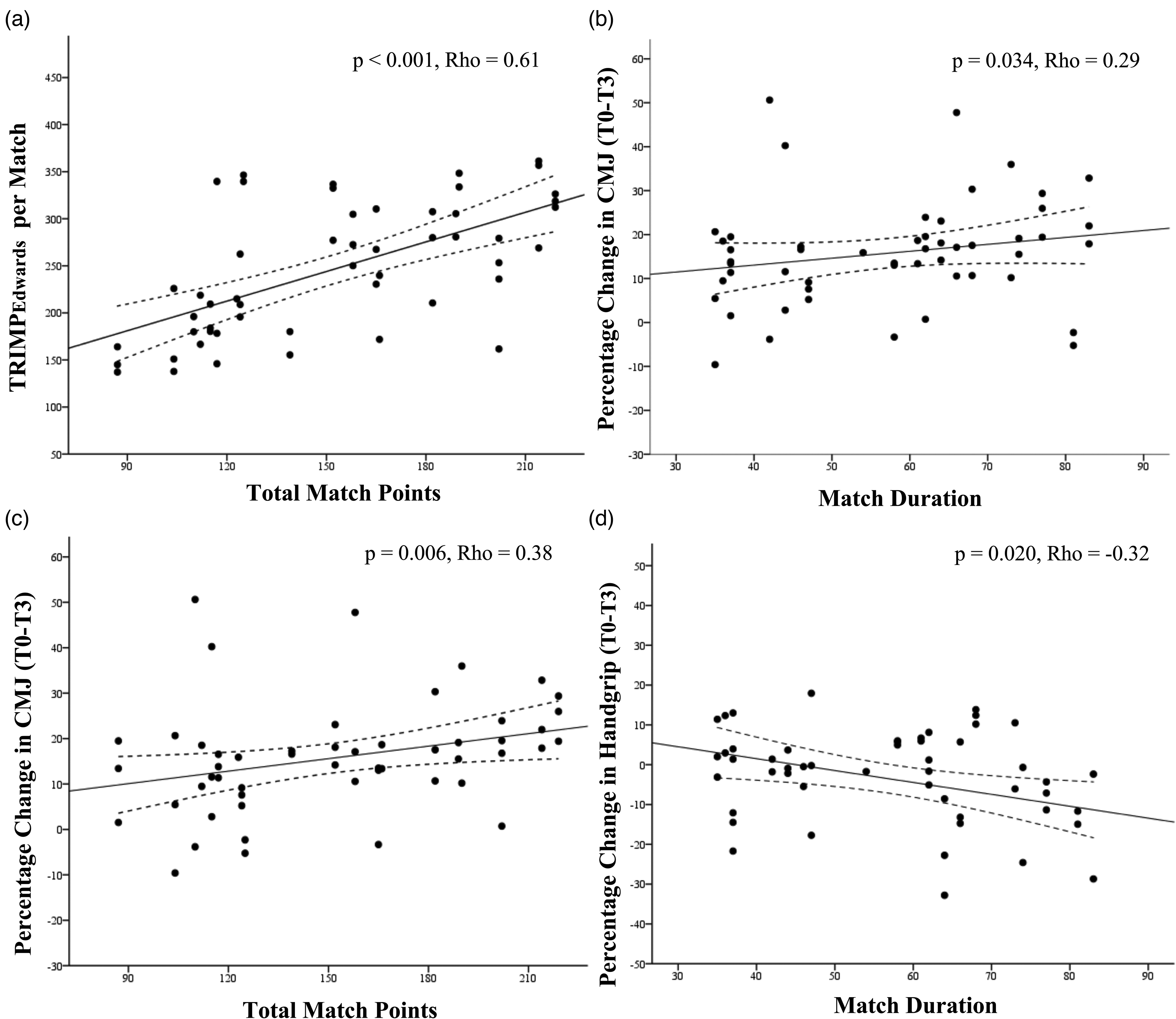
Correlations between physiological variables and match parameters: (1a) correlation between total match points and overall TRIMPEdwards; (1b) correlation between the total number of points played and the percentage change in jump capacity from the beginning to the end of the match (T0-T3); and (1c) correlation between match duration and the percentage change in handgrip strength from the beginning to the end of the match (T0-T3).
Discussion
The aim of the present study was to analyze the evolution of physiological and neuromuscular responses during matches in amateur padel players. The findings indicate that HRpeak, HRavg, accumulated time in different intensity zones (Z2, Z3, Z4), and TRIMPEdwards increased significantly across sets. Regarding neuromuscular response, players showed improved jump capacity at T1, T2, and T3 compared to baseline values (T0). However, a decrease in handgrip strength was observed at T1 compared to T0. As for the correlations between the analyzed variables, these were statistically significant but varied in magnitude. Specifically, a small correlation was found between the percentage change in jump capacity and the total number of points played, a small correlation between the percentage change in handgrip strength and match duration, and a moderate correlation between TRIMPEdwards and the total number of points played in the match.
Recent studies have examined physiological responses in padel players at amateur and professional levels.6,31 However, no evidence has been found analyzing the progression of physiological responses across the different sets of a match, which limits our understanding of how these responses evolve during gameplay. In the present study, an increase in HRpeak values was observed from S1 to S2 (p = 0.003, d = −0.16, no effect), along with an increase in HRavg from S1 to S2 (p = 0.004, d = −0.17, no effect). Regarding intensity, significant increases were observed in time spent in zone 2 from S2 to S3 (p = 0.006, d = −0.71, intermediate), in zone 3 from S2 to S3 (p = 0.004, d = −0.86, large), and in zone 4 from S1 to S2 (p = 0.047, d = −0.26, small) and from S1 to S3 (p = 0.043, d = −0.58, intermediate). In line with these findings, research in elite players has also reported marked fluctuations in heart rate response across match phases, with decreased values during competition and partial recovery post-match, supporting the idea that physiological and autonomic responses vary throughout gameplay. 32 Additionally, TRIMPEdwards significantly increased from S1 to S3 (p < 0.001, d = −1.18, large) and from S2 to S3 (p < 0.001, d = −1.32, large). The results of the present study demonstrate an increase in physiological demands as the match progresses, particularly in sets 2 and 3. This trend may be explained by the decisive nature of these sets, where play becomes more competitive, and by the longer duration recorded in the third set, which likely contributes to a greater accumulated load. Although previous research in men's padel has reported no significant differences in set duration, only a slight increase, 33 the greater number of volleys typically performed in the third set may contribute to higher heart rate values and accumulated load. In line with this idea, in a study conducted with tennis players, reported a general increase in oxygen consumption and heart rate as play advances, indicating higher physiological activation in the later stages of a match. 34 These findings highlight the need to prepare players to tolerate high levels of exertion during key moments of competition.
On the other hand, considering the intermittent, short-duration and high-intensity demands of padel, characterized by repeated high-intensity actions such as changes of direction, sprints, jumps, and frequent pace variations, 35 interspersed with pauses, it appears necessary to analyze whether neuromuscular fatigue occurs during play. Quantifying the presence and type of fatigue in padel could enable the development of specific training programs aimed at optimizing players’ physical and technical endurance, helping to prevent or delay the onset of fatigue and enhancing performance during critical moments of the match. Contrary to expectations, the results of the present study showed an improvement in CMJ values at T1, T2 and T3 compared to baseline T0, with no significant differences between T1 and T3. In contrast, a significant decrease was only observed between T0 and T1 for handgrip strength. Similarly to the present study, in a study conducted with top-level provincial padel players in Spain, observed significant increases in jump height after the match. 11 These results indicate the absence of fatigue in the muscle groups involved in vertical jumping and forearm grip strength. It is possible that the type of exertion and rest intervals inherent to padel do not generate substantial neuromuscular fatigue. Specifically, the improvement observed in vertical jump capacity at T1, T2 and T3 may be attributed to the post-activation performance enhancement (PAPE) effect phenomenon in which a prior high-intensity activity induces neuromuscular potentiation, thereby improving performance in explosive tasks such as the CMJ. 36 This effect has been studied in various sports, demonstrating its impact on performance. 37 In this context, the intermittent nature of padel, with high-intensity actions followed by short recovery periods, 35 may induce sustained neuromuscular activation, enhancing motor unit recruitment and increasing force production during explosive movements. This mechanism could explain the improved CMJ performance throughout the match and the absence of neuromuscular fatigue. On the other hand, regarding the decrease in handgrip strength from T0 to T1, but not at later time points (T2 and T3), the findings partially align with those of a recent study which reported that playing a padel match did not result in reductions in handgrip strength at the end of the match. 11 While these findings provide relevant evidence, it remains essential to further investigate fatigue during play, with particular attention to upper-body segments involved in sustained and repetitive actions. In padel, the shoulder and scapular stabilisers are highly engaged in overhead strokes, volleys, and continuous racket handling, which may expose them to greater cumulative load and make them more susceptible to fatigue than lower-limb muscle groups.
In a novel approach within the context of padel, the present study analyzed the correlations between various physiological variables, neuromuscular changes, and match-related parameters in padel players, with the aim of better understanding the relationship between physiological responses and variations in neuromuscular performance, match duration, or scoring during competition. The main findings indicate that, although there were some significant moderate or low associations, such as between TRIMPEdwards and the total number of points played, between the percentage change in CMJ and total points, or between match duration and performance loss in handgrip, most of the analyzed variables did not show significant correlations. These results differ from those reported in a study conducted with tennis players, in which correlations were found between physiological variables and match parameters (such as match duration, number of points, or surface type). 38 This divergence may be due to the fact that, in tennis, being an individual modality with longer distances covered and higher locomotor demands (due to court dimensions and the usual one vs. one format), physiological demands are more pronounced and therefore may be more closely associated with the onset of fatigue. On the other hand, the absence of correlations in the present study may be explained by amateur players’ ability to regulate their effort throughout the match, optimizing performance according to the specific demands of each set. In intermittent sports such as padel, 39 players alternate between high and low-intensity periods, which can generate variations in physiological response without translating into proportional changes in neuromuscular capacity. Additionally, partial recovery between points and sets may mitigate fatigue accumulation and minimize the impact of internal load on neuromuscular function.
Despite the present study's high ethical and methodological rigor, certain limitations should be considered when interpreting the results. First, the sample consisted exclusively of male amateur players, which limits the generalizability of the findings to players at higher competitive levels, such as those participating in professional tournaments, and to female padel players. Differences in game intensity, experience, and strategies used by elite or female players may influence the physiological and neuromuscular responses observed, highlighting the need for future research in populations with varying performance levels and sex. Another limitation is that players’ physical responses were not quantified, which could have helped explain or better understand the results obtained. In this regard, investigating physical responses during competition would be of great interest. Additionally, the increase in physiological demands observed in later sets may partly reflect longer duration and more points played. As values were not normalized for time, results should be interpreted with caution, and future studies should include time-normalized measures. Finally, considering that amateur padel tournaments are typically held over weekends and last approximately three days, it would be valuable to assess fatigue during a single match and evaluate fatigue accumulation throughout the course of a tournament.
Conclusions
The present study analyzed the evolution of physiological responses and neuromuscular fatigue at different moments during matches in amateur padel players. At the physiological level, significant variations were observed in HRpeak, HRavg, and time distribution across different intensity zones (Z2, Z3, and Z4) between sets, reflecting a progressive adaptation to effort and a greater physiological load as the match progresses. In neuromuscular terms, no fatigue was observed in the muscles involved in vertical jumping, and an increase in CMJ performance was detected, possibly attributable to the post-activation performance enhancement effect previously described in the literature. The absence of strong correlations between physiological responses and changes in neuromuscular capacity may be explained by the fact that padel is an intermittent sport characterized by short-duration efforts and recovery periods between points and sets, which may have a limited impact on neuromuscular fatigue. Practically, these results suggest that training for amateur players should emphasize cardiovascular endurance and the ability to sustain repeated high-intensity efforts, preparing them for the increasing demands of later sets.
Footnotes
Consent to participate
Written informed consent to participate was obtained from all participants.
Consent for publication
Written informed consent for publication of anonymized data was obtained from all participants, and no individual participant can be identified from the data presented.
Data availability
The data are not publicly available due to ethical and confidentiality restrictions related to participant privacy, but are available from the corresponding author upon reasonable request.
Declaration of conflicting interest
The author(s) declared no potential conflicts of interest with respect to the research, authorship, and/or publication of this article.
Ethical considerations
The study was conducted in accordance with the Declaration of Helsinki and was approved by the Ethics Committee for Research Involving Human Subjects of the University of the Basque Country (UPV/EHU), approval code CEISH M10/2024/167.
Funding statement
The author(s) received no financial support for the research, authorship, and/or publication of this article.
