




Abstract
Boltanski and Chiapello argued that creativity is a required attribute of managers emanating from the ideology of the ‘New Spirit of Capitalism’. Ideology provides the justification for work practices and brings material consequences in relation to the experience of time. This article explores both the ideology and the links between the ideological and the experience of time by assessing whether male managers prioritise creativity and whether this is related to their working hours, driving them to work longer hours than other workers and longer hours than they actually want. Men’s dominant position in work organisations puts them at the centre of this exploration. Using multilevel linear and logistic models on 2010 data from the European Social Survey (N = 7049), we show that male managers prioritise creativity more than other workers do. There are consequences for the experience of time as valuing creativity in combination with being a manager increases working hours above the large and significant effect of being a manager. The feeling of overwork is raised independently for those who value creativity and for those who are managers.
Introduction
In their work The New Spirit of Capitalism, Boltanski and Chiapello (2005) argued that in contemporary times the ideology that justifies capitalism prescribes the qualities that ideal managers should display. It is not by accident that these qualities spur workers on to greater goals, and at the same time, are the qualities that firms require of their managers for business success. The ideology that justifies the need for these qualities is linked to actual practices in that ideology is ‘a set of shared beliefs, inscribed in institutions, bound up with actions, and hence anchored in reality’ (Boltanski and Chiapello, 2005: 3). Contemporary managers distinguish themselves from their ‘cadre’ predecessors by their attributes of intuition, humanism, inspiration, vision and creativity (Boltanski and Chiapello, 2005). Creativity is connected to wider arguments about its commercial importance. For example, for Florida (2002) creativity is not simply a desirable quality but is a requisite for making profit. Many conceptualisations place creativity as the first step in innovation which makes it crucial to business survival (Boltanski and Chiapello, 2005; Leslie and Rantisi, 2012). Qualities such as creativity have assumed greater importance as organisational forms have evolved. In contrast to the types of management attributes required in the bureaucratic organisation, for example as described by Mintzberg (1973), a more contemporary view is that management in less bureaucratic organisations relies on self-control and internalised values (Alvesson and Willmott, 2012; Barley and Kunda, 2001).
Several sociologists also link the current operation of capitalism and its changing forms of work to an ideology which stresses the particular qualities of managers. Klikauer (2015) highlighted the managerialist ideology that managers are a class apart with special personal and intellectual qualities and learned skills that enable them to run any type of business. Castells (2006: 10) placed self-control as a vital quality of contemporary managers, classifying the resulting labour as self-programmable. Although the switch to network organised work predated the current ‘information age’, the speed of flows made possible by digital communication networks means that networks have fundamentally altered firms’ organisation (Castells, 2006) and what is required of workers, with greater emphasis on the ability to build relationships.
The correspondence between what firms require and the values managers display is not as harmonious as it may appear. Although managers may be the first to describe their work as meaningful and to provide the rationale for it, their compliance under the guise of their agency masks their firms’ appropriation of their efforts, which is seen in the long hours managers work (see, e.g. Kanji and Samuel, 2017). As Kuhn et al. (2008) explained ‘the agency apparently characterizing discursive resources pertaining to meaningful work ironically helps to mask its disciplinary power’ (167–168). We pursue one aspect of this disciplinary power and its material consequences by examining male managers’ working hours and whether creativity drives, or even disciplines, them to work longer hours than they would ideally like, the situation of overwork, rendering them more susceptible to overwork than others. Making workers, or in this case managers, work more than they want links to Dörre’s (2011) argument that the degree of exploitation is substantially linked to working hours and the intensity of labour use.
Overwork, working longer hours than a person desires taking into account the adjustment to their remuneration that this implies, is a material manifestation of highly unequal societal work patterns in relation to time (Jacobs and Gerson, 2004). Its impact is seen in lowered work and life satisfaction (Barnett, 1998; Wooden et al., 2009). Furthermore, overwork increases turnover, as workers and managers seek to overcome the imbalance (Jacobs and Gerson, 2004). Managers, as a group, are particularly at risk of overwork (Feldman, 2002), and research has shown that overwork is even more detrimental to work and life satisfaction than long hours (Barnett, 1998; Wooden et al., 2009). Male managers are particularly susceptible, as working longer hours is a competitive strategy that is mainly open to men in positions of responsibility (Eastman, 1998; Kanji, 2013; Rubery, 1995) in part because female partners make this possible (Cha, 2010). Men tend to work longer hours than women and women are far more likely than men to exit paid work on having children.
The ‘ideal worker’ norm (Williams, 2001) which can be traced back to the start of the 20th century clearly distinguishes work time from family time (Davies and Frink, 2014), requiring devotion to work which is demonstrated through limited restraints on working time (Blair Loy, 2003). In fact, the ideal worker norm is highly gendered with a certain type of masculinity being integral to the definition of the ideal worker (Davies and Frink, 2014). In particular, stereotypical views of men have been found to be congruent with stereotypes of managers, so that people tend to ‘think manager, think male' (Schein, 1973). The centrality of the male body in organisations (Turner, 2007) makes Boltanski and Chiapello’s (2005) silence on the issue of gender not unexpected, although it is a glaring omission. Ideology regarding paid work and organisational culture has its counterpart in the performance of idealised gendered roles in the home with lesser material rewards for women (Feldman, 2002; West and Zimmerman, 1987). Following Collinson and Hearn (1994) in naming men and masculinity for their central part in connecting ideology to work and given the very different position that men and women occupy in the labour market, in workplaces and in the home in Europe (see also Dörre, 2011) we explicitly focus on men in this study.
The article sets out to examine how male managers’ values impact their experience of time, both in terms of their working hours and how they feel about those hours. First, we examine if there is any empirical corroboration that male managers have, or at least have internalised, a particular set of values, which distinguish them from others. Our particular interest is whether male managers are set apart from other workers in valuing creativity more than other values. Second, we explicitly link ideology to time practices and workers’ experience of these practices. We show how managers’ values, as part of an overall ideology, lead to working longer hours than other workers do and to working longer hours than they actually desire. The contribution of this result is to bring out the ways in which a seemingly emancipatory ideology around rewarding work also masks a disciplinary mechanism for extracting additional work from managers who work by far the longest hours of any occupational group, their long hours have become a kind of marker of their privilege (Kanji and Samuel, 2017).
Theoretical framework and hypotheses
In this article, we ask whether there is an empirical basis for viewing male managers as having a distinct set of values, shaped by the workings of contemporary capitalism. Values are ‘abstract structures that involve the beliefs that people hold about desirable ways of behaving or about desirable end states’ (Feather, 1995: 1135). The individual values people hold (Rokeach, 1973) combine to form a value system that constitutes an important part of an individual’s identity (Hitlin, 2003). Although values are abstract, they have tangible effects and, critical to our argument, they act as motivational goals (Schwartz, 1992). As Verbakel (2013) points out, value studies provide insight into what people would like to do even if they are not currently doing it. Modern value theory holds that there is a basic set of values that are observable across cultures (Schwartz, 2012). Previous studies have linked other value motivations to creativity, for example conformity value (Zhou et al., 2009) and conservation value (Shin and Zhou, 2003). In his study on values of bureaucratic work, Racko (2017) demonstrates the importance of values in understanding the work of managers. He found that, for example, employed senior managers placed more value on openness to change than conservation compared to ‘their self-employed entrepreneurial counterpart’. The New Spirit of Capitalism also underlines the importance of values for modern managers’ identities and argues that these values are held because they are required by modern forms of work and are inculcated through management ideology.
The association of creativity with managers is contemporary, distanced from Fordist forms of work as Florida’s (2002) association of creativity with a wide range of occupations illustrates; even in the ‘supercore’ of creative jobs, he included seemingly unconnected occupations, such as scientists, engineers and university professors. The implication is that creativity extends to a larger group than the artists, musicians and dancers traditionally thought to be creative. As a result defining the group of those working in the ‘creative industries’ is challenging and hard to reconcile (Banks, 2007). Yet there is a connection between artists and the ‘network man’ of the spirit of capitalism at the level of working practices. In order to ensure their material survival, artists have to work hard to establish networks and partnerships, and engage in a diverse set of projects. These kinds of skills are increasingly called for in managers. Boltanski and Chiapello (2005) made the link explicitly, asking: ‘Is not the neo-manager, like the artist, a creative figure, a person of intuition, invention, contacts, chance encounters, someone who is always on the move, from one project to the next, one world to another?’ (312). Based on this thesis that managers are required to value creativity, we hypothesise:
H1: Compared to other workers, male managers attribute greater importance to creativity.
If values act as a source of motivation which induces action (Feather, 1995), valuing creativity could be one of the driving forces for long hours, which leads us to hypothesise.
H2a: Valuing creativity is associated with working longer hours.
H2b: Being a manager and valuing creativity interact to increase work hours.
H3a: Valuing creativity is associated with the likelihood of experiencing overwork.
H3b: Being a manager and valuing creativity in combination elevate the likelihood of experiencing overwork.
Methods
Data
The hypotheses are tested using data from round five of the European Social Survey (ESS), which was conducted in 2010. The ESS contains a short version of the Portrait Values Questionnaire (PVQ) to measure Schwartz’ Basic Human Values Scale (1994). Valuing creativity is one of the value items in this scale. Job characteristics and hours’ mismatches are provided from a rotating module on work, family and well-being. We restricted the analysis sample to working men in the age range of 25–60 and used data from 22 countries. 1 This provides 7049 complete cases for our models.
Dependent variables
The first dependent variable is total weekly hours, including overtime. We exclude outlier observations in which the reported average weekly hours were in excess of 80 hours per week. We run the models with and without these outliers, but do not find any substantial differences.
The second dependent variable, overwork, is constructed from the following two questions. First, ‘Regardless of your basic or contracted hours, how many hours do/did you normally work a week (in your main job), including any paid or unpaid overtime.’ The second question is about desired hours: ‘How many hours a week, if any, would you choose to work, bearing in mind that your earnings would go up or down according to how many hours you work?’ A dummy variable for overwork indicates when the difference between the hours currently worked (including overtime) and the desired hours is positive. In this case, the respondent wants to work fewer hours than his current hours. The reference category is no difference or a negative difference between the hours currently worked and the desired hours, indicating that the respondent wants to work the same as or more than his current hours, respectively.
Independent variables
The system of values developed by Schwartz (1994) provides an opportunity to study whether managers attribute more importance to the values that are described in The New Spirit of Capitalism than other workers. In the short version of the PVQ contained in the ESS (Davidov et al., 2008), the respondents were asked to rate how much they feel a hypothetical person is like themselves. The statement is: ‘Thinking up new ideas and being creative is important to him. He likes to do things in his own original way’, with answers coded on a scale from 1 = ‘very much like me’ to 6 = ‘not like me at all’. To allow for a more intuitive interpretation of the results in this analysis, the scale is reversed so that high values represent a strong agreement with this statement. This value item is part of a system of basic human values developed by Schwartz (1994). Apart from the creativity item, the instrument consists of 20 additional single value items measuring a wide variety of basic values, such as conservatism and benevolence. We follow Schwartz (1997) in subtracting the score for the creativity value items from the average of all items. This yields a measure of the relative importance of creativity, compared to all other value items of the PVQ. To aid interpretation, we further standardise the resulting variable such that an average level of creativity is represented by a value of zero and one unit of the creativity variable corresponds to one standard deviation.
Work status and organisational characteristics were accounted for by several variables. A dummy variable indicates whether a man was working in a managerial position, corresponding to the one-digit International Standard Classification of Occupations (ISCO). The reference category contains all of the other one digit ISCO occupational groups. Dummy variables indicate whether the respondents were responsible for supervising other employees or had a fixed-term contract or no actual contract (the reference category is a permanent contract). We measure autonomy using responses to the following statement: ‘I am allowed to decide on a daily basis how work is controlled.’ The responses were coded on a scale from 0, ‘I have no influence’, to 10, ‘I have complete control.’ The first variable is used untransformed and also centred and squared to account for u-shaped effects of autonomy on overwork. This models the idea that high levels of autonomy and work control might be associated with longer hours (Schieman et al., 2009; Van Echtelt et al., 2006).
As controls, we include two measures of a household’s financial position that previous research has shown to be important determinants of both overwork and underwork (Golden, 2009). An objective scale of household income uses the respondents’ self-classification of their household’s income from a choice of income bands. A subjective measure captures feelings about the household’s income, from ‘living comfortably on present income’ to ‘finding it very difficult on present income’. As the experience of overwork is likely to vary by age, we control for age and age squared. We further include unemployment at the country level in our models, as this might further drive both the experience of work hours and also actual work hours.
Table 1 shows the descriptive statistics and the correlation of all variables used in the models (see Appendix 1 for work hours per country).
Descriptive statistics.
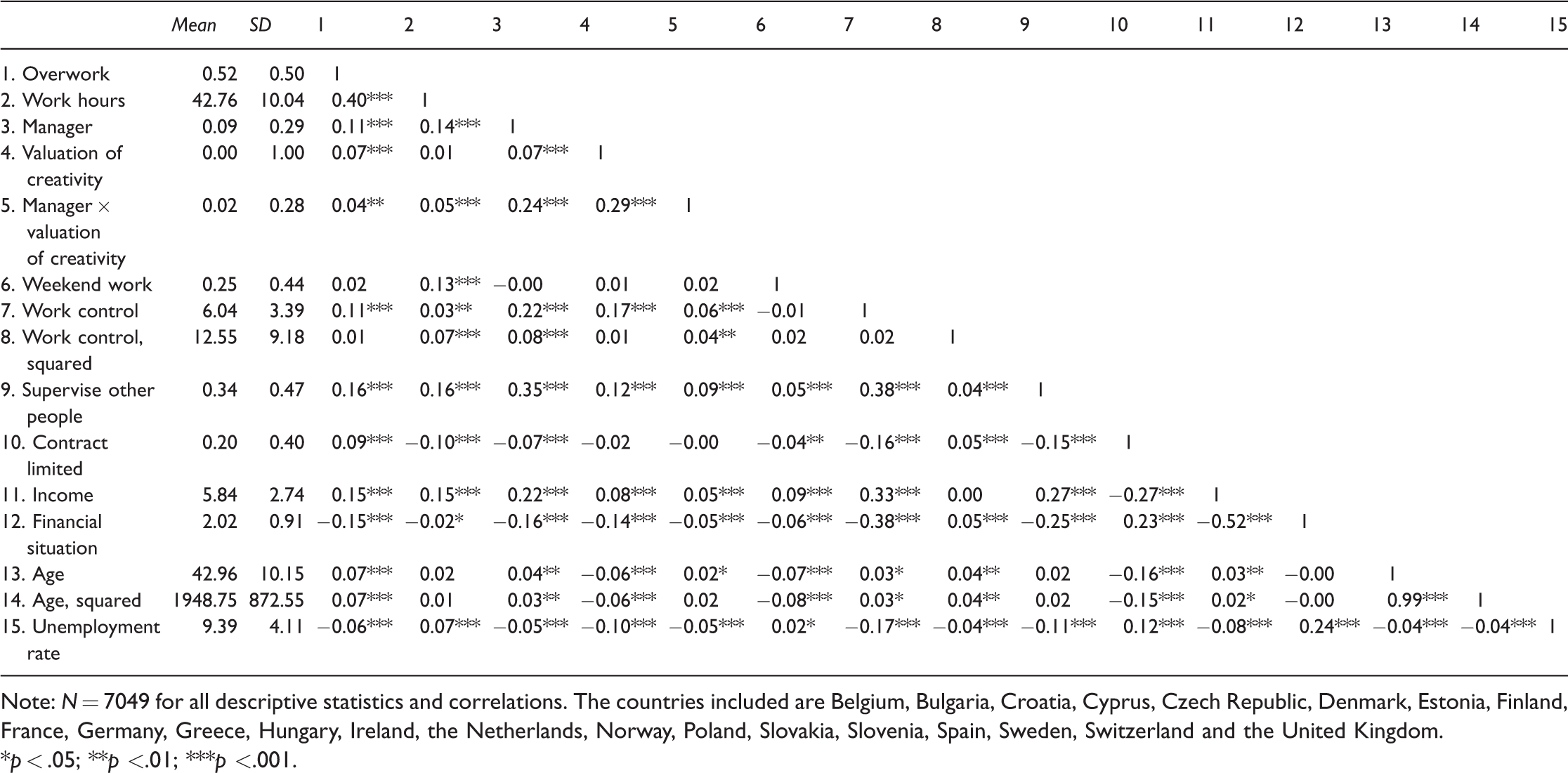
Note: N = 7049 for all descriptive statistics and correlations. The countries included are Belgium, Bulgaria, Croatia, Cyprus, Czech Republic, Denmark, Estonia, Finland, France, Germany, Greece, Hungary, Ireland, the Netherlands, Norway, Poland, Slovakia, Slovenia, Spain, Sweden, Switzerland and the United Kingdom.
*p < .05; **p <.01; ***p <.001.
Statistical models
To test our first hypothesis that male managers attribute more importance to creativity than other workers do, we use a t-test, which accounts for unequal sample sizes and variances. Our other hypotheses are examined using two sets of models. The first set of models tests whether valuing creativity is associated with long hours of work. The second set of models tests whether valuing creativity increases the feeling of overwork.
We model men’s total hours of work employing a linear multilevel model with cluster robust standard errors. The multilevel model accounts for the structure of the data in which individuals are nested within countries. A two-level random intercept model includes countries at level 2 and individuals at level 1. The random intercept represents the combined effect of all omitted country-specific covariates that makes some subjects more or less prone to overwork than others. Model Ia explores whether valuing creativity is associated with work hours, while Model Ib additionally controls for work and organisational characteristics to establish whether the effects found for valuing creativity in Model Ia were due to other characteristics related to work or organisational type. In combination, Models Ia and Ib test the hypothesis about the association between working hours and valuing creativity (H2a). Model Ic includes an interaction term between being a manager and valuing creativity in order to test the combined effects over and above the individual effects of being a manager and valuing creativity, that is a test of H2b.
The second set of models comprises multilevel logistic regressions. Model IIa explores whether valuing creativity is associated with overwork, while Model IIb adds controls for work and organisational characteristics to Model IIa so as to establish whether the effects found for valuing creativity in Model IIa were due to work or organisational characteristics. Models IIa and IIb test Hypothesis H3a. Model IIc includes the interaction between being a manager and valuing creativity in order to test Hypothesis H3b. We further calculate average marginal effects for all variables in the model.
We cannot include work hours as a predictor of overwork in our second set of models because of potential endogeneity, which would introduce bias; overwork and work hours are likely to be predicted by the same omitted variable or a set of omitted variables. As a check, men’s total hours of work, including overtime, were introduced in Models IIa, IIb and IIc. Most estimates did not change substantively, and in particular, the effect of valuing creativity on the feeling of overwork remains significant, even when including the potentially endogenous work hours’ variable.
Comparing the average marginal effects from Models Ia, Ib and Ic with Models IIa, IIb and IIc enables us to gauge whether valuing creativity makes men work longer hours or whether this simply adds to the feeling of being overworked or if both conditions hold.
A potential issue is that individual countries exhibit value patterns or other specific characteristics, such as high unemployment rates, that bias the results. Furthermore, countries on level 2 are not a random sample and are relatively few in number. If some countries prove to be outliers, this may bias the results considerably. Countries could either be outliers via variables on level 2 or indirectly if countries act as moderators. To test whether outliers on the country level affect our findings, we analyse standardised differences in parameter estimates (DFBETAs) on level 2 for all models, following Verbakel (2013). As we are interested in an unbiased estimate of valuing creativity and being a manager, we focus on these variables in all of our models. Exploring level 2 outliers for our first set of models (Ia, Ib, and Ic) shows Poland and Switzerland as level 2 outliers for the effect of being a manager on hours worked. Germany and the United Kingdom differ from the other countries with respect to the creativity variable, and the United Kingdom could bias the estimate of the interaction term (manager × creativity). Running Model IIc on selected subsamples excluding the countries which could potentially bias the results does not yield substantial differences in the estimates of our key variables. We do not find any other substantial differences in the estimates of other variables. We therefore report the results from the models using all countries. For the models using overwork as a dependent variable (Model IIa, IIb and IIc), the DFBETAs for being a manager indicate that Poland differs from the other countries. We rerun the model without Poland, but do not find a substantial change in the estimation of this variable, as the coefficient for being a manager, with and without Poland, is insignificant. As with Model Ic, we present our final models including all countries.
Results
The results corroborate our first hypothesis that managers accord more importance to creativity than other workers: Managers score 0.26 standard deviations higher on creativity than other workers (t = −6.86; p < 0.001).
The multilevel models account for the structure of the data where individuals are nested within countries. We estimate an unconditional model, where no covariates are included, to estimate the intraclass correlation (ICC). The ICC is 0.041. Hence, about 4% of variation in our models is due to country differences and 96% is due to differences between individuals.
The effects of valuing creativity on hours of work
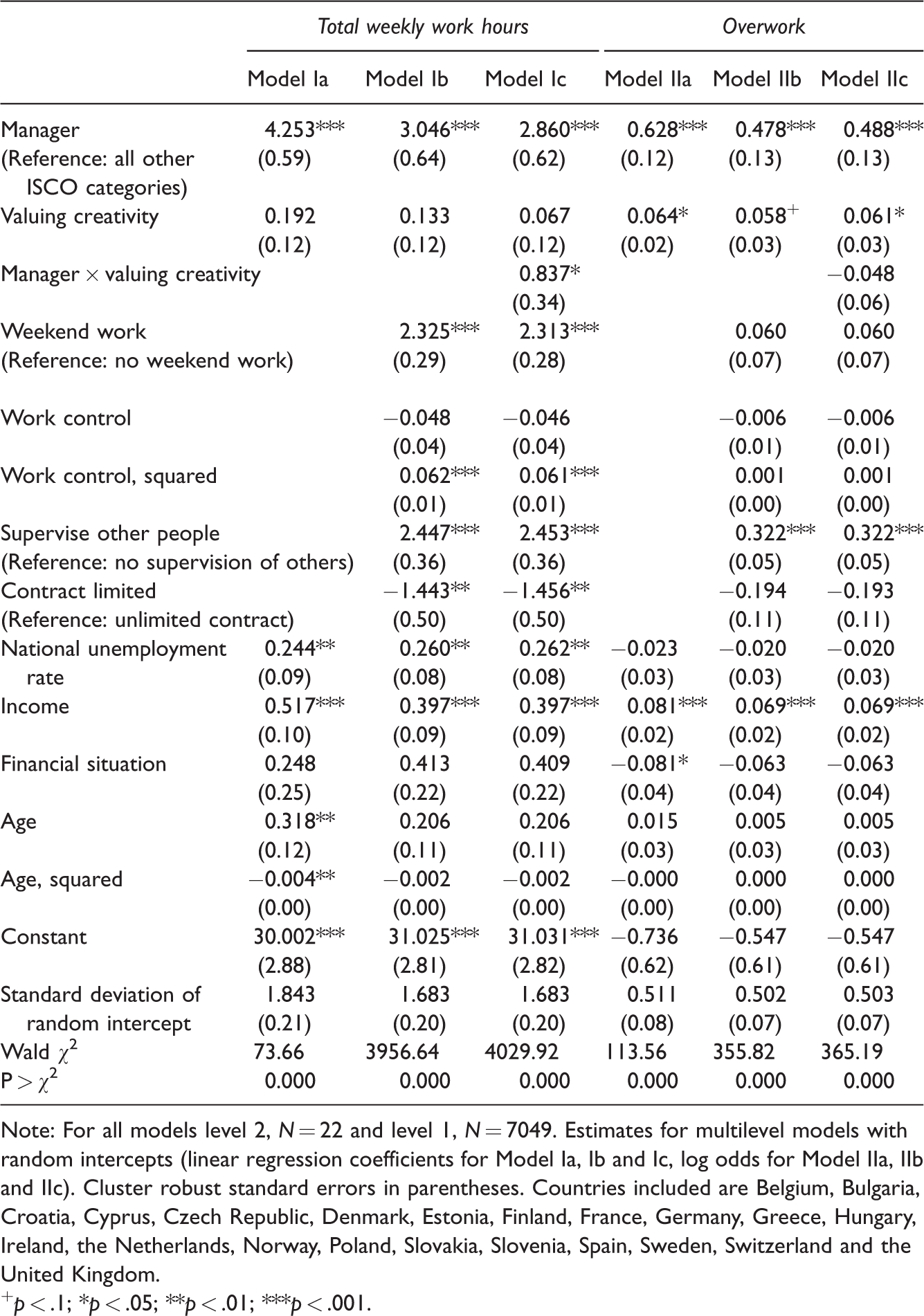
Valuing creativity is not associated with working longer hours (Table 2, Model Ia). Work characteristics are the drivers of long hours, as is shown to be the case when these are added in Model Ib. Being a manager is associated with working considerably longer hours (Model Ia); work status and organisational characteristics seem to be responsible for parts of this effect, as the inclusion of the relevant variables in Models Ib and Ic diminishes the effect of being a manager. In Model Ic we added an interaction term to test whether managers are especially prone to work more hours when they value creativity above average. As the interaction term is significant and positive, we conclude that managers who value creativity above average are found to work more hours than other workers and more than other managers who do not attach equal importance to creativity.
Predictors of total weekly work hours (including overtime) and overwork (reference no overwork).
Note: For all models level 2, N = 22 and level 1, N = 7049. Estimates for multilevel models with random intercepts (linear regression coefficients for Model Ia, Ib and Ic, log odds for Model IIa, IIb and IIc). Cluster robust standard errors in parentheses. Countries included are Belgium, Bulgaria, Croatia, Cyprus, Czech Republic, Denmark, Estonia, Finland, France, Germany, Greece, Hungary, Ireland, the Netherlands, Norway, Poland, Slovakia, Slovenia, Spain, Sweden, Switzerland and the United Kingdom.
+p < .1; *p < .05; **p < .01; ***p < .001.
In addition to the findings pertaining to the key research variables, the analysis uncovers several other noteworthy effects. The relationship between work control and work hours appears to be u-shaped, meaning that little or no work control or a high degree of work control is associated with working longer hours. However, this effect is weak. Weekend work is associated with working considerably longer hours. Supervising other people is associated with working longer hours. National unemployment rates are also positively associated with longer working hours. People with fixed-term contracts work, on average, fewer hours.
The effects of valuing creativity on overwork
Valuing creativity is positively associated with the likelihood of men feeling overworked (Table 2, Model IIa). This finding is robust to the inclusion of a variety of variables relating to work characteristics, as seen in Model IIb (Table 2). 2 Creativity has its own effect, independent of work control. Work control, which previous studies have found does not necessarily help workers to lower work–life conflict (Schieman et al., 2009; Van Echtelt et al., 2006), is insignificant in Model IIb.
An important finding is that being a manager is the strongest predictor of overwork in our models (Models IIa and IIb). The average marginal effects show that this variable increases the likelihood that men report feeling overworked by 14% and 11% in Models IIa and IIb, respectively (Appendix 2). Reinforcing this finding, men who are responsible for supervising other people are 7% more likely to be in the overwork category. Adding the interaction term in Model IIc does not change the positive and significant main effects of being a manger and valuing creativity. The interaction term between being a manager and valuing creativity is not significant. This suggests that managers who have an above average valuation of creativity do not experience an additional increased likelihood of feeling overworked. More generally, for managers the propensity to feel overworked does not vary over the response surface of valuing creativity. Thus, there is support for H3a, but not for H3b.
In sum, being a manager and valuing creativity are significant predictors of feeling overworked. However, the interaction between being a manager and valuing creativity on the feeling of overwork is not significant. This finding shows that it is not managers only, or managers especially, who experience overwork when valuing creativity above average. 3
The models of work hours tell a different story. In the basic model (Model Ia), being a manager is positively associated with work hours. Adding the interaction term to this model, we find that its coefficient is significant. Thus, managers experience a direct effect of valuing creativity on their work hours.
Of course, the exploratory analysis of this article has its limitations. Further research should try to employ multi-item measures of valuing creativity rather than the single item we use to allow for tests of measurement invariance and scale reliability. There is the potential for multilevel models to be erroneously specified (Bryan and Jenkins, 2016; Schmidt-Catran and Fairbrother, 2016) if there are too few units at the upper levels. To gauge whether our models were affected, we checked how level 2 outliers affect our estimates and ran a series of sensitivity tests. These tests all show that our results may be deemed robust. Some research argues that there is no universal model of a European manager, because of the different histories of European societies (Bauer and Bertin-Mourot, 1999). While this may be true, our results suggest otherwise to the extent that we find little cross-country variation in the association between valuing creativity and work hours and overwork in European managers.
Discussion and conclusions
We explored the proposition based on Boltanski and Chiapello’s (2005) work in the ‘New Spirit of Capitalism’ that modern managers attach more importance to creativity than other workers do. The focus was on men because male managers are at the centre of organisational ideology, providing the basis of the ideal worker. Our results on the creativity hypothesis were striking in showing that male managers are set apart from other men in valuing creativity. This finding lends support to Klikauer’s (2015) argument that managers form a class apart. We interpret this result as indicating that modern managers are expected to value creativity, and that it is a requirement for success, as argued by Boltanski and Chiapello (2005). Moreover, holding an ideal, such as valuing creativity, provides managers with a legitimisation for engaging in the process of accumulation, since engaging in this process requires some kind of motivational script (Chiapello and Fairclough, 2002). Finding meaning in work justifies engaging in it, which necessarily involves participating in a package of associated work practices.
We were motivated to link the ideological to the material by seeking to understand the material consequences of valuing creativity (Kuhn et al., 2008). Work in the creative industries has already established how creative ideals and interests are linked to insecure conditions (Hesmondhalgh and Baker, 2010). At first sight, these conditions seem unrelated to modern managers, who are amongst the best-paid workers. However, the mechanism of influence from ideological to material may bear some similarity to that for creative workers: managers are motivated by valuing creativity, which drives them to long working hours and coerces them into working longer hours than they want, that is to overwork (Kanji and Samuel, 2017). To some extent their consent is secured but at the cost of overwork, which has consequences for health and well-being (Angrave and Charlwood, 2015). An important associated result is the effect on inequality: the most privileged workers work far more than they want, and the least advantaged cannot get the hours they want (Jacobs and Gerson, 2004).
The results on working hours show that valuing creativity is seemingly associated with working longer hours than other workers, but that when a full set of work characteristics is included, the effect of valuing creativity becomes insignificant. This result reinforces the idea that we put forward in the Introduction, that is that changes in ideology accompany transformations in the nature of work (Castells, 2006). It seems that a set of employee characteristics, values and type of work, in combination, result in long hours, with managers working longer hours than others. A key finding from our analysis is that managers who value creativity above average are found to work more hours than other workers, but also more than other managers who do not attach equal importance to creativity. We cannot tell whether it is a personal sense of forgetting oneself, the sense of flow that leads managers who value creativity to extend their working hours more than other managers do, or if they are more strongly compelled to work long hours. This issue of agency surely merits further investigation.
We found that those who value creativity are more susceptible than other workers to the feeling of overwork. As well as pointing to the burden that holding the ‘right’ values imposes, this finding may provide insight into how creative people experience time. It adds a new dimension to innovation studies that identify time as an important requirement for ‘incubating’ ideas (Runco, 2004) and studies that conclude that employees require freedom in order to come up with ideas (Amabile et al., 1996; Amabile and Pillemer, 2012; Csikszentmihalyi and Sawyer, 1995). Paradoxically, the emphasis on creativity as a value in The New Spirit of Capitalism is increasingly accompanied by a strong business emphasis on creativity as the driver of innovation. Yet these differing emphases on creativity have very different needs. As we have argued and empirically explored, creativity as a value in The New Spirit of Capitalism is associated with extracting greater effort from employees. In contrast, studies have shown that creative task performance benefits from time away from tasks for the generation of ideas (Barron and Harrington, 1981). Insights often occur during ‘idle time’ when a person is not tightly constrained (Csikszentmihalyi and Sawyer, 1995: 168). Creating the conditions for creativity is therefore about getting the right mix of intense working time, less pressured working time and time away from work, which together stimulate creative activities. Advising organisations about how to stimulate creativity, Amabile et al. (1996) recommended that promising employees should be rewarded with time away from work in order to refresh their thought processes and that they should be encouraged to take vacations and not to work weekends. Runco (2004) summarised a number of studies that show that creative ideas take time and that time pressures adversely impact creativity. This study points to some of the difficulties in implementing these kinds of changes to working practices when creativity values form part of the ideological edifice of power.
Footnotes
Acknowledgements
We would like to thank Stephen Wood for helpful discussions and comments on earlier drafts of this paper, and members of the Individual in the Labour Market Research Group, Department of Sociology, University of Cambridge. The authors are responsible for the decisions taken. Robin Samuel conducted part of the research for this project when he was a visiting scholar at the Center on Poverty and Inequality, Stanford University and at the Department of Sociology, University of Cambridge.
Declaration of Conflicting Interests
The author(s) declared no potential conflicts of interest with respect to the research, authorship, and/or publication of this article.
Funding
The author(s) disclosed receipt of the following financial support for the research, authorship, and/or publication of this article: This work was partly supported by the Swiss National Science Foundation [Grant nos 140322 and 141399].