




Abstract
Projects are ubiquitous throughout the management of public services and the implementation of public policy but implementation processes often remain a ‘black box’. This article argues that technical approaches to project management neglect the role of power. Combining Foucault’s concept of the productive power of governmentality with the notion of timescapes into an analytical lens, the ethnography opens up the black box to reveal how project management functions as a powerful disciplinary technique. I show what escapes the imposed boundaries of the project as, in contrast to rational representations of the linearity of the project life cycle, decisions are retrospectively framed and the past rewritten. Simultaneously, project managers attempt to bring an uncertain future under control, discursively enrolling actors into their visions. Discursive and symbolic meanings of projects link to materiality as resources are represented as plentiful or meagre. Financial year-end exerts a disciplinary force so that time gets compressed and decision making becomes expedient. As resources move between budgets, governmentality is enacted, while budget headings of ‘other’ account for inevitable remaindering. Creative ‘time tactics’ are an adaptive response to achieving externally imposed targets while performing local project success. It turns out that time is at once metaphysical and mundane.
Keywords
Introduction
This article presents findings from an ethnographic study of project management and policy implementation that took place in the late 2000s in a multi-organisational network located at a UK local authority level and addresses the question: ‘how and why do public policy entrepreneurs engage in creative accountancy when they manage projects?’ Understanding the work that goes into producing accounts for public expenditure is a vital component of democratic legitimacy (Carter, 2011; Peckham, 2014) but use of the term creative accountancy is not meant to imply deliberate deception or fraud. Rather, the aim is to provide sociological insight into how time and money are translated, interpreted and managed creatively. This matters because successful delivery of project management or ‘delivery’, is often presented as a rational logical attainment of pre-defined goals (Cicmil and Hodgson, 2006) that in turn contributes to effective policy implementation. This misperception is a form of governmentality that denies the role of power (Clegg et al., 2002; Flyvbjerg, 1998; Mosse, 2004) and overlooks the social and interpretive work that takes place in practice, the tacit knowledge possessed by experienced managers, their power to define reality and their use of artefacts that are produced and circulated within and across networks. Detailed empirical studies of how time and money are conceptualised and creatively managed in practice or ‘choreographed’ by public service managers (Adam et al., 2002) are difficult to locate. This is a surprising lacuna which this article aims to address using the concept of timescapes as an analytical tool.
Timescapes and project management as a form of governmentality
Adam has analysed in detail how clock time informed the development of capitalism, replacing more organic notions of time (Adam, 2004). Adam’s concept of timescapes is premised on a sophisticated understanding of time and timetabling as artefactual and as socially constructed (Adam, 2001). She shows how diachronic practices associated with clock time have never displaced synchronic practices of myth and symbolism but there is a common-sense understanding, a ‘naturalized norm’ (2004: 142) of time as a commodity to be managed. Adam (2004) theorises time in relation to control, showing how time can be ‘objectified, externalized and constructed to specific design principles’ (Adam, 2004: 143). Design principles embedded in project management tools and techniques are now ubiquitous in the delivery of public services (Radnor and Noke, 2013), although their relevance and effectiveness is contested (Osbourne, 2006). Adam’s work on the social construction of time (Adam, 2001, 2004) is well known to readers of this journal but time has been relatively neglected in the fields of public administration/public management and public policy (although see Fitzpatrick, 2004; Pollitt, 2008). It is important to note that the development and persistence of New Public Management (Ferlie et al., 1996) has led to management techniques originally developed for the private sector such as lean, Six Sigma, PDSA cycles (Plan Do Study Act) becoming embedded in policy texts and the management of public services. A presumption of project management is that a project is bounded with time and money and these constraints are generally regarded as fixed, or as two sides of a triangle that can be traded off against quality (Atkinson, 1999). Specified financial resources usually accompany projects, bounded to achieve specific aims, outputs or outcomes with a presumption that this enables an assessment of ‘cost-effectiveness’ (Mosse, 2004). This emphasis on rationality and efficiency is a modernist trope that presumes that time is finite, linear and predictable and so can be managed sequentially. The continuing significance of seasonal effects, symbolism, the subjective experience of time and the multiplicity of rhythms of social life and administrative routines (Whipp et al., 2002) are hidden from view beneath such modernist guises. Such technicist, rational approaches to planning and delivering public services have been critiqued by Flyvbjerg (1998), Clegg et al. (2002) and Mosse (2004) among others, who draw on Foucault’s work on governmentality to demonstrate the multiple ways in which power is central to the control of projects. These authors have adopted Foucault’s genealogical approach to focus on mundane practices in order to reveal the realpolitik that is concealed by formal textual documents such as project plans or reports. As Keenoy et al. (2002: 187) point out: … with few exceptions, conventional accounts of decision processes tend to project them as taking place in a ‘time vacuum’. At best, the temporal aspects remain marginalized.
Multi-organisational timescapes in public sector networks
The bounding of time, resource and short term project objectives takes place within historically situated environments where public policy may be attempting to tackle long standing ‘wicked’ social problems and necessarily complex social situations (Carter, 2012). A range of challenges and benefits pertaining to partnerships and multi-organisational networks that contrast with single organisation or ‘silo working’ have been theorised. Identified challenges include how to ensure efficiency and democratic accountability within public networks that rely on co-operation and trust, rather than a hierarchical system of command and control (Hibbert and Huxham, 2005; Sullivan and Skelcher, 2002). Partnership working has been shown to lead in some instances to collaborative inertia (Huxham, 1998) due in part to complex governance (Newman and Clarke, 2009; Skelcher, 2014). Such problems may be outweighed by advantages however, as partnership working also provides opportunities to address so-called ‘wicked issues’, such as child poverty (Carter, 2012). The benefits of networks are purported to be the ability to tackle entrenched social problems through bringing the separate expertise of individual organisations together.
Whether located in the public or private sectors, when projects are delivered through networks of inter-organisational partnership arrangements, rather than via a single hierarchical organisation, this form of multiple accountability is referred to in project management terms as matrix management (Brooks and Kakabadse, 2014). Networks are often created for specific time periods and the challenges of ‘initiativitis’, whereby projects proliferate and may create incoherence (Carter, 2012) have been acknowledged. Writing about public policy and management in health services, Pollitt (2008: 184) argues: We have become unrealistically impatient and energetically clumsy in our handling of time. Yet we already possess the tools to do much better. We are certainly sophisticated enough not to have to believe that extreme time compression is the inevitable, universal or only way forward. Time tactics: A selection. Adapted and reproduced from Pollitt (2008: 177–178).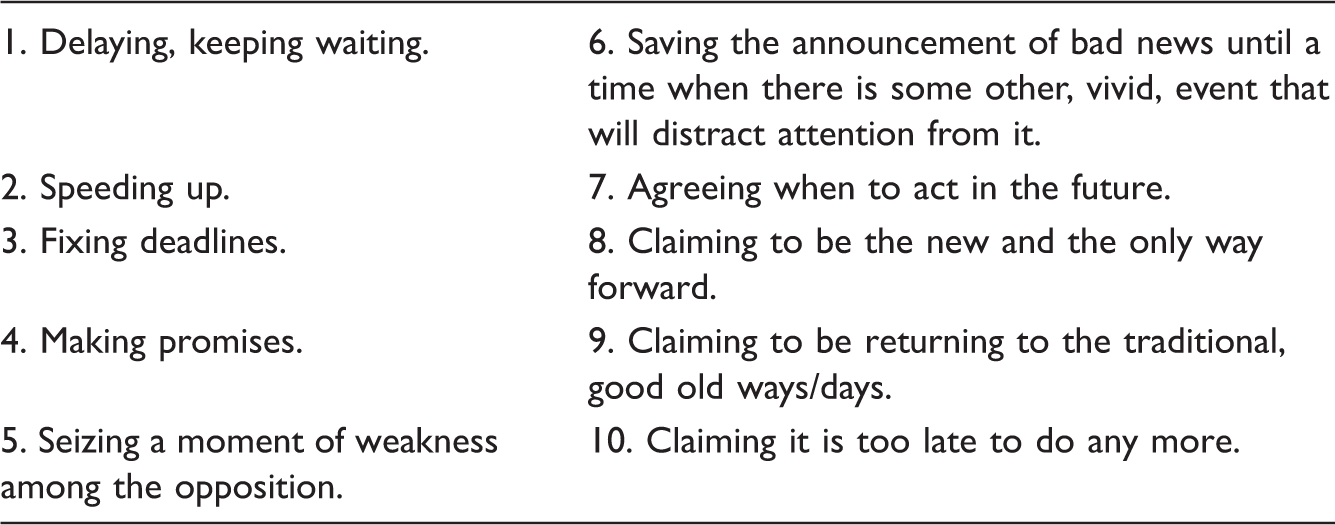
Pollit cites Machiavelli on power as does Flyvbjerg who notes that power can be exercised not only through ‘force and law’ but also through ‘strategies and tactics’ (Flyvbjerg, 1998: 5). This resonates with Foucault’s insistence on the necessity of studying power through analysing practices, artefacts, mundane tools and taken for granted forms of knowledge (Foucault, 1980). The value of Foucault’s work on governmentality lies in the recognition of the inherent relationship between knowledge and power such that the exercise of force is no longer required when forms of knowledge become embedded in routine practice and people using these routines regard them as productive rather than as a repressive form of power. Foucault’s work is drawn on by Miller and Fox (2007: 89) who note that techniques of power are deployed such that: … It is forbidden to waste time. Time becomes linear and serialized, organized into successive activities. These are technologies of discipline, the practices of governmentality.
Methodology
This article draws on data gathered in the late 2000s as part of an ethnographic study of the local implementation of UK child care policy. The original data set incorporates face-to-face semi-structured interviews (n = 54), field notes from 10 months of non-participant observation of a network and related policy artefacts and documents. Interviews were fully transcribed and then this data was integrated with observational field notes and artefacts. For the purpose of this article, previously unpublished original data were re-analysed using a Foucaultian lens that combined theoretical work on time with the concept of governmentality. This methodology echoes Blomquist et al.’s (2010) call for a ‘project-as-practice approach’. These authors argue that: Being able to understand how real people solve real problems is, consequently, of paramount interest, whereas to evaluate or research how well project plans are implemented is of less significance.
The aim of ethnography is to provide a ‘thick description’ of how events occur but also move to why explanations (Katz, 2001). Clearly, when ethnographies are produced, they depend upon researchers’ ontological and epistemological assumptions. I have framed the ethnography as a journey but there are necessarily many ellipses, partly because this account is based on data selected from a larger project but also because the process of selecting data itself entails a process of analysis that is informed by theory. I have re-created events, weaving observational, artefactual and interview data with academic literature and present these in the past tense except for a specific situation where, with the aim of achieving a sense of immediacy for the reader, I adopt the current tense (see Van Maanen, 1988, on writing ethnography). The intent is to show how mundane time tactics exercised in practice allow flexible interpretation of policy and enable local implementers to demonstrate their work of successful implementation and achieve successful performance. In the next section, I outline the background to the empirical study before going on to present artefactual data in the form of images, selected quotes from interviewees and a key ethnographic moment that reveals how time was reversed by juggling accounts.
In the beginning – ‘year one’
The ethnography that is reported here formed part of a broader longitudinal study conducted in the late 2000s and based within a community network created by a UK County Council. The project that is reported here was bounded by time (12 months initially) and money (£100,000 initially). The project coincided with the creation of a new multi-agency network – a Community Learning Partnership (CLP). Partner agencies included primary and secondary schools, a Sure Start Children’s Centre that provided early years childcare and family support services, a Further Education college, voluntary sector organisations and a County Council. The development of the network was central to the project, while there were instrumental goals and targets for the project manager to achieve, other important work that the project manager engaged in was the processual goal (Hibbert and Huxham, 2005) of network formation and relationship building, less easily categorised in terms of time and money and not able to be reified into quantitative project ‘outputs’.
The CLP was designed to combine the policy objectives of an Extended Schools initiative and early years childcare (Carter, 2011). Extended Schools were expected to engage not only with pupils but with families and communities. Operating beyond the traditional school day and offering a range of out-of-school activities, they were intended to enhance pupil attainment but also achieve broader social inclusion objectives. These policy objectives were accompanied by new funding that was allocated by central government to local authorities. The money flowed from what was then the Department for Education via the County Council and the County Council retained legal, fiduciary responsibility as the lead accountable body. As well as delivering the government policy, the CLP network also aimed to be responsive to local community needs for family learning and general wellbeing. The County Council produced a CLP strategy setting out a narrative of community empowerment and oriented predictably towards a ‘future positive’ (Edwards, cited in Mosse, 2004). This document described in broad terms how successful implementation would lead to enhanced quality of life for local children and their families but left the detail to be worked through by individual CLPs that were expected to produce their own business plans.
The backgrounds, roles and responsibilities of CLP project managers working throughout the local authority area varied but in this case study, the manager was simultaneously the manager of a local Sure Start Children’s Centre and an employee of the County Council. I will call this person Shireen. My analysis, based on ethnographic data, indicated that Shireen was the de facto CLP leader, in part because she took responsibility for the project timetable. Despite discursive representation in strategy documents of the CLP network as independent of the local authority, democratic and rooted organically in the local community, Shireen had the authority to make budgetary decisions and could be held formally to account by the County Council. In contrast, the nominated Chair, who was a head teacher of a secondary school, was in a more distant relationship with the Council, positioned as a ‘partner’. The Chair took some responsibility for the development of the CLP but this was secondary to his ‘day job’, for which he reported separately to the education regulatory body OFSTED and to the school governing body. A range of other CLP members had similar dual arrangements with respect to partnership working and accountability to their host or employing organisation, some of which were located in the voluntary and community sectors.
Initial funding for the first 12 months operation of the CLP was released during what was framed as ‘year one’ of the project lifecycle. It was made clear that resources would also be available for year two but it was not made clear at the outset what amount would be released at what time for ‘year two’. Therefore, CLP project managers faced inevitable uncertainty. The response was to remain alert to what ‘year two’ would bring but not commit to investments that lasted beyond year one financial year end. Although in theory the resources could have been spent on staffing as well as capital expenditure such as equipment, initial expenditure needed to be allocated to projects that could ‘achieve spend’ within year one. There was an initial agreement amongst CLP partners that it would take too long to recruit new staff and employment contracts would be too short to be effective.
Representing the journey
During early field work, I attended an Early Years conference that was an opportunity for the local authority to promote CLPs. The conference was held in a large venue with a programme of speakers, together with a market-place forum of information stalls. There were optional workshops on offer titled ‘business planning’ and ‘running a happy team’. The conference afforded a shopping opportunity in the break times with suppliers of educational toys enticing people to view and purchase their wares. The County Council that granted me permission to study implementation had produced a project plan for its CLP strategy. As I browsed the information stalls, I stopped at one that had a display made up of bright and shiny toys arranged on a table top and colourful laminated print outs representing a CLP (see Figure 1). Note that the representation of the CLP journey roughly follows the traditional sequential planned understanding of policy implementation with unidirectional arrows pointing out the phased stops and ‘Route 2’ that mirrors the ‘plan-do-study-act’ sequential approach much vaunted by proponents of healthcare improvement (Taylor et al., 2013). There was no visible timetable for the metaphorical bus journey but in this aestheticised representation of a strategy, we have a stop off point for some indeterminate ‘route deviation’. The business planning process appears child-like in its simplicity with the ‘business plans made easy’ text book in the centre of the second image recalling management ‘gurus’ (Knights and Willmott, 1999; Parker and Pearson, 2013). Finally, CLP Management Action Groups are congratulated for arriving at their destination somewhere over the rainbow and rewarded with an overflowing crock of gold.
Pictoral display slides collected as part of ethnographic data.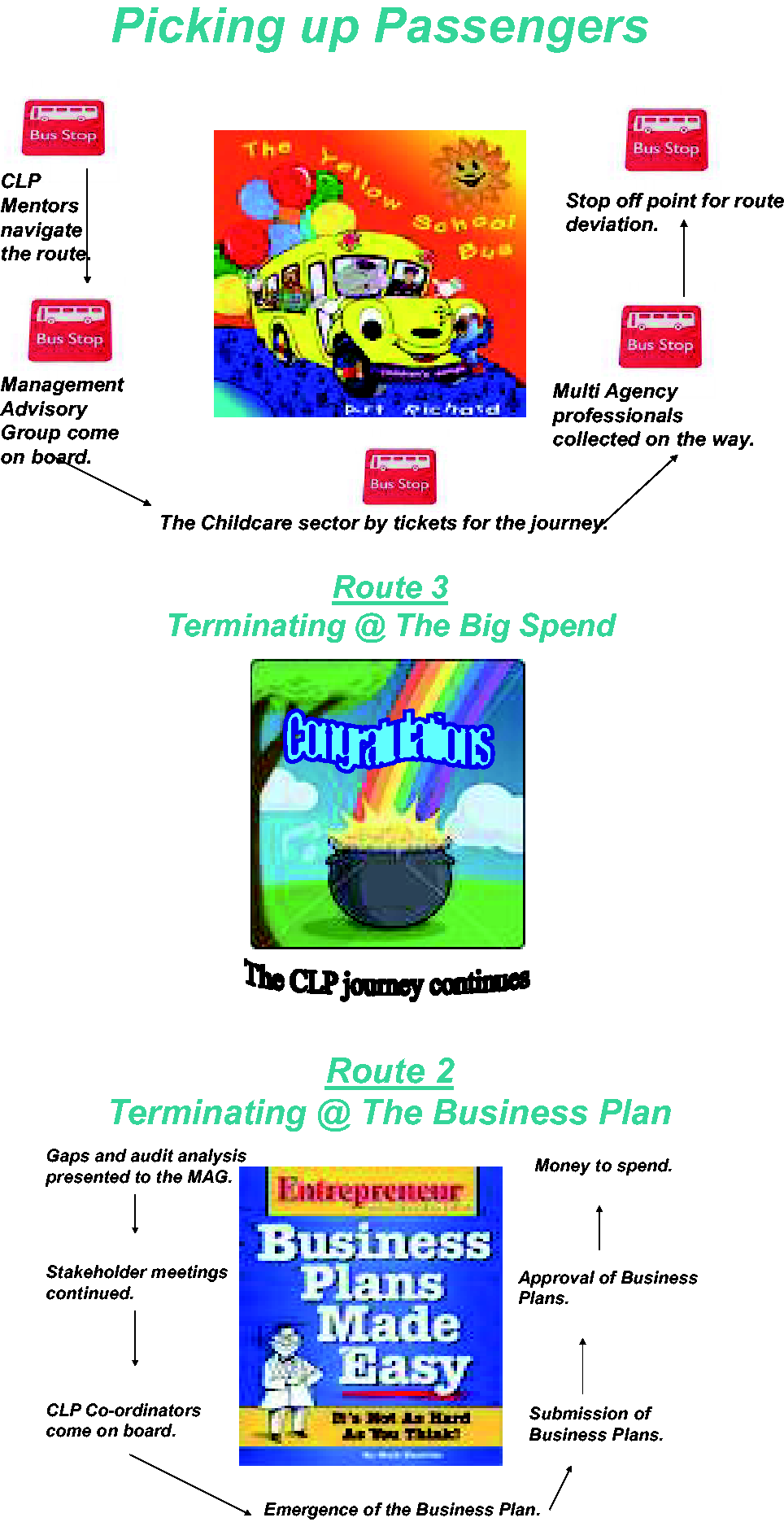
In contrast with these artefacts that celebrate business planning text books, in interview a Partnership Development Officer described an encounter with a management consultant: somebody who was brought in from a management consultancy … and he was talking as if he’d swallowed an MBA text and y’know, I was frustrated … I said ‘I don’t mean to be rude but you don’t know what you’re talking about. (LA20)
A local diversion
The written Council CLP strategy iterated through multiple versions over the course of several months, during which time decisions continued to be taken because activity was expected to happen in advance of a formally adopted CLP business plan. Rather than a written plan based on rigorous research, audit, gap analysis or ‘mapping’ of the current situation against a desired future, that might direct subsequent actions, the plan evolved at the same time as the doing, disrupting the logical sequence represented in the ‘business plans made easy’ CLP journey. At a local level, implementation, project management or ‘delivery’ requires a pragmatic judgement about sequencing and how to frame or label stages of a project phase. This seems to be a judgement about ‘good enough’ planning, balanced against the need to effect change and ‘delivery’; as explained by this manager: … there’s an awful lot of mapping and auditing that can be done. I mean we could we could spend all the sums of money we’ve got mapping and researching but that won’t give you the delivery. (LA01) you can’t actually sit down with a piece of paper and think and actually work out – I’m sure you could if you got an accountant and a statistician who could do something, that would make it look good. (LA06)
One CLP network generously granted me permission to observe their meetings. At an early meeting of the newly formed group, Shireen deployed her communications skills and projected her own vision and interpretation of the emergent strategy to partners. She screened an image of autumn leaves to represent the present ‘where we are now’ current phase of the strategy but explained that her vision only enabled her to see clearly as far as the end of the financial year. She informed the audience about a Government strategy timed to run until 2010 but with resources only released for the current year (framed as ‘year one’) with year two resources as yet unavailable for spending. This meant that March 2008 was the ‘nearest and next horizon that we have’ by which time ‘we need to have allocated the year one money and implemented a business plan for the following financial year’. People in the room seemed attentive and many were taking notes like me. They paid attention when one of Shireen’s slides showed a graphic image of peanuts in their shells. She explained that the picture was intended to illustrate that the money available to the CLP which was, in her interpretation, meagre. Shireen did not seem to have confidence that there would be a generous allocation of resources or a pot of gold. Rather than focus on a nebulous mythical arrival point at the end of the rainbow, in order to stand a chance of becoming a sustainable viable network, efforts were concentrated on short term achievements.
Time was spent over the course of several CLP meetings, working up a tailor-made project idea to suit the specific needs of the area. However, around 5 months into ‘year one’ this planning process was disrupted when news came from the County Council that the CLP was required to have a paid half time co-ordinator. Some members of Council staff whose work plans could be redirected to CLP activity were already in place, but money to extend the contracts for these posts would need to come from the CLP budgets, reducing the CLP’s scope for discretionary expenditure. In some instances, new staff needed to be recruited. A discussion took place regarding the timing of interviews for the prospective coordinator. School teachers complained about the scheduling of the interviews during the half term break, whereupon the CLP revised the dates.
A co-ordinator was appointed and, rather than take time for further reflection, deliberation or planning, quick solutions to spending the remaining finance were encouraged. The CLP circulated a letter to a wide range of organisations including community groups, advising them that they could put forward proposals for money as long as they could manage to spend it within the current financial year. Bids came in to the CLP from most of the schools whose headteachers were already part of the network and attending CLP meetings. As a primary school teacher explained to me, they got their ‘share of the pie’ (LA53). A range of initiatives were allocated funds, including refurbishing the kitchen of the local charitable playscheme, books for family learning and closed circuit television (CCTV) for two primary schools. In interview a Council manager explained to me that CCTV was not quite what was intended in terms of the CLP strategic objectives of promoting wellbeing and family learning but he was happy to let the decision stand in the interest of ensuring a longer term partnership and the continuing support of teachers for the CLP strategy. For the CLP, the imperative to deliver against imposed targets, meant that CCTV was an ‘easy spend’, or ‘good enough’ action, enabling the CLP to deliver the project by the end of the financial (not calendar) year.
Approximately eight months into ‘year one’, in addition to the CLP money, more resources appeared. The teenage pregnancy budget at the County Council was underspent so CLPs were encouraged to get involved in delivering projects that would contribute to reducing teenage conception rates. A menu of sex and relationships projects was put before the CLP for them to tick a box and make their selection. This menu functioned as a heuristic – a device to reduce complexity and a means of speeding up decision making. At mid-point through year one, the Chair wrapped up the meeting congratulating the network: ‘It’s good that we’re finally starting to deliver.’ (fieldnotes). The issue of who could claim responsibility for success – the teenage pregnancy team or the CLP – did not seem to matter. ‘Quick wins’ in the ‘early days’ of CLPs were justified with reference to an uncertain but speculative future. Decision making at this point in time was expedient, with no time for reflection. To use the PDSA analogy, doing took precedence over studying.
Black holes and the public purse
Public sector bodies are expected to adhere to standards to of good governance that include transparency (Midwinter, 2001). I interviewed the Chair of the CLP and asked him about written terms of reference that I anticipated might provide clarification of his duties and responsibilities and the form and nature of the CLP’s powers and responsibilities. He answered with an acknowledgement of his personal accountability for spending public money: I still haven’t seen them. I think that is really bizarre and I cannot understand how it is that they are saying we’ll send them to you soon, given that we’ve now met three or four times and have allocated something like a hundred thousand pounds of spend I mean I could have spent that on a Caribbean holiday … (LA28) ‘Other’ is if it isn’t doesn’t fit into anywhere. Now I’ve been advising our Community Learning Partnerships about this just the last couple of days. Because the DfES
1
found that over this last financial year, X millions numbers of pounds had been recorded as ‘Other’. Not just by our local authority but by a number of local authorities. And what they’re saying is they cannot match that to specific monitoring and evaluation data. (LA47) if we don’t hit those targets for DfES[former Department for Education and Skills] we get penalised. So – but I suppose my analogy is we’ve all done essays you’ve been given six months and you’ve done ‘em overnight so I mean, you know. And I also say to teachers when they go up in arms and say ‘I can’t spend this money’ and I say ‘I’ve never met a school that couldn’t spend its money’ like, you know. (LA01) Because as [a colleague]’s fond of saying … (and I’m not sure this is apocryphal or this is an actual quote) ‘why is it everybody thinks that all the problems have been solved on the 31st of March?’ Cos obviously they haven’t. (LA12)
To get to where the CLP is meeting, we go through the main reception of a high school. There is a flat screen TV with looped timeless images of nature – a waterfall, autumn trees, snow scene, etc.; accompanied by inspirational aphorisms along the lines of ‘When you leave this earth you won’t be remembered for what you earned but for what you left behind’. The final slide on the loop consists not of pictures but of the textual command ‘no piercings, no jewellery’. At the meeting partners conduct the CLP business and work through an agenda. Cath: I asked for this next item, finance, to be placed on the agenda. I am concerned that decisions are being made such as the community project and I’m not clear whether this is an actual project that will be going ahead and if so, how many days it is supposed to be for, and what exactly is happening at my school? When did this decision get made? Who agreed to it? Some decisions seem to be being made elsewhere, away from this group. And I’m not happy about the lavish buffet that was put on at the other meeting I attended at the community centre. I’m not sure it was really necessary – I’d already had my lunch. Where is all the money coming from and who made those decisions? I don’t want to be awkward and I’m not saying I don’t support what we’re trying to do here but many of us are here in a voluntary capacity and we need to make sure we are effective … Kath: Yes and those highlighter pens that were given out – (several people hastily rummage through previous minutes of meetings). Shireen: If you remember, we have been under serious pressure to spend money within this financial year and we all agreed that the community project would be a way of bringing the community together and getting agencies to buy in. It isn’t just about the money – it’s about the needs of families in our community … Cath: Well in my school I am used to strict budgetary control. Our school governors authorise expenditure and there is a clear tracing of accountability. Bob: What are the terms of reference for this partnership? Shireen: I can charge back the time I have spent on CLP business so that is OK.
Discussion
Sociological studies that go beyond an emphasis on rationality show that, when faced with complexity, managers use rules of thumb and heuristics (Ostrom, 1999) as part of their array of sense-making tools (Weick, 1995). However, despite longstanding empirical research in the field of public policy and administration that acknowledges the messy process of ‘muddling through’ (Lindblom, 1959, cited in Mendel and Scott, 2010) and ‘garbage can policy making’ (Paton, 2014), rational project management techniques have been adopted and advocated in policy guidance alongside an emphasis on ‘delivery’ and outcomes (Carter, 2011) and a concomitant neglect of power (Flyvbjerg, 1998). Foucault has taught us to study power through a focus on mundane administrative tools and practices but he also cautioned against presumptions that such tools and techniques are stable, fixed entities. Quantified in project plans, time and money may appear to carry objective status, but here they became relativised as they translated across systems of organisational timescapes and accounting systems. Projects may have artefactual deadlines but these can be manipulated by creative policy entrepreneurs whose practical experience in the form of historicised, practical and locally derived knowledge Scott (1999) terms ‘métis’. The ethnography uncovered a genealogy of how accounts are produced by socially situated actors who translate and interpret policy using time tactics. The time tactics surfaced from this study might be a useful addition to Pollitt’s list (Pollitt, 2008: 177) and contribute to an understanding of the inevitable remaindering processes that are hidden from view by the governmentality of formal accounts.
Muddling through the present and satisficing
Project management techniques and management guru text books typically present time as a commodity, capable of being exchanged for money. The presumption is that the past is largely irrelevant, that the present can be managed rationally and that the future is predictable (Cicmil et al., 2009). The ethnography revealed how, in contrast to the ‘linearity of the project life-cycle’ (Kesby, 2005: 2052), an experienced project manager of a network ‘muddled through’ (Mendel and Scott, 2010) by juggling both time and money creatively. Resources were variously interpreted as plentiful (a crock of gold) or meagre (peanuts) and value for money was disputed in relation to the ‘lavish’ buffet and the decision to purchase highlighter pens. Hypothecated funding is an attempt to ring-fence resources for particular objectives (Annesley and Gains, 2007) but a budget heading of ‘other’ accounts for inevitable remaindering.
Rather than distinct phases of formulating a plan (as presumed with plan-do-study-act models) planning, studying, acting and doing were immanent, emergent processes (Chia and Holt, 2006) and time was experienced as compressed, especially towards the end of year one. Time also appeared fluid as the CLP responded to external exigencies as the County Council attempted to govern the CLP from a distance (Rose and Miller, 1992). Time compression is discussed by Adam (2004) in relation to profit maximisation but in this instance, no financial surplus was generated by speeding up time. Nonetheless, project managing public service delivery in this way did severely constrain what could be achieved for local families. In contrast with the idealist symbolic vision represented as a glowing crock of gold that reflects what Mosse calls the ‘future positive’ orientation of policy, decision making took the form of pragmatic ‘satisficing’ (Simon, 1957). Simon (1957: 204–205) notes that: The key to the simplification of the choice process … is the replacement of the goal of maximizing with the goal of satisficing, of finding a course of action that is ‘good enough’.
Foresight
Money was spent to achieve instrumental short term goals but also to secure longer term trust relationships between a project manager and local partners and between the CLP, and external policy makers. The symbol of the rainbow was used to orientate the network towards a ‘future positive’ (Mosse, 2004). Fitzpatrick notes that: relative time is qualitative since here the position of the subject (the observer, actor, experiencer) begins to matter. What is known is now in some way dependent upon the episteme, the knower. (2004: 200) It is not the hearts and minds, but the ideographs of culture that must be won … Microlevel events and impasses become moments of political contestation and purposive engagement as the ideographs at stake attract meaning and importance …
Turning back the clock
Principles of project management are premised on instrumental means-ends rationality and policy is inherently teleological (Carter, 2012) yet here the arrow of time sometimes pointed backwards, as justifications for decisions were put in place and re-framed retrospectively (Weick, 1995). Money was spent and had real effects but it was also represented symbolically, vired and translated or ‘re-badged’ (Carter, 2011) according to the interpretive repertoires (Potter, 1996) of the project manager. Individual organisations have a specified accounting rhythm in the form of financial reporting timetables (Miller et al., 2006) but these are complicated by multi-organisational timescapes. The ethnography revealed that the CLP’s network powers were not derived solely from its organisational governing instrument (terms of reference) that might detail legal powers, or at least describe duties and responsibilities, but also from the practices of its constituent members and their ‘rules in use’ (Ostrom, 1999). Performance management systems were manipulated using the resources of the network and the imposed short term project as a means of control. This retrospective strategy of creatively accounting for time spent in ‘year one’ functioned as a contingency plan – an adaptive institutional mechanism for coping with the high velocity environment; insuring against the dreaded judgement of failure to deliver.
Conclusion
Experienced project managers are likely to deploy time tactics in the form of intuition or creative ‘muddling through’, foresight or prescience based on experience and re-writing history, turning back the hand of time as they go beyond simplistic text books and sequential tools such as PDSA to juggle time and money creatively across multi-organisational timescapes. A project deadline of financial year end functions as a form of governmentality, a taken for granted mundane accounting device but while this may impose a timetable, formal accounts can disguise diverse multi-organisational timescapes and accounting arrangements that a genealogical approach can bring to the surface. The real time ethnography showed that, as Adam’s theory of time control would predict, those who manage the project timetable control both the actions of network partners and the external perception of ‘success’. Subverting what has been termed ‘the rationalist façade of project management’ (Cicmil et al., 2009), creative juggling of budgets allows time to stretch forwards and backwards as experienced managers act in the present but simultaneously react to the future and reframe the past. A commodified form of time may be translated into money but this study reveals the time tactics required to enact such a translation. Creative accounting for time proved to be an adaptive managerial response to achieving externally imposed targets while enacting local project success and building a network with a credible reputation. Policy is always likely to be portrayed with a future positive orientation and new projects may well be announced with enthusiasm and visions of a golden solution somewhere over the rainbow. However, projects enacted in practice are likely to require a greater degree of pragmatism and satisficing. As Pollitt (2008) has pointed out, an awareness of history suggests that long standing social problems are not likely to be solved by short term fixes or performative, managerialist approaches focussed on the artificial deadline of financial year end. It turns out that time is at once metaphysical and mundane.
Footnotes
Acknowledgements
The author would like to thank Graham Martin for very helpful comments on drafts of this article. The views expressed are those of the author and not necessarily those of the NHS, the NIHR or the Department of Health. The views expressed are those of the author(s) and not necessarily those of the NHS, the NIHR or the Department of Health.
Declaration of Conflicting Interests
The author(s) declared no potential conflicts of interest with respect to the research, authorship, and/or publication of this article.
Funding
The author(s) disclosed receipt of the following financial support for the research, authorship, and/or publication of this article: The author would like to acknowledge grateful appreciation to the participants in this study and to ESRC for funding (Award PTA-03-2005-00249). The author is currently supported by the National Institute for Health Research (NIHR) Collaboration for Leadership in Applied Health Research and Care East Midlands.