



Abstract
In an era shaped by artificial intelligence (AI), libraries face critical imperatives to reassert relevance and operational vitality. This study explores how library professionals perceive and navigate AI’s transformative influence. Informed by Sociotechnical Systems Theory, a cross-sectional survey of 84 practitioners from Zimbabwe examined perceptions of institutional relevance, AI impact, and strategic adaptation. Using a structured questionnaire with Likert-scale items, data were analysed through descriptive and inferential statistics. Exploratory factor analysis confirmed construct validity (KMO = 0.78), with high internal consistency (α = 0.80). Results reveal strong consensus on libraries’ enduring significance (d = 1.64), high AI awareness but notable readiness gaps (r = 0.35, 95% CI [0.15, 0.52]), and that skill development significantly predicts perceived institutional capacity (β = 0.34, sr2 = 0.11). Professional optimism is contingent on capacity-building and empowerment. Findings position libraries as ethical agents within algorithmically mediated knowledge environments, contributing empirical insights to practitioner-focussed discourse on AI integration in resource-constrained contexts.
Keywords
Introduction
The integration of artificial intelligence (AI) into libraries profoundly disrupts traditional roles, expertise, and institutional legitimacy, as systems now autonomously retrieve, synthesise, and generate information, supplanting functions once central to librarianship (Bhui, 2024; Hawamdeh et al., 2025; Mandal, 2024). Libraries must negotiate access to vast, personalised datasets whilst sustaining professional mediation and institutional authority. Viewing libraries as sociotechnical systems highlights that relevance depends not on technology alone but on aligning technical capabilities with human expertise, professional values, and community needs (Imanghaliyeva, 2020; Sony and Naik, 2020). AI disruption tests whether social subsystems, professional agency, institutional culture, and ethical frameworks, co-evolve with technical subsystems to sustain institutional purpose (Thomas, 2024).
These dynamics are intensified in Zimbabwe, where historical infrastructural disparities, multilingual contexts, and colonial legacies intersect with underfunding, limited connectivity, and shortages of AI-literate professionals. Zimbabwe’s information and communications technology (ICT) infrastructure is characterised by inconsistent electricity supply, limited broadband penetration outside urban centres, and reliance on mobile internet connectivity, which constrains access to cloud-based AI systems (Bangani and Dube, 2024). The library training pipeline remains shaped by curricula developed under colonial frameworks, with limited integration of emerging technologies and data science competencies. Policy environments governing AI adoption in public institutions are nascent, with few formal guidelines addressing algorithmic transparency, data sovereignty, or indigenous knowledge representation. Adaptation in this context requires coordinated development of both social and technical subsystems under resource constraints (Shatona and Mwiiyale, 2025; Ukwoma and Ngulube, 2023).
Unlike earlier technological shifts, such as the internet and digitisation, which expanded access whilst preserving interpretive and pedagogical roles, AI internalises these functions. Machine learning automates metadata generation, natural language processing enables intuitive search without controlled vocabularies, and generative models provide direct answers that circumvent reference services (Hodonu-Wusu, 2025; Xu and Gao, 2025). Libraries, therefore, confront not merely operational change but an existential imperative to redefine institutional value in environments where core professional tasks are replicated by AI, faster and at scale (Mandal, 2024; Preethi, 2024).
Beyond functional displacement, AI disrupts the epistemological foundations of library work. Whilst libraries increasingly acknowledge their positionality, recognising that collection development and classification embed social values, AI systems often present outputs as neutral and objective (Kumar and Kumar, 2024; Manjunatha, 2023). Yet AI design, training data, and optimisation processes embed cultural and ideological biases (Carayon et al., 2015; Thomas, 2024), risking the reinstatement of neutrality illusions that critical librarianship seeks to challenge by replacing visible human mediation with opaque AI decision-making (Preethi, 2024).
These tensions are amplified by structural inequities in global information infrastructures. In the Global South, including Zimbabwean libraries, AI disruption often mirrors colonial dependency patterns, as libraries rely on technologies developed within Western epistemologies and corporate frameworks, trained on data underrepresenting local knowledge (Chemulwo and Sirorei, 2020; Fabunmi and Akinyemi, 2024; Thomas, 2024). Whilst AI promises democratised access, it frequently consolidates power amongst controllers of algorithms and data infrastructures. For resource-constrained libraries, this deepens informational marginalisation, undermining knowledge sovereignty efforts.
Despite extensive research on users’ experiences with AI-enabled services (Chemulwo and Sirorei, 2020; Fabunmi and Akinyemi, 2024), the perspectives of library professionals navigating AI disruption remain marginalised. Existing theoretical analyses (Dettman, 2024; Halaburagi and Mukarambi, 2024; Sony and Naik, 2020; Zondi et al., 2024) rarely capture practitioners’ lived realities or the tensions between technological opportunities and institutional constraints. This study focuses on the Zimbabwean context to illuminate how AI disruption intersects with structural inequities, resource limitations, and decolonial imperatives. Hence, by foregrounding practitioners’ voices, it addresses a critical gap in predominantly Western-centric literature, generating insights into how professionals perceive relevance, assess readiness, and prioritise strategic adaptations to AI integration across the Global South. Three specific research objectives guided this investigation:
To examine library and information professionals’ perceptions of institutional resilience amid artificial intelligence disruption in the contemporary information ecosystem.
To analyse library and information professionals’ perceptions of artificial intelligence’s disruptive impact on library services and their readiness for AI integration.
To identify strategic adaptation priorities that library and information professionals perceive as essential for navigating AI disruption and ensuring institutional resilience.
Literature review
This review examines scholarship on artificial intelligence (AI) integration in library environments through a sociotechnical lens, analysing how conceptual frameworks, empirical findings, and strategic discourse illuminate professional agency, institutional legitimacy, and epistemic authority amid AI disruption.
Perceptions of library relevance amid AI disruption
Discussions on library relevance in AI-driven contexts reveal a tension between functional indispensability and epistemic distinctiveness. Pai (2025), Halaburagi and Mukarambi (2024), and Harisanty et al. (2025) describe libraries as enduring knowledge hubs whose value extends beyond information provision, though this position becomes complex as AI performs cataloguing, recommendation, and synthesis tasks once central to librarianship (Ashikuzzaman, 2024; Ram, 2024). This shift shapes how professionals interpret institutional resilience, distinguishing those who regard libraries as inherently irreplaceable from those who view their value as continually redefined in response to technological disruption (Crihană, 2023; Nongalo, 2025).
In Zimbabwe and Southern Africa, library relevance is shaped by historical underfunding, institutional priorities, and sociocultural mandates. Libraries navigate pressures to demonstrate value whilst addressing transformation, decolonisation, and social justice, positioning them as sites of cultural memory, community empowerment, and epistemic justice (Bangani and Dube, 2024; Ngoepe and Saurombe, 2021; Shatona and Mwiiyale, 2025). Material constraints mean professional significance depends on adaptability, resilience, and preserving indigenous knowledge, functions beyond AI’s current capabilities (Kodua-Ntim and Fombad, 2024; Preethi, 2024). Libraries face the dual challenge of engaging globally through technology whilst maintaining culturally responsive local services, with uncritical AI adoption risking inequity and reproduction of colonial knowledge hierarchies (Bangani and Dube, 2024; Preethi, 2024; Ukwoma and Ngulube, 2023).
Harisanty et al. (2025) and Machado et al. (2024) note that professionals increasingly adopt titles such as ‘information architect’ and ‘digital curator’, though these may represent rhetorical rather than substantive differentiation if such functions are algorithmically executed (Corrado, 2021; Jaffe, 2020). Assertions that libraries foster critical thinking and digital literacy (Halaburagi and Mukarambi, 2024; Kaur, 2015) must be examined in light of whether these roles stem from enduring expertise or constitute adaptive responses to automation (Cox, 2023; Ashikuzzaman, 2024). The idea of libraries as dynamic, human-centred knowledge hubs (Crihană, 2023; Nongalo, 2025) depends on practitioners’ confidence in managing what Machado et al. (2024) call the paradox of AI empowerment, where technologies enhance personalisation but erode professional oversight.
Perceptions of relevance are context-specific, influenced by institutional capacity, professional identity, and readiness for change (Corrado, 2021; Jaffe, 2020). Whilst Pai (2025) and Halaburagi and Mukarambi (2024) highlight libraries’ civic and ethical roles, few studies examine whether practitioners see AI as a threat or enhancement to relevance, or how institutional context shapes these interpretations (Dettman, 2024). Understanding such perspectives is essential, as professional confidence in relevance affects engagement with AI and advocacy for libraries’ strategic importance in research ecosystems (Cox, 2023; Ashikuzzaman, 2024).
Navigating AI’s impact and integration: A sociotechnical perspective
Research on AI’s operational impact divides between optimistic accounts of efficiency and critical analyses of structural implications. Studies by Ashikuzzaman (2024) and Ram (2024) demonstrate that natural language processing and analytics improve cataloguing, indexing, and discovery, yielding measurable gains in productivity and personalisation (Corrado, 2021; Jaffe, 2020). Yet this efficiency-oriented view overlooks deeper epistemic effects, particularly how algorithmic mediation alters relationships between users, information, and librarians (Kumar and Simhachalam, 2025; Rahmani, 2023). Challenges such as staff readiness, ethics, and infrastructure are often framed as implementation issues rather than as systemic consequences of AI’s logic (Kumar and Simhachalam, 2025; Rahmani, 2023). Corrado (2021) and Harisanty et al. (2025) note that automation advances service delivery but simultaneously reshapes professional identity (Jaffe, 2020). The transformation extends beyond workflows, redefining librarians as metadata strategists, digital educators, and algorithmic stewards (Ashikuzzaman, 2024; Cox, 2023).
Gupta (2026) advocates iterative AI experimentation, and Cox (2023) proposes reflective frameworks integrating ethics and innovation. However, such models often assume technological neutrality and institutional agency, overlooking how algorithmic design embeds epistemic biases (Siddique et al., 2025). AI’s impact is operational, epistemic, and civic (Corrado, 2021; Cox, 2023), demanding new competencies (Harisanty et al., 2025). Yet few studies explore how librarians experience integration, negotiate automation’s tensions, or reconcile efficiency goals with pedagogical values (Rahmani, 2023). Adoption disparities are evident: resource-rich academic libraries lead integration, whilst public and Global South institutions lag due to infrastructural and capacity constraints (Kumar and Simhachalam, 2025; Rahmani, 2023). This uneven progress indicates that AI’s impact is context-dependent, mediated by resources, training, and institutional priorities (Ashikuzzaman, 2024; Ram, 2024). Few studies, however, analyse whether practitioners view these disparities as temporary or systemic (Dettman, 2024).
Strategic adaptation for navigating algorithmic futures
Scholarship on strategic adaptation alternates between transformation and pragmatic adjustment, reflecting divergent interpretations of what constitutes strategy. Berkowitz (2025) distinguishes proactive transformation from reactive adoption, whilst Gupta (2026) and Gupta and Gupta (2023) promote experimental, low-risk AI pilots to develop adaptive capability. Such approaches conceptualise strategy as iterative learning, though they presume institutional autonomy and resources not always available in constrained contexts (Kumar and Simhachalam, 2025; Rahmani, 2023).
Siddique et al. (2025) propose a balanced framework emphasising ethical stewardship, staff development, and human-centred service. Yet these principles offer limited guidance for managing conflicts between efficiency demands and educational mandates (Cox, 2023; Ashikuzzaman, 2024). Ekka (2025) and Siddique et al. (2025) portray AI tools as efficiency enablers, though this framing neglects their transformative effects on professional roles and user engagement (Chow and Li, 2024; Oluchi Emmanuel et al., 2025). Strategic adaptation, therefore, involves aligning technology with institutional purpose and ethical commitments (OCLC, 2025; Stickley and Haak, 2024). Stickley and Haak (2024) and OCLC (2025) emphasise scenario planning and leveraging traditional strengths such as metadata expertise and data ethics. Their approach reinforces the value of enhancing, not replacing, human expertise. Ashikuzzaman (2024) similarly underscores algorithmic literacy and role redefinition as priorities, though research seldom explores how institutions implement such principles under constraint (Gupta, 2026). Strategies must also reflect institutional diversity: academic libraries prioritise research enhancement, whilst public and special libraries emphasise community engagement and professional support (Crihană, 2023; Nongalo, 2025).
Although scholars broadly agree on the need for ethical, participatory, and innovation-driven strategies (Gupta, 2026; Siddique et al., 2025), few frameworks are empirically validated. Recommendations often derive from theory or management discourse rather than practitioner experience (Cox, 2023). Participatory design approaches (Oluchi Emmanuel et al., 2025) are endorsed but rarely examined in practice (Chow and Li, 2024). Moreover, few studies explore how professionals assess the feasibility or prioritisation of adaptation strategies amid resource pressures (Dettman, 2024; Harisanty et al., 2025).
The empirical gap: Marginalising practitioner voices
Despite extensive debate on AI’s potential, research emphasises theoretical and technological perspectives rather than practitioners’ experiences (Gupta, 2026; Siddique et al., 2025). Existing studies outline institutional imperatives but seldom capture how librarians perceive relevance, assess preparedness, or identify strategic priorities amid algorithmic transformation (Dettman, 2024). This gap spans all three research objectives. On relevance, limited attention is given to how practitioners interpret AI’s implications for institutional purpose. On integration, few examine how librarians negotiate automation’s operational and pedagogical tensions. On adaptation, research rarely analyses how professionals prioritise strategies under constraint whilst preserving institutional values.
Crihană (2023) and Nongalo (2025) emphasise the need for human-centred transformation but acknowledge the absence of empirical validation. This study addresses that gap by investigating how library professionals perceive relevance, evaluate preparedness for AI, and determine strategic priorities within diverse institutional settings (Gupta, 2026; Siddique et al., 2025). By foregrounding practitioners’ perspectives as sources of theoretical and practical insight, the study grounds abstract technological debates in the realities of professional practice (Ashikuzzaman, 2024; Cox, 2023) and responds to calls for research that recentres professional agency in shaping the library’s AI-mediated future (Oluchi Emmanuel et al., 2025; Stickley and Haak, 2024).
Theoretical framework
Sociotechnical Systems Theory (STS) underpins this study, highlighting the interdependence of social subsystems (professional agency, institutional values, and community needs) and technical subsystems (AI technologies, algorithmic processes, and digital infrastructures) within library contexts (Imanghaliyeva, 2020; Thomas, 2024). Originating from Trist and Bamforth (1951) and developed through participatory design and human-centred computing (Cherns, 1987; Eason, 1988; Emery and Trist, 1965; Mumford, 1983), STS challenges techno-determinism, asserting that organisational effectiveness depends on co-optimising technology with human practices, institutional culture, and ethical accountability (Sony and Naik, 2020). This framework is particularly relevant for AI integration, where algorithmic efficiency must align with professional expertise and democratic information access (Imanghaliyeva, 2020; Manjunatha, 2023).
STS guided the study’s conceptualisation of library relevance, AI integration, and strategic adaptation. Library relevance (Objective 1) was treated as a socially negotiated outcome, arising when social subsystems mediate technical outputs (Sony and Naik, 2020; Xue et al., 2022). Survey items captured multiple dimensions: libraries’ role in meeting researchers’ needs, the significance of professional expertise, and user engagement patterns, operationalising STS’s principle that relevance emerges from the interplay of social and technical systems (Zondi et al., 2024).
AI impact and integration (Objective 2) drew on STS’s joint optimisation principle, recognising that technology succeeds only when supported by social infrastructures such as training, ethical frameworks, and participatory governance (Carayon et al., 2015; Thomas, 2024). Constructs measured awareness, belief in AI’s transformative potential, preparedness, and perceived service enhancement, operationalising STS’s prediction that awareness alone does not ensure organisational readiness (Ali et al., 2024; Ashikuzzaman, 2024).
Strategic adaptation (Objective 3) was framed as deliberate sociotechnical redesign, where technical upgrades are paired with skill development, role redefinition, and institutional value clarification (Imanghaliyeva, 2020; Manjunatha, 2023). Regression analyses tested STS’s proposition that investments in social subsystems enhance perceived institutional capacity, enabling libraries to proactively shape technological change (Sony and Naik, 2020; Xue et al., 2022).
Likert-scale items captured subjective perceptions, reflecting STS’s view that actors’ perceptions both mirror and constitute institutional realities (Sony and Naik, 2020). Measuring awareness, preparedness, and service enhancement separately operationalised the distinction between technical knowledge, organisational readiness, and expected outcomes (Manjunatha, 2023; Thomas, 2024). Multiple strategic priorities were measured independently to reflect STS’s systems-level perspective, recognising that optimisation requires concurrent attention to technical, professional, institutional, and civic dimensions (Imanghaliyeva, 2020; Xue et al., 2022). Correlation and regression analyses aligned with STS’s emphasis on subsystem interdependencies, capturing how social investments shape perceptions of overall system capacity (Carayon et al., 2015; Xu and Gao, 2025).
STS, thus, functions as a generative framework, guiding the study from conceptualisation to analysis. As such, by operationalising principles of joint optimisation, co-evolution, and participatory design, the research translated theory into testable constructs and empirical insights. Library relevance in the AI era emerges from ongoing calibration between technical possibilities, professional capabilities, institutional values, and community needs (OCLC, 2025; Stickley and Haak, 2024), enabling an analytical understanding of conditions that sustain epistemic authority, professional integrity, and democratic purpose amid algorithmic transformation.
Hypotheses development
Hypothesis 1: Perceived library relevance amid AI disruption
STS posits that institutional legitimacy stems from successful alignment between technical capabilities and social mandates (Imanghaliyeva, 2020; Sony and Naik, 2020). In library contexts, this suggests that professionals maintain confidence in institutional relevance when they perceive libraries as fulfilling distinct roles that technical systems alone cannot replicate. The literature demonstrates that library professionals emphasise enduring values such as information literacy, critical evaluation, and community engagement as sources of distinctiveness (Halaburagi and Mukarambi, 2024; Pai, 2025). These functions represent social subsystem strengths that resist full automation (Crihană, 2023; Nongalo, 2025). Empirical evidence from related contexts suggests that professionals in knowledge-intensive organisations sustain occupational identity through differentiation from technological systems (Cox, 2023), whilst studies in Southern African settings indicate that librarians view their roles as culturally embedded and community-oriented in ways that transcend information provision (Bangani and Dube, 2024; Ngoepe and Saurombe, 2021).
Drawing on these theoretical and empirical foundations, the study hypothesises:
Hypothesis 2: Awareness-preparedness relationship
STS emphasises that successful technology integration requires alignment between technical knowledge (awareness) and organisational capacity (preparedness). The joint optimisation principle suggests that awareness of technological change activates organisational responses, prompting investment in training, infrastructure, and governance mechanisms (Carayon et al., 2015; Thomas, 2024). In library settings, this implies that professionals who recognise AI’s transformative potential are more likely to engage in preparedness activities and advocate for institutional readiness. The technology acceptance literature supports this relationship, demonstrating that awareness precedes adoption behaviours (Ali et al., 2024), whilst organisational change research indicates that perception of environmental shifts drives adaptive responses (Ashikuzzaman, 2024). However, STS also cautions that this relationship is moderated by institutional factors: awareness may not translate to preparedness in resource-constrained environments where structural barriers limit adaptive capacity (Kumar and Simhachalam, 2025; Rahmani, 2023).
Drawing on these theoretical insights, the study hypothesises:
Hypothesis 3: Strategic adaptation and institutional capacity
STS proposes that institutional resilience depends on deliberate sociotechnical redesign, where investments in social subsystem development enhance overall system capacity (Sony and Naik, 2020; Xue et al., 2022). In the context of AI disruption, this suggests that professionals who prioritise social subsystem strengthening, through skill development, institutional differentiation, and role redefinition, perceive greater organisational capacity to navigate technological change. The strategic adaptation literature distinguishes between reactive technology adoption and proactive capability building, with the latter associated with sustained competitive advantage (Berkowitz, 2025; Gupta, 2026). Furthermore, organisational learning research demonstrates that investments in human capital and distinctive competencies predict perceptions of organisational effectiveness (Oluchi Emmanuel et al., 2025; Stickley and Haak, 2024). In library contexts specifically, emphasis on professional development and institutional value clarification has been theoretically linked to adaptive capacity, though empirical validation remains limited (Cox, 2023; Ashikuzzaman, 2024).
Drawing on STS principles and strategic adaptation scholarship, the study hypothesises:
Methodology
This study was grounded in the positivist research paradigm, which assumes that reality is objective, measurable, and independent of the observer. Positivism is well-suited to quantitative inquiry that seeks to test hypotheses and uncover relationships through empirical observation and statistical analysis (Mohammad Ali, 2024; Park et al., 2020). Accordingly, a cross-sectional survey design was adopted to collect data at a single point in time, allowing the researcher to capture prevailing attitudes, perceptions, and strategic orientations amongst library and information professionals (Okoroma, 2023).
The target population comprised formally qualified library professionals across academic, public, national, and special libraries in Zimbabwe. Due to absent national registries, the sampling frame was constructed using professional association directories, institutional staff lists, and professional networks. Estimates suggest 400–500 active professionals. Purposive sampling targeted participants with direct library experience, enhancing validity. Approximately 280 invitations yielded 84 complete responses (30% response rate), aligning with specialised professional survey standards (Stratton, 2024) and providing adequate statistical power.
Data were collected via a structured online questionnaire (Google Forms) between February and August 2025, comprising closed-ended items on five-point Likert scales (Jebb et al., 2021). Distribution occurred through professional associations, academic networks, and social media, supplemented by snowball referrals. Early-late respondent comparisons revealed no significant differences (p > 0.05), suggesting minimal non-response bias.
The survey instrument comprised 28 items measuring four constructs: library relevance (three items), AI awareness and impact (four items), AI preparedness and enhancement (two items), and strategic adaptation priorities (seven items). Additional items captured demographic and institutional characteristics. All construct items used five-point Likert scales (1 = Strongly Disagree, 5 = Strongly Agree) to maintain response consistency. Item wording was informed by the literature review and theoretical framework, with phrasing designed to capture both affective and cognitive dimensions of professional perceptions. For example, library relevance items assessed perceived contribution to research processes, whilst AI impact items distinguished between awareness of disruption and belief in transformative potential.
Instrument reliability was ensured through pilot testing with 10 practitioners. Prior to hypothesis testing, construct validity was evaluated through exploratory factor analysis (EFA) using principal axis factoring with varimax rotation. The Kaiser-Meyer-Olkin (KMO) measure and Bartlett’s test verified appropriateness. Factor loadings above 0.40 were acceptable. Given sample constraints, the study relied on internal consistency measures (Cronbach’s alpha) and expert validation by three senior academics and two experienced practitioners who assessed item clarity and theoretical alignment. The single-source, single-timepoint, Likert-scale design presents potential common method bias. Although Harman’s single-factor test suggested this was not dominant, findings should be interpreted cautiously. The cross-sectional design precludes causal inferences. Self-reported measures may not reflect objective organisational indicators.
Quantitative data were analysed using descriptive statistics and inferential tests, including correlation and multiple regression (Bryman, 2016; Mweshi and Muhyila, 2024). The methodology was conceptually underpinned by STS, ensuring a holistic analysis of professional agency and technological change interactions. For H3 regression analysis, the dependent variable ‘institutional capacity’ was operationalised as perceived organisational capability to maintain relevance amid AI disruption, measured through composite scores. Seven strategic adaptation variables were initially considered: skill development, collaborative space emphasis, AI tool integration, unique strengths focus, digital divide advocacy, physical-digital integration, and overall adaptation importance. The final regression model included five predictors based on theoretical relevance and multicollinearity diagnostics (variance inflation factors < 2.5). Variables excluded from the final model were adaptation importance (conceptual redundancy with the dependent variable) and physical-digital integration (multicollinearity with collaborative space emphasis, VIF = 3.2). Residual plots indicated no serious assumption violations.
Ethical considerations
As the study involved human participants, permission to conduct the research was duly sought and approved by the relevant authorities. Participation was voluntary, and informed consent was obtained from all participants through an explicit consent mechanism in the online survey. No personally identifiable information was collected beyond demographic categories necessary for analytical purposes. All data were stored securely on password-protected systems and reported in aggregate form only. Participants were informed of their right to withdraw at any point without penalty, though withdrawal after submission was not feasible due to the anonymous nature of the instrument.
Data availability statement
The dataset supporting this study’s findings is available from the corresponding author upon reasonable request. Due to ethical constraints and the sensitive nature of professional perceptions in a resource-constrained context, the dataset cannot be made publicly available. However, anonymised summary statistics and correlation matrices are included in this manuscript to support transparency and replicability.
Results
This section presents the study’s findings from questionnaires administered to library and information professionals.
Reliability analysis
To ensure internal consistency, Cronbach’s alpha was calculated across key constructs. Results are shown in Table 1.
Cronbach’s alpha reliability analysis.
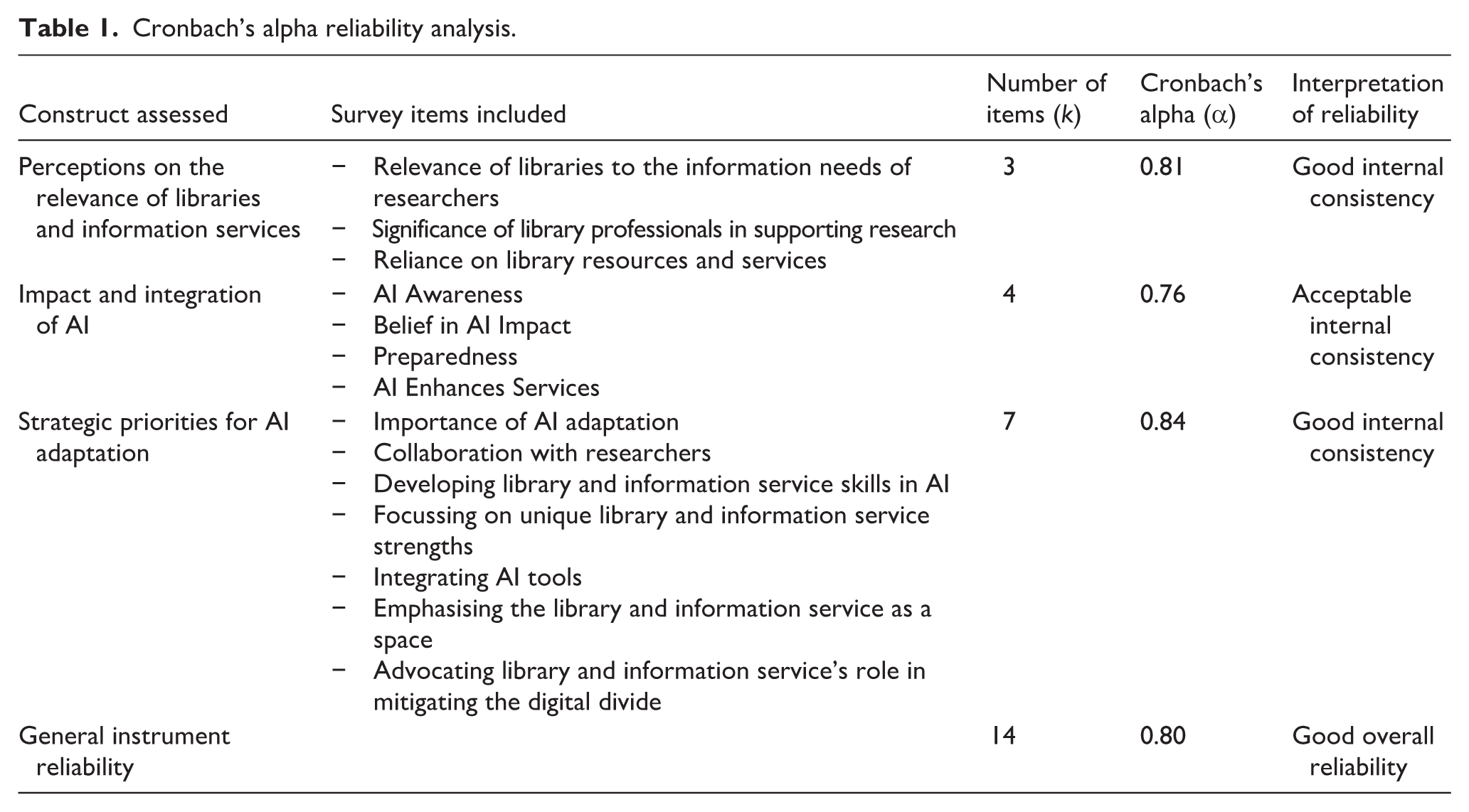
The instrument demonstrated good overall reliability (α = 0.80), with all construct values exceeding the 0.70 threshold (Taber, 2018), confirming the instrument’s suitability for measuring the study’s key dimensions.
Participant characteristics
Table 2 presents the distribution of professional roles by experience level among surveyed practitioners (N = 84).
Distribution of professional roles by years of experience among surveyed information practitioners (N = 84).
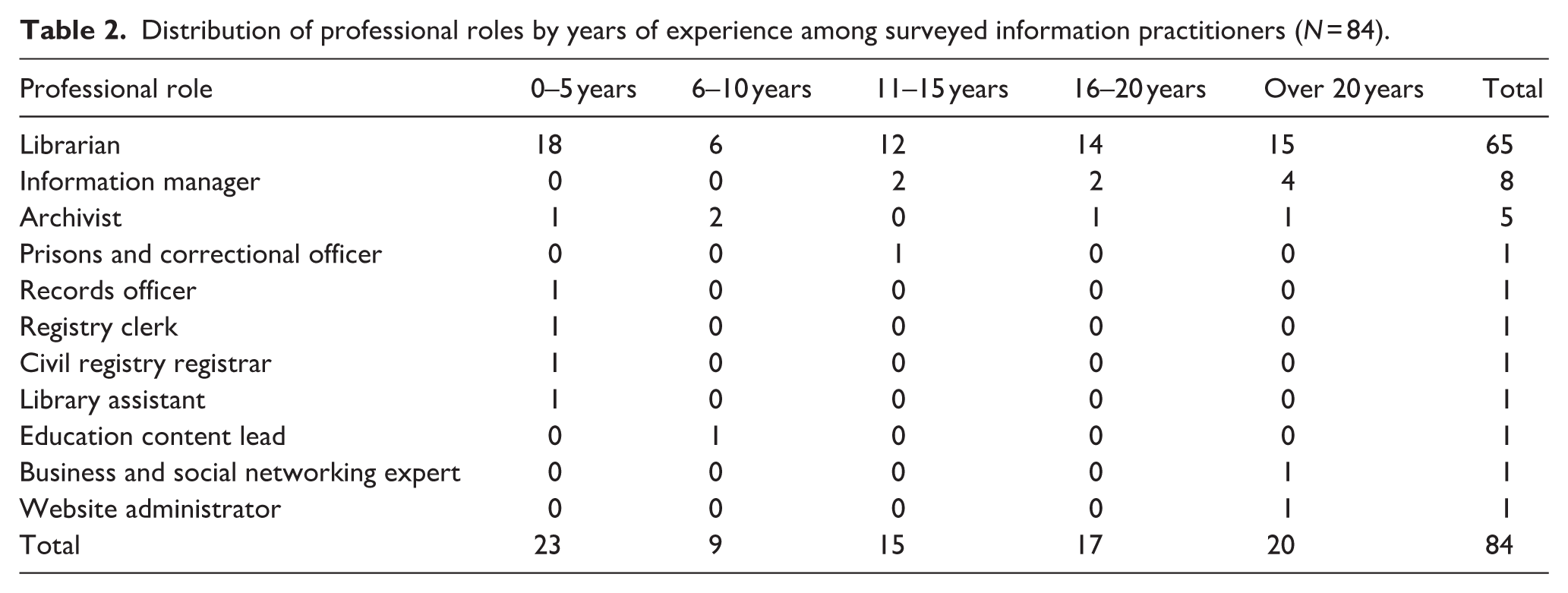
Librarians comprised 77.4% (n = 65) of respondents, distributed across all experience levels with concentrations in early-career (0–5 years, n = 18) and late-career (over 20 years, n = 15) stages. Over 40% (n = 37) possessed more than 15 years of experience, indicating substantial institutional knowledge, while early-career professionals (n = 23) suggest workforce renewal. Adjacent professionals (information managers, archivists, records officers) were purposefully included due to their functional proximity to library systems and engagement with strategic information environments. Table 3 presents the institutional contexts of surveyed practitioners.
Distribution of library and information service types represented in the survey sample (N = 84).
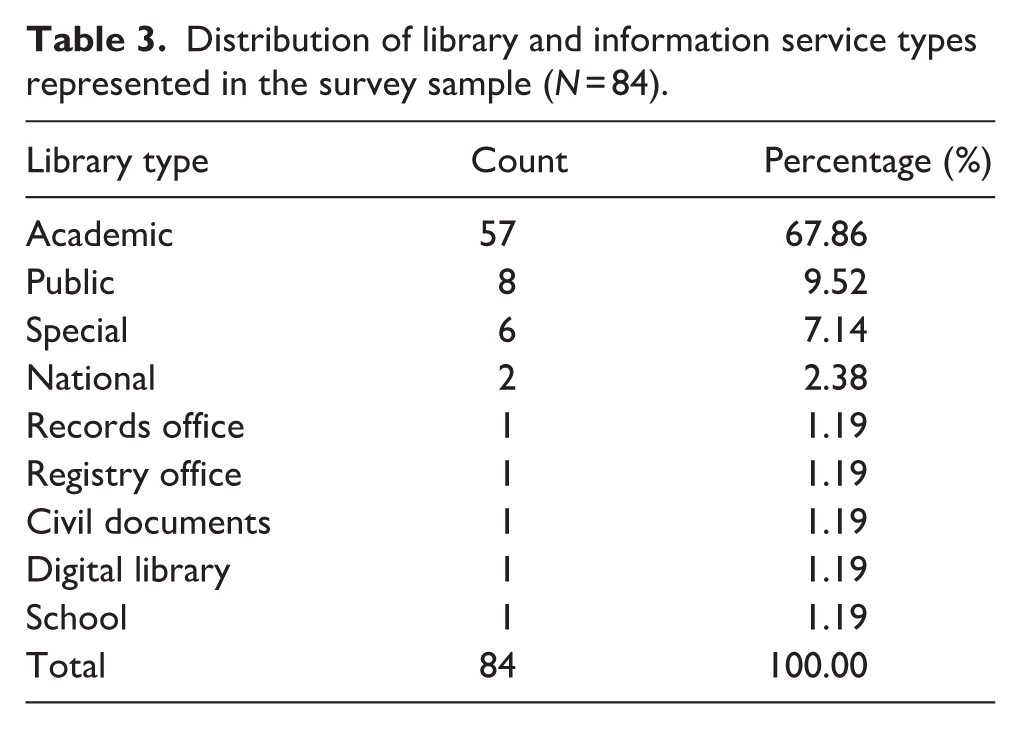
Academic libraries dominated the sample (67.86%), with public and special libraries contributing 9.52% and 7.14%, respectively. All other institutional types comprised minimal representation (⩽2.38% each), indicating findings are most reflective of academic library contexts.
Perceived library relevance
Table 4 summarises participants’ perceptions of library and information service contributions to research.
Perceived contribution of library and information service professionals to the research process: Descriptive statistics of survey responses.
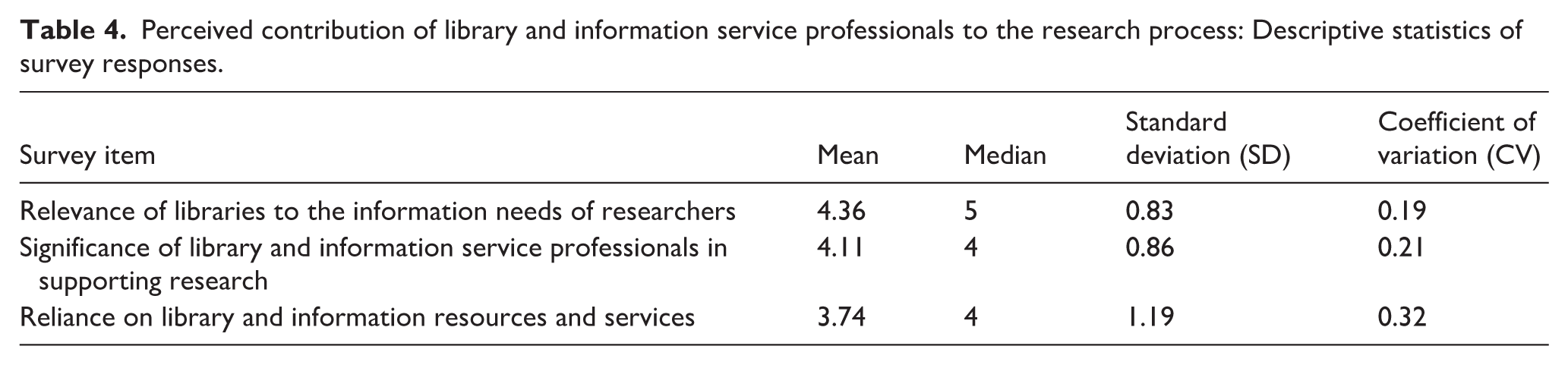
Respondents strongly endorsed the relevance of libraries to researchers’ information needs (M = 4.36, CV = 0.19), with high consistency indicating broad agreement. The significance of library professionals received favourable ratings (M = 4.11, CV = 0.21), though with slightly higher variability. Reliance on library resources scored lowest (M = 3.74) with the greatest variation (CV = 0.32), suggesting uneven perceptions possibly influenced by service uptake, resource availability, or institutional integration differences.
Perceptions of AI impact and integration
Table 5 presents respondents’ perceptions of AI in information retrieval and library services.
Perceptions of artificial intelligence in information retrieval and library and information service: Descriptive survey statistics.
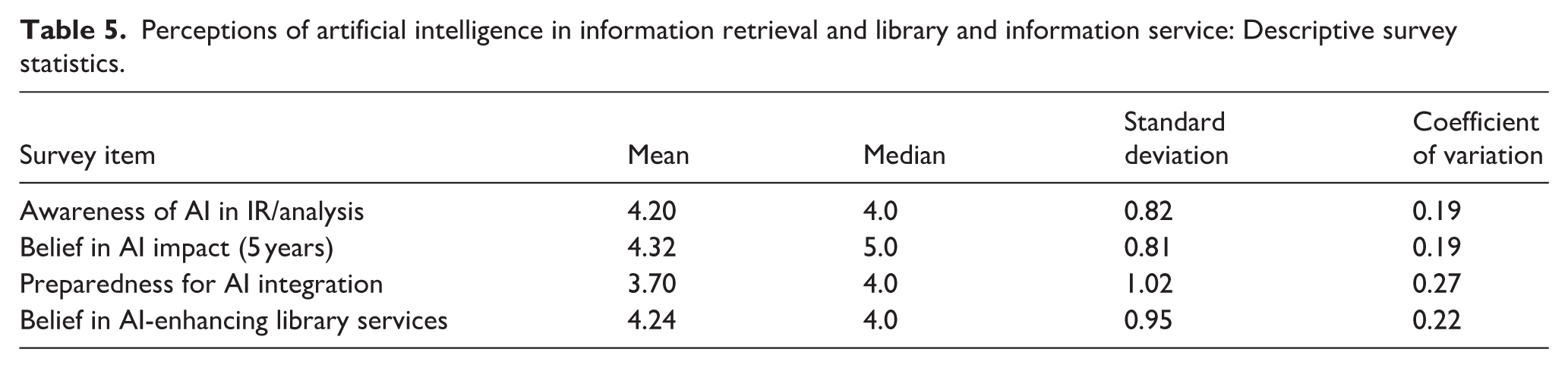
Respondents expressed strong awareness of AI in information retrieval (M = 4.20) and optimism about its future impact (M = 4.32, CV = 0.19) and capacity to enhance services (M = 4.24, CV = 0.22). However, preparedness for integration scored lowest (M = 3.70) with the highest variation (CV = 0.27), revealing a gap between awareness/belief and institutional readiness. Table 6 examines relationships among AI perceptions through Pearson correlation analysis.
Pearson correlation matrix: Relationships among perceptions of artificial intelligence in library and information services.

The strongest correlation emerged between preparedness and belief in enhancement (r = 0.39), indicating that professionals who feel better equipped are more likely to view AI positively. Weaker correlations, particularly between awareness and belief in enhancement (r = 0.11), reveal that familiarity alone does not translate into confidence in AI’s value. These associations indicate perceptual patterns rather than causal relationships.
Strategic adaptation priorities
Table 7 outlines respondents’ views on strategic priorities for AI adaptation.
Perceived strategic priorities for libraries in the age of artificial intelligence: Descriptive survey statistics.
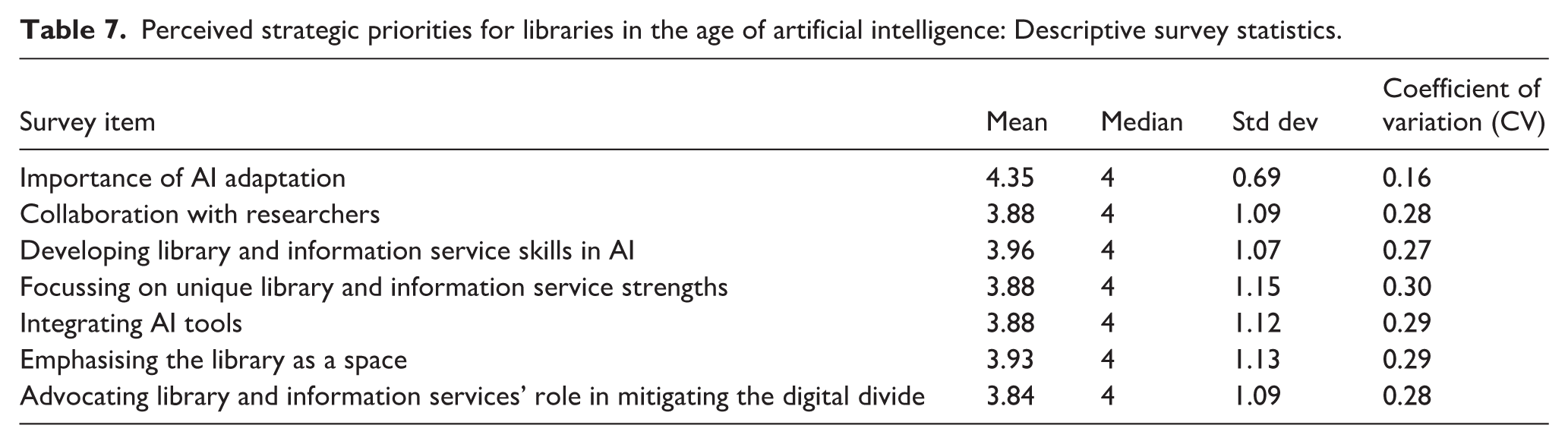
Strongest consensus emerged around AI adaptation importance (M = 4.35, CV = 0.16). Other priorities, including skill development (M = 3.96), emphasising physical space (M = 3.93), and collaboration, integration, unique strengths focus, and digital divide advocacy (M = 3.84–3.88), received moderate but consistent support, reflecting a multifaceted strategic outlook.
Measurement model validation
Exploratory factor analysis confirmed the instrument’s construct validity. Kaiser-Meyer-Olkin measure (KMO = 0.78) exceeded the 0.60 threshold, and Bartlett’s test was significant (χ2 = 485.32, df = 91, p < 0.001). Principal axis factoring with varimax rotation extracted three factors explaining 64.7% of the total variance:
− Factor 1 (Library relevance: three items; eigenvalue = 4.12; 29.4% variance)
− Factor 2 (AI integration and impact: four items; eigenvalue = 2.85; 20.4% variance)
− Factor 3 (Strategic adaptation: seven items; eigenvalue = 2.08; 14.9% variance).
All items loaded adequately (>0.45) with no substantial cross-loadings (<0.30), supporting discriminant validity. Factor scores were computed for hypothesis testing.
Hypothesis testing
Hypothesis 1: Perceived relevance of libraries
H1 posited that library and information professionals perceive libraries as highly relevant to supporting researchers’ information needs in an AI-dominated information ecosystem. A one-sample t-test compared mean relevance scores against the neutral midpoint of 3 (Table 8).
One-sample t-test for perceived relevance of libraries.

Professionals rated library relevance significantly higher than neutral (t(83) = 12.45, p < 0.001), with a very large effect size (Cohen’s d = 1.64, 95% CI [1.32, 1.96]), strongly supporting H1.
Hypothesis 2: Relationship between AI awareness and preparedness
H2 posited a significant positive relationship between professionals’ awareness of artificial intelligence and their preparedness for its integration in library services. Pearson correlation tested the association between AI awareness and preparedness (Table 9).
Pearson correlation between AI awareness and preparedness.

p < 0.01.
A significant positive correlation emerged (r = 0.35, p < 0.01, 95% CI [0.15, 0.52]), representing medium effect size with 12% shared variance (r2 = 0.12). Whilst statistically significant, this moderate relationship suggests awareness is necessary but insufficient for integration readiness, supporting H2 with the caveat that additional factors (institutional support, training, organisational culture) are important.
Hypothesis 3: Strategic adaptation and institutional capacity
H3 posited that library and information professionals who prioritise skill development and strategic adaptation perceive stronger institutional capacity for ensuring long-term relevance in the AI era. Multiple regression analysis examined strategic adaptation indicators as predictors of institutional capacity. Multicollinearity diagnostics confirmed acceptable VIF values (<2.5), and residual plots showed no serious assumption violations (Table 10).
Regression analysis of strategic adaptation on institutional capacity.
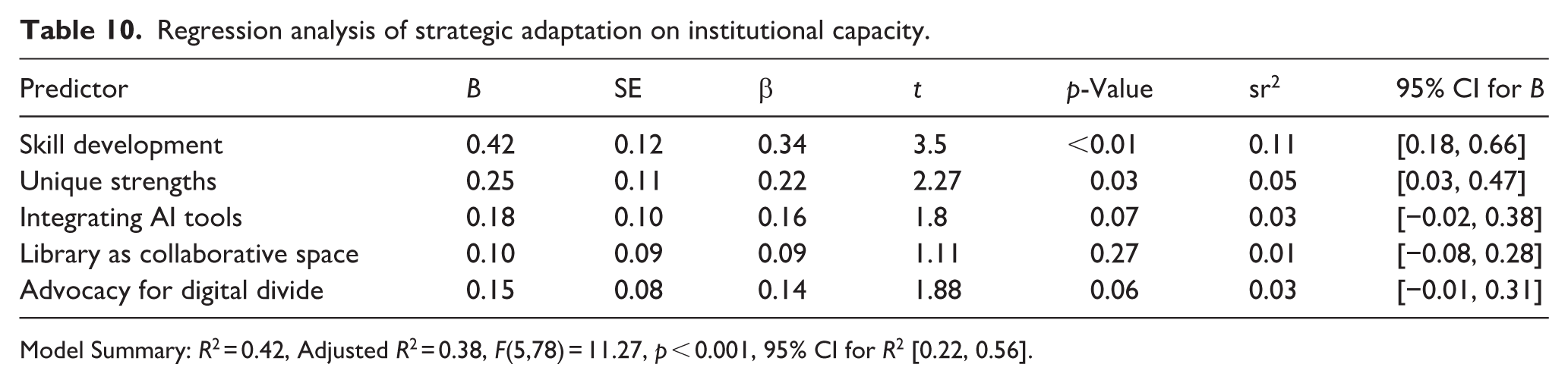
Model Summary: R2 = 0.42, Adjusted R2 = 0.38, F(5,78) = 11.27, p < 0.001, 95% CI for R2 [0.22, 0.56].
The model explained 42% of variance in perceived institutional capacity (R2 = 0.42, Adjusted R2 = 0.38, F(5,78) = 11.27, p < 0.001, 95% CI for R2 [0.22, 0.56]), representing a large effect size (Cohen’s f2 = 0.72). Skill development emerged as the strongest predictor (β = 0.34, p < 0.01, sr2 = 0.11, 95% CI [0.12, 0.56]), uniquely accounting for 11% of variance. Focus on unique strengths also significantly predicted capacity (β = 0.22, p < 0.05, sr2 = 0.05, 95% CI [0.03, 0.41]), contributing 5% unique variance. Remaining predictors showed positive but non-significant associations. These findings strongly support H3, demonstrating that professionals prioritising skill development and institutional differentiation perceive significantly stronger organisational capacity to maintain relevance amid AI disruption.
Discussion
Grounded in Sociotechnical Systems Theory (STS), which frames institutional resilience as the co-evolution of technical capabilities and social structures (Imanghaliyeva, 2020; Thomas, 2024), this study reveals a critical disjuncture between professional consciousness, organisational readiness, and strategic action in library responses to AI disruption.
The resilience paradox: High relevance, low utilisation
The confirmation of H1, demonstrating strong perceived library relevance (M = 4.36, d = 1.64), contrasts sharply with moderate service reliance scores (M = 3.74, CV = 0.32). This paradox illuminates what STS identifies as subsystem misalignment: professionals affirm libraries’ epistemic authority whilst acknowledging uneven engagement patterns. The institutional skew towards academic libraries (67.86%) further complicates generalisability, as these contexts possess infrastructural advantages absent in public, national, and special libraries (Fabunmi and Akinyemi, 2024; Thomas, 2024).
STS interprets this divergence not as measurement error but as a systemic signal: perceived relevance coexists with structural barriers to actualisation (Sony and Naik, 2020). The concentration of experienced professionals (44% with >15 years) alongside early-career practitioners (27%) creates potential for intergenerational knowledge transfer (Dettman, 2024; Halaburagi and Mukarambi, 2024), yet the absence of mechanisms to leverage this diversity represents a missed opportunity for sociotechnical co-optimisation. Libraries retain cognitive legitimacy but struggle with operational integration, a condition Cox (2023) attributes to the gap between symbolic value and embedded practice.
The awareness-preparedness gap: Knowing without capacity
The moderate correlation between AI awareness and preparedness (r = 0.35, p < 0.01), supporting H2, exposes what Rahmani (2023) and Kumar and Simhachalam (2025) identify as the implementation chasm: familiarity fails to translate into institutional capability. More revealing is the weak association between awareness and belief in enhancement (r = 0.11), suggesting that exposure to AI discourse does not organically generate confidence in its transformative potential. Equally, the stronger preparedness-enhancement correlation (r = 0.39) indicates that readiness, not mere knowledge, drives technological optimism.
STS explains this pattern through joint optimisation failure: technical subsystems (AI awareness, tool familiarity) advance independently of social subsystems (training infrastructure, organisational support, ethical frameworks), creating what Ashikuzzaman (2024) terms ‘hollow readiness’. The highest variation in preparedness scores (CV = 0.27) across otherwise optimistic perceptions (M = 4.32 for AI impact belief) reveals institutional heterogeneity masked by aggregated optimism. This aligns with Gupta’s (2026) observation that enthusiasm for AI experimentation often proceeds without corresponding investments in governance, capacity-building, or participatory design.
The disjuncture between high awareness (M = 4.20) and moderate preparedness (M = 3.70) operationalises what Siddique et al. (2025) describe as the ‘readiness illusion’: professionals recognise AI’s trajectory but lack organisational supports to engage meaningfully. STS prescribes deliberate subsystem realignment where technical adoption is paced by social infrastructure development, yet findings suggest libraries remain trapped in anticipatory paralysis (OCLC, 2025; Stickley and Haak, 2024).
Strategic adaptation as sociotechnical reconfiguration
The regression analysis confirming H3 identifies skill development (β = 0.34, sr2 = 0.11) and unique strengths focus (β = 0.22, sr2 = 0.05) as significant predictors of perceived institutional capacity, collectively explaining 42% of variance (R2 = 0.42, p < 0.001). This finding operationalises STS’s core proposition: institutional resilience depends less on technical acquisition than on deliberate social subsystem cultivation (Imanghaliyeva, 2020; Manjunatha, 2023).
The non-significance of AI tool integration (p = 0.07), collaborative space emphasis (p = 0.27), and digital divide advocacy (p = 0.06) as capacity predictors challenges instrumental approaches privileging technology deployment over professional empowerment. STS interprets this as confirmation that sociotechnical systems resist optimisation through technical subsystem enhancement alone: sustainable adaptation requires simultaneous investment in human expertise, institutional differentiation, and value clarification (Sony and Naik, 2020; Xue et al., 2022).
The primacy of skill development aligns with Ashikuzzaman’s (2024) and Cox’s (2023) contention that algorithmic literacy and role redefinition constitute strategic imperatives, not peripheral concerns. However, the equal weighting across most strategic priorities (M = 3.84–3.96) suggests professionals lack clear hierarchies for resource allocation, a condition Gupta (2026) attributes to the absence of evidence-based implementation frameworks. The strong consensus on adaptation importance (M = 4.35, CV = 0.16) coexists with undifferentiated strategic preferences, revealing what Oluchi Emmanuel et al. (2025) describe as ‘strategic diffusion’: broad agreement on urgency without operational specificity.
Sociotechnical implications for AI integration
The intergenerational workforce composition (18 early-career librarians, 15 with >20 years’ experience) creates conditions for what Halaburagi and Mukarambi (2024) identify as productive tension: novices bring AI fluency, whilst veterans contribute institutional memory. Yet STS warns that this potential remains latent without deliberate knowledge exchange mechanisms. The emergence of hybrid roles (content leads, digital administrators) signals workforce evolution towards what Harisanty et al. (2025) term ‘boundary-spanning positions’, though their minimal representation (n = 3) indicates incipient rather than systemic transformation.
The academic library dominance (67.86%) creates epistemological distortion, as findings primarily reflect contexts with research mandates, digital infrastructure, and stable funding, conditions absent in public and special libraries navigating resource constraints typical of Global South contexts (Bangani and Dube, 2024; Chemulwo and Sirorei, 2020). STS cautions against universal prescriptions derived from privileged settings, as adaptation strategies requiring substantial infrastructure may intensify rather than mitigate inequities (Thomas, 2024).
The measurement model validation (KMO = 0.78, 64.7% variance explained) confirms practitioners intuitively distinguish between relevance, integration, and adaptation constructs, yet moderate inter-factor correlations (r = 0.18–0.39) reveal these dimensions operate semi-independently. STS interprets this as evidence that professional consciousness has not yet coalesced into integrated strategic frameworks: libraries recognise discrete challenges but lack holistic models for sociotechnical co-evolution (Carayon et al., 2015; Xu and Gao, 2025).
Theoretical synthesis
Findings collectively illustrate what STS theorises as partial system optimisation: libraries strengthen individual subsystem components (awareness, strategic intent) without achieving systemic integration. The study demonstrates that professional optimism about AI (H1) and recognition of awareness-preparedness relationships (H2) are necessary but insufficient conditions for institutional transformation. Only when strategic adaptation prioritises social subsystem development, specifically skill cultivation and institutional differentiation (H3), do professionals perceive enhanced organisational capacity.
This pattern validates STS’s central tenet: technological disruption demands not reactive adoption but proactive sociotechnical redesign where human expertise, institutional values, and algorithmic capabilities co-evolve through participatory, ethically grounded processes (Imanghaliyeva, 2020; Sony and Naik, 2020). The persistent gaps between awareness and preparedness, between perceived relevance and actual utilisation, and between strategic consensus and differentiated action reveal that libraries remain in transitional states, acknowledging AI’s trajectory whilst struggling to operationalise adaptive responses within resource-constrained, institutionally heterogeneous contexts (OCLC, 2025; Stickley and Haak, 2024).
Conclusions and recommendations
Library professionals strongly affirm institutional relevance despite AI disruption, though notable disparities exist in readiness and service utilisation, particularly beyond academic contexts. This reflects sociotechnical systems in flux. Professionals perceive AI as an enabler rather than a threat, recognising urgency for strategic adaptation, capacity-building, and inclusive design to retain epistemic authority.
The study recommends a multifaceted strategy to strengthen libraries’ adaptive capacity in the AI era. Priority should be given to capacity-building through structured programmes that enhance algorithmic literacy and ethical fluency, ensuring AI integration complements human expertise. Cross-sector collaboration is vital for addressing infrastructural disparities through scenario-based planning and context-specific interventions, particularly in underrepresented library types. Institutions should pursue differentiation by leveraging distinctive strengths in metadata expertise, data ethics, and cultural memory preservation, whilst promoting physical-digital integration by reimagining libraries as spaces for democratic dialogue and critical engagement with algorithmic systems. Participatory governance frameworks must ensure that professional voices shape AI adoption in alignment with institutional values. These measures embody the Sociotechnical Systems Theory principle that sustained resilience depends on harmonising technological capacity with human agency and organisational identity.
Limitations and future research
This study acknowledges several limitations. The sample composition, dominated by academic librarians (68%), limits the generalisability of findings to public, national, and special libraries. Reliance on self-reported perceptions may introduce bias, as responses might not reflect objective institutional performance. The cross-sectional design captures views at a single timepoint, preventing analysis of changing perceptions or causal inference, whilst the use of a single-source Likert-scale instrument raises the possibility of common method bias. Additionally, the geographic specificity of the Zimbabwean context constrains broader applicability to other Global South regions, and the modest sample size (N = 84) reduces statistical power for subgroup analyses.
Future research should broaden sampling across multiple Southern African countries and library types, employ longitudinal and mixed-method designs, and integrate objective indicators such as infrastructure investment and training outcomes. Comparative Global North–South studies could illuminate structural disparities, whilst confirmatory factor analysis and causal modelling would enhance measurement validity and theoretical precision. Incorporating behavioural measures of actual AI adoption would extend understanding beyond perception-based analyses.
Footnotes

Funding
The authors received no financial support for the research, authorship, and/or publication of this article.
Declaration of conflicting interests
The authors declared no potential conflicts of interest with respect to the research, authorship, and/or publication of this article.
Data availability statement
The data is available from the corresponding author.