



Abstract
Social inclusion of refugees and asylum seekers includes addressing their information needs. This research seeks to examine the role of public libraries in this process through the analysis of public librarians’ perceptions. Based on the constructivist paradigm, the case study method, and the semi-directive interview survey technique, 16 public municipal libraries in the Lisbon Metropolitan Area (Portugal) are studied. The results highlight that these libraries do not identify forced migrants as their users. Still, they consider that the information needs and behaviors and the use of libraries by these communities are similar to those of economic migrants, with emphasis on the relevance of free access to the internet, foreign language resources, Portuguese language and digital literacy courses, and help to interact with online platforms. The gaps include the existence of few Portuguese courses for foreigners, a limited practice in assisting with job and housing searches, promoting health literacy, and inclusive collaboration with schools, as well as space, financial, and human resources constraints. To overcome these difficulties, librarians emphasize the motivation to fulfill the inclusive social mission of the public library, the universal accessibility and informal environment of the library, and its action to promote social cohesion and social capital. The respondents consider that the mission of public libraries is adjusted to the goal of social inclusion of forced migrants, but that there is room for improvement in the training of librarians. This research points to the need for more initiative-taking public library collaboration with existing inclusion networks. In conclusion, we seek to alert to the urgency of the involvement of Portuguese public libraries in the social inclusion of forced migrants, which will also contribute to their institutional legitimization.
Keywords
Introduction
Forced migration is a pressing global humanitarian problem not likely to decrease shortly. By the end of 2021, it was estimated that the total number of people forcibly displaced from their origin had reached 89.3 million. Included in this figure were, among other categories of displaced persons, 27.1 million refugees and 4.6 million asylum seekers (European Asylum Support Office, 2021; UNHCR, 2022b). By mid-2022, an estimated 101.1 million people were already displaced that year (UNHCR, 2022a).
Observing the growing influx of these forced migrants, host countries are faced with the need to develop strategies for their inclusion in society. These integration plans should be developed within an inclusive and holistic social perspective, based on multilingualism, citizenship, active civic participation, and the rejection of prejudices (Council of Europe, 2018). The creation and implementation of welcoming and inclusion policies are particularly relevant in the case of forced migrants because they are usually more vulnerable than voluntary migrants (for example, economic migrants): they less often speak the local language, have fewer social support networks, have more economic difficulties, and they more probably have faced a traumatizing event before or throughout the migration (Hynie, 2018). It is also important to bear in mind that forced migrants have to comply with different regulations that more often limit their experiences in the host society concerning, for example, work, instruction or housing (Hynie, 2018). In the development of these inclusive policies, it is important to have the active participation of forced migrants themselves in the planning and operationalization of services to their communities, to enhance their social integration (Mestheneos and Ioannidi, 2002).
Integration policies for forced migrants should address their basic needs, facilitate their orientation and communication, and promote the host society’s understanding of the phenomenon of forced migration. The host country must also promote the reconstruction of the migrant’s life (employment, housing, and education); trust in institutions and civic participation; family reunification; and the development of interpersonal relationships, supportive social networks, and feelings of belonging and identity. It is also essential to foster social cohesion and the recovery of cultural and religious practices, in an environment of respect and diversity, avoiding any kind of discrimination (UNHCR, 2002). One of the host society institutions that can have a say in this is the public library.
Research has focused primarily on the so-called functional and objective domains of social inclusion, rather than a more comprehensive approach that also considers cultural and emotional aspects. Still, there has been a growing concern to adopt a holistic view of social inclusion, preoccupied with the social relationships established, as in this research. According to this view, inclusion should not only be assessed in light of legal integration and economic independence, but also of civic participation, feelings of belonging, inheritance, and cultural identity (Khoir and Du, 2020; Korntheuer et al., 2021; Strang and Ager, 2010). Inclusion programs must also increasingly focus on areas such as psychosocial and family support, learning the local language, and vocational/professional development (UNHCR, 2021d).
In their process of social inclusion, forced migrants face several challenges. Among these, the literature has highlighted unemployment, unfamiliarity with the language, culture, and information systems of the country of arrival, and digital illiteracy (Mestheneos and Ioannidi, 2002; Wang et al., 2020). A prime example is proficiency in the local language, as it facilitates communication, the development of interpersonal relations, employability, and interaction with administrative services (High Commissioner for Migration, 2017; IFLA, 2018; Oliveira, 2021). According to Lloyd, migrants face situations of transition and disruption of their information environments, particularly in terms of knowledge sources, social support networks, and information landscapes. In this context, the ability to deal with information, that is, to conduct information literacy practices, can be an indicator of resilience. In turn, this “informational resilience” is related to the development of social relationships, information sharing, and knowledge creation (Lloyd, 2015).
Beyond the issue of information, social inclusion also includes more complex emotional and cultural aspects (the feeling of control over one’s own life, the skills to manage feelings of guilt and loss, and the development of self-esteem and feelings of security, identity, and dignity). The sense of belonging does not end with the feeling of being “at home,” but also encompasses a constant “transnational” dialog between the past and the expectations of the present, in a context that also presents limitations (Bird et al., 2016).
Information services, such as public libraries, emerge as social agents that should acknowledge the information needs of the communities they serve and promote access to and availability of information. In this way, not only can they better evaluate the services and products they already provide, but they can also develop others to respond effectively to these needs (Lloyd, 2015; Wang et al., 2020).
The relevance of this research is justified by the growing importance of the phenomenon of forced migration in the European and Portuguese reality, especially since 2015, and the lack of in-depth and current studies on the relationship between public libraries and forced migration in Portugal, in terms of their reception and integration. The research question was: What is the role of public libraries in the social inclusion of refugees and asylum seekers in the Lisbon Metropolitan Area (LMA)?
This work first focuses on a literature review including definitions and current knowledge about forced migration, new landscapes and information needs of forced migrants, social inclusion (and its relation with social capital, multiculturalism, and social cohesion), and the social mission of public libraries. The literature review is followed by the methods of the investigations, its findings and discussion, and final remarks about the work.
Literature review
Forced migration: Definitions and current situation
The definitions of refugee and asylum seeker encompass multiple sub-statutes under international conventions, declarations, and protocols, most notably the United Nations Convention relating to the Status of Refugees (Geneva Convention, 1951 ), and its 1967 Protocol (Oliveira, 2021). A “refugee” is any person who is outside his or her country of origin (of which he or she is a national or habitual resident in the case of statelessness) and requires international protection for various reasons (race, religion, social group, nationality, political opinion) which make him or her a target of persecution and which place his or her life and freedom in danger there, and cannot, therefore, be protected by that country (European Migration Network, 2018; UNHCR, 2021c). The term “asylum seeker” means a person seeking international protection who may or may not have already applied for refugee status or another complementary international protection status, but who has not yet had a final decision on that status (European Migration Network, 2018; UNHCR, 2021a).
Although Portugal is not one of the main destination countries for these forced migrants worldwide, or even in Europe, it has been showing receptivity and welcoming these migrants with increasing assiduity, namely since the Russian invasion of Ukraine in February 2022 (Oliveira, 2021). Applications for international protection have increased in recent years (except 2020, due to mobility restrictions in the context of the COVID-19 pandemic) (Oliveira, 2021). In terms of cumulative totals in Portugal, in 2020 there were 1230 people with refugee status, 1231 with a subsidiary protection residence permit. Of these, 606 were in reception programs, 540 in social support, and 1315 in a state of autonomy in the country (Oliveira, 2021). People with refugee residence permits in Portugal had 53 different nationalities, with more than half (54.6%) coming from Syria, Eritrea, and Iraq; while holders of subsidiary protection residence permits belonged to 50 different nationalities, with 57.4% coming from Syria, Iraq and Ukraine (Oliveira, 2021). During the year 2021 there were 1537 asylum requests: 1051 male (68.4%) and 486 female (31.6%). The 10 most represented countries of origin, in total asylum requests, were, in descending order: Afghanistan, Morocco, India, Gambia, Guinea, Guinea-Bissau, Angola, Senegal, Pakistan, and Sierra Leone. Also in 2021, 226 applicants received refugee status, 78 received subsidiary protection, and 418 saw their asylum application rejected, with no data for the number of requests pending a decision at the end of the year (Carreirinho, 2022). Despite the scarcity of concrete data on the academic qualification of asylum seekers arriving in Portugal, these suggest low levels of education, especially for migrants from programs coordinated by the European Union (Matos, 2019). However, recently, there has been a significant influx of forced migrants from Ukraine, following the Russian invasion of that country on February 24, 2022. A change in the reality of forced migration in Portugal may be taking place, which increases the relevance of this research.
In Portugal, the inclusion of forced migrants is eminently accomplished through collaboration between local entities, in a geographically decentralized way, and with growing autonomy (Costa et al., 2019: 119). The main difficulties in this process are related to the reduced articulation between the various public, private, national, and local actors; the heterogeneity in the planning and procedures of the various entities; and gaps in human resources and specialized training. On the part of forced migrants, the main problems were identified at the level of Portuguese language proficiency and, closely related, at the level of employability (unemployment and downward professional mobility) (Santos, 2015; Zarro, 2017).
New landscapes and information needs of forced migrants
The process of forced migration causes changes in the sociocultural contexts, the information environments, and the information needs of individuals (Caidi et al., 2010; Le Louvier, 2019; Lloyd, 2015; Lloyd et al., 2013). Inability or difficulty in accessing, understanding, and using information, which Dannenbaum described as “information poverty,” are aspects of social exclusion. These can negatively influence a person’s ability to make decisions in a new cultural, linguistic, social, and economic environment (Dannenbaum, 2019; Díaz Andrade and Doolin, 2016; Khoir and Du, 2020; Wang et al., 2020). Facing situations of information poverty and unknown and fractured information environments, it is necessary to promote access to and interpretation of information (Barckow and Pierce, 2017; Caidi et al., 2010; Dannenbaum, 2019; Díaz Andrade and Doolin, 2016; Khoir and Du, 2020; Kosciejew, 2019; Lloyd, 2017; Lloyd et al., 2017; Lloyd, 2020; Shepherd et al., 2018; Wang et al., 2020). According to Le Louvier, the creation of meaningful social relations is also important in the re-edification of informational landscapes and the adaptation of information practices (Le Louvier, 2019).
Considering the centrality of information to survival, personal development, and the process of social inclusion, it is important to recognize migrants’ sources of information and their information needs, which vary individually and throughout the stages of the inclusion process. Some researchers have identified personal contacts, local authorities and institutions, the Internet, and the media as preferred sources (Akullo and Odong, 2017; Wang et al., 2020). Migrants need the information to make decisions and adapt to their new society, especially about housing, finance, employment, health, education, communication, the local language, rights and duties, leisure, and digital and media literacy (Caidi et al., 2010; Díaz Andrade and Doolin, 2019; Kennan et al., 2011; Le Louvier, 2019; Le Louvier and Innocenti, 2019; Lison, 2016; Oduntan and Ruthven, 2019). The literature reports that initially these people prioritize information related to issues that are pressing for their immediate survival, for example, access to food and housing, spatial orientation/transportation system, language learning, a basic understanding of laws and social services, education, and health care. However, as their inclusion progresses, these needs also encompass institutional and legal functioning, social welfare, and local culture (Akullo and Odong, 2017; City of Sanctuary, 2020; Hassan and Wolfram, 2019; Shepherd et al., 2018; Vincent and Clark, 2020; Wang et al., 2020).
Social inclusion: Social capital, multiculturalism, and social cohesion
The phenomenon of social inclusion is multidimensional, complex, dynamic, and bidirectional, referring to the spheres of interpersonal relationships, autonomy, cultural identity, sense of belonging to the community, and civic intervention (Ager and Strang, 2008; Constantino, 2019; Cordier et al., 2017; Díaz Andrade and Doolin, 2016; Meixner and Spitzner, 2021). According to the United Nations, it is a process of improving the well-being and social participation of marginalized individuals, which involves access to education, health care, infrastructures, employment, and involvement in political, cultural, and social life (United Nations Department of Economic and Social Affairs, 2016).
Regarding forced migrants, this process can be expressed in their access to resources and opportunities, their civic participation, their empowerment, and the development of feelings of belonging and security. On the other hand, how society, including at the institutional level, receives the migrant also contributes to their integration. The interaction between migrants and the host community results in mutual adaptations that enable the construction of a culturally diverse and inclusive society (Constantino, 2019; Díaz Andrade and Doolin, 2016; Hynie, 2018; Phillimore, 2021; Rivera et al., 2016; Strang and Ager, 2010; UNHCR, 2018)
The main obstacles to social inclusion of forced migrants are unemployment, lack of knowledge of the local language, culture, and information systems, access to education and health care, and digital illiteracy (Mestheneos and Ioannidi, 2002; Santos, 2015; Wang et al., 2020; Zarro, 2017). Social inclusion can be seen as a problem of access, understanding, and adequacy of information (Caidi and Allard, 2005; Mckeown, 2016; Oduntan and Ruthven, 2021; Reisdorf and Rhinesmith, 2020). In these situations, forced migrants have less capacity for decision-making and social participation, which can increase the mentioned obstacles (Lloyd et al., 2013, 2016).
The development of meaningful social relationships (or social capital), is also fundamental to social inclusion (Hart, 2013). According to Ager and Strang’s model of integration, three main types of social relationships have been identified: “social ties” (between members of the same community, e.g. ethnic or religious); “social bridges” (between members of different communities); and “social links” (between individuals and local or governmental institutions/ organizations) (Ager and Strang, 2008; Sorgen, 2015). Social capital thus has a multidimensional nature and can be associated with access to information, the development of feelings of trust, belonging, solidarity and collaboration, civic participation, and cohesion in multicultural societies (Ager and Strang, 2008; Alvim, 2015; Elbeshausen and Skov, 2004; Ferguson, 2012; Pacífico, 2009; Putnam, 2000; Shuva, 2020; Togores, 2014; Wojciechowska and Topolska, 2021; Zetter et al., 2006). However, the establishment of social relationships, with respect and sharing of values and ideals, does not imply the exclusion of individual identity and plurality. Social capital has a shared nature and therefore generates benefits in the form of resources that are not exclusively individual (Ager and Strang, 2008; Pacífico, 2009; Shuva, 2020). The creation of social capital is favored by the existence of spaces and opportunities that promote the encounter between people, dialog between cultures, and social equality (Giglitto et al., 2019; Strang and Ager, 2010).
Information literacy and the development of social capital are central to the processes of social inclusion, on which the development and cohesion of today’s multicultural society also depend. Thus, it is relevant that Information Science discusses the relationships between these aspects (Caidi et al., 2010; Khoir and Du, 2020). In the specific case of Librarianship, the informative and social mission of the public library is emphasized as a democratic, accessible, meeting space, builder of citizenship and social capital (Alvim, 2015).
Considering that forced migrations are situations that reduce social capital, migrants must establish interpersonal relationships that facilitate access to and interpretation of information, contributing to their inclusion (Audunson et al., 2011; Caidi and Allard, 2005; Crisp and Taket, 2020; Elbeshausen and Skov, 2004; Ferguson, 2012; Le Louvier, 2019).
The social mission of public libraries
The public library is socially oriented, advocating for equal access to information, freedom, and social inclusion (Almeida, 2018). Its social mission, embodied in multiple guiding documents (Ifla/faife, 1999, 2002; IFLA/UNESCO, 2001, 2022; PULMAN, 2003), refers to respect for human rights, non-discrimination, democracy, citizenship, social justice, and the defense of linguistic, cultural, and identity heterogeneity (Alvim, 2015; Calixto, 2007; Gorham et al., 2016; IFLA, 2005, 2009; IFLA/UNESCO, 2001, 2012; Koontz and Gubbin, 2010; Meneses Tello, 2013; Rodriguez, 2019).
The International Federation of Library Associations and Institutions (IFLA) has advocated that libraries are safe spaces (sanctuaries); spaces for building memories and preserving experiences (storehouses); entry spaces to the community (gateways); and spaces for migrants to meet and develop personal relationships (bridges) (IFLA, 2018). The library can thus enhance trust, a sense of belonging, and social cohesion (Alvim, 2015; Audunson et al., 2007; Calixto et al., 2012; Ferguson, 2012; Gómez-Hernández et al., 2017; IFLA/UNESCO, 2001; Johnson, 2010; Koontz and Gubbin, 2010; PULMAN, 2003). Public libraries should be informal spaces, as opposed to the bureaucratic and impersonal world that often constitutes official immigration and asylum systems. For these purposes, multilingual material and human resources were considered important, as well as the constitution of community archives or repositories of migrants’ memories. The provision of classes in the host language and conversation groups, as well as courses in citizenship, digital literacy, entrepreneurship, and career planning, were also valued. A collaborative approach with multiple entities related to the welcoming and inclusion of migrants, who may even provide some of their services in the libraries, has also been highlighted (Dannenbaum, 2019: 5–9; IFLA, 2018).
Social librarianship reflects a concern with the social context in which libraries operate, including the information needs of the communities they serve (Anna et al., 2018; Civallero, 2016; Dannenbaum, 2019; Díaz-Jatuf, 2013, 2017; Faggiolani and Galluzzi, 2015; Lindemann, 2014; Meneses Tello, 2013; Rojas Morales, 2016; Tanus and Silva, 2019). According to this conception, librarianship should promote social development, go beyond the library walls into close contact with the community, and establish multidisciplinary partnerships. Librarians must assume a socially responsible, inclusive, humanist, and participatory attitude, in favor of democracy, freedom of expression, human rights, and the protection of disadvantaged communities (Anna et al., 2018; Civallero, 2016; Dannenbaum, 2019; Díaz-Jatuf, 2013, 2017; Faggiolani and Galluzzi, 2015; Lindemann, 2014; Meneses Tello, 2013; Rojas Morales, 2016; Tanus and Silva, 2019).
For forced migrants, information needs include access to the internet and technological resources, resources in native languages, practical and legal information, help in interacting with digital services, language, citizenship, and local culture courses, digital and information literacy, entrepreneurship, and career planning, as well as cultural and leisure activities and the development of social relationships (Dannenbaum, 2019; IFLA, 2018; Khoir et al., 2017; Kosciejew, 2019; Lloyd et al., 2016; Mabi, 2018; Mckeown, 2016; Pilerot, 2018; Wang et al., 2020).
Researchers have investigated the potential of the relationship between migrants and public libraries. Dannenbaum (2019: 9–10) pointed out that these institutions can play an important role in improving living conditions and developing individual potential. For Salzano et al. (2020) the main motivations for library use by these communities were related to language, culture, and economic issues. Migrants use libraries to access resources in their native languages, especially when they are unfamiliar with the local language and thus value multilingual resources. They also seek free access to the Internet and digital resources, and courses in language, civics, digital literacy, and information literacy. The library’s collaborations with other agencies (in employment, housing, health, and justice) and with other types of libraries (e.g. academic or health libraries) are valued by migrants. Similarly, they also highlight the existence of cultural activities (associated with both their origins and the host country), and the possibility to meet and develop social relationships in the public library (IFLA, 2018; Khoir et al., 2017; Wang et al., 2020).
The main institutional obstacles in the use of public libraries by forced migrants relate to accessibility, financial, material, and human resource limitations, and librarian training. From the migrants’ point of view, isolation, illiteracy, and prejudice or lack of knowledge about the library are highlighted (Caidi and Allard, 2005; City of Sanctuary, 2020; Goulding, 2016; Lison, 2016; Togores, 2014; Wang et al., 2020; Wojciechowska and Topolska, 2021). To overcome these limitations, it is crucial to invest in librarian training (foreign language skills, multiculturalism of teams, and interdisciplinary work); and to develop collaborative approaches with other entities (to optimize resources, increase funding, and develop more fruitful projects) (Crisp and Taket, 2020; Dutch and Muddiman, 2001; Elbeshausen and Skov, 2004; Giesler, 2019; IFLA, 2018; Khoir et al., 2017; Moxley and Abbas, 2016; Togores, 2014; Wang et al., 2020).
As part of the social inclusion of these communities, some areas that public libraries should focus on include: the effective dissemination of their services and products; the translation of practical information about the host community (Bolt and Gerasimidou, 2020; Eskola et al., 2017; IFLA Library Services to People with Special Needs Section, 2017; Lison, 2016; Shepherd et al., 2018); the promotion of education, and lifelong learning (Alvim, 2015; IFLA, 2002, 2004; IFLA/UNESCO, 2001, 2022; PULMAN, 2003) employment (Audunson et al., 2011; Togores, 2014; Yavuzdemir, 2019); as well as the participation of migrants in the development of inclusive strategies (Ashraf, 2017; Crisp and Taket, 2020; Grossman et al., 2022).
Despite the multiple international examples of public library action in the field of social inclusion of forced migrants, there are no in-depth and current studies on the Portuguese reality. This lack of knowledge turns this research unprecedented and relevant. Using the perceptions of public librarians in the Lisbon Metropolitan Area (LMA), we seek to understand the role of public libraries in the social inclusion of refugees and asylum seekers.
Methods
Starting from the general objective of analyzing the role played by public libraries in the social inclusion of refugees and asylum seekers, including the relationship established between public librarians and these communities in the LMA space, five specific objectives were designed:
To know public librarians’ perceptions of information needs, information behavior, and usage patterns of public libraries by forced migrants;
Understand how public libraries can conceive themselves as inclusive spaces, contributing to the empowerment of forced migrants, building social capital and social cohesion;
Inquiring about the need for public libraries to adjust their mission to meet the information needs and promote the social inclusion of forced migrants;
Investigate the adjustment of public librarians’ training and the development of personal strategies to meet the information needs and promote the social inclusion of forced migrants;
Identify collaborations of LMA public libraries with other institutions in the field of social inclusion of forced migrants.
For the theoretical framework of the research, the constructivist paradigm was chosen, which assumes that reality and knowledge are complex, socially and actively constructed, changeable, and contextualized (Amado, 2014; Cohen et al., 2018; Creswell and Creswell, 2018; Gonçalves and Gonçalves, 2021; Mertens, 2010). This option took into account that constructivism involves the heterogeneity of points of view about the reality(s), as well as assuming the subjectivity and intervention of the researcher in the empirical phase and in the interpretation of the results obtained in the investigation. This paradigm helped legitimize the methodology because not only it privileges a qualitative investigation approach, but it also defends that the investigator takes into account the different perspectives of the participants (librarians) and their meanings (Cohen et al., 2018; Creswell and Creswell, 2018; Mertens, 2010).
The research method is the case study, which allows one to deepen and understand the “how” or “why” of a complex social phenomenon in a detailed manner (Cohen et al., 2018; Escalante Gómez, 2021; Fortin, 2009; Gauthier, 2009; Yin, 2015). This is a descriptive case study (Amado, 2014; Yin, 2015), but also exploratory (Cohen et al., 2018; Yin, 2015); single, integrated, inclusive, or branched type with multiple analysis units that correspond to each sample library (Amado, 2014; Coutinho, 2015; Yin, 2015). LMA comprises 18 municipalities in two sub-regions (Greater Lisbon and Setubal Peninsula). According to provisional data from the 2021 Census, it is the most populated metropolitan area (NUTS III) in Portugal, with about 27.75% of the Portuguese population (Atlas digital da Área Metropolitana de Lisboa, s.d.; PORDATA, Base de Dados de Portugal Contemporâneo, s.d; Área Metropolitana de Lisboa, 2021) 41% of forced migrants from European Union programs lived in the LMA—35% in Lisbon and 6% in Setúbal, while 70% of forced migrants with spontaneous applications in Portugal lived in the districts of Lisbon, Santarém and Setúbal (Matos, 2019). These aspects justify the choice of LMA as a case study.
The research sample was delimited, by convenience, to 18 municipal libraries in the 18 municipalities of LMA: Alcochete, Almada, Amadora, Barreiro, Cascais, Lisboa, Loures, Mafra, Moita, Montijo, Odivelas, Oeiras, Palmela, Seixal, Sesimbra, Setúbal, Sintra, and Vila Franca de Xira.
For data collection, the survey technique was used by semi-directive interview through videoconference to public librarians in LMA (Cohen et al., 2018; Gauthier, 2009; Ghiglione and Matalon, 2005; Rosa and Arnoldi, 2006) and data analysis was performed using content analysis (Amado, 2014; Bardin, 2011; Bell and Waters, 2018; Brandão et al., 2021; Campenhoudt et al., 2019; Cohen et al., 2018; Coutinho, 2015; Ghiglione and Matalon, 2005; Magalhães and Paul, 2021). The interview script followed the five research objectives and included seven open-ended questions. A previous categorization was carried out based on the literature review and the research objectives in order not only to formulate the questions but also to simplify the subsequent analysis of the data obtained (Amado, 2014). The interview script was structured in thematic blocks (related to the research objectives): information needs and behavior of the forced migrants and the library’s response; public library as an inclusive space for empowerment and social development; public library’s mission; training and personal strategies of public librarians to answer to the information needs and social inclusion of forced migrants; and public library’s institutional collaborations.
Findings
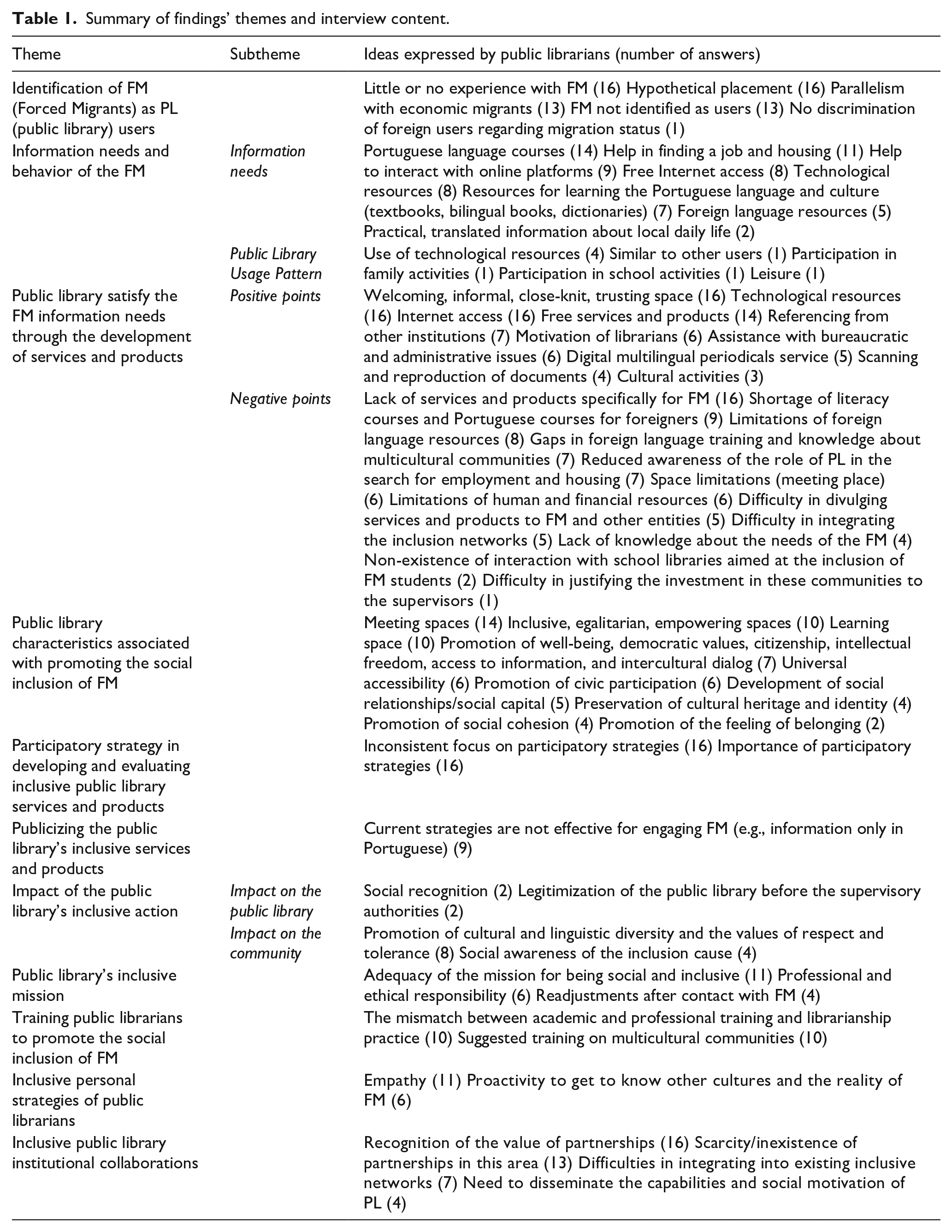
In the sample’s municipal libraries (n = 18), only those from Mafra and Odivelas refused to participate in the research. The 16 respondents (one librarian per institution) are characterized as Head of Division/Library Coordinator (n = 11); senior technician with librarian functions (n = 4); and senior technician of the Library Division without current librarian functions (n = 1). Interviews were conducted between January 31 and March 11, 2022, with an average duration of approximately 62 minutes per interview. The data were transcribed and analyzed, concerning the five objectives of the research design. The results are summarized in Table 1 according to identified themes, subthemes, and interview content.
Summary of findings’ themes and interview content.
Information needs, information behavior, and use of public libraries by forced migrants
Most librarians (n = 13) interviewed did not identify forced migrants as users of their libraries, and therefore had little or no experience serving this community. In most cases (n = 13), they chose to draw on their experience with economic migrants to answer the questions but cautioned about any particularities that forced migrants might present. On the pattern of public library use by forced migrants, they felt that it could be mainly focused on the use of technological resources (n = 4); in the participation in family (n = 1), school (n = 1) and leisure (n = 1) activities; or just “like that of other users” (n = 1).
In terms of information needs, the most highlighted were access to the internet, technological resources, resources in foreign languages, and practical information on local daily life; Portuguese language courses; and help in interacting with online platforms, in the search for jobs and housing.
About their libraries’ response to these needs, respondents (n = 16) identified as added value the fact that they are welcoming, informal, and close spaces with motivated information professionals. Also mentioned were the free services and products (such as access to the Internet and multilingual digital periodical services); the reference from other institutions; the help in interacting with administrative platforms; and the development of cultural activities.
The major difficulties identified were the lack of knowledge about forced migrants; the shortage of human and financial resources; the lack of foreign language resources; the few Portuguese courses for foreigners; and the limitations of library space. Other obstacles mentioned were the justification of investment in these communities before the authorities; the lack of integration in existing inclusion networks; the problems of dissemination of ideas, services, and products of the library; and the lack of training of librarians about multicultural communities and foreign languages.
Characterization of the library as an inclusive entity
In response to the second objective, respondents characterized their libraries as inclusive and empowering spaces, advocates of democratic values, citizenship, intellectual freedom, access to information, and intercultural dialog. Although there are gaps in library buildings, they were considered meeting spaces promoting well-being and the development of social relationships. Their role in preserving cultural heritage and identity was also mentioned, as was the sense of belonging that promotes social cohesion. Librarians argued that their libraries are spaces for learning. In some cases, they mentioned the provision of digital literacy (n = 3) and Portuguese language courses for foreigners (n = 3). Regarding help in promoting health literacy and finding housing and employment, most librarians (n = 9) felt that this was primarily a competence of other municipal or local services.
The research revealed that there is no consistent focus on participatory strategies in the development and evaluation of services and products of these public libraries; as well as on the effectiveness of their outreach to captivate forced migrants, particularly as this is done only in Portuguese.
The respondents considered that the action of their libraries in favor of the social inclusion of forced migrants has an impact on institutional legitimization before the authorities and the society, on social awareness of the subject, and the defense of cultural and linguistic diversity, respect, and tolerance in the host society.
Adjusting the public library’s mission
Most librarians in the sample (n = 11) felt that the mission of their public libraries, being social and inclusive, met the information needs of forced migrants and promoted their inclusion. Still, they added that it might be necessary to reformulate this mission when they learned more about the real needs of forced migrants in their communities.
Adequacy of training and personal strategies of public librarians
Librarians reported a mismatch between the academic and professional training (organized by supervisors and professional associations) and the actual librarianship practice with forced migrant communities. They suggested more training on library service to multicultural communities.
When asked about personal strategies for the inclusion of these migrant communities, librarians highlighted the importance of empathy and the interest in learning about other cultures and the reality of forced migration.
Inclusive inter-institutional public library collaborations
The librarian respondents valued partnerships between public libraries and other entities aimed at the social inclusion of forced migrants, although these were almost non-existent (n = 3) in the sample. However, they identified some collaborations targeting migrant communities in general (n = 6), especially with other municipal departments and with cultural, religious, and charitable associations.
It was recognized the need for public libraries to disseminate their services and their social motivation among entities that already work in the welcoming and integration of forced migrants. The library’s resources could be optimized, more funding could be obtained, and inclusive initiatives could be more solidly structured.
Discussion
Information needs of forced migrants
The literature and the respondents agreed that one of the key aspects for public libraries to serve forced migrants is to know their information needs (Costa et al., 2021; Hoyer, 2011; Lo and Stark, 2021; Morehart, 2018; Togores, 2014; UNHCR, 2021b; Winberry and Potnis, 2021). The research showed that there is an optimistic view about the libraries’ ability to respond to these needs. However, librarians also admitted to not knowing those needs in detail because they do not have frequent contact with forced migrants (Grossman et al., 2022). These librarians have more experience with economic migrants and they did not specifically identify that forced migrants might have more or different information needs regarding local language, work, instruction, housing, or social, healthcare, and economic support (Hynie, 2018).
Nonetheless, the information needs identified by the respondents matched mostly what has been identified in other works. These can cover areas such as the language and culture of the host country; education and training; employment; housing, healthcare; knowledge of the social, legislative, economic-financial, and mobility systems of the host country; digital and media literacy; communication with family and friends; or social life and leisure (Alam and Imran, 2015; Caidi et al., 2010; Comparte & Integração, 2021; Constantino, 2019; Díaz Andrade and Doolin, 2019; High Commissioner for Migration, 2017; Kennan et al., 2011; Le Louvier, 2019; Le Louvier and Innocenti, 2019; Lison, 2016; Oduntan and Ruthven, 2019; Oliveira, 2021; Twork, 2009).
The need for access to resources in foreign languages (books, newspapers, and magazines) was also mentioned, not only to maintain contact with the culture of origin and preserve the identity memory but also for its dissemination to the host society, enhancing the creation of social capital, the feeling of belonging, civic participation, cohesion and social inclusion (Audunson et al., 2011; Caidi and Allard, 2005; Helsingin Kaupunginkirjasto - Yleisten Kirjastojen Keskuskirjasto [Helsinki City Library - Central Library Of Public Libraries], 2016; Koontz and Gubbin, 2010; Togores, 2014; Wang et al., 2020).
According to international guidelines, the service of public libraries to multicultural communities should include making available practical multilingual, culturally appropriate, and up-to-date information for their orientation in the host society (Bolt and Gerasimidou, 2020; IFLA, 2009, 2014; IFLA Library Services to People with Special Needs Section, 2017; The Network, 2021). However, none of the libraries in the sample reported having this information compiled, although they recognized its importance in the context under analysis.
Inclusive characteristics of public libraries
The librarians interviewed considered the public library as a space that welcomes everyone, is guided by the foundational values of fighting discrimination in access to information and culture, and that works toward continuous learning and conscious civic participation (Alvim, 2015; Gómez-Hernández et al., 2017; IFLA, 2021; IFLA/UNESCO, 2012, 2022; Koontz and Gubbin, 2010; Lo and Stark, 2021; Togores, 2014).
As an egalitarian space, the public libraries in the sample are also guided by the principle of respect for all users. In addition to being sources of information, they were defined as spaces of equality, where forced migrants can feel that they are full community members. Regarding accessibility, librarians reported that most of their services and products are free and that many do not require that the users show identification documents, as recommended in the literature (Fisher et al., 2004; IFLA, 2009; Koontz and Gubbin, 2010; Leeper, 2017; RNBP, 2022; Yavuzdemir, 2019). However, they recognized that the fact that their signage is not multilingual can be an obstacle for forced migrants, as indicated in other research (Helsingin Kaupunginkirjasto - Yleisten Kirjastojen Keskuskirjasto [Helsinki City Library - Central Library Of Public Libraries], 2016; IFLA, 2009; Togores, 2014).
The public libraries analyzed were also characterized as democratic spaces, where there is freedom of expression and the promotion of citizenship building, which is in line with international guidelines. In a multicultural society, public libraries should promote respect for the migrants’ culture and identity, their social recognition, and the preservation of their cultural heritage (IFLA, 2005, 2020; Ifla/faife, 1999, 2002; IFLA/UNESCO, 2012; Koontz and Gubbin, 2010).
The public libraries surveyed consider themselves to be aggregator, meeting, and socializing spaces. To enhance these dynamics of inclusion, libraries should be comfortable, inviting, spacious and multifunctional spaces. But that is not always what happens in the libraries studied. Regarding forced migrants, the library can function as a safe space, a “sanctuary,” or a refuge (City of Sanctuary, 2020; IFLA, 2018; IFLA/UNESCO, 2012; Vincent, 2018; Vincent and Clark, 2020).
The respondents perceived their libraries as meeting places that can foster positive experiences and enhance feelings of belonging in migrants, not only through connections with the host community but also with the communities of origin (Alvim, 2015; Atfield et al., 2007; Calixto et al., 2012; Fuchs et al., 2021; Hynie, 2018; IFLA/UNESCO, 2001; Koontz and Gubbin, 2010; Mahoney and Siyambalapitiya, 2017; PULMAN, 2003).
Respondents also felt that the library can foster interpersonal relationships and that this social capitalization is associated with reduced isolation and increased social cohesion (Constantino, 2019). Some examples of actions that converge with literature include organizing cultural celebrations that emphasize the cultural, ethnic, and linguistic diversity of the community (Ethnic and Multicultural Information Exchange Round Table (ALA) (2020); Helsingin Kaupunginkirjasto - Yleisten Kirjastojen Keskuskirjasto [Helsinki City Library - Central Library Of Public Libraries], 2016).
Notwithstanding these considerations, there is still a long way to go in some areas relevant to the inclusion of forced migrants. These include lifelong learning (literacy courses, Portuguese courses, and multilingual resources) (Alvim, 2015; Crawford and Irving, 2013; Cronnelly, 2021; Eskola et al., 2017; Fejes, 2019; Helsingin Kaupunginkirjasto - Yleisten Kirjastojen Keskuskirjasto [Helsinki City Library - Central Library Of Public Libraries], 2016; IFLA, 2002, 2004, 2015, 2020; IFLA/UNESCO, 2001, 2022; PULMAN, 2003; Togores, 2014; UNESCO, 2016; UNESCO Institute for Lifelong Learning, 2022; U.S. Citizenship and Immigration Services, 2006); interaction with school libraries targeting these specific communities (Bolt and Gerasimidou, 2020; IFLA, 2015; IFLA Library Services to People with Special Needs Section, 2017; Paraschiv, 2017; Thomas, 2016; Vincent, 2018; Vincent and Clark, 2020); assistance in finding housing and employment, and promoting health literacy (Audunson et al., 2011; Caidi and Allard, 2005; Ethnic and Multicultural Information Exchange Round Table (ALA), 2020; IFLA, 2020; Khoir et al., 2017; Koontz and Gubbin, 2010; Megersa, 2020; Togores, 2014; Yavuzdemir, 2019; Yeon and Lee, 2021); and the integration of forced migrants into library staff (American Library Association Council, 2019; Ethnic and Multicultural Information Exchange Round Table (ALA), 2020; IFLA, 2020; Togores, 2014; Welcome To Your Library, 2007; Yeon and Lee, 2021).
Although it is not the most common practice in the sample libraries, all the interviewees recognized the benefits of including forced migrants in the design, implementation, and evaluation of their services and products, as argued by several researchers (Ashraf, 2017; Crisp and Taket, 2020; Grossman et al., 2022; IFLA, 2021; Togores, 2014; Welcome To Your Library, 2007).
The literature has also argued that institutions should seek to captivate forced migrants, especially those who are unfamiliar with the concept and/or what the public library can offer (City of Sanctuary, 2020; Eskola et al., 2017; Ethnic and Multicultural Information Exchange Round Table (ALA), 2020; Helsingin Kaupunginkirjasto - Yleisten Kirjastojen Keskuskirjasto [Helsinki City Library - Central Library Of Public Libraries], 2016; IFLA, 2021; IFLA Library Services to People with Special Needs Section, 2017; Leeper, 2017; Lison, 2016; Shepherd et al., 2018; Wang et al., 2020; Yavuzdemir, 2019). This research revealed gaps in the effective and diversified dissemination of the services and products of the libraries studied, namely because they are limited to the Portuguese language.
The respondents also assessed what could be the impact of the promotion of social inclusion of forced migrants by the public library. As in other studies, the library’s fulfillment of its social mission, and the legitimation of its role in promoting solidarity, tolerance, respect for cultural and linguistic diversity, intercultural dialog, and cohesion in a multicultural society were highlighted. (Almeida, 2018; Barckow, 2016; Gómez-Hernández, 2016; IFLA/UNESCO, 2012; Mahoney and Siyambalapitiya, 2017; Oğuz and Kurbanoğlu, 2013; The Network, 2021; Togores, 2014).
The social mission of public libraries
Globally, librarians advocated that the mission of their libraries was to serve the community in a universal, inclusive, and non-discriminatory way, according to the values expressed in the IFLA/UNESCO Public Library Manifesto (IFLA/UNESCO, 2022). Among these is the defense of human rights, democracy, active citizenship, informed decisions, accessibility, social justice, freedom of expression, development of a sense of community belonging, multiculturalism, and continuous learning.
Along with international recommendations, the mission was considered appropriate for its institutions to act as safe meeting places that promote dialog and respect for linguistic, cultural and identity heterogeneity (Alvim, 2015; Calixto, 2007; Gorham et al., 2016; IFLA, 2005; Ifla/faife, 1999; IFLA/UNESCO, 2001, 2012; Meneses Tello, 2013; PULMAN, 2003; Rodriguez, 2019; Sipilä, 2015; Sirikul and Dorner, 2016). Still, librarians acknowledged that few multilingual and culturally diverse services and products are available. For example, in most cases (n = 9) the signage, library catalog, or outreach elements are not translated. There is also little diversity in foreign language resources, and the services and products to learn the Portuguese language are scarce.
It was also mentioned that the emergence/increase of refugees and asylum seekers in the daily reality of their public libraries might cause the future need for adjustments in their mission. Rethinking the library’s mission and values will involve identifying migrants’ real information needs, which are heterogeneous and variable throughout the stages of inclusion, and continuously adapting the services and products provided (Beretta et al., 2018; Caidi and Allard, 2005; City of Sanctuary, 2020; Eskola et al., 2020; Kosciejew, 2019; Mabi, 2018; Shepherd et al., 2018; Wang et al., 2020).
Training and inclusive personal strategies of public librarians
As other research has shown, most of the librarian respondents (n = 9) identified gaps in their academic and professional training to work with multicultural communities, including foreign language proficiency and knowledge of other cultures (Caidi and Allard, 2005; Dowling, 2017; Dutch and Muddiman, 2001; Flinner et al., 2019; Goulding, 2016; Leeper, 2017; Le Louvier, 2019; Lison, 2016; Togores, 2014; Vincent, 2018; Winberry and Potnis, 2021; Wojciechowska and Topolska, 2021). Likewise, the respondents mentioned the need for a more focused approach to social librarianship and to increase the educational offer (in academia, municipalities, and professional associations) about the reality of forced migrations and cultural diversity (American Library Association Council, 2019; Ethnic and Multicultural Information Exchange Round Table (ALA), 2020; IFLA, 2018, 2020; IFLA/UNESCO, 2001, 2012).
As in previous studies, public librarians advocate a proactive, collaborative, empathetic, tolerant, and inclusive attitude from the information professionals toward the migrant communities (Caidi and Allard, 2005; Crisp and Taket, 2020; Helsingin Kaupunginkirjasto - Yleisten Kirjastojen Keskuskirjasto [Helsinki City Library - Central Library Of Public Libraries], 2016; Hynie, 2018; IFLA/UNESCO, 2012; Togores, 2014). The respondents highlighted several key points for an inclusive strategy: the recognition of cultural diversity; the identification of existing welcoming and integration plans and services, and institutions’ previous experience with these communities; the motivation to establish interpersonal relationships of trust and proximity; and the teamwork with local associations and the community.
Inclusive public library partnerships
Despite the identification of scarce institutional partnerships in the studied public libraries targeting forced migrant communities, all the respondents highlighted that collaborative practices with local, national, or international, public, and private entities close to these communities are essential. This idea is also identified in existent recommendations (Dutch and Muddiman, 2001; Elbeshausen and Skov, 2004; IFLA, 2009; IFLA/UNESCO, 2012; Muddiman et al., 2001; Togores, 2014).
As mentioned by other researchers, all the respondents argued that the establishment of such contacts would be essential to get to know the forced migrant community in their municipalities; publicizing the library; optimizing human and financial resources; avoiding duplication of inclusive services; and developing stronger initiatives (Akullo and Odong, 2017; Crisp and Taket, 2020; Ethnic and Multicultural Information Exchange Round Table (ALA), 2020; Helsingin Kaupunginkirjasto - Yleisten Kirjastojen Keskuskirjasto [Helsinki City Library - Central Library Of Public Libraries], 2016; U.S. Citizenship and Immigration Services, 2006; Wang et al., 2020). Librarians felt it was important to counter the current (auto)exclusion of their public libraries from established forced migrant social inclusion networks; to broaden the scope of existing partnerships that are sometimes limited to providing library space; to mobilize the library outside its usual space of action; to integrate multidisciplinary teams; and to reach out to communities (Andersen et al., 2013; Australian Association of Social Workers, 2020; Crisp and Taket, 2020; de Moor and van Den Assem, 2013; Gorham and Bertot, 2018; Helsingin Kaupunginkirjasto - Yleisten Kirjastojen Keskuskirjasto [Helsinki City Library - Central Library Of Public Libraries], 2016; Jaeger et al., 2016; Murray et al., 2010; Potocky and Naseh, 2019; Winberry and Potnis, 2021).
Final remarks
In this research, a relational and holistic approach to the social inclusion of forced migrants was chosen. Going beyond economic and functional issues, we have also tried to take into account social, emotional, and cultural aspects of this process, in which information occupies a prominent place (Bird et al., 2016; Caidi and Allard, 2005; Cordier et al., 2017; Crisp and Taket, 2020; Díaz Andrade and Doolin, 2016; Kennan et al., 2011; Khoir and Du, 2020; Korntheuer et al., 2021; Liamputtong, 2021; Mckeown, 2016; Meixner and Spitzner, 2021; Narli and Özaşçılar, 2020; Oduntan and Ruthven, 2021; Reisdorf and Rhinesmith, 2020; Strang and Ager, 2010).
Regarding the global humanitarian emergency of forced migrations, and its impact on host communities, it was of interest to understand the positioning of public libraries in the process of inclusion of refugees and asylum seekers. Despite the significant lines of research on the subject at the international level, there was a lack of knowledge about the Portuguese reality. The importance of this subject also lies in the need for public libraries to assume their social mission, raising the awareness of the community and the authorities to this issue. In this way, they may institutionally legitimize themselves regarding inclusion, the defense of cultural diversity, tolerance, and social cohesion, as well as the creation of social capital.
International literature has shown that forced migrants value public libraries as free and inclusive means of access to information, and as meeting places that promote well-being, interpersonal relationships, feelings of belonging, autonomy, and security, and socio-professional skills. As a gateway to the community and a “third place,” libraries must work in a dynamic, welcoming, and respectful way toward community heterogeneity. Their areas of activity may involve language and cultural learning, digital literacy, fostering a sense of community and citizenship, preserving cultural identity, and helping with access to housing and employment (Alvim, 2015; CDCS, 2004; Council of Europe, 2005; ECLAC, 2007; Gómez-Hernández et al., 2017; Lo et al., 2019; Vårheim, 2014; Zetter et al., 2006).
This unprecedented research on the role of the public library in the social inclusion of forced migrants in Portugal aims to foster the development of guidelines, plans, and concerted actions that encompass more than the “functional aspects” traditionally considered in the inclusive process.
Although these forced migrant communities are not yet frequent users of LMA libraries, respondents recognized the importance of identifying and addressing their information needs, which they sought to recognize by analogy with economic migrants. The information professionals surveyed considered their libraries as promoters of inclusion, cohesion, and social capital, which is mirrored in their mission and personal inclusive strategies. However, they identified gaps in their academic and professional training for serving multicultural communities, as well as in the implementation of partnerships of their public libraries with other entities for the inclusion of refugees and asylum seekers.
In conclusion, considering the LMA situation and the international examples, and despite the motivation expressed by respondents to answer in an inclusive way to the information needs of forced migrants, there is a great margin for progress in the area of social librarianship. For instance, it seems necessary that LMA public libraries, entities of trust and proximity, make efforts to be continuously more accessible, critical, ambitious, and initiative-taking in establishing collaborative projects. Still, the promotion of a critical reflection on the library’s inclusive ideas, services, and products, which fit the essence of the constructivist paradigm, was one of the added values arising from this research.
Regarding the limitations of this work, we highlight that we only studied a fraction of the role that public libraries have, or may have, in the social inclusion of forced migrants in Portugal. Despite the importance of LMA in this process of reception and integration, other regions of the country are also involved. Nevertheless, the conclusions obtained can be subject to a process of “analytical generalization” (Yin, 2015) and constitute a starting point for future geographically broader studies. On the other hand, this research relies primarily on the self-perceptions of public librarians. This is only one viewpoint that does not exhaust the reality (or realities) of the space and the impact of public libraries on social inclusion.
As proposals for future research, the study might be extended to other regions of the country and involve other stakeholders. The research findings could be enriched with contributions from the viewpoints of both forced migrants and other entities already working on their inclusion. This approach would make it possible to cover different realities of the phenomenon under study, for example, in rural settings and at distinct stages of the inclusion of individuals.
Methodologically, diversification of data collection techniques, for example with direct observation and/or questionnaire surveys, could reduce biases, allow for data triangulation, and enhance the validity of the work (Coutinho, 2015; Yin, 2015). It is also proposed to conduct impact studies on library practices on the social inclusion of forced migrants. Finally, it is suggested to deepen the discussion between the use of interventions developed exclusively for forced migrants versus the inclusion of these users in interventions created for the whole community. In this context, one must remember that IFLA recommended respecting the particularities of forced migrants but without making them feel different and/or excluded from other public library users (IFLA, 2021; IFLA Library Services to People with Special Needs Section, 2017).
Footnotes
Funding
The author(s) received no financial support for the research, authorship, and/or publication of this article.
