



Abstract
This paper examines in-depth processes of librarian professional identity negotiations impacting practitioners’ perception of, affiliation with, and behaviour within the profession. It outlines three key themes which moderate librarian professional identity and introduces the Relational States of Librarian Professional Identity, outlining variations of individual affiliation with the profession. This paper also offers a theoretical framework of identity negotiations with theoretical propositions relating to librarian professional identity development. Forty semi-structed interviews were conducted with practicing public librarians throughout Aotearoa New Zealand. Interviews were analysed with an inductive approach. NVivo was used to code and query interview data. Findings demonstrate identity negotiations as grounded in perceptions of profession through meaning ascribed to the profession and its manifestations (professional associations, etc.), respectively; and perceptions of practice as related to organisational/institutional contexts. Six theoretical propositions are offered detailing the relationship of the three themes moderating librarian professional identity and the Relational States of Librarian Professional Identity to this identity and its negotiations.
Introduction
Librarians, as the personifications of the library-as-institution (Hicks, 2016), co-construct relationships with individual patrons and communities, suggesting that societal perception is influenced to some extent by interactions with librarians. In particular, public librarians have more contact with a wider cross-section of society than counterparts in other library types (Kane, 2008). Public librarianship is characterised by the need to understand and accommodate social changes, such as new information behaviours and changing demographics.
Public libraries in Aotearoa New Zealand faces similar demands with increasing suburban densification (e.g. Johnson et al., 2019) and demographic diversification and immigration (Statistics New Zealand Tatauranga Aotearoa, 2019). The societal and governmental positioning of public libraries is largely influenced by its Anglo-American antecedents, for example, values and funding. Professionally, however, librarianship in Aotearoa New Zealand offers multiple pathways to credentialization, such as an accredited higher degree programme (Victoria University of Wellington, n.d.) or professional registration (Library and Information Association of New Zealand Aotearoa, 2022). Intended as an alternative pathway to professional qualification, registration is a status conferred by the LIS association body of Aotearoa New Zealand demonstrating ‘that the registrant meets professional standards of competency in the body of knowledge and ethics required for library and information work’ (Library and Information Association of New Zealand Aotearoa, 2022). To earn registration, one must meet eligibility guidelines and map one’s career and qualifications to prescribed competency standards. Registration was previously required for some types of employment in certain library systems.
While the public librarian and library are uniquely situated in society, there continues to be paucity of focus specifically on the professional identity of public librarians. The aim of this paper is to examine in-depth processes of librarian professional identity negotiations impacting practitioners’ perception of, affiliation with, and behaviour within the profession. To achieve this aim, this paper reports findings from interviews with 40 practicing public librarians in Aotearoa New Zealand. It outlines three broad themes moderating librarian professional identity and discusses the variable affiliations within the profession by introducing the Relational States of Librarian Professional Identity framework. Finally, it presents a theoretical framework of identity negotiations with theoretical propositions relating to librarian professional identity development. Findings therefore contribute to discussions on the role of identity for practitioners in the profession and associated issues, such as professional behaviours, tensions, boundary setting, attrition, etc.
Literature review
Identity
Identity is produced by social and environmental influences in a continuous process over time (Lawler, 2014), which includes societal-facing representations and one’s interior world, for example, thoughts and emotions. (Lawler, 2014; Mead, 1934). The meanings ascribed to interactions with social influences impact identity formation and negotiation. The use of the term ‘identity’ is a convenience as multiple manifestations of an individual’s identity exist in a complex, interconnected relationship characterised by perception and negotiation (Lawler, 2014: 7). The iterative nature of identity highlights it as processual and as composite. One’s perception of self coexists with others’ perceptions of it; these perceptions are not necessarily identical (Lawler, 2014). Thus, identity negotiations over time are pivotal for the development of an individual’s identity. Multiple identity categories can exist for an individual, for example, with multiple group affiliation. While a ‘normal’ state of identity is debated, the perception of a normative process or identity persists. Collective identities, from which individual identities are derived and within which they participate, are often framed and interpreted relative to a normative definition of that identity (Lawler, 2014: 170). When variation occurs, this normative definition becomes more apparent, further compounding identity negotiations relative to perception of a normative understanding.
Professional identity
A profession offers a context in which a distinct identity is developed. Professional identity is the product of the impact the organisational and/or professional life has had on one’s understanding of self within its context (Whyte, 1956/2002), and one’s pre-existing identity is its basis (Trede et al., 2012). It results from self-perception and the relation of a practitioner’s self to a collective occupation, influencing behavioural and discursive actions (Sundin and Hedman, 2009). In Whyte’s (1956/2002) conceptualisation, the practitioner is responsible to the organisation, in which what is asked of the practitioner generally coheres with their perception of their professional duty, despite ceding some individual control. Balancing individualism and collectivism acts as a developmental influence on this identity which is a result of being associated with the organisation and its wider profession. As pre-existing and professional identities are connected, one is required to maintain balance between one’s self outside the organisation/profession and what the organisation/profession may ask of them, which can be too much of any single person (p. 404). One’s organisational/professional obligations predominately are ‘not so much to the community in a broad sense but the actual. . .one about [them]’ (p. 8). These obligations are reflective of the public library context in which practitioners are tasked with professional services to the local community. They are not responsible to the whole of society, but by serving their communities within practice, they contribute to the profession and the broad sense of society. Whyte (1956/2002) emphasises the processual nature of identity and its external and internal influences. His conceptualisation accommodates individual differences and the basic assumptions of sociological identity as a process over time in which social influences provide for development in individual identity negotiations (Lawler, 2014). Whyte (1956/2002) transposes these assumptions into the organisational/professional realm.
Professional identities are influenced by and contribute to the construction of social practices through behaviour (Sundin and Johannisson, 2005), perceiving, acting towards, and constructing certain contextualities. By participating in broader elements of a profession, practitioners enact their professional identity as derived from a collective conceptualisation while also contributing to its collective formation (Sundin and Johannisson, 2005: 38–39). Socialisation into a profession informs this identity by conveying collective values and status quo behaviours. Behaviours express the degree of affiliation to the profession, enacting the extent to which these values and expectations have been adopted and in what way. This dynamic indicates negotiation over time between one’s perception of pre-existing and professional identities relative to professional and social influences (Wise, 2012). This negotiation underscores the importance of meaning creation through individual perception, which informs identity development.
Other professions, such as teaching and nursing, similarly are developing lines of inquiry into the role of professional identity in perception of, affiliation with, and behaviour within the profession. For example, teaching practices of teacher educators have been found to be derived from perceptions of professional identity (Richter et al., 2021), while technology integration in the educational setting is influenced by teacher perception of professional identity (Lai and Jin, 2021). Variations of teacher professional identity orientation have similarly been shown to impact practitioners’ approach to their position and students (Hsieh, 2015). Similarly, nurses derive some amount of their professional identity from, among other influences, public image, socio-cultural values, and work environment (Hoeve et al., 2014). The nursing profession has similarly acknowledged the role of historic and social influences on a collective identity, from which individual professional identity is derived (van der Cingel and Brouwer, 2021). It has also been suggested that supporting components associated with professional identity, such as values, can help address professional attrition (van der Cingel and Brouwer, 2021). These findings from related disciplines suggest professional identity plays a key role in the evolution of professions into the information economy, the increasing automation of information tasks, and therefore definition and differentiation of professional jurisdiction in societies faced with rapid technological and social change.
Librarian professional identity
Professional education often provides initial socialisation and introduction to professional values, a body of knowledge, and professional culture (Holley, 2016; Hussey and Campbell-Meier, 2016; Sare et al., 2012; Wilkins-Jordan and Hussey, 2014). Professional culture, among other avenues, manifests through professional associations. Such manifestations provide a common identity (Preer, 2006). Professional practice further defines professional identity through differentiation from other practitioners and professions (Sare and Edward Bales, 2014; Sare et al., 2012). Over time, this identity becomes more personalised (Fraser-Arnott, 2017b). Societal perception also play a role in librarian professional identity negotiations and development (Fraser-Arnott, 2019; Pagowsky and Rigby, 2014). Perceptions of practitioner personal affiliations with the profession can vary according to individual (Fraser-Arnott, 2017a).
Critical incidents play a key role in prompting identity negotiations and may have a long-term influence on identity (Duckett, 2001; Frye, 2018). When a librarian professional identity is prompted to develop in a variant way, a new identity may emerge or accommodation of other identities may occur (Austin and Bhandol, 2013; Wheeler and McKinney, 2015). These elements highlight individual perception and ascribed meaning in identity development. The author, however, could identify no literature offering an in-depth examination of degrees of individual affiliation of practicing public librarians within the library profession nor any studies outlining the role of individual practitioner perception of profession and practice in professional identity negotiations of public librarians.
Critical incident negotiation process
Some, however, offer an examination the specific identity negotiation process resulting from critical incidents as related to professional identity. Flanagan (1954) pioneered the critical incident technique to explore behaviour and effects associated with critical incidents. The Critical Incident Negotiation process (Pierson, 2022), describes how such incidents first provoke an affective response, which prompts discovery and/or growth of some facet of identity, for example, validation. The practitioner perceives initial conclusions resulting from discovery and/or growth as an identity outcome. This outcome will either affirm or undermine professional identity. Over time, perception of and meaning ascribed to these incidents and their outcomes may change. This change prompts an additional iteration(s), whereby subsequent identity outcomes similarly affirm or undermine contemporaneous identity perception.
Dominant influences on perception and behaviour, and a reliance first on individual practitioner professional identity, are theorised to guide the identity outcomes resulting from negotiations prompted by critical incidents (Pierson, 2022). This process, however, does not account for the context in which public librarian professional identity negotiations take place nor how individual practitioner affiliation with the profession is similarly embedded within the wider identity development process. This paper reports on how perceptions of the profession and professional practice feature in identity negotiations of practicing public librarians. It also reports on variations of practitioner affiliation with the profession as understood through professional identity. Finally, it discusses how the Critical Incident Negotiation Process features in the wider identity negotiation process.
Research questions
This paper is guided by the following research questions:
How do perceptions of profession and practice feature in identity negotiations of practicing public librarians?
What are the variations in individual practitioner affiliation with the profession of librarianship?
How do the variations in individual practitioner affiliation with the profession of librarianship feature in identity negotiations of practicing public librarians?
How does the Critical Incident Negotiation Process feature in the professional identity negotiation framework for practicing public librarians?
Methodology
This paper draws on a wider, qualitatively driven research project. The research project was designed to use a multimethod approach (e.g. Brewer and Hunter, 2006) to develop findings first through qualitatively, inductively derived constructs which would be refined through quantitative analysis. Quantitative analysis produced statistically insignificant results. This paper, therefore, focuses on findings from the qualitative analysis phase. Phase 1 administered a questionnaire with a section of open-ended questions. Phase 2 consisted of in-depth semi-structed interviews with 40 practicing public librarians in Aotearoa New Zealand. According to research design, 40 interview participants were purposefully chosen based on their responses to the open-ended questions in the questionnaire, completeness of responses to all four questions, and their willingness to be interviewed. These questions were:
Think about the library profession. By using a metaphor, describe how you view librarianship. A short, generic example might be: ‘The diamond waves crashed against the neck of the shoreline’ or ‘the sea shone like a diamond’.
Think about yourself as a librarian. By using a metaphor, describe how you view yourself as a librarian.
Think of an important event or events that has/have impacted your identity as a librarian. Please describe the event(s).
Please elaborate on what specifically made the event(s) impactful to your identity as a librarian.
All 40 participants were interviewed. Interviews were conducted from March to September 2019. A key part of discussions focused on, in part: ascribed meaning of librarianship, signifying the individual practitioner’s meaning assigned to the profession; and relation between pre-existing and professional identities. Participants were prompted to elaborate on ascribed meaning to being a practitioner within a profession: ‘What does it mean to be a librarian to you?’; and the relationship between their pre-existing and professional identities: ‘To you, is there a separation between your identity as a librarian and your identity outside of being a librarian?’
The researcher transcribed all interviews. Analysis of all qualitative data adopted the inductive approach: systematically collecting data and using constant comparison while concurrently collecting and analysing the data to develop theoretical knowledge (Charmaz, 2014). A generic form of Grounded Theory coding procedure was useful and acceptable (Myers, 2013), despite pre-existing theoretical assumptions prohibiting use of formal Grounded Theory. The semi-structured interview approach allowed for tailoring to the respondents in such a way that certain thematic avenues were explored in depth while others were omitted due to individual differences. When used in conjunction with constant comparison (Charmaz, 2014), it allows for agile pivoting of questions and topics due to the iterative nature of data analysis. This approach supported theme exploration with respondents. Constant comparison also informed both initial interview guide and code development. The coding procedure followed the technique as outlined by Charmaz (2014) in defining and creating an analytic account of the data. This process followed three primary phases: Initial, Focused, and Theoretical coding. Concurrent analysis was also undertaken, which developed the initial coding categories over the course of the interview phase. In theoretical coding, the researcher conceptualised relationships among relevant codes, which were emergent, integrative, and coherent. This step developed the emerging theoretical knowledge. The researcher kept notes throughout the coding process on coding structure and possible relationships among codes. Theoretical sensitivity (i.e. sociological and professional identity theories) was necessary for this project and its methodology. While this sensitivity required in-depth knowledge, it assisted in directing theoretical coding in a more precise and guided manner to develop theoretical knowledge within a theoretical domain. For example, the complex interplay between external and internal perceptions play a role in identity development (Lawler, 2014). While this theoretical knowledge helped guide interview topics, it did not dominate analysis. NVivo was used to code and query interview data. Excel was used for additional coding arising from NVivo queries and to arrange notations resulting from those queries. This research was granted ethical approval on 29 November 2018.
Findings
Note that Findings will only focus on interview participants.
Respondent demographics
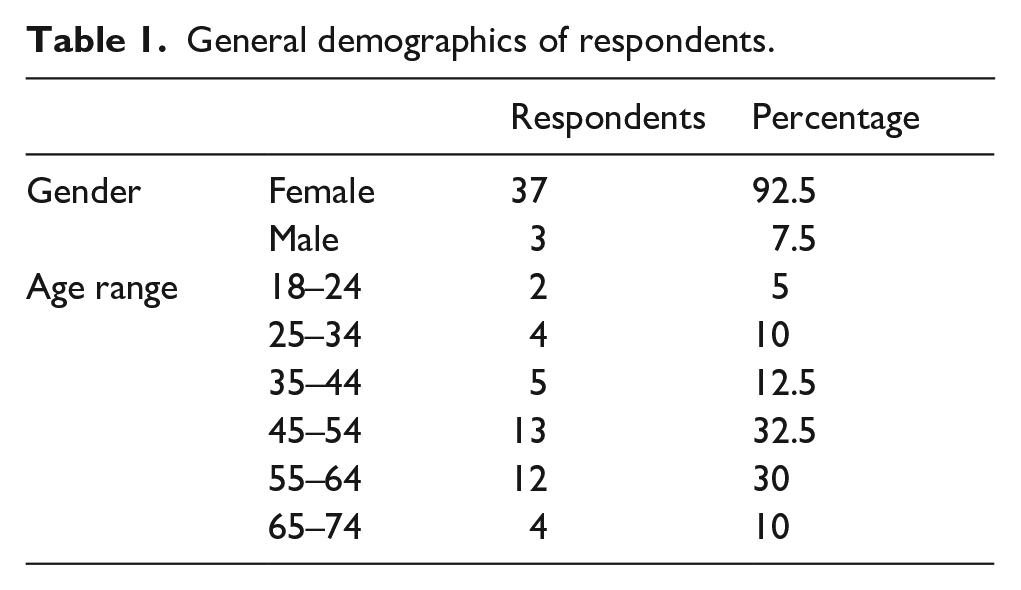
Most interview participants were New Zealand European ethnicity (32, 80%), and of New Zealand nationality (33, 82.5%). This sample also included representation from those of culturally diverse contexts, such as Māori, North/South American, and European. Due to scale and location of the population under study, reporting specific ethnicities and nationalities beyond the above would risk confidentiality. Table 1 outlines gender and age demographic information. Table 2 outlines factors relating to respondent entry into librarianship. Table 3 outlines role and professional context at time of respondent reporting.
General demographics of respondents.
Respondent entry into librarianship.
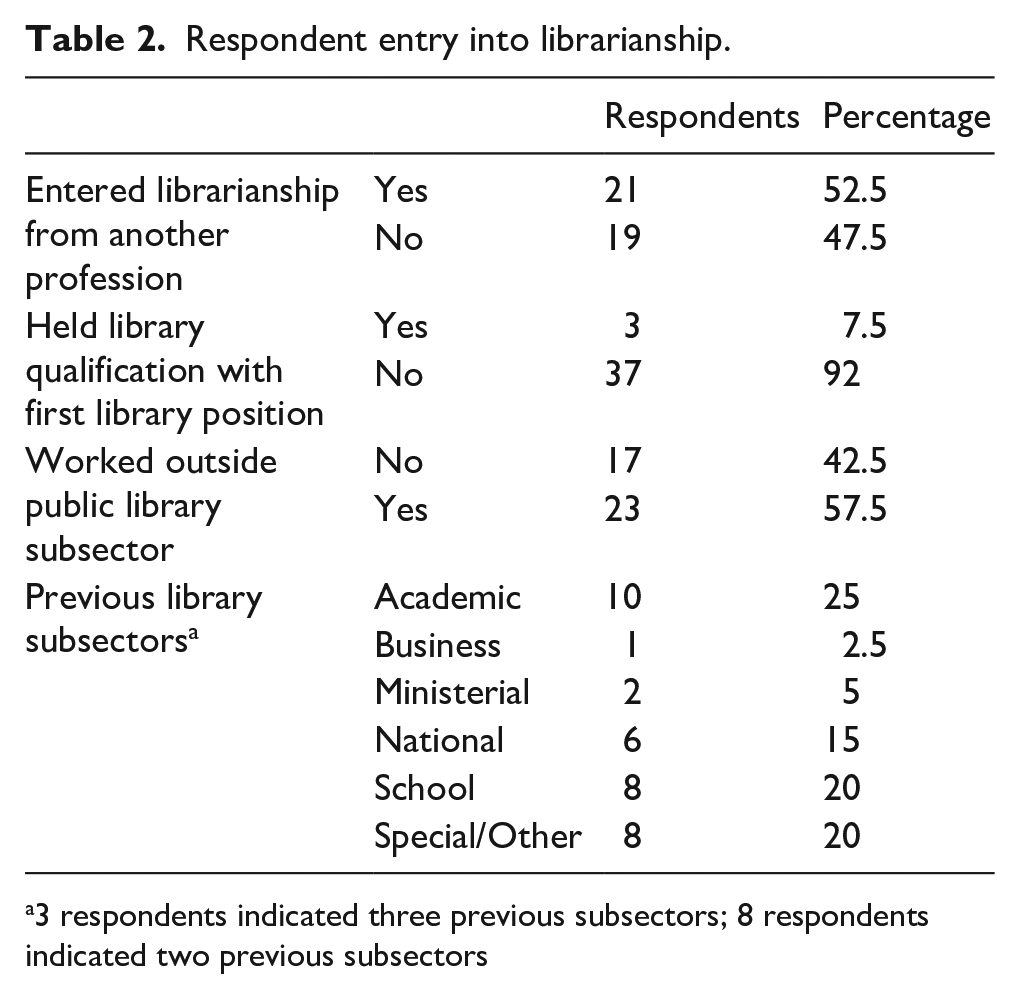
3 respondents indicated three previous subsectors; 8 respondents indicated two previous subsectors
Respondent contexts within librarianship.
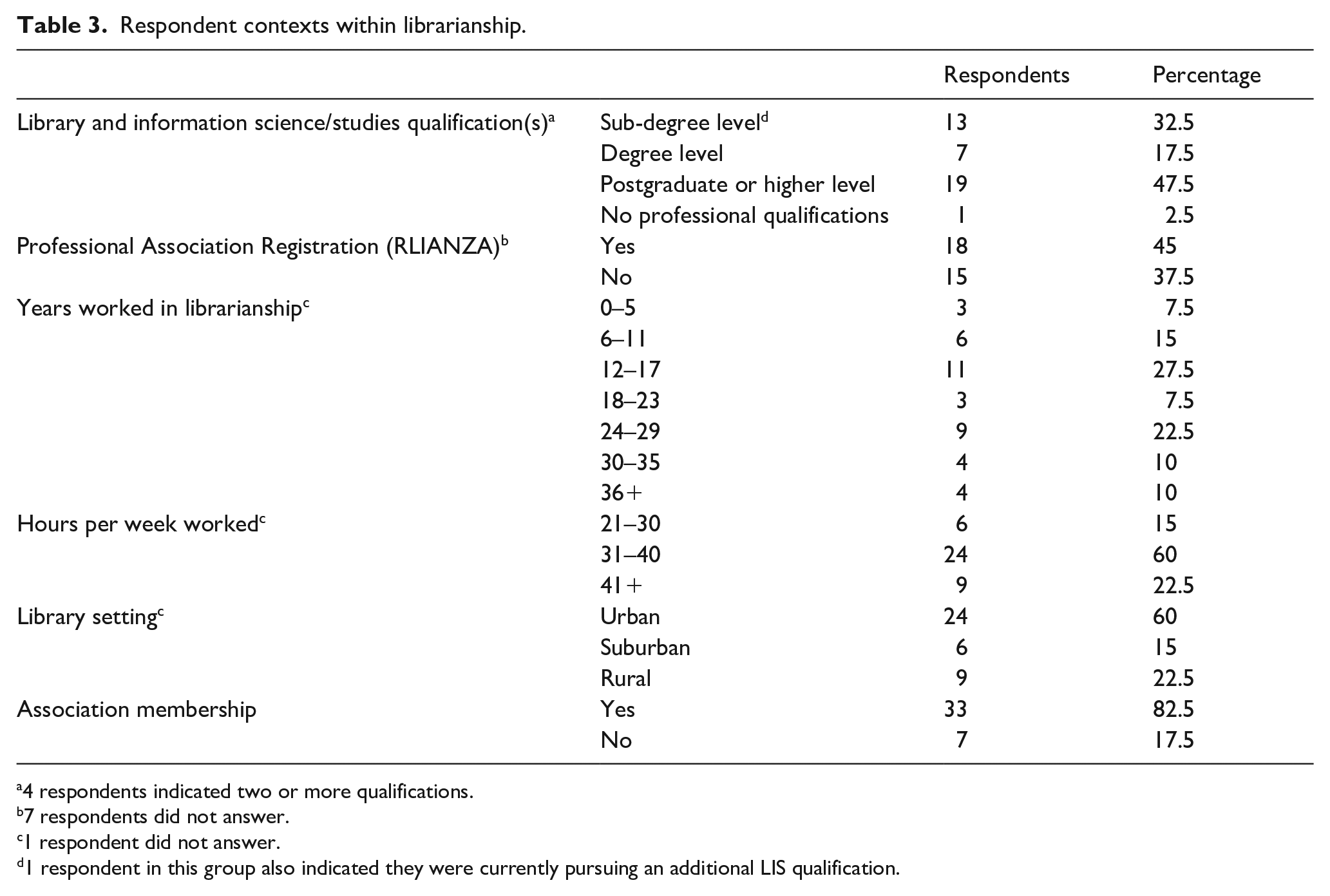
4 respondents indicated two or more qualifications.
7 respondents did not answer.
1 respondent did not answer.
1 respondent in this group also indicated they were currently pursuing an additional LIS qualification.
Moderators of professional identity negotiations
Two key themes were identified from the discussions around identity development during the interviews. The first theme, perceptions of profession, is comprised of two components. The first component, perceptions of the profession through ascribed meaning, arose from explicit elicitation on practitioners’ individual meaning given to being a librarian. Meaning ascribed to the profession could not be extricated from responses on being a member of the profession. These responses offered perception of profession through ascribed meaning to it and the self within it. The second component of the first theme is perception of profession through its manifestations. Professional manifestations embody abstract aspects of the profession, such as its culture, specifically understood to be professional associations, conferences, formal education, socialisations, etc.
Analysis revealed a relationship between the two components of this theme, (1) ascribed meaning and (2) manifestations of profession, as either self-reinforcing of perception of profession or as tension embedded within perception of profession. Self-reinforcing is characterised as an agreement between the two components of perception of profession; tension is characterised by a lack of agreement between these perceptions or presence of an undermining element to self-reinforcement. For example, self-reinforcing is often indicated by a favourable perception of both meaning given to the profession and its various manifestations; tension is often indicated by a favourable perception of ascribed meaning to the profession, yet an unfavourable view of its manifestation(s), often cited by respondents through professional associations.
The second theme is perception of practice vis-à-vis organisational/institutional contexts. This theme is characterised by practitioner perceptions on the local level, organisational practice, for example, library-as-organisation, the institutional context, within a local government structure. Perceptions of the profession through manifestations and perceptions of practice both arose in the interviews independently from being directly prompted. Both, however, were associated with certain questions, for example, participation in professional culture either formally or informally.
Analysis also revealed a relationship between the two themes as either with the presence or absence of dissonance. Dissonance is characterised as a lack of agreement between perceptions of practice and profession, often indicated by an unfavourable view of an association body (manifestation) maintained alongside a favourable view of practice (Figure 1).
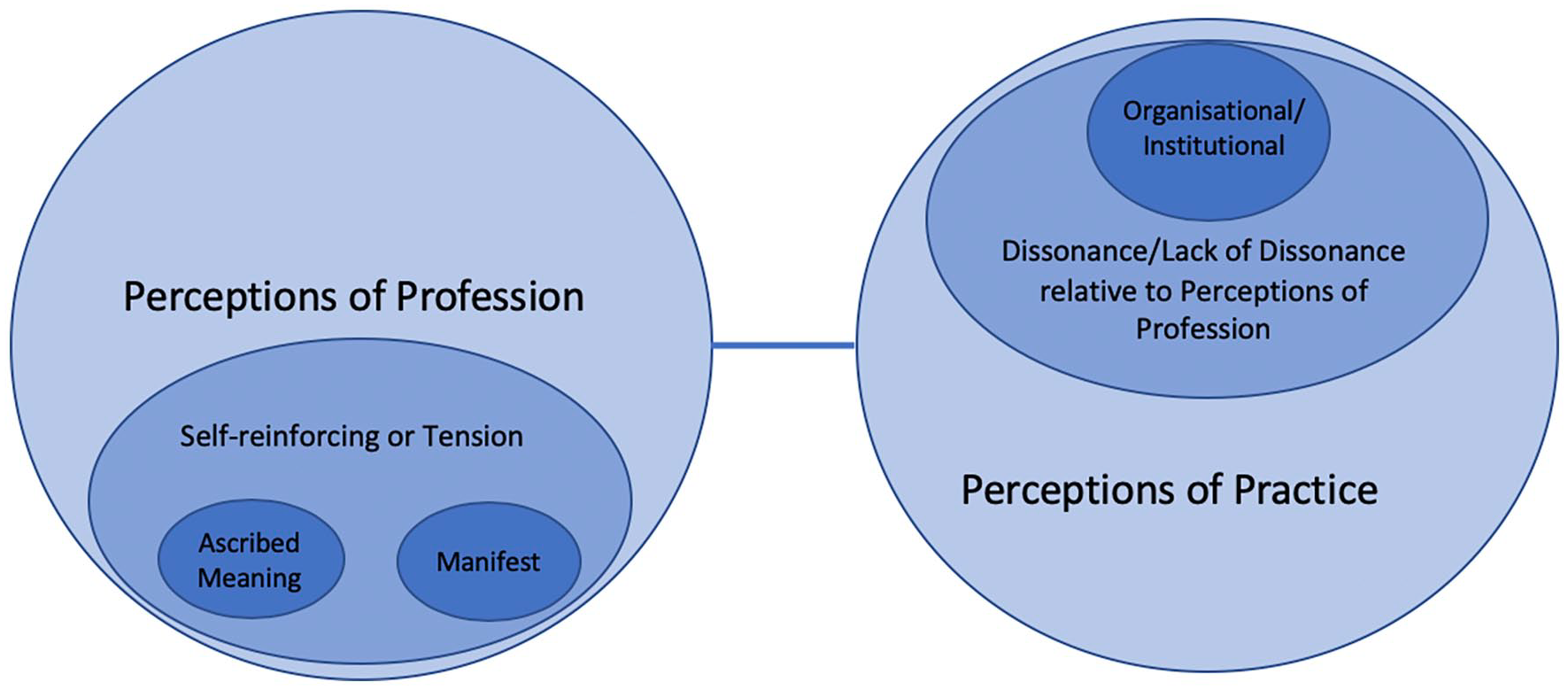
Relationship between moderators of professional identity.
While 40 interviews were conducted, 25 (62.5%, n = 40) respondents discussed all three of these themes within their interviews. Analysis of the themes together only focused on these 25 respondents. The use of partial sample was to support coding and theory building, reinforced by a coherent data set for analysis. While all participants discussed at least one theme, interviews discussing all three themes allowed theoretical relationships to be understood with increased clarity. Direct comparison and analysis could be conducted among this subset of the data and themes. The following discussion of results will outline four exemple combinations of this dynamic among the three themes. The respective combinations of themes outlined below can be understood as a moderating category to professional identity negotiations.
Self-reinforcing/Dissonance
Both Respondent R1’s (Table 4) perceptions of profession do not actively display tension between each other. The respondent indicates active participation in professional manifestations, saying ‘I am a member of LIANZA’ and ‘I do quite a bit of professional development’, and discussion of a leadership programme. The respondent’s view of ‘supporting communities’, and actions associated with this view, are consistent with their perception of an identity offered by the profession, the meaning they ascribe to it, and their perceived identity as derived from its manifestations. This meaning ascribed to being a librarian and the profession is exemplified in their statement ‘as being a support person for the communities. . . and a person who helps people find, to access the information they need’.
Respondent R1 exemple.
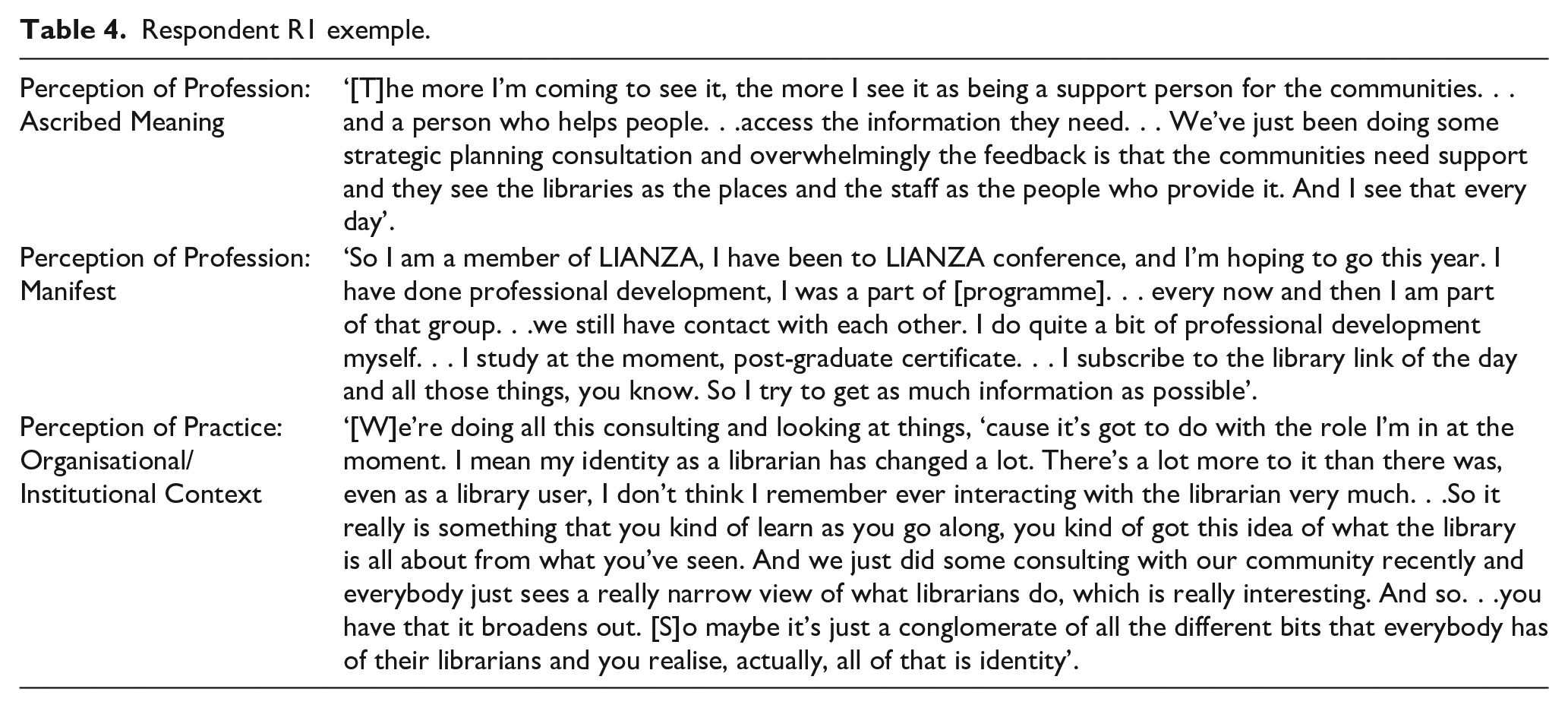
Perception of practice offers a slightly different dynamic, suggesting consultation found the community views the local library in limited terms: ‘everybody just sees a really narrow view of what librarians do’. This view contrasts with Respondent’s R1′s own perceptions of the library as situated within the wider profession, ‘support’ for communities. The patrons/community do not perceive the same organisation/profession as Respondent R1. This contrast of perception highlights that the organisational library is not perceived to display this broader conceptualisation of professional ‘identity’, as Respondent R1 indicates with their above statement and ‘maybe it’s just a conglomerate of all the different bits that everybody has of their librarians’. This contrast and acknowledgement from the respondent is indicative of a dissonance between patron/community perception, organisational circumstances, and respondent perceptions. This perception of dissonance coexists with their perception of being a community support. While the community indicates it seeks support from the library, the narrow view of the library perhaps limits its perception of support available. This suggests that individual perception takes precedence, exemplified here as perceptions of profession are self-reinforcing. While the dissonance has now come to the fore, this was not the case previous to community consultation.
Self-reinforcing/No dissonance
Respondent A2 (Table 5) displays self-reinforcing between perceptions of profession, saying ‘I think it become a vocation’, ‘I had a brilliant. . . mentor’, and through their discovery and moving further into the profession, through associations and study. Between the two themes of perceptions of profession and practice, the respondent articulates a preference for their perceptions in contrast to other views which may not see the profession as a developed calling, remarking ‘the time that I’ve dedicated to the career is more than “I work in a public library, 8 to 5.”’ This is supported by their comment in perceptions of practice, ‘the message that I would like to project as a professional librarian. . .is reinforced by the environment, by people around making comments or seeking their advice, so they reinforce it’. They maintain this perception into their organisational context, indicated as, in part, due to previous negative organisational incidents: [A]nd the approval came negative. . .that’s really stuck in my mind. . . those people who consider themselves librarians, not seeing the potential in me. And that impacted how I work with my colleagues and I promised myself I will never make a mistake like that.
Respondent A2 exemple.
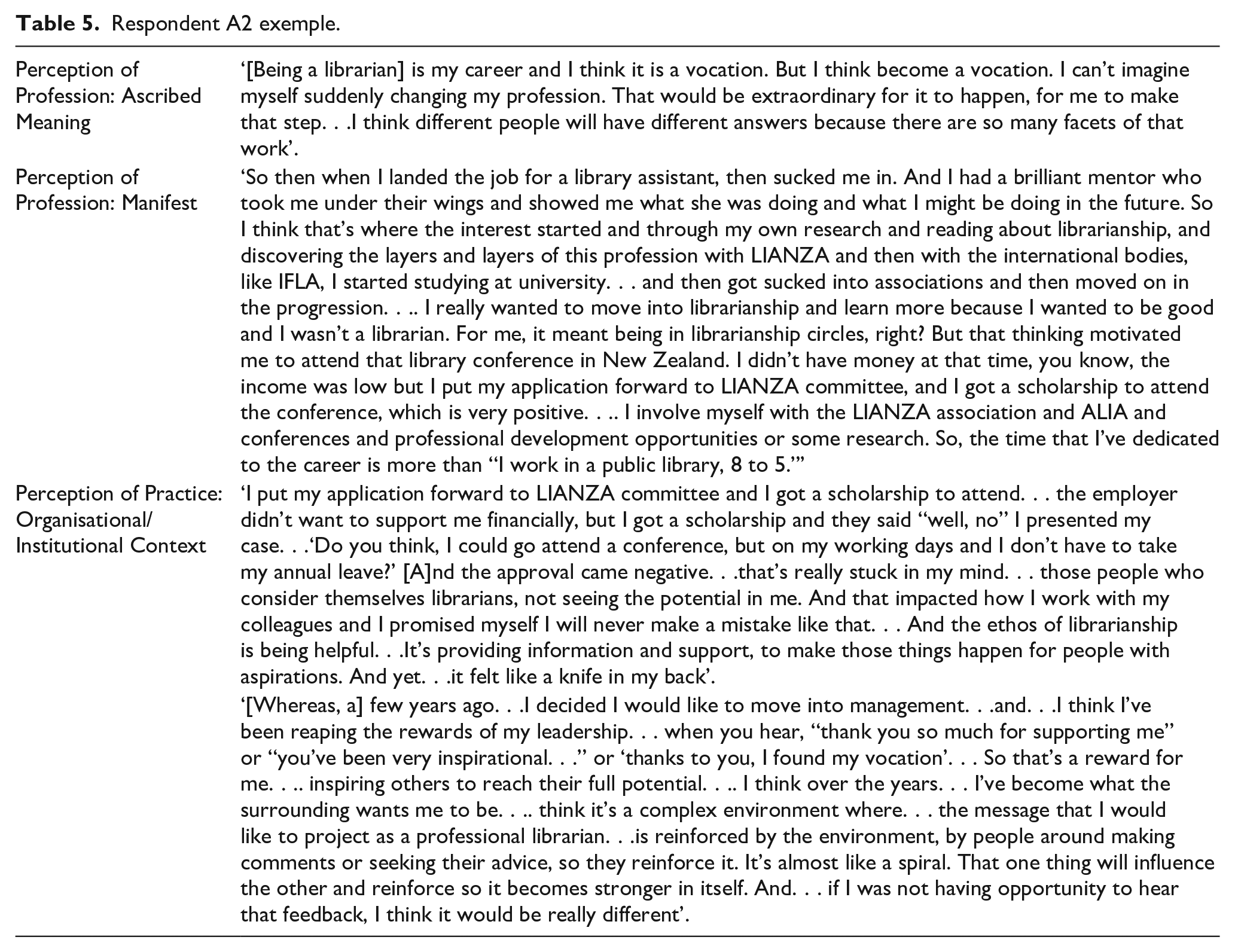
Being and developing as a librarian meant being in ‘librarian circles’, indicating professional manifestations, leading to increased participation beyond only the organisational/institutional. They state, ‘I really wanted to move into librarianship and learn more because I wanted to be good and I wasn’t a librarian’ and ‘that thinking motivated me to attend that library conference in New Zealand’. The respondent’s articulation is consistent with their view that librarianship is a ‘vocation’ and became so, as increased exposure to and participation in an identity offered by the profession’s manifestations reinforced this perception.
Respondent A2, however, demonstrates change of perception over time, in individual meaning ascribed to profession and perception of its manifestations. The respondent’s negative perceptions focus on organisational incidents, for example, ‘the approval came negative”. . .“And yet. . .it felt like a knife in my back’, whereas their positive perceptions focus on profession, for example, ‘the ethos of librarianship is being helpful’ and ‘the career is more than “I work in a public library, 8 to 5.”’ The respondent also states ‘the message that I would like to project as a professional librarian. . .is reinforced by the environment’, which is consistent with their report of their successful leadership style and as a result of a perceived organisational failure in the denial of her request. Respondent A2, as a leader, seeks to encourage and permit, rather than deny and discourage. They articulate how those experiences have benefitted them within their leadership experiences in their current organisational context. Respondent A2’s contrast indicates previous dissonance, yet continues by saying they are ‘reaping the rewards’ in their leadership role, in contrast to previous experience, and ‘[i]t’s almost like a spiral. That one thing will influence the other and reinforce so it becomes stronger in itself’, indicating a lack of dissonance. The respondent has incorporated aspects of previous experiences and the meaning they ascribed to them into their identity, in both leadership and incorporation of feedback.
This finding highlights the influence of past incidents over time and into current identities, such as to influence present perception and dispositions. This is indicative of a layering effect, where current identities are built upon previous experiences. This layering effect in identity development can create contradictions and new contextualities which, over time, may guide the development of an identity which is different from its previous iterations.
Tension/Dissonance
Respondent M4 (Table 6) displays tension between their perceptions of profession. They say being a librarian is a ‘privilege’, that they are passionate about people and resources, that ‘being a librarian. . . fits in with my own philosophy or ethics of helping the community, serving the community’. Their ascribed meaning indicates ‘people and resources’ and ‘community’ and directly indicates that their perception of the profession is in agreement with the meaning they’ve ascribed to it, their individual philosophy. They similarly indicate societal perceptions as a part of this view, identifying with certain stereotypes. Their discussion of professional manifestation through the association body, however, demonstrates a developed dissonance over time:
Respondent M4 exemple.
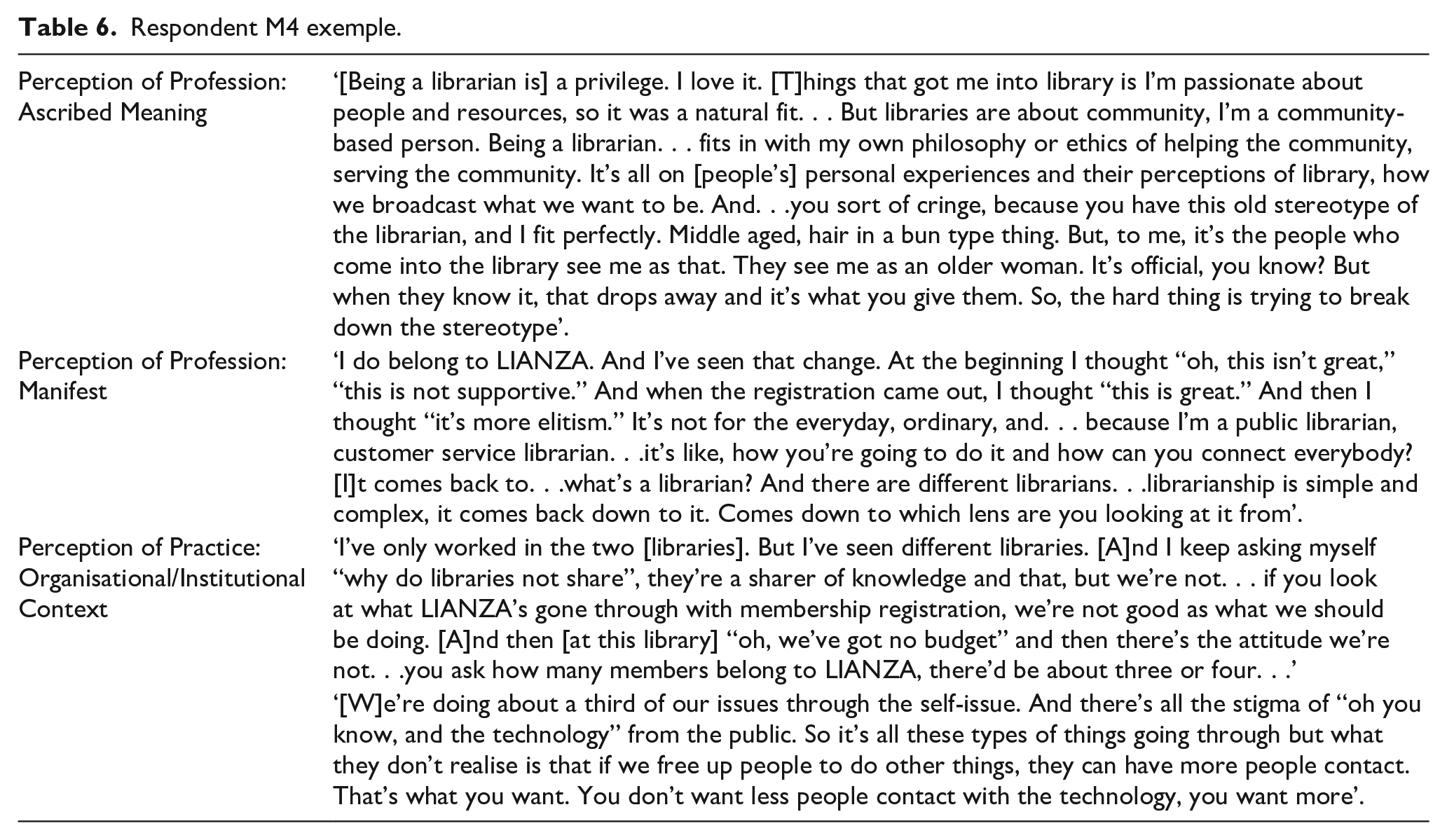
I do belong to LIANZA. And I’ve seen that change. At the beginning I thought ‘oh, this isn’t great’, ‘this is not supportive’. And when the registration came out, I thought ‘this is great’. And then I thought ‘it’s more elitism’. It’s not for the everyday, ordinary, and. . . because I’m a public librarian, customer service librarian. . . it’s like, how you’re going to do it and how can you connect everybody?
Respondent M4 indicates oscillation over time of perceptions of the association. They contrast these professional manifestation perceptions by elaborating further on their meaning ascribed to the profession, as a public customer service librarian, whose role and meaning are at odds with this association and its registration scheme. This respondent, however, notes that perception may differ according to the individual, highlighting the key role of individual perception in professional identity development, behaviour, and collective identity construction: ‘And there are different librarians. . .librarianship is simple and complex, it comes back down to it. Comes down to which lens are you looking at it from’.
Respondent M4 also offers an important contrast in perceptions of practice. They display a perceived dissonance between different organisations and professional manifestations. First they state: I keep asking myself ‘why do libraries not share’, they’re a sharer of knowledge and that, but we’re not. . . if you look at what LIANZA’s gone through with membership registration, we’re not good as what we should be doing.
Referring to self-issue kiosks in the library, they continue by stating: And there’s all the stigma of ‘oh you know, and the technology’ from the public. So it’s all these types of things going through but what they don’t realise is that if we free up people to do other things, they can have more people contact. That’s what you want.
While they indicate a negative view of professional manifestations, they also suggest an inherent problem from organisational/institutional non-sharing, which they link to professional manifestations, ‘we’re not good at what we should be doing’, both for inter-organisational resource sharing, and effective support and development from an association body and its role in organisational contextualities. Respondent M4 follows up with specific discussion of local context, to ‘free up people to do other things, they can have more people contact’, which is consistent with their meaning ascribed to the profession, for example, ‘libraries are about community’. Dissonance is further evidenced with organisational tension indicated by budget constraints and a perceived lack of direct relevance of a professional manifestation to local context: ‘you ask how many members belong to LIANZA, there’d be about three or four’.
Tension/No dissonance
Respondent A1 (Table 7) indicates that they were previously more involved in formal professional culture through its manifestations: ‘In the past, I used to go to LIANZA conference every year, as one part of my role back in the day. I haven’t for a number of years. I did go to weekend school years ago’. They continue by mentioning being professionally registered, yet comment sarcastically, ‘very thrilling’. This comment is suggestive of a deeper (unexplored) perception of registration. Due to the nature of their discussion around community and service in articulating the ascribed meaning, being registered is implied to be a matter of procedure rather than intrinsic desire. They state being a librarian is ‘now almost integral to how I think about myself’ and detail the interaction with their community as a result of their work there: ‘I have customers who know me by name. I have customers who offer me lifts if it’s raining and I’m walking home. I get mobbed, I get hugs. I know them by name’. These statements suggest the perception that registration status does not confer librarianship nor what necessarily allows to adopt the identity for all librarians. Note that registration was previously compulsory in certain library systems for certain types of employment.
Respondent A1 exemple.
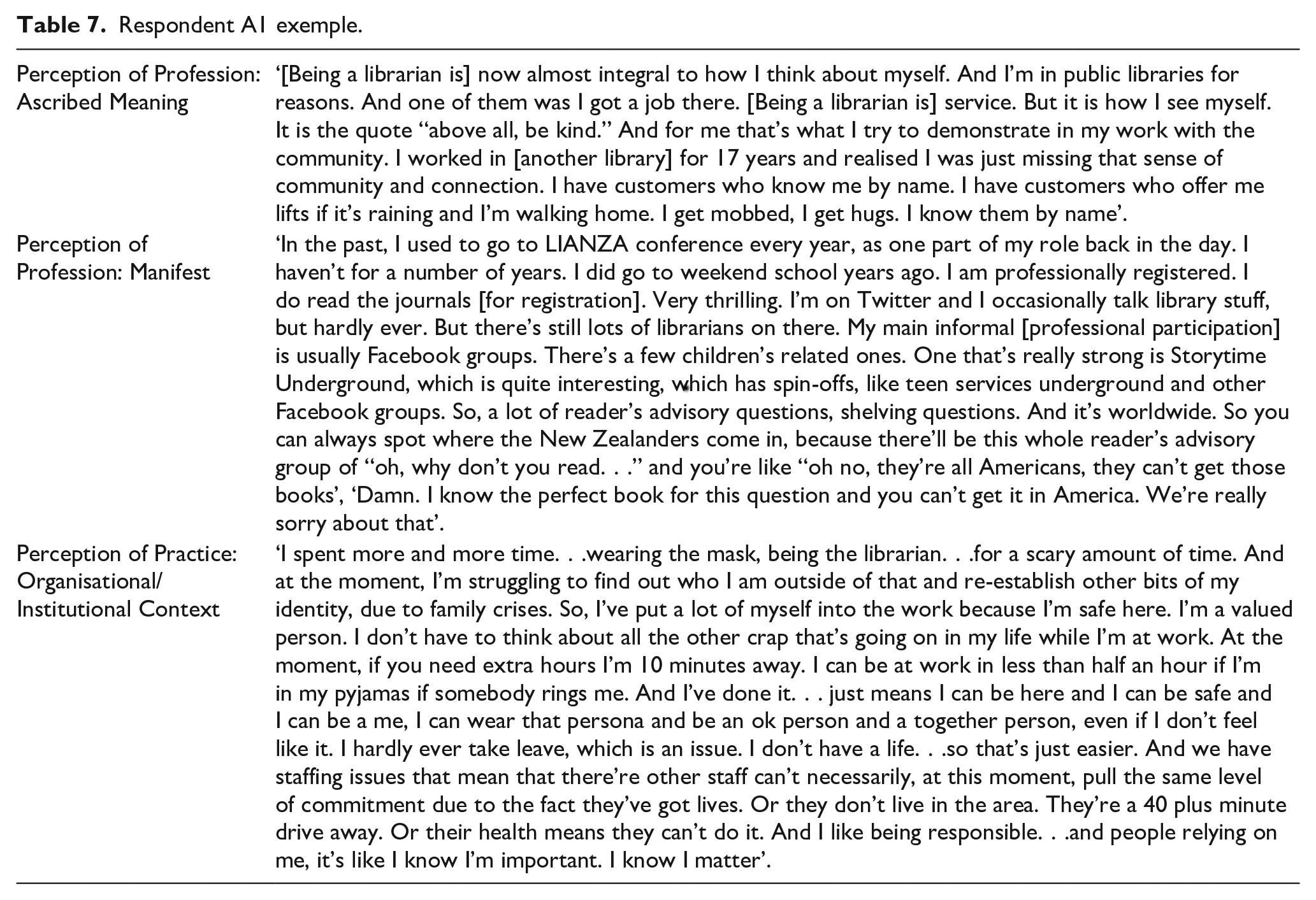
Respondent A1 mentions no current participation in formal manifestations, for example, ‘back in the day’, ‘haven’t for a number of years’, but participates informally: ‘I’m on Twitter and I occasionally talk library stuff, but hardly ever. But there’s still lots of librarians on there. My main informal [professional participation] is usually Facebook groups’. Respondent A1 is illustrative of a tension between perceptions of profession. They clearly indicate a perception of practice as a safe place, a place of respite: ‘I can be here and I can be safe and I can be a me, I can wear that persona and be an ok person and a together person, even if I don’t feel like it’. In ‘wearing the mask’ and ‘wearing that persona’, their professional identity is a sanctuary in a specific organisation away from outside difficulties. This supports their perception of practice as being a positive place. They also illustrate a sense of service both within meaning ascribed to the profession, for example, ‘[Being a librarian is] service. But it is how I see myself. It is the quote “above all, be kind.” And for me that’s what I try to demonstrate in my work with the community’, and their participation in informal professional manifestations, for example, participation on online forums relating to professional work, suggesting some alignment of these specific aspects of perceptions of profession through their understanding of service.
Respondent A1 offers another important contrast: while seemingly contradictory, their discussion of registration status indicates a perceived minimum required participation within a formal manifestation, stating they are professionally registered with associated sarcasm. Their statements acknowledge tension between the two perceptions of profession through the nature of their differentiation of formal and informal participation. For example, regarding an association conference, they mention ‘I haven’t for a number of years’, while also stating ‘My main informal [professional participation] is usually Facebook groups’. They admit being less active than previously within formal manifestations.
Their discussion around being a librarian as integral to who they are and involving such aspects as kindness illustrates how their professional identity has become personalised over time. In becoming personalised, participation within formal manifestations, beyond the required, is omitted. Their displayed tension supports their perceptions of ascribed meaning to the profession and practice relating to organisational/institutional context. Such contradiction in identity negotiations is not uncommon (e.g. Lawler, 2014).
Similar to Respondent A2, Respondent A1 demonstrates the layering effect by indicating ‘at the moment, I’m struggling to find out who I am outside of that and re-establish other bits of my identity, due to family crises’. They mention a compelling force in professional identity development, outside crises, supporting their statement of their professional identity as a respite: ‘I don’t have to think about all the other crap that’s going on in my life while I’m at work’.
Relational states of professional identity
Respondents were asked whether they perceived a separation between their pre-existing and professional identities, to understand their perception of such a separation and its degree. All 40 respondents gave a response. Five relational degree affiliations were articulated. A number of respondents indicated sub-variations within the relational degree affiliations. These affiliations can be understood as the Relational States of Librarian Professional Identity (the relational states). These states describe the degree of relationship between an individual’s pre-existing and professional identities, thus their perceptions of their individual affiliation to the profession of librarianship. These states are: Separation; No separation; Fluctuating separation; Convergent separation; Divergent separation, as outlined in Table 8.
Outline of the Relational States of Librarian Professional Identity.
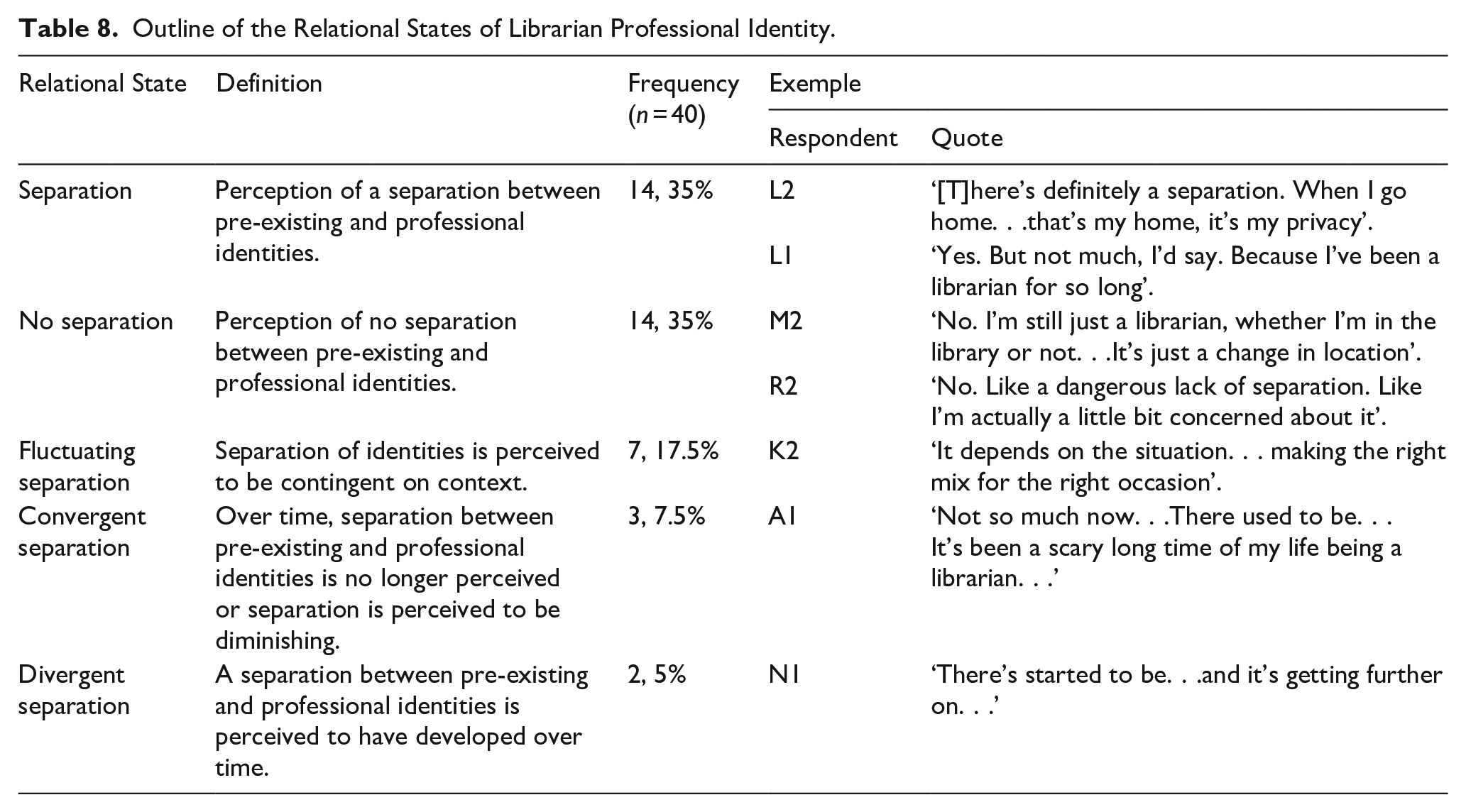
These states offer a granularity in understanding individual affiliation with the profession. The granularity is further developed by respondent statements within the first two states. The sub-states demonstrate differentiation within the broader relational state. The latter three states also demonstrate that the states are mutable.
The state of separation has two sub-states; Respondent L2 mentions a clearly understood separation, whereas Respondent L1 answered that while a separation does exist, it is ‘not by much’, due to length of practice. While the separation is maintained, it is not as firmly or clearly perceived as Respondent L2 illustrates. For Respondent L2, privacy is important, and they draw on privacy in conjunction with boundaries while discussing this separation, saying: ‘I mean most people are respectful of my privacy, because I am a very private person. But there’s just times when people have overstepped their boundaries just in terms of what they’ve asked of me’. For example, Respondent L2 details an example to illustrate the point: [O]ne gentleman ringing up one Easter Sunday morning, wanting me to get his friend’s glasses out of the library, and I said ‘well I’m sorry but I’m busy this morning, but I can meet you at such and such a time and give you the glasses’. Well, I turned up, he wasn’t there, so I rang him again, ‘oh I don’t know when I’ll be down’. And I said ‘well, I’m just leaving the glasses case in the plant so it’ll be there for you to pick up’. But you know, just kind of, people using you in a way? And not respecting your boundaries.
For Respondent L2, boundaries and privacy are connected not only to their separated identities, but also the physical manifestation of their home as they say ‘that’s my home, it’s my privacy’. Respondent L1, however, acknowledges that while they perceive a separation, it is not as strong when contrasted with Respondent L2.
Respondent L1 illustrates this separation: ‘I suppose it’s a core part of me. . . the whole service profession thing, about caring for people, about wanting to, so you don’t have to be a librarian to be doing that’. They link their identities through service and caring for others, making these themes primary in discussions of the separation. They highlight aspects central to their self over the specific profession. They strengthen this point by adding ‘if I hadn’t been so averse to blood, I probably would have been an enormously fantastic nurse, doctor’ and ‘If I hadn’t disliked school so much, I might have been a good teacher’. While librarianship allows them these aspects of service, caring for others, and they allude to length of time in practice contributing to a reduction of separation, they acknowledge a small separation is maintained, highlighting aspects of pre-existing identity.
The state of no separation also presents with sub-states. Respondent M2 mentions they are a librarian regardless of location, drawing on professional tools and service. First, they indicate the support of online resources to help them execute librarian duties outside of the physical library and formal working hours: ‘So if someone asks me “where do I find this or whatever”, I can still use most of the same online resources’. They conclude of their non-separation: ‘Or if somebody asks me for help, I’m there to help them as well’. For Respondent M2, the modern tools of librarianship support the extension of service beyond compartmentalisation by location and working hours. They illustrate that, if in a position to be a librarian outside of their job itself, they will do so because they do not perceive a separation between their identities.
Respondent R2, however, illustrates a significant integration of these identities, candidly saying there is a ‘dangerous lack of separation’. This type of integration suggests a deeply embedded form of personalised professional identity: [I]f I were to be made redundant, for example, which is a real possibility, like I feel like I would just be disproportionately affected by that. I’ve been thinking recently, like I need to do something about where I’ve found myself in terms of those things being so closely intertwined. Because if one was to go, I wouldn’t have anything. I’ve got a husband, life is good and stuff, but I would just be lost in the world.
This respondent illustrates an existential crux through their job/profession and their identity linked to it. Their understanding of their existence, and its meaning, is closely linked to their professional identity that were it lost, their sense of meaning would be at risk. They further allude to this existential crux and their professional identity being also linked to the organisational level: ‘[I]f I thought about leaving here, I would be genuinely concerned about losing a fundamental part of my identity’. That they perceive their identities to be so fundamentally intertwined, losing that identity would have severe consequences. They also allude to the primacy of this job/profession and associated identity over other aspects in their life, particularly were it to be lost.
Respondent K2 discusses their identities as fluctuating, saying ‘it’s all part of a continuum’. This fluctuating state is seemingly ever-present, dependent on circumstance: I do try and always be myself, but in a job you’ve still got to be relatively sensible, and make sure you’re. . .working with people in [an] appropriate way for them, but bringing out your personality when you can, or using it in the right way.
They detail working with others in an ‘appropriate way for them’, indicating the influence of professional expectations of behaviour and that this may vary from person to person with whom they are working. Their own personality remains and each situation requires finding the proper proportion of both identities. They continue to illustrate the nature of the fluctuating identities: [I]f you’re dealing with a tricky customer you’re gonna present something different than you would to a customer you’ve known for a long time, or if you’re having to have a bit of a difficult conversation with a staff member, you’re gonna be different just every day. But I guess the thing is just work out what’s appropriate and if you are having to present something [that]. . .doesn’t come naturally, that you’re doing that in a very careful way. . .
They say ‘you’re gonna be different just every day’ while discussing how different situations will call for different approaches, drawing on different combinations of pre-existing and professional identities. As Respondent K2 illustrates, fluctuating separation of pre-existing and professional identities is contingent on context.
Respondent A1 illustrates convergent separation, separation between pre-existing and professional identities is no longer perceived or separation is perceived to be diminishing. They mention that ‘there used to be’ a separation, but over time it has become less: ‘As I spent more and more time being the librarian, it’s eight hours a day on a good day, five days a week on a good week. For, yeah, a scary amount of time’. They repeatedly state that length of time as ‘a scary long time of my life being a librarian’, further suggesting that their diminished separation is, in part, due to length of service. They later mention their identity as a ‘persona’, connected to what the library affords them: ‘I can be here and I can be safe and I can be a me, I can wear that persona and be an ok person and a together person, even if I don’t feel like it’.
They invoke ‘persona’ while also stating ‘I can be me’ while at work in the library. The dynamic of Respondent A1 suggests that, at least for some, this identity may begin as something to be enacted which over time becomes embedded. This may be in part due to what the library and its work allow for the individual. For Respondent A1, it provides safety, a place to express their self, and to be simply ‘an ok person and a together person’, suggesting that this identity, and the place and work it is connected to, provides safety and stability.
Finally, Respondent N1 illustrates divergent separation, a separation perceived to have developed over time. Respondent N1 describes their ‘disenchantment’ with the library profession among accounts of organisational circumstances and interactions with co-workers and patrons. They continue by contemplating what it means for them to no longer have this identity, despite still being in the profession: I think there is also a kind of guilt there, that all these people are going ‘ah, I’ve always wanted to work in a library’, ‘I’ve always wanted to do this, it’s my dream’ and well, it was my dream. I thought of myself as that, up to a certain point, but now I’m done. And now I feel like if that’s no longer part of my identity, whereas it’s such a big part of librarian culture. . . then maybe I should move out, maybe I should leave, because of my disenchantment with the profession and the library system as a whole. Don’t get me wrong, I think they’re massively important, but I’m not entirely convinced of my own ability to have agency or create change within the system. So, I might as well leave. I don’t have gusto or the internal identity perhaps needed to keep forcing those changes.
Respondent N1 articulates complex perceptions and feelings towards their circumstances. They readily admit that the librarian professional identity is no longer a part of their identity, also remarking that it an important part of ‘librarian culture’. Due to this, they consider leaving the profession altogether, while feeling guilty over having once wanted this work and identity yet finding themself no longer wanting either. They assess themself as lacking the agency to affect change they perceive to be needed in the profession and their library system. This assessment alludes to their perception of the profession and local/organisational context, and perhaps the overall climate of that context. Respondent N1 also pointedly remarked ‘I need to look for different work, and looking for different work is easier if you don’t have that kind of internal identity as a librarian’. Notably, this contrasts with Respondent R2’s remarks on the consequences of losing their job/professional identity.
Discussion
Respondents indicate a complex dynamic in which identity negotiations and development is embedded. Findings indicate three key themes of perception which moderate identity negotiations. Respondent perception demonstrates the existence of two ‘professions’: the abstract through the meaning ascribed to it through professional identity; and the manifestations beyond practice which make the profession tangible to practitioners. Both perceptions of profession are necessarily brought into identity negotiations and subsequent constructions. These identity constructions move beyond individual practitioner and, through behaviour and participation in manifestations, impact the profession as it is enacted and constructed as a collective identity.
Three of the four exemples illustrate contrasts, or contradictions, which are inherent in identity, for example, tensions in Western societies between individualism and belonging to a collective, and events which may transpire which impact perceived affiliation with either (Lawler, 2014). These contradictions are indicative of a layering effect, where current identities are built upon previous experiences. Each identity iteration resulting from identity constructions, such as negotiations, are brought into each new experience through the extant professional identity. Each new experience informs subsequent identity negotiations and identity iterations. This layering effect in identity development can create contradictions and new contextualities which may guide the development of identity in a way differing from previous iterations.
The nature of the relational states indicates change of state is possible. This finding suggests a practitioner’s relational state may be contradictory to their own moderating categories. Moreover, the layering effect may have a temporal lag on its influence on the relational states, where a threshold over time must be met for a perceived change to occur in the relational states (e.g. Respondent N1). The influence of temporal lag on the layering effect is further supported and demonstrated by the Critical Incident Negotiation Process (Pierson, 2022). Perception of and meaning ascribed to critical incidents impacting professional identities may change, prompting additional identity negotiations.
Participants demonstrate that individual perception within a relational state is by degree (e.g. Respondents L1, L2). The various states between individual pre-existing and professional identities can be understood as expressions of individual affiliation with the profession (Table 5). Such membership by degree also suggests an influence on practitioner behaviour in a co-constructed relationship with those served, and broader relation of the library to its patrons in a society.
Theoretical underpinnings of identity highlight identity as a process, which is developed continuously according to internal (perception) and external (social) influences over time and place (Lawler, 2014). Identity for an individual is often associated with number and type of group affiliation. These underpinnings further suggest the relational states are also mutable over time and according to environment. For example, consider Respondent A1’s admission, I spent more and more time. . .wearing the mask, being the librarian. . .for a scary amount of time. And at the moment, I’m struggling to find out who I am outside of that and re-establish other bits of my identity, due to family crises.
Their comment ‘re-establishing other bits of my identity’ demonstrates both that a change has occurred previously and that they are working towards a similar change again, implicating their relational state. ‘Family crises’ is suggestive of an unexplored, and perhaps relevant, critical incident playing a role within this identity negotiation dynamic. Sensitivity to the respondent and personal critical incidents, defined as out of scope for this project, excluded further investigation of this particular type of critical incident. It is suggestive, however, that critical incidents outside of the professional scope impact professional identity negotiations and development.
Figure 2 illustrates the process outlined above, understood at the Librarian Professional Identity Negotiation Framework. Four fundamental components are embedded within the practitioner, who is represented as the encompassing square: the Librarian Professional Identity Continuum (Pierson et al., 2019), which outlines the developmental process of librarian professional identity, signifying both external and internal processes of identity development over time. Embedded within this process is the Critical Incident Negotiation Process (Pierson, 2022), necessarily influencing identity construction over time. Perceptions of profession encompass both meaning ascribed by the practitioner to librarianship and perceptions of the profession’s manifestations (e.g. association bodies). A practitioner’s perception of these two constructs will either be self-reinforcing or demonstrate tension. Perceptions of practice within this process refers to the organisational/institutional context. Perceptions of practice are linked to perceptions of profession, both individual ascribed meaning and manifestations. Perceptions of practice will either demonstrate dissonance or a lack of dissonance relative to perceptions of profession. Both perceptions of profession and practice, along with their associated negotiations, are brought into the practitioner’s identity developmental process, through individual perception. These identity negotiations are held alongside a practitioner’s relational state. Findings suggest that negotiations will result to be in accord with individual relational state. However, the influence of the layering effect and temporal lag, on any components of the above negotiation process, indicates that over time the relational state may change if a sufficient threshold has occurred to prompt such a change, consistent with theoretical underpinnings of identity (Lawler, 2014).
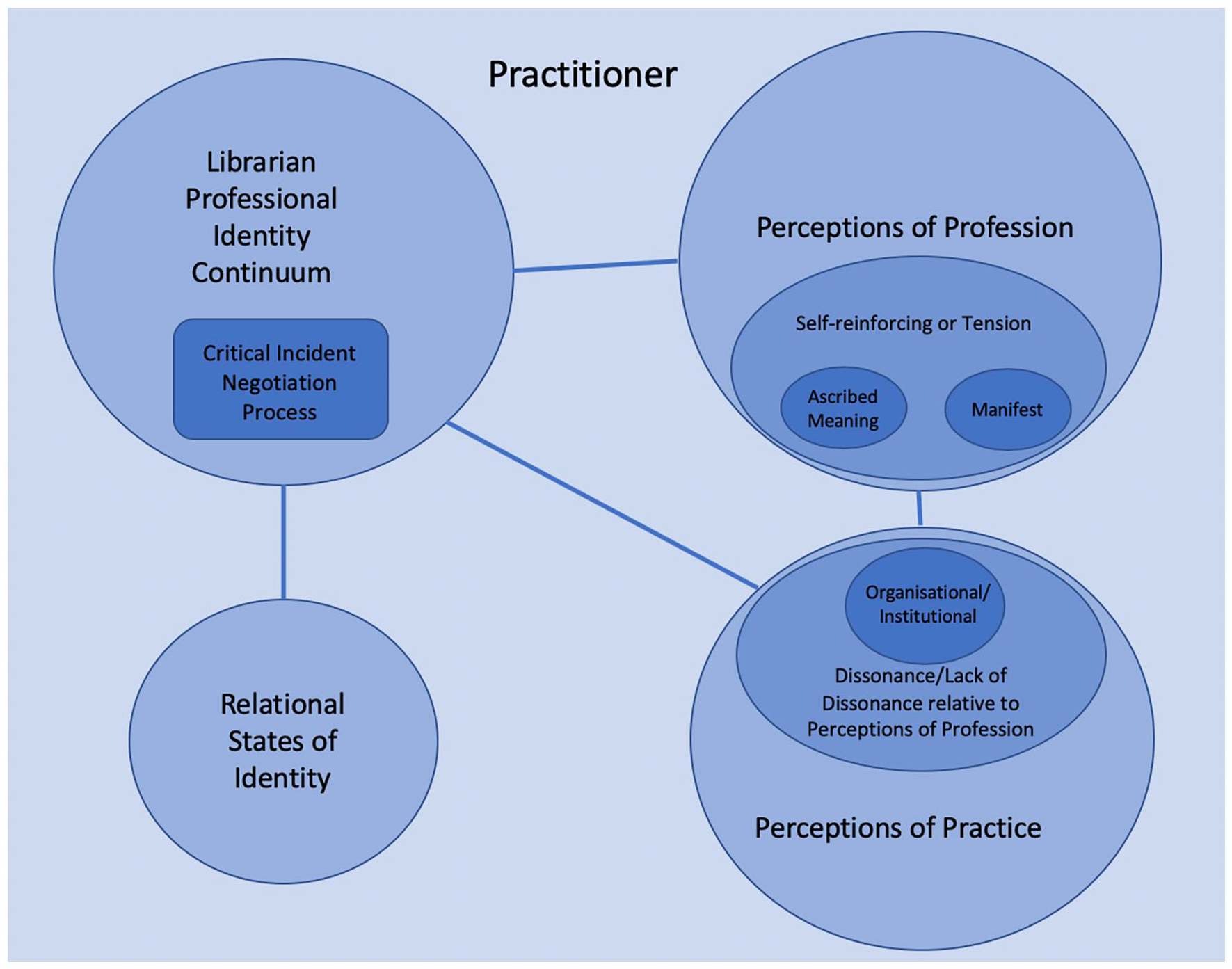
Librarian professional identity negotiation framework.
Based on the fundamental concepts discussed above, six theoretical propositions are outlined relating to librarian professional identity negotiations.
A practitioner’s perception of their professional identity will take precedence and inform subsequent identity development, behaviour, and perception.
A practitioner’s perception of their professional identity will take precedence until a threshold event prompts identity negotiations.
A practitioner’s perceptions of profession will be self-reinforcing until disrupted.
If disrupted, a practitioner’s perceptions of profession will display tension in which ascribed meaning will take precedence.
Practitioner affiliation with the profession is by degree and represented by the Relational States of Librarian Professional Identity.
A practitioner’s relational state of professional identity may change if a sufficient threshold event occurs to prompt such a change.
Limitations and future research
This paper reports on responses to questions posed to public librarians in one country at a particular time. Additionally, the Professional Identity Negotiation Framework is a specific process. Future research could investigate the transferability of the process to other prompts to identity negotiations in other contexts. The implications of the relational states can similarly be investigated, such as their relation to burn-out, boundary setting, and tensions between role awareness and expectation between professional and community. Additionally, the theoretical propositions offered are untested. Future research should test these propositions in other library, locational, and temporal contexts.
Conclusion
This paper has presented findings related to three key themes moderating librarian professional identity and its negotiations. Findings demonstrate that identity negotiations are grounded in perceptions of profession through meaning ascribed to the profession and through its manifestations, respectively; and perceptions of practice as related to organisational/institutional contexts.
Findings further report on the Relational States of Librarian Professional Identity, outlining variations of individual afflation with the profession. Finally, this paper offers six theoretical propositions relating to librarian professional identity. In discussions on the definition and fit of the librarian and library in the communities and societies they serve, it is fundamental to consider and examine the role of librarian professional identity in these co-constructed relationships.
Footnotes
Acknowledgements
The author would like to acknowledge Prof. Anne Goulding and Dr. Jennifer Campbell-Meier, who were his supervisors during the doctoral research process, and the reviewers for their time and feedback.
Declaration of conflicting interests
The author declared no potential conflicts of interest with respect to the research, authorship, and/or publication of this article.
Funding
The author received no financial support for the research, authorship, and/or publication of this article.
