




Abstract
As knowledge workers, library staff are assumed to be highly autonomous, meaning that they are in control of how work is done. Yet, this work is heavily influenced by the expectations of others, and the expectation to take control can pressure staff to overwork. In this qualitative study, 13 public library staff members engaged in think-alouds (TAs) and semi-structured interviews (SSIs) aimed at uncovering potential misalignments between a staff member’s own prescriptive expectations for library work and the expectations of management, customers, colleagues, and technological and material artifacts. Findings suggest that public library staff have several expectations for how work will be done and, at times, want the freedom to control work in ways that match these expectations. They devise and implement defiance workarounds aimed at reinforcing their own expectations in the face of conflicting expectations from other system actors. Yet, autonomy is a multifaceted concept that goes beyond the mere need for control and, sometimes, giving up control meant that other needs were fulfilled. This study advances research on the nature of workplace autonomy and the active role of workers in its expression. This study also has implications for library management, as it suggests important considerations for shared autonomy and workplace relationships, as well as the need to engage in efforts aimed at shifting problematic expectations in the library work system.
Introduction
In a knowledge society, the primary raw material of work has shifted from iron and steel to information and knowledge. Because workers own these means of production (Drucker, 1993), they should have more control over what is done with them: “The individual must shoulder the burden of defining what his or her own contribution will be” (Harris, 1993). Individual autonomy and work control continues to be a defining feature of knowledge work (Jacobs, 2017; Palvalin, 2019; Vuori et al., 2019). Given that library staff are knowledge workers (Asogwa, 2012; Materska, 2004), library work might be expected to be highly autonomous. Yet, public library staff—particularly those with information service responsibilities—report less control over their work than staff at other types of libraries (Patillo et al., 2009). Public library staff are also heavily influenced by the expectations of others, which may put limits on their autonomy. During the pandemic, for instance, the public demanded freedom from restrictions like masks, management demanded increases in workload, library staff expectations for mental health support were not met, and the failure of technology to meet staff expectations resulted in work barriers and struggles to meet demand (Robinson et al., 2022; Stevenson, 2022). As a homogenous profession, an expectation for Whiteness also pervades public library work. These expectations stand as “marker(s) for the privilege and power that acts to reinforce itself through hegemonic cultural practice that excludes all who are different” (Hathcock, 2015). BIPOC staff are often expected to look past abusive customer behavior to continue providing “excellent customer service” (ULU, 2022) or follow rigid work procedures and restrict their pursuit of career goals (Ossom-Williamson et al., 2021). Yet, because these expectations are rarely stated explicitly, they are often allowed to operate unchecked in the background.
While some, like Bell (1973)—focused on the post-industrial and revolutionary nature of knowledge societies, others have suggested that this shift continues to reinforce the beliefs and practices that came before it (Webster, 2014). This suggests that the supposed autonomy of knowledge work is more illusion than reality (Väänänen and Toivanen, 2018). This may help explain a large amount of evidence that suggests considerable restraints on knowledge worker autonomy: “One of our knowledge economies’ greatest paradoxes is that knowledge workers perceive their efforts as autonomous despite evidence that it is under organizational control” (Michel, 2011: 325). For instance, Lupu and Empson (2015) found that supposedly autonomous workers in accounting are susceptible to organizational pressures to overwork. This is known as the autonomy paradox of knowledge work, which suggests how the expression of autonomy can limit autonomy. For instance, Mazmanian et al. (2013) found that, while the use of mobile phones afforded workers flexibility and control over some interactions, it also led to expectations that they would always be available. As a result, the autonomy of mobile phone use diminished their autonomy overall.
The autonomy paradox can lead to workaholism (Schaufeli et al., 2008), which is associated with perfectionistic needs for orderliness and control, as well as conscientious needs to control planning and task completion (Mazzetti et al., 2014). One workaround developed by workers to avoid the autonomy paradox is the phenomenon known as quiet quitting, which reflects a worker’s decision not to go above and beyond in certain situations (Kilpatrick, 2022: 222). It suggests that workers give up control over specific elements of work, allowing others to complete tasks and fill in the gaps. Thus, quiet quitting represents a giving up of control over work-related matters as a means of taking back control of work/life boundaries. Yet, the negative connotation of the term suggests that quiet quitting, itself, represents a misalignment with workplace expectations. This is because overwork is encouraged and reinforced through sociocultural experiences and behavioral reinforcements (Ng et al., 2007). Advances in technology have contributed to these expectations, effectively erasing the boundary between work and nonwork and leading to a 996 work day, that is, 9 to 9, 6 days a week (Wang et al., 2020).
The aim of the current study was to learn more about the expectations placed on public library work and how the affordances and disaffordances of these expectations impacted staff autonomy. Thirteen public library staff members engaged in think-alouds (TAs) and semi-structured interviews (SSIs). Findings suggest that library staff are heavily influenced by expectations from management, colleagues, customers, and technological and physical artifacts. They also have their own prescriptive needs-based expectations for work. Misalignment in these sets of expectations represents a significant source of dissonance, which staff manage through the development of workarounds. While some workarounds were aimed at taking back control of the work environment, others centered on relinquishing control and deferring to the expectations of others. These workarounds were associated with both positive and negative outcomes for work staff. This study contributes to continued research on the supposed autonomy of knowledge work, answering Väänänen and Toivanen’s (2018) call to investigate the ways in which social and organizational environments surrounding knowledge work both enable and restrict this work.
Literature review
Systems
Knowledge work is deeply embedded within complex socially constructed work systems. These systems—comprised of work participants, customers, processes, information, technology, and products and services (Alter, 2011)—exert significant influence on knowledge work. Activity Theory suggests that these systems can be understood as a series of activities, each representing “ongoing, object-directed, historically conditioned, dialectically structured, [and] tool-mediated human interaction” (Russell, 1997). Knowledge work is influenced, then, by the people in these systems, how their efforts are structured, their objectives and motivations, the tools they use, and the rules they are obliged to follow (Engeström, 1999). Explicating the contradictions and tensions among these system components—what Engeström (2000) referred to as disturbances—is key to understanding the nature of this work.
The situated nature of knowledge work is highlighted in definitions of knowing, that is, the ways in which workers use knowledge in action (Cook and Brown, 1999). Like Activity Theory, knowing links consciousness with behavior, such that “you are what you do” (Jonassen and Rohrer-Murphy, 1999). This is distinct from approaches to knowledge work that focus on knowledge as an individual possession (Nag et al., 2007), that is, you are what you know. These knowledge-based—rather than activity-based—approaches tend to situate knowledge work as a series of rational cognitive processes, that is, thinking for a living (Davenport, 2005). Knowing, on the other hand, emerges out of, and is embedded within, specific situations (Gherardi, 2009: 357). It is also materially mediated (Nicolini et al., 2004), which highlights the role of embodied knowledge that “comes from the experienced body in practice and from the implicit nuanced information that is embodied within the whole group” (Lloyd, 2010, para. 33).
In addition to its ability to better account for work environments, the definition of knowledge work as a series of knowing activities also broadens the scope of this work. In so far as all workers are engaged in knowing-based activities, they are all knowledge workers. This has the distinct advantage of not limiting this work to certain classes of workers. For instance, Davenport (2005) suggested that knowledge workers are only seen in certain sectors, like management and finance. Knowledge work is often assumed to be the purview of only the most educated in society (Choi and Varney, 1995; Drucker, 1993; Sulek and Marucheck, 1994). Freeburg (2020) found that some public library management allocate knowledge work only to those perceived to be the most creative. Classifying this work based on educational achievement and perceptions of creativity is problematic given that both are heavily influenced by issues of race and gender. Educational attainment, for instance, is heavily influenced by socio-economic factors (Vinopal, 2016). Research on patent applications suggests that neither women (IPO, 2019) nor those from minority groups (Schuster et al., 2020) are likely to be perceived as innovative.
Expectations
Misalignments between the expectations of a worker and the expectations of other human and nonhuman actors represent one potential source of work system disturbance. Expectations are embedded in the ostensive aspects of organizational routines. While a routine represents a repetitive pattern of learned behavior (Cohen and Bacdayan, 1994; Felin and Foss, 2009), the ostensive aspect of a routine represents the abstract blueprints or recipes for work behavior (Becker, 2004; Felin and Foss, 2009). They are social structures that outline the expected ways in which work will be completed or how workers will behave (Feldman and Pentland, 2003)—highlighting components of the identity kit (Gee, 1989) of the workplace. Management, customers, and colleagues have expectations for how work will proceed. So, too, does technology and other material artifacts. Some of these expectations are role-based and outline assumptions about the behavior of someone in a specific social structure (Dierdorff and Morgeson, 2007). For instance, top management expects middle management to implement strategy, promote experimentation, and synthesize important information (Mantere, 2008). Expectations may also be relation- or communication-based, grounded in social norms or a person’s unique idiosyncrasies and behavioral patterns (Burgoon, 1993). For instance, people have expectations for a robot’s behavior during a handover, which is a shared activity that requires coordination and communication between a human and technological actor (Claure and Jung, 2018). The ostensive routines and expectations of management make up a large part of an organization’s canonical knowledge (Brown and Duguid, 1991).
These system expectations may fail to align with a worker’s own expectations for work. One way to conceptualize this misalignment is through affordances and dissaffordances. Consistent with structuration theory (Giddens, 1993), the expectations embedded in ostensive routines both enable and constrain what workers do. For instance, collections of routines equip organizations with capabilities that enable essential activities (Winter, 2003). Yet, the assumptions and theories of action embedded in routines may be outdated or irrelevant (Senge, 2006). Thus, routines and expectations are sources of both affordances and dissaffordances. Affordances represent perceived “opportunities for action” in an environment (Hadavi et al., 2015: 20), and are noted when expectations align. For example, congruency in expectations between therapist and patient affords continuation in therapy, improved clinician ratings of patients, and improved self-reported outcomes (Arnkoff et al., 2002). Dissaffordances suggest what someone—particularly a user of technology—is blocked from doing (Costanza-Chock, 2020), and they are present when expectations fail to align. For instance, Kitzie (2019) found that while technology suggests several affordances for LBGTQ+ individuals, it also represents constraints on information behavior.
Another way to conceptualize congruency in expectations is to consider these expectations as based in human needs. Green et al. (2017) suggested that workers come to work with a suite of expectations, derived from previous experiences, regarding how their needs will be fulfilled at work. Approach-oriented need expectations refer to a worker’s pursuit of some positive state, for example, self-actualization. Avoidance-oriented need expectations refer to a worker’s avoidance of a negative outcome, for example, not getting hurt. The extent to which a worker applies their energy to their work, that is, is engaged at work, is dependent on the nature of their day-to-day experiences and interactions with others (Green et al., 2017). Confirmed expectations and positive emotional experiences and interactions energize engagement, which can result in improved focus and attention, increased openness to new information, and personal and career growth. Disconfirmed expectations and negative emotional experiences deplete this energy. The current study suggests that a mismatch between a worker’s expectations and the expectations of other system actors represents a negative emotional experience that depletes the energy required for work engagement.
Workarounds
Canonical knowledge is not the only knowledge available to workers, however, and routines do not exist only ostensibly. All routines have performative aspects: “The specific actions, by specific people, at specific times and places, that bring the routine to life” (Feldman and Pentland, 2003: 94). It is through the performance of a routine that workers can change them or create workarounds. Workarounds are “goal-driven adaptations, improvisations, or other activities that attempt to bypass or overcome obstacles or exceptions” (Alter, 2014: 5). They are like deviations from the standard operating script that arise from disturbances in the system (Engeström, 2000). Workarounds are possible because, amid these expectations from work system actors, workers still have agency—“[the] feeling of being in the driving seat when it comes to [their] actions” (Moore, 2016). Workers use this agency to devise new ways of working or interacting with each other that account for barriers or limitations in a given routine. This is consistent with structuration theory, which suggests that people, in response to social structures, can choose “to do otherwise” (Giddens and Pierson, 1998: 84). Workarounds are sources of noncanonical knowledge, which is knowledge that emerges from the journey of work and, thus, can account for more of the complexities and realities of the journey itself (Brown and Duguid, 1991). Whereas canonical knowledge tends to be separated from work, alienating, and individualizing, noncanonical knowledge is situated, loosely structured, and created through mutual problem-solving (Cox, 2005, 2007).
Sources of routines
Managerial routines
The Industrial Revolution centered the routines of management. This was especially evident in the theories of Frederick Taylor, who advocated in the early 20th century that work activities should be structured by management who would scientifically analyze work processes to discover the best, quickest, and most productive ways to get work done. According to Scientific Management, the “old rule-of-thumb knowledge or guesswork” (Taylor, 1926: 185) should be replaced by a “foundation of fixed principles” (Taylor, 1912: 63). This approach intentionally ignored individual differences in favor of standardization and uniformity (Erden et al., 2008).
There is strong evidence to suggest that managerial routines continue to drive work. For instance, the gig economy failed to fulfill its promise of a new wave of worker-controlled KW (Hasija et al., 2020). Instead, company leadership has sought to “appropriate creativity within a digitized system of command and control to augment efficiency and maximization” (Holford, 2019: 147–148). And, although companies continue to hire for knowledge-intensive jobs, this work is overly standardized by management around rigid job titles and predictable outputs (Martin, 2019). Managerial routines were often a source of frustration for public library staff during the pandemic, particularly because they changed so frequently and failed to account for increasing workloads and demands (Robinson et al., 2022). Staff reported feeling ignored by management, and they pushed back against the one-size-fits-all approach embedded in managerial guidelines (Stevenson, 2022). Inconsistent support and poor communication from library leadership was found to be a major cause of low morale among public librarians (Kendrick, 2021).
Colleague routines
Workers bring different—often competing—perceptions of the object of a given work activity (Jonassen and Rohrer-Murphy, 1999), and the Theory of Planned Behavior (TPB) suggests that the expectations of a person’s peers have a significant influence on a person’s intentions and subsequent behaviors (Ajzen, 1991). Colleague expectations have been shown to influence workers’ availability after work hours (Derks et al., 2015) and their decision to enroll in a tax-deferred savings account plan (Duflo and Saez, 2002). Research suggests that, seemingly paradoxically, highly autonomous workers are more dependent than ever on other similarly autonomous workers (Väänänen and Toivanen, 2018). This reliance on others enables a form of collective autonomy, which—distinct from individual autonomy—emphasizes the ways in which workers “collectively define what kinds of knowledge resources should be used towards which purposes and how” (Hermansen, 2017: 7). Public library staff relied heavily on their colleagues during the pandemic to form partnerships and find new ways of working (Robinson et al., 2022), and the support of colleagues was central to a staff member reporting a positive experience during COVID lockdowns (Holden et al., 2020).
Customer routines
The activities of a work system tend to revolve around the production of products and services for customers (Alter, 2011). Public library customers come from the communities in which these libraries are embedded, and Brown (2021) suggests that public library staff need to be particularly attuned to the ways in which communities themselves articulate these needs. This can be challenging given the diversity and evolution of these needs and expectations, particularly as the library shifts from a role as information repository to a role as community hub (Adams and Krtalić, 2022). Increasingly, customers and municipal leaders expect public libraries to act as default social service providers, challenging library staff who are not trained social workers to address issues around substance abuse, mental illness, and housing instability (Kendrick, 2021). The public library is expected to provide a wide range of free services, from lending out books and providing Internet access to offering children’s programing and career resources (Pew, 2013). Restrictions and closings due to the pandemic made it even more difficult for libraries to address these expectations. Some staff experienced guilt over concerns that they would not be able to meet customer expectations (Wilson, 2021). Others reported abuse and disrespect from customers—particularly over safety guidelines (Robinson et al., 2022).
Routines from nonhuman actors
Activity theory suggests that the mental and physical are deeply intertwined (Jonassen and Rohrer-Murphy, 1999). Similarly, Actor-Network theory suggests that all human and nonhuman actors within a system are “associated in such a way that they make others do things” (Latour, 2005: 107). Thus, nonhuman actors also establish expectations that influence work behavior. Technological routines are particularly central to work under the paradigm of Digital Taylorism. Here, emerging technology is used to meet the efficiency goals and methods of Scientific Management (Holford, 2019; Moorkens, 2020). Whereas Scientific Management relied on management to allocate and design work, Digital Taylorism relies on algorithms and deep learning to establish work expectations (Wang et al., 2020). This can be noted in the rise of people analytics, where data is being used to establish expectations for who should be hired, how to improve job performance, and who should be fired (Bodie et al., 2017). Public libraries are increasingly relying on analytics to measure performance and support advocacy efforts. For instance, the public library association’s (PLA) Project Outcome provides guidance on data collection and analysis aimed at answering the question, “What good did we do?” (PLA, 2019). Additional research is needed into the impact these digital measuring tools are having on staff behavior. In academic libraries, for instance, the use of bibliometric analysis as a measure of performance may influence the focus of a librarian’s research (Miles et al., 2018).
Personal routines
Knowledge workers also have their own prescriptive expectations (Staines and Libby, 1986) for work, which they may not be fully aware of. For instance, a medical doctor’s expectations regarding the outcome of a patient examination are influenced by both their “explicit and experiential medical knowledge” (Engeström, 2000: 962). This experiential knowledge exists mostly tacitly, which Polanyi (2009) suggests represents a back-of-mind subsidiary awareness that guides one’s focal awareness. Knowledge work, then, is understood to include both tacit and explicit forms of knowledge (Jasimuddin et al., 2005). The former can include intuition, skills, insight, know-how, beliefs, mental models, and practical intelligence (McAdam et al., 2007).
Scientific Management tried to rid the workplace of personally derived routines and tacit knowledge, for example, rules of thumb (Taylor, 1926). A worker autonomy paradigm (Wang et al., 2020), on the other hand, centers these routines and focuses on engaging a worker’s intrinsic motivation and the desire for self-determination. This centering of worker routines is important for public libraries who rely extensively on the tacit knowledge of staff—from financial and interpersonal skills to creativity and an ability to assess gaps in understanding (Norlander and Barchas-Lichtenstein, 2021). Staff expectations regarding social justice and staying in touch with communities helped libraries pivot during the pandemic (ALA, 2020). There are concerns, however, about the availability of training to support the development of these skillsets (Norlander and Barchas-Lichtenstein, 2021). And while the Master of Library and Information Science offers one way to develop these skillsets, some staff report concerns over the applicability of this curriculum to library work (Freeburg and Vera, 2021).
Informed by prior research, the current study asks:
Methodology
The design of the current study was informed by social constructivism, which assumes that individual behavior and cognition are heavily influenced by social context (Talja et al., 2005). This enabled the study to account for the situated nature of knowing, and it also suggested the need for interpretive approaches to data collection. Two such approaches were chosen: think-alouds (TAs) and semi-structured interviews (SSIs). TAs represent one form of protocol analysis, termed concurrent protocols, that ask participants to say out loud everything they think as they work on a task. They provide “thoroughly reliable” insight into thought processes (Ericsson and Simon, 1980: 247). Because these data are collected closer to the event itself, they provide rich insights into complex thinking and problem-solving (Koro-Ljungberg et al., 2013). This is particularly important in the current study, given that staff may not be expressly aware of the impact of work routines.
SSIs are conversations with individual participants that flow loosely according to a pre-determined set of questions, and they are commonly used in conjunction with TAs (Charters, 2003). They have a goal of “discovering the experiential world of the respondent within topical dimensions” (McIntosh and Morse, 2015: 4). SSIs give participants an opportunity to reflect on their work, which can elicit implicit knowledge that participants relied on but were not explicitly aware of: “The distance that reflection creates allows us to discover and articulate the implicit personal knowledge that we refer to as tacit, to critique it, and thus be ready for new understanding” (Carlsson et al., 2002). Implicit knowledge refers to tacit knowledge that can be made explicit (Muñoz et al., 2015).
Process
After receiving institutional review board approval, participants were recruited from a public library system in the SE United States. This system—a nonprofit organization funded mostly by local tax dollars and charitable donations—is made up of a main location and several smaller branch locations. An invitation was sent to the system’s main location, which then helped recruit participants for the study. Because of this, additional care was taken to protect the confidentiality of participants. This was accomplished through the use of pseudonyms and the removal of references to specific work products that might reveal a participant’s identity. All staff were allowed to participate, though the main branch was informed of the researcher’s interests in working with staff who are typically underrepresented in these kinds of studies, for example, staff of color, pre-professional staff, roles without “librarian” in the title.
Each participant first engaged in a 20-minute TA at their place of work. Participants were allowed to choose the work they did, with the only suggestion that it be work that is typical for them. A similar approach was used by Aitken and Mardegan (2000), who elicited reliable data by asking nurses to engage in TAs while working with patients. The researchers audio recorded participants talking aloud as they worked, interjecting only to remind participants to keep talking. Participants engaged in various work during this time, including processing books, pulling holds, curating content for a newsletter, interacting with patrons at the drive-thru and entrance, and choosing books for display. Immediately following the TA, participants engaged in a 30-minute audio-recorded SSI focused primarily on the work they had just done. Participants were asked to reflect on the role of various system actors in their work. This included questions about perceived expectations, for example, what do you think library customers expect from you? Participants then completed a short demographics survey. Each participant received a $25 gift card at the completion of the study.
Audio recordings were transcribed and imported into Nvivo for qualitative thematic analysis. Thematic analysis attempts to uncover patterns of meaning in data through the application and grouping together of codes (Clarke and Braun, 2017). Following the steps outlined by Braun and Clarke (2012), the research team first listened to each recording to familiarize themselves with the data, meeting at multiple points to compare notes on emerging themes. Next, the researchers began applying codes to the data. While initially guided by concepts noted in previous research, coding was primarily inductive, aimed at allowing codes to emerge from the data (Hsieh and Shannon, 2005). Each researcher coded the same first two transcripts, meeting to discuss and agree on the meaning of the codes and the codebook structure. A codebook was created that described codes and themes and provided excerpts from the transcript. The remaining transcripts were split among the research team who met at several points to compare coding progression and update the codebook.
Results
Sample description
To protect participant confidentiality, pseudonyms are used, and demographics are described in the aggregate. The 13 participants ranged in age from 25 to 66 years (M = 46 years) and identified as Black women (N = 3), Black nonbinary (N = 1), Hispanic women (N = 1), White women (N = 7), White men (N = 1), and White no answer (N = 1). The library work experience of participants ranged from 9 months to 38 years (M = 12 years), and they represented both smaller suburban libraries (N = 6) and larger urban libraries (N = 7). Eleven participants engaged in front-line work with library patrons, and two were in managerial positions. Only three had an MLIS degree, but three others had master’s degrees in other areas. Seven participants made an annual salary below $40,000.
Routines, affordances, and dissaffordances
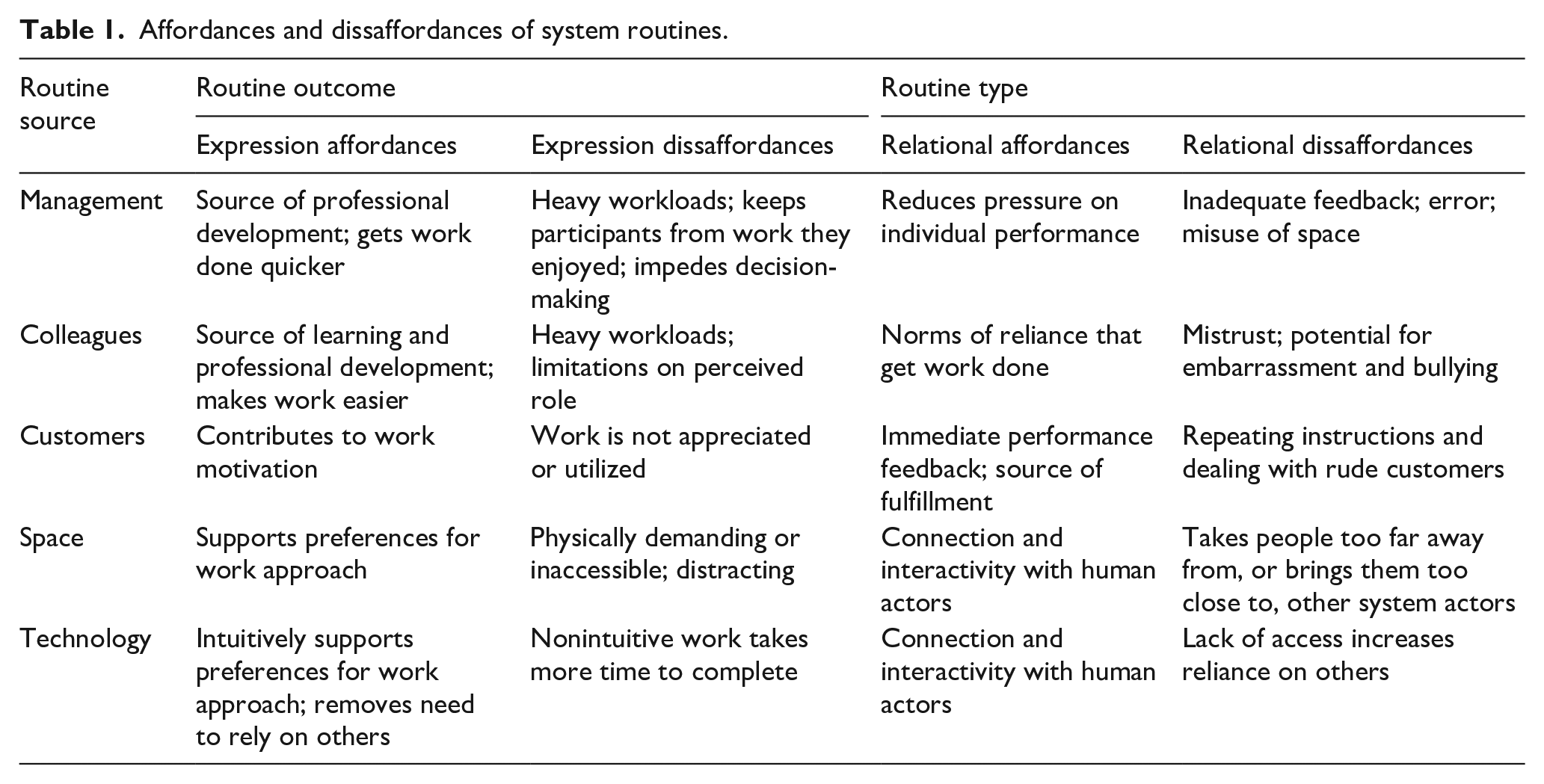
The codebook included three general codes (Table 1). Source codes referred to the source of a routine and included management, colleagues, customers, physical space, and technology. Type codes referred to the general impact of a given routine. Expression-based routines influenced a participant’s expression of agency and self-determination, particularly as it concerned what tasks they would work on and how those tasks should be completed. Relationship-based routines influenced a participant’s development of work relationships, including norms for communication, interaction, and reciprocity. Outcome codes referred to whether a routine represented an affordance or a disaffordance to staff ).
Affordances and dissaffordances of system routines.
Managerial routines
Affordances
Expression-based affordances supported a participant’s professional development goals. James discussed how management supported his work interests: “Our manager’s very good about, if you’re interested in something, helping you achieve that. So, I was interested in learning to do more displays and getting more involved with teen programs and stuff like that.” Mary noted that management knew what staff were good at and allocated work in ways that matched people’s skillsets: “She’s the best [manager I’ve had]. …she finds out our strengths and puts all that work on the people that are good at it. She doesn’t even bother me with tech stuff anymore because, like, I don’t understand that stuff and I’m okay with it, because I know that I can’t do that stuff.”
Managerial routines could also support a participant’s task goals. Alyssa noted that management’s idea for the use of SharePoint cut her workload in half: “[That] was my supervisor’s idea. And I didn’t think about it. I really like it because I was going to send a bunch of emails, so this is cutting my workflow in half.”
Relationship-based affordances reduced the pressure on individual performance. Rebecca noted that she did not have to spend as much time on a task during her TA, because she would be able to run it by management before finalizing it: “I expect changes back, so it doesn’t have to be in perfect form.” She felt supported by management: “I always know that management will always back us up with whatever, unless we do something profoundly stupid. But I always feel like I’m supported, both emotionally and with resources and things that we need to do our job.”
Dissafordances
Expression-based dissaffordances centered around the allocation of work. Managerial routines kept Brittany from work she enjoyed doing: “My background is in public service, and I miss serving the public so much… I still get to do some of that. I just don’t get to dig in as much as I’d like.” Alexis noted that managerial routines could lead to excessive workload requirements: “Today I had four clients, but I still have to be at each one of my stations. As you can see, I have to be at all three stations at my normal time. I’m customer service. I’m everything. And [I] try not to be burnt out.”
These dissaffordances were particularly impactful given the expectation that managerial routines would be prioritized over a participant’s own routines and ideas, as noted by Amy: “Sometimes, decisions that are made by management are not the decisions I would recommend or like to see… on some level, I am expected to make those decisions or those plans happen in a way that works, even if it’s one I don’t agree with.”
Expression-based dissaffordances could also impede a participant’s decision-making autonomy, as Beth noted: “[They] micromanaged… where I got to the point where I felt like I could not make a decision on my own because it was going to be the wrong decision, and so that was, like, really stressful for a while.”
Managerial expectations kept Alexis from decisions about how to complete her work: “Another coworker here told me… you shouldn’t do that, because then [management is] gonna think that you can’t handle your work in the amount of time that you’re here…maybe you shouldn’t be promoted.”
Relationship-based dissaffordances were typically the result of communication breakdowns. Brittany worried that the lack of feedback from management could lead to efforts wasted on projects that might be discontinued as priorities shifted: “Sometimes I’m a little fuzzy on, I think this would be a cool place to go. Do you (management) think this would be a cool place to go?…[I want to] make sure that I’m putting my eggs in the right basket.”
Mary noted that management’s failure to listen to staff feedback could lead to improper use of library space: “I think a lot of times what does well at [the central library] does not necessarily do well here, and there’s no real communication about, would you like this? Do you need it?” Communication breakdowns were particularly frustrating when they led to errors, as Amy noted, “I’ve often said, I just need a t-shirt that says, ‘just ask [me] first’… it’s frustrating when things go wrong, and I didn’t break it in the first place.” Due to a lack of clarity, Sarah was forced to develop her own assumptions about budget allocations across the library system: “Is it because we’re in a location that taxes may not be as high, because [of] property taxes around this location? That’s something that I’ve asked [management], [but] I never quite got an answer.” This can negatively impact staff: “I think a lot of people sometimes feel jaded about it.”
Colleague routines
Affordances
Expression-based affordances in colleague routines supported a participant’s professional growth. Imani suggested that her colleagues represented a significant source of knowledge: “Rebecca knows English and history. Joan knows birdwatching… so, learning across a spectrum of information, as opposed to having to rely on just yourself, is really helpful.” Colleague routines could also highlight approaches to work that better aligned with a participant’s own work goal. James found a better way to find books to put on display: “The way I was doing it, which was the way I was shown how to do it, was like a 16-step process. I knew there had to be a faster way. I asked somebody, and they showed me a different way of doing it that took, like, four steps.”
Relationship-based affordances included norms of reliance and reciprocity that participants relied on to get work done. Robert noted, “Our crew’s good. … I’ll do this for you if you do that for me. I’ll watch the desk, you’ll do holds.” Imani relied on the social capital embedded in these expectations to get work done: “We’re all very, like, I’m going to be working on my thing, but if somebody asks me for help, we will stop what we’re doing to help that other person, even though we might have our own deadlines.” Beth noted that colleague routines freed her up to do work she felt she was better equipped to do: “We all have our different strengths, so if there’s something I know somebody is better at than I am, I will be like, ‘Hey, are you interested in doing this?’” For James, this relieved much of the stress related to individual performance: “If I fail at something, I know somebody’s got my back to say, ‘Hey… let me help you’… it makes my job kind of stress-free, to be honest. I can go home at the end of the day [and] know that I’ve completed my job 100%.”
Colleagues were also source of feedback for Sarah: “It’s [the] positive feedback that they like how I’m doing [my job].
Dissaffordances
Expression-based dissaffordances in colleague routines centered around workloads and job roles.
Rebecca noted that colleague expectations can be overwhelming: “[They] expect really quick turnaround and excellent work. Like, no room for error work, which puts pressure on it.” Sarah expressed frustration when colleagues outlined expectations for work they did not do themselves: “Those kinds of comments irk me, cause I’m like, ‘I work so hard on [this] and then you’re trying to criticize it. I want to see you do it.’” Colleague routines could also conflict with a participant’s perception of their role in the library, as Beth recalled her first year at the library: “It was a struggle for a while trying to find my place in a new position with people who had already been doing that work… I knew what I wanted my role to be, but then I also didn’t want to step on people’s toes who were already doing that job.”
Relationship-based dissaffordances typically resulted from an environment of mistrust. Robert called his library Peyton Place, a reference to an American soap opera, noting that some of his colleagues would “talk behind your back” and “text [about] you behind your back.” Alexis worried that her confusion over a colleague’s gender identity would be used against her: “It definitely affects how I approach people… I’m worried that I’ll use the wrong pronoun, and then I’m going to get bullied for it.” Because of this mistrust, colleague norms for the completion of work could be a source of embarrassment. Rebecca noted, “Sometimes technology—and specifically SharePoint—is frustrating for me. But there are a lot of people who can breeze around in it, like no problem. I’m not one of those people, so it’s kind of like embarrassing to me that I’m not at that level.”
Customer routines
Affordances
Expression-based affordances were noted when customer routines supported a participant’s motivations for working in a library. Brittany noted, “You can really help change somebody’s life with just a book or a learning experience, or a social connection, or helping some of them connect with each other.” Mary’s interactions with customers confirmed her sense of purpose: “Knowing all the people and what they read, and what they want, and what they’re interested in, it makes me feel like our purpose as a library is doing good and positive things.”
Relationship-based affordances were noted when customer routines provided participants with immediate feedback on their performance. Mary noted: “I always feel like if I can get [Mr. Smith] a good book, I’m doing all right.” This feedback was particularly important to Joanna during the pandemic, when she started using newsletters to connect with customers: “When the pandemic first started, it was like the only quick, easy way to communicate with [them]. And everyone seemed to really like it… the feedback was so good.” The relationships enabled by customer routines also afforded a sense of fulfillment. As James interacted with customers at the front desk, he noted, “I like when the patrons say ‘have a good one’ back to me. I don’t know, it kind of makes you feel human.”
Dissaffordances
Expression-based dissaffordances centered around a mismatch between customer expectations for the services they would receive and staff expectations for the services they offered. For instance, getting customers connected with pleasure reading was a strong motivator for Imani. Yet, she found it difficult to communicate this to customers: “It’s hard. Some people are like, ‘I don’t have time for reading.’” Alyssa noted difficulties communicating the purpose of the library to customers: “There’s a perception that all we do is provide books and that’s it: books, books, books. So, people are not aware of our role as a community hub.” Beth noted that this misalignment of expectations could lead to low program attendance: “We have really high expectations and we’re really optimistic, but sometimes it doesn’t go as we plan. Like, sometimes 20 people signed up and [and only] two people show up. And then we’re a little bit disappointed.”
Relationship-based dissaffordances centered around communication breakdowns. Robert noted his struggle to help a customer with a technology-related issue: “My brain was like, “Lady, you’re not remembering my steps. I just told you three times how to do this.”” After Alexis took a phone call as she worked drive-thru, she noted, “I need to work on trying to cut people off because they will talk and talk and talk. He literally told me his mini, like, life story right there. And I was like, ‘is there a car going to come?’”
Mary noted that customers can also be rude: “I guess the thing that I don’t enjoy is working with unreasonable patrons—people that feel entitled, people that feel they can treat you however they want to, because ‘I pay your salary.’”
Space routines
Affordances
Expression-based affordances were noted when the physical space aligned with participant preferences for how they work. James noted, “Everything is very fine-tuned to where it’s supposed to be. If somebody comes in looking for a specific book by a specific person, [since] everything’s alphabetized, the most I need to know is the genre and the person’s last name, and I could probably just find it out on the shelf.”
Because Brianna worked better by herself, the location of her workspace away from customers was an affordance: “I just enjoyed working down here because I don’t have to work with the public a whole lot… I like working by myself.” Similarly, the separation of the drive-thru from the rest of the library matched Alexis’ personality: “I’m introverted. So, being closed off, I can turn this fan, which I’m gonna do. I can have a phone out… so it’s good for me.” Amy’s space helped her concentrate: “I feel good about being down here because it’s quieter, and I can concentrate on my work.”
Relationship-based affordances were noted when the physical space brought people together. The space afforded Amy improved relationships with her colleagues: “I prefer working in the same space with the other members of our department; that helps with communication. It also helps with, just, that kind of holding the department together.” The space afforded Rebecca an improved connection with customers: “I love seeing the busy-ness around, and then customers coming in and doing things. It’s always nice to see customers going around… I come out [to this space] and I’m like, ‘Oh yeah, this is why we’re here.’”
Dissaffordances
Expression-based dissaffordances were noted when the physical space did not align with a participant’s preferences for how they work. Robert was a plumber for 14 years, which led to knee issues. The physical requirements of pulling holds, as a result, could be particularly difficult: “My brain is saying, ‘Man, I got to squat again. These are down at the bottom’… when you got shot knees, you never like to squat.” Brianna noted that her space required her to sit most of the day: “I think just for body circulation. It’s not good to just be sitting, looking at a screen. You need to move around a little bit and get some fresh air.” Amy used to work in a busy open office environment: “I, unfortunately, found it extremely stressful to try and do this kind of work in that environment. It made me really crazy and kind of unhappy.”
Relationship-based dissaffordances were noted when the physical space isolated participants from their colleagues. Beth noted the location of her desk: “The first time I went there, it was like, I feel so far away from everybody.” Amy noted that staff who used to work together in the same space were now split up: “I mean, we still do a pretty good job [of staying connected], but there is less of that camaraderie.” Yet, dissaffordances were also noted when this space brought people too close together. Alyssa noted the openness of her cubicle workspace: “We’re around other people [and] you can end up looped into a meeting on demand. I hate that.” Rebecca’s space brought her closer to managerial routines: “Well, my desk is right next to my supervisor’s office, and so she steps out her door and says ‘Hey [can you do this]?”
Technological routines
Affordances
Expression-based affordances were noted when technological routines aligned with a participant’s preference for how they work. Brianna was particularly excited to showcase the technology at her desk: “I love how equipped my desk is. I can do everything… I think we have some of the best-equipped desks to do what we need to do.” Amy noted that the ability to search OCLC simultaneously with the library’s catalog reduced the number of steps she had to take: “It allows me to basically pull that information from OCLC when it’s appropriate and put it straight into Polaris without going through all of those other intermediate steps.” Technological routines afforded Alexis the opportunity to learn on her own, without needing to rely on coworkers: “There was a webinar to teach how to do that step-by-step, where I didn’t have to go to my coworkers, like, ‘Hey, can you show me this?’” These affordances were supported by a sense of familiarity with technology, as Alyssa noted, “I love technology. I mean, I think I’m part of that generation, though. Like, we’ve been trained with Microsoft since we were little… I’m not frustrated by [technology] because I’m not intimidated by [it].”
Technological routines also brought participants together, suggesting an important relationship-based affordance. Rebecca relied on Sharepoint to coordinate work schedules with her colleagues and management: “We’re going to use a calendar on SharePoint to record our time off, leaving early, coming in late, those kinds of things.” Brianna relied on email to communicate with her colleagues: “We communicate a lot with the branches and the other departments… so, anytime there’s any questions or changes, we do email different people on our staff.”
Dissaffordances
Expression-based dissaffordances centered around workflow disruptions. Technology kept failing during Alyssa’s TA: “It kept kicking me out. I had to keep logging back into SharePoint. I’m not sure what happened. So, it disrupts your flow for sure.” Because of technological routines, Brianna’s work took longer than she expected: “I’m thinking that this process takes a long time longer than I wish it would… I just wish that they would save a little bit quicker than they do.” Some technological routines disrupted work because they were unfamiliar to a participant. Alyssa noted, “[SharePoint] is not quite as navigable as I thought it would be—or is not as intuitive as I thought it would be.” Joanna and Imani both used laptops during their TAs that they did not typically use. The “persnickety finger mouse pad” on Joanna’s laptop led to repeated errors: “Laptops without mouses are a pain in the neck.” The public-facing version of software installed on Imani’s laptop led to confusion: “[It] makes this a little extra hard because, when I’m working with an unfamiliar program, I don’t know all the shortcuts to see stuff.” These dissafordances were especially problematic given a participant’s reliance on these routines. Alexis noted, “I pray to God that the system doesn’t go down again… there’s, like, literally nothing to do because everything revolves around a computer and Internet.”
Relationship-based dissaffordances were noted when technological routines made participants overly reliant on other system actors. Mary noted the inability of her library’s technology to change spine labels: “What we have to do is gather up those books, send an email downtown, ask them to send us a new label. Why can’t we do that here? We used to have the technology to do that, but when we got this latest brand, it didn’t do that anymore.”
When she was forced to rely on the central library for printing signage, it could significantly delay program marketing: “Sometimes it takes them two days. And by then the program is two days away and half the people that you want to see this sign have already come in.”
Workarounds
Participants devised three types of workarounds when faced with routine dissaffordances: continuance, secretive, and defiance (Table 2). Continuance workarounds enabled a participant to continue their work in spite of the dyssaffordance. One strategy was pivoting, which involved a participant changing their approach to a given routine without changing the routine itself. Alyssa noted that colleagues may not follow her expectations for getting work done:
Staff-derived workarounds.

“We’re just incredibly busy all the time. We fly by the seat of our pants. You have to be willing to pivot. You can’t be mad if something doesn’t finish when you expected it to just, [it] doesn’t go that way here.”
Mary adapted to people talking loudly in the library: “I’ve come a long way, because now obviously people talk regularly in the library. At first, that really p****d me off. But now it’s like, these are people living their lives.” Pivoting was particularly helpful with physical dissaffordances, as these expectations could not as easily or immediately be changed. Beth pivoted to the use of a different space: “The desk is where I put my stuff, but I don’t really work at that desk very much. I actually work at these computers more than I work in there.” Brittany pivoted her approach to limited concentration space by scheduling work time in private rooms: “We’ve tried to create protocol to allow for that hunker down space… letting people know they can schedule time for themselves in a room by themselves.”
Another strategy was acceptance. Faced with managerial routines that had him doing work he did not choose, Robert noted: “It’s just part of my job. I know I’ve got to just do it. That’s why I just do it and get it over with.” Sarah deferred to the role expectations of management when they made decisions she did not agree with: “At the end of the day, this is her branch. She’s the manager and, you know, I’m just here to help her out.” Sometimes, particularly in response to technological dissaffordances, a participant felt that they would be able to continue following a routine if they understood it better. Faced with unfamiliar technology, for instance, Alyssa crowdsourced solutions online: “What [the manual] is telling me to do. I’m like, ‘I don’t know what you’re saying.’ Crowdsourcing is people that are doing the work with me. People like me.”
Secretive workarounds enabled a participant to hide their inability to meet a given expectation or follow a routine as-is. One strategy was regulating emotional expression. For instance, Alexis hid her panic attacks from her current manager: “My manager doesn’t know… if my manager knew. … I’d probably, like, freak out.” Brianna suggested that an indicator of work success was her ability to hide her frustration with customers: “I try to be polite… sometimes customers can be really abrasive about things like fines. I thought I handled it well [because] I was nice to them.” Another strategy was avoidance. Robert tried to work around problematic workplace relationships by avoiding certain people: “Walk on pins and needles. Don’t go poke the bear, you know what I’m saying?” When she was unsure about a colleague’s pronouns, Alexis avoided the topic: “Just how I vocalized that to you, I didn’t vocalize that to them.”
Defiance workarounds enabled a participant to question the assumptions of a given routine and suggest alternatives. Emboldened by impending retirement, Amy pushed back against expectations: “I’m going to be honest, I’m in a position where I can be pretty… not obnoxious, but forceful… because honestly, I can retire anytime. My stake in, you know, making people happy with me is maybe not as high as it was when I first started.”
Imani ignored managerial preferences for displaying books with interesting cover art: “My boss really, really hates those [books] that are just plain… but I still sneak them in. I push the envelope because I’m just, like, ‘but it’s a good book… this is going to blow somebody’s mind.’”
Some staff tried to confront and correct expectations from their colleagues. Roxane offered a replacement expectation: “I communicated back that, unfortunately, I wasn’t able to [do this today], but I would be happy to do it first thing Tuesday morning when I got in.” Sarah used emotional appeals: “I know you have a lot of responsibilities, and I’m trying my best to give you this time. But, just please be patient. Work with me.” Mary tried to correct a patron’s expectations for taking down a Pride month display: “We offer something for everybody. Sorry, you don’t agree with it, but we’re thinking about everybody.” To change technological expectations, Amy documented issues in an Excel document she sent to the company who made the software: “I’ll usually attach this with an email saying, ‘These are some of the patterns that I have noticed. Take a look at this.’” Defiance could also be more subtle, like when Beth tried to slowly revise role expectations: “You know the changes that need to happen, but you can’t make them too quickly, you know, you kind of have to do it slowly.”
Discussion
Autonomy paradox
These findings have implications for research on the perceived autonomy of knowledge work. There were several times when the routines of another system actor failed to align with a participant’s own routines and expectations for work, and this restricted their autonomy. Consistent with the assumptions of the worker autonomy paradigm (Wang et al., 2020), it could be difficult for staff when they could not work as much as they wanted to, on the things they wanted to, in the ways they wanted to, or for the reasons they wanted to. Thus, control-based autonomy was important to participants. Social Determination Theory suggests, for instance, that the feeling of being in control is important to one’s psychological well-being (Kachanoff et al., 2019). It is important to note that many of the limitations on control-based autonomy were a function of a staff member’s identity. For instance, given the commonplace encouragement of overwork (Ng et al., 2007), it is notable that Alexis was discouraged by management from taking work home with her. While this action would appear to be an indication of hard work, it is clear that the expectations for control are not distributed consistently across different staff identities. As a Black woman, Alexis’ experience is consistent with the over-proceduralization of the work of staff of color (Ossom-Williamson et al., 2021) and an increased expectation that they will defer to the expectations of others.
Yet, findings also suggest that autonomy is not merely a matter of taking control at work. Consistent with research on the autonomy paradox (Lupu and Empson, 2015; Mazmanian et al., 2013; Pérez-Zapata et al., 2016) and the link between empowerment and work strain (Harley et al., 2007), staff often perceived control as a burden that increased pressure on individual performance. This is likely because it reinforced norms of overwork (Ng et al., 2007) and workaholism (Schaufeli et al., 2008). Thus, staff declining control-based autonomy—often noted in continuance workarounds—can be seen as a form of quiet quitting that enabled them to meet certain avoidance-oriented needs, like avoiding unnecessary work (Green et al., 2017). This suggests a needs-based autonomy, where workers want to feel that their actions are freely chosen and consistent with their needs (Kluwer et al., 2020). To the extent that deference to the expectations of others meets a need, it can be seen as an autonomous act. The final check of management reduced the pressure for perfection. Colleagues taking over a task meant that a participant did not have to do everything by themselves. Changing behavior to meet the expectations of customers could be rewarding. Technology and physical space could be relied on to get work done. Workers know and can articulate which parts of their job they would be happier with if they were allowed more control.
Deference to others’ expectations might also be associated with positive organizational outcomes. For instance, deference to the expectations of customers might be representative of a high customer orientation, which increases awareness and sensitivity toward customer expectations in ways that positively impact customer satisfaction (Grizzle et al., 2009; Stock and Hoyer, 2005). Deference to the expectations of colleagues might enable forms of affiliation-oriented organizational citizenship behaviors—for example, peacekeeping, cheerleading, altruism—that result in a supportive climate, improved organizational performance, and increased customer satisfaction (Podsakoff et al., 2014). In the celebration of autonomy as individual control, these activities may be discouraged. This has implications for the management of library work, particularly when it comes to staff promotion. One way to help staff limit the emotional burden of work is to focus praise, not solely on individual efforts to take charge, but also on efforts to share it.
However, while continuance workarounds can represent autonomous acts, secretive workarounds are at odds with needs-based autonomy (Kluwer et al., 2020). These workarounds require staff to misidentify themselves in ways that introduce additional burdens. This is consistent with dysaffordances, which is a subcategory of disaffordances that “requires some users to misidentify themselves to access its functions” (Costanza-Chock, 2020: 39). To avoid certain dissaffordances, staff had to act like they did not suffer knee pain or panic attacks, hide their disappointment when no one showed up for events they planned, or fake their way through non-intuitive software. Brianna’s politeness to customers, in spite of her inner frustration, suggests surface acting—that is, “faking the required emotions” (Lu et al., 2019: 1). While this regulation is often necessary at work, it also represents a significant strain on a person’s energy consumption (Lu et al., 2019) and can quickly lead to burnout (Matteson and Miller, 2012). This is especially problematic for staff whose very identity represents a misalignment with system expectations—particularly regarding expectations to conform to dominant ideologies based on things like sexual orientation, ability, class, and race (Hathcock, 2015). This has implications for the role of library management as planned change agents (Lewin, 1947) who can unfreeze problematic expectations and develop and institutionalize expectations that inclusively support the efforts of all library staff. Further, the avoidance inherent in secretive workarounds reinforces a culture of mistrust, which can have a negative impact on organizational performance (Tan and Lim, 2009).
Additional research is needed into identity-based expectations and routines and how they present additional limitations on autonomy for staff from non-dominant social groups. In this study, identity played a role in both limiting autonomy and increasing the need to misidentify oneself. This is consistent with research that shows additional expectations placed on library staff of color. For instance, Ossom-Williamson et al. (2021) noted that, “It is common for Black library workers to continue to hide parts of themselves to remain viable in their careers, face aggressions and hostility as they inhabit their workplaces, and remain silent to the visible inequities we are surrounded by” (p. 140). Kendrick and Damasco (2019) found that unlike white colleagues, ethnic and racial minority academic librarians perform additional labor from EDI work and emotional labor in the form of deauthentication and stereotype threat (2019). These factors are contributing to the high rates of attrition among staff from these underrepresented identity groups (Vinopal, 2016).
Library relationships
Findings also suggest that a focus away from autonomy as workplace control can also make room for relationships, which are key to the success of public library staff. For instance, staff interactions with the public can contribute to social capital development, building trust, connecting people to resources and skills, and reducing isolation (Johnson, 2012). Staff relationships with emerging technology are crucial to its ability to meet community needs (Bertot et al., 2008). This is consistent with relational-cultural theory, which questions the assumption that human development is a move from dependence to autonomy through a separate self that has power over others (Jordan, 2008). Instead, safety and well-being are fostered through relationships. Chan et al. (2022) connected this to the workplace, noting that careers are not developed through “individualistic approaches divorced from connections to community, family, and society” (p. 2). This is particularly true for traditionally marginalized groups who tend to flourish through interdependence and for whom the entire workplace environment plays a crucial role in career success. Relationships are particularly valuable in the workplace given that one of the “five good things” about relationships is increased creativity and productivity (Jordan, 2008).
By outlining some of the primary ingredients of successful relationships—built around aligned expectations—this study offers several considerations for these relationships. First, the staff-management relationship is built around shared communication expectations. Participants associated nonfrequent communication with wasted efforts, misuse of physical artifacts, and errors. Frequent communication is an important part of a worker’s perception that supervisors are listening to them, and this perception is linked with increased job satisfaction (Brownell, 1990). In addition, understanding staff as individuals helps management set appropriate expectations and assign tasks in ways that more closely align with a staff member’s expectations. Second, the staff-staff relationship is built on trust. When participants did not trust their colleagues, they tended to avoid them. Facilitating these relationships is a significant component of a high-trust work environment that reduces stress and improves performance (Zak, 2017).
Third, the staff-customer relationship is built on a shared purpose. When a participant’s purpose for library work conflicted with a customer’s purpose for using the library, it could result in a loss of meaning. This could lead to boreout, a “negative psychological state of low work-related arousal” (Stock, 2015: 574) that can negatively impact things like service quality, civility toward customers, and a worker’s overall well-being (Abubakar et al., 2022). Fourth, the staff-space relationship is built around flexibility. Conflicts occurred when participants felt that they could not adapt their space to meet their needs. The study of macroergonomics suggests that worker involvement in the design of flexible workspaces increases a worker’s physical health and performance (Robertson et al., 2008). Fifth, the staff-technology relationship is built on familiarity and intuitive interaction. Self-determination theory suggests that a worker’s well-being is enhanced when technology is perceived as natural and easy to use and they feel competent in its use (Cascio and Montealegre, 2016).
Finally, it is important that the human actors in the library work system recognize and appreciate the identities of other human actors in the system, how these identities fail to align with normalized expectations, and how this increases the burden of work. This reinforces the need for cultural competency training to weave “competent, inclusive, and caring professional practice… into the fabric of LIS culture” (Cooke, 2017: 130). Management can use this competency to better align technology and space to the unique needs of particular staff, and staff can use this competency to better advocate and support their colleagues. Cultural competency training would also help ensure that the expectations of those working in the library do not present disaffordances for customers coming into the library.
Limitations
Because of the study’s design of the TA, findings are limited to the types of work that staff felt they could talk about as they did it. This limited the study’s ability, for instance, to analyze staff interactions with patrons—though these interactions still occurred. Further, as a qualitative study with a small sample size, the results illuminate particular phenomena in a public library setting that should not be taken as generalizable across library types. And while the diversity of the sample enabled the researchers to consider several different types of libraries and library staff, it did restrict the study from comparisons across similar types. Future research could address this limitation by focusing the entire analysis on specific sample characteristics, for example, library size, location, staff demographics, staff employment level. This would enable the identification of patterns that may be generalizable to libraries and staff matching these characteristics. The presence of the research team during the TA also suggests that another set of routines—from the researchers themselves—was present. To the extent that participants are performing, or feel they are being watched, they may change parts of how they do their work. However, participants generally agreed that the presence of the research team—although awkward at first—did not significantly change what they did. This is likely because the TA lasted for a significant amount of time, participants completed mostly routine work, and the researchers interacted minimally with participants during the TA.
Conclusion
This study found that public library staff have several expectations for how work will be done and, at times, want the freedom to control work in ways that match these expectations. They devise and implement defiance workarounds aimed at reinforcing their own expectations in the face of conflicting expectations from other system actors. Yet, autonomy is a multifaceted concept that goes beyond the mere need for control and, sometimes, giving up control meant that other needs were fulfilled. There were also times, however, when this giving up of control required staff to misidentify themselves in ways that increased the burden of work. As management attempts to increase autonomy at work, they need to take a holistic approach and consider all the needs staff want the freedom to fulfill, as well as the ways in which other system actors challenge this freedom.
Footnotes
Acknowledgements
We would also like to thank the reviewers for their helpful contributions.
Declaration of conflicting interests
The author(s) declared no potential conflicts of interest with respect to the research, authorship, and/or publication of this article.
Funding
The author(s) disclosed receipt of the following financial support for the research, authorship, and/or publication of this article: This research was supported, in part, by funding from the College of Information and Communications at the University of South Carolina.
