




Abstract
This paper reports the results of a survey undertaken in December 2021 and January 2022 related to public library staff in the United Kingdom and their experiences of COVID-19, exploring the lockdowns that were enabled, the subsequent re-openings, their mental health and their views for the future of the service post-COVID-19. Over 200 responses were received, and the findings indicate a range of views. The importance of the library as a community resource is evident in the comments from staff, and their observations of patrons on library re-openings. Findings also indicate concern for the future of the library service, and fear that new technologies like e-books may be seen as adequate replacements for the traditional library service. Findings also indicate staff face stress and mental health issues in terms of dealing with patrons while the virus remains highly prevalent.
Introduction
The COVID-19 pandemic has seen public services undergo an unprecedented amount of change, be it changing how they operate, spending more time on sanitization, or closing completely. The public library service is no different, with libraries across the UK closing their doors, moving to digital, or offering remote services that neither staff nor patrons had experienced before. Such a change in services has been a major upheaval for staff, who have had to completely change their mode of working, taking on new roles they were not used to, moving, or being redeployed to other areas of local councils to help with COVID-19 relief efforts, having to work from home, or to not having work at all.
The aim of this study was to explore the effect on public library workers in the UK, both in terms of services provided, as well as impacts on mental health, the challenges brought about by the COVID-19 pandemic, the unexpected opportunities provided and their hopes and concerns for the future of the library service.
Literature review
Measuring the impact of the pandemic on public libraries has led to several major studies. Both the Public Library Association and the American Library Association carried out surveys of various library types early on in the pandemic in March 2020 and then in May 2020 respectively (American Library Association, 2020; Goek, 2020; Public Library Association, 2020). These were focussed on library institutions and how COVID-19 was impacting them in terms of services, activities, financial impact and perceived needs. The Public Library Association and the American Library Association also produced guidance on how to serve communities during unprecedented events, based on reflections from library staff across the US (Hughes and Santoro, 2021). The Public Library Association also surveyed individual library staff members in February 2021 to examine the impact of COVID-19, including library priorities, working hours and job duties and burnout (American Library Association, 2021). Kendrick (2020a, 2020b, 2021) has ongoing surveys regarding library worker’s experiences with low morale, negligence and burnout, both before and during the COVID-19 pandemic. As well as national surveys, there were also state-wide surveys of library services across the US, examining how libraries have provided various services during the pandemic, such as digital and pick-up services (Real, 2021; Santos, 2020). Libraries Connected examined service provision in England, Wales, Northern Ireland and the Channel Islands via surveys and interviews of Heads of Service. Data included service provision, constraints and barriers to providing services, the impact of providing services for the library and the community, staff redeployment, professional support and challenges in services reuptake (Libraries Connected, 2020). Reid and Bloice (2021) used social media analysis, surveys and interviews with Heads of Service to examine service provision, digital service provision, service innovation, community impact and challenges during lockdown. The Carnegie Trust report by Peachey used staff surveys to examine service provision, staff attitudes towards provisions, staff skills and staff experiences (Peachey, 2020).
Alongside this, there have been individual reports, case studies and overviews of library experiences during the COVID-19 pandemic. This includes responses to service provisions (Ameen, 2021; Cowell, 2021; Goddard, 2020; Grassel, 2020; Guevara, 2021; Hoenke, 2020; Tammaro, 2021) detailing safety guidance (Bray, 2020), response to a crisis situation (Carbery et al., 2020), provision of digital services (Ćirić and Ćirić, 2021; Cleave and Geijsman, 2020; LaMagna et al., 2021) and providing help with technology (Garcia-Ortiz, 2021; Hadidi and Linscot, 2021; Riggs, 2020; Tanzi, 2020).
Overall, there have been a number of case studies, surveys and interviews regarding library responses to the pandemic. This has mostly been focussed on provision of services, in particular innovative alternative services due to library closures, such as Click and Collect, home delivery and the expansion and extension of digital services such as e-books, online collaborative projects and provision of digital services to those without the infrastructure.
Stevenson (2021) explored the experiences of frontline library workers in Canada as the COVID-19 lockdowns began to ease. Conducting an online survey of staff via the library employee union’s 1700 members, she discovered that frontline staff were concerned with a range of issues, including both the wearing of PPE for themselves, and the necessity to police this condition of entry to the library for patrons. She found that, “dealing with noncompliance and being tasked with enforcement among customers was the most cited source of emotional duress” among respondents (Stevenson, 2021, p.5). Concerns were also raised with regards to communications from senior managers to frontline staff, with timings of changes to operations and the like often being incomplete or incorrect (Stevenson, 2021, p.7).
Whilst there has been a large amount of research on the impact of COVID-19 on library services generally, in particular service provision, there has been less research carried out on the attitudes, perceptions and emotional impact on individual library workers, particularly those on the front line, in the United Kingdom. Therefore, this study was designed to understand how UK public library staff feel about the impact of COVID-19, and their perceptions of their library service during the pandemic
Research objectives
The specific objectives of this research were to find out:
What are the perceptions of individual library workers of providing a library service during the COVID-19 pandemic, in terms of impact on service provision, mental health and support received?
What kind of challenges and unexpected opportunities arose from the COVID-19 pandemic?
What attitudes do library workers have for the future of the library service?
Methods
This research used an online survey, created using the Qualtrics online survey building software. It was published online mid-December 2021 and kept open for a month, closing mid-January 2022. The survey was advertised on the project’s Twitter account (https://twitter.com/DownloadNormal). As the project has contacts in the library community and there is an active library community on Twitter, this was an ideal method of recruiting participants, as the Tweet was widely shared. It was also shared through service distribution lists via e-mail, specifically JISCMAIL lis-pub-libs and lis-link mailing lists. The survey was completely anonymous, and respondents were able to skip questions, or withdraw completely at any time.
The survey was a mixture of open and closed questions:
The survey began with demographic questions regarding role designation, whether the respondent’s role was public facing and the type of library service they were based in. These were closed multiple choice questions with the option to add answers in “Other” fill-in boxes.
This was followed by multiple choice questions regarding furlough periods, service provision during the COVID-19 period and communication with users (both to and from).
This followed with questions regarding support from external sources (such as other council departments), whether the services provided by the library were better or worse compared to before lockdown, and the current opening status of their library.
This then moved onto closed questions regarding how concerned the respondents felt about the re-opening of the library, their mental health and what sort of emotional support they were given and where they sought emotional support during this time.
The survey closed with open questions about challenges during the pandemic period, any unexpected opportunities arising from the pandemic period, and their hopes or concerns for the future of their library service and the library service as a whole.
By allowing respondents to answer via open questions, deeper insight could be gained into their perceptions and attitudes regarding the challenges they faced due to the COVID-19 pandemic, and what they felt are important concerns for the future of the library service. Asking open questions about the future of the library service opened up the possibility of gaining insight into the state of play in terms of how library workers feel about the current condition of both their library service and the library service in the UK in general. The survey is provided at the appendices section.
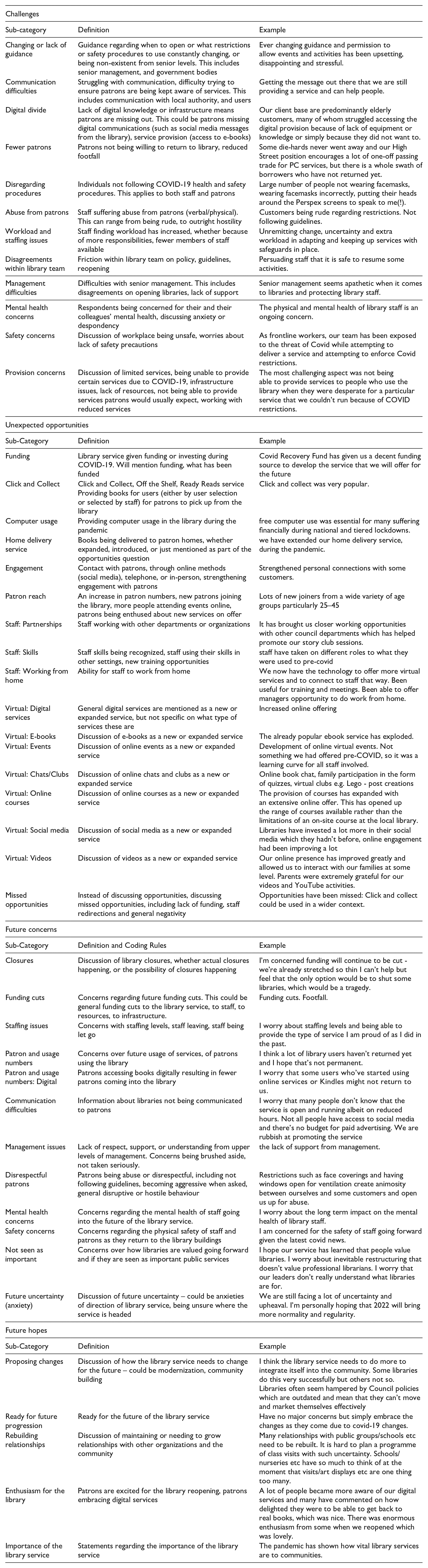
The open questions were analysed using qualitative thematic analysis in the NVivo qualitative analysis suite. Coding was an inductive process, brought about by the data as gleaned from the responses to the open questions. A coding manual is provided at the appendices section.
Limitations
As the survey was dependent on individuals opting-in, there is a limitation in regard to how much of the library worker population is captured, and the risk that some replies might not be genuine. As the survey was administered online any library worker who did not have ICT access would miss the survey. There is also the possibility that certain individuals will be more interested in the topic of the survey than others. The responses captured however, do include individuals from various roles and library types which provides a useful snapshot of how library workers perceive their work and institution during the COVID-19 pandemic.
Findings
The findings will be presented in the following order. Firstly, we will explore the experiences of staff with regards to the services that were provided during the pandemic, and how the library services communicated ruing lockdown with staff and users. We will then focus on issues related to staff well-being, including exploring how staff felt about workloads and re-opening libraries after lockdown, as well as dealing with patrons while social distancing and other public health measures were in place. We will also present staff views related to the opportunities gained related to service innovation that resulted. Finally, we will discuss staff comments related to the future of the public library service, including how important the library service has been in communities, as well as thoughts related to future uncertainty of service provision, as well as how the services may evolve in the future.
Respondents
Two hundred and four respondents completed most questions in the survey.
Our original classification of job roles was Head of Service, Assistant Librarian (a qualified librarian not in charge of a library), Library Assistant, Event Staff and Volunteer Staff. There were no volunteers or event staff who responded, and this may result from these staff not being on the distribution lists and Twitter feeds used to distribute the survey.
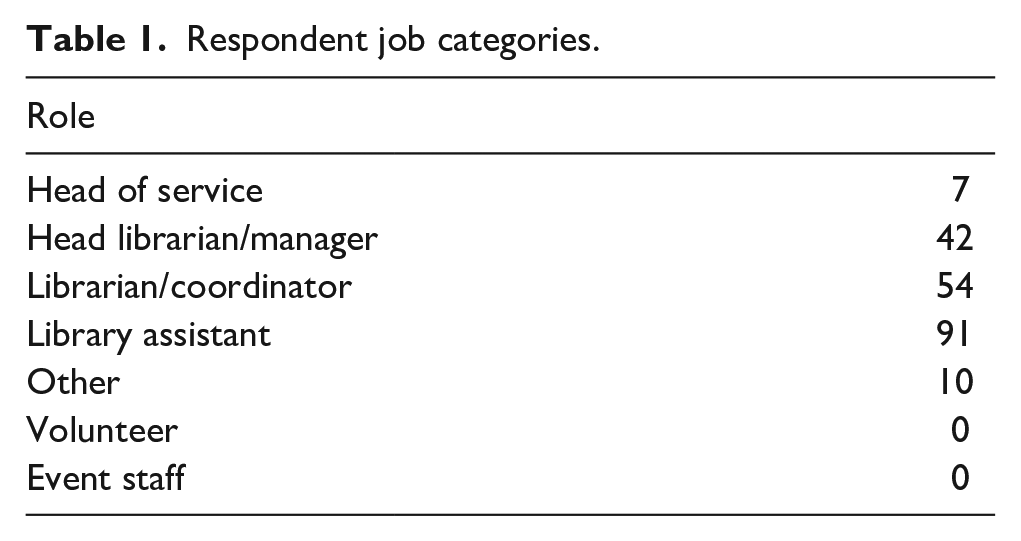
Seven respondents were Heads of Service, 42 Head Librarian, 33 Assistant Librarian, 89 Library Assistant (or equivalent), 53 were “Other” which covered a range of positions such as children’s assistant, area manager, team leaders, team supervisors, community librarian and senior librarian. Given the high rate of “Other” responses, we regrouped the categories into Head of Service, Head Librarian/Manager (including all “Other” responses that seemed to include line management), Librarian/Coordinator (including roles such as systems officer, and volunteer coordinator), Library Assistant and Other for cases where no role description was provided. The results of this classification are shown in the Table 1 below.
Respondent job categories.
Most respondents had roles that were public-facing (n = 135) or partly public facing (n = 42) with only 27 in non-public-facing roles, and most worked in relatively urban environments (main city n = 55, branch libraries n = 45, town n = 78) compared to rural ones (n = 12) with a small number (n = 8) working in positions that covered mixed services.
The survey therefore contains a mixture of roles, public and non-public facing roles and library types.
Service provision
We asked respondents about their primary mode of working during the main COVID-19 lockdown period (March 2020–September 2021) and allowed multiple answers as respondents may have had mixed experiences during the period. Most respondents worked at home (n = 105), worked in their normal workplace (n = 64), or were deployed to another service (n = 17), whilst some were on furlough for the entire period (n = 28) or part of the lockdown period (n = 19).
At the time of responding to our survey, 143 had their library fully open, 58 partially open, 2 closed with some services in an alternative form and none were closed.
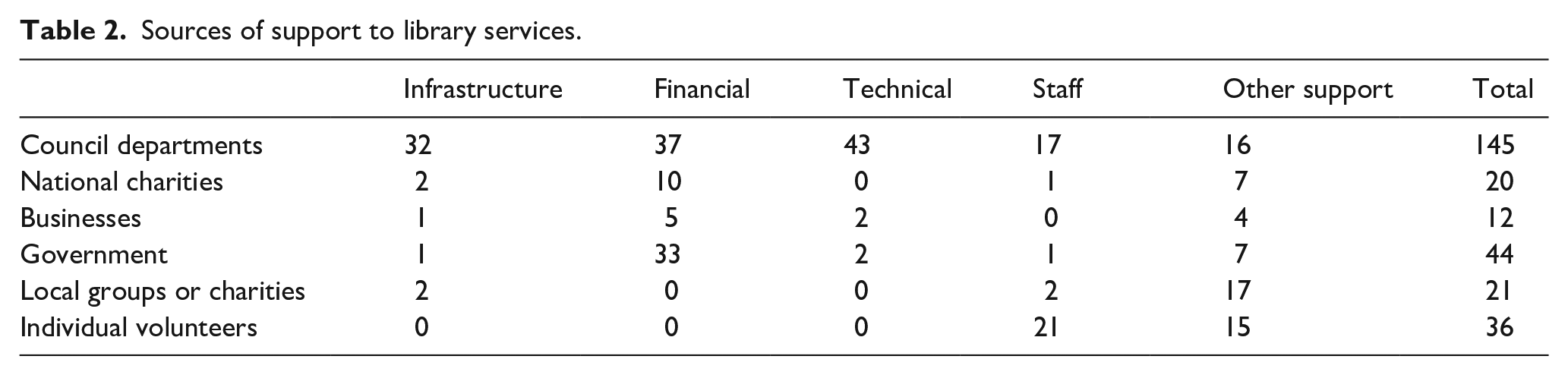
We asked about what support from external services they received to provide library services during the COVID-19 period (March 2020–January 2022). Table 2 presents how many respondents felt they received support from each type of external service. The most common source of support in every category was local councils, with government providing financial support.
Sources of support to library services.
Of the 199 who responded to the question, 176 felt their library services were worse than before lockdown, 14 felt they were similar and 9 felt their service was better than before lockdown. A Chi-Square test of independence was performed to assess the relationship between job role and view on library service change. To meet the requirements of this test we collapsed the categories of Head of Service and Head Librarian and removed the category Other, which had few entries, to give three categories: Head Librarian/Manager, Librarian/Coordinator, Library Assistant. There was no significant relationship between the two variables, X2 (1, 205) = 13.056, p = 0.160: most staff in each category felt there had been a drop in service provision due to lockdown (Table 3).
Responses on changes to library services since before lockdown.

Regarding the open question on challenging aspects of providing a library service, main challenges included difficulties with service provision, such as not being able to provide a service, not being able to communicate with patrons that services were ongoing and having to change services due to constantly shifting guidelines from senior levels.
Library workers noted frustration at not being able to provide services due to a lack of infrastructure or resources, such as IT systems being out of date or not being upgraded in a timely fashion, or not being able to provide services to those who needed it most due to COVID-19 limitations: “The most challenging aspect was not being able to provide services to people who use the library when they were desperate for a particular service that we couldn’t run because of COVID restrictions.”
Sometimes services were available but in a very limited fashion, which was challenging for staff, and caused frustration for patrons. Respondents noted customers feeling isolated and that working from home was more challenging as they lost face-to-face time with library visitors: “The main part of my day to day prior to covid was engaging face to face with customers supporting them.”
Communication and engagement
We asked how library services provided information to their library patrons. Most reported using social media (n = 184), email (n = 126), posters (n = 71), telephone (n = 60) and a small number reporting physical post (n = 10). Others mentioned newsletters, newspaper articles, websites, local press and chat functions on websites.
We asked how they received information such as enquiries from library patrons. The most common methods reported were email (n = 178), social media (n = 141), telephone (n = 113) and physical post (n = 23). Others mentioned chat services, Zoom meetings, meeting users in the street, speaking to people at the door, and word of mouth. The local nature of many libraries, and that library staff were known to patrons, was apparent in many comments.
Staff noted that keeping patrons informed of service availability was not always easy due to the changing nature of the pandemic situation, as well as some user demographics not having the skills or infrastructure for accessing information through platforms such as social media. Sometimes staff were hampered by the amount of promotion they were able or allowed to do. Several the respondents noted concern over leaving out certain parts of the population who may need library services, or voiced frustration over not being able to communicate with patrons that services were up and running: “Pushing to get information out to our users, predominately older people who do not use social media while our marketing and management insist this is the format used”
Being able to keep on top of the constantly changing guidance from administrative levels was also cited as an issue. Sometimes the information was not passed down to front line staff in a timely manner, meaning patrons were left feeling confused and frustrated. This was exacerbated by different areas having different guidelines, which led to patron complaints if services in one area were not available in the neighbouring area. The following response illustrates the difficulties of the situation: “the limits put in place by local council procedures that made it so much harder to be able to quickly implement changes or respond to customers e.g. everything had to go up to the top level in the council before it was cascaded to the depts and the divisions within the depts as in our case. Libraries are a small division within a division of a council department.”
These findings very much mirror the experiences of staff in Canada reported by Stevenson (2021), suggesting an element of inefficiency and disorganization was perhaps a universal element of this extraordinary time.
Even though digital communication was a challenge in many cases, when asked about unexpected opportunities arising from the pandemic period, digital services were cited by many respondents. Expanded services such as e-books, and online courses, as well as online activities such as book clubs, along with some services that were completely new, such as virtual events.
When asked about alternative services during lockdown, the most common services that could be provided whilst the libraries were closed were click-and-collect (n = 164), virtual services (book events, etc.) (n = 137) and home delivery (n = 107). Other things mentioned were book groups (n = 46), mobile library services (n = 18) and wellness checks (n = 38).
Other services mentioned included access to research databases, digital services such as e-books, COVID-19 helplines, social media including YouTube, digital book clubs, IT support, telephone befriending reading services, school library services, collections point for food pack, check-in services for those shielding, essential PC use and acting as Wi-Fi hotspots. Outreach services included telephone support and telephone friend services, engaging with local communities by providing support and cross-working with other local council departments to provide support such as promoting health and well-being.
Although generally library membership has been reported to have been hit by the COVID-19 pandemic, some respondents noted an increase in membership numbers, with an increased use of digital services and some patrons unexpectedly being enthusiastic on the new resources provided. Others noted the expanded range of patrons they were able to reach out to, as users spread out geographically could tune into online events, with some respondents noting they had gained a large following, including users outside the UK. Staff noted that an increased social media presence meant they were able to increase engagement with patrons: “The power of social media for promotion and to engage the local community was surprising.”
Click and Collect was seen as being valuable for both patrons and staff, with patrons being able to discover new authors and avoid having to use online book services if they did not want to, and staff being able to engage with patrons, and enjoying choosing books for their users. Whilst it was mentioned throughout by respondents that Click and Collect was popular during the lockdown period, this was not always the case as libraries began to open up, with some stating that it continued to be popular, whilst others noted a drop off in numbers once libraries started re-opening.
Likewise, home delivery was seen as valuable, with respondents citing increased customer engagement, increased stock knowledge through choosing books for users, as well as customer satisfaction through enjoyment and money saving: “Our home delivery service has been greatly appreciated by the people who have made use of it, and we have had many interactions with members of the public who have taken up or rediscovered reading during lockdown and who have expressed their thanks for the library as it saves them a lot of money for books.”
Family activities were provided in the form of Lego building, YouTube videos aimed at parents and children and online story and rhyme times, which were noted to be popular, with parents being grateful for these provisions. Funding provided during COVID-19 was also used to expand demand for digital offerings such as e-books, as well as set-up services that could be maintained for future use in the library service.
Staff well-being
The COVID-19 pandemic has been a very stressful period for many. When asked about their mental health, 116 respondents felt their mental health had been negatively affected by the COVID-19 period, 10 felt it had been positively affected and 68 felt their mental health had been unaffected (Table 4).
Views on mental health and COVID-19.

To investigate the data on staff mental health and well-being in more we detail, we performed a series of Chi-Square tests of independence.
If we look first at how respondents felt their mental health was affected by COVID-19 we see a statistically significant difference between roles (X2(12, N = 205) =30.66, p = 0.002) with those in more senior and less senior roles (Head Librarian/Manager and Library Assistant) more likely to feel that their mental health had been negatively affected by COVID-19.
One hundred and fifteen respondents reported that their library services provided mental health or emotional support, 32 were unsure as to whether such support was available and 55 felt there was no support provided by their library service (Table 5). Of those who sought mental health or emotional support during this period, 90 sought it from friends and family, 38 from colleagues, 39 from state or private healthcare and 15 from the library service provided support. Others (8) mentioned other sources of support such as the local council, online resources and charities.
Awareness of mental health and emotional support.

Looking more closely at respondents’ knowledge of mental health support we see that those working as Library Assistants were significantly less likely than those in more senior roles to say that their library service provided mental health or emotional support (X2(9, N = 205) = 33.69, p < 0.001), with fewer than half of library assistants being aware of such support compared to over 70% of Head Librarian/Managers.
A particular source of concern may be reopening a library during an active pandemic. Of the 201 who responded, 78 reported no concerns about opening the library again, 93 were slightly concerned and 25 were very concerned (5 were unsure). We found that there were statistically significant differences in levels of concern across job roles Table 6. Library Assistants were more likely to be very or slightly concerned (over 63% of respondents) compared to Librarian/Coordinators (55% of respondents) and Head Librarians/Managers/Head of Service (53% of respondents) X2(12, N = 205) = 27.54, p = 0.006.
Concerns over library reopening.

Those who worked in roles that are not public-facing were less concerned about library reopening Table 7, whilst those in public-facing roles were more likely to be very concerned and almost two-thirds of respondents expressed concern. These differences were significant, X2(12, N = 205) = 63.22, p < 0.001.
Concerns over library reopening according to public-facing nature of role.

Finally, we look at who are most concerned about reopening, not surprisingly it is those who were most negatively affected by COVID-19 who feel most concerned about reopening, Table 8. This relationship is significant X2(16, N = 205) = 169.54, p < 0.001.
Concerns over library reopening according to changes in mental health quality.

There are then differences between how staff in different job categories feel about the COVID-19 period and returning to work: whilst those in Head of Service roles expressed substantial negative effects on their mental health, it seems those in the Library Assistant roles also felt this effect, were less aware of support available, and have more concerns about returning to front line roles.
When asked about challenges of providing a library service, respondents noted concern with the physical and mental well-being of themselves and their patrons. Issues included not always being supplied with the right safety equipment, such as PPE, masks, etc., as well as being pressured to re-open earlier than staff wished. Staff noted feeling anxiety about workplaces being open or unsafe. Mental health was noted as being an issue, with many respondents citing burnout or mental stress, anxiety, low job satisfaction and issues with confidence. Being able to keep motivation and energy high, in the face of the COVID-19 pandemic was a challenge for many respondents, and the uncertainty of the future was a cause for anxiety: “Attempting to protect library staff, both physically and mentally has been the greatest challenge. As frontline workers, our team has been exposed to the threat of Covid while attempting to deliver a service and attempting to enforce Covid restrictions. The anxiety level of staff has been through several peaks and troughs since the pandemic began.”
Patron were also concerned about safety, with some respondents noting a reduced footfall due to patron uncertainties about returning to the library during the pandemic. There was tension both with patrons and other members of staff as they were not always clear on the guidelines in place, and some staff were more eager to have the library service re-open as normal: “working with the public prior to any sort of vaccination definitely increased anxiety in some members, myself included, leading to disputes and occasional friction.”
The safety procedures they had to follow when open also added to their workload, and sometimes made service provision more difficult.
Likewise, when asked about future hopes and concerns staff well-being was again a concern, in terms of morale, worries about safety, concerns not being taken seriously and staff levels dropping. The pandemic was thought to have highlighted existing problems in terms of staffing pressures: “I feel that the library service is being squeezed. The pandemic has highlighted how depleted staff levels are and the pressure it is putting on the staff who remain. I am concerned about the mental wellbeing of the library assistant as we are expected to go above and beyond our job descriptions. This is having huge repercussions with a high number of staff leaving the service.”
There were three broad themes in the open responses relating to staff wellbeing: management and workload, patrons and opportunities gained and missed.
Management and workload issues
There were general issues reported with senior levels of administration and management, such as not seeming to take staff concerns seriously, not appreciating the amount of stress staff are under, or not appreciating the demands or efforts that the job role requires. There was sometimes a perceived disconnect between the perception of the senior levels of management and the council, and the realities of front-line library work, and management who worked from home did not adequately consider the possible safety concerns of those having to provide services face-to-face, or were apathetic in terms of worker safety: “a very top down approach with managers with no front facing jobs making decisions about how what we are meant to do/say etc I felt like staff and customers safety were not a priority but that the council felt it needed to be in line with the governments rulings and peoples expectations.”
This pattern was also reflected in the study of Canadian frontline public library staff experiences of working during COVID-19, where: respondents described a range of negative feelings, perceptions, and assumptions regarding management’s concerns for their personal health and safety against the library’s goal of resuming public services (Stevenson, 2021, p.12).
In our study, the findings suggest that there was also a felt expectation that services were to be the same even when fewer members of staff were available to provide the service through absences and illness. This sometimes resulted in double the workload for staff, and inconsistency in terms of work breaks such as days off. Respondents also felt that having to provide these extra services also put them at risk. Some staff were asked to provide other council services, sometimes with no extra training being given: “Having to deal with social issues like finance, housing, mental health. Feels like we have become Social Workers with no training on the issues.”
Some respondents also noted a lack of staff due to vacancies not being filled. The absences meant the available staff having to work with less help than usual, and for some services this meant temporary closures.
The perceived disconnect between management and those running the library was a recurring issue, with some respondents observing that management appeared to be motivated by financial interests and disregarded the importance of having a library service running: “senior management in Council did not rate libraries reopening as important and therefore wanted to keep them closed for longer than necessary.”
Patron issues
Difficulties and issues involving patrons was also mentioned as a challenge. There was a number of reports of incidents, abuse and disrespect from patrons, particularly when asked to follow COVID-19 safety guidelines, or if patrons became frustrated over library re-opening schedules or services being unavailable or limited: “Customers being rude regarding restrictions. Not following guidelines. Constantly asking when we would reopen as ‘normal’.”
This behaviour from patrons could lead to workers feeling distressed or finding work difficult: “Tensions were rather high with the public. Everyone was stressed out and often people would take it out on the staff, I had never had so many rude encounters with customers before lockdown. It became a negative work environment to spend all day being screamed at by strangers.”
Opportunities gained and missed
Staff found unexpected opportunities through working with others, forming partnerships, as well as finding new ways of working. Value was found being in able to work with other council departments such as education to provide support for activities such as reading and literacy projects. Being redeployed to other council areas meant that staff were recognized for their skills in customer service, as well as communication and their agile way of working and ability to adapt to new situations, which proved valuable during the constantly changing nature of the COVID-19 pandemic. Being able to demonstrate their considerable skills was seen as a potential benefit for future working collaboration and also raised the profile of the library service, promoting the resources they have on offer: “The redeployment of lots of front line library staff to support council COVID response activities made their excellent customer care skills more apparent to council colleagues, which has raised the profile of the service within the council. This will hopefully lead to more cross-service working and better use of the libraries for public access to council services more generally to promote health and well-being in our local population.”
Some respondents found they were able to extend their expertise and collaborate with colleagues, making improvements in staffing structures and service provision, learning new skills in IT through digital provision, as well as finding new, improved ways of working: “The team as a whole to work together and communicate more effectively I think covid has helped us to draw our on skills as a collective.”
However, despite being recognized for their skills this did not prevent possible issues for staff in the future: “Library staff were seen as flexible and responsive. . . as we adapted service delivery and assisted with the covid response. This has shown my teams in a new light, however we are still under review”
Despite a number of unexpected opportunities, a number of respondents simply replied No, or “I wish I had” when asked if they had found any unexpected benefits. There was frustration from staff who were furloughed and unable to provide services, as well as concerns over staff leaving and cuts to funding, and how far digital services would continue into the future, including some services being discontinued and not enough time to devote to keeping up such services. Sometimes there were issues when providing new services.
This response was particularly notable: “I personally haven’t had the opportunity because I’m too low a grade to come up with ideas. I just follow what others have decided to put in place.”
Future of the service
Our final question was “Finally, what are your concerns or hopes for the future of your library service? You might use this space to talk specifically regarding concerns about working currently in a library, or generally about the future of your service.”
Whilst some responses were positive in how important the library service is, particularly to those without access to books and ICT resources elsewhere, there was widespread concern over falling patron numbers and what this could do to the future of the library service. There were concerns over funding cuts and closures, as well as staff levels dropping. Mental health issues were also cited as an area of concern, with many members of staff noting mental stress, anxiety and burnout due to the pandemic. There was also discussion of the modernization of the service. Below we summarize the main themes.
The importance of the library
The importance of the library as a community space was highlighted by a number of respondents. This included staff noting the enthusiasm of patrons for the re-opening of the library, the importance of the library as a social hub for the elderly, and as a resource for IT usage, both for those without ICT infrastructure at home, as well as those discovering IT use for the first time. There were hopes for the library to remain as a community space, and be an important part of the community on the other side of the COVID-19 pandemic: “I hope that our libraries can act as hubs for their communities, helping people regain their confidence and social skills.”
However too much emphasis on the community centre aspect was seen by some respondents as straying too far from the library’s mission as a service. There was also concern over the library service’s increasing amalgamation with other council services and departments: “We are at risk due to merging with council’s other departments of just being a council public facing outlet so no longer will be seen as neutral unbiased space and staff specialist library knowledge will be further eroded.”
Uncertainties: Patrons, cuts and closures
For many respondents, there was uncertainty and anxiety in what the future of the library service holds. This included being unsure of what would happen in the near future, as libraries are still getting back to a regular service, and more longer-term outlooks, such as restructures of services, dropping patron levels and potential budget cuts. Respondents noted concerns over whether the library was seen as important, both by patrons and at senior levels. This included patrons simply forgetting that library services are on offer, or using other methods of access and not needing the library services: “Worried we have lost some customers that will not come back, as we are no longer part of their life.”
The rise of digital also had some negative effects in this area, with staff being concerned over future patron numbers dropping due to the increase in e-book usage. One or two respondents noted companies such as BorrowBox and Amazon were taking customers. There were also concerns over whether patrons would be aware that services were running due to lack of promotion.
There were concerns that the value of the library would not be recognized when determining which budgets to cut and where to allocate money. Some respondents felt that it was easy for administrative levels to overlook the library service when considering budget cuts. Funding cuts were a major concern for respondents, with responses noting anxiety about cuts affecting services that are already stretched, financial constraints influencing service provision, and library closures, including closures that were temporary during the pandemic being made permanent without much in the way of notice, or as an extension of cuts that were already taking place: “Concerned that Covid-related closures may lead to (or used as an excuse for) further cuts to library services.”
Modernization and evolving the service
Although some respondents were uncertain of the future of their library service, others felt that they were in a strong position, supported by their users and authorities. As mentioned previously, some respondents noted the profile of the library service being raised by staff working in other departments, and libraries showing their agility and ability to support the community in a constantly changing environment: “The flexibility, creativity and perseverance of my colleagues in the service over lockdown made me fiercely proud of us all and helped ‘raise the profile’ of the libraries in the community and in the council - both staff and elected officials. I am determined to help maintain and maximise this profile over the coming years in what will be increasingly challenging circumstances.”
There were also comments about the modernization of the service, with some respondents proposing changes for the library service to update it, such as becoming more integrated with the community. Some also noted the importance of having to keep a watchful eye on the development service post-COVID-19, including monitoring patron usage, and having to rebuild relationships that had fallen away during the pandemic.
Discussion
Library workers under stress
A clear outcome of the survey answers was that those who work in library services—particularly on the front line—are under an enormous amount of stress in terms of workload and being face-to-face with customers daily during the COVID-19 pandemic. This was present in both the closed questions about mental health, mental health support and concerns over re-opening, and in the open questions asking respondents to consider challenges and future concerns. The stress respondents felt came from various directions. A lot of respondents had large workloads, especially during the COVID-19 pandemic as many members of staff had to take on more work due to other members of staff being off work because of illness, along with general workloads being increased during the pandemic period. Most of the respondents were in roles that were either fully or partially public-facing and stress was exacerbated for some respondents by the abuse, disregarding of safety guidelines and negativity of some of the library visitors, who were unable to understand or were annoyed by the safety guidelines being put before them. The reactions from patrons ranged from general frustration to outright verbal abuse of library staff, with some respondents noting that they felt distressed or deflated at having to spend all day being subjected to verbal abuse. In addition to this, many respondents reported apathetic or uncaring attitudes of senior staff. Library workers have faced some extremely difficult and mentally stressful work of the pandemic, yet fewer than half the respondents who identified as Library Assistants were aware of any mental health support provided by their library services. From our data we cannot tell if this is a lack of awareness or lack of support to this group.
Library as a lifeline and community resource
The library was clearly felt to be an important community resource by both the library staff and observations they made of their patrons. This included comments about the enthusiasm of patrons at the re-opening of libraries, as well as some of the library respondents feeling ready to get back into the workplace in an in-person setting, rather than working and providing remote services from home. This was also highlighted through comments about the challenges the respondents faced during the COVID-19 lockdown period. Respondents discussed feeling concerned over elderly library users who may be locked out of services due to a lack of digital awareness, and the closure of libraries being keenly felt by them as they rely on them for social interaction. As the closed questions indicated, all of the services that the respondents worked for were open in some capacity, and most provided Click and Collect or home delivery services, acting as a valuable lifeline for those who needed it. Added to this, the online offering was clearly successful during the lockdown period. Libraries were able to expand their digital offerings, and many saw uptake of online resource such as e-books grow.
It should be noted that such a rise in use of online services on offer does not mean that in-person or face-to-face services can, or should, be replaced, nor does it mean that patrons and staff are not looking forward to be able to browse books in-person or attend clubs or activities with other members of the community in the flesh. Indeed, one of the indications of the open-ended survey questions regarding the future of the library service was how important such a service is in the local community. There is also a question regarding how much budget may be taken from physical book offerings if e-books are set to become the norm.
Despite providing much needed physical and digital services during the lockdown period, respondents were not always able to communicate what services were available to patrons. This was particularly hampered due to difficulties with patrons not having access to ICT infrastructure or the Internet, or not being able to advertise or promote their services. Most of the respondents stated that library communication to patrons was done through social media and e-mail. This then leaves a whole swathe of the population without contact, particularly those who may rely on the library for certain services such as the elderly or those without ICT infrastructure. This issue highlights the digital divide that remains in the UK. Despite Internet and other ICT access having gone up in recent years there remains a large number of the population who do not have these facilities or are unable to use them effectively. These are the key people that would benefit from knowing about services such as Click and Collect and Home Delivery. Respondents noted the frustration of not being able to adequately promote their services. Not being able to promote or advertise their library services is particularly problematic in regard to users who do not have the ICT infrastructure or know how to participate in the services being offered or find out if their library is offering services such as Click and Collect or Home Delivery through their library’s social media output.
Future of the service
Despite the clear need of library services and resources, particularly for those vulnerable sections of the population who may not have ICT infrastructure in place at home, or find the benefits of the library as a safe, social space, it is clear there is still concern among library staff over potential funding and service cuts. Unlike other more obvious front-line services, such as medical and care work, it is easy to perhaps overlook what library staff are doing and providing on the front line. It was clear among a number of respondents that they were worried about being forgotten in the post-pandemic budget considerations, and that their value would be overlooked by those in charge of budget and service cuts. This is despite the clear impact the respondents had felt that their service and staff made, and that so many of the responses cited considerable effort on their part to work hard and provide an excellent service, including providing much needed services to residents in the local community, as well as library staff being able to offer their skills when working with other departments in the council during the COVID-19 pandemic.
This may also be exacerbated by the fact that libraries do not generate as much income as other services (something that was indeed mentioned by respondents). In a period of further restrictions and monetary squeezing, if those overseeing the budget allocation have to choose between a public library service, and a service that generates income, they may well wish to choose the service that will generate them some revenue. Although there is obvious social and educational value that the library service provides, as well as the existence of a third space for the community to gather in, the fact that monetary value is not generated from the public library means that some will not find that they are worth keeping open at the potential expense of other, more lucrative endeavours. Due to libraries neither generating income or particularly high usage numbers during the COVID-19 pandemic, they may be seen as an easy target for closure. The fact library workers clearly put a lot of effort into providing services during such a difficult time yet still worry about funding and staff cuts, as well as possible closures, demonstrates how difficult it is just now to work in library.
Conclusion and future work
Public libraries are but one in a multitude of services that have been impacted by the effects of the COVID-19 pandemic. The research carried out here demonstrates the various services that libraries have provided during the pandemic, the challenges in doing so and how library workers have been affected by the impact of COVID-19. Whilst the various types of services provided by libraries have been a lifeline to patrons, such as Click and Collect, home delivery and online offerings, it is clear there have been challenges of providing such services, on a logistical, physical and mental front. It is concerning then, that after this effort, library workers continue to be worried about the future of their service.
We would concur with Stevenson that, “work needs to be done and more opportunities provided to enable staff to talk about their lived experiences of working in the public library sector during COVID-19” (Stevenson, 2021, p.13). As the research presented in this paper examines library workers attitudes towards their service, and the future of their service at a specific point of time, it would be worthwhile to investigate these same areas (current challenges, opportunities, future hopes and concerns) in the future to compare and examine the long-term impact of COVID-19 on the future of the library service.
Footnotes
Appendix
| Challenges | ||
| Sub-category | Definition | Example |
| Changing or lack of guidance | Guidance regarding when to open or what restrictions or safety procedures to use constantly changing, or being non-existent from senior levels. This includes senior management, and government bodies | Ever changing guidance and permission to allow events and activities has been upsetting, disappointing and stressful. |
| Communication difficulties | Struggling with communication, difficulty trying to ensure patrons are being kept aware of services. This includes communication with local authority, and users | Getting the message out there that we are still providing a service and can help people. |
| Digital divide | Lack of digital knowledge or infrastructure means patrons are missing out. This could be patrons missing digital communications (such as social media messages from the library), service provision (access to e-books) | Our client base are predominantly elderly customers, many of whom struggled accessing the digital provision because of lack of equipment or knowledge or simply because they did not want to. |
| Fewer patrons | Patrons not being willing to return to library, reduced footfall | Some die-hards never went away and our High Street position encourages a lot of one-off passing trade for PC services, but there is a whole swath of borrowers who have not returned yet. |
| Disregarding procedures | Individuals not following COVID-19 health and safety procedures. This applies to both staff and patrons | Large number of people not wearing facemasks, wearing facemasks incorrectly, putting their heads around the Perspex screens to speak to me(!). |
| Abuse from patrons | Staff suffering abuse from patrons (verbal/physical). This can range from being rude, to outright hostility | Customers being rude regarding restrictions. Not following guidelines. |
| Workload and staffing issues | Staff finding workload has increased, whether because of more responsibilities, fewer members of staff available | Unremitting change, uncertainty and extra workload in adapting and keeping up services with safeguards in place. |
| Disagreements within library team | Friction within library team on policy, guidelines, reopening | Persuading staff that it is safe to resume some activities. |
| Management difficulties | Difficulties with senior management. This includes disagreements on opening libraries, lack of support | Senior management seems apathetic when it comes to libraries and protecting library staff. |
| Mental health concerns | Respondents being concerned for their and their colleagues’ mental health, discussing anxiety or despondency | The physical and mental health of library staff is an ongoing concern. |
| Safety concerns | Discussion of workplace being unsafe, worries about lack of safety precautions | As frontline workers, our team has been exposed to the threat of Covid while attempting to deliver a service and attempting to enforce Covid restrictions. |
| Provision concerns | Discussion of limited services, being unable to provide certain services due to COVID-19, infrastructure issues, lack of resources, not being able to provide services patrons would usually expect, working with reduced services | The most challenging aspect was not being able to provide services to people who use the library when they were desperate for a particular service that we couldn’t run because of COVID restrictions. |
|
|
||
|
|
|
|
| Funding | Library service given funding or investing during COVID-19. Will mention funding, what has been funded | Covid Recovery Fund has given us a decent funding source to develop the service that we will offer for the future |
| Click and Collect | Click and Collect, Off the Shelf, Ready Reads service Providing books for users (either by user selection or selected by staff) for patrons to pick up from the library |
Click and collect was very popular. |
| Computer usage | Providing computer usage in the library during the pandemic | free computer use was essential for many suffering financially during national and tiered lockdowns. |
| Home delivery service | Books being delivered to patron homes, whether expanded, introduced, or just mentioned as part of the opportunities question | we have extended our home delivery service, during the pandemic. |
| Engagement | Contact with patrons, through online methods (social media), telephone, or in-person, strengthening engagement with patrons | Strengthened personal connections with some customers. |
| Patron reach | An increase in patron numbers, new patrons joining the library, more people attending events online, patrons being enthused about new services on offer | Lots of new joiners from a wide variety of age groups particularly 25–45 |
| Staff: Partnerships | Staff working with other departments or organizations | It has brought us closer working opportunities with other council departments which has helped promote our story club sessions. |
| Staff: Skills | Staff skills being recognized, staff using their skills in other settings, new training opportunities | staff have taken on different roles to what they were used to pre-covid |
| Staff: Working from home | Ability for staff to work from home | We now have the technology to offer more virtual services and to connect to staff that way. Been useful for training and meetings. Been able to offer managers opportunity to do work from home. |
| Virtual: Digital services | General digital services are mentioned as a new or expanded service, but not specific on what type of services these are | Increased online offering |
| Virtual: E-books | Discussion of e-books as a new or expanded service | The already popular ebook service has exploded. |
| Virtual: Events | Discussion of online events as a new or expanded service | Development of online virtual events. Not something we had offered pre-COVID, so it was a learning curve for all staff involved. |
| Virtual: Chats/Clubs | Discussion of online chats and clubs as a new or expanded service | Online book chat, family participation in the form of quizzes, virtual clubs e.g. Lego - post creations |
| Virtual: Online courses | Discussion of online courses as a new or expanded service | The provision of courses has expanded with an extensive online offer. This has opened up the range of courses available rather than the limitations of an on-site course at the local library. |
| Virtual: Social media | Discussion of social media as a new or expanded service | Libraries have invested a lot more in their social media which they hadn’t before, online engagement had been improving a lot |
| Virtual: Videos | Discussion of videos as a new or expanded service | Our online presence has improved greatly and allowed us to interact with our families at some level. Parents were extremely grateful for our videos and YouTube activities. |
| Missed opportunities | Instead of discussing opportunities, discussing missed opportunities, including lack of funding, staff redirections and general negativity | Opportunities have been missed: Click and collect could be used in a wider context. |
|
|
||
|
|
|
|
| Closures | Discussion of library closures, whether actual closures happening, or the possibility of closures happening | I’m concerned funding will continue to be cut - we’re already stretched so thin I can’t help but feel that the only option would be to shut some libraries, which would be a tragedy. |
| Funding cuts | Concerns regarding future funding cuts. This could be general funding cuts to the library service, to staff, to resources, to infrastructure. | Funding cuts. Footfall. |
| Staffing issues | Concerns with staffing levels, staff leaving, staff being let go | I worry about staffing levels and being able to provide the type of service I am proud of as I did in the past. |
| Patron and usage numbers | Concerns over future usage of services, of patrons using the library | I think a lot of library users haven’t returned yet and I hope that’s not permanent. |
| Patron and usage numbers: Digital | Patrons accessing books digitally resulting in fewer patrons coming into the library | I worry that some users who’ve started using online services or Kindles might not return to us. |
| Communication difficulties | Information about libraries not being communicated to patrons | I worry that many people don’t know that the service is open and running albeit on reduced hours. Not all people have access to social media and there’s no budget for paid advertising. We are rubbish at promoting the service |
| Management issues | Lack of respect, support, or understanding from upper levels of management. Concerns being brushed aside, not taken seriously. | the lack of support from management. |
| Disrespectful patrons | Patrons being abuse or disrespectful, including not following guidelines, becoming aggressive when asked, general disruptive or hostile behaviour | Restrictions such as face coverings and having windows open for ventilation create animosity between ourselves and some customers and open us up for abuse. |
| Mental health concerns | Concerns regarding the mental health of staff going into the future of the library service. | I worry about the long term impact on the mental health of library staff. |
| Safety concerns | Concerns regarding the physical safety of staff and patrons as they return to the library buildings | I am concerned for the safety of staff going forward given the latest covid news. |
| Not seen as important | Concerns over how libraries are valued going forward and if they are seen as important public services | I hope our service has learned that people value libraries. I worry about inevitable restructuring that doesn’t value professional librarians. I worry that our leaders don’t really understand what libraries are for. |
| Future uncertainty (anxiety) | Discussion of future uncertainty – could be anxieties of direction of library service, being unsure where the service is headed | We are still facing a lot of uncertainty and upheaval. I’m personally hoping that 2022 will bring more normality and regularity. |
|
|
||
|
|
|
|
| Proposing changes | Discussion of how the library service needs to change for the future – could be modernization, community building | I think the library service needs to do more to integrate itself into the community. Some libraries do this very successfully but others not so. Libraries often seem hampered by Council policies which are outdated and mean that they can’t move and market themselves effectively |
| Ready for future progression | Ready for the future of the library service | Have no major concerns but simply embrace the changes as they come due to covid-19 changes. |
| Rebuilding relationships | Discussion of maintaining or needing to grow relationships with other organizations and the community | Many relationships with public groups/schools etc need to be rebuilt. It is hard to plan a programme of class visits with such uncertainty. Schools/nurseries etc have so much to think of at the moment that visits/art displays etc are one thing too many. |
| Enthusiasm for the library | Patrons are excited for the library reopening, patrons embracing digital services | A lot of people became more aware of our digital services and many have commented on how delighted they were to be able to get back to real books, which was nice. There was enormous enthusiasm from some when we reopened which was lovely. |
| Importance of the library service | Statements regarding the importance of the library service | The pandemic has shown how vital library services are to communities. |
Funding
The author(s) disclosed receipt of the following financial support for the research, authorship, and/or publication of this article: This research was funded by the UK Arts and Humanities Research Council (Grant number: AH/V014730/1)
